Lo Ammi, Not My People – For Now

Artwork by Douglas Kallerson.

Lo Ammi, Not My People – For Now

One of the issues in the world today, and which is becoming increasingly polarized, concerns what its role, if any, Israel still holds in redemptive history. Most people have heard of replacement theology, Zionism, and other terms that seek to define Israel’s place in the greater scheme of things. Some definitions, as we go, will help.

Replacement theology, also called supersessionism, is a doctrine that I do not hold to. It is an unbiblical concept that was born out of a need to justify that God’s word is, in fact, reliable when it otherwise appeared to fall apart at the time when Israel was exiled by Rome.

At that time, there were so many promises found in Scripture that were never fulfilled. What was the church to do about that? In short, replacement theology teaches that the Christian Church has entirely replaced Israel as God’s chosen people in His redemptive plan.

According to this view, because Israel as a nation rejected Jesus, the promises, blessings, and covenant privileges originally given to Israel in the Old Testament are now fulfilled spiritually in the Church. This means that prophecies concerning Israel’s restoration, land, and future kingdom are to be interpreted symbolically rather than as literal promises to the nation of Israel.

Because of this, this doctrine teaches that Israel no longer has a distinct prophetic role in relation to Scripture. Instead, the Church is considered the continuation or fulfillment of “true Israel” in God’s ongoing purposes. As such, some find Israel, the nation that exists today, an aberration.

Some go so far as to claim they are not the people who were exiled for rejecting Jesus, and they have no legitimate right to the land they possess. One of a great number of problems with this is that when asked why Israel lost the right to the land and was exiled, the answer is that they fell under the promised curses of Leviticus and Deuteronomy.

It is true, they did. Exactly what the Lord promised them would occur, did occur. But replacement theology leaves the door of punishment open with no logical point for it to be closed. And yet, the Lord promised that the door would, in fact, be closed. Not only is this true of Old Testament promises and prophecies, but it is also true of New Testament words, such as those of Jesus in Matthew 23 –

“O Jerusalem, Jerusalem, the one who kills the prophets and stones those who are sent to her! How often I wanted to gather your children together, as a hen gathers her chicks under her wings, but you were not willing! 38 See! Your house is left to you desolate; 39 for I say to you, you shall see Me no more till you say, ‘Blessed is He who comes in the name of the Lord!’” Matthew 23:37-39

In those verses, Jesus is speaking to Israel about future events. There is a time when their house would be left desolate. However, Jesus tells them exactly when He will return to earth and what will bring that about. The words are explicit and apply to no one but Israel of the future at that point. They were never fulfilled in Jesus’ first advent.

Equally illogical, it would mean that there is a group of people in the world, suffering the curses of the law, who are somehow not identifiable. But denying the people in the land of Israel today are the same people who were exiled, means that Israel must still be exiled and still under punishment among the nations. The premise is ridiculous on the surface.

The Jews scattered around the world for two thousand years were always considered the Jews who were dispersed. Only when they were regathered to the land of Israel did they suddenly become “not the true Jews” in order to justify the untenable nature of replacement theology.

Several other similar arguments, equally untenable, can be drawn out from this theology. All are easily refuted when held up to what the Bible proclaims.

Another point concerning this is that the typology of Old Testament passages, as we have learned over the years in the Superior Word sermons, clearly and unambiguously points to what God is doing in redemptive history, including the restoration of Israel.

For those who don’t know what I am talking about, you have missed a vast store of theological wealth by not following these sermons. What God will do is carefully pictured in what has already happened.

A second term that needs to be defined is Zionism. Zionism is the belief that the Jewish people have the right to return to and live in their historic homeland in the land of Israel, and that the Jewish nation should exist as a recognized state there.

It is generally assumed that this idea originally emerged in the late 19th century when Zionism developed as a political movement that sought safety and self-determination for Jews amid widespread persecution. For many, both Jews and non-Jews, there was a religious conviction tied to biblical promises concerning Israel’s restoration.

In modern usage, the term Zionism, for the most part, refers to support for the existence and preservation of the State of Israel, which was established in 1948. I am not a replacement theologian. I’ve taken the time to read and understand the Bible. I am a Zionist, however, for the same reason. It’s not because it is a late 19th century movement, but because it is a biblical movement, prophesied thousands of years ago, and which has been held to by many Bible-believing Christians all along. In Isaiah 11, it says –

“It shall come to pass in that day
That the Lord shall set His hand again the second time
To recover the remnant of His people who are left,
From Assyria and Egypt,
From Pathros and Cush,
From Elam and Shinar,
From Hamath and the islands of the sea.” Isaiah 11:11

This was prophesied by Isaiah before Israel’s first exile to Babylon. Therefore, either Isaiah got it wrong, and this is not God’s word (and so why are we debating the status of Israel at all?), or there would be a second exile followed by a second recovery of the people.

As the Roman exile is that second exile, then God has performed what He said He would do by returning this disobedient nation back to the land He has called His own. In Amos, also a pre-exilic book, the prophet closes out the book with these words –

“I will bring back the captives of My people Israel;
They shall build the waste cities and inhabit them;
They shall plant vineyards and drink wine from them;
They shall also make gardens and eat fruit from them.
15 I will plant them in their land,
And no longer shall they be pulled up
From the land I have given them,”
Says the Lord your God.” Amos 9:14, 15

This presents another problem with replacement theology. If the words of Amos are not true, then God failed to keep his promise to Israel after the first exile, which he must be speaking of if Isaiah was wrong about a second exile (which he wasn’t wrong).

Or Amos was speaking of the time after the second exile, which he was. He has to have been because James cites Amos 9:11 in Acts 15, noting it has a future application which applied to Israel, the people.

The prophecy being cited by James refers to the tabernacle of David, meaning Israel’s intimate fellowship with the Lord in a kingdom relationship. It refers to a time when Davidic rule would again be realized in the land.

This has never occurred since the time of Coniah, whom Jeremiah spoke of in Jeremiah 22:24, 25, words which were also pre-exilic and which extended to only the very beginning of the Babylonian exile.

Amos 9:15 says that the Lord would return Israel to their land, planting them so that they will never be pulled up again. Either the Lord failed at this after the Babylonian exile, which He did not, or the promise is in line with the words of James, meaning that they would be brought back a second time (just as Isaiah said), at a future date.

So sure is this prophecy that John Gill, who lived from 1697 to 1771, said –

“by which it appears that this is a prophecy of things yet to come; since the Jews, upon their return to their own land after the Babylonish captivity, were pulled up again, and rooted out of it by the Romans, and remain so to this day; but, when they shall return again, they will never more be removed from it; and of this they may he assured; because it is the land the Lord has, ‘given’ them, and it shall not be taken away from them any more; and, because he will now appear to be the ‘Lord their God’, the ‘loammi’, Hosea 1:9, will be taken off from them; they will be owned to be the Lords people, and he will be known by them to be their covenant God; which will ensure all the above blessings to them, of whatsoever kind; for this is either said to the prophet, ‘the Lord thy God’, or to Israel; and either way it serves to confirm the same thing.”

Adam Clarke, who came a few years after John Gill, says the same thing –

“Most certainly this prophecy has never yet been fulfilled. They were pulled out by the Assyrian captivity, and by that of Babylon. Many were planted in again, and again pulled out by the Roman conquest and captivity, and were never since planted in, but are now scattered among all the nations of the earth. I conclude, as the word of God cannot fail, and this has not yet been fulfilled, it therefore follows that it will and must be fulfilled to the fullness of its spirit and intention. And this is established by the conclusion: ‘Saith the Lord thy God.’ He is Jehovah, and cannot fail; he is Thy God, and will do it. He can do it, because he is Jehovah; and he will do it, because he is Thy God. Amen.”

This is why I am a Zionist. Because God is a Zionist. He wrote the book. Zionism never had a beginning. It is derived from the eternal council of God. Having said that, and now to get to the purpose of this diversionary sermon, because we had to divert from 1 Samuel to hear it, just recently, Passover began in Israel.

In celebration of that, the headlines from Israel said, Netanyahu Casts Iran War as Modern Exodus. Another article from All Israel News said, Is 2026 a Re-enactment of the Original Passover?

Both of these, and all such claims, fail to recognize that what happened at the original Passover was performed by God for one overarching purpose, which was to bring glory to Himself. But this particular glory is specific, not general.

From a proper Christian perspective, what was the reason God chose Israel, worked through them in the manner He did, and accomplished His great miracles?

Was it to glorify one people over all others? Was that the ultimate point of the Passover? The answer is No. Rather, these, and all such stories found in Scripture, point to one particular thing, one main point. What is that point? The answer is found in John 5 –

“You search the Scriptures, for in them you think you have eternal life; and these are they which testify of Me. 40 But you are not willing to come to Me that you may have life.” John 5:39, 40

And again –

“Do not think that I shall accuse you to the Father; there is one who accuses you—Moses, in whom you trust. 46 For if you believed Moses, you would believe Me; for he wrote about Me. 47 But if you do not believe his writings, how will you believe My words?” John 5:45-47

After the resurrection, this sentiment is repeated in Luke 24 –

“Then He said to them, ‘These are the words which I spoke to you while I was still with you, that all things must be fulfilled which were written in the Law of Moses and the Prophets and the Psalms concerning Me.’ 45 And He opened their understanding, that they might comprehend the Scriptures.” Luke 24:44, 45

Scripture points to is Jesus. A question must be asked to establish a baseline for everything else to come concerning God, Jesus, Israel, and the world at large. Is Jesus God?

The answer to that question is the single most important question in all of human existence. The answer is, “Yes, Jesus is God.” He is Yehovah incarnate. Therefore, as Christians who accept that He is, everything else must come under that main tenet. Jesus Christ is God.

As all of Scripture points to Him, God incarnate, then the stories of the Old Testament were initiated by God, watched over by God, and accomplished by God to tell us of what he would do in and through Jesus, not Israel. This is where the disconnect with modern Zionism takes place in the minds of most pro-Zionist Christians.

Zionism is God’s plan, but the purpose of that plan, though involving Israel, does not find its main purpose in Israel. It finds its main purpose in Jesus, including what He will do with Israel in the future.

That takes us back to the primary purpose of the Passover. As I said, it is for God to bring glory to Himself. If the Passover points to Jesus (because the word clearly reveals that it does, as in 1 Corinthians 5:7, for example), then God is bringing Himself the ultimate glory of the Passover through the Person of Jesus Christ.

To equate what is happening today in Israel, in any shade, hue, or tone with what God has done in and through Jesus is… well, frankly, it is blasphemous. Without including Jesus in the equation, it becomes all about Israel. It dismisses the intent God has for Israel and His plan of redemption.

It is true that God will use these events for His glory. It is the purpose of returning Israel to the land of Israel. But, as with Scripture, the purpose of saving Israel from Egypt was not to exalt Israel. Rather, it was to exalt the Lord, and, in type, to exalt Jesus Christ. Israel was chosen to be the nation through which that would happen.

That makes Israel incidental to the story, not the focus of it. Israel, the nation, will be exalted among the nations, it is true, but only after they acknowledge and exalt Jesus Christ.

The same truth exists for the Gentile believers of the earth today. God has not exalted the believing Gentiles because they are worthy of it. He has done so to be glorified in and among them, while at the same time provoking Israel to jealousy (Romans 11:11) so that they may turn and be saved.

And why do they need to be saved? (I’m speaking of Israel collectively here, as a nation). It is because they rejected Jesus as a nation. John 15:23 says, “He who hates Me hates My Father also.” The standard thinking in Israel, concerning Israel, and which is constantly used to justify that God is on Israel’s side, is that they are His eternal covenant people, etc.

Unfortunately, those verses have a context that must be considered. Taking verses out of their intended context forms a pretext. For example, one of the most commonly used passages in Scripture that is cited in an attempt to justify faithful allegiance to Israel by Christians is from Genesis 12 –

“And He said, Yehovah, unto Abram,
‘You must walk to you from your land,
And from ‘your nativity,
And from house, your father’,
Unto the land which I will ‘cause to see, you’.
2And let Me make you to ‘nation, great’.
And let Me bless you.
And let Me enlarge your name.
And you must be ‘benediction’.
3And let me bless ‘blessing you,’
And ‘lightening you’, I will execrate.
And they were blessed, in you, all families the ground.’” Genesis 12:1-3 (CG)

Within the past half year, Mike Huckabee used this very set of verses to imply that those who do not support Israel are under a curse. I have had this verse cited to me, warning me that I tread on dangerous waters because of various things I have said about Israel and their coming temple.

The building of that temple is not a point Christians should rejoice over. Nor is it something we should support. The coming temple is completely opposed to God’s plan of salvation in Christ.

To understand this, pick up the Bible and read the book of Hebrews. God implores the Jewish people, through that book, to reject temple worship and everything associated with it and come to Jesus by faith, apart from any deeds of the law. The temple will be built not because God approves of it, but because the antichrist does.

This is seen, explicitly, in both the Old and New Testaments, specifically Daniel and 2 Thessalonians, but elsewhere as well. The reason for the two witnesses in Revelation 11 is that they will tell the people about Jesus, right there in Jerusalem, where the temple is.

Supporting the rebuilding of the temple signifies a total separation from Christians doctrines found in Scripture and a complete rejection of the full, final, finished, and forever work of Jesus Christ. Instead of elation for a new temple, there should be mourning for what it will bring upon the nation of Israel.

Two-thirds of them (Zechariah 13:8) will be annihilated because they failed to understand the time of Jesus Christ’s visitation, something they continue to not understand to this day.

As for Israel today, I do support them. In fact, I don’t know anyone who supports them more than I do, but not in the manner of blind allegiance that permeates the thinking of many Christians.

There is a reason why I support Israel. I have already explained it and will continue to do so. For now, we must consider who the Lord was speaking to and under what conditions He would bless or curse those He refers to in Genesis 12.

The Lord called Abram. The words of Genesis 12 were spoken to Abram, not to Israel. It is true that a similar set of words are spoken by Balaam in Numbers 24. But that blessing must be understood from the surrounding context as well.

As for the blessing to Abram, does that transfer directly to Israel? Does it transfer only to Israel? The answer to both is, “No, it does not.” Abram, who was renamed Abraham, received the blessing in Genesis 22. That is why the pronouncement in Genesis 12 was in the cohortative form, “Let me…”

God used the life of Abraham to introduce key doctrines into Scripture. In Genesis 15, the doctrine of justification by faith was introduced –

“And behold! ‘Word, Yehovah’ unto him, to say, ‘Not he will possess you, this. For if whom he will come out from your innards. He, he will possess you.’ 5And He brought out – him, the outside. And He said, ‘You must cause to scan, I pray, the heavens-ward, and you must tally the stars (If you will be able to tally them!).” And he said to him, “Thus, it will be, your seed.’
6And he caused to establish in Yehovah. And He interpenetrated it to him – righteousness.” Genesis 15:4-6 (CG)

Abraham was declared righteous by faith in the word of the Lord. Paul explains that in Romans 4 and Galatians 3. However, the blessing came after that when Abraham’s faith was tested. The Lord told Abraham to take his son of promise, Isaac, and sacrifice him on Mount Moriah –

“And He called, ‘Messenger, Yehovah’, unto Abraham – second, from the heavens. 16And He said, ‘In Me, I was sevened – oracle Yehovah – that forasmuch you did the word, the this, and not you restrained your son, your sole, 17that blessing, I will bless you, and causing to increase, I will cause to increase your seed according to ‘stars, the heavens’ and according to the sand which upon ‘lip,  the sea’. And he will possess, your seed, ‘gate, his hatings’. 18And they will bless themselves in your seed, all ‘nations, the earth’ due to ‘which, you heard’ in my voice.’” Genesis 22:15-18 (CG)

The blessing was given to Abraham. It was based on his faith. Paul explains that this blessing anticipates the blessing of faith in Christ Jesus. He carefully details that this blessing only applies to those who have faith in Christ Jesus.

It applies to both the circumcised and the uncircumcised, but only to those who possess faith in Christ Jesus. Since the coming of Christ, it does not apply to those who are under the law. Paul exactingly details this in Romans and Galatians. In fact, Paul says that those who are under law are under a curse (Galatians 3:10).

Unfortunately, far too many supposed Christians dismiss the words of Paul because they do not fit with their unsound theology. But didn’t Jesus say the same thing to those under the law? Yes, Jesus did –

“‘I know that you are Abraham’s descendants, but you seek to kill Me, because My word has no place in you. 38 I speak what I have seen with My Father, and you do what you have seen with your father.’
39 They answered and said to Him, ‘Abraham is our father.’
Jesus said to them, ‘If you were Abraham’s children, you would do the works of Abraham. 40 But now you seek to kill Me, a Man who has told you the truth which I heard from God. Abraham did not do this. 41 You do the deeds of your father.’” John 8:37-41

The works of Abraham, as noted by Jesus, were works of faith, not law (see Romans 4 and Hebrews 11). But the Jews did not believe in Jesus, God incarnate, the central focus of all of Scripture and the ultimate Purpose of giving the law in the first place –

“But before faith came, we were kept under guard by the law, kept for the faith which would afterward be revealed. 24 Therefore the law was our tutor to bring us to Christ, that we might be justified by faith. 25 But after faith has come, we are no longer under a tutor.” Galatians 3:23-25

Because of this, the currently unbelieving nation of Israel cannot claim sonship to Abraham. In fact, Jesus explicitly told them who their father is –

“Jesus said to them, ‘If God were your Father, you would love Me, for I proceeded forth and came from God; nor have I come of Myself, but He sent Me. 43 Why do you not understand My speech? Because you are not able to listen to My word. 44 You are of your father the devil, and the desires of your father you want to do. He was a murderer from the beginning, and does not stand in the truth, because there is no truth in him. When he speaks a lie, he speaks from his own resources, for he is a liar and the father of it. 45 But because I tell the truth, you do not believe Me. 46 Which of you convicts Me of sin? And if I tell the truth, why do you not believe Me? 47 He who is of God hears God’s words; therefore you do not hear, because you are not of God.’” John 8:42-47

One is not a son of God, nor is he considered a descendant of Abraham as outlined in Scripture, if he does not believe in Jesus. This should not be hard to understand. And yet, people are just not getting it. Does national Israel today believe in Jesus? To them, is He their Messiah? No. Therefore, they are not of God. Jesus explicitly said who they belong to – the devil.

Why? Because the devil has authority over all bound by sin. And it is by law that man is bound by sin. Law is what makes sin possible. Unless sin is dealt with through Jesus Christ, they are like all who have not come to Jesus. They are, by default, sinners who belong to the devil.

Jesus spoke of exactly this in Revelation 2:9 and 3:9. Go look those verses up. He calls them a synagogue of Satan. Earlier, I asked, “Is Jesus God?” The answer was…? Yes!

If Jesus is God (and from a proper handling of Scripture, He is), the next question that needs to be asked concerning national Israel is, “Have they, as a nation, accepted Jesus?” The answer is No.

If they have not accepted Jesus, who is God, then they have rejected… God. That is why the book of Hosea, which John Gill cited above, prophesied that this would come about. In Hosea, the Lord calls Israel Lo Ammi, Not My people. Paul explains this in Romans 9-11. In Romans 9, he says –

“But it is not that the word of God has taken no effect. For they are not all Israel who are of Israel, nor are they all children because they are the seed of Abraham; but, “In Isaac your seed shall be called.” That is, those who are the children of the flesh, these are not the children of God; but the children of the promise are counted as the seed. For this is the word of promise: ‘At this time I will come and Sarah shall have a son.’” Romans 9:7-9

If you do not belong to Jesus, you are not of the commonwealth of Israel, even if you are of the stock of Israel. That is the entire point of Paul’s discussion in Romans 9-11. It is also the painfully obvious intent of the Parable of the Wicked Vinedressers in Matthew 21, Mark 12, and Luke 20. Be sure to read them today.

At this time, God is doing something else, for both Jew and Gentile, that has nothing to do with national Israel. Rather, it has to do with the commonwealth of Israel. It is called the ecclesia, the out-calling, meaning the church.

The common blessing upon Israel falls upon both Jew and Gentile during this dispensation. It does not fall upon national Israel who has rejected its Messiah. This is why Paul cites Hosea in Romans 9:25, 26 –

“As He says also in Hosea:
‘I will call them My people, who were not My people,
And her beloved, who was not beloved.’
26 ‘And it shall come to pass in the place where it was said to them,
“You are not My people,”
There they shall be called sons of the living God.’”

While Israel is Lo Ammi, Not My People, God is continuing the redemptive narrative through the church. This does not mean that the church has replaced Israel. That is a fallacy in thinking based on a misguided interpretation of Scripture. We have already discussed that.

But it is just like the fallacy that Israel today is God’s people. They are not. Those who are of faith in Jesus Christ are God’s people. To go around calling Israel God’s people is a slap in the face of Jesus Christ.

Israel may be God’s “chosen people.” That is not a misnomer. They were chosen, they are chosen, and they will be made right with God someday because they are chosen. But they are not God’s people now.

Because Jesus is God, it cannot be otherwise. Calling national Israel of our current time “God’s people” destroys what the Bible teaches. The atoning power of the cross is obliterated, and the glory of the resurrection of Jesus Christ is nullified when we use that term for them.

According to the Lord in both testaments, they are Lo Ammi, “Not My People.” This then leads to another obvious question. If they are not God’s people, then why are they in the land of Israel? Why has God brought them back, protected them, and blessed them? Anyone?

The answer is because He has covenanted with them. Their disobedience in no way negates His faithfulness. God has spoken, He has determined, and His will concerning the people of Israel will come to pass.

And that necessitates that we define what the word covenant means. From a biblical perspective, a covenant is a solemn, binding relationship established by God in which He makes promises and defines the terms of interaction between Himself and people.

Unlike a human contract between equals, a biblical covenant is usually initiated by God and may be unconditional (based solely on God’s faithfulness) or conditional (requiring obedience). Covenants often include promises, responsibilities, signs, and blessings or consequences.

God cut a covenant with Abraham in Genesis 17. It was the covenant of circumcision. Moses later incorporated circumcision into the Law of Moses. It is the sign of the covenant. However, a sign is something that points to something else. It is not a thing in itself.

Jews point to their circumcision and say, “See, this means I am a member of the covenant people.” This is incorrect because the sign of circumcision ultimately pointed to something else. Anyone? Yes, Jesus Christ.

Man has sin. Sin transfers from father to child. All humans have a father, and thus all inherit Adam’s sin. God gave circumcision to Israel as a sign, anticipating that God in Christ was going to cut the line of sin. He did this in the incarnation.

Jesus was born of a woman. Thus, He is fully human. But because His Father is God, no sin transferred to Him. He “cut” the line of sin in humanity. Sign fulfilled! This is why Paul explains several times that after the coming of Christ, the physical sign no longer has import. He does this particularly in Romans 2 and Galatians 5 and 6.

True circumcision now is that of a believing heart in the completed work of Jesus Christ. As such, and because national Israel rejected Jesus, they are not the covenant people of God. The reason for this is that the New Covenant was given in Christ’s blood.

In this, He annulled (Hebrews 7:18, 8:13, and 10:9. Also, Ephesians 2:15 and Colossians 2:14) the Old Covenant. However, because the covenant is binding on Israel until they come into the New Covenant, they are Lo Ammi, Not My People. That will only change when they exchange the Old for the New.

And that will come about. God has covenanted with Israel and Judah (Jeremiah 31:31-34). Hebrews 8 cites that, clearly indicating that it will come to pass. As for the assurances that they will enter into the New Covenant, they go all the way back to Moses.

In Leviticus 26 are found the details concerning the curses that will fall upon Israel. These are stated by the Lord in the first person, “I will.” The chapter concludes with the following…

44 Yet for all that, when they are in the land of their enemies, I will not cast them away, nor shall I abhor them, to utterly destroy them and break My covenant with them;

The Lord speaks through His word. His word becomes His signature of assurance. Does this passage speak of one exile, and then all hope is lost? No, it refers to two exiles. Does this passage speak of accepting or rejecting Christ, who is their Lord, as a justification for His breaking the covenant? No, it does not.

Is not Christ Jesus the Lord, Yehovah, who has come in human flesh? Yes, He is. And so, if Israel rejected Jesus, is that any different than of their having rejected Yehovah previously? Absolutely not. None of these apply.

The Lord made a covenant, and it must stand. The appeal is to the patriarchs, and it is then noted in the Mosaic Covenant. It has nothing (zip, zero, nada) to do with the church age, except that Gentiles have been grafted into the promised salvation by faith. Or did you miss that, O, misdirected replacement theologian!

Should I speak of dispensationalism without scholarly support? Have I not cited John Gill, who could never have fathomed what occurred in modern times concerning Israel? Did we also not cite Adam Clarke, born 1760 and died 1832, years before the modern dispensationalist and Zionist movement? We will turn again to Clarke. Of Leviticus 26:44, he says –

“Though God has literally fulfilled all his threatenings upon this people in dispossessing them of their land, destroying their polity, overturning their city, demolishing their temple, and scattering themselves over the face of the whole earth; yet he has, in his providence, strangely preserved them as a distinct people, and in very considerable numbers also. He still remembers the covenant of their ancestors, and in his providence and grace he has some very important design in their favor. All Israel shall yet be saved, and, with the Gentiles, they shall all be restored to his favor; and under Christ Jesus, the great Shepherd; become, with them, one grand everlasting fold.”

While the land laid so utterly desolate that Mark Twain stood shocked at the curse which befell it, while the people of Israel were so scattered and so diminished that the world almost entirely ignored them as anything other than a nuisance, and while the Lord seemed completely absorbed with blessing the church and cursing the few remaining and scattered Jews, the word of God still remained the word of God. It has stood while the faith of those who read it… faltered.

The disbelieving Christian spiritualized its content and neglected its intent, but the word remains unchanged in what it proclaims. And why should it be otherwise when the word bears the mark of a Divine Signatory…

44  (con’t) for I am the Lord their God.

ki ani Yehovah elohehem – “for I Yehovah their God.” Who is speaking? Yehovah, the God of Israel. He is the covenant-keeping God. Their faithlessness does not in any way negate His faithfulness. His word is unconditional to the patriarchs, and it cannot be violated.

His words of verse 44 are unconditional in what they proclaim. And yet, let us cast them to the wind. Let us spiritualize them. Let us reject the sure and everlasting promises of Yehovah – because we are faithless replacement theologians. Let us accept the words of those who waffle in the Sea of Scripture instead. From the Pulpit Commentary of the 1800s –

“God’s pardon will, even yet, as always, follow upon confession of sin and genuine repentance. They must recognize not only that they have sinned, but that their sufferings have been a punishment for those sins at God’s hand. This will work in them humble acquiescence in God’s doings, and then he will remember his covenant with Jacob, and also his covenant with Isaac, and also his covenant with Abraham, and for the sake of the covenant of their ancestors, he will not cast them away, neither will he abhor them, to destroy them utterly, and to break his covenant with them. Whether Jewish repentance has been or ever will be so full as to obtain this blessing, cannot be decided now. Perhaps it may be the case that all the blessings promised by Moses and by future prophets to repentant and restored Israel are to find their accomplishment in the spiritual Israel, the children of Abraham who is ‘the father of all them that believe’ … seeing that ‘God is able of stones to raise up children unto Abraham’ …” Pulpit Commentary

How stupid. This commentary, which is somewhat reflective of replacement theology, with a minor caveat questioning if this could still apply to the Jews, mixes four dispensations in one. They started with God’s pardon being based on repentance. That is speaking of the verses in Leviticus, the dispensation of the law.

It then defers back to the dispensation of promise, which was given first to Abraham, and then to Isaac, and then to Jacob.  In that dispensation, of which we participate in the spiritual blessings, was the land promise – a promise meant for Israel, not for the church.

They then refer back to the law – given to Israel, not the church – while mixing in the dispensation of grace, by saying, “Perhaps it may be the case that all the blessings promised by Moses and by future prophets to repentant and restored Israel are to find their accomplishment in the spiritual Israel,” meaning the church and speaking of the dispensation of the millennium at the same time.

The covenant promised to Abraham, Isaac, and Jacob is truly what the Lord is referring to. But adherence to, or violation of, the Mosaic Covenant is what brought about the promises of blessings and the promises of punishment. These had nothing to do with the covenant spoken to Abraham, Isaac, and Jacob. And more, they have nothing to do with the church.

Is the church under the law or grace? It is under grace! Paul says to those in Christ, “that God was in Christ reconciling the world to Himself, not imputing their trespasses to them, and has committed to us the word of reconciliation.” 2 Corinthians 5:19

How can what Leviticus 26, which is in the Law of Moses, be speaking to the church? The church is certainly looking for promised blessing but are we also looking for assured curses? No!

We aren’t even imputed our trespasses, so how can we be assured of curses based on a violation of the law that we are not now, and never were, under? Are we in Christ or not? The unthinking nature of the replacement theologian, or those who are unsure about exactly what God means when He says, “I will not break My covenant with them,” is almost unimaginable to contemplate.

45 But for their sake I will remember the covenant of their ancestors,

The Lord’s words are spoken as an accomplished fact. Everything is present in the Lord’s mind – from what was, to what will be. It is as if we are looking at a train leaving a station, arriving at another station, and everything in between, all at the same moment. This verse is not speaking of the covenant referred to in verse 42. It is speaking of the covenant that was being given through Moses, and which continued to be given and built upon through Deuteronomy.

Therefore, the “covenant of their ancestors” in this verse is speaking of the Mosaic Covenant. It is about a people far in the future to Leviticus 26, while looking back to this time. The Lord will execute to that future generation the words of the Mosaic Covenant, which was made to their ancestors, meaning that which was executed with Israel via Moses and those with him. This is certain because of the next words…

45 (con’t) whom I brought out of the land of Egypt in the sight of the nations,

It is Israel, in the wilderness and who received the words of the covenant, who was “brought out of the land of Egypt.” The Lord appealed to the covenant made with the patriarchs, but He has solidified His word and thus His actions toward that covenant by bringing them out of Egypt and by initiating the Mosaic Covenant.

He had promised to give the land in which the patriarchs dwelt to their descendants. He is now confirming that, and He is stipulating everything associated with that covenant in this covenant. And there is a specific reason for doing this. It is…

45 (con’t) that I might be their God:

This was stated explicitly in Exodus 6:7, prior to the exodus –

“I will take you as My people, and I will be your God. Then you shall know that I am the Lord your God who brings you out from under the burdens of the Egyptians.” Exodus 6:7

The Lord did bring them out, and then the Lord offered them the covenant which He is now speaking of. They agreed to its precepts, and thus, He is their God. The deal is done. And who is their God? He tells us – meaning all people of the world (including replacement theologians)…

45 (con’t) am the Lord.’”

ani Yehovah – “I, Yehovah.” Yehovah is their God. Does this change with Jesus’ incarnation? Is He any less God, or any less Israel’s God? Not at all! Nothing has changed between Israel and the Lord. They remain under His authority – to be punished, or to receive mercy and blessing – according to their acceptance of His statutes and judgments.

And those statutes and judgments include heeding the One He will send to fulfill this covenant and to initiate a new one. They have seven years left to them, under this covenant, in order to accept Christ and be restored to God through Him. This was confirmed to them through the words of Daniel 9:24.

The covenant is fulfilled and annulled in Christ, but they have not received Christ. Thus, the Mosaic Covenant is binding on them as a people until they come to Christ.

The laws have been given, the promised blessings and curses have been identified, and the promises of restoration have been named. Israel failed and was exiled twice. But God did not neglect His other promises in the meantime. Throughout the Old Testament, the promise of a Messiah was given.

When He came, He fulfilled what Israel had failed at. And in His fulfillment, He offered them a chance to be included in His New Covenant. They, as a nation, rejected that, as He knew they would, and they went into a punishment “seven times over” for their sins.

With the promise of seven more years of the Old Covenant for them to come to Christ, Israel is now again in the land, being prepared for that to occur.

Those seven years will be a time of great trial and tribulation, but they will end with the Lord Jesus returning to them, rescuing them, and setting up the millennial kingdom among them. And this will occur as it says in Psalm 118 (which was cited by Jesus earlier) when they say, barukh haba beshem Yehovah – “Blessed ‘the coming in Name Yehovah’.”

When they acknowledge that Jesus Christ is Yehovah incarnate, He will return to rescue them. This messianic promise is what the disciples had anticipated in Acts 1, and it is what is promised in Revelation 20. It is what is minutely described in the prophetic writings of the Old Testament. While still under the Old Covenant, those prophets foresaw the glory which lay ahead in the New.

Israel has been on a journey that has taken thousands of years to come to its fulfillment, but God, who is ever faithful to His word, is bringing them back to Himself, slowly but surely, and despite their continued rejection of Him. This is the Lord who is ever faithful and true.

While He is working towards mending that bridge, He has been tenderly caring for the Gentiles of the world and believing Jews – His people currently. Israel failed to see the glory of what occurred at the cross of Calvary, but they are beginning to see it now as more Jews, almost daily, are realizing what they had missed.

Together, Jew and Gentile are offered the same marvelous grace of God. It is that which says, “Come to Me and your sins will be forgiven. I will no more remember them, and I will cast them further than they could ever be brought back to mind.” Each step of what God has done has been for us to see and realize our desperate need for God’s grace and mercy.

That is the purpose of the cross. Jesus has done the work, paying the penalty for our sin. All we need to do is receive that, and all will be well between God and us.

The land of Israel belongs to the Lord (2 Chronicles 7:20). He gave it to Israel. Their dwelling in it, however, is conditional. When the Lord decides they may live there, it will be so. When the Lord decides they may not live there, it will not be so. But the land has been given to Israel, not to any other nation.

Their return to the land is not because they are currently His people, nor is it because they are right with Him. Ezekiel 36:22 tells us why they are back –

“Therefore say to the house of Israel, ‘Thus says the Lord God: ‘I do not do this for your sake, O house of Israel, but for My holy name’s sake, which you have profaned among the nations wherever you went.’”

God’s glory is tied up in Israel because Israel bears His name, even when they are Lo Ammi. Everything that has happened to them, and everything that will happen to them, is, above all else, to bring glory to God.

And so, to summarize what has been said. Replacement theology is wrong. It is a failed belief that the church has replaced Israel. It diminishes the glory of God because it fails to understand that the Lord’s very name is tied up in His faithfulness to Israel.

Second, Zionism is proper because God, who gave us His word concerning Israel, is a Zionist. Speaking of a day future to us now, the Lord says –

“For Zion’s sake I will not hold My peace,
And for Jerusalem’s sake I will not rest,
Until her righteousness goes forth as brightness,
And her salvation as a lamp that burns.” Isaiah 62:1

The Lord, by His own sovereign design, determined the day Israel would be returned to the land. He has laid out their future, both tragic and glorious, for them to know His hand is in what occurs, and Jesus Christ will return to them when their time of calamity ends on the day they call out to Him for salvation.

Third, Christians calling Israel God’s people today does a catastrophic disservice to Israel, because it gives them a false assurance that we somehow believe they are right with God. They are not. It also diminishes the significance of the cross of Jesus Christ in the lives of everyone who says it. And because Jesus Christ is God, it brings discredit upon the name of God.

Fourth, supporting the building of the temple in Jerusalem, acknowledging the sacrificial system which will be enacted at that temple, and assuming that those sacrifices will make them right with God, is a blasphemous attack against the full, final, finished, and forever atoning sacrifice of Jesus Christ.

We can marvel that those things take place, just as we can marvel that God has brought Israel back to the land. But our marveling should be because the Bible prophesied these things.

For Israel, we should mourn that two-thirds of them will be exterminated before they realize the futility of their failed sacrificial system. For the rebuilding of the temple, we should mourn that it only means a further rejection of Jesus, of whom those things were only anticipatory types and shadows.

Fifth, Israel cannot be called the “covenant people of God” at this time, unless one is referring to the Law of Moses, under which they remain accursed under the law (Galatians 3:10). Until they enter the New Covenant, the Christ Covenant, it is a galactic misnomer to say they are God’s covenant people. Only those who have entered through Christ’s blood, Jew or Gentile, can make this claim.

Our job is to tell all people, Jews and Gentiles alike, that they are not God’s people until they call on Jesus Christ as Lord. Until that happens, they belong to Satan and remain under his authority.

Jesus. He alone is the ultimate point of Scripture, of Israel’s calling, and of the calling of the church. Without Him, nothing else matters, life is futile, and only condemnation remains. Jesus. All people need Jesus.

Our Closing Verse is from 1 Peter 2, and based on where it is in the New Testament, we know that Peter’s epistle is addressed to the end times Jews, after the rapture of the church –

“But you are a chosen generation, a royal priesthood, a holy nation, His own special people, that you may proclaim the praises of Him who called you out of darkness into His marvelous light; 10 who once were not a people but are now the people of God, who had not obtained mercy but now have obtained mercy.” 1 Peter 2:9. 10

Those who were Lo Ammi will once again be the people of God. Trust Him. He is ever faithful to those He has covenanted with.

 

Where Do Believers Go When They Die? What the Bible Says

Artwork by Douglas Kallerson.

Where Do Believers Go When They Die?
What the Bible Says

In the church, some people are evangelists, some are missionaries, some are preachers, etc. Among preachers, there are the uplifters, the charlatans, the comforters, etc. I am a preacher, and my focus is the word, especially proper doctrine from the word.

One point of doctrine that is misapplied more often than not is that of what happens to believers when they die. Because of so much faulty teaching on this subject that permeates the church, people generally have a completely misguided sense of the matter.

The Bible is not confused. Rather, when things are translated or taught incorrectly, it causes people to become confused

———————————-

Bryan Johnson is a wealthy tech entrepreneur who reportedly spends over two million dollars per year in hopes of reversing aging and avoiding death. He renounced Mormonism and lives totally for his own continued existence. People Magazine says –

“To put his body in its ‘ideal state,’ Johnson told Don’t Die filmmakers that he follows a strict daily routine that includes over a hundred different practices. Those practices include taking 54 pills throughout the day, eating a few pounds of vegetables, having dinner at 11 a.m., an hour-long workout and going to bed at 8:30 p.m. every night.”

Among other things, he also swaps blood with his son and his dad. Somehow, he thinks he is going to live forever. The Bible, however, says otherwise.

It would be ironic if he keeled over in his vegetables one day. But along with medical issues, it is impossible to control car accidents, slipping in the shower, or having his house come down on him in an earthquake. One cannot plan his way out of acts of God or the ways of man.

Bryan Johnson could use his time a lot more productively and maybe a little more freely while awaiting the inevitable, enjoying himself along the way as he goes. In the movie Grumpy Old Men, Burgess Meredith, while having a beer and talking with his son, said –

“Last Thursday, I turned 95 years old. And I never exercised a day in my life. Every morning I wake up and I smoke a cigarette, and then I eat five strips of bacon, and for lunch, I eat a bacon sandwich. And for a midday snack, bacon! A whole d*** plate. And I usually drink my dinner. Now, according to all them flat-belly experts, I should’ve took a dirt nap like 30 years ago. But each year comes and goes, and I’m still here… ha! And they keep dying.  You know, sometimes I wonder if God forgot about me.”

Though just a movie, people who live like this often live just as long as anyone else. As far as God forgetting someone though, unless the Lord comes first, we all have a meeting with Him. There is no escaping the inevitable. But there is good news for those who know the Lord…

Text Verse: “I will praise You, O Lord my God, with all my heart,
And I will glorify Your name forevermore.
13 For great is Your mercy toward me,
And You have delivered my soul from the depths of Sheol.” Psalm 86:12, 13

David spoke as if his life was threatened to the point of entering Sheol. And yet, the Lord delivered him from that. Eventually, however, David did die, and he went to that place where all people are set to go to. Is there hope for such as him?

Job knew there was and boldly proclaimed that he knew his Redeemer lived and that he would stand before Him someday. This is the hope of mankind, to be delivered to a state where death no longer can affect us. Bryan Johnson is counting on pills, vegetables, exercise, other people’s blood, and such to deliver him from death.

Others know there is a God and that He has the power to deliver even the dead from that state. But which “God,” or which expression of God that man has encountered is correct? We can know 100% and for certain by reviewing history.

One Man alone has come back from Sheol, proving several things in the process. He proved that He was without sin because the wages of sin is death. He proved that He is fully God because all have sinned and fallen short of the glory of God.

But Jesus, the sinless Son of God, prevailed over death. And He promises those who believe in Him that He will likewise bring them back from death as well. The sermon today will explain the process of how that happens.

What happens to believers in Jesus Christ when they die? Stay tuned and you will find out. It is a process and it is described in God’s superior word. And so, let us turn to that precious word once again, and… May God speak to us through His word today, and may His glorious name ever be praised.

I. Sheol, The Repository for the Dead

Despite being the most tragic event to happen to humans, death is a part of who we are and what we will experience as we watch others die and as we eventually come to our own end. The old saying, “Nothing is certain but death and taxes” fails to acknowledge the ability of people to cheat their way out of paying taxes.

However, death is a certainty that will come to pass in all of us unless the Lord comes for His people first. Kilroy J. Oldster said –

“Death is the great equalizer of human beings. Death is the boundary that we need to measure the precious texture of our lives. All people owe a death. There is no use vexing about inevitable degeneration and death because far greater people than me succumbed to death’s endless sleep without living as many years as me.”

Despite death being a constant theme in Scripture, as for what happens to people who die, when they do, the Bible doesn’t give a lot of specifics on it.

There are two types of death that are highlighted. The first is spiritual death. That is, surprisingly, a state of death we are born with. How can that be? We are born into life, not death! Rather, we are born into physical life, but we are born spiritually dead.

The first hint of this came in Genesis 2, on the 6th day of creation, and it is the first time that death is mentioned in Scripture –

“Then the Lord God took the man and put him in the garden of Eden to tend and keep it. 16 And the Lord God commanded the man, saying, ‘Of every tree of the garden you may freely eat; 17 but of the tree of the knowledge of good and evil you shall not eat, for in the day that you eat of it you shall surely die.’” Genesis 2:15-17

God was not referring to physical death at this time. This is obvious from the next chapter. Adam did eat the fruit, and he didn’t die. So was the Lord was wrong, or was He was trying to intentionally scare Adam by lying to him? Rather, He was speaking of a different state of death than Adam’s physical being, a spiritual death.

That it was a spiritual death is confirmed by Paul, but what is understood is that the spiritual death leads directly to the physical death that man experiences. That is seen in Genesis 3 –

“Then to Adam He said, ‘Because you have heeded the voice of your wife, and have eaten from the tree of which I commanded you, saying, “You shall not eat of it”:
‘Cursed is the ground for your sake;
In toil you shall eat of it
All the days of your life.
18 Both thorns and thistles it shall bring forth for you,
And you shall eat the herb of the field.
19 In the sweat of your face you shall eat bread
Till you return to the ground,
For out of it you were taken;
For dust you are,
And to dust you shall return.’” Genesis 3:17-19

As for physical death, the first record of that happening is found in Genesis 4 –

“Now Cain talked with Abel his brother; and it came to pass, when they were in the field, that Cain rose up against Abel his brother and killed him.” Genesis 4:8

Concerning the state of spiritual death we are born with, Paul confirms that it is so in Romans 5 –

“Therefore, just as through one man sin entered the world, and death through sin, and thus death spread to all men, because all sinned— 13 (For until the law sin was in the world, but sin is not imputed when there is no law. 14 Nevertheless death reigned from Adam to Moses, even over those who had not sinned according to the likeness of the transgression of Adam, who is a type of Him who was to come.” Romans 5:12-14

First and foremost, Paul is speaking of spiritual death here. This is certain because he notes that sin entered the world through Adam and death spread to all men. If death spread to all men through Adam, who was alive physically but spiritually dead through sin, then he must be referring to spiritual death.

He also says that sin is not imputed where there is no law. Other than the law given to Adam, no other law is recorded in Scripture before the birth of Cain and Abel. And yet, Paul says that death spread to all men.

If sin comes through law and there was no other law by which sin is imputed, then it means that Paul is referring to spiritual death that is transmitted from father to child. Our physical deaths are merely a result of our spiritually dead state.

As for physical death, there is a lot said about it in Scripture. Chapter 5 of Genesis lists the generations of Adam, with the exception of Enoch, who was taken by God, and Noah, who ends the chapter, it notes that Adam and each of his descendants died. So from Genesis 2 through Genesis 5, it is like reading a smorgasbord about death.

All of that death, however, would be eclipsed by the events of Genesis 6 & 7 where God destroyed the entire world by flood with the exception of Noah, his family, and the animals on the ark. Genesis 8 is the first chapter since Genesis 2 where nothing about a person’s death is specifically mentioned. Instead, the Lord promised that He would never again destroy every living thing as He had done.

But death still reigned. At the end of Genesis 9, Noah is said to have died. Genesis 11 provides the genealogical list of Noah’s son Shem with the years they lived. At the end of Genesis 11, Terah, Abraham’s Father is said to have died.

This seemingly endless succession of death continued all the way through the Old Testament. With the exception of Enoch and later Elijah, every person who lived also died.

Different explanations about death are spattered throughout Genesis. Terms such as being buried, dying in a “good old age,” or being gathered to one’s people, are given to explain death, but the place where they go is only first mentioned in Genesis 37 where Jacob says –

“And all his sons and all his daughters arose to comfort him; but he refused to be comforted, and he said, ‘For I shall go down into the grave to my son in mourning.’ Thus his father wept for him.” Genesis 37:35

The word translated there as grave is sh’ol, a noun coming from sha’al, to ask. Thus, it means Asked For. It is understood from the rest of the Old Testament that this is the place where all the dead go. However, what happens there is not described in any detail.

Outside of some poetic and prophetic proclamations, the only real hint that can be derived from being in Sheol is found in 1 Samuel 28. King Saul was out of options concerning what lay in store for a battle coming the next day. The Lord did not respond to his requests for guidance, and so he went to the witch at En Dor to consult the dead. There it says –

“Then the woman said, ‘Whom shall I bring up for you?’
And he said, ‘Bring up Samuel for me.’
12 When the woman saw Samuel, she cried out with a loud voice. And the woman spoke to Saul, saying, ‘Why have you deceived me? For you are Saul!’
13 And the king said to her, ‘Do not be afraid. What did you see?’
And the woman said to Saul, ‘I saw a spirit ascending out of the earth.’
14 So he said to her, ‘What is his form?’
And she said, ‘An old man is coming up, and he is covered with a mantle.’ And Saul perceived that it was Samuel, and he stooped with his face to the ground and bowed down.
15 Now Samuel said to Saul, ‘Why have you disturbed me by bringing me up?’” 1 Samuel 28:11-15

As noted, other than some poetic and prophetic literature that explains things about Sheol, this is the only instance where such a thing occurs. All we can glean from it is that Saul had disturbed Samuel by being called up from Sheol. It was as if he was peacefully sleeping, and Saul’s arousing him was unwelcome.

When Adam fell, death spread to all men
And so all in Adam die
When our numbered days are finished, it is over… and then
Where do we go? Up to the sky?

We who have trusted in the Lord Jesus Christ
Are set to die unless the rapture happens first
But with His shed blood, our souls were priced
And so, death in us will surely be reversed

God promises that it is so
We have no need to doubt that it is true
Because of Jesus, we can fully know
That to us eternal life God will endue

II. Where Believers Go When They Die

If you ask people where they will go when they die, you’ll get a lot of different answers. A rather common one, however, is “I don’t know.” Many people give no thought about it despite the fact that death is the anticipated end for all people.

As for nonbelievers, nothing has changed. When they die, they go to the same place as man has gone to since the beginning. It isn’t like God whipped up something new for the dead just because man has gone from Old Testament times to New.

This is made clear in Scripture and it is not really debated by scholars. However, if you ask believers where they will go when they die, the almost universal answer is, “To heaven.” They don’t qualify it like, “My ultimate end is in heaven.” And so even if they know that is the case, they simply say, “To heaven.”

But the ultimate place for believers isn’t the question being addressed in this sermon. The question is, “Where do believers go when they die,” meaning the right away part. If you were to ask it that way, it is still pretty certain the answer is, “I’m going to heaven.”

It is as if they will die one minute and be in heaven the next. Is this what happens? The answer is found in Scripture, but it takes a bit of work, a proper understanding of certain doctrines, and laying emotions, biases, and presuppositions aside.

As a spoiler alert, I will give the answer and then defend it. This may prematurely weed out the people who refuse to lay aside their emotions, biases, and presuppositions. But their failure to finish the contents of the sermon will only hinder their understanding of Scripture.

The answer is that believers who die do not go directly to heaven. Being believers, that is their final destination, but it is not the first stop on the trip. Paul states this explicitly in his writings, but it is particularly clear in 1 Corinthians 15. There are verses that seem to contradict this, but they will be dealt with as we go.

Where believers go when they die now is the same place where people went in the Old Testament and where nonbelievers since the time of Christ also go, Sheol. The corresponding word in Greek is Hades.

We can know with all certainty that Sheol and Hades are the same because of what it says in Acts 2, where Peter cites Psalm 16, a messianic psalm about the death of Jesus –

For You will not leave my soul in Hades [Sheol as recorded in the psalm],
Nor will You allow Your Holy One to see corruption.
28 You have made known to me the ways of life;
You will make me full of joy in Your presence.’
29 “Men and brethren, let me speak freely to you of the patriarch David, that he is both dead and buried, and his tomb is with us to this day. 30 Therefore, being a prophet, and knowing that God had sworn with an oath to him that of the fruit of his body, according to the flesh, He would raise up the Christ to sit on his throne, 31 he, foreseeing this, spoke concerning the resurrection of the Christ, that His soul was not left in Hades, nor did His flesh see corruption. Acts 2:27-31

Jesus went to Hades. He resurrected from Hades. But that leaves an obvious question to be considered and answered, “What about what He said to the thief on the cross?”

“But the other, answering, rebuked him, saying, ‘Do you not even fear God, seeing you are under the same condemnation? 41 And we indeed justly, for we receive the due reward of our deeds; but this Man has done nothing wrong.’ 42 Then he said to Jesus, ‘Lord, remember me when You come into Your kingdom.’
43 And Jesus said to him, ‘Assuredly, I say to you, today you will be with Me in Paradise.’” Luke 23:40-43

See! See! This proves that people go to heaven. Actually, no. It doesn’t. Peter said that Jesus, citing the 16th Psalm and referring to the words of Jesus in death, was in Hades (Sheol). Therefore, what people think about Paradise being heaven is flawed.

The word paradeisos, translated as Paradise, is found only three times in the New Testament. It is also found nineteen times in the Greek Old Testament (Genesis 2:8, 2:9, 2:10, 2:15, 2:16, 3:1, 3:2, 3:3, 3:8 (twice), 3:9, 3:23, 3:24, 13:10; Joel 2:3; Ezekiel 28:13, 31:8 (twice), 31:9). None of these refer to heaven.

This is because it doesn’t mean heaven. It is a Persian word signifying an enclosure or park. Thus, it can mean a place in heaven, like in Revelation 2:7, or it can mean a place in Hades, like in Luke 23. It can also be a place on earth that is idyllic in nature. We think of paradise as somewhere else, but it can be right here. We used to have a paradise right out on Siesta Key. Since Helene and Milton… not so much.

Jesus went to Sheol/Hades. When there, He was in a paradise. He gives an example of this in the parable of Lazarus. In Hades, there were two separate and distinct realms. The one at Abraham’s side would be a state of paradise. The other… not so much. And more, this doesn’t mean that there are only two places in Hades. It simply means that there are at least two places in Hades.

Heaven is a different word, ouranos. But even it – in both Testaments – has various meanings. It can refer to the sky, the starry heavens, the spiritual heavens, and so forth.

The word is derived from oros, a mountain or hill. Thus, it speaks of elevation. The context of the word ouranos in each usage is needed to determine what is being referred to.

The next obvious question to arise from some is, “Wha.. wha… What about Paul’s words in 2 Corinthians 5:6-8. They ‘prove’ that all believers go straight to heaven!” Actually, no. They don’t. The NKJV, like most translations, renders these verses in a rather flawed manner, but we will go with it for now –

“So we are always confident, knowing that while we are at home in the body we are absent from the Lord. For we walk by faith, not by sight. We are confident, yes, well pleased rather to be absent from the body and to be present with the Lord.”

With merely a surface read, people immediately jump to the conclusion that one thing leads directly to the next and that all believers are taken lickety-split to heaven. It is even a common misquote: “Absent from the body; present with the Lord,” forgetting that the word “and” rests between the clauses.

However, suppose someone were to argue that the words mean both being absent from the body and being present with the Lord. The Bible doesn’t say this, but from an academic point, we could argue for that. To answer, we can start with a question: Are we as believers with the Lord now?

The answer depends on what “with the Lord” means, but for the believer, the answer should be obvious. We are in Christ. There is physical absence (or presence) with the Lord (or with others), and there is spiritual absence (or presence).

Obviously, these things depend on whether a person is saved or not. But to see a practical example of this, in 1 Corinthians 5, Paul uses the same terminology toward those in Corinth.

He notes his physical presence, and he notes his spiritual presence. Likewise, any believer who is in Christ is… in Christ. He is present with the Lord. That is a truth that permeates Paul’s writings. There is no time we are not present with the Lord.

Referring to 1 Corinthians 5, Paul writes concerning this dual nature of presence concerning himself –

“For I indeed, as absent in body but present in spirit, have already judged (as though I were present) him who has so done this deed. In the name of our Lord Jesus Christ, when you are gathered together, along with my spirit, with the power of our Lord Jesus Christ, deliver such a one to Satan for the destruction of the flesh, that his spirit may be saved in the day of the Lord Jesus.” 1 Corinthians 5:3-5

But more pertinent to Paul’s words about being present with the Lord, are his words in their full context from 2 Corinthians 5 because, as we are aware, context matters.

Again, these words are from the NKJV. It follows the KJV and it is not well rendered, but we will go with it for now with explanations as we progress –

“For we know that if our earthly house, this tent, is destroyed [meaning death], we have a building from God, a house not made with hands, eternal in the heavens [something that occurs at the resurrection as indicated in 1 Corinthians 15]. For in this we groan, earnestly desiring to be clothed with our habitation which is from heaven [our permanent, glorified body that comes at the resurrection], if indeed, having been clothed [meaning in a body], we shall not be found naked [a soul without a body, meaning Hades]. For we who are in this tent groan, being burdened [living in our current state], not because we want to be unclothed [dying – the soul without the body], but further clothed [death is a state of being unclothed, an unnatural state that occurs until we receive our heavenly body, our “further clothed”], that mortality may be swallowed up by life. Now He who has prepared us for this very thing is God, who also has given us the Spirit as a guarantee.

So we are always confident, knowing that while we are at home in the body [our current clothing] we are absent [physically absent] from the Lord [because we are in a state of corruption]. For we walk by faith, not by sight. We are confident, yes, well pleased rather to be absent from the body [our state of corruption] and to be present with the Lord [a state of incorruption, but Paul does not say that this is immediate, as if all suddenly go to heaven. He is simply making a point that we cannot be present with the Lord while in this corruptible body].

Therefore we make it our aim, whether present [he uses the same word here as in verse 6 and indicating being at home in the body] or [better ‘whether’ the same word just used in this verse – “whether present”] absent [he uses the same word as in verse 6 and indicating to be absent from the Lord], to be well pleasing to Him [Paul could not say this if we immediately went to heaven because we would be with a body in a state of incorruption if we were with Jesus in heaven]. 10 For we must all appear before the judgment seat of Christ [all believers, both alive and asleep, gathered at the resurrection for their coming judgment], that each one may receive the things done in the body, according to what he has done, whether good or bad. 11 Knowing, therefore, the terror of the Lord, we persuade men; but we are well known to God, and I also trust are well known in your consciences.”

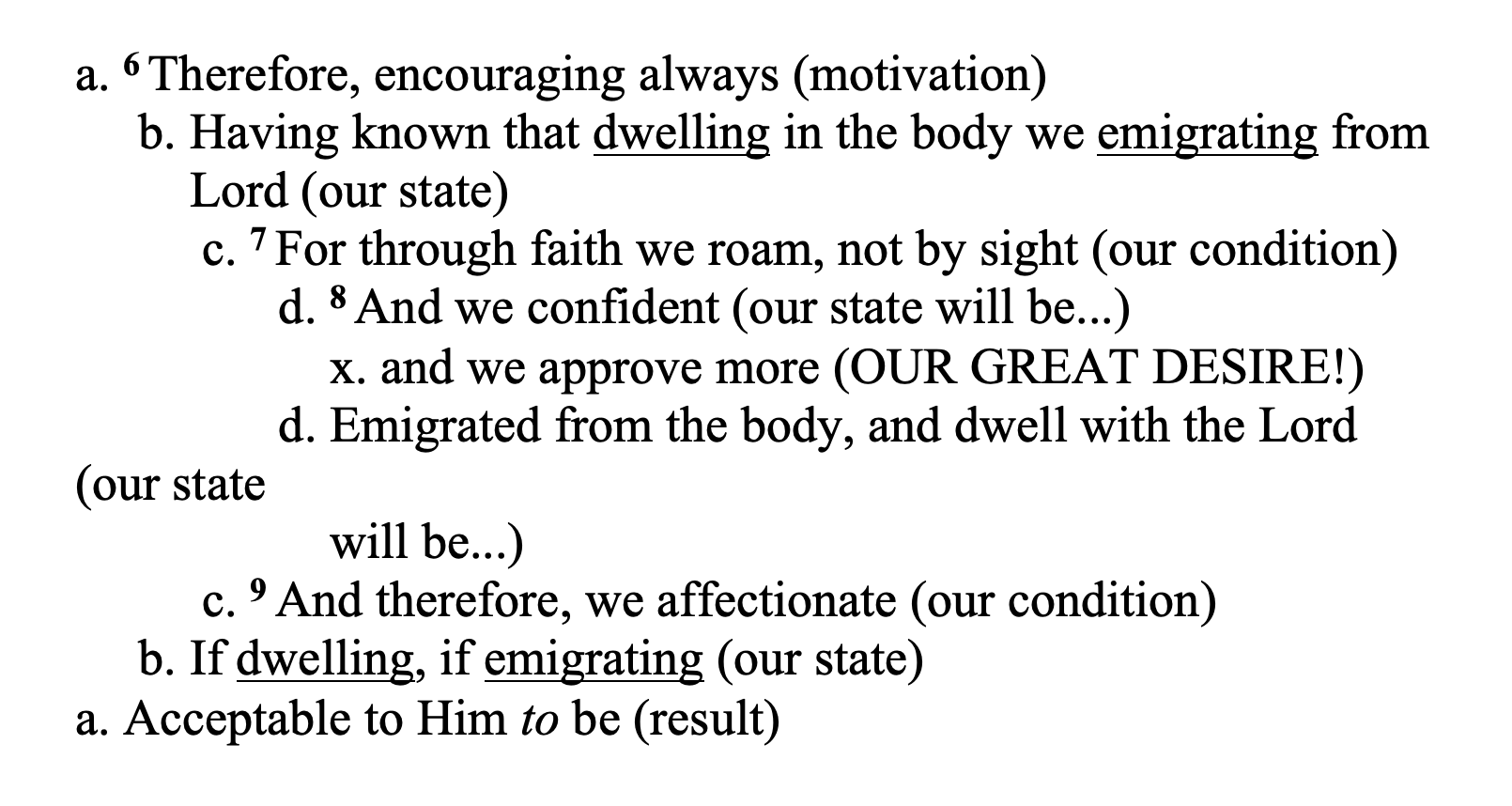
If we are naked at death but supposedly go to heaven, then we would be bodyless souls in heaven, something the Bible never teaches. But more, one of the problems with understanding this passage properly is the faulty nature of most translations. They obscure what Paul is saying by mistranslating the participles. For example, a literal translation of verses 6-9 says –

“Therefore, encouraging always, and having known that dwelling in the body we emigrating from Lord. 7 For through faith we roam [peripateó: tread around], not by sight. 8 And we are confident, and we approve more, emigrated from the body, and dwell with the Lord. 9 And therefore, we affectionate – if dwelling, if emigrating – acceptable to Him to be (CG).

Paul’s words in verse 9 about being absent are based on what he said in verse 6, not verse 8. It is the same word in both as well as verse 8, but the use of the present participle in verse 6 and again in verse 9 shows us this with certainty.

And, as noted above, Paul could not say this if we immediately went to heaven (emigrated) because we would be in a body in a state of incorruption if we were with Jesus in heaven. As such, we would be pleasing. It wouldn’t be our desire (affectionating) but our reality.

The only time we can desire (affectionate) to please the Lord is when we are alive. When we die (emigrate), regardless where we actually go, our eternal state is sealed. Notice the chiastic structure that is found throughout Paul’s writings, and which is also seen here –

Again, and further, Paul does not equate being absent from the body to being present with the Lord. He says that being absent from the body, meaning our current state of corruption, is less desirable than to be present with the Lord. That is why he spoke in verse 4 about groaning and being burdened.

It is also why he goes on to speak of the judgment seat of Christ in verses 10 & 11. The two thoughts complement each other. It is as if he is shouting out, “Anything but being here bearing this burden of life! When I mess up, judgment for my faults lies ahead.”

Unfortunately, bad translations often equate to bad theology. In this instance, Paul’s use of the word kai, and, signifies two things, not one. It is approved more to be absent from the body, and it is approved more to be present with the Lord. This doesn’t mean they occur together. That was seen in the analysis above, and it will be explained further as we continue.

The point that Paul is making is that even when we die, we are in Christ. Paul addresses this in several ways in at least two letters. It is the main point of his words in 1 Thessalonians 4 –

“But I do not want you to be ignorant, brethren, concerning those who have fallen  asleep, lest you sorrow as others who have no hope. 14 For if we believe that Jesus died and rose again, even so God will bring with Him those who sleep in Jesus.

15 For this we say to you by the word of the Lord, that we who are alive and remain until the coming of the Lord will by no means precede those who are asleep. 16 For the Lord Himself will descend from heaven with a shout, with the voice of an archangel, and with the trumpet of God. And the dead in Christ will rise first. 17 Then we who are alive and remain shall be caught up together with them in the clouds to meet the Lord in the air. And thus we shall always be with the Lord. 18 Therefore comfort one another with these words.” 1 Thessalonians 4:13-18

It is understood from Paul’s words that the people of Thessalonica were under the impression that those who had died might not be a part of what the Lord promised. But he tells them otherwise.

In these words, as in 1 Corinthians 15, which will be evaluated momentarily, Paul exactingly explains that there are two categories of people in regard to what he is referring to: they are asleep (meaning dead and in Sheol/Hades) or they are still alive.

That’s it. Those are the only two options Paul speaks of. The logic of Paul’s words from earlier is, “Better to be asleep in Hades than to be here in this sin-sack.”

But wait. Let’s stop and address an issue that always comes up concerning such an analysis about death. There is the inane accusation floating around that teaching soul sleep is heresy.

First, Paul says that the dead in Christ are… anyone? Yes, asleep. In fact, he says it many times. Jesus said the same thing about Lazarus in John 11, and Luke recorded it concerning both David of Old Testament times and Stephen, the first martyr recorded in New Testament times.

The implication is that nothing has changed between the dispensations. The same content state that Samuel felt before he was disturbed by Saul is what each departed believer to this day experiences.

Second, he notes (as indicated above) that the soul without a body is the state of a person when he dies. If the soul without a body is his state, and if the state of the person is asleep, then the person’s soul is… asleep. One plus one always equals two in proper theology.

This doesn’t mean the person is not aware. The interaction between Samuel and Saul shows us this. He was aware and he was resting comfortably, something that can be inferred from his words. He was in Sheol, the same place where believers today go, meaning Hades (as explained already).

Third, whoever started the “teaching soul sleep is a heresy” doesn’t know what a heresy is. If it is incorrect, it would simply be bad doctrine, not a heresy. Further, such a person doesn’t know the Bible very well. Saying that is merely a tactic to scare people into a false belief about going to heaven as soon as you die, which the Bible doesn’t teach.

Fourth, to claim that those who died have been resurrected to heaven means that the resurrection… has happened. If that were true, there wouldn’t be any believers left to talk about it. It is exactly what Paul calls “straying from the truth” in his letter to Timothy –

“And their message will spread like cancer. Hymenaeus and Philetus are of this sort, 18 who have strayed concerning the truth, saying that the resurrection is already past; and they overthrow the faith of some. 19 Nevertheless the solid foundation of God stands, having this seal: ‘The Lord knows those who are His,’ and, ‘Let everyone who names the name of Christ depart from iniquity.’” 2 Timothy 2:17-19

In all instances where the resurrection is spoken of, it is either explicit or implied that this involves both the living and the dead in the church.

That is seen, for example, in Paul’s next words in 1 Corinthians 15. They are perfectly in line with what we have seen so far, meaning that there are only two categories of people at this time, they are 1) asleep (meaning dead and in Sheol/Hades), or 2) still alive. He says –

“But now Christ is risen from the dead, and has become the firstfruits of those who have fallen asleep [meaning those who have died in the church since Christ’s completed work]. 21 For since by man came death, by Man also came the resurrection of the dead. 22 For as in Adam all die [Greek: present tense], even so in Christ all shall be made alive [Greek: future tense]. 23 But each one in his own order: Christ the firstfruits, afterward those who are Christ’s at His coming.” 1 Corinthians 15:20-23

People who are dead in Christ “have fallen asleep.” That will remain unchanged until “His coming.” Has Christ come yet? Again, one plus one will always equal two in proper theology. Further explaining this, he says –

“Now this I say, brethren, that flesh and blood cannot inherit the kingdom of God; nor does corruption inherit incorruption. 51 Behold, I tell you a mystery: We shall not all sleep, but we shall all be changed [Greek: future tense]— 52 in a moment, in the twinkling of an eye, at the last trumpet. For the trumpet will sound, and the dead will be raised incorruptible, and we shall be changed.” 1 Corinthians 15:50-52

Paul continues to explain that those who have died are… are… anyone? Yes! Asleep! They will remain in that state until the time of the rapture, not before. He further confirms this as he continues, saying…

“So when this corruptible has put on incorruption, and this mortal has put on immortality, then shall be brought to pass the saying that is written: ‘Death is swallowed up in victory.’
55 ‘O Death, where is your sting?
O Hades, where is your victory?’” 1 Corinthians 15:54, 55

Paul could not say this if the people who died were not still in Hades. It would be a perfectly pointless pronouncement. If people who died were immediately taken to heaven, then the victory over Hades would have come before our state of incorruption, meaning while we are still corrupt.

But he just tied our state of becoming incorrupt to the event we call the rapture. Again –

“Now this I say, brethren, that flesh and blood cannot inherit the kingdom of God; nor does corruption inherit incorruption. 51 Behold, I tell you a mystery: We shall not all sleep, but we shall all be changed— 52 in a moment, in the twinkling of an eye, at the last trumpet. For the trumpet will sound, and the dead will be raised incorruptible, and we shall be changed.” 1 Corinthians 15:50-52

The meaning of Paul’s words is that all Christians, both alive and dead, are currently in a state of corruption. None have been made incorrupt yet. We still bear the effects of sin even though we are in Christ.

Until the rapture, which includes both the living and the dead in Christ, that will not change. Until then, Paul says, clearly and without any ambiguity, that in our corruption, when we die, we go to Hades, where Christ was. When the rapture occurs, our corruption will be replaced with incorruption. Hades will no longer have dominion over the dead.

While we are in Hades, we will (I’m speaking to believers here) be in Paradise – a really nice place to nap, be it two thousand years or 2 seconds.

The incorrectly translated words “to be absent from the body and to be present with the Lord,” in 2 Corinthians 5 do not mean we go to heaven when we die. If they did, we would have a glaring and insurmountable contradiction in Paul’s letters.

We are the Lord’s. He has full control over us. This is a truth that exists even right now. We are present with the Lord. When we die, that state does not change. This is why Paul said, “Therefore comfort one another with these words” (1 Thessalonians 4:18).

The Thessalonians, and indeed all believers who don’t understand these key points of doctrine, may feel that when the rapture occurs, those who had died are lost. Such is not the case.

Paul could not have even written the words of 1 Thessalonians 4 unless this was the issue at hand and which continues to be a misinterpreted issue to this day.

To review:

1) Paradise, as noted by Jesus in Luke 23, is not heaven. Jesus confirmed this when He said in John 20:17 that He had not ascended to the Father. That was after the resurrection. Paradise cannot be heaven. If Paradise was heaven, then there would be a contradiction in Jesus’ words.

2) Until we are glorified, we cannot enter heaven. Paul says we are corruptible and cannot inherit that which is incorruptible.

Here is the sequence –

“Now this I say, brethren, that flesh and blood cannot inherit the kingdom of God; nor does corruption inherit incorruption. 51 Behold, I tell you a mystery: We shall not all sleep, but we shall all be changed— 52 in a moment, in the twinkling of an eye, at the last trumpet. For the trumpet will sound, and the dead will be raised incorruptible, and we shall be changed. 53 For this corruptible must put on incorruption, and this mortal must put on immortality54 So when this corruptible has put on incorruption, and this mortal has put on immortality, then shall be brought to pass the saying that is written: “Death is swallowed up in victory.” 1 Corinthians 15:50-54

Only then…

55 “O Death, where is your sting?
O Hades, where is your victory?” 1 Corinthians 15:55

3) The rapture deals with both the dead and the living as noted in 1 Thessalonians 4.

4) 2 Corinthians 5:6 does not mean that when we die, we will be physically present with the Lord in heaven. Despite misanalyses, usually based on faulty translations, that verse does not mean that there is an immediate transfer at death from this realm to heaven. That only occurs for living believers at the rapture.

———————————-

Scripture reveals to us that those who have died have not gone to heaven. However, we are assured in 1 Thessalonians 4 that they are safely in the hands of the Lord. However, they are not yet – according to the clear and unambiguous timeline in 1 Corinthians 15 – glorified and in heaven.

That day lies ahead for them and for us. But God set it forth in this manner for His purposes. At some point, known to God alone, He will call forth His people from the grave and bring them, along with all of His living believers, to Himself.

The words are recorded, the event will come to pass, and we should not in any way worry that it might not happen just as He says. We are to be people of faith, living in faith until that day. This includes faith that God has securely kept those who have gone before us through the sad event of death and that they will be raised when we are translated.

God has assured us that it is so. Let us have faith in His promises. May it be so, to the glory of God who created us and redeemed us according to His tender mercies.

Closing Verse: “…that I may know Him and the power of His resurrection, and the fellowship of His sufferings, being conformed to His death, 11 if, by any means, I may attain to the resurrection from the dead.” Philippians 3:10, 11

A Few Additional Passages: After giving this sermon, two questions were asked concerning other verses that may point to a different conclusion. The first being–

“Then, behold, the veil of the temple was torn in two from top to bottom; and the earth quaked, and the rocks were split, 52 and the graves were opened; and many bodies of the saints who had fallen asleep were raised; 53 and coming out of the graves after His resurrection, they went into the holy city and appeared to many.” -Matthew 27:51-53

There is nothing beyond these verses to explain who these people were, how long they were dead, or what happened to them afterwards. Therefore, there really is nothing else to add to them but speculation. However, it doesn’t say they went to heaven. It says they were raised, went into the holy city, and appeared to many.

As there is Lazarus as a precedent from John 11, the most likely explanation is that these were people who had believed Jesus was the Messiah and who had died recently. As it says that they went into the holy city, they could have come from all over Israel.

It is estimated that there were 500,000 to 600,000 people in Israel at Jesus’ time. If the death rate was 4500 people per year, then 375 per month would die. If 5 percent of them believed Jesus was the Messiah and He raised them to substantiate this, that would be about 18 people. If 18 people were raised and came to Jerusalem, proving they had returned to life, like Lazarus did, it would be sufficient evidence to justify that Jesus truly was the Messiah.

After this, they could have lived out normal lives, like Lazarus, and died at whatever age the Lord determined.

The second set of verses which seem to point to going straight to heaven are from Psalm 68:18, and which is substantially repeated in Ephesians 4:8–

Therefore He says:
“When He ascended on high,
He led captivity captive,
And gave gifts to men.”

The verse begins with “Therefore.” This is stated to explain the previous words, “But to each one of us grace was given according to the measure of Christ’s gift.” In order to show this, Paul cites the substance of Psalm 68:18. He changes several words, and he goes from the 2nd person to the 3rd person. Thus, it is not a direct quote, but rather it conveys the substance of what was said and then he equates it to the triumph of the work of Christ –

“You have ascended on high,
You have led captivity captive;
You have received gifts among men,
Even from the rebellious,
That the Lord God might dwell there.” Psalm 68:18

In the Old Testament, the Ark of the Covenant was the place where God met with man. Its placement in Zion was the sign of victory of God over His enemies. They were defeated, the land had been subdued, and God rested in His place. The thought of ascending on high is that of being exalted above all the others who have been placed in subjection to Him.

Though Zion was not the highest peak in elevation, it was considered the highest place of honor. Thus, any time that someone traveled to Jerusalem, regardless of direction or elevation from which they came, they were said to “go up” to Jerusalem.

As the Lord who dwelt between the cherubim of the ark had been brought to this place of exaltation, and as it was a sign that His enemies had been vanquished, it says, “You have led captivity captive.” This signifies that those who were once the captors (called the abstract “captivity”) had themselves been made captive. They were now the subdued prisoners who were conducted in bonds during the triumphal procession to that spot of exultation.

Quite often this verse is cited as a display of the prisoners being released from captivity by the work of Christ. Though this is something He did, it is not what is being referred to here. Rather, it is the foes of God being brought into captivity. After this defeating of His enemies, it then says, “You have received gifts among men.”

Ascribing this thought to the work of Christ, Paul modifies it and says, “And gave gifts to men.” This is the specific explanation of the previous verse which said, “…but to each one of us grace was given according to the measure of Christ’s gift.” The spoils of war were handed out to the subjects of the kingdom according to the pleasure of the vanquishing ruler. Likewise, God passes out His gifts of victory according to His choosing as well.

Paul’s words, though modifying the psalm, do not change the intent. The two thoughts side by side say:

  • And gave gifts to men (Paul)
  • You have received gifts among men (Psalm)

The same idea is expressed. Christ received gifts which He then immediately turned around and handed out to His subjects. This follows from other times in Scripture where the same thought is denoted by a sudden and succinct expression. Scripture may say something like, “Bring me a heifer,” which is simply a shortened form of “Bring a heifer to me for sacrifice.”

The analogy Paul is making is that Christ was victorious in His work. He was exalted to the highest position, there at the right hand of God, and from that position He gives the Holy Spirit to His subjects in the measure He so chooses. These two verses refer to just the opposite of what most people think.

This idea actually goes back to Deuteronomy 21:10. That was explained when I went through the Deuteronomy sermons –

10 (con’t) and you take them captive,

Again, it is third person, masculine, singular: v’shavita shivyo – “and you take captive his captivity.” It is a poetic way of saying that the entity which had its own victories and held its own captives has now become captive. David, probably thinking of this verse right now, penned this in Psalm 68 –

“You have ascended on high,
You have led captivity captive;
You have received gifts among men,
Even from the rebellious,
That the Lord God might dwell there.” Psalm 68:18

Paul then cites this verse from the psalms in Ephesians 4 –

“Therefore He says:
‘When He ascended on high,
He led captivity captive,
And gave gifts to men’” Ephesians 4:8

Those who were once the captors (called the abstract “captivity”) had themselves been made captive. They were now the subdued prisoners who were conducted in bonds during the triumphal procession to the victor’s spot of exultation.

Quite often the words in Ephesians are incorrectly cited as a display of the prisoners being released from captivity by the work of Christ. Though this is something He did, it is not what is being referred to there. Rather, as can be seen from Moses’ words of Deuteronomy, it is the foes of God being brought into captivity.


The Word of God – A Petition for Reason

The Word of God – A Petition for Reason

“The law of the Lord is perfect, converting the soul;
The testimony of the Lord is sure, making wise the simple;
The statutes of the Lord are right, rejoicing the heart;
The commandment of the Lord is pure, enlightening the eyes;
The fear of the Lord is clean, enduring forever;
The judgments of the Lord are true and righteous altogether.
10 More to be desired are they than gold,
Yea, than much fine gold;
Sweeter also than honey and the honeycomb.
11 Moreover by them Your servant is warned,
And in keeping them there is great reward.” Psalm 19:7-11

During this sermon, I am going to reference myself about 8 million times, taking you through some of my personal experiences since coming to Christ. This is not to blow my own horn, but it is to provide you with a basis for understanding why I am constantly telling you to read your Bible.

The one way that I can, hopefully, drum this into you, is to tell you about my own experiences. In seeing them, I hope you will see why you also need to follow suit.

The night before typing this sermon, I was getting over a cold and quit work early, just after I got all the necessary Sunday stuff done. “The rest can wait while I get some rest.” As Hideko wasn’t home, and as I was too hungry to go to bed without eating, I turned on a war movie that I was still finishing from days before.

The guys were in combat and right in the middle of the fighting, they took a break to read their letters from home. Those letters were handwritten, took some time to arrive in Vietnam, and then more time to get out to the men in the field.

The next day, when I typed this sermon, I went as usual to the mall and 7-11 to do my morning jobs there before coming home and finishing this sermon. As I came home, an Amazon truck pulled in front of me, rushing down the road with some hugely important package that had to be there… right now.

We have gone from patiently waiting for things to come about, to wanting everything – right now. And more, we want bigger, better, flashier, and something that will delight our senses and tickle our ears. The love letters from home no longer fill our minds with delight.

We can talk to someone on the other side of the world, face to face, for free, and any time we wish. We hurry through our conversations and cut off the other person over a knock on the door, or the start of a football game.

We started this series with a sermon entitled, “The Word of God – The Basis of Our Faith.” Since then, we’ve mildly touched on only a few relevant points of doctrine. This was never intended to be a series on anything more than the most important of tenets which will at least give us a sound basis for not getting pulled into some teaching which is completely crazy. But that can still happen. I assure you of this.

To teach forever on doctrines which may be important to anyone of us would mean that we would never again actually get into the Bible itself. And if that was the case, each and every one of us would be all the less sound in our relationship with the Lord. Doctrine is not a means to an end. It is simply a part of what the Lord expects of us in our walk with Him.

And so, if you want to continue learning sound doctrine, there is a cure for your hunger. That is to attend our Thursday evening Bible studies. Yes, I know… Oh no! Each week, you will get exactly that – directly from the Bible, but also as a compilation of doctrinal concepts which fit in with the verses that are being analyzed.

However, what I teach you there is still based on who I am as a person, what I have learned through reading, studying, being trained by others, and so on. Or, maybe I simply plagiarized someone else – meaning I just took what sounded good and went with it because that was the easiest route to my path of wealth and stardom.

When I met the Lord – I mean when I really realized who I was in relation to Him and my need to devote my life to Him – I had a lot of other responsibilities in my life. Of course, I had Hideko as a wife, and you must know how time-consuming that is… well, at least for her.

Tangerine and Thorr lived in the house and children are known to take up some of our time. I had a business just down the road – Asian Trade. I also had several part-time jobs. In total, I worked seven days a week, from before sunrise until up to, or after, sunset.

But I also had something that most people don’t have. I had ten hours a day of free time. How is that possible? It is because I had Asian Trade. A retail business, especially one that deals with things that people don’t need, but who are just looking to fill their lives with something interesting, is a business that may have one customer a day, or maybe ten, each there for just a few minutes.

The rest of the time is spent all alone and it needs to be filled with something. With ten hours a day, and with nothing else to do, when the Jehovah’s Witnesses came and asked if I wanted to talk, I was like, “Thank God – relief from the boredom!”

And so, we talked. At one point, I asked a question, and one of the two said, “Oh that’s right here.” He opened up the Bible, showed me a verse that was pertinent to a particular part of my life that was not right with the Lord, and I froze. One verse had changed my life.

From that day on, I started to read the Bible – ten hours a day. Actually more, because when I got home, I started to read it again on the couch. If you have an audio Bible, you know that it takes about 70 hours to get through it. That is read aloud, and it is read slowly. One can read the Bible in much less time than an audio Bible.

Each week, I would read the Bible through. As soon as I got to the word “Amen” at Revelation 22:21, I would turn back to Genesis 1:1 and start again. For the first couple of months of this, I also started going to the JWs Kingdom Hall on Sunday morning. I had never seen anyone actually open the Bible to teach, and so I thought they must really know what they were talking about.

After just a short time, it was perfectly evident that what they were teaching had nothing to do with what the Bible says. If it was two months going there, I had already read the Bible at least eight times. If it was three, make it twelve or more. And so, through the Lord’s tender mercies of giving me a slow retail business to run, we parted company.

Text Verse: “And He Himself gave some to be apostles, some prophets, some evangelists, and some pastors and teachers, 12 for the equipping of the saints for the work of ministry, for the edifying of the body of Christ, 13 till we all come to the unity of the faith and of the knowledge of the Son of God, to a perfect man, to the measure of the stature of the fullness of Christ; 14 that we should no longer be children, tossed to and fro and carried about with every wind of doctrine, by the trickery of men, in the cunning craftiness of deceitful plotting, 15 but, speaking the truth in love, may grow up in all things into Him who is the head—Christ— 16 from whom the whole body, joined and knit together by what every joint supplies, according to the effective working by which every part does its share, causes growth of the body for the edifying of itself in love.” Ephesians 4:11-16

Paul warned us about being tossed to and fro and being carried about by every wind of doctrine. And as he says, that is “by the trickery of men, in the cunning craftiness of deceitful plotting.” My question to you is, “How do you know?” It is the main subject of our final sermon of this series.

After my short stint with the JWs, I continued to read the Bible each week or so. But I started changing things up. I would count time intervals – how many years it was from this to this. Or how many days old a person was when something happened in his life, and so on. One time through, I counted how many times the word “Jerusalem” was mentioned in the Bible and made a note of all of the different names that God used when speaking of Jerusalem – there are a lot.

I also changed the order of reading. I would read one OT book and then one NT book. By the time I had read the Old once, I was also finishing the New for a second time.

Then I started reading books 1, 23, and 45; 2; 24, and 46, and etc. Thus, you would end at 22, 44, and 66. The patterns that run through that type of reading are literally astonishing, but that is for another day.  Every time that I read through the Bible, I would think of something interesting to do or to search out so that there was some type of a challenge for me.

Eventually, I took a self-learn course in both Hebrew and Greek, and then bought an interlinear Hebrew and Greek Bible and read both testaments, out loud, in Hebrew and Greek. I had no idea what it said, but it was a start.

As I went through them, I also looked for translational and numerical errors in their text. By the time I was done – after going through only one time and without knowing Hebrew or Greek at even a basic level, I had almost nine single-spaced pages of errors which I submitted to the publishers for correction.

An example of a very basic error is that they translated the divine name Yehovah as “Jacob.” I would say that is a bit problematic for someone who thinks they are reading an accurate translation. If you want to see the errors – the four-part Bible is on the shelf in the back here at the church. Just flip through and look for highlighted or annotated errors.

Why is this important? Because people are reading that document, as pitifully translated as it is, and they think they are getting the straight scoop. They have put their trust in something which even a dolt like me, on my first read through it, could find innumerable errors.

And that was recommended to me by the well-known TV Show “Prophecy in the News.” It came with his highest stamp of approval, and it turned out to be a marginal translation at best. After that, I realized that if he is endorsing something so bad, I could find something other to do with my time than watch his TV show.

Ok, that is a portion of my original time in the word. I continued this pace for two full years until I finally closed Asian Trade and went back into the wastewater business. This wasn’t bad, because on the night shift, other than one’s regular duties, you either watched TV, read a book, or went outside out and threw paper airplanes. Again, I spent any free time reading the Bible.

So, I’ll let you do the math. I never counted the number of times that I have read it, and that isn’t what was important. What was, is that despite having read the Bible many, many times, I still had absolutely no theology at all.

One can read a manual on chemicals and understand what is being said, and yet not know how to properly work with those chemicals because there are other things that are involved doing so. One form of knowledge does not necessarily equate to ability in all areas of that discipline.

I knew all about Jesus, why He came, and what the Bible was telling me, but I had no way of expressing it. I had never told anyone about Him in a specific way and probably could not have done so. But one day, a pastor asked Hideko if he could tell her about Jesus. He did, and in three minutes, he had explained something that I could not have properly done after three years of reading the Bible.

Once I realized this, my next step was to make a sign, “Bible Questions Answered – Don’t Be Shy,” and I would go to the beach, plunk it in the sand, and wait for people to come. And they came constantly. If you want to learn how to teach, or if you want to learn how to unpackage the knowledge you possess and turn it into theology, then what you need to do is to simply get a sign and let people start asking you questions.

You might make yourself look like a fool for the first week, but very quickly, if you care at all about sticking it out, you will expand in your ability to unpackage that information you possess, and you will be able to convey it to others in a reasonable, intelligent manner.

But there is the same problem with going to that guy on the beach that there is with going to church on Sunday morning. Without knowing the Bible yourself, you are listening to someone who may or may not have any idea of what he is talking about. That is a real problem. Because the Bible is our means of understanding the Lord and what He expects. And so, let us discuss that beautiful word once again, and may God open our hearts to His word today, and may His glorious name ever be praised.

I. Proper Interpretation

The subject of proper biblical interpretation has been written about and expanded on for millennia. Entire books are dedicated to single sections of individual disciplines, and in-depth courses in Bible colleges and seminaries are focused on these things as well.

Simply defined, the subject of hermeneutics is that of dealing with interpretation of a given literary text. In the case of the Bible, we would say, “biblical hermeneutics.”

Within biblical hermeneutics, there is a vast array of terminology which is used to define various interpretive methods. In order to properly apply biblical hermeneutics, however, we need to first define what is proper concerning the application of those things.

In other words, we might know that the book of Acts is a historical account of what occurred at the beginning of the church. But we may not understand how to properly apply that knowledge in our interpretative method.

And so, even before knowing the type of literature that is presented – be it historical, prophetic, poetic, or whatever, we must know how to draw out from what we are reading what is actually appropriate.

This is the area of study known as exegesis. The prefix ek, means “out,” and thus one is to draw out of the text what is being said. The opposite of this, then, is eisegesis. Instead of drawing out what is intended, someone may read a passage and insert his own completely subjective interpretation into the text. Without any support for the conclusion at all, he will make a statement that what he presents is valid, logical, and appropriate.

This is what democrat scholars do with the constitution of the United States of America. They call it a “living document,” meaning that it changes and grows within itself, and it is thus subject to their own personal interpretations. From that faulty premise, they then eisegete all kinds of ideas which destroy the original intent of those who presented us with this founding document.

The Bible was given to man by God. He did it through men of God at various points within history, in various languages, and in various locations. But even with these variations, there is the one overarching truth that what is presented is ultimately from God. Therefore, the word will be consistent, unchanging in its overall intent, and will steadily and unwaveringly direct the reader concerning its overall truths.

Therefore, and with that in mind, we are to exegete, or draw out, what is being said. But there is then something which is actually even more important to be considered. It is the first, greatest, and most destructive failing of almost all students of the Bible. That failing is to simply know the contents of the Bible – in their entirety.

One of my favorite personal expressions – one that I say all the time and so many of you have heard it many times – is that “Everyone is a specialist in the Bible, but almost no one knows the Bible.” They may dogmatically argue for a particular precept from the Bible, for example a mid-tribulation rapture, and yet they may not have ever read the entire New Testament, or even the books in which the rapture verses are given.

Never mind that the rapture is actually even alluded to in Old Testament typology – a part of the Bible which they probably have never even opened. For anyone to teach any part of the Bible, it is almost unthinkable to me, and unconscionable at best, that he would not have first read through the Bible – from cover to cover many, many times.

And yet, there are pastors and ministers that I know personally who have admitted to me that they have never read the Old Testament, or that they have gone through the Bible once. One was an ordained minister of 34 years, and he had read it once. What this means is that everything such people are teaching is based on an uncertain footing, and it has been derived solely from someone else’s possibly already faulty hermeneutic.

But the problem is that if they have not read their Bible – which is a vast and complicated book – many, many times, then they cannot truthfully say that what they have been taught actually matches with what God – who is consistently revealing Himself through this word – is actually saying.

An example of this is the heresy known as hyperdispensationalism. This teaching incorrectly divides the overall gospel message of Jesus Christ into two gospels – one for the Jew and one for the Gentile. This occurs based on a faulty hermeneutic, and an eisegesis of many verses and concepts, particularly those which refer to the Old Testament, and especially the Mosaic Covenant.

And so, I ask you now, before we continue on, have you read the entire Bible – cover to cover? If not, you are unqualified to teach on any subject of the Bible. Because the Bible is inspired by God, and because its message is a unified whole, how can you know that what you are teaching is not somehow aberrant when taken in the entire context of Scripture, of which you have not even read?

Secondly, how many times have you read through the Bible? Some have better memories than others, but remembering something is not the same as properly aligning that memory with all of the other points contained within the whole.

Only in repeatedly returning to the Bible, reading it while considering everything else that is contained within it – something which can only occur through repeated readings – and then properly aligning those considerations into a rounded systematic theology, can you properly explain why you have chosen one interpretation of a verse or concept rather than another.

There is a savant who has memorized every book he has ever read. He read the KJV of the Bible once, and you can ask him, “What is the name of the person on page 247” of the copy he read, and he will tell you that – or anything else that is in that book. And yet, despite knowing every word of that Bible, he has no theology at all.

Thirdly, how long has it been since you last read the Bible? How many here today remember what they had for lunch yesterday? How about lunch last Tuesday? That food was something you probably personally selected based on its size and content, numminess, cost, and etc. Or, maybe it was prepared by the loving hands of someone important to you. And yet, you don’t remember what it was.

The Bible says that God’s word is sweet to our taste, more so than honey (that is the numminess). It says that it nourishes us (that would be the size and content). It says that it is better to us than thousands of coins of gold and silver (that is its cost). And along with those things, it was prepared, in love, by the hands of the Creator of the universe. And yet, like our lunch from last Tuesday, our memory will fade concerning its contents if we do not open it daily and eat of its delight. This not an “if.” It will happen.

Fourthly, have you limited yourself to one translation of the Bible? If so, you have limited yourself to man’s fallible and short-sighted ability to translate what God has given us. As I type commentaries and sermons from the word, I make a special point of documenting each valid translational error in the King James Version.

So far, and having completed only a small portion of the books of the Bible, I am up to thousands of actual, verifiable, and often damaging errors in it. If you want a copy of that resource, email me and I’ll send it to you.

But people have been so conditioned by a false teaching that – as Paul calls it – “the trickery of men, in the cunning craftiness of deceitful plotting” – that they simply accept that the King James Version is the only acceptable Bible version on planet earth.

But, like not reading the Bible and yet being a specialist in all things theology, many have never checked these translational things out. Despite this, they are adamant that what they have been told about the infallibility of the King James Version is not to be questioned. How can they know if they haven’t even checked it out?

I will give several reasons for both sides of this issue before we finish today. For now, I will give you arguments against the lie. One is that there is great money to be made by those who perpetuate this lie. The KJV is in the Public Domain. Anyone can make a printing of it without any costs apart from the printing itself.

Making a Bible translation is a huge undertaking. It is expensive, time-consuming, and tedious. But printing Bibles can be a very profitable business. And so, translations are copyrighted. But what if you can convince people that the Bible you are printing for free is God’s only inspired word? These people make – literally – millions of dollars.

Secondly, like any cult, if you claim that you have the only “something” that comes from God, you now have total sway over those you are leading. If your doctrine is based on the faulty King James Version, and someone in the congregation says, “But wait, that’s not how the NASB translates it!”, then your theology is called into question, and it very well may be wrong. Poor Pastor Imperfect. He has made an error!

And so to tell your congregation that the KJV is inspired by God and no other translation is to be accepted – why, in fact, it is of the devil!, then you now have ease and comfort in your control over those otherwise difficult miscreants.

And thirdly, this type of practice comes down to pure laziness. Theology is hard work and walking around with an unopened and unread KJV is so much easier. The pastor will explain to you what you need to know, and that is sufficient for you. This is one of the largest problems within the church – simple laziness towards the things of God.

Those are but three of the innumerable reasons why people hold onto the inane teaching of KJV-onlyism. I will give the other side of the argument before we finish today. This is a sad mark on those people, and someday they must stand before the Lord and give an account for their beliefs, as we all will.

Next, it is of the highest value to believers that they read the Bible from cover to cover, that they read it constantly, and that they ask questions of it, and then mentally tie the various parts of it together into a unified whole. If you are not doing this, then you have absolutely no basis – at all – for accepting the doctrine of one person over another.

The teachings of RC Sproul, Charles Spurgeon, John Wesley, John Calvin, the Jehovah’s Witnesses, the Mormons, John Hagee, Andy Woods, and Charlie Garrett – and any and all others – are actually on an exact same level with you. Your acceptance or dismissal of their teachings is subjective and without any real foundation. This is a thought that Solomon deals with in the proverbs –

“The first one to plead his cause seems right,
Until his neighbor comes and examines him.” Proverbs 18:17

Each of these people or groups has a theology which sounded good to those who listened, and yet the divergence in doctrine between them is often as great as the difference between oxygen and lead. Someone gives his case, and it sounds good. But then you hear another argument and you say, “Yes, that sounds better.” But without knowing the word, they could both be completely wrong, and you would never know it.

There are people that spend their entire lives pursuing constitutional law. They argue over it, they debate it before courts, they present their cases to representatives and senators, and they fight against those who twist the true intent and meaning of what the constitution is saying. As important as that is for each of us in the United States, it is actually of very little weight, value, and meaning in the greater scheme of things.

As you sit here, or in any other church, unless you have read your Bible, and unless you continue to read your Bible, how can you be sure of anything – literally anything – that you are told concerning this marvelous gift of God?

The Word of God – holy, pure, and perfect too
It is given to satisfy man’s weary soul
In this life we trod, let us take an eternal view
And allow the word to convert us to God’s heavenly roll 

There, in the Book of Life our names will be
Because we pursued His word and found Jesus
Innumerable redeemed, there by the glassy sea
Such a marvelous thing God has done for us

If we will just open the Bible, our own Book of Life
And accept what it says as holy and true
Then between us and God will end the strife
The word is given; to us life begins anew 

Thank You, O God, for this marvelous word
In accepting its truths our place in heaven is forever assured

II. Errors in Thinking

My hope, my desire, and my yearning for each of you is that you get to know this word. This doctrine series is fine, but it is simply an attempt to have you reason out what you should already know. This is why we have been going through the Bible, verse by verse, on Sunday morning and on Thursday evening.

Doctrine sermons are only as good as how they actually align with what the Bible says. In Acts, Paul said to those at Ephesus, “For I have not shunned to declare to you the whole counsel of God” (Acts 20:27). One cannot declare the whole counsel of God unless he teaches the whole word of God.

But in teaching – be it in the word of God, in constitutional law, in thermodynamics or astrophysics, or in some type of scientific, religious, or philosophic discipline – we as humans make logical errors in our thinking. These are known as fallacies.

Fallacies can be things we can do in our own heads without ever expressing them, we can type them up in an article for a newspaper or magazine (liberals are especially good at this type of thing), or we can pass them on to others in our speech. These things usually come about because we do not think critically.

A great way to think critically is to take a course on…. Yes! Critical Thinking. What is a category mistake? Well, if you don’t know, then you might not see why Calvinism is wrong on so many points. What is a fallacy of illicit major? What if I said to you, “All cats are mammals. No dogs are cats. Therefore, no dogs are mammals.”

You know that is incorrect, but you cannot reasonably explain where the error is. What is a red herring? What is an argument from popularity? What is a source fallacy? If you don’t know what these things are, then you probably haven’t got a clue as to why you are being led down the primrose path by a speaker, scholar, or commentary.

Not too long ago, I finished a line by line commentary of the book of 1 Peter. In verse 5:13 Peter says, “She who is in Babylon, elect together with you, greets you; and so does Mark my son.” People argue over what Peter means by “Babylon.” Is he speaking of the real Babylon, is he metaphorically speaking of Rome? Or is it something else.

Regardless as to the answer, one commentator that I read – one of my favorite commentators – cited the work of a guy named Professor Salmond, stating, “Professor Salmond, in his admirable commentary on this epistle, has so forcibly summed up the testimony that we cannot do better than to give his comment entire:” (Vincent’s Word Studies).

In his quote, Professor Salmond makes several illogical arguments, he makes at least two fallacies – an argument from popularity and an argument from silence, and then he makes his faulty conclusion based on those things.

My goal next is to give you just a few fallacies that run through our heads so that you will not make these errors in the future. The first is so obvious that it is hard to know how we fall for it, and yet we do. It has become such a large problem within the church in recent years that it has stolen away countless thousands from the simple gospel of grace, or from simple proper doctrine.

It is the source, or genetic, fallacy that because someone is Jewish, he is authoritative to speak on a particular issue. This has grown so much in recent years because Israel is back her land, Hebrew is revived as a language, and the Jewish people are coming to Christ in large numbers.

Because of this, people make the immediate assumption that this particular person, or that guy over there, is a specialist simply because he speaks Hebrew and/or was raised in Israel. Others go even further and quote rabbis and rabbinic commentaries as if they were authoritative.

Such people have rejected Christ, and still reject Christ, and yet they are sought out because of who they are. Because of this, there are so many aberrant teachings on things like the Feasts of the Lord, or the Sabbath day, that it is almost impossible to find anyone who can give a proper biblical answer on those things.

And because people haven’t taken the time to simply read their Bible, they just… go with it. “That sounds good to me. I’ll go with it.” And this is not limited to Jews, but to Arab Christians, or even – believe it or not – Muslims who have converted to Christianity. Because of the source, they are held in an esteem which is both improper and dangerous.

Paul says in Galatians 2, “But from those who seemed to be something—whatever they were, it makes no difference to me; God shows personal favoritism to no man—for those who seemed to be something added nothing to me” (v.6).

The Galatians had gotten into an idol-fest because of Jews who came in, showed how holy they were through the teaching of a false gospel message, and had led the church astray. Paul had to deal with them forcefully and in a direct rebuke because of their inability to not think logically – they had fallen for the genetic fallacy.

And more, in both 2 Corinthians 11 and Philippians 3, and elsewhere, Paul gives a list of his own supposed qualifications – much greater than anyone else’s – and yet he calls them as loss and as rubbish. They are not the basis of who he was as an apostle, and nor should they be the basis for what we think concerning others.

A second, similar, fallacy is trusting in someone because he knows a source language – for example Hebrew or Greek. Add in that they are Jewish and they speak the language, and you have the perfect recipe for disaster. One of the people that I mentioned in a previous sermon, who teaches that Jesus was created by God, is both Jewish and speaks the biblical languages.

And yet he not only teaches that Jesus was created, but he also teaches that one can lose his salvation, and that the rapture is mid-tribulation, not pre-tribulation. If he can’t get those basic points of doctrine correct, then he shouldn’t be listened to. But… he is Jewish and he speaks Hebrew and Greek. So what!

Every single day as I type my own Bible commentary, and each week as I type a sermon, I read numerous commentaries from some of the finest Hebrew and Greek scholars in Christian history, going back hundreds of years, and yet they will come to completely opposite conclusions concerning very important verses, concepts, and even doctrines.

And so, the only thing that I have to rely on when I come to such divergent opinions is my own understanding of Scripture. If my knowledge of the word is limited, then my analysis of the word will also be faulty. Forget the fact that Pastor Imperfect knows Greek. That means less than nothing if he doesn’t know how to tie his knowledge of Greek in with what the rest of the Bible is saying.

And that fallacy ties in with the next. Forget his race or culture. Forget whether he speaks Hebrew, Greek, or Latin. And also, please ignore the title that is placed before or after his name. That is a fallacy known as an appeal to authority. We look to titles, accredited degrees, or the place where someone was educated, as a mark of authority.

Do you know how many Doctors of Theology teach Calvinism or Wesleyanism? Do you know how many pastors and professors were educated at Yale or Harvard Divinity School? Nowadays, they don’t even teach the Bible for the most part, and if they do, they dismiss it as a book of myths and nonsense.

Accepting someone’s theology because he has a particular degree, or was schooled at a particular school, or has a particular title – such as “Reverend” – is a terrible way to place your trust in someone. Do any of you know what Jesse Jackson’s title is? How about Al Sharpton?

Having said that, it is equally fallacious to dismiss someone because he has a certain degree, title, or place of education. People do that all the time as well, and it is equally as wrong. The only thing that matters in a presentation is if that which is presented is correct.

Another thing we should avoid is to assume that someone is a great preacher or teacher because of either his eloquence or rhetorical skills. How many of you would agree with the statement that Jesus never claimed to be the Messiah? How many of you would agree with the following statement –

“The Jewish people have a relationship to God through the law of God as given through Moses… I believe that every Gentile person can only come to God through the cross of Christ. I believe that every Jewish person who lives in the light of the Torah, which is the word of God, has a relationship with God and will come to redemption.” John Hagee, April 30, 1988, Houston Chronicle

The man who said these things is one of the greatest orators that you might ever hear. He is confident in his presentation, dogmatic in what he barks out, and he is a first-class heretic. He clothes his sermons in Americanism, he presents flowery sermons which are powerful and stir the emotions, and yet, of those I have heard, very few – if any – were biblically accurate. I personally do not remember one.

He says that the Torah is the word of God, but he fails to acknowledge that it is only a part of the word of God, and that it speaks of one over-arching theme – the need to come to Jesus Christ. as He Himself said in John 5 –

“You search the Scriptures, for in them you think you have eternal life; and these are they which testify of Me. 40 But you are not willing to come to Me that you may have life.” John 5:39, 40

Another preacher, who gave some of the finest sermons I have ever heard, and which were delivered with precision and conviction, admitted one night that he had never read the Old Testament. So, where did his theology come from? Even if it was correct, and it was, it was only by the grace of God that he was educated in one school rather than another. Because he didn’t get it from Scripture.

What a sad commentary on how we select our leaders, and on how we nearly idolize people without even considering what their standing with the very basis of our faith is. Such fallacies could go on and on. “He leads a 20,000 person church? So what! Is that any more important than a guy in rural Arkansas that leads a 50-person church?

“He’s been to Israel 47 times?” Yes, and Benny Hinn was raised there. So what! “Everybody agrees with Him!” Yes, and everybody could be wrong. It doesn’t matter if 10,000 people teach that Yom Teruah is a picture of the rapture. If it isn’t (and it isn’t!), then it is a false teaching. That is what is known as “The Bandwagon Fallacy.” “Everybody climb aboard! The more on the bandwagon, the truer this will become.” No, it doesn’t work that way.

For now, that is enough fallacies. You get the point. What I would ask of you is to be reasonable in your thinking, dogged in your pursuit of sniffing out the truth, and fervent in your desire to read the word. Read it when you rise. Read it during the day. Play it on the radio as you drive. Think on it, meditate on it, talk about it, and let it fill your heart and your soul as you come in and as you go out. And in the evening, before going to bed, pick it up and read it again.

I know some of you have it with you in bed at night, right under your pillow, but that means of learning is untrue. Biblical osmosis has been scientifically proven to not work. You will have to expand your brain cells through active participation with the word. And when you do, I know that the Lord will be pleased with your efforts. I know He will.

And so now, before we close, I want to read you some highlights from the original preface to the King James Version. This preface is exceedingly long, very hard to read and understand, and at times tedious. One might think that this is why it is no longer published with the King James Version, but that is not correct.

The reason for this is because it dispels every single myth that KJV Only adherents hold to. And if it were known to the general populace, then those who profit so greatly off the word of God, in the manner in which they do, would no longer have that giant source of revenue filling their unholy coffers.

And, people would actually start to obtain sound theology by doing what the King James translators suggested when they put forth their very faulty, but admirable translation. Their words speak of the word of God, the basis of our faith. If people cannot get something as basic as what they say correct, then how susceptible are we as humans to the trickery of men, in the cunning craftiness of deceitful plotting.

There are numerous quotes in this lengthy preface which speak of using reason when handling the word of God. I have selected only a few for you today. The rest are recorded and explained on my website for those who wish to know more.

Nay, we will yet come nearer the quick: doth not their Paris edition differ from the Lovaine, and Hentenius his from them both, and yet all of them allowed by authority? Nay, doth not Sixtus Quintus confess, that certain Catholics (he meaneth certain of his own side) were in such an humor of translating the Scriptures into Latin, that Satan taking occasion by them, though they thought of no such matter, did strive what he could, out of so uncertain and manifold a variety of Translations, so to mingle all things, that nothing might seem to be left certain and firm in them, etc.? [Sixtus 5. praefat. fixa Bibliis.] Nay, further, did not the same Sixtus ordain by an inviolable decree, and that with the counsel and consent of his Cardinals, that the Latin edition of the old and new Testament, which the Council of Trent would have to be authentic, is the same without controversy which he then set forth, being diligently corrected and printed in the Printing-house of Vatican? Thus Sixtus in his Preface before his Bible. And yet Clement the Eighth his immediate successor, published another edition of the Bible, containing in it infinite differences from that of Sixtus, (and many of them weighty and material) and yet this must be authentic by all means.

The finger of the translators of the King James Version not only points back in time to those who accuse translators of various translations of being in bed with Satan, but they point forward to modern King James Only adherents who make exactly the same claim.  

Further, they make it quite clear that those named translations and editions are all authoritative. And more, they go on and name other Bibles, stating they too are also of equal authority, even though they had “infinite differences” between them. Despite all of these variations in numerous translations, they state that each is authentic.

Has God completely lost control of His word? The answer is “No.” He has protected this marvelous gift and has given us the honor and responsibility of searching it out and using reason when we approach it. It may be that translations by man have problems, as the KJV certainly does, but God’s message still goes forth, even through such marginal translations as it.

Therefore as S. Augustine saith, that variety of Translations is profitable for the finding out of the sense of the Scriptures: [S. Aug. 2. de doctr. Christian. cap. 14.] so diversity of signification and sense in the margin, where the text is no so clear, must needs do good, yea, is necessary, as we are persuaded.

The King James Version translation committee agrees that a variety of Translations is profitable for finding out the sense of Scripture. And not only that, but marginal notes for those “no so clear” areas are not only a little ok, but they are “must needs do good” and are necessary.  

They that are wise, had rather have their judgments at liberty in differences of readings, than to be captivated to one, when it may be the other.

According to the translators, the wise should search out varied translations. The opposite then, would show a lack of scholarship by those captivated by one translation. It is exactly why we use at least two versions during our Thursday night Bible study, and I refer to between 20 and 25 versions for each sermon I type. I would also say that sticking to one teacher of the Bible is equally damaging and that multiple teachers, may bring you to a better understanding of the truth.


Add hereunto, that niceness in words was always counted the next step to trifling, and so was to be curious about names too: also that we cannot follow a better pattern for elocution than God himself; therefore he using divers words, in his holy writ, and indifferently for one thing in nature: [see Euseb. li. 12. ex Platon.] we, if we will not be superstitious, may use the same liberty in our English versions out of Hebrew and Greek, for that copy or store that he hath given us.

The translators say God uses diverse words in His holy word to make a point and that we should feel free to do the same through multiple translations in the English (or any) language.

As you can see, from this final sermon in our doctrine series, a sermon which actually contains almost no doctrine in and of itself, there is an immense need to do one thing above all else, and there is another thing which supports that first matter. We are to read and study the word of God, in its fullness, in order to know God and what He expects of us.

And the thing which supports that first matter is that we are to use reason in our pursuit of this word as we do so. If we are willing to do these two things, we will be on a sure footing as we proceed on our happy trek to our even happier home where we will fellowship with our Creator for all eternity.

Don’t squander your time. What you do right now has bearing on what you will be doing for all eternity. This word tells us of our state before God, of what God has done to correct that state, and what that correction means for the human soul.

And throughout the entire word – this precious gift of God – there is one point of highlight that radiates forth from it – the promise and then the coming of Messiah. The whole body of Scripture testifies to the Person and work of Jesus Christ. May we never be found deficient in our pursuit of this word, because in pursuing this word, we will be pursuing the love of God in Christ – to the glory of God the Father.

Closing Verse: “For the word of God is living and powerful, and sharper than any two-edged sword, piercing even to the division of soul and spirit, and of joints and marrow, and is a discerner of the thoughts and intents of the heart.” Hebrews 4:12

Saturday, 25 January 2020

And many will follow their destructive ways, because of whom the way of truth will be blasphemed. 2 Peter 2:2

There is a dispute between manuscripts in this verse. Some say the plural of the same word used in verse 2:1 (destructive). Others use a different word signifying licentiousness. Either way, the intent is that the false teachers will lead those they teach astray, the number being “many.”

This has been true throughout the church age. False teachers leading aberrant sects and cults have taken many down unsound paths of unrighteousness, sexual sin, perversion, bad doctrine, and on and on. This isn’t just limited to those who branch off from the mainstream church, but it is also found in a great way among the church itself. Within large, mainstream denominations, there is an underlying culture of sexual sin and the covering up of it when it catches public attention.

At times, however, what is shameful becomes an open part of the ways of such people, such as Joseph Smith of the Mormons. Today, that has become a reality in many “mainstream” denominations where such destructive and licentious ways are openly acknowledged and applauded. Several branches of the Presbyterians, the Church of Christ, the Episcopal Church, the Methodists, and many more all applaud sexual perversion, abortion, and other unholy lifestyle choices. In fact, it has become a necessary requirement for ordination and selection to a position to that people hold to completely unholy values.

Even the most conservative denominations in the church today are showing signs of cracking and giving way to such avenues. The magnitude of the term “many will follow” probably could not have even been imagined by Peter as he sat and wrote out the words of his epistle. It is because of following such people, and their perverse agendas, that many will be led astray, Peter notes that of them “the way of truth will be blasphemed.”

There are at least two ways that this is true. The first is that people would actually believe that this is what the gospel teaches. It is taking something pure and glorious and turning it into something vile, perverse, and unholy. The second is that people would then accuse the gospel of actually being responsible for what the people did. The first thought leads directly to the next. When it is believed that the gospel is the source of such unholy conduct, then it is the gospel which leads people to following that same path of unholiness.

Considering, for example, that homosexuals are gladly ordained as pastors and priests in such denominations, and then they are eventually elevated to the positions of Bishop, it is no wonder that the outside world sees this conduct, believes that it is something acceptable within Christianity, and turns from any desire to participate in the faith at all. The greatest heathen in society is on a better moral standing than the highest officials within the church. When this is so, woe to those who lead and participate in such halls of unrighteousness.

Life application: Such people are set on their own appetites and how they can manipulate others for their own benefit and glory. Unfortunately, in order to be a false teacher with followers, there must be those who follow.

History is replete with such groups and sects. In the 1800s, there was a huge turning away from the truth and many heretics flourished in the freedom provided by the US Constitution. The Mormons, Jehovah’s Witnesses, and some Adventist groups grew rapidly in numbers. All of this occurred because people followed a charismatic leader rather than paying heed to the Bible – which admonishes us to follow the Lord, to think on the Lord, and to fix our eyes on the Lord.

Cults continue to spring up in our times, but something much less obvious has arisen in the 20th and early 21st century. Heretics have infiltrated mainstream denominations – both in the seminaries and in the pulpits. Bad doctrine abounds and there has been a grand shift from reliance on the word of God to the traditions and teachings of these heretical leaders.

What the Bible clearly forbids is heralded as “tolerant” and they say God is “doing a new thing.” But God is unchanging, and His standards never fluctuate. Sadly, the congregants who sit in these denominations are accountable for their failure to investigate what they are taught, but the majority will fail to do so. As you attend church, please compare what is taught with what the Bible says. If the two contradict each other, the problem rests with the church or the pastor, not with God and His loving intent for you.

What He speaks is for the good of His creatures; the Bible is for our well-being and to dismiss it will only bring sadness. Be filled with the joy of the Lord; read, learn, and love His word – the Holy Bible.+

Heavenly Father, You are a great and loving God. We know that Your word is meant to lead us down paths of righteousness and safety and we divert from it at our own peril. Please continue to give us the desire, time, and ability to study and discern Your word and intent for us. All glory to You. Amen.


Once Saved Always Saved? Or, “Not So!”

“Once Saved Always Saved?” Or, “Not So!”

“But I will hope continually,
And will praise You yet more and more.
15 My mouth shall tell of Your righteousness
And Your salvation all the day,
For I do not know their limits.
16 I will go in the strength of the Lord God;
I will make mention of Your righteousness, of Yours only.” Psalm 71:14-16

Each day begins for me by getting up and typing a commentary on a verse of the Bible. Right now, I am going through 2 Peter for the second time, refining the commentary I wrote many years ago. The day I typed this sermon, after typing the commentary, and before starting here, I went to emails to see if there was anything pressing, or if there was anything simple and which could be responded to in less than a minute or so.

There were a few quick emails to answer. The rest will have to wait. I’m sorry, but brevity is the key to getting a response from me. Type a long email, and you go to the back of the line for a response. What was propitious is that one of the short emails I responded to, and also the closing comments of the Bible commentary I typed, both fit into the content of today’s doctrine sermon. First, the email –

“Have you ever produced a salvation message geared to children? Or do you know of any?”

That was the entire email. May the Lord bless such brevity! My answer to him was –

“Not that I can remember. A reason why it shouldn’t really be necessary is something I mentioned in the sermon we did at the church yesterday. The gospel is the epitome of simplicity – it tells what God did in Christ to restore us as is detailed in 1 Cor 15:3, 4 –

“For I delivered to you first of all that which I also received: that Christ died for our sins according to the Scriptures, and that He was buried, and that He rose again the third day according to the Scriptures.” 1 Corinthians 15:3, 4

That is the gospel message. So, just simply explain what it means – to the youngest child, or to the wisest professor. Christ died for our sins. “Have you ever disobeyed mom, or told a lie?” Any and all must acknowledge, “Yes” if truthful. “Jesus died for that. He was buried, proving He was dead, and He was raised – proving He had no sin. The sin He died for was yours, not His. As only God is without sin, then Jesus is God.”

That simple message is all that is needed. In fact, anything beyond that isn’t the gospel. Then you simply ask, “Do you believe that God did this for you? If “Yes,” then thank God for sending His Son and accept it as the full payment for what you have done wrong.”

That is all that is needed according to Scripture. Upon belief, the person is sealed with God’s Spirit as a guarantee of His salvation (Ephesians 1:13, 14).

And from my commentary on 2 Peter 1:15, in the “Life Application” section of the commentary, I said –

There are still thousands of unique languages without a copy of the Bible. Christian churches spend a great deal of money sending missionaries overseas to evangelize the lost. This is most noteworthy, but without a strong follow-up, only the people who originally hear the word will benefit. Therefore, it is important to not only tell of Jesus, but also to put in place safeguards so that the message will continue to be told. One way of doing this is schooling, raising up elders, and establishing churches. However, without a copy of the Bible, bad doctrine can easily creep in.

Likewise, missionaries from non-conforming sects such as the Mormons and Jehovah’s Witnesses can come in and steal away the truth. To provide copies of the Bible in English is arrogant and presumptuous when it isn’t the native language of the people. Therefore, it has been the practice of faithful Christians throughout the ages to translate the Bible into the language of the natives.

What do these two thoughts – a question about salvation and an impetus to have both trained people and a copy of Scripture available to those who receive the gospel – have to do with one another?

Text Verse: “But also for this very reason, giving all diligence, add to your faith virtue, to virtue knowledge, to knowledge self-control, to self-control perseverance, to perseverance godliness, to godliness brotherly kindness, and to brotherly kindness love. For if these things are yours and abound, you will be neither barren nor unfruitful in the knowledge of our Lord Jesus Christ. For he who lacks these things is shortsighted, even to blindness, and has forgotten that he was cleansed from his old sins.” 2 Peter 1:5-9

If the person who emailed me was wondering about a gospel message for children because he was wanting to evangelize his own child, then he was wanting to ensure that his child would call on Jesus and be saved. My answer, that the simple gospel is the only gospel, is true.

We don’t need an elaborate presentation. We just present what the Bible presents and accept that what God has presented is reliable and effective. But what if this person told his child the gospel, then the child – we’ll say one that is six years old – accepts the message, and then the person dies the next day. Without this Christian influence in the child’s life, that child may go off on many unhealthy paths. He is a human, after all.

And what about the folks in the jungle of Papua New Guinea. A missionary comes into a village, tells the gospel, and the whole village gladly receives the good news of God in Christ. They all believe and are baptized – grateful for the salvation God has granted.

But, a week later, the missionary is eaten by a saltwater crocodile. After a year, a group of Mormons comes in, establishes a church based on Mormon doctrine, and everyone starts attending there. They had no discipleship beyond their conversion, and they had no copy of Scripture left in their native language. They have even, as Peter says, forgotten they were cleansed from their old sins.

What will happen to that child who received Christ by faith? What will happen to that village who gladly came to Christ? The answer you give will show just how much you understand, or fail to understand, several key words which the Bible uses, especially the meaning of the words “gift,” and “grace.” It will also reveal your understanding concerning several key concepts, such as the nature of God and the weight of His decrees.

The issue of whether one can lose his salvation or not is one of the most important issues that can be addressed in Scripture. It calls into question the truth of God in Christ, the surety possessed by any person who has been saved, and also the efficacy of what Jesus did – was it sufficient or not? This is not a minor issue, but it is the heart of the matter in salvation.

It must be addressed, and it must be faithfully answered. And it can be, right from the word of God. And so, let’s turn to that precious word once again, and may God speak to us through His word today, and may His glorious name ever be praised.

I. Scriptural and Logical Reasons for Eternal Salvation

The gospel was stated in our opening comments. It is what Paul said in 1 Corinthians 15:3, 4 – “For I delivered to you first of all that which I also received: that Christ died for our sins according to the Scriptures, and that He was buried, and that He rose again the third day according to the Scriptures.”

Paul tells how to appropriate that in Romans 10:9, 10 – “…if you confess with your mouth the Lord Jesus and believe in your heart that God has raised Him from the dead, you will be saved. 10 For with the heart one believes unto righteousness, and with the mouth confession is made unto salvation.”

That is the gospel and the means of receiving it in order to be saved. Paul also gives these words to show that there is nothing beyond that gospel which man must do, or indeed can do, in order to be saved –

“For by grace you have been saved through faith, and that not of yourselves; it is the gift of God, not of works, lest anyone should boast.” Ephesians 2:8, 9

Grace is unmerited favor. Anything – anything at all – which is added to grace negates grace. A gift is something that cannot be earned. It is something given without any strings attached, and it is something that once given away now belongs – wholly and entirely – to the recipient. A “gift” which is, or can be, recalled, is not a gift.

Paul then tells what the effects of salvation – of this gift – are in Ephesians 1:13, 14 –

“In Him you also trusted, after you heard the word of truth, the gospel of your salvation; in whom also, having believed, you were sealed with the Holy Spirit of promise, 14 who is the guarantee of our inheritance until the redemption of the purchased possession, to the praise of His glory.” Ephesians 1:13, 14

Paul says that upon belief a person is saved. When this happens, he is sealed with the Holy Spirit. The word for “sealed” is sphragizó. It “signifies ownership and the full security carried by the backing (full authority) of the owner. ‘Sealing’ in the ancient world served as a ‘legal signature’ which guaranteed the promise (contents) of what was sealed” (HELPS Word Studies).

This seal then is as sure as a signature of ownership by God. No higher seal than this can be found in heaven or on earth. And no power can reclaim from God what God has sealed. Further, it is something that is given and will never be taken back. If it were to be taken back, then it means that God has made a mistake in His sealing; something impossible. The logical progression of what Paul says is –

1) A person hears the word of truth (the gospel of his salvation).
2) He believes the message.
3) He is sealed with the Holy Spirit of promise.
4) He is now entitled to all of the benefits that the Jews, as an inheritance, also received by that same process of faith – there being one gospel alone for both Jew and Gentile.

Next, the word for “guarantee” is arrabón. It is a rare word, found only three times in the New Testament. It means “properly, an installment; a deposit (‘down-payment’) which guarantees the balance (the full purchase-price) … [It] is the regular term in NT times for ‘earnest-money,’ i.e. advance-payment that guarantees the rest will be given…[it] then represents full security backed by the purchaser who supplies sufficient proof they will fulfill the entire pledge (promise)” (HELPS Word Studies).

Understanding the meaning of this word, it is impossible that there could later be a loss of salvation for a person who has – at any time in his life – believed in Him and been saved. If God seals us with His Holy Spirit as a guarantee, and if we can lose that, then –

1) The gift was not a gift at all. As it can be taken back, the term “gift” is then a lie.
2) It was not a very good guarantee. In fact, it was no guarantee at all. God’s decree has failed.
3) It is, by default, of our effort and not of God that we are saved. (If we can lose our salvation at any time after having it granted, then it was never of grace in the first place. By default, it must be of works.)
4) God made a mistake in sealing us with His “guarantee.” As God cannot make a mistake, because He knows the end from the beginning, a person who believes salvation can be lost is now following a false god.
5) It would diminish the value of Christ’s atoning shed blood which was used for the purchase of the possession. His cross is, by default, unable to procure and secure that for which it was intended.

As noted, the word arrabón is found only three times in the New Testament. The other two times are in 2 Corinthians 1:22 and in 2 Corinthians 5:5. In all three uses, it is referring to the pledge of the Holy Spirit. He is our surety and our guarantee. As this is the sealing of God in us, it represents the highest of all authorities.

It further represents an eternal decree of God. It can never be undone without violating the initial decree. As we learned in a previous doctrine sermon, God’s decrees are unconditional, and they are eternal. Therefore, the believer is one hundred percent secure as he awaits “the redemption of the purchased possession.”

What is being referred to here is, as Charles Ellicott says, “the complete and final salvation from sin and death.” This indicates the result of the action, and not the action itself. In other words, we have already been purchased by and through the work of Christ. This is evidenced by the sealing of the Holy Spirit.

God cannot lie. The salvation of the one who has believed the gospel is secure. And all of this is, as Paul says, “to the praise of His glory.” Vincent’s Word Studies notes that this final clause is to be taken together with the words “you were sealed.” Our sealing is to the praise of God’s glory because it conforms to “God’s purpose as it respects Himself.”

Those who teach one can lose his salvation state the following –

1) What Christ did is ineffectual for the purpose it was intended.
2) God’s gift of salvation, meaning Christ Jesus, must be earned; it is not a gift.
3) Salvation is not of grace, but of works.
4) God’s sealing of the Holy Spirit has no value beyond human ability.
5) God’s guarantee is conditional upon human action, which is fallible, forgetful, and futile.

Further, to teach that one can lose his salvation demonstrates a complete misunderstanding, or a total rejection, of what Christ did in regard to the law and its effects for the people of the world. The Law of Moses was given to Israel, and only to Israel, but it is the standard which God has set for judgment. This is true, because Jesus Christ came under the Law of Moses. Therefore, in man’s judgment – whether Jew or Gentile – the comparison is to Christ, who came under the law. It is His perfection which is the standard by which all will be judged.

Paul shows us in Romans 6:14, 15 that for those in Christ, they are not under law but under grace. He further explains in Romans 10:4 that “Christ is the end of the law for righteousness to everyone who believes.” In other words, for the one who has placed his faith in Christ, He is their righteousness. In Him, the requirements of the law have been met, and the law is dead to them.

Paul says in Romans 3:20 that by law is the knowledge of sin. In Romans 6:23, he then says that the wages of sin is death. Death is the payment for sin, which comes through law. But Paul then says that, “the gift of God is eternal life in Christ Jesus our Lord.”

God’s gift is given, the demands of the law are satisfied in Him, and therefore, the believer is not under law. Without law, there can be no imputation of sin. And this is what Paul says is the case for those in Christ. He says that God is “reconciling the world to Himself, not imputing their trespasses to them, and has committed to us the word of reconciliation” (2 Corinthians 5:19).

This then is the fundamental misunderstanding of those who believe one can lose his salvation. Sin is the problem which leads to death and separation from God. Sin comes through law. Those not under law are not imputed sin. Therefore, they cannot lose their salvation.

If God did count sin against the man in Christ, then it would mean that God has not accepted Christ’s fulfillment of the law for that man, or any man – ever – in human history. The entire point of Christ’s coming is wasted if even one person who has been saved by Christ is lost. And if one person is lost, then none will be saved. The efficacy of what Christ has done is obliterated by those who teach salvation can be lost.

As stated already, God’s decrees are unconditional. Those who believe that the decree of salvation is conditional have no understanding of the nature of God, or of the eternal nature of His spoken word.

To understand salvation on a basic level, all one needs to do is to look to Israel. God made a promise to Israel that He would never reject them, even when they rejected Him. His word is His guarantee, and His honor is what is at stake. It is “to the praise of His glory.”

This was not for their sake, but for His name’s sake. The salvation or rejection of Israel by God is the template for the salvation or rejection of each individual in Christ. As He said to Israel –

“Thus says the Lord God: ‘I do not do this for your sake, O house of Israel, but for My holy name’s sake, which you have profaned among the nations wherever you went.’” Ezekiel 36:22 (and substantially repeated in Ezekiel 36:32)

Though individuals were cut off, it was not to individuals that the covenant was made, it was made with the people of Israel collectively. In the New Covenant, God promises salvation through His covenant of grace not only to the house of Israel and to the house of Judah collectively, but it applies to individuals.

If God were to reject Israel, He could not be trusted. His word is given, and it must come to pass. The same is true with each person in Christ, of which Israel is the template. His word is given, and that person’s salvation must come to pass – or God cannot be trusted.

Despite Israel’s failings, they remain collectively saved. And thus, despite our failings, we remain individually saved. We can ask, “What sin would separate us from God’s salvation in Christ?” The answer comes back in several ways. First in 1 Corinthians 5, a man is noted as committing an offense “not even named among the Gentiles.”

So perverse were his actions that Paul instructed the congregation to expel him from the fellowship. They were to, “deliver such a one to Satan for the destruction of the flesh, that his spirit may be saved in the day of the Lord Jesus” (verse 5).

He may die in the process of his sinful life, but he remains saved. Secondly, can walking away from the faith result in a loss of salvation? The answer is, again, “No.” From 1 Timothy 1 –

“This charge I commit to you, son Timothy, according to the prophecies previously made concerning you, that by them you may wage the good warfare, 19 having faith and a good conscience, which some having rejected, concerning the faith have suffered shipwreck, 20 of whom are Hymenaeus and Alexander, whom I delivered to Satan that they may learn not to blaspheme.” 1 Timothy 1:18-20

These two rejects, Hymenaeus and Alexander, had shipwrecked their faith, they had left the proper path, and Paul gave them the exact same treatment that he instructed the Corinthians to give to their offender – handing them over to Satan. The implication is that they remain saved but will suffer affliction in this life and loss in the next.

There is no incident in Scripture where a person is said to lose his salvation, and there is no verse in Scripture which supports a loss of salvation, as we will see next…

Who can find the end of God’s grace?
Who can say, “It goes this far, but no further does it go!”?
Can you, this attribute of God erase?
The answer comes back from the heavens with a resounding “No!” 

What God has done is because of who He is
When He grants salvation, it is a gift – handed out to you
He will never take back a gift; He is not in that biz
Rather, His word stands firm because He is ever Faithful and True 

Praise be to God who does not forget His word
But sends it forth as a testimony of His mercy and grace
And to the ends of the earth, His message will be heard
To those who come to Jesus, upon them will forever shine His face

II. Proper Context and Right Division

In biblical interpretation, context is king. It is the primary point of consideration – before any other is necessary – to determine the applicability of a passage or verse. For the doctrine of salvation, including whether it can be lost or not, the context is that of post-resurrection.

Generally, verses or precepts, prior to Christ’s work in the fulfillment of the law which includes Christ’s death as a part of that fulfillment, are not acceptable to be considered in the context of salvation. The law was not fulfilled, Christ had not died for our offenses, and He had not been raised for our justification.

Therefore, if someone cites a verse from the synoptic gospels as proof that one can lose his salvation, that can be tossed out immediately. The words are spoken to Israel, under the law. The context is wrong, and therefore the analysis is also wrong. There is no need to go further.

The book of Acts is a descriptive account of the establishment of the church. It prescribes almost nothing. With very few exceptions, if someone uses the book of Acts in a prescriptive manner, that analysis is to be tossed out. The context is wrong, and therefore the analysis is also wrong.

The epistles are where church age doctrine comes from. If one is to also include Revelation 1-3 in this analysis, which is not unacceptable, the context still needs to be maintained. Who is being addressed? Under what circumstances are the words being written? Are the words speaking about individuals or a group of people? Does the verse stand alone, or is it a part of a greater whole? What brought about the issue? And so on. All of this must be considered. An example of this is the often-misused verse of Revelation 2:5 –

“Remember therefore from where you have fallen; repent and do the first works, or else I will come to you quickly and remove your lampstand from its place—unless you repent.” Revelation 2:5

This verse has nothing to do with individual salvation. Jesus is speaking to a church, not to individuals. This is even explicitly explained in Chapter 1 where he says that the lampstand represents the church. To have a lampstand removed, then, is to no longer be recognized as an acceptable church. That verse can be tossed out.

This idea of a corporate addressee resolves several of the most often misunderstood verses concerning loss of salvation in Scripture – Hebrews 6:4-6 and Hebrews 10:26-29. Who is being spoken to? The answer is, “The Hebrews.” Hebrews 6:4-6 says –

“For it is impossible for those who were once enlightened, and have tasted the heavenly gift, and have become partakers of the Holy Spirit, and have tasted the good word of God and the powers of the age to come, if they fall away, to renew them again to repentance, since they crucify again for themselves the Son of God, and put Him to an open shame.” Hebrews 6:4-6

This set of verses has nothing to do with individual salvation. It has to do with the corporate group known as Israel. Everything the author says is in the plural. But to settle this, we will spend the next several minutes, or more, going through these verses individually, maintaining that context, and see what they are saying –

6:4 – “For it is impossible for those who were once enlightened, and have tasted the heavenly gift, and have become partakers of the Holy Spirit,”

The letter is written to Hebrew Christians. The temple was standing at the time of the letter to the Hebrews as can be determined from other verses within the letter.

The content of Hebrews is pertinent to today’s church as well, but the specific addressees are the Hebrew people. With this understanding, the words of this verse are not directed to the Gentile-led church age, nor to individual salvation.

For it is impossible.” The words themselves call to mind the words of Jesus in Matthew 19:26, “With men this is impossible, but with God all things are possible.” However, some things are, in fact, impossible with God. He cannot violate one of His own attributes. He is righteous and He cannot, therefore, commit unrighteousness.

Such is the case with all of His attributes. What Jesus was referring to were things which are not logically or morally impossible for God. Such is the case with spiritual matters like salvation. Man cannot save himself through his own merits, but man can be saved through the merits of Christ.

…for those.” The words are not in the singular, but are rather in the plural, “those.” This will continue throughout all three verses. It is speaking about a collective whole.

…who were once enlightened.” This is a metaphor which is used in Hebrews 10:32 where it is again in the plural. There it applies in a general manner to all who are addressed. Here it is speaking of a certain group who have been enlightened. From this, the words will explain what that enlightenment means.

…and having tasted.” To “taste” something in Scripture is to experience or understand that thing. In Hebrews 2:9, Jesus “tasted” death for everyone. He experienced death, but it was also something that was, at least in the case of believers, something that could be tasted vicariously. Some will never taste death because He died on our behalf (see 1 Thessalonians 4:17).

…the heavenly gift.” There is a parallelism with the words here, and the words of chapter 2. In verse 3, it speaks of salvation (tasted); and in verse 4, it speaks of gifts of the Holy Spirit (the heavenly gift). The heavenly gifts, those of the Holy Spirit, are the proof of salvation. These were imparted to the Jews of Acts 2.

In Acts 2:38, Peter, while speaking to the Jews of Israel (not the Gentile-led church), promised that they would likewise receive the gift of the Holy Spirit by repenting and being baptized in the name of Jesus.

This is something that occurred differently (in order and in requirement) in Acts 8 with the Samaritans, and again in Acts 10 with the Gentiles in Caesarea. The author of Hebrews is writing to this same group of people, the Hebrews, to instruct them in how to properly understand what reception of this gift then means to them as a collective group.

…and have become partakers of the Holy Spirit.” They (the collective whole, but not necessarily every one of them) tasted of the gifts of the Spirit because they had partaken of the Holy Spirit. Those who so tasted can only mean true believers. When we partake of something, we participate in that thing. The Holy Spirit is the Gift, and the Gift itself is what bears the heavenly quality.

This is the state of things so far in the first of these three rather complicated verses. “Those who have tasted the heavenly gift” are those who have understood the message which they heard – whether they collectively accepted it or not.

They have, in their mind, all the knowledge sufficient to be saved through the work of Jesus Christ. Theirs is no longer a problem with comprehending the message, but the collective heart hasn’t been touched – something which must occur.

Those “who have shared in the Holy Spirit” are those who have seen the effective power of God displayed in the lives of the converted among them. They may have personally witnessed the miracles and power of Jesus and/or the apostles, or they may have seen the power of the Holy Spirit demonstrated in the conversion of another – they “have shared in” this experience. This does not necessarily mean that all of those in this collective have received the Holy Spirit personally.

6:5 – “…and have tasted the good word of God and the powers of the age to come,”

…and have tasted the good word of God.” Again, to taste is to experience. The good word of God is the gospel message of Jesus, the Messiah of the Hebrews (who are the recipients of this epistle), and all of the sound doctrine which pertains to this word. It is an acceptance of the truth of Jesus the Messiah as Scripture testifies to.

Faith comes by hearing, and hearing by the word of God. The language here speaks of the Hebrew people collectively having tasted this good word of God. First, while the temple was still standing, the Jews had this taste and yet, as a people, they adamantly remained under the sacrificial system of temple worship.

In the first century, these people had both the Old Testament and any word which was then in circulation – either orally or written – which confirmed Jesus’ ministry and spoke of how the Old was fulfilled in the New.

By hearing and understanding this word, they could taste and understand its goodness. Adding in the demonstrable proofs of the apostles which testified to the fulfillment of their Scriptures in Jesus, they had surely tasted the good word of God.

…and the powers of the age to come.” The wording here is different than in Hebrews 2:5, though some translations make them the same in the English by saying “the world to come.” Hebrews 2:5 speaks of the inhabited world; here it is speaking of a cycle of time, and thus an age.

In the end, they both look forward to the same thing: a taste of which was given to the Hebrews at Pentecost, and which will also be the case after the rapture of the church, and during and after the tribulation period. There will be notable gifts of the Spirit then as there was at the beginning.

Charles Ellicott states, they “were as truly anticipations of a future age of glory as was the ‘heavenly gift’ an anticipation of the ‘heavenly fatherland.’” These Hebrews had experienced these “powers of the age to come.” These powers most especially indicate the promised time when Jesus will return to rule the nations and “He will rule them with an iron scepter…” (Revelation 2:27).

The Jewish people had seen or heard of this power demonstrated in the resurrection – the very proof that Jesus is God. These points would have been made known to those who received this letter – that Jesus both fulfilled the role of Messiah and would return again in that capacity at some point in the future.

To have an understanding of these wonderful tenets and then to reject them for an inferior system (meaning temple sacrifices) would not only make no sense, but it would also show a complete lack of faith in God’s provision which was provided in the Person and work of Jesus.

6:6 – “…if they fall away, to renew them again to repentance, since they crucify again for themselves the Son of God, and put Him to an open shame.”

The author now begins with, “if they fall away.” There is actually no “if” in the Greek. This insert is based on a presupposition that the entire thought is hypothetical, but one which could not be expected to occur in reality. The words say, “and (then, or having) fallen away.” The verb is in the aorist tense. However, though “if” is not included in the thought, it is still, in a sense, a hypothetical postulation.

From verse 6:4 until this point, the author has not said that such a thing has occurred, but he is proposing that it could and then stating what the results would be. In this case, and understanding that, at a specific time, there was a falling away in this proposal being submitted.

Despite having tasted and participated in what was offered through the Holy Spirit they fell away.  It is a warning that in the rejection of the Lord, after they had tasted the heavenly gift, and after they had tasted the good word of God, they would be considered as having fallen away.

It is the same collective type of thought which was mentioned earlier in Hebrews where the people failed to believe, and they collectively did not enter into God’s rest. That was referring to the time of the people’s rejection of the Lord in the book of Numbers.

If it were to occur that this group of people fell away, it would be impossible “to renew them again to repentance.” The “repentance” speaks of turning the mind of the people once again to what they had already turned their minds to.

Many in the collective had believed, but eventually, the people as a whole turned from this belief in (or about) Christ. They had been enlightened, tasted the heavenly gift, etc. To be renewed, in fact, implies that they had once been endowed with this tasting of Christ; some were followers of the Messiah.

The verb here for “renew” is now in the active voice. What this is telling us is that it is impossible for men. However, as seen from Jesus’ words of Matthew 19:26, what is impossible with men is not impossible for God. There can be no contradiction in Scripture, and so this must be considered.

Nothing that a man does to renew this group will be possible. But the truth is that nothing any person does can bring a person to salvation in the first place. Apart from God’s specific revelation of Himself, salvation is not possible. God has brought man to salvation through Christ. A man cannot save himself. The same is true with this verse here concerning Israel.

Scripture never shuts the door on forgiveness to anyone who repents concerning Christ, nor does it shut the door on Israel as a collective (see Romans 9-11). Therefore, when such a falling away occurs, as long as the condition lasts, a renewal is impossible.

The words in no way mean that such a renewal is impossible, but that it cannot occur while the person (or the group) is living under an old economy which has found its fulfillment in Christ (through the New Covenant).

As Cambridge notes, “There can, he implies, be no second ‘Second Birth.’ The sternness of the passage is in exact accordance with Hebrews 10:26-29 (comp. 2 Peter 2:20-21); but ‘the impossibility lies merely within the limits of the hypothesis itself.’”

…since they crucify again.” The Greek, as is translated by the Berean Study Bible, more closely reads, “and then having fallen away– to restore them again to repentance, crucifying in themselves the Son of God and subjecting Him to open shame.”

It does not say, “again,” twice. Rather, it is only used once in relation to “repentance.” As far as the word, “crucify,” the verb is a present participle; and thus, the Berean Study Bible is correct in saying “crucifying.”

It has the intent of “crucifying as they are doing.” It does not imply an absolute apostasy, but one which is continuous. The tense of the verbs went from past to present. Such is the case with Israel today. They are “crucifying” the Lord through their rejection of Him.

The temple was standing; a future temple will stand. To observe temple rites, to then come to Jesus who is the fulfillment of all of those types and shadows; and then to return to the same temple rites which only prefigured Him, would be to reject what God has done in Christ. He died for the sins of the world. Therefore, the cross of Christ is no longer available to them because it no longer has the meaning they once assigned to it.

The author then continues with, “…for themselves.” This is a reflexive pronoun, dative, third person, plural. It should read, “in themselves,” or, “to themselves.” As Cambridge notes, “This is what is called ‘the dative of disadvantage’ – ‘to their own destruction.’”

There is no human remedy for sin forgiveness, and the temple rites which looked forward to Christ are now, in fact, a human remedy to Israel. Only God can forgive, and that through Christ, who is “… the Son of God.” To take this course of action would then lead to the final words of the verses, “…and put Him to open shame.”

What is the purpose of Christ’s cross if Israel retreats to what only looked forward to that cross – meaning observing the Law of Moses? It is a shameful act which would, in turn, bring discredit upon the Lord who voluntarily took on the very sin which the temple rites could not expiate. This is what Israel did. After tasting His goodness, they shunned Him and returned fully to temple worship. To this day, they are looking to re-establish that temple worship once again.

What is seen here is merely A theoretical possibility concerning the salvation of God’s people, Israel, collectively. It is not speaking of what God has done in saving and sealing individuals under the New Covenant. This is the same for Hebrews 10:26-29 which we will not bother analyzing due to time constraints.

For Israel, there is no finality revealed in these three verses. Everything in Scripture testifies to the forgiveness of God in Jesus Christ which is by grace through faith. The author’s warning is that for Israel to assume that going back to the temple rites will make them holy (or more holy), or bring them nearer to God, is completely contradictory to the work of Christ itself.

Further, the words of the author later in verse 9 actually presuppose that this is, in fact, a hypothetical situation which is being spoken of, and thus it is a doctrinal treatise for the church to read and learn from, and for the nation of Israel, as a whole, to do the same. Until they, as a collective whole, come to Christ, they can find no way of being restored to God. Those things of the Old merely looked forward to the New.

As I noted, the other set of verses which are often used to justify that one can lose his salvation are Hebrews 10:26-29. Like the previous verses, a proper evaluation of them will likewise reveal that these words have nothing to do with the loss of individual salvation. This is true with other difficult verses like John 15:6.

Time does not allow for a full evaluation of these verses, or for any others which are brought into this false teaching by the theologically confused. For anyone who feels differently, my commentaries are available to them for their doctrinal correction.

This is true for any other verse or verses that are incorrectly and haphazardly pulled out of their intended context. If you feel you have the verse which you believe clinches your claim concerning this matter, I have two points for you –

1) You are wrong, and
2) Email me for the correction of your faulty analysis.

Stand approved, obtain right doctrine, and don’t continue to spout off the false doctrine which says that one can lose what God has given, sealed, and guaranteed. Your stubborn attitude in this diminishes the work of Christ, and thus the glory that God is due through the giving of His Son.

In the end, simple logic concerning the nature of God refutes the idea of a loss of salvation. The written word, combined with understanding His nature, confirms this. And finally, taking all verses in their intended context dispels any misunderstanding or misapplication of what is being conveyed.

Saved once and for ever through Christ’s shed blood
Safe within Him for now and for all eternity
Come and be rescued through the cleansing flood
His grace is a gift of love, poured out abundantly 

We praise You, O God, for what you have done
We thank You for the grace of Jesus Christ our Lord
How glorious, O God, is the Gift of Your Son
For through Him, on us, Your salvation You have poured 

Now and forever, we give You thanks and praise
Yes, we shall hail Your goodness and glory, even for eternal days

III. Rewards and Losses

Paul says in Romans 8:30, “Moreover whom He predestined, these He also called; whom He called, these He also justified; and whom He justified, these He also glorified.”

God’s decrees are unconditional. What He has stated is done. Though we are still in this mortal body, in God’s mind, we were predestined, we were called, we are justified, and we are glorified. That is His decree, and it is immutable. Thank God that this process is once and forever behind us.

However, because we are still in this body, there are consequences for not living as we should while still here. Those consequences will not affect our salvation, but they can affect us in several profound ways –

1) In our earthly walk in physical or mental ways.
2) In the confidence of our walk with the Lord. And,
3) In our future rewards when we stand before the Lord.

The first was alluded to by Paul concerning the sexually immoral man at Corinth. He instructed the church to hand him over to Satan for the destruction of the flesh. What that meant is, “To the consequences of his sin.” He may suffer or die from a sexually transmitted disease, he may get shot by a jealous lover, and so on.

Any sin is destructive. A drunk may die from alcohol-related problems, a person taking drugs may contract a communicable disease, die of the effects of the drugs, and so on. This is what Paul meant.

The second way our life can be negatively affected is through an uncertain walk with the Lord. When we are not living for the Lord, it hinders our prayer life. Peter says this explicitly when husbands fail to honor their wives as they should.

If prayers are hindered for that, then it is logical to assume that they will be hindered for other failings as well. Further, when one fails to live for the Lord, his personal testimony is harmed in the eyes of others. How can one be confident in the Lord, especially before others, when he isn’t living as he should?

And thirdly, all that we do from the time we come to Christ is being evaluated for the day when we receive our judgment before Him. Paul speaks of this day and what it means for the believer, explicitly, in both 1 Corinthians 3 and in 2 Corinthians 5. In his words are further confirmations of the doctrine of eternal salvation –

For we are God’s fellow workers; you are God’s field, you are God’s building. 10 According to the grace of God which was given to me, as a wise master builder I have laid the foundation, and another builds on it. But let each one take heed how he builds on it. 11 For no other foundation can anyone lay than that which is laid, which is Jesus Christ. 12 Now if anyone builds on this foundation with gold, silver, precious stones, wood, hay, straw, 13 each one’s work will become clear; for the Day will declare it, because it will be revealed by fire; and the fire will test each one’s work, of what sort it is. 14 If anyone’s work which he has built on it endures, he will receive a reward. 15 If anyone’s work is burned, he will suffer loss; but he himself will be saved, yet so as through fire.” 1 Corinthians 3:9-15

&

“Therefore we make it our aim, whether present or absent, to be well pleasing to Him. 10 For we must all appear before the judgment seat of Christ, that each one may receive the things done in the body, according to what he has done, whether good or bad. 11 Knowing, therefore, the terror of the Lord, we persuade men; but we are well known to God, and I also trust are well known in your consciences.” 2 Corinthians 5:9-11

We are not saved in order to then continue working to keep our salvation – something which both denies the grace of God and which excludes faith in His provision. Rather, we are saved in order to live faithful lives and lives of faith. Those things we do, in faith, for the Lord will receive rewards. Those things we do that are not in faith will receive none.

And I would suggest to you that for those who started in faith, believing the gospel, and who then later turned to the false teaching which says salvation can be lost, will receive no rewards for their conduct. Having started in grace, they have returned to works, setting aside that grace.

And having started in faith, they no longer trust that the grace is sufficient. Therefore, and by default, they are no longer walking in faith. Thus, rewards are excluded. Such a person is ever striving to somehow earn the grace he has set aside.

In such a walk, there is no room for failure, and there is no true joy in one’s salvation. The doom of banishment is one slipup away. And worse, there is nothing in Scripture to say what that one failure might be. Therefore, any failure at all is one of possible, but uncertain condemnation. What a sad, vapid existence in Christ.

At the beginning of this sermon, I mentioned the scenario where a child was led to Christ and then he was no longer discipled. And also, of the village that was led to Christ and then their mentoring ended. For the villagers, an aberrant cult came in and reeducated them with a lie.

What are the consequences of such things? Those people will remain saved because salvation is eternal. God has spoken and sealed and the deal is done. However, sadly, the next generation of those villagers will never come to the same saving knowledge of Jesus Christ. This is why it is incumbent on us to not only lead people to Christ, but to lead them to sound doctrine in Christ.

Some years ago, I was friended on Facebook by a person who watched the prophecy updates. He was all excited about them and sent a gift to me, a painting. However, many months later when he – in his confused theology – found out that I teach the doctrine of eternal salvation, he emailed me and demanded the gift back.

That is a marvelous object lesson for each of you. Think about it. Think about the nature of what was supposed to be a “gift.” And think about the depravity of the giver who would do such a thing. Now think about the nature of God, the goodness of God in sending His Son, and what God has said in His word concerning this issue.

Are you going to ascribe such a perverse nature to the Giver of all good things? Israel’s failings actually bring glory to God because He has stood by them despite their conduct. And your failings, tragic as though they may be, will not be imputed to you as sin who are in Christ. Such is the nature of God’s grace.

If you are one of the uninformed or willfully uneducated people who actually believes that you have to help God along in order to stay saved, you are to be pitied. Your walk has become a walk of works, and if of works, it is not of Christ.

Such is not the case for those who have trusted and continue to trust in God’s provision of unmerited favor in Christ. There are no loopholes in God’s promise that a person is justified, sanctified, and glorified. It is a done deal. So, rest in that blessed assurance. And then, go forth in faith and receive your rewards for the conduct of your life on that great Day when you stand before the Lord who saved you, once and forever.

Closing Verse: “The grace of our Lord Jesus Christ be with you all. Amen.” Revelation 22:21


God’s Predestination and Election in Christ

God’s Predestination and Election in Christ

“Then the Lord said to Moses, ‘Rise early in the morning and stand before Pharaoh, and say to him, ‘Thus says the Lord God of the Hebrews: “Let My people go, that they may serve Me, 14 for at this time I will send all My plagues to your very heart, and on your servants and on your people, that you may know that there is none like Me in all the earth. 15 Now if I had stretched out My hand and struck you and your people with pestilence, then you would have been cut off from the earth. 16 But indeed for this purpose I have raised you up, that I may show My power in you, and that My name may be declared in all the earth.’” Exodus 9:13-16 

In our last sermon, we looked into the doctrine of being saved by grace alone through faith alone. This, as we saw, does not mean that we must first make Christ Lord of our lives (MacArthur’s Lordship salvation). Logically, that cannot happen until one is saved. It is faulty logic based on a faulty premise.

We also cannot logically repent of sin prior to our conversion in the way that Ray Comfort of The Way of the Master presents. It is true, we are sinful beings, and we need a Savior. But to repent of sins as Ray Comfort states then implies that we know all of that which is considered sinful, turning from all of that, and only then can we can be saved. This too is faulty logic.

We turn from sin as we discover that which is displeasing to God, and that comes from discipleship, not calling on Christ by faith to receive the gift of salvation which God offers in Him.

Both of those teachings were shown to be faulty because they present a faulty view of the simple gospel – salvation by faith alone through grace alone. But what is the process provided by God that even gets us to that point? And once we arrive at that point, what are the results of the act of salvation which God provides?

These doctrines, those of predestination, election, and that of the security of the believer, are major doctrines. Today we will look at predestination and election. Next week, we will look at the security of the believer.

However, these are not separate in the mind of God, as we will see today. Each point of doctrine leads logically and absolutely to the next because of the very nature of God. That they are combined, is seen in the words of Paul to the Romans in a single verse, Romans 8:30, but for more context, we will give you both verses, 29 and 30…

Text Verse: “For whom He foreknew, He also predestined to be conformed to the image of His Son, that He might be the firstborn among many brethren. 30 Moreover whom He predestined, these He also called; whom He called, these He also justified; and whom He justified, these He also glorified.” Romans 8:29, 30

Paul speaks of being foreknown, predestined, called, justified, and glorified – all in just two verses. Each of these five verbs is in the same tense – aorist, indicative, active. In essence, the act is defined at a particular moment, it is past, and its effects are ongoing.

Today, we will look at some of the mechanics of what this means for the individual who is to be saved by God through Jesus Christ. Be advised, though, that no matter what is said in the next few minutes, another ten volumes of commentary could be added to each point, and there would still be someone who says, “But you didn’t cover this verse in Romans,” or “Why didn’t you mention that particular point.”

The study is vast, and it takes a lifetime of pursuit. So, please don’t think that every “i” has been crossed or every “t” has been dotted… Wait! reverse that, please. This is just a short talk to hopefully encourage you to desire more. Because there is ever so much more to be desired in His superior word. And so, let’s turn to that precious word once again, and may God speak to us His word today, and may His glorious name ever be praised.

God’s Predestination and Election in Christ

Paul says that believers are predestined, and they are called. The Greek word, proorizó, translated as “predestined” means “to mark out beforehand.” It comes from the preposition pro, meaning before, in front of, and so on, and also the verb horizó, meaning to mark off by boundaries or determine. You can see the English word “horizon” in it. One might think of “pre-horizon,” and thus “pre-determined.”

God has “pre-determined” those who will be saved. But what does that mean? Did God actively choose each before creation as in, “I will make a Charlie Garrett, and I will save him”? If this is so, does He then say, “I will make a Joseph Stalin and I will condemn him”?

Or does God say, “I will make a path to salvation. This is the predetermined boundary, and any who accept that path will be saved”? Or, is there some variation between these that God will use to save man?

One thing is for sure, Paul says believers are predestined, and so there is no reason to argue if this is true or not. What needs to be established is what that actually means, and how it comes about. The importance of why this needs to be known translates directly into the nature of God – His love, His competence, His trustworthiness, and so forth.

It also translates directly into what the believer needs to do in salvation, and even after salvation – both in regard to his salvation, and in regard to his obligation to others for their salvation.

In order to understand at least a small part of predestination and election, we will go over various views on what is involved in them. To do this, we will repeat points already covered in earlier sermons from the books of Moses, and in several Bible studies that some of you have already attended or watched.

However, as this is a series on doctrine, the repetition is necessary, and it will – hopefully – be a good refresher for those of you who have already heard these things before. So, no napping and sit up straight.

Paul’s words of Romans 8:29, 30 are a result of his statement in 8:28 about all things being worked out for good for those who are the called according to His purpose.

Based on this, he says that those whom God “foreknew, He also predestined to be conformed to the image of His Son.” Those who are a part of God’s plans and purposes will be conformed. It is already done in God’s mind. How does this come about?

Four main views will be presented – supralapsarianism, infralapsarianism, sublapsarianism, and Wesleyanism. Despite being mentally challenging and a bit complicated, we can simplify the big words for your mind by using easier examples for you to grasp.

In the past, I have used ducks in a pond which then flows into a river. That was so that people wouldn’t quack their heads by thinking too hard. Today, we shall use real people stuck in the same dilemma. The wrong views will be explained first, who believes them, and why.

*The first view is known as Supralapsarianism (supra – above). It says that election, or predestination, is logically prior to the decree to permit the fall of man. In other words, even before sin entered into the picture, election was made for all people. The big word is more easily understood from its parts – Supra-above. Lapse-fall. Ism-doctrine. This is the doctrine of “before the fall.”

This view involves a group known as hyper-Calvinists. It is also known as double-predestination because its effects actively go in two directions. It is radical and biblically unsound. It inevitably leads to judgmental egoists who feel God loves them and hates everyone else.

The reason for this is because their assumption is that God predestined humanity before He permitted the fall of man. Therefore, He actively elected some for salvation and actively elected others for condemnation. The fall hasn’t even happened, and He has made His choice.

In His act of creation, He purposefully created with the intent that His people would either be saved or condemned. That is their state and they have no choice in the matter.

This means that God provides and applies salvation only for the elect. This is known as limited atonement. Christ’s atonement is limited only to those who were elected, and it applies – both potentially and actually – only to certain people. Another term must be applied to those who are saved and those who are unsaved – forced salvation to the one, and purposeful condemnation to the other.

To explain, we can look at the Garden of Eden where God placed man. God created both the garden and the man. The man was placed in the garden, and even before the man has done anything wrong, God has already chosen which of his descendants He will love and which He will hate.

Only after this decision, this one man and his wife disobey. In this, the catastrophe of sin entered into the realm. Man was forced from the garden into a stream of existence, one generation leading to the next. However, that stream leads away from the garden to the abyss of hell – complete, total, and eternal separation from God.

But, during the course of time, God actively comes along and initiates a process of salvation for those He chose to save even before any wrong had been committed. He gives them his Spirit and seals them for future glory whether they want it or not. The choice was made even before the fall, and they were saved at that point in time. The work of Jesus may be a part of this process, but it is actually an afterthought in the stream of events.

And the ones He created for condemnation, He actively withholds His saving of them, forcing them into condemnation and hell because He chose them to be created for condemnation. This is a mean and angry God who actively hates some of His creation, the non-elect, even before He created them.

If you think about it, for those who espouse this doctrine, there is absolutely no reason to evangelize anyone. Why bother telling anyone about Jesus or sending out missionaries? God chose and that’s that. And more, why go to church or read your Bible? If you are elect, there is nothing needed by you in regard to that nonsense. So, live it up, elect!

It ascribes evil to God because the evil that exists is not attempted to be corrected by Him when it could have been corrected by Him, even by those who may have desired it.

This view, double predestination, was held by the first Calvinist, John Calvin. In his Institutes of the Christian Religion, Chapter 21, Section 5, he states –

“All are not created on equal terms, but some are preordained to eternal life, others to eternal damnation; and, accordingly, as each has been created for one or other of these ends, we say that he has been predestinated to life or to death.” John Calvin

Such is the view of the first Calvinist, and it is a heretical view of what God is doing in the stream of human existence.

*The second incorrect view is Infralapsarianism (infra – below). This concept says that the decree of election, meaning to call someone to salvation, is logically after the decree to permit the fall. This is held by strong Calvinists, but it is technically not double-predestination.

In essence, God created all and then He permitted the fall of man. Since then, He has and will continue to elect some and will pass by others. He provides, and applies, salvation only for the elect. He chooses who will be saved and they have no choice in the matter.

Traditional Calvinists such as RC Sproul, John Piper, and others, are in this category. This view still holds to limited atonement like the first view. Christ’s atonement is limited only to those who were elected and it applies – both potentially and actually – only to certain people who will be saved. To the saved, it is forced salvation, and to the unsaved we could use the term uncaring condemnation.

We’ll go back to the Garden of Eden to understand. God creates the Garden and the man. After this, man disobeyed, and the catastrophe of sin entered into the realm. It is at this time that God decides who He will save and who He will simply ignore.

In the meantime, man is forced from the garden into a stream of existence, one generation leading to the next. But that stream leads away from the garden to the abyss of hell – complete and total separation from God.

During this course of time, God actively comes along and initiates a process of salvation for some of these people. He gives them his Spirit and seals them for future glory whether they want it or not. The rest, He simply ignores. He does nothing to secure their salvation.

They were simply not a part of His plan. One might argue that this isn’t a hateful God, but that is incorrect. He is uncaring about those He didn’t elect, and to not care about their eternal state is an unloving act.

He made the choice for salvation or condemnation after the fall, but He also did so before He actually took any action to correct the matter. Thus, the cross is an afterthought in God’s redemptive plans and purposes. In His mind, they were saved before His decree to correct their state. Like the first view, the work of Jesus may be a part of this process, but it is actually a secondary thought in the stream of events.

There is an implicit problem with this view which brings it to the same level as the first view. God is all-knowing. The order of the occurrences as I am presenting are for our benefit and understanding, but they are not actually how God’s mind see things. He knows all things at all times. To state that God didn’t actually create some for salvation and some for condemnation in this view would be a hard sell.

In both views so far, God loves only the elect in terms of salvation. The others, He either actively hates, or He simply doesn’t care about them. Which, by default, is a hateful act.

Another problem with this is that God is love – He loves everyone equally. There is no increase or decrease in His love for us from His perspective. The Bible proclaims this. But to pass over some while choosing others, especially after finally providing the means of salvation to the world, is actually no different than actively condemning them. Both views present an unloving God towards the non-elect.

This “passing by” someone, when He knew before creating them that He would “pass them by” is actually more than uncaring. It shows a disdain for a certain portion of His creatures. Calvinist’s like to say that those who are not elect are “simply not a part of His plan,” and that may be true, but it is He – not the poor soul who might want to be – who determines it is so.

In order to justify this, many verses have to be taken out of context, and entire doctrines which are, in fact, taught in Scripture – such as free will – have to be dismissed. By denying free will in the process of salvation, Calvinists then supposedly remove this stain from God, as they view Him.

Like the first view, there is no reason why someone would bother telling anyone else about Jesus or sending out missionaries. They will dispute this, but it is the logical result of such a view. If God chooses us for salvation apart from our will – and even before He has initiated the plan for man’s salvation – then honestly, what is the point? Are God’s plans going to be thwarted by us somehow?

Further, proponents of this faulty view would say that if it was intended for all to be saved, then all would be saved – because God’s sovereign intentions must come about. God is, after all, sovereign – as we saw in a previous sermon. Therefore, if it was not intended for all to be saved, then it was only intended for some, meaning the elect.

This is a fallacy of thinking known as a false dilemma. The atonement of Jesus is an offering and it is intended to save all, but it only applies salvation for those who believe – as 2 Peter 3:9 states explicitly –

“The Lord is not slack concerning His promise, as some count slackness, but is longsuffering toward us, not willing that any should perish but that all should come to repentance.” 2 Peter 3:9

Calvinism wrongly assumes, and therefore asserts, that the atonement of Jesus has only one purpose, which is to secure the salvation of the elect. In other words, Jesus died so that we can be saved. This is incorrect.

It can be inferred that Jesus’ sacrifice, according to Romans 1:32, has another purpose – to reveal the righteousness of God in judgment. God sends His Son to die in your place, but you turn Him down. Even without the cross, we are condemned. How much more just is God in judgment because of it!

The result of the idea of limited atonement is that it denies that God really desires all people to be saved. This is contrary to His omni-benevolence and also to what Peter wrote, as inspired by God, and which God included in His infallible word.

To understand this view more clearly, one needs to consider the concept of free-will. Do we freely choose Christ, or does God choose us apart from our will? The two options are known as monergism and synergism.

**Monergism, or Unconditional Election, teaches that regeneration is completely the result of God’s work and man has no part or cooperation in it. It is salvation by irresistible grace leading to regeneration and then to faith. In other words, if thought through logically, a person is saved before he is saved. This is in accord with the two models we have already discussed – supra- and infralapsarianism.

To justify this, Calvinist doctrine says that one is born again by the Spirit. After that occurs, they then choose Christ Jesus, and then they are saved. In other words, being “born again” is not salvation, but rather an intermediate step on the road to salvation.

One could paraphrase that by saying, “Nobody has freewill unto salvation, but God chooses a person to be saved, gives them freewill to choose through regeneration (being born again) and then he uses that free will of choice to be saved.

But if they have free will to choose after being born again, and they cannot use it to reject Christ, then it really isn’t free will. Rather, it is “forced will.” Calvinism is convoluted and it involves very unclear thinking and a twisting of the Bible.

Further, this view actually usurps God. If you have no choice in your salvation, then how do you know you are saved? How can anyone make a claim that they are saved when they didn’t have anything to do with their salvation? In other words, you are speaking for God by claiming salvation at all.

Of course, an answer might be, “I believed after regeneration; therefore, I am saved.” However, there are false gospels and people believe them. There are people who believe wrongly and yet claim they are saved. When they find out they are wrong, they change their belief (hopefully) in order to be saved. So, when were they saved? When they believed correctly!

But Calvinism says they were saved by God’s predetermined will, even before they were created. So why did they go through the times of falsely believing they were saved. What exactly was God doing with them at that time? If He wasn’t doing something with them at that time, then they had to have been freely choosing to do what they were doing. Hence, they had free will in the matter.

False gospels imply there is a true gospel and the spirit of the antichrist implies that there is a true Spirit. Belief must precede regeneration. And it does. This is what the Bible teaches. Your faith brings salvation. Finally, monergism denies free will in fallen man, but free will is necessary for love because forced love isn’t love at all. And if you are forced to will, then you are not freely loving.

**Synergism, or Conditional Election, on the other hand, teaches that we freely choose Christ and then are regenerated to life. This is exactly what the Bible teaches numerous times, both by Jesus’ words as well as the apostolic writings –

“For God so loved the world that He gave His only begotten Son, that whoever believes in Him should not perish but have everlasting life.” John 3:16

“In Him you also trusted, after you heard the word of truth, the gospel of your salvation; in whom also, having believed, you were sealed with the Holy Spirit of promise, 14 who is the guarantee of our inheritance until the redemption of the purchased possession, to the praise of His glory.” Ephesians 1:13,14

An argument against this though is that the Bible says we are dead in our sins and that it is Jesus who restores us to life. The argument is, “How can a dead person choose life?” RC Sproul, who is now dead, basically says it this way – “You have as much power to awaken yourself from spiritual death as a corpse has the power to awaken himself from physical death.”

This is a fallacy, or an error in thinking, known as a category mistake. We are spiritually dead in our sins. We are not dead beings. God made us with the ability to reason, to choose, and to decline. In fact, this is exactly what Genesis 3:22 implies –

“Then the Lord God said, ‘Behold, the man has become like one of Us, to know good and evil. And now, lest he put out his hand and take also of the tree of life, and eat, and live forever…’” Genesis 3:22

Just because we are totally depraved beings, incapable of saving ourselves, it does not mean that we cannot see the good and receive it. People always strive towards what they perceive is good. And this is what Jesus came to do, to lead us as a beacon back to God. As He said Himself –

“He who believes in Me, believes not in Me but in Him who sent Me. 45 And he who sees Me sees Him who sent Me. 46 I have come as a light into the world, that whoever believes in Me should not abide in darkness.” John 12:44-46

Christ is the Beacon, and man comes to God through Him. Nobody in his right mind who has read the Bible accurately assumes that he can restore himself to life. Only Christ can do that. He has done all that we need for that to happen. We simply receive it, and He accomplishes the rest. Peter speaks of this synergistic model in 1 Peter 3 –

“There is also an antitype which now saves us—baptism (not the removal of the filth of the flesh, but the answer of a good conscience toward God), through the resurrection of Jesus Christ.” 1 Peter 3:21 

There, he uses the word suneidésis, translated as “conscience.” It is a compound of sýn, meaning “together with” and eídō, meaning “to know or see.” It provides a look into the idea of synergism.

It is a word used frequently by Paul that signifies joint-knowing. In other words, man has a “…conscience which joins moral and spiritual consciousness as part of being created in the divine image. Accordingly, all people have this God-given capacity to know right from wrong because each is a free moral agent” (HELPS Word Studies).

Peter says that man uses this God-given capacity, acknowledges what God has done through the resurrection of Jesus Christ, and he is saved.  As man is a free moral agent, and as his conscience must work out an acceptable faith in the work of Christ – a work which culminated in His resurrection – then it shows that man is not regenerated in order to believe as Calvinism wrongly states.

Rather, man’s free will must actively reason out his state before God, see that he is lost in a world of filth (meaning moral unrighteousness), and come into the Ark of Safety, which is the Person and work of Jesus Christ, and thus be saved.

The faith in Christ leads to the “baptism” which is the demand, or question, by which God answers – “Am I right before God?” The answer is, “Yes.” It is Christ who allows this to occur.

Mixing categories, and rejecting core doctrines of the Bible – as Calvinism does – leads to bad theology, such as monergism. To understand the doctrine of free will better go back and watch our Genesis 2 sermon entitled Free to Will or Not Free to Will.

The Bible teaches what we would call anthropological hylomorphism – we are a soul/body unity. The spirit of man is dead, but the spirit of man is tied to the soul. Paul, speaking to saved believers in 2 Corinthians 5, says the soul without a body is naked. The spirit of man is made alive when we call on Christ, even if the body later dies.

This is eternal life, and it occurs the moment we believe. We don’t become a soul/body/spirit unity. Rather it is our soul which is now spiritually alive. Adam’s spirit died at the fall, faith in Christ regenerates that spirit. As I said, the spirit of antichrist which John speaks of confirms this. This is the error of Calvinist thinking. The spirit is not a separate entity. It is a reconnection of the soul to God.

The third wrong concept of our four major categories is Wesleyanism – named after John Wesley. Jacob Prasch, who we mentioned in a previous sermon, is a proponent of this faulty view. It says that God’s election is based on His foreknowledge but not necessarily in accord with it. In other words, God’s decrees are conditional; He changes His mind.

This is the beginning of major error and it goes back to a guy named Jacob Arminius who lived in the 1500s. His view denies eternal security. It reveals a God who is changing and makes mistakes.

John Wesley couldn’t decide what was right and so he followed the teaching of Arminius after asking God for a sign and then throwing lots twice. But we don’t get our theology from happenstance and chance. Instead, we get it from the Bible.

John Wesley, the Methodists, the Church of God, Mennonites, and others who hold this view are wrong – frightfully wrong. Like the previous view, they believe that God created all and then permitted the fall. Then He provides salvation for all people.

God knows who the elect are based on the foreseen faith of those who believe. Because of this faith, He applies salvation only to believers, but believers can lose their salvation.

Going back to the Garden of Eden for an example, God creates the garden and the man. The man disobeys God and the catastrophe of sin entered into the realm. Man is forced from the garden into a stream of existence, one generation leading to the next. However, that stream leads away from the garden to the abyss of hell – complete and total separation from God.

God, however, offers the corrective measure for man – He sends His Son to die for their sin. The Son calls out, “Come to Me and be saved.” Some never hear the message and continue through life without Christ. Some respond and come to Him. Others like the existence they are living and have no care about where their end will be, or they simply fail to believe what they hear, and they reject what God has offered.

For those who come to His Son, however, they can never know if they have upset God enough for Him to take away the salvation He has provided. They must keep doing things, or not doing things, in order to continue to be saved. If they fail in the doing, or not doing, God removes His salvation from them, and they are returned to the highway to hell.

There is never true safety, and in fact, those who are saved can’t really tell if they are saved or not from day to day. They spend their entire life trying to please a group of lower level pastors, preachers, and scholars who carefully decide what constitutes acceptance or rejection.

When God says in the book of Hebrews that those who believe have entered God’s rest, it is a conditional statement. When God says in the book of Ephesians that the seal of His Holy Spirit is a guarantee, it is so in name only. But a guarantee in name only is not a guarantee. In this, God – and what God says in His word – cannot be trusted.

Where Jesus says that hearing His word and believing in Him who sent Him results in 1) everlasting life, 2) that they will not come into judgment, and 3) that they have passed from death to life, does not really mean that. Jesus’ words are not to be taken at face value, but rather, they are conditional.

As this is so, one must earn his salvation, and thus salvation is not by grace through faith. This is a failed system of deceit which comes from a God who vacillates and changes. His decrees are conditional.

Understanding this, we can make a simple and logical refutation of Wesleyanism. First, there is actually no chronological order in the decrees of God. We put them in an understandable order for our benefit, but in God, there is no chronology.

He does not think in time or in sequence. Rather, God knows everything immediately and intuitively. All thoughts in God are simultaneous, and so chronological thinking is therefore excluded. However, there is an operational order in what God has done.

He has willed all things to occur in the temporal sequence of time. One thing happens and then another. We know that God created first. Only after creation came the fall of man. Only after the fall did God then begin to explain His plan of redemption. That plan slowly unfolded in the stream of time.

In this, we can think of a person getting sick. Once sick, a plan is made to bring him back to health, the doctor writes a prescription, and if the man follows what has been prescribed, he will get well. But this plan is unfolded for our benefit. What God has decreed is eternal –

“All of God’s attributes, thoughts, and decisions are eternal in accord with one another, and none is logically dependent on or independent of another. If it were, there would be contradictory logical sequence in a God who has no multiplicity, not even in His thoughts.” Norman Geisler

God provides salvation. Man accepts the prescription which has been filled out for him. The man is saved. The man is sealed with the Holy Spirit. The salvation is eternal. Each decree is eternal, none is taken out of the whole, but is in accord with the whole, and man is saved. That corresponds wholly and accurately to Paul’s words of Romans 8:29, 30 which was our text verse today.

Our final view is what is correct. First, it makes sense from a philosophic standpoint. Second, it makes sense from a moral standpoint. And third, it is the only view which is supported by the Bible. It also answers the question of why we fell in the first place.

Further, it answers where evil came from without ever ascribing it to God. Without this view, one is forever searching for where evil came from. This is a question that Calvinists must, and do, ask. They can never find an answer to it because their theology leaves no room for it.

Their mistaken idea is that God created everything perfect and so if man fell, then God must have blown it by creating a being that could fall. This is especially true because if intent to sin is evil (as Jesus clearly says it is), then Adam fell before the fall because he lusted after the fruit before he ate it. But they know God didn’t create evil, so – as RC Sproul is noted for asking – “Whence comes evil?”

As a short and logical reason for free will in Adam, it is obvious that what Adam did involved self-determination. That Adam sinned can be taken as an axiom. But was it caused by another, meaning it was determined; was it uncaused, meaning it is undetermined; or was it caused by himself, meaning self-determined?

We know that God did not cause him to sin, and the serpent did not force him to sin. So, it was not determined.

As far as Adam himself, there was no lack in him concerning the matter at hand. What he possessed in himself as created by God was perfect. Though he did not possess the knowledge of good and evil, that was not an imperfection. A lack does not necessarily correlate to, or imply, imperfection.

Adam was given a command which he could obey. He simply did not. As there is no such thing as an uncaused action, the action was not undetermined. The answer to “Whence comes evil?” is that it was self-determined by Adam.

For our views on predestination and election, the correct view is sublapsarianism (sub, meaning under or after). In order of decrees, God’s order to provide salvation came before His order to elect the people of the world, as the Bible reveals in Revelation 13:8 where it calls Jesus “the Lamb slain from the foundation of the world.”

“I will send My Son to die, and then all who call on Him will be saved.” It provides unlimited atonement for everyone potentially, but only for God’s people who choose Christ actually. Thus, it is unlimited atonement, potential; limited atonement, actual.

Like the previous two views, this view holds that God created all and then permitted the fall of man before election. He provides salvation for all people, but the elect of God are those who believe. God passes by those who do not believe based on their rejecting His offer of Jesus. It isn’t that He doesn’t care about them, it is that they don’t care about Him.

This view applies salvation only to believers who cannot lose it. This is in accord with Scripture which reveals there is security, eternal security, in the arms of Christ. A theological basis for this view is that God is omni-benevolent. In other words, He loves all of the people of the world because He is love, as the Bible states.

There is no hatred of the person willing to come to Him, and no active passing by people. He offers to any and all who hear the message, and the elect respond. He desires all to come to Him for His unmerited salvation and favor. This doesn’t mean there is good in us, it means we see the good in Him and we come to it – as the Bible states. Christ is the Light drawing all men unto Himself.

For a final, and correct visit to the Garden of Eden – God creates the garden and the man. The man disobeys God, and the catastrophe of sin enters into the realm. God, at this time, reveals that He will provide salvation for man – before He elects anyone to that salvation.

This is the order which is revealed in the Genesis 3 account. Man fell, God’s curse came, but even during the curse, He promises a Redeemer. After that, Adam demonstrates faith in the promise by naming his wife Khavah, or life, and because of that act, God covers the man and the woman – a picture of man’s atonement.

This pattern continues outside of the garden for those in the stream of existence, one generation leading to the next. The stream leads away from the garden to the abyss of hell and complete and total separation from God, it is true. Jesus said it is so in John 3:18 –

“He who believes in Him is not condemned; but he who does not believe is condemned already, because he has not believed in the name of the only begotten Son of God.” John 3:18

God, however, offers the corrective measure for man – He first promises a Redeemer and those who believe are rewarded for their faith, such as Abraham. Eventually, He sends His Son to die for sin. The Son calls out, “Come to Me and be saved.”

Some respond and come to Him, others like the existence they are living and have no care about where their end will be. Or, they simply reject Him out of disbelief. Or, they are never told the message because a bunch of Calvinists who say that God’s plans in salvation cannot be thwarted – and so it isn’t necessary to share the gospel for people to be saved – fail to get out and share the message of Christ. Or, for whatever other reason the word doesn’t get out.

For those who come to His Son, they move from condemnation to salvation. They move from hell to heaven. They move from mortality to immortality. They are further protected from themselves by Christ, even if they fail Him along the way.

They are clothed in Christ, they are no longer imputed sin, and therefore, they cannot die again, because “the wages of sin is death,” but death comes through sin. If sin is not imputed, death no longer reigns. And, as a witness to them that this is true, God’s word says that they are sealed with a guarantee – not a crummy Wesleyan Arminian guarantee that doesn’t amount to a hill of beans, but the guarantee of God in Christ.

God was pleased that they believed. He saved them, and He continues to save them, even if they may have forgotten it. Peter even says that can happen in 2 Peter 1:9. A person can go so far away from God that he can forget he was ever saved, but God never does. God’s redeemed are eternally secure because of what He has done, not because of what we may do or fail to do.

God even gives us examples of people who either commit such grievous sin that what they do is worse than anything Paul can describe among the Gentile nations, or who completely shipwreck their faith, and yet Paul uses terminology saying that they are saved, and they will remain saved, yet as through fire. Meaning they will suffer great loss at their judgment.

Concerning predestination and election, the first two views hold to salvation only for the elect. The third view holds to salvation for believers but that they can lose it. The correct view holds to salvation for believers, who are the elect, even though it is offered to all – and when that is accepted it is a done deal, the salvation cannot be lost.

This will be the subject of our next sermon entitled “Once Saved Always Saved? Or, Not So!” There is ample biblical support for salvation being offered, free will in the process, and also of eternal salvation. Any verses which appear to contradict these views are taken out of context by the theologically confused Christian.

John 6:44, for example, is a boilerplate verse used by Calvinists to deny that one can come to Christ through free will. It says –

“No one can come to Me unless the Father who sent Me draws him; and I will raise him up at the last day.” John 6:44

“See, you have no free will to come to Christ! See!” Wrong! The problem with using this verse for saying that one does not have free will in salvation is at least two-fold. First, it rejects the context of what Jesus relayed to the people. His words were based on the argument he had begun to build in John 5. There He said –

“You search the Scriptures, for in them you think you have eternal life; and these are they which testify of Me. 40 But you are not willing to come to Me that you may have life.” John 5:39, 40

God had drawn them, through His word, for about 1500 years. However, they were unwilling to accept the word and failed to come to Christ. When Jesus said that no one can come to Him unless the Father who sent Christ draws him, that is true.

Nobody can come to Christ apart from the word of God. Paul says as much in Romans 10 – “Faith comes by hearing and hearing by the word of God” (Romans 10:17). Paul goes on to show in the next four verses that God did, in fact, draw them, and He continues to do so today.

The problem isn’t the drawing by God. The problem is the rejection by the people. This is without a doubt, because, secondly, John 12:32 – which comes after John 6 – says the following –

“And I, if I am lifted up from the earth, will draw all peoples to Myself.”

God draws all men to Himself through His word, and it is His word which tells of the cross of Christ, by which Christ will draw all people to Himself, and thus all people to God. Likewise, this goes for John 15 where Jesus says –

“You did not choose Me, but I chose you and appointed you that you should go and bear fruit, and that your fruit should remain, that whatever you ask the Father in My name He may give you.” John 15:16

NEWS FLASH: Jesus was speaking to His disciples. The entire chapter deals solely and only with them. He said the same to them in John 6:70. He chose them. Such verses cannot be used to justify God electing people apart from their free-will.

Predestination is what God has done for the people of the world by sending Christ. When they receive that, they are a part of God’s predestination. Election is God’s calling in Christ. This comes about when one hears God’s message of salvation and responds to the call. When this occurs, the man is justified. And when that occurs, the man is glorified.

In God’s mind, these are eternal decrees which came about through His will being expressed in the temporal sequence of time. Our response to them results in an action which is not conditional, but which is fixed and forever.

To further solidify this, we will spend next week looking at the doctrine of eternal salvation as a separate doctrine. But you can see from what has been submitted today, they are only separate in our minds, not in God’s. This is something that will be confirmed in our closing verse.

As I said at the beginning of this sermon, we could go on and on, for hours, and yet someone will find a reason why I should have also addressed this particular precept, or this particular verse. There is no end to the learning that can be done.

What matters concerning this sermon is not the content which is not provided, but the content which is. And that which you have been provided is accurate, it is logical, and it is in accord with the word of God. Please be sure to now take this information, and use it as a basis for going forward and analyzing the countless other precepts which this short sermon did not include due to its time limitations.

Closing Verse: “In Him also we have obtained an inheritance, being predestined according to the purpose of Him who works all things according to the counsel of His will12 that we who first trusted in Christ should be to the praise of His glory.

13 In Him you also trusted, after you heard the word of truth, the gospel of your salvation; in whom also, having believed, you were sealed with the Holy Spirit of promise, 14 who is the guarantee of our inheritance until the redemption of the purchased possession, to the praise of His glory.” Ephesians 1:11-14