2 Samuel 2:12-23 (Man of Shame, Part II)

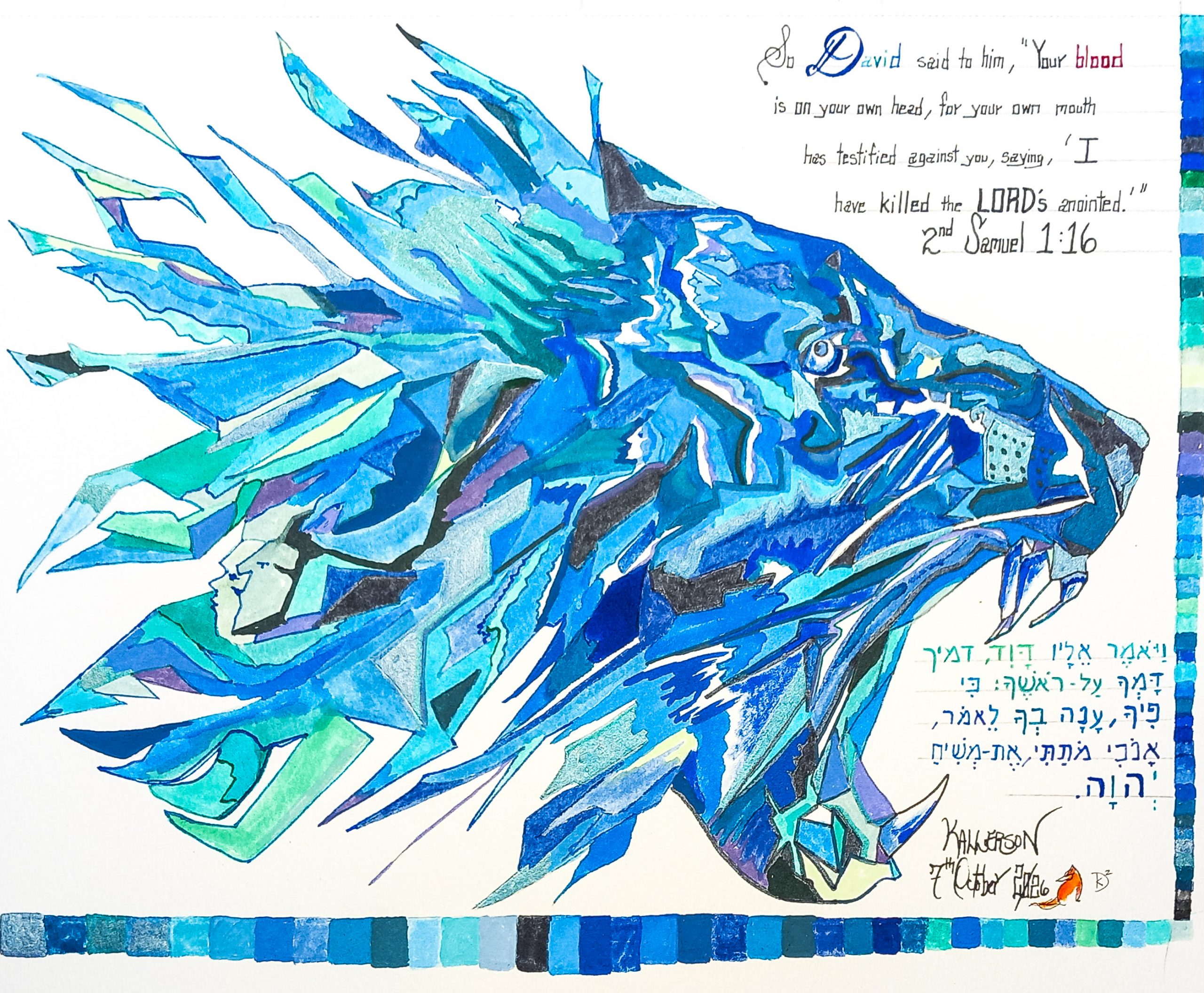
Uggggh! Artwork by Douglas Kalleron.

2 Samuel 2:12-23
Man of Shame, Part II

(Typed 13 July 2026) The Bible is chock full of accounts of battles and wars. At times, some battles challenge our sensibilities, such as when Israel took vengeance on Midian. After the battle was won, the Israelite army brought back the Midianite women and children.

Moses was highly displeased with that decision. He told them to take all the women who had known a man and every male child, and put them to the sword. In other battles, every living thing was to be devoted to the Lord, meaning put to death.

Many people find this troubling, but this is the Lord’s world. What He determines is right. One of the truly odd things that we see is those who complain that the God of the Bible is mean because of things like this, and yet they will approve of aborting babies without a second thought.

That reveals their cognitive dissonance. What God determines is always right. He created, and He has every right to dispense with His creation as He sees fit. When Israel was disobedient to the Lord, they found this out.

Text Verse: “Indeed, you will cause to return edgerock (tsur) his sword,
And not you will cause to rise him in the battle.” Psalm 89:43 (CG)

The 89th Psalm carries a mournful tone as it remembers the Lord’s covenant with David while sorrowing over lost blessings. The people strayed from Him, and they received the due penalty for it.

God is working out a great plan of redemption, and the world continues as it has for thousands of years. God intervenes when necessary to ensure things turn out according to His plans, but He allows free will in man during the process.

Because of this, war and death will continue to be a part of our human experience. Someday, all of this will be behind us. Until then, we need to trust that His way is right and that what He does is for a good purpose.

These are certain truths that are revealed in His superior word. And so, let us turn to that precious word once again, and… May God speak to us through His word today, and may His glorious name ever be praised.

I. Upon the Kneepool (verses 12-16)

12 Now Abner the son of Ner, and the servants of Ishbosheth the son of Saul, went out from Mahanaim to Gibeon.

vayetse avner ben-ner vəavde ish-bosheth ben-shaul mimakhanayim givonah – “And he went out, Abner, ‘son, Ner’, and ‘servants, Ishbosheth, son, Saul’ from Mahanaim Gibeon-ward.” Abner is working to solidify rule over the land for Ishbosheth. During this time, he and Ishbosheth’s servants went out, a term signifying war when applied to soldiers. They headed toward Gibeon.

Gibeon is in the territory of Benjamin, well north of where David is and a good distance from Mahanaim. However, it is not far from the northern border of Judah. This meeting at this location is most likely set by both sides to gain control over the tribe of Benjamin.

Saul was from the tribe of Benjamin, but after his death, they may have followed David. However, Ishbosheth is a son of Saul, and he certainly wanted to maintain sway over the tribe after Saul’s death.

Gibeon is the city noted in Joshua 9 where its inhabitants deceived Joshua into making a treaty with them, pretending to be from a far distant land. However, they were from just down the road. Because of the treaty, when Gibeon was attacked for making peace with Israel, Joshua and the Israelite army fought to protect them.

Despite the prominence of the location in Joshua, it has not been mentioned since then. Now, with the intent of meeting David and possibly gaining rule over Judah, Abner and the servants of Ishbosheth have gone out. Abner is looking to restore Saul’s kingdom, with Ishbosheth assuming rule over all of Israel.

Gibeon, giv’on, comes from gavia, meaning a cup or a bowl. When upside down, it looks like a hill. The vav–nun (-on) couple at the end makes the word locative. As such, it means Hill Town, Place of the Hill, or something similar. It is etymologically tied to Gabbatha.

Ner means Lamp. Abner means Father Is a Lamp and thus, Father of Light. Ishbosheth means Man of Shame. Saul means Asked. Mahanaim means Two Camps.

13 And Joab the son of Zeruiah, and the servants of David, went out

vəyoav ben-tsəruyah vəavde david yatsəu – “And Joab, ‘son, Zeruiah’, and ‘servants, David’, they went out.” Whether from intel that Abner had come out, or from a challenge sent from Abner to meet in battle, Joab went out with David’s servants to meet for a challenge.

Joab comes from an abbreviated form of Yehovah and av, father. Thus, it means Yehovah Is Father or Whose Father Is Yehovah.

Zeruiah is the mother’s name. She is David’s sister according to 1 Chronicles 2:16. However, as noted in 1 Samuel 26, she is likely a stepsister of David. Joab, her oldest son, would make him David’s oldest nephew. He is the most prominent figure seen during David’s life.

Depending on the root, Zeruiah means something like Balm, Wounded, Balsam, Balsam of Yah, or His Edgerock Is Yah. The last option would be a commemoration of an event or person, such as calling someone “His Blimp” because she was born on the day her father rode on a blimp.

13 (con’t) and met them by the pool of Gibeon.

vayiphgəshum al-bərekhath givon yakhdav – “and they intermet them upon ‘kneepool, Gibeon’ unitedly.” An infrequently used word, pagash, is used concerning the meeting. It means “to come in contact with, whether by accident or violence; figuratively, to concur — meet (with, together)” (Strong).

The Topical Lexicon says, “the verb marks a decisive point of intersection ordained by God.” Using this word means it is more than just a meeting, but a joining. That is reflected in the word unitedly, because a unit is formed.

The word translated as kneepool, berekah is introduced here. It signifies a reservoir (at which camels kneel as a resting place). It is from barak, to kneel, a word usually translated as bless or kneel. When blessing, kneeling is usually at least mentally associated with the act –

“And God blessed (barak) them, saying, “Be fruitful and multiply, and fill the waters in the seas, and let birds multiply on the earth.” Genesis 1:22

Barnes says of this kneepool –

“On the east of the hill (El-jib, the ancient Gibeon) is a copious spring, which issues in a cave excavated in the limestone rock, so as to form a large reservoir. In the trees further down are the remains of a pool or tank of considerable size (120 feet by 110 feet). This is doubtless “the pool of Gibeon.”

In Jeremiah 41:12, it notes “the great pool that is in Gibeon.” This is likely that same spot…

13 (con’t) So they sat down, one on one side of the pool and the other on the other side of the pool.

vayeshəvu eleh al-ha’bərekhah mizeh və’eleh al-ha’bərekhah mizeh – “And they sat, these, upon the kneepool from this, and these upon the kneepool from this.” At this kneepool, the two sides are enjoined, each taking an opposite side as they consider their options…

14 Then Abner said to Joab, “Let the young men now arise and compete before us.”

vayomer avner el-yoav yaqumu-na ha’nəarim visakhaqu ləphanenu – “And he said, Abner, unto Joab, “They will arise, pray, the lads, and they will ‘laugh’ to our faces.” With the warriors lined up across the pool from each other, a proposal is made for a competition to take place between the warriors.

The probable reason for doing so is that a battle between them would essentially be a civil war within the nation. Even though they have anointed their own kings, they are all Israelites. It may be that neither side was willing to be the first to shed blood in actual combat.

Therefore, these lads will fight to set things in motion, seeing what skills the other side possesses. The word sachaq, to laugh, is used. In this case, it means to cause those engaging in, watching, or hearing about an event to find amusement.

Thus, they are looking to see how the warriors will perform, hopefully laughing at the loss of the other side. Abner proposes this to start the engagement…

14 (con’t) And Joab said, “Let them arise.”

vayomer yoav yaqumu – “And he said, Joab, ‘They will arise.’” Joab feels confident in the skill of his men, and so he agrees to the proposal. As a military suggestion, the outcome of this and any fighting that takes place after it means that those who kill in battle are not considered murderers.

This important point has bearing on an issue that arises in 2 Samuel, which will be resolved only after the death of David when Solomon assumes the throne.

15 So they arose and went over by number, twelve from Benjamin, followers of Ishbosheth the son of Saul, and twelve from the servants of David.

vayaqumu vayaavru bəmispar shəneim asar ləvinyamin ulə’ish-bosheth ben-shaul ushəneim asar meavde David – “And they arose, and they traversed in number two-ten to Benjamin and to Ishbosheth, ‘son, Saul’, and two-ten from ‘servants, David’.” Twelve men were selected from each side. From there, they traversed, or went over, from their location to meet the other twelve at a certain point where both armies could watch the spectacle.

As only Benjamin is named, it seems that all of the men selected are from Benjamin, the single name being given for both groups –

“And they arose, and they traversed in number two-ten to Benjamin:
and to Ishbosheth, ‘son, Saul’,
and two-ten from ‘servants, David’.”

This is speculation, but they have met in the territory of Benjamin. Thus, to have Benjamites fight would nicely set the tone for the conflict. David already had men of Benjamin under him by this time, as is recorded in 1 Chronicles 12 –

“Then some of the sons of Benjamin and Judah came to David at the stronghold. 17 And David went out to meet them, and answered and said to them, ‘If you have come peaceably to me to help me, my heart will be united with you; but if to betray me to my enemies, since there is no wrong in my hands, may the God of our fathers look and bring judgment.’ 18 Then the Spirit came upon Amasai, chief of the captains, and he said:
‘We are yours, O David;
We are on your side, O son of Jesse!
Peace, peace to you,
And peace to your helpers!
For your God helps you.’
So David received them, and made them captains of the troop.” 1 Chronicles 12:16-18

The number twelve signifies perfection of government or governmental perfection. As there were two sets of twelve, the number twenty-four should be explained. Strong says, “It is the number associated with the heavenly government and worship, of which the earthly form in Israel was only a copy.”

Regardless of whether David’s men were from Benjamin or not, this is a real battle appointed by the military commanders. Therefore, there will be death involved…

16 And each one grasped his opponent by the head and thrust his sword in his opponent’s side;

The words are rushed to show the suddenness of the engagement: vayakhaziqu ish bərosh reehu vəkharbo bətsad reehu – “And they caused to seize, man, in head his associate, and his sword → in ‘side, his associate’.” The men were probably told to enter the challenge with only their swords, making it a duel to the death, as none were holding a shield.

Therefore, to immediately try to gain the advantage and end the fight quickly, each man seized the head of the other, leaving his body exposed. The plan was to be the first to stab the other.

This was the case with all twenty-four men. None prevailed. In the second clause, the verb is missing, demonstrating the rapidity with which the thrusts were made for both fighters, as if a single action. The head was seized, and the sword was in his associate’s side.

Some scholars think that only Ishbosheth’s men fell. David’s twelve were mentioned in the previous verse, indicating that it was those twelve who prevailed over the other twelve. That is possible, but if that were the case, it would say something like, “So David’s men prevailed over those of Ishbosheth.” The next words could go either way as well…

16 (con’t) so they fell down together.

vayipəlu yakhdav – “and they fell unitedly.” This could be that all twenty-four fell together, the position I favor, or it could be that all twelve of Ishbosheth’s men fell unitedly. One would think there would be another clause provided as explanation if this were the case. Either way, it next says…

16 (con’t) Therefore that place was called the Field of Sharp Swords, which is in Gibeon.

Rather: vayiqra la’maqom ha’hu khelqath ha’tsurim asher bəgivon – “And he called to the place, the it, ‘Smoothness, the Edgerocks, which in Gibeon.” Who “he” refers to is not stated. Young makes it indefinite and says, “And one calleth that place…” Most other translations punt and ignore the Hebrew.

The meaning of the name khelqath ha’tsurim is extremely hard to pin down. Numerous suggestions have been given. The first part, khelqath, is from khelqah, smoothness. It does not mean field. Quite often, the word khelqah is combined with sadeh, field, to indicate the smoothness of a field. But that could mean a portion or allotment because a smooth stone is used for casting lots.

The next word, tsur, is plural, tsurim, and prefixed by the definite article, ha. The word tsur signifies an edgerock, such as a cliff, but also a sharp flint knife, such as in Joshua 5 when the men of Israel were circumcised with edgerocks. The word tsur is often used when referring to the Lord, especially in poetry.

The most literal rendering is ‘Smoothness, the Edgerocks’. However, the intent here is probably ‘Parcel, the Edgerocks’, being the place where the edgerocks were used as swords (verse 16) to destroy those engaged in the fighting.This is not without precedent. As our text verse notes, the sword and the edgerock are used in Psalm 89:43 in conjunction with one another. Thus, the men held edgerocks as their swords.

Why should I strike you? It wouldn’t be right
You need to break off from this path
My word is true, you’re in a dreadful plight
Get out your calculator and do the math

How would I face your brother, turn off now!
If you don’t, things will surely get grim
Joab will come after me, someday, somehow
Until then, how could I ever face him

Well, I told you to turn off, but you would not
That hole in your abdomen can’t feel nice
Plenty of blood coming from that spot
You wouldn’t turn off, and now you’ve paid the price

II. And He Fell There, Asahel (verses 17-23)

17 So there was a very fierce battle that day,

vatehi ha’milkhamah qashah ad-məod ba’yom ha’hu – “And it was, the battle, severe until vehemently in the day, the it.” Without a decisive win by either side in the challenge, the men of war engaged each other in heated battle. The number of dead will be noted at the end of the chapter, but the immediate result is…

17 (con’t) and Abner and the men of Israel were beaten before the servants of David.

vayinageph avner və’anshe yisrael liphne avde David – “And he was smitten, Abner, and ‘mortals, Israel’ to faces ‘servants, David’.” Abner came looking for a fight. He found one, but the results he hoped for eluded him. The servants of David, led by Joab, overpowered him.

Next, a portion of the battle involving Abner is recorded. Until the battle ends when the men are recalled to their camps, the men remain under a state of war. Death in war is not considered murder. Understanding this, it says…

18 Now the three sons of Zeruiah were there: Joab and Abishai and Asahel.

vayihyu-sham shəloshah bəne tsəruyah yoav va’avishai va’asahel – “And they were there, three ‘sons, Zeruiah’: Joab, and Abishai, and Asahel.” The mother’s name is often given when referring to one or more of her sons. Because she is a sister (or stepsister) of David, this shows the nearness of these men to David.

Quite often in their interactions with David, a tension exists. The men are impulsive warriors, whereas David is more patient, desirous of having the Lord’s timing in a matter.

Abishai means My Father Yehovah Exists. He was with David when David went into Saul’s camp in 1 Samuel 26 to take Saul’s personal effects while he slept. Asahel is first seen in this verse.  His name is from asah, to do or make, and el, God. Thus, his name means Made by God…

18 (con’t) And Asahel was as fleet of foot as a wild gazelle.

va’asahel qal bəraglav kə’akhad ha’tsəvayim asher ba’sadeh – “And Asahel, light in his feet, according to ‘one, the gazelles’ which in the field.” It is a marvelous honor to be described in this manner. Gazelles are among the fastest land mammals. Some gazelle species can reach sprint speeds of 40 to 60 mph.

Cheetahs may be slightly faster in a short dash, but the gazelle’s superior endurance and sharp maneuverability allow it to outrun predators in prolonged chases.

They also possess cloven hooves, which provide traction and balance across uneven terrains and loose, sandy areas. This allows them to execute lightning-fast twists, turns, and abrupt direction changes to shake off predators.

In addition to this, as part of being termed light in their feet, gazelles perform what is called stotting. They leap straight into the air with all four legs stiff while arching their backs. It is a signal to predators that they are strong, healthy, and too fast to catch.

To be compared to a gazelle in one’s feet would encompass these attributes. Further, in 1 Chronicles 11:26, Asahel is noted as one of the mighty warriors. Because of his speed, agility, and endurance, he took off after Abner…

19 So Asahel pursued Abner,

vayirdoph asahel akhare avner – “And he pursued, Asahel, after Abner.” Being faster than the rest, Asahel was able to fix Abner in his sights and close in on him. To either capture or kill the general of Israel’s army would be an honor he could not refuse to try for.

His brother, Joab, may have been the leader of David’s army, but this victory would elevate Asahel to high esteem among all the warriors. As he continued…

19 (con’t) and in going he did not turn to the right hand or to the left from following Abner.

vəlo-natah lalekheth al-ha’yamin və’al-ha’səmol me’akhare avner – “And not he stretched to walk upon the right and upon the left from after Abner.” Asahel followed Abner step for step. Instead of trying to outrun him by going one way or another and getting ahead of him, he methodically pursued directly after him.

If he could run Abner to the point of exhaustion, he would have the edge in any combat that followed. By defeating Abner, the battle would end. Therefore, Asahel doggedly pursued him. Eventually, he got close enough that Abner called out as they ran…

20 Then Abner looked behind him and said, “Are you Asahel?”

vayiphen avner akharav vayomer ha’atah zeh asahel – “And he turned, Abner, after him, and he said, “The you, this, Asahel?” The question implies that Abner and Asahel knew one another. Or it may be that Abner only knew Joab but recognized Asahel as Joab’s brother. Either way, he needed to know the answer before he decided what to say next…

20 (con’t) He answered, “I am.”

vayomer anokhi – “And he said, “I myself.” Ashael confirms that it is he. The extended form anokhi is probably like saying, “Yes, it is I and none other!” With his identity confirmed…

21 And Abner said to him, “Turn aside to your right hand or to your left,

Abner’s words to Asahel are emphatic: vayomer lo avner nəteh ləkha al-yəminəkha o al-səmolekha – “And he said to him, Abner, ‘You must stretch to you upon your right or upon your left.’” Using the word natah, stretch, is like telling him, “You’re pursuing the wrong person.”

Abner isn’t telling Asahel to veer off from chasing him or to turn aside from following him as much as he is telling him to take another direction and pursue someone else.

There will be no reward for Asahel in pursuing Abner, but there will be one for going after someone less of a threat. That is seen next…

21 (con’t) and lay hold on one of the young men and take his armor for yourself.”

və’ekhoz ləkha ekhad meha’nəarim vəqakh ləkha eth-khalitsatho – “and you must grasp to you one from the lads, and you must take to you his stripping.” Asahel is pursuing Abner, an experienced soldier. Asahel may be able to outrun Abner, but even after a long pursuit, he will not be able to defeat him.

Rather than dying a fool’s death for taking on someone more experienced than he should have, Abner implores him to chase after someone less experienced, kill him, and take what he can strip off the dead soldier.

If he is looking for a reward or a trophy, he can find it elsewhere and not die in the process of his current pursuit. Abner’s possessions may be a great prize, but Asahel is not the one who will possess them. However, despite Abner’s warning…

21 (con’t) But Asahel would not turn aside from following him.

vəlo-avah asahel lasur me’akharav – “And not he acquiesced, Asahel, to veer from after him.” Asahel was convinced he could wear down Abner enough to be successful. And so, he kept up the pursuit. Abner may have even prompted him to double down in his resolve. However, he does not want the situation to end badly…

22 So Abner said again to Asahel, “Turn aside from following me.

vayoseph od avner lemor el-asahel sur ləkha me’akharay – “And he caused to add again, Abner, to say unto Asahel, ‘You must veer to you from ‘after me’.’” Abner continues with emphatic words. This time, he doesn’t tell Asahel to stretch in another direction in order to find another target. He simply implores him to break off his pursuit. If he doesn’t, there will be a painful lesson for Asahel…

22 (con’t) Why should I strike you to the ground?

lamah akekha artsah – “To why, I will cause to strike you earthward?” Abner is determined to convince Asahel that he is not afraid of stopping to fight. But if he does, he will be forced to kill him. If Asahel doesn’t stop, Abner will still be forced to kill him.

No matter what transpires, the only way to avoid death is for Asahel to break off the pursuit. He next gives the reason for his impassioned plea…

22 (con’t) How then could I face your brother Joab?”

və’ekh esa phanay el-yoav akhikha – “And how I will lift my faces unto Joab, your brother?” It doesn’t say how they knew one another, but Abner held a favorable view of Joab. Even though Abner is the general of Ishbosheth’s army, it had probably dawned on him in one way or another that David would eventually rule all of Israel.

At that time, it would be exceedingly difficult to face Joab. He would have his eyes downcast anytime they met, knowing that he had killed Joab’s younger brother. The shame would plague him.

Knowing Joab’s character, he would also understand that Joab would probably never let the matter rest. To kill Asahel would serve no good purpose in his future…

23 However, he refused to turn aside.

vaymaen lasur – “And he refused to veer.” After several impassioned warnings, Asahel remained stubbornly set on attaining victory over Abner. Being fleet of foot does not necessarily equate to clarity of thought. Asahel is chasing a seasoned warrior who is now close enough to practically touch with his hands.

Not carefully thinking through the repercussions of his chase, he has made a fatal error in his thinking…

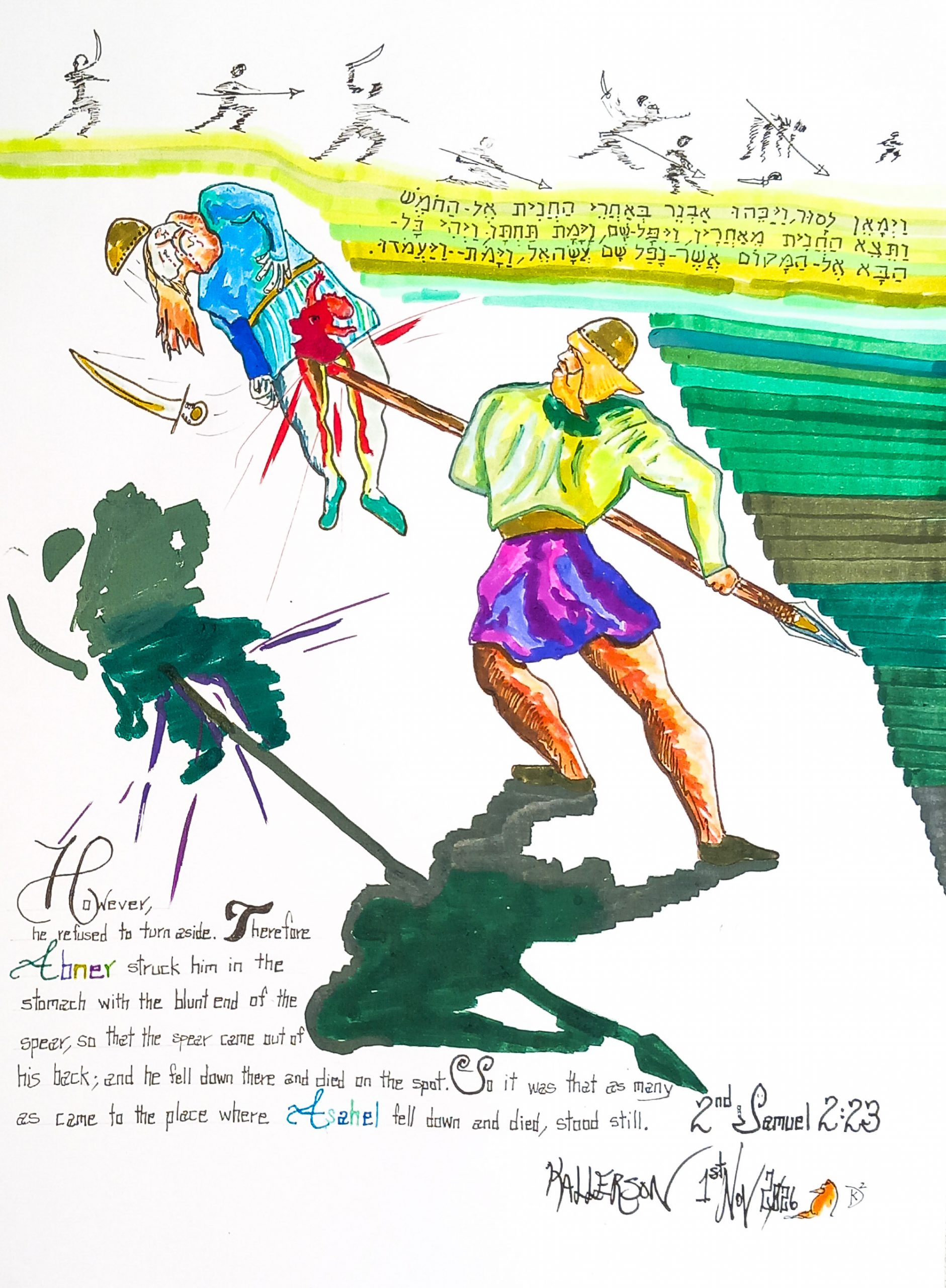
23 (con’t) Therefore Abner struck him in the stomach with the blunt end of the spear,

Rather: vayakehu avner bə’akhare ha’khanith el-ha’khomesh – “And he caused to strike him, Abner, in ‘afters, the spear’ unto the abdomen.” There is nothing to suggest the spear had a blunt end. In fact, that would be contrary to using it as a sound, close-quarters military weapon.

A military spear used for close fighting may not always be double-ended, but it would certainly be pointed for exactly this purpose. If a soldier was surrounded, he could thrust in either direction. The main head would be large, flared, and sharp. The other end would be pointed, making it painful to whoever received it.

A new word is seen here, khomesh, the abdomen. Strong says of it, “From an unused root probably meaning, to be stout; the abdomen (as obese).” Ye olde KJV says, “under the fifth rib.” That is wrong for two reasons. The first is that it says “unto,” not “under.” The second reason requires explanation.

Other than the vowel pointing, khomesh is spelled the same as the noun khamesh, five –

חֹמֶשׁ – khomesh/abdomen
חָמֵשׁ – kahmesh/five

The problem with this is that the adjective, fifth, would be khamishi, a word spelled differently. Most older versions have this translation, but it is unlikely.

As for the rendering abdomen, which Strong suggests, others say groin, loins, breast, chest, belly, stomach, etc. It is some part of the body that is stout, but soft enough to allow a spear to pass right through.

Despite the translation, the abdomen, khomesh, is typical of grace, being identical to the number five, khamesh…

23 (con’t) so that the spear came out of his back;

vatetse ha’khanith me’akharav – “and it went out, the spear from his ‘afters’.” The “afters” of the spear went into him so hard that it came out of Asahel’s “afters.” The plural indicates a fullness of a location. Although not as common in English, we do use terms like this when we say something like, he scanned his surroundings.

The spear went right through him while he was running. It would be difficult for him or anyone to survive. The pulse rate would be high, the blood would flow like pressure from a squirt gun, and the sudden transition to being fully stopped would cause a massive shock to the body.

As before, khanith, spear, is identical to the feminine word meaning grace. Once the spear was pulled out, he would be bleeding profusely from both sides. Asahel was a fer-sher goner…

23 (con’t) and he fell down there and died on the spot.

vayipal-sham vayamath takhto – “and he fell there, and he died, his ‘under’ [k.].” The written text reads takhto, “his under,” meaning the spot directly under him, but it may also mean “immediately,” as an identical change occurs in 2 Samuel 3:12, which is translated that way in the Greek.

The oral changes it to takhtav, under him. That can mean either the spot under a person or in place of him. For example, a son who reigns in place of his father, the king, is said to reign under him. The overall meaning for Asahel is the same. He went down and died right where he fell…

*23 (fin) So it was that as many as came to the place where Asahel fell down and died, stood still.

vayhi kal-ha’ba el-ha’maqom asher-naphal sham asahel vayamoth vayaamodu – “And it was, all the ‘coming’ unto the place where he fell there, Asahel, and he died, and they stood.” Those who passed by did just what rubbernecks do on the highway today when there is an accident. They slow down and look over the horrific scene, causing traffic disruptions.

This scene caused the people to quit the chase of those who were retreating from the battle. This is seen again later in 2 Samuel –

“Then Joab said to Amasa, ‘Are you in health, my brother?’ And Joab took Amasa by the beard with his right hand to kiss him. 10 But Amasa did not notice the sword that was in Joab’s hand. And he struck him with it in the stomach, and his entrails poured out on the ground; and he did not strike him again. Thus he died.
Then Joab and Abishai his brother pursued Sheba the son of Bichri. 11 Meanwhile one of Joab’s men stood near Amasa, and said, ‘Whoever favors Joab and whoever is for David—follow Joab!’ 12 But Amasa wallowed in his blood in the middle of the highway. And when the man saw that all the people stood still, he moved Amasa from the highway to the field and threw a garment over him, when he saw that everyone who came upon him halted. 13 When he was removed from the highway, all the people went on after Joab to pursue Sheba the son of Bichri.” 2 Samuel 20:9-13

This is the right place to stop for today. There are eight verses left in the chapter, and the typology needs to be determined. It is a bloody passage, but it fits the course of human events. Man has waged war since his earliest days on earth.

From a biblical perspective, for the soldier, and despite the killing, it is not the same offense as murdering another. Paul says in Romans 14 that citizens are to be subject to the ruling authorities. This includes serving in militaries, if that is what is required.

How leaders will be judged may be a different story. It’s hard to imagine how a leader could so carelessly throw away the lives of his people and those he faces in battle simply for power and gain. But those things are determined by the Lord.

The narrative today, at least in the surface story, is given to more fully expose killing that is not sanctioned warfare later. The end of 2 Samuel will fully reveal this, and it will come in due time.

As tragic as war seems to us, the Lord is presented as a Warrior in both testaments. Revelation 19 vividly depicts this. Regardless of how we feel about a particular issue, if the Bible does not condemn it, we should not either.

And if the Bible condemns certain actions, within the proper context, we should condemn them as well. This is a necessary qualifier because under the law, eating certain things was forbidden. However, for those not under law, there is no such restriction.

Context matters. Therefore, we should not only read the Bible, but consider the context of what is being said as we do. This is a display of wisdom, and God is pleased with those who properly handle and rightly divide His word.

Both of those precepts are necessary to properly know and call on God as He has presented Himself to the people of the world. We need to handle Scripture through the lens of Christ Jesus, and we need to ensure we properly obtain our doctrine from the word concerning Him.

The first step in that process is to receive His work on our behalf. Before we close, let me tell you how to do just that…

Closing Verse: “Now I saw heaven opened, and behold, a white horse. And He who sat on him was called Faithful and True, and in righteousness He judges and makes war.” Revelation 19:11

Next Week: 2 Samuel 2:24-32 He’ll get all the blame, just wait and see… (Man of Shame, Part III) (5th 2 Samuel sermon)

The Lord has you exactly where He wants you. He has a good plan and purpose for you. He is the One who abases the haughty and exalts the humble. He regards the lowly, and the proud, He knows from afar. So yield yourself to Him, trust Him, and believe His word. In this, He will do great things for you and through you.

2 Samuel 2:12-23 (CG)

12And he went out, Abner, ‘son, Ner’, and ‘servants, Ishbosheth, son, Saul’~ from Mahanaim Gibeon-ward. 13And Joab, ‘son, Zeruiah’, and ‘servants, David’ they went out, and they intermet them upon ‘kneepool*, Gibeon’ unitedly. And they sat, these, upon the kneepool from this, and these upon the kneepool from this. 14And he said, Abner, unto Joab, “They will arise, pray, the lads, and they will ‘laugh*’ to our faces.”

And he said, Joab, “They will arise.”

15And they arose, and they traversed in number. Two-ten to Benjamin and to Ishbosheth, ‘son, Saul’, and two-ten from ‘servants, David’. 16And they caused to seize, man, in head his associate, and his sword → in ‘side, his associate’, and they fell unitedly. And he called to the place, the it, ‘Smoothness, the Cliffs*’, which in Gibeon. 17 And it was, the battle, severe until vehemently in the day, the it. And he was smitten, Abner, and ‘mortals, Israel’ to faces ‘servants, David’.

18And they were there, three ‘sons, Zeruiah’: Joab, and Abishai, and Asahel. And Asahel, light in his feet, according to ‘one, the gazelles’ which in the field. 19And he pursued, Asahel, after Abner. And not he stretched to walk upon the right and upon the left from after Abner.

20And he turned, Abner, after him, and he said, “The you, this, Asahel?”

And he said, “I myself.”

21And he said to him, Abner, “You must stretch to you upon your right or upon your left, and you must grasp to you one from the lads, and you must take to you את his stripping.” And not he acquiesced, Asahel, to veer from after him. 22And he caused to add again, Abner, to say unto Asahel, “You must veer to you from ‘after me’. To why I will cause to strike you earthward? And how I will lift my faces unto Joab, your brother?” 23And he refused to veer. And he caused to strike him, Abner, in ‘afters, the spear’ unto the abdomen*, and it went out, the spear from his ‘afters’, and he fell there, and he died, his ‘under’ [k.]. And it was, all the ‘coming’ unto the place where he fell there, Asahel, and he died, and they stood.


*Verse 13 – Hebrew: berekah, from barak, to kneel, as in blessing, or being blessed by, God.
*Verse 14 – Act out to bring joy to the watchers.
*Verses 16 – This is a literal translation without interpretive speculation.
*Verse 23 – Hebrew: khomesh, from a root probably meaning “to be stout.”
Verse 23 – Qeri: תחתיו / taḥtāw = under him / beneath him. Kethiv: תחתו / taḥtōw = his under-place / in his place. Both point to dying there, on the spot.


2 Samuel 2:12-23 (NKJV)

12 Now Abner the son of Ner, and the servants of Ishbosheth the son of Saul, went out from Mahanaim to Gibeon. 13 And Joab the son of Zeruiah, and the servants of David, went out and met them by the pool of Gibeon. So they sat down, one on one side of the pool and the other on the other side of the pool. 14 Then Abner said to Joab, “Let the young men now arise and compete before us.”

And Joab said, “Let them arise.”

15 So they arose and went over by number, twelve from Benjamin, followers of Ishbosheth the son of Saul, and twelve from the servants of David. 16 And each one grasped his opponent by the head and thrust his sword in his opponent’s side; so they fell down together. Therefore that place was called the Field of Sharp Swords, which is in Gibeon. 17 So there was a very fierce battle that day, and Abner and the men of Israel were beaten before the servants of David.

18 Now the three sons of Zeruiah were there: Joab and Abishai and Asahel. And Asahel was as fleet of foot as a wild gazelle. 19 So Asahel pursued Abner, and in going he did not turn to the right hand or to the left from following Abner.

20 Then Abner looked behind him and said, “Are you Asahel?”

He answered, “I am.”

21 And Abner said to him, “Turn aside to your right hand or to your left, and lay hold on one of the young men and take his armor for yourself.” But Asahel would not turn aside from following him. 22 So Abner said again to Asahel, “Turn aside from following me. Why should I strike you to the ground? How then could I face your brother Joab?” 23 However, he refused to turn aside. Therefore Abner struck him in the stomach with the blunt end of the spear, so that the spear came out of his back; and he fell down there and died on the spot. So it was that as many as came to the place where Asahel fell down and died, stood still.
 

2 Samuel 2:1-11 (Man of Shame, Part I)

Artwork by Douglas Kallerson

2 Samuel 2:1-11
Man of Shame, Part I

(Typed 29 June 2026) There are things in life which are axiomatic: If you want the house to go up properly and according to budget (well, hopefully), you will follow the blueprint. If you want the TV to work properly, you will follow the setup instructions. And if you want to avoid a speeding ticket, then don’t speed.

What should also be obvious to every Christian is that if you want to be pleasing to the Lord, you will follow His word. It makes no sense to assume that things will go well for you when you are disobedient to His will. And you cannot know what His will is unless you have access to it.

Your church may provide proper instruction in what it teaches, but considering that there are 18 billion denominations out there (plus or minus a few), each with its own doctrine, is it wise to put your life in the hands of someone else’s teaching?

It’s fine to listen to your pastor, but the old saying, “trust, but verify”, doesn’t go far enough. I would drop the trust part and go straight to the verify if I were you.

Israel has the choice between two directions in this passage. One of them is by the will of the Lord. The other isn’t. Which do you think will ultimately succeed?

Text Verse: “When You said, ‘Seek My face,’
My heart said to You, ‘Your face, Lord, I will seek.’” Psalm 27:8

The first sentence of this chapter says that David inquired of the Lord. He indeed had a source of inquiry that we do not possess today. But I would suggest that our means of inquiring of the Lord is preferable to what David possessed.

God is not directing the redemption of the world to get us to Jesus. If He were, we would still have prophets occasionally telling people what to do. Rather, Jesus came. We now have the completed word of God that tells about it.

We don’t need to be directed by prophets any longer. Instead, we are instructed to live according to the word that has been provided. People who expect a prophetic word today have misunderstood what the Bible says, or maybe they are looking for an easy way out by not picking it up and reading it.

Whatever the case is, we have the blueprint. We are expected to know what it says and apply it to our lives. If we do this, we will know if we are in the will of the Lord.

That doesn’t mean our lives will be great. Troubles, trials, and temptations are a part of human existence. But we can know that even through those things, we are doing what He expects when we follow His word. Let each of us determine to read His word daily.

Remaining in the will of the Lord is an important tenet that is found in His superior word. And so, let us turn to that precious word once again, and… May God speak to us through His word today, and may His glorious name ever be praised.

I. They Sat in ‘Cities, Hebron’ (verses 1-7)

It happened after this that David inquired of the Lord, saying, “Shall I go up to any of the cities of Judah?”

vayhi akhare khen vayishal david bəyehovah lemor ha’eeleh bəakhath are yəhudah – “And it was, after thus, and he asked, David, in Yehovah, to say, ‘I will ascend in one, ‘cities, Judah’?’” David was in Ziklag when word about Saul and Jonathan came to him, as detailed in 2 Samuel 1.

With Saul dead, he now has the opportunity to return to Judah and prepare to reign over the people. David means Beloved. Thus far, he has typologically pictured accepting the doctrines of Christ. This may change as he assumes his new role in the redemptive narrative. Either way, we will continue to look carefully for each bit of typology. Judah means Praise.

The words contain a chronological timestamp, akhare khen, after thus. It doesn’t say how long after Saul and Jonathan’s deaths it was, but it can be assumed it was not long. There would be no need to lollygag around Ziklag if Saul was dead.

David had the anointing oil and knew he would rule. Therefore, he probably very quickly asked the Lord for guidance. With Abiathar and an ephod, David is able to directly inquire of the Lord concerning what he should do next. In response…

1 (con’t) And the Lord said to him, “Go up.”

The verb is imperative: vayomer Yəhovah elav aleh – “And He said, Yehovah, unto him, ‘You must ascend!’” The time has come for David’s reign to begin. Therefore, it is time to leave the lower coastal area and ascend into the higher terrain where he will establish a foothold in the land.

The next question is an obvious one. Instead of going where he wished, David again inquires of the Lord…

1 (con’t) David said, “Where shall I go up?”

vayomer david anah eeleh – “And he said, David, ‘Whither I will ascend?’” The Lord has directed David’s movement. Therefore, He has a plan and a purpose for him. To ensure that he remained in the will of the Lord, he asks for specificity concerning his destination. Where the Lord directed, he would go…

1 (con’t) And He said, “To Hebron.”

vayomer khevronah – “And He said, ‘Hebron-ward.’” Hebron is a logical choice. It is in the mountains, and thus readily defensible. The main city is a priestly one. In verse 3, the plural “cities” means it was essentially a metropolis at this point, being filled with agriculture and trade.

Hebron is not just a city, but it includes the surrounding area. It is within Judah, so David would be among those of his tribe.

Hebron also had connections to the promises of the past. Abraham, Sarah, Isaac, and Jacob were buried there. The area was granted to Caleb after the land was subdued, as seen in Joshua 14:6-15.

At this time, Jerusalem was under the control of the Jebusite. It was also on the border of Judah and Benjamin. Therefore, because of the coming events, starting in Jerusalem was not a proper choice. The Lord directed David first to Hebron.

Only later will Jerusalem get its special standing within the nation. Hebron means Alliance.

2 So David went up there, and his two wives also, Ahinoam the Jezreelitess, and Abigail the widow of Nabal the Carmelite.

vayaal sham david vəgam shəte nashav akhinoam ha’yizrəelith va’avigayil esheth naval ha’karməli – “And he ascended there, David, and also ‘two, his wives’, Ahinoam the Jezreelitess, and Abigail, ‘wife, Nabal, the Carmelite’.” Rather than a general statement, such as, “And David took his wives…,” the record carefully details their names.

This has happened a couple of times already, allowing for typology to be considered in relation to their names. Ahinoam means Kindred to Sweetness. Jezreel comes from zara, to scatter seed or sow, and el, God. Thus, it means God Sows.

Abigail is derived from av, father, and giyl, joy or exultation. That is derived from gil, to spin around, which gives the sense of rejoicing. Her name means Father of Joy, she being the source of the joy. Nabal means Dolt. Carmel means Vineyard of God.

3 And David brought up the men who were with him, every man with his household. So they dwelt in the cities of Hebron.

va’anashav asher imo heelah david ish uveitho vayeshəvu bəare khevron – “And his mortals who with him, he caused to ascend, David, man and his house. And they sat in ‘cities, Hebron’.” This would be a very large contingent.

First are the six hundred men noted in 1 Samuel 30:9. This also would have included the wives, children, and livestock. That alone would be a large caravan of people pulling into Hebron all at once.

Along with them, 1 Chronicles 12 details men from various tribes who defected to David prior to Saul’s death , including Benjamin, Gad, Manasseh, Judah, etc. In 1 Chronicles 12:22, it says, “it was a great army, like the army of God.”

Thus, it was a sizeable contingent moving into the cities of Hebron. From that point, the number will increase significantly as David solidifies his position before the people. That establishment of power begins to be seen next…

4 Then the men of Judah came, and there they anointed David king over the house of Judah.

vayavou anshe yəhudah vayimshəkhu-sham eth-david ləmelekh al-beith yəhudah – “And they came, ‘mortals, Judah’, and they anointed, there את David to king upon ‘house, Judah’.” The tribe of Judah knew David was to be king. With Saul dead, they knew this was the time for that to take place, at least in Judah.

Therefore, they came to him at Hebron intending to bring about this new kingdom. Samuel first anointed David in 1 Samuel 16:13 –

“And he took, Samuel, ‘horn, the oil’, and he anointed him in ‘inward, his brothers’. And it surged, Spirit Yehovah, unto David from the day, the it, and upward. And he arose, Samuel, and he walked the Ramah-ward.” (CG)

That anointing gave David the right to the kingdom at whatever time God determined. Saul was still the king, and that continued as the Lord saw fit.

With Saul dead, there could be no hint of David having attempted to usurp the throne from him. Saul’s kingdom was prophesied to end. Therefore, because of what transpires between David in the coming verse, it cannot be seen as a rebellion against the duly established government.

In Hebron, with the approval and anointing of the men of Judah, David has been granted authority over the kingdom of Judah.

The rest of the land was still under the reign of Saul’s house, despite Samuel’s prophecy that Saul’s reign would end and be given to another. In 1 Samuel 28, the name of that person was made explicit –

“And He did, Yehovah, to Him according to which He spoke in my hand. And He rent, Yehovah, the kingdom from your hand, and He gave it to your associate, to David.” 1 Samuel 28:17 (CG)

While with David, these men of Judah inform him of something that would help him solidify power. This is his first recorded official act as king. It is a means of establishing an alliance outside of Judah…

4 (con’t) And they told David, saying, “The men of Jabesh Gilead were the ones who buried Saul.”

vayagidu lədavid lemor anshe yavesh gilad asher qavəru eth-shaul – “And they caused to declare to David, to say, ‘Mortals, Jabesh Gilead’, who, they interred את Saul.’” The sentence seems abrupt and out of place unless, as seems likely, David asked about Saul’s burial. With that being supposed, the form of the words is natural.

It could also be that this was prompted by the men of Judah as a means of spurring David toward securing favor with those east of the Jordan. Without such suppositions, the reason for the inclusion of the clause is abrupt and mystifying.

Jabesh Gilead is on the other side of the Jordan. Jabesh comes from the verb yavesh, to be dry, dried up, or withered. It is used to describe the drying up of a river, land, bones, etc. It also applies to the withering of grass. Gilead means Perpetual Fountain. Thus, Jabesh Gilead means Dry Perpetual Fountain. Saul means Asked.

The details of the disposition of the bodies of Saul and his sons was recorded in 1 Samuel 31:11-13 –

“And they heard, unto it, ‘sitting Jabesh Gilead’ what they did, Philistines, to Saul. 12And they arose, all ‘man, valorous’, and they walked all the night, and they took ‘body, Saul’, and ‘bodies, his sons’, from ‘rampart, Beth Shan’. And they came Jabesh-ward, and they burned them there. 13And they took their bones, and they interred under the tamarisk in Jabesh-ward. And they fasted seven days.”

Because of their actions…

5 So David sent messengers to the men of Jabesh Gilead,

vayishlakh david malakhim el-anshe yavesh gilad – “And he sent, David, messengers unto ‘mortals, Jabesh Gilead’.” This is a sign of gratitude for their bravery and honoring of the fallen king. However, it is also more than that. It is an opportunity for conveying news of the new kingdom and giving them a chance to align with David…

5 (con’t) and said to them, “You are blessed of the Lord, for you have shown this kindness to your lord, to Saul, and have buried him.

vayomer alehem bərukhim atem ləYəhovah asher asithem ha’khesed ha’zeh im-adonikhem im-shaul vatiqbəru otho – “and he said unto them, ‘Blessed, you, to Yehovah, for you did the kindness, the this, with your (exalted) lord, with Saul, and you interred him.’” David acknowledged that their kindness toward Saul means he would have done the same if the opportunity was given to him.

It means that David was kindly disposed toward Saul, not a usurper of him. This understanding is important to convey the sense that what has transpired since Saul’s death was only because of Saul’s death.

Had Saul still been alive, David would have remained subject to him. However, with Saul now dead and the anointing resting on David, it was time for a new direction in the leadership of Israel. And so…

6 And now may the Lord show kindness and truth to you.

vəatah yaas-Yəhovah imakhem khesed və’emeth – “And now, may he do, Yehovah, with you kindness and stability.” David brings in the name of the Lord, petitioning for His hand to bless those in Jabesh Gilead. He then tells them how that kindness and stability will come about, saying…

6 (con’t) I also will repay you this kindness, because you have done this thing.

Rather: vəgam anokhi eeseh itəkhem ha’tovah ha’zoth asher asithem ha’davar ha’zeh – “and also, I myself I will do with you the goodness, the this, for you did the word, the this.” David is not offering repayment but to act as Yehovah’s instrument for bringing about the blessing of kindness and stability upon them –

“And now, may he do, Yehovah, with you kindness and stability.”
“and also, I myself I will do with you the goodness, the this.”

In other words, “the goodness” David promises them is the “kindness and stability” that he has petitioned the Lord to grant them. He essentially says to them, “I will be the Lord’s representative to do this for you.” The reason he can do this is found in the next verse…

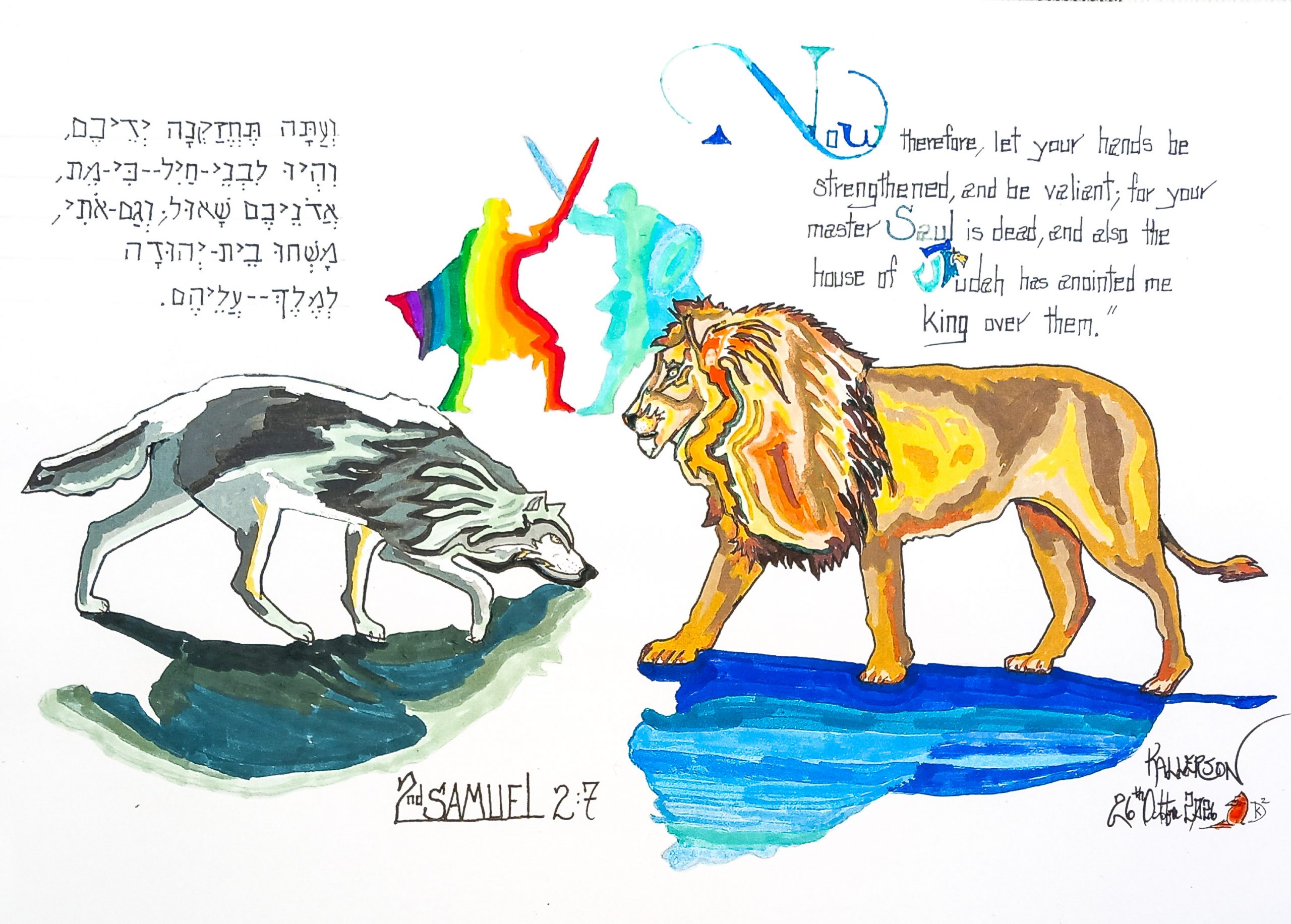
7 Now therefore, let your hands be strengthened, and be valiant;

vəatah tekhĕzaqnah yədekhem vihyu livne-khayil – “And now, they will seize, your hands, and you must be to ‘faces, valor’.” Jabesh Gilead was the location attacked by Nahash the Ammonite in 1 Samuel 11. The first engagement Saul took on was saving them. It is what truly established him as king in the minds of the people.

David telling them to strengthen themselves and be valiant means that they are probably going to face an onslaught of enemies, just as they had before. This is because…

7 (con’t) for your master Saul is dead,

ki-meth adonikhem shaul – “For he died, your (exalted) lord, Saul.” Saul, the great defender of Jabesh Gilead, was dead. Without him, the surrounding nations would be tempted to return to Jabesh and take it, paying Israel back for the loss they had suffered in the past.

However, David said he would deal with Jabesh Gilead with the goodness of Yehovah (kindness and stability). And how could he do that? It is because…

7 (con’t) and also the house of Judah has anointed me king over them.”

vəgam-othi masəhkhu veith-yəhudah ləmelekh-alehem – “And also את me, they anointed, ‘house, Judah’ to king upon them.” David acknowledged his allegiance to Saul while he was alive. He thanked those who tended to Saul in his death, and he said he would do the Lord’s goodness to them.

He reminded them of what the peril of Saul’s death meant for them, and he informed them that he now stands as the anointed king of Judah in Saul’s place, ready to tend to them as Saul did.

The whole package of thought is complete. It basically says, “Align with me and I will tend to you as our beloved Saul did.” The first act of David as king somewhat mirrors the first act of Saul as king.

Both have been directed toward the security of the men of Jabesh Gilead. Having them align with David would mean the rest of those east of the Jordan would possibly side with him as well.

While David presses his diplomacy toward them, something else is happening that could interfere with David’s petition…

When vying for control, you must do what’s right
Following what the Lord would have you do
With all your soul, and with all your might
Doing His will is what is proper for you

To usurp His will can only lead to a bad end
So stay away from that dangerous path
Be sure that the things you intend
Will add up to His approval, so do the math!

When David was patient and did what was right
Things came out as they should
But when he strayed and diverted his sight
Things ended up not so good

Ishbosheth started out wrong
And his two years to reign weren’t that long

II. Surely, ‘House, Judah’, They Were After David (verses 8-11)

8 But Abner the son of Ner, commander of Saul’s army,

və’avner ben-ner sar-tsava asher ləshaul – “And Abner, ‘son, Ner, commander, host’ which to Saul.” Abner somehow managed to survive the battle with the Philistines that took the lives of Saul and his sons.

Abner was related to Saul in some manner. The difficulty rests in the names found in 1 Samuel 9. Abner’s father is Ner. In 1 Samuel 9:1, it says that Kish, Saul’s father, is the son of Abiel. In 1 Chronicles 8 & 9, it says that Kish is the son of Ner.

Several suggestions were given to rectify the matter. Ner means Lamp. Abner means Father Is a Lamp and thus, Father of Light. Whatever the case, Abner and Saul were somehow related in their genealogies.

Abner was also Saul’s commander. It was an army that was significantly reduced in the battle with the Philistines. As the Philistines moved into the areas of Israel east of Jezreel and west of the Jordan, Abner…

8 (con’t) took Ishbosheth the son of Saul and brought him over to Mahanaim;

laqakh eth-ish-bosheth ben-shaul vayaavirehu makhanayim – “he took את ‘Ishbosheth, son, Saul’ and he caused to traverse him – Mahanaim.” Ishbosheth is introduced here. He is noted as a son of Saul, but he is not in the listing of Saul’s sons in 1 Samuel 14:49.

Based on what it says later in the chapter, when rightly understood, it is likely he was born after Saul became king. Ishbosheth means Man of Shame. He is named as Esh-baal in 1 Chronicles 8 & 9.

Names that include baal, master, in Chronicles are commonly given names with a form of bosheth, shame, here. The reason normally given is that baal eventually became synonymous with something shameful rather than indicating “master.”

This view is held by pretty much everyone. However, that is a poor explanation for two reasons. The first is that it is putting the cart before the horse.

The Chronicles were compiled long after these names were recorded in 2 Samuel. Using that logic, it would be the other way around, where baal would be noted here and bosheth would be noted there.

The second problem with this view is that the term baal continued to be used as “master” even until the time of the pre-exilic minor prophets, and even when referring to the Lord, such as in Nahum 1:2, where Yehovah is called baal khemah, Master of Heat (meaning fury).

Because of this, it would be ridiculous to say that using baal had pagan intent. The word simply means master, regardless of whether it is used by pagans in relation to their false gods.

As Chronicles was compiled later, this should not be taken as Chronicles changing “shame” back to “Baal.” Rather, Chronicles likely preserves an older genealogical name-form, while Samuel reflects a form of shame-substitution, replacing baal, “lord/master,” with bosheth, “shame.”

As the common noun baal continued in Hebrew usage, the concern was not the word itself, but its presence as a rhetorical shame-tag. This is seen in the change of the name Jerubbaal found in Judges to Jerubbesheth in 2 Samuel 11:21.

Gideon was named Jerubbaal as an honorific. The name Jerubbaal is not a name honoring Baal, but a taunt. It means Let Baal Contend, and it was given because Gideon had torn down Baal’s altar.

Samuel even used the name Jerubbaal in 1 Samuel 12:11. Therefore, the substitution of besheth/bosheth, “shame,” cannot be explained simply as avoiding a pro-Baal name.

Instead, it reflects a broader textual tendency in 2 Samuel alone to replace baal in personal names with bosheth/besheth, regardless of whether the original use of baal was positive, neutral, or polemical.

It is not merely because the word baal could no longer be spoken, as scholars suggest, since Jerubbaal remains unchanged in 1 Samuel 12:11, and the older baal forms are preserved in Chronicles.

Rather, 2 Samuel employs these shame-forms of the names in the aftermath of Saul’s death, where the narrative repeatedly displays the humiliation and decline of Saul’s house.

In the case of Jerubbesheth in place of Jerubbaal, it recalls the shameful death of Abimelech the son of Gideon (called Jerubbesheth in 2 Samuel 11:21) brought on by foolish military actions which cost him his life. In Judges 9, Abimelech pictured those who reject Christ, ultimately fulfilled in the Antichrist.

Summed up, the evidence suggests not a universal ban on baal in names, but a localized shame-substitution found only here in 2 Samuel, especially suited to the post-Saul narrative world of humiliation, dynastic collapse, and exposed folly.

Mahanaim is east of the Jordan. It was a Levitical city not too far from the Jabbok River. It means Two Camps. Abner took Ishbosheth there…

9 and he made him king over Gilead,

Rather: vayamlikhehu el-ha’gilad – “And he caused to reign, him, unto the Gilead.” With the prefixed article, the Gilead means The Perpetual Fountain. It says he reigned unto the Gilead. Also…

9 (con’t) over the Ashurites, over Jezreel, over Ephraim, over Benjamin, and over all Israel.

və’el-ha’ashuri və’el-yizrəel və’al-ephrayim və’al-binyamin və’al-yisrael kuloh – “and unto the Ashurite, and unto Jezreel, and upon Ephraim, and upon Benjamin, and upon Israel, it all.” Other than the SLT, all translations I checked botch the intent. In this clause, there are two more untos and then three upons.

The intent is that of showing continual growth. First, Ishbosheth was made king in Mahanaim up to the point of the Gilead, then up to the point of the Ashurite, and then up to the point of Jezreel.

He did not necessarily reign over them all at once. Rather, it indicates that there is expansion. He reigned over those in the named areas “up to” and possibly including the “untos.”

Later, his rule became inclusive of Ephraim, Benjamin, and all Israel. The “over all Israel” is a general statement that any of Israel not ruled by David were, by default, under the rule of Ishbosheth.

Who the Ashurite is referring to is highly debated. The term normally signifies the Assyrians, but at this point in history, they were too far east for it to mean them.

Some take it as a misspelling of Asher, but that would mean he probably ruled the area at the very northwest of Israel while the Philistines were still in control of some of the areas. Further, the definite article before Ashurite negates the thought of it being Asher.

Regardless of where he dwelt, the Ashurite is defined by Abarim as Level Plain, Step, Happy, or Just. Jezreel means God Sows. Ephraim has two meanings: Twice Fruitful and Of the Dust. Benjamin means Son of the Right Hand. Israel means He Strives with God.

The reign of Ishbosheth, because of the military prowess of Abner, slowly expanded outward from Mahanaim…

10 Ishbosheth, Saul’s son, was forty years old when he began to reign over Israel,

ben-arbaim shanah ish-bosheth ben-shaul bəmaləkho al-yisrael – “‘Son forty year, Ishbosheth, son, Saul’, in his reigning upon Israel.” The numbers seem so incomprehensible to scholars that there is little agreement among them. Nothing seems to match in relation to what is said, including Saul’s age, the timing of David’s reign, meaning before or after these two years, etc.

However, there is no need for consternation. The way to reconcile the many conflicting things that surround Ishbosheth’s age and time of rule is to tie them to the contents of verse 9, which is why that lengthy detail was provided.

Ishbosheth was made king from Mahanaim unto the Gilead and all the other untos, and then he ruled over Ephraim, then Benjamin, then all Israel. The verse gives a step-by-step process until he reigned over all Israel. Until that happened, it could not be stated that he was king over Israel.

But once the progressive steps were complete, some years after going to Mahanaim, he finally began to rule over all Israel. This occurred at the time when he was forty years old.

This is why it said that Abner made him king unto the Gilead, and then it later says that he reigned over Israel. It is the same person reigning, but it does not refer to the same scope of his reign. The latter is the culmination of the process. As for his age, Bullinger says forty is –

“…associated with a period of probation, trial, and chastisement—(not judgment, like the number 9, which stands in connection with the punishment of enemies, but the chastisement of sons, and of a covenant people). It is the product of 5 and 8, and points to the action of grace (5), leading to and ending in revival and renewal (8). This is certainly the case where forty relates to a period of evident probation. But where it relates to enlarged dominion, or to renewed or extended rule, then it does so in virtue of its factors 4 and 10, and in harmony with their signification.”

10 (con’t) and he reigned two years. Only the house of Judah followed David.

u-shətayim shanim malakh akh beith-yəhudah hayu akhare David – “and two years he reigned. Surely ‘house, Judah’, they were after David.” This is referring to the point that Ishbosheth ruled over all of Israel, minus Judah. At that point, he reigned. This reign then lasted for two years.

Two is the number of division or difference. This would make him forty-two at the time of his death. It’s a fun number associated with the antichrist. Bullinger says –

“Being a multiple of seven, it might be supposed that it would be connected with spiritual perfection. But it is the product of six times seven. Six, therefore, being the number of Man, and man’s opposition to God, forty-two becomes significant of the working out of man’s opposition to God.”

11 And the time that David was king in Hebron over the house of Judah was seven years and six months.

vayhi mispar ha’yamim asher hayah david melekh bəkhevron al-beith yəhudah sheva shanim vəshishah khodashim – “And it was, ‘number, the days’ that he was, David, king in Hebron upon ‘house, Judah’ seven years and six renewals.” This shows that the analysis concerning Ishbosheth’s rule is correct.

The words of this verse only deal with David’s rule over Judah. In 2 Samuel 5, it will say –

“Son, thirty year’, David, in his reigning. Forty year, he reigned. 5In Hebron, he reigned upon Judah seven years and six renewals. And in Jerusalem he reigned thirty and three year upon all Israel and Judah.” 2 Samuel 5:4, 5

One is only ruler over the extent of the kingdom he rules. David first ruled over Judah only, and that happened all at once, not progressively, like Ishbosheth. David’s rule over Judah was for seven years and six renewals of the moon.

If Ishbosheth and David began ruling at the same time, Ishbosheth was about thirty-five when he began to reign from Mahanaim. At forty, he reigned over all Israel, and he died at forty-two.

If Ishbosheth’s death occurred closer to the time when David began his reign over all of Israel, then the numbers would be different by that much, up to two years. If so, it would mean he was closer to 37 when he began to reign in Mahanaim. It would just make the progression over all Israel that much less. Either way, there is no problem with the dating.

What will happen in the coming verses occurs during the period just examined. They detail an interesting story that would be improper to divide at some random point. Because of that, this is a good place to finish up for now.

As we have seen, David took the time to consult the Lord before acting. By doing so, he was in line with the Lord’s will and was directed accordingly. Abner surely knew that the kingdom was to pass to David.

Saul would not have kept that from him once he was told by Samuel. This means that Abner was working against the will of the Lord by attempting to reestablish the house of Saul under Ishbosheth. It was a plan destined to fail.

We can look at the world around us and, in many cases, we can tell what will fail and what will succeed by using this same metric. Iran says that Israel will disappear as a nation.

They have come out over the years with definite dates by which Israel will be gone. But Israel is still here, and it will continue to be here even after a giant coalition, which includes Iran, comes against them in the days ahead.

Israel will continue to exist through the tribulation period, and throughout the millennium. How can we know this? Because the Lord’s word says so.

We can know which churches will still be here when the rapture happens. Faithful Christians will be taken out while innumerable others will be left behind. How can we know? All we need to do is pick up the Bible and see what it says.

When we follow the will of the Lord, we can be certain of the outcome. When His will is rejected, we can be certain of another outcome. This isn’t complicated. It is a simple equation.

If you want to receive eternal life, receive Jesus by believing the gospel. When you do, you will be saved. If you want to be pleasing to the Lord after that, read His word and do what He says. In doing so, you will receive rewards. If you don’t, you will lose them. Again, this is not complicated.

David asked the Lord if he should go and where he should go. The Lord directed him. We can be certain that David did not ask the Lord what he should do about Bathsheba, and he certainly didn’t adhere to the written word of the Lord when he went into her. In failing to do so, it cost him.

Follow the simple steps God has laid out for us, and things will go well for you. Believe the gospel, follow His word, and be sure to give Him thanks and praise in all you do. In this, you will do well.

Closing Verse: “Ponder the path of your feet,
And let all your ways be established.
27 Do not turn to the right or the left;
Remove your foot from evil.” Proverbs 4:26, 27

Next Week: 2 Samuel 2:12-23 Who is to blame, who who who?… (Man of Shame, Part II) (4th 2 Samuel Sermon)

The Lord has you exactly where He wants you. He has a good plan and purpose for you. He is the One who abases the haughty and exalts the humble. He regards the lowly, and the proud, He knows from afar. So yield yourself to Him, trust Him, and believe His word. In this, He will do great things for you and through you.

2 Samuel 2:1-11 (CG)

2 And it was, after thus, and he asked, David, in Yehovah, to say, “I will ascend in one, ‘cities, Judah’?”

And He said, Yehovah, unto him, “You must ascend!”

And he said, David, “Whither I will ascend?”

And He said, “Hebron-ward.”

2And he ascended there, David, and also ‘two, his wives’~ Ahinoam the Jezreelitess, and Abigail, ‘wife, Nabal, the Carmelite’. 3And his mortals who with him, he caused to ascend, David, man and his house. And they sat in ‘cities, Hebron’.

4And they came, ‘mortals, Judah’, and they anointed, there את David to king upon ‘house, Judah’. And they caused to declare to David, to say, “‘Mortals, Jabesh Gilead’, who, they interred את Saul. 5And he sent, David, messengers unto ‘mortals, Jabesh Gilead’. And he said unto them, “Blessed, you, to Yehovah, for you did the kindness, the this, with your (exalted) lord, with Saul, and you interred him. 6And now, may he do, Yehovah, with you kindness and stability. And also, I myself I will do with you the goodness, the this, for you did the word, the this. 7And now, they will seize, your hands, and you must be to ‘faces, valor’. For he died, your (exalted) lord, Saul. And also את me, they anointed, ‘house, Judah’ to king upon them.”

8And Abner, ‘son, Ner, commander, host’ which to Saul. He took את ‘Ishbosheth, son, Saul’ and he caused to traverse him – Mahanaim. 9And he caused to reign, him, unto the Gilead, and unto the Ashurite, and unto Jezreel~ and upon Ephraim, and upon Benjamin, and upon Israel, it all. 10‘Son forty year, Ishbosheth, son, Saul’, in his reigning upon Israel, and two years he reigned. Surely ‘house, Judah’, they were after David. 11And it was, ‘number, the days’ that he was, David, king in Hebron upon ‘house, Judah’~ seven years and six renewals.


2 Samuel 2:1-11 (NKJV)

It happened after this that David inquired of the Lord, saying, “Shall I go up to any of the cities of Judah?”

And the Lord said to him, “Go up.”

David said, “Where shall I go up?”

And He said, “To Hebron.”

2 So David went up there, and his two wives also, Ahinoam the Jezreelitess, and Abigail the widow of Nabal the Carmelite. 3 And David brought up the men who were with him, every man with his household. So they dwelt in the cities of Hebron.

4 Then the men of Judah came, and there they anointed David king over the house of Judah. And they told David, saying, “The men of Jabesh Gilead were the ones who buried Saul.” 5 So David sent messengers to the men of Jabesh Gilead, and said to them, “You are blessed of the Lord, for you have shown this kindness to your lord, to Saul, and have buried him. 6 And now may the Lord show kindness and truth to you. I also will repay you this kindness, because you have done this thing. 7 Now therefore, let your hands be strengthened, and be valiant; for your master Saul is dead, and also the house of Judah has anointed me king over them.”

8 But Abner the son of Ner, commander of Saul’s army, took Ishbosheth the son of Saul and brought him over to Mahanaim; 9 and he made him king over Gilead, over the Ashurites, over Jezreel, over Ephraim, over Benjamin, and over all Israel. 10 Ishbosheth, Saul’s son, was forty years old when he began to reign over Israel, and he reigned two years. Only the house of Judah followed David. 11 And the time that David was king in Hebron over the house of Judah was seven years and six months.


2 Samuel 1:17-27 (The Bow)

Artwork by Douglas Kallerson

2 Samuel 1:17-27
The Bow

(Typed 22 June 2026) I like watching war documentaries on YouTube. They have real stories of the men who fought in various wars, from the Revolutionary War through the most current battles we have engaged in.

Seeing how men fought, the locations of the battles, and the strength of the enemy is exciting for me to contemplate. Time and again, stories of the most unlikely soldiers to become war heroes come up on my feed.

Medal of Honor recipients are highlighted. Some give their own testimonies, while others are referred to posthumously. But their achievements are always worth hearing. Recently, a couple of videos have come up that truly amazed me.

With the advance of Super Intelligence, things that we could not have imagined a few years ago can be done with a few clicks of a computer keyboard. Someone took old photographs from the Civil War, put them into AI, and not only colorized the faces, but they also animated them as well. It was as if those long-dead soldiers were alive and posing for their photo right in front of you.

They smiled, moved their heads, and some even got up and changed position. It brought a sense of reality to photos that we may otherwise just glance at and move on to the next one without a lot of consideration.

How close to reality the animations were is only speculation, but it was an incredible thing to see.

Text Verse: “And afterward they asked for a king; so God gave them Saul the son of Kish, a man of the tribe of Benjamin, for forty years.” Acts 13:21

Saul reigned as king of Israel about a thousand years before the coming of Christ, but because his kingship was recorded in the Bible, people in Jesus’ time spoke of him as a historical figure who they could imagine as they recounted facts from his life.

Another two thousand years later, we continue to do the same thing every time we read or hear the story of his life. We have no clue what he actually looked like outside the few details given concerning his stature.

If there were a photo of him, it, too, could be put into AI to make him appear alive. What is even more impressive than that is the fact that someday Saul will be raised from the dead along with all humans who have ever lived to receive the reward for the lives they lived.

In the passage today, we will learn about David’s sense of loss over Saul and Jonathan. The emotions expressed in this dirge are the same ones we all have faced or will face. It is a part of the human experience to suffer the loss of those around us.

But thanks be to God who has promised us restoration. If we simply acknowledge Him and what He has done through Christ Jesus, we don’t need to have AI programs to remind us of what others were like.

Someday, we will be raised to eternal life. All God asks us to do is believe the simple gospel. Once we are saved, we can read, contemplate, and apply His word to our lives. David composed instruction for the sons of Judah and for us to learn from.

We now have the whole counsel of God. Let us take full advantage of it as we walk through this world. Great things are to be found in His superior word. And so, let us turn to that precious word once again, and… May God speak to us through His word today, and may His glorious name ever be praised.

I. How They Fell, Mighties (verses 17-22)

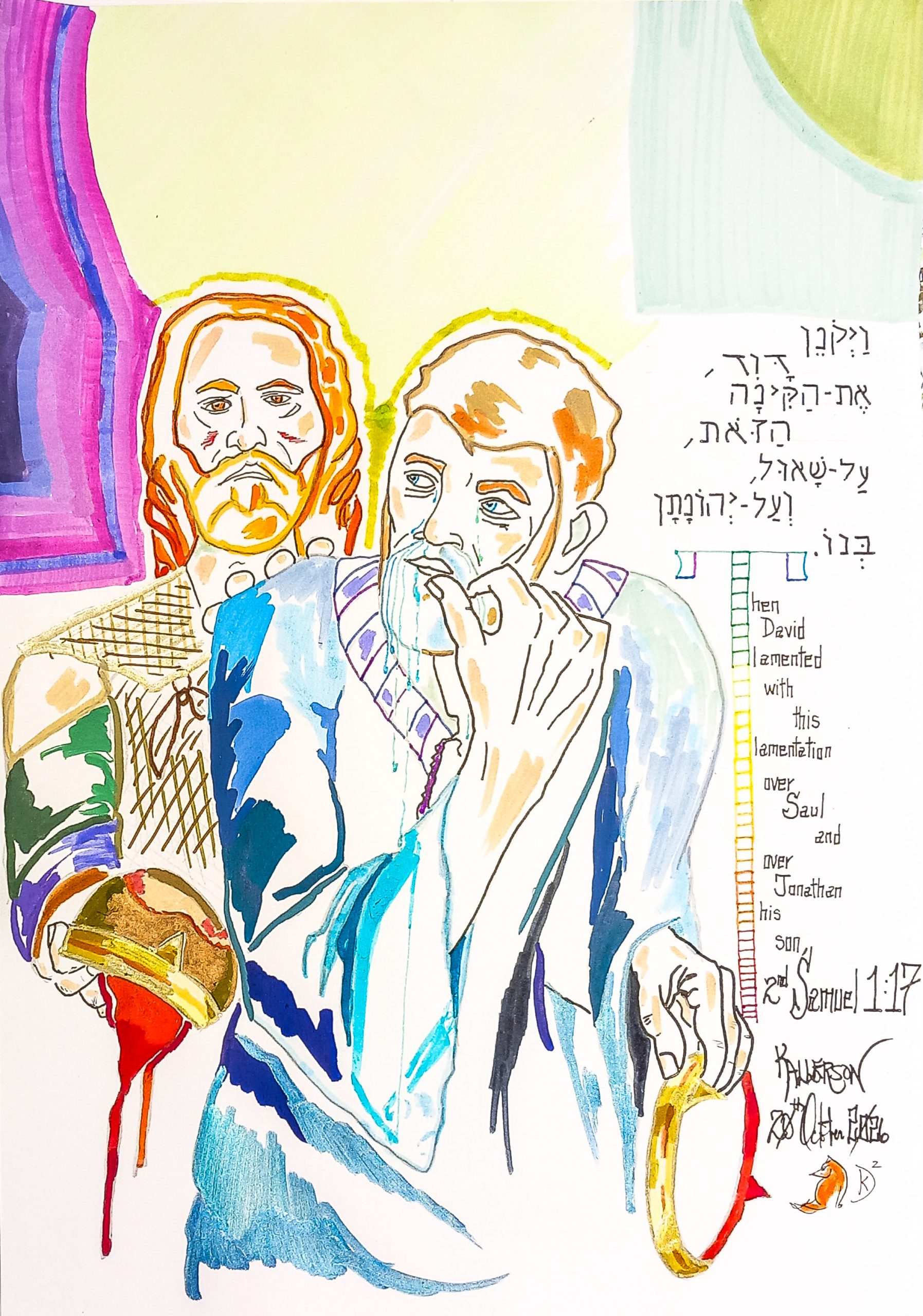
17 Then David lamented with this lamentation over Saul and over Jonathan his son,

vayqonen david eth-ha’qinah ha’zoth al-shaul və’al-yəhonathan beno – “And he dirged*, David את the dirge, the this, upon Saul, and upon Jehonathan his son.” Saul, the anointed of Israel and a man David never felt personal enmity towards, along with Jonathan, his beloved friend, are dead. David does what he often did in times of stress, distress, sadness, joy, etc. He put pen to parchment, writing what was on his heart.

In this instance, a new word in the Bible is seen, qonen, to chant or wail at a funeral. Along with that, the noun form, qinah, is also introduced in this verse. The words are connected with the thought of striking a musical note or beating on the breasts.

David means Beloved. Saul means Asked. Jonathan means Yah Has Given. His name will be mentioned five times in these verses. All five times, it will be spelled with the additional letter hey (our h). It is the fifth letter of the aleph-bet and means look, reveal, and breath –

יוֹנָתָ֗ן
יְהוֹנָתָ֜ן

A funeral dirge is not just something David wrote and sang to ease his own distress. Rather, like the National Anthem, David wanted the music to be remembered in the collective conscience of the people as a testimony to the fallen king and his anticipated heir. Thus, this was intended to be a historical song for Israel…

18 and he told them to teach the children of Judah the Song of the Bow;

vayomer ləlamed bəne-yəhudah qashet – “And he said to train ‘sons, Judah’ – Bow.” The word lamad, to goad as with a rod, is used. It is usually translated as teach, but that doesn’t always give the sense of a deeper instilling of what is being conveyed. David wants the dirge to be trained into the people so that they will remember it, just as we remember the Star-Spangled Banner.

In this case, the name of the dirge is qeshet, Bow. The word is from qashah, which gives the sense of being stiffened. Wood, when it is put under tension, such as when formed into a bow, stiffens. What may be the case, and how I will present it, is that this song was to be committed to memory while practicing the bow.

In other words, it would be a military song, sung by the people as they were in training, just as military men sing while marching. In this case, it would be while shooting arrows at targets. Some translations seem to imply this is what they thought as well. Through the use of various inserted words, they say –

“Also he bade them teach the children of Iudah to shoote…” Geneva
“Also he bade them teach the children of Judah the use of the bow…” KJV

Others, such as the NKJV, take the clause to mean that the song alone is being referred to. The people were to learn the song for the sake of learning it, apart from any military application. That is possible, but using the song as a means of both memorization and military discipline seems to suit the context better.

It is speculation, but it matches what we could expect for those sons of Judah while in military training. Of this Song of the Bow…

18 (con’t)  indeed it is written in the Book of Jasher:

hineh khetuvah al-sepher ha’yashar – “Behold! Written upon ‘Book, the Upright.” The word ha’yashar is common in the Old Testament, such as in Deuteronomy 6:18, “And you will do the upright [ha’yashar] and the good in ‘eyes, Yehovah’ to intent: it will wellify to you…”

However, this word is used twice to indicate a particular book, sepher ha’yashar, ‘Book, the Upright’. Quite commonly it is only transliterated as the Book of Jasher. It is noted twice in the Bible, here and in Joshua 10 –

“Then he will speak, Joshua, to Yehovah in ‘day, giving Yehovah the Amorite’ to ‘faces, sons, Israel’, and he said to ‘eyes, Israel’:

Sun in Gibeon, you must mute!
And moon in ‘Valley, Aijalon’!
13And it muted, the sun,
And moon, it stood,
Until he will avenge ‘nation, his hatings’.

(Indeed) not it written upon ‘Book, the Upright’? And it stood, the sun, in ‘half, the heavens’, and not it pressed to go according to ‘day, complete’.” (CG) Joshua 10:12, 13

From these two uses, it appears likely that it is a poetical book of the heroic deeds of the people. It very well may be the same book called “the Book of the Wars” in Numbers 21. The poetic verses cited in that chapter are said to be written there.

It was probably a collection of songs or psalms that celebrated the great acts of the Lord and the powerful deliverances the people experienced through His personal action.

Later, in Deuteronomy, the name Jeshurun, Upright, was used by Moses to describe Israel. As such, it very well may be that the Book of the Wars was renamed the Book of the Upright to indicate the wars of Israel under the Lord.

This is speculation, but it fits with how the narrative developed. Putting these words side by side, one can see the similarity of the Hebrew, and how each plays upon the name Israel –

Israel – Yisrael:  יִשְׂרָאֵל
Jeshurun – Yeshurun: יְשֻׁרוּן
The Upright – ha’yashar: הַיָּשָׁ֑ר

As a side note, there is a book available on the internet called The Book of Jasher. It has nothing to do with the Book of Jasher noted in Scripture. It is a later forgery, and a poor one at that, containing references to France and Italy, confirming it was written much later, probably during the 16th century.

With the introduction complete, David next begins the Bow…

19 “The beauty of Israel

ha’tsevi yisrael– “The ‘splendor, Israel’.” The word tsviy, splendor, is translated as gazelle at times, because of their grace and beauty. Because of this, the Aramaic translations and some scholars argue that this verse should say ‘gazelle, Israel’, referring to Jonathan, who was like a gazelle.

That is not a sound analysis. The dirge is about Saul and Jonathan together, united as the ‘splendor, Israel’. Verse 19 forms an epigraph to the song where David sets the theme for the main body.

David sums up the personages of Saul and Jonathan as the ‘splendor, Israel’ because Saul, as the king, stands as the epitome of the kingdom. He is like a beacon of light to the kingdom. Likewise, his heir-apparent, Jonathan, is included because he was the one set to carry the name of the House of Saul forward.

One can imagine a line of men training with the bow, raising them in unison and saying ha’tsevi yisrael, while considering the splendor of Saul’s house continuing over the nation. But that will never come to pass because this splendor…

19 (con’t) is slain on your high places!

al-bamotekha khalal – “Upon your elevations – pierced!” Saul and Jonathan, along with Saul’s other sons, died together on Mount Gilboa –

“And Philistines ‘being fought’ in Israel. And they fled, ‘mortals, Israel’, from ‘faces, Philistines’. And they fell, pierced, in ‘Mount, the Gilboa’. 2And they caused to impinge, Philistines, Saul and his sons. And they caused to strike, Philistines, Jehonathan, and Abinadab, and Malki-shua, ‘sons, Saul’. 3And it enweighed, the battle, unto Saul. And they found him, the ‘causing to flow mortals’ in the bow. And he whirled, vehemently, from the ‘flowers’.” 1 Samuel 31:1-3 (CG)

Imagine the bowmen with their bows fully raised, drawing back the bowstring, shouting out al-bamotekha (upon your elevations), and then releasing the arrow while calling out khalal, pierced!

The shouts of the men as they let flow the arrows, would match the scene in their minds of Saul and Jonathan being pierced through as they battled on Mount Gilboa. After that, the men would lower their bows, just as if Saul and Jonathan were falling to the ground in battle. As their bows went to that state of rest, the men would call out…

19 (con’t) How the mighty have fallen!

eikh naphəlu gibborim – “How they fell, mighties.” With the cadence and substance of their words matching the raising, shooting, and falling of the bows, one could easily replay the sad ballet of the deaths of Saul and Jonathan in his mind.

It is easy to see how such a song would be perfect for military instruction and remembrance every time an archer would go out to practice. It would be so ingrained in him that he would automatically repeat the song, just as those in a march do when the cadence caller shouts out.

This phrase, eikh naphəlu gibborim, is repeated three times in the song, resounding like a dirge-bell repeatedly being struck, “How they fell, mighties!” It sets the tone, carries the grief, and binds the lament together.

At the same time, it serves another purpose for the archers. It would steel their minds, preparing them for battle as they mentally determined to never again allow such a loss among their nation. They would take the initiative. They would pierce the enemy. They would be the victors, remembering Saul and Jonathan in their battle cry, while anticipating triumph over the foe.

20 Tell it not in Gath,

al-tagidu vəgath – “Not you will cause to declare in Gath.” Gath is close to the border of Israel, lying on Philistia’s eastern edge. Its name means Winepress. David poetically commands that the news of the deaths of Saul and Jonathan not be proclaimed in Gath. If it were, there would be a resulting commotion within the borders of Philistia. That will be seen in a moment.

Along with Gath, David says…

20 (con’t) Proclaim it not in the streets of Ashkelon—

al-təvasəru bəkhotsoth ashqelon – “Not you will announce in ‘outsides, Ashqelon’.”  Ashkelon is on the west coast of Philistia. Thus, David covers the total distance across the land of the Philistines. As such, the two cities are poetically used to represent the whole of Philistia.

David is in Ziklag. It is notable that despite Ashkelon being a bit south of ancient Gath (today known as Tel es-Safi), the two cities are in a straight line from Jerusalem. It is as if the Lord inspired David to choose these two cities, using Jerusalem as the reference to do so.

The word basar, announce, more fully signifies announcing good news. David does not want Israel’s sad tidings to be proclaimed as “good tidings” in Philistia, and he certainly didn’t want it reaching the ears of the people in Ashkelon, Market. The reason for the words of these two clauses is…

20 (con’t) Lest the daughters of the Philistines rejoice,

pen-tismakhna bənoth pəlishtim – “Lest they will brighten, ‘daughters, Philistines’.” If the news of the battle reached Philistia, the women of the land would become jubilant at the victory over their foes. David would have such a time of rejoicing removed forever from their ears. Next, he uses parallelism to repeat the previous sentiment…

20 (con’t) Lest the daughters of the uncircumcised triumph.

pen-ta’alozəna bənoth ha’arelim – “Lest they will jubilate ‘daughters, foreskinned’.” This is a new word, alaz. It signifies to jump for joy. It is similar to, but maybe a bit more elevated than alats, a word first seen in 1 Samuel 2:1. They both have the same general meaning.

However, to differentiate the two, I chose the word jubilate. One can see the similarity between the two words. It is possible that over time, a mispronunciation of the two may have caused one word to stem from the other, like shibboleth and sibboleth –

עָלַז – alaz
עָלַץ – alats

David couldn’t bear the thought of the daughters of the uncircumcised enemy rejoicing from border to border over the deaths of the splendor of Israel.

Imagine the four clauses of this verse being formed into the continuing military drill. With bows down, the men would reach for another arrow from their quivers while calling out the first clause, al-tagidu vəgath.

Then they would notch the arrow and raise the bow while proclaiming, al-təvasəru bəkhotsoth ashqelon. That would be followed by drawing back the bow and aiming at the enemy while shouting pen-tismakhna bənoth pəlishtim. That would be immediately followed by a volley of arrows flying toward the enemy with the cry, pen-ta’alozəna bənoth ha’arelim.

The majestic beauty of the whirling pen of David next turns to the location where Saul and Jonathan met their end…

21 “O mountains of Gilboa,

hare vagilboa – “Mountains in the Gilboa.” The plural is poetic and geographic: the one place, Mount the Gilboa, is addressed in all its ridges, slopes, and heights. David makes the whole landscape answer for the tragedy and shame of Israel’s fall. He does this by proclaiming…

21 (con’t) Let there be no dew nor rain upon you,

al-tal və’al-matar alekhem – “Not dew and not rain upon you.” David is poetically calling for eternal drought to be on the mountain as a testament to the death of Saul and Jonathan. Just as they died, so the mountain should forever reflect their death. Next, in apposition to that…

21 (con’t) Nor fields of offerings.

The words are abstruse: usəde tərumoth – “And fields – raise-offerings.” The terumah, raise-offering, comes from rum to rise or raise. It is an offering that is presented before the Lord, raised like a presentation being lifted to Him. This type of offering included personal possessions, such as metals, fabrics, etc., for building the tabernacle.

It was used widely in Leviticus concerning animal sacrifices to the Lord. In Numbers 15, it includes dough, grain, and produce from the land. Thus, səde terumoth, fields – raise offerings, suggests fields fruitful enough to yield sacred contributions to Yehovah.

David is using the same thinking as in the previous clause. Let those fields not produce in this manner. I suggest the point is that David is mentally picturing the battle as the archers stood on the fields lifting their bows in the direction of Israel, as if they were raise-offerings, and then letting them flow toward Israel’s army, including Saul and Jonathan.

Because of this, and in memory of the event, he is calling for the fields to be desolate and unable to produce suitable offerings to Yehvoah. With more to pen concerning his beloved friends, David further explains his appeal to the mountains and fields…

21 (con’t) For the shield of the mighty is cast away there!

Rather: ki sham nig’al magen gibborim – “For there, it was detested, ‘shield, the mighties’.” David again poetically uses a plural concerning Saul. It signifies that he was the embodiment of all that is mighty in battle. However, because of the blood that was shed, which defiled the shield, it was to be detested.

This was seen in Numbers 31 when Israel took vengeance on the Midianites. Those who went to battle where people were slain were to have their implements purified with the water of purification. However, Saul died, and his shield was not purified.

It isn’t that Saul’s shield was cast away, a rendering which does not fit the Hebrew word gaal. That may be the result, but it is not the intent. The shield may be rejected, but only because it was detested.

Again, as stated before, one can imagine those training in the use of the bow following through with their practice while calling out each clause.

21 (con’t) The shield of Saul, not anointed with oil.

magen shaul bəli mashiakh bashamen – “‘Shield, Saul’ – failure: anointing in the oil.” These words are placed in apposition to the previous clause. Because the shield was not cleansed with the water of purification, it was not to be handled, including being anointed with oil, something warriors did to protect them from the elements.

Some try to align the word mashiakh with Saul, the anointed of the Lord. It is not referring to him. However, it does bring to mind that he was the mashiakh, the anointed, of the Lord. Thus, there is an implied pun where the anointed of the Lord’s shield failed to receive its anointing.

As with the previous verses, one can imagine those practicing with their bows aligning their actions with each clause. It would seem likely that as the arrows were raised to shoot, they would be aligned with the words usəde tərumoth, and ‘fields, raise-offerings’, as if the archers are responding to a battle with their own raised arrows.

It’s speculation, but it fits with David’s teaching the sons of Judah the Bow. If this is correct, the military practice would continue with the next words…

22 From the blood of the slain,

midam khalalim – “From ‘blood, the pierced’.” These words can be taken in one of two ways. The first is that David is referring to the blood of their enemies. The second is that it refers to the blood of the Israelites who fell around Saul and Jonathan as they continued the battle.

The former is correct. David is writing in parallelism. In this clause, he refers to those whose blood was shed by Jonathan. The next clause changes the subject…

22 (con’t) From the fat of the mighty,

mekhelev gibborim – “From ‘fat, mighties’.” Here David refers to those who were slain by Saul in battle. As is common in Hebrew poetry, an idea is set forth and only afterward is the subject introduced. The subject of each clause is next presented…

22 (con’t) The bow of Jonathan did not turn back,

qeshet yəhonathan lo nasog akhor – “‘Bow, Jehonathan’, not it was retreated backside.” Jonathan did not turn and run with his bow pointing in the opposite direction of the battle. Rather, he faced the enemy as long as he was physically able to do so. Placing the first and third clauses side by side, David’s intent is seen –

“From ‘blood, the pierced’,
‘Bow, Jehonathan’ not it was retreated backside.”

The parallelistic arrangement continues…

22 (con’t) And the sword of Saul did not return empty.

vəkherev shaul lo tashuv reqam – “And ‘sword, Saul’, not it will return emptily.” Until he could no longer fight, Saul kept up the battle, cutting into his foes as they came before him. The parallelism is seen in the second and fourth clauses –

“From ‘fat, mighties’,

… ‘sword, Saul’ not it will return emptily.”

As before, the clauses would be memorized by practicing archers, learning both the song and the skill of the bow. When they entered into real battle, they would carry the imagery in their minds, targeting their enemies and standing fast, just as Saul and Jonathan did.

One can almost sense what a U.S. Marine might think while engaged in battle –

“Here’s health to you and to our Corps
Which we are proud to serve;
In many a strife we’ve fought for life
And never lost our nerve.”

David next changes direction to speak of the men intimately…

Strong warriors engaged in battle
Saul and Jonathan fighting Philistines
The arrows flow, and the swords rattle
Their time has come, so it seems

As one and then another fall around the men
They continue to fight. Hear their swords rattle
The arrows hit their mark again and again
For them, it is the end of the battle

But it is not the end for those who know
For those who serve the God of Israel
Even death cannot win – that mighty blow
He will keep His people from the clutches of hell

II. My Brother, Jonathan (verses 23-27)

23 “Saul and Jonathan were beloved and pleasant in their lives,

shaul vihonathan ha’ne’ehavim vəhanə’imim bəkhayehem –

“Saul and Jehonathan –

The ‘being cherished’, and the delightful in their livings.”

David refers to both of them with these descriptions. He is not trying to explain a relationship between the two (Cambridge et al.). Rather, David conveys how he (and others) viewed Saul and Jonathan. They were affectionately seen as united.

Throughout their days, they were “being cherished.” The participle signifies that they were cherished and continued to be cherished throughout their lives. David overlooks Saul’s many faults, recognizing him as the beloved leader of Israel with Jonathan at his side.

The “delightful in their livings” signifies that they were people worthy of emulation. Others would see them and strive to be like them. David thus erases every fault Saul was known for in his gracious eulogy. Having joined them in life as examples others could aspire to, David also unites them as their lives closed out…

23 (con’t) And in their death they were not divided;

uvəmotam lo niphradu – “And in their death, not they were parted.” As a team, the king of Israel and his heir-apparent stood together in battle and then faced death as one. It is a high compliment that after the death of one, the other stood fast and continued the fight until he, too, succumbed to death on the battlefield.

David continues the united accolades…

23 (con’t) They were swifter than eagles,

Rather: min-nəsharim qalu – “From eagles, they lightened.” The word qalal signifies to be or make light. This doesn’t speak of the eagle’s swiftness but of its soaring nature. David refers to their exalted status. Just as an eagle soars in the heavens, Saul and Jonathan soared above the people, and even more than eagles. And more…

23 (con’t) They were stronger than lions.

me’arayot gaveru – “From lions, they prevailed.” All translations that I know of except the ISV say stronger or mightier. That is certainly the case, but it does not exhaust David’s intent. The ISV says that they were “more valiant than lions.” Even that only provides one trait of the lion.

The word gavar signifies to prevail, such as when the waters prevailed and increased over the earth during the flood. David is drawing on the nature of the lion itself.

The lion is strong, bold, watchful, stealthy, fierce, majestic, patient, commanding, fearless, and more. It is also predatory and ferocious, something applicable to the best of military men when engaged in combat. In whatever way a lion is regarded as noble, formidable, or surpassing among beasts, Saul and Jonathan prevailed beyond it.

David has placed Saul and Jonathan at the height of human excellence. As eagles surpass in the heavens with their lofty majestic soaring, and as lions surpass all beasts in strength and majesty, so these two men surpassed even these creatures in the qualities for which they were renowned.

One can imagine warriors practicing the bow calling out these words, strengthening their own resolve, and desiring to be like Saul and Jonathan. With his accolades of Saul and Jonathan complete, the dirge takes another direction…

24 “O daughters of Israel, weep over Saul,

bənoth yisrael el-shaul bəkhenah – “‘Daughters, Israel’, unto Saul, you must weep.” Saul was the king of Israel. He led the army against Nahash the Ammonite, saving the people from a collective national embarrassment.

He also battled Philistines, Amalekites, Moabites, Edomites, and the kings of Zobah to secure his borders and rid the land of Israel’s enemies. His battles allowed the women of Israel to live lives of peace and prosperity. David implores them to weep for their slain king…

24 (con’t) Who clothed you in scarlet, with luxury;

ha’malbishkhem shani im-adanim – “The ‘causing to clothe you’ – scarlet, with pleasures.” Such items as scarlet were expensive. The words “with pleasures” mean that it came in a variety of ways, such as garments, sheets, coverings, etc. These things had to be labored for, traded for, or taken in battle. However they were acquired, Saul made it possible for the daughters of Israel to possess them. And more…

24 (con’t) Who put ornaments of gold on your apparel.

ha’ma’aleh adi zahav al-ləvushəkhen – “The ‘causing to ascend’ ‘finery, gold’ upon your clothing.” This may be referring to gold thread or gold ornamentation upon their clothes. Either way, these are things that reveal a prosperous society. Saul, through his leadership abilities, was able to secure the nation and plunder its enemies.

The women should consider his life and devotion to leading the nation and mourn over their fallen hero. And more, there is every reason to assume that those practicing the bow would call out these words as well. They were men of Israel with families of their own to protect. Each arrow they practiced with would be in defense of the women of Israel.

25 “How the mighty have fallen in the midst of the battle!

eikh naphəlu gibborim bətokh ha’milkhama – “How they fell, mighties, in ‘midst, the battle’.” Again, David’s lament turns on the words eikh naphəlu gibborim, “How they fell, mighties.” It is the song’s burden, its refrain, and its ache. David was stunned at the loss –

“And he caused to seize, David, in his garment, and he rent them, and also all the mortals who with him. 12And they lamented, and they wept, and they fasted until the evening upon Saul, and upon Jehonathan his son, and upon ‘people, Yehovah’, and upon ‘house, Israel’, for they fell in the sword.” 2 Samuel 1:11, 12

Even after collecting himself, the thought of the defeat haunted him as he penned out the words of this dirge. The mighty warriors of Israel had fallen in battle, and chief among them were Saul and Jonathan. With that in mind, David’s most personal loss comes to the forefront…

25 (con’t) Jonathan was slain in your high places.

yəhonathan al-bamotekha khalal – “Jehonathan, upon your elevations – pierced.” David would have remembered the time Jonathan and his armorbearer alone took on an entire garrison of Philistines. The achievement would have been considered heroic by all who heard of it. His military fame would have been legendary.

One can imagine a line of warriors with their bows remembering David’s pain and not wanting it to be repeated in their own lives. And so, while practicing their skills, they call out the Bow.

For David, the thought that Jonathan was gone would come flooding back into his mind time and again, wondering if it was just a nightmare he would wake up from. How could Jonathan be gone? And so his lament continues…

26 I am distressed for you, my brother Jonathan;

tsar-li alekha akhi yəhonathan – “It ‘cramped’ to me, upon you, my brother, Jehonathan.” David felt like he was in a room with the walls closing in on him. His surroundings smothered him as he considered the loss of his closest and most personal friend. Anyone who has lost someone very close can immediately empathize with David’s plight. It is as if there is nothing but sadness left in life…

26 (con’t) You have been very pleasant to me;

na’amta li məod – “You sweetened to me, vehemently.” The word naem signifies to be agreeable. Thus, one gets the sense of delight, pleasantness, etc. As the verb is in the perfect aspect, the word sweetened fits David’s remembrance of Jonathan. Everything about their relationship was sweet and welcome. And more…

26 (con’t) Your love to me was wonderful,
Surpassing the love of women.

niphləathah ahavatəkha li me’ahavath nashim –

“It was marveled, your love, to me,
From ‘love, women’.”

David’s remembrance of their fellowship, how they stood with one another in adversity and trial, the covenant they cut, all of it was more personal and memorable than even the love of a woman.

There is nothing sexual or physically intimate to be considered. Rather, it is the fellowship of warriors whose lives became completely intermingled with the most personal events humans can experience.

The soldiers, working on their archery skills, would contemplate what it meant to lose someone so near and dear to them. It would make them all the more willing to stand in the heat day after day and practice their skills. With such a thought coming to mind, David again cries out…

27 “How the mighty have fallen,

eikh naphəlu gibborim – “How they fell, mighties.” For the third time, David sounds the mournful refrain. It is the summary burden of the song, the grief that gathers every line into itself. One can see David years later standing on the practice field with a line of men learning archery skills. As they practiced, they would call out these words of the Bow.

With each cry of these particular words, David would remember the events that caused him to write this dirge. He would remember Jonathan and consider the hoped-for right-hand man that was never to be. It would prompt him to be even more adamant that his men should be properly prepared for battle.

If Jonathan could fall, anyone could fall. The men needed to be prepared. And so, they would practice and sing the mournful words of the Bow, because if they were outmatched, the final words of the dirge would apply to their own bows…

*27 (fin) And the weapons of war perished!”

vayovədu kəle milkhama – “And they… gone, ‘vessels, battle’.” One can feel the emotion in David’s words. He equates Saul and Jonathan to weapons of war. They were used in battle and perished in the battle. He considers them, pauses, and then notes that they, like their actual battle implements, have vanished into the past, never to rise and be used again.

If the archers failed to heed instruction, they too would perish in battle. The Bow would have been a tool to remind the men of Judah of the cost of war and the importance of being prepared for it. War is something that nations face. This is reality.

Therefore, not being prepared for it by failing to consider its consequences is a fatal mistake. In a few verses, David set forth the Bow as a testament to the lives of Saul and Jonathan, but also as a tool of instruction for the sons of Judah to learn from.

The Bible serves this purpose as well. It is a testament to the work of God in Christ, who gave His life to secure His people from the greater battle all humanity faces. It is a tool of instruction for those who commit to memory and contemplate its precepts.

There is a battle being waged in the world, and people are lost to it every day. Without Jesus, they will perish, never rising to the life God offers to any who are willing to come to Him through His Son. Paul writes about the battle we are facing and the implements we possess in order to be victorious.

His words will do no good if we don’t read them and apply them to our lives. Let us learn how to engage the enemy, be prepared for his attacks, and go on the offensive against him. To wage that war, we must first yield ourselves to the Commander of the battle.

Without Him, the battle is already lost. With Him, the outcome is certain. Yes! Victory! So call on the Lord, be saved, and then engage the ongoing battle that continues to be waged around us in the world.

Closing Verse: “Therefore take up the whole armor of God, that you may be able to withstand in the evil day, and having done all, to stand.” Ephesians 6:13

Next Week: 2 Samuel 2:1-11 What an uncomfortable name, it couldn’t have been fun… (Man of Shame, Part I) (3rd 2 Samuel sermon)

The Lord has you exactly where He wants you. He has a good plan and purpose for you. He is the One who abases the haughty and exalts the humble. He regards the lowly, and the proud, He knows from afar. So yield yourself to Him, trust Him, and believe His word. In this, He will do great things for you and through you.

2 Samuel 1:17-27 (CG)

17And he dirged*, David, את the dirge, the this~ upon Saul, and upon Jehonathan his son. 18And he said to train ‘sons, Judah’ – Bow. Behold! ‘Written upon Writing, the Upright:

19The ‘splendor, Israel’’
Upon your elevations – pierced!
How they fell, mighties.
20Not you will cause to declare in Gath,
Not you will announce in ‘outsides, Ashqelon’.
Lest they will brighten, ‘daughters, Philistines’,
Lest they will jubilate*, ‘daughters, the foreskinned’.

21Mountains in the Gilboa,
Not dew and not rain upon you.
And fields – raise-offerings.
For there, it was detested, ‘shield, mighties’,
‘Shield, Saul’ – failure: anointing in the oil.
22From ‘blood, the pierced’,
From ‘fat, mighties’,
‘Bow, Jehonathan’ not it was retreated backside.
And ‘sword, Saul’ not she will return emptily.

23Saul and Jehonathan –
The ‘being cherished’, and the delightful in their livings.
And in their death, not they were parted.
From eagles, they lightened.
From lions, they prevailed.

24‘Daughters, Israel’, unto Saul, you must weep.
The ‘causing to clothe you’ – scarlet, with pleasures,
The ‘causing to ascend’ ‘finery, gold’ upon your clothing.

25How they fell, mighties, in ‘midst, the battle’.
Jehonathan, upon your elevations – pierced.
26It ‘cramped’ to me, upon you, my brother, Jehonathan.
You sweetened to me, vehemently.
It was marveled, your love, to me,
From ‘love, women’,
27How they fell, mighties,
And they… gone, ‘vessels, battle’.

*Verse 17 – Hebrew: qonen. To chant or wail at a funeral. Also, noun form, qinah, is found in this verse.
*Verse 20 – Hebrew: alaz, to jump for joy. It is similar to, but maybe a bit more elevated than alats (see 1 Samuel 2:1), which has the same general meaning.


2 Samuel 1:17-27 (NKJV)

17 Then David lamented with this lamentation over Saul and over Jonathan his son, 18 and he told them to teach the children of Judah the Song of the Bow; indeed it is written in the Book of Jasher:

19 “The beauty of Israel is slain on your high places!
How the mighty have fallen!
20 Tell it not in Gath,
Proclaim it not in the streets of Ashkelon—
Lest the daughters of the Philistines rejoice,
Lest the daughters of the uncircumcised triumph.

21 “O mountains of Gilboa,
Let there be no dew nor rain upon you,
Nor fields of offerings.
For the shield of the mighty is cast away there!
The shield of Saul, not anointed with oil.
22 From the blood of the slain,
From the fat of the mighty,
The bow of Jonathan did not turn back,
And the sword of Saul did not return empty.

23 “Saul and Jonathan were beloved and pleasant in their lives,
And in their death they were not divided;
They were swifter than eagles,
They were stronger than lions.

24 “O daughters of Israel, weep over Saul,
Who clothed you in scarlet, with luxury;
Who put ornaments of gold on your apparel.

25 “How the mighty have fallen in the midst of the battle!
Jonathan was slain in your high places.
26 I am distressed for you, my brother Jonathan;
You have been very pleasant to me;
Your love to me was wonderful,
Surpassing the love of women.

27 “How the mighty have fallen,
And the weapons of war perished!”

2 Samuel 1:1-16 (I Killed ‘Anointed, Yehovah’)

Artwork by Douglas Kallerson

2 Samuel 1:1-16
I Killed ‘Anointed, Yehovah’

(Typed 15 & 17 June 2026) 1 and 2 Samuel are considered one book in the Hebrew canon. 2 Samuel is a seamless continuation of 1 Samuel. However, that doesn’t mean that the division in our canon is inappropriate.

It is not uncommon to read commentaries that dismiss the division of Samuel into two books. Cambridge, for example, says, “The narrative of the closing chapters of the First Book is continued without any break. The division of the Books is purely artificial, and did not exist in the original Hebrew text.”

And yet the division was not invented by a Christian who wanted to disassociate the writings from the Jewish canon. Rather, the division is found in the Septuagint, the Greek translation of the Old Testament, which is of Jewish design.

My introduction to 1 Samuel is thorough, including some of the main information for 2 Samuel. Therefore, only a few key points concerning the book will be provided here, such as the key verse of the book, which is…

Text Verse: “And it will be established, your house and your kingdom, until vanishment to your faces. Your throne, it will be ‘being erect’ until vanishment” 2 Samuel 7:16 (CG)

2 Samuel is the tenth book of the Old Testament. It would be tough to find a better example of the realization of the underlying meaning of the number ten than this being the tenth book. The generations of man began with Adam.

They have been steadily worked through in the pages of the Bible since him, finally leading to David, the one whose house becomes emblematic of the messianic throne, and through whom comes the Messiah who is recognized by that throne, He being the “Son of David.”

The events of the book of 2 Samuel cover about forty years, from the beginning of David’s reign over Judah and later all of Israel, and ending chronologically in Chapter 20, with the quashing of a treasonous uprising against him.

Chapters 21-24 are generally accepted as a non-chronological appendix detailing several key events that occurred during David’s reign.

David’s rule demonstrates great devotion to the Lord, even during times of severe lapses in faithful obedience to Him. That may sound contradictory unless you, as a saved believer, go look in the mirror and consider your own life and actions.

There are twenty-four chapters to go in 2 Samuel, so let’s get started. Great things are to be found in His superior word. And so, let us turn to that precious word once again, and… May God speak to us through His word today, and may His glorious name ever be praised.

I. Saul, and Jehonathan His Son, They Died (verses 1-5)

Now it came to pass after the death of Saul

vayhi akhare moth shaul – “And it was, after ‘death, Saul’.” The words follow after 1 Samuel 31, which detailed the death of Saul and his sons. That was followed by the actions of those in Jabesh Gilead, who arose and retrieved the bodies of Saul and his sons, taking them back to Jabesh and burning them, after which they buried their bones.

While those events were going on, other events were happening.

Saul means Asked. It is identical in unpointed spelling to Sheol.  Following those events detailed in 1 Samuel 31, it next says…

1 (con’t) when David had returned from the slaughter of the Amalekites,

vədavid shav mehakoth eth ha’amaleq – “and David, he returned from causing to strike the Amalek.” This is the only time the term “the Amalek” is found in Scripture. It is an odd phrase to use, replacing the more common term “the Amalekites.” Not a single translation that I read accurately translates it as it is given, with the article followed by the name in the singular.

This refers to the battle carefully detailed in Chapter 30, where David and his men crossed Wadi, the Besor to reclaim all the people and booty taken by the Amalekite invaders who plundered David’s city of Ziklag.

David means Beloved. Amalek is derived from am, people, and malaq, to nip or wring off the head of a bird with or without severing it from the body. They are The People Who Wring Off. They are those who are disconnected from the body and who strive to disconnect the body. Once the battle was complete and David returned…

1 (con’t) and David had stayed two days in Ziklag,

vayeshev david bətsiqlag yamim shənayim – “and he sat, David, in Ziklag ‘days, two’.” While Saul was alive, David had escaped to the land of the Philistines. Ziklag belonged to the Philistines at the time. After David took up residence there, it became a city of Judah from that time on.

Ziklag is derived first from tsuq, to pour out or melt, or to oppress or distress, such as to put pressure on someone to give up information or to lay siege to a city. The second part is from log, a small amount poured into a hollow, like the hand. Thus, it signifies Measure of Pressure.

Two is the number of division or difference. Two days after David returned there…

2 on the third day,

vayhi bayom ha’shəlishi – “And it was, in the day, the third.” Following the timeline from David’s return from marching with the Philistines, through all of the trials that occurred after that, it seems that David returned to Ziklag on the same day or within one day of Saul’s death in battle.

Three stands for that which is solid, real, substantial, complete, and entire. Bullinger expands on that and says –

“The number three, therefore, must be taken as the number of Divine fulness. It signifies and represents the Holy Spirit as taking of the things of Christ and making them real and solid in our experience. It is only by the Spirit that we realise spiritual things. Without Him and His gracious operation, all is surface work: all is what a plane figure is to a solid (John 3:6). He it is who has wrought all our works in us, and by whom alone we can serve or worship (John 4:24).”

2 (con’t) behold, it happened that a man came from Saul’s camp 

vəhineh ish ba min-ha’makhaneh me’im shaul – “and behold, man coming from the camp, from with Saul.” Whether this person was actually with Saul as a part of his amassed army or whether he was just in the area at the time of the battle is debated. Here it says he came “from with Saul.” That is not definitive enough to say he was a part of Saul’s army. Either way, he came from the battlefield…

2 (con’t) with his clothes torn and dust on his head.

u-vəgadav qəru’im va’adamah al-rosho – “and his garments rent, and ground upon his head.” These are both signs of mourning and distress. One tears his garments in a time of distress, such as bad news or great grief. Putting the ground on one’s head indicates an idea like, “From the ground I came, and to the ground I will return.” As such, it is a sign of mourning for the dead, an indication that one feels he is deserving of death, etc.

2 (con’t) So it was, when he came to David, that he fell to the ground and prostrated himself.

vayhi bevoo el-david vayipol artsah vayishtakhu – “And it was, in his coming unto David, and he fell earthward, and he prostrated himself.” This is an act of subordination, recognizing David as the superior. So far, this is what one would expect of someone attempting to humble himself and report tragic news. David recognizes this…

3 And David said to him, “Where have you come from?”

vayomer lo david ei mizzeh tavo – “And he said to him, David, ‘Where from this you will come?’” When someone shows up in the condition this guy is in, the question is perfectly natural. Something has happened, and David is curious what it is…

3 (con’t) So he said to him, “I have escaped from the camp of Israel.”

vayomer elav mimakhaneh yisrael nimlaṭəti – “And he said unto him, ‘From ‘camp, Israel’ I was eluded.” This doesn’t bode well for Israel. To run from the camp would be unthinkable if there was a resounding victory. Thus, David probably next speaks in a hesitant and anxious tone…

4 Then David said to him, “How did the matter go? Please tell me.”

vayomer elav david meh-hayah ha’davar hagged-na li – “And he said unto him, David, ‘What it was, the word? You must cause to declare, pray, to me.’” Without being in the room, we can’t know the intonation of David’s voice, but it seems he must be stressed or fearful about the answer he may receive. The reason for this is seen in the response…

4 (con’t) And he answered, “The people have fled from the battle,

vayomer asher nas ha’am min-ha’milkhama – “And he said, ‘That it fled, the people, from the battle.’” It seems that his words form an ellipsis. David asked, “What it was, the word?” Instead of replying normally, he said, “It fled, the people, from the battle.” The response begins with a relative pronoun, “That it fled…” Thus, the ellipsis would be something like, “The word is that it fled…”

The person speaking can tell that David is disturbed, and so his response doesn’t follow the expected grammar. Without knowing the intonation, facial expression, and so forth, it is hard to tell if he thinks David is excited (maybe he will be the king soon), fearful (Israel has been defeated in battle), or something else.

Whatever the case, the man has purposefully spoken to accentuate the events. First, the battle has gone in the favor of the Philistines. His next words elevate the intensity of the situation…

4 (con’t) many of the people are fallen and dead,

vəgam harbeh naphal min-ha’am vayamuthu – “and also ‘causing to increase’, he fell from the people, and they died.” Not only did Israel turn and flee, but they were cut down as they did. The use of the singular and then the plural is like saying, “Man after man fell from the people, and as they fell, they died.” His words are excitedly intense and descriptive. And more…

4 (con’t) and Saul and Jonathan his son are dead also.”

vəgam shaul vihonathan beno metu – “And also Saul, and Jehonathan his son, they died.” This is the climax of the matter. Not only did Israel suffer great defeat and loss of men, but also the king and his anticipated successor are dead. This puts the nation in a difficult place without someone competent to assume leadership.

Israel had asked for a king. The request was granted, thus ending the time of the judges. Now, the nation stood as a rudderless ship without the king appointed over them.

Jehonathan means Yah Has Given. With the additional letter, hey, it indicates the presence of the Spirit. As for David, he needs to know more…

5 So David said to the young man who told him, “How do you know that Saul and Jonathan his son are dead?”

vayomer david el-ha’na’ar ha’maggid lo eikh yad’ata ki-met shaul vihonathan bənō – “And he said, David, unto the lad, the ‘causing to declare to him’, ‘How you knew that he died, Saul, and Jehonathan his son?’” The question is natural. If he heard that they fell, it could be that one or both was actually still alive. Falling on the battlefield is not proof that the person died, only that he was no longer actively engaged in the battle.

David hopes that the person before him may have gotten bad information…

We can face the enemy and not realize it’s him
When we are losing in our own fight
Looking for help in our trial, ever so grim
We ask him to relieve us of our plight

And yet, he is there to sever the head
Something that will bring disaster galore
With the leader gone, yes, with him dead
The enemy will destroy many more

Eventually, there is none left to keep up the fight
The battle is lost, and this enemy has won
For those who are left, it is a terrible plight
Imagine having no truth about God’s Son!

II. And They Lamented, and They Wept (verses 6-16)

6 Then the young man who told him said, “As I happened by chance to be on Mount Gilboa,

vayomer ha’na’ar ha’magid lo niqro niqreti bəhar ha’gilboa – “And he said, the lad, the ‘causing to declare to him’, ‘Being encountered, I was encountered in Mount the Gilboa.’” The lad has not said anything definite about why he was on the mountain. Was he a part of the army or the camp in support of the army? Was he there to watch as a spectator?

He leaves out key information that would normally be supplied.

In the Bible, a mountain typologically signifies a large but centralized group of people. The Gilboa means The Rolling Fountain. As for the lad, his evasive or incomplete answers continue…

6 (con’t) there was Saul, leaning on his spear; and indeed the chariots and horsemen followed hard after him.

vəhineh shaul nishan al-khanito vəhineh hā’rekhev uva’ale ha’parashim hidbiquhu – “And behold! Saul ‘being leaned’ upon his spear. And behold! The chariot and ‘masters, the steeds’ they caused to impinge him.” This guy is making the scene as active and lively as he can, setting himself up as the hero.

According to his version of the events, Saul was in retreat, going up Mount Gilboa. He was exhausted from the battle and ascent. He was propping himself up with his spear. Chariots were generally used on flat terrain. They were not intended for much beyond that.

Horsemen may find success, depending on the terrain. But fighting on horseback on an incline has limitations. 1 Samuel 31:3 gives the truth of the matter. It was archers who shot up the incline toward those in retreat.

The spear is the symbol of Saul’s authority. However, the word khanith, spear, is identical to the feminine word meaning grace.

Chariots and horsemen are used at times to signify pride and confidence in self –

“Some trust in chariots, and some in horses;
But we will remember the name of the Lord our God.” Psalm 20:7

7 Now when he looked behind him, he saw me and called to me. And I answered, ‘Here I am.’

vayiphen akharav vayir’eni vayiqra elay vaomer hineni – “And he turned after him, and he saw me, and he called unto me, and I said, ‘Behold me!’” The guy is inserting himself into the narrative in a close and personal way, as if he arrived just in time to heroically resolve whatever situation lay ahead.

8 And he said to me, ‘Who are you?’

vayomer li mi-atah – “And he said to me, ‘Who you?’” According to the person, Saul didn’t recognize him. Was he a Philistine? Was he a soldier of Israel Saul didn’t know? Or was he someone just caught up in the events as they unfolded?

8 (con’t) So I answered him, ‘I am an Amalekite.’

vayomer elav amaleqi anokhi – “— and he said [k.] unto him, ‘Amalekite, I myself.’” The written text says, “And he said.” The oral reading says, “And I said.” The only way the text as written could be correct is if the narration momentarily shifted from the Amalekite’s first-person report to the narrator’s third-person description. If so, it would look as I rendered it –

“And he said to me, ‘Who are you?’ — and he said to him, ‘I am an Amalekite.’”

Although awkward, that is not impossible, especially if Saul didn’t wait for an answer while rushing into his next question. They would have talked over one another. Meanwhile, the narrator added in the information about him being an Amalekite. This actually seems likely because of what it will say in verse 13.

Similar discords occur elsewhere, such as Nehemiah 5:9 and Zechariah 4:2. All translations go with the oral, implicitly agreeing that the variation is best understood as a preserved written irregularity corrected by the traditional reading, rather than a meaningful change in speaker.

Whatever the correct way of interpreting these words, the young man continues…

9 He said to me again, ‘Please stand over me and kill me, for anguish has come upon me, but my life still remains in me.’

vayomer elay amad-na alay umotəteni ki akhazani ha’shavats ki kal-od naphshi bi – “And he said unto me, ‘You must stand, pray, upon me, and you must kill me. For it grasped me, the convulsion, but all, yet, my soul in me.’” The noun translated as convulsion, shavats, is found only here in the Bible.

It is derived from the verb shavats, to interweave, and thus, entanglement. Its meaning is debated, but if one thinks about how convulsions interweave throughout the body when one is in agony or dying, it adequately explains the meaning.

There is a glaring oversight in the lad’s words. He says nothing of Saul’s vessel-lifter or anyone else. It is hard to imagine that Saul would be the last one standing and this guy just chanced upon him. He is setting himself up as the resolver of the matter at hand, but his words are improbable at best.

It is also unlikely that the king of Israel would ask a stranger, and an Amalekite at that, to send him off to the next world. Regardless of each point, he makes his boastful claim…

10 So I stood over him and killed him, because I was sure that he could not live after he had fallen.

va’e’emōd alav va’amotətehu ki yadati ki lo yikhyeh akhare niphlo – “And I stood upon him, and I killed him, for I knew that not he will live after his fall.” This guy has set himself up as the brave hero who mercifully put the king of Israel to death. He also seems to brag about his medical expertise, being fully aware of when a man’s wounds were so great that there was no chance of surviving.

The words “after his fall” are debated. Some take it to mean “his defeat in battle.” Conflating a defeat with physical anguish makes no sense at all. That would be like saying, “He said to me, ‘I lost the battle. I can’t live with this. Kill me now.’”

Two reasonable options come to mind. The first would mean Saul’s fall in battle. It would explain why he was propping himself up with the spear. Another possibility, which is not out of the question, is that the lad is referring to Saul’s fall from God’s favor, like the Nephilim, the fallen ones, mentioned elsewhere.

That may seem dubious, but this person is an Amalekite, the clan that Saul failed to anathematize in 1 Samuel 15. If he was aware of Saul’s state and David’s ascendancy, which is implied in him coming to David, it would explain why he was willing to claim he killed Saul.

Saul was severely wounded, and his kingdom was destined to end. As such, “not he will live after his fall” would not be referring to the time of the battle, but the surety that he would die after God rejected him in the past. The battle simply gave this Amalekite the opportunity to be the hero who would bring about Saul’s death.

If this is the correct interpretation, it is ironic that Saul’s fall was on account of Amalek, and the evidence of the final step in his fall is presented to David by an Amalekite.

As for the head, it speaks of primacy and superiority. The arm speaks of power and exertion, but also effectual reach to accomplish. The man continues…

10 (con’t) And I took the crown that was on his head and the bracelet that was on his arm, and have brought them here to my lord.”

va’eqakh ha’nezer asher al-rosho və’ets’adah asher al-zero’o va’aviem el-adoni hennah – “And I took the crown which upon his head, and step-chain which upon his arm, and I caused to bring them unto my lord hither.” This would not be what we think of as a kingly crown.

Rather, it would be a military crown of some sort that identified him as king, or maybe a ring that would go around his military helmet. Either way, it would identify Saul as the king.

The next word is etsadah, a step-chain. This is its second and last use in the Bible. It is derived from tsa’ad, a pace or a step. It is probably a chain of links, as if marching around the arm, hence a step-chain. This, too, would be an identifier of Saul’s position and authority.

The guy probably found Saul lying dead, realized it was him from his ornaments, and stripped these items from his body. Knowing David was to be the next king, he then rushed them southward to gain David’s favor. This seems to be the most probable explanation of the events. Seeing the evidence of Saul’s death, David reacts emotionally…

11 Therefore David took hold of his own clothes and tore them, and so did all the men who were with him.

vayakhazeq david bivgado vayiqra’em vəgam kal-ha’anashim asher ito – “And he caused to seize, David, in his garment [k.], and he rent them, and also all the mortals who with him.” The written text says garment in the singular. To match the plural “he rent them,” the oral tradition says “garments.”

The written text is possible, because the Hebrew word translated as “garment” can sometimes function collectively, almost like “clothing” in English. That is seen, for example, in Genesis 28:20. It is infrequently used in this manner, so the oral tradition makes the change.

As noted earlier, rending the garment is a sign of anguish and mourning. Seeing David’s actions, the others with him followed suit…

12 And they mourned and wept and fasted until evening for Saul and for Jonathan his son, for the people of the Lord and for the house of Israel, because they had fallen by the sword.

vayispəḏu vayivku vayatsumu ad-ha’arev al-shaul və’al-yəhonathan bəno və’al-am Yəhovah və’al-beith yisrael ki-naphəlu bekharev – “And they lamented, and they wept, and they fasted until the evening upon Saul, and upon Jehonathan his son, and upon ‘people, Yehovah’, and upon ‘house, Israel’, for they fell in the sword.” Saul was the leader of the nation, even if he blew it as a king.

Therefore, he was mourned over as any leader would normally be. The loss of Jonathan would add to the unhappy national situation by removing Saul’s successor and any chance for a smooth transition.

The “people of Yehovah” probably refers to those in the army who died as well as those who lived, now without a military leader. The house of Israel refers to the entire nation, which was now left without a king. The situation was bad news all around.

13 Then David said to the young man who told him, “Where are you from?”
And he answered, “I am the son of an alien, an Amalekite.”

vayomer david el-ha’na’ar ha’magid lo ei mizeh atah vayomer ben-ish ger amaleqi anokhi – “And he said, David, unto the lad, the ‘causing to declare to him’, ‘Where from this, you?’ And he said, ‘Son ‘man, sojourner, Amalekite’ I myself.’” This gives weight to sticking with the written text in verse 8.

If the Amalekite had told David this, rather than it being a narrator’s explanation, it would make no sense for David to ask him again. Attempts have been made to indicate that the words “where from this, you” mean something like “to whom do you belong.”

That would smooth over the obvious difficulty of verse 8, but the person’s response to David shows exactly what David’s intent was. He is the son of an Amalekite who had taken up residence in Israel.

It explains why he was aware of who Saul was, how he knew Saul had fallen out of favor with the Lord, and why he came to David. He was aware of everything going on and wanted to gain favor with the obvious candidate for the next king. One thing he didn’t know, however, was how David would react to his story…

14 So David said to him, “How was it you were not afraid to put forth your hand to destroy the Lord’s anointed?”

vayomer elav david eikh lo yareta lishloakh yadəkha ləshakheth eth-məshiakh Yəhovah – “And he said unto him, David, ‘How not you feared to send your hand to ruin ‘anointed, Yehovah’?’” David was given opportunities to take Saul’s life. He explicitly stated he would not do so because the anointing of the Lord rested on Saul.

The fact that this person claims to be a sojourner in Israel means he should know that Saul was the anointed king. Despite being a liar about the entire death scenario, his words testify that he was guilty of a crime against the Lord. Therefore, whacking time has arrived…

15 Then David called one of the young men and said, “Go near, and execute him!” And he struck him so that he died.

vayiqra david lə’akhad meha’nə’arim vayomer gash pəg’a-bo vayakehu vayamoth – “And he called, David, to one from the lads, and he said, ‘You must near! You must impinge in him!’ And he caused to strike him, and he died.” David already had the ruling authority. He was anointed by Samuel.

Therefore, with Saul dead, he had the full right, authority, and responsibility to vindicate Saul’s death. To not do so would be an affront to the Lord whose anointing oil rested upon Saul. Therefore, the words of the Amalekite were his own witness and sentence against himself. David merely ordered what must be done.

And thus ended the life of one more Amalekite…

16 So David said to him, “Your blood is on your own head,

vayomer elav david damekha al-roshekha – “And he said unto him, David, ‘Your bloods [k.] upon your head!’” The written text says bloods. The oral tradition changes it to read blood in an attempt to smooth out the thought. But that is completely unnecessary.

The plural signifies an association with bloodshed or bloodguilt. It is a way of intensifying the legal sense concerning the responsibility for Saul’s death. The lad made the claim, and he must accept the bloods, the bloodguilt, for his actions. Abigail used the same terminology in 1 Samuel 25:26, and Solomon will used it in 1 Kings 2:37. David gives the explanation next…

*16 (fin) for your own mouth has testified against you, saying, ‘I have killed the Lord’s anointed.’”

ki phikha anah vəkha lemor anokhi motati eth-meshiakh Yəhovah – “For your mouth, it answered in you, to say, ‘I myself, I killed ‘anointed, Yehovah’.” David didn’t need to investigate any further. The man claimed he did it, and he provided the evidence that Saul was dead. Having the king’s ornaments in his possession after admitting the act was all David needed to make his determination.

This is all the surer because David had, in the past, explicitly said that it was morally objectionable for him to take Saul’s life, even after he had been anointed king in place of Saul. There was no excuse for the man’s actions, and there could be no excuse for David to not execute him.

God’s word is truth, sufficient to save
But having the truth isn’t enough
One must believe the word that God gave
But for some, that may still be tough

One can believe that the story of the ark is true
But not understand the message behind it
There must be a lens for one to look through
To find Christ in the story and to believe it

Until the veil is lifted from one’s eyes
Reading the word will not save
Finding Jesus and accepting Him is the prize
Only then can one truly believe the word that God gave

III. The Death of the Truth in Israel

Verse 1 noted that after the death of Saul, Asked, and at the time that David, accepting the doctrines of Christ, returned from striking Amalek, David stayed in Ziklag for two days. Saul died at essentially the same time that David was in Ziklag, Measure of Pressure.

Ziklag typologically pictured the tribulation in 1 Samuel, but it extends beyond that to tribulations in one’s own life. In Colossians 1:24, Paul speaks of the thlipseōn tou Christou, the ‘tribulations, the Christ’. It is a truth that will explain itself as we go.

It is highlighting the difference between Saul and David. There are those who are seeking the truth, whether saved or not, and there are those who accept the doctrines of Christ. One, now dead, was the anointed king. The other is the living anointed king.

In verse 2, it said, “on the third day.” It is the number of that which is solid, real, substantial, complete, and entire. It is the number of Divine fullness. It “signifies and represents the Holy Spirit as taking of the things of Christ and making them real and solid in our experience.” Bullinger

As this is the third day after Saul’s death, it is the day when that which anticipated Christ and His work is realized. It is the time when the Spirit made them real and solid in our experience through the cross and resurrection.

At this time, it mentions the man who came from the camp, from ‘with Saul’. He was supposedly in a state of mourning, having his garments rent and the ground on his head. He came to David, accepting the doctrines of Christ, and prostrated himself before him.

When David asked him where he had come from (verse 3), he said he had escaped from the camp of Israel. Knowing what that meant, in verse 4, David asked to be briefed concerning the situation.

In response, the man said in ascending order that the people fled from the battle, many fell dead, and that also Saul, Seeking the Truth, and Jehonathan, Yah Has Given, the saved believer with the Spirit, had died.

In verse 5, David asked how the man knew they were dead. In verse 6, the man only responded with his knowledge about Saul, but it logically follows that he knew about Jonathan if he proved he knew about Saul.

He said he was there on Mount the Gilboa (Gathering of the Rolling Fountain) and he saw Saul leaning on his spear. As seen in Chapter 31, this was the time of the early church, while those of Israel were still the mainstay of the Christian faith. The spelling of spear, without the later-added vowel points, is identical to the feminine word for grace. Saul was leaning on his grace.

However, the chariots and horsemen, typical of those who are prideful and trust in self, were set to impinge in Saul.  Therefore, in verse 7, it said that Saul called to the lad. In verse 8, Saul asked who he was. He continued, requesting that they should come and kill him because the convulsion had grasped him (verse 9), but his soul was still in him.

This typologically looks to the time when Israel’s faith in Jesus was almost at its end. At the same time as Saul was speaking, the man said he was an Amalekite, but Saul talked over him. Hence the narrator (verse 8) said (and he said) that the man said he was an Amalekite.

It appears that Saul didn’t even bother waiting for an answer to find out who he was. He just wanted to get his words out while he had strength, going from one question to the next while the first question was being answered.

Because of this, Saul never realized that the same type of person who had battled against him (the Philistines) was set to finish him off (Amalek). Israel was destroying itself as they got caught up with those who wanted to sever the head from the body.

In verse 10, having heard Saul’s plea, the man said he stood over Saul and killed him, knowing that he could not survive. After that, it said he took the crown off his head and the step-chain off his arm, the proofs of who Saul was.

The head speaks of primacy and superiority. The arm speaks of power and exertion, but also effectual reach to accomplish. He removed these from Saul and took them to David, signifying that those things which belonged to Saul were now David’s. Accepting the doctrines of Christ now possesses what Saul, seeking the truth, once possessed.

Being in Ziklag, Measure of Pressure, means the Jewish believers were suffering the tribulations of Christ during this period. Eventually, accepting the doctrines of Christ would no longer be a part of Israel’s experience. Those who accept His doctrines would be in the Gentile-led church.

With the evidence of Saul’s death presented to him, it said (verse 11) that David and his men tore their clothes, rending them. It also noted in verse 12 that they fasted and wept until evening for Saul and Jonathan, the people of the Lord, and for the house of Israel. The reason was, “for they fell in the sword.”

The kherev, sword, is identical in unpointed spelling to Horeb, the mountain of the law. In typology, they are identical, referring to the Law of Moses. The faith of those of Israel who pursued the truth was eventually killed off by law observance. We are getting essentially the same picture as 1 Samuel 31, but with different points to consider.

In verse 13, David asked the man, “Where from this, you?” He wanted to know about his identity in relation to what he had done. He answered that he was a son of a sojourner, an Amalekite. The meaning is that an Amalekite had taken up residence in Israel, and he was his son. Until this point, David didn’t know this.

Hearing that, in verse 14, David wanted to know how he failed to fear when sending out his hand to ruin the anointed of Yehovah. Without waiting for a response, in verse 15 he called for one of his lads to strike and kill the Amalekite. It never mentioned that this was done with a sword, even if that is what happened. Any picture of the law is left out of the matter.

In verse 16, David noted that his bloods, his bloodguilt, was on his own head because his mouth testified against him. He said that he had killed meshiakh Yəhovah, Messiah, Yehovah.

Every semblance of the Messiah was killed out of Israel by Amalek, typologically picturing the spiritual leaders of the nation who removed every vestige of the truth of Jesus from Israel’s collective conscience. Those same people, represented by Amalek, remain in control of the nation’s spiritual health today in synagogues around the world.

It doesn’t matter if the story given by the Amalekite was true or not. What matters is that he claimed it was and that the Bible records it this way. For all intents and purposes, the Philistines and the Amalekites serve the same purpose. One is there to weaken the faith of others. The other is there to separate the body from the Head.

These are the religious leaders of Israel for the past two thousand years. Those of Israel who were seeking the truth were eventually stopped from doing so by the Judaizers and law observers. They took away any chance of Israel coming to a saving knowledge of the truth about Jesus, their Messiah, after the earliest years of the faith.

Eventually, the knowledge of Jesus was stolen from them, pictured in the death of Saul. Seeking the truth in Israel was over, symbolized by Saul’s death. In 1 Samuel 31, it was the Philistines. In this chapter, it is the Amalekites. David, accepting the doctrines of Christ, saw what was done when Saul’s authority was removed from him.

He was presented with the implement of Saul’s authority, but the Amalekite failed to sway David. Seeking the truth is not the same thing as accepting the doctrines of Christ. At one time, seeking the truth was the preeminent thing going on in redemptive history, but that died out after Christ’s incarnation.

The transition from Israel to the church is seen in this passage, where accepting the doctrines of Christ, meaning having faith in Christ and His work as Yehovah’s Messiah, is what reigns.

For those who teach against this, David’s words to the Amalekite are essentially the words of Jesus to Israel’s religious elite, “Your bloods [k.] ‘upon your head’! For your mouth, it answered in you, to say, ‘I myself, I killed ‘anointed, Yehovah’.”

What a sad place to be on the day when they must stand before Jesus and give a reckoning for their lives and how they have dissuaded so many from ever coming to a saving knowledge of the truth.

Imagine being the people of the Lord, having every imaginable proof that your Messiah had come, and yet not only rejecting those things, but also destroying the faith of those within the nation seeking the truth!

A tragic part of this is that when they read their own Scriptures, they come to stories about the Philistines, Amalek, Haman, and other foes of their national identity, and yet these foes picture them or the doctrines they hold to. Despite this, they cannot see it.

Until they, as a people, come to understand who Jesus is and what He has done, they will continue to be their own worst enemies. In pursuing the Torah, they think they are pursuing the truth, but they are unwittingly pursuing lies because they have missed what the Torah points to.

This extends beyond Israel to many who claim to be in the church. In following the law, they cannot follow the grace of God found in Jesus. The two are mutually exclusive. Until the blinders are removed, they will continue to be represented by the Philistines and Amalekites.

For those who have called on Jesus, hold fast to the grace found in Him. For a right walk with the Lord, nothing else will do.

Closing Verse: “But their minds were blinded. For until this day the same veil remains unlifted in the reading of the Old Testament, because the veil is taken away in Christ.” 2 Corinthians 3:14

Next Week: 2 Samuel 1:17-27 This will move your heart, I know… (The Bow) (2nd 2 Samuel Sermon)

The Lord has you exactly where He wants you. He has a good plan and purpose for you. He is the One who abases the haughty and exalts the humble. He regards the lowly, and the proud, He knows from afar. So yield yourself to Him, trust Him, and believe His word. In this, He will do great things for you and through you.

2 Samuel 1:1-16 (CG)

1 And it was, after ‘death, Saul’, and David, he returned from causing to strike את the Amalek. And he sat, David, in Ziklag ‘days, two’. 2And it was, in the day, the third, and behold, man coming from the camp, from with Saul, and his garments rent, and ground upon his head. And it was, in his coming unto David, and he fell earthward, and he prostrated himself.

3And he said to him, David, “Where from this you will come?”

And he said unto him, “From ‘camp, Israel’ I was eluded.”

4And he said unto him, David, “What it was, the word? You must cause to declare, pray, to me.”

And he said, “That it fled, the people, from the battle, and also ‘causing to increase’, he fell from the people, and they died. And also Saul, and Jehonathan his son, they died.”

5And he said, David, unto the lad, the ‘causing to declare to him’, “How you knew that he died, Saul, and Johnathan his son?”

6And he said, the lad, the ‘causing to declare to him’, “Being encountered, I was encountered in Mount the Gilboa. And behold! Saul ‘being leaned’ upon his spear. And behold! The chariot and ‘masters, the horseforce, they caused to impinge him. 7And he turned after him, and he saw me. And he called unto me, and I said, ‘Behold me!’ 8And he said to me, ‘Who you?’ And he said [k.] unto him, ‘Amalekite, I myself’. 9And he said unto me, ‘You must stand, pray, upon me, and you must kill me. For it grasped me, the convulsion*. But all, yet, my soul in me.’ 10And I stood upon him, and I killed him, for I knew that not he will live after his fall. And I took the crown ‘which upon his head’, and step-chain which ‘upon his arm’, and I caused to bring them unto my lord hither.”

11And he caused to seize, David, in his garment [k.], and he rent them. And also, all the mortals who with him. 12And they lamented, and they wept, and they fasted until the evening~ upon Saul, and upon Jehonathan his son, and upon ‘people, Yehovah’, and upon ‘house, Israel’, for they fell in the sword.

13And he said, David, unto the lad, the ‘causing to declare to him’, “Where from this, you?”

And he said, “‘Son, man, sojourner, Amalekite’ I myself.”

14And he said unto him, David: “How not you feared to send your hand to ruin את ‘anointed, Yehovah’?” 15And he called, David, to one from the lads, and he said, “You must near! You must impinge in him!” And he caused to strike him. And he died. 16And he said unto him, David, “Your bloods [k.] ‘upon your head’! For your mouth, it answered in you, to say, ‘I myself, I killed את ‘anointed, Yehovah’.”

Verse 8 – Qeri: “And I said.” The Qeri follows the flow of the Amalekite’s first-person report. The Kethib requires a narrator shift as indicated. Similar K/Q cases elsewhere include Nehemiah 5:9 and Zechariah 4:2.
*Verse 8 – Hebrew: shabats, a unique word coming from v. shabats, to interweave. As such, there is an interweaving of pains. Hence, convulsions.
Verse 11 – Qeri: To match the plural “he rent them” says, “in his garments.”
Verse 16 – Qeri: “Your blood.”


2 Samuel 1:1-16 (NKJV)

1 Now it came to pass after the death of Saul, when David had returned from the slaughter of the Amalekites, and David had stayed two days in Ziklag, 2 on the third day, behold, it happened that a man came from Saul’s camp with his clothes torn and dust on his head. So it was, when he came to David, that he fell to the ground and prostrated himself.

3 And David said to him, “Where have you come from?”

So he said to him, “I have escaped from the camp of Israel.”

4 Then David said to him, “How did the matter go? Please tell me.”

And he answered, “The people have fled from the battle, many of the people are fallen and dead, and Saul and Jonathan his son are dead also.”

5 So David said to the young man who told him, “How do you know that Saul and Jonathan his son are dead?”

6 Then the young man who told him said, “As I happened by chance to be on Mount Gilboa, there was Saul, leaning on his spear; and indeed the chariots and horsemen followed hard after him. 7 Now when he looked behind him, he saw me and called to me. And I answered, ‘Here I am.’ 8 And he said to me, ‘Who are you?’ So I answered him, ‘I am an Amalekite.’ 9 He said to me again, ‘Please stand over me and kill me, for anguish has come upon me, but my life still remains in me.’ 10 So I stood over him and killed him, because I was sure that he could not live after he had fallen. And I took the crown that was on his head and the bracelet that was on his arm, and have brought them here to my lord.”

11 Therefore David took hold of his own clothes and tore them, and so did all the men who were with him. 12 And they mourned and wept and fasted until evening for Saul and for Jonathan his son, for the people of the Lord and for the house of Israel, because they had fallen by the sword.

13 Then David said to the young man who told him, “Where are you from?”

And he answered, “I am the son of an alien, an Amalekite.”

14 So David said to him, “How was it you were not afraid to put forth your hand to destroy the Lord’s anointed?” 15 Then David called one of the young men and said, “Go near, and execute him!” And he struck him so that he died. 16 So David said to him, “Your blood is on your own head, for your own mouth has testified against you, saying, ‘I have killed the Lord’s anointed.’”