
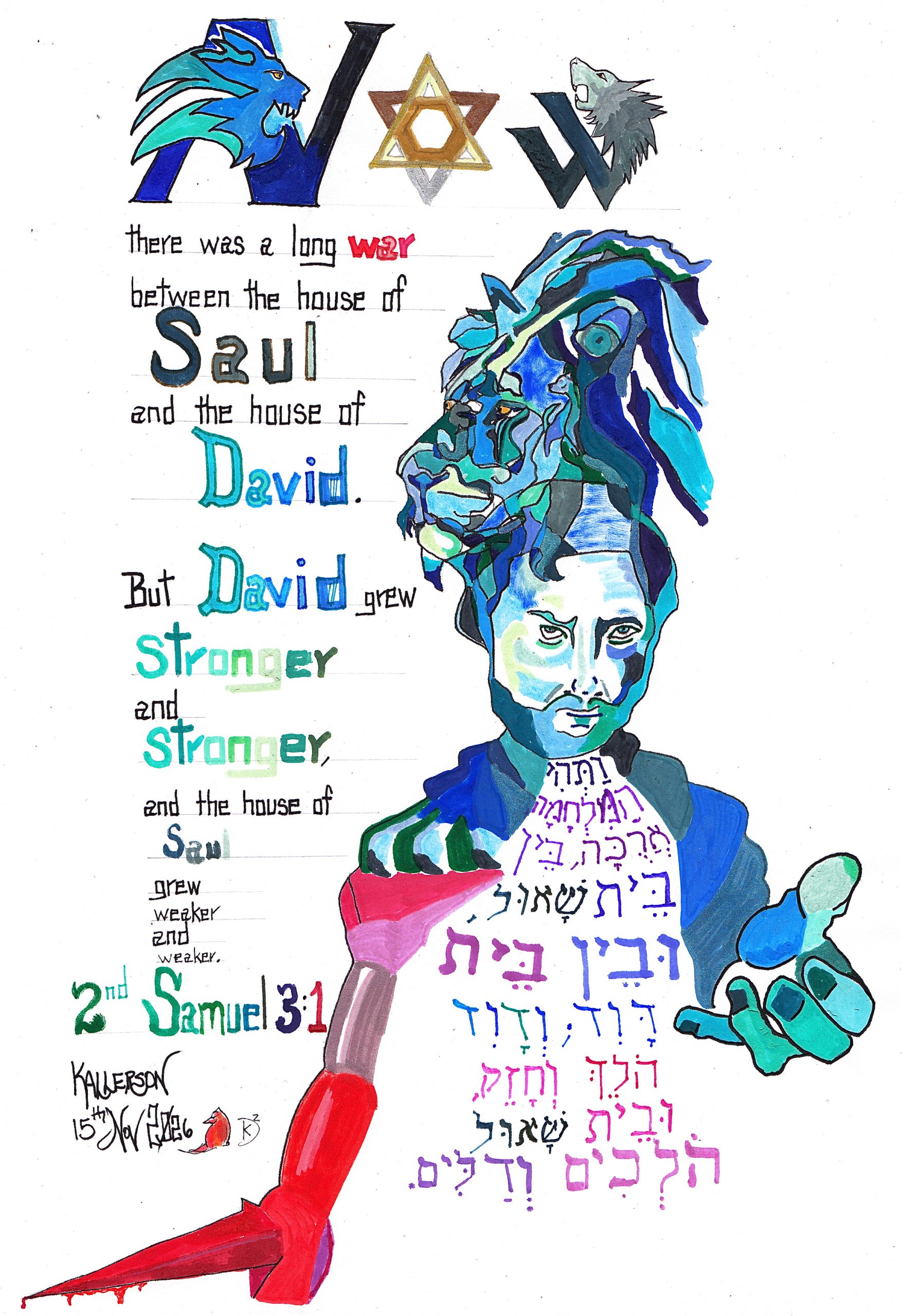
Artwork by Douglas Kallerson
2 Samuel 3:1-16
The Death of Abner, Part I
(Typed 27 July 2026) The day before I typed this sermon, I got an email stating that 50% of pastors are using AI to come up with what they are going to preach on Sunday. If pastors aren’t deciding what to preach on, or if they allow AI to type their sermons, they probably shouldn’t be in the pulpit.
A sermon is something that requires personal consideration and attention. Having said that, I have no problem using AI to obtain information for a sermon. We used to use books to research things. That eventually led to using the internet.
Google and other search engines made that easier over the last few years. With the introduction of AI, we are getting the same information, just a lot faster. Plus, we can research and evaluate things much more fully with this resource.
I am not an expert in the English language. Outside of knowing what a noun and a verb are, I spend a lot of time trying to figure out the rest. How much time is required when going between languages? For those who are uncomfortable with using AI, an example came up as I typed this sermon.
In the first verse of Chapter 3, the adjective khazeq, strong, is used. Most translations say “stronger,” but I translated it as strong, feeling that was correct. Then, while reading about adjectives, I saw that there are base adjectives and comparative adjectives.
A base adjective is strong, whereas a comparative is stronger. Wanting to be sure I properly applied this, I asked, “Ok, this adjective is only used twice. Would you consider it a base adjective, ‘strong,’ or a comparative, ‘stronger’?” I lean toward strong, but want an evaluation to make the correct decision.”
Text Verse: “Therefore, whether you eat or drink, or whatever you do, do all to the glory of God.” 1 Corinthians 10:31
In about 1 second, it came back with a ton of information. Here is a bit of it –
חָזֵק (ḥāzēq) is the base adjective: “strong,” not inherently “stronger.” More precisely, BDB calls it a verbal adjective/Qal participial form from חָזַק [khazeq], but there is nothing comparative built into the form itself.
The comparative or progressive force comes from the construction:
הֹלֵךְ וְחָזֵק
“going and strong”
This Hebrew pattern—הֹלֵךְ [holekh] + participle/adjective—expresses continuing development: “going on becoming strong,” “growing strong,” or idiomatically, “growing stronger and stronger.”
Thus:
Exodus 19:19: the trumpet sound was “going and strong exceedingly” → becoming increasingly strong/loud.
2 Samuel 3:1: David was “going and strong” → becoming progressively stronger.
The translations use “stronger” because the subject is increasing in strength, not because חָזֵק [khazeq] itself is a comparative adjective. The contrasting clause in 2 Samuel 3:1—Saul’s house “going and weak”—makes the progressive comparison especially obvious. Bible Hub likewise lists the literal form simply as “powerful,” while its translations render the whole construction “waxed louder” or “grew stronger.”
Correct verdict:
Use “strong” as your consistent lexical value.
Your ultra-literal rendering could be:
And David was walking and strong, and the house of Saul was walking and weak.
Or, if your treatment of הָלַךְ [holekh] in this construction allows the developmental sense:
And David was going and becoming strong…
But “stronger” belongs to the English interpretation of the construction, not to the adjective itself.
Strong wins. High five. ✋
My response was, “High five. Maybe I will be back for more sermon help today. But I only want technical assistance. No cheating and having sermon material from another source. That is my desire at all times.”
In return, “High five. ✋ Understood and remembered: technical assistance only—grammar, morphology, lexical evaluation, structure, accuracy checks, and polishing your own material. No imported sermon ideas or borrowed sermon content.”
As you will see, I had to correct the second clause of the verse because it is plural, something the AI did not properly evaluate. The point is that AI is a tool. The information I received in a couple of seconds would have taken 20 or 30 minutes for me to search out. All that for one word.
Later in the sermon, I spent almost 45 minutes on another word, just to be sure what is presented is biblically accurate. Without AI, it may have been 2 to 3 hours.
Don’t be afraid to use AI, but understand that it retrieves and evaluates information already out there. It is rong almost as often as it is right. So be wise in what you accept.
A proper and carefully-considered evaluation of the Bible is a precept taught right in the word itself. Great truths are to be found in His superior word. And so, let us turn to that precious word once again, and… May God speak to us through His word today, and may His glorious name ever be praised.
I. Walking and Strong (verses 1-11)
Now there was a long war between the house of Saul and the house of David.
vatəhi ha’milkhamah arukah ben beith shaul uven beith david – “And it was, the battle, long between ‘house, Saul’ and between ‘house, David’.” The war that began with Abner’s incursion as far as Gibeon, which was seen in the last chapter, continued. That battle ended, but the wider conflict between the two sides is said to progress.
What types of battles, if any, are left unrecorded. Maybe this references the state of enmity that existed between the two sides, but saying the battle was long seems to indicate active fighting between the two.
A new and rare adjective is seen here, arok, long. It is from the verb arak, to be long. This adjective will only be seen three times in the Bible. Saul means Asked. His name is identical in spelling to Sheol. David means Beloved. During this period of battle, it says…
1 (con’t) But David grew stronger and stronger,
vədavid holekh vəkhazeq – “And David, walking and strong.” The words are lively. First, saying David was “walking” gives the sense of onward progression. It is as if his kingdom was on the march.
As for the adjective strong, it is the word that I inquired about and mentioned in the opening comments. I had already translated it as a base adjective, but most translations make it a comparative. Therefore, I wanted to be sure which was correct. This is the second and last use of khazaq in the Bible. The first use was in Exodus 19:19, where the exact same words are used to describe the shofar blast of the Lord –
“And it was, voice the shofar, walking and strong, vehemently. Moses, he will speak, and the God, He answered him in voice.” Exodus 19:19 (CG)
The intensity of the words in Exodus helps us to see how David’s kingdom was at this time. On the other hand…
1 (con’t) and the house of Saul grew weaker and weaker.
The contrast is interesting: uveith shaul holəkhim vədalim – “and ‘house, Saul’, walkings and danglings.” Notice the difference:
“And David, walking and strong.”
“And ‘house, Saul’, walkings and danglings.”
David stands for his kingdom. As he walks, the kingdom increases in size and is strong. In contrast is “house, Saul.” Thus, it refers to its constituent members forming a larger picture of dynastic collapse. Ishbosheth is ineffective at ruling, Abner is ineffective in battle against David, etc.
The word dal, dangle, gives the sense of being weak, thin, poor, needy, etc. It is as if they are so weak, they only have strength to dangle. To bolster the notion of David being established and “walking and strong,” the growth of his house is next detailed…
2 Sons were born to David in Hebron:
The written text and the oral reading are different: vayelədu [k.] lədavid banim bəkhevron – “And they begot [k.] to David, sons in Hebron.” The oral changes the verb to the more expected “and sons were born to David.” The written seems to make no sense because the verb is masculine plural. However, there is precedent for the use of the verb (vayelədu) in this manner. That is seen in Genesis 20 –
“And he interceded himself, Abraham, unto the God. And he mended, God, Abimelech, and his wife, and his handmaids, and they begot (vayelədu).” Genesis 20:17 (CG)
In other words, the masculine plural in Genesis is because Abimelech is included in the verse along with the wife and maidservants. This is the thought here. David is included, sons are born, and it is through his wives who are next mentioned.
Hebron means Alliance.
2 (con’t) His firstborn was Amnon by Ahinoam the Jezreelitess;
vayhi vəkhoro amnon la’akhinoam ha’yizrəelith – “And he was, his firstborn, Amnon, to Ahinoam the Jezreelitess.” Amnon turns out to be a loser in several ways. He will rape his half-sister Tamar, and he will lose his life at the hands of Absalom because of that.
The name comes from aman, to build or support, and thus means Faithful. The vav–nun (on) couple at the end of the name may personalize or localize it. As such, Abarim says Amen-guy. I would just say Faithful One. Ahinoam means Kindred to Sweetness. Jezreel means God Sows.
3 his second, Chileab, by Abigail the widow of Nabal the Carmelite;
Another discord is seen: umishnehu khilav la’avigal esheth naval ha’karməli – “And his double, Kileab, to Abiygal [k.] ‘wife, Nabal, the Carmelite’.” The name Kileab is seen only here. In 1 Chronicles 3:1, he is called Daniel.
The name Kileab comes from kala, to restrict or to complete, and ab, father. Thus, it means Restraint of Father or Accomplished of the Father. The name may be a play on words indicating that David is the father of this son, not Nabal. When looked at by its letters combined in various ways, the name could read According to ‘to Father’, or All Father.
This may seem obvious based on the words of verse 5, but it may be an assurance that Abigail was not already pregnant when David married her.
The discord comes in the spelling of Abigail’s name. The written text spells it the same as 1 Samuel 25:32, Abiygal. As such, it means Father of Heap and thus, by implication, Father of Witness. Nabal means Dolt. Carmel means Vineyard of God.
3 (con’t) the third, Absalom the son of Maacah, the daughter of Talmai, king of Geshur;
vəha’shəlishi avshalom ben-maakhah bath-talmay melekh gəshur – “and the third, Absalom, ‘son, Maakah, daughter Talmai, king, Geshur’.” Absalom is another loser son of David. He will attempt to usurp the throne and will come to a bad end. His name means The Father Is Peace or Father of Peace.
Maakah comes from ma’ak, to squeeze. Thus, it means Squeezer, Pusher, or Oppression. Talmai means Plowman. Geshur comes from an unused root meaning to join. Thus, it may mean Bridge.
4 the fourth, Adonijah the son of Haggith;
vəha’rəvii adoniyah ven-khagith – “and the fourth, Adonijah, ‘son, Haggith’.” Adonijah is another loser son of David. He will attempt to steal the kingship when David is very old and almost completely incapacitated. However, Solomon will prevail, and Adonijah will meet a bad end. His name means My Lord is Yehovah, or Lord of the Lord (Yehovah), meaning Worshipper of Yehovah.
Haggith is from khaggi, festive. Thus, it means Exultation or Festive. However, that is from khagag, to move in a circle. Thus, her name could mean Roundelay.
4 (con’t) the fifth, Shephatiah the son of Abital;
vəha’khamishi shəphatyah ven-avital – “and the fifth, Shephatiah, ‘son, Abital’.” Shephatiah comes from shaphat, to judge or govern, and Yah. Thus it means Yah Has Judged, Yah Judges, Yah Governs, Judge of the Lord, or something similar. Abital is from av, father, and tal, dew. Thus, it means Father of Dew or My Father Is (the) Dew.
5 and the sixth, Ithream, by David’s wife Eglah.
vəha’shishi yithrəam ləeglah esheth david – “and the sixth, Ithream, to Eglah ‘wife, David’.” Ithream comes from yether, to be left over or excess, and am, people. Suggestions for the meaning are Residue of the People, Rest of the People, Exalted of the People, Excellence of the People, or Superfluity of the People (CG).
Eglah comes from eglah, a female calf. Thus, her name means Heifer. Jones says A Girl, A Heifer. The word eglah, however, comes from the adjective agol, revolve, round, or circular. Thus, Circular is also suggested.
The words “wife, David” are unusual. They are all David’s wives. I propose, and not to be demeaning, that because her name is heifer, she may be associated with a likeness to her name in one way or another (fat, a servant animal, etc.). To ensure it is understood that she was David’s wife, the clarification is included.
Other suggestions have been given, but none seems reasonable to me.
5 (con’t) These were born to David in Hebron.
eleh yulədu lədavid bəkhevron – “These, they were born to David in Hebron.” This is recorded to show that David was increasing during his time reigning over Judah in Hebron, and also to set these children apart from those who will be born later in Jerusalem.
After this, the narrative returns to the main thought left off in verse 1…
6 Now it was so, while there was war between the house of Saul and the house of David, that Abner was strengthening his hold on the house of Saul.
vayhi bihyoth ha’milkhamah ben beith shaul uven beith david və’avner hayah mitkhazeq bəveith shaul – “And it was, in being the battle between ‘house, Saul’ and between ‘house, David’, and Abner, he was strengthening himself in ‘house, Saul’.” The NKJV rightly diverts from the KJV, which says, “…Abner made himself strong for the house of Saul.” That is not what the Hebrew says.
The verb is reflexive. Abner was strengthening himself in Saul’s house. This is the verb form of the adjective used in verse 1 –
“And David walking and strong [khazeq].”
“And Abner, he was strengthening [khazaq] himself in ‘house, Saul’.”
The point, then, is that what transpires in the verses ahead is based on Abner’s strength within Saul’s house. A part of that reason is seen in the next words…
7 And Saul had a concubine, whose name was Rizpah, the daughter of Aiah.
uləshaul pilegesh ushəmah ritspah vath-ayah – “And to Saul, concubine. And her name Rizpah, ‘daughter, Aiah’.” Saul’s concubine comes into the drama of the king’s court.
The pilegesh, concubine, is believed by some to be a compound of the word palag, to split or divide, and nagash, to draw near or approach. Therefore, it means that the man divides his attention between his wife and his concubine.
Rizpah is from ritspah, a burning stone or also a tessellated pavement, such as in the temple complex. Suggestions for her name are Glowing Coal or Baking Stone. I would go with Hearthstone or Hotstone, both indicating heat associated with the imagery.
Aiah comes from ayyah, screamer, meaning a falcon or kite. That comes from iy, woe or alas. Of this woman…
7 (con’t) So Ishbosheth said to Abner, “Why have you gone in to my father’s concubine?”
In a very unusual occurrence, the name of the speaker is left out: vayomer el-avner madu’a ba’thah el-pilegesh avi – “And he said unto Abner, ‘Whatchaknow? You went unto ‘concubine, my father’.’” Only in the next verse is Ishbosheth named. It is as if Ishbosheth is a secondary thought, not worth mentioning by name at this point.
Based on the text, it’s hard to know if the accusation is true or not. If he did sleep with her, it would not have been an attempt to usurp the throne, as many believe. Abner’s coming actions dispel that thought. Rather, if he had her, it was more likely a union of passion.
Abner means Father of Light. His next words seem to be a denial of trying to usurp the throne, and of having done anything at all with Rizpah…
8 Then Abner became very angry at the words of Ishbosheth, and said, “Am I a dog’s head that belongs to Judah?
vayikhar lə’avner məod al-divre ish-bosheth vayomer ha’rosh kelev anokhi asher liyhudah – “And it burned to Abner, vehemently upon ‘words, Ish-bosheth’, and he said, ‘The ‘head, dog’ I myself who to Judah?” Older versions, following the Vulgate, completely botch the intent of his response. The meaning is just as the NKJV translates it.
The dog typologically pictures Gentiles. Ishbosheth means Man of Shame. Abner continues…
8 (con’t) Today I show loyalty to the house of Saul your father, to his brothers, and to his friends, and have not delivered you into the hand of David;
Every translation I know of is incorrect here: ha’yom e’eseh-khesed im-beith shaul avikha el-ekhav və’el-mereehu vəlo himtsithikha bə’yad-david – “The day, I will do kindness with ‘house, Saul, your father’, unto his brothers, and unto his companion, and not I caused to ‘find’ you in ‘hand, David’?”
The job of a translator is to translate. The word merea, companion, is singular. All translations make it plural, as if it refers to a collective whole. That doesn’t make sense because it also says, “his brothers.” One would naturally say, “unto his brothers and unto his companions.”
The plural is used in Judges 14:11. The other instances are singular. As such, and because Rizpah is the subject of the argument, this is most likely speaking of her. If so, it is an adamant assertion that he has treated Rizpah with respect. This is speculation, but the accusation has Abner thoroughly miffed.
To take Rizpah would be an act of unkindness. The tenor of his words shows fealty to the house of Saul. Despite that…
8 (con’t) and you charge me today with a fault concerning this woman?
vatiphqod alay avon ha’ishah ha’yom – “And you visited upon me ‘perversity, the woman’ the day?’” Regardless of Abner’s interaction with Rizpah, of which his words lean toward being innocent of the charge, Ishbosheth has visited, meaning placed an accusation, upon Abner concerning her. It is more than he would tolerate…
9 May God do so to Abner, and more also, if I do not do for David as the Lord has sworn to him—
koh-yaaseh elohim lə’avner vəkhoh yosiph lo ki kaasher nishba Yəhovah lədavid ki-khen e’eseh-lo – “Thus He will do, God, to Abner, and thus He will cause to add to him that according to which he was sevened, Yehovah, to David, for thus I will do to him.” The meaning of “which He was sevened, Yehovah, to David” is that a solemn oath was made by Yehovah to David.
This has not been recorded anywhere in the Bible to this point. However, it was understood that David was anointed as the king and that his enemies would be vanquished. That this was known was seen, for example, in 1 Samuel 25 when Abigail first spoke to David –
“And he arose, human, to pursue you and to seek your soul. And it will be, ‘soul, my lord’, cramped in ‘parcel, the livings’ with Yehovah your God. And ‘soul, your hatings’, He will sling it in ‘midst, palm, the sling’. 30And it will be, for He will do, Yehovah, to my lord according to all which He spoke, the goodness, upon you, and He will enjoin you to commander upon Israel.” 1 Samuel 25:29, 30
If Abigail knew this, then others throughout the realm knew it as well. To this point, Abner has been actively working against the will of the Lord in his desire to protect and further the kingdom of Saul. Now, allowing his conscience to do what is right, he vows that he will not be an enemy of David who is slung from Yehovah’s sling. Instead, he determines…
10 to transfer the kingdom from the house of Saul, and set up the throne of David over Israel and over Judah, from Dan to Beersheba.”
ləhaavir ha’mamlakhah mibeith shaul uləhaqim eth-kise david al-yisrael və’al-yəhudah midan və’ad-bəer shava – “to cause to traverse the kingdom from ‘house, Saul’ and to cause to rise ‘throne, David’ upon Israel, and upon Judah from Dan and until Beersheba.” Abner states that he will expend his energy to effect the transfer of the kingdom from Saul’s house to that of David, as he should have from the start.
In doing this, David will then sit upon the throne over the entire house of Israel.
This is the third of seven times the phrase from Dan and until Beersheba is used in the Old Testament. It will also be used twice in reverse in the Chronicles, saying, “from Beersheba to Dan.” It signifies the entirety of the land and people of Israel within the borders of Canaan. Dan is the northernmost point of reference, while Beersheba is the southernmost.
Dan means Judge. Beersheba means both Well of Seven and Well of Oath.
11 And he could not answer Abner another word, because he feared him.
vəlo-yakhol od ləhashiv eth-avner davar miyiratho otho – “And not he was able again to cause to return Abner ‘word’ from his fearing him.” Ishbosheth had challenged Abner, accusing him of wrongdoing. What prompted the charge isn’t stated, but he realizes the error of bringing it up.
Being the general of the army, he has the power to cause real trouble for Ishbosheth, or even to completely overthrow him. Because of that, he decides, wisely, to refrain from any further speech.
The kingdom will be transferred from you
To a better man, it will be given
There is nothing you can do
This is just how it is in the life you’re livin’
From Dan to Beersheba, David will reign over all
The Lord’s anointed will unite Israel
Ishbosheth will be the last to reign in the house of Saul
To that house, we will finally say farewell
God has planned every detail
Of redemptive history for us to see
When we trust in Him, all will go well
As we await our step into eternity
II. Walking and Weeping (verses 12-16)
12 Then Abner sent messengers on his behalf to David, saying, “Whose is the land?”
The written Hebrew is different than the oral: vayishlakh avner mal’akhim el-david takhto lemor ləmi-arets – “And he sent, Abner, messengers unto David, his ‘under’ [k.], to say, ‘To whom ‘land’?’” This is the same change that took place in 2 Samuel 2:23. The written text speaks of the place directly below him. The oral changes it to read that which is under, which can extend to a person replacing another, being under another’s authority, etc.
Because of the odd nature of the written, the oral is used to provide clarity when read. However, the Greek translation says “immediately,” which may convey what “his under” means. As if in that moment, where he stood, he called messengers and sent them out as a slight to Ishbosheth.
As for the question itself, the NKJV renders it correctly. It means, “Whose land is it?” The Pulpit Commentary says –
“You, David, he seems to say, will answer that the land is mine; for Jehovah has promised it to me. But, as a matter of fact, much of the land is mine (Abner’s), or at least belongs to the house of Saul, whose prime minister I am. Yours is an abstract right; mine is actual possession.”
Lange agrees, but that seems contrary to the words about the oath of Yehovah from verse 10. Abner may have the power to help transfer the land to its rightful king, but he does not assume that the possession belongs to the throne of Ishbosheth, even if it is currently under his control
Thus, the answer, though fought over in the past, is that the land belongs to David. And more…
12 (con’t) saying also, “Make your covenant with me, and indeed my hand shall be with you to bring all Israel to you.”
lemor karəthah vəritəkha iti vəhineh yadi imakh ləhasev elekha eth-kal-yisrael – “To say, ‘You must cut it, your covenant, with me. And behold, my hand with you to cause to revolve unto you all Israel.’” This shows that Abner knows that the land should be united under David. He is just the means by which the Lord will make it come about.
When the covenant is made, Abner is looking to be protected, and possibly gain a high position under David. David is willing to deal…
13 And David said, “Good, I will make a covenant with you.
His reply is emphatic: vayomer tov ani ekhroth itəkha bərith – “And he said, ‘Good. I, I will cut with you – covenant.” There is absolute surety that he will do as Abner has asked, with one condition…
13 (con’t) But one thing I require of you: you shall not see my face unless you first bring Michal, Saul’s daughter, when you come to see my face.”
akh davar ekhad anokhi shoel me’itəkha lemor lo-thireh eth-panay ki im-liphne heviakha eth mikhal bath-shaul bəvoakha lir’oth eth-panay – “Surely, ‘word, one’ I myself asking from you, to say: Not you will see my faces for, if to faces, you causing to bring Michal ‘daughter, Saul’ in your coming to see my faces.’”
David has at least six other wives at this time. And whatever his affections were toward Michal, she needed to be restored to him for political reasons. She was his rightful wife, and he was entitled to his position within Saul’s house. Saul took that away from him.
Therefore, this request is an act of restoration and a means of removing anyone else from claiming any right to Saul’s house through her. Michal is a shortened form of Michael, which means Who Is like God.
14 So David sent messengers to Ishbosheth, Saul’s son, saying, “Give me my wife Michal, whom I betrothed to myself for a hundred foreskins of the Philistines.”
vayishlakh david mal’akhim el-ish-bosheth ben-shaul lemor tənah eth-ishti eth-mikhal asher erasti li bəmeah arəloth pəlishtim – “And he sent, David, messengers unto Ish-bosheth ‘son, Saul’, to say, ‘You must (surely) give my wife, Michal, whom I betrothed to me in ‘hundred foreskins, Philistines’.’” Ishbosheth, probably not having a clue about the exchange between David and Abner, received this request directly from David.
Michal was David’s rightful wife. He had legal authority to request this. The dowry was paid, and the wrong done to him by taking her away must be undone. Going through Ishbosheth solidifies the fact that David did not take her from her present husband by force.
This would also confirm that though Saul had done him wrong, he bore no ill will toward Saul, desiring to still have his daughter as his own wife.
One hundred is a product of tens, the number signifying the completion of a whole cycle where nothing is wanting.
15 And Ishbosheth sent and took her from her husband, from Paltiel the son of Laish.
vayishlakh ish-bosheth vayiqakheha me’im ish me’im palti’el ben-lush – “And he sent, Ishbosheth, and he took her from ‘with husband’, from ‘with Paltiel, son, Lush [k.]’.” The oral tradition changes the name from Lush to Laish. As requested by David, Ishbosheth complied, removing Michal from Paltiel in order to restore her to David.
Paltiel is the same person as Phalti noted in 1 Samuel 25. The name is from palat, to escape, or causatively, to deliver. Here, the name includes the ending, el, God. His name means God Has Delivered or Deliverance of God.
Lush is from lush, to knead. Thus, it means Kneading.
16 Then her husband went along with her to Bahurim, weeping behind her.
vayelekh itah ishah halokh uvakhoh akhareha ad-bakhurim – “And he walked with her, her husband, walking and weeping after her until Bahurim.” It’s kind of a pitiful scene, but Paltiel had no right to her, as she was legally David’s wife. Thus, it was an adulterous marriage.
Bahurim is first seen here. It is from bakhur, selected, when referring to a young man. That is from bakhar, to select or choose. It is defined as Young Men or Village of Young men. I would say Selected Ones.
*16 (fin) So Abner said to him, “Go, return!” And he returned.
vayomer elav avner lekh shuv vayashov – “And he said unto him, Abner, ‘You must walk! You must return!” And he returned.’” Not wanting David to see the drama, once they got to Bahurim, it was time for Paltiel to accept his fate and head back to his home. In obedience, he headed back from whence he came.
So far, we have gotten a lot of information out of the verses. That will continue as we progress through the remaining verses of the chapter. Even without knowing the typology, it is interesting.
There are cultural nuances that we may not be familiar with in our society. There is intrigue and heartache, and there is also the downfall of one kingdom and the rising of another.
These and so many other points are given to reveal Jesus’ coming and how that will change the eternal direction of innumerable souls. There is information in the words that is provided to express to us the unending love of God for His wayward creatures.
With those who turn to Him, He is building a house where He can dwell forever. This truth is exactingly expressed in His word. Therefore, we can trust that it is so. But we will only be a part of that house if we come to God on His terms. That is the gospel, and it is limited to those who reach out to Him through Jesus Christ by faith. Be sure that you will be a part of what God is doing by accepting the gospel.
Closing Verse: “Now, therefore, you are no longer strangers and foreigners, but fellow citizens with the saints and members of the household of God, 20 having been built on the foundation of the apostles and prophets, Jesus Christ Himself being the chief cornerstone, 21 in whom the whole building, being fitted together, grows into a holy temple in the Lord, 22 in whom you also are being built together for a dwelling place of God in the Spirit.” Ephesians 2:19-22
Next Week: 2 Samuel 3:17-27 It was all such a blur, yes it’s true… (The Death of Abner, Part II) (7th 2 Samuel Sermon)
The Lord has you exactly where He wants you. He has a good plan and purpose for you. He is the One who abases the haughty and exalts the humble. He regards the lowly, and the proud, He knows from afar. So yield yourself to Him, trust Him, and believe His word. In this, He will do great things for you and through you.
2 Samuel 3:1-16 (CG)
3 And it was, the battle, long between ‘house, Saul’ and between ‘house, David’. And David, walking and strong, and ‘house, Saul’, walkings and danglings.
2And they begot [k.] to David, sons in Hebron. And he was, his firstborn, Amnon, to Ahinoam the Jezreelitess. 3And his double, Kileab, to Abiygal [k.] ‘wife, Nabal, the Carmelite’. And the third, Absalom, ‘son, Maakah, daughter Talmai, king, Geshur’, 4 and the fourth, Adonijah, ‘son, Haggith’. And the fifth Shephatiah, ‘son, Abital’, 5and the sixth, Ithream, to Eglah ‘wife, David’. These, they were born to David in Hebron.
6And it was, in being the battle between ‘house, Saul’ and between ‘house, David’. And Abner, he was strengthening himself in ‘house, Saul’.
7And to Saul, concubine. And her name Rizpah, ‘daughter, Aiah’. And he said * unto Abner, ‘Whatchaknow? You went unto ‘concubine, my father’.
8And it burned to Abner, vehemently upon ‘words, Ish-bosheth’, and he said “The ‘head, dog’ I myself who to Judah? The day, I will do kindness with ‘house, Saul, your father’, unto his brothers, and unto his companion, and not I caused to ‘find’ you in ‘hand, David’? And you visited upon me ‘perversity, the woman’ the day? 9Thus He will do, God, to Abner, and thus He will cause to add to him. For according to which He was sevened, Yehovah, to David, for thus I will do to him: 10to cause to traverse the kingdom from ‘house, Saul’~ and to cause to rise את ‘throne, David’ upon Israel, and upon Judah from Dan and until Beersheba.” 11And not he was able again to cause to return את Abner ‘word’~ from his fearing him.
12And he sent, Abner, messengers unto David, his ‘under’ [k.], to say, ‘To whom ‘land’? To say, ‘You must cut it, your covenant, with me. And behold, my hand with you to cause to revolve unto you את all Israel.
13And he said, “Good. I, I will cut with you – covenant. Surely, ‘word, one’ I myself asking from you, to say: Not you will see את my faces for, if to faces, you causing to bring את Michal ‘daughter, Saul’ in your coming to see את my faces.” 14 And he sent, David, messengers unto Ish-bosheth ‘son, Saul’, to say: “You must (surely) give את my wife, את Michal, whom I betrothed to me in ‘hundred foreskins, Philistines’.” 15And he sent, Ish-bosheth, and he took her from ‘with husband’~ from ‘with Paltiel, son, Lush [k.]’. 16And he walked with her, her husband, walking and weeping after her until Bahurim. And he said unto him, Abner, “You must walk! You must return!” And he returned.
Verse 2 – Qeri: “And they were begotten…”
Verse 3 – Qeri: Abigail.
*Verse 7 – The name of the subject, Ish-bosheth, is lacking in the Hebrew.
Verse 12 – Qeri: תחתיו / taḥtāw = under him / beneath him. Kethiv: תחתו / taḥtōw = his under-place / in his place.
Verse 15 – Qeri: Laish.
2 Samuel 3:1-16 (NKJV)
Now there was a long war between the house of Saul and the house of David. But David grew stronger and stronger, and the house of Saul grew weaker and weaker.
2 Sons were born to David in Hebron: His firstborn was Amnon by Ahinoam the Jezreelitess; 3 his second, Chileab, by Abigail the widow of Nabal the Carmelite; the third, Absalom the son of Maacah, the daughter of Talmai, king of Geshur; 4 the fourth, Adonijah the son of Haggith; the fifth, Shephatiah the son of Abital; 5 and the sixth, Ithream, by David’s wife Eglah. These were born to David in Hebron.
6 Now it was so, while there was war between the house of Saul and the house of David, that Abner was strengthening his hold on the house of Saul.
7 And Saul had a concubine, whose name was Rizpah, the daughter of Aiah. So Ishbosheth said to Abner, “Why have you gone in to my father’s concubine?”
8 Then Abner became very angry at the words of Ishbosheth, and said, “Am I a dog’s head that belongs to Judah? Today I show loyalty to the house of Saul your father, to his brothers, and to his friends, and have not delivered you into the hand of David; and you charge me today with a fault concerning this woman? 9 May God do so to Abner, and more also, if I do not do for David as the Lord has sworn to him— 10 to transfer the kingdom from the house of Saul, and set up the throne of David over Israel and over Judah, from Dan to Beersheba.” 11 And he could not answer Abner another word, because he feared him.
12 Then Abner sent messengers on his behalf to David, saying, “Whose is the land?” saying also, “Make your covenant with me, and indeed my hand shall be with you to bring all Israel to you.”
13 And David said, “Good, I will make a covenant with you. But one thing I require of you: you shall not see my face unless you first bring Michal, Saul’s daughter, when you come to see my face.” 14 So David sent messengers to Ishbosheth, Saul’s son, saying, “Give me my wife Michal, whom I betrothed to myself for a hundred foreskins of the Philistines.” 15 And Ishbosheth sent and took her from her husband, from Paltiel the son of Laish. 16 Then her husband went along with her to Bahurim, weeping behind her. So Abner said to him, “Go, return!” And he returned.