
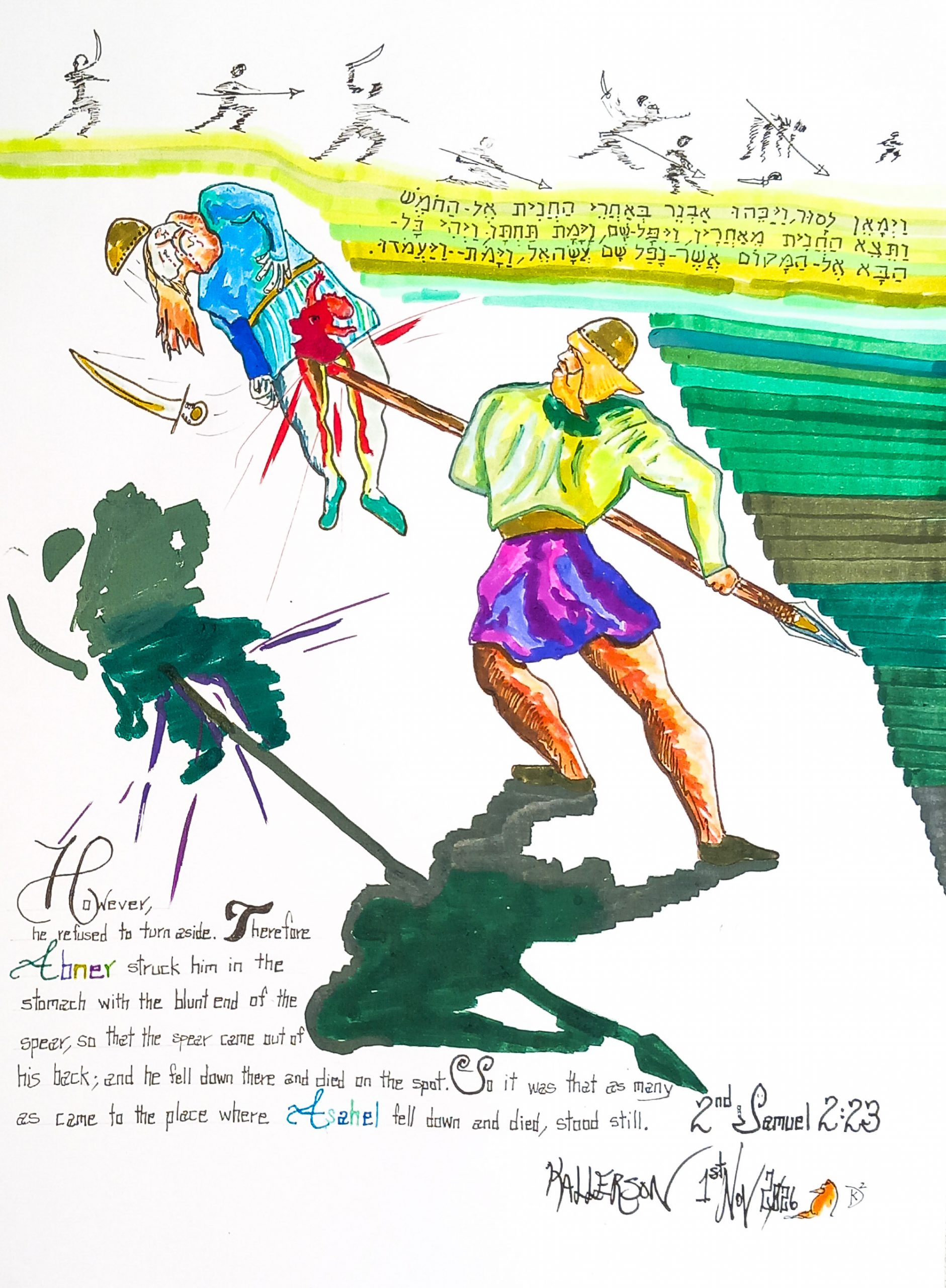
Uggggh! Artwork by Douglas Kalleron.
2 Samuel 2:12-23
Man of Shame, Part II
(Typed 13 July 2026) The Bible is chock full of accounts of battles and wars. At times, some battles challenge our sensibilities, such as when Israel took vengeance on Midian. After the battle was won, the Israelite army brought back the Midianite women and children.
Moses was highly displeased with that decision. He told them to take all the women who had known a man and every male child, and put them to the sword. In other battles, every living thing was to be devoted to the Lord, meaning put to death.
Many people find this troubling, but this is the Lord’s world. What He determines is right. One of the truly odd things that we see is those who complain that the God of the Bible is mean because of things like this, and yet they will approve of aborting babies without a second thought.
That reveals their cognitive dissonance. What God determines is always right. He created, and He has every right to dispense with His creation as He sees fit. When Israel was disobedient to the Lord, they found this out.
Text Verse: “Indeed, you will cause to return edgerock (tsur) his sword,
And not you will cause to rise him in the battle.” Psalm 89:43 (CG)
The 89th Psalm carries a mournful tone as it remembers the Lord’s covenant with David while sorrowing over lost blessings. The people strayed from Him, and they received the due penalty for it.
God is working out a great plan of redemption, and the world continues as it has for thousands of years. God intervenes when necessary to ensure things turn out according to His plans, but He allows free will in man during the process.
Because of this, war and death will continue to be a part of our human experience. Someday, all of this will be behind us. Until then, we need to trust that His way is right and that what He does is for a good purpose.
These are certain truths that are revealed in His superior word. And so, let us turn to that precious word once again, and… May God speak to us through His word today, and may His glorious name ever be praised.
I. Upon the Kneepool (verses 12-16)
12 Now Abner the son of Ner, and the servants of Ishbosheth the son of Saul, went out from Mahanaim to Gibeon.
vayetse avner ben-ner vəavde ish-bosheth ben-shaul mimakhanayim givonah – “And he went out, Abner, ‘son, Ner’, and ‘servants, Ishbosheth, son, Saul’ from Mahanaim Gibeon-ward.” Abner is working to solidify rule over the land for Ishbosheth. During this time, he and Ishbosheth’s servants went out, a term signifying war when applied to soldiers. They headed toward Gibeon.
Gibeon is in the territory of Benjamin, well north of where David is and a good distance from Mahanaim. However, it is not far from the northern border of Judah. This meeting at this location is most likely set by both sides to gain control over the tribe of Benjamin.
Saul was from the tribe of Benjamin, but after his death, they may have followed David. However, Ishbosheth is a son of Saul, and he certainly wanted to maintain sway over the tribe after Saul’s death.
Gibeon is the city noted in Joshua 9 where its inhabitants deceived Joshua into making a treaty with them, pretending to be from a far distant land. However, they were from just down the road. Because of the treaty, when Gibeon was attacked for making peace with Israel, Joshua and the Israelite army fought to protect them.
Despite the prominence of the location in Joshua, it has not been mentioned since then. Now, with the intent of meeting David and possibly gaining rule over Judah, Abner and the servants of Ishbosheth have gone out. Abner is looking to restore Saul’s kingdom, with Ishbosheth assuming rule over all of Israel.
Gibeon, giv’on, comes from gavia, meaning a cup or a bowl. When upside down, it looks like a hill. The vav–nun (-on) couple at the end makes the word locative. As such, it means Hill Town, Place of the Hill, or something similar. It is etymologically tied to Gabbatha.
Ner means Lamp. Abner means Father Is a Lamp and thus, Father of Light. Ishbosheth means Man of Shame. Saul means Asked. Mahanaim means Two Camps.
13 And Joab the son of Zeruiah, and the servants of David, went out
vəyoav ben-tsəruyah vəavde david yatsəu – “And Joab, ‘son, Zeruiah’, and ‘servants, David’, they went out.” Whether from intel that Abner had come out, or from a challenge sent from Abner to meet in battle, Joab went out with David’s servants to meet for a challenge.
Joab comes from an abbreviated form of Yehovah and av, father. Thus, it means Yehovah Is Father or Whose Father Is Yehovah.
Zeruiah is the mother’s name. She is David’s sister according to 1 Chronicles 2:16. However, as noted in 1 Samuel 26, she is likely a stepsister of David. Joab, her oldest son, would make him David’s oldest nephew. He is the most prominent figure seen during David’s life.
Depending on the root, Zeruiah means something like Balm, Wounded, Balsam, Balsam of Yah, or His Edgerock Is Yah. The last option would be a commemoration of an event or person, such as calling someone “His Blimp” because she was born on the day her father rode on a blimp.
13 (con’t) and met them by the pool of Gibeon.
vayiphgəshum al-bərekhath givon yakhdav – “and they intermet them upon ‘kneepool, Gibeon’ unitedly.” An infrequently used word, pagash, is used concerning the meeting. It means “to come in contact with, whether by accident or violence; figuratively, to concur — meet (with, together)” (Strong).
The Topical Lexicon says, “the verb marks a decisive point of intersection ordained by God.” Using this word means it is more than just a meeting, but a joining. That is reflected in the word unitedly, because a unit is formed.
The word translated as kneepool, berekah is introduced here. It signifies a reservoir (at which camels kneel as a resting place). It is from barak, to kneel, a word usually translated as bless or kneel. When blessing, kneeling is usually at least mentally associated with the act –
“And God blessed (barak) them, saying, “Be fruitful and multiply, and fill the waters in the seas, and let birds multiply on the earth.” Genesis 1:22
Barnes says of this kneepool –
“On the east of the hill (El-jib, the ancient Gibeon) is a copious spring, which issues in a cave excavated in the limestone rock, so as to form a large reservoir. In the trees further down are the remains of a pool or tank of considerable size (120 feet by 110 feet). This is doubtless “the pool of Gibeon.”
In Jeremiah 41:12, it notes “the great pool that is in Gibeon.” This is likely that same spot…
13 (con’t) So they sat down, one on one side of the pool and the other on the other side of the pool.
vayeshəvu eleh al-ha’bərekhah mizeh və’eleh al-ha’bərekhah mizeh – “And they sat, these, upon the kneepool from this, and these upon the kneepool from this.” At this kneepool, the two sides are enjoined, each taking an opposite side as they consider their options…
14 Then Abner said to Joab, “Let the young men now arise and compete before us.”
vayomer avner el-yoav yaqumu-na ha’nəarim visakhaqu ləphanenu – “And he said, Abner, unto Joab, “They will arise, pray, the lads, and they will ‘laugh’ to our faces.” With the warriors lined up across the pool from each other, a proposal is made for a competition to take place between the warriors.
The probable reason for doing so is that a battle between them would essentially be a civil war within the nation. Even though they have anointed their own kings, they are all Israelites. It may be that neither side was willing to be the first to shed blood in actual combat.
Therefore, these lads will fight to set things in motion, seeing what skills the other side possesses. The word sachaq, to laugh, is used. In this case, it means to cause those engaging in, watching, or hearing about an event to find amusement.
Thus, they are looking to see how the warriors will perform, hopefully laughing at the loss of the other side. Abner proposes this to start the engagement…
14 (con’t) And Joab said, “Let them arise.”
vayomer yoav yaqumu – “And he said, Joab, ‘They will arise.’” Joab feels confident in the skill of his men, and so he agrees to the proposal. As a military suggestion, the outcome of this and any fighting that takes place after it means that those who kill in battle are not considered murderers.
This important point has bearing on an issue that arises in 2 Samuel, which will be resolved only after the death of David when Solomon assumes the throne.
15 So they arose and went over by number, twelve from Benjamin, followers of Ishbosheth the son of Saul, and twelve from the servants of David.
vayaqumu vayaavru bəmispar shəneim asar ləvinyamin ulə’ish-bosheth ben-shaul ushəneim asar meavde David – “And they arose, and they traversed in number two-ten to Benjamin and to Ishbosheth, ‘son, Saul’, and two-ten from ‘servants, David’.” Twelve men were selected from each side. From there, they traversed, or went over, from their location to meet the other twelve at a certain point where both armies could watch the spectacle.
As only Benjamin is named, it seems that all of the men selected are from Benjamin, the single name being given for both groups –
“And they arose, and they traversed in number two-ten to Benjamin:
and to Ishbosheth, ‘son, Saul’,
and two-ten from ‘servants, David’.”
This is speculation, but they have met in the territory of Benjamin. Thus, to have Benjamites fight would nicely set the tone for the conflict. David already had men of Benjamin under him by this time, as is recorded in 1 Chronicles 12 –
“Then some of the sons of Benjamin and Judah came to David at the stronghold. 17 And David went out to meet them, and answered and said to them, ‘If you have come peaceably to me to help me, my heart will be united with you; but if to betray me to my enemies, since there is no wrong in my hands, may the God of our fathers look and bring judgment.’ 18 Then the Spirit came upon Amasai, chief of the captains, and he said:
‘We are yours, O David;
We are on your side, O son of Jesse!
Peace, peace to you,
And peace to your helpers!
For your God helps you.’
So David received them, and made them captains of the troop.” 1 Chronicles 12:16-18
The number twelve signifies perfection of government or governmental perfection. As there were two sets of twelve, the number twenty-four should be explained. Strong says, “It is the number associated with the heavenly government and worship, of which the earthly form in Israel was only a copy.”
Regardless of whether David’s men were from Benjamin or not, this is a real battle appointed by the military commanders. Therefore, there will be death involved…
16 And each one grasped his opponent by the head and thrust his sword in his opponent’s side;
The words are rushed to show the suddenness of the engagement: vayakhaziqu ish bərosh reehu vəkharbo bətsad reehu – “And they caused to seize, man, in head his associate, and his sword → in ‘side, his associate’.” The men were probably told to enter the challenge with only their swords, making it a duel to the death, as none were holding a shield.
Therefore, to immediately try to gain the advantage and end the fight quickly, each man seized the head of the other, leaving his body exposed. The plan was to be the first to stab the other.
This was the case with all twenty-four men. None prevailed. In the second clause, the verb is missing, demonstrating the rapidity with which the thrusts were made for both fighters, as if a single action. The head was seized, and the sword was in his associate’s side.
Some scholars think that only Ishbosheth’s men fell. David’s twelve were mentioned in the previous verse, indicating that it was those twelve who prevailed over the other twelve. That is possible, but if that were the case, it would say something like, “So David’s men prevailed over those of Ishbosheth.” The next words could go either way as well…
16 (con’t) so they fell down together.
vayipəlu yakhdav – “and they fell unitedly.” This could be that all twenty-four fell together, the position I favor, or it could be that all twelve of Ishbosheth’s men fell unitedly. One would think there would be another clause provided as explanation if this were the case. Either way, it next says…
16 (con’t) Therefore that place was called the Field of Sharp Swords, which is in Gibeon.
Rather: vayiqra la’maqom ha’hu khelqath ha’tsurim asher bəgivon – “And he called to the place, the it, ‘Smoothness, the Edgerocks, which in Gibeon.” Who “he” refers to is not stated. Young makes it indefinite and says, “And one calleth that place…” Most other translations punt and ignore the Hebrew.
The meaning of the name khelqath ha’tsurim is extremely hard to pin down. Numerous suggestions have been given. The first part, khelqath, is from khelqah, smoothness. It does not mean field. Quite often, the word khelqah is combined with sadeh, field, to indicate the smoothness of a field. But that could mean a portion or allotment because a smooth stone is used for casting lots.
The next word, tsur, is plural, tsurim, and prefixed by the definite article, ha. The word tsur signifies an edgerock, such as a cliff, but also a sharp flint knife, such as in Joshua 5 when the men of Israel were circumcised with edgerocks. The word tsur is often used when referring to the Lord, especially in poetry.
The most literal rendering is ‘Smoothness, the Edgerocks’. However, the intent here is probably ‘Parcel, the Edgerocks’, being the place where the edgerocks were used as swords (verse 16) to destroy those engaged in the fighting.This is not without precedent. As our text verse notes, the sword and the edgerock are used in Psalm 89:43 in conjunction with one another. Thus, the men held edgerocks as their swords.
Why should I strike you? It wouldn’t be right
You need to break off from this path
My word is true, you’re in a dreadful plight
Get out your calculator and do the math
How would I face your brother, turn off now!
If you don’t, things will surely get grim
Joab will come after me, someday, somehow
Until then, how could I ever face him
Well, I told you to turn off, but you would not
That hole in your abdomen can’t feel nice
Plenty of blood coming from that spot
You wouldn’t turn off, and now you’ve paid the price
II. And He Fell There, Asahel (verses 17-23)
17 So there was a very fierce battle that day,
vatehi ha’milkhamah qashah ad-məod ba’yom ha’hu – “And it was, the battle, severe until vehemently in the day, the it.” Without a decisive win by either side in the challenge, the men of war engaged each other in heated battle. The number of dead will be noted at the end of the chapter, but the immediate result is…
17 (con’t) and Abner and the men of Israel were beaten before the servants of David.
vayinageph avner və’anshe yisrael liphne avde David – “And he was smitten, Abner, and ‘mortals, Israel’ to faces ‘servants, David’.” Abner came looking for a fight. He found one, but the results he hoped for eluded him. The servants of David, led by Joab, overpowered him.
Next, a portion of the battle involving Abner is recorded. Until the battle ends when the men are recalled to their camps, the men remain under a state of war. Death in war is not considered murder. Understanding this, it says…
18 Now the three sons of Zeruiah were there: Joab and Abishai and Asahel.
vayihyu-sham shəloshah bəne tsəruyah yoav va’avishai va’asahel – “And they were there, three ‘sons, Zeruiah’: Joab, and Abishai, and Asahel.” The mother’s name is often given when referring to one or more of her sons. Because she is a sister (or stepsister) of David, this shows the nearness of these men to David.
Quite often in their interactions with David, a tension exists. The men are impulsive warriors, whereas David is more patient, desirous of having the Lord’s timing in a matter.
Abishai means My Father Yehovah Exists. He was with David when David went into Saul’s camp in 1 Samuel 26 to take Saul’s personal effects while he slept. Asahel is first seen in this verse. His name is from asah, to do or make, and el, God. Thus, his name means Made by God…
18 (con’t) And Asahel was as fleet of foot as a wild gazelle.
va’asahel qal bəraglav kə’akhad ha’tsəvayim asher ba’sadeh – “And Asahel, light in his feet, according to ‘one, the gazelles’ which in the field.” It is a marvelous honor to be described in this manner. Gazelles are among the fastest land mammals. Some gazelle species can reach sprint speeds of 40 to 60 mph.
Cheetahs may be slightly faster in a short dash, but the gazelle’s superior endurance and sharp maneuverability allow it to outrun predators in prolonged chases.
They also possess cloven hooves, which provide traction and balance across uneven terrains and loose, sandy areas. This allows them to execute lightning-fast twists, turns, and abrupt direction changes to shake off predators.
In addition to this, as part of being termed light in their feet, gazelles perform what is called stotting. They leap straight into the air with all four legs stiff while arching their backs. It is a signal to predators that they are strong, healthy, and too fast to catch.
To be compared to a gazelle in one’s feet would encompass these attributes. Further, in 1 Chronicles 11:26, Asahel is noted as one of the mighty warriors. Because of his speed, agility, and endurance, he took off after Abner…
19 So Asahel pursued Abner,
vayirdoph asahel akhare avner – “And he pursued, Asahel, after Abner.” Being faster than the rest, Asahel was able to fix Abner in his sights and close in on him. To either capture or kill the general of Israel’s army would be an honor he could not refuse to try for.
His brother, Joab, may have been the leader of David’s army, but this victory would elevate Asahel to high esteem among all the warriors. As he continued…
19 (con’t) and in going he did not turn to the right hand or to the left from following Abner.
vəlo-natah lalekheth al-ha’yamin və’al-ha’səmol me’akhare avner – “And not he stretched to walk upon the right and upon the left from after Abner.” Asahel followed Abner step for step. Instead of trying to outrun him by going one way or another and getting ahead of him, he methodically pursued directly after him.
If he could run Abner to the point of exhaustion, he would have the edge in any combat that followed. By defeating Abner, the battle would end. Therefore, Asahel doggedly pursued him. Eventually, he got close enough that Abner called out as they ran…
20 Then Abner looked behind him and said, “Are you Asahel?”
vayiphen avner akharav vayomer ha’atah zeh asahel – “And he turned, Abner, after him, and he said, “The you, this, Asahel?” The question implies that Abner and Asahel knew one another. Or it may be that Abner only knew Joab but recognized Asahel as Joab’s brother. Either way, he needed to know the answer before he decided what to say next…
20 (con’t) He answered, “I am.”
vayomer anokhi – “And he said, “I myself.” Ashael confirms that it is he. The extended form anokhi is probably like saying, “Yes, it is I and none other!” With his identity confirmed…
21 And Abner said to him, “Turn aside to your right hand or to your left,
Abner’s words to Asahel are emphatic: vayomer lo avner nəteh ləkha al-yəminəkha o al-səmolekha – “And he said to him, Abner, ‘You must stretch to you upon your right or upon your left.’” Using the word natah, stretch, is like telling him, “You’re pursuing the wrong person.”
Abner isn’t telling Asahel to veer off from chasing him or to turn aside from following him as much as he is telling him to take another direction and pursue someone else.
There will be no reward for Asahel in pursuing Abner, but there will be one for going after someone less of a threat. That is seen next…
21 (con’t) and lay hold on one of the young men and take his armor for yourself.”
və’ekhoz ləkha ekhad meha’nəarim vəqakh ləkha eth-khalitsatho – “and you must grasp to you one from the lads, and you must take to you his stripping.” Asahel is pursuing Abner, an experienced soldier. Asahel may be able to outrun Abner, but even after a long pursuit, he will not be able to defeat him.
Rather than dying a fool’s death for taking on someone more experienced than he should have, Abner implores him to chase after someone less experienced, kill him, and take what he can strip off the dead soldier.
If he is looking for a reward or a trophy, he can find it elsewhere and not die in the process of his current pursuit. Abner’s possessions may be a great prize, but Asahel is not the one who will possess them. However, despite Abner’s warning…
21 (con’t) But Asahel would not turn aside from following him.
vəlo-avah asahel lasur me’akharav – “And not he acquiesced, Asahel, to veer from after him.” Asahel was convinced he could wear down Abner enough to be successful. And so, he kept up the pursuit. Abner may have even prompted him to double down in his resolve. However, he does not want the situation to end badly…
22 So Abner said again to Asahel, “Turn aside from following me.
vayoseph od avner lemor el-asahel sur ləkha me’akharay – “And he caused to add again, Abner, to say unto Asahel, ‘You must veer to you from ‘after me’.’” Abner continues with emphatic words. This time, he doesn’t tell Asahel to stretch in another direction in order to find another target. He simply implores him to break off his pursuit. If he doesn’t, there will be a painful lesson for Asahel…
22 (con’t) Why should I strike you to the ground?
lamah akekha artsah – “To why, I will cause to strike you earthward?” Abner is determined to convince Asahel that he is not afraid of stopping to fight. But if he does, he will be forced to kill him. If Asahel doesn’t stop, Abner will still be forced to kill him.
No matter what transpires, the only way to avoid death is for Asahel to break off the pursuit. He next gives the reason for his impassioned plea…
22 (con’t) How then could I face your brother Joab?”
və’ekh esa phanay el-yoav akhikha – “And how I will lift my faces unto Joab, your brother?” It doesn’t say how they knew one another, but Abner held a favorable view of Joab. Even though Abner is the general of Ishbosheth’s army, it had probably dawned on him in one way or another that David would eventually rule all of Israel.
At that time, it would be exceedingly difficult to face Joab. He would have his eyes downcast anytime they met, knowing that he had killed Joab’s younger brother. The shame would plague him.
Knowing Joab’s character, he would also understand that Joab would probably never let the matter rest. To kill Asahel would serve no good purpose in his future…
23 However, he refused to turn aside.
vaymaen lasur – “And he refused to veer.” After several impassioned warnings, Asahel remained stubbornly set on attaining victory over Abner. Being fleet of foot does not necessarily equate to clarity of thought. Asahel is chasing a seasoned warrior who is now close enough to practically touch with his hands.
Not carefully thinking through the repercussions of his chase, he has made a fatal error in his thinking…
23 (con’t) Therefore Abner struck him in the stomach with the blunt end of the spear,
Rather: vayakehu avner bə’akhare ha’khanith el-ha’khomesh – “And he caused to strike him, Abner, in ‘afters, the spear’ unto the abdomen.” There is nothing to suggest the spear had a blunt end. In fact, that would be contrary to using it as a sound, close-quarters military weapon.
A military spear used for close fighting may not always be double-ended, but it would certainly be pointed for exactly this purpose. If a soldier was surrounded, he could thrust in either direction. The main head would be large, flared, and sharp. The other end would be pointed, making it painful to whoever received it.
A new word is seen here, khomesh, the abdomen. Strong says of it, “From an unused root probably meaning, to be stout; the abdomen (as obese).” Ye olde KJV says, “under the fifth rib.” That is wrong for two reasons. The first is that it says “unto,” not “under.” The second reason requires explanation.
Other than the vowel pointing, khomesh is spelled the same as the noun khamesh, five –
חֹמֶשׁ – khomesh/abdomen
חָמֵשׁ – kahmesh/five
The problem with this is that the adjective, fifth, would be khamishi, a word spelled differently. Most older versions have this translation, but it is unlikely.
As for the rendering abdomen, which Strong suggests, others say groin, loins, breast, chest, belly, stomach, etc. It is some part of the body that is stout, but soft enough to allow a spear to pass right through.
Despite the translation, the abdomen, khomesh, is typical of grace, being identical to the number five, khamesh…
23 (con’t) so that the spear came out of his back;
vatetse ha’khanith me’akharav – “and it went out, the spear from his ‘afters’.” The “afters” of the spear went into him so hard that it came out of Asahel’s “afters.” The plural indicates a fullness of a location. Although not as common in English, we do use terms like this when we say something like, he scanned his surroundings.
The spear went right through him while he was running. It would be difficult for him or anyone to survive. The pulse rate would be high, the blood would flow like pressure from a squirt gun, and the sudden transition to being fully stopped would cause a massive shock to the body.
As before, khanith, spear, is identical to the feminine word meaning grace. Once the spear was pulled out, he would be bleeding profusely from both sides. Asahel was a fer-sher goner…
23 (con’t) and he fell down there and died on the spot.
vayipal-sham vayamath takhto – “and he fell there, and he died, his ‘under’ [k.].” The written text reads takhto, “his under,” meaning the spot directly under him, but it may also mean “immediately,” as an identical change occurs in 2 Samuel 3:12, which is translated that way in the Greek.
The oral changes it to takhtav, under him. That can mean either the spot under a person or in place of him. For example, a son who reigns in place of his father, the king, is said to reign under him. The overall meaning for Asahel is the same. He went down and died right where he fell…
*23 (fin) So it was that as many as came to the place where Asahel fell down and died, stood still.
vayhi kal-ha’ba el-ha’maqom asher-naphal sham asahel vayamoth vayaamodu – “And it was, all the ‘coming’ unto the place where he fell there, Asahel, and he died, and they stood.” Those who passed by did just what rubbernecks do on the highway today when there is an accident. They slow down and look over the horrific scene, causing traffic disruptions.
This scene caused the people to quit the chase of those who were retreating from the battle. This is seen again later in 2 Samuel –
“Then Joab said to Amasa, ‘Are you in health, my brother?’ And Joab took Amasa by the beard with his right hand to kiss him. 10 But Amasa did not notice the sword that was in Joab’s hand. And he struck him with it in the stomach, and his entrails poured out on the ground; and he did not strike him again. Thus he died.
Then Joab and Abishai his brother pursued Sheba the son of Bichri. 11 Meanwhile one of Joab’s men stood near Amasa, and said, ‘Whoever favors Joab and whoever is for David—follow Joab!’ 12 But Amasa wallowed in his blood in the middle of the highway. And when the man saw that all the people stood still, he moved Amasa from the highway to the field and threw a garment over him, when he saw that everyone who came upon him halted. 13 When he was removed from the highway, all the people went on after Joab to pursue Sheba the son of Bichri.” 2 Samuel 20:9-13
This is the right place to stop for today. There are eight verses left in the chapter, and the typology needs to be determined. It is a bloody passage, but it fits the course of human events. Man has waged war since his earliest days on earth.
From a biblical perspective, for the soldier, and despite the killing, it is not the same offense as murdering another. Paul says in Romans 14 that citizens are to be subject to the ruling authorities. This includes serving in militaries, if that is what is required.
How leaders will be judged may be a different story. It’s hard to imagine how a leader could so carelessly throw away the lives of his people and those he faces in battle simply for power and gain. But those things are determined by the Lord.
The narrative today, at least in the surface story, is given to more fully expose killing that is not sanctioned warfare later. The end of 2 Samuel will fully reveal this, and it will come in due time.
As tragic as war seems to us, the Lord is presented as a Warrior in both testaments. Revelation 19 vividly depicts this. Regardless of how we feel about a particular issue, if the Bible does not condemn it, we should not either.
And if the Bible condemns certain actions, within the proper context, we should condemn them as well. This is a necessary qualifier because under the law, eating certain things was forbidden. However, for those not under law, there is no such restriction.
Context matters. Therefore, we should not only read the Bible, but consider the context of what is being said as we do. This is a display of wisdom, and God is pleased with those who properly handle and rightly divide His word.
Both of those precepts are necessary to properly know and call on God as He has presented Himself to the people of the world. We need to handle Scripture through the lens of Christ Jesus, and we need to ensure we properly obtain our doctrine from the word concerning Him.
The first step in that process is to receive His work on our behalf. Before we close, let me tell you how to do just that…
Closing Verse: “Now I saw heaven opened, and behold, a white horse. And He who sat on him was called Faithful and True, and in righteousness He judges and makes war.” Revelation 19:11
Next Week: 2 Samuel 2:24-32 He’ll get all the blame, just wait and see… (Man of Shame, Part III) (5th 2 Samuel sermon)
The Lord has you exactly where He wants you. He has a good plan and purpose for you. He is the One who abases the haughty and exalts the humble. He regards the lowly, and the proud, He knows from afar. So yield yourself to Him, trust Him, and believe His word. In this, He will do great things for you and through you.
2 Samuel 2:12-23 (CG)
12And he went out, Abner, ‘son, Ner’, and ‘servants, Ishbosheth, son, Saul’~ from Mahanaim Gibeon-ward. 13And Joab, ‘son, Zeruiah’, and ‘servants, David’ they went out, and they intermet them upon ‘kneepool*, Gibeon’ unitedly. And they sat, these, upon the kneepool from this, and these upon the kneepool from this. 14And he said, Abner, unto Joab, “They will arise, pray, the lads, and they will ‘laugh*’ to our faces.”
And he said, Joab, “They will arise.”
15And they arose, and they traversed in number. Two-ten to Benjamin and to Ishbosheth, ‘son, Saul’, and two-ten from ‘servants, David’. 16And they caused to seize, man, in head his associate, and his sword → in ‘side, his associate’, and they fell unitedly. And he called to the place, the it, ‘Smoothness, the Cliffs*’, which in Gibeon. 17 And it was, the battle, severe until vehemently in the day, the it. And he was smitten, Abner, and ‘mortals, Israel’ to faces ‘servants, David’.
18And they were there, three ‘sons, Zeruiah’: Joab, and Abishai, and Asahel. And Asahel, light in his feet, according to ‘one, the gazelles’ which in the field. 19And he pursued, Asahel, after Abner. And not he stretched to walk upon the right and upon the left from after Abner.
20And he turned, Abner, after him, and he said, “The you, this, Asahel?”
And he said, “I myself.”
21And he said to him, Abner, “You must stretch to you upon your right or upon your left, and you must grasp to you one from the lads, and you must take to you את his stripping.” And not he acquiesced, Asahel, to veer from after him. 22And he caused to add again, Abner, to say unto Asahel, “You must veer to you from ‘after me’. To why I will cause to strike you earthward? And how I will lift my faces unto Joab, your brother?” 23And he refused to veer. And he caused to strike him, Abner, in ‘afters, the spear’ unto the abdomen*, and it went out, the spear from his ‘afters’, and he fell there, and he died, his ‘under’ [k.]. And it was, all the ‘coming’ unto the place where he fell there, Asahel, and he died, and they stood.
*Verse 13 – Hebrew: berekah, from barak, to kneel, as in blessing, or being blessed by, God.
*Verse 14 – Act out to bring joy to the watchers.
*Verses 16 – This is a literal translation without interpretive speculation.
*Verse 23 – Hebrew: khomesh, from a root probably meaning “to be stout.”
Verse 23 – Qeri: תחתיו / taḥtāw = under him / beneath him. Kethiv: תחתו / taḥtōw = his under-place / in his place. Both point to dying there, on the spot.
2 Samuel 2:12-23 (NKJV)
12 Now Abner the son of Ner, and the servants of Ishbosheth the son of Saul, went out from Mahanaim to Gibeon. 13 And Joab the son of Zeruiah, and the servants of David, went out and met them by the pool of Gibeon. So they sat down, one on one side of the pool and the other on the other side of the pool. 14 Then Abner said to Joab, “Let the young men now arise and compete before us.”
And Joab said, “Let them arise.”
15 So they arose and went over by number, twelve from Benjamin, followers of Ishbosheth the son of Saul, and twelve from the servants of David. 16 And each one grasped his opponent by the head and thrust his sword in his opponent’s side; so they fell down together. Therefore that place was called the Field of Sharp Swords, which is in Gibeon. 17 So there was a very fierce battle that day, and Abner and the men of Israel were beaten before the servants of David.
18 Now the three sons of Zeruiah were there: Joab and Abishai and Asahel. And Asahel was as fleet of foot as a wild gazelle. 19 So Asahel pursued Abner, and in going he did not turn to the right hand or to the left from following Abner.
20 Then Abner looked behind him and said, “Are you Asahel?”
He answered, “I am.”
21 And Abner said to him, “Turn aside to your right hand or to your left, and lay hold on one of the young men and take his armor for yourself.” But Asahel would not turn aside from following him. 22 So Abner said again to Asahel, “Turn aside from following me. Why should I strike you to the ground? How then could I face your brother Joab?” 23 However, he refused to turn aside. Therefore Abner struck him in the stomach with the blunt end of the spear, so that the spear came out of his back; and he fell down there and died on the spot. So it was that as many as came to the place where Asahel fell down and died, stood still.