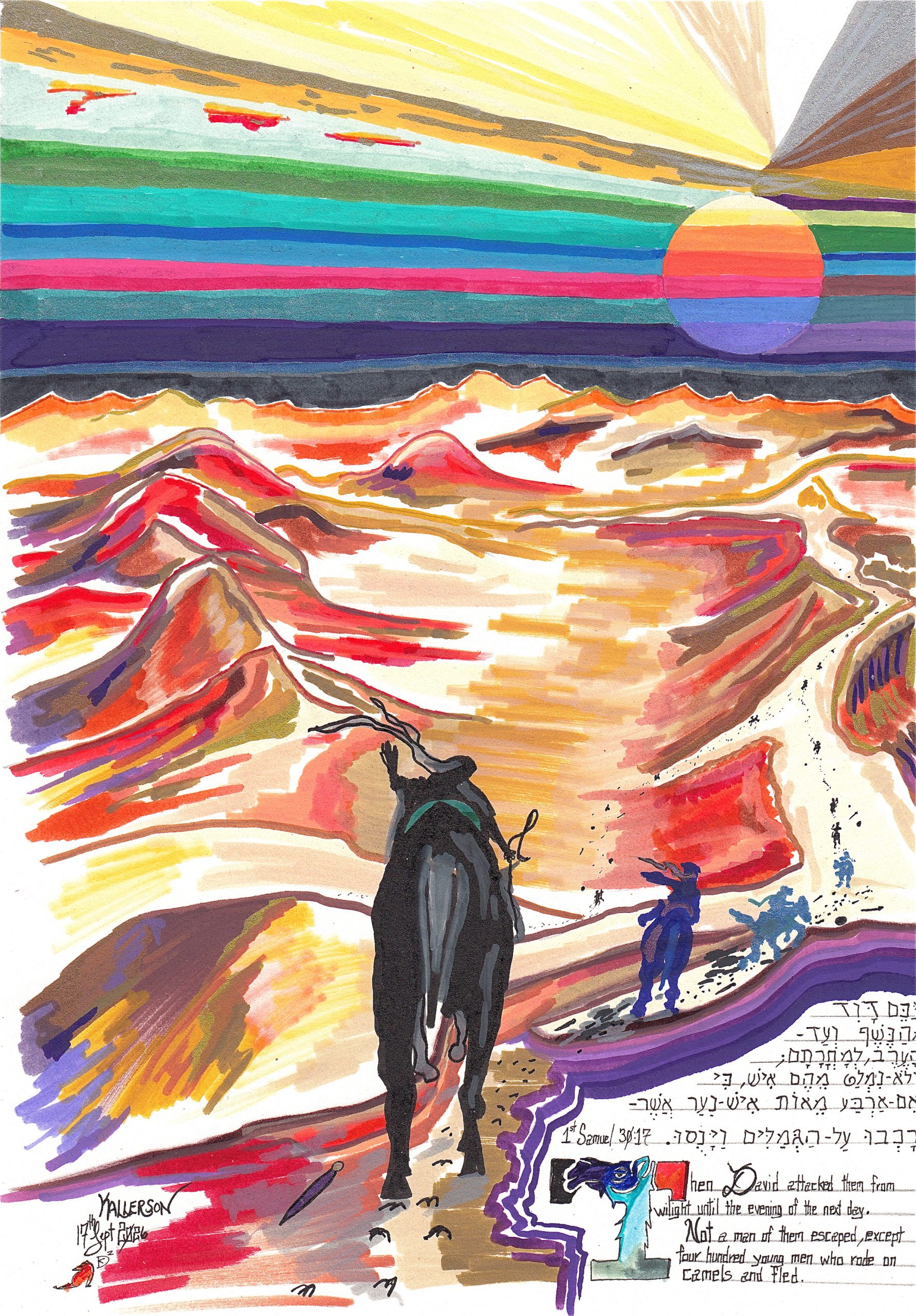
1 Samuel 12:1-12 (Behold the King, Part I)

Artwork by Douglas Kallerson

1 Samuel 12:1-12
Behold the King, Part I

(Typed 18 August 2025 ) Studying the verses in a given passage to form a sermon is only the beginning of the work. Once the information is accumulated and laid out, figuring out what it all means is the next, and most difficult, step.

God paints pictures of portions of redemptive history with the stories He selects from Israel’s history. Each story has to match what the Bible says about the concept being pictured. Just because something may appear correct doesn’t mean it is.

The sermons from 1 Samuel 10 presented pictures of things. I made notes to myself that if the pictures elicited from the verses didn’t match what would continue to be seen in subsequent sermons, I would have to reconsider my conclusions and admit that I was unsure of the typology.

However, when evaluating Chapter 11 and the story of Nahash, the earlier sermons fit seamlessly. What I thought was correct was. That was a big relief. Otherwise, instead of going forward, I would have had to spend quite a bit of time going back to figure out where the disconnect was.

Text Verse: “These were more fair-minded than those in Thessalonica, in that they received the word with all readiness, and searched the Scriptures daily to find out whether these things were so.” Acts 17:11

In this verse from Acts, we see that when Paul and Silas made claims about Jesus, the Bereans went to Scripture, meaning the Hebrew Scriptures, to see if they were true.

The implication is that the Hebrew writings were speaking about Jesus and what He would accomplish. This is true of the law, the prophets, and the writings. Paul confirms this in verses found in his epistles, such as in 1 Corinthians 10, Galatians 4, etc.

Elsewhere in the New Testament, this is seen as well, such as Jesus’ words to the two who were with Him on the road to Emmaus. In John 5:39, He notes that the Scriptures testify of Him. Therefore, we are to look for Jesus in them.

Everything we evaluate must be logical, orderly, and consistent. If we follow this method and these rules, we will be properly and responsibly evaluating the word. Let us endeavor to do so. God is revealing His mind to us. We should respectfully keep this in mind.

Jesus! He is the One to be revealed in this superior word. And so, let us turn to that precious word once again, and… May God speak to us through His word today, and may His glorious name ever be praised.

I. Not a Speck (verses 1-6)

Now Samuel said to all Israel: “Indeed I have heeded your voice in all that you said to me, and have made a king over you.

vayomer shemuel el kal Yisrael hineh shamati veqolekhem lekhol asher amartem li vaamlikh alekhem melekh – “And he said, Samuel, unto all Israel, ‘Behold! I heard in your voice to all which you said to me, and I caused to reign upon you king.” This refers to 1 Samuel 8 –

“Now it came to pass when Samuel was old that he made his sons judges over Israel. The name of his firstborn was Joel, and the name of his second, Abijah; they were judges in Beersheba. But his sons did not walk in his ways; they turned aside after dishonest gain, took bribes, and perverted justice.
Then all the elders of Israel gathered together and came to Samuel at Ramah, and said to him, ‘Look, you are old, and your sons do not walk in your ways. Now make us a king to judge us like all the nations.’” 1 Samuel 8:1-5

This request for a king signified a rejection of the Lord as their King –

“But the thing displeased Samuel when they said, ‘Give us a king to judge us.’ So Samuel prayed to the Lord. And the Lord said to Samuel, ‘Heed the voice of the people in all that they say to you; for they have not rejected you, but they have rejected Me, that I should not reign over them.’” 1 Samuel 8:6, 7

Their request led to the selection of Saul as detailed in Chapter 9 and his anointing and acceptance as king in Chapter 10. Chapter 11 detailed Saul’s victory over Nahash, which led to the assembly being called together now in Gilgal.

And now here is the king, walking before you;

veatah hineh ha’melekh mithhalekh liphnekhem – “And now, behold the king, walking himself to your faces.” The people asked for a king, the Lord agreed to give them one, and Saul now stood before them, presented by the final judge of Israel, who confirms the selection and the process of appointment.

The idea of the king walking before them signifies a leader. Samuel walked with the people more than before them. The king, however, was to walk before them, and his subjects were to follow, being obedient to his authority.

At the same time, there is the expectation that a king would be like a shepherd to his people, keeping them safe from the enemies round about. Next, Samuel says…

2 (con’t) and I am old and grayheaded, and look, my sons are with you.

His words are emphatic: vaani zaqanti vasavti u-vanay hinam itekhem – “And I, I aged and I grayed. And my sons, behold, with you.” The emphasis is given as a response to their accusations in verse 8:5 – “Look, you are old, and your sons do not walk in your ways.”

The agreement with their words could be paraphrased, “Indeed, I am old, and yes, my sons are with you.” As Samuel is the God-appointed judge, his words will address that fact. The sons’ conduct was never the issue. Instead, it was used as a pretext, along with his age, to be like the other nations and have a king.

That should be evident because Samuel’s predecessor, Eli, had his sons taken from him in battle. If the Lord felt it necessary for Samuel’s sons to punch their proverbial tickets, He could have taken care of it. To openly rebuke them for this, Samuel continues…

2 (con’t) I have walked before you from my childhood to this day.

Again, the words are emphatic: vaani hithhalakhti liphnekhem mineuray ad ha’yom ha’zeh – “And I, I walked myself to your faces from my youth until the day, the this.” The reflexive verb, “I walked myself to your faces,” is a way of highlighting his personal conduct. It is like saying, “I wasn’t forced to conduct myself as I did. Rather, I set my walk and walked it before you.”

Because of this, he wants the people to inspect themselves and their reason for petitioning a king…

Here I am. Witness against me before the Lord and before His anointed:

The emphatic nature of the words is highlighted with an interjection followed by an imperative verb: hineni anu vi neged Yehovah veneged meshikho – “Behold me! You must heed in me – afront Yehovah and afront His anointed.” He stands before the people, asking them to raise any accusation they may have against him. The intent of his words is, “This is your big chance to justify your request for a king, so let’s hear it…”

This is the first time the word mashiakh, anointed (also Messiah, or Christ), is used concerning a king. It signifies one who is anointed, literally or spiritually, for a given position. The high priest already bears this title. It was used in the Song of Hannah and again by the man of God who spoke to Eli, both in Chapter 2, and both prophetically speaking of the Messiah of God.

Saul is now an anointed king. As such, he is also a witness to the words that follow…

3 (con’t) Whose ox have I taken, or whose donkey have I taken, or whom have I cheated? Whom have I oppressed, or from whose hand have I received any bribe with which to blind my eyes?

eth shor mi laqakhti vakhamor mi laqakhti veeth mi ashaqti eth mi ratsothi u-miyad mi laqakhti kopher veaelim enay bo – “Bullock whose I took, and jack whose I took, and whom I oppressed, whom I crushed, and from hand whom I took cover and I will cause to conceal my eyes in him?”

Each question, based on the one asking, demands a negative answer. Samuel would not implicate himself to make his point. The question concerning the ox and donkey implies covetousness leading to theft through the abuse of his position.

Oppression and crushing imply abuse of his authority to obtain something at the expense of others’ labor, or even a person of a sadistic spirit, who revels in harming others for pleasure. Both words are used in Deuteronomy to indicate the rough treatment by others towards Israel as a curse of the law –

“A nation whom you have not known shall eat the fruit of your land and the produce of your labor, and you shall be only oppressed and crushed continually.” Deuteronomy 28:33

To take a cover signifies closing one’s eyes, as in covering them, to either punish someone unjustly or not punish someone who should be punished (as a ransom) based on a bribe. The bribe thus covers the eyes –

“For I know your manifold transgressions
And your mighty sins:
Afflicting the just and taking bribes [kopher: cover];
Diverting the poor from justice at the gate.” Amos 5:12

To further highlight his conduct before them, Samuel says…

3 (con’t) I will restore it to you.”

veashiv lekhem – “And I will cause to return to you.” It is a proposal to restore any wrongs committed against them. The unstated meaning is, “Here is your big chance to get what I owe you. Everyone is watching, so speak up!”

And they said, “You have not cheated us or oppressed us, nor have you taken anything from any man’s hand.”

vayomeru lo ashaqtanu velo ratsothanu velo laqakhta miyad ish meumah – “And they said, ‘Not you oppressed us, and not you crushed us, and not you took from hand man speck.’” With this response, Samuel is entirely acquitted of any possible charge against him, even of taking a single speck that was not rightfully his.

As such, the people cannot say it is because of his judgeship that they asked for a king. His age is irrelevant because kings also age, but the people will still have to serve under them. His sons’ conduct is irrelevant because he, not they, is the nation’s judge. There was no hint of succession suggested or insinuated.

Further, with the appointment of Saul as king, whatever the king decided concerning Samuel’s sons was his responsibility. Samuel had left their fate in his hands for judging any wrongdoing. Therefore, the reason the people have asked for a king cannot be what they implied were the reasons.

Then he said to them, “The Lord is witness against you, and His anointed is witness this day,

vayomer alehem ed Yehovah bakhem veed meshikho ha’yom hazeh – “And he said unto them, ‘Witness, Yehovah, in you. And witness His anointed the day, the this.’” Samuel calls for a double witness. The first is “in you,” meaning “against you.” The Lord has seen all that has taken place and has a valid cause to level charges against them.

Further, the new king, the Lord’s anointed, stands as a witness to Samuel’s integrity, having heard the people’s admission that he has done nothing wrong. If the Lord decides to judge the people, Saul must testify that His judgments are just. This is because…

5 (con’t) that you have not found anything in my hand.”

ki lo metsatem beyadi meumah – “For not you found in my hand speck.” Even to the slightest speck, Samuel stood blameless before the Lord and now also His anointed. The word, repeated from the previous verse, is meumah, a speck or point. It is from mum, a spot or blemish. Samuel’s integrity testifies that he has not been found with a spot or blemish in his hand before the Lord or the king.

5 (con’t) And they answered, “He is witness.”

Rather: vayomer ed – “And they said, ‘Witness!’” The witness is the fact of innocence concerning Samuel. It is not “He is a witness,” but that there is a standing witness. Yehovah is the principal witness, but this extends to His anointed who will henceforth represent Him as their king.

They have unwittingly acknowledged their guilt, revealing there was no valid reason for having asked for a king. Samuel has set them up, like Moses did, having Korah present unauthorized incense before the Lord. Now that they have revealed their guilt, Samuel will next witness against them as Yehovah’s representative…

Then Samuel said to the people, “It is the Lord who raised up Moses and Aaron, and who brought your fathers up from the land of Egypt.

vayomer shemuel el ha’am Yehovah asher asah eth mosheh veeth Aharon vaasher heelah eth avotekhem meerets mitsrayim – “And he said, Samuel, unto the people, ‘Yehovah – whom He made Moses and Aaron, and whom He caused to ascend your fathers from land Egypt.’”

The name, Yehovah, is placed absolutely. Only then is what He did given as an explanation. This can be seen without the intervening words –

“And they said, ‘Witness!’” … “Yehovah – whom He made Moses and Aaron, and whom He caused to ascend your fathers from land Egypt.” It is the Lord who sees what transpired. But it was He who made, directed the lives of, selected, and commissioned Moses as the lawgiver and Aaron the administrator and mediator of the Law.

It is also He who led Israel out of Egypt, bringing them through the wilderness and into the land of Canaan. The people could not dispute this, nor would they think of doing so. This is a truth that permeated their society and culture.

To deny this would mean that Israel was established on a lie and there would be no reason for their national identity. To this day, Israel celebrates the Passover, practices circumcision, and observes the Sabbath. These bind them as a people.

If they denied Moses and Aaron, they would, by extension, deny the Lord. In doing so, the entire fabric of their existence as Israel would have no merit. This doesn’t mean they actually believe in Yehovah, Moses, or Aaron, but logic alone means they could not openly deny any of them.

As Yehovah made these two men, and as they formed the established basis for Israel’s lives, conduct, and existence within Canaan, what did they lack as a people? And more, judges were raised up by Him. To substantiate that they had done wrong, Samuel will next present them with historical proofs to remind them and to accuse them…

Who is the Lord that He should reign over us?
Israel sounds like Pharoah, king of Egypt
They rejected Yehovah, and they rejected Jesus
Of His glory, the Lord has been stripped

And yet, the Lord has been faithful and true
He has kept them, thus keeping His word
Israel doesn’t know Him, sad but true
Someday, they will call on Him as Lord

Are they really any different than us?
One day, we are proclaiming His name
But in no time, we have forgotten Jesus
And off we go, seeking our own fame

II. They Forgot Yehovah Their God (verses 7-12)

Now therefore, stand still, that I may reason with you before the Lord

Rather: veatah hithyatsevu veishapetah itekhem liphne Yehovah – “And now, you must station yourselves, and let me judge with you to faces Yehovah.” Samuel is not reasoning with them. He is judging them. First, he offered the people the chance to bring charges against him, giving them a chance to explain why they wanted a king. No valid reason was given.

Telling them to station themselves means that they are now the ones on trial. They have been arraigned for their actions, and the evidence will next be submitted. This evidence is…

7 (con’t) concerning all the righteous acts of the Lord which He did to you and your fathers:

eth kal tsidqoth Yehovah asher asah itekhem veeth avothekhem – “all righteousnesses Yehovah, which He did with you and with your fathers.” The word tsedaqah, righteousness, is used in the sense of covenant faithfulness.

Even before Moses and Aaron, there was already a covenant between the Lord and Abraham. That covenant extended to Isaac and then Jacob. At the time of Abraham, the Lord explained what would occur so that when it did, the people would remember His words –

“Then He said to Abram: ‘Know certainly that your descendants will be strangers in a land that is not theirs, and will serve them, and they will afflict them four hundred years. 14 And also the nation whom they serve I will judge; afterward they shall come out with great possessions.’” Genesis 15:13, 14

These were words associated with the covenant. Therefore, the people could not say their time in Egypt was because the Lord didn’t care or that He was faithless. Rather, just the opposite was the case. He explained this to Abraham –

“Now as for you, you shall go to your fathers in peace; you shall be buried at a good old age. 16 But in the fourth generation they shall return here, for the iniquity of the Amorites is not yet complete.” Genesis 15:15, 16

The Lord’s words include two specificities that should be carefully explained. They are the period of four hundred years (Genesis 15:13) and that of the fourth generation (Genesis 15:16).

The movement of Jacob and his family to Egypt occurred in the year 2299 Anno Mundi. It was 215 years after the initial promise of the land that was made to Abraham in Genesis 12. That occurred in the year 2084AM.

After that, it would be another 215 years before Israel would be brought out of Egypt in the year 2514AM. One might say that the Lord’s words to Abraham in Genesis 15 are not true. If Israel were afflicted for 400 years and yet they were only in Egypt for 215 years, then there is an error.

But this is incorrect. It says, “Know certainly that your descendants will be strangers in a land that is not theirs, and will serve them, and they will afflict them four hundred years.” Isaac was born in the year 2109AM.

He would have been weaned between two and four years old. That would be 2011-2013AM. As Israel departed from Egypt in 2514AM, and as Ishmael afflicted Abraham’s descendants at the weaning of Isaac in a land that was not yet theirs, it is 400 years from Ishmael afflicting Isaac to the exodus from Egypt.

Also, one might argue that the words “the fourth generation” are wrong because the people were in Egypt for more than four generations. Again, this would be incorrect. Only the line of Levi, out of all of those who went to Egypt, has the specific years of their lives recorded.

The timing is understood based on the naming of Jochebed, the daughter of Levi, in the ongoing narrative of Exodus and Numbers. Those two mentions are –

“Now Amram took for himself Jochebed, his father’s sister, as wife; and she bore him Aaron and Moses. And the years of the life of Amram were one hundred and thirty-seven.” Exodus 6:20

&

“The name of Amram’s wife was Jochebed the daughter of Levi, who was born to Levi in Egypt; and to Amram she bore Aaron and Moses and their sister Miriam.” Numbers 26:59

Jochebed is noted as Amram’s wife and also “his father’s sister,” but she is also called “the daughter of Levi who was born to Levi in Egypt.”

In Exodus 6:16, it said that Levi lived to the age of 137. The only other son of Jacob whose age at death was recorded was Joseph, because it was necessary to know. After Levi, of his three sons, only the age of Kohath is given at his death, 133.

And then, for all the sons of Kohath, only the age of Amram is given at his death, 137. As the Israelites dwelt in Egypt for 215 years, these ages were recorded to show the reliability and covenant faithfulness of the Lord’s promise to Abraham. This is evidenced by the words, “and to Amram she [Jochebed] bore Aaron and Moses and their sister Miriam.”

Jochebed is Levi’s natural daughter, and Kohath is Levi’s natural son. Amram was Levi’s grandson who married his aunt, Levi’s daughter. From that union, Aaron, Moses, and Miriam, Levi’s great-grandchildren, were born.

The specific record of this line was given to establish a direct line from Abraham to Moses and Aaron through Isaac and Jacob. That is clearly evident when compared with the other sets of genealogies already given in the Bible.

But more, the special record of the years of these people’s lives, along with the special note of Jochebed being both the daughter of Levi and sister of Kohath, is given to show that the Lord’s words were both true and fulfilled.

Jacob went to Egypt with his family, which included his son Levi and Levi’s three sons, Gershon, Kohath, and Merari. In Egypt, Kohath had a son named Amram, and Amram had a son named Moses.

Thus, Moses is the fourth generation from Jacob, who went to Egypt (Jacob: Levi, Kohath, Amram, Moses). And the sons of Aaron and Moses are the fourth generation from Kohath, Levi’s son, who also went to Egypt. As it is this generation that entered Canaan, the prophecy concerning the fourth generation was exactingly fulfilled.

That information needed to be explained because Samuel next specifically addresses it…

When Jacob had gone into Egypt, and your fathers cried out to the Lord,

kaasher ba yaaqov mitsrayim vayizaqu avothekhem el Yehovah –“According to which he came, Jacob – Egypt. And you shrieked, your fathers, unto Yehovah.” This is recorded in Exodus 3 –

“And the Lord said: ‘I have surely seen the oppression of My people who are in Egypt, and have heard their cry because of their taskmasters, for I know their sorrows.’” Exodus 3:7

Because of this, and because of His covenant faithfulness, meaning His righteousnesses…

8 (con’t) then the Lord sent Moses and Aaron, who brought your fathers out of Egypt and made them dwell in this place.

vayishlakh Yehovah eth mosheh veeth Aharon vayotsiu eth avothekhem mimitsrayim vayoshivum bamaqom ha’zeh – “And He sent, Yehovah, Moses and Aaron, and they caused to bring your fathers from Egypt, and they caused to sit them in the place, the this.” Joshua made essentially this same appeal during his farewell address to the people –

“Also I sent Moses and Aaron, and I plagued Egypt, according to what I did among them. Afterward I brought you out.” Joshua 24:5

The exodus from Egypt was the defining act to prepare Israel’s existence as a nation set apart to God. Giving them the law and bringing them into Canaan then confirmed what the exodus anticipated, establishing them as a nation and providing a homeland for them.

Saying that Moses and Aaron were the ones who caused them to “sit in this place” signifies the giving of and subsequent adherence to the law, typified by Moses and Aaron. This is evident because in the future, they would be ejected from Canaan, going into exile in Babylon for their disobedience.

The Lord had been faithful to them in every detail. None of what transpired in Egypt could be held against Him because He had informed them in advance of what would happen. It was a set part of His plan, and His words were fulfilled to the letter.

Further, despite Israel’s continued rebellion against Him in the wilderness and as they entered Canaan, He remained faithful to the covenant He made. This covenant faithfulness even includes His chastisement upon them…

And when they forgot the Lord their God, He sold them into the hand of Sisera, commander of the army of Hazor,

vayishkehu eth Yehovah elohehem vayimkor otham beyad Sisera sar tseva khatsor – “And they forgot Yehovah their God, and He sold them in hand Sisera, commander host Hazor.” This is recorded in Judges 4 –

“When Ehud was dead, the children of Israel again did evil in the sight of the Lord. So the Lord sold them into the hand of Jabin king of Canaan, who reigned in Hazor.” Judges 4:1, 2

The account is recorded in Judges 4, and is memorialized in the Song of Deborah in Judges 5. However, Israel failed to listen. Therefore, the Lord sold them again…

9 (con’t) into the hand of the Philistines, and into the hand of the king of Moab; and they fought against them.

u-veyad pelishtim u-beyad melekh moav vayilakhamu bam – and in hand Philistines, and in hand king Moab. And they were consumed in them.” In Judges 10, it says –

“Then the children of Israel again did evil in the sight of the Lord, and served the Baals and the Ashtoreths, the gods of Syria, the gods of Sidon, the gods of Moab, the gods of the people of Ammon, and the gods of the Philistines; and they forsook the Lord and did not serve Him. So the anger of the Lord was hot against Israel; and He sold them into the hands of the Philistines and into the hands of the people of Ammon.” Judges 10:6, 7

In Judges 3, it says –

“And the children of Israel again did evil in the sight of the Lord. So the Lord strengthened Eglon king of Moab against Israel, because they had done evil in the sight of the Lord. 13 Then he gathered to himself the people of Ammon and Amalek, went and defeated Israel, and took possession of the City of Palms. 14 So the children of Israel served Eglon king of Moab eighteen years.” Judges 3:12-14

The three foes, Sisera, the Philistines, and Moab, are named to identify enemies within Canaan (Sisera led the armies of Jabin, king of Canaan), to their west (Philistines), and to their east (Moab). With each instance of rebellion and chastisement, the same response followed…

10 Then they cried out to the Lord, and said,

vayizaqu el Yehovah vayomer – “And they shrieked unto Yehovah, and he said…” The written and oral Hebrew do not match. The written says, “and he said.” The oral says, “and they said.” There is no need for the change. The people cried out to the Lord. Samuel then refers to them as one people in the singular. They next acknowledge their universal guilt…

10 (con’t) ‘We have sinned, because we have forsaken the Lord and served the Baals and Ashtoreths; but now deliver us from the hand of our enemies, and we will serve You.’

khatanu ki azavnu eth Yehovah vanaavod eth ha’bealim veeth haashtaroth veatah hatsilenu miyad oyevenu venaavdekha – “We sinned, for we relinquished Yehovah, and we served the Baals and the Ashtaroth. And now, you must cause to deliver us from hand our hatings, and let us serve you.” The people cried out, acknowledged their sin, and begged for deliverance. In place of serving other gods, they petitioned the Lord to allow them to serve Him again.

This is the repeated theme of the Book of Judges, and it is then followed up with the Lord relenting and bringing deliverance through someone selected by Him. To substantiate this, Samuel next says…

11 And the Lord sent Jerubbaal, Bedan, Jephthah,

vayishlakh Yehovah eth yerubaal veeth bedan veeth yiphtakh – “And He sent, Yehovah, Jerubbaal, and Bedan [In Dan], and Jephthah.” Each of these was selected by the Lord as a judge to deliver the people. Jerubbaal’s judgeship is recorded in Judges 6 & 7. He was selected to fight Midian.

Bedan appears to be an unnamed judge, but this is not the case. The usual excuse of most scholars is that it is a copyist’s error, which should have said Barak. That would assume that the name, which is not as close as scholars claim based on the last letter, was not only copied wrong but was also ignored from the very first read through –

ברק
בדן

More to the point, Barak was not a judge of Israel, nor was the credit for the victory in the battle given to him. Rather, it was given to Jael, the wife of Heber the Kenite.

As for Bedan, the name is an appellative for Samson. He was from Dan, and Samuel calls him bedan, In Dan. The spelling is identical between this name and the words “in Dan” in 1 Kings 12:29 –

בדן
בדן

The general (but incorrect) argument, summed up by Lange, is that “a name resting on a word-play would by no means suit this serious discourse; against the first (apart from the form) is the fact that Samson is never so-called, as must have been the case if the people were here to understand the name.”

This is nonsense. It is a speculative opinion combined with an argument from silence. It is incorrect because Jerubbaal was not called Jerubbaal until he received the name based on what he did at the time of his appointment as judge.

His name was Gideon, and yet, Samuel called him Jerubbaal based on that event. Thus, it was a name based on… wordplay. Further, it is an argument from silence to assume that Samson would not be known as Bedan, In Dan, simply because the name is not recorded in Judges.

There are abundant times where names and titles are seen as understood without ever having been recorded at some prior time. A good example of this was the word ro’eh, seer, in Judges 9:9. It was never used before in Scripture, and yet it notes that the word was common in the past but was no longer used.

This is what Samuel now does with Samson, who was from the same tribe as those who went north to Laish in Judges 18, apostatizing from the Lord. Unlike his wayward family members, Samson was a judge from the tribe of “Judge,” thus he is In Dan.

Samson’s judgeship is found in Judges 14 & 15, detailing his interactions with the Philistines. He judged Israel 20 years.

Jephthah’s judgeship is recorded in Judges 11 & 12. He was selected to fight the people of Ammon. Finally, Samuel refers to himself as a judge and deliverer as well…

11 (con’t) and Samuel, and delivered you out of the hand of your enemies on every side; and you dwelt in safety.

veeth shemuel vayatsel ethkhem miyad oyevekhem misaviv vateshevu betakh – “and Samuel, and He caused to deliver you from hand your hatings from surrounding, and you sat in security.” Various scholars have a problem with Samuel including himself in the list as if it were bragging or complaining about his loss of authority to Saul.

However, Samuel is making a point about what was said in verse 10 and here in verse 11. Israel cried out to the Lord and then He sent a deliverer to turn them back to the Lord. Samuel was appointed to do just that. It is the reason for the specific timeline that was highlighted in Chapter 4 and resumed in Chapter 7, along with the particular timeline that was seen in Chapter 11, but which began in Chapter 8.

Events occurred that necessitated a judge to tend to a matter. The matter is resolved because the Lord faithfully tended to His covenant promises, even when Israel was faithfully unfaithful to Him. It was the case with the Philistines in Chapter 7 and with Nahash the Ammonite in Chapter 11, whose story actually fits into the narrative beginning in Chapter 8.

Despite the Lord having been faithful every step of the way, from Moses and Aaron until Samuel, Israel had never been faithful. This included the events that just took place and which have led to their gathering in Gilgal…

12 And when you saw that Nahash king of the Ammonites came against you, you said to me, ‘No, but a king shall reign over us,’

vatiru ki nakhash melekh bene amon ba alekhem vatomeru li lo ki melekh yimlokh alenu – “And you saw for Nahash, king sons Ammon, came upon you, and you said to me, ‘No! For king, he will reign upon us.’” It is these words that necessitate the unusual but precise timeline I laid out in verse 5 of the last sermon.

Nahash came against Jabesh Gilead. When he demanded the right eyes of the people of the city, it was considered a disgrace upon the entire nation. Thus, Samuel rightly says that he came against the nation.

Feeling that Samuel, and thus the Lord whom he represented, was incapable of handling the matter, they asked for a king, wanting one to reign over them like all the other nations. In the same manner that they had treated the Lord since the exodus, Samuel next says…

*12 (fin) when the Lord your God was your king.

Rather: veYehovah elohekhem malkekhem – “And Yehovah your God – your King!” Again and again over the years, Israel cried out to Yehovah and He delivered them. He had been faithful to a T every step of the way. He was their King, and He remained their King. They just failed to see it and acknowledge Him as such.

In fact, they had tried to appoint Gideon as ruler over them in Judges 8, but he refused, telling them that the Lord would rule over them. Not heeding that, the people of Shechem proclaimed Gideon’s son Abimelech king, something that didn’t go over so well for them.

The pattern of Israel’s failures seems almost endless because of their inability to acknowledge the Lord for who He is. Unfortunately, that has continued to this day.

Despite paying constant lip service to Him in synagogues, discussions, and homes around the world, they have rejected their King because they have rejected Jesus. Until they correct this and acknowledge Jesus for who He is, they will continue to face insurmountable troubles and woes.

And yet, just as during the time of the judges and now the kings, the Lord has remained faithful to them. His heavy hand upon them has not been an indication of His rejection of them. Rather, it is an indication of His continued correction of them.

Correction from the Lord is intended for exactly that purpose. If they were no longer on His radar in regard to redemptive history, they would have disappeared like all their enemies around them have, being swallowed up by the forces of time and human movement.

And yet, just as prophesied, they have remained a separate and distinct island among the nations of the world, even in their dispersion. And just as the ancient oracles have prophesied, they have been returned to their land to bring about the fulfillment of God’s word, including the return of Jesus to them.

The disobedient and stubborn nature of Israel exists in each of us unless we purposefully and actively quash it. Churches founded on Jesus Christ, which are grounded in God’s word, are often seen to apostatize in the course of a single lifetime, leaving nothing but a worthless shell of congregants fighting against God and maligning Him through their actions.

When we look at Israel, we are observing the human condition. This is why the Bible is relevant in every society it is introduced into. Therefore, let us consider what we read, determine to obey it, and actively direct our thoughts and hearts to the Lord, even until the day He calls us home.

Closing Verse: “A voice was heard on the desolate heights,
Weeping and supplications of the children of Israel.
For they have perverted their way;
They have forgotten the Lord their God.” Jeremiah 3:21

Next Week: 1 Samuel 12:13-25 What kind of leadership will he bring? I wonder and so do you… (Behold the King, Part II) (22nd 1 Samuel Sermon)

The Lord has you exactly where He wants you. He has a good plan and purpose for you. He is the One who abases the haughty and exalts the humble. He regards the lowly, and the proud He knows from afar. So yield yourself to Him, trust Him, and believe His word. In this, He will do great things for you and through you.

1 Samuel 12:1-12 (CG)

12 And he said, Samuel, unto all Israel, “Behold! I heard in your voice to all which you said to me, and I caused to reign upon you king. 2 And now, behold the king, walking himself to your faces. And I, I aged and I grayed. And my sons, behold, with you. And I, I walked myself to your faces from my youth until the day, the this.

3 Behold me! You must heed in me – afront Yehovah and afront His anointed. Bullock whose I took, and jack whose I took, and whom I oppressed, whom I crushed, and from hand whom I took cover and I will cause to conceal my eyes in him? And I will cause to return to you.” 4 And they said, “Not you oppressed us, and not you crushed us, and not you took from hand man speck.”

5 And he said unto them, “Witness, Yehovah, in you. And witness His anointed the day, the this. For not you found in my hand speck.”

And they said, “Witness!”

6 And he said, Samuel, unto the people, “Yehovah – whom He made Moses and Aaron, and whom He caused to ascend your fathers from land Egypt. 7 And now, you must station yourselves, and let me judge with you to faces Yehovah all righteousnesses Yehovah, which He did with you and with your fathers. 8 According to which he came, Jacob – Egypt. And you shrieked, your fathers, unto Yehovah. And He sent, Yehovah, Moses and Aaron, and they caused to bring your fathers from Egypt, and they caused to sit them in the place, the this. 9 And they forgot Yehovah their God, and He sold them in hand Sisera, commander host Hazor, and in hand Philistines, and in hand king Moab. And they were consumed in them. 10 And they shrieked unto Yehovah, and he said, ‘We sinned, for we relinquished Yehovah, and we served the Baals and the Ashtaroth. And now, you must cause to deliver us from hand our hatings, and let us serve you.’ 11 And He sent, Yehovah, Jerubbaal, and Bedan [In Dan], and Jephthah, and Samuel, and He caused to deliver you from hand your hatings from surrounding, and you sat in security. 12 And you saw for Nahash, king sons Ammon, came upon you, and you said to me, “No! For king, he will reign upon us.” And Yehovah your God – your King!”


1 Samuel 12:1-12 (NKJV)

Now Samuel said to all Israel: “Indeed I have heeded your voice in all that you said to me, and have made a king over you. And now here is the king, walking before you; and I am old and grayheaded, and look, my sons are with you. I have walked before you from my childhood to this day. Here I am. Witness against me before the Lord and before His anointed: Whose ox have I taken, or whose donkey have I taken, or whom have I cheated? Whom have I oppressed, or from whose hand have I received any bribe with which to blind my eyes? I will restore it to you.”

And they said, “You have not cheated us or oppressed us, nor have you taken anything from any man’s hand.”

Then he said to them, “The Lord is witness against you, and His anointed is witness this day, that you have not found anything in my hand.”

And they answered, “He is witness.”

Then Samuel said to the people, “It is the Lord who raised up Moses and Aaron, and who brought your fathers up from the land of Egypt. Now therefore, stand still, that I may reason with you before the Lord concerning all the righteous acts of the Lord which He did to you and your fathers: When Jacob had gone into Egypt, and your fathers cried out to the Lord, then the Lord sent Moses and Aaron, who brought your fathers out of Egypt and made them dwell in this place. And when they forgot the Lord their God, He sold them into the hand of Sisera, commander of the army of Hazor, into the hand of the Philistines, and into the hand of the king of Moab; and they fought against them. 10 Then they cried out to the Lord, and said, ‘We have sinned, because we have forsaken the Lord and served the Baals and Ashtoreths; but now deliver us from the hand of our enemies, and we will serve You.’ 11 And the Lord sent Jerubbaal, Bedan, Jephthah, and Samuel, and delivered you out of the hand of your enemies on every side; and you dwelt in safety. 12 And when you saw that Nahash king of the Ammonites came against you, you said to me, ‘No, but a king shall reign over us,’ when the Lord your God was your king.


1 Samuel 11:1-15 (Nahash the Ammonite)

Artwork by Douglas Kallerson

1 Samuel 11:1-15
Nahash the Ammonite

(Typed 11 August 2025) Word studies, including names of things, places, and peoples, are invaluable for understanding what is being presented in Scripture. For example, understanding the meaning of the fig will help you understand what is going on in several key passages of both testaments.

Knowing the meaning of a city’s name, such as Gibeah or Jerusalem, will reveal what is on God’s mind as He repeatedly highlights that particular location.

In such cases, the meaning and imagery will be consistent, even if there is more than one meaning. Water, for example, has several underlying meanings, but they will be consistently applied.

One reliable source for understanding the meaning of various things in Scripture is Abarim Publications. From time to time, I mention them when they have accurately analyzed a particular word. They give great insights into why that word should be considered in a particular way.

For example, the name Nahash is introduced into Scripture in 1 Samuel 11:1. This is what Abarim has to say about it –

The most fundamental meaning of the root נחש (nahash) is that of intuitive knowledge and near-accidental skill. It describes an ability to achieve a great technological feat — particularly smelting bronze — but crucially without truly understanding what makes the magic happen: the fire or the prayer, the air blasted into the furnace or the zealous faith of the technicians.

Dictionaries commonly spread the following words out over four separate roots, but to the ancients, these words all expressed the same core meaning:

The noun נחש (nahash) is the Bible’s most common word for snake. Snakes in the Bible always represent some kind of mental process, usually intuitive and usually impure or otherwise detrimental.

The identical verb נחש (nahash) means to divine or soothsay. Its derived noun, again identical, נחש (nahash) means divination or enchantment.

Either this same verb נחש (nahash), or an identical other one, also appears to have described the production of bronze. It’s not used as such in the Bible but the following derivations are: Noun נחשת (nehoshet) refers to copper or bronze, or items made from bronze. Adjective נחוש (nahush) means bronze. And noun נחושה (nehusha) or נחשה (nehusha) means copper or bronze.

Text Verse: “Now the serpent [nakhash] was more cunning than any beast of the field which the Lord God had made. And he said to the woman, ‘Has God indeed said, “You shall not eat of every tree of the garden”?’” Genesis 3:1

The name Nahash is derived from the identical noun, nakhash, meaning serpent which is seen in Genesis 3:1. That is derived from the verb nakhash, meaning to whisper a magic spell (think of hissing), and thus to prognosticate, which is first found in Genesis 30:27.

Traveling through the origins of words will open up incredible avenues of biblical understanding. However, be careful that what you hear aligns with reality. Many people say the fig represents Israel. It doesn’t. But that has been passed along so often that most people take it as an axiom.

If you read an analysis concerning a word, even if it sounds right, don’t be afraid to ask the person making the claim to justify where they got their information and how it can be supported. Quite often, people arbitrarily make unfounded claims concerning names, numbers, concepts, etc.

By doing this, the Bible becomes a tool manipulated to make anything say anything. That is not responsible. Hold fast to what is reasonable and can be verified. In doing this, you will be properly handling His superior word. And so, let us turn to that precious word once again, and… May God speak to us through His word today, and may His glorious name ever be praised.

I. Spirit God, Upon Saul (verses 1-7)

Then Nahash the Ammonite came up and encamped against Jabesh Gilead;

The word “Then” is wholly inappropriate based on the surrounding events: vayaal nakhash ha’amoni vayikhan al yavesh gilad – “And he ascended, Nahash the Ammonite, and he encamped upon Jabesh Gilead.” It is not known how long Nahash encamped and besieged Jabesh Gilead. The narrative makes it sound like it is one thing immediately followed by another, but this is not the case.

What is evident is that the times of the events are closely connected. 1 Samuel 12:12 noted that Israel desired a king when Nahash came against them. The actions of Nahash recorded here were the impetus for their request which was first mentioned in 1 Samuel 8.

At some point during the siege, these events take place. It appears that during this time of being besieged, Saul will be anointed king by Samuel and then proclaimed king by the people.

As noted, Nahash has a primary meaning of Serpent. It also signifies Bronze and Oracle. Ammon is the name of the people descended from Ben-Ammi, the child of Lot through his younger daughter. The name means A People. They were particularly highlighted in the account of Jephthah.

The name Jabesh (Yavesh) comes from the verb yavesh, to be dry, dried up, or withered. It is used to describe the drying up of a river, land, bones, etc. It also applies to the withering of grass. Gilead means Perpetual Fountain. Thus, Jabesh Gilead means Dry Perpetual Fountain. Its location is east of the Jordan in the tribal allotment of Manasseh.

Jabesh Gilead was seen in Judges 21. It was the city destroyed by Israel for not coming up to Mizpah when the tribes were gathered to war against Benjamin.

1 (con’t) and all the men of Jabesh said to Nahash, “Make a covenant with us, and we will serve you.”

vayomeru kal anshe yavesh el nakhash kerath lanu verith venaavdekha – “And they said, all men Jabesh, unto Nahash, ‘You must cut to us covenant and let us serve you.’” At some point during the siege, their separation from the tribes across the Jordan isolated them from most of Israel, so the inhabitants yielded to Nahash’s advances, offering themselves without further resistance if Nahash would cut a covenant with them.

It is total capitulation. Whatever he determined, they would agree to, becoming his servants. Seeing their willingness to yield so quickly, he decides to take advantage of the situation in a forceful and degrading manner…

And Nahash the Ammonite answered them, “On this condition I will make a covenant with you, that I may put out all your right eyes,

vayomer alehem nakhash ha’amoni bezoth ekhroth lakhem binqor lakhem kal ein yamin – “And he answered unto them, Nahash the Ammonite, ‘In this I will cut to you: In boring to you all eyes, right.” There are at least two reasons for this. The first is that when soldiers go into battle, they hold their shields with their left hands. When lifted, it would thus predominantly cover their left eyes.

By removing their right eyes, they would be ineffective in battle, having no usable eye to fight with, or their heads would be exposed to unacceptable dangers.

This is a variation on what Adoni-Bezek did to his enemies and what was ultimately also done to him in Judges 1. There, it was cutting off their thumbs and big toes, making them ineffective in battle. Along with this is a second, taunting, reason…

2 (con’t) and bring reproach on all Israel.”

His words are directional: vesamtiha kherpah al kal Yisrael – “and I sat-ward reproach upon all Israel.’” It is as if all of Israel is before him. By taking this action, he will take a bucketful of reproach and pour it out on them.

This is probably in response to the Ammonites’ defeat under Jephthah recorded in Judges 12. They were subdued by Israel. Now, Nahash is hoping to return the disgrace of the past upon them.

Then the elders of Jabesh said to him, “Hold off for seven days, that we may send messengers to all the territory of Israel.

vayomeru elav ziqne yavesh khereph lanu shivath yamim venishlekhah malakhim bekol gevul Yisrael – “And they said unto him, elders Jabesh, ‘You must cause to slacken to us seven days. And let us send messengers in all border Israel.” At this time, Samuel is old and his sons are serving as judges in Beersheba.

Whether Nahash knew this or not, he would be aware that Israel was not united under a king. Granting this request would allow the word to spread throughout Israel that one of their cities was besieged.

However, by this time in the siege, Saul has been anointed and is ready to lead the nation. Without specifying how long it has been since his acceptance as king, the narrative sets forth the first challenge to Israel with him as their leader.

With a mere seven days to coalesce as a nation, something seemingly impossible, it would become known throughout the land that the people’s ineptitude was rewarded with the disgrace of the men of Jabesh’s humiliation. Thus, the humiliation would also rest upon the nation. That is expressed in the next words…

3 (con’t) And then, if there is no one to save us, we will come out to you.”

veim ein moshia othanu veyatsanu elekha – “And if naught causing to save us, and we came out unto you.’” This was a seemingly win-win scenario. If anyone came to assist, they would not be sufficiently arranged to overcome Nahash. As such, they would suffer defeat against his army.

On the other hand, if no one came, there would be no need to continue besieging the city, a time-consuming and costly proposition. The men have agreed, in advance, to no longer resist Nahash and instead come out and face their fate. Therefore, he acquiesces to their request…

So the messengers came to Gibeah of Saul and told the news in the hearing of the people.

vayavou ha’malakhim givath shaul vaydaberu ha’devarim beazene ha’am – “And they came, the messengers, Gibeah Saul. And they spoke the words in ears the people.” It is speculation, but the messengers may have gone to some other location or even directly to Samuel. Upon their arrival, they were told something like, “While Jabesh Gilead was being besieged, a king was anointed over Israel. He is in Gibeah of Saul. Go there and he will decide what to do.”

Whether or not this is the case, upon arriving in Gibeah, the news concerning Jabesh’s impending doom is conveyed to the people. Gibeah means Hill. Saul means Asked. It next says…

4 (con’t) And all the people lifted up their voices and wept.

vayisu kal ha’am eth qolam vayivku – “And they lifted, all the people, their voice, and they wept.” There is the obvious sadness for the people of Jabesh. However, the remembrance of Jephthah’s victory over Ammon would have been a point of national pride. That pride will be lost, and further disgrace will be heaped upon the men of Jabesh.

However, their distress is about to be redirected to excited determination…

Now there was Saul, coming behind the herd from the field;

vehineh shaul ba akhare ha’baqar min ha’sadeh – “And behold! Saul coming after the cattle from the field.” Until this point, there was nothing yet to impel him to act as a king. And so, he went back to his regular routine, plowing with cattle. It is not unlike the apostles after Jesus’ resurrection –

“After these things Jesus showed Himself again to the disciples at the Sea of Tiberias, and in this way He showed Himself: Simon Peter, Thomas called the Twin, Nathanael of Cana in Galilee, the sons of Zebedee, and two others of His disciples were together. Simon Peter said to them, ‘I am going fishing.’” John 21:1-3

As with the apostles, the life of Saul is about to change. It may be that he didn’t yet know the reason for being anointed king, meaning that the people had asked for one based on the siege of Jabesh. Now, however, he wants to know what is going on.

There is a bit of punnery with the Hebrew. Saul is following after the baqar, cattle, coming in from the field. The noun is derived from the verb baqar, to inquire or seek, stressing the diligent nature of the inquiry. This is just what Saul will do next…

5 (con’t) and Saul said, “What troubles the people, that they weep?” And they told him the words of the men of Jabesh.

vayomer shaul mah la’am ki yivku vaysaperu lo eth divre anshe yavesh – “And he said, Saul, ‘What to the people that they will weep?’ And they recounted to him words men Jabesh.” Whether Saul knew about the siege of the city before or not, the fact that the men of Jabesh were about to surrender and be disfigured is now revealed to him.

As for a timeline of the events since Chapter 8, based on Samuel’s statement in verse 12:12, this is how it seems likely that they have unfolded –

Nahash comes against Jabesh Gilead (11:1).
Israel hears of the city being besieged and asks for a king because Saul is old and his sons are incapable of handling this matter (8:1-5).
Samuel hears their request and sends the people to their homes (8:22).
Saul’s story, including his being anointed by Samuel (9:1-10:16).
Samuel calls Israel to Mizpah, where Saul is officially appointed as the king (10:17-27).
At some point during the siege, Jabesh agrees to cut a covenant if not given relief within seven days (11:1).
Messengers are sent throughout Israel (11:3).
Messengers arrive at Gibeah of Saul (11:5).

If this is correct, and it seems likely, then this is how the events are recorded –

And it was according to which he was aged, Samuel, and he set his sons – judging to Israel. 2 And it was, name his son the firstborn, Joel, and name his second Abijah: judging in Beersheba. 3 And not they walked, his sons, in his way, and they stretched after the plunder, and they took donation, and they caused to stretch verdict. (8:1-3). … And he ascended, Nahash the Ammonite, and he encamped upon Jabesh Gilead (11:1a) … 8:4 – 10:27 … Narrative resumes at 11:1b with “And they said, all men Jabesh, unto Nahash, ‘You must cut to us covenant and let us serve you.’”

This is similar to what occurred in 1 Samuel 4:1a, which was followed by a lengthy insert ending at 1 Samuel 7:2. With this timeline understood, it next says…

Then the Spirit of God came upon Saul when he heard this news, and his anger was greatly aroused.

vatitslakh ruakh elohim al shaul beshameo eth hadevarim ha’eleh vayikhar apo meod – “And it surged, Spirit God, upon Saul in his hearing the words, the these. And it burned, his nostril, vehemently.” The surging of the Spirit was prophesied by Samuel in verse 10:6, and it came upon Saul in verse 10:10. Now, he again experiences the surge of the Spirit.

Along with that comes the familiar terminology concerning the burning nostril. It is as if flames shoot out of his nose as he snorts at the news he has heard…

So he took a yoke of oxen and cut them in pieces, and sent them throughout all the territory of Israel by the hands of messengers,

vayiqakh tsemed baqar vaynatehehu vayshalakh bekhal gevul Yisrael beyad ha’malakhim – “And he took, pair cattle, and he dismembered it. And he sent it in all border Israel in hand the messengers.” It may be that these are the same cattle he just followed in the field. Like when the Levite of Judges 19 cut up his concubine and sent her throughout Israel, Saul is doing the same. It is a sign to go with the message which is…

7 (con’t) saying, “Whoever does not go out with Saul and Samuel to battle, so it shall be done to his oxen.”

lemor asher enenu yotse akhare shaul veakhar shemuel koh yeaseh livqaro – “to say, ‘Whom he not going after Saul and after Samuel, thus it will be done to his cattle.’” In an agricultural society, cattle are extremely important. Saul had been appointed king. Whether all of Israel knew that yet or not, they would find out when the news reached their ears. But the directive is made not only in his name, but in Samuel’s as well. Samuel means Asked from God. Due to the demand, it says…

7 (con’t) And the fear of the Lord fell on the people, and they came out with one consent.

vayipol pakhad Yehovah al ha’am vayetseu keish ekhad – “And it fell, alarm Yehovah, upon the people. And they came according to man one.” Not wanting to lose their livelihood, the fear of the Lord because of the fear of the Lord’s anointed brought them out as one.

A foe must be defeated to save the people
They have no Spirit and no life
They failed to join us ‘neath the church steeple
It caused them eons of enmity and strife

The foe has come against them, and there is a need
Someone must respond, or it will be over and done
They need to do so with some real speed
These people need to find out about the Son

Who will save their proverbial bacon
And free them from the mess they are in
If no help comes, they will all be achin’
This is a fight they alone cannot win

II. And They Struck Ammon (verses 8-15)

When he numbered them in Bezek, the children of Israel were three hundred thousand, and the men of Judah thirty thousand.

vayiphqedem bevazeq vayihyu vene Yisrael shelosh meoth eleph veish Yehuda sheloshim aleph – “And he visited them in Bezek. And they were, sons Israel, three hundreds thousand. And man Judah thirty thousand.” The location, Bezek, was seen in Judges 1. This is the last time it will be seen in Scripture.

Bezek comes from the noun, bazaq, a flash of lightning. However, this is not in reference to heat, noise, or illumination, but of the scattering effect. Hence, it means Scattering.

The numbers are derived from three, ten, and thirty. Three signifies divine perfection. Ten signifies completeness of order, marking the entire round of anything. It implies that nothing is wanting; that the number and order are perfect; that the whole cycle is complete. Thirty denotes in a higher degree the perfection of Divine order, as marking the right moment.”

And they said to the messengers who came, “Thus you shall say to the men of Jabesh Gilead: ‘Tomorrow, by the time the sun is hot, you shall have help.’”

vayomeru la’malakhim ha’baim koh tomerun leish yavesh gilad makhar tiyeh lakhem teshuah bekhom ha’shamesh – “And they said to the messengers, ‘the coming,’ ‘Thus you will (surely) say to man Jabesh Gilead, “Tomorrow it will be to you salvation in heat the sun.”’” Using a paragoge, the note of deliverance is promised emphatically. It is the exact opposite of what happened to this same city at the hands of Israel in Judges 21. They were destroyed to the man at that time, but here, total delivery is promised.

9 (con’t) Then the messengers came and reported it to the men of Jabesh, and they were glad.

vayavou ha’malakhim vayagidu leanshe yavesh vayismakhu – “And they came, the messengers, and they caused to declare to men Jabesh. And they brightened.” The words are reflected in a proverb later written by Solomon –

“Anxiety in heart, man, it will depress-ward itself,
And word good, it brightened-ward.” Proverbs 12:25 (CG)

In hearing the word, their state improved from fear to joy. With that good news, the men of the city provide deceitful words to their enemy…

10 Therefore the men of Jabesh said, “Tomorrow we will come out to you, and you may do with us whatever seems good to you.”

vayomeru anshe yavesh makhar netse alekhem vaasithem lanu kekhal ha’tov beenekhem – “And they said, men Jabesh, ‘Tomorrow we will come unto you, and you did to us according to all the good in your eyes.’” It would be a true statement if Saul and his army failed to show. The men of Jabesh would have no choice in the matter. Instead, however, things will not go so well for Nahash…

11 So it was, on the next day, that Saul put the people in three companies; and they came into the midst of the camp in the morning watch,

vayhi mimakhorath vayasem shaul eth ha’am sheloshah rashim vayvou bethokh ha’makhaneh beashmoreth ha’boqer – “And it was from morrow, and he set, Saul, the people – three heads. And they came in midst the camp in watch, the morning.” Without stating it explicitly, this probably means they marched all night, crossing the Jordan and making it to the area by daybreak.

With three heads to lead the men, they would be able to come at the Ammonite camp from three different directions. It would be an overwhelming wave, confusing them in the din of the multi-pronged attack. Israel had the advantage…

11 (con’t) and killed Ammonites until the heat of the day. And it happened that those who survived were scattered, so that no two of them were left together.

vayaku eth amon ad khom ha’yom vayhi ha’nisharim vayaphutsu velo nisharu vam shenayim yakhad – “And they struck Ammon until heat the day. And it was, the ‘being left,’ and they dispersed. And not they were left, in them, two together.” As promised, by the heat of the day, the battle was over. The rout was so complete that Ammon was totally overpowered, and any who escaped did so alone. Because of the immense success, the people delight in their new king…

12 Then the people said to Samuel, “Who is he who said, ‘Shall Saul reign over us?’ Bring the men, that we may put them to death.”

vayomer ha’am el shemuel mi ha’omer shaul yimlokh alenu tenu ha’anashim u-nemitem – “And he said, the people unto Samuel, ‘Who the saying, “Saul, he will reign upon us?” You must give the men, and let us cause to kill them.’” Addressing Samuel rather than Saul is a way of confirming his, and thus the Lord’s, choice of king.

Those who came against Saul had defied the process set forth by Samuel, which was approved by the Lord. The people who now see the exceptional leadership displayed by Saul wanted any foe to pay for their arrogance and willful rejection of Saul.

13 But Saul said, “Not a man shall be put to death this day, for today the Lord has accomplished salvation in Israel.”

vayomer shaul lo yumat ish ba’yom ha’zeh ki ha’yom asah Yehovah teshuah beyisrael – “And he said, Saul, ‘Not he will be caused to die, man, in the day, the this. For the day He made, Yehovah, salvation in Israel.’” Saul understood that an execution would lead to further blood being shed as his reign was being established. Rather, through this act of leniency, the kingship is established.

Nobody would question the decision further. And more, Saul wisely passed the credit for the victory to the Lord. Despite the men fighting under his leadership, it is the Lord who brought about the salvation.

If the men had died in battle, that would have been His choice. Any that did not were thus ultimately spared by the Lord. Because of the people’s steadfast call to defend Saul…

14 Then Samuel said to the people, “Come, let us go to Gilgal and renew the kingdom there.”

vayomer shemuel el ha’am lekhu venelekhah ha’gilgal u-nekhadesh sham ha’melukhah – “And he said, Samuel, unto the people, ‘You must walk, and we will walk the Gilgal, and let us renew there the kingdom.’” The reason for this is probably based on the meaning of Gilgal. It signifies The Wheel, coming from galal, to roll.

In Joshua, when the people crossed the Jordan, the men were circumcised in Gilgal. At that time, it said –

“Then the Lord said to Joshua, ‘This day I have rolled away the reproach of Egypt from you.’ Therefore the name of the place is called Gilgal to this day.” Joshua 5:9

Because of the action and what it signifies, the meaning of Gilgal, though Wheel or Rolling, is rightly defined as Liberty. In urging the people to go there, Samuel is symbolically rolling away both the reproach of Saul’s detractors as well as the reproach of the Ammonites.

A new verb, khadash, is used here. It signifies to be new, but causatively it gives the idea of rebuilding, restoring, or renewing. It is derived from a root signifying to be new. The kingship had been tainted by the actions of the rebels, so the renewal of it will confirm it in everyone’s minds…

15 So all the people went to Gilgal, and there they made Saul king before the Lord in Gilgal.

vayelekhu kal ha’am ha’gilgal vayamlikhu sham eth shaul liphne Yehovah ba’gilgal – “And they walked, all the people, the Gilgal. And they caused to reign there, Saul, to faces Yehovah in the Gilgal.” The Greek says that they anointed Saul there, but that is incorrect.

The verb means to reign. Being causative, it means that they not only accepted him as their king, but that he has been positionally assigned as their king.

This did not happen when Saul was chosen in Chapter 10. Instead, when he returned home to his labors. From this point on, his duties and efforts would be directed to leading the kingdom. Being done before the Lord was an acknowledgment and commitment to that premise.

15 (con’t) There they made sacrifices of peace offerings before the Lord,

vayizbekhu sham zevakhim shelamim liphne Yehovah – “And they sacrificed there sacrifices repayments to Yehovah.” Nothing is mentioned of burnt offerings. This is solely a festival of rejoicing in praise and thanks to the Lord for allowing the nation a king, and a good one at that, who has already exercised sound leadership, masterful skill in battle, and wise discernment in his judgments. Therefore…

* 15 (fin) and there Saul and all the men of Israel rejoiced greatly.

The words are superlative: vayishmakh sham shaul vekhal anshe Yisrael ad meod – “And he brightened there, Saul, and all men Israel, until vehemently.” One can see the people sacrificing, dining, and passing around the wine in the greatest measure, absolutely ecstatic about how the battle went, how the selection of Saul was validated, and how future prospects for safety, union, and prosperity were anticipated.

Jabesh Gilead won’t be dry no more
When Saul and his army show up for the fight
They will get Nahash and settle up the score
Things are going to turn out all right

The future is set. It is written in the book
All we need to do is pick it up
And then open it and take a thorough look
That is a fact, my friend, fer sher and yup

There on its pages is the One
Who God asks us to focus on at all times
There on its pages, we will find the Son
The one who paid our fine, forgiving all our crimes

III. The Ending of a Nightmare

What is presented in this passage is a typological representation of what will occur during the tribulation. Nahash, Serpent, is a picture of the spirit of the Antichrist. He is noted as an Ammonite, signifying A People.

In the Jephthah series, Ammon represented the people of Israel who had rejected Jesus. They were “not My people” according to Hosea 1:9. This was also cited by Paul in Romans 9:25, 26. After the church age, the focus will return to Israel. That is seen in Peter’s words directed to the Jews of the end times –

“But you are a chosen generation, a royal priesthood, a holy nation, His own special people, that you may proclaim the praises of Him who called you out of darkness into His marvelous light; 10 who once were not a people but are now the people of God, who had not obtained mercy but now have obtained mercy.” 1 Peter 2:9, 10

Someday, Israel will again be God’s people, no longer merely A People. All those who enter the tribulation, Jew and Gentile, will not be God’s people when it begins. However, Saul represents those seeking the truth and finding it in Christ.

Those who come against the truth of God in Christ, meaning the Father/Son relationship, are of the spirit of Antichrist. They are led by the Serpent, who will come against Israel by encouraging continued temple worship/law observance.

That is seen in 2 Thessalonians where the Antichrist will sit “as God in the temple of God, showing himself that he is God” (2 Thessalonians 2:4). The connection to Satan, the serpent, is explicit there –

“The coming of the lawless one is according to the working of Satan, with all power, signs, and lying wonders, 10 and with all unrighteous deception among those who perish, because they did not receive the love of the truth, that they might be saved. 11 And for this reason God will send them strong delusion, that they should believe the lie, 12 that they all may be condemned who did not believe the truth but had pleasure in unrighteousness.” 2 Thessalonians 2:9-12

This is who Nahash and the Ammonites represent. Coming against Jabesh Gilead, Dry Perpetual Fountain, Nahash is doing exactly what Paul says. The same typology is seen of this location as in Judges.

When the article is used with Gilead (the Perpetual Fountain), it refers to the Holy Spirit. However, Gilead, without the accompanying definite article, speaks of Israel, Perpetual Fountain.

To grasp the meaning, one must think of Israel as the means of providing the Fountain, regardless of whether individuals are included in its transmission or not (Ephesians 2:12). The Spirit is the Mode by which one is included.

During the church age, Gentiles are brought into the commonwealth of Israel along with Jews. However, not all people receive it. Israel is Perpetual Fountain, not The Perpetual Fountain (meaning the Holy Spirit). The use or lack of use of the article defines this.

Understanding that, Dry Perpetual Fountain would reflect those who have no means of providing the Fountain. There is no connection to the Spirit, and thus no ability to provide it. They are Israel without the Spirit.

They have agreed to make a covenant with Nahash. He agrees in verse 2, but he tells them that the condition for it is boring out their right eyes. As seen before, the eye is used to indicate one’s spiritual state, focus, and understanding. It is used when referring to seeing spiritual truths or being blind toward them. This leads to the moral character or intentions of a person, such as referring to a good eye or a bad eye to indicate one’s level of generosity.

Demanding the right eye, the position of power and authority, signifies yielding their power and authority to discern spiritual truth. This is what is demanded of them, which will, in turn, bring reproach on all Israel.

Being on the other side of the Jordan (it is understood, though not stated) signifies not coming through Christ to be saved. Will they throw their allegiance in with Nahash and never be saved?

In verse 3, seven days are requested for an answer, the number of spiritual perfection. It reflects the biblical “day for a year” time of testing, meaning the tribulation. If the people of Jabesh Gilead are not saved by then, they will come out to Serpent.

In verse 4, the messengers came to Gibeah of Saul. Gibeah, Hill, has consistently been used in relation to Gabbatha, a word to which it is etymologically connected. Saul, those seeking the truth and who are united to Christ, are explicitly connected with Gabbatha, signifying Christ’s work.

The people in Gibeah wept because of the news, but it then says (verse 5) that Saul, Asked, was coming after the baqar (to enquire diligently) from the field (field consistently refers to the world at large). A diligent search of the world at large is where the information about Christ will come from during the tribulation period, probably from Superior Word sermons still on YouTube, Rumble, or Sermon Audio .

Saul, Asked, hears of the plight of those of Jabesh (the Jews without Christ), and then it says, “And it surged, Spirit God, upon Saul.” Understanding the events of the end times is what will bring the people to a realization of their need for Christ and a desire to act in accord with that knowledge.

In verse 7, a pair of baqar are dismembered and sent throughout Israel. It signifies a petition to search both testaments of Scripture and come to a proper conclusion. Each who fails to go out with Saul and Samuel (Asked from God and signifying the Seed of Grace) will have his baqar cut up. Without that, they would be doomed.

Therefore, they all show up (verse 8) at Bezek, Scattering, as one man. In Judges 1, Bezek was used as a symbol of the scattering of the nations at the time of the Tower of Babel. Those who are seeking the truth and who are of the Seed of Grace will unite to defend Dry Perpetual Fountain, meaning Israel without the Spirit, to bring them to spiritual wholeness.

The numbers three, ten, and thirty emphasize the higher degree of divine order as marking the right moment. It is the anticipation of Israel’s salvation. The promise of verse 9 is that the next day, when the shemesh, the sun, is hot, they will be delivered. It is the promise of the Righteousness Sun of Malachi 4 to finally illuminate Israel, the nation, after eons of rejecting Christ.

With that promised, the battle was engaged and the Ammonites, A People (who are not God’s people), were completely routed. That is the promise of the return of Christ to Israel to save it at the end of the tribulation.

When that happens, there will be a call to put to death those who refused Asked to reign over them. In other words, the people who rejected what those seeking the truth stated were to be killed. Rather than this, however, the order is that none of them should be.

There are people of Israel who will live through the tribulation and who did not take the mark of the beast, but who also did not call on Christ. They will be brought into the millennium because of the “salvation in Israel.” The corporate salvation of Israel will include those reflected in Zechariah 12 –

“And I will pour on the house of David and on the inhabitants of Jerusalem the Spirit of grace and supplication; then they will look on Me whom they pierced. Yes, they will mourn for Him as one mourns for his only son, and grieve for Him as one grieves for a firstborn.” Zechariah 12:10

Corporate Israel will be saved. Those who didn’t believe… well, they will when Jesus returns to save them.

In verse 14, Samuel, Asked from God and referring to the seed of Grace, said to go to Gilgal, Liberty, and renew the kingdom. It is the renewing of the Davidic kingdom that Israel proclaimed on Palm Sunday at the coming of Christ to Jerusalem –

“Hosanna!
‘Blessed is He who comes in the name of the Lord!’
10 Blessed is the kingdom of our father David
That comes in the name of the Lord!
Hosanna in the highest!” Mark 11:9, 10

This time, all of Israel will join in the event, hailing Jesus, their long-rejected Messiah, as indicated in verse 15. Israel asked for a king, and they got Asked for a king. Jesus is the King they asked for, though they didn’t even realize who He was. Saying He was caused to reign in the Gilgal signifies Jesus will finally reign among Israel in “the Liberty” of finally being freed from the law.

Noting that they sacrificed repayments to Yehovah is a way of saying that they will finally worship the Lord in the way they should. They will not need sin offerings and burnt offerings because Jesus is the fulfillment of them. But there will always be a time for thanks, praises, and fellowship when it comes to a relationship with God through Jesus.

Consider the final words of the chapter, “And he brightened there, Saul, and all men Israel, until vehemently.” Imagine what that day will be like when the enemy is defeated and Jesus alone reigns in Israel. What a story of realized hope we are being shown!

As noted, at some point, the typology of Saul will have to give way to that of David. There will be many chapters of overlap between the two, but what has been presented in today’s sermon is a sure and profound picture of what is coming upon Israel in the future.

What this means can be explained through a few thoughts. First, Israel, the nation, is not right with God at this time. That is certain. It is the law that has separated them from Him. Instead of trusting Him and His grace, they rejected Him and continue under law to this day.

Understanding that, the coming temple in Jerusalem is not to be a point of rejoicing for the people of God. It is the place where the ultimate enmity between God and His people rests, meaning the Law of Moses and what that will lead to. The coming temple signifies a thorough rejection of Jesus Christ, which will be on display for the entire world to see.

The Antichrist will see it, revel in it, and use it against Israel. But the truth will ultimately prevail, and the glory of Jesus Christ will finally radiate in the hearts of the people who have long rejected Him.

And that leads to two truths as well. First, Israel today is identified as lo ammi, Not My People. They are Dry Perpetual Fountain, meaning the people through whom Christ came and the Spirit was granted, but who do not possess either.

Second, Israel of today is not wholly rejected by God, the church did not replace them, and there is a plan and a purpose for them in the future. Someday they will be ammi, My People, once again. These truths are clearly and unambiguously taught in the New Testament, but even the Old Testament assures us it is so, both explicitly and in pictorial/typological ways.

We need to have our theology correct concerning Jesus, Israel, the church, and eschatology. Each of these tenets is important. Consider what God is doing in the world, hold fast to Jesus Christ, and be confident that when God enters into a covenant, He will see it through to its completion.

In the case of Israel, that means national salvation and exaltation. In the case of belief in Jesus and entering the New Covenant, it means eternal salvation. Hold fast to this truth. God’s word proclaims both. Hallelujah and amen.

Closing Verse: “…for I know whom I have believed and am persuaded that He is able to keep what I have committed to Him until that Day.” 2 Timothy 1:12

Next Week: 1 Samuel 12:1-12 Trumpers will trumpet and singers will sing, lots of fun! … (Behold the King, Part I) (21st 1 Samuel Sermon)

The Lord has you exactly where He wants you. He has a good plan and purpose for you. He is the One who abases the haughty and exalts the humble. He regards the lowly, and the proud, He knows from afar. So yield yourself to Him, trust Him, and believe His word. In this, He will do great things for you and through you.

1 Samuel 11:1-15 (CG)

1 And he ascended, Nahash the Ammonite, and he encamped upon Jabesh Gilead. And they said, all men Jabesh, unto Nahash, “You must cut to us covenant and let us serve you.”

2 And he answered unto them, Nahash the Ammonite, “In this I will cut to you: In boring to you all eyes, right, and I sat-ward reproach upon all Israel.”

3 And they said unto him, elders Jabesh, “You must cause to slacken to us seven days. And let us send messengers in all border Israel. And if naught causing to save us, and we came out unto you.”

4 And they came, the messengers, Gibeah Saul. And they spoke the words in ears the people. And they lifted, all the people, their voice, and they wept. 5 And behold! Saul coming after the cattle from the field. And he said, Saul, “What to the people that they will weep?” And they recounted to him words men Jabesh. 6 And it surged, Spirit God, upon Saul in his hearing the words, the these. And it burned, his nostril, vehemently. 7 And he took, pair cattle, and he dismembered it. And he sent it in all border Israel in hand the messengers, to say, “Whom he not going after Saul and after Samuel, thus it will be done to his cattle.”

And it fell, alarm Yehovah, upon the people. And they came according to man one. 8 And he visited them in Bezek. And they were, sons Israel, three hundreds thousand. And man Judah thirty thousand. 9 And they said to the messengers, ‘the coming,’ “Thus you will (surely) say to man Jabesh Gilead, ‘Tomorrow it will be to you salvation in heat the sun.’” And they came, the messengers, and they caused to declare to men Jabesh. And they brightened. 10 And they said, men Jabesh, “Tomorrow we will come unto you, and you did to us according to all the good in your eyes.”

11 And it was from morrow, and he set, Saul, the people – three heads. And they came in midst the camp in watch, the morning. And they struck Ammon until heat the day. And it was, the ‘being left,’ and they dispersed. And not they were left, in them, two together.

12 And he said, the people unto Samuel, “Who the saying, ‘Saul, he will reign upon us?’ You must give the men, and let us cause to kill them.”

13 And he said, Saul, “Not he will be caused to die, man, in the day, the this. For the day He made, Yehovah, salvation in Israel.”

14 And he said, Samuel, unto the people, “You must walk, and we will walk the Gilgal, and let us renew there the kingdom.” 15 And they walked, all the people, the Gilgal. And they caused to reign there, Saul, to faces Yehovah in the Gilgal. And they sacrificed there sacrifices repayments to Yehovah. And he brightened there, Saul, and all men Israel, until vehemently.


1 Samuel 11:1-15 (NKJV)

1 Then Nahash the Ammonite came up and encamped against Jabesh Gilead; and all the men of Jabesh said to Nahash, “Make a covenant with us, and we will serve you.”

And Nahash the Ammonite answered them, “On this condition I will make a covenant with you, that I may put out all your right eyes, and bring reproach on all Israel.”

Then the elders of Jabesh said to him, “Hold off for seven days, that we may send messengers to all the territory of Israel. And then, if there is no one to save us, we will come out to you.”

So the messengers came to Gibeah of Saul and told the news in the hearing of the people. And all the people lifted up their voices and wept. Now there was Saul, coming behind the herd from the field; and Saul said, “What troubles the people, that they weep?” And they told him the words of the men of Jabesh. Then the Spirit of God came upon Saul when he heard this news, and his anger was greatly aroused. So he took a yoke of oxen and cut them in pieces, and sent them throughout all the territory of Israel by the hands of messengers, saying, “Whoever does not go out with Saul and Samuel to battle, so it shall be done to his oxen.”

And the fear of the Lord fell on the people, and they came out with one consent. When he numbered them in Bezek, the children of Israel were three hundred thousand, and the men of Judah thirty thousand. And they said to the messengers who came, “Thus you shall say to the men of Jabesh Gilead: ‘Tomorrow, by the time the sun is hot, you shall have help.’” Then the messengers came and reported it to the men of Jabesh, and they were glad. 10 Therefore the men of Jabesh said, “Tomorrow we will come out to you, and you may do with us whatever seems good to you.”

11 So it was, on the next day, that Saul put the people in three companies; and they came into the midst of the camp in the morning watch, and killed Ammonites until the heat of the day. And it happened that those who survived were scattered, so that no two of them were left together.

12 Then the people said to Samuel, “Who is he who said, ‘Shall Saul reign over us?’ Bring the men, that we may put them to death.”

13 But Saul said, “Not a man shall be put to death this day, for today the Lord has accomplished salvation in Israel.”

14 Then Samuel said to the people, “Come, let us go to Gilgal and renew the kingdom there.” 15 So all the people went to Gilgal, and there they made Saul king before the Lord in Gilgal. There they made sacrifices of peace offerings before the Lord, and there Saul and all the men of Israel rejoiced greatly.


1 Samuel 10:17-27 (Saul – Select and Good, Part IV)

1 Samuel 10:17-27
(Saul – Select and Good, Part IV)

(Typed 4 August 2025) As I was heading out to missions on Saturday morning, Hideko did something she had never done in our 41 years of marriage. She said, “If you go to Demetrio’s for lunch, would you bring home an eggplant parmesan for me for dinner?”

She then said, “You don’t have to. I don’t mind. You just went there not too long ago.” I said, “No problem.” As I headed out, she rushed after me, almost in a panic. “It’s ok. You don’t need to get it. I shouldn’t have asked. Don’t go there for me.”

As she has never asked for a thing since we got married, I figured she really had a hankering for eggplant parmesan. I said, “Ok.” She started up again, and I said, “Don’t worry. All will be fine.” She looked almost apoplectic that she had asked for something from her husband. Having a Japanese wife is kinda like that…

Text Verse: “And they tested God in their heart
By asking for the food of their fancy.” Psalm 78:18

Israel was in the wilderness, and they tested God concerning food. They continued to test Him and His patience throughout their time in the land of promise. One way they tested Him was by asking for a king. Samuel will let them know that in today’s passage. He will bring it up again in Chapter 12.

Despite Israel’s anticipation of a king, we got a sense of Saul’s reticence to accept the position earlier in the chapter. Despite his reticence, once the people see him, they will have their minds made up that he is the one, agreeing to the Lord’s selection.

As for Hideko, she got her eggplant parmesan. When I came through the door and handed it to her, you would think I had given her the crown jewels. It doesn’t take much to make her happy. This definitely did. She was literally beaming that I went out of my way to get her food… imagine that.

As long as she doesn’t make this into a regular habit, things should go well . Boy, do I have it made. Such things as amazing wives (Proverbs 31) and Israel’s outlandishly asking for a king in place of the Lord are to be found in His superior word. And so, let us turn to that precious word once again, and… May God speak to us through His word today, and may His glorious name ever be praised.

I. You Spurned Your God (verses 17-19)

The main narrative of Israel’s history, which ended in Chapter 8, is resumed here. At the beginning of Chapter 8, it said –

“Now it came to pass when Samuel was old that he made his sons judges over Israel. The name of his firstborn was Joel, and the name of his second, Abijah; they were judges in Beersheba. But his sons did not walk in his ways; they turned aside after dishonest gain, took bribes, and perverted justice.
Then all the elders of Israel gathered together and came to Samuel at Ramah, and said to him, ‘Look, you are old, and your sons do not walk in your ways. Now make us a king to judge us like all the nations.’” 1 Samuel 8:1-5

As the chapter closed out –

“And Samuel heard all the words of the people, and he repeated them in the hearing of the Lord. 22 So the Lord said to Samuel, ‘Heed their voice, and make them a king.’
And Samuel said to the men of Israel, ‘Every man go to his city.’” 1 Samuel 8:21, 22

In Chapter 9, the narrative diverted to introduce Saul and explain the events around his calling. That aside ended with verse 10:16, which noted that Saul did not tell his uncle about the matter of the kingdom. With Saul identified as the one to be king, the main narrative, which ended Chapter 8, resumes…

17 Then Samuel called the people together to the Lord at Mizpah,

vayatseq shemuel eth ha’am el Yehovah ha’mitspah – “And he caused to shriek, Samuel, the people unto Yehovah – the Mizpah.” The meaning of shriek is to call out loudly, thus gathering the assembly of Israel.

Israel asked for a king. The narrative does not tell how much time passed between their request and this assembly of the people, but Samuel heeded their voice, petitioned the Lord, and gathered the people to inform them of the Lord’s decision. The Mizpah means The Watchtower.

The last time they gathered here was in Chapter 7 when they poured out water before the Lord after putting away their Baals and the Ashtoreth, acknowledging their sins. At that time, the Philistines attacked Israel, but the Lord defeated them.

Now that they are gathered, Samuel provides the people with a history lesson, reminding them of the past so that they will contemplate their situation and realize what they have done…

18 and said to the children of Israel, “Thus says the Lord God of Israel:

vayomer el bene Yisrael koh amar Yehovah elohe Yisrael – “And he said unto sons Israel, ‘Thus he said, Yehovah God Israel.’” Samuel’s words convey the word of the Lord. The people are to receive it as such and consider what He says, taking it to heart and contemplating their folly in making this request…

18 (con’t) ‘I brought up Israel out of Egypt, and delivered you from the hand of the Egyptians

The words of the Lord are emphatic: anokhi heelethi eth Yisrael mimitsrayim vaatsil ethkhem miyad mitsrayim – “I, I caused to ascend Israel from Egypt, and I caused to snatch you from hand Egypt.” One can imagine Samuel repeating the Lord’s words, probably using a stern and almost angry voice – “I! I have done these things…”

The Lord proclaims the great things He had done for Israel since their calling. He first reminds them that He brought them up from Egypt, a place where they had called out to God for deliverance.

Egypt means Double Trouble. The Lord heard and responded to their pleas, rescuing them from the hand of Egypt, meaning Pharaoh himself…

18 (con’t) and from the hand of all kingdoms and from those who oppressed you.’

These words speak of one category, not two: u-miyad kal ha’mamlakhoth ha’lokhatsim ethkhem – “and from hand all the kingdoms, the ‘distressing you.’” It wasn’t that they were delivered from all the kingdoms and then delivered from other kingdoms that distressed them. Rather, all kingdoms had distressed them.

There is a gender discord in the words where “kingdoms” is feminine while “the distressing you” is masculine. Keil sees this as an exception (ad sensum) to align with the intended meaning.

Regardless of that, there was no ally for Israel to rely on for safety. Rather, the Lord alone was their Deliverer from all of those around them. The many instances of such deliverances were carefully recorded in the Book of Judges for the people to remember.

The irony of these words is that the words “all the kingdoms” comprise Israel’s entire history thus far since leaving Egypt. The Lord delivered them from all the kingdoms, and yet they wanted to have a king set over them so that they could be like all the nations. The Lord rebukes them for this, but instead of heeding…

19 But you have today rejected your God,

Samuel contrasts the emphatic declaration of the Lord concerning Himself with another emphatic statement: veatem ha’yom meastem eth elohekhem – “And you, the day, you spurned your God.” The words are a cutting indictment upon the hearts and minds of the people –

“I, I caused to ascend Israel from Egypt…”
“And you, the day, you spurned your God.”

Israel is being chastised for their failure to even consider the Lord’s careful, continuous, and complete care of them. It was He…

19 (con’t) who Himself saved you from all your adversities and your tribulations;

asher hu moshia lakhem mikal raothekhem vetsarotekhem – “who He causing to save to you from all your evils and your straits.” Only by reflecting on their own history in relation to these words would they make any sense. They had evils and straits. If the Lord was with them, why did they have these trials? The answer lies in their own writings, such as –

“Then the children of Israel did evil in the sight of the Lord, and served the Baals; 12 and they forsook the Lord God of their fathers, who had brought them out of the land of Egypt; and they followed other gods from among the gods of the people who were all around them, and they bowed down to them; and they provoked the Lord to anger. 13 They forsook the Lord and served Baal and the Ashtoreths. 14 And the anger of the Lord was hot against Israel. So He delivered them into the hands of plunderers who despoiled them; and He sold them into the hands of their enemies all around, so that they could no longer stand before their enemies. 15 Wherever they went out, the hand of the Lord was against them for calamity, as the Lord had said, and as the Lord had sworn to them. And they were greatly distressed.” Judges 2:11-15

They disobeyed, the Lord allowed them to be depressed, then the people called out to the Lord for His help, and He helped them, delivering them from the mess that they had gotten themselves into. Despite knowing these things, they wanted a change in direction…

19 (con’t) and you have said to Him, ‘No, set a king over us!’

vatomeru lo ki melekh tasim alenu – “and you said to Him, ‘For king you set upon us!’” In Chapter 8, they asked for a king. The Lord, through Samuel, warned them what having a king set over them would mean.

Despite the warnings, which indicated that major and unhappy sets of burdens would be laid upon them, they persisted in the folly of their request. In other words, it was as if they said, “No matter how bad you portray our life under a king, it has to be better than our lives now.” Their attitude was a complete slap in the Lord’s face.

19 (con’t) Now therefore, present yourselves before the Lord by your tribes and by your clans.”

veatah hithyatsevu lipne Yehovah leshivtekhem u-lealphekhem – “And now, you must station yourselves to faces Yehovah to your scepters and to your thousands.” The words “And now” separate the narrative from what has been said, and yet they continue the irony of the people’s request –

“I, I caused to ascend Israel from Egypt…”
“And you, the day, you spurned your God.”
“And now…”

The scepters refer to the divisions of the main twelve tribes. The thousands signify a general division of the tribes by families accordingly. The representatives of these divisions were to come forward, symbolically presenting themselves before the Lord.

The Lord Himself did it all for you
He brought you out from the hand of Egypt
All along, He has been faithful and true
But you would have His glory stripped

When you faced troubles and trials
He was there to rescue you
Leaving you with contentment, joy, and smiles
Because He is faithful and true

Why should you turn your back on Him
With the Lord, you need no other king
In rejecting Him, things will be grim
Rather, hold fast to Him. Yes to Him you must cling

I. And He Soared (verses 20-27)

20 And when Samuel had caused all the tribes of Israel to come near, the tribe of Benjamin was chosen.

vayaqrev shemuel eth kal shivte Yisrael vayilakhed shevet Binyamin – “And he caused to approach, Samuel, all scepters Israel. And it was caught, scepter Benjamin.” Nothing is said concerning how these results were obtained, be it by casting lots, drawing lots, or through the Urim and Thummim. However it was done, it would have been noted as fair and unbiased.

Of the twelve sons of Israel, the youngest son, whose descendants comprised the smallest tribe in number, was “caught” by the Lord. The word is lakad, to catch or capture. It is repeatedly used when a city is captured in battle.

It is not the normal word used when lots are cast. However, it is the same word used eight times in Joshua 7 when determining the offender during the battle of Jericho. Achan was “caught” and things didn’t go well for him.

The only other time it is used in this sense is in 1 Samuel 14, where an offense was committed and a similar process was used to determine who committed the offense. Regardless of anything else, the use of this word reveals that the Lord’s will has captured His intended target and that He controls the fate of that person.

Benjamin means Son of the Right Hand.

21 When he had caused the tribe of Benjamin to come near by their families, the family of Matri was chosen.

vayaqrev eth shevet Binyamin lemishpekhoto vatilakhed mishpakhath ha’matri – “And he caused to approach, scepter Benjamin, to his family, and it was caught, family the Matri.” The written and oral are different. The written says, “to his family.” The oral says, “to his families.” The written is probably correct based on the unusual nature of the next name, Matri.

Matri is mentioned nowhere else in Scripture, and for whatever reason, the use of the singular, the Matri, highlights the name. Scholars, however, generally (and conveniently) go with the plural and say that Matri is a corruption of the Bikrites who descended from Becher as noted in 1 Chronicles 7. The name Matri is derived from matar, rain. Thus, it means Rainy, My Rain, or Rain of Yehovah.

Based on what occurs in 1 Samuel 12, I would suggest this is not a family name, but an advanced-noted appellative describing the family of Saul –

“‘Not harvest wheat the day? Let me call unto Yehovah, and he will give voices and rain (matar), and you must know and you must see, for your evil abundant which you did in eyes Yehovah, to ask to you king.’
18 And he called, Samuel, unto Yehovah, and He gave voices and rain (matar) in the day, the it. And he feared, all the people, vehemently, Yehovah and Samuel.” 1 Samuel 12:17, 18

As such, the words here should be considered to say, “And it was caught, family the Rain of Yehovah.” It is a reminder that Israel did evil in asking for a king, and yet their request was granted. The chronicler is going back to this time of selection, designating it here even though the associated event occurs later.

This also explains why the word “caught” is used. Evil was committed in asking for a king. The king is “caught” on behalf of the people. Of this family, it says…

21 (con’t) And Saul the son of Kish was chosen. But when they sought him, he could not be found.

vayilakhed shaul ben qish vaybaqshuhu velo nimtsa – “and he was caught, Saul son Kish. And they sought him, and not he was found.” There is a pun here that is worth explaining. The word lakad, to catch, is used again. The name Kish signifies Ensnared. It is from qush, a by-form of the word yaqosh, to snare, the verb from which moqesh, a snare, is derived.

The words form the pun that Saul, son of Ensnared, was caught. The thought can be seen in Amos 3:5 –

“Will a snare [moqesh] spring up from the earth, if it has caught [lakad] nothing at all?”

Despite Saul (Asked), the son of Ensnared, being caught, he could not be found. The words are filled with lively irony. The main thought, including the words of the next verse, is similar to what Jesus said, “Ask, and it will be given to you; seek, and you will find.”

The people asked for a king. They got Asked for a king. They sought him and couldn’t find him, so they will ask the Lord for the location of Asked and He will provide the answer…

22 Therefore they inquired of the Lord further, “Has the man come here yet?”

Rather: vayishalu od beYehovah haba od halom ish – “And they asked yet in Yehovah, ‘He came yet hither, man?’” Saying “in Yehovah” appears to indicate the use of the Urim and Thummim, a phrase used elsewhere in this manner.

The repetition of od, yet, seems to indicate they were drawing (or casting) lots. When Saul was chosen, they looked for him. When he couldn’t be found, they resorted to the use of the Urim to determine the matter directly from the Lord.

Curiously, their question is left indefinite. They don’t say, “Saul” or “the man.” Instead, they ask if a man has come yet hither. It seems they are asking, “Has a man come here to accept the kingship?” They don’t need to be more specific. The Lord made the choice. All they need to know is if a man had come and, if so, where he is. As such, the response is provided…

22 (con’t) And the Lord answered, “There he is, hidden among the equipment.”

In response, there is an emphasis followed by a passive verb: vayomer Yehovah hineh hu nekhba el ha’kelim – “And He said, Yehovah, ‘Behold! He – being secreted unto the vessels.’” The Lord provides the necessary details concerning the location to look. Saul was being secreted.

What seems to be the case is that Samuel told Saul not to station himself among the crowds. Therefore, Saul is not hiding. Rather, he is being hidden. Each thing has been done to show, without any doubt, that Saul was chosen by the Lord.

First, he was selected by lot. When he didn’t come forward, it necessitated going directly to the Lord to locate him. Thus, the people could not say the lot was by chance. Rather, it was of the Lord and confirmed by the Lord. The indefinite question concerning “a man” has left no doubt about it.

23 So they ran and brought him from there; and when he stood among the people,

vayarutsu vayiqakhuhu misham vayithyatsev betokh ha’am – “And they ran, and they took him from there. And he stood himself in midst the people.” The reflexive verb reveals a contrast with the passive participle. He was being secreted, and now he stood himself.

Saul’s initial words of unworthiness found in verse 9:21 about being from the smallest of the tribes and the least of the families has been replaced with a confident acceptance of his anointing.

23 (con’t) he was taller than any of the people from his shoulders upward.

vayigbah mikal ha’am mishikhmo vamaelah – “And he soared from all the people, from his neck and upward.” The word gabah, to soar, is introduced. It means to be lofty. Figuratively, it signifies pride or haughtiness. In this case, it is saying that even the tallest person was shorter than him. Thus, he soared over the people.

24 And Samuel said to all the people, “Do you see him whom the Lord has chosen, that there is no one like him among all the people?”

vayomer shemuel el kal ha’am hareithem asher bakhar bo Yehovah ki ein kamohu bekhal ha’am – “And he said, Samuel, unto all the people, ‘You saw whom He selected in Him, Yehovah. For naught according to him in all the people.’” Samuel lays out the reasons for satisfaction in the selection.

First, the selection was made by Yehovah. Second, that was based upon the fact that he is unique among all the people. Saul is, literally, a king the people would look up to. Therefore…

24 (con’t) So all the people shouted and said, “Long live the king!”

vayariu kal ha’am vayomeru yekhi ha’melekh – “And they caused to shout, all the people, and they said, ‘May he live, the king!’” The words reveal the great emotion of the people. The emotion of the moment probably welled up in them, leading to a great roar that rose among them, eventually finding itself in a set chant, yekhi ha’melekh, yekhi ha’melekh – “May he live, the king!”

As a side note, several versions of this clause give an absolutely terrible rendering, such as the KJV, “And all the people shouted, and said, God save the king.” The words “God save” are inserted without being italicized. It is an unfortunate rendering that shows a lack of precision concerning translating the word of God.

25 Then Samuel explained to the people the behavior of royalty,

vaydaber shemuel el ha’am eth mishpat ha’melukhah – “And he spoke, Samuel, unto the people verdict the kingdom.” The verdict of the kingdom means the law that will govern the conduct of the kingdom. This does not mean what will happen. Rather, this is what is supposed to happen. This is no different than having the rules for the conduct of the priests set forth in the law, which, more often than not, was not adhered to by the priests.

Notice the difference –

Vs. 8:9 – “…and you caused to declare to them verdict the king who he will reign upon them.”
Vs. 10:25 – “And he spoke, Samuel, unto the people verdict the kingdom.”

There is what the Lord expects concerning the kingdom, and there is what the king will do, despite what the Lord expects. Concerning what the Lord expects, Samuel first declared it to the people, then…

25 (con’t) and wrote it in a book and laid it up before the Lord.

vayikhtov basepher vayanakh liphne Yehovah – “and he wrote in the book, and he deposited to faces Yehovah.” This probably included the words of Deuteronomy 17:14-20. There, Moses gave specific instructions concerning the conduct of a king that might be set over the people. Whatever else the Lord expected of a king would be included in the scroll written by Samuel. It was then placed before the Lord as a witness to the agreement.

This document, however, was not added to the ongoing book of the law noted elsewhere, as some assume, such as –

“Take this Book of the Law, and put it beside the ark of the covenant of the Lord your God, that it may be there as a witness against you.” Deuteronomy 31:26

“Then Joshua wrote these words in the Book of the Law of God.” Joshua 24:26

Both Deuteronomy and Joshua were maintained as canon. This writing is not included in the canon of Scripture. Instead, it was a document intended to stand as a witness between the Lord and the king. With the matter settled…

25 (con’t) And Samuel sent all the people away, every man to his house.

vayshalakh shemuel eth kal ha’am ish leveito – “And he sent, Samuel, all the people – man to his house.” With the selection made, and without any further instructions or guidance at this point, the assembly was dismissed, notably by Samuel and not Saul.

26 And Saul also went home to Gibeah;

vegam shaul halakh lebeitho givathah – “And also Saul, he walked to his house, Gibeah-ward.” At the present, there is no structure set up for a kingdom, no palace awaiting the king, and no attendants to keep a kingdom properly functioning. Therefore, until these matters are tended to and begin functioning, Saul headed home toward Gibeah. Gibeah means Hill.

26 (con’t) and valiant men went with him, whose hearts God had touched.

vayelekhu imo ha’khayil asher naga elohim belibam – “And they walked with him, the valor, whom He had touched, God, in their heart.” It is a note of anticipation. A king had been selected, and some of the people knew they wanted to be a part of what was coming. Therefore, these men, being noted as valor and having had their hearts touched by God, attended Saul as he headed home. However, being set in complete contrast to them…

27 But some rebels said, “How can this man save us?”

u-vene veliyaal ameru mah yoshienu zeh – “And sons worthlessness, they said, ‘How he will cause to save us, this?’” The term sons of worthlessness was used to describe Hophni and Phineas in 1 Samuel 1:16. It refers to a degenerate person who lacks any value. This is noted as their state because they have explicitly rejected the decision of the Lord who selected Saul.

Their words are also words of contempt. The arrogant and dismissive “this” affixed to the end of their statement signifies they look at Saul as a complete nobody. Because of their lack of confidence, it says…

27 (con’t) So they despised him, and brought him no presents.

vayivzuhu velo heviu lo minkhah – “And they disesteemed him, and not they caused to bring to him present.” These men didn’t care about God. They might piously claim, “We don’t want this guy as king because the Lord is our King.” But if that were the case, they would have accepted the Lord’s decision and stood by Saul.

Rather, they have looked down on Saul for whatever reason that infected their minds, be it his descent from Benjamin or simply because they were jealous. To complement and demonstrate their attitude, they refused to bring gifts signifying homage that would have been expected for a newly appointed king. It signifies a rejection of his authority. Despite this…

*27 (fin) But he held his peace.

vayhi kemakharish – “And he will be according to causing to deafen.” The word kharash signifies to scratch. As such, it figuratively gives the sense of devising, as if a person is mulling over wickedness, scratching around for what will work concerning his designs.

That, in turn, gives the sense of holding one’s peace as he mulls a situation. And that, in turn, gives the sense of being deaf as a state accompanying dumbness. What the intent here is hard to determine. Either Saul held his peace, remaining silent at their contemptuous attitude, or he shut his ears, deafening himself to their words.

Either way, he wisely held his tongue and decided that if he should ever act, it would be at a time when he could do something about it. That opportunity will arise, and yet he will continue to restrain himself in order to honor the Lord above any such desire.

What is it you desire in a king?
The one to lead you as you follow along
What aspect of royalty do you think he should bring
And what if he fails, getting things wrong

There is One who will never fail in His reign
It is to Him you should look for a guiding hand
He earned this right through His own time of pain
But it was God’s choice to help us understand

A King who has gone before us, even to the pit
But who prevailed over it, to Him we should cling
He submitted first so now we should submit
And forever hold fast to this glorious King’

III. Preparing Israel for a King

In verse 17, Samuel, the Seed of Grace, called the people together at the Mizpah, The Watchtower. As seen before, it indicates that the Lord is watching over His people.

Verse 18 noted the Lord’s statement that He had brought the people out of Egypt, Double Trouble. That is indicative of life under sin and without God. Man is born in sin, and he cannot redeem himself. Thus, he is in double trouble.

Despite that, and despite saving Israel from all the kingdoms, they rejected Him as their God, instead asking for a king to be set over them. Therefore, Samuel told the people to station themselves before the Lord. Of the tribes, Benjamin, Son of the Right Hand, was caught.

The selection of Benjamin as a type of Christ is like the narrative in Genesis when Benjamin was with Jacob in Canaan, but was asked for by Joseph. He was accused of stealing Joseph’s cup, and Judah offered himself in place of Benjamin.

The narrative had two types of Christ at the same time, Joseph and Benjamin. Benjamin was the behind-the-scenes type, while Joseph was the rejected son, like Jesus was rejected by His brothers.

Benjamin, Son of the Right Hand, is Christ working behind the scenes as the Son of God. From him, the family of Matri, Rain of Yehovah, is caught. The name, as noted, is anticipatory of what lies ahead in Chapter 12.

This anticipates what is said in Zechariah 10 concerning the restoration of Judah and Israel –

“Ask the Lord for rain [matar]
In the time of the latter rain [malqosh].
The Lord will make flashing clouds;
He will give them showers of rain [matar],
Grass in the field for everyone.” Zechariah 10:1

That is explained by James –

“Therefore be patient, brethren, until the coming of the Lord. See how the farmer waits for the precious fruit of the earth, waiting patiently for it until it receives the early and latter rain. You also be patient. Establish your hearts, for the coming of the Lord is at hand.” James 5:7, 8

James cites the latter rain as a sign of the coming of the Lord. Matri is given to designate this period. As noted earlier, it is a reminder to Israel of their evil in asking for a king, and yet the Lord granted their request. The Son of the Right Hand is given as their King, whether they realize it or not.

From this, Saul, Asked, the Son of Kish, Ensnared, is chosen. Saul has anticipated those seeking the truth. He now reflects the truth that was asked for in the Person of Jesus. Kish, Ensnared, reflects being ensnared by the law. It is what the people are without Christ and what Christ was in order to redeem His people.

Despite being caught, Saul was looked for, but not found. The people asked for a king. They got Asked for a king. They sought him and couldn’t find him, so they asked the Lord for the location of Asked, and He provided the answer, saying he was secreted among the vessels.

The term ha’kelim, the vessels, is used several times when indicating the vessels of the tabernacle and temple. Thus, this points to Jesus being secreted away among the true things of heaven which those things only foreshadowed (Exodus 25:40/Hebrews 8:5).

The thing about using Saul from Benjamin as indicating a type of Christ is that, like in Genesis, it eventually has to be transferred to Judah, from which Jesus descends. So the typology will only be used so far before it is complete.

Once he was found, Saul stood among the people. The word gabah was used to describe him. It is a word used several times when referring to the exalted nature of the Lord. It is also used of Jesus in His crucifixion –

“Behold, He must circumspect Himself, My Servant,
He will be high, and He was lifted and he exalted [gabah], very.” Isaiah 52:13

Saul now reflects a merging of the One Asked for by those seeking the truth, meaning the truth in Christ. It is a note that Jesus was declared the king at this time. One can see Israel of the future in this state, saying, “We will go where the truth lies.”

Samuel, Asked of God, the seed of Grace, explained the verdict of the kingdom to the people. One might ask how there can be a seed of Grace during the tribulation, but Paul explains that in Romans –

“Even so then, at this present time there is a remnant according to the election of grace. And if by grace, then it is no longer of works; otherwise grace is no longer grace. But if it is of works, it is no longer grace; otherwise work is no longer work.” Romans 11:5, 6

Even though Paul’s words refer to the church age, the implication is that there is always a remnant according to the election of grace. With the king identified and the verdict of the kingdom written in the book, something which is actually found in the New Testament, Samuel sent the people away.

At that time, it said that Saul walked to his house, Gibeah-ward. Gibeah has consistently pointed to Gabbatha in typology. The meaning is that those seeking the truth head toward the completed work of Christ, uniting with Christ. On his way, he is accompanied by the “the valor” whom God touched in their heart.

Those who are tender-hearted will join with those seeking the truth. On the other hand are those who outright reject the truth. They will not follow that path to their own detriment.

This is what the narrative is set for in the selection of Saul. In the next sermon, what happens to solidify Saul as the king will begin. One step at a time, Israel is being brought to the point where it will find the truth concerning what they have missed for so long.

The story is revealing these wonderful nuggets of gold for us to consider and understand what God is doing in redemptive history. His faithfulness throughout the pages of Scripture is a sure testament to our security in Him once we come to Christ. Let us be willing to seek the truth, embracing it as we find it in the face of Jesus.

Closing Verse: “The Lord is high above all nations,
His glory above the heavens.
Who is like the Lord our God,
Who dwells on high,
Who humbles Himself to behold
The things that are in the heavens and in the earth?” Psalm 113:4-6

Next Week: 1 Samuel 11:1-15 Seeing this dood is one terrible sight… (Nahash the Ammonite) (20th 1 Samuel Sermon)

The Lord has you exactly where He wants you. He has a good plan and purpose for you. He is the One who abases the haughty and exalts the humble. He regards the lowly, and the proud, He knows from afar. So yield yourself to Him, trust Him, and believe His word. In this, He will do great things for you and through you.

1 Samuel 10:17-27 (CG)

17 And he caused to shriek, Samuel, the people unto Yehovah – the Mizpah. 18 And he said unto sons Israel, “Thus he said, Yehovah God Israel, ‘I, I caused to ascend Israel from Egypt, and I caused to snatch you from hand Egypt and from hand all the kingdoms, the ‘distressing you.’ 19 And you, the day, you spurned your God who He causing to save to you from all your evils and your straits, and you said to Him, ‘For king you set upon us!’ Also now, you must station yourselves to faces Yehovah to your scepters and to your thousands.”

20 And he caused to approach, Samuel, all scepters Israel. And it was caught, scepter Benjamin. 21 And he caused to approach, scepter Benjamin, to his family, and it was caught, family the Matri. And he was caught, Saul son Kish. And they sought him, and not he was found. 22 And they asked again in Yehovah, “He came yet hither, man?”

And He said, Yehovah, “Behold! He – being secreted unto the vessels.”

23 And they ran, and they took him from there. And he stood himself in midst the people. And he soared from all the people, from his neck and upward. 24 And he said, Samuel, unto all the people, “You saw whom He selected in Him, Yehovah. For naught according to him in all the people.”

And they caused to shout, all the people, and they said, “May he live, the king!”

25 And he spoke, Samuel, unto the people verdict the kingdom, and he wrote in the book, and he deposited to faces Yehovah. And he sent, Samuel, all the people – man to his house. 26 And also Saul, he walked to his house, Gibeah-ward. And they walked with him, the valor, whom He had touched, God, in their heart. 27 And sons worthlessness, they said, “How he will cause to save us, this?” And they disesteemed him, and not they caused to bring to him present. And he will be according to causing to deafen.


1 Samuel 10:17-27 (NKJV)

17 Then Samuel called the people together to the Lord at Mizpah, 18 and said to the children of Israel, “Thus says the Lord God of Israel: ‘I brought up Israel out of Egypt, and delivered you from the hand of the Egyptians and from the hand of all kingdoms and from those who oppressed you.’ 19 But you have today rejected your God, who Himself saved you from all your adversities and your tribulations; and you have said to Him, ‘No, set a king over us!’ Now therefore, present yourselves before the Lord by your tribes and by your clans.”

20 And when Samuel had caused all the tribes of Israel to come near, the tribe of Benjamin was chosen. 21 When he had caused the tribe of Benjamin to come near by their families, the family of Matri was chosen. And Saul the son of Kish was chosen. But when they sought him, he could not be found. 22 Therefore they inquired of the Lord further, “Has the man come here yet?”

And the Lord answered, “There he is, hidden among the equipment.”

23 So they ran and brought him from there; and when he stood among the people, he was taller than any of the people from his shoulders upward. 24 And Samuel said to all the people, “Do you see him whom the Lord has chosen, that there is no one like him among all the people?”

So all the people shouted and said, “Long live the king!”

25 Then Samuel explained to the people the behavior of royalty, and wrote it in a book and laid it up before the Lord. And Samuel sent all the people away, every man to his house. 26 And Saul also went home to Gibeah; and valiant men went with him, whose hearts God had touched. 27 But some rebels said, “How can this man save us?” So they despised him, and brought him no presents. But he held his peace.


1 Samuel 10:1-16 (Saul – Select and Good, Part III)

Artwork by Douglas Kallerson

1 Samuel 10:1-16
Saul – Select and Good, Part III

(Typed 28 July 2025) This past year, when we were hit by three hurricanes in a single month, two of which were quite devastating, people that I didn’t even know who attend online or watch later reached out to help Hideko and me.

A few said they had attended online for many years. They quietly went about their lives without any fanfare or asking for a thing. But when they saw we had a need, they offered to help or simply sent a gift and said it was to get us through the ordeal.

That is something I will never forget. My level of appreciation will never diminish for what they did. Add these to the others I know through personal contact or an active online presence, and I know that the church means enough to them to include us in their lives when a time of need arises.

In today’s passage, Saul will come into contact with people whom he had never met. Samuel, through the word of prophecy, told him of events that would take place, and they occurred just as he prophesied.

In a group of three men going up to Bethel, one of them gave him and his servant two loaves of bread. He saw a need existed and he tended to it. This guy probably had no idea that he was fulfilling prophecy as he extended a generous hand to the two travelers.

Text Verse: “But whoever has this world’s goods, and sees his brother in need, and shuts up his heart from him, how does the love of God abide in him?” 1 John 3:17

It is true that if you helped every person who asked without some type of discernment, you would be as in debt as our nation is. Needs exist, and we have to use wisdom in helping people out. We can still have a heart for others, even when we cannot meet every need they may have.

The biggest need of all is one that many people don’t even realize they have. People go through life never understanding their sin debt or how to take care of it. Some people know there is a need and look to find a cure. In the process, many are led astray for various reasons.

The sin debt we bear can be taken care of without any cost to the one in need. All God asks us to do is have faith in what He has done through giving Jesus. If you can help others beyond that, may the Lord bless you as you do. But be sure to tell people about Jesus.

Israel has done without Him for over two thousand years now. But that will change. This truth continues to be revealed in our passage today. Such great truths as Christ’s fully sufficient atonement are to be found in His superior word. And so, let us turn to that precious word once again, and… May God speak to us through His word today, and may His glorious name ever be praised.

I. And It Surged Upon You (verses 1-7)

Then Samuel took a flask of oil

Rather: vayiqakh shemuel eth pakh ha’shemen – “And he took, Samuel, flask the oil.” Here is a new and rare word, pak, a flask or vial. It is only found here and in 2 Kings 9, where Elisha is told to take such a flask and anoint Jehu, son of Jehoshaphat. It is derived from pakah, to pour or run out, and it is only found in Ezekiel 47 –

“He brought me out by way of the north gate, and led me around on the outside to the outer gateway that faces east; and there was water, running out [pakah] on the right side.” Ezekiel 47:2

This oil is marked by a definite article, the oil. Thus, it could be the anointing oil described in Exodus 30. Nothing is said of it being used on kings there, but there were no kings to anoint at the time. Samuel would have access to this –

“Moreover the Lord spoke to Moses, saying: 23 ‘Also take for yourself quality spices—five hundred shekels of liquid myrrh, half as much sweet-smelling cinnamon (two hundred and fifty shekels), two hundred and fifty shekels of sweet-smelling cane, 24 five hundred shekels of cassia, according to the shekel of the sanctuary, and a hin of olive oil. 25 And you shall make from these a holy anointing oil, an ointment compounded according to the art of the perfumer. It shall be a holy anointing oil. 26 With it you shall anoint the tabernacle of meeting and the ark of the Testimony; 27 the table and all its utensils, the lampstand and its utensils, and the altar of incense; 28 the altar of burnt offering with all its utensils, and the laver and its base. 29 You shall consecrate them, that they may be most holy; whatever touches them must be holy. 30 And you shall anoint Aaron and his sons, and consecrate them, that they may minister to Me as priests.
31 “And you shall speak to the children of Israel, saying: ‘This shall be a holy anointing oil to Me throughout your generations. 32 It shall not be poured on man’s flesh; nor shall you make any other like it, according to its composition. It is holy, and it shall be holy to you. 33 Whoever compounds any like it, or whoever puts any of it on an outsider, shall be cut off from his people.’” Exodus 30:22-33

The presence of this oil would separate the offices of priest and king while elevating the new office of king to a place of equality with that of the priest. Samuel took the flask of oil…

1 (con’t) and poured it on his head,

vayitsoq al rosho – “and he poured upon his head.” This is in accord with the Lord’s previous instruction –

According to the time, tomorrow, I will send unto you man from land Benjamin. And you anointed him to commander upon My people, Israel. And he caused to save My people from hand Philistines. For I saw My people. For it came, his shriek, unto Me.” 1 Samuel 9:16

The only time the oil is noted as being used is during the anointing of a new line of succession or to validate a line of succession. Those noted as being so anointed after Saul are:

*David, who was selected to replace Saul (1 Samuel 16:3).
*Absalom, who usurped his father (2 Samuel 19:10).
*Solomon, who was confirmed as David’s successor (1 Kings 1:39).
*Jehu, who was anointed king over Israel in place of Ahab’s house (2 Kings 9:3).
*Joash, who received the kingdom after the slaying of the wicked woman Athalia (2 Kings 11:12).
*Jehoahaz, who was not the eldest son of Josiah (2 Kings 23:30).

It may be that anointing rightful sons who inherited the throne was not necessary because the father’s anointing transferred to him, or it may be that the Bible is ensuring that we know these people were anointed as kings because of the circumstances surrounding their rule that needed to be validated.

Likewise, prophets are also noted as being anointed. For example, in 1 Kings 19:6, it says –

“Also you shall anoint Jehu the son of Nimshi as king over Israel. And Elisha the son of Shaphat of Abel Meholah you shall anoint as prophet in your place.”

Whether all prophets were anointed or not is not known. However, this note of anointing Elisha demonstrates that the three offices were considered equal in respect to duties before the Lord. If all received the same anointing of the oil, which seems to be what is implied, they are distinct but equal offices. Next…

1 (con’t) and kissed him

vayishaqehu – “and he kissed him.” There is no previous instruction on this, and it is not something seen later in this context. However, it must be stated for a reason. Most commentators say it is a sign of fealty, homage, friendship, congratulations, etc.

I would suggest, that beyond affection and honor, it reveals an implied uniting of the two distinct offices for the purposes of serving the Lord. The word nashaq, to kiss, is used not only to describe the physical act between people, but to indicate a fastening together. Such a uniting is seen in Psalm 85 –

“Mercy and truth have met together;
Righteousness and peace have kissed.” Psalm 85:10

The offices of prophet and king are symbolically united, something that follows through the narrative of the kings, where prophets are continuously consulted by kings.

1 (con’t) and said: “Is it not because the Lord has anointed you commander over His inheritance?

vayomer halo ki meshakhakha Yehovah al nakhalatho lenagid – “and he said, ‘Not for He anointed you, Yehovah, upon His inheritance to commander?’” The word mashakh signifies to rub with oil and thus to anoint. It is the root of mashiakh, anointed, which is translated at times as messiah.

Samuel indicates that anointing Saul confirmed that Yehovah had already chosen and anointed him to be commander. It is, therefore, an outward display of a spiritual truth. As for saying, “His inheritance,” it refers to Israel –

“For the Lord’s portion is His people;
Jacob is the place of His inheritance.” Deuteronomy 32:9

Next, to confirm to Saul that what Samuel did is sanctioned by the Lord, he tells him of three signs that will occur…

When you have departed from me today, you will find two men by Rachel’s tomb in the territory of Benjamin at Zelzah;

belekhtekha hayom meimadi u-matsatha shene anashim im qevurath rakhel bigvul Binyamin betseltsakh – “In your walking the day from with me, and you found two men with sepulcher Rachel in border Benjamin, in Zelzah.” The words are specific and in the singular. Samuel is talking only to and about Saul. They confirm to Saul that his selection and anointing are valid.

The number two signifies division or difference. Rachel means Ewe. It is the word that describes the Messiah in Isaiah 53:7, “Like an ewe [rakhel]…” Benjamin means Son of the Right Hand. Zelzah is found only here, and its meaning is hard to determine. The Greek translates the word as “exulting greatly.” However, it is preceded by “in,” therefore, it is more likely a location.

It is derived from tsel, shade/shadow, and tsakhakh (Lam 4:7) to glare as in dazzling white, or tsakh, (Song of Songs 5:10) dazzling, such as the effect when heat causes a mirage. Jones’ Dictionary says Shade in the Heat of the Sun. Strong’s says Clear Shade. I say Dazzling Shadow.

There is a problem with the instruction in this clause. If they are in Ramah, as the previous chapter seemed to indicate, Samuel is sending Saul out of the way to get where he is going. Rachel is said to have been buried on the way to Ephrath (Bethlehem) in Genesis 35:19.

The distances are not great, so Samuel could have sent him out of the way as confirmation that this was not by chance. The way the Hebrew is laid out, some think the two men they met were at Rachel’s tomb, left there, and then met him at the border of Benjamin in Zelzah, or something similar.

In the New Testament, Ramah and Rachel are united in thought –

“A voice – it was heard in Ramah,
Lamentation, and a wailing, and a mourning – great.
Rachel sobbing – her children.
And she would not be comforted,
For they are not” Matthew 2:18 (CG)

Once Saul meets these men, Samuel continues…

2 (con’t) and they will say to you, ‘The donkeys which you went to look for have been found. And now your father has ceased caring about the donkeys and is worrying about you, saying, “What shall I do about my son?”’

veameru elekha nimtseu ha’athonoth asher halakhta levaqesh vehineh natash avikha eth divre ha’athonoth vedaag lakhem lemor mah eeseh livni – “and they said unto you, ‘They were found, the jennies, which you walked to seek. And behold, he abandoned, your father, words the jennies, and he dreaded to you, to say, “What I will do to my son?”’”

As noted in Chapter 9, the word athon is used to indicate jennies, female donkeys. They had been lost, but were eventually found. The word signifies permanence or that which endures.

Now that they were found, the men will tell Saul that his father is no longer worried about him but has redirected his dread to what may have happened to Saul. This is just what Saul said would be the case in verse 9:5. This was to be the first sign.

Then you shall go on forward from there and come to the terebinth tree of Tabor.

vekhalaphta misham vahaleah u-vatha ad elon tavor – “And you slid by from there and onward and you went until oak Tabor.” In other words, Saul isn’t to stay where the men were. Instead, he was to slide by that location, continuing onward until he came to a particular oak in Tabor.

An elon, oak, signifies strength, ultimately coming from ul, strength. Tabor is derived from barar, to purify. Thus, it means Purifying or Purified. Strong’s, however, identifies it with tevar, to break, and thus Broken Region.

3 (con’t) There three men going up to God at Bethel will meet you,

umetsaukha sham sheloshah anashim olim el ha’elohim beith el – “and they found you there, three men, ascending unto the God, Bethel.” The number three signifies divine completeness. Of these three men, it says they are going to “the God,” signifying a right relationship with God or a lack thereof. Bethel means House of God. In their ascending, it says…

3 (con’t) one carrying three young goats, another carrying three loaves of bread, and another carrying a skin of wine.

ekhad nose sheloshah gedayim veekhad nose shelosheth kikeroth lekhem veekhad nose nevel yayin – “one lifting three kids, and one lifting three circles bread, and one lifting skin wine.” It is specific. When Saul sees it, he will remember that this is just what Samuel said would be.

The word gedi, kid, comes from a root signifying to cut off. There is the sense of finality, or a matter being decided (cut off). Next, the kikar, circle, refers to either a loaf of bread or maybe a piece of bread that is round. That is derived from karar, to dance, as in whirling.

Bread, lekhem, is derived from lakham, to consume. Thus, by extension, to do battle, which consumes one’s enemy. It signifies life (as in giving or taking).

The third person carried a nevel, skin, of wine. That is derived from navel, to wilt, as when a wineskin collapses when empty. Of this root, the Topical Lexicon says, “Scripture applies the term to plants, people, nations, even the heavens, underscoring the universal reach of decay outside the sustaining grace of God.”

Wine, yayin, symbolizes the merging together of cultural expressions into a result. The thing that ought to happen can happen, symbolized by wine. It is as if an act of reasoning is occurring, and an intended result is realized.

And they will greet you

veshaalu lekha leshalom – “And they asked to you to peace.” The meaning is, “How is your peace?,” and thus, “How are you doing?” The word shaal, to ask, is the root of Saul’s name. They are asking Asked about his peace. Along with that…

4 (con’t) and give you two loaves of bread, which you shall receive from their hands.

venatenu lekha shete lekhem velaqakhta miyadam – “and they gave to you two bread, and you took from their hand.” Scholars try to force meaning from the men into this, suggesting that they are giving their sacrificial offerings to him as a sign of homage to his anointing, as if he is now due a share of the offerings meant for the sanctuary.

That assumes too much. Nothing is said to indicate they knew he was anointed, and there is nothing that says what belonged to the Lord now belonged to the king. This is merely a sign stated by Samuel concerning what will occur. This will complete the second sign.

After that you shall come to the hill of God where the Philistine garrison is.

akhar ken tavo givath ha’elohim asher sham netsive phelishtim – “After thus, you will come hill the God which there garrisons Philistines.” Some convert this to Gibeah of God instead of hill of the God. It is a designation found nowhere else.

Further, saying that it is where the Philistine garrison is would otherwise be obvious to Saul. As such, even if it is Gibeah, it seems best to leave it as “hill the God.” Either way, however, the meaning remains the same. Philistine means Weakener.

5 (con’t) And it will happen, when you have come there to the city, that you will meet a group of prophets coming down from the high place

vihi kevoakha sham ha’ir u-phagata khevel neviim yoredim meha’bamah – “And may it be according to your coming there, the city, and you impinged company prophets descending from the elevation.” The timing will be precise. At the time of Saul’s arrival, these prophets will be coming down from the high place.

None of this is by chance. Samuel has explained what will happen in the minutest detail. Saul will proceed at his own pace, and yet, when he arrives at each meeting, it will be just as Samuel said.

5 (con’t) with a stringed instrument, a tambourine, a flute, and a harp before them; and they will be prophesying.

veliphnehem nevel vethoph vekhalil vekinor vehemah mitnabeim – “and to their faces lyre, and tambourine, and flute, and harp, and they prophesying themselves.” The first item mentioned is a nevel, a lyre. It is the same word, just used to describe a wineskin. The shape of a lyre is like a wineskin or a vase.

The next word is a toph, tambourine, or timbrel. That comes from taphaph, to drum, as in beating a tambourine or on one’s breast. The third word is khalil, a flute. That is derived from khalal, to bore or pierce through. Therefore, it is a flute that is bored out, meaning hollow.

The fourth instrument is a kinor, a harp. That is from an unused root meaning to twang. The topical lexicon says, “Prophets employ the kinor to portray both judgment and restoration.” As he and these prophets impinge, it says this third sign will occur…

Then the Spirit of the Lord will come upon you,

vetsalekhah alekha ruakh Yehovah – “And it surged upon you, Spirit Yehovah.” It is the same thought as when the Spirit surged upon Samson on three separate occasions.” While these men are prophesying, the Spirit will surge upon him. Next…

6 (con’t) and you will prophesy with them

vehithnabitha imam – “And you prophesied yourself with them.” Not only will the Spirit come upon him, but he will in turn begin to prophesy. As such, it is a confirmation that his change is more than something emotional. Rather, it will be an external influence that manifests itself in an outward action. And more…

6 (con’t) and be turned into another man.

venehpakhta leish akher – “And you were overturned to man another.” It is a unique phrase. It will be as if Saul is picked up and turned over in a spiritual sense. He will no longer be the person he was. Rather, he will be prepared by the Spirit Yehovah to adequately perform the duties he has been called to assume.

And let it be, when these signs come to you, that you do as the occasion demands; for God is with you.

vehayah ki tevoenah ha’othoth ha’eleh lakh aseh lekha asher timtsa yadekha ki ha’elohim imakh – “And it was when they will come, the signs, the these, to you, you must do to you which it will find, your hand. For the God with you.” The meaning is that he will be prepared for whatever comes to pass from that point on. He will not need to consult others, but simply go forth in his own authority, symbolized by the hand.

Saying, “the God with you,” signifies that he is in a right relationship with God.

A kiss for the one whom God has selected
Soon he will be appointed the king
Something of value in him, God detected
It will be great to watch him do his thing

I pray he will be wise and discerning
A man suitable to be Israel’s king
To see how he pans out, my heart is yearning
It will be super to watch him do his thing

I pray he will be wise and understanding
That he will want to be a righteous king
This is what God of him is demanding
I can’t wait to watch him do his thing

II. And Who Is Their Father (verses 8-16)

You shall go down before me to Gilgal;

veyaradta lephanay ha’gilgal – (“And you descended to my faces the Gilgal.” The words here seemingly make no sense based on the ongoing narrative. In verse 17, Samuel will call the congregation together at Mizpah, not Gilgal. In Chapter 11, there will be a call to Gilgal to renew the kingdom.

Then, in Chapter 13, the people gathered at Gilgal, where Samuel will also be expected. When he doesn’t show up at the anticipated time, Saul will take matters into his own hands.

As such, the words of this verse are conditional and should be taken as parenthetical. They are not telling Saul to go to Gilgal now, but that at appointed times, when they were to meet there, Saul was not to do anything except wait until Samuel arrived.

Gilgal literally means The Wheel or The Rolling Away, but due to Joshua’s proclamation in Joshua 5, it metaphorically and typologically means The Liberty –

“Then the Lord said to Joshua, ‘This day I have rolled away the reproach of Egypt from you.’ Therefore the name of the place is called Gilgal to this day.” Joshua 5:9

What Saul is specifically instructed is…

8 (con’t) and surely I will come down to you to offer burnt offerings and make sacrifices of peace offerings.

vehineh anokhi yored elekha lehaaloth oloth lizboakh zivkhe shelamim – “And behold! I descending unto you to cause to ascend burnt offerings to sacrifice sacrifices repayments.” In other words, when Saul goes to Gilgal for a purpose of national significance, Samuel, not he, will make the priestly sacrifices.

The reason for this is to ensure that the priestly and kingly duties are kept separate. He was just told, “you must do to you which it will find, your hand. For the God with you.” However, that does not extend to anything he wants without any qualifiers. Therefore…

8 (con’t) Seven days you shall wait, till I come to you and show you what you should do.”

shivath yamim tokhel ad boi elekha vehodati lekha eth asher taaseh – “Seven days may you cause to wait until I come unto you. And I caused to know, to you, what you will do.”) When a time of national importance necessitates gathering at the Gilgal, Samuel will offer the appropriate offerings to the Lord and then instruct Saul concerning what he is expected to do.

So it was, when he had turned his back to go from Samuel, that God gave him another heart; and all those signs came to pass that day.

The Hebrew is lively and expressive: vehayah kehaphnoto sikhmo lalekheth meim shemuel vayahaphakh lo elohim lev akher vayavou kal ha’othoth ha’eleh bayom ha’hu – “And it was according to his causing to turn his neck to walk from with Samuel, and He overturned him, God, heart another. And they came, all the signs, the these, the day, the it.” With the parentheses complete, God gave Saul a new self and direction, making him a new man, represented by his new heart. This led to the three signs being fulfilled, culminating in the final sign…

10 When they came there to the hill, there was a group of prophets to meet him; then the Spirit of God came upon him, and he prophesied among them.

vayavou sham ha’givathah vehineh khevel neviim liqrato vatitslakh alav ruakh elohim vayithnabe betokham – “And they came there, the hill-ward, and behold, company prophets to meet him. And it surged upon him, Spirit God. And he prophesied himself in their midst.” Just as Samuel had stated, so it came to pass. This provides a bit more detail. Saul didn’t just prophesy, but he did so among the prophets, joining them as one…

11 And it happened, when all who knew him formerly saw that he indeed prophesied among the prophets,

vayhi kal yodo meitemol shilshom vayiru vehineh im neviim niba – “And it was, all knowing him from time before, trebly, and they saw, and behold with prophets – being prophesied.” The meaning is that everyone who knew Saul in the past, regardless of how long, be it days or years, saw Saul prophesying.

This tells us that this occurred in Gibeah or that they arrived there while prophesying. It also tells us that the prophets were a known entity within the society by this time. Seeing Saul among them, those who knew him were surprised…

11 (con’t) that the people said to one another, “What is this that has come upon the son of Kish? Is Saul also among the prophets?”

vayomer ha’am ish el reehu mah zeh hayah leven qish hagam shaul baneviim – “And it said, the people, man unto his associate, ‘What this it came to son Kish? Also Saul in the prophets?’” It is clear from their question that Saul had not previously been a prophet or associated with them. He was a farm boy and the son of Kish. But now, he is prophesying with the band of prophets…

12 Then a man from there answered and said, “But who is their father?”

vayaan ish misham vayomer umi avihem – “And he answered, man from there, and he said, ‘And who their Father?’” The people were surprised that Saul was prophesying and asked about it in an astonished manner, as if Saul had no such lineage (son Kish) to justify this. The man from there, however, pointed at the other prophets while stressing the word “their.”

In other words, “You act as if there is nothing special about Saul, but is there anything special about them? They are all sons of Israel.” God will decide who He chooses to be His prophet, regardless of some supposed schooling, heritage, or other identifying mark.

We can know this with all certainty because of the plural “their” and the singular “Father.” The unnamed man remembered the words of Moses –

“Do you thus deal with the Lord,
O foolish and unwise people?
Is He not your Father, who bought you?
Has He not made you and established you?” Deuteronomy 32:6

He understood that God, who is the Father of Israel, was capable of endowing His Spirit on any of His sons.

12 (con’t) Therefore it became a proverb: “Is Saul also among the prophets?”

al ken hayethah lemashal hagam shaul baneviim – “Upon thus, it became to proverb, ‘Also Saul in the prophets?” As a proverb, it is a universal saying. One might paraphrase it as, “I’m just as good as anyone else. Saul was also in the prophets.” Or maybe, “Why would you look down on that person? Wasn’t Saul also a prophet?” It is ultimately an acknowledgment of the oneness of the family of Israel.

13 And when he had finished prophesying, he went to the high place.

vaykhal mehitnaboth vayavo habamah – “And he finished from prophesying himself, and he went the elevation.” The reason for going to the high place, the elevation, is to seek God, be it the true God or false gods. This is the consistent meaning in Scripture. As such, it is saying that once Saul’s prophesying was complete, he went up to where the prophets were to commune with the Lord. After that…

14 Then Saul’s uncle said to him and his servant, “Where did you go?”
So he said, “To look for the donkeys. When we saw that they were nowhere to be found, we went to Samuel.”

vayomer dod shaul elav veel naaro an halakhtem vayomer levaqesh eth ha’athonoth vanireh khi ayin vanavo el shemuel – “And he said, uncle – Saul, unto him and unto his servant, ‘Wither you walked?’ And he said, ‘To seek the jennies, and we saw that not, and we went unto Samuel.’”

This is probably Ner, as will be seen in Chapter 14. He, not Kish, wanted to know where Saul went, curious about their exploits. It is a natural line of questioning that anyone would ask. In noting that they went to Samuel, it probably piqued his curiosity even more. “Wow, these guys went to the seer.” As such…

15 And Saul’s uncle said, “Tell me, please, what Samuel said to you.”

vayomer dod shaul hagidah na li mah amar lakhem shemuel – “And he said, uncle – Saul, ‘You must cause to declare-ward, I pray, to me, what he said to you, Samuel.’” On hearing the name Samuel, the question is stated in the imperative. Today, we might say, “Holy sh’moley! You absolutely must tell me about that.” Therefore…

*16 (fin) So Saul said to his uncle, “He told us plainly that the donkeys had been found.” But about the matter of the kingdom, he did not tell him what Samuel had said.

vayomer shaul el dodo haged higid lanu ki nimtseu ha’athonoth veeth devar ha’melukhah lo higid lo asher amar shemuel – “And he said, Saul unto his uncle, ‘Causing to declare, he caused to declare to us that they were found, the jennies.’ And word the kingdom not he caused to declare to him what he said, Samuel.”

Saul explained that the donkeys had been found. However, he did not convey the details to his uncle about Samuel anointing him as king.

Is Saul among the prophets? We want to know
Where did he get this new ability?
Listen to his words! Hear how they flow
Hear how his tongue speaks with such agility

What is it that has come upon the son of Kish
Is Saul among the prophets? We want to know
If we could prophesy like that! Don’t we wish
Listen to his words! Hear how they flow

*

And WHO is their father? Answer that!
Who gave them the gift they possess
It’s not a trick pulled from a hat
Think about my words, and hear my address

III. The Good News

The verses today follow the same thought process as the previous chapter. Saul represents those of Israel at the end of the church age seeking the truth. Samuel, Asked from God, and signifying the seed of Grace, anointed Saul. It is an anticipatory note of being brought into the kingdom, such as –

“Now He who establishes us with you in Christ and has anointed us is God, 22 who also has sealed us and given us the Spirit in our hearts as a guarantee.” 2 Corinthians 1:21

Samuel kissing Saul reflects the fastening of the two together, both now bearing the same nature. As such, Saul (those seeking the truth) represents those who are accepted to lead Israel, signified by Saul being anointed commander over the Lord’s inheritance.

As a confirmation, three signs were to be given to Saul. The first (verse 2) was, “you found two men with sepulcher Rachel in border Benjamin, in Zelzah.” Who the two men are is debatable, but I see this as a picture at Christ’s empty tomb.

As noted, Christ is called the rakhel, ewe, led to slaughter in Isaiah 53. The two men would be the two mentioned in the gospels, such as –

“And it happened, as they were greatly perplexed about this, that behold, two men stood by them in shining garments.” Luke 24:4

The dazzling shadow would be the prophecy of Zechariah concerning Jesus –

“Through the tender mercy of our God,
With which the Dayspring from on high 1has visited us;
79 To give light to those who sit in darkness and the shadow of death,
To guide our feet into the way of peace.” Luke 1:78, 79

Christ overcame death. Thus, betseltsakh, in Zelzah, is reflective of this, the Dazzling Shadow, even in His death. Saying it is in the border of Benjamin, Son of the Right Hand, would be a reference to the authority of Christ.

If the same symbolism is used from the previous chapter, where my proposal was that Benjamin reflected the epistles of Paul, it would still match. Those of the end times will find the proper doctrine concerning Christ’s work in his epistles. It also could just be the work of Christ, apart from any further explanation. Either way, the terminology suits.

Saying that Kish’s donkeys had been found means that the permanence before God that was lacking in 1 Samuel 9:3 has been found in Christ. That was to be the first sign.

Verse 3 noted that Saul was to slide along to Oak Tabor. In Judges 4, it was noted that Tabor, Purified, speaks of the state of believers, such as is noted in Titus 2:14, saying, “who gave Himself for us, that He might redeem us from every lawless deed and purify for Himself His own special people, zealous for good works.” Thus, the Oak of Tabor signifies the strength of this purification.

The three men picture the divine completeness of what is taking place. Going up to Bethel, House of God, signifies the heavenly state. The three goats signify the spiritually complete state of sin being cut off.

The three circles of bread signify the spiritual completeness of life in Christ (the Bread of Life). The skin of wine reflects the “decay outside of the sustaining grace of God.” As it is filled with wine, it signifies that the intended result of being within the sustaining grace of God is realized.

Giving Saul two loaves of bread, the number of division or difference, reflects the two testaments of Scripture. They contrast, but they confirm the whole, which points to the Bread of Life, Christ. That was to be the second sign.

The third sign would begin with Saul coming to “hill the God.” The word givah, hill, has consistently been seen as a connection to Gabbatha, the two words being etymologically connected. Those seeking the truth will find it there.

Mentioning a Philistine (Weakener) garrison there shows that law observance is the permanent object of those who work to weaken others’ faith. Christ’s all-sufficient atonement and fulfillment of the law is what they constantly come against.

However, Saul was told he would come to the hill. Upon his arrival, the company of prophets would meet him with the lyre, tambourine, flute, and harp. Each anticipates an aspect of Christ’s passion: being withered, being beaten, being pierced, and the “judgement and restoration” that results from it.

Once he had encountered these three signs, Samuel told him what would then occur with the words, “And it surged upon you, Spirit Yehovah.” Accepting the finished work of Christ results in this.

Samuel next said that Saul would prophesy. This is exactly what it says of those of Israel who will receive the Spirit in the future, as noted in Acts 2:18. The new man (overturned to man another) will be realized –

“And on My menservants and on My maidservants
I will pour out My Spirit in those days;
And they shall prophesy.” Acts 2:18

At that time, Samuel told Saul that “the God with you.” It is what happens when one encounters and accepts the good news concerning Jesus.

After that, the parenthetical note about descending to Gilgal, Liberty, was stated. That note is given in anticipation of the events of Chapter 13, where Saul will disobey Samuel.

In verse 9, it noted that Saul was given “heart another.” That process was explained in the next verses, confirming what Samuel said would occur. It is reflected in the words of Ezekiel concerning Israel of the future, exactly what is pictured in this passage –

“I will give you a new heart and put a new spirit within you; I will take the heart of stone out of your flesh and give you a heart of flesh.” Ezekiel 36:26

Verse 11 asked when Saul and the prophets came to “the hill,” “What this it came to son Kish.” The son of Ensnared is a new man. Not understanding how such a change could be, they questioned the transformation, just as the Jews of Israel did at the first Pentecost. The man from “the hill,” responded, “And who their Father?”

The point of the proclamation is that those who seek God through Christ, regardless of who they are or what their lineage is, are included in what God is doing in the redemption of man.

There is the general Fatherhood of Israel that covers the people as set apart to Him, but not all are His children. Only those who come to Him through Christ and receive the Spirit are the sons of the Father with full rights within His house.

Those who are His because of being in Christ are pictured in Saul’s going up to the elevation. It signifies communion with God because of their state in Christ.

The final verses about Saul’s uncle are included. They are anticipatory of what lies ahead when the matter is more fully revealed in the coming chapters. It seems likely that Samuel told Saul to keep the matter secret until he announced the kingship to the people.

This can be inferred from Samuel asking Saul’s servant to go on ahead while he talked to Saul and anointed him alone. Samuel will be the one to announce the kingdom at the proper time.

Like the previous chapter, which logically follows the events of the previous chapter, it is evident from the flow of the verses and what is pictured in them, that there is a future for Israel that includes salvation for them. The progression of thought throughout the chapters so far is showing us clues of the dispensational model, which includes this coming event.

It is a sure and remarkable note concerning the faithfulness of God to His covenant promises. Because of this, we can also be fully assured that He will be faithful to us, even in our times of unfaithfulness. The blood of Christ, once it has been applied to the person who has come to Him through faith, is sufficient not only to save, but to continue to save.

Israel, the nation, is a model of this for each person. Let us hold fast to this truth and rejoice in what God has done for us in the giving of His Son.

Closing Verse: “I will put My Spirit within you and cause you to walk in My statutes, and you will keep My judgments and do them.” Ezekiel 36:27

Next Week: 1 Samuel 10:17-27 Having a ball, it’s understood and that’s for shore… (Saul – Select and Good, Part IV) (19th 1 Samuel Sermon)

The Lord has you exactly where He wants you. He has a good plan and purpose for you. He is the One who abases the haughty and exalts the humble. He regards the lowly, and the proud He knows from afar. So yield yourself to Him, trust Him, and believe His word. In this, He will do great things for you and through you.

1 Samuel 10:1-16 (CG)

10 And he took, Samuel, flask the oil, and he poured upon his head, and he kissed him and he said, “Not for He anointed you, Yehovah, upon His inheritance to commander? 2 In your walking the day from with me, and you found two men with sepulcher Rachel in border Benjamin, in Zelzah, and they said unto you, ‘They were found, the jennies, which you walked to seek. And behold, he abandoned, your father, words the jennies, and he dreaded to you, to say, “What I will do to my son?”’ 3 And you slid by from there and onward and you went until oak Tabor, and they found you there, three men, ascending unto the God, Bethel: one lifting three kids, and one lifting three circles bread, and one lifting skin wine. 4 And they asked to you to peace, and they gave to you two bread, and you took from their hand. 5 After thus, you will come hill the God which there garrisons Philistines. And may it be according to your coming there, the city, and you impinged company prophets descending from the elevation, and to their faces lyre, and tambourine, and flute, and harp, and they prophesying themselves. 6 And it surged upon you, Spirit Yehovah. And you prophesied yourself with them. And you were overturned to man another. 7 And it was when they will come, the signs, the these, to you, you must do to you which it will find, your hand. For the God with you.

(8 And you descended to my faces the Gilgal. And behold! I descending unto you to cause to ascend burnt offerings to sacrifice sacrifices repayments. Seven days may you cause to wait until I come unto you. And I caused to know, to you, what you will do.”)

9 And it was according to his causing to turn his neck to walk from with Samuel, and He overturned him, God, heart another. And they came, all the signs, the these, the day, the it. 10 And they came there, the hill-ward, and behold, company prophets to meet him. And it surged upon him, Spirit God. And he prophesied himself in their midst. 11 And it was, all knowing him from time before, trebly, and they saw, and behold with prophets – being prophesied. And it said, the people, man unto his associate, “What this it came to son Kish? Also Saul in the prophets?” 12 And he answered, man from there, and he said, “And who their Father?” Upon thus, it became to proverb, “Also Saul in the prophets?” 13 And he finished from prophesying himself, and he went the elevation.

14 And he said, uncle – Saul, unto him and unto his servant, “Wither you walked?”

And he said, “To seek the jennies, and we saw that not, and we went unto Samuel.”

15 And he said, uncle – Saul, “You must cause to declare-ward, I pray, to me, what he said to you, Samuel.”

16 And he said, Saul unto his uncle, “Causing to declare, he caused to declare to us that they were found, the jennies.” And word the kingdom not he caused to declare to him what he said, Samuel.


1 Samuel 10:1-16 (NKJV)

Then Samuel took a flask of oil and poured it on his head, and kissed him and said: “Is it not because the Lord has anointed you commander over His inheritance? When you have departed from me today, you will find two men by Rachel’s tomb in the territory of Benjamin at Zelzah; and they will say to you, ‘The donkeys which you went to look for have been found. And now your father has ceased caring about the donkeys and is worrying about you, saying, “What shall I do about my son?”’ Then you shall go on forward from there and come to the terebinth tree of Tabor. There three men going up to God at Bethel will meet you, one carrying three young goats, another carrying three loaves of bread, and another carrying a skin of wine. And they will greet you and give you two loaves of bread, which you shall receive from their hands. After that you shall come to the hill of God where the Philistine garrison is. And it will happen, when you have come there to the city, that you will meet a group of prophets coming down from the high place with a stringed instrument, a tambourine, a flute, and a harp before them; and they will be prophesying. Then the Spirit of the Lord will come upon you, and you will prophesy with them and be turned into another man. And let it be, when these signs come to you, that you do as the occasion demands; for God is with you. You shall go down before me to Gilgal; and surely I will come down to you to offer burnt offerings and make sacrifices of peace offerings. Seven days you shall wait, till I come to you and show you what you should do.”

So it was, when he had turned his back to go from Samuel, that God gave him another heart; and all those signs came to pass that day. 10 When they came there to the hill, there was a group of prophets to meet him; then the Spirit of God came upon him, and he prophesied among them. 11 And it happened, when all who knew him formerly saw that he indeed prophesied among the prophets, that the people said to one another, “What is this that has come upon the son of Kish? Is Saul also among the prophets?” 12 Then a man from there answered and said, “But who is their father?” Therefore it became a proverb: “Is Saul also among the prophets?” 13 And when he had finished prophesying, he went to the high place.

14 Then Saul’s uncle said to him and his servant, “Where did you go?”

So he said, “To look for the donkeys. When we saw that they were nowhere to be found, we went to Samuel.”

15 And Saul’s uncle said, “Tell me, please, what Samuel said to you.”

16 So Saul said to his uncle, “He told us plainly that the donkeys had been found.” But about the matter of the kingdom, he did not tell him what Samuel had said.


1 Samuel 9:19-27 (Saul – Select and Good, Part II)

1 Samuel 9:19-27
Saul – Select and Good, Part II

(Typed 21 August 2025) The name Saul comes from the verb shaal, to ask. Thus, his name means Asked, as in Asked for. There may be many reasons why someone could be named Saul.

Likewise, there is a reason why Saul’s name is used in Scripture. He is Asked, and the Lord is using the name to continue the details of the story of redemption.

There are innumerable things we could ask for, and someone who asks for something enough may be given a name to reflect what he wants the most. My grandmother grew up knowing a boy named Canigo.

Every time anyone said they were going somewhere, he would immediately say, “CanIgo?” as if it were one word. Eventually, that was what everyone called him. What is it that you ask for the most in life? If you ask for it enough, the Lord may have a name for you.

Text Verse: “One, I asked [shaal] from Yehovah,
It I will seek,
My dwelling in house Yehovah
All days my livings,
To gaze in beauty Yehovah
And to inquire in His temple.” Psalm 27:4 (CG)

Saul probably got his name based on being asked for, but the Lord will use him to typologically describe something asked for by others. As you read the Bible, if you know the meaning of a name, you may be able to decode the deeper meaning of a passage by thinking about how the Lord is using it in relation to Jesus, redemptive history, etc.

There does need to be consistency in how things are used, maintaining the context of what is being presented, and not stretching things to fit a preconceived notion.

Keeping things such as the names of people and places in line with such principles is important. If there is a deviation from what is presented in one place, there needs to be a valid reason for it. For example, Saul’s name could go in two directions, asking for or being asked for.

It is likely that in the stories of his life, either will be the case, depending on what is being conveyed in each story. We’ll find out as we go, but a full explanation for such a change should be provided. The word of God is too precious to just pull things out of the wind and declare, “This is what is being said here.”

Read the word, rejoice in it, and handle it carefully as you consider what it is conveying. Such truths as this are necessary when evaluating His superior word. For now, let us turn to that precious word once again, and… May God speak to us through His word today, and may His glorious name ever be praised.

I. You Must Eat! (verses 19-27)

19 Samuel answered Saul and said, “I am the seer. Go up before me to the high place,

vayaan shemuel eth shaul vayomer anokhi ha’roeh aleh lephanay ha’bamah – “And he answered, Samuel, Saul, and he said, ‘I the seer. Ascend to my faces the height.” Samuel addresses Saul alone, even though his servant is with him. The general consensus is that this is a sign of honor. Just as a king or nobleman would appear first at a banquet or getting off an airplane, such as when the president deplanes first, Saul is given the honor of going to the meal before Samuel…

19 (con’t) for you shall eat with me today;

vaakhaltem imi hayom – “and you ate with me the day.” The words have gone from the singular to the plural. Despite Saul being the one to go before Samuel, both he and his servant are invited to the sacrificial meal that awaits…

19 (con’t) and tomorrow I will let you go and will tell you all that is in your heart.

veshilakhtikha vaboker vekhol asher bilvavekha agid lakh – “And I sent you in the morning, and all which in your heart, I will cause to declare to you.” The words return to the singular. Samuel has invited the servant to attend as well, but Saul is the focus of attention and the one who will receive Samuel’s vision and prophecy.

The words “all which in your heart” aren’t referring to the lost donkeys, but to Saul’s life and the direction it will take based on who he is and what he is capable of. This would be comparable to us saying, “I will tell you everything about yourself, even things you don’t know.”

To validate that this is possible and to be expected, he says…

20 But as for your donkeys that were lost three days ago, do not be anxious about them, for they have been found.

velaathonoth ha’ovedoth lekha hayom shelosheth hayamim al tasem eth libekha lahem ki nimtsau – “And to the jennies, the ‘meanderings to you, the day, three the days,’ not may you put your heart to them. For they were found.” Samuel’s expression, “the day, three the days” is a way of saying the day before yesterday, which is now three days ago.

He has said this to show that he is aware of Saul’s search and of the fact that it is no longer necessary. This was stated as a proof that he is, in fact, a seer who can reveal what he just promised concerning all that is in Saul’s heart. And more…

20 (con’t) And on whom is all the desire of Israel?

u-lemi kal khemdath Yisrael – “And to whom all delight Israel?” The meaning is not, “And all of the desirable things of Israel are destined to be yours.” Rather, the statement is that he is the focus of Israel’s desires. In other words, he is the one anticipated to fulfill their request –

“And they refused, the people, to hear in voice Samuel. And they said, ‘No! For lo! King, he will be upon us! 20 And we will be, also we, according to all the nations. And he will judge us, our king, and he will go to our faces and he will battle our battles.’” 1 Samuel 8:19, 20 (CG).

Israel desired a king. The Lord agreed and is giving them what they have asked for. Saul doesn’t yet know this, but Samuel continues to prepare him for the word…

20 (con’t) Is it not on you and on all your father’s house?”

halo lekha u-lekhol beith avikha – “Not to you, and to all house your father?” This means that Saul will be the one who fulfills Israel’s request to be king, but a person is defined by who he issues from. The house of the father is, therefore, the basis for the establishment of any particular individual.

David is referred to as the son of Jesse, and Jesus is called the carpenter’s Son in Matthew 13:55. Saul has been looking for his father’s lost jennies, while Israel has been searching for Kish’s son to be their king. Saul, not knowing what Samuel is talking about, dismisses such a notion…

21 And Saul answered and said, “Am I not a Benjamite,

Rather: vayaan shaul vayomer halo ven yemini anokhi – “And he answered, Saul, and he said, ‘Not son right, I?” The term “son right” or “son the right” was first seen in Judges 3:15. It was seen in the written text in verse 1 of this chapter and alluded to again in that same verse. It is an uncommon phrase which the Topical Lexicon says –

“…designates an individual belonging to the tribe of Benjamin. Its nine appearances mark people whose personal identity, calling, or conduct is inseparably linked to that tribe’s prophetic destiny within Israel.”

The term was used in the plural in Judges 19:16, “sons right” when the people of Gibeah committed atrocities against a man and his concubine, which led to the almost total annihilation of the tribe.

Saul may be thinking along the lines of, “I am a son of ‘right’ but they are always doing wrong.” Saul cannot fathom why all of Israel would desire him, as he was from this group of people. Because of the war, he was…

21 (con’t) of the smallest of the tribes of Israel,

miqatane shivte Yisrael – “From least scepters Israel?” During the war, the tribe, represented by the scepter of the main family of Benjamin, was reduced to only six hundred men. They were almost completely annihilated so that the entire tribe was smaller than most families within the other tribes…

21 (con’t) and my family the least of all the families of the tribe of Benjamin?

u-mishpakhti hatseirah mikal mishpekhoth sivte vinyamin – “And my family the little from all families, scepters Benjamin?” Of all of the families, represented by the scepters of the main fathers, Saul’s family was the least of all of them. Who would ever look to such a lowly person in such a lowly group and say, “Here is the desire of all Israel.”?

21 (con’t) Why then do you speak like this to me?”

velamah dibarta elay kadavar hazeh – “And why you spoke according to word, the this?” In modern vernacular, Saul is saying, “What, are you kidding? I have no idea what you are talking about.” He is standing there with a seer who he is sure must have seen incorrectly. Despite that…

22 Now Samuel took Saul and his servant and brought them into the hall,

vayiqakh shemuel eth shaul veeth naaro vayviem lishkathah – “And he took, Samuel, Saul and his servant, and he caused to bring them chamber-ward.” A new word, lishkah, is seen. It is derived from an unused root with an uncertain meaning.

Elsewhere, it refers to a place of storage or where an official may be stationed. Here, it is a room where dining takes place. As such, the word chamber sufficiently explains the intent. Upon arrival there…

22 (con’t) and had them sit in the place of honor among those who were invited; there were about thirty persons.

vayiten lahem maqom berosh haqeruim vehemah kishloshim ish – “and he gave to them place in head the called. And they according to thirty man.” Of those called to the sacrifice, which would have included the chief men of the city, Saul is set at the head of them all.

Of the number of them, Bullinger says, “THIRTY being 3 x 10, denotes in a higher degree the perfection of Divine order, as marking the right moment.” Once seated…

23 And Samuel said to the cook, “Bring the portion which I gave you, of which I said to you, ‘Set it apart.’”

vayomer shemuel latabakh tenah eth hamanah asher nathati lakh asher amarti elekha sim othah imakh – “And he said, Samuel, to the cook, ‘You must bring-ward the portion which I gave to you, which I said unto you, “Put it with you.”’” The tabakh, cook, is derived from the verb tabakh, to slaughter. It refers to a butcher or a cook who cuts and prepares meat.

This person was told, in advance, to have a particular portion of meat ready for the arrival of Saul. With him now seated, that portion is requested to be brought forth…

24 So the cook took up the thigh with its upper part and set it before Saul.

vayarem hatabakh eth hashoq vehealeha vayasem liphne shaul – “And he caused to raise, the cook, the leg and the ‘upon it.’ And he put to faces Saul.” The cook lifted the shoq, the leg, which he had been instructed to set aside.

The word comes from shuq, to overflow, as in the leg flowing out from the body.  The “upon it” is probably referring to the shoulder. Therefore, it is the entire leg of the animal, including its shoulder, a sizable hunk of meat. With that set before him…

24 (con’t) And Samuel said, “Here it is, what was kept back. It was set apart for you. Eat; for until this time it has been kept for you, since I said I invited the people.”

It is the cook, not Samuel, who is the nearest antecedent: vayomer hineh hanishar sim lephanekha ekhol ki lamoed shamur lekha lemor ha’am qarathi – “And he said, ‘Behold, the ‘being left,’ it must set to your faces. You must eat! For to the appointment, guarded to you.” … To say, ‘The people, I called.’” The cook is taking the time to insert his own experience in the matter. His words are elliptical.

He was asked to set something aside for an appointed time. Until the time came, he guarded it. As for the verb translated as “to say,” it has no verb to which it refers, but it is referring to what Samuel said to him, “The people, I called.”

A paraphrase will help to get the intent: “The cook said, ‘Look at this! It’s what was set aside for you and is now set before you. Eat up! This was specially guarded for you until the appointed time. Samuel said to me, “I have called the people.”’”

The point of recording this is to show that Saul understood everything was prearranged for his arrival. He was to consider his selection as divinely directed by God through Samuel.

24 (con’t) So Saul ate with Samuel that day.

vayokhal shaul im shemuel bayom hahu – “And he ate, Saul, with Samuel in the day, the it.” Realizing that what had taken place was purposeful, he ate with Samuel without hesitation or reservation.

25 When they had come down from the high place into the city, Samuel spoke with Saul on the top of the house.

vayeredu meha’bamah ha’iyr vaydaber im shaul al ha’gag – “And they descended from the height, the city. And he spoke with Saul upon the roof.” The roof of the house is a place of relaxation, be it for a party, a bath, or sleeping. In this case, they went up there to talk. After that, Saul spent the night there.

The roof, gag, comes from gaah, to rise up or (figuratively) exalt or be majestic. One can get the sense that Samuel wanted anyone in the area to be able to see the two of them together and that he had approved of Saul after the day’s gathering.

26 They arose early; and it was about the dawning of the day

The NKJV, following the KJV, is misleading. It is not two events, but one: vayashkimu vayhi kaaloth ha’shakhar – “And they arose early. And it was according to ascending the dawn.” The second sentence is given to describe what “early” means. At that time…

26 (con’t) that Samuel called to Saul on the top of the house, saying, “Get up, that I may send you on your way.”

vayiqra shemuel el shaul ha’gag lemor qumah vaashalekhekha – “And he called, Samuel, unto Saul – the roof, to say, ‘You must arise-ward! Let me send you.’” Samuel got up first, at the ascending of the dawn, long before sunrise. Saul was on the roof sleeping still, and so Samuel called to awaken him so he could send him off.

The reason for this will not be seen until the next chapter. Events have been ordained to take place, and Saul must be on his way to encounter them as they occur. Therefore…

26 (con’t) And Saul arose, and both of them went outside, he and Samuel.

There is an emphatic repetition in the words: vayaqam shaul vayetseu shenehem hu u-shemuel hakhutsah – “And he arose, Saul, and they went – they two – he and Samuel, the outside-ward.” The repetition assures the reader that everything is in accordance with the direction of Samuel. This is, therefore, ultimately at the orchestration of the Lord.

27 As they were going down to the outskirts of the city, Samuel said to Saul, “Tell the servant to go on ahead of us.” And he went on. “But you stand here awhile,

hemah yordim biqtseh ha’iyr u-shemuel amar el shaul emor lanaar veyaavor lephanenu vayaavor veatah amod kayom – “They descending in extremity the city. And Samuel, he said unto Saul, ‘You must say to the servant, and he will cross over to our faces, (and he crossed over), and you, you must stand according to the day.’”

As they reached the extremity of the city, out of earshot of anyone who could hear, Samuel instructed that even the servant needed to be removed from the conversation. His words are imperative and emphatic. The way they are written highlights the importance of each thing being said. This is because what he will convey to Saul is of divine origin…

*27 (fin) that I may announce to you the word of God.”

veashmiakha eth devar elohim – “And let me cause to tell you word God.” Samuel received a word from God to convey to Saul. This means that the conversation of the night before did not convey the details that will be spoken in the next chapter.

The division of the chapters at this point leaves us in a state of anticipation, like the end of an especially exciting episode of a TV series. But because this is where it ends. It is where we, too, will end.

I am just a nobody in this world
My family is the least, small and despised
But upon me favor has been unfurled
And to the Lord, I am highly prized

How could something so small change it all?
Out looking for jennies and then something new
On my life there has come a call
To it, I will be faithful and true

A new direction is set for me
A new path on which my feet are set
Out looking for jennies, how can it be?
That on this new path, destiny has been met

II. Seeking the Truth

As of sermon typing day, I admit to not being entirely sure concerning the typology in this passage. Therefore, there may be changes in my analysis in the sermons ahead, or I may go back and revise this even before this sermon is given, having ascertained more perfectly what is being conveyed as the coming passages are analyzed.

Verse 1 noted that there was a man from son right. As it doesn’t say Benjamin, Son of the Right Hand, this thought doesn’t refer to Jesus. Instead, the subject represents the person of Israel who is seeking the truth, even if he has not found it.

His name is Kish, Ensnared, signifying his state in Israel, living under the law which still binds them, as yet without Christ. He is the son of Abiel, God is My Father, a correct statement, even if impersonal. He is the son of Zeror, Besieged. It is another correct statement of those in Israel without Jesus. He is also the son of Bechorath, First Born, a true statement based on Exodus 4:22 –

“And you said unto Pharaoh, ‘Thus He said, Yehovah, “My son, My Firstborn (bekhor) – Israel.” Exodus 4:22 (CG)

He, in turn, is the son of Aphiah, Utterer. It is an apt name for the people of Israel in all its associated connotations. Kish is then called “son man right – powerful valor.” It describes Israel at the end of the church age when Samuel is old (1 Samuel 8:1).

To Kish is a son, Shaul, Saul, meaning Asked and signifying Asked for. He is noted as “select and good.” It would aptly describe someone seeking the truth. The name, however, also carries the connotation of Sheol, the Pit. It is identical in spelling except for the later-added vowel points. It is a good idea to keep that connection in mind.

He is noted as the goodest of the good and is described as being “upward higher from all the people” from his shoulders. The word signifying higher can have positive and negative connotations.

Verse 3 referred to the jennies of Ensnared having wandered. The root signifies permanence. It is an apt description of Israel without Jesus and without the word. They have no sense of permanence before God. Therefore, Ensnared tells Asked to take a servant and seek the jennies.

The locations in verse 4 are described as being “traversed,” meaning passed over. In other words, they were not stopped at. The first was Mount Ephraim, a location constantly and consistently representing the church, meaning a large but centralized group of people (Mount) who are Twice Fruitful (Jew and Gentile) because of Christ’s afflictions (Ephraim).

The next was Shaalim, Threeland, a reference to the church whose doctrine stems from an understanding of the Trinity. The next is Shaalim, Place of Foxes, an apt description of the church where people are constantly trying to trip up believers.

Next is land Right, a great description of the true church. Each of these places they traversed without stopping. It identifies Israel missing what they are looking for throughout the church age. But finally, it says in verse 5 that they “came in land Zuph,” Honeycomb. It is the same symbolism as Chapter 1. It refers to the word.

Until Israel goes to the word, they will never find what they are looking for. In this location, seen in verse 6, there was said to be a man of God and that “all that he will speak, coming, it will come.” Isn’t it amazing how reliable the Bible is? It even refers to itself as such! The servant notes that they should go there so that they can ascertain the path to walk upon.

Verse 7 noted that Saul didn’t have anything to bring to the man of God. But the law said not to appear before the Lord empty-handed. They had no bread, an apt description of Israel without Jesus. He asks the servant what they had available.

The servant responds in verse 8 that he had in his hand a fourth of a shekel of silver to give to the “man the God.” It signifies that this man represents being in a right relationship with God. The quarter shekel is never mentioned again, but silver refers to redemption. Four is the world number, the number of material creation.

The only other time outside of this chapter the word translated as “seer” is used is in Isaiah 28:7, where it says, “they error in the vision.” It appears this is purposeful. One cannot purchase redemption that is found in the word. It can only be obtained by faith. Hence, no note of Samuel accepting it is mentioned.

Verse 10 referred to them walking to the city of “man the God,” and ascending the hill. On the way up, they passed three damsels going out to draw water. Water signifies life and the Spirit. Three is the number of divine completeness.

The man the God is in the land of Honeycomb, where the divine completeness for life and the Spirit can be found. The damsels say to Saul and his servant that Samuel was there, just before them. They are heading in the right direction.

The damsels also told them that Samuel had just arrived and was there for a sacrifice in the high place. It is a divine appointment for them to participate in. Also, they tell them that the people will not eat until Samuel arrives to bless the sacrifice. Once that takes place, the called would eat.

The whole picture is one of order and propriety in relation to a sacrifice. Twice, the damsels emphatically noted that in seeking him, they would surely find him. And sure enough, in verse 14, just as they were entering the city, it says that Samuel, Seed of Grace, was coming out to meet them, because (verse 15) Yehovah denuded his ear to Saul’s coming the day prior.

At that time (verse 16), the Lord told Samuel that at the same time the next day, he would send a man from land Benjamin, Son of the Right hand, to be the commander of His people, Israel. It is the first time the proper name Benjamin is used in the chapter.

Without being dogmatic about this, it appears to be an appeal to the epistles of Paul, who was from the tribe of Benjamin. It is his epistles that set forth the doctrines of the “seed of Grace” in Scripture. The thought matches the intent of the passage. Although it could be a reference to Jesus as the Son of the Right Hand without regard to such a lesser division.

Still in verse 16, the Lord said that it would be Saul who would save His people from the hand of the Philistines, Weakeners, meaning those who would weaken the faith of others, especially through law observance. The Lord noted (verse 17) that it would also be Saul who would “enclose in My people.”

The meaning is that he would keep Israel safe from these enemies as he fought outward against them. Verses 18 & 19 gave the details about the meeting and the honor that Samuel gave Saul by having him ascend before him to the high place.

Verse 20 said that the jennies, the “permanences,” that were lost “the day, three the days” had been found. This means it is the third day. It appears to be what is referred to in Hosea 6 –

“He will revive us from two days,
In the day, the third, He will cause to raise us,
And will revive us to His faces.” Hosea 6:2 (CG)

The time for Israel’s restoration is at hand. As such, Samuel asked, “And to whom all delight Israel?” It will be on those who are able to lead them to restoration and freedom from the Weakeners. There will be a spiritual struggle in Israel as those who accept Jesus will fight against those who hold to law observance.

Saul, however, notes his heritage (verse 21), arguing that he is a “son right,” from the least tribe and the least family of the scepters (tribes) of Benjamin. That may be true, but Benjamin possesses the proper qualities to wage war against the Weakeners. This is especially so because Paul’s epistles set proper doctrine against them.

Verse 22 noted Samuel bringing Saul and his servant into the chamber, sitting him in the place of honor among the thirty who were called. As seen, Bullinger says, “THIRTY being 3 x 10, denotes in a higher degree the perfection of Divine order, as marking the right moment.”

The right moment in redemptive history has arrived for the plans and purposes of God toward those in Israel who are to be redeemed. As such, verse 24 noted that the shoq, the overflowing, was set before Saul, it having been left “for to the appointment,” being guarded for him.

It signifies the best part of the sacrifice was kept for him. Everything about the event was purposeful and prearranged. It is a way of solidifying in Saul’s mind that the path he was on was the correct one. Those seeking the truth will receive an overflowing of it.

Everything in verses 25 and 26 was given to further confirm this. Samuel talked with Saul on the gag, roof, a word coming gaah, to be exalted. Saul slept there and was called from there. After that, Samuel and Saul went out together in words that were repetitive, ensuring that everything occurring was at the orchestration of the Lord.

Finally, in verse 27, Samuel had Saul send the servant ahead because he would announce to him the word of God. That was spoken in anticipation of what lies ahead in the next chapter.

The contents of chapter 9 give us assurances that God is not yet done with Israel. After the church age, the seed of Grace will continue. Israel will be led by a pursuit of the truth and a fight against law observance, the antichrist, and temple worship, all of which are intricately connected in the end times.

Care in our theology today is, therefore, necessary in several directions. Churches that hold to replacement theology are incorrect in what they teach. The church is not “spiritual Israel.”

Rather, it is a part of the commonwealth of Israel that exists until the time for Israel’s punishment under the law for rejecting Jesus is fulfilled. Understanding this, we are also not to get sucked into the idea that Israel’s future temple restoration, along with its rites and rituals, is to be excitedly anticipated and supported.

Though these things are coming, they signify a continued rejection of Jesus, a return to the law which He fulfilled, and a rejection of God’s intent for His returning people. That is clearly evidenced in this passage, and it will continue to be seen, just as it was repeatedly seen in the Book of Judges.

We must maintain a proper balance in our approach to what God is doing lest we get caught up in strange, unbiblical doctrines. Eyes on Jesus! That is where the sweet spot of our walk before the Lord lies.

Closing Verse: “I say then, has God cast away His people? Certainly not! For I also am an Israelite, of the seed of Abraham, of the tribe of Benjamin.” Romans 11:1

Next Week: 1 Samuel 10:1-16 He got the call, and he understood – pretty nifty… (Saul – Select and Good, Part III) (18th 1 Samuel Sermon)

The Lord has you exactly where He wants you. He has a good plan and purpose for you. He is the One who abases the haughty and exalts the humble. He regards the lowly, and the proud, He knows from afar. So yield yourself to Him, trust Him, and believe His word. In this, He will do great things for you and through you.

1 Samuel 9:19-27 (CG)

19 And he answered, Samuel, Saul, and he said, “I the seer. Ascend to my faces the height, and you ate with me the day. And I sent you in the morning, and all which in your heart, I will cause to declare to you. 20 And to the jennies, the ‘meanderings to you, the day, three the days,’ not may you put your heart to them. For they were found. And to whom all delight Israel? Not to you, and to all house your father?”

21 And he answered, Saul, and he said, “Not son right, I? From least scepters Israel? And my family the little from all families, scepters Benjamin? And why you spoke according to word, the this?”

22 And he took, Samuel, Saul and his servant, and he caused to bring them chamber-ward, and he gave to them place in head the called. And they according to thirty man. 23 And he said, Samuel, to the cook, “You must bring-ward the portion which I gave to you, which I said unto you, ‘Put it with you.’” 24 And he caused to raise, the cook, the leg and the ‘upon it.’ And he put to faces Saul. And he said, “Behold, the ‘being left,’ it must set to your faces. You must eat! For to the appointment, guarded to you.” … To say, “The people, I called.” And he ate, Saul, with Samuel in the day, the it.

25 And they descended from the height, the city. And he spoke with Saul upon the roof. 26 And they arose early. And it was according to ascending the dawn. And he called, Samuel, unto Saul – the roof, to say, “You must arise-ward! Let me send you.” And he arose, Saul, and they went – they two – he and Samuel, the outside-ward.

27 They descending in extremity the city. And Samuel, he said unto Saul, “You must say to the servant, and he will cross over to our faces, (and he crossed over), and you, you must stand according to the day. And let me cause to tell you word God.”


1 Samuel 9:19-27 (NKJV)

19 Samuel answered Saul and said, “I am the seer. Go up before me to the high place, for you shall eat with me today; and tomorrow I will let you go and will tell you all that is in your heart. 20 But as for your donkeys that were lost three days ago, do not be anxious about them, for they have been found. And on whom is all the desire of Israel? Is it not on you and on all your father’s house?”

21 And Saul answered and said, “Am I not a Benjamite, of the smallest of the scepters of Israel, and my family the least of all the families of the tribe of Benjamin? Why then do you speak like this to me?”

22 Now Samuel took Saul and his servant and brought them into the hall, and had them sit in the place of honor among those who were invited; there were about thirty persons. 23 And Samuel said to the cook, “Bring the portion which I gave you, of which I said to you, ‘Set it apart.’ ” 24 So the cook took up the thigh with its upper part and set it before Saul. And Samuel said, “Here it is, what was kept back. It was set apart for you. Eat; for until this time it has been kept for you, since I said I invited the people.” So Saul ate with Samuel that day.

25 When they had come down from the high place into the city, Samuel spoke with Saul on the top of the house. 26 They arose early; and it was about the dawning of the day that Samuel called to Saul on the top of the house, saying, “Get up, that I may send you on your way.” And Saul arose, and both of them went outside, he and Samuel.

27 As they were going down to the outskirts of the city, Samuel said to Saul, “Tell the servant to go on ahead of us.” And he went on. “But you stand here awhile, that I may announce to you the word of God.”