
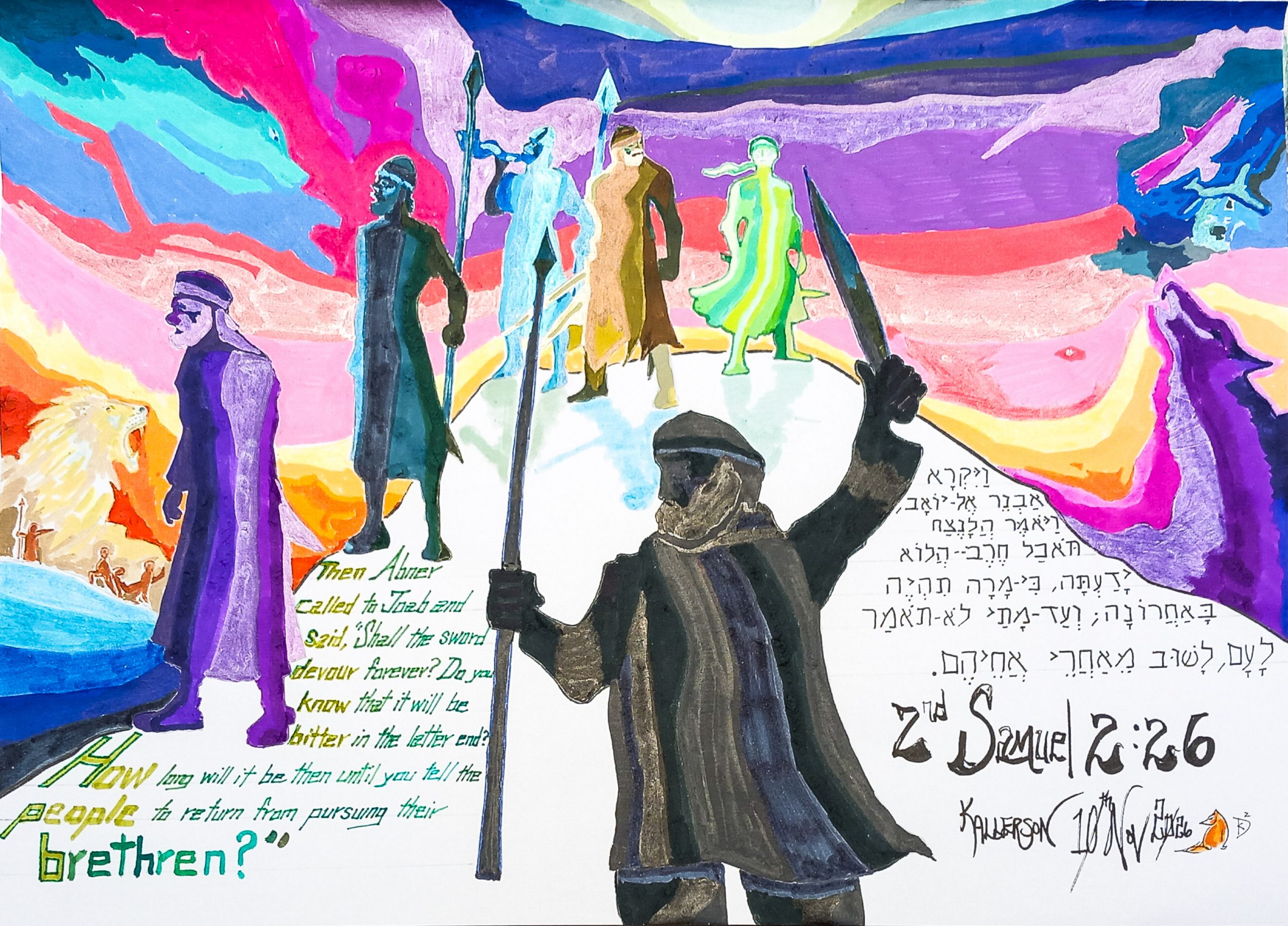
Artwork by Douglas Kallerson
2 Samuel 2:24-32
Man of Shame, Part III
(Typed 20 July 2026) In the first sermon in this series, we went through a lengthy explanation of why the word baal, master, affixed to a person’s name in other passages is changed to bosheth, shame, in the early 2 Samuel chapters.
In summary, 2 Samuel employs these shame forms, which begin in the aftermath of Saul’s death, where the narrative repeatedly displays the humiliation and decline of Saul’s house.
Saul’s son assumed the throne of his father’s kingdom, and yet he is called Ishbosheth, Man of Shame. He typologically represents a particular group of people in the world. As this is the word of God, what would you think if he represented you or your beliefs?
Would you reconsider your ways, or would you double down and press ahead with what the Lord deems is shameful? It would be good to know and then to amend your ways rather than be on the wrong side of the Lord’s favor.
And yet, innumerable people take exactly the opposite avenue every day of their lives. People who supposedly have called on Christ reject God’s clear and understandable word and press ahead with their own unacceptable agendas.
For example, take those who read Paul’s epistles, decide they know better than he does (as well as the Lord who inspired his writings), and ignore what is recorded in Scripture.
Text Verse: “This only I want to learn from you: Did you receive the Spirit by the works of the law, or by the hearing of faith?” Galatians 3:2
Paul defends the doctrine of living by faith, not by law observance, throughout his writings. At times, he will stop and ask a “DUH” question, trying to snap his readers out of the mental lethargy they are in.
In Galatians, he carefully and methodically explains why law observance is such a hindrance to a right walk with the Lord. In Galatians 3:1, he stops and asks a DUH question. The Galatians were being duped by law-observant Judaizers into forsaking grace and turning to law observance.
Therefore, Paul asks them plainly to explain at what point they received the Spirit. Was it when they heard the gospel or after observing works of the law? As the Galatians were never under the law, and as Paul never taught them law observance, the answer should be obvious.
They heard the gospel, accepted the premise, believed on the Lord Jesus, and then they received the Spirit. For them to reject that and turn to law observance was a shame to them. He is quite clear about that. Peter got this as well –
“Therefore it is also contained in the Scripture,
‘Behold, I lay in Zion
A chief cornerstone, elect, precious,
And he who believes on Him will by no means be put to shame.’” 1 Peter 2:6
Law observance does not lead to faith in Christ. Rather, it leads to faith in self. If the one who believes in Jesus will not be put to shame, then what does that say about those who believe in themselves?
Think these things through. We are to do what the Bible says. It is our book of spiritual marching orders. The word is written. God is not going to change His mind about what He says. So hold fast to the word as it is presented.
This is an important aspect to be found in His superior word. And so, let us turn to that precious word once again, and… May God speak to us through His word today, and may His glorious name ever be praised.
I. They Traversed the Jordan (verses 24-32)
24 Joab and Abishai also pursued Abner.
vayirdəphu yoav va’avishai akhare avner – “And they pursued, Joab and Abishai, after Abner.” In contrast to those who stopped to gaze on Asahel’s body, the two brothers continued pursuing Abner after the death of their brother. It is a time of war, and they have a debt to pay within that context…
24 (con’t) And the sun was going down when they came to the hill of Ammah, which is before Giah by the road to the Wilderness of Gibeon.
vəha’shemesh ba’ah vəhemah ba’u ad-givath amah asher al-pəne-giakh derekh midbar givon – “And the sun, it went, and they, they came until ‘Hill, Ammah’ which upon ‘faces, Giah’ – ‘road, wilderness, Gibeon’.” The details are extremely precise and beg for a thorough evaluation.
The givah, hill, is etymologically connected to Gabbatha. Ammah is only found here in the Bible. It is from em, mother, or amam, origin. It means Mother, Origin, Beginning, etc. A mother, like av, father, and ben, son, refers as much to a designation or social function as a literal person, such as “the mother city.”
Giah is also found only here. It is from giakh, to burst forth, as in a river or during a birth. It is the root of the location Gihon. It probably means Waterfall or Breaking Forth.
The wilderness and the law are closely connected because testing is accomplished through law. This is seen in the word itself, midbar. It is derived from the verb davar, to speak, and the noun davar, meaning word. The Lord spoke the Ten Commandments (words/devarim) in the desert (midbar) of Sinai.
Gibeon, giv’on, comes from gavia, meaning a cup or a bowl. When upside down, it looks like a hill. The vav–nun (-on) couple at the end of the word makes it locative. Therefore, it means Hill Town, Place of the Hill, or something similar. It is etymologically tied to Gabbatha.
25 Now the children of Benjamin gathered together behind Abner and became a unit, and took their stand on top of a hill.
vayitqabətsu vəne-vinyamin akhare avner vayihyu la’agudah ekhath vayaamdu al-rosh givah ekhath – “And they amassed themselves, ‘sons, Benjamin’, after Abner. And they were to ‘band, one’. And they stood upon ‘head, hill, one’.” Though scattered as they fled, the men were able to regroup.
Benjamin was Saul’s tribe. These men were ready to defend Saul’s kingdom, which continued through Ishbosheth. Therefore, rather than fleeing any longer, those of Benjamin were ready to resume the battle in a defensive position.
The word used to describe them, aguddah, is rare. It is from a root signifying to bind. Thus, they have formed a single band, united as one. Benjamin means Son of the Right Hand.
26 Then Abner called to Joab and said, “Shall the sword devour forever?
vayiqra avner el-yoav vayomer ha’lanetsakh tokhal kherev – “And he called, Abner, unto Joab, and he said, ‘The ‘to refulgency’ she will eat, sword?’” Abner is set to defend the hill. However, in an attempt to end the battle, he called out to his chief pursuer, Joab. The word he uses, usually translated as “forever,” is netsakh.
To understand its intent, a lengthy explanation is provided in 1 Samuel 15:29. In short, the word “goal” would be better. It signifies “the bright object at a distance traveled towards.”
In Scripture, the kherev, sword, is typologically used to indicate the law, it being spelled the same as Horeb, the mountain of the law.
26 (con’t) Do you not know that it will be bitter in the latter end?
halo yadatah ki-marah tihyeh ba’akharonah – “(Indeed) not you knew that bitter it will be in the afterward?” Various suggestions are given concerning the meaning of this phrase. In the end, the result is the same: as long as the sword devours, there will be bitter consequences that remain afterwards.
They are all of Israel. They will all suffer loss and hold enmity concerning those who died. Being on a hill with nowhere to flee, the battle will be more intense, and there will be more death, etc. After all is said and done, only bitterness will be left if the fighting doesn’t cease.
26 (con’t) How long will it be then until you tell the people to return from pursuing their brethren?”
və’ad-mathay lo-thomar la’am lashuv me’akhare akhehem – “And until when not you will say to the people to return from ‘after their brothers’?” Abner is the one being pursued. Joab has pressed the attack. When the two sides meet, there will be an enormous amount of bloodshed, which will be unnecessary.
Judah has already attained the victory. Because of this, to lose more men over pride and a blood feud will only make things worse. More blood feuds will needlessly arise.
27 And Joab said, “As God lives,
It is a phrase found nowhere else in Scripture: vayomer yoav khai ha’elohim – “And he said, Joab, ‘Alive, The God!” Joab’s words are a firm attestation, preparing for what he will next say. He is making an adjuration on “The God,” the one true God.
The article is expressive. It refers to the one true God in relation to man. It is used to reveal those who are in a right relationship with Him, or to contrast those who are not in a right relationship with Him.
27 (con’t) unless you had spoken, surely then by morning all the people would have given up pursuing their brethren.”
The words are difficult: ki lule dibarta ki az meha’boqer naalah ha’am ish me’akhare akhiv – “For yea not you spoke, for then, from the morning, it was ascended, the people, man from after his brother.’” There are two predominant views on what this means. The first is that Joab is casting the weight of all of the death on Abner by referring back to verse 14 –
“And he said, Abner, unto Joab, ‘They will arise, pray, the lads, and they will ‘laugh’ to our faces.’
And he said, Joab, ‘They will arise.’”
Abner came to start a fight. When the forces met, he suggested the men fight. That led to the greater conflict. David never intended to attack Ishbosheth. The only reason his army came out was to defend against Abner’s invasion.
If Abner had seen a battle would ensue and kept his mouth shut, everyone would have gone home in peace by the morning. This seems likely based on the structure of Joab’s words, which repeat the word ki, for, to explain his thoughts:
“For yea not you spoke, (for then, from the morning), it was ascended, the people, man from after his brother.’”
The other view is that Joab only intended to keep up the pursuit until the morning. However, because Abner had asked for peace early, Joab was ok with ceasing the battle at this time. Why Joab would call off the battle at morning isn’t stated, nor does it seem likely while his brother lay dead.
The term meha’boqer, from the morning, is used only three times in the Bible. It signifies “from the morning until the night.” If Joab meant that he was going to stop in the morning, he would have said ba’boqer, in the morning, or u-ba’boqer, and in the morning. They are common phrases that mean, “in the coming morning.”
28 So Joab blew a trumpet; and all the people stood still
vayitqa yoav ba’shophar vayaamdu kal-ha’am – “And he slapped, Joab, in the shophar, and they stood, all the people.” The word taqa means to slap, as in slapping hands together. Thus, it signifies a sharp blow of the shofar to call those pursuing others to halt. With the slap of the shofar, the battle is considered over. Any violence after this point would be unsanctioned. Therefore…
28 (con’t) and did not pursue Israel anymore, nor did they fight anymore.
vəlo-yirdəphu od akhare yisrael vəlo-yasəphu od ləhilakhem – “And not they will pursue again after Israel. And not they added again to be battled.” Any remaining soldiers from Israel’s camp were considered free to return without any harm or fear of retribution. Whatever happened during the battle was sanctioned. From this point, however, that ends.
29 Then Abner and his men went on all that night through the plain,
və’avner va’anashav haləkhu ba’aravah kol ha’laylah ha’hu – “And Abner, and his mortals, they walked in the wasteplain all the night, the it.” The Aravah, wasteplain, is on the western side of the Jordan. The word comes from the noun arav, to grow dark or become evening. This is because of the darkness of the terrain. The word is identical to the verb arav, meaning to take or give in pledge. From there, they…
29 (con’t) crossed over the Jordan,
vayaavru eth-ha’yarden – “And they traversed the Jordan.” The Jordan means the Descender. In typology, it pictures Christ’s incarnation. Each side explains the state of those on one side or the other of it in relation to the time of that event.
For example, even though Christ already came, the people of Israel today are reflected as being east of the Jordan because they, as a nation, have not yet come to Christ.
29 (con’t) and went through all Bithron; and they came to Mahanaim.
vayelekhu kol-ha’bithron vayavou makhanayim – “and they walked all the Bithron, and they came → Mahanaim.” The Bithron is seen only here in the Bible. It is derived from bathar, to chop, found only in Genesis 15:10. Thus, it signifies the Chopped. However, in chopping something, a division is produced. So, it could ostensibly mean the Division, as in Song of Songs 2:17.
As there is no further reference to this location, we can only speculate what it is. Being preceded by the word “all” indicates that it is not a city. It could signify a place where the land is chopped, like a giant crag or ravine. Or it could indicate an area whose inhabitants are chopped, meaning divided from the rest of Israel.
Mahanaim means Two Camps.
30 So Joab returned from pursuing Abner. And when he had gathered all the people together,
vəyoav shav me’akhare avner vayiqbots eth-kal-ha’am – “And Joab, he returned from ‘after Abner’, and it amassed, all the people.” Joab ceased the pursuit. With the slap of the shofar, the people stopped the pursuit and gathered to him. The purpose of this is to account for all the men…
30 (con’t) there were missing of David’s servants nineteen men and Asahel.
vayipaqədu meavde david tishah-asar ish va’asah-el – “And they were visited from ‘servants, David’ nine-ten man, and Asah-el.” The numbering is precise and yet unusual. By stating the number nineteen separately from Asahel, it begs for that number to be defined. Bullinger says –
“NINETEEN is a number not without significance. It is a combination of 10 and 9, and would denote the perfection of Divine order connected with judgment. It is the gematria of Eve and of Job.”
Also, a peculiarity in the spelling of Asahel’s name is seen here. Asahel is seen 15 times. Five of those times, there is a space in his name, dividing it into two words, asah el. The Masoretes placed a dash between them to denote that they belong together. Without that dash, the two words say “made” and “God.”
Whether these nineteen fallen included the twelve killed at the kneepool is not stated. If so, it would mean only eight more died, seven, plus Asahel. As for those on Abner’s side…
31 But the servants of David had struck down, of Benjamin and Abner’s men, three hundred and sixty men who died.
vəavde david hiku mibinyamin uvə’anshe avner shəlosh-meoth vəshishim ish methu – “And ‘servants, David’, they caused to strike from Benjamin, and in ‘mortals, Abner’, three hundreds and sixty man, they died.” There are two separate listings. There are those from Benjamin, and there are those of Abner’s men who came from other tribes of Israel.
They are reckoned together for a total. From both groups, three hundred and sixty were struck down. The number comes from thirty-six and ten. Thirty-six has nine positive divisors, so it is a hard number to pin down for typology.
Including Asahel, Abner lost exactly eighteen times as many men as David. It is an astonishing victory numerically.
32 Then they took up Asahel and buried him in his father’s tomb, which was in Bethlehem.
vayisu eth-asahel vayiqbəruhu bəqever aviv asher beith-lakhem – “And they lifted Asahel, and they interred him in ‘sepulcher, his father’ which → Bethlehem.” There is debate on when this occurred. The battle lasted from morning until the sun was going down. The men had to sleep. So the probable meaning is that they lifted Asahel, took him to Bethlehem, and interred him there during the day after the battle.
Bethlehem means House of Bread, with a secondary meaning of House of War. From there, it says…
*32 (fin) And Joab and his men went all night, and they came to Hebron at daybreak.
vayeləkhu kal-ha’laylah yoav va’anashav vayeor lahem bəkhevron – “And they walked all the night, Joab and his mortals, and it was illuminated to them in Hebron.” This is likely the next morning, and thus, the third morning after the two forces originally met at the kneepool.
Hebron means Alliance.
Are you a David or a man of shame
Your doctrine will decide for you
And then will be affixed the correct name
Your doctrine is yours, so what will you do?
Have you trusted fully in the work of Christ?
Putting deeds of the law behind
Is that how your soul is priced?
Or has the law still got your soul in a bind?
Only you can decide what you will do
But God gives a name to either side
Will David or “man of shame” define you?
Be like David and give up on your pride
II. The Typology Explained
The chapter is logically divided between verses 1-11, and then the details of the war that occurred during the period which spans verses 12-32. The first eleven verses begin with David, Beloved, inquiring of the Lord if he should ascend to one of the cities of Judah.
The Lord emphatically tells him, “You must ascend!” David asks where. The Lord says to go Hebron-ward, meaning in the direction of Alliance. It is the alliance of God in Christ with His people, as seen in previous passages.
In verse 2, it specifically noted that he went up with his two wives, referring to them by name, Ahinoam (Kindred to Sweetness) from Jezreel (God Sows), and Abigail (Father of Joy), meaning the source of Joy, the wife of Nabal (Dolt) the Carmelite (Vineyard of God). Previously, they represented those of the church who missed the rapture (married to Dolt) and those of Israel who, together, will form the whole of those whom God calls during the tribulation.
In verse 3, the men under David came with his house and together they dwelt in Hebron, Alliance. At that time, it said the men of Judah came and anointed David King over the house of Judah.
Then in verse 4, he was informed that the men of Jabesh, Dry Perpetual Fountain, had interred Saul, typologically referring to seeking the truth.
Remember that when the article is used with Gilead (the Perpetual Fountain), it refers to the Holy Spirit. However, Gilead, without the accompanying definite article, speaks of Israel, Perpetual Fountain.
To grasp the meaning, one must think of Israel as the means of providing the Fountain, regardless of whether individuals are included in its transmission or not (Ephesians 2:12). The Spirit is the Mode by which one is included.
During the church age, Gentiles are brought into the commonwealth of Israel along with Jews. However, not all people receive it. Israel is Perpetual Fountain, not The Perpetual Fountain (meaning the Holy Spirit). The use or lack of use of the article defines this.
With this understanding, Dry Perpetual Fountain reflects those who have no means of providing the Fountain. There is no connection to the Spirit, and thus, no ability to provide it. It reflects Israel without the Spirit. Burying Saul was essentially burying any possibility of seeking the truth.
Despite this, David sent them a blessing and said he would repay the men of Jabesh for their kind act. He noted that with their master Saul dead, they should be men of valor, and that Judah had anointed him king over them. The implication was that David was inviting them, those who had no access to the fountain, to join him in his kingdom.
It is an offer to join those who have accepted the doctrines of Christ. Thus, there is Judah, representing those who have accepted Christ at this time, and there is the rest of Israel who have not yet anointed Christ as king over them.
The matter concerning Jabesh Gilead is left unresolved. In verse 8, Abner the son of Ner reenters the scene. He is noted as the commander of Saul’s army.
Saul means Asked. In his life, he had two typological representations. One was those seeking the truth, whether rightly or wrongly. The other was Sheol calling out, asking for the souls of men. Thus, he reflected fallen man, destined for the pit. It appears both aspects are being represented here.
Abner, Father of Light, is carrying on the mission of Saul. He is noted as the son of Ner, Lamp. The lamp is that which speaks of continuance and ability to rule. That is seen several times, such as –
“Yet the Lord would not destroy Judah, for the sake of His servant David, as He promised him to give a lamp [ner] to him and his sons forever.” 2 Kings 8:19
In verse 9, Abner took Ishbosheth, Man of Shame, Saul’s son, and brought him over to Mahanaim. The name ultimately points to the humiliation and decline of Saul’s house. It is a localized shame-substitution directed to the post-Saul narrative, revealing humiliation, dynastic collapse, and exposed folly.
He represents those of Israel who, after the completion of Jesus’ work, rejected His all-sufficient work. In the past, Mahanaim has represented the salvation of both Jews and Gentiles as seen in Ephesians 2 –
“having abolished in His flesh the enmity, that is, the law of commandments contained in ordinances, so as to create in Himself one new man from the two (Mahanaim), thus making peace, 16 and that He might reconcile them both to God in one body through the cross, thereby putting to death the enmity.” Ephesians 2:15, 16
In this case, it is specifically noted as being on the other side. It reflects the two camps of Jews and Gentiles who have rejected the all-sufficient work of Christ, reverting in their theology to a time before His incarnation, meaning holding to law observance.
At that time, the precise wording of untos and upons was seen, which is lacking in almost all translations. It says Abner made Ishbosheth king “unto” the Gilead. It doesn’t say he reigned over the Perpetual Fountain, but unto it. The same is true with the Ashurites, the Just, and Jezreel, God Sows.
The word unto speaks of expansion, not necessarily a set rule over. Ishbosheth was, however, over Ephraim (Twice Fruitful), Benjamin (Son of the Right Hand), and all Israel (He Strives with God). He rules over them, and he represents those who have rejected Jesus. Thus, they are unable to bear fruit or participate in the Son of the Right Hand, and they continue to strive against God.
In verse 10, it said that he was forty in his reigning upon Israel. It reflects a period of the chastisement of the covenant people, a period of grace (5), leading to revival and renewal (8). It speaks of Israel from the time they rejected Christ until the time they will come to Him. It then said that he reigned two years.
It is the number of division or difference. While David ruled Judah, Ishbosheth, Man of Shame, ruled over Israel. As he ruled two years, he was forty-two at his death, the number associated with antichrist. It tells us that Israel will not come to Christ until the end of the tribulation period.
In verse 11, it said that David was “king in Hebron upon ‘house, Judah’ seven years and six renewals.” Seven is the number of divine perfection. Six is the number of man, generally fallen man. This reflects the total period of the tribulation and the state of those who are awaiting their renewal at the return of Christ.
With those verses complete, the story which is inserted into this timeframe began at verse 12. Abner the son of Ner went out, meaning for war, with the servants of Ishbosheth from Mahanaim toward Gibeon. His intent was to solidify Ishbosheth’s rule over all Israel.
Gibeon is etymologically tied to Gabbatha. Thus, this is an attempt to rule over what Christ’s passion signifies. In verse 13, Joab, Yehovah Is Father, son of Zeruiah, His Edgerock Is Yah (or Balsam of Yah), met Abner and his forces at the kneepool of Gibeon.
The kneepool, berekhah, is from barak, to kneel, and thus, to bless. One can see that each is looking for a blessing based on the side they have taken.
The word for the meeting, pagash, signifies a particular time or situation in which there is an intermeeting of two disparate things. In this case, it is the forces of those accepting the doctrines of Christ and those who have rejected them. They may claim Christ, but they reject that they no longer need to observe the law.
Once there and sitting, Abner suggests that a group of lads from each side perform in battle to decide the outcome. Joab agreed, and so in verse 15, twelve from each side arose to engage in combat. From Abner’s men, only those from Benjamin, Son of the Right Hand, arose.
The intent of this appears to be that those of Israel are claiming they hold the messianic promises, not Judah, who has accepted the doctrines of Christ. Being twelve from each side, it signifies each claims their side is the perfection of government.
In verse 16, the bloody details of the event were conveyed, saying, “And they caused to seize, man, in head his associate, and his sword – in ‘side, his associate’.” The sense is of each relying on his sword, the law. For those who represent Ishbosheth’s side, theirs would be the law they needed to continue to observe.
For those on David’s side, it represents the law fulfilled in Christ. Each relied on his sword, but it said that they fell unitedly. Various options were given concerning what that meant, but the point is that the match was not decisive, so the battle was engaged by the men from both camps.
Verse 17 noted the severity of the battle, but that Abner and his men of Israel were smitten before the servants of David. At some point in the future, the spiritual battle between those who accept Christ as Messiah and those who reject Him will be intense. They will pour over Scripture, attempting to prove their view over the other.
During the battle, in verse 18, it mentioned the three sons of Zeruiah: Joab, Abishai, and Asahel. Asahel, Made by God, is singled out as being light in his feet, according to one of the gazelles which is in the field.
Because of his fleetness of foot, in verse 19, he is the one singled out as pursuing Abner, following him step for step. Verses 20-22 noted the exchange between Abner and Asahel. I cannot find any typology here. Maybe I am missing something, or maybe the purpose of the encounter is solely to explain what happens between Joab and Abner in the future.
Either way, in verse 23, because Asahel would not turn aside, Abner struck Asahel with the back end of his spear, piercing his abdomen and coming out his back. The khanith, spear, is identical to the feminine form of grace. The abdomen, khomesh, is also typical of grace, being identical to the number five, khamesh.
For a law observer, the only way to win in an argument concerning whether Christ is the Messiah or not is to reject grace, turning it around as a weapon. This doesn’t mean the battle is won, but that there is no winning an argument about God’s gift of grace in Christ when the premise of the gift is rejected.
In other words, you will never win an argument concerning who Christ is, or proper doctrine concerning Christ, with someone who has rejected the premise of grace, when they use that view against those who stand on grace. The abruptness of the words “he fell there, and he died ‘his under’” is like saying, “He was completely shut down in his argument.” Asahel was destroyed at his point of grace.
Still in verse 23, it said that those who came to where Asahel fell just stood there. It is a logical reaction for those who cannot overcome such an argument. “This argument is done. We have nowhere to go from here.”
In verse 24, however, it says that Joab and Abishai pursued Abner. There is determination in them to overcome the foe. As the sun was going down, it emphatically said, “and they, they came until ‘Hill, Ammah’ which upon ‘faces, Giah’ – ‘road ‘wilderness, Gibeon’.”
The words are difficult, but they point to the work of Christ. They are at givath amah, ‘Hill, Ammah’. The givah, hill, has consistently been seen as a connection to Gabbatha, the two words sharing etymology. Ammah is reflective of the source of something. Hence, it can mean either Mother or Origin.
Thus, ‘Hill, Ammah’ looks to the source of the faith, the passion of Christ, including His cross. It is “upon ‘faces, Giah’, or “before the Breaking Forth.” That signifies that the cross is before the resurrection.
The ‘road, wilderness, Gibeon’ looks to the way of Christ, who was tested through the law, which culminated in His passion represented by Gibeon, Place of the Hill. This is where they will make their stand.
On the other hand, it says that the sons of Benjamin amassed themselves after Abner, becoming a single band. They are standing on the premise that the law must be observed even while they claim Christ. It is the same message seen since the earliest days of the Judaizers Paul continuously spoke against.
In verse 26, Abner blinks first, saying, “The ‘to refulgency’ she will eat, sword?” He is asking if the law is going to continue to destroy those on either side of the conflict until the goal is finally attained. If so, there will only be bitterness awaiting after the matter is settled.
In the final clause of the verse, he asked at what point they would stop pursuing their brothers. Joab, however, throws the entire blame on Abner. It was the law observers who came to engage in battle, and it was Abner who suggested the two sides have a round of mortal combat.
Joab’s words essentially said, “If you had just kept your mouth shut and let us do what we are doing, this never would have happened.” However, it did happen, and Joab and his men were willing to stand and defend the truth.
Having said that, in verse 28, Joab blew the shofar, the battle halted, and Joab and his forces stopped the pursuit after Israel.
In verse 29, it noted that Abner and his men walked in the wasteplain all the night. The aravah, wasteplain, represents the pledge of the Spirit. They walked right through it, traversed the Jordan, meaning they went back to a time prior to the state of accepting Christ. Then they walked all the Bithron, the Division, and came to Mahanaim, the two camps of Jews and Gentiles who held to law observance, even though claiming Christ.
Verse 30 said that Joab returned from pursuing Abner, the people were amassed, and nineteen men were missing, along with Asah-el. As Bullinger says –
“NINETEEN is a number not without significance. It is a combination of 10 and 9, and would denote the perfection of Divine order connected with judgment. It is the gematria of Eve and of Job.”
There is judgment upon sin in Christ, or there will be judgment of sin apart from Christ. Either way, sin will be judged. It may be reading too much into the way Asah-el is written here, especially because the same form is used four other times, but the change seems purposeful to make a pun on his name, ‘Made, God’. In doing this, Asahel is excluded from the typology to ensure focus on the number 19.
Verse 31 provided the number of those from Benjamin and Abner’s camp who died, totaling three hundred and sixty. It is eighteen times the number of David’s men, but because the number has so many divisors, I won’t even attempt to give typology, lest I make stuff up out of my head.
Verse 32 noted that they lifted Asahel, Made by God, and interred him in his father’s sepulcher in Bethlehem, House of Bread. After that, Joab and his men walked all the night, and the sky was illuminated to them by the time they reached Hebron, Alliance.
Although I am sure there is typology in this verse as well, I am unsure of what it is conveying. As I said, this may simply be historical notes to provide background for what will happen in the future between Joab and Abner.
As you can see, there are two separate ideologies being presented. There are those who hold to grace alone, claiming Christ as their Savior and their sole means of justification. Then, there are those who hold to law observance while claiming Christ in whatever capacity they think He serves in their salvation.
But Jesus is either our total Savior or He is not a Savior at all. The battle between these ideologies has been going on since the beginning, and it will continue even into the tribulation period. This is not an ideology left to fringe cults like the Hebrew Roots Movement.
It is an ideology that fits like a glove in the Roman Catholic Church, the Seventh-day Adventists, and other large denominations. At what point are you willing to say that you have no merit in your salvation? Christ has done it all. Trust this! He did the work so that we can rest in Him.
Closing Verse: “I do not set aside the grace of God; for if righteousness comes through the law, then Christ died in vain.” Galatians 2:21
Next Week: 2 Samuel 3:1-16 It happened like a blur, but then it was done… (The Death of Abner, Part I) (6th 2 Samuel Sermon)
The Lord has you exactly where He wants you. He has a good plan and purpose for you. He is the One who abases the haughty and exalts the humble. He regards the lowly, and the proud, He knows from afar. So yield yourself to Him, trust Him, and believe His word. In this, He will do great things for you and through you.
2 Samuel 2:24-32 (CG)
24And they pursued, Joab and Abishai, after Abner. And the sun, it went, and they, they came until ‘Hill, Ammah’ which upon ‘faces, Giah’ – ‘road, wilderness, Gibeon’. 25And they amassed themselves, ‘sons, Benjamin’, after Abner. And they were to ‘band, one’. And they stood upon ‘head, hill, one’. 26And he called, Abner, unto Joab, and he said, “The ‘to refulgency’ she will eat, sword? (Indeed) not you knew that bitter it will be in the afterward? And until when not you will say to the people to return from ‘after their brothers’?”
27And he said, Joab, “Alive, The God! For yea not you spoke~ for then, from the morning, it was ascended, the people, man from after his brother.” 28And he slapped, Joab, in the shophar, and they stood, all the people. And not they will pursue again after Israel. And not they added again to be battled. 29And Abner, and his mortals, they walked in the wasteplain all the night, the it. And they traversed את the Jordan, and they walked all the Bithron, and they came – Mahanaim.
30And Joab, he returned from ‘after Abner’, and it amassed את all the people. And they were visited from ‘servants, David’ nine-ten man, and Asah-el*. 31And ‘servants, David’, they caused to strike from Benjamin, and in ‘mortals, Abner’. Three hundreds and sixty man, they died. 32And they lifted את Asahel, and they interred him in ‘sepulcher, his father’ which – Bethlehem. And they walked all the night, Joab and his mortals, and it was illuminated to them in Hebron.
*Verse 30 – The name Asahel appears here in WLC with maqqef: עֲשָׂה־אֵל, “Asah-el,” but it functions as the single proper name Asahel.
2 Samuel 2:24-32 (NKJV)
24 Joab and Abishai also pursued Abner. And the sun was going down when they came to the hill of Ammah, which is before Giah by the road to the Wilderness of Gibeon. 25 Now the children of Benjamin gathered together behind Abner and became a unit, and took their stand on top of a hill. 26 Then Abner called to Joab and said, “Shall the sword devour forever? Do you not know that it will be bitter in the latter end? How long will it be then until you tell the people to return from pursuing their brethren?”
27 And Joab said, “As God lives, unless you had spoken, surely then by morning all the people would have given up pursuing their brethren.” 28 So Joab blew a trumpet; and all the people stood still and did not pursue Israel anymore, nor did they fight anymore. 29 Then Abner and his men went on all that night through the plain, crossed over the Jordan, and went through all Bithron; and they came to Mahanaim.
30 So Joab returned from pursuing Abner. And when he had gathered all the people together, there were missing of David’s servants nineteen men and Asahel. 31 But the servants of David had struck down, of Benjamin and Abner’s men, three hundred and sixty men who died. 32 Then they took up Asahel and buried him in his father’s tomb, which was in Bethlehem. And Joab and his men went all night, and they came to Hebron at daybreak.