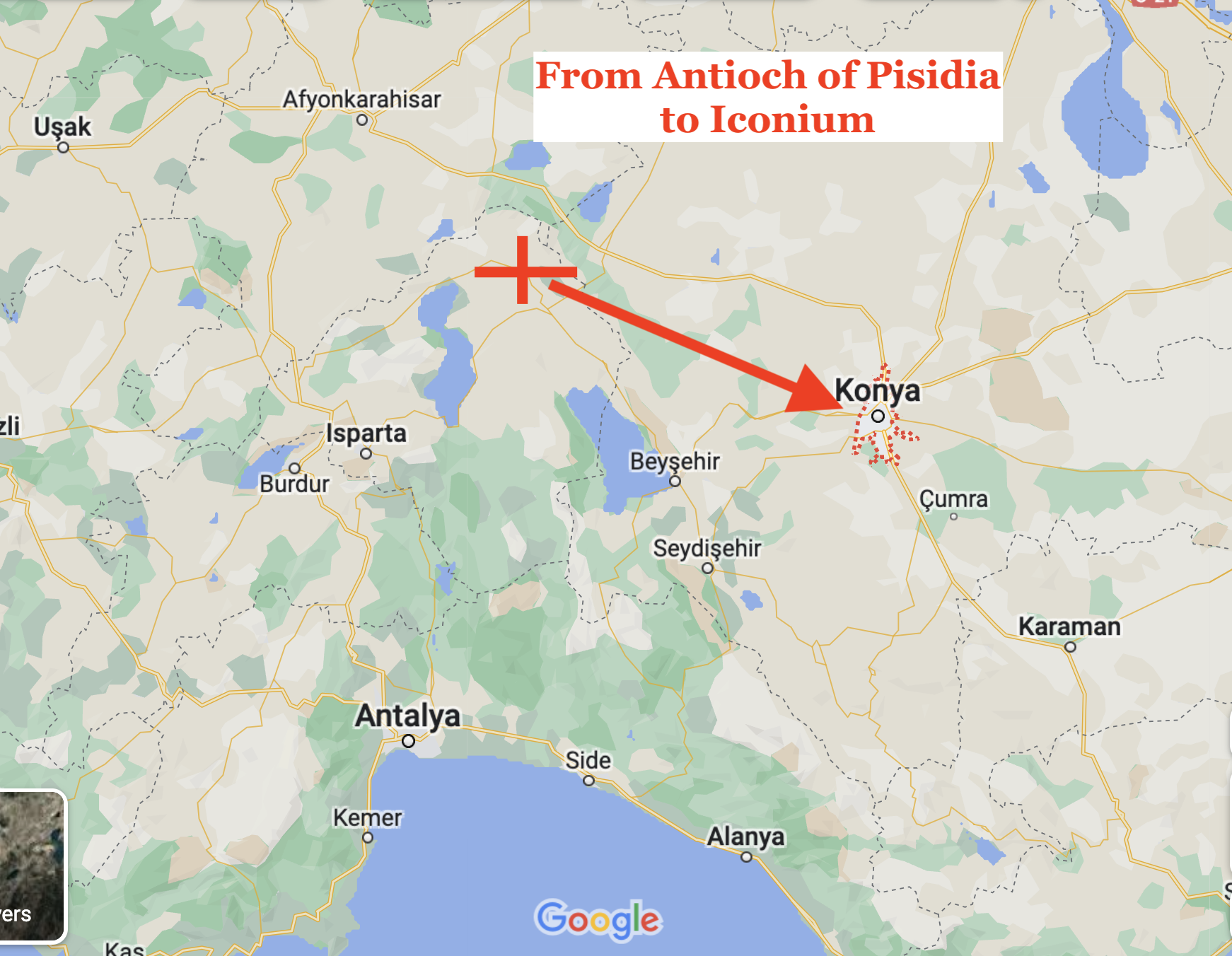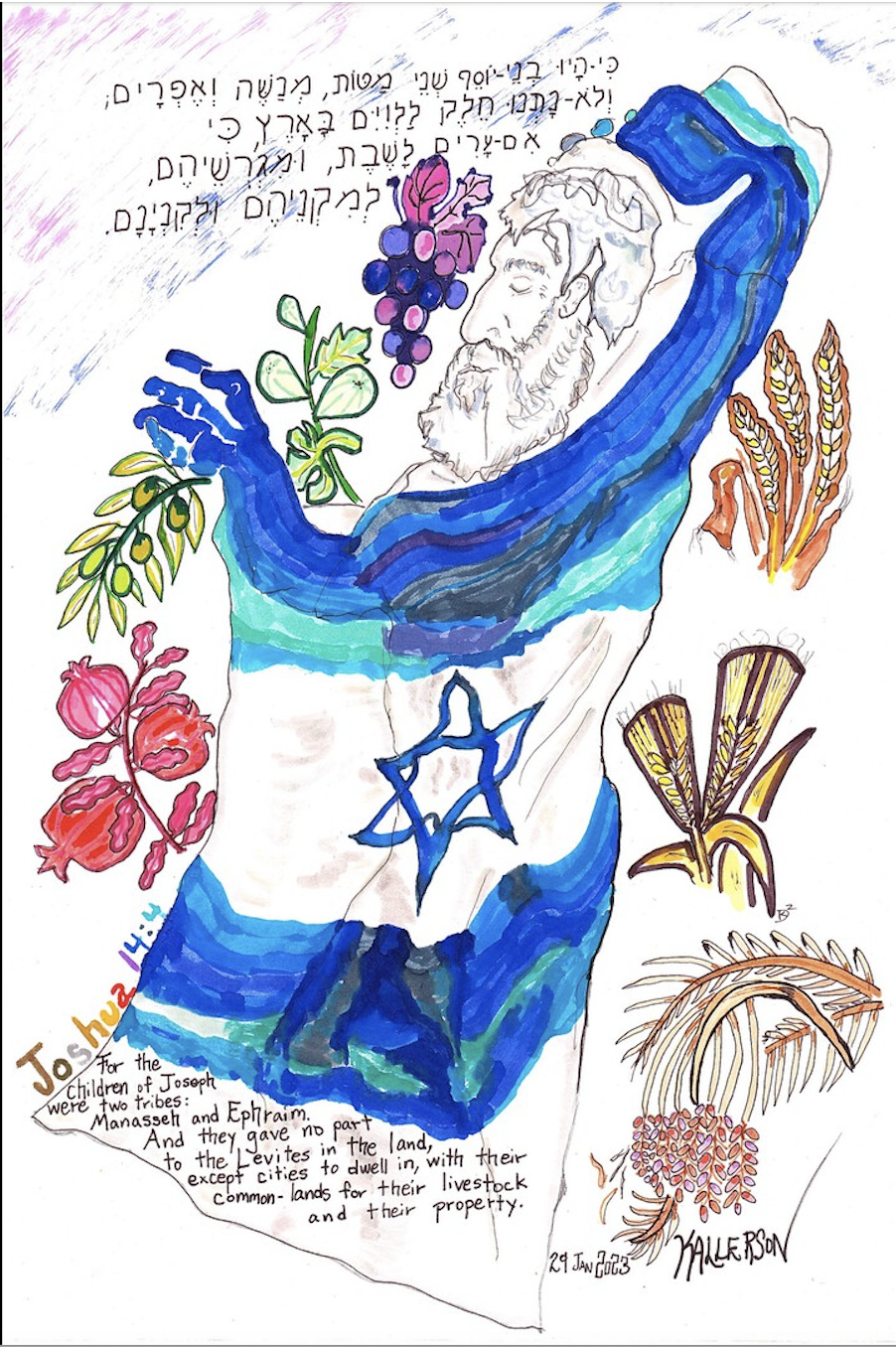
Artwork by Doug Kallerson.
Joshua 14:1-5
No Part to the Levites
In 1972, the Miami Dolphins, under coach Don Shula, had what became known as “the Perfect Season.” They went 14-0. Many of the players became household names. I remember watching them and being excited about the team despite not really caring much about sports. One can kind of get caught up in something like that.
But despite having a perfect season, each player was imperfect, and each game had its own flaws. There were fumbles, there were interceptions, and so on. And so, there is the dichotomy between the imperfect team and their perfect season. The two are seemingly at odds with one another, and yet they really aren’t. Out of imperfection, perfection arose.
The Bible shows us what is perfect and what is flawed. At times, it shows us this explicitly, and at times it does so in veiled ways. It also shows us how something that is seemingly imperfect can be made perfect. We’ll see something along those lines in our verses today.
Text Verse: “How then can man be righteous before God?
Or how can he be pure who is born of a woman?
5 If even the moon does not shine,
And the stars are not pure in His sight,
6 How much less man, who is a maggot,
And a son of man, who is a worm?” Job 25:4-6
Despite often not speaking rightly about the Lord, the questions of Bildad the Shuhite are still valid. How can man, who is by nature unrighteous, be considered righteous before God? In understanding the work of Christ, we can know that with God, it is possible.
How can a person who is born of a woman be pure? Being a human implies bearing sin, simply because sin is transmitted from father to child. So, how can one who is born of a woman be pure? With God in Christ, that too is possible.
As for stars not being pure in the sight of God, that depends on the nature and meaning of the word “star.” One thing that is tainted and impure can be emblematic of another thing that is not. We have seen that in typology innumerable times in our study of the Old Testament.
For example, Joshua may have been a fallen, sinful man, but he could still anticipate and picture the perfect, unblemished Lord Jesus. Likewise, despite the imperfection of the individual members of the team, the Miami Dolphins were still able to have the perfect season
This sermon is entitled No Part to the Levites, but that is only in relation to a tribal land grant, one that reveals imperfection. And yet, in the imperfection of the land inheritance of the tribes of Israel, there is still a note of a double measure of spiritual perfection. How? Well, stick around and we will evaluate the matter.
Nifty things such as this are to be found in His superior word. And so, let us turn to that precious word once again, and… May God speak to us through His word today, and may His glorious name ever be praised.
I. And They Divided the Land (verses 1-5)
These are the areas which the children of Israel inherited in the land of Canaan,
After designating the inheritance east of the Jordan to the three-and-one-half tribes, the narrative now turns to the inheritance in the land of Canaan proper. This is the land…
1 (con’t) which Eleazar the priest, Joshua the son of Nun, and the heads of the fathers of the tribes of the children of Israel distributed as an inheritance to them.
It is of note that Eleazar (God Has Helped) is placed prior to Joshua. The reason for this goes back to Joshua’s inauguration –
“And the Lord said to Moses: ‘Take Joshua the son of Nun with you, a man in whom is the Spirit, and lay your hand on him; 19 set him before Eleazar the priest and before all the congregation, and inaugurate him in their sight. 20 And you shall give some of your authority to him, that all the congregation of the children of Israel may be obedient. 21 He shall stand before Eleazar the priest, who shall inquire before the Lord for him by the judgment of the Urim. At his word they shall go out, and at his word they shall come in, he and all the children of Israel with him—all the congregation.’” Numbers 27:18-21
Eleazar is the one to determine the will of the Lord. He then conveys that will to Joshua. One must know the will of the Lord prior to abiding by that will. In the case of the division of the land, it will come from the Lord through the hand of Eleazar.
From there Joshua will oversee the process and direct it through the fathers of the tribes. The word translated as tribe, mateh, signifies the genealogical aspect of the tribe rather than the political aspect.
As for the fathers of the tribes, it is rather surprising that they have already been named and designated for this purpose in Numbers 34:16-28. Although that passage was not too long before entrance into Canaan, the narrative now follows after seven years of war within the land.
And yet, it can be assumed that they have all survived in order to receive their inheritance and portion it out to their tribes. Were it not so, a replacement would have been named.
2 Their inheritance was by lot,
b’goral nakhalatam – “In lot their inheritance.” This is now the first of twenty-six times that the goral, or lot, will be mentioned in Joshua. The word comes from an unused root meaning to be rough, such as a stone. Hence, it is a pebble used for the purpose of determining lots. At times, it is used to indicate a portion or destiny, such as “this is my lot in life.”
2 (con’t) as the Lord had commanded by the hand of Moses, for the nine tribes and the half-tribe.
This is what was specifically detailed in Numbers 34:16-29 and which was summed up with the words, “These are the ones the Lord commanded to divide the inheritance among the children of Israel in the land of Canaan” (Numbers 34:29).
Hence, the narrative now is given to show strict obedience to the words set forth by the Lord through Moses. Notably in those verses, however, there is no mention of Reuben, Gad, or the other half-tribe of Manasseh. The reason for that is…
3 For Moses had given the inheritance of the two tribes and the half-tribe on the other side of the Jordan;
This was specifically stated in Numbers 34:14, 15. Their land had been subdued and the inheritance was given, provided they helped the other tribes to subdue their inheritances west of the Jordan.
What is notable concerning these stated allotments is that though there are twelve tribes recorded as receiving an inheritance, there are actually thirteen land allotments:
Two and one-half east of the Jordan = 3
Nine and one-half west of the Jordan = 10
The number thirteen in Scripture signifies “rebellion, apostasy, defection, corruption, disintegration, revolution, or some kindred idea” (Bullinger). This is pretty much the constant theme of Israel throughout their years. The number of their inheritances forms a picture of their attitude and their conduct before the Lord.
Despite this, there is one more tribe to consider…
3 (con’t) but to the Levites he had given no inheritance among them.
This defines the fourteenth division which is spread among the thirteen divisions. This is the third time in just two chapters that this has been stated. Levi is given no land inheritance. However –
“Only to the tribe of Levi he had given no inheritance; the sacrifices of the Lord God of Israel made by fire are their inheritance, as He said to them” (13:14).
“But to the tribe of Levi Moses had given no inheritance; the Lord God of Israel was their inheritance, as He had said to them” (13:33).
“…but to the Levites he had given no inheritance among them” (14:3).
And so, despite there being no land inheritance for Levi, there actually is an inheritance for them. As such, the number of inheritances now extends to fourteen, the number Bullinger defines as “a double measure of spiritual perfection” and “the number associated with the incarnation.”
One can see that despite Israel’s rebellion and apostasy in the earthly realm, because of Levi, the Lord has placed His stamp upon them in the spiritual realm. The wisdom of God is carefully revealed in everything that is seen in these tribal allotments.
Next, the note of how one tribe became two is stated again…
4 For the children of Joseph were two tribes: Manasseh and Ephraim.
If this were not detailed in Scripture, there would be an imperfection of division, both as tribes and in land grants. However, Jacob adopted the two sons of Joseph, thus giving him a double portion of land. But this then brings in another multiple of fourteen. Though there are twelve natural sons of Jacob, there are fourteen reckoned to Israel –
Twelve: Reuben, Simeon, Levi, Judah, Dan, Naphtali, Gad, Asher, Issachar, Zebulun, Joseph, and Benjamin.
Fourteen: Reuben, Simeon, Levi, Judah, Dan, Naphtali, Gad, Asher, Issachar, Zebulun, Joseph (and Manasseh and Ephraim), and Benjamin.
This then corresponds to twelve/fourteen apostles –
Twelve: Simon/Peter, Andrew, James the son of Zebedee, John, Philip, Bartholomew, Thomas, Matthew, James the son of Alphaeus, Lebbaeus (Thaddaeus), Simon the Canaanite, Judas Iscariot.
Fourteen: Simon/Peter, Andrew, James the son of Zebedee, John, Philip, Bartholomew, Thomas, Matthew, James the son of Alphaeus, Lebbaeus/Thaddaeus, Simon the Canaanite, Judas Iscariot (replaced by Matthias), Saul/Paul.
As for the imperfection of the land inheritance for Israel, that is seen in the next words…
4 (con’t) And they gave no part to the Levites in the land,
This is based upon what has already been repeatedly said and which was noted again in verse 3. No tribal land inheritance is given to the tribe of Levi because they will be spread out among the tribes as those who minister the law among the people.
This was first prophesied by Jacob in Genesis 49 –
“Simeon and Levi are brothers;
Instruments of cruelty are in their dwelling place.
6 Let not my soul enter their council;
Let not my honor be united to their assembly;
For in their anger they slew a man,
And in their self-will they hamstrung an ox.
7 Cursed be their anger, for it is fierce;
And their wrath, for it is cruel!
I will divide them in Jacob
And scatter them in Israel.” Genesis 49:5-7
Because of what they did in Genesis 34 by killing the males in Shechem, Jacob prophesied over these two sons that they would be divided and scattered.
Though seemingly a negative, the reason for their scattering within Israel occurs for Levi because of their bravery before the Lord at the time when Israel made the golden calf to worship –
“Now when Moses saw that the people were unrestrained (for Aaron had not restrained them, to their shame among their enemies), 26 then Moses stood in the entrance of the camp, and said, ‘Whoever is on the Lord’s side—come to me!’ And all the sons of Levi gathered themselves together to him. 27 And he said to them, ‘Thus says the Lord God of Israel: “Let every man put his sword on his side, and go in and out from entrance to entrance throughout the camp, and let every man kill his brother, every man his companion, and every man his neighbor.”’ 28 So the sons of Levi did according to the word of Moses. And about three thousand men of the people fell that day. 29 Then Moses said, ‘Consecrate yourselves today to the Lord, that He may bestow on you a blessing this day, for every man has opposed his son and his brother.’” Exodus 32:25-29
Levi took up arms against his own brothers. This was reckoned to them as the reason for a particular blessing from the Lord which is that He would be their inheritance. To understand that, one must then understand how this came about.
At the Exodus, the Lord killed the firstborn of Egypt, including both man and beast. As He spared them in Israel, the law of the firstborn was enacted –
“And it shall be, when the Lord brings you into the land of the Canaanites, as He swore to you and your fathers, and gives it to you, 12 that you shall set apart to the Lord all that open the womb, that is, every firstborn that comes from an animal which you have; the males shall be the Lord’s. 13 But every firstborn of a donkey you shall redeem with a lamb; and if you will not redeem it, then you shall break its neck. And all the firstborn of man among your sons you shall redeem. 14 So it shall be, when your son asks you in time to come, saying, ‘What is this?’ that you shall say to him, ‘By strength of hand the Lord brought us out of Egypt, out of the house of bondage. 15 And it came to pass, when Pharaoh was stubborn about letting us go, that the Lord killed all the firstborn in the land of Egypt, both the firstborn of man and the firstborn of beast. Therefore I sacrifice to the Lord all males that open the womb, but all the firstborn of my sons I redeem.’ 16 It shall be as a sign on your hand and as frontlets between your eyes, for by strength of hand the Lord brought us out of Egypt.” Exodus 13:11-16
The firstborn of all belonged to the Lord and was to be sacrificed to Him. To avoid the obvious difficulties of such a situation, the firstborn males were to be redeemed.
Next, in Numbers, the selection of the Levites in place of the firstborn of Israel was made. Hence, they would belong solely to the Lord and not be reckoned for a tribal land inheritance –
“Then the Lord spoke to Moses, saying: 6 ‘Take the Levites from among the children of Israel and cleanse them ceremonially. 7 Thus you shall do to them to cleanse them: Sprinkle water of purification on them, and let them shave all their body, and let them wash their clothes, and so make themselves clean. 8 Then let them take a young bull with its grain offering of fine flour mixed with oil, and you shall take another young bull as a sin offering. 9 And you shall bring the Levites before the tabernacle of meeting, and you shall gather together the whole congregation of the children of Israel. 10 So you shall bring the Levites before the Lord, and the children of Israel shall lay their hands on the Levites; 11 and Aaron shall offer the Levites before the Lord like a wave offering from the children of Israel, that they may perform the work of the Lord. 12 Then the Levites shall lay their hands on the heads of the young bulls, and you shall offer one as a sin offering and the other as a burnt offering to the Lord, to make atonement for the Levites.
13 ‘And you shall stand the Levites before Aaron and his sons, and then offer them like a wave offering to the Lord. 14 Thus you shall separate the Levites from among the children of Israel, and the Levites shall be Mine. 15 After that the Levites shall go in to service the tabernacle of meeting. So you shall cleanse them and offer them like a wave offering. 16 For they are wholly given to Me from among the children of Israel; I have taken them for Myself instead of all who open the womb, the firstborn of all the children of Israel. 17 For all the firstborn among the children of Israel are Mine, both man and beast; on the day that I struck all the firstborn in the land of Egypt I sanctified them to Myself. 18 I have taken the Levites instead of all the firstborn of the children of Israel. 19 And I have given the Levites as a gift to Aaron and his sons from among the children of Israel, to do the work for the children of Israel in the tabernacle of meeting, and to make atonement for the children of Israel, that there be no plague among the children of Israel when the children of Israel come near the sanctuary.’” Numbers 8:5-19
At that time, it still has not been recorded that Levi would receive no land inheritance. That is first seen in Numbers 18 –
“Then the Lord said to Aaron: ‘You shall have no inheritance in their land, nor shall you have any portion among them; I am your portion and your inheritance among the children of Israel.
21 “Behold, I have given the children of Levi all the tithes in Israel as an inheritance in return for the work which they perform, the work of the tabernacle of meeting. 22 Hereafter the children of Israel shall not come near the tabernacle of meeting, lest they bear sin and die. 23 But the Levites shall perform the work of the tabernacle of meeting, and they shall bear their iniquity; it shall be a statute forever, throughout your generations, that among the children of Israel they shall have no inheritance. 24 For the tithes of the children of Israel, which they offer up as a heave offering to the Lord, I have given to the Levites as an inheritance; therefore I have said to them, ‘Among the children of Israel they shall have no inheritance.’” Numbers 18:20-24
As is seen there, it is Aaron – meaning the priestly class – who was told that he would receive no land inheritance and Levi would be attached to them in the service of the Lord. The Levites were to stand between the people and the priests in the service of the tabernacle while the priests ministered between the people and the Lord.
Because of this service, those tithes that were presented to the Lord as a heave offering, meaning the third-year tithes, were to belong to the Levites. These tithes were considered the Lord’s portion. As such, it is said that the Lord is Levi’s inheritance.
From this tithe of the land, the Levites were then to offer up a tenth of that for the priests –
“Then the Lord spoke to Moses, saying, 26 ‘Speak thus to the Levites, and say to them: ‘When you take from the children of Israel the tithes which I have given you from them as your inheritance, then you shall offer up a heave offering of it to the Lord, a tenth of the tithe. 27 And your heave offering shall be reckoned to you as though it were the grain of the threshing floor and as the fullness of the winepress. 28 Thus you shall also offer a heave offering to the Lord from all your tithes which you receive from the children of Israel, and you shall give the Lord’s heave offering from it to Aaron the priest. 29 Of all your gifts you shall offer up every heave offering due to the Lord, from all the best of them, the consecrated part of them.’ 30 Therefore you shall say to them: ‘When you have lifted up the best of it, then the rest shall be accounted to the Levites as the produce of the threshing floor and as the produce of the winepress. 31 You may eat it in any place, you and your households, for it is your reward for your work in the tabernacle of meeting. 32 And you shall bear no sin because of it, when you have lifted up the best of it. But you shall not profane the holy gifts of the children of Israel, lest you die.’” Leviticus 18:25-32
What is presented to the Levites is a tithe to the Lord. What is then presented to the priests, the tithe of the tithe, is reckoned as if it was the actual produce of the Levites, even though they had no land inheritance. Therefore, even though they had no land grant, those tithes from the third-year tithes are given as if they had their own land.
With this understood, the reason for their receiving no land inheritance is more perfectly seen. Their siding with the Lord at the incident of the golden calf became the defining moment which fulfilled the prophecy of Jacob, and which allowed them to receive the Lord as their inheritance.
Moses spoke of this as he blessed the tribes before his death. In his blessing upon Levi, a portion of his words said –
“Who says of his father and mother,
‘I have not seen them’;
Nor did he acknowledge his brothers,
Or know his own children;
For they have observed Your word
And kept Your covenant.” Deuteronomy 33:9
To more perfectly understand Moses’ words, those lines from Deuteronomy concerning Levi should be reexamined…
*Who says of his father and mother,
Levi is referred to by a verb prefixed by an article: ha’omer l’aviv u-l’imo – “The sayer to his father and to his mother.” Here, it is referring to Levi as if he is an individual, a collective in the singular. He says…
*‘I have not seen them’;
It is singular: lo’reitiv – “Not I have seen him.” The mother is the wife of the father and so the singular stands for both. The father and the mother are there, but it is as if they are not seen, and they are not regarded. The same attitude is again seen in the next words…
*Nor did he acknowledge his brothers,
v’eth ekhav lo hikir – “And his brothers no regard.” Moses says that even though Levi had brothers, his mind was not on them when called to do what he must do. Moses is making a point about Levi’s priorities. Moses next says…
*Or know his own children;
v’eth banav lo yada – “And sons no know.” Any children of Levi are as if they are not even his when he is called to act. Levi doesn’t see the parents before him, doesn’t regard the brothers around him, and he doesn’t know his own sons.
Despite them being the closest of family relationships, Moses speaks of Levi’s priorities. What is it that Levi has put first? To tell us, Moses slips into the plural…
*For they have observed Your word
ki shameru imratekha– “For they have heeded Your word.” The plural now speaks of the people of the tribe. They are Levi, but they are also Levites. The actions of the people are being highlighted.
The word of the Lord takes precedence over even the closest of family relationships. If parents, siblings, or even children come between a person and the Lord, they are to be overlooked, disregarded, and treated as a stranger. Nothing can come between the faithful and the word of the Lord. Levi accepted the premise and applied it…
*And kept Your covenant.
uberitekha yintsoru – “And Your covenant they have guarded.” The covenant of the Lord, which is based upon the word of the Lord, must take priority. To not heed it is to find death. To heed it is to find life. All family relations will end, but the covenant and the word remain. Levi was presented with a choice at the time of the golden calf, and they chose the side of the Lord.
Levi put the word of the Lord, and His covenant, first. They went throughout the camp without recognizing faces, and they slew any who came before them. Because of this, they and those attached to them were granted the high honor of the priestly class.
Their zeal for the Lord was a highlight among all of the failings of Israel, and – indeed – all the failings of Levi, including those of Moses and Aaron. What they did was a demonstration of what the Lord finds pleasing above all else, meaning faith in Him and attendance to His word.
It is for this reason that Levi was particularly chosen to not receive any land inheritance. There is a perfection in the numbering of the tribes (14) and an imperfection in the number of earthly land grants (13) that only becomes perfect when the Lord is included in the inheritance, revealed through the spiritual inheritance of Levi.
One might ask, “How can perfection come from imperfection?” Indeed, it was essentially the question implied in the Red Heifer sacrifice, and that is implied here again in the designation of land grants. The answer is, “When the Lord is involved, that which is imperfect can be perfected.”
In this case, it is because of the separation of Levi and yet the inclusion of Levi. They were not counted for a land grant. However, they were given property…
4 (con’t) except cities to dwell in, with their common-lands for their livestock and their property.
This is dealt with several times, but the provision for Levitical cities is found in Numbers 35 –
“And the Lord spoke to Moses in the plains of Moab by the Jordan across from Jericho, saying: 2 ‘Command the children of Israel that they give the Levites cities to dwell in from the inheritance of their possession, and you shall also give the Levites common-land around the cities. 3 They shall have the cities to dwell in; and their common-land shall be for their cattle, for their herds, and for all their animals. 4 The common-land of the cities which you will give the Levites shall extend from the wall of the city outward a thousand cubits all around. 5 And you shall measure outside the city on the east side two thousand cubits, on the south side two thousand cubits, on the west side two thousand cubits, and on the north side two thousand cubits. The city shall be in the middle. This shall belong to them as common-land for the cities.’” Numbers 35:1-5
And again, in the next verses, the Lord designated some of their cities as cities of refuge, and then designated the total number of cities to be given them –
“Now among the cities which you will give to the Levites you shall appoint six cities of refuge, to which a manslayer may flee. And to these you shall add forty-two cities. 7 So all the cities you will give to the Levites shall be forty-eight; these you shall give with their common-land. 8 And the cities which you will give shall be from the possession of the children of Israel; from the larger tribe you shall give many, from the smaller you shall give few. Each shall give some of its cities to the Levites, in proportion to the inheritance that each receives.” Numbers 35:6-8
All of these cities will be named and appointed in the coming chapters of Joshua. However, the fact that they receive no individual tribal inheritance is most appropriately dealt with now, before the division of the lands to the other tribes.
With that noted and understood, this section is complete with the words…
*5 (fin) As the Lord had commanded Moses, so the children of Israel did; and they divided the land.
This is a preemptory statement anticipating the actual division of the land as recorded in the coming chapters. Each step of the process is logical and necessary to first lay the framework for what is anticipated and to then actually comply with the command that was given by the Lord through Moses.
You shall bear the iniquity of the sanctuary
Upon Your priesthood, it shall fall
Those who are unclean but who come to Me
You shall bear it for one and all
And You shall attend to the duties of the Sanctuary
And the duties of the altar, that terrible cross
That no wrath may come upon those who belong to Me
You shall bear it, and of them, there shall be no loss
Behold, I have taken You from among all the firstborn
Only You are the First-begotten of Me
Your body shall be bruised, and it shall be torn
But through it, You shall make holy those for My Sanctuary
II. Pictures of Christ
The division of the land is an obvious anticipation of Christ’s dividing the inheritance to the saints. The dividing is said to be by Eleazar (Whom God Helps), Joshua (The Lord is Salvation) the son of Nun (Propagate, or Increase), and the fathers of the tribes.
In Numbers 27, it noted that Eleazar would inquire before the Lord for Joshua at the judgment of the Urim, meaning Lights. Although it cannot be known for certain, it seems likely based on that Numbers passage that this is what is used as the lot for determining the land divisions.
In type, Jesus is both the High Priest of the New Covenant and the Leader of the people of God, filling both roles. It indicates that He is the One who obtains the revelation from God and who then exercises the authority over what God has determined.
Once the will of the Lord is known, Jesus in His Mediatorial Role, then Jesus, in His role as the Savior, carries through with the action. And both of these anticipate Christ in His deity who both knows and then performs the counsels of God.
As noted in verse 3, the combination of the tribes east and west of Jordan comes to thirteen land allotments. The number reflects the state of the people, steeped in rebellion, apostasy, and so on. However, in the same verse, the Levites are mentioned, noting that they have no inheritance among Israel.
And yet, that must be taken in light of the other verses that indicate they do have an inheritance, just not a land inheritance. Their inheritance is the Lord. Within Levi are the priests and the Levites. The priests anticipate Christ in His priestly role. The Levites anticipate Christ representing the Firstborn.
The offerings to (and of) the tabernacle have all been seen to anticipate Christ, He is the first and best of all of those things offered. In Christ, God has given them as a gift to the world. Levi, being the fourteenth inheritance, is like the glue that makes everything else bind together.
In Levi, as Bullinger noted, is the double measure of spiritual perfection and the anticipation of the incarnation. As noted in verse 3, despite Israel’s rebellion and apostasy in the earthly realm, because of Levi, the Lord has placed His stamp upon Israel in the spiritual realm.
This is only an anticipation of Jesus who actually performs these functions. He is the One who makes the inheritance both possible and complete for Israel, and thus for all people.
In verse 4, it mentioned Joseph being divided into two tribes, Manasseh and Ephraim. In remembering the meaning of the names, the anticipations of Christ are seen.
Joseph is derived from two words that indicate “He Shall Add” and “Take Away.” Joseph then anticipates Christ who takes away man’s reproach and then adds him to God’s people. He is then divided into Manasseh and Ephraim.
Manasseh means “To Forget” but it also means “From a Debt.” He pictures Christ who came to pay Adam’s debt and who, in the process, allows that debt to be forgotten before God.
Ephraim means “Twice Fruitful”, but it also means “Ashes.” He pictures Jesus. He is twice fruitful in the land of His affliction, prevailing over the law and thus becoming the Savior of both Jew and Gentile, but His work also meant that sin was judged in Him; thus the ashes, signifying His afflictions.
The specific inclusion of the names of Joseph and his sons is given as a reminder of what the Lord has done and how it is revealed in the assignment of the tribal inheritances. Without this reminder, the perfection of the numbering of the tribes for the land inheritance would not be properly aligned as it should be.
But with its inclusion, the typology for our own spiritual inheritances is revealed. And then it immediately gave the reminder that Levi had no part in the land. Because Levi, who anticipates Christ, has the Lord as their inheritance, there is no need for a land grant.
Likewise, the only thing Christ is said to inherit is found in Hebrews 1:4 where “He has by inheritance obtained a more excellent name than they.” This is a note that through His resurrection, He has proved that He is the Son of God and thus the full inheritance of the Father belongs to Him.
In other words, just as the Lord is Levi’s inheritance, so the Lord is Jesus’ inheritance. What belonged to the Lord from Israel passed to and through Levi. What belongs to the Lord from redeemed humanity passes to and through Jesus.
In verse 4, it noted that despite not having a land inheritance, Levi was given cities to dwell in. This was detailed in Numbers 35. These cities are interspersed throughout all of Israel on both sides of the Jordan.
As seen, the allocation of these will be detailed later in Joshua, but the sense of this is that if Levi anticipates Christ in so many ways, this must as well. And that is stated by Paul in 2 Corinthians 6, which says –
“I will dwell in them
And walk among them.
I will be their God,
And they shall be My people.” 2 Corinthians 6:16
The actual residing of Levi among Israel was to keep the people’s focus, understanding, and thoughts concentrated on the Lord. They were to minister to the people in the things of the Lord, keeping them properly educated in the law and so forth. Someday the fulfillment of that will be seen when we dwell in heaven and Christ dwells in us and walks among us.
Everything mentioned about Levi throughout the books of Moses and now into Joshua is given to help us understand the work of Christ on our behalf and then to point us to our relationship with God because of Him.
Every detail concerning Levi, as a tribe, their duties, concerning their inheritance, all of it, is given in anticipation of Christ to come. It is an incredible thing to consider, but it is not unexpected. God used this imperfect tribe that is a portion of the imperfect people known as Israel to reveal to us the perfection of Christ Jesus.
What an amazing thing He has done and is doing in His word as we travel through it. From one turn of the page to the next, there is a continuous stream of wonder and delight. Thank God for His precious word and thank God for Jesus Christ who is revealed in that word. Indeed, thank God for Jesus Christ our Lord.
Closing Verse: “But now the righteousness of God apart from the law is revealed, being witnessed by the Law and the Prophets, 22 even the righteousness of God, through faith in Jesus Christ, to all and on all who believe.” Romans 3:21, 22
Next Week: Joshua 14:6-15 What is recorded in the Bible about Joshua is pretty swell… (He Wholly Followed the Lord God of Israel) (30th Joshua sermon)
The Lord has you exactly where He wants you. He has a good plan and purpose for you. It is He who has defeated the enemy and who now offers His people rest. So, follow Him and trust Him and He will do marvelous things for you and through you.
No Part to the Levites
These are the areas which the children of Israel
Inherited in the land of Canaan, land where they could
———-sing and dance
Which Eleazar the priest, Joshua the son of Nun, and the heads of
———-the fathers of the tribes
Of the children of Israel distributed to them as an inheritance
Their inheritance was by lot
As the LORD had commanded, so he did prescribe
By the hand of Moses
For nine tribes plus Manasseh’s half-tribe
For Moses had given the inheritance
Of the two tribes and the half-tribe for their livin’
On the other side of the Jordan
But to the Levites he had no inheritance among them given
For the children of Joseph were formed tribes:
———-Manasseh and Ephraim
And they gave no part to the Levites in the land
Except cities to dwell in, with their common lands
For their livestock and their property, just as was planned
As the LORD had commanded Moses, so the children of Israel did
And they divided the land laying out the grid
Lord God, turn our hearts to be obedient to Your word
Give us wisdom to be ever faithful to You
May we carefully heed each thing we have heard
Yes, Lord God may our hearts be faithful and true
And we shall be content and satisfied in You alone
We will follow You as we sing our songs of praise
Hallelujah to You; to us Your path You have shown
Hallelujah we shall sing to You for all of our days
Hallelujah and Amen…
These are the areas which the children of Israel inherited in the land of Canaan, which Eleazar the priest, Joshua the son of Nun, and the heads of the fathers of the tribes of the children of Israel distributed as an inheritance to them. 2 Their inheritance was by lot, as the Lord had commanded by the hand of Moses, for the nine tribes and the half-tribe. 3 For Moses had given the inheritance of the two tribes and the half-tribe on the other side of the Jordan; but to the Levites he had given no inheritance among them. 4 For the children of Joseph were two tribes: Manasseh and Ephraim. And they gave no part to the Levites in the land, except cities to dwell in, with their common-lands for their livestock and their property. 5 As the Lord had commanded Moses, so the children of Israel did; and they divided the land.