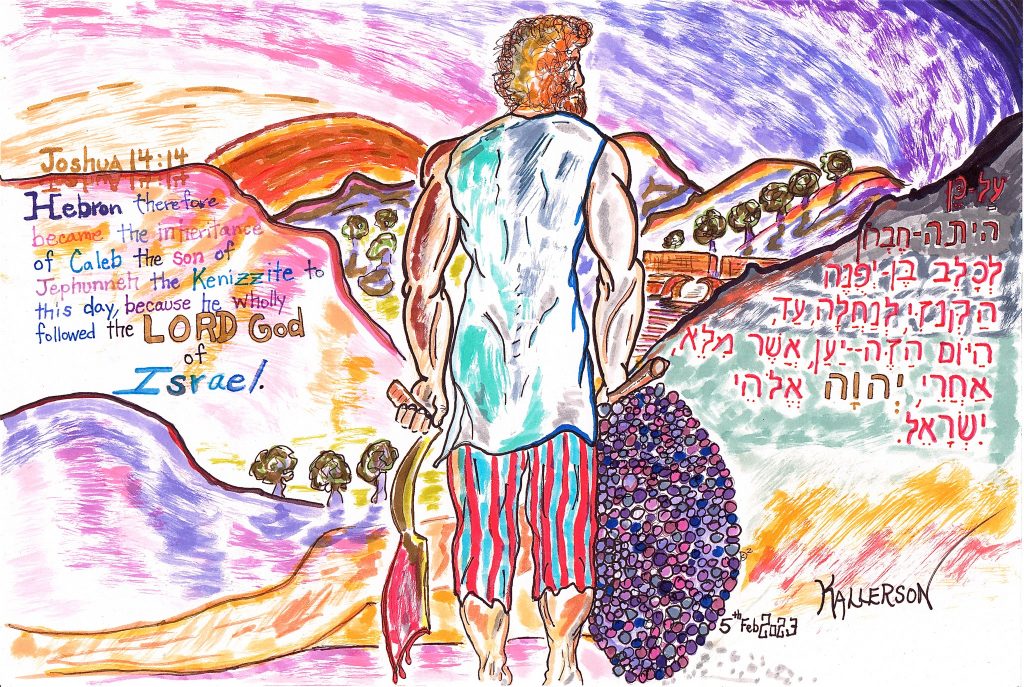
Artwork by Douglas Kallerson.
Joshua 14:6-15
He Wholly Followed the Lord God of Israel
A big question for you to answer in your head is, “When was Caleb ‘saved?’” When I say “saved,” I mean it in the sense of who he typologically pictures, the Gentiles. You’ve heard the sermon verses and you can easily deduce that the answer is, “When he wholly followed the Lord.”
He believed. The other spies with him did not. The entire context of the passage was faith in the word of the Lord. No commandment was ever given. Instead, he demonstrated faith. That is the conclusion made in Hebrews 3:18 where the author uses the word “obey” synonymously with “belief.”
When did that happen? It was back in Numbers. This is said several times in several ways in the passage. And yet, it is now many years later that he is actually being granted his inheritance, even though it was promised so long before.
Are you getting a hint of yourself in this? Some of you were saved when you were young. Others a little later in life. Some may have been saved just a short while ago. But for each of us, there is the same thing to consider. We have been saved and promised an inheritance, and yet we are waiting for our inheritance to be realized.
Think on this as we continue through the verses. Maybe before we get to the explanation of them, you’ll already be able to see the meaning of much of what is being presented.
Text Verse: “For if the inheritance is of the law, it is no longer of promise; but God gave it to Abraham by promise.” Galatians 3:18
Going back to when Caleb was “saved.” There was a law at the time, but nobody had lived it out. Israel was under the law and headed to Canaan, but Caleb did something other than observe the law in order to be given the promise spoken of in our passage today. And, for sure, it wasn’t law observance. Numbers 13 and 14 make that absolutely clear.
Abraham was promised the inheritance before the law came about. Caleb was promised the inheritance apart from the law, even if he was among Israel who was under the law. Those Jews being bit by serpents were saved apart from any law observance. What is the common theme among them all? Faith. Caleb’s deeds followed his faith. They were not the basis of it.
Even during the time of the law, the precept of salvation by grace through faith was clearly and precisely detailed. And it wasn’t demonstrated once or twice, but countless times. Pay heed to these things. Your walk with the Lord is to be one based on faith. So, have faith in all you do, and you will be pleasing to God.
This is a marvelous truth that is to be found in His superior word. And so, let us turn to that precious word once again, and… May God speak to us through His word today, and may His glorious name ever be praised.
I. And Joshua Blessed Him (verses 6-15)
The introductory note in verse 14:1 indicated that what follows would be the division of the land in Canaan proper. This would be for the nine tribes and the half-tribe of Manasseh. The verses remembered that Moses had given two tribes and the half-tribe an inheritance east of the Jordan. From there it specifically noted that no land grant was given to Levi, except cities to dwell in with their common lands.
With those points explicitly detailed, the contents of verse 14:1 concerning the division of the land of Canaan is now to be dealt with. And yet, within that division, there is a matter to be resolved based upon a promise made back in Numbers 14. The fulfillment of that promise is now realized…
6 Then the children of Judah came to Joshua in Gilgal.
va’yig’shu bene yehudah el Yehoshua ba’gilgal – “And approached sons Judah, unto Joshua, in the Gilgal.” The matter to be resolved involves the tribe of Judah.
To help you understand what is being conveyed, translating the meaning of the names, it would literally state: “And approached sons Praise, unto the Lord is Salvation, in the Liberty.” With that, the words continue, saying…
6 (con’t) And Caleb the son of Jephunneh the Kenizzite said to him:
More precisely, it reads, “And said to him, Caleb, son Jephunneh the Kenizzite.” The reason for these words is twofold. The first is because the promise was made to Caleb. As such, that promise must be dealt with at some point. The second is that Caleb is the leader of Judah designated to administer the land division for Judah –
“And the Lord spoke to Moses, saying, 17 ‘These are the names of the men who shall divide the land among you as an inheritance: Eleazar the priest and Joshua the son of Nun. 18 And you shall take one leader of every tribe to divide the land for the inheritance. 19 These are the names of the men: from the tribe of Judah, Caleb the son of Jephunneh.’” Numbers 34:16-19
Hence, the sons of Judah approaching Joshua is intended to resolve both matters, but the primary one is the fulfillment of the promise to Caleb. In fact, this process will take all the remaining verses in Chapter 14 and then all of Chapter 15 to complete.
Of the names mentioned here, Caleb means “Dog.” Yephunneh means “He will be beheld.” He is also identified as a Kenizzite, a descendant of Canaan, or a son of Kenaz, which is an Edomite name.
Later in Joshua, his brother Othniel is identified as a son of Kenaz. Thus, he is of foreign birth but brought into the people of Israel and the tribe of Judah. The reference to him being a Kenizzite is to show his Gentile heritage. Of this name, Kenizzite, Abarim provides an interesting analysis worth citing –
“The name Kenizzite means Hunter or Trapper but is a name like Fisherman or Troglodyte or Tanner or Metallurgist or Technician (which was the profession of Jesus and Joseph; τεκτων, tekton). It doesn’t describe physical descent but an occupational niche that would ultimately be absorbed into the worldwide market of human trade. Since the Bible is only interested in the evolution of the wisdom tradition (rather than politics or biological descent) the nature of Kenizzite should be understood to relate to wisdom.
Just like Jesus taught his disciples to be ‘fishers of men’, so should the Kenizzite be understood to be a ‘hunter of men’, and just like the legendary Nimrod was a ‘mighty hunter before YHWH’ so were the Kenizzites known for their contribution to the greater world of human interaction and exchange that would ultimately form the crib within which the Word of God could assume human form.”
6 (con’t) “You know the word which the Lord said
Rather than “said,” it uses the word “spoke.” There is also an emphasis in his words: atah yadata eth ha’davar asher dibber Yehovah – “YOU know the word which spoke Yehovah.” This spoken word was…
6 (con’t) to Moses the man of God concerning you and me in Kadesh Barnea.
el Mosheh ish ha’elohim al odothai v’al odotekha b’qadesh barnea – “unto Moses, man the God, upon my sake and upon your sake in Kadesh Barnea.” The specific reference comes from Numbers 14. The twelve spies had returned searching out Canaan. Upon their return, ten of them spread a bad report about the land, but Caleb and Joshua repudiated their report –
“But Joshua the son of Nun and Caleb the son of Jephunneh, who were among those who had spied out the land, tore their clothes; 7 and they spoke to all the congregation of the children of Israel, saying: ‘The land we passed through to spy out is an exceedingly good land. 8 If the Lord delights in us, then He will bring us into this land and give it to us, ‘a land which flows with milk and honey.’ 9 Only do not rebel against the Lord, nor fear the people of the land, for they are our bread; their protection has departed from them, and the Lord is with us. Do not fear them.’” Numbers 14:6-9
In response to this, the Lord spoke to Moses concerning them –
“Then the Lord said: ‘I have pardoned, according to your word; 21 but truly, as I live, all the earth shall be filled with the glory of the Lord— 22 because all these men who have seen My glory and the signs which I did in Egypt and in the wilderness, and have put Me to the test now these ten times, and have not heeded My voice, 23 they certainly shall not see the land of which I swore to their fathers, nor shall any of those who rejected Me see it. 24 But My servant Caleb, because he has a different spirit in him and has followed Me fully, I will bring into the land where he went, and his descendants shall inherit it.” Numbers 14:20-24
With this in mind, Caleb next says…
7 I was forty years old when Moses the servant of the Lord sent me from Kadesh Barnea to spy out the land,
The Hebrew form of speaking is more poetic: “Son forty years, I, in sending Moses, servant Yehovah, me from Kadesh Barnea to foot the land.” This is an important point in determining the biblical timeline when it is united with his words of verse 10. Caleb gives his age and the details of what occurred at that time.
In considering what is presented here, remember that Numbers 14 is when Israel failed to enter the promise by faith. It was a typological picture of Israel’s failure to receive Jesus as their Messiah. Despite that, Caleb – a Gentile by descent – did. The typology of that is obvious.
Kadesh Barnea means “Holy Purifying Wanderings.” It is at this location that Caleb proved himself a man of faith…
7 (con’t) and I brought back word to him as it was in my heart.
va’ashev oto davar ka’asher im l’vavi – “and returned to him word according to which with to my heart.” Despite being beautifully said in the Hebrew, the words look to a theological truth that will be explained later, but which you may already have discerned.
Caleb searched out the land, saw that it was good, and returned with a word according to the state of his heart. On the contrary…
8 Nevertheless my brethren who went up with me made the heart of the people melt,
v’akhai asher alu imi him’siv eth lev ha’am – “And my brothers who went up with me dissolved heart the people.” It is a new word, masah, signifying to melt, liquify, or dissolve. The idea then is that the collective heart of the people vanished. In complete contrast to that, Caleb says…
8 (con’t) but I wholly followed the Lord my God.
v’anokhi milethi akhare Yehovah elohai – “And I, I filled after Yehovah my God.” The meaning is to be taken as if Yehovah was walking on a path and Caleb literally stepped into His footprints, filling them as he went. It is a note of absolute devotion to the Lord’s ways in a walk of faith.
While Israel’s heart dissolved, Caleb “filled after Yehovah,” and his heart was set with a proper and pleasing response when he returned with the other spies. The contrast is remarkable. Because of this…
9 So Moses swore on that day, saying,
There is no direct mention of Moses swearing in this manner, only the Lord. And more, there is no mention of a specific piece of land being promised to Caleb. But this doesn’t mean neither happened.
The Lord’s words to Moses were, “But My servant Caleb, because he has a different spirit in him and has followed Me fully, I will bring into the land where he went, and his descendants shall inherit it” (Numbers 14:24). From there, Moses referred to this in Deuteronomy 1 –
“And the Lord heard the sound of your words, and was angry, and took an oath, saying, 35 ‘Surely not one of these men of this evil generation shall see that good land of which I swore to give to your fathers, 36 except Caleb the son of Jephunneh; he shall see it, and to him and his children I am giving the land on which he walked, because he wholly followed the Lord.’” Deuteronomy 1:34-36
The Lord promised that Caleb would enter and inherit. Moses repeated that. It is unnecessary for the word to record what Caleb now claims. Caleb has stated it to Joshua, and if it were not true, Joshua would have known. A similar example of this is Solomon’s right to the throne.
In 1 Kings 1:17, Bathsheba stated that David had sworn to her that Solomon would reign as king after him, and yet that is not recorded elsewhere. Obviously, she would not have made the claim if it wasn’t true. She was speaking to the person who made the statement! This is the same situation now being conveyed by Caleb to Joshua. Hence, Caleb continues…
9 (con’t) ‘Surely the land where your foot has trodden shall be your inheritance and your children’s forever,
More precisely, it reads, “if not – the land which has trodden your foot, in her, to you shall be to inheritance, and to your sons, until everlasting.” Caleb’s feet filled after the Lord, and so Moses promised that where his feet had trodden, that would be his everlasting inheritance. And this is…
9 (con’t) because you have wholly followed the Lord my God.’
ki miletha akhare Yehovah elohai – “for you filled after Yehovah my God.” Moses confirmed that Caleb had rightly pursued the Lord. Hence, Caleb was able to claim that he had done so as well. He simply repeated to Joshua what Moses had already stated. The words he speaks here were specifically stated by Moses in Deuteronomy 1 that we just cited a moment ago.
With that affirmed, Caleb then completes giving the timeline of events for us to logically know what year this is…
10 And now, behold, the Lord has kept me alive, as He said, these forty-five years,
Rather than “said,” the word is “spoke.” Other than that, it is close enough. The Lord spoke and it was as good as done. And now, it has come to pass. Caleb carried this word with him…
10 (con’t) ever since the Lord spoke this word to Moses while Israel wandered in the wilderness;
The words are precise: me’az diber Yehovah eth ha’davar ha’zeh el Mosheh asher halak Yisrael ba’midbar – “From that time spoke Yehovah the word, the this, unto Moses, which walked Israel in the wilderness.” Rather than “while Israel wandered,” it is from the beginning of the time that Israel wandered. While all of Israel was faithless, Caleb demonstrated faith. As a result, he was promised the inheritance at that time…
10 (con’t) and now, here I am this day, eighty-five years old.
The Hebrew has more excitement coming from Caleb – “and now, behold, I – the day – son of five and eighty years.” The words of Caleb provide the necessary information to understand the continued biblical timeline.
As explained in Joshua 11, the people left Mount Sinai on the twentieth day of the second month of the second year after the exodus (Numbers 10:11). Moses then says in Deuteronomy 2 –
“And the time we took to come from Kadesh Barnea until we crossed over the Valley of the Zered was thirty-eight years, until all the generation of the men of war was consumed from the midst of the camp, just as the Lord had sworn to them.” Deuteronomy 2:14
Entry into Canaan happened at the beginning of the forty-first year since leaving Egypt (Joshua 4:19). In Numbers 13, the spies went to look over Canaan. From there we come to the words of this verse and deduce that he was forty years old in the second year after leaving Egypt.
Being eighty-five at the end of the campaign, it means he was 39 when departing Egypt and 79 when entering Canaan. Thus, the campaign to subdue Canaan went somewhere between six and seven years. With that revealed, Caleb continues…
11 As yet I am as strong this day as on the day that Moses sent me; just as my strength was then, so now is my strength for war, both for going out and for coming in.
The translation gets the point across sufficiently. In verse 13:1, it said that Joshua was old, advanced in years. That implies that he had not simply aged in years, but that he was aged from the years. On the contrary, Caleb’s physical strength had essentially gone unchanged for the whole span of time.
Now that it’s time to draw out the inheritances, Caleb wanted what was promised to him to be identified first. But his choice of land would not be an inheritance ready to be inhabited. Rather, it would require a man of war to subdue it. This is the reason why he mentions his abilities as he does. That is then made explicitly known with his next words…
12 Now therefore, give me this mountain of which the Lord spoke in that day;
The “mountain” means the mountainous country around Hebron. These words now give definitive evidence that even though nothing was recorded of this specific promise, it was made, nonetheless. Caleb is reminding Joshua of what was spoken by the Lord at that time.
In Numbers 13:22, the Hebrew went from the 3rd person plural to the 3rd person singular, saying “And they went up through the Negev and he came to Hebron.” This indicates that Caleb is the one who reconnoitered this area and he really loved what he saw.
The narrative specifically noted this so that we would remember that this is the land Caleb had walked through. The spies all went up through the Negev. Caleb branched off and went to Hebron while others searched out other towns.
In this manner, they were able to cover much more land by dividing among cities within geographical areas. As a part of his report, he recalls the next words…
12 (con’t) for you heard in that day how the Anakim were there, and that the cities were great and fortified.
As can be seen, there is more than one city in “the mountain” that is being referred to. Thus, Hebron is the main city, but it is a general area that Caleb is referring to. And more, in Chapter 10, we saw Joshua took Hebron. Hence, Hebron was either reoccupied, and there was at least one other city also reoccupied in the area or the accounts are not chronological. Either way, this is seen in Chapter 15 –
“Now to Caleb the son of Jephunneh he gave a share among the children of Judah, according to the commandment of the Lord to Joshua, namely, Kirjath Arba, which is Hebron (Arba was the father of Anak). 14 Caleb drove out the three sons of Anak from there: Sheshai, Ahiman, and Talmai, the children of Anak. 15 Then he went up from there to the inhabitants of Debir (formerly the name of Debir was Kirjath Sepher).
16 And Caleb said, ‘He who attacks Kirjath Sepher and takes it, to him I will give Achsah my daughter as wife.’”
A note concerning multiple cities in this area is seen at the time of David as well –
“So David went up there, and his two wives also, Ahinoam the Jezreelitess, and Abigail the widow of Nabal the Carmelite. 3 And David brought up the men who were with him, every man with his household. So they dwelt in the cities of Hebron.” 2 Samuel 2:2, 3
The Anakim dwelt there, and they continued to dwell and they are still there. But Caleb had faith that they, along with the other inhabitants, would be cleared out…
12 (con’t) It may be that the Lord will be with me, and I shall be able to drive them out as the Lord said.”
Rather than “as the Lord said,” it reads “as the Lord spoke.” As before, the Lord spoke, and it was as if it was already accomplished. Hence, Caleb’s words do not indicate any doubt in his mind.
Rather, he is making a pious but confident statement that it would come to pass. Today, we might say, “No doubt about it. If the Lord is with me, I will get it done.” With his continued vigor, and the Lord’s presence with him, the Anakim will be dispossessed.
13 And Joshua blessed him,
This could mean either a verbal blessing followed by the gift, or the words could simply anticipate the next clause, the gift being the blessing. Probably both are combined in thought: a blessing of words accompanied by the blessing of the grant. Therefore, Joshua blessed him…
13 (con’t) and gave Hebron to Caleb the son of Jephunneh as an inheritance.
This is the third note that a verbal promise was made to Caleb concerning the granting of a specific area. Caleb never explicitly mentioned Hebron, only “the mountain.” But Joshua perfectly understood the meaning and granted it to Caleb as an inheritance.
Caleb had longed for the area for forty-five years and it is now his own possession. As for the name Hebron, it means Alliance. It is the general name given to a city as well as an entire area of cities allied together.
14 Hebron therefore became the inheritance of Caleb the son of Jephunneh the Kenizzite to this day,
With these words, the area belonged to Caleb. Despite this, it is included in the overall land grant of Judah, as seen in Joshua 15. Also, the main city of Hebron will be designated as a Levitical city in Joshua 21:11. Despite these things, the general mountainous area that falls under the designation “Hebron” became Caleb’s possession…
14 (con’t) because he wholly followed the Lord God of Israel.
yaan asher mile akhare Yehovah elohe Yisrael – “because which he filled after Yehovah God Israel.” This same sentiment has now been repeated numerous times.
The Lord said it in Numbers 14:24. Moses repeated it in Deuteronomy 1:36. Caleb said it in verse 8 of this chapter and cited Moses saying it in verse 9. Now, the author of the book restates it again. It is an absolute testimony to the character of the man and his willingness to be wholly faithful to the Lord.
With that, it next says…
15 And the name of Hebron formerly was Kirjath Arba
The first mention of Hebron is in Genesis 13:18. After that, it is called Kirjath Arba in Genesis 23:2, but it qualifies that saying it is Hebron. The name Kirjath Arba is repeated in Genesis 35:27 where it was again qualified as Hebron.
Because of this, it was probably always known as Hebron, but it was eventually conquered by Arba and was renamed after him, but it still retained its original name in the memory of the people. The name Hebron is mostly used from this point on, but the last time the area is mentioned in chronological time is at the time of Nehemiah where it is again called Kirjath Arba. That is supposing it is referring to the same city.
The name Kirjath Arba means City of Four. That is then explained with the words…
15 (con’t) (Arba was the greatest man among the Anakim).
The clause is more succinct: ha’adam ha’gadol ba’anaqim hu – “the man the great in the Anakim, he.” In other words, it appears Arba is the name of a man for whom the city is named. As odd as the name “Four” might sound, it is not unique in Scripture.
In Numbers 31:8, there is a person named Reba, meaning Fourth. And in Romans 16:3, Quartus is mentioned. His name is Latin meaning “Fourth.” The reason for giving such a name is as simple as being the fourth one born in a family or as a servant in a house. For this, or some other reason, Arba, or Four, was considered the greatest man among the Anakim. With that noted, the chapter ends with…
*15 (fin) Then the land had rest from war.
This is a letter-for-letter repeat of Joshua 11:23. The word translated as “rest” signifies to be quiet or undisturbed. It comes from a primitive root signifying to repose. Hence, one can think of idleness or being undisturbed. Rather than Israel, it is the land itself that is spoken of in this manner. With the enemy subdued, there is a sense of calm and idleness left for the people to enjoy.
Why this is stated here is not readily seen. But it is included just prior to the land divisions of the tribes, signifying that the major battles were complete.
And so, even though Caleb is the main focus of this narrative, and he is the one who will be the interested figure in subduing Hebron, it is actually a campaign that was under the authority of Joshua. That seems perfectly evident when the two accounts are placed side by side –
Joshua 11: And at that time Joshua came and cut off the Anakim from the mountains: from Hebron, from Debir, from Anab, from all the mountains of Judah, and from all the mountains of Israel; Joshua utterly destroyed them with their cities. 22 None of the Anakim were left in the land of the children of Israel; they remained only in Gaza, in Gath, and in Ashdod.
23 So Joshua took the whole land, according to all that the Lord had said to Moses; and Joshua gave it as an inheritance to Israel according to their divisions by their tribes. Then the land rested from war.
Joshua 14: Now therefore, give me this mountain of which the Lord spoke in that day; for you heard in that day how the Anakim were there, and that the cities were great and fortified. It may be that the Lord will be with me, and I shall be able to drive them out as the Lord said.”
13 And Joshua blessed him, and gave Hebron to Caleb the son of Jephunneh as an inheritance. 14 Hebron therefore became the inheritance of Caleb the son of Jephunneh the Kenizzite to this day, because he wholly followed the Lord God of Israel. 15 And the name of Hebron formerly was Kirjath Arba (Arba was the greatest man among the Anakim).
Then the land had rest from war.
In this, we see that the accounts are not at all chronological but categorical. Joshua completed the battles, but before that occurred, Caleb came to make his claim upon the land. Hence, when the land was to be divided, it would already be understood that Caleb had claim to Hebron.
Have faith in your walk and you will do well
It will bring you life and joy in the presence of the Lord
It is the necessary thing to keep you from hell
This is what is shown to us in the word
But misdirected faith is wasted faith, it is true
So have your faith directed as God has revealed
Look unto Jesus, this is what you are to do
And when you do, you too, will be sealed
God asks us to believe the gospel; nothing else will do
Believe what Jesus has done and in His presence you will dwell
In your believing, God who is faithful and true
Will save your soul, so His word does tell
II. An Explanation of the Typology
The account here, as I said a minute ago, is obviously not chronological. It fills in details of something that has already been shown as complete from Chapter 11. There, it said that the land had rest from war, and that sentiment is repeated again here.
As such, it is like Genesis 2 which fills in details not stated in Genesis 1. In Genesis 1, the creation account is completed in six days. In Genesis 2, it goes back to fill in the details about the creation of man on the sixth day. This is what is happening here. It is a common biblical style of writing.
It is important for a couple reasons. The first is that Caleb was given the promise by the Lord many years earlier and in order to not interfere with the inheritances of the tribes, his land is determined first.
Also, it needs to be dealt with before the division of the land because the Levites are given cities within Israel to minister to the people. That occurs after the divisions of the land. Thus, it is appropriate to have Caleb’s land determined first, then the tribal divisions, and then the Levitical cities. When looked at this way, what is detailed here makes all the sense in the world.
Also, nothing is said when the land divisions in Chapter 15 will be decided. As this is so, it could be that they were determined earlier. If so, then Caleb’s claim would be a part of Judah’s land and thus they would be interested parties in the division.
Even if not, Caleb is the main figure in this process of division and so it is right that Judah should accompany him when he approached Joshua. But there is also typology being conveyed here.
The account of the Gibeonites in Joshua 9 showed us how Gentiles are brought fully and completely into the New Covenant. But this account shows us that Gentiles are also included in the inheritance of that covenant. That may seem obvious, but it could be argued that they had no inheritance by someone with an agenda.
Caleb, meaning Dog, anticipates Gentiles. Along with his name, his repeated designation as a Kenizzite reveals this as well. This would explain verse 6 that said the sons of Judah approached Joshua in the Gilgal (the Liberty).
Think of Jews coming to Jesus, curious if Gentiles are included in the inheritance. This account resolves that. His name, Dog, son of He Will be Beheld, gives us a nice picture of a Gentile beholding the Lord. The inheritance is not something reserved to Jews alone.
As for the name Kenizzite, or Hunter, as Abarim noted, it is a name based on a profession, similar to many of our own names. Hence the name symbolizes someone who seeks a form of wisdom as would a person in any such profession. A number of verses from the New Testament could be used to explain this thought, such as –
“But of Him you are in Christ Jesus, who became for us wisdom from God—and righteousness and sanctification and redemption— 31 that, as it is written, ‘He who glories, let him glory in the Lord.’” 1 Corinthians 1:30, 31
With this remembered, Caleb spoke emphatically that Joshua knew the word of the Lord spoken “to Moses the man of God concerning you and me in Kadesh Barnea.”
Think of the words of the law, “You shall therefore keep My statutes and My judgments, which if a man does, he shall live by them: I am the Lord” (Leviticus 18:5). Joshua stands as Jesus here, testifying to the state of Caleb.
He knows that Caleb fulfilled the law through faith as was so carefully detailed in Numbers 13 and 14. Moses (the law) testified to this in Kadesh Barnea, or Holy Purifying Wanderings. Where Israel had failed and would remain under law, Caleb had trusted and that was credited to him for righteousness.
Verse 7 noted that Caleb was forty when he was sent from Kadesh Barnea. According to Bullinger, forty signifies “a period of probation, trial, and chastisement—(not judgment, like the number 9, which stands in connection with the punishment of enemies, but the chastisement of sons, and of a covenant people). It is the product of 5 and 8, and points to the action of grace (5), leading to and ending in revival and renewal (8).”
The Gentiles went through such a period and at the end of it received grace leading to and ending in revival and renewal. Think of Gentile salvation. This is seen in the words of Caleb, “and I brought back word to him as it was in my heart.” It is exactly what occurs when a person is saved –
“But what does it say? ‘The word is near you, in your mouth and in your heart’ (that is, the word of faith which we preach): 9 that if you confess with your mouth the Lord Jesus and believe in your heart that God has raised Him from the dead, you will be saved. 10 For with the heart one believes unto righteousness, and with the mouth confession is made unto salvation.” Romans 10:8-10
It would be hard to find a better statement by Caleb to match the events that occurred as they were recorded in Numbers 14, which matches what Paul says. He believed in his heart, he confessed, and he was saved.
Verse 8 spoke of the people’s (Israel’s national) rejection of the Lord, even when the Gentiles believed. As he said, “And I, I filled after Yehovah my God.” The Gentiles believed Jesus is the incarnate Lord, even when national Israel did not. They walked after Him in faith. Caleb’s words are reflective of Paul’s words –
“And he received the sign of circumcision, a seal of the righteousness of the faith which he had while still uncircumcised, that he might be the father of all those who believe, though they are uncircumcised, that righteousness might be imputed to them also, 12 and the father of circumcision to those who not only are of the circumcision, but who also walk in the steps of the faith which our father Abraham had while still uncircumcised.” Romans 4:11, 12
It must be recalled that every person that approached Joshua with Caleb was saved only later, typologically seen in their having crossed the Jordan. All those in the wilderness twenty years old and above had died. National Israel’s salvation comes after Gentile salvation.
Verse 9 revealed Moses’ concurrence with Caleb’s right to the inheritance as spoken by the Lord. The law testifies to Gentile salvation because it reveals Christ’s vicarious sacrifice, fulfillment of the law, and the imputation of His righteousness to those who believe. In this case, to “fill after Yehovah” is to follow Him as Paul states –
“Or do you not know that as many of us as were baptized into Christ Jesus were baptized into His death? 4 Therefore we were buried with Him through baptism into death, that just as Christ was raised from the dead by the glory of the Father, even so we also should walk in newness of life.” Romans 6:3, 4
Verse 10 noted that Caleb had been kept alive forty-five years more. It is the product of nine and five. Nine is “significant of the conclusion of a matter.” Five is “the number of grace.” It would be hard to think up anything more appropriate to the settling of an inheritance than those two thoughts.
The Gentiles were given the promise and the Lord will sustain them in salvation until the conclusion of the matter. The inheritance is guaranteed because the Lord has spoken.
With that, Caleb added the two numbers (40 & 45) together and essentially boasted that he was now eighty-five. What a cool number, because it is the product of five (grace) and seventeen, a number Bullinger was excited about. It is the seventh of the prime numbers. Hence –
“…it partakes of and intensifies the significance of the number seven. Indeed, it is the combination or sum of two perfect numbers—seven and ten—seven being the number of spiritual perfection, and ten of ordinal perfection. Contrasted together the significance of these two numbers is clear; and when united in the number seventeen we have a union of their respective meanings, viz., spiritual perfection, plus ordinal perfection, or the perfection of spiritual order.”
As such, it speaks of eternal salvation. One of several examples he gives is that of Romans 8. It…
“concludes the first great division of that all-important Epistle, and sums up the blessings of those who are dead and risen in Christ. First we have a series of seven, then a series of ten. The seven are marked off by being put in the form of a question, while the ten are given as the answer to it.
“Who shall separate us from the love of Christ? Shall
Tribulation, 1
Or distress, 2
Or persecution, 3
Or famine, 4
Or nakedness, 5
Or peril, 6
Or sword? 7
as it is written, For Thy sake are we killed all the day long; we are accounted as sheep for the slaughter. Nay, in all these things we are more than conquerors through Him that loved us. For I am persuaded, that,
Neither death (1),
Nor life (2),
Nor angels (3),
Nor principalities (4),
Nor things present (5),
Nor things to come (6),
Nor powers (7),
Nor height (8),
Nor depth (9),
Nor any other creature (10),
shall be able to separate us from the love of God which is in Christ Jesus our Lord.”
Thus is set forth the spiritual and eternal perfection of the believer’s standing in Christ.” EW Bullinger
This is just what is being conveyed by Caleb in typology. Caleb’s spiritual strength (in Christ and for his inheritance) was not diminished. It is at this point that he anticipates his inheritance and asks for it, noting the Anakim in the process.
To get the full meaning of the name Anakim, one would have to go back and review the Numbers sermons. In short, the word from which Anakim is derived means neck, or necklace, but that comes from the word anaq which means being fitted out with supplies, and thus furnished liberally, just as a necklace is generally made up of many pieces.
Hence, obtaining the inheritance of Anak signifies the believer is one who is furnished liberally by God for every necessary work to which he is appointed. Seeing this, verse 13 said, “and gave Hebron to Caleb the son of Jephunneh as an inheritance.”
In type, it is giving an Alliance to the Gentile, the son of “He Will Behold.” In other words, the Gentile inheritance is no less than that of the Jew. With that, the author of the narrative (the Lord is the ultimate Author) proclaimed one last time that Caleb “filled after Yehovah God of Israel.” Caleb was a man of faith, and he was granted the inheritance.
Verse 15 noted the previous name of Hebron, Kirjath Arba, City of Four. Four “is emphatically the number of Creation; of man in his relation to the world as created … It is the number of things that have a beginning, of things that are made, of material things, and matter itself. It is the number of material completeness. Hence it is the world number, and especially the ‘city’ number” according to Bullinger.
In this case, Four is then noted as “the man, the great in the Anakim.” Wycliff bizarrely translated these words, “Adam, moost greet there in the loond of Enachym was set.”
But maybe his odd thoughts give us a clue as to the meaning of the otherwise difficult to pin down words. In type, I will speculate that this is referring to the second Adam (the second Man of 1 Corinthians 15:47).
If so, it typologically means that the inheritance of the Gentiles is that of the greatest Man, the One furnished most liberally of all by God for every necessary work to which He was appointed. This would then match the words of Paul –
“In Him also we have obtained an inheritance, being predestined according to the purpose of Him who works all things according to the counsel of His will, 12 that we who first trusted in Christ should be to the praise of His glory.” Ephesians 1:11, 12
Paul, writing to Gentiles, notes “we who first trusted.” This would include the believing Jews as well as believing Gentiles, even before national Israel believes, which is exactly the pattern seen in these verses from Joshua.
The promise was made to Caleb in Numbers, the land is still not subdued in Joshua, and yet Caleb is granted the inheritance of the new creation before national Israel because of the work of Christ. With that, it noted that the land had rest from war. This is the same set of words from Joshua 11, and they show that Caleb’s inheritance came prior to that time, and thus prior to national Israel’s.
In the story of the five kings that came against Gibeon, there had to be a resolution as to how the Gentiles were brought into the covenant that was given to Israel and Judah (Jeremiah 31:31). Likewise, there had to be the clarification that Christ fulfilled all of the law, not just a portion of it. That was dealt with in the slaying of the five kings.
This account is not unlike that. Despite Gentiles being brought into the commonwealth of Israel, there needed to be a presentation of what that meant concerning the inheritance. It is explained by Paul in the New Testament, but it is typologically seen way back here in Joshua.
Every t is dotted and every i is crossed (wait, reverse that) so that we don’t have to later argue about what Paul is telling us. Understanding the typology in Joshua puts to rest many points of bad doctrine and even heresy. This is the beauty of traveling through these passages together.
For now, we will close with the thought that God has everything laid out, it was told us in advance, and then it is explained elsewhere. It is absolutely certain that this came from God and not from the minds of Jewish writers. They never would have penned such things as we continuously see in Joshua.
It is a real boost to our surety in the reliability of the word of God to see these types. As this is so, be sure to trust what is explicitly stated concerning Jesus. He is the One and the Only path to restoration with God. Be wise, be discerning, and be sure to call on Him today.
Closing Verse: “For this reason we also, since the day we heard it, do not cease to pray for you, and to ask that you may be filled with the knowledge of His will in all wisdom and spiritual understanding; 10 that you may walk worthy of the Lord, fully pleasing Him, being fruitful in every good work and increasing in the knowledge of God; 11 strengthened with all might, according to His glorious power, for all patience and longsuffering with joy; 12 giving thanks to the Father who has qualified us to be partakers of the inheritance of the saints in the light.” Colossians 1:9-12
Next Week: Joshua 15:1-12 Knowing the symbolism will put you in a great moodah… (The Borders of the Land of Judah) (31st Joshua sermon)
The Lord has you exactly where He wants you. He has a good plan and purpose for you. It is He who has defeated the enemy and who now offers His people rest. So, follow Him and trust Him and He will do marvelous things for you and through you.
He Wholly Followed the Lord God of Israel
Then the children of Judah came to Joshua in Gilgal
And Caleb the son of Jephunneh the Kenizzite said to him:
“You know the word which the LORD said to Moses
———-the man of God
Concerning you and me in Kadesh Barnea when times
———-were a bit grim
I was forty years old when Moses the servant of the LORD
Sent me from Kadesh Barnea to spy out the land
And I brought back word to him as it was in my heart
But things didn’t go as I planned
Nevertheless my brethren
Who went up with me (their thinking was flawed)
Made the heart of the people melt
But I wholly followed the LORD my God
So Moses swore on that day, saying
‘Surely the land where your foot had trod
Shall be your inheritance and your children’s forever
Because you have wholly followed the LORD my God
And now, behold, the LORD has kept me alive
As He said, these forty-five years. Yes, just as He told
Ever since the LORD spoke this word to Moses while Israel
———-wandered in the wilderness
And now, here I am this day, eighty-five years old
As yet I am as strong this day as on the day that Moses sent me
Just as my strength was then – any battle I could win
So now is my strength for war
Both for going out and for coming in
Now therefore, give me this mountain of which the LORD
———-spoke in that day
For you heard in that day how the Anakim were there
And that the cities were great and fortified
That means next to nothing; I couldn’t care
It may be that the LORD will be with me – those dudes
———-are already dead
And I shall be able to drive them out as the LORD said
And Joshua blessed him (maybe he did a happy dance)
And gave Hebron to Caleb the son of Jephunneh as an inheritance
Hebron therefore became the inheritance of Caleb
The son of Jephunneh the Kenizzite to this day
Because he wholly followed the LORD God of Israel
This is how he was. Yes, just that way
And formerly Kirjath Arba was Hebron’s name
(Arba was the greatest man among the Anakim), so was his fame
Then the land had rest from war
That’s the end of the chapter; there ain’t no more
Lord God, turn our hearts to be obedient to Your word
Give us wisdom to be ever faithful to You
May we carefully heed each thing we have heard
Yes, Lord God may our hearts be faithful and true
And we shall be content and satisfied in You alone
We will follow You as we sing our songs of praise
Hallelujah to You; to us Your path You have shown
Hallelujah we shall sing to You for all of our days
Hallelujah and Amen…
6 Then the children of Judah came to Joshua in Gilgal. And Caleb the son of Jephunneh the Kenizzite said to him: “You know the word which the Lord said to Moses the man of God concerning you and me in Kadesh Barnea. 7 I was forty years old when Moses the servant of the Lord sent me from Kadesh Barnea to spy out the land, and I brought back word to him as it was in my heart. 8 Nevertheless my brethren who went up with me made the heart of the people melt, but I wholly followed the Lord my God. 9 So Moses swore on that day, saying, ‘Surely the land where your foot has trodden shall be your inheritance and your children’s forever, because you have wholly followed the Lord my God.’ 10 And now, behold, the Lord has kept me alive, as He said, these forty-five years, ever since the Lord spoke this word to Moses while Israel wandered in the wilderness; and now, here I am this day, eighty-five years old. 11 As yet I am as strong this day as on the day that Moses sent me; just as my strength was then, so now is my strength for war, both for going out and for coming in. 12 Now therefore, give me this mountain of which the Lord spoke in that day; for you heard in that day how the Anakim were there, and that the cities were great and fortified. It may be that the Lord will be with me, and I shall be able to drive them out as the Lord said.”
13 And Joshua blessed him, and gave Hebron to Caleb the son of Jephunneh as an inheritance. 14 Hebron therefore became the inheritance of Caleb the son of Jephunneh the Kenizzite to this day, because he wholly followed the Lord God of Israel. 15 And the name of Hebron formerly was Kirjath Arba (Arba was the greatest man among the Anakim).