
Monday, 10 August 2026
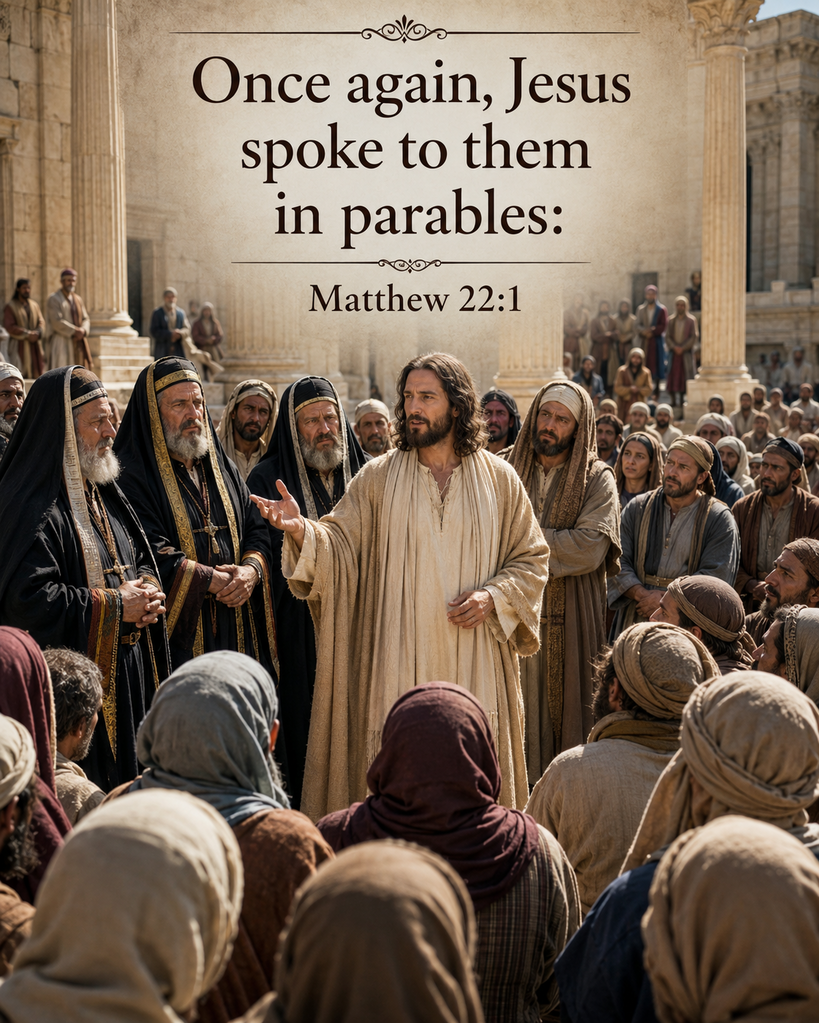
And Jesus answered and spoke to them again by parables and said: Matthew 22:1
Note: You can listen to today’s commentary courtesy of our friends at the “Bible in Ten” podcast. (Click Here to listen).
You can also read this commentary, scrolling with music, courtesy of our friends at “Discern the Bible” on YouTube. (Click Here to listen), or at Rumble (Click Here to listen).
“And answering, the ‘Jesus’, again, He said in parables to them, saying,” (CG)
The previous verse finished Chapter 21, noting that when the chief priests and Pharisees wanted to lay hands on Jesus, they feared the multitudes because they took Him for a prophet. Chapter 22 begins with the words, “And answering, the ‘Jesus’, again.”
It appears that what is being introduced is either chronological or at least occurring at the same general time and location. The word “answer,” as has been seen already, does not necessarily mean a question was asked, and this is in response to it. Rather, Jesus has made an observation based on the final words of Chapter 21 –
“And having heard, the chief priests and the Pharisees, His parables, they knew that concerning them, He speaks. 46And seeking Him to seize, they feared the crowds, since as ‘prophet’, Him, they held.”
The coming parable is given in response to Jesus’ observation of this situation. In this case, “He said in parables to them, saying…”
The use of the plural, parables, indicates an ongoing set of parables, not that He will speak more than one at this particular time. As for the parable itself, it has some similar points to the parable in Luke 14:15-24. However, they are quite different.
Because of this, scholars ridiculously debate which is the original “correct” one and which is a later amendment. Rather, as has already been seen in Matthew, Jesus uses overlapping information in His teachings, just as pastors do in their sermons. This shows consistency, not irregularity.
Likewise, it appears in Mark 12 that Jesus’ conversation with the leaders ends after the parable of the wicked vinedressers. That does not exclude there being another parable first. It is simply a fact that is stated to conclude Mark’s particular focus on the events.
Life application: Once we have something in our heads about a matter, we will spend our time focusing on ensuring what we believe will prove to be true.
If we are looking for fault in the person we are with, we may find it easily enough by making comparisons or suppositions that may be entirely unfounded. Instead of looking at the positive qualities of that person and the beauty of his or her being, we will look for reasons why he or she is somehow defective in our sight.
People who are told that a certain version of the Bible is the only true version will spend their time trying to justify that fact, even to the point of being unreasonable in their conclusions. Likewise, they will do everything possible to find errors in all other translations they are presented with when they do not align with the version they are sure must be correct.
Those who are looking for an answer to supposed faults in the Bible will look for an answer that accommodates faults. Those who look for an answer to differences in the Bible, while assuming it reflects God, who is perfect, will attempt to find a resolution to those differences that will not accommodate faults in the text.
However, because of this, it could be argued that those who do the latter are doing the same thing that the others are doing, just from a different perspective. Both are trying to meet an agenda that they have already established in their minds. And that may be true. But the premise of the second approach takes the nature of God into consideration. The first does not.
If there is a God, He will be perfect in Himself and in what He does. Therefore, it is more reasonable to look for the perfections in God’s word than any perceived imperfections. Man, of course, has been entrusted with God’s word, and so error may naturally be found in whatever man has done.
But the overall thought is that God is in control of His word in a manner that will allow us to weed out any such incorruption. Therefore, we should be reasonably assured that with diligent study, we can come closer and closer to the perfections of His word, thus eliminating the supposed imperfections that others have presented.
For a multitude of reasons, it is unrealistic to assume a single version of the Bible is the one and only “true” version. However, because God is perfect, it is reasonable to assume we can and should strive to understand His word as a book of perfection when rightly considered and researched. This is what we should strive for.
Lord God, grant us the wisdom to carefully and prayerfully consider Your word as we read it. May we look for the perfection in it that we know exists in You. As Your word is a reflection of You, we can be certain such perfection is there. Help us to have this attitude. Amen.