
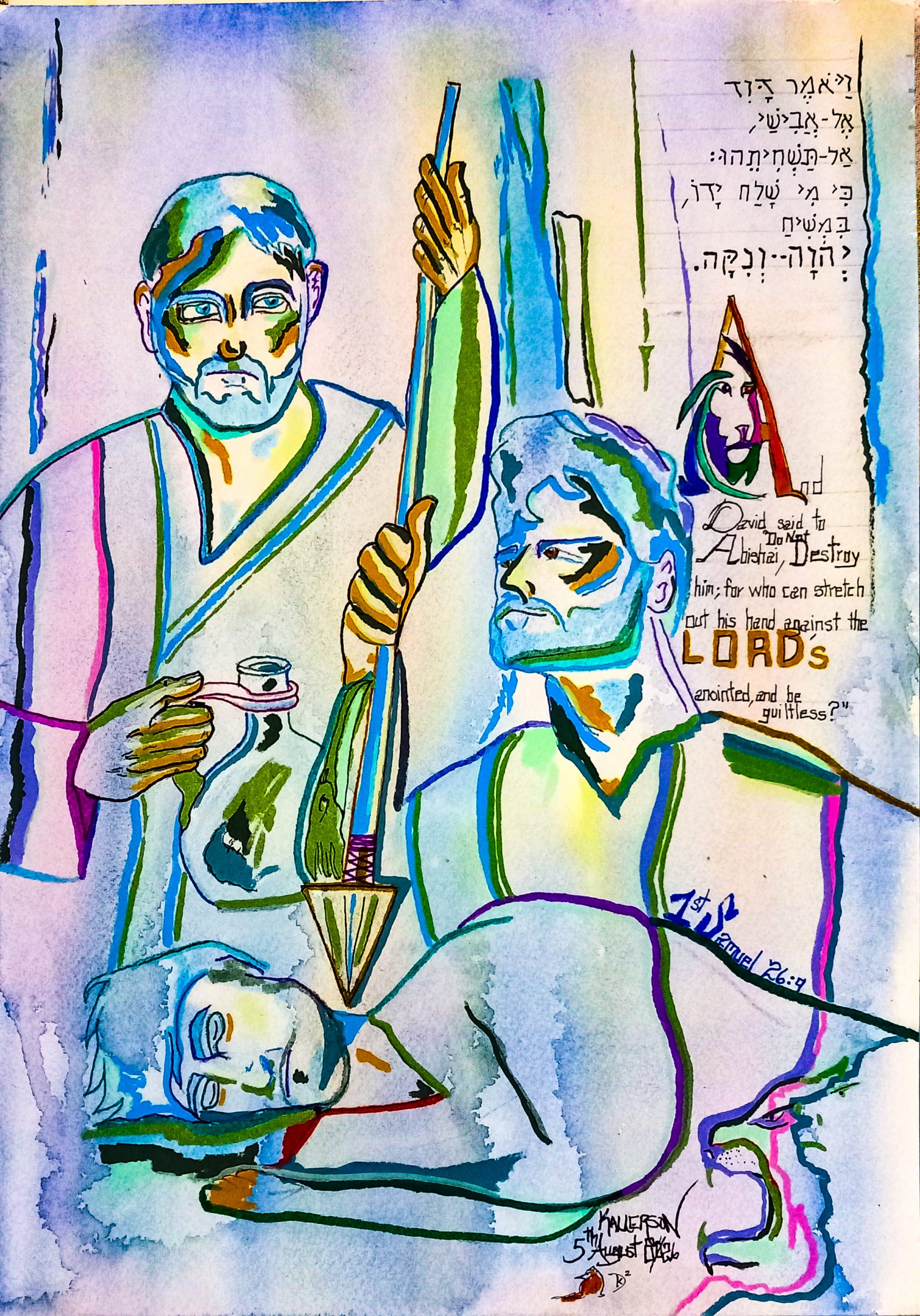
Artwork by Douglas Kallerson
1 Samuel 26:1-16
He Caused to Snatch Me from All Strait, Part I
(Typed 6 April 2026) It’s been over six years since I last went to Israel. That was when I went on a hike from Jericho to Jerusalem with Sergio and Yosi.
One of the memorable parts of the walk, and not necessarily a great one, was of sleeping on the ground in the wilderness at night. It was cold, the ground was hard as the mats weren’t up to the challenge, and there were bugs everywhere.
Whenever I read a passage in the Bible where people are sleeping in the wilderness, that comes to mind. Likewise, when I read about the good Samaritan, the images of the surrounding landscape are real to me. Before visiting Israel, I had to make up my own mental images of what the landscape was like.
I fully recommend that if you are a reader of the Bible and get a chance to go to Israel, take the opportunity to go. The things you read will make much more sense once you have gone.
If you aren’t able to go for whatever reason, you can always watch videos about the area you are reading about. Someone will surely have done a video about the location.
Text Verse: “O God, You are my God;
Early will I seek You;
My soul thirsts for You;
My flesh longs for You
In a dry and thirsty land
Where there is no water.” Psalm 63:1
A moment ago I said, “If you are a reader of the Bible…” But if you aren’t reading the Bible, then why not? Pick it up and read it! A lifetime of joy lies ahead for the person who picks it up daily and reads its pages. It is a wealth of marvelous information being transmitted from God to you.
Neglecting it is equivalent to neglecting Him. He has expressed Himself in this word. In fact, apart from a general knowledge of Him obtained by studying what He has created, there is no other source for us to know Him intimately. The Bible is, therefore, where it is at in our properly knowing God.
To trust someone else’s knowledge of Him without checking what you are being told is not smart. Be smart. Read your Bible. There are amazing treats to be found in His superior word. And so, let us turn to that precious word once again, and… May God speak to us through His word today, and may His glorious name ever be praised.
I. I Will Descend with You (verses 1-7)
This chapter closely resembles part of the overall narrative of 1 Samuel 23 & 24 so that some scholars decided they are the same account, justifying this in various ways. Others disagree, noting the similarities, but finding the differences so great that they must be two different accounts.
The similarities and differences will be evaluated as we go, the first of which is…
Now the Ziphites came to Saul at Gibeah,
vayavou ha’ziphim el shaul ha’givathah – “And they came, the Ziphites, unto Saul the Gibeah-ward.” This is a close repeat of 1 Samuel 23:19 –
1And they came, the Ziphites, unto Saul the Gibeah-ward.
19And they ascended, Ziphites, unto Saul the Gibeah-ward.
The two substantial differences are in the verb “they came,” while in the previous account, it says “they ascended.” The second difference is less noticeable, but actually more poignant. Here, it says “the Ziphites,” while in the earlier account it said, “Ziphites.”
Including the definite article here, “the Ziphites,” gives a sense that they have been identified before. In 1 Samuel 23, the lack of the article shows less specificity, something normal for a group not previously identified. This is supposition, but it is logical.
In Chapter 23, a lengthy explanation of Ziphite was given. Ultimately, it was decided that Ziph signifies an outflowing, as in pitch melting.
Saul means Asked. The spelling of his name without the later-added vowel points is identical to Sheol, the place of the dead.
Gibeah means Hill. It is etymologically connected to Gabbatha. The Ziphites came toward Gibeah to meet with Saul…
1 (con’t) saying, “Is David not hiding in the hill of Hachilah, opposite Jeshimon?”
lemor halo David mistater begivath ha’khakhilah al pene hayeshimon – “to say, ‘(Indeed) not David hiding himself in ‘Hill, the Hachilah’ upon ‘faces, the wasteland’?’” This is the second similarity to Chapter 23 –
26:1 – to say, “Not David hiding himself in ‘Hill, the Hachilah’ upon ‘faces, the wasteland?”
23:19 – to say, “Not David hiding himself with us in the strongholds in the Horesh-ward in ‘Hill, the Hachilah’ which from ‘right, the wasteland’?”
As with the previous clause, the differences point to different accounts. Giving less specificity in this account makes sense. On a first meeting, one might be more detailed than on a second –
“You can find him on the beach on Siesta Key. When you get to the parking lot, you want to go to the right towards the village.”
“He is on the beach, up by the village.”
David means Beloved.
According to Strong, Hachilah is from khaklili, a word “By reduplication from an unused root apparently meaning to be dark; darkly flashing (only of the eyes); in a good sense, brilliant (as stimulated by wine) — red.”
That word is found only once in Scripture –
“Crimson – eyes from wine,
And white – teeth from milk.” Genesis 49:12 (CG).
In this Genesis verse, it is being used as a comparative with the use of the word “from.” As the second clause is compared to white, meaning whiter, I would assume this means darker red from the redness of wine. Therefore, my conclusion is Crimson. Others say Dark, Gloomy, or Dusky.
As for the wasteland, the word is yeshimon, coming from yasham, to lie waste. Being prefixed by the definite article, it signifies the wasteland.
As for the reason why the Ziphites might repeat the same thing they did before, it may be that Saul had asked them to continue to watch David, or that they feared David more now, since they turned him over to Saul once and yet he eluded Saul’s hand. They may be fearful David might act against them. Thus, they decide to let Saul deal with him before that could happen. Either way…
2 Then Saul arose and went down to the Wilderness of Ziph,
vayaqam shaul vayered el midbar ziph – “And he arose, Saul, and he descended unto ‘Wilderness, Ziph’.” This is a third similarity to 1 Samuel 23. There is another difference this time –
26:2 – And he arose, Saul, and he descended unto ‘Wilderness, Ziph’.
23:24 – And they arose, and they walked Ziph-ward to ‘faces, Saul’.
In Chapter 23, the Ziphites were before Saul. In this account, Saul just gets up and descends into the wilderness. If they are two separate accounts, it makes sense that there would be men to direct Saul. With that knowledge, he wouldn’t need guides on a second hunt.
In Scripture, the wilderness is a place of God’s grace and of closeness to Him, but it is also a place of testing. For some, such as Israel, the testing results in disobedience. For others, such as Christ when He was tested, it is a place of fellowship through obedience.
The wilderness and the law are closely connected because testing is accomplished through law. This is seen in the word itself, midbar. It is derived from the verb davar, to speak, and the noun davar, meaning word. The Lord spoke the Ten Commandments (words/devarim) in the desert (midbar) of Sinai.
As for Saul’s expedition to find David…
2 (con’t) having three thousand chosen men of Israel with him, to seek David in the Wilderness of Ziph.
veito shelosheth alaphim ish bekhure Yisrael levaqesh eth David bemidbar ziph – “And with him three thousands man, ‘selected, Israel’, to seek David in ‘Wilderness, Ziph’.” In Chapter 23, Saul pursued David. The chase was so close they almost met and engaged each other. However, Saul’s attack was broken off when he was alerted that Philistines had invaded the land.
After engaging the Philistines, Saul reengaged the hunt for David. At that time, David was in the Wilderness of En Gedi. Therefore, those locations are different. Despite this, in 24:2, there was another similarity –
24:2 – And he took, Saul, three thousands man, selected from all Israel.
26:2 – And with him three thousands man, ‘selected, Israel’.
The same brevity of thought in the latter account is seen again. Something that would seem natural if this account is different. The same number, though seemingly making it “obviously” the same account is not that unusual.
In 1 Samuel 13:2, Saul selected three thousand men from Israel, dividing them between himself and Jonathan. Thus, this appears to be his standard number of recruits. Others would only be called up from the populace when necessary.
Three thousand is derived from the numbers three and ten. Bullinger notes that three “stands for that which is solid, real, substantial, complete, and entire.” As such, it represents Divine Perfection.
Of the number ten, he says, “Completeness of order, marking the entire round of anything, is, therefore, the ever-present signification of the number ten. It implies that nothing is wanting; that the number and order are perfect; that the whole cycle is complete.” It represents Ordinal Perfection.
Israel means He Strives with God.
3 And Saul encamped in the hill of Hachilah, which is opposite Jeshimon, by the road.
vayikhan shaul begivath ha’khakhilah asher al pene hayeshimon al ha’darekh – “And he inclined, Saul, in ‘Hill, the Hachilah’ which upon ‘faces, the wasteland’, upon the road.” Saul took up his position in the exact location stated by the Ziphites in verse 1. Saying “by the road” indicates there was a known trail in this area. It makes the account verifiable and the location findable for any curious reader at a future date.
3 (con’t) But David stayed in the wilderness, and he saw that Saul came after him into the wilderness.
vedavid yoshev bamidbar vayar ki va shaul akharav ha’midbarah – “And David ‘sitting in the wilderness’, and he saw that he came, Saul, after him the wilderness-ward.” Being a military man, David would have men situated outside his camp. This is probably how he learned of the arrival of a sizeable force.
It could be, however, that he knew because of where he was stationed, having an elevated view of the surrounding area. He could see a large group of men and then determine who it was. Either way…
4 David therefore sent out spies, and understood that Saul had indeed come.
More poetically: vayishlakh David meragelim vayeda ki va shaul el nakhon – “And he sent, David, ‘walkings’, and he knew that he came, Saul, unto ‘being established’.” The thought is that David sent men out as spies, but the term meragelim, walkings, gives the sense that this was done in the open.
It was used 6 times in Genesis 42 when Joseph accused his brothers of spying on Egypt. It was used once about the spies who entered Jericho while walking through Canaan. It will be seen one more time when Absalom will send men throughout all the tribes of Israel.
Each instance, they are spies but not lurking in the dark. Other forms of the same verb give the same sense. The spies openly walk as if they are common people just ambling around. The final words of the verse, unto ‘being established’, signify that Saul had established his camp in that location.
Young’s, however, uniquely translates this not as the participle form of the verb, but as the name of a location, Nachon. It is the same name used in 2 Samuel 6:6 of another location. If Young’s is right, the name is either derived from naka, to strike, and thus Smitten, or it is from kun, to establish. If so, it may mean Prepared or It Has Been Determined.
5 So David arose and came to the place where Saul had encamped.
vayaqam David vayavo el ha’maqom asher khanah sham shaul – “And he arose, David, and he came unto the place where he inclined there, Saul.” David took the initiative and went out to encounter Saul where he was. This was at night as is next seen…
5 (con’t) And David saw the place where Saul lay, and Abner the son of Ner, the commander of his army.
vayar David eth ha’maqom asher shakav sham shaul veavner ben ner sar tsevao – “And he saw, David, the place where he lay there, Saul, and Abner, ‘son, Ner’, ‘commander, his host’.” Despite being night, there would be fires lit to keep warm. In the desert, even if the days are hot, the nights are chilly.
Also, Israel’s desert areas are famous for bugs, really creepy ones. Lighting fires around the camp would produce a “circle of trust” for those inside it. Today, someone may take bug repellant and squirt it on the ground around a sleeping encampment to form such a barrier.
Abner comes from two words, av, father, and ner, a lamp. It means Father of Light. Ner, his father, means Lamp or Light.
5 (con’t) Now Saul lay within the camp, with the people encamped all around him.
veshaul shokev bamagal vehaam khonim sevivoto – “And Saul, ‘lying in the circular’, and the people ‘inclining his around’ [k.].” The written and oral Hebrew are different. The written reads in the singular, “his around.” The oral is changed to the plural, “his arounds.” The reason for this change is that it appears grammatically incorrect to use such a spatial word in the singular.
We do the same thing. If someone lives outside an area, we will say, “He lives on the outskirts of the town.” Here, it essentially says, “the people were lying in his surrounding,” where it should say, “the people were lying in his surroundings.” The only spelling difference is the addition of the letter yod in the oral.
As for “the circular,” the most likely explanation is what Adam Clarke says, “The Arabs, to the present day, always form a circle in their encampments, and put their principal officers in the center.”
They are men on an expedition. They would travel lightly so they could move quickly. For the safety of the king, a circle would be formed around him as they slept.
6 Then David answered, and said to Ahimelech the Hittite and to Abishai the son of Zeruiah, brother of Joab,
vayaan David vayomer el akhimelekh ha’khiti veel avishai ben tseruyah akhi yoav – “And he answered, David, and he said unto Ahimelech the Hittite and unto Abishai, ‘son, Zeruiah, brother, Joab’.” Ahimelech the Hittite is only mentioned here in the Bible. Abishai is David’s nephew, the son of David’s sister Zeruiah. He is also the brother of Joab.
The three are mentioned in 1 Chronicles 2:16. However, in 2 Samuel 17:25, Zeruiah is said to be the daughter of Nahash. Without going into all the detail now, it appears she is likely a stepsister of David.
Ahimelech means My Brother Is King. Hittite is from kheth, terror. They were descended from Heth, a son of Canaan as recorded in Genesis 10:15. They should have been eradicated in the conquest of Canaan, but they continued to live in the land.
Hittite means Terror, Dismayed, etc., or actively Terrible or Fearsome. Depending on the root, Abishai either means My Father Is Jesse, and thus, My Father Yehovah Exists, or it is from a noun signifying a gift. Thus, it would mean Father of Gifts or Father of a Gift.
Zeruiah is his mother’s name. Depending on the root, it means something like Balm, Wounded, Balsam, Balsam of Yah, or His Edgerock Is Yah. The last option would be a commemorative of an event or person, such as calling someone “His Blimp” because she was born on the day her father rode on a blimp.
Joab comes from an abbreviated form of Yehovah and av, father. Thus, it means Yehovah Is Father or Whose Father Is Yehovah.
6 (con’t) saying, “Who will go down with me to Saul in the camp?”
And Abishai said, “I will go down with you.”
lemor mi yered iti el shaul el ha’makhaneh vayomer avishai ani ered imakh – “to say, ‘Who he will descend with me unto Saul, unto the camp?’ And he said, Abishai, ‘I, I will descend with you.’” Once he looked over the camp, David determined he could infiltrate it. Therefore, he obtains a volunteer to join him. Abishai’s emphatic “I, I will descend” may have been prompted by a temporary silence.
In other words, David asked who would go with him. The two may have looked at David, then at each other, and then back at David with that “Like, what are you talking about?” look. There were three thousand men lying down there encircling Saul.
They probably thought David was kidding until they realized he was serious. Hence, after an embarrassing pause, Abishai yields to his uncle’s will, “I, I will go…”
Someday he will be gone, let the Lord decide on that
His reign will end, and something new will come about
Like donning a new coat, or changing one’s hat
Something new is coming. Of this, have no doubt
Until then, it is not our job to rush things
The Lord has a plan that we must abide by
Knowing He is in control is from where our hope springs
So, in meddling with His plan, we shouldn’t even try
All is well, so let us not fret or worry
Take life easy, one day at a time
There is no need to push the plan or hurry
In the end, we will see that God’s plan is ever so sublime
II. The King, Your Lord (verses 7-16)
7 So David and Abishai came to the people by night; and there Saul lay sleeping within the camp,
vayavo David vaavishai el ha’am laylah vehineh shaul shokev yashen bamagal – “And he came, David, and Abishai, unto the people – night. And behold! Saul lying asleep in the circular.” David had the assurance that he was the anointed king and that God would preserve him for attaining the kingdom.
Therefore, to go in amongst the entire army of Saul was not reckless. If they were caught, David knew the Lord would get him out of it. However, they faced no resistance as they neared the middle where Saul was…
7 (con’t) with his spear stuck in the ground by his head. And Abner and the people lay all around him.
vakhanito meukhah vaarets meraashohto veavner vehaam shokhevim sevivoto – “And his spear pressed in the earth – his headpiece [k.]. And Abner, and the people, ‘lying his around’ [k.].” Two more written/oral discords exist in this clause. The first is in conjunction with the meraashoth, headpiece. In biblical Hebrew, elsewhere it is always a plural word. However, it is singular here.
The second is the same as in verse 5 where “around” should be plural. The only change in both is the addition of the letter yod to bring the oral in line with common usage.
The khanith, spear, is the symbol of Saul’s authority. It is pressed into the ground by his headpiece so that he can get up and immediately have it ready to fight with. As before, khanith, is identical to the feminine word meaning grace.
8 Then Abishai said to David, “God has delivered your enemy into your hand this day.
vayomer avishai el David sigar elohim ha’yom et oyivikha beyadekha – “And he said, Abishai, unto David, ‘He shut, God, the day, your hating in your hand.” This is a fifth similarity to the previous time David could have killed Saul. He is being encouraged by one with him to act against Saul. The wording is quite different though –
24:4 – And they said, ‘mortals, David’, unto him, “Behold! The day which He said, Yehovah, unto you, “Behold! I ‘giving your enemies in your hand’,” and you did to him according to which it will be good in your eyes.”
26:8 – And he said, Abishai, unto David, ‘He shut, God, the day, your hating in your hand.
A single person speaks this time. He invokes God, not Yehovah, and instead of urging David to do what he thought was good…
8 (con’t) Now therefore, please, let me strike him at once with the spear, right to the earth; and I will not have to strike him a second time!”
veatah akenu na bakhanith u-vaarets paam akhath velo eshneh lo – “And now, let me cause to strike, pray, in the spear and in the earth, ‘beat, one’, and not I will duplicate to him.’” Abishai desires to personally strike Saul. There is nothing said of a spear being available in the cave. There are too many differences between the accounts for these to be a recapitulation of the same account with further information.
Abishai said he would strike Saul one time because he is certain of the outcome. If he failed to kill Saul on the first thrust, Saul would cry out and the entire army would be on them like sweet fragrance on durian. Despite Abishai’s zeal…
9 But David said to Abishai, “Do not destroy him; for who can stretch out his hand against the Lord’s anointed, and be guiltless?”
vayomer David el avishai al tashkhithehu ki mi shalakh yado bimshiakh Yehovah veniqah – “And he said, David, unto Abishai, ‘Not you will cause to ruin him. For whom, he sent his hand in ‘anointed, Yehovah’, and he will be cleansed?’” In this account, David specifically rebukes Abishai before any action could take place. When David was in the cave, he cut off the extremity of Saul’s garment, after which he felt guilty regarding what he did.
In both instances, and elsewhere, David sees the anointing of Saul as inviolable. Nobody but the Lord had the right to take Saul’s life except as He directed, such as…
10 David said furthermore, “As the Lord lives, the Lord shall strike him, or his day shall come to die, or he shall go out to battle and perish.
vayomer David khai Yehovah ki im Yehovah yigaphenu o yomo yavo vameth o vamilkhamah yered venispah – “And he said, David, ‘Alive Yehovah! For if Yehovah, He will smite him, or his day, it will come, and he will die, or in the battle, he will descend, and he will be scraped.’” David muses over the ways Saul could go. First, he could have a bad day like Nabal or some other schlub who is struck with a physical malady, be it a stroke or a heart attack.
Or it could be that his day would come. He might just got old and kick off, fall off a cliff, get run over by a runaway donkey, or some other avenue the Lord would allow into his life.
Next, David considers that Saul, a warrior, could come to his end in battle. That would ultimately be the Lord’s will because the Lord promised that obedient Israel could have five chase a hundred and a hundred could chase ten thousand.
Therefore, if Saul died in battle, then it must have been the Lord’s will that he was poetically scraped, like hair off a man’s face when a knife is scraped over it.
Whatever fate the Lord determined, David knew it was ahead. He was the one anointed to replace Saul. He had no need to rush into bloodshed against the Lord’s will when the Lord would eventually finish off Saul’s life, and thus, his reign. As for David…
11 The Lord forbid that I should stretch out my hand against the Lord’s anointed.
khalilah li meYehovah misheloakh yadi bimshiakh Yehovah – “(Surely) Profane to me from Yehovah from stretching my hand in ‘anointed, Yehovah’.” David does not see taking Saul’s life as part of the Lord’s allowance, even in a situation like this. Rather, he sees it as an act against the Lord. David is the one who would benefit from Saul’s death. Therefore, his action in this regard could not be excused.
David probably saw future ramifications of this as well. If he struck Saul, the rightful king of Israel, what would prohibit others from thinking it was ok to strike David when he ascended to the throne? The honor and respect for the office would be diminished if he were involved in such an act.
However, he has a design in mind to hopefully put Saul’s constant pursuit of him to rest, once and for all…
11 (con’t) But please, take now the spear and the jug of water that are by his head, and let us go.”
veatah qakh na eth ha’khanith asher meraashotho veeth tsapakhath ha’mayim venelakhah lanu – “And now, you must take, pray, the spear which – his headpiece [k.], and ‘cruse, the waters’, and let us walk to us.” Again, the oral changes from the written text. It is the same change, from the singular to the plural that has been seen several times. Instead of headpiece, it is changed in the oral to headpieces.
By adding a single yod, the oral is read under standard grammatical Hebrew form. The number of times this has happened in the chapter tells us these were not mere copyists’ error, but a purposeful set of changes within the text.
David has Abishai take the khanith, spear, and the tsaphakhath, cruse of Saul’s water. This is a new word, coming from an unused root meaning to expand. It signifies a saucer, as if clay is expanded on a wheel.
In this case, however, it refers to an expanded jug, easily carried but which will not interfere with movement, like a soldier’s canteen.
It is certain this is a cruse, not a saucer, because of its other uses in 1 Kings where it signifies a type of jar meant for containing water.
Interestingly, despite David telling Abishai to grab the implements, the credit for doing so is assigned to David in the text…
12 So David took the spear and the jug of water by Saul’s head, and they got away;
vayiqakh David eth ha’khanith veeth tsapakhath ha’mayim meraashothi shaul vayelekhu lahem – “And he took, David, the spear and ‘cruse, the waters’ from ‘headrest, Saul’. And they walked to them.” With these two particularly named implements belonging to Saul in hand, they boogied on out of the camp.
The word translated as headrest is found only here in the Bible, raashoth. It is cognate to marashah, a word found only in Jeremiah 13:18, which signifies headship. Both are from rosh, head. The cruse was resting right on Saul’s headrest. David could not have gotten any closer to vital arteries that could be cut with a knife than this.
It is solely because of David’s integrity and honor for the Lord that Saul remained alive.
12 (con’t) and no man saw or knew it or awoke.
vein roeh vein yodea vein meqits – “And naught seeing, and naught knowing, and naught causing to awaken.” The repetitive wording is specifically intended to heighten the reader’s senses to the incredible nature of what happened. The Lord Himself was superintending over the events.
The reason that this amazing situation was possible is next stated…
12 (con’t) For they were all asleep, because a deep sleep from the Lord had fallen on them.
ki khulam yeshenim ki tardemath Yehovah naphelah alehem – “for they all languid, for ‘trance, Yehovah’ it fell upon them.” The same word was used to describe when Adam was put to sleep for God to make Eve out of one of his ribs. It was also seen when Abraham was overcome with deep sleep when the Lord cut a covenant with him in Genesis 15. It is now used here for the third time.
The entire camp of three thousand men was effectively incapable of wakening, as if they had been doused with aerosol anesthesia, allowing David and Abishai to depart unharmed.
13 Now David went over to the other side, and stood on the top of a hill afar off, a great distance being between them.
vayaavor David ha’ever vayaamod al rosh ha’har merakhoq rav ha’maqom benehem – “And he traversed, David, the side. And he stood upon ‘head, the mount’ from remote. Great, the place, between them.” This leaves no possible way of reconciling the previous account with this one –
26:13 – And he traversed, David, the side. And he stood upon ‘head, the mount’ from remote. Great the place between them.
24:8 – And he called after Saul, to say, “My lord the king!” And he caused to scan, Saul, after him. And he stooped, David, nostrils earthward, and he prostrated himself.
This time, David put a great distance between himself and Saul, probably because there were three thousand anxious warriors around Saul. David went to the top of a mountain in order to project his voice to all of them while maintaining a safe distance from them.
There would be archers, spearmen, and those with slings itching to be the one to take out David. His placement is a life-saving expedient. Once properly stationed…
14 And David called out to the people and to Abner the son of Ner, saying, “Do you not answer, Abner?”
vayiqra David el ha’am veel avner ben ner lemor halo taaneh avner – “And he called, David, unto the people, and unto Abner, ‘son, Ner’, to say, ‘(Indeed) not you will answer, Abner?’” Abner was Saul’s right-hand man and protector. If something happened to Saul, he would bear the responsibility for it. Not having even a whiff of what took place, he responds…
14 (con’t) Then Abner answered and said, “Who are you, calling out to the king?”
vayaan avner vayomer mi atah qaratha el ha’melekh – “And he answered, Abner, and he said, ‘Who you, you called unto the king?’” David called out to Abner. But Abner elevates it to the king, as if to say, “I’m here, but you must realize the king is here too. You are disturbing his peace by calling me!”
15 So David said to Abner, “Are you not a man? And who is like you in Israel? Why then have you not guarded your lord the king?
vayomer David el avner halo ish atah u-mi khamokha beyisrael velamah lo shamarta el adonekha ha’melekh – “And he said, David, unto Abner, ‘(Indeed) not man, you? And who according to you in Israel? And to why not you guarded unto your lord the king?’” David’s words equate to, “You are a man, and indeed, none are like you in Israel.”
The sense is coming with the next words, but his intent is, “If you’re the best the king has got, the king is doomed already.” That is seen in the words, “And to why not you guarded unto your lord the king?” Abner has no idea what David is talking about, but he knew David wasn’t a fool. Maybe the entire camp was surrounded and ready to be executed! But no, it is much more embarrassing…
15 (con’t) For one of the people came in to destroy your lord the king.
ki va akhad ha’am lehashkhit eth ha’melekh adonekha – “For he came, ‘one, the people’, to ‘cause to ruin’ the king, your lord.” Someone neared the king and could have killed him. As yet, there is no proof of it. For all Abner knows, it could have been someone outside the camp that David eliminated while he slept. He had no idea, but by now he realizes he failed to properly guard Saul.
16 This thing that you have done is not good. As the Lord lives, you deserve to die, because you have not guarded your master, the Lord’s anointed.
lo tov ha’davar ha’zeh asher asita khai Yehovah ki vene maveth atem asher lo shemartem al adonekhem al meshiakh Yehovah – “Not good, the word, the this, which you did. Alive Yehovah! For ‘sons, death’ you, which not you guarded upon your lord, upon anointed Yehovah.” At this point, David is taunting Abner. He still has not explained what happened or why the king’s life was in peril, but it is certain it was.
Calling those in the camp “sons, death” speaks of identity. It is what they all deserve for not performing their duties as they should. Understanding this, David next provides the proof that they are, in fact, sons of death…
*16 (fin) And now see where the king’s spear is, and the jug of water that was by his head.”
veatah reeh e khanith ha’melekh veeth tsaphkhath ha’mayim asher meraashohto – “And now, you must see where ‘spear, the king’ and ‘cruse, the waters’, which his headpiece [k.].” The oral again changes the text from the singular to the plural concerning the headpiece. It isn’t just the narrator as in the past using this unusual verbiage. As in verse 11, David is recorded as saying it.
David’s possession of Saul’s spear and water cruse mean that Saul’s life could have been ended without any effort at all. If they covered his mouth and slit his throat, nobody would have known. And yet, the king remained alive.
This does not exonerate Abner and all of the others from failing in their duty to protect him.
As for us, we have responsibilities to attend to as well. As the people of God, one of the things we should be doing is learning about Him. And this doesn’t just mean what we can get out of Him for our personal benefit, but how we can get more of Him in a personal relationship.
David was careful to seek that, as seen in the passage today. He understood that his actions toward Saul had to be in accord with God’s nature for him to keep from sinning. In seeing how David handled things, we can learn and grow in our own walk before the Lord.
At times, David failed in his actions, but when faced with what he did, he immediately went to restore his relationship with the Lord. And we can learn from his failings as well. This is the beauty of the word of God. It doesn’t hide people’s faults. Rather, they are carefully placed in the word to help us learn from them.
So keep reading the word, and think on why God put the things into it as He did. None of it is lacking purpose. There is nothing random or arbitrary in what it says. There is intent. So evaluate each passage as a unique look into something that is on God’s mind for us to learn from.
We will be back to finish the chapter next week. Until then, think about what has happened. Take time to read the rest of the chapter and ponder what lies ahead. When we evaluate those verses, we will do our best to contemplate what God is telling us.
Enjoy your time in the word. And above all, revel in what God has done for you in giving His Son. Jesus is the ultimate point of everything in the word, so be grateful to God for Him as you read it.
Closing Verse: “Because Your lovingkindness is better than life,
My lips shall praise You.
4 Thus I will bless You while I live;
I will lift up my hands in Your name.” Psalm 63:3, 4
Next Week: 1 Samuel 26:17-25 (He Caused to Snatch Me from All Strait, Part II) (57th 1 Samuel Sermon)
The Lord has you exactly where He wants you. He has a good plan and purpose for you. He is the One who abases the haughty and exalts the humble. He regards the lowly, and the proud, He knows from afar. So yield yourself to Him, trust Him, and believe His word. In this, He will do great things for you and through you.
1 Samuel 26:1-16 (CG)
26 And they came, the Ziphites, unto Saul the Gibeah-ward, to say, “(Indeed) not David hiding himself in ‘Hill, the Hachilah’ upon ‘faces, the wasteland?” 2And he arose, Saul, and he descended unto ‘Wilderness, Ziph’. And with him three thousands man, ‘selected, Israel’, to seek David in ‘Wilderness, Ziph’. 3And he inclined, Saul, in ‘Hill, the Hachilah’ which upon ‘faces, the wasteland’, upon the road. And David ‘sitting in the wilderness’, and he saw that he came, Saul, after him the wilderness-ward. 4And he sent, David, ‘walkings’, and he knew that he came, Saul, unto ‘being established.’
5And he arose, David, and he came unto the place where he inclined there, Saul. And he saw, David, the place where he lay there, Saul, and Abner, ‘son, Ner’, ‘commander, his host’. And Saul, ‘lying in the circular’, and the people ‘inclining his around’ [k.]. 6And he answered, David, and he said unto Ahimelech the Hittite and unto Abishai, ‘son, Zeruiah, brother, Joab’, to say, “Who he will descend with me unto Saul, unto the camp?”
And he said, Abishai, “I, I will descend with you.”
7And he came, David, and Abishai, unto the people – night. And behold! Saul lying asleep in the circular. And his spear pressed in the earth – his headpiece [k.]. And Abner, and the people, ‘lying his around’ [k.]. 8And he said, Abishai unto David, “He shut, God, the day, your hating in your hand. And now, let me cause to strike, pray, in the spear and in the earth, ‘beat, one’, and not I will duplicate to him.”
9And he said, David, unto Abishai, “Not you will cause to ruin him. For whom, he sent his hand in ‘anointed, Yehovah’, and he will be cleansed?” 10And he said, David, “Alive Yehovah! For if Yehovah, He will smite him, or his day, it will come, and he will die, or in the battle, he will descend, and he will be scraped. 11(Surely) Profane to me from Yehovah from stretching my hand in ‘anointed, Yehovah’. And now, you must take, pray, the spear which – his headpiece [k.], and ‘cruse, the waters’, and let us walk to us. 12And he took, David, the spear and ‘cruse, the waters’ from ‘headrest*, Saul’. And they walked to them. And naught seeing, and naught knowing, and naught causing to awaken, for they all languid, for ‘trance, Yehovah’ it fell upon them.
13And he traversed, David, the side. And he stood upon ‘head, the mount’ from remote. Great, the place, between them. 14And he called, David, unto the people, and unto Abner, ‘son, Ner’, to say, “(Indeed) not you will answer, Abner?”
And he answered, Abner, and he said, “Who you, you called unto the king?”
15And he said, David, unto Abner, “(Indeed) not man, you? And who according to you in Israel? And to why not you guarded unto your lord the king? For he came, ‘one, the people’, to ‘cause to ruin the king, your lord. 16Not good, the word, the this, which you did. Alive Yehovah! For ‘sons, death’, you, which not you guarded upon your lord, upon ‘anointed, Yehovah’. And now, you must see where ‘spear, the king’, and ‘cruse, the waters’, which his headpiece [k.].”
Verse 5 – Qeri: “his ‘arounds.”
Verse 7 – Qeri: “his headpieces.”
Verse 7 – Qeri: “his ‘arounds.”
Verse 11 – Qeri: “his headpieces.”
Verse 12 – Hebrew: raashoth, a headrest and thus, a pillow.
Verse 16 – Qeri: “his headpieces.”
1 Samuel 26:1-16 (NKJV)
Now the Ziphites came to Saul at Gibeah, saying, “Is David not hiding in the hill of Hachilah, opposite Jeshimon?” 2 Then Saul arose and went down to the Wilderness of Ziph, having three thousand chosen men of Israel with him, to seek David in the Wilderness of Ziph. 3 And Saul encamped in the hill of Hachilah, which is opposite Jeshimon, by the road. But David stayed in the wilderness, and he saw that Saul came after him into the wilderness. 4 David therefore sent out spies, and understood that Saul had indeed come.
5 So David arose and came to the place where Saul had encamped. And David saw the place where Saul lay, and Abner the son of Ner, the commander of his army. Now Saul lay within the camp, with the people encamped all around him. 6 Then David answered, and said to Ahimelech the Hittite and to Abishai the son of Zeruiah, brother of Joab, saying, “Who will go down with me to Saul in the camp?”
And Abishai said, “I will go down with you.”
7 So David and Abishai came to the people by night; and there Saul lay sleeping within the camp, with his spear stuck in the ground by his head. And Abner and the people lay all around him. 8 Then Abishai said to David, “God has delivered your enemy into your hand this day. Now therefore, please, let me strike him at once with the spear, right to the earth; and I will not have to strike him a second time!”
9 But David said to Abishai, “Do not destroy him; for who can stretch out his hand against the Lord’s anointed, and be guiltless?” 10 David said furthermore, “As the Lord lives, the Lord shall strike him, or his day shall come to die, or he shall go out to battle and perish. 11 The Lord forbid that I should stretch out my hand against the Lord’s anointed. But please, take now the spear and the jug of water that are by his head, and let us go.” 12 So David took the spear and the jug of water by Saul’s head, and they got away; and no man saw or knew it or awoke. For they were all asleep, because a deep sleep from the Lord had fallen on them.
13 Now David went over to the other side, and stood on the top of a hill afar off, a great distance being between them. 14 And David called out to the people and to Abner the son of Ner, saying, “Do you not answer, Abner?”
Then Abner answered and said, “Who are you, calling out to the king?”
15 So David said to Abner, “Are you not a man? And who is like you in Israel? Why then have you not guarded your lord the king? For one of the people came in to destroy your lord the king. 16 This thing that you have done is not good. As the Lord lives, you deserve to die, because you have not guarded your master, the Lord’s anointed. And now see where the king’s spear is, and the jug of water that was by his head.”