
Monday, 27 July 2026
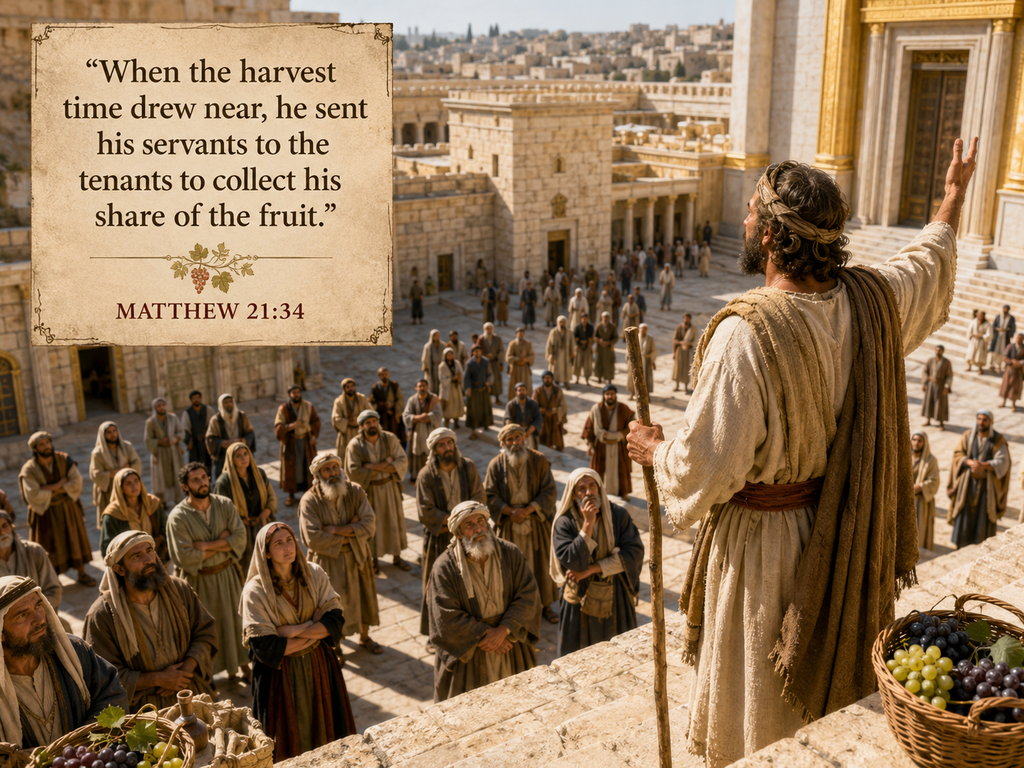
Now when vintage-time drew near, he sent his servants to the vinedressers, that they might receive its fruit. Matthew 21:34
Note: You can listen to today’s commentary courtesy of our friends at the “Bible in Ten” podcast. (Click Here to listen)
You can also read this commentary, scrolling with music, courtesy of our friends at “Discern the Bible” on YouTube. (Click Here to listen), or at Rumble (Click Here to listen).
“When also it neared, the ‘juncture, the fruits’, he sent the ‘servants, his’ to the agronomists to receive the ‘fruits, his’.” (CG)
In the previous verse, Jesus began another parable about a landowner planting a vineyard, getting it ready, leasing it out, and going to a far country. He continues that, saying, “When also it neared, the ‘juncture, the fruits’.”
This is the particular time when the fruits are ready to be harvested. It is at this time that the housemaster would expect a suitable recompense for the land and expenses he had put into the land to make a vineyard productive.
As a harvest season comes once a year, there is no reason to assume that this is a single point Jesus is referring to. The kairos, the opportune season for fruit, is a recurring event throughout the span of time concerning what Jesus is referring to. The rest of the parable will bear this out. As for the parable, Jesus continues, saying, “he sent the ‘servants, his’ to the agronomists.”
Here is a new word, geórgos. It is derived from gé, soil (and by implication, a region, land, etc.), and ergon, work, deed, labor, etc. A word that exactingly matches this would be agronomist.
These are the people working the land as agreed to by the housemaster. The appropriate juncture in time for the fruits to be harvested has come. This means that he should receive a share of the earnings from the vineyard, as Jesus next says, “to receive the ‘fruits, his’.”
As the housemaster is in a far land, the reception of the fruits will have to come by a proxy. This would be the servants appointed for the task noted earlier. They are being sent to the vineyard on his behalf.
Life application: As we continue through the parable, think about what you already know concerning what is being stated in the metaphor. A vineyard represents the economy (a cultural expression) where God is dealing with man in order to bring about a result.
Jesus is speaking to the leaders of Israel. So, consider what He says to them as the parable continues. The parable is not a complicated one. What it conveys should be readily understood, but you may come up with some interesting questions or insights.
This is what we are to do when we read the Bible. File away known metaphors, look for other metaphors of which you are unaware of their meaning, and try to deduce what is being conveyed. And then form pictures of what may be going on in relation to the rest of Scripture.
It is true that anyone can come to erroneous conclusions about what is going on in a story. So be careful not to be dogmatic about things unless you are certain that your conclusions are defensible.
But for thousands of years, people have been reading the word and forming conclusions about what it is conveying. Many have proven correct over time, and yet there is still much more that can be elicited from its pages. So be diligent in thinking through what you are reading.
God is giving us information. The more we study the word, the more precise our understanding of that information will be.
Lord God, Your word is a treasure. It is filled with wonderful stories that can instruct us on many levels and in differing ways as we progress through our lives. So, Lord, help us to stick with reading it and considering it all the days we walk in Your presence. Amen.