
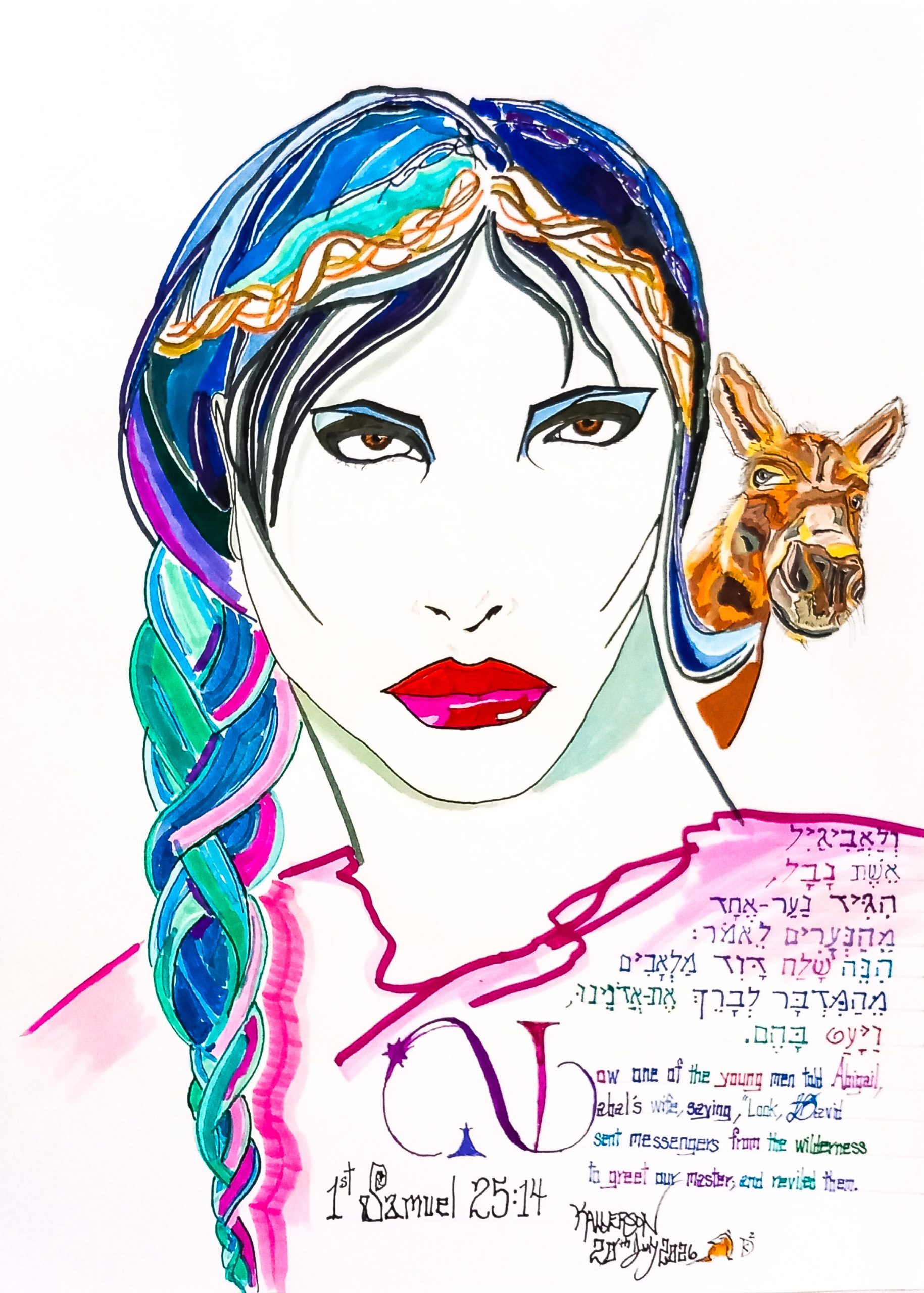
Beautiful Abigail, by Douglas Kallerson
1 Samuel 25:14-31
Abigail, Part II
(Typed 23 May 2026) Although the Bible is generally a male-centered book, there are several women who are especially highlighted. Some of them are exceptionally wicked, like Jezebel.
Others are noted for a particular position that they possess, such as Deborah. And then, there is also the catchall chapter which highlights any woman who is exemplary in her life’s conduct, Proverbs 31.
The feminine aspect of humanity is used when referring to wisdom in the book of Proverbs. Among the women of the Old Testament, there is one who is particularly noteworthy in many ways, Abigail.
She was obviously a patient woman living with a doltish husband like Nabal. She learned that his judgments could not be trusted and so she watched over her house and ensured things were working properly.
This is understood by her interaction with one of the lads in the house in today’s passage. She was a woman of wisdom in handling troubling situations. She was a woman of marvelous insights into the direction Israel was taking and who would be the one to lead it on that path.
Studying her words in these verses is a truly rewarding experience.
Text Verse: “The wise woman builds her house,
But the foolish pulls it down with her hands.” Proverbs 14:1
Abigail was wise. So much was this the case that she participated in managing her house with Nabal, and she will be a participant in building David’s house in the future.
This chapter is all the Bible details concerning Abigail outside of a few one-line references to her in relation to David. Pay attention if you want to know all that there is to know about her.
She died and returned to the dust thousands of years ago, but her memory and the impact she had on David is carefully recorded in the pages of Scripture. In fact, much of an entire chapter is devoted to her and her interactions with him.
That is saying something when many important people in Israel’s history are never mentioned at all. Enjoy the information today. It is a marvelous part of God’s superior word. And so, let us turn to that precious word once again, and… May God speak to us through His word today, and may His glorious name ever be praised.
I. Riding Upon the Jack (verses 14-22)
14 Now one of the young men told Abigail, Nabal’s wife, saying,
velaavigayil eshet naval higid naar ekhad mehanearim lemor – “And to Abigail, ‘wife, Nabal’, he caused to declare, ‘lad, one’ from the lads, to say.” Although mentioned as the wife of Nabal in verse 3, Abigail is first addressed at this point. As noted, her name is spelled several ways in this chapter. In this verse, it is spelled with two yod (our i or y).
Her name is derived from av, father, and giyl, joy or exultation. That is derived from gil, to spin around, which gives the sense of rejoicing. The i after av may be possessive (my). Thus, her name means Father of Exultation, Father Is Joyful, My Father Is Joy, Father of Joy, etc.
Nabal is derived from the adjective nabal, stupid or wicked. Most translations translate it as fool. His name is usually translated as Fool or Foolish. Strong gives the magnificent rendering of Dolt.
This lad has important information to transmit to Nabal’s wife…
14 (con’t) “Look, David sent messengers from the wilderness to greet our master;
hineh shalakh David malakhim meha’midbar lebarekh eth adonenu – “Behold, he sent, David, messengers from the wilderness to bless our lords.” This is what happened in verse 6, where David sent greetings “To the living! And you, peace, and your house, peace, and all which to you, peace.” The term adonenu, lords, it is a plural of rank referring to a single person.
The wilderness is a place of God’s grace and of closeness to Him, but it is also a place of testing. For some, such as Israel, the testing results in disobedience. For others, such as Christ when He was tested, it is a place of fellowship through obedience.
The wilderness and the law are closely connected because testing is accomplished through law. This is seen in the word itself, midbar. It is derived from the verb davar, to speak, and the noun davar, meaning word. The Lord spoke the Ten Commandments (words/devarim) in the desert (midbar) of Sinai.
As for the words being conveyed to Abigail, so far so good, but then…
14 (con’t) and he reviled them.
vayaat bahem – “And he swooped in them.” This is the second and last use of the word iyt in Scripture. It means two swoop down on, as a raptor might do to a mouse. It was first used in 1 Samuel 15:19, when Saul and his men swooped down upon the spoil of the Amalekites.
Nabal is being equated to a bird of prey, an unclean bird, that swoops down on its spoil. Such a bird fixes its eyes on the goal before it to the exclusion of all else. Nabal fixed his eyes on David’s men, as if they came to ravage and plunder his own possessions. And so, he greedily closed his ears to the petition from David.
Despite the facts presented to Nabal, which the servant now tells Abigail…
15 But the men were very good to us,
veha’anashim tovim lanu meod – “And the mortals, good to us, very.” Whether he is repeating the words of David and/or fellow servants, or whether he was one of the lads who was personally in the wilderness when David was there, isn’t completely certain.
However, he seems to indicate he was personally hedged in and kept safe by David. This confirms David’s words of verse 8, “You must ask your lads, and they will cause to declare to you.” Nabal’s servants were fully aware of the helpful treatment they received from David and his men…
15 (con’t) and we were not hurt,
Rather: velo hakhelamnu – “And not we were caused to be humiliated.” The word kalam means to wound, but it is only used figuratively to indicate a type of emotional hurt, such as shame, insult, humiliation, etc. The meaning then is that there was no forceful removal of animals, taunting, bullying, or anything else that people in the wilderness might otherwise receive from rugged warrior types who were fugitives from the king.
15 (con’t) nor did we miss anything as long as we accompanied them, when we were in the fields.
velo phaqadnu meumah kal yeme hithalakhnu itam bihyothenu basadeh – “and not we visited speck all days we walked ourselves with them in our ‘being in the field’.” To visit a speck means to miss anything, even the smallest possession. David’s men didn’t take a single lamb for themselves, and they didn’t allow anyone else to harm them either.
Instead, the servants ambled around with their flocks without a care of being robbed or molested. As for the “field,” he is equating the wilderness as a single field. However, in the Bible, the field is typologically representative of the world at large. The servant continues with his accolades concerning David…
16 They were a wall to us both by night and day, all the time we were with them keeping the sheep.
khomah hayu alenu gam laylah gam yomam kal yeme heyothenu imam roim ha’tson – “Rampart, they were, upon us. Also, night, also, daily, all days we were with them pasturing the flock.” The khomah is a wall, but the idea is not like a wall around a house intended to hold up a roof. Rather, it is generally one of protection, like a fortress battlement. For example, its first use in Scripture was at the exodus from Egypt. There it said –
“So the children of Israel went into the midst of the sea on the dry ground, and the waters were a wall [khomah] to them on their right hand and on their left.” Exodus 14:22
This special protection provided by David was like a 24/7 security team. The area may be raided by Philistines from the west or others such as Arabs or Amalekites from the south and east.
Understanding David’s capabilities and his care for Nabal’s property, the servant knows David’s attitude could completely turn based on Nabal’s attitude…
17 Now therefore, know and consider what you will do,
The lad speaks in imperatives, showing a sense of urgency: veatah dei urei mah taasi – “And now, you must know and you must see what you will do.” A situation has arisen that must be tended to. Nabal won’t tend to it, so Abigail has to consider and act on her own…
17 (con’t) for harm is determined against our master and against all his household.”
ki khalethah ha’raah el adonenu veal kal beitho – “For it finished, the evilness, unto our lords, and upon all his house.” To “finish” the evilness means to heap up evil until there is no more room for more. The word kalah, finish, was first used in Genesis 2:1 when the heavens and the earth and all the host of them were finished. The servant understands that only bad can come of this situation. However…
17 (con’t) For he is such a scoundrel that one cannot speak to him.”
vehu ben beliyaal midaber elav – “And he, ‘son, worthlessness’ from speaking unto him.” The NKJV gives the right sense. No matter what is said to Nabal, it will be pointless appealing to reason.
The term ben beliyaal, son worthlessness, is the same term used of the perverted people in Judges 19 who wanted to rape the visitor in Gibeah. They wouldn’t listen to reason, and the visitor’s life was only saved when his concubine was thrown out to them to abuse.
Such people are like rabid animals that refuse to see reason because of the utterly depraved state of their minds. As a side note, some Jewish commentators say the “son, worthlessness” is referring to David, not Nabal, meaning that he would be the son of worthlessness when he heard the news.
That is not likely. It is a poor analysis of the intent. The nearest antecedent is “our lords” followed by “all his house.” Before that, the servant spoke of David’s men in the plural half a dozen times…
18 Then Abigail made haste and took two hundred loaves of bread,
vatemaher avogayil vatiqakh matayim lekhem – “And she hurried, Avogail [k.], and she took two hundred bread.” The written Hebrew spells Abigail differently than at other times, replacing the yod (i or y) with a vav (v).
אֲבִיגַיִל – Abigail
אֲבוֹגַיִל – Abogail
The reason scribes give is that it is a defective form of the word. The name Abigail is given nine times in this chapter, and yet, this is the only instance with this variant spelling. However, it is also spelled in various ways throughout the chapter. These changes are purposeful.
As for the two hundred loaves of bread, the number two hundred in Scripture signifies insufficiency. Bread, lekhem, signifies dependence on God, sustenance, and life itself. Next…
18 (con’t) two skins of wine, five sheep already dressed,
u-shenayim nivleh yayin vekhamesh tson asaoth – “and two ‘botas, wine’, and five sheep, made [k.].” The written form of the word “made” has two vavs. The oral changes it to one vav and one yod.
The reason given is that it is “likely preserving an archaic or dialectal spelling that reflects the original root” (AI analysis from web search). That makes no sense when considering that the same yod to vav change was made in Abigail’s name like… two seconds ago.
A bota is a Spanish word for a skin of wine. This is necessary to avoid being confused with other words that also describe wineskins.
Two is the number of division or difference. When two things are stated, they normally present a contrast which forms a whole, such as day and night forming the duration of a day.
Wine, yayin, symbolizes the merging together of cultural expressions into a result. The thing that ought to happen can happen, symbolized by wine. It is as if an act of reasoning occurs, and an intended result is realized.
Five is the number of grace. The tson, flock or sheep, is from a root signifying to migrate. Next…
18 (con’t) five seahs of roasted grain, one hundred clusters of raisins,
vekhamesh seim qali u-meah tsimuqim “and five seahs roasted, and hundred raisin-cakes.” The word seah is from a root meaning to define. Thus, it is a certain known measure. The word roasted is qali, that which has shrunk from heat. The root word gives the idea of that which is degraded, inferior, lightly esteemed, etc.
One hundred is a product of tens, the number signifying the completion of a whole cycle where nothing is wanting.
The tsimuqim, raisin-cakes are a new word in Scripture, coming from tsamaq, to dry up. Next…
18 (con’t) and two hundred cakes of figs, and loaded them on donkeys.
u-matayim develim vatasem al ha’khamorim – “and two hundred fig-cakes, and she put on the jacks.” Another new word is seen here, develah, a fig-cake. It is derived from an unused root probably meaning “to press together.”
Abigail takes all the prepared goodies and loads them onto a khamor, a male donkey. The word signifies red, which refers to the redness of the animal. With everything loaded up…
19 And she said to her servants, “Go on before me; see, I am coming after you.”
vatomer linareha ivru lephanay hini akharekhem baah – “And she said to her lads, ‘You must traverse to my faces. Behold me, after you, coming.’” She doesn’t want any delay in getting the things on the road. If David is riled up about the conduct of Nabal, she knew he would already be heading for a showdown. Therefore, the lads were dispatched with alacrity, and she notes she would catch up in due time.
19 (con’t) But she did not tell her husband Nabal.
u-leishah naval lo higidah – “And to her husband Nabal, not she caused to declare.” Smart move on her part. Nabal was an unreasonable man. To tell him in advance would have only brought destruction down on them all as he needlessly quibbled with her about her poor decision-making skills. And so, off she goes…
20 So it was, as she rode on the donkey, that she went down under cover of the hill;
vehayah hi rokhveth al ha’khamor veyoredeth beseter ha’har – “And it will be, she, ‘riding upon the jack’. And she, descending in ‘secret, the mountain’.” Abigail fetched her own donkey and headed out. At this point, it says she is descending. The secret of the mountain is probably a chasm or hollow that made it possible to descend, but which obscured her from view, hence the term “secret.”
20 (con’t) and there were David and his men, coming down toward her, and she met them.
vehineh David vaanashav yoredim liqrathah vatiphgosh otham – “And behold! David and his mortals descending to encounter her, and she met them.” David and his men are also descending. Therefore, it may be another path down the same mountain heading in the opposite direction, or a path from another mountain.
Either way, they met up at the bottom between the two trails. As David was going, he was also fuming…
21 Now David had said, “Surely in vain I have protected all that this fellow has in the wilderness,
Rather: vedavid amar akh lasheqer shamareti eth kal asher lazeh bamidbar – (“And David, he said, ‘Surely to the untruth I guarded all which to this in the wilderness.” Verses 21 and 22 are a parenthetical thought, peering into David’s mind, or repeating words David said to his men. The intent of the NKJV may be somewhat correct, but the word untruth is a noun rather than an adverbial phrase, in vain.
It is as if David was living in a state of self-deception, assuming he was doing good to an ally. Instead, he was helping out a doltish fool. He was meticulous about the care of Nabal’s servants…
21 (con’t) so that nothing was missed of all that belongs to him.
velo niphqad mikal asher lo meumah – “And not it was visited, from all which to him, speck.” This is just what the lad said to Abigail in verse 15. David knew it and Nabal’s men knew it. He was informed that such care had been given to his men and flocks, but he couldn’t have cared less. And more…
21 (con’t) And he has repaid me evil for good.
vayashev li raah takhath tovah – “And he caused to return to me evilness under goodness.’” The idea of “under” in this case is akin to subversion. David had performed goodness to Nabal, but Nabal came under his foundation of blessing and toppled it over with his evilness. Therefore…
22 May God do so, and more also, to the enemies of David,
koh yaaseh elohim leoyeve David vekhoh yoseph – “Thus He will do, God, to ‘hatings, David,’ and thus, He will cause to add.” This is a proverbial expression first seen in Ruth 1:17. It is the fourth time it is seen in 1 Samuel.
It is used to form an absolute assertion or a firm adjuration. Associated with it comes an implied threat upon the speaker or the one being spoken to or about, sometimes for noncompliance and sometimes as a matter of fact. In this case, it is the “hatings, David,” meaning his enemies.
David is saying that if he fails to act upon them, then let God take vengeance on them. One way or another, David’s intent is that the matter will be seen through to its completion.
22 (con’t) if I leave one male of all who belong to him by morning light.”
The Hebrew is way more descriptive and carries the authenticity of soldier-speak: im ashir mikal asher lo ad ha’boqer mastin beqir – “if I will cause to leave from all who to him until the morning ‘whizzing, in wall.’”) There are a lot of ways the thought is translated. Ye olde KJV says pisseth, while Smith’s says pissing. Those are a bit crude. Some say urinate… too technical. Coverdale says maketh water… too boring.
Many translations avoid the imagery and give the intent behind the expression. Some try to hide the meaning completely. The word is new to Scripture, shathan, to urinate, but I masterfully formed a magnificently marvelous and memorable alliteration which is non-offensive, catchy, and wonderfully maintains the word-for-word original thought exactingly – “whizzing, in wall.”
This is what men have done since creation. It obviously excludes women. The meaning is that not a single male should be left alive in the household of Nabal as repayment for his conduct. This includes hired hands and all male children too, thus terminating his family line.
In the Bible, the qir, wall, figuratively means “revelation of character.” Thus, two things can be gleaned from this. The first is the fact that they are males. The second is that they are as dead men because of David’s anger. With the parenthesis ended…
Nabal is worthlessness, not worth the bother
Don’t waste your time on that doltish man
Of the company of fools, he is the father
So, turn away from your unwise plan
In me, me place the blame
I wasn’t attentive to my house
Nabal: a dolt yesterday, and today he is the same
It is my fault for not watching over that louse
You will be the commander upon Israel
You don’t need his doltish blood on your mind
Turn from your anger, let it quell
Let him be forgotten, put your memory of him behind
II. According to All Which He Spoke (verses 23-31)
23 Now when Abigail saw David, she dismounted quickly from the donkey, fell on her face before David, and bowed down to the ground.
The words are quick and succinct, rapidly stating one thought after another: vatere avigayil eth David vatemaher vatered meal ha’khamor vatipol leape David al paneha vatishtahu arets – “And she saw, Abigail, David. And she hurried, and she descended from upon the jack. And she fell to ‘nostrils, David’, upon her faces. And she prostrated herself – earth.” Abigail is spelled with two yod (equivalent to the English i or y) in this verse.
The phrase “to ‘nostrils, David’” is unique. All translations, missing the intent, say “before” or “in front of.” That is true, but that thought is usually expressed as “to faces, XX.” At other times, it will note that the person who is prostrating is “nostrils earthward” or something similar.
This is a reference to David’s raging anger. Quite often, in the Bible the term “nostril” refers to just that –
vayikhar aph shaul bihonathan – “And it burned, nostril Saul, in Jehonathan.” 1 Samuel 20:30 (CG)
There was no need to say his nostrils were burning because the parenthetical clause explained the matter. Abigail would have been terrified. David has four hundred men with him, all bearing swords.
Hence, the abrupt phrase, “And she prostrated herself – earth.” She wasn’t prostrated “earth-ward.” Rather, she became one with the earth. She didn’t know if she would meet one of those swords herself within moments…
24 So she fell at his feet
vatipol al raglav – “And she fell upon his feet.” Again, all translations are wrong. It doesn’t say l’raglav “to (at) his feet,” as in Exodus 4:25. She is already down. So, saying that she fell at his feet is a redundancy.
She was on the ground already. She then reached out and pulled herself over his feet, falling al, upon them the way a child might when she is in complete distress over her favorite grandfather saying he had to go home 🤣.
The emotion is utter distress and a plea for mercy. Abigail begins speaking, and she will continue without interruption until the end of verse 31…
24 (con’t) and said: “On me, my lord, on me let this iniquity be!
vatomer bi ani adoni he’avon – “And she said, ‘In me, me, my lord, the perversity.’” Rather than what the NKJV conveys, this means, “It’s my fault!” She, as the mother of the house, takes full responsibility for her husband’s faults, feeling she should have been more attentive to things.
24 (con’t) And please let your maidservant speak in your ears, and hear the words of your maidservant.
u-tedaber na amatekha beazenekha ushema eth divre amatekha – “And she will speak, pray, your handmaid, in your ears, and you must hear ‘words, your handmaid’.” Abigail has an earful for David to hear before he makes a decision. There she is grasping his feet and crying out to him. If he kicks her away, a sword will be forthcoming. And so, she continues…
25 Please, let not my lord regard this scoundrel Nabal.
al na yasim adoni eth libo el ish ha’beliyaal hazeh al naval – “Not, pray, he will put, my lord, his heart unto ‘man, the worthlessness’, the this, upon Nabal.” She first petitions that David will let the error of Nabal go, turning his heart away from destroying him. And there is a good, valid reason for this…
25 (con’t) For as his name is, so is he: Nabal is his name, and folly is with him!
ki khishmo ken hu naval shemo u-nevalah imo – “For according to his name, thus he. Nabal his name, and foolishness with him.” Abigail admits that Nabal is just as he is named, repeating and intensifying the thought as she speaks. Nabal is fool and he is a man of foolishness. He is a dolt and a man doing dumb.
His actions aren’t out of malice or spite. Rather, they are driven by the fact that he is a dullard. So why should he be killed? It would be a pointless act. And more…
25 (con’t) But I, your maidservant, did not see the young men of my lord whom you sent.
vaani amatekha lo raiti eth naare adoni asher shalakheta – “And I, your handmaid, not I saw ‘lads, my lord’, whom you sent.” She conveys that it is her fault because she wasn’t attentive to the workings of the house. The meaning is that she has come to make restitution for her oversight…
26 Now therefore, my lord, as the Lord lives and as your soul lives, since the Lord has held you back from coming to bloodshed and from avenging yourself with your own hand, now then,
veatah adoni khai Yehovah vekhe napshekha asher menaakha Yehovah mibo vedamim vehoshea yadekha lakh – “And now, my lord, alive Yehovah, and alive your soul, which He debarred you, Yehovah, from coming in bloods, and causing to avenge, your hand, to you.” Abigail notes that her presence has brought about the divine will of Yehovah by stopping David from doing something that would have been true lawlessness.
There is no excuse for shedding blood in this manner. Nabal might be a dolt, but the law does not allow people to go around killing dolts. He had not declared war on David. As such, his actions were not justification for murder. Rather…
26 (con’t) let your enemies and those who seek harm for my lord be as Nabal.
This isn’t a petition, but a statement of fact: veatah yihyu khenaval oyevekha vehambaqshim el adoni raah – “And now, they will be according to Nabal, your hatings, and the ‘seeking unto my lord evilness’.” The meaning is seen when compared to what she previously said about Nabal –
“Nabal his name, and foolishness with him.”
“And now, they will be according to Nabal, your hatings.”
All of David’s enemies, and those who seek evilness toward him, will be rendered as foolish as Nabal. This would not come to pass if he carried out his plans to destroy Nabal and his house. But because Yehovah has used her to intervene, it is an assured prophecy. With that, the offering of peace and restitution for his grief is made…
27 And now this present which your maidservant has brought to my lord,
Rather: veatah ha’berakha ha’zoth asher hevi shiphkhatekha ladoni – “And now the benediction, the this, which he caused to bring, your maidservant, to my lord.” Not a single translation gets what is going on. The verb is causative and masculine. It cannot be “which your maidservant has brought.” Some translations punt and say, “your servant.”
The meaning is that either Nabal, Yehovah, or David caused Abigail to bring the benediction. David is the nearest antecedent and would logically be on Abigail’s mind –
“And now, they will be according to Nabal, your hatings, and the ‘seeking unto my lord evilness. 27And now the benediction, the this, which he caused to bring, your maidservant, to my lord.”
As for the benediction…
27 (con’t) let it be given to the young men who follow my lord.
venitenah lanearim hamithalekhim beragle adoni – “And it will be given to the youths, the ‘walking themselves in feet my lord.’” She has prepared a benediction to allay David’s wrath, but it is for those who follow David so faithfully. They would have had abundant plunder from Nabal’s possessions, but this is a peace offering to lessen the letdown. As such…
28 Please forgive the trespass of your maidservant.
sa na lephesha amatekha – “You must lift, pray, to ‘revolt, your handmaid’.” Abigail again takes responsibility for what transpired. In essence, “I failed at my responsibilities and caused all this trouble by not tending to my house. I understand it was a revolt in your eyes, but please lift this incident from my record.”
28 (con’t) For the Lord will certainly make for my lord an enduring house,
ki asoh yaaseh Yehovah laadoni bayith neeman – “For doing, He will do, Yehovah, to my lord ‘house, being established’.” Apparently, it was common knowledge by this time that David would ascend to the throne. Any in Israel who knew the ancient prophecies would know that the kingly line would transfer to Judah.
Understanding that, along with knowing the recent events between Saul and David, it seemed clear that David would become the established king. This is what Abigail is conveying, and it will be explicitly stated in verse 30.
28 (con’t) because my lord fights the battles of the Lord, and evil is not found in you throughout your days.
ki milkhamoth Yehovah adoni nilkham veraah lo timatse vekha meyamekha – “For ‘battles, Yehovah’, my lord, being fought. And evilness not it will be found in you from your days.” Abigail ties in David’s status as a noted warrior of the Lord with the fact that her intercession has allowed him to stay that way. He would otherwise have a permanent stain on his record.
29 Yet a man has risen to pursue you and seek your life,
vayaqam adam lirdaphekha u-levaqesh eth naphshekha – “And he arose, human, to pursue you and to seek your soul.” It’s hard to figure how so many scholars ignore the obvious meaning. This is referring to Saul, not David’s enemies in general. The aspect of the first verb is perfect. A man arose to pursue and kill David. He has failed thus far, and he will continue to fail because…
29 (con’t) but the life of my lord shall be bound in the bundle of the living with the Lord your God;
vehayethah nephesh adoni tserurah bitsror ha’khayim eth Yehovah elohekha – “And it will be, ‘soul, my lord’, cramped in ‘parcel, the livings’ with Yehovah your God.” David is carefully packaged away in the Lord’s parcel of living people, as if He is carrying it around and watching over those inside of it.
David could not reign over Israel if he were discovered and killed by Saul, but his reigning is exactly what is going to happen. As such, Saul will not prevail in his pursuit of David. And more…
29 (con’t) and the lives of your enemies He shall sling out, as from the pocket of a sling.
veeth nephesh oyevekha yeqaleenah betokh kaph ha’qala – “And ‘soul, your hatings’, He will sling it in ‘midst, palm, the sling’.” This speaks of any enemy. Whoever else comes against David will be as if the Lord placed him in the “palm” of His sling and slung him far away.
The palm signifies possession. The meaning is that the Lord possesses David’s enemies, and He will dispose of them accordingly. They have no ability to harm him. These things are certain…
30 And it shall come to pass, when the Lord has done for my lord according to all the good that He has spoken concerning you, and has appointed you ruler over Israel,
vehayah ki yaaseh Yehovah ladoni kekhol asher diber eth ha’tovah alekha vetsivekha lenagid al Yisrael – “And it will be, for He will do, Yehovah, to my lord according to all which He spoke, the goodness, upon you, and He will enjoin you to commander upon Israel.” This shows that the word about David being king had become well known.
The word nagid, commander, was introduced in 1 Samuel 9:16 when Samuel was told by the Lord that he was to anoint a particular man as nagid over His people. That was confirmed in 1 Samuel 10:1. However, the word was used one more time before Abigail’s speech –
“And now – your kingdom, not it will rise. He sought, Yehovah, to Him man according to His heart, and He enjoined him, Yehovah, to commander [nagid] upon His people, for not you guarded which He enjoined you, Yehovah.” 1 Samuel 13:14 (CG)
Abigail is certain of David’s accession to the throne. The matter was known in Israel and Saul already knows it as well as seen in 1 Samuel 24. It wasn’t a matter of if, but when. Because of this, Abigail continues…
31 that this will be no grief to you, nor offense of heart to my lord, either that you have shed blood without cause, or that my lord has avenged himself.
velo tihyeh zoth lekha lephuqah u-lemikshol lev ladoni velishpakh dam khinam u-lehoshia adoni lo – “And not it will be, this, to you to unsteadiness, and to ‘stumbling-block, heart’ to my lord: and to pouring blood gratuitously, and to causing to save, my lord, to him.” The wording seems almost incomprehensible, but what is being conveyed is rightly expressed with the colon.
The “this” is referring to the last two clauses where “and” is given as an emphatic conjunction. To paraphrase for clarity –
“And this matter will not be to you to a reason for unsteadiness, and as a stumbling-block in the heart of my lord: even (and) to unnecessary shedding of blood, even (and) to ‘save’ himself.”
A unique word is seen, puqah, unsteadiness. It is from puq which signifies to waver, as when a false idol wavers as it is carried on a pedestal. As such, unsteadiness is the idea. Abigail’s words are extremely precise, and each one has been carefully stated.
As she finishes, she adds in a note of confidence that she is certain that what she said will happen. At the same time, it is also a continued plea for leniency in the matter of Nabal’s transgression…
*31 (fin) But when the Lord has dealt well with my lord, then remember your maidservant.”
vehetiv Yehovah ladoni vezarkhata eth amatekha – “And He will cause to wellify, Yehovah, to my lord, and you will remember your handmaid.” We do this all the time by confidently stating a matter as a product of something still in its infancy, such as, “Once you’ve made your first million, be sure to buy me lunch.”
Such a statement is both an acknowledgment of what is sure to come about as well as a confident hope that the speaker won’t be forgotten when it does. “For sure, you will be rich and famous, but don’t forget about me.”
Her words are intended to butter David up and keep him from taking out his anger on her or those in her home as much as it is a pat on the back for his future.
We will finish here for today. The contents have been exciting and filled with detail, but the words of Abigail have been a real highlight. They have been filled with humility and wisdom.
How blessed we will be if, like David, we come across someone when we are about make a ridiculous mistake. It is something we can pray for: “Lord, keep me from myself and my foolish tendencies. Send me someone wise when I am about to make the wrong turn. And Lord, give me the wisdom and humility to take the advice when it comes.”
At all times, we should ask the Lord to guide our steps and keep us on the straight and narrow path. As this is what He wants for us, we can be sure He will provide according to our requests. We just need to be aware of His provision when it comes.
If there is anyone who has not yet called on Jesus, God is giving you a hint of His provision right now. For whatever reason, you are engaging in a biblical sermon. He is giving you the opportunity to be wise and respond accordingly. So let me explain to you how you can be saved by this wonderful Lord…
Closing Verse: “The way of a fool is right in his own eyes,
But he who heeds counsel is wise.” Proverbs 12:15
Next Week: 1 Samuel 25:32-44 Nabal: deader than a doornail, just wait and see… (Abigail, Part III) (55th 1 Samuel Sermon)
The Lord has you exactly where He wants you. He has a good plan and purpose for you. He is the One who abases the haughty and exalts the humble. He regards the lowly, and the proud, He knows from afar. So yield yourself to Him, trust Him, and believe His word. In this, He will do great things for you and through you.
1 Samuel 25:14-31 (CG)
14And to Abigail*, ‘wife, Nabal’, he caused to declare, ‘lad, one’ from the lads, to say, “Behold, he sent, David, messengers from the wilderness to bless our lords*. And he swooped in them. 15And the mortals, good to us, vehemently. And not we were caused to be humiliated, and not we visited, speck, all days we walked ourselves with them in our ‘being in the field’. 16Rampart, they were, upon us. Also, night, also, daily, all days we were with them pasturing the flock. 17And now, you must know, and you must see what you will do. For it finished, the evilness, unto our lords*, and upon all his house. And he, ‘son, worthlessness’ from speaking unto him.”
18And she hurried, Abogail* [k.], and she took two hundred bread, and two ‘botas, wine’, and five sheep, made* [k.], and five seahs, roasted, and hundred raisin-cakes, and two hundred fig-cakes, and she put on the jacks. 19And she said to her lads, “You must traverse to my faces. Behold me, after you, coming.” And to her husband Nabal, not she caused to declare.
20And it will be, she, ‘riding upon the jack’. And she, descending in ‘secret, the mountain’. And behold! David and his mortals descending to encounter her, and she intermet them. (21And David, he said, “Surely to the untruth I guarded all which to this in the wilderness. And not it was visited, from all which to him, speck. And he caused to return to me evilness under goodness. 22Thus He will do, God, to ‘hatings, David’, and thus, He will cause to add, if I will cause to leave from all who to him until the morning ‘whizzing, in wall’.”)
23And she saw, Abigail*, David. And she hurried, and she descended from upon the jack. And she fell to ‘nostrils*, David’, upon her faces. And she prostrated herself – earth. 24And she fell upon his feet. And she said, “In me, me, my lord, the perversity. And she will speak, pray, your handmaid, in your ears, and you must hear ‘words, your handmaid’. 25Not, pray, he will put, my lord, his heart unto ‘man, the worthlessness’, the this, upon Nabal. For according to his name, thus he. Nabal his name, and foolishness with him. And I, your handmaid, not I saw ‘lads, my lord’, whom you sent. 26And now, my lord, alive Yehovah, and alive your soul, which He debarred you, Yehovah, from coming in bloods, and causing to avenge, your hand, to you. And now, they will be according to Nabal, your hatings, and the ‘seeking unto my lord evilness’. 27And now the benediction, the this, which he* caused to bring, your maidservant, to my lord. And it will be given to the lads, the ‘walking themselves in feet my lord’. 28You must lift, pray, to ‘revolt, your handmaid’. For doing, He will do, Yehovah, to my lord ‘house, being established’. For ‘battles, Yehovah’, my lord, being fought. And evilness not it will be found in you from your days. 29And he arose, human, to pursue you and to seek your soul. And it will be, ‘soul, my lord’, cramped in ‘parcel, the livings’ with Yehovah your God. And ‘soul, your hatings’, He will sling it in ‘midst, palm, the sling’. 30And it will be, for He will do, Yehovah, to my lord according to all which He spoke, the goodness, upon you, and He will enjoin you to commander upon Israel. 31And not it will be, this, to you to unsteadiness, and to ‘stumbling-block, heart’ to my lord: and to pouring blood gratuitously, and to causing to save, my lord, to him. And He will cause to wellify, Yehovah, to my lord, and you will remember your handmaid.”
*Verse 14, 23, 36, 39, 40 & 42 – Abigail spell with two yod.
*Verse 14, 17 – Hebrew: adonenu, our lords, a plural of rank referring to a single superior.
Verse 18 – Qeri: Abigail.
*Verse 18 – Abogayil – spelled with a vav and a yod.
Verse 18 – Ketiv and qeri differ orthographically. Both mean “made.”
Hebrew passive participle from asah, to make or do.
*Verse 23 – Signifying his intense anger.
*Verse 27 – David is the nearest antecedent.
1 Samuel 25:14-31 (NKJV)
14 Now one of the young men told Abigail, Nabal’s wife, saying, “Look, David sent messengers from the wilderness to greet our master; and he reviled them. 15 But the men were very good to us, and we were not hurt, nor did we miss anything as long as we accompanied them, when we were in the fields. 16 They were a wall to us both by night and day, all the time we were with them keeping the sheep. 17 Now therefore, know and consider what you will do, for harm is determined against our master and against all his household. For he is such a scoundrel that one cannot speak to him.”
18 Then Abigail made haste and took two hundred loaves of bread, two skins of wine, five sheep already dressed, five seahs of roasted grain, one hundred clusters of raisins, and two hundred cakes of figs, and loaded them on donkeys. 19 And she said to her servants, “Go on before me; see, I am coming after you.” But she did not tell her husband Nabal.
20 So it was, as she rode on the donkey, that she went down under cover of the hill; and there were David and his men, coming down toward her, and she met them. 21 Now David had said, “Surely in vain I have protected all that this fellow has in the wilderness, so that nothing was missed of all that belongs to him. And he has repaid me evil for good. 22 May God do so, and more also, to the enemies of David, if I leave one male of all who belong to him by morning light.”
23 Now when Abigail saw David, she dismounted quickly from the donkey, fell on her face before David, and bowed down to the ground. 24 So she fell at his feet and said: “On me, my lord, on me let this iniquity be! And please let your maidservant speak in your ears, and hear the words of your maidservant. 25 Please, let not my lord regard this scoundrel Nabal. For as his name is, so is he: Nabal is his name, and folly is with him! But I, your maidservant, did not see the young men of my lord whom you sent. 26 Now therefore, my lord, as the Lord lives and as your soul lives, since the Lord has held you back from coming to bloodshed and from avenging yourself with your own hand, now then, let your enemies and those who seek harm for my lord be as Nabal. 27 And now this present which your maidservant has brought to my lord, let it be given to the young men who follow my lord. 28 Please forgive the trespass of your maidservant. For the Lord will certainly make for my lord an enduring house, because my lord fights the battles of the Lord, and evil is not found in you throughout your days. 29 Yet a man has risen to pursue you and seek your life, but the life of my lord shall be bound in the bundle of the living with the Lord your God; and the lives of your enemies He shall sling out, as from the pocket of a sling. 30 And it shall come to pass, when the Lord has done for my lord according to all the good that He has spoken concerning you, and has appointed you ruler over Israel, 31 that this will be no grief to you, nor offense of heart to my lord, either that you have shed blood without cause, or that my lord has avenged himself. But when the Lord has dealt well with my lord, then remember your maidservant.”