
Sunday, 19 July 2026
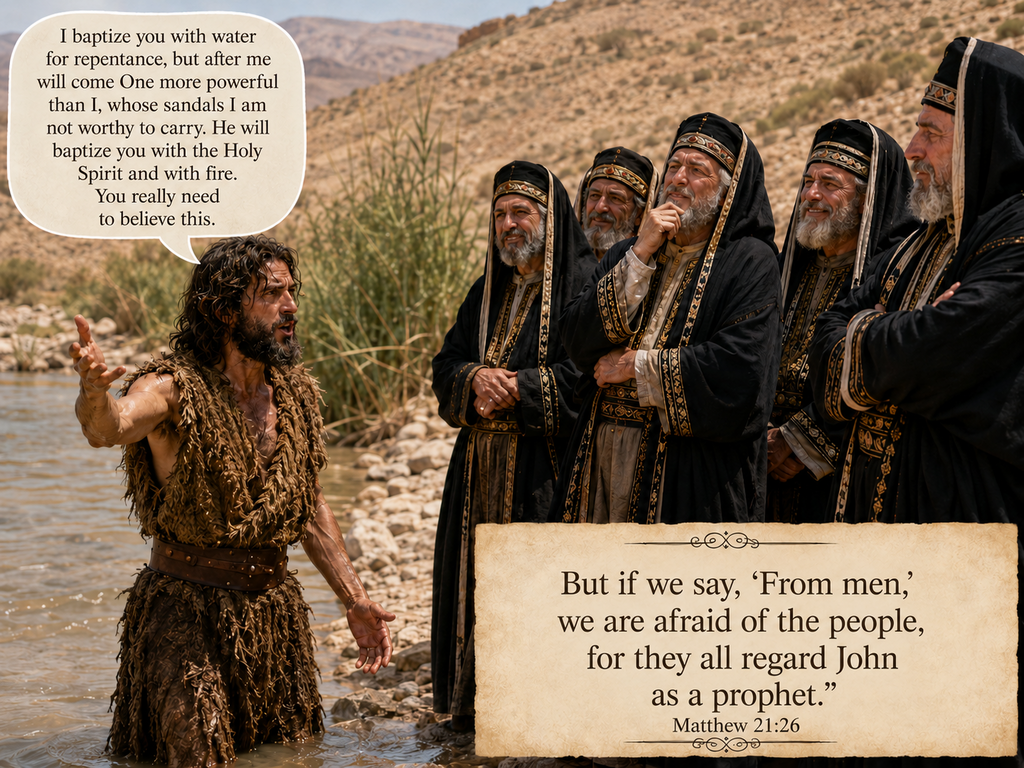
But if we say, ‘From men,’ we fear the multitude, for all count John as a prophet.” Matthew 21:26
Note: You can listen to today’s commentary courtesy of our friends at the “Bible in Ten” podcast. (Click Here to listen)
You can also read this commentary, scrolling with music, courtesy of our friends at “Discern the Bible” on YouTube. (Click Here to listen), or at Rumble (Click Here to listen).
“If, also, we should say, ‘From men,’ we fear the crowd, all, for, as a prophet, they have the ‘John’.” (CG)
In the previous verse, the leaders of Israel responded to Jesus’ question, saying that they didn’t want to admit John’s authority came from heaven because they knew Jesus would then ask why they didn’t believe him. They next say, “If, also, we should say, ‘From men.’”
Their next dilemma supposes that John’s authority is not at all from God, but that someone, including John himself, made up his calling out of his head. There is always that possibility. Israel’s recorded history is lined with false prophets. However, there is a problem with making such a claim. They say, “we fear the crowd, all, for, as a prophet, they have the ‘John’.”
The masses of the people accepted that John was a prophet. To openly and publicly deny his ministry was of God would cause a riot, and their very lives could be in jeopardy. This is stated explicitly in Luke 20:6, “But if we say, ‘From men,’ all the people will stone us, for they are persuaded that John was a prophet.”
Because of their fecklessness, they were unable to give Jesus a suitable answer to His question. But this was the condition upon which Jesus promised to respond to their request.
Life application: This same line of response can be used against those who try to use the Bible as a tool to shut Christians up or to make invalid arguments concerning a matter. For example, New York currently has a mayor who is opposed to anything godly or biblical. However, we can be certain that at some point, he will cite a verse from the Bible out of its intended context. Maybe he will say, “The Bible says to love one’s neighbor” to justify supporting homosexuality.
If he does this, a valid response to him would be, “Ok, we will argue from your premise, which is citing the Bible as an authoritative reason to justify homosexuality. Because you have done so, I need to ask, ‘Do you hold Scripture as authoritative?’”
He is now stuck in a conundrum. If he says no (which he would have to do being a Muslim), then the next obvious response to him would be, “Then why are you citing Scripture?” If he says yes, then you have the right to tell him that his verse was taken out of its intended context, and a thorough evaluation of the acceptability of homosexuality can be presented.
Either way, he has opened himself up to showing he has no right to cite Scripture in the manner he did. Remember this tactic. Jesus used it to silence those who challenged Him. We, too, have the right, the responsibility, and the duty to do likewise.
Lord God, help us to be quick enough in our thinking to accurately defend Your word from those who would misquote it, abuse its precepts, and attempt to silence Your people over issues that have no basis in biblical reality. May we responsibly handle Your word at all times. Amen.