
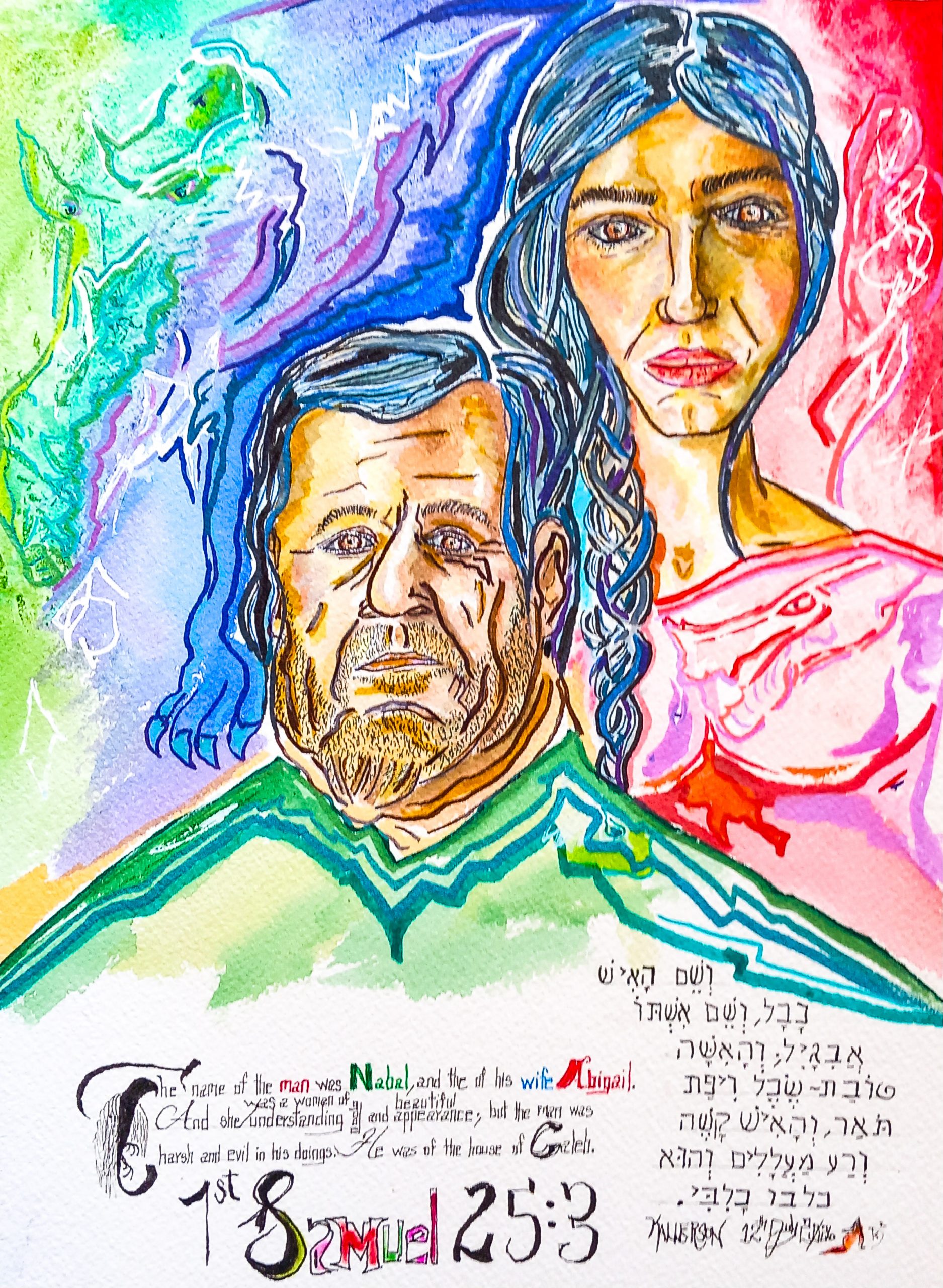
Artwork by Douglas Kallerson
1 Samuel 25:1-13
Abigail, Part I
(Typed 9 March 2026) 1 Samuel 25:1 is similar to several verses in the book of Judges. A single verse can hold so much importance and convey so much information that it is amazing to consider once the reason for it being included is seen.
And it’s not just the information in the verse itself, but its placement that carries its own special extra meaning. Despite having read this verse more times than I could count on my fingers and toes, along with many of yours, I never considered it more than words that give a bit of context, after which I continue reading the passage.
That’s sad. We have been with Samuel since 1 Samuel 1:20 when he was born. The sermon he was introduced in was typed on 14 April 2025, about 11 months before I typed this one. It was then preached on 6 July 2025.
Since then, we have followed his life as a faithful steward of the Lord, carefully handling his duties. And yet, we get to a verse like this, read through it, and move on. Such is life…
Text Verse: “Yes, and all the prophets, from Samuel and those who follow, as many as have spoken, have also foretold these days.” Acts 3:24
In Scripture, the word “all” does not necessarily mean all in the absolute sense. For example, in Matthew 3, it says –
“Now John himself was clothed in camel’s hair, with a leather belt around his waist; and his food was locusts and wild honey. 5 Then Jerusalem, all Judea, and all the region around the Jordan went out to him 6 and were baptized by him in the Jordan, confessing their sins.” Matthew 3:4-6
Later, in Luke 7, it says –
“And when all the people heard Him, even the tax collectors justified God, having been baptized with the baptism of John. 30 But the Pharisees and lawyers rejected the will of God for themselves, not having been baptized by him.” Luke 7:29, 30
Not every prophet is necessarily referred to in our text verse. It simply speaks of a unified message from the office of a true prophet. That includes “from Samuel and those who follow.”
Peter specifically mentions Samuel, and yet prophets were noted between the time of Moses and Samuel, such as in Judges 4:4 and 6:8. In 1 Samuel 2:27-36, a person – though not specifically called a prophet – carried the word of the Lord to Eli the high priest. It can be inferred that Eli the high priest heard and knew the word of the Lord from 1 Samuel 3:9.
However, the office of prophets took on its own order at the time of Samuel, where groups of prophets are recorded together. Further, the distinct nature of Samuel’s prophetic office is noted in Psalm 99 –
“Moses and Aaron were among His priests,
And Samuel was among those who called upon His name;
They called upon the Lord, and He answered them.” Psalm 99:6
Along with being a prophet, Samuel was the final judge of Israel. Thus, a great change in Israel takes effect at his death, even if there was a king that reigned during his time.
One thing is for sure: there is a lot going on in God’s superior word. And so, let us turn to that precious word once again, and… May God speak to us through His word today, and may His glorious name ever be praised.
I. And He Arose, David (verse 1)
Then Samuel died;
vayamath Shemuel – “And he died, Samuel.” It appears that this statement means that the narrative follows chronologically from Chapter 24 and into Chapter 25. However, one chapter or the other could be categorically placed.
Either way, the statement concerning Samuel’s death is one that continues highlighting the progression of death from the time of Moses that continues unabated until the time of Christ. Despite being a great prophet who served the Lord all his life, Samuel died. This indicates his need for a Redeemer. In Leviticus 18:5, it says –
“And you guarded My enactments and My verdicts, which he will do them, the human, and he lived in them. I, Yehovah.” (CG)
Samuel may have closely followed the Lord’s enactments and verdicts, but the fact that he died tells us that he was unable to fully follow them. The law promised life to the human who would do them. It is a solemn witness to the need for the incarnation to free humanity from the clutches of Sheol.
It is true that the prophet Elijah was taken directly to heaven to fulfill God’s purposes. But he will be back to testify to Israel as one of the two witnesses in the end times, and he too will die. It is also true that two children were returned to life in the Old Testament, but those were restorations, not resurrections.
It is certain that they lived and died under the law as well. If not, they would be the talk of the town to this day.
Samuel means Asked from God. Samuel has died…
1 (con’t) and the Israelites gathered together and lamented for him,
vayiqavetsu kal Yisrael vayispedu lo – “and they were amassed, all Israel, and they lamented to him.” This was probably an optional national gathering for anyone who wished to come. Or it may be that the leaders were gathered, thus representing all of Israel.
Either way, the word saphad signifies to beat the breasts and tear the hair. There is not a single English word that exactly conveys the intent, but lament is generally used for such an event. It would have been accompanied with dirges, wailing, etc., all intended to honor the man.
Samuel served the Lord and ministered to Israel from his youth. He was the last of the judges, which then transitioned into the time of the kings. In Chapter 12, Israel testified to Samuel’s faithfulness, finding no fault in how he judged and led them.
Israel means He Strives with God.
After being lamented…
1 (con’t) and buried him at his home in Ramah.
vayiqberuhu beveitho baramah – “and they interred him in his house in the Ramah.” The word bury refers to the act of putting someone in the ground and heaping dirt over them. This may or may not be the case. The word inter covers burying or placing in a cave, sepulcher, etc.
Scholars argue over whether “his house” means exactly that or something like in the “general area of.” When a king was buried in a particular area, it normally says it. However, there are examples when a king was buried on the property of his house, such as –
“So Manasseh rested with his fathers, and they buried him in his own house. Then his son Amon reigned in his place.” 2 Chronicles 23:20
Therefore, there is no reason to go beyond the text in the case of Samuel. He may have prepared a garden, sepulcher, or cave where he was interred.
Ramah means Lofty Place. With these few words given to sum up Samuel’s demise, the narrative returns to David…
1 (con’t) And David arose and went down to the Wilderness of Paran.
vayaqam David vayered el midbar paran – “And he arose, David, and he descended unto ‘Wilderness, Paran’.” There is debate on the location and size of the Wilderness of Paran. Much of the debate stems from the actual location of Mount Sinai.
Regardless, the next verses refer to the areas of Maon and Carmel. Wherever Paran is, it is somewhat removed from those locations. Therefore, people default to the Septuagint, which says Maon instead of Paran in this verse.
But there is no reason to assume the two locations are being referred to one after the other. All it says is that David went down to the Wilderness of Paran. He could have been there ten days or a year and then returned to an area closer to Maon.
This verse is a statement of fact. The wilderness is a place of God’s grace and of closeness to Him, but it is also a place of testing. For some, such as Israel, the testing results in disobedience. For others, such as Christ when He was tested, it is a place of fellowship through obedience.
The wilderness and the law are closely connected because testing is accomplished through law. This is seen in the word itself, midbar. It is derived from the verb davar, to speak, and the noun davar, meaning word. The Lord spoke the Ten Commandments (words/devarim) in the desert (midbar) of Sinai.
Paran comes from the same root as porah, meaning a branch. But the idea from which it comes is that of ornamentation. That is found in the root of both words, paar, signifying to beautify or glorify. Thus, it means Glorious. David means Beloved.
What will happen after the rapture?
At the time when the church is gone
Who will God’s attention capture?
Will there be a glorious new dawn?
And what will happen to Israel?
The One who strives with God
Of them, what does the word tell?
Has He sent forth His final judgment rod?
Or is there hope for this wayward bunch?
Will they ever be back in God’s good graces?
We don’t need to guess or “have a hunch”
Someday they will again stand to His faces
II. An Explanation of the Typology
This first verse of the chapter indicates a transition. Samuel is the final judge of Israel. Saul, though king at this time, is no longer the true king. That role transferred to David in Chapter 16. Saul has been typical of Sheol since then, calling out for the souls of men.
The typology in Chapter 24 revealed that he will rule until the time set by God. David will replace him, just as life will replace those in Christ who die and await their resurrection while in Sheol. That will happen at the rapture.
Samuel, as a human, was set to die. Likewise, there has to be a point when Israel will realize that Jesus died for them. That is why verse 1 was placed here.
David, Beloved, pictures accepting the doctrines of Christ. Samuel is typical of the Seed of Grace being asked for. The death of Samuel pictures the death of Christ that has already occurred, but Israel didn’t realize their Messiah had come.
Israel lamenting for Him here is thus an anticipatory note of Israel’s realization and acknowledgement that Jesus is the Messiah they missed. This will happen in the future as prophesied in Zechariah 12:10 –
“And I will pour on the house of David and on the inhabitants of Jerusalem the Spirit of grace and supplication; then they will look on Me whom they pierced. Yes, they will mourn [saphad] for Him as one mourns [saphad] for his only son, and grieve for Him as one grieves for a firstborn.”
The word saphad was introduced in 1 Samuel 25, and its last three uses are in Zechariah 12. It is like bookends for us to consider. There is the type and then the Antitype. It then said that Israel, He Strives with God, buried Samuel in his home in the Ramah, the Lofty Place.
It is a way of acknowledging that Christ, because of His cross, was exalted to the highest position of all –
“And being found in appearance as a man, He humbled Himself and became obedient to the point of death, even the death of the cross. 9 Therefore God also has highly exalted Him and given Him the name which is above every name, 10 that at the name of Jesus every knee should bow, of those in heaven, and of those on earth, and of those under the earth, 11 and that every tongue should confess that Jesus Christ is Lord, to the glory of God the Father.” Philippians 2:8-11
The next clause referred to David arising and descending to the Wilderness of Paran, Glorious. It is a picture of Christ arising from his throne in heaven and His return (descent) to the glorious (Paran) place of testing and closeness to God (wilderness). Several verses in Isaiah reveal this, but the last use of it in the Bible will suffice –
“To console those who mourn in Zion,
To give them beauty for ashes,
The oil of joy for mourning,
The garment of praise for the spirit of heaviness;
That they may be called trees of righteousness,
The planting of the Lord, that He may be glorified.” Isaiah 61:3
This first verse of Chapter 25 has been given as a doctrinal assurance that even if the church ends at the rapture, God is not done with Israel. Samuel’s dying indicates this time. There is no longer a reason to Ask from God for the seed of grace if the church is gone, which was alluded to in the previous chapter.
Everything He has promised to Israel will occur in its own time.
Just how stuck on yourself are you?
Are you the center of your world?
Do you check the mirror often? Is that what you do?
Has your sail of self-love been completely unfurled?
We are told not to think of ourselves
More highly than we ought to think
Let us put our pride up on them shelves
And a cup of humility daily we should drink
Let us endeavor to always exalt the Lord
And think of others as better than we are
Let it sink into your souls, this instructive word
If you do, you’ll be better off by far
III. My, My, My (verses 2-13)
2 Now there was a man in Maon
veish bemaon – “And man in Maon.” Regardless of what was said about David in the Wilderness of Paran, this begins a new narrative. Maon means Habitation. Of this man, it says…
2 (con’t) whose business was in Carmel,
umaasehu vakarmel – “and his work in the Carmel.” Maon is west/southwest of En Gedi, which is on the shore of the Dead Sea. Carmel is a bit north of Maon, still west/southwest of En Gedi.
Carmel is from kerem, vineyard. Thus, it means Plantation, Orchard, or Fruitful Field (Plentiful Place). Clarke calls it Vineyard of God because the name is supplemented with the ending el, God. More information about the man is…
2 (con’t) and the man was very rich.
The words are superlative: vehaish gadol meod – “And the man great, vehemently.” Being great can mean many things. In the case of this guy, the sense of the NKJV is correct. He was a man of great wealth. That is explained as…
2 (con’t) He had three thousand sheep and a thousand goats.
velo tson sheloshet alaphim veeleph izim – “and to him ‘flock, three thousands’, and ‘thousand goats’.” The tson, flock, comes from a word signifying to migrate. The word izim, goats, is derived from a root signifying to be stout.
Three thousand is derived from the numbers three and ten. Bullinger notes that three “stands for that which is solid, real, substantial, complete, and entire.” As such, it represents Divine Perfection.
The number ten means “Completeness of order, marking the entire round of anything, is, therefore, the ever-present signification of the number ten. It implies that nothing is wanting; that the number and order are perfect; that the whole cycle is complete.” It represents Ordinal Perfection.
2 (con’t) And he was shearing his sheep in Carmel.
vayhi bigzoz eth tsono bakarmel – “And he was in ‘shearing his flock’ in the Carmel.” This means that it is the time of shearing. With three thousand to be sheared, he would make a great deal of money selling the wool, thus increasing his already sizable estate. It would be a time of joy and feasting, like the harvest season for a farmer.
3 The name of the man was Nabal,
veshem ha’ish naval – “And ‘name, the man’, Nabal.” The name Nabal is derived from the adjective naval, stupid or wicked. Most translations translate it as fool. Most onomasts translate the name as Fool or Foolish. Strong gives the pleasing rendering of Dolt.
Dad must not have been happy with this kid. Either that or he was given this nickname, and it stuck because it mirrors him so well. His name is believed by some to be where the Latin nebulo, knave, is derived from.
3 (con’t) and the name of his wife Abigail.
veshem ishto avigayil – “and ‘name, his wife’, Abigail.” The name Abigail is spelled several ways throughout this chapter. The differences will be explained in the final sermon of the chapter. Here, her name is spelled with one yod (our i or y).
The name is derived from av, father, and giyl, joy or exultation. That is derived from gil, to spin around, which gives the sense of rejoicing. The i after av may be possessive (my). Thus, her name means Father of Exultation, Father Is Joyful, My Father Is Joy, Father of Joy, etc.
If the intent was Father of Joy, she is the source or cause of joy. It all depends on what her parents were thinking…
3 (con’t) And she was a woman of good understanding and beautiful appearance;
vehaishah tovath sekhel viphath toar – “And the woman good intelligence and beautiful form.” The word sekel, intelligence, is first used here. It is from sakal, circumspect. She was the doubly blessed type. She was both intelligent and had a nice figure. However, she was also cursed in a particular way…
3 (con’t) but the man was harsh and evil in his doings. He was of the house of Caleb.
The written and oral Hebrew are different: vehaish qasheh vera maalalim vehu kalevo – “And the man severe, and evil actions. And he, according to his heart [k.].” The written says kalevo, according to his heart. This is exactly the way he is reflected in the narrative. Because the Hebrew is linguistically odd, the Masoretes decided to amend it to say kalibbi, Calebite.
However, the oddly worded “And he, according to his heart” nicely reflects the man’s odd worldview and values perfectly. As the Bible doesn’t call him a Calebite anywhere else, rather calling him a Carmelite, which designates him by location, the written should have been left as it is.
The Greek translation adds a bit of humor, calling him anthropos kunikos, “man, dog-like.” The Aramaic translations also say he was like a dog. This would be wordplay on kalevo, according to his heart, which is spelled like kalev, dog. That is disrespectful to our faithful dogs, which are not at all like the rude and rough (ruff?) Dolt.
4 When David heard in the wilderness that Nabal was shearing his sheep,
Rather: vayishma David bamidbar ki gozez naval eth tsono – “And he heard, David, in the wilderness, that shearing, Nabal, his flock.” This is its own complete sentence. David knew the owner of so many sheep would be rejoicing at shearing time, and he intends to take advantage of the situation, with good reason. Therefore…
5 David sent ten young men; and David said to the young men, “Go up to Carmel, go to Nabal, and greet him in my name.
vayishlakh David asarah nearim vayomer David lanearim alu kharmelah uvatem el naval usheeltem lo vismi leshalom – “And he sent, David, ten lads. And he said, David, to the lads, ‘You must ascend Carmel-ward, and you will go unto Nabal, and you will ask to him in my name to peace.” Ten lads are necessary for the blessing that David expects.
Before the request, however, they are first to send David’s greetings to Nabal. To ask to peace means to ask for peace to rest upon the one being addressed: shalom beshem David, “Peace, in ‘name, David’,” or something similar.
6 And thus you shall say to him who lives in prosperity:
Rather: vaarmartem koh lekhai – “And you will say thus, ‘To the living!’” Translations vary widely, but most don’t get near the intended sense. It is intended as a joyous address to Nabal as the head of the house, which then extends to the house itself. That is rightly paraphrased by the JPS Tanakh, saying, “All hail!”
Young’s renders it as To life!, but the words are an adjective preceded by an article, not a noun. After this initial address, the thought is repeated in fuller sense…
6 (con’t) ‘Peace be to you, peace to your house, and peace to all that you have!
veatah shalom uvetekha shalom vekol asher lekha shalom – “And you, peace, and your house, peace, and all which to you, peace.” The fact that this clause begins with the word “and” shows that the previous clause is rightly translated as “To the living!” The clauses are parallel thoughts based on David’s first instructions in verse 5 –
“Peace, in ‘name, David’.”
“To the living!”
“And you, peace, and your house, peace, and all which to you, peace.”
With the greeting complete, the reason for his request is next given…
7 Now I have heard that you have shearers.
veatah shamati ki gozezim lakh – “And now, I heard that ‘shearers to you’.” The meaning is, “As I have heard, it is your time for shearing…” Because of this, one would expect it to be a time of feasting, drinking, and parties. There might be gifts to family, children, and employees. This is the first reason for his request. Next…
7 (con’t) Your shepherds were with us, and we did not hurt them, nor was there anything missing from them all the while they were in Carmel.
atah haroim asher lekha hayu imanu lo hekhlamnum velo niphqad lahem meumah kal yeme heyotham bakarmel – “Now, ‘pasturers which to you’, they were with us. Not we caused to humiliate them, and not it was visited to them speck all days they ‘being in the Carmel’.” David explains that while he was in the wilderness with his men, Nabal’s shepherds were in the same area.
If David and his men were ruffians, they would have demanded sheep, given grief to the shepherds, etc. However, they never did that. Further, saying, “not it visited to them speck” means that nothing bad happened to his shepherds. David is saying that this was because he and his men looked over them. As proof of their civil behavior, he says…
8 Ask your young men, and they will tell you.
sheal eth nearekha veyagidu lakh – “You must ask your lads, and they caused to declare to you.” The imperative verb gives the sense of, “Be sure to check it out. You’ll find it is just as I said. As such, and because it is a great time of joy and feasting for Nabal and his house, David would like to impose on him a bit…
8 (con’t) Therefore let my young men find favor in your eyes, for we come on a feast day.”
Rather: veyimtseu hanearim khen beenekha ki al yom tov banu – “And they found, the lads, graciousness in your eyes. For upon ‘day, good’, we came.” It is a good day. There is feasting, but it isn’t necessarily a Feast of the Lord day. Instead, David’s words are to be understood as a time of jubilation at Nabal’s house. The sentiment is seen in 2 Samuel 13:23 –
“And it came to pass, after two full years, that Absalom had sheepshearers in Baal Hazor, which is near Ephraim; so Absalom invited all the king’s sons.”
A party for all the king’s sons was called due to the season of shearing. This is what is being conveyed, therefore…
8 (con’t) Please give whatever comes to your hand to your servants and to your son David.’”
tenah na eth asher timtsa yadekha laavadekha u-levinkha ledavid – “You must (surely) give, pray, what it will find, your hand, to your servants, and to your son, to David.” David makes his request because he has tended to those who tended to Nabal’s sheep. It is why Nabal could even have such a good day.
It is reasonable request because it is, in fact, a good day. And it is right because being a good day, it was culturally appropriate as a symbol of brotherhood to grant when such a request was made.
9 So when David’s young men came, they spoke to Nabal according to all these words in the name of David, and waited.
vayavou naare David vaydaberu el naval kekhal ha’devarim ha’eleh beshem David vayanukhu – “And they came, ‘lads, David’, and they spoke unto Nabal according to all the words, the these, in ‘name, David’. And they rested.” Exactly as David instructed, his young men did. They were probably happily waiting for enough from Nabal that each of them would have to drag the bounty behind them. As it was a good day for Nabal, so it would be for them…
10 Then Nabal answered David’s servants, and said, “Who is David,
vayaan naval eth avde David vayomer mi David – “And he answered, Nabal, servants David. And he said, ‘Who, David?” Answering a request with a question means that the hopes of the request being granted are significantly diminished. When the question is as short and abrupt as Nabal’s, the chances of getting a single bean out of him are unlikely at best.
Not only does he degrade the request, he continues to do so…
10 (con’t) and who is the son of Jesse?
u-mi ven Yishai – “And who, ‘son, Jesse’?” Nabal knows exactly who David is. Unless David sent his full name with his servants, which would not be the case, it means that Nabal knew exactly who David was. His name was famous in the land. He was the hero of the battle with Goliath, and he was once Saul’s right hand man.
And so, to say “Who, David?” wasn’t a general question. It was a purposefully derogatory statement: “David? David is a nobody.” That is followed up by “The son of Jesse? He’s just a nobody!” Nabal is proving his name’s meaning with each word he speaks. And yet, he continues…
10 (con’t) There are many servants nowadays who break away each one from his master.
hayom rabu avadim ha’mitparestim ish mipene adonav – “The day, they increased, servants the ‘breaking out themselves’ man, from ‘faces, his lord’.’” Nabal is fully aware of who David is and that he has separated from Saul. Whether he knows the reason why or not, by saying that he broke off from his master means he knows exactly who David is.
Each word is carefully selected, conveying arrogance mixed with contempt. How could he have anything to do with a good-for-nothing turncoat who abandoned his master and hid in the wilderness, causing trouble to those around him?
If Nabal weren’t such a dolt, he might have a clue how precarious his situation had actually become.
11 Shall I then take my bread and my water and my meat that I have killed for my shearers,
Nabal’s completely self-centered attitude is revealed as he refers to himself again and again: velaqakhti eth lakhmi veeth memay veeth tivkhathi asher tavakhti legozezay – “And I will take my bread, and my waters, and my slaughter which I slaughtered to my shearers.”
He uses a new noun, tibkhah, slaughter. It is from the verb tabakh, to slaughter, also used in this sentence. In his mind, everything is his or is there as a service to him. It is as if he personally grew the grain, dug the water well, butchered his own meat, and tended to his shearers out of the goodness of his heart.
His life was consumed with all these responsibilities, and he couldn’t imagine extending his poor self another inch. And just to needle his hearers a bit more, he continues…
11 (con’t) and give it to men when I do not know where they are from?”
venathati laanashim asher lo yadati ei mizeh hemah – “and I will give to mortals whom not I knew where, from this, they?” He has already indicated that he knows who David is. David’s men have told him where they were from. Thus, his response is an acerbic and prickly poke at David and his men, as if they just showed up from some sewer looking to mooch off of Nabal.
Thus ends Nabal’s uncaring and demeaning diatribe…
12 So David’s young men turned on their heels and went back;
The NKJV unnecessarily paraphrases these words: vayahaphkhu naare David ledarkam – “And they turned, ‘lads, David’, to their road.” There were probably not any sad farewells or promises to return when Nabal was in a better mood. Rather, depending on their age, they may have been in surprised shock or total indignation. Probably more than a few choice words were spoken to Nabal, or at least about him, as they headed back…
12 (con’t) and they came and told him all these words.
vayashuvu vayavou vayagidu lo kekhol ha’devarim ha’eleh – “And they returned, and they came, and they caused to declare to him according to all the words, the these.” One can just imagine the conversation. “Man, what a jerk that guy is. He lives up to his name and then some.” On and on it would have gone. They had a long walk to stew over what transpired. Along with that, they for sure would have said, “Man o man, David is not going to be happy about this.” And they were right…
13 Then David said to his men, “Every man gird on his sword.” So every man girded on his sword, and David also girded on his sword.
vayomer David laanashav higru ish eth kharvo vayahgeru ish eth kharvo vayakhgor gam David eth kharvo – “And he said, David, to his mortals, ‘You must gird, ‘man, his sword’.’ And they girded, ‘man, his sword’. And he girded, also David, his sword.” David was a warrior from his youth. While shepherding, he killed the lion and the bear. His first encounter with a man was Goliath, the dreaded Philistine.
Since then, he had killed many men in battle. That is what warriors did. But David had met a new kind of enemy, one who strove against human decency, compassion, and gratitude. He was not bound to let such an inhuman soul get away with it…
13 (con’t) And about four hundred men went with David,
vayaalu akhare David kearba meoth ish – “And they ascended after David according to four hundreds man.” A sizable contingent strapped on their swords and were ready for business. Considering there is Nabal, sheep shearers, and maybe a few other men, the engagement would not last long.
Four hundred is a derivative of four, the number of creation and the world (and city) number. Ten was explained earlier. Four hundred is also a derivative of forty and ten. Bullinger says of forty –
“It is the product of 5 and 8, and points to the action of grace (5), leading to and ending in revival and renewal (8). This is certainly the case where forty relates to a period of evident probation. But where it relates to enlarged dominion, or to renewed or extended rule, then it does so in virtue of its factors 4 and 10, and in harmony with their signification.”
Along with this group, it says…
13 (con’t) and two hundred stayed with the supplies.
u-matayim yashevu al ha’kelim – “And two hundred, they sat upon the vessels.” It would be unthinkable to leave their possessions behind with less than two hundred men. A band of marauding Amalekites could strike at any time. Of the number two hundred, Bullinger says –
“Twenty is the number of expectancy. … Here we have it tenfold (20×10). The significance of this number is suggested by John 6:7, where we read, ‘Two hundred pennyworth of bread is NOT SUFFICIENT for them.’ And so we find this number stamping various things with insufficiency.”
Well, the verses for today are complete. They started with a wonderful note about Israel’s future hope, tucked away in a single verse about the sad death of Samuel. But in Christ, death is not truly sad. It is just a temporary part of God’s unfolding plan for restoring us to Himself.
The sad part of life is when those who do not know Christ Jesus meet their end. In such a case, there is no longer any hope for that poor, lost soul. Jesus is the only difference in the final destiny of all men. With Him, glory is assured. Without Him, condemnation is humanity’s fate.
Be wise and be sure about your destiny. There is nothing complicated about how to be saved. But God does ask for a great change in you. He asks you to set yourself aside and yield your destiny to Him, trusting in nothing else but what He has done in the sending of Jesus.
That can be the hardest thing for some. We so desperately want to have some portion of control over our lives. But in the case of salvation, we have none. Just reach out, by faith, and yield yourself to God in Christ. He will see you through. Make the right choice. Choose Jesus, and do it today.
Closing Verse: “Sing, O heavens, for the Lord has done it!
Shout, you lower parts of the earth;
Break forth into singing, you mountains,
O forest, and every tree in it!
For the Lord has redeemed Jacob,
And glorified [paar] Himself in Israel.” Isaiah 44:23
The Lord has you exactly where He wants you. He has a good plan and purpose for you. He is the One who abases the haughty and exalts the humble. He regards the lowly, and the proud, He knows from afar. So yield yourself to Him, trust Him, and believe His word. In this, He will do great things for you and through you.
Next Week: 1 Samuel 25.14-31 It will go a lot faster than a snail, yes, it’s true… (Abigail, Part II) (54th 1 Samuel Sermon)
1 Samuel 25:1-13 (CG)
25 And he died, Samuel, and they were amassed, all Israel, and they lamented to him, and they interred him in his house in the Ramah. And he arose, David, and he descended unto ‘Wilderness, Paran’.
2And man, in Maon, and his work in the Carmel. And the man great, vehemently. And to him ‘flock, three thousands’, and ‘thousand goats’. And he was in ‘shearing his flock’ in the Carmel. 3And ‘name, the man’, Nabal, and ‘name, his wife’, Abigail*. And the woman, good intelligence and beautiful form. And the man, severe, and evil actions. And he, according to his heart [k.].
4And he heard, David, in the wilderness, that shearing, Nabal, his flock. 5And he sent, David, ten lads. And he said, David, to the lads, ‘You must ascend Carmel-ward, and you will go unto Nabal, and you will ask to him in my name to peace. 6And you will say thus, “To the living! And you, peace, and your house, peace, and all which to you, peace. 7And now, I heard that ‘shearers to you’. Now, ‘pasturers which to you’, they were with us. Not we caused to humiliate them, and not it was visited to them, speck, all days they ‘being in the Carmel’. 8You must ask your lads, and they caused to declare to you. And they found, the lads, graciousness in your eyes. For upon ‘day, good’, we came. You must (surely) give, pray, what it will find, your hand, to your servants, and to your son, to David.”
9And they came, ‘lads, David’, and they spoke unto Nabal according to all the words, the these, in ‘name, David’. And they rested.
10And he answered, Nabal, servants David. And he said, “Who, David? And who, ‘son, Jesse’? The day, they increased, servants the ‘breaking out themselves’ man, from ‘faces, his lord’. 11And I will take my bread, and my waters, and my slaughter which I slaughtered to my shearers, and I will give to mortals whom not I knew where, from this, they?”
12And they turned, ‘lads, David’, to their road. And they returned, and they came, and they caused to declare to him according to all the words, the these. 13And he said, David, to his mortals, “You must gird, ‘man, his sword’.” And they girded, ‘man, his sword’. And he girded, also David, his sword. And they ascended after David according to four hundreds man. And two hundred, they sat upon the vessels.
1 Samuel 25:1-13 (NKJV)
Then Samuel died; and the Israelites gathered together and lamented for him, and buried him at his home in Ramah. And David arose and went down to the Wilderness of Paran.
2 Now there was a man in Maon whose business was in Carmel, and the man was very rich. He had three thousand sheep and a thousand goats. And he was shearing his sheep in Carmel. 3 The name of the man was Nabal, and the name of his wife Abigail. And she was a woman of good understanding and beautiful appearance; but the man was harsh and evil in his doings. He was of the house of Caleb.
4 When David heard in the wilderness that Nabal was shearing his sheep, 5 David sent ten young men; and David said to the young men, “Go up to Carmel, go to Nabal, and greet him in my name. 6 And thus you shall say to him who lives in prosperity: ‘Peace be to you, peace to your house, and peace to all that you have! 7 Now I have heard that you have shearers. Your shepherds were with us, and we did not hurt them, nor was there anything missing from them all the while they were in Carmel. 8 Ask your young men, and they will tell you. Therefore let my young men find favor in your eyes, for we come on a feast day. Please give whatever comes to your hand to your servants and to your son David.’”
9 So when David’s young men came, they spoke to Nabal according to all these words in the name of David, and waited.
10 Then Nabal answered David’s servants, and said, “Who is David, and who is the son of Jesse? There are many servants nowadays who break away each one from his master. 11 Shall I then take my bread and my water and my meat that I have killed for my shearers, and give it to men when I do not know where they are from?”
12 So David’s young men turned on their heels and went back; and they came and told him all these words. 13 Then David said to his men, “Every man gird on his sword.” So every man girded on his sword, and David also girded on his sword. And about four hundred men went with David, and two hundred stayed with the supplies.