
Wednesday, 27 May 2026
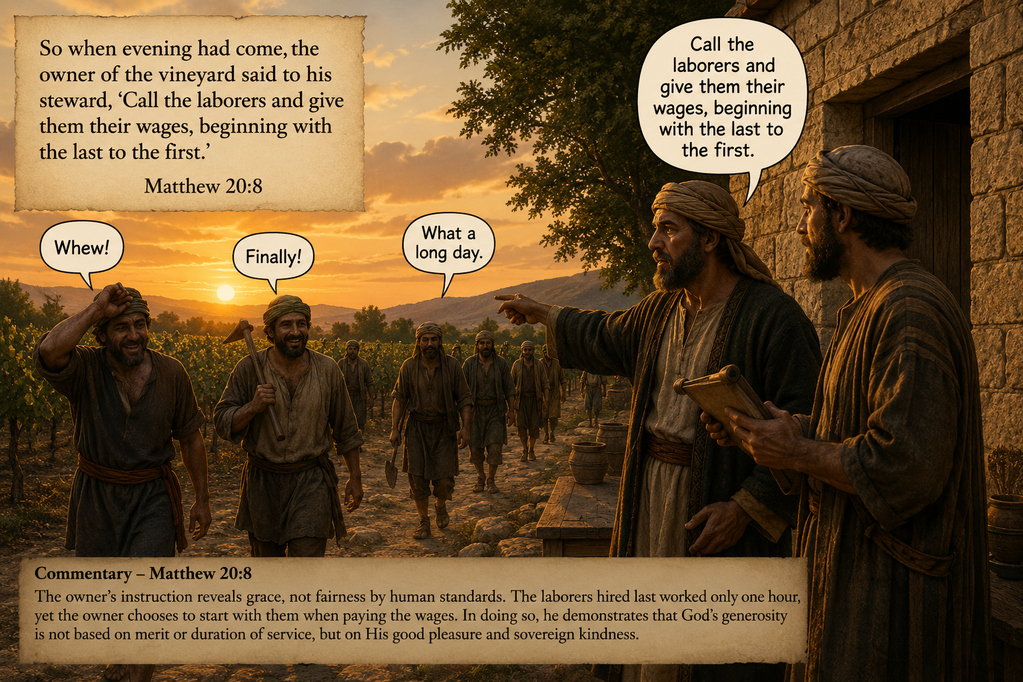
“So when evening had come, the owner of the vineyard said to his steward, ‘Call the laborers and give them their wages, beginning with the last to the first.’ Matthew 20:8
Note: You can listen to today’s commentary courtesy of our friends at the “Bible in Ten” podcast. (Click Here to listen)
You can also read this commentary, scrolling with music, courtesy of our friends at “Discern the Bible” on YouTube. (Click Here to listen), or at Rumble (Click Here to listen).
“Evening, also, having become, he says, the ‘lord, the vineyard’ to ‘commissioner, his’, ‘You call the toilers, and you pay them the reward, having commenced from the last unto the first.’” (CG)
In the previous verse, the house master sent laborers into his vineyard even in the eleventh hour of the day. Next, it says, “Evening, also, having become.”
As noted previously, this means the day’s length where work can be conducted, which is approximately twelve hours. The shortest day is in the winter and is a bit more than ten hours. The longest is in the summer. It is a tad over fourteen hours.
As the evening was coming, it also signifies the start of a new day because biblical days start at evening. This is based on the Genesis 1 account, where it says, “And it was, evening, and it was, morning – Day, X.” Thus, to go past evening would mean work continuing into a new day. Therefore, in the evening, “he says, the ‘lord, the vineyard’ to ‘commissioner, his’.”
Here is a new word, epitropos, a commissioner. It is derived from epi, upon, and tropos, a turn and thus a mode or style of doing something, as in “The way [tropos] a hen gathers her chicks.” It signifies one who has been given a commission, meaning full power, to act on behalf of another. This person is entrusted with the authority of the house in a manner similar to Joseph, who was first over Potipher’s house and eventually over Pharaoh’s house –
“Then Pharaoh said to Joseph, ‘Inasmuch as God has shown you all this, there is no one as discerning and wise as you. 40 You shall be over my house, and all my people shall be ruled according to your word; only in regard to the throne will I be greater than you.’ 41 And Pharaoh said to Joseph, ‘See, I have set you over all the land of Egypt.’” Genesis 41:39-41
The housemaster is ensuring that the law is being complied with. In Deuteronomy, it says –
“You shall not oppress a hired servant who is poor and needy, whether one of your brethren or one of the aliens who is in your land within your gates. 15 Each day you shall give him his wages, and not let the sun go down on it, for he is poor and has set his heart on it; lest he cry out against you to the Lord, and it be sin to you.” Deuteronomy 24:14, 15
As it is the evening, the wages for the day must be paid. The fact that these are day laborers shows that they are exactly who the law was intended to protect. Therefore, the housemaster says, “You call the toilers, and you pay them the reward.”
This is what is expected, both by the laborers and by the law itself. The day is over, the laborers have complied with their part of the bargain, and it is time for his words “if it should be righteous” to be enacted.
Only the first were guaranteed a denarius for their labors. All others were at his decision concerning what is righteous. Thus, to ensure all see that he pays a righteous amount, he says to his commissioner, “having commenced from the last unto the first.”
Those who came last are to be paid first. It seems contradictory to the way one would normally think, but it is a demonstration to all concerning grace. Grace is getting what one does not deserve. The housemaster wants all of the laborers to see that he will treat the last with care and respect, despite their being late into the field.
Life application: Remember that what we are reading is a description of the kingdom of the heavens. What the world sees in one light, God sees in another. As such, things seem turned upside down until we understand what is being conveyed.
As seen in the parables of the hidden treasure and that of the pearl of great price in Matthew 13, the general consensus over the millennia has been that it was speaking of us selling all we have in order to “buy” the field or “buy” the pearl. That would make the parable about us earning heaven.
Rather, the man in both parables is Christ, who saw the people of the world as His treasure and pearl of great price. He sold everything, stepping down from heaven to redeem us to Himself. When we look at what God is doing from our perspective, we will always have a flawed sense of what He is doing.
Our failed marriages are then mentally considered to be like God’s kingdom. Our fallen fathers who bumble through life, often making bad decisions, make us think that God must be like them. Instead of looking at things this way, we must look to God as the perfect ideal, and to what He does as what is perfectly right.
In doing this, we will always more fully appreciate Him and what He is doing. Have joy in your heart when you think of God. He has a perfect plan that will be perfectly fulfilled in us someday. Don’t let the imperfection of “right now” cause you to live a life lacking joy. It will be behind us soon, and things will be more glorious than we can even imagine.
Lord God, we are so thankful to You for what lies ahead. In this world, there are all kinds of troubles, but someday they will be behind us. Thank You for this wonderful hope we possess because of Jesus Christ. Amen.