
Wednesday, 17 June 2026
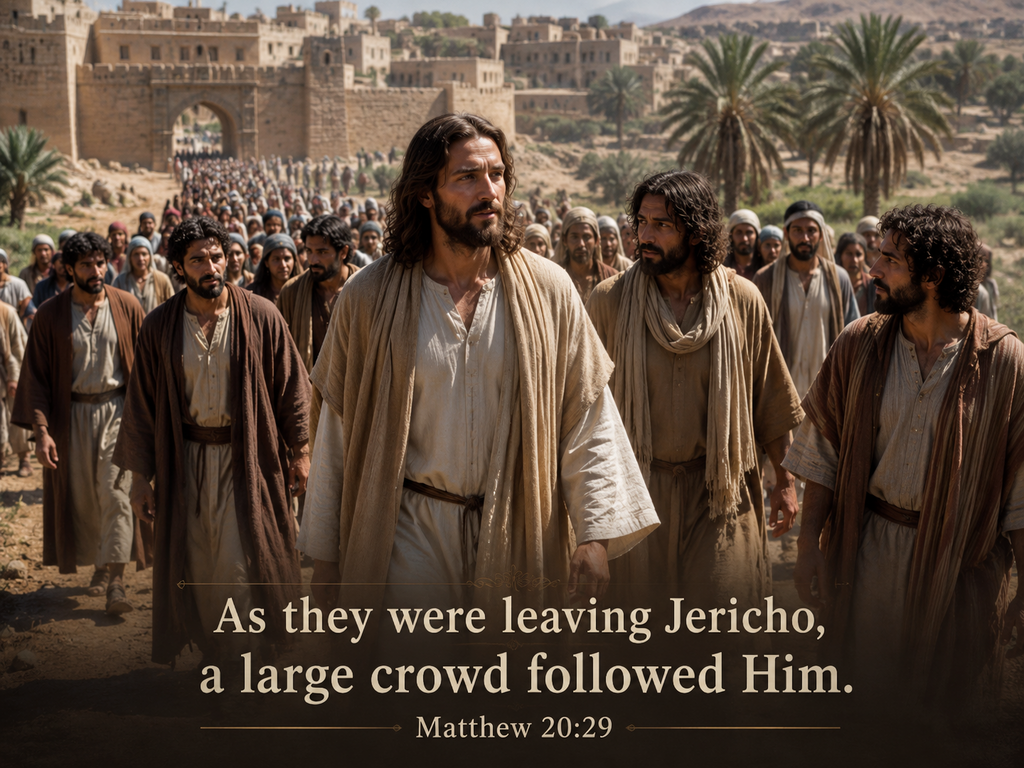
Now as they went out of Jericho, a great multitude followed Him. Matthew 20:29
Note: You can listen to today’s commentary courtesy of our friends at the “Bible in Ten” podcast. (Click Here to listen).
You can also read this commentary, scrolling with music, courtesy of our friends at “Discern the Bible” on YouTube. (Click Here to listen), or at Rumble (Click Here to listen).
“And they, proceeding from Jericho, it followed Him, ‘crowd, great’.” (CG)
In the previous verse, Jesus explained that He did not come to be served, but to serve, and to give His life a ransom for many. The narrative continues, saying, “And they, proceeding from Jericho.”
This is the first mention of Hiericho, Jericho, in the New Testament. Depending on the root of the name, it has two possible meanings: Place of Fragrance or Place of the Moon. The account says that they, meaning Jesus and the disciples, were proceeding from Jericho.
This has caused a great deal of difficulty based on the words of Luke 18, where it says, “He was coming near Jericho” when the account occurred. This should not be a problem. The accounts can be reconciled by understanding the full picture.
Jesus is nearing Jericho (Luke 18:35). A blind man sat by the road begging. As Jesus approached, he heard the multitude. It does not say where he is, just that he heard the multitude as they were passing (meaning him) by (Luke 18:26). He asked what was going on and heard it was Jesus who was coming. He starts to cry out, having no idea where Jesus is, just that He is coming. People tell him to be quiet. It then happens that as Jesus and His disciples are on their way out of Jericho, the multitude followed Him (Matthew 20:29). It is at this time that Jesus will heal the blind. This is why it says in Luke 19:1, “And having entered, He traversed the ‘Jericho’” (CG).
The assumption people make from Luke’s account is that the blind were on the entrance side of Jericho. But that is only an assumption. Jesus entered and passed through Jericho. The blind would have heard the commotion from the very beginning of the ruckus as the entire city went out to see Jesus. The perspectives are given by each gospel writer:
Luke says He was coming near Jericho.
Mark says they came to Jericho.
Matthew says they were proceeding from Jericho.
Luke records the beginning of the encounter as Jesus approached Jericho: the blind man heard the crowd and began crying out. Matthew and Mark record the point at which the healing is associated with Jesus’ departure from Jericho. Whether the cry began on the approach and culminated near the departure, or whether the locality of Jericho is being described from different sides of the city/region, the accounts need not contradict. Luke 19:1 confirms that Jesus entered and passed through Jericho in connection with the same movement, so the event belongs to the whole Jericho passage, not necessarily to a single frozen instant at one gate.
When Jesus got to the other side of Jericho as He passed through, He would have come to where the blind man was (while exiting the city), and the two parties would have finally met. It is Luke 19:1 that solves this otherwise difficult and wholly misunderstood situation. Since the beginning, excuses have been made to justify the event. To read some of them, go to the Pulpit Commentary on Matthew 20:29.
The problem is that at times, the gospels present information categorically rather than chronologically. However, it is evident throughout the gospels that this is not the case. Unless something is described with a time marker, there is no reason to assume the information is chronological instead of categorical.
We tend to assume that everything happened all at once when reading the accounts, but the man is blind. He would not have gotten up and gone to the other side of Jericho. He would have sat and called out, hoping someone would assist him. But the accounts all say otherwise, saying to him that he should be quiet. As such, “he cried out all the more” (Luke 18:39 et al.).
To “hear” and to “be present with” are not the same things for a blind person as they are for the seeing. The people would have flocked to Jesus as He entered. The blind would have sat in misery-filled anticipation until Jesus finally exited. Understanding this “supposed” discrepancy, it next says, “it followed Him, ‘crowd, great’.”
This would include those who travelled with Jesus, those who met up with Him on His nearing Jericho, and those who were in Jericho who flocked to Him.
Life application: There are other supposed contradictions in Jesus’ movements as He traveled from the Galilee to and through Jericho. Some were mentioned in earlier commentaries. There are also supposed contradictions in the account of the healing that will take place. These are not contradictions.
However, when coming to the narratives found in Scripture, we have to insert ourselves into the surrounding events. After giving several options to resolve the matter discussed above, options which span nineteen hundred years of scholarly study, the Pulpit Commentary sadly says, “Inspiration extends not to petty circumstances, and the credibility of the gospel depends not on the rectification of such minutiae.”
That is a cheap and inexcusable way of handling God’s “inspiration.” If God inspired the word, then there will be a resolution to the matter. God deals in minutiae. He created the universe, and yet a single atom will not be out of place. He set forth His plan of salvation, and not a single saved person will be forgotten by Him. If God weren’t in the details, the whole universe would collapse in on itself.
By placing ourselves in the narrative and seeing it (at least in a non-visual way) as the blind saw it, there is no contradiction at all. If Luke 19:1 didn’t exist, the matter would be more difficult to reconcile. Despite this, if Luke 19:1 were not included, we could make our own assumptions, knowing that God had a reason for saying things the way He did.
Unfortunately, without having the right information, errors will naturally seem to arise. The NKJV does not say “And” in Luke 19:1. It says, “Then Jesus entered and passed through Jericho.” That would cause a real contradiction. But the Greek kai (and), not tote (then), is used. It is simply a statement of fact that Jesus entered and passed through without regard to time.
Commentaries will also muddy the waters. Benson says, “Jesus entered and passed through Jericho — Namely, after performing the miracle recorded at the close of the preceding chapter.” This is an assumption (as noted above) that the account of the events is chronological rather than categorical.
The thought Benson presents is that Jesus was entering Jericho, He healed the blind, and then proceeded through Jericho. But taking Matthew, Mark, and Luke together, along with considering Luke 19:1, there is no discrepancy.
Regardless of the fumbling of fallible man, God’s word will be vindicated. Be careful not to assume that a commentary (even this one) is correct until you have fully thought through what is being said. If you still cannot come to a resolution on the matter, you can still have faith that God is in the details. All will be made clear someday.
If this is true with His word, it is true with you as well. He is there with you as you struggle through life. Trust that it is so. Keep your eyes, heart, and affections on Him. You will be rewarded for your faith on that day when you stand before Him.
Lord God, thank You that we possess a sure word about what You are doing to bring us back to Yourself. Thank You that Jesus is in the details, and that we are on the right and proper path back to You. Help us to walk in faith each step of the way. To Your glory, we pray. Amen.