
Tuesday, 16 June 2026
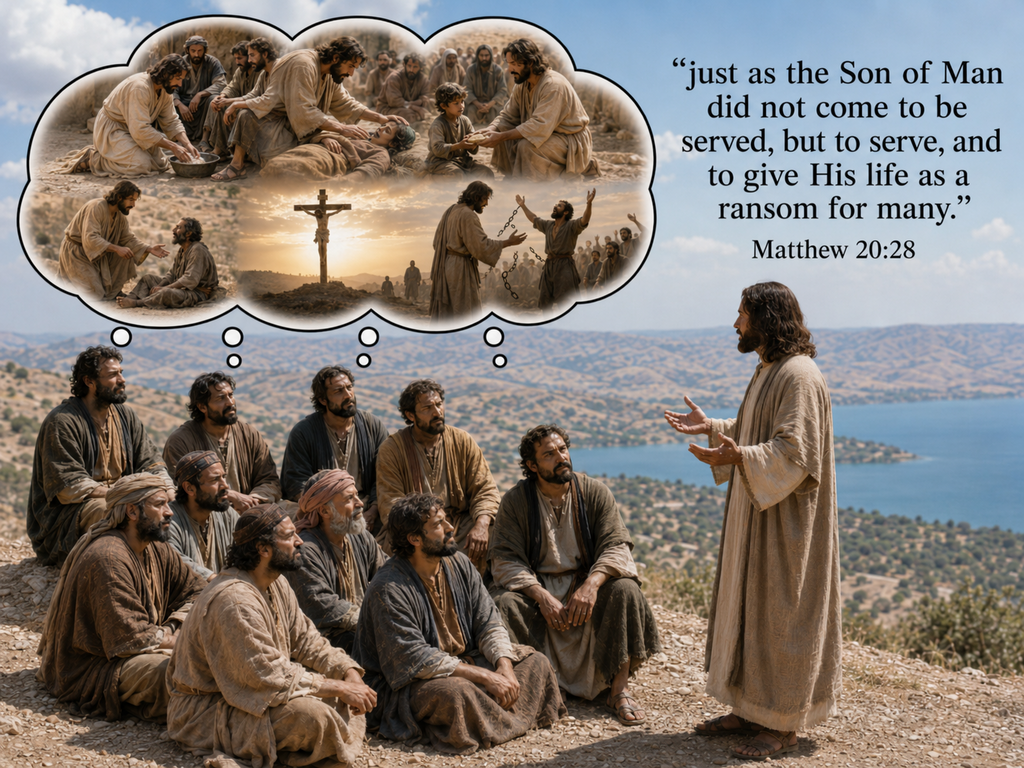
just as the Son of Man did not come to be served, but to serve, and to give His life a ransom for many. Matthew 20:28
Note: You can listen to today’s commentary courtesy of our friends at the “Bible in Ten” podcast. (Click Here to listen)
You can also read this commentary, scrolling with music, courtesy of our friends at “Discern the Bible” on YouTube. (Click Here to listen), or at Rumble (Click Here to listen).
“Just as the ‘Son, the Man’, not He came to be attended to but to attend, and give the ‘soul, His’ – ransom for many.” (CG)
In the previous verse, Jesus told the disciples that whoever desires to be first among them should be their slave. With that noted, He next explains why this is to be so in His kingdom, saying, “Just as the ‘Son, the Man’.”
Referring to Himself, Jesus highlights His humanity. He is fully human. Thus, His example is one that is understandable and attainable in the stream of human existence by others, even if it is not what is normally expected of greatness or preeminence. In this example He sets forth, He notes that “not He came to be attended to.”
This would have been evident to the disciples, even if they didn’t really pay attention to it throughout their days together. People didn’t come to Jesus to serve Him. The disciples followed Him and learned from Him. They also did the things He directed, such as telling Peter to get a fish in which he would find a coin in its mouth, but there is nothing about people coming to Him and serving Him in a designated capacity.
There is a note in Luke 8:2, 3 about the women who helped provide for Him from their substance, but that is not so much attending to Him as one would think of a servant or slave, but as helpers assisting the ministry of which He was the leader.
Examples such as Martha serving while Mary listened to Jesus cannot be used to dismiss Jesus’ words here. Those were duties people do in their regular lives. Jesus being present was incidental to the fact. In other words, Martha would have served anyone who came into her house in a similar manner.
Jesus’ words are referring to a person who actively allowed people to serve Him because they were under Him and designated to do so. And so, to explicitly state that the opposite was true, He continues, saying, “but to attend.”
The disciples had seen Jesus tirelessly serving the masses, tending to them, even at His own expense. He didn’t expect people to come to His castle and meet His every need. He was in the thick of the masses of Israel, tending to their needs, both physical and spiritual.
In just a short time from His words to these disciples, He would give them a visual, tangible lesson of servitude, which is recorded in John 13:1-17. The Creator and Sustainer of all things would wash their feet, instructing them on what it means to live a life of servitude. And more, Jesus says, “and give the ‘soul, His’ – ransom for many.”
A new word is seen, lutron, something to loosen with. As such, it signifies a redemption price, as in one paying a sum to loosen another’s bonds. The word is found only here and in the parallel passage in Mark 10:45. However, it is also used in the Greek translation of the Old Testament over twenty times, including key passages, such as Exodus 21:30, Leviticus 19:20, Proverbs 13:8, and Isaiah 45:13.
The word is used to translate specific Hebrew words (such as pidyon, geulah, and kopher) to indicate a redemption price or ransom paid to liberate individuals, such as slaves, captives, or those subject to the death penalty.
The meaning of Jesus’ words is clear and unambiguous. Jesus would give His soul, meaning His life, as a ransom payment for others. This, then, would be the ultimate ministration of His life on behalf of those He came to attend to.
Life application: As noted above, Jesus was among the people of Israel, actively serving them with His life, and yet, the disciples probably never stopped to think, “Jesus is spending all His time serving others.”
They would have heard the teaching and thought, “He sure is a great Teacher.” They would have seen the miracles and thought, “He has the most incredible healing abilities.” But they probably didn’t put two and two together to conclude, “Jesus is the most stupendous Servant we have ever seen.”
And yet, this is exactly what He was doing. The teaching, healing, counseling, and training were all forms of service which permeated His existence. As Christians, we can get so myopic about things that we miss the greater picture of what is going on in the world around us.
Some focus so heavily on Israel that they miss what God is doing in the church. Some focus so heavily on the church that they miss what God is doing in regard to Israel. We might focus so much on helping that we never take time to teach personal responsibility. We might focus so much on doctrine that we forget about evangelizing.
This doesn’t mean that we don’t each have our own specialty that we can excel at. But we should not become so focused on our specialty that we forget that others are doing great things that are not necessarily directly related to what we are doing.
A church that teaches sound doctrine may not have a lot of converts, but a church with very basic doctrine may get multitudes saved. One is not better than the other. Rather, they have different abilities and capabilities that should be considered.
It is great to have converts. People’s eternal destinies are changed by that. But it is also great that people don’t just get converted and then stagnate. There needs to be proper doctrine taught that will keep people from being led astray.
Let us not get bogged down in our own little circle where we forget that God is doing a great work of building His church with an almost innumerable number of specialties, all of which overlap and are intended to bring His purposes together into a perfect body someday.
Lord God, may we be ready to recognize the value of what others are doing, seeing the importance and effect of their efforts, and acknowledging them as such. It took the disciples of Jesus quite a while to figure out what He was doing. May we be willing to carefully evaluate all You have going on in order to build Your people into an everlasting dwelling. Amen.