
Wednesday, 20 May 2026
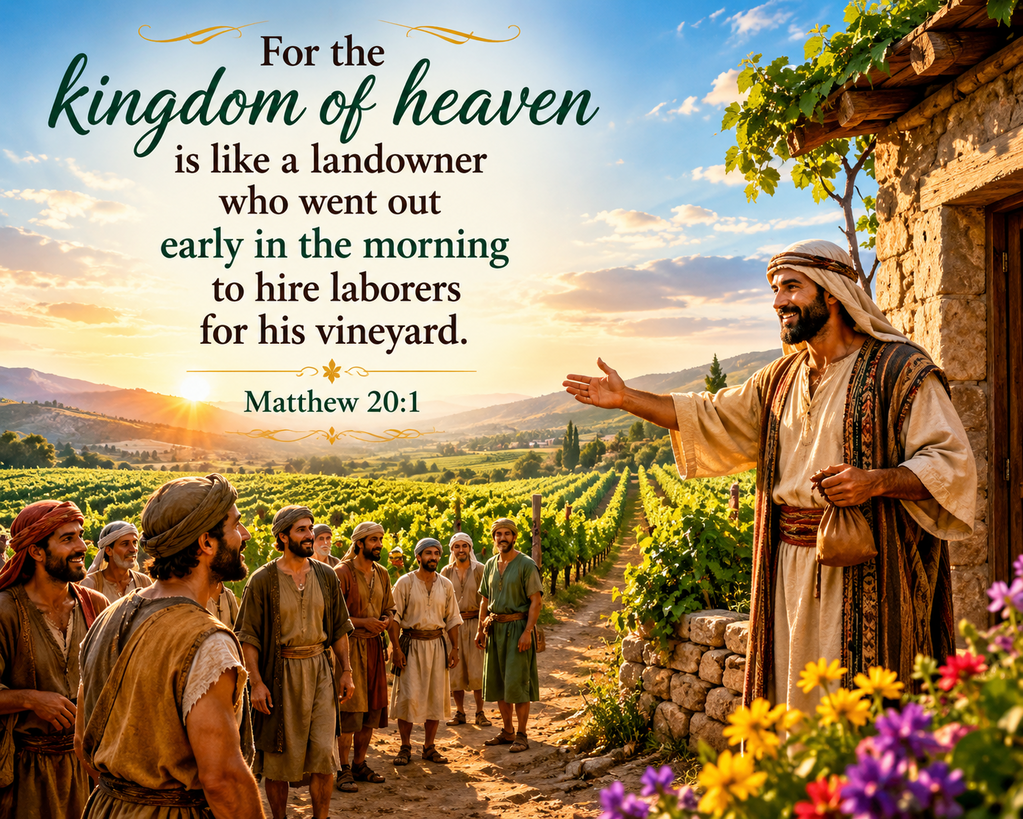
“For the kingdom of heaven is like a landowner who went out early in the morning to hire laborers for his vineyard. Matthew 20:1
Note: You can listen to today’s commentary courtesy of our friends at the “Bible in Ten” podcast. (Click Here to listen)
You can also read this commentary, scrolling with music, courtesy of our friends at “Discern the Bible” on YouTube. (Click Here to listen), or at Rumble (Click Here to listen).
“Like, for, it is the ‘kingdom, the heavens’: man, housemaster, who he exited concurrently early to hire toilers into ‘vineyard, his’.” (CG)
In the previous verse, Chapter 19 concluded with Jesus’ words concerning many who are first will be last and last who will be first. Continuing with that thought, He now begins another parable, saying, “Like, for, it is the ‘kingdom, the heavens’.”
As with His other parables about the kingdom of the heavens, we can anticipate that what Jesus will say is to be considered a recognizable truth about how the workings of God concerning redemption are played out in humanity.
In other words, there is the kingdom of the heavens, an example of which is given for us to learn from. This will help us see and understand more clearly what God is doing in the redemptive process. As such, Jesus says the kingdom is like a “man, housemaster.”
It can already be speculated that the man is the Lord. He is overseeing His plan of redemption, which is typified by the house. The house in this case doesn’t just mean a physical house. Rather, it involves everything under the authority of the house.
For example, the house of David signifies his person, authority, descendants, scope of influence, etc. It is an all-encompassing thought concerning that which belongs to David. Of this house master, Jesus says of him, “who he exited concurrently early.”
Though a bit clunky, evaluating the words will help understand the meaning. The word hama signifies “at the same time.” A single word to suit the purpose is “concurrently.” The word prói is an adverb that means “at dawn.” Thus, the man exited his house “concurrently early.” This was “to hire toilers.”
A new word is seen here, misthoó, to hire or let out for wages. It will only be seen here and in verse 7 of this chapter. This practice has probably existed since the first people on the earth. It continues today in companies with names like Labor Ready, Jobs Today, Hire Me, etc.
It is also not uncommon for people to go to work sites or various locations where workers hoping for a job gather. Temporary hire solves many immediate labor problems while allowing the laborers freedom to move, choose what they will do, etc. In this case, the housemaster wants employees to go “into ‘vineyard, his’.”
The ampelón, vineyard, is introduced here. It is derived from ampelos, a vine. In many cases, it would make no sense to have a lot of permanent employees to tend to a particular type of job all year. Hence, people may hire employees for a day, a week, a month, or a season.
There may be a few permanent servants or employees, but until the vines are ready to be clipped and the grapes gathered, there is no point in having people sit around doing nothing while being paid. This is the setting Jesus begins with to explain what it is like in the kingdom of the heavens.
Life application: Jesus is using examples that the people would have been intimately familiar with. This is true both from Scripture and from the society in which the people lived. Although many of the things He talks about are understood pretty much anywhere, there are things He mentions that are unique to the land and culture of Israel.
If you had never seen a palm tree, you would have no idea what it was without seeing a picture of one. Many of the things Jesus speaks of in the gospels can be understood if one has read the Old Testament, even if it isn’t generally known in a particular society.
Without reading the Old Testament, a person may not have any idea what He is talking about. Inferences can be made, and understanding in a general sense can be obtained, but like going to Israel itself to see the land and grasp the layout for a better understanding of Jesus’ movements, it is important not to neglect reading the Old Testament.
Redemptive history did not just begin when Jesus started His ministry. Everything about what He does and where He does it is intimately connected to what has already been recorded. So, don’t neglect reading and thinking about the contents of the Old Testament.
For those parts that are difficult to understand, there are scholars who have laid out what is meant for pretty much every part of the Bible. The more you study, contemplate, and consider the Old Testament, the more alive and meaningful the New Testament will be to you. Be sure to read your Bible… the whole Bible!
Lord God, what a wonderful thing You have done. You came and participated in Your creation in the Person of Jesus. He was a real Man who dwelt in a particular land among a particular group of people. Everything about Him reveals intimacy and fellowship. May we now participate in that as we interact with You through Your word that tells us all about Jesus. Amen.