
Thursday, 14 May 2026
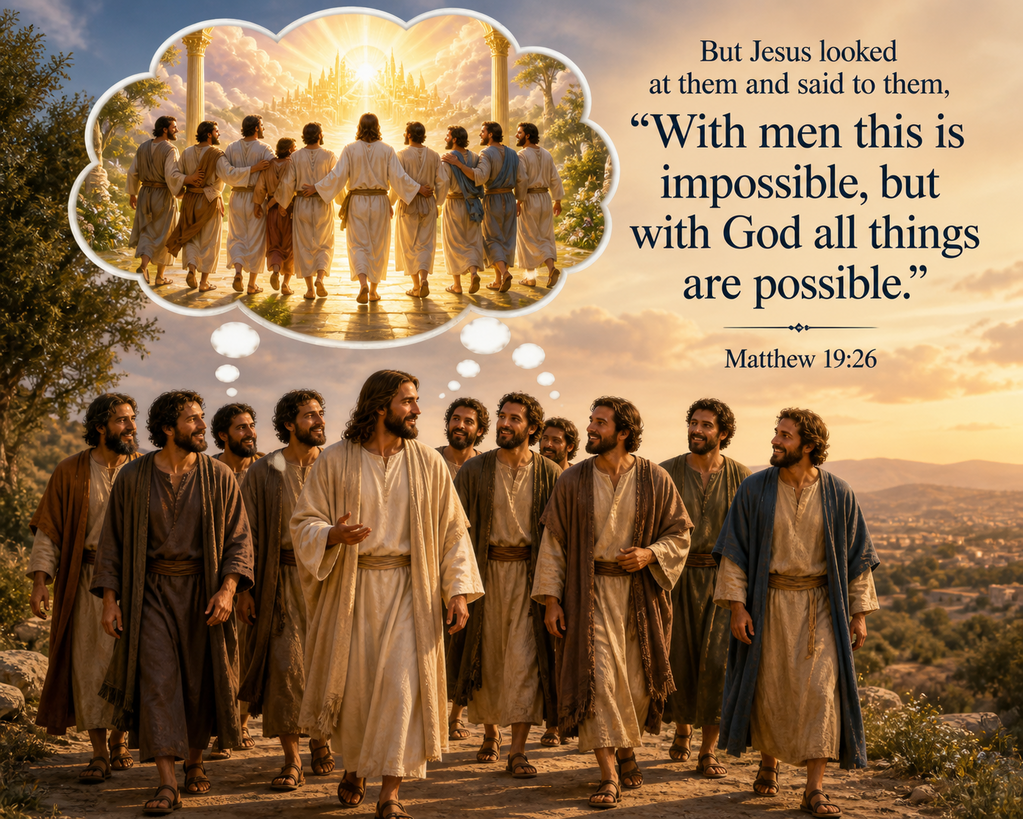
But Jesus looked at them and said to them, “With men this is impossible, but with God all things are possible.” Matthew 19:26
Note: You can listen to today’s commentary courtesy of our friends at the “Bible in Ten” podcast. (Click Here to listen)
You can also read this commentary, scrolling with music, courtesy of our friends at “Discern the Bible” on YouTube. (Click Here to listen), or at Rumble (Click Here to listen).
“Having gazed, also, Jesus, He said to them, ‘With men, this – impossible, it is. With, also, God – all possible, it is.’” (CG).
In the previous verse, the disciples were floored at Jesus’ words about the chances of the rich entering the kingdom of God, asking, “Who then can be saved?” Because of their question, it next says, “Having gazed, also, Jesus.”
This is only the second time the word emblepó is seen in Matthew. It is from en, in, and blepo, to look. As such, it is more than just looking, but “in-looking” or gazing at, observing fixedly, etc. In Matthew, it doesn’t say who or what Jesus gazed at, but in Mark, it specifically says He gazed at them, meaning the disciples.
Something prompted more than just a cursory look. They may have had confusion, fear, or even a sense of horror at what they heard. If salvation is that hard to obtain, then what will happen to them, their families, or even their nation? Jesus, understanding the magnitude of weight His words placed on their minds, next responds. Matthew records, “He said to them, ‘With men, this – impossible, it is.’”
A new word is seen, adunatos, to be unable. It is derived from the negative particle a adjoined to dunatos, powerful or capable. That is derived from dunamai, to be able or possible. Jesus refers to the impossibility of the rich saving themselves (with men).
Whatever thoughts the disciples had about salvation, Jesus had taken their highest supposed ideal, that of a rich man, and He had negated any chance of such a person saving himself.
The implication, then, is that all others would fare just the same. None could save themselves. With that difficult thought expressed, He then provides a ray of good news, saying, “With, also, God – all possible, it is.”
The first use of dunatos is seen here. It was explained already. Where there is no chance of humanity saving itself, with God, it is possible. The disciples had not thought through their state from a biblical perspective. But neither had anyone in Israel done so. If they had, they would not believe that the rich were more easily saved than anyone else.
Only in the writings of Scripture, inspired by God, is there a hint of the thought expressed by Jesus. There is a problem that exists within humanity that, by default, negates any hope of man being able to restore himself to God. That problem is sin. It is an internal infection that is found in all humanity.
As sin comes through law, it should have dawned on Israel that the medium in which they existed, that of law, would never correct their state, even with the efforts of the most law-observant person.
Life application: Imagine a perfect precision machine that requires a particular perfect part to work without catastrophic failure. It is known that such a part is possible to be constructed, but from the first prototype onward, a flaw is found in every single part that follows.
Would it make sense to use one of those parts in this perfectly precision machine? Of course not! The machine itself would fail. It would be pointless to even try to use a part with a known defect. Every single copy of the original would have to be destroyed.
The problem isn’t with the form of the prototype. Rather, it is the state of the prototype. Every piece molded after it carries the same state. To resolve this, another prototype with the same form could be introduced. However, if it had a perfect state to go along with its form, it would be an acceptable “first part.”
And more, because it isn’t the form, but the state, it could be used to change the state of parts from the original prototype. The form wasn’t the problem. There must be a realm, or state, in which the part exists that will make each previously defective part acceptable. Once that is realized, the problem is resolved.
The problem for the parts is that they have no power to change their state. They simply exist in the state in which they were produced. But an external source could make the change. This is what Jesus is speaking about. Humanity is in a state that does not, and indeed cannot, restore itself to perfection.
But God, who is outside of our realm, could make the change. He could, and He did. When that change was effected, it was then made available to all others. This is why no other religion on the planet can bring salvation. They are dealing within the state of corruption. This is because there is one God, and His correction for our state is only found in Jesus.
Only this one, true God, can bring about the necessary change in our state. And He did! Thank God for the goodness of God in Christ. Through the incarnation, cross, and resurrection of Jesus Christ, we go from the state of law to the state of grace. Hooray for Jesus!
Lord God, we have a fault within us that is impossible to correct. No wonder destroying the whole world by flood, minus eight people, still didn’t fix the problem. The corruption remained. What amazing lessons You are giving us in Your word. We need what You have done through Christ. It is evident that nothing else will do. And so, we choose JESUS! Amen.