
Tuesday, 12 May 2026
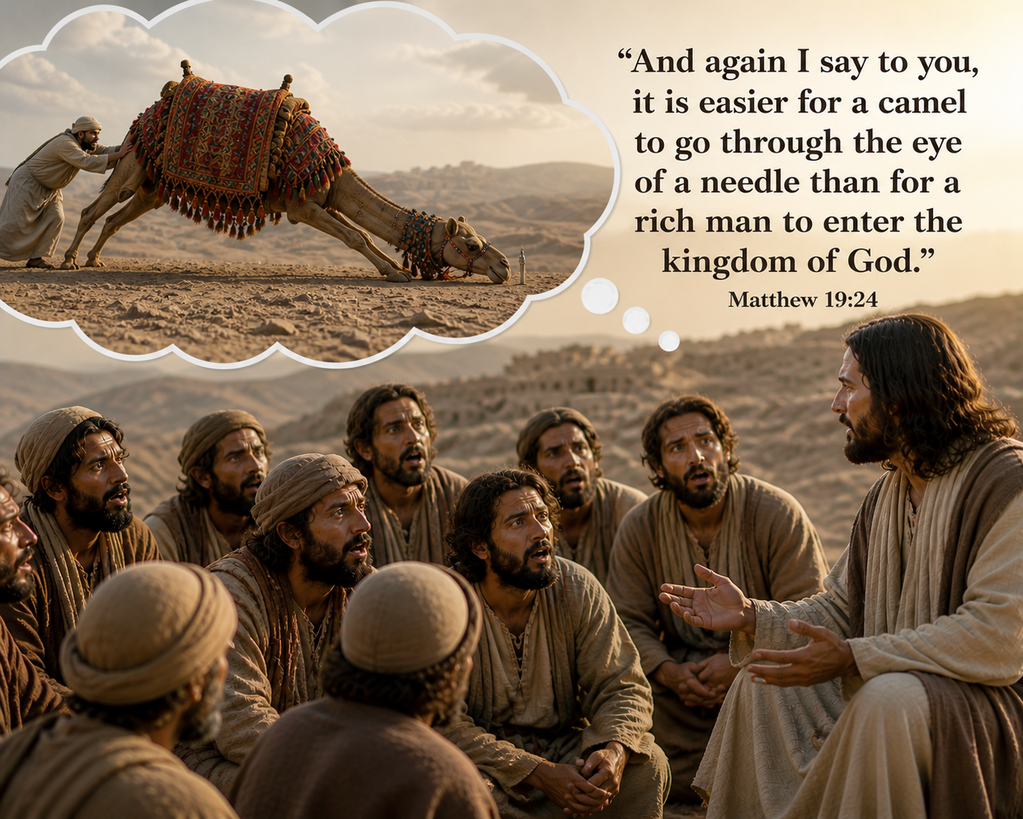
And again I say to you, it is easier for a camel to go through the eye of a needle than for a rich man to enter the kingdom of God.” Matthew 19:24
Note: You can listen to today’s commentary courtesy of our friends at the “Bible in Ten” podcast. (Click Here to listen).
You can also read this commentary, scrolling with music, courtesy of our friends at “Discern the Bible” on YouTube. (Click Here to listen), or at Rumble (Click Here to listen).
“Again, now, I say to you, easier, it is: camel through ‘aperture, needle’ to traverse, if rich entered into the ‘kingdom, the God’.” (CG)
In the previous verse, Jesus noted the impracticability of a rich man to enter the kingdom of the heavens. He now shows just how hard this is, saying, “Again, now, I say to you, easier, it is.”
Jesus will give an example of the immense impracticability of a rich person getting into the kingdom of the heavens. His words have resulted in several unfounded explanations of the meaning. What He says is, “camel through ‘aperture, needle’ to traverse.”
Two new words are introduced here. The first is trupéma, an aperture. In the case of a needle, it would be what we call its eye. The second is the rhaphis, a needle, coming from rhapto, to sew.
In plain English, Jesus says that it is easier for a camel to go through the aperture (the eye) of a needle than what He will next state. Before that, two amendments to this over the centuries to soften the meaning have been made. The first is that some claim the word is not κάμηλος [kamelos], a camel, but κάμιλος [kamilos], a cable. It is agreed there is no support for this, but it was introduced.
The second change-up is a switcheroo in the meaning of “aperture.” Instead of it being a literal needle’s eye, it is a gate called the Eye of the Needle, which is not big enough for a camel to go through.
This is something that was introduced much later in Christian history. Most believe it came about around the 1400s to soften the meaning of Jesus’ words, probably introduced by someone who was rich and didn’t like the implication of what Jesus says, which continues with “if rich entered into the ‘kingdom, the God’.”
In other words, it is easier for a camel to squish through the eye of a needle than for a rich person to get to heaven. The comparison of an animal going through a literal needle’s eye is seen elsewhere in Mideastern writings. The Koran uses Jesus’ statement exactly, without regard to a gate. The Talmud uses the term “elephant” instead of “camel.”
Another point is that the word trupéma, aperture, in Matthew is changed in Mark 10:25 to trumalia, orifice. Likewise, the word rhaphis, needle, is changed in Luke 18:25 to belos, a missile (as in the flaming darts of Ephesians 6:16).
Why are these changes important? It is because they demonstrate that Jesus was talking of something small, held in the hand, and that has an aperture or an orifice, not an eye. The word “eye” is an explanation, not a translation. In other words, Jesus was speaking of a literal needle with a teeny weeny, eensy weensy hole in it.
It was a phrase that would have been known and understood by the disciples without any changes or needed modifications.
Life application: At times, pastors will use the “small gate” explanation in an attempt to justify why it is ok to be rich, teaching that Jesus was giving a moral lesson and He wanted to show that a camel must get on its knees to squish through such a small gate. Thus, we should be humble as we rake in the millions.
This is a ludicrous twisting of Scripture, and it completely misses Jesus’ point. The words of this verse are making a point about trusting in anything but God for a right standing with him. Jesus will even say this explicitly.
But people run ahead with teachings that are easy to comprehend, sensational, or that seem to relieve the immense tension that arises with such a bold statement about wealth and salvation. If they would pick up the Bible and read it in context and from cover to cover, the tension would fade away.
Paul explains exactly what the meaning of Jesus’ words is in 1 Timothy 6:17 –
“Command those who are rich in this present age not to be haughty, nor to trust in uncertain riches but in the living God, who gives us richly all things to enjoy.”
Jesus was speaking about trust. Paul, speaking through Timothy to rich people (yes, saved rich people), speaks about trust. Trust in Jesus, regardless of how much you have, little or much. That is the sweet spot.
Heavenly Father, whatever wealth or possessions we possess, they ultimately came from You. We thank You for what we have, but we also know it could all be gone in a flash of fire or a deluge of water. We will put our trust in You alone for all things. Amen.