
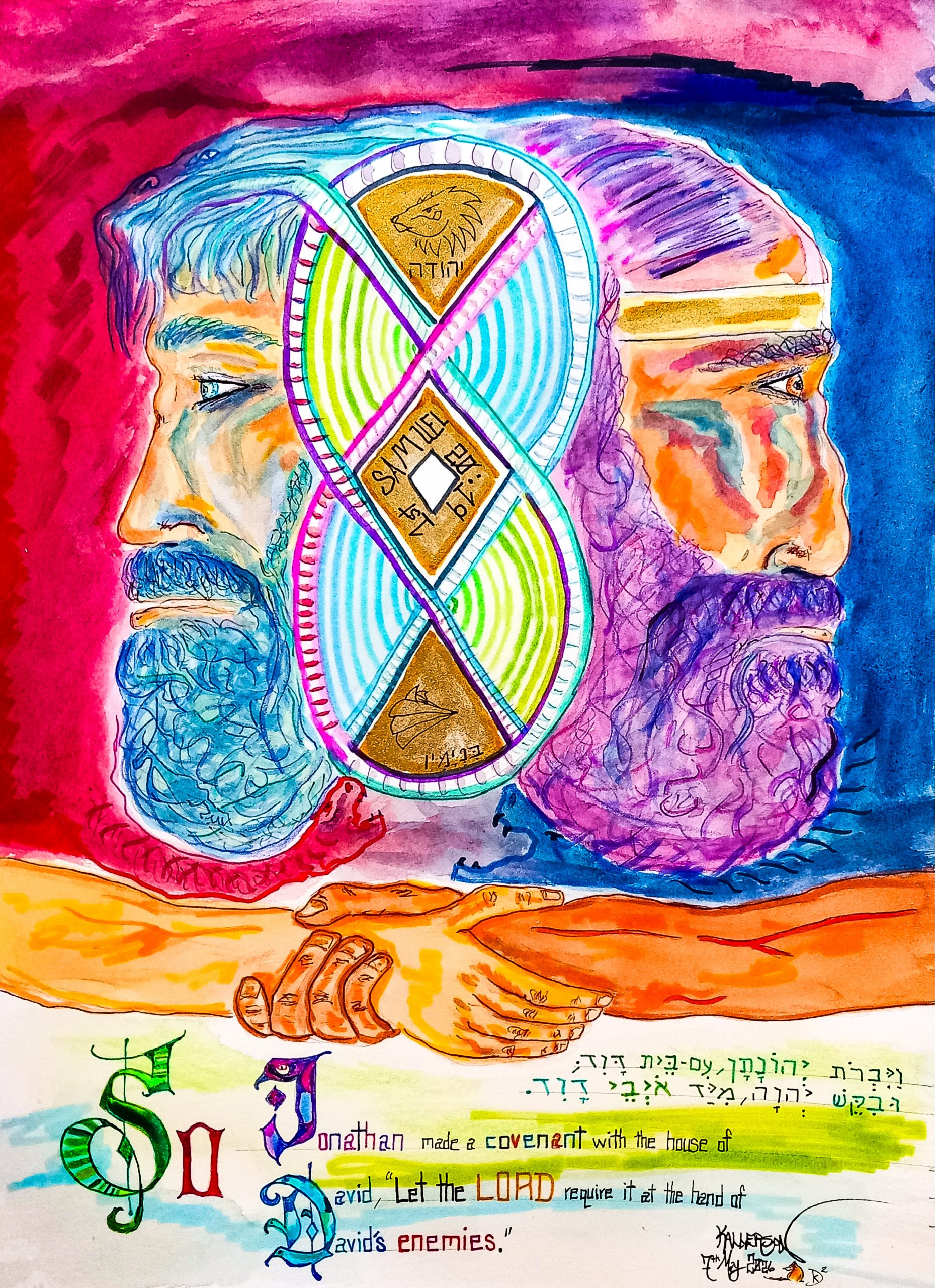
Artwork by Douglas Kallerson
1 Samuel 20:1-16
The Stone, the Departure, Part I
(Typed 29 December 2025) One of the curiosities in Scripture, at least to me, is found in these sermon verses. The word khodesh, translated as month, monthly, or new moon, is found two hundred and eighty-three times in the Bible.
The first two times it is used are Genesis 7:11, which refers to “the second month, the seventeenth day of the month.” Numbers 10:10 is the first time the new moon is referred to directly, noting that the trumpet was to be blown over the offerings on various celebratory days, including the new moon.
In Numbers 28:11-15, the new moon offerings are detailed. Later, Numbers 29:1-6 details the offerings mandated for the Feast of Acclamation which, is the first day of the seventh month. Particular offerings were required on that day in addition to the offerings “for the new moon.”
In these 1 Samuel verses, the new moon is mentioned three times as ha’khodesh, the moon, meaning the new moon. The implication from these verses is that it is a set time for feasting. In Amos 8:9, it says –
“When will the New Moon be past,
That we may sell grain?
And the Sabbath,
That we may trade wheat?” Amos 8:9
So, the new moon was a time like the Sabbath when some type of rest was apparently expected. At a minimum, it was a time when selling was not allowed.
The new moon is mentioned by Paul in the New Testament as well. He implies the new moon was some type of day regularly observed like the Sabbath –
Text Verse: “So let no one judge you in food or in drink, or regarding a festival or a new moon or sabbaths, 17 which are a shadow of things to come, but the substance is of Christ.” Colossians 2:16, 17
What I question is where that tradition came from. Other than the mandatory offerings at the temple, which are detailed in Numbers 28, there is nothing in Scripture to define why this day was observed by the general populace, but, if translations are right, it was.
The Topical Lexicon details the new moon history from Scripture. Two of their points say –
“Numbers 28:11-15 prescribes burnt offerings, grain offerings, and a sin offering ‘at the beginning of your months.’ The new moon thus joins Sabbath and festival days as divinely appointed convocations.”
“Saul’s court held a two-day feast at the new moon (1 Samuel 20:5,18,24-27), illustrating the day’s social and royal importance.”
The first point assumes too much for anything beyond the temple offerings. There were other offerings that were made, some every day, that were not observed by the general populace. The second point is correct, but it doesn’t answer anything about why the populace observed them.
Doing something and knowing the reason why it is done are not the same thing. In 2 Kings 4:23, the new moon is mentioned in the same context as the Sabbath, as if it were a particularly designated time, but as noted, there is nothing in the law to prescribe this as there is with the Sabbath.
And so, I find the day curious. Without a basis for why this day was observed by the people, all we are left with is speculation. Having said that, we will explore it in some detail and provide what may be the answer to the matter. One way or another, the new moon (whatever that actually means) was a day for general observance.
A few of the verses have some of the most complicated Hebrew I have encountered. The ungrammatical nature of what is presented is intended to convey a highly troubled state of mind as the words are being spoken.
These and other interesting items are included in this portion of God’s superior word. And so, let us turn to that precious word once again, and… May God speak to us through His word today, and may His glorious name ever be praised.
I. Graciousness in Your Eyes (verses 1-3)
Then David fled from Naioth in Ramah,
vayivrakh David minavoth baramah – “And he bolted, David, from habitations [k.] in the Ramah.” As in Chapter 19, the written and the oral Hebrew are different. The written is debated. It says from habitations, or from Navith, Residence (Strong’s 5121). The same spelling can be considered either way. The oral changes the name to Naioth, which means Habitations.
Thus, the result is the same meaning, but is it a noun or a proper noun? The reason David bolted is that his location has become known. Even though Saul was overwhelmed and lay around prophesying, it is likely he would eventually resume his pursuit of David.
David means Beloved. Navith (or Naioth) means habitations. The Ramah means The Lofty. As for where David bolted to…
1 (con’t) and went and said to Jonathan,
vayavo vayomer liphne yehonathan – “And he came, and he said to ‘faces, Jehonathan’.” Notice that Jonathan’s name goes to the variant spelling, adding in a hey (our h). It is the fifth letter of the aleph-bet and means look, reveal, and breath.
יוֹנָתָ֗ן
יְהוֹנָתָ֜ן
Jonathan will be mentioned twenty-nine times in this chapter. All twenty-nine times, the additional letter will be used. Jehonathan has the same meaning as Jonathan, Yah Has Given.
1 (con’t) “What have I done? What is my iniquity, and what is my sin before your father, that he seeks my life?”
meh asithi meh avoni u-meh khatathi lipne avikha ki mevaqesh eth naphshi – “What I did? What my perversity, and what my sin to ‘faces, your father’ that ‘seeking my soul’?” David proposes his questions to Jonathan, assuming he has heard from Saul the reason for his actions. His threefold set of questions is nothing short of being a threefold denial of any wrongdoing.
In asking the king’s son to identify what he did, meaning any actions against the king, what his perversity is, meaning any attempts of insurrection against Saul or subversion of Saul’s authority, and what his sin is, meaning working against or ignoring the Lord’s anointing of Saul, he is asking Jonathan to confirm or deny such ill intent.
However, no reasonable person would purposefully implicate himself with such questions. Instead, they are an implied confirmation that he had done none of these things. Therefore, the wrongdoing is to be found in Saul, who seeks David’s soul with no valid reason for doing so.
Jonathan, understanding that David’s questions are a declaration of innocence, doesn’t bother responding to them. Instead, he responds to the charge that Saul is seeking to kill David…
2 So Jonathan said to him, “By no means! You shall not die!
vayomer lo khalilah lo thamuth – “And he said to him, ‘(Surely) Profane! Not you will die.’” By ignoring David’s questions, Jonathan implicitly agrees with the premise that David is innocent. Therefore, there is no reason his father would seek David’s life. He assures him of this. And more…
2 (con’t) Indeed, my father will do nothing either great or small without first telling me.
hineh lo asah avi davar gadol o davar qaton velo yigleh eth azeni – “Behold! To him [k.] he did [k.], my father, word great or word diminutive and not he will denude my ear.” Again, the written and the oral Hebrew don’t agree. The reason is based on a homophone. The word lo means either “to him” or “not” –
לו־ – lo, to him.
לֹֽא־ – lo, not.
With the change, the verb also changes. Therefore, it either says, “To him he did, my father…” or “Not he will do, my father.” All English translations that I know of use the oral, and most scholars agree. However, despite the written being a bit more clunky, the change is unnecessary.
The difference between the two is that Jonathan is saying that Saul will not do anything (past, present, or future) without telling him (the oral). Or he is saying that Saul has not done anything to this point without telling him (the written). As the claim of David’s innocence is based on past actions, there is no need to deviate from the written.
Based on that, Jonathan signifies that David’s deduction about Saul’s intent to kill him cannot be correct. Jonathan assures him he has misread the situation. Therefore…
2 (con’t) And why should my father hide this thing from me? It is not so!”
u-madua yastir avi mimeni eth ha’davar ha’zeh ein zoth – “And whatchaknow – he will cause to hide, my father, from me the word, the this? Naught, this.” This is the first use of madua, whatchaknow, in 1 Samuel. It is a contraction of mah, what, and a shortened form of yada, to know. It is used adverbially to indicate “why,” but whatchaknow gives the same idiomatic sense.
As Saul has not hidden anything from Jonathan in the past, then David’s claim cannot be correct. Despite Jonathan’s assurances, David knows it to be otherwise. Therefore…
3 Then David took an oath again, and said,
vayishava od David vayomer – “And he was sevened again, David, and he said.” To be sevened means to swear an affirmation, as if seven times. It is the strongest way of confirming a matter. He will also include the name of the Lord in his affirmation.
Saying “again” is a bit perplexing. The word od signifies an iteration. This may be referring to David and Jonathan’s covenant, noted in 1 Samuel 18:3. David is reminding Jonathan of this. As such, his words are covenantally truthful, but he is further swearing to testify to his surety of the matter.
3 (con’t) “Your father certainly knows that I have found favor in your eyes,
yadoa yada avikha ki matsathi khen beenekha – “Knowing, he knew, your father, for I found graciousness in your eyes.” The repetition of the verb is like our saying, “Your father certainly knows that our relationship means he cannot speak any ill about me when you are around.”
In Chapter 18, Jonathan gave David his garments, his sword, his bow, and his belt. Every time David came into Saul’s presence, Saul would be reminded of this bond between David and Jonathan. Therefore…
3 (con’t) and he has said, ‘Do not let Jonathan know this, lest he be grieved.’
vayomer al yeda zoth yehonathan pen yeatsev – “And he said, ‘Not he will know this, Jehonathan, lest he will be carved.’” The word astav means to carve. As such, it conveys the sense of pain, as if one is being cut open. We use the same terminology in English when we say things like, “She carved out my heart when she rejected me.”
Knowing that Jonathan would be pained because of his intent to kill David, Saul kept the matter away from him. That was seen in the exchange between Jonathan and Saul in Chapter 19. Saul could no longer fully confide in Jonathan because of David. David knew this…
3 (con’t) But truly, as the Lord lives and as your soul lives, there is but a step between me and death.”
veulam khai Yehovah vekhe napshekha ki khephesa beni u-ven ha’maveth – “And, however, alive Yehovah, and alive your soul, for ‘according to stride’ between me and between the death.” A unique word is seen here, pesa, a stride, meaning a single step. It is derived from the verb pasa, to stride, which is only found in Isaiah 27:4.
We use the same terminology to this day, saying things like “a step away from calamity,” “a step away from the answer,” etc. It means that the result of an action is imminent, like taking our next step. Also, David personifies death, saying “the death.”
It is as if Mr. Death were following hard after him, just a step away. If David wasn’t attentive, he would be overtaken by him. Finally cluing in to the gravity of David’s words, because of his adjuration, Jonathan concedes…
Into a covenant with the Lord we have been brought
When we called on the name of Jesus
Our souls from the grip of Satan have been bought
See what great things God has done for us
A covenant of the Lord comes with His guarantee
When we unite with Him through faith in Jesus
The sealing of the Spirit reflects this certainty
Oh! What great things He has done for us
Oh God, we thank You for the shed blood
The precious blood of our Lord, Christ Jesus
We are sealed ‘neath the crimson flood
What wonderful things You have done for us
II. Sacrifice the Days (verses 4-9)
4 So Jonathan said to David, “Whatever you yourself desire, I will do it for you.”
vayomer yehonathan el David mah tomar naphshekha veeeseh lakh – “And he said, Jehonathan, unto David, ‘What it will say, your soul, and let me do to you.’” Jonathan is convinced and offers his total commitment to help in any manner David desires. This is an implied form of personal rebellion against Saul. As for what David desires…
5 And David said to Jonathan, “Indeed tomorrow is the New Moon, and I should not fail to sit with the king to eat.
vayomer David el yehonathan hineh khodesh makhar veanokhi yashov eshev im ha’melekh leekhol – “And he said, David, unto Jehonathan, ‘Behold! Renewal tomorrow. And I myself, sitting I will sit with the king to eat.” David notes the coming of the Renewal. As noted in the introduction, it is a time set apart in Numbers for sacrifice at the temple.
The translation as New Moon is an explanation of the word khodesh, where the moon is made new. It literally means renewed, coming from khadash, to renew, as in “new again,” not just “restored.” When speaking of the first of the month, it is rightly to be capitalized to offset it. To avoid misunderstanding, using the term Renewal makes the word understandable.
However, without any explanation elsewhere as to why, David understands that he was to be present at a meal with the king at this time. If this refers to the monthly first day of the month, we are not told if this was a nationwide practice or something the king ordered for his people. Regardless, David’s presence was expected…
5 (con’t) But let me go, that I may hide in the field until the third day at evening.
veshilakhtani venistarti vasadeh ad ha’erev hashelishith – “And you sent me, and I was hidden in the field until the evening, the third.” David cannot arbitrarily avoid being at this meal. But in asking Jonathan to send him, it provides him with a legitimate excuse to not be in attendance.
Noting that he would be there until the third day at evening seems to imply a two-day feast was ordained. One day was to usher in the new moon, the second would be to acknowledge it was over.
I suggest that the Renewal here doesn’t mean this feasting occurred every month, but that this is specifically the seventh month. In Leviticus 23, it says –
“Then the Lord spoke to Moses, saying, 24 ‘“Speak to the children of Israel, saying: ‘In the seventh month, on the first day of the month, you shall have a sabbath-rest, a memorial of blowing of trumpets, a holy convocation. 25 You shall do no customary work on it; and you shall offer an offering made by fire to the Lord.’” Leviticus 23:23-25
Thus, “Renewal tomorrow,” could be a reference to this particular day in the year, which happened to be on the day of the Renewal. It is something we do today with New Year’s Day. We might say, “Tomorrow is New Year’s Day,” or “Tomorrow is the first of January.” In the latter, the fact that it is New Year’s Day is implied.
This explanation aligns with what is said next…
6 If your father misses me at all,
im paqod yiphqedeni avikha – “If visiting, he will visit me, your father.” To visit signifies many things in Scripture. One can visit the troops, meaning muster them. It can also signify counting the number of people, such as mustered troops.
In this case, it means that Saul has his attention on David, as if he counted those at the table, came to David’s empty chair, and considered his absence. Perhaps he asked about where David was. Being the king’s son-in-law, it would be expected of him to be in attendance on a special feast day, such as the Feast of Acclamation. If Saul were to ask…
6 (con’t) then say, ‘David earnestly asked permission of me that he might run over to Bethlehem, his city, for there is a yearly sacrifice there for all the family.’
veamarta nishol nishal mimeni David laruts beith lekhem iro ki zevakh ha’yamin sham lekhal ha’mishpakhah – “and you said, ‘Being asked, he was asked ‘from with me’, David, to run – Bethlehem, his city. For ‘sacrifice, the days’ there to all the family.’” If this is the Feast of Acclamation, it would explain why everyone was resting, sacrificing, and feasting.
It was mandated as a holy convocation in Leviticus 23. This would be a time when families and entire communities gathered, blew trumpets, and rejoiced. In fact, this may explain some of the unusual examples of the use of the term in both testaments.
Rather than it being only a monthly event, the word would, at times, be used synonymously with “New Year,” where the khodesh, Renewal, is referring to the one day appointed in Leviticus 23 that falls on both the day of the new month and the first day of the regal year.
If so, Paul’s use of the word in the singular in Colossians 2:16, 17 would be speaking of one celebration each year, not one each month. These are points of speculation, but they answer all the questions about this otherwise misunderstood day.
We do know that the first of each month was a time for sacrificing at the temple, such as in Ezekiel 45:17. On the other hand, the first of the seventh month was a particular New Moon that was set apart from the others as a special observance by all the people.
Bethlehem is from beith, house, and lekhem, bread. It means House of Bread. It bears a secondary meaning of House of Battle because when soldiers engage in battle (lakham), they consume or are consumed as food.
Whatever is intended here concerning the Renewal, I lean toward this referring to the first day of the seventh month, which is known as the Feast of Acclamation. David’s words to Jonathan continue…
7 If he says thus: ‘It is well,’ your servant will be safe.
im koh yomar tov shalom leavdekha – “If thus, he will say, ‘Good,’ peace to your servant.” If Saul questioned David’s seat being empty, Jonathan was to give the excuse that David asked him to go to his city for the annual sacrifice. If Saul accepted that, saying, “Good,” then David had misunderstood the events, and he was ok in Saul’s eyes. On the other hand…
7 (con’t) But if he is very angry, be sure that evil is determined by him.
veim kharoh yekhereh lo da ki kalethah ha’raah meimo – “And if burning, it will burn to him, you must know for it finished, the evilness, from with him.” If Saul blew a gasket over David’s absence, he intended to harm to him. Saying, “it finished, the evil,” means that Saul’s intention to harm David was fully fleshed out, and the matter was set in his mind.
8 Therefore you shall deal kindly with your servant, for you have brought your servant into a covenant of the Lord with you.
veasitha khesed al avdekha ki bivrith Yehovah hevetha eth avdekha imakh – “And you did kindness upon your servant, for in ‘covenant, Yehovah’ you caused to bring your servant with you.” Although 1 Samuel 18:3 doesn’t mention the Lord, it is now implied that the covenant made between the two was either made in the Lord’s name or understood that, as a covenant, the Lord was a Witness to it. Either way, David reminds Jonathan that he initiated the covenant, bringing David into it, uniting the two in faithful allegiance. As such, David makes a solemn request…
8 (con’t) Nevertheless, if there is iniquity in me, kill me yourself,
David’s words are emphatic: veim yesh bi avon hamitheni atah – “And if exists in me perversity, you must cause to kill me, you.” If anything David said in verse 1 was true based on the oath that they had made, David calls on Jonathan to personally kill him. He was not to allow the matter to go beyond himself…
8 (con’t) for why should you bring me to your father?”
vead avikha lamah zeh tevieni – “And unto your father, to why this you must cause to bring me?” The “why this” refers to any matter of perversity found in David. It is an insufficient reason to allow Saul to take vengeance on him. Rather, the matter should be settled by Jonathan. David appeals to the covenant as binding in this matter.
9 But Jonathan said, “Far be it from you!
The intent is just the opposite: vayomer yehonathan khalilah lakh – “And he said, Jehonathan, ‘(Surely) Profane to you!” It would be like us saying, “No way, Jose,” or maybe, “You’re off your rocker!” Jonathan conveys that by all means, he trusts that David is not an offender. Rather…
9 (con’t) For if I knew certainly that evil was determined by my father to come upon you, then would I not tell you?”
ki im yadoa eda ki kalethah ha’raah meim avi lavo alekha velo othah agid lakh – “For if knowing I will know that it ‘finished, the evilness, from with my father’ to come upon you, and not, it, I will cause to declare to you?’” Jonathan is assured of David’s innocence. What he was unsure of was David’s claim that Saul wanted to kill him.
However, by the end of verse 3, he was convinced that David was probably right. The matter would be determined by Saul’s attitude while at the evening meal. If, in fact, Saul was wholly determined to kill David, despite him being innocent (of which Jonathan was certain), he would definitely let David know, hiding nothing from him. Therefore…
Deal kindly with us forever, O God
And we know that You will, because of Your love for us
In this earthly life as we trod
And throughout eternity – all because of Jesus
We have entered into the covenant of the Lord
We have been saved through the blood of Jesus
Redeemed from the law’s bitter sword
What a glorious thing You have done for us
Thank You, O God, that we are set free
To worship You in spirit and in truth
Endless ages before the glassy sea
Eternally in the day of our youth
Thank You, O God, for Jesus Christ our Lord
Hallelujah to the Lamb, God’s eternal Word
III. Until Vanishment (verses 10-16)
10 Then David said to Jonathan, “Who will tell me, or what if your father answers you roughly?”
If this is one sentence, the words are ungrammatical. If it is two, it is still very complicated. My proposal, which can’t be any worse than the others, is that it is two questions followed by one exclamation: vayomer David el yehonathan mi yagid li o mah yaankha avikha qashah – “And he said, David, unto Jehonathan, ‘Who he will cause to declare to me? Or what he will answer you, your father? Severe!’”
In other words, both questions of David are essentially rhetorical. First, Jonathan can’t send a messenger without risking it getting back to Saul. The old saying that fits is, “If one person knows, it’s a secret. If two know, it’s a risk. And if three know, it’s almost impossible to keep.”
Second, David is worried about Jonathan being involved. Saul tried to pin David to the wall twice. Would Jonathan fare any better if Saul thought he was covering for David? Saul already agreed that Jonathan should die over tasting a bit of honey. How much more would his life be in peril over taking David’s side?
Jonathan understands and develops a plan in his mind…
11 And Jonathan said to David, “Come, let us go out into the field.” So both of them went out into the field.
vayomer yehonathan el David lekhah venetse ha’sadeh vayetseu shenehem ha’sadeh – “And he said, Jehonathan, unto David, ‘You must (surely) walk, and let us go – the field.’ And they went out, they two – the field.” Jonathan wants David to understand the layout of the plan that will avoid any severe consequences in communicating what transpired between him and Saul.
Once in the field, more complicated verses follow…
12 Then Jonathan said to David: “The Lord God of Israel is witness!
vayomer yehonathan el David Yehovah elohe Yisrael – “And he said, Jehonathan, unto David, ‘Yehovah, ‘God, Israel’!” The words are understood by almost all translations to mean something like, “As God is my witness.” His words are similar to where it elsewhere says, “Alive Yehovah!” A solemn adjuration is being made. The next words continue to be mostly understood.
12 (con’t) When I have sounded out my father sometime tomorrow, or the third day,
The NKJV says when and then starts inserting stuff that confuses what is said: ki ekhqor eth avi kaeth makhar ha’shelishith – “For I will penetrate my father according to the time tomorrow, the third.” This issue was already raised in verse 5. David was to be at the king’s table for the meal that accompanied the Renewal. During that time, Saul may question where David is. If so…
12 (con’t) and indeed there is good toward David, and I do not send to you and tell you,
Because of all the insertions, most translations completely divert from the intent. The NASB and a few others are close: vehineh tov el David velo az eshlakh elekha vegalithi eth azenekha – “And behold! Good unto David, and not then I will send unto you, and I denuded your ear?’” It is two clauses, a question, and a statement.
The NASB gives the sense, but incorrectly makes it all one question, saying, “if he has a good feeling toward you, shall I not then send word to you and inform you?”
The verse is actually Jonathan making a vow, agreeing to David’s plans about the feast, followed by his rhetorical question, “And not then will I send unto you?” This means he will do so. And then, he expresses that he will denude David’s ear, meaning that he will explain that all is ok. However…
13 may the Lord do so and much more to Jonathan. But if it pleases my father to do you evil,
Because of all their insertions, the NKJV (et al) takes this as a finishing of the previous thought. That is incorrect. Rather, it begins the next thought: koh yaaseh Yehovah lihonathan vekhoh yosiph ki yetiv el avi eth ha’raah alekha – “Thus He will do, Yehovah, to Jehonathan, and thus He will cause to add, that he will cause to accept unto my father the evilness upon you.”
Jonathan has essentially called a curse down upon himself should he accept it if his father intends evil to come upon David. No matter what happens, he will get word to David of his father’s evil intent. If Saul intends to harm him…
13 (con’t) then I will report it to you and send you away, that you may go in safety.
vegalithi eth azenekha veshilakhtikha vehalakhta leshalom – “And I denuded your ear, and I sent you, and you walked to peace.” Jonathan promises to personally reveal to David exactly what Saul intends. After that, he will send David off, allowing him to go in peace. In his going…
13 (con’t) And the Lord be with you as He has been with my father.
vihi Yehovah imakh kaasher hayah im avi – “And may He be, Yehovah, with you according to He was with my father.” Not only will Jonathan send David off peacefully, but he will send him off with a kingly blessing, as he understands that the kingdom will transfer to David.
14 And you shall not only show me the kindness of the Lord while I still live, that I may not die;
The words are about as complicated as any to be found. Ellicott speaks for most scholars, saying, “The Hebrew of this and the next verse is again very confused, abrupt, and ungrammatical, but this is evidently to be attributed to the violent emotion of the speaker.”
It is evident that Jonathan is in great distress and is blurting out his thoughts abruptly and emotionally. Some find the words entirely impossible to understand. However, if understood as emotionally charged, they do make sense: velo im odeni khai velo taaseh imadi khesed Yehovah velo amuth – “And not, if I yet alive, and not you will do with me ‘kindness, Yehovah’? And not I will die.”
Jonathan has essentially ceded the kingdom to David in his mind. He knows David’s ascendency is inevitable and that he will never be king. But he doesn’t want to be faced with execution by a new king as might be expected, especially because of his love for David and the covenant they made. Therefore, this is the sense of his overwhelmed words:
“As long as I am alive, won’t you bestow the mercy of Yehovah upon me? In doing this, I won’t be executed by you.”
Understanding the threefold “and not” is how to rightly interpret the words –
And not… (sob)
If I am still alive… (gasp)
And not (won’t you be sure to) you will do with me kindness Yehovah? (sob)
And not (be sure to remember this) I will die (by your hand).
Understanding this, he continues…
15 but you shall not cut off your kindness from my house forever,
velo takhrith eth khasdekha meim beithi ad olam – “And not you will cause to cut your kindness from ‘with my house’ until vanishment.” Jehonathan not only asks for mercy upon himself, but for mercy upon his house, which includes his descendants after him, forever. As long as the house of David exists, he asks for mercy upon his own house so that his name will not perish.
15 (con’t) no, not when the Lord has cut off every one of the enemies of David from the face of the earth.”
The words are again very complicated. Despite being a complete paraphrase, the NKJV gives the sense: velo behakhrith Yehovah eth oyeve David ish meal pene ha’adamah – “And not, in cause to cut, Yehovah, ‘hatings, David’ – man from upon ‘faces, the ground’.” The meaning is that as the king, Yehovah will naturally give David’s enemies, his hatings, into his hand, causing them to be cut off.
Even if these enemies include Jonathan’s house, he is asking for mercy to be extended to them. Said plainly, “When all the king’s enemies have been obliterated, please spare my house.” This is his pained request…
16 So Jonathan made a covenant with the house of David,
vayikhroth yehonathan im beith David – “And he cut, Jehonathan, with ‘house, David’.” The meaning is that “he cut a covenant.” This was based on his words petitioning for grace.
Jonathan will fulfill his words to David, ensuring that Saul will not be able to put his hand on him. Likewise, David has covenanted to ensure that the house of Jonathan will continue without being cut off.
*16 (fin) saying, “Let the Lord require it at the hand of David’s enemies.”
u-viqesh Yehovah miyad oyeve David – “(And He sought, Yehovah, from ‘hand, hatings David’.)” This is not something Jonathan said, as the NKJV implies. The words are most likely those of the narrator, confirming that the Lord sought what Jonathan had covenanted with David, requiring it at the hand of David’s enemies.
Despite plenty of complicated ideas and wording, the overall intent of the passage is readily understandable, even from a paraphrase. Translations may lack correctness with the nuances, but that shouldn’t overly concern us unless we are looking for typology.
Then we need to be more precise to understand what is being conveyed. What is certain is that the bond between Jonathan and David is guaranteed to last as long as David’s kingdom lasts. That alone should help us understand what is going on in the passage.
Despite Saul’s attempts at killing David, and any future troubles that may arise in David’s house, the bond between these two houses will last. If we take that understanding, based on a covenant between two men before the Lord as binding, how much more should we consider the covenant between the Lord and His people as binding!
It is true that Israel failed at pretty much every step of their history in complying with the covenant, but the Lord never failed to uphold every single word of wh?t He said he would do for Israel, both positively in blessing and negatively in executing the curses.
And through it all, He has faithfully maintained them, just as He said He would. Now, with the introduction of the New Covenant, we have an even surer hope. This covenant was not enacted with the blood of bulls and goats, but in the precious blood of Jesus Christ.
Therefore, when we enter into the covenant through faith in what Christ has done, the Lord will never fail to uphold what He has promised. The salvation He has given us is as fixed and permanent as Israel as people is before His eyes.
When we mess up, He will be there to carry us through, despite ourselves. When we are faithful and obedient, He will faithfully credit that to our accounts for the day we stand before Him.
Reading about the surety of the faithfulness to the covenant between Jonathan and David is intended to have us consider the greater surety we possess. Hold fast to this thought. Jesus has you! He will never leave you nor forsake you.
It is a great and enduring promise we possess. Thank God for His faithfulness to us! Hooray for Jesus, who has made this possible.
Closing Verse: “If we are faithless,
He remains faithful;
He cannot deny Himself.” 2 Timothy 2:13
Next Week: 1 Samuel 20:17-33 When alone and your hearture really pains you… (The Stone, the Departure, Part II) (44th 1 Samuel sermon)
The Lord has you exactly where He wants you. He has a good plan and purpose for you. He is the One who abases the haughty and exalts the humble. He regards the lowly, and the proud, He knows from afar. So yield yourself to Him, trust Him, and believe His word. In this, He will do great things for you and through you.
1 Samuel 20:1-16 (CG)
20 And he bolted, David, from habitations [k.] in the Ramah. And he came, and he said to faces Jehonathan, “What I did? What my perversity, and what my sin to faces your father that seeking my soul?’”
2And he said to him, “(Surely) Profane! Not you will die. Behold! To him [k.] he did [k.], my father, word great or word diminutive and not he will denude my ear. And why he will cause to hide, my father, from me the word, the this? Naught, this.”
3And he was sevened again, David, and he said, “Knowing, he knew, your father, for I found graciousness in your eyes. And he said, ‘Not he will know this, Jehonathan, lest he will be carved.’ And, however, alive Yehovah, and alive your soul, for according to stride between me and between the death.”
4And he said, Jehonathan unto David, “What it will say, your soul, and let me do to you.”
5And he said, David unto Jehonathan, “Behold! Renewal tomorrow. And I, sitting I will sit with the king to eat. And you sent me, and I was hidden in the field until the evening, the third. 6If visiting, he will visit me, your father, and you said, ‘Being asked, he was asked from among me, David, to run – Bethlehem, his city. For sacrifice the days there to all the family.’ 7If thus, he will say, ‘Good,’ peace to your servant. And if burning it will burn to him, you must know for it finished, the evil, from with him. 8And you did kindness upon your servant, for in covenant Yehovah, you caused to bring your servant with you. And if exists in me perversity, you must cause to kill me, you. And unto your father, to why this you must cause to bring me?”
9And he said, Jehonathan, “(Surely) Profane to you! For if knowing I will know for it finished, the evil, from with my father to come upon you, and not, it, I will cause to declare to you?”
10And he said, David unto Jehonathan, “Who he will cause to declare to me? Or what he will answer you, your father? Severe!”
11And he said, Jehonathan, unto David, “You must (surely) walk, and let us go – the field.” And they went out, they two – the field. 12And he said, Jehonathan, unto David, “Yehovah God Israel! For I will penetrate my father according to the time tomorrow, the third. And behold! Good unto David, and not then I will send unto you, and I denuded your ear?” 13Thus He will do, Yehovah, to Jehonathan, and thus He will cause to add, for he will cause to accept unto my father the evil upon you. And I denuded your ear, and I sent you, and you walked to peace. And may He be, Yehovah, with you according to He was with my father. 14And not, if I yet alive, and not you will do with me kindness Yehovah? And not I will die. 15And not you will cause to cut your kindness from with my house until vanishment. And not, in cause to cut, Yehovah, hatings David – man from upon faces the ground.” 16And he cut, Jehonathan, with house David, (And He sought, Yehovah, from hand hatings David.)
1 Samuel 20:1-16 (NKJV)
Then David fled from Naioth in Ramah, and went and said to Jonathan, “What have I done? What is my iniquity, and what is my sin before your father, that he seeks my life?”
2 So Jonathan said to him, “By no means! You shall not die! Indeed, my father will do nothing either great or small without first telling me. And why should my father hide this thing from me? It is not so!”
3 Then David took an oath again, and said, “Your father certainly knows that I have found favor in your eyes, and he has said, ‘Do not let Jonathan know this, lest he be grieved.’ But truly, as the Lord lives and as your soul lives, there is but a step between me and death.”
4 So Jonathan said to David, “Whatever you yourself desire, I will do it for you.”
5 And David said to Jonathan, “Indeed tomorrow is the New Month, and I should not fail to sit with the king to eat. But let me go, that I may hide in the field until the third day at evening. 6 If your father misses me at all, then say, ‘David earnestly asked permission of me that he might run over to Bethlehem, his city, for there is a yearly sacrifice there for all the family.’ 7 If he says thus: ‘It is well,’ your servant will be safe. But if he is very angry, be sure that evil is determined by him. 8 Therefore you shall deal kindly with your servant, for you have brought your servant into a covenant of the Lord with you. Nevertheless, if there is iniquity in me, kill me yourself, for why should you bring me to your father?”
9 But Jonathan said, “Far be it from you! For if I knew certainly that evil was determined by my father to come upon you, then would I not tell you?”
10 Then David said to Jonathan, “Who will tell me, or what if your father answers you roughly?”
11 And Jonathan said to David, “Come, let us go out into the field.” So both of them went out into the field. 12 Then Jonathan said to David: “The Lord God of Israel is witness! When I have sounded out my father sometime tomorrow, or the third day, and indeed there is good toward David, and I do not send to you and tell you, 13 may the Lord do so and much more to Jonathan. But if it pleases my father to do you evil, then I will report it to you and send you away, that you may go in safety. And the Lord be with you as He has been with my father. 14 And you shall not only show me the kindness of the Lord while I still live, that I may not die; 15 but you shall not cut off your kindness from my house forever, no, not when the Lord has cut off every one of the enemies of David from the face of the earth.” 16 So Jonathan made a covenant with the house of David, saying, “Let the Lord require it at the hand of David’s enemies.”