
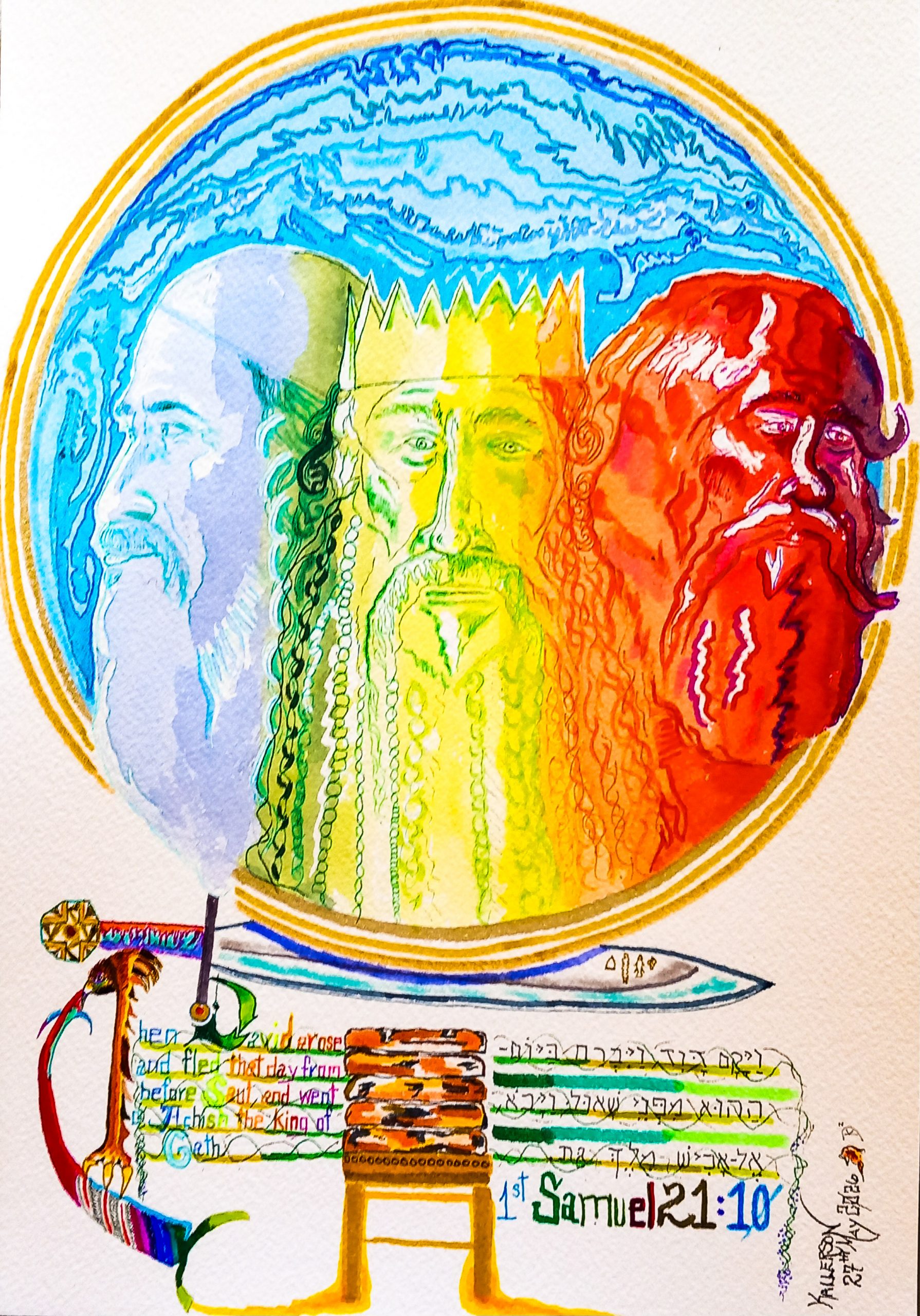
Artwork by Douglas Kallerson.
1 Samuel 21:1-15
The Sword of Goliath
(Typed 19-21 January 2026 – Broken Brain sermon) The events of 1 Samuel 21 are important enough in the life of David to have been highlighted in several psalms, not just in veiled references, but he openly refers to events that took place, naming names.
It’s unlikely that he took paper and pen along with him to write what was on his mind. Therefore, he didn’t just live out these events, but he carried them in his heart, processing them in his mind enough that he could later turn them into psalms to the Lord.
Along with that, one of the events in this chapter is remembered in all three of the synoptic gospels. Regardless of how we, or scholars, feel about David’s lying to Ahimelech, the Bible never points an accusing finger at him or his actions.
Jesus refers to the account to support His disciples when they picked grain on a Sabbath. When they did, the Pharisees accused Him of breaking the law. What transpired between David and Ahimelech was certainly a violation of the written law, and yet Jesus showed that there was a higher standard at work that Scripture did not later condemn.
Jesus used that standard to show how His disciples were not to be condemned for their actions either.
Text Verse: “And He said to them, “Not you read what he did, David, when he hungered, he and those with him? 4How he entered into the house of God and the bread ‘the before-setting’ they ate, which not it is being permitted him to eat, nor those with him, if not the priests only?” Matthew 12:3, 4 (CG)
Jesus is the fulfillment of all the types and pictures seen in these Old Testament accounts. He is referred to in metaphor many times in the New Testament as well. He is highlighted in a way that ties Him back to these Old Testament accounts, and He is also used in many of the same metaphors in new ways, particularly in the book of Revelation.
Reading Scripture without looking for Jesus will only provide a very limited idea of what is going on in the word. It is true that people have read the word for eons without considering typology, metaphor, and so forth as they relate to Jesus, and they benefitted from this.
But when the Person of Jesus is contemplated, the word opens up in an entirely new way. It is no longer just a book of right moral living and a relationship with God in a general way. Instead, it takes on an entirely new dynamic as we truly seek out God in the face of Jesus Christ.
Think about Jesus each time you pick up the Bible and read. He is what God is asking us to focus on above all else. This is a certain truth to be found in His superior word. And so, let us turn to that precious word once again, and… May God speak to us through His word today, and may His glorious name ever be praised.
I. Ahimelech the Priest (verses 1-7)
Now David came to Nob,
vayavo David noveh – “And he came, David, Nob-ward.” Before going into exile from the land, David passed the area of Nob. It is a location mentioned six times, four in 1 Samuel and one time each in Nehemiah and Isaiah. Nob is in the tribe of Benjamin, being noted along with Anathoth, a priestly city, by Nehemiah.
This would make sense because Saul may have directed the tabernacle to be there in his tribal inheritance, maybe to somewhat consolidate the priestly kingdom of the Lord. In Isaiah, it is noted to be on the road of Sennacherib’s trek to Jerusalem –
“Lift up your voice,
O daughter of Gallim!
Cause it to be heard as far as Laish—
O poor Anathoth!
31 Madmenah has fled,
The inhabitants of Gebim seek refuge.
32 As yet he will remain at Nob that day;
He will shake his fist at the mount of the daughter of Zion,
The hill of Jerusalem.” Isaiah 10:30-32
David means Beloved. Strong’s says Nob means Fruit, coming from nob, to flourish. This can be real fruit or figurative, such as the fruit of the lips, meaning praise, etc. Abarim has the source as nabah, to be high or prominent. They define it as Height or High Place.
1 (con’t) to Ahimelech the priest.
el akhimelekh ha’kohen – “unto Ahimelech the priest.” This is the first time Ahimelech is mentioned. Some commentators say he is Ahijah, noted in 1 Samuel 14:3. He could also be his brother. Whatever the relationship, he is noted as “the priest.” Thus, he is likely the high priest, filling in for his brother Ahijah, or some other unknown connection between the two. His name means My Brother Is King, Brother of the King, or something similar.
1 (con’t) And Ahimelech was afraid when he met David,
vayekherad akhimelekh liqrath David – “And he shuddered, Ahimelech, to encounter David.” David arrived without a weapon, so his shuddering probably had nothing to do with feeling danger. A possibility is that he may think David is retreating from battle with bad news, such as in 1 Samuel 4 when Eli got bad news concerning the battle. It would otherwise be abnormal for David to travel alone, as it next says…
1 (con’t) and said to him, “Why are you alone, and no one is with you?”
vayomer lo madua atah levadekha veish ein itakh – “And he said to him, ‘Whatchaknow – you to your separation, and man naught with you?’” The reason Ahimelech was fearful had to do with David being alone. It was not what would normally be expected. Thus, it caused Ahimelech to shudder anxiously.
2 So David said to Ahimelech the priest, “The king has ordered me on some business,
vayomer David laakhimelekh ha’kohen ha’melekh tsivani davar – “And he said, David, to Ahimelech the priest, ‘The king, he enjoined me – word.” It’s remarkable that the same scholars who roasted Rahab for lying find it acceptable that David did. Adam Clarke, for example –
Joshua 2:5 – “But this is no excuse for the woman’s prevarication, for God could have saved his messengers independently of her falsity. God never says to any, Do evil that good may come of it.”
1 Samuel 21:2 – “It is well known that from all antiquity it was held no crime to tell a lie, in order to save life.”
David lies to the high priest, and yet, the Bible makes no indictment against him for doing so. This wasn’t just a “word” for David’s safety. It would have been one for Ahimelech’s as well…
2 (con’t) and said to me, ‘Do not let anyone know anything about the business on which I send you, or what I have commanded you.’
vayomer elay ish al yeda meumah eth ha’davar asher anokhi sholekhakha vaasher tsivitikha – “and he said unto me, ‘Man not he will know ‘speck, the word’ which I myself sending, and which I enjoined you.’” This is an explanation of the “word” of the previous clause. David claims to be on a secret mission from Saul, one that demands he not reveal the details to anyone else. That would include Ahimelech.
To explain why he was alone, he next says…
2 (con’t) And I have directed my young men to such and such a place.
veeth ha’nearim yodati el meqom peloni almoni – “And the lads I knew unto place such n’ such.” David is not alone at all. Rather, the lads under him have gone elsewhere, under his direction, to await him. This is restated in Mark 2:26, where Jesus cites this encounter and mentions the men with David.
David uses the term peloni almoni, such n’ such. The words have no equivalent value in English. They are a way of addressing a definite person or place without the name.
The first word comes from palah, to identify, distinguish, or specify. The second is alam, to bind, be silent, or speechless. This then gives the twofold sense of identifying a thing while concealing it at the same time. A good way of understanding the phrase would be to think of a mountain range full of caves. In one of the caves, there is gold.
If someone wanted only me to know where the gold was, he’d take me there and show me. If someone else later asked me where I was working when I brought in a bag of gold, I would say, “In such and such a cave in the mountains.” I have revealed, but I have also concealed. I’m working in the mountains in a cave, but I ain’t telling which or where. Understanding this, David continues…
3 Now therefore, what have you on hand? Give me five loaves of bread in my hand, or whatever can be found.”
veatah mah yesh takhath yadekha khamishah lekhem tenah veyadi o hanimtsa – “And now, what exists under your hand? Five bread you must (surely) give in my hand, or the ‘being found’.” The NKJV gets the sense, but it may have been even more relaxed. “Whaddaya have on hand? I need five loaves if you have ‘em. You gotta have that. If not, give me whatever you can find.” David is acting normal, as if this is a common mission he is tending to.
Five is the number of grace. Bread, symbolic of food in general, is that which sustains life. In response to David’s words…
4 And the priest answered David and said, “There is no common bread on hand;
vayaan hakohen eth David vayomer ein lekhem khol el takhath yadi – “And he answered, the priest, David. And he said, ‘Naught bread exposed unto ‘under my hand’.’” The priest uses a technical term only seen so far in Leviticus 10:10, khol, exposed. It is derived from khalal, to bore.
Boring exposes what is bored. Something holy is unexposed. It is set aside as sacred. That which is exposed is profane and thus common. The priest essentially says that there is no Wonder Bread in his kitchen. However, there is wonderful bread there…
4 (con’t) but there is holy bread, if the young men have at least kept themselves from women.”
ki im lekhem qodesh yesh im nishmeru ha’nearim akh meishah – “For if – ‘bread, sacred’ exists, if they were guarded, the lads, surely from woman.” This would be the lekhem panim (Exodus 25:30), bread of the faces or showbread. It is described in Leviticus 24:5-9.
Each week on the Sabbath, twelve new loaves of bread were set before the Lord on the Table of Showbread. The bread that was replaced was still considered most holy. Therefore, it was only to be eaten by the priests.
In this case, however, Ahimelech sees the mission of the king as comparable to the mission of the priests. Both the priest and the king bore the anointing oil. Thus, the men could eat the bread with the caveat that they had been kept from women, meaning intercourse, which would defile them according to Leviticus 15:18. Therefore…
5 Then David answered the priest, and said to him, “Truly, women have been kept from us about three days since I came out.
vayaan David eth hakohen vayomer lo ki im ishah atsurah lanu kithmol shilshom betsethi – “And he answered, David, the priest. And he said to him, ‘For if – woman enclosed to us according to yesterday, trebly, in my going out.’” They had already been on a mission for three days. Thus, there was no need for further explanation. The words are a convenient expediency.
David had been out for three days, according to the previous chapter, but nothing is said about the lads with him. In Scripture, the number three signifies that which is solid, real, substantial, complete, and entire. In essence, it refers to divine perfection. Expanding on that, Bullinger says –
“The number three, therefore, must be taken as the number of Divine fulness. It signifies and represents the Holy Spirit as taking of the things of Christ and making them real and solid in our experience. It is only by the Spirit that we realise spiritual things. Without Him and His gracious operation, all is surface work: all is what a plane figure is to a solid (John 3:6).”
5 And the vessels of the young men are holy, and the bread is in effect common, even though it was consecrated in the vessel this day.”
The words seem to make no sense. As such, most translations insert words, heavily paraphrase, etc. But thinking as David would, it becomes understandable: vayihyu khele ha’nearim qodesh vehu derekh khol veaph ki ha’yom yiqdash bakeli – “And they were, vessels the lads, sacred. And it, road, exposed. And yea, for the day, it will be clean in the vessel.”
David reassures the priest that his obligation to maintain the holiness of the bread won’t be jeopardized –
And they were, vessels the lads, sacred: The king’s mission means that the men were set apart to a sacred calling. They and their vessels were sanctified as such. However…
And it, road, exposed: David acknowledges that the road they are traveling on is unclean. Despite that…
And yea, for the day, it will be clean in the vessel: The bread will remain in the vessel of each man. Therefore, the bread will remain sacred and untainted by the common because it will be maintained in consecrated vessels.
David’s words are untrue. He was not on a sacred commission. Thus, the vessels can’t be sacred, but he has needs and fudges the entire narrative in order to get what he and his men need. With his reassurance…
6 So the priest gave him holy bread; for there was no bread there
vayiten lo hakohen qodesh ki lo hayah sham lekhem – “And he gave to him, the priest, sacred. For not, it was there, bread.” With nothing else available, and with David’s reassurance, the priest acquiesces to David’s request and gives him the sacred bread. That is again more carefully detailed…
6 (con’t) but the showbread which had been taken from before the Lord, in order to put hot bread in its place on the day when it was taken away.
ki im lekhem ha’panim ha’musarim milphene Yehovah lasum lekhem khom beyom hilaqekho – “For if – ‘bread, the faces’, the ‘being caused to turn from faces Yehovah,’ to put ‘bread, heat’, in day the ‘being taken’.” This refers to the showbread mentioned before in Leviticus 24, which says –
“And you shall take fine flour and bake twelve cakes with it. Two-tenths of an ephah shall be in each cake. 6 You shall set them in two rows, six in a row, on the pure gold table before the Lord. 7 And you shall put pure frankincense on each row, that it may be on the bread for a memorial, an offering made by fire to the Lord. 8 Every Sabbath he shall set it in order before the Lord continually, being taken from the children of Israel by an everlasting covenant. 9 And it shall be for Aaron and his sons, and they shall eat it in a holy place; for it is most holy to him from the offerings of the Lord made by fire, by a perpetual statute.” Leviticus 24:5-9
There is the week-old bread, the “being caused to turn from faces Yehovah,” which is replaced with hot bread. The “day the ‘being taken’” refers to the Sabbath when the exchange was made. This explains why they had no common bread. Being a Sabbath, they would not need to make common bread. Rather, they would eat the consecrated bread.
This, however, has caused all kinds of speculation by scholars, both Jewish and Christian. If it were a Sabbath, how could they kindle a fire and make the bread? Both would be a violation of the Sabbath, such as the prohibition to kindle a fire in Exodus 35:3. Because of this, some say that the bread was made on Friday and kept in an oven.
Such commentaries fail to consider that the priests always violated the Sabbath in everything they did in their Sabbath duties. And yet, they were not guilty –
“Or not you read in the law that, the Sabbaths, the priests in the temple the Sabbath profane, and they are guiltless?” Matthew 12:5 (CG)
If this were a Sabbath, how would that affect David? If he were on a consecrated mission for Saul, we could assume that he had the same protections from guilt as the priests had. Or it could be that this is the day after the Sabbath. Whatever the case, there is no reason to assume any wrongdoing among the priests.
Understanding this, the next words are parenthetical…
7 Now a certain man of the servants of Saul was there that day, detained before the Lord.
vesham ish meavde shaul bayom ha’hu neetsar liphne Yehovah – (“And there, man from ‘servants, Saul’, in the day, the it, being enclosed to ‘faces, Yehovah’.” The introduction of this person sets the stage for what will occur in the next chapter. The meaning of “enclosed to faces Yehovah” is debated. He could have been unclean and sequestered there, or if it was a Sabbath, he could have been detained there to keep from traveling, etc.
The reason is not important. Rather, there are two points of note. The first is that Saul’s servant was detained before the Lord. He was under an obligation to the law. Also, the fact that he was there is stated to confirm him as a witness to David’s arrival and then being sent off in peace.
Saul means Asked, but the spelling is identical to Sheol, the place of the dead. Of this servant of Saul, it next says…
7 (con’t) And his name was Doeg, an Edomite,
Rather: ushemo doeg ha’adomi – “And his name Doeg the Adomite.” Adomi, Adomite, is used eleven times. Of those, it is further defined as “the Adomite” six times, five of which refer to Doeg, and one to Hadad in 1 Kings 11:4.
Doeg is from daag, to be or become anxious. Thus, his name means Anxious or Fearful. Adomi comes from adom, red or ruddy. Thus, He is the Red One. He was…
7 (con’t) the chief of the herdsmen who belonged to Saul.
Again, the translation is off: abir ha’roim asher leshaul – “‘mighty, the pasturers’ which to Saul.”) The adjective abir, mighty, is not a common word, and it is almost always used in poetry or figurative speech. Further, it is used more often than not when describing animals.
Concerning ha’roim, the pasturers, it is a term that signifies “the shepherds.” However, it is used both literally and figuratively. There are the shepherds of flocks, and there are the shepherds of people.
In verse 22:9, it says that Doeg is stationed with (lit: upon) the servants of Saul. His being mighty of the pasturers may be a way of expressing that he is the chief of those who shepherd Saul’s people. Or he may be the chief herdsman. If so, the words of verse 22:9 are a way of acknowledging his rank among the servants of Saul.
The sword of Goliath is there
The one you used to kill in the Valley of Elah
Behind the ephod it is, that’s where
I can still see the scene and hear the united oohrah!
If you want it, go ahead and take
There is none other on hand
You are the one who earned it, for goodness’ sake!
Your victory over the Philistine was grand
*
I will take it! It is like no other
I remember the day I killed Goliath with it
And I have to admit it, O brother
I enjoyed that cut more than a bit
II. The King of the Land (verses 8-15)
With the parentheses concerning Doeg complete, it next says…
8 And David said to Ahimelech, “Is there not here on hand a spear or a sword?
vayomer David laakhimelekh veein yesh poh takhath yadekha khanith o kharev – “And he said, David to Ahimelech, ‘And not, exists here, under your hand spear or sword?’” David knew a sword was there, but he asks indirectly, first mentioning the spear and then the sword.
Remember that khanith, spear, is the same spelling as the feminine form of the word grace. The sword is the same spelling as Horeb, the mountain of the law. Thus, typologically, this clause anticipates those things, grace and law. Of these implements, David says…
8 (con’t) For I have brought neither my sword nor my weapons with me, because the king’s business required haste.”
ki gam kharbi vegam kelay lo laqakhti beyadi ki hayah devar ha’melekh nakhuts – “For also, my sword, and also, my vessels, not I brought in my hand, for it was ‘word, the king’ urgent.’” The word nakhats, urgent, is found only here. In his urgency, he took off without proper supplies, including his sword. He doesn’t mention the spear this time.
There is a sword at the temple. David is looking to gain control over it. In response…
9 So the priest said, “The sword of Goliath the Philistine, whom you killed in the Valley of Elah, there it is, wrapped in a cloth behind the ephod.
vayomer ha’kohen kherev galeyath ha’pelishti asher hikitha beemeq ha’elah hineh hi lutah basimlah akhare ha’ephod – “And he said, the priest, ‘‘Sword, Goliath, the Philistine’ whom you caused to strike in ‘Valley, the Elah’ behold, it enveloped in the mantle behind the ephod.’” The priest acknowledges the sword’s presence.
When he does, he calls Goliath “the Philistine.” He is the main Weakener, typical of Satan, who uses law to destroy humanity’s relationship with God.
The priest uses a new word, lut, to envelop or wrap tightly. It will be seen only two more times. In 1 Kings 19:13, Elijah enveloped his face in his cloak to hide from the presence of the Lord. And in Isaiah 25:7, it says –
“And He will swallow in mount, this, faces the enveloping [lut], the envelope [lot] upon all the peoples, and the pouring, the poured upon all nations.” (CG)
Isaiah 25:8 goes on to explain the enveloping and the pouring as the pall of death, which universally affects all of humanity.
The simlah, mantle, comes from semel, to resemble. Thus, it is that which takes the form of what is inside it. The mantle thus took the form of the sword inside it.
The mantle was probably the mantle Goliath was wearing when he died. That is speculation, but the definite article seems to indicate that. Being behind the ephod would mean that it is behind the sacred high priestly garment in which were kept the Urim and Thummim.
Goliath comes from galah, to uncover or remove, but it also means to lead away into exile. Thus, the name means Uncoverer, and thus Exposer, but with the secondary meaning of Exiler. Philistine means Weakener or Griever.
The Valley of Elah is a deep, broad valley. Elah means Terebinth. Thus, it means Valley of the Terebinth. But based on the root words, one could paraphrase it as Depth of the Mighty.
9 (con’t) If you will take that, take it. For there is no other except that one here.”
And David said, “There is none like it; give it to me.”
im othah tiqakh lekha qakh ki ein akhereth zulathah bazeh vayomer David ein kamoha tenenah li – “If it you will take to you, take. For naught other beside it in this.’ And he said, David, ‘Naught according to it. You must give it to me.’” David received the sword from Ahimelech. However, despite it being in David’s possession, outside of Doeg’s reference to it in the next chapter, it is never referred to again in Scripture.
10 Then David arose and fled that day from before Saul, and went to Achish the king of Gath.
vayaqam David vayivrakh bayom ha’hu mipene shaul vayavo el akhish melekh gath – “And he arose, David, and he bolted, in the day, the it, from ‘faces, Saul’. And he went unto Achish, ‘king, Gath’.” David retreated completely from Israel-held territory. It seems odd he would go to Philistine territory, but being enemies of Saul, they would be unlikely to extradite him. Other surrounding countries may have been more disposed towards handing him over.
Further, David was a stripling, a young man, when he fought Goliath. By now, as will be seen in a few verses, he is bearded. As such, his appearance would be completely different.
The meaning of Achish is uncertain, having an unclear etymology. Young’s says Serpent Charmer. Others defer to Persian, Egyptian, Greek, or Arabic roots. Some suggestions are He Was Afraid, Majestic, Angry, or Gift of God. Gath means Winepress.
11 And the servants of Achish said to him, “Is this not David the king of the land?
vayomeru avde akhish elav halo zeh David melekh ha’arets – “And they said, ‘servants, Achish’, unto him, ‘(Indeed) not this David, ‘king, the land’?” They do not call David king of Israel, knowing that was not the case. Instead, he is given a term of honor for his military prowess, king of the land. Achish was the seren, axle, of Gath. But he is also called the king of Gath.
The main point is that David was recognized. This wouldn’t be unusual. Militaries, including Israel’s, had former enemies within their ranks. Doeg was an Edomite, Uriah was a Hittite, etc. Around the world today, soldiers who were previously enemies are found in the lands and even the militaries of those they once faced in battle.
However, the title “king of the land” sets David off from the rest. And more…
11 (con’t) Did they not sing of him to one another in dances, saying:
‘Saul has slain his thousands,
And David his ten thousands’?”
halo lazeh yaanu vamekholoth lemor hikah shaul baalapho vedavid berivoto – “(Indeed) not to this they will answer in the dances to say, ‘He caused to strike Saul in his thousand [k.], and David in his myriad [k.]?’” The military prowess of David was well known, including the song the women sang, honoring his victories.
The written Hebrew has both of these numbers in the singular. However, the oral changes them to the plural, thousands and myriads. The song, as recorded in the written Hebrew of 1 Samuel 18:7, was thousand and myriads. The servants speak in general terms, and there is no need to divert from the written.
As for David, anyone else may have gone down to Gath Saloon for the afternoon and gotten no grief at all, but David, because of his reputation, was a noted exception to the locals. Because of this…
12 Now David took these words to heart, and was very much afraid of Achish the king of Gath.
vayasem David eth ha’devarim ha’eleh bilvavo vayira meod mipene akhish melekh gath – “And he put, David, the words, the these, in his heart. And he feared, vehemently from ‘faces, Achish, king, Gath’.” Being servants of Achish, it only makes sense that David would be afraid. Achish was the authority over the land, and having his servants advise him to capture or kill David would be expected. Therefore, David adapts to the situation…
13 So he changed his behavior before them,
vayshano eth tamao beenekhem – “And he transmuted his taste in their eyes.” The word shanah, to duplicate, is used. In this case, it implies that he made a new way of presenting himself so that his taam, taste, meaning his perception, would be changed. Thus, he transmuted his behavior.
This event was recorded in the introduction to Psalm 34, where Achish is called Abimelech, a designation for the kings of the Philistines, like Pharaoh is used concerning the leader of Egypt –
“To David, in his transmute – taste, to faces Abimelech, and his expatriating him, and he walked.” (CG)
13 (con’t) pretended madness in their hands,
Rather: vayithholel beyadam – “and he shined himself in their hand.” The word halal signifies to be clear (of sound or color). As such it means to shine. It is almost always translated as praise. We shine the Lord, meaning praise the Lord.
David shined himself, meaning instead of being humble, he acted outwardly. He may have even praised himself, boastfully proclaiming his greatness as lunatics often do.
Saying “in their hand” probably means that he was actually arrested by the people. If so, it would be the reason for the opening words of Psalm 56 –
“To the Chief Musician. Set to ‘The Silent Dove in Distant Lands.’ A Michtam of David when the Philistines captured him in Gath.”
13 (con’t) scratched on the doors of the gate,
vayetav al daltoth ha’shaar – “and he tav’d [marked ✞’s] [k.] upon ‘doors, the gate.” The written and the spoken Hebrew are different. The written says that he tav’d, he marked, on the doors of the gate. The oral says he tayv’d, beat, on them. The act of marking, tavah, is only seen here and in Ezekiel 9:4.
One marks a mark, a tav. It is a word seen once in Job and twice in Ezekiel 9. The ancient tav represented crossed sticks which form a cross.
The deleth, or door, comes from dalah, to draw water. Thus, they are something swinging like a pail when it is drawn up. From there, one sees the idea of the door swinging on its posts. The door is what provides access and egress to what is on the other side.
The shaar, gate, comes from shaar, meaning to calculate or reckon. That is used only once, in Proverbs 23 –
“For as he thinks [shaar] in his heart, so is he.
‘Eat and drink!’ he says to you,
But his heart is not with you.” Proverbs 23:7
13 (con’t) and let his saliva fall down on his beard.
vayored riro el zeqano – “and he caused to descend his saliva unto his beard.” This is something that happens to me anytime I take a nap. In David’s case, it is purposeful. He drooled all over his beard as lunatics with beards often do.
The beard is used to signify personal dignity. In 2 Samuel 10, David’s ambassadors had their beards shaved off. Because of that, David told them to remain in Jericho until they grew back. Having no beard was an affront to their dignity.
The riyr, spittle, is introduced here. Its only other use is in Job 6:6 when it refers to the whites of an egg. If the beard makes the wearer dignified, then the drool all over it is a purposeful debasing of those qualities.
With his showstopping performance abilities seen by Achish, a response is given..
14 Then Achish said to his servants, “Look, you see the man is insane. Why have you brought him to me?
vayomer akhish el avadav hineh tiru ish mishtagea lamah taviu otho elay – “And he said, Achish, unto his servants, ‘Behold! You will see ‘man, raving himself’! To why you will cause to bring him unto me?” Again, it seems this is the event that prompted David to write Psalm 56. They laid their hands on him and brought him to Achish, probably to the gates where he sat and judged.
While David was drooling, raving, and marking, Achish was miffed that they even bothered bringing forward such a lunatic. As such, he exclaimed…
*15 (fin) Have I need of madmen, that you have brought this fellow to play the madman in my presence? Shall this fellow come into my house?”
khasar meshugaim ani ki havethem eth zeh lehishtagea alay ha’zeh yavo el beiti – “Lacking ‘being, raved,’ I, that you caused to bring this to rave himself upon me? The ‘this’ you will bring unto my house?’” A new word, khaser, to lack, is used. The king notes that he already has enough lunatics to tend to, so why did they bring him another? He couldn’t be bothered with judging such a matter.
Saying “bring unto my house” means into his sphere of authority or even his service, not to his literal house. With the verses complete, what are the details of this chapter telling us?
There is an inheritance coming to us
And it has already been granted, the deal is done
We have received the promise because of Jesus
It is based on His work alone – that of God’s own Son
There is no need to worry if we will enter glory
It is guaranteed because we believed what was told to us
We heard the word of faith, the gospel story
And we believed in the glorious name – Jesus
The inheritance is given to all who are sanctified
It has been granted because of what God has done
It has come through the blood of Jesus, He who died
And who rose again! In Him, the victory is won
III. Our House, Their House
The main consideration of this chapter explains what it means to a person when he holds to the doctrines of Christ. What is his state in relation to those who hold to law instead of God’s grace?
In verse 1, David, who pictures accepting the doctrines of Christ, has fled from Saul, the state of man destined for Sheol. He came Nob-ward, Fruit-ward, the anticipation of the fruit of the Spirit. His coming was to Ahimelech, My Brother is King, the high priest.
He pictures the law anticipating Christ (as noted in Galatians 3:24). Ahimelech was fearful and wanted to know why David was alone, as if some calamity had come about.
As the mediator of the law for the people, he would be terrified if something was wrong with those who had accepted the doctrines of Christ. If that were the case, how much more would there be a problem with those of faith under the law?
David’s response (verse 2) was that he had been given a word necessitating mission silence, and those with him had been sent to a known location, identifying the fact while at the same time concealing the location.
In verse 3, David asked for five loaves of bread. Five is the number of grace. Bread concerns that which sustains life. The thought of bread is inclusive of the word of God, the word of life.
Those who accept the doctrines of Christ need provision. However, there is a problem. Ahimelech told David (verse 4) that he had no exposed, meaning common, bread available. He did, however, have sacred bread if the men were kept from women.
Those who accept the doctrines of Christ must be sanctified if they are to partake in that which is holy. Are they? This is what is being addressed in this section. In verse 5, David assured the priest that the men had been kept from women for three days, the number of divine fulness and perfection. Of three, Bullinger says –
“The number three, therefore, must be taken as the number of Divine fulness. It signifies and represents the Holy Spirit as taking of the things of Christ and making them real and solid in our experience. It is only by the Spirit that we realise spiritual things. Without Him and His gracious operation, all is surface work: all is what a plane figure is to a solid (John 3:6).” Bullinger
The three days are thus a typological assurance that those who accept the doctrines of Christ are acceptable to what is holy. This is even surer because David noted that the vessels of the lads were sacred, even though the road was exposed (profane). Therefore, the bread would remain clean.
In verse 6, the sacred bread was given to David, meticulously noting that the exchange of the bread was made that day, meaning it was a Sabbath day. Two thoughts can be derived from this one verse.
The first is that what those who accept the doctrines of Christ eat is sanctified through Christ. The second is that they have entered their rest (Hebrews 4:3) and are thus freed from the law of the Sabbath.
In verse 7, there was a parenthetical note about Doeg, Anxious/Fearful, the Red One. It said he was enclosed before Yehovah. The underlying typological meaning of saying he was enclosed is that the Lord is the limiter and restrainer of life for man.
Doeg is a type of Adam bound under law, even if he is not of Israel, fearful of his state before the Lord. He was also noted as “mighty the pasturers which to Saul.” Saul represents those destined for Sheol. Everything about Doeg speaks of fallen man, living his set and predetermined life before the Lord.
Adam is the chief servant of Sheol, reflected in all humans after him before they come to Christ. Therefore, he pictures those of Hebrews 2:15 “who through fear of death were all their lifetime subject to bondage.” Hence the name, Doeg, Fearful.
With the parenthetical note complete, in verse 8, David asked Ahimelech if there was either spear or sword (grace or law) available under his hand (authority) because he had not brought his sword. Ahimelech told him in verse 9 that he had the sword of Goliath (Exposer/Exiler), the Weakener whom David killed in the Valley of Elah (Depth of the Mighty).
It was a reminder of Christ’s victory over the Serpent, and thus that those who hold to the doctrines of Christ are entitled to the same victory as the Lord.
The priest meticulously described the sword’s location. It was “enveloped in the mantle behind the ephod.” The mantle was wrapped, and thus it assumed the form of the sword. In other words, the implement used by Satan, though wrapped, bears the same form as when unwrapped.
Where it was kept, meaning behind the ephod, which is the symbol of the priest’s status as representative before God, means that the Law of Moses symbolically bears the same form as the law that originally caused man to fall. This is a logical conclusion because the ephod is seen, but when it is moved, law is still seen. This is just what Paul says about the law –
“What purpose then does the law serve? It was added because of transgressions, till the Seed should come to whom the promise was made; and it was appointed through angels by the hand of a mediator. 20 Now a mediator does not mediate for one only, but God is one.” Galatians 3:19, 20
Law got man into the mess he is in. The law of Moses only added to transgressions before God.
The priest told David to take the sword if he wished. He said that there was none like it, accepted it, and fled from before Saul (verse 10) to Achish king of Gath.
Thus, David had possession of the law of the Exposer. Because the sword is never mentioned again, except in Doeg’s statement to Saul in Chapter 22, it is implied that David retains control over it. In other words, those who accept the doctrines of Christ are free from law, having total control over it. As Romans 6:14 says, “for you are not under law but under grace.”
As for Achish, his name is not from any known root and can only be speculated on. Thus, unless more information is found before he is reintroduced in Chapter 27, I won’t even guess at typology. Robert Young’s definition, Serpent Charmer, is intriguing and would fit. But I have no idea how he derived the name.
Gath means Winepress. Whatever Achish means, he is the king of Gath, Winepress, symbolizing the place of judgment on sin.
In verse 11, Achish’s servants called David the king of the land, saying he was remembered in the dances where Saul slayed thousands and David myriads. Christ is the King of the earth. Those who follow Him will reign as kings as well (Revelation 1:6). As for the song they cited, it is reflective of Romans 5:17 –
“For if by the one man’s offense death reigned through the one, much more those who receive abundance of grace and of the gift of righteousness will reign in life through the One, Jesus Christ.)”
In verse 12, David feared Achish because he was recognized. Therefore, in verse 13, he “transmuted his taste in their eyes,” meaning he presented himself in a new way.
David was not a Philistine, a Weakener, and others recognized this. To make this completely conspicuous, it says, “He shined himself in their hand.”
The meaning of “shine” is “to make clear.” Those who hold to the doctrines of Christ, when they proclaim them, are completely identifiable and separate from those who hold to law and teach law observance.
Next, “he tav’d [marked ✞(es)] [k.] upon doors the gate.” A door is what provides access. A gate is the place where judgment in a city takes place. A person who holds to the doctrines of Christ will proclaim that Christ’s cross, not law, is the only way to obtain access to salvation because it is where God’s judgment on sin lies.
David also let saliva descend on his beard, his symbol of personal dignity. Drooling on his beard is a sign of debasing that dignity. Believers do not get their dignity from their own efforts through law observance. Rather, their dignity stems from Christ alone. Paul explains this attitude –
“But what things were gain to me, these I have counted loss for Christ. 8 Yet indeed I also count all things loss for the excellence of the knowledge of Christ Jesus my Lord, for whom I have suffered the loss of all things, and count them as rubbish, that I may gain Christ 9 and be found in Him, not having my own righteousness, which is from the law, but that which is through faith in Christ, the righteousness which is from God by faith; 10 that I may know Him and the power of His resurrection, and the fellowship of His sufferings, being conformed to His death, 11 if, by any means, I may attain to the resurrection from the dead.” Philippians 3:7-11
Because of David’s conduct, the last three verses comprise Achish’s rejection of him from his house. In other words, those who hold to law observance cannot find anything of value in those who hold to the doctrines of Christ. They are too filled with pride in themselves to understand what God has done for them in the giving of His Son.
If you don’t believe that, try having a conversation with a law observer sometime. You’ll see how evident this is in their lives.
As noted in the introduction, the events of this chapter are used by David in the psalms, and they are referred to by the writers of the gospels. So what we have learned is important for those reasons as well as the typology conveyed.
God has a particular reason for including this account, and its details assure us that when we hold to the doctrines of Christ, we are on the right track. We may find ourselves in the land of the Philistines, but we have no similarity to them.
Rather, we bear the truth of God in Christ, and someday we will be found in His image for all eternity. This is the hope we possess because of what He has done. Remember this and do not allow yourself to fall back under the presumptuous sin of law observance. God will not accept His glory being marred by those who put themselves above what He has done.
So yield yourself to Him and accept with humility the grace that He has given to the world in giving His Son.
Closing Verse: “Whenever I am afraid,
I will trust in You.
4 In God (I will praise His word),
In God I have put my trust;
I will not fear.
What can flesh do to me?” Psalm 56:3, 4
Next Week: 1 Samuel 22:1-13 JJ would say dy-no-mite, for fun… (Doeg the Adomite, Part I) (47th 1 Samuel sermon)
The Lord has you exactly where He wants you. He has a good plan and purpose for you. He is the One who abases the haughty and exalts the humble. He regards the lowly, and the proud He knows from afar. So yield yourself to Him, trust Him, and believe His word. In this, He will do great things for you and through you.
1 Samuel 21:1-15 (CG)
21 And he came, David, Nob-ward unto Ahimelech the priest. And he shuddered, Ahimelech, to encounter David. And he said to him, “Whatchaknow – you, to your separation, and man naught with you?”
2And he said, David, to Ahimelech the priest, “The king, he enjoined me – word, and he said unto me, ‘Man not he will know ‘speck, the word’ which I myself sending, and which I enjoined you. And the lads, I knew unto place such n’ such. 3And now, what exists under your hand? Five bread you must (surely) give in my hand, or the ‘being found.’”
4And he answered, the priest, David. And he said, “Naught bread exposed unto ‘under my hand’. For if – ‘bread, sacred’ exists, if they were guarded, the lads, surely from woman.”
5And he answered, David, the priest. And he said to him, “For if – woman enclosed to us according to yesterday, trebly, in my going out. And they were, vessels the lads, sacred. And it, road, exposed. And yea, for the day, it will be clean in the vessel.”
6And he gave to him, the priest, sacred. For not, it was there, bread. For if – ‘bread, the faces’, the ‘being caused to turn from faces Yehovah’, to put ‘bread, heat’, in day the ‘being taken’.
(7And there, man from ‘servants, Saul’, in the day, the it, being enclosed to ‘faces, Yehovah’. And his name Doeg the Adomite*, ‘mighty, the pasturers’ which to Saul.)
8And he said, David to Ahimelech, “And not, exists here, under your hand spear or sword? For also, my sword, and also, my vessels not I brought in my hand, for it was ‘word, the king’ urgent.”
9And he said, the priest, “‘Sword, Goliath, the Philistine, whom you caused to strike in ‘Valley, the Elah’, behold, it enveloped in the mantle behind the ephod. If it you will take to you, take. For naught other beside it in this.”
And he said, David, “Naught according to it. You must give it to me.”
10And he arose, David, and he bolted, in the day, the it, from ‘faces, Saul’. And he went unto Achish, ‘king, Gath’. 11And they said, ‘servants, Achish’, unto him, “(Indeed) not this David, ‘king, the land’? (Indeed) not to this, they will answer in the dances to say, ‘He caused to strike Saul in his thousand [k.], and David in his myriad [k.]?’”
12And he put, David, the words, the these, in his heart. And he feared, vehemently from ‘faces, Achish, king, Gath’. 13And he transmuted his taste in their eyes, and he shined himself in their hand, and he tav’d* [k.] upon ‘doors, the gate’, and he caused to descend his*saliva unto his beard. 14And he said, Achish, unto his servants, “Behold! You will see ‘man, raving himself’! To why you will cause to bring him unto me? Lacking ‘being, raved’, I, that you caused to bring this to rave himself upon me? The ‘this’ you will bring unto my house?”
*Verse 7 – A term used seven times in the Old Testament.
Verse 11 – Qeri: “in his thousands.”
Verse 11 – Qeri: “in his myriads.”
Verse 13 – Ketiv and qeri differ only orthographically; same root (תוה).
*Verse 13 – To tav, the 22nd letter of the aleph-beth. In paleo Hebrew, it signified crossed sticks and was made in the form of a cross. Thus, he marked ✞’s.
1 Samuel 21:1-15 (NKJV)
Now David came to Nob, to Ahimelech the priest. And Ahimelech was afraid when he met David, and said to him, “Why are you alone, and no one is with you?”
2 So David said to Ahimelech the priest, “The king has ordered me on some business, and said to me, ‘Do not let anyone know anything about the business on which I send you, or what I have commanded you.’ And I have directed my young men to such and such a place. 3 Now therefore, what have you on hand? Give me five loaves of bread in my hand, or whatever can be found.”
4 And the priest answered David and said, “There is no common bread on hand; but there is holy bread, if the young men have at least kept themselves from women.”
5 Then David answered the priest, and said to him, “Truly, women have been kept from us about three days since I came out. And the vessels of the young men are holy, and the bread is in effect common, even though it was consecrated in the vessel this day.”
6 So the priest gave him holy bread; for there was no bread there but the showbread which had been taken from before the Lord, in order to put hot bread in its place on the day when it was taken away.
7 Now a certain man of the servants of Saul was there that day, detained before the Lord. And his name was Doeg, an Edomite, the chief of the herdsmen who belonged to Saul.
8 And David said to Ahimelech, “Is there not here on hand a spear or a sword? For I have brought neither my sword nor my weapons with me, because the king’s business required haste.”
9 So the priest said, “The sword of Goliath the Philistine, whom you killed in the Valley of Elah, there it is, wrapped in a cloth behind the ephod. If you will take that, take it. For there is no other except that one here.”
And David said, “There is none like it; give it to me.”
10 Then David arose and fled that day from before Saul, and went to Achish the king of Gath. 11 And the servants of Achish said to him, “Is this not David the king of the land? Did they not sing of him to one another in dances, saying:
‘Saul has slain his thousands,
And David his ten thousands’?”
12 Now David took these words to heart, and was very much afraid of Achish the king of Gath. 13 So he changed his behavior before them, pretended madness in their hands, scratched on the doors of the gate, and let his saliva fall down on his beard. 14 Then Achish said to his servants, “Look, you see the man is insane. To why have you brought him to me? 15 Have I need of madmen, that you have brought this fellow to play the madman in my presence? Shall this fellow come into my house?”