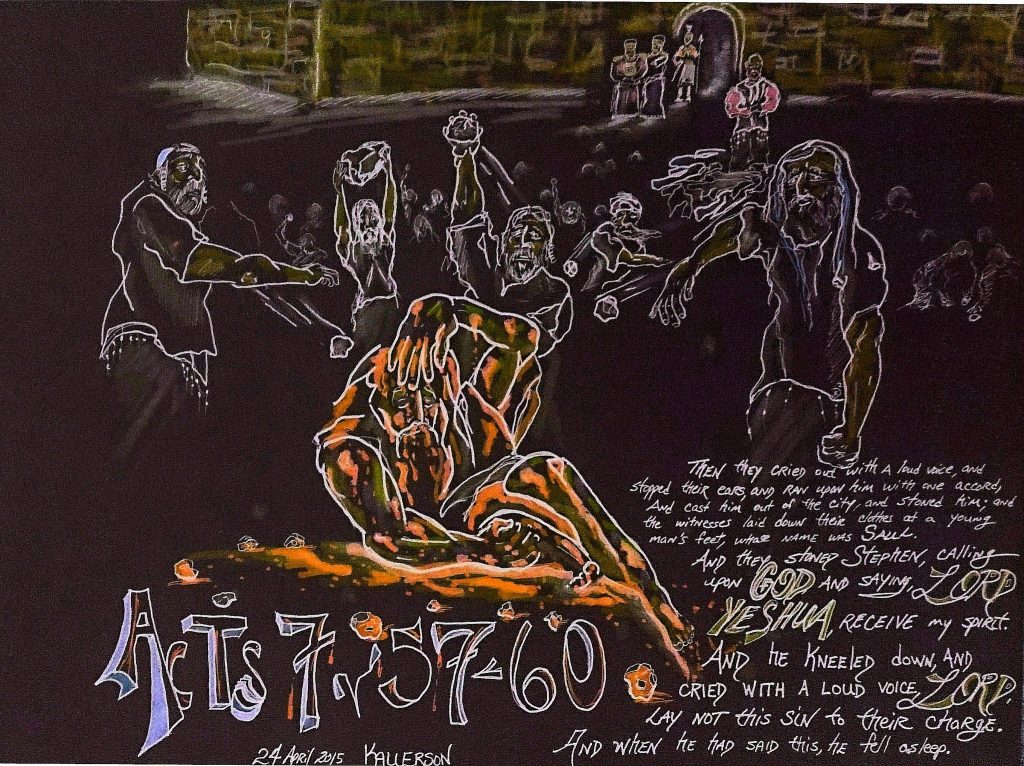
Acts 7:59

Artwork by Doug Kallerson.

Saturday, 4 June 2022

And they stoned Stephen as he was calling on God and saying, “Lord Jesus, receive my spirit.” Acts 7:59

Note: You can listen to today’s commentary courtesy of our friends at “Bible in Ten” podcast. (Click Here to listen).

You can also read this commentary, with music, courtesy of our friends at “Discern the Bible” on YouTube. (Click Here to listen), or at Rumble (Click Here to listen).

The words of this verse are important to consider in their greater context. They are tied directly to verses 55 & 56 and can be understood more clearly by presenting them in this manner –

“But he, being full of the Holy Spirit, gazed into heaven and saw the glory of God, and Jesus standing at the right hand of God, 56 and said, ‘Look! I see the heavens opened and the Son of Man standing at the right hand of God!’ … 59 And they stoned Stephen as he was calling on God and saying, ‘Lord Jesus, receive my spirit.’” Acts 7:55, 56, & 59

There are several points of importance concerning what is said now. The first is that the word “God” is inserted by the translators. The Greek reads –

“And they were stoning Stephen, he was calling and saying…”

As such, there are various ideas about how to rightly translate it. For example, the Pulpit Commentary (among other similar commentaries) says inserting God “is certainly not justified by the context, because the words which follow, ‘Lord Jesus,’ show to whom the invocation was made, even to him whom he saw standing at the right hand of God.”

As such, there are various translations of the words –

While they were stoning him, Stephen prayed, (NIV)
And they stoned Stephen as he was calling on God and saying, (NKJV)
They went on stoning Stephen as he called on the Lord and said, (NASB)

Some stick with the action and leave out the implied object. Some say “God.” Some say “Lord.” And so on. What is obvious is that Stephen is praying to Jesus. That is understood from the previous verses, and it is obvious from the final clause of this verse. To leave the object out is fine. It expresses the Greek. To say “Lord” is clear and precise and it is an exacting expression of what the intent is.

However, the commentaries (such as the Pulpit above) that say that translating this as “God” are incorrect and they fail to consider the intent of the translators. Jesus is the Lord and Jesus is God. By making such a statement, they fail to understand the meaning of “the right hand of God.”

As noted in previous commentaries, this is a statement that confirms Jesus is God, not the other way around. The right hand of God is not a physical position, as if He is sitting (or standing) next to God. It is a way of saying that He is at the position of all of the authority and power of God. By inserting the word “God,” it is thus an acknowledgment of this.

With this understood, and regardless of the three general translations noted above, Stephen continues with, “Lord Jesus, receive my spirit.” This is the second main point of importance. Prayers are to be made to the Lord YHVH, meaning “God” (such as in Psalm 39:12), or simply to God (such as in Psalm 54:2). Any observant Jew would know this. To hear any other prayer would be considered blasphemy –

 “And in all that I have said to you, be circumspect and make no mention of the name of other gods, nor let it be heard from your mouth.” Exodus 23:13

“Therefore be very courageous to keep and to do all that is written in the Book of the Law of Moses, lest you turn aside from it to the right hand or to the left, and lest you go among these nations, these who remain among you. You shall not make mention of the name of their gods, nor cause anyone to swear by them; you shall not serve them nor bow down to them, but you shall hold fast to the Lord your God, as you have done to this day.” Joshua 23:6-8

By invoking the name of Jesus, as he is being stoned, he is explicitly acknowledging that Jesus is the Lord God. The fact that he is being stoned means that the Jews have rejected this notion. Regardless of that, this is the intent of Stephen’s words, and thus it makes this a direct and explicit reference to the deity of Jesus.

The record says that Jesus is the glory of God and that He is at the position of all of the power and authority of God. Stephen then acknowledged that. Stephen then appeals to Jesus in the presence of all of the Jews, invoking His name and calling for Him to do something that only God can do, meaning receive his spirit.

Life application: Those who deny the deity of Christ are without excuse. The record of the Bible leaves no other option than the Father is God, the Son is God, and that the Holy Spirit is also God. As such, there is a Godhead that forms the Trinity.

Stephen’s words now clearly confirm that he understood that Jesus is God, and his calling out His name at the ending of his life is a final, forceful acknowledgment of that. It is another witness against those of his people who disbelieve, and it is a witness against anyone who denies the intent of what he says.

Even if you do not fully grasp the idea of the Trinity, and nobody fully does, you should – by faith – accept that it is what the Bible teaches. Be clear in your thinking and be steadfast in your acknowledgment that Jesus is God.

Glorious God Almighty, You have revealed Yourself in the Person of Jesus. In seeing Him, we are seeing the complete expression of who You are in a manner that we can understand. Thank You for this eternally available view into Your very nature. You have done it! Thank You for what You have done. Thank You for Jesus Christ our Lord. Amen.
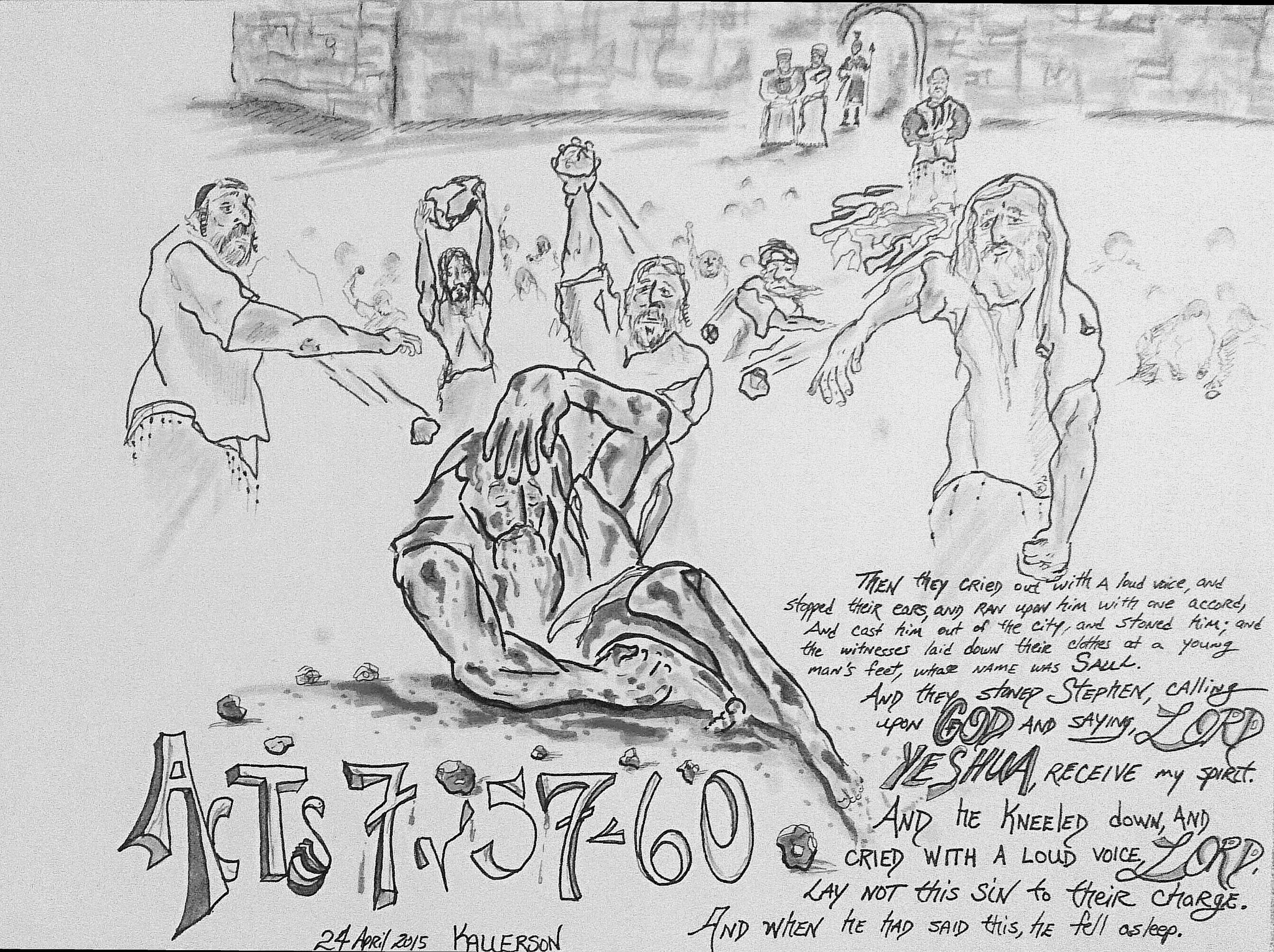
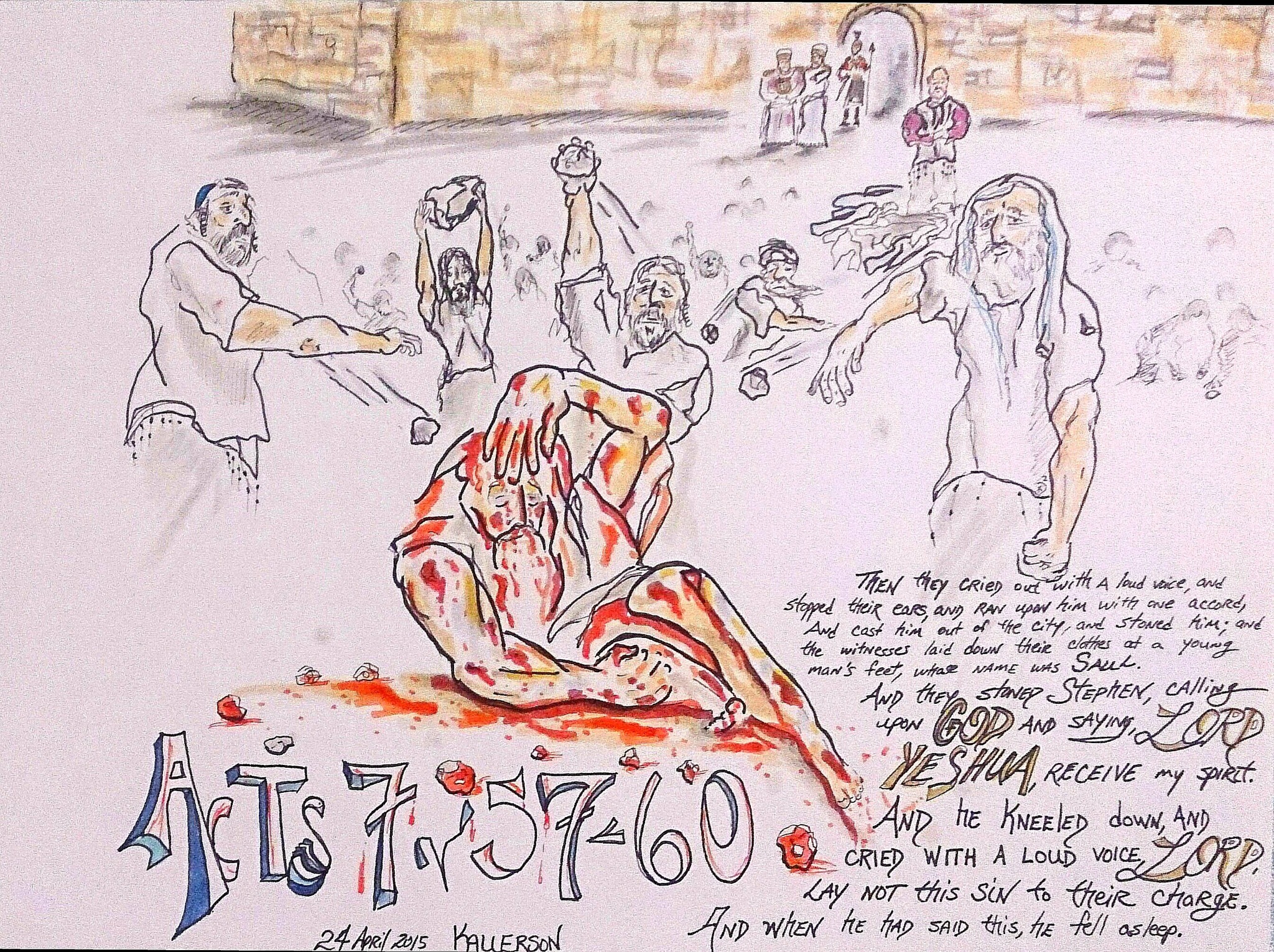


Acts 7:58

Artwork by Doug Kallerson

Friday, 3 June 2022

and they cast him out of the city and stoned him. And the witnesses laid down their clothes at the feet of a young man named Saul. Acts 7:58

Note: You can listen to today’s commentary courtesy of our friends at “Bible in Ten” podcast. (Click Here to listen)

You can also read this commentary, with music, courtesy of our friends at “Discern the Bible” on YouTube. (Click Here to listen), or at Rumble (Click Here to listen).

The previous verse saw the council in a tizzy, and they ran at Stephen with one accord. With that remembered, it now says, “and they cast him out of the city.”

The verb is an aorist participle and should read, “And having cast him out of the city.” One action is taken before the next in a lively description of what occurred. As for the act itself, offenders were to be taken outside of the gates of the city to be stoned. This is not stated in every instance where stoning was outlined as the punishment, but it is generally understood that it was to be so.

This was to show the heinous nature of the crime. It was as if the person was cut off from the community’s favor, blessing, and protection. There are exceptions to this, such as Deuteronomy 22:21 where a certain infraction required a young woman to be stoned at the door of her father’s house. In the case of perceived blasphemy, being taken outside of the city was the appropriate spot for this to take place. As such, it says they cast him outside the city “and stoned him.”

Here, the verb is imperfect. It more correctly reads, “and they were stoning him.” Again, the presentation by Luke is lively and active, detailing it as if the reader is there watching the events unfold.

As for the process of stoning, there are some rabbinic commentaries on the method of stoning that was prescribed, but they may or may not match what Scripture actually says and should be avoided for this reason. When a person was stoned, the general practice would follow that stated in Deuteronomy 13 –

“If your brother, the son of your mother, your son or your daughter, the wife of your bosom, or your friend who is as your own soul, secretly entices you, saying, ‘Let us go and serve other gods,’ which you have not known, neither you nor your fathers, of the gods of the people which are all around you, near to you or far off from you, from one end of the earth to the other end of the earth, you shall not consent to him or listen to him, nor shall your eye pity him, nor shall you spare him or conceal him; but you shall surely kill him; your hand shall be first against him to put him to death, and afterward the hand of all the people. 10 And you shall stone him with stones until he dies, because he sought to entice you away from the Lord your God, who brought you out of the land of Egypt, from the house of bondage. 11 So all Israel shall hear and fear, and not again do such wickedness as this among you.” Deuteronomy 13:6-11

There are variations to the practice (as noted above concerning Deuteronomy 22:21), but the general idea was to symbolically excommunicate the person from the congregation by taking him out of the gates. This would also keep the city from defilement. From there, those who were personally aware of the offense were to be the first to cast the stones, and then all of the people were to join in until the offender was dead.

This could be the accusation that Jesus wrote with His finger in John 8. When they brought the woman caught in adultery to be stoned, they asked Him what should be done. He simply stooped down and wrote. It can only be speculated what He wrote, but it could have been this very law. They had failed in two ways. First, they only brought the woman, not both of them. Secondly, they brought her to the temple, not out to the gates of the city –

“If a young woman who is a virgin is betrothed to a husband, and a man finds her in the city and lies with her, 24 then you shall bring them both out to the gate of that city, and you shall stone them to death with stones, the young woman because she did not cry out in the city, and the man because he humbled his neighbor’s wife; so you shall put away the evil from among you.” Deuteronomy 22:23, 24

With the reason for mentioning that Stephen was taken outside the city understood, the narrative continues, saying, “And the witnesses laid down their clothes.”

The word “clothes” should read “garments.” It is a long flowing outer garment that would inhibit the casting of stones. In other words, these witnesses – meaning those who were to cast the stone first – wanted to ensure they got the maximum amount of effect out of their toss. And so, they would take the outer garment off. The laying down of the clothes is specifically noted to introduce the next person. It is obvious they laid them down in order to cast, but it says they laid them down “at the feet of a young man.”

Vincent’s Word Studies notes that the term “young man” used by Luke “gives no indication of his age, since it is applied up to the age of forty-five. Thirty years after Stephen’s martyrdom, Paul speaks of himself as the aged (Plm 1:9).”

All we can know is that the person standing there watching over the garments is a man less than forty-five years old “named Saul.” This is the first time Saul, later called Paul and who will become the apostle to the Gentiles, is named in Scripture. This act of guarding the clothes of those stoning Stephen is alluded to in Acts 22:20, where Paul speaks of what is now recorded by Luke –

“And when the blood of Your martyr Stephen was shed, I also was standing by consenting to his death, and guarding the clothes of those who were killing him.”

By guarding the clothes of these men, he was agreeing to the execution.

Life application: As you read the Bible, pay attention to the introduction of names or events that seem disconnected from the continuing narrative. Quite often, what is introduced at one point, and which seems to have nothing to do with what is said at the time, is a vital key to knowing where the narrative will soon be going. An example of this is found in Genesis 22.

There, the account of Abraham taking Isaac to be a whole burnt offering to the Lord is given. At the very end of the chapter, it suddenly says –

“Now it came to pass after these things that it was told Abraham, saying, ‘Indeed Milcah also has borne children to your brother Nahor: 21 Huz his firstborn, Buz his brother, Kemuel the father of Aram, 22 Chesed, Hazo, Pildash, Jidlaph, and Bethuel.’ 23 And Bethuel begot Rebekah. These eight Milcah bore to Nahor, Abraham’s brother. 24 His concubine, whose name was Reumah, also bore Tebah, Gaham, Thahash, and Maachah.” Genesis 22:20-24

This family line comes after the account of Abraham and Isaac on Mount Moriah, and before the record of Sarah’s death and burial in Genesis 23. But then the reason for it is realized in Genesis 24:15 when Rebekah is suddenly reintroduced into the ongoing narrative. This instance is not unique, but it happens again and again in the ongoing biblical account.

Pay attention to these introductory clues. The reason for them will be made manifest as you continue along with your reading. The Bible is showing us that it is a logical, orderly, and planned out document that leads in a steady fashion to its ultimate purpose – the coming of the Messiah. Everything in it makes sense when it is taken with that in mind.

What a wonderful treasure of wisdom and order is Your precious word, O God. Thank You for how it is presented, and how it leads slowly and inevitably to the revealing of what is most important of all, meaning the coming of Jesus. Thank You for such wisdom and detail that fills us with the surety that we are truly dealing with Your word. Yes, thank You for this wonderful word. Amen!


Acts 7:57

Artwork by Doug Kallerson.

Thursday, 2 June 2022

Then they cried out with a loud voice, stopped their ears, and ran at him with one accord; Acts 7:57

Note: You can listen to today’s commentary courtesy of our friends at “Bible in Ten” podcast. (Click Here to listen)

You can also read this commentary, with music, courtesy of our friends at “Discern the Bible” on YouTube. (Click Here to listen), or at Rumble (Click Here to listen).

Stephen had just called out, stating that he saw the heavens opened and the Son of Man standing at the right hand of God. It was all the council could take. Stephen was claiming that the Man they had betrayed and handed over to the Romans for crucifixion was now in the position of all authority and power. It would mean that He was the One spoken of by Daniel who would judge them all.

With this, Luke next records, “Then they cried out.” This was probably done for two reasons. The first was to snarl at Stephen some more while accusing him of blasphemy. Secondly, it would have been to drown out any more words from him. Hence, they cried out “with a loud voice.”

One can almost imagine the ruckus of seventy-plus people wildly howling out. It would turn very quickly from a ruling council to an out-of-control mob. Along with crying out in a loud manner, it says they “stopped their ears.”

The verb means “held together.” In other words, they would have folded the bottom of their ears up and tightly held them in place so that they wouldn’t hear any more words. This, together with their crying out, would completely drown out the sound of Stephen’s words. It was a way of demonstrating that they believed his words were blasphemous, and they would no longer tolerate hearing anything he said. In this frenzied state, it next says, “and ran at him with one accord.”

The entire council got up from their seats and came forward as a single tidal wave, rushing upon him and seizing him. Their minds were made up and they would move to take action against the “offender.” But Stephen had seen the heavenly vision. Thus, he was certain that whatever was to happen had divine sanction. He would be unmoved by whatever was to come.

Life application: The early church was heavily persecuted by the leaders of Israel. As Acts continues, it will be seen that the believers were subjected to being arrested, imprisoned, and even executed. This has continued on throughout the church age and throughout the world. The gospel is a point of liberty for the human soul. But leaders often want control over their people. Someone who is free in his soul is not a person that can be easily manipulated into perverse obedience.

This hostility towards believers is quickly rushing upon the people of the United States. Believers are being purged from the military through planned contrivances. This will make the military easier to manipulate. Believers are being openly attacked in their churches because of their opposition to murdering the unborn. Society is being deadened to such things by an unsympathetic news media.

Soon, to stand before others and proclaim the message of Jesus may be a cause for being openly executed, even without a trial. As far-fetched as that sounds, it is no more far-fetched than the current administration openly violating public law with no repercussions for their actions. And yet, it is happening daily. Be ready to take your stand now. Be firm in your convictions, and be prepared to hold fast to your faith, even if the inevitable outcome is death. This may be necessary, so prepare yourselves now for what may lie ahead.

Lord God, it is sad to think that those nations that once proudly proclaimed the good news of Jesus are now almost at complete enmity with that message, but that day has arrived. Give Your people the inner strength to work against this unholy tide and to stand firm on their faith in Your word. It sure is needed in this darkened hour. Amen.


Acts 7:56

Looking up inside capitol dome. San Antonio, Texas.

Wednesday, 1 June 2022

and said, “Look! I see the heavens opened and the Son of Man standing at the right hand of God!” Acts 7:56

Note: You can listen to today’s commentary courtesy of our friends at “Bible in Ten” podcast. (Click Here to listen)

You can also read this commentary, with music, courtesy of our friends at “Discern the Bible” on YouTube. (Click Here to listen), or at Rumble (Click Here to listen).

The previous verse contained Luke’s words describing the situation surrounding Stephen. This verse now describes Stephen’s own words about that situation. When taken together, they read –

“But he, being full of the Holy Spirit, gazed into heaven and saw the glory of God, and Jesus standing at the right hand of God, 56 and said, ‘Look! I see the heavens opened and the Son of Man standing at the right hand of God!’” Acts 755, 56

It is Stephen who saw the glory of God, and Jesus standing at his right hand. With that vision, he exclaimed, “Look!”

The word can be variously translated depending on the surrounding words, but in this instance, it signifies “Behold!” His eyes so clearly saw the vision before him that he must have felt certain everyone else could see it as well, if they just directed their eyes in the same direction. To help them along, he then called out, “I see the heavens opened.”

It was as if what he was looking at was right in front of him. There is no doubt that what he saw was as real as the council members he had been speaking to. And yet, only he would have had the vision. The door to this otherwise unseen realm had been opened wide for him to behold. With this heavenly sight before him, he then says, “and the Son of Man standing.”

This is a term frequently used by Jesus when speaking of Himself. It is most commonly used in the books of Matthew and Luke, but all four gospels use it frequently. And yet, despite it being so commonly spoken by Jesus concerning Himself, this is the only time that the exact term is used outside of the gospels.

In Revelation, John uses the term twice without the article (a Son of Man rather than the Son of Man). Hebrews uses the term in a general way when citing the psalms as well. The term “the Son of Man” speaks more of Jesus’ deity than His humanity, even though it refers to His humanity. In other words, it is a way of saying that despite Him being a human being, He is also fully God.

Hence, this is the reason for Stephen’s proclamation now. He is telling the council just what Jesus had told them on the night before they crucified Him –

“‘Hereafter the Son of Man will sit on the right hand of the power of God.’
70 Then they all said, ‘Are You then the Son of God?’
So He said to them, ‘You rightly say that I am.’
71 And they said, ‘What further testimony do we need? For we have heard it ourselves from His own mouth.’” Luke 22:69-71

The council understood perfectly what Jesus was saying. In claiming that He was the Son of Man, they took it to mean that He is the Son of God – deity. The reference came from their own Scriptures –

“I was watching in the night visions,
And behold, One like the Son of Man,
Coming with the clouds of heaven!
He came to the Ancient of Days,
And they brought Him near before Him.
14 Then to Him was given dominion and glory and a kingdom,
That all peoples, nations, and languages should serve Him.
His dominion is an everlasting dominion,
Which shall not pass away,
And His kingdom the one
Which shall not be destroyed.” Daniel 7:13, 14

Stephen now confirms this to the council, implying that the Man whom they crucified is also the Lord their God, and He now stood in a vision before Stephen “at the right hand of God!”

As noted in the previous commentary, God does not have parts. To say Jesus is at the right hand of God is to say that He is God, with all of His authority, position, and power. The Creator of all things, the One who breathed life into man, the Lord who spoke forth the law at Mount Sinai. And the Son of Man named Jesus, who this council had betrayed and sentenced to His death, is the Risen Messiah who stood from His position of authority to greet the man who would be His first of many martyrs.

Life application: As noted in the previous commentary, the care of the Lord Jesus for His people is wholly and perfectly evident in His standing up to receive Stephen’s martyrdom. Stephen faithfully witnessed to what he knew was true, and he was willing to boldly speak out his words despite whatever the council would decide to do to him.

Are we willing to do the same for the witness of Jesus? How sure are you of your faith in Christ? And how capable are you of telling others about Him? If you received the gospel and were saved, was your life changed? That is a witness all by itself. It is something that testifies to the power of the gospel message.

And what about explaining the weightier matters of your faith? Can you accurately tell people why you believe Jesus is God? Can you explain difficult verses that people use against that notion? Stephen believed with all of his being that Jesus is God. He could not have said what he said otherwise.

Be ready to defend your faith. Be ready to tell others about the wonder that Jesus has brought about in your own life. And be ready to do so even if it will cost you your life. Your faithfulness will receive a full reward when you are brought before this wonderful, tender, caring Savior. He is Jesus.

Lord God, what a sure and blessed hope we possess! Thank You that our faith in Jesus is not dubious or unexplainable. We have a certain hope, and it is one that can be explained to any person, in any culture, and of any language. The gospel has a universal application because it speaks to the very heart of man. Thank You for this wonderful message of hope and reconciliation. Amen.


Acts 7:55

Floor seal under dome of Texas state capitol.

Tuesday, 31 May 2022

But he, being full of the Holy Spirit, gazed into heaven and saw the glory of God, and Jesus standing at the right hand of God, Acts 7:55

Note: You can listen to today’s commentary courtesy of our friends at “Bible in Ten” podcast. (Click Here to listen)

You can also read this commentary, with music, courtesy of our friends at “Discern the Bible” on YouTube. (Click Here to listen), or at Rumble (Click Here to listen).

The words of the previous verse said that upon hearing the words of Stephen, those who heard them “were cut to the heart, and they gnashed at him with their teeth.” With that said, Luke next notes, “But he.”

It is referring to Stephen. He is set in contrast to those who were like enraged animals snarling at him. Instead, it says of him, “being full of the Holy Spirit.”

This was just as promised by Jesus. First, it is a reminder that everything Stephen had said has been under the influence of the Spirit and in accord with His intents –

“Now when they bring you to the synagogues and magistrates and authorities, do not worry about how or what you should answer, or what you should say. 12 For the Holy Spirit will teach you in that very hour what you ought to say.” Luke 12:11, 12

Also, it is an indication that Stephen was covered in the peace that can only come from being filled with the Holy Spirit –

“But the Helper, the Holy Spirit, whom the Father will send in My name, He will teach you all things, and bring to your remembrance all things that I said to you. 27 Peace I leave with you, My peace I give to you; not as the world gives do I give to you. Let not your heart be troubled, neither let it be afraid.” John 14:26, 27

As this is so, it also confirms that this council of leaders did not have the Holy Spirit to guide them. Instead, they stood as enemies of God because of their rejection of Christ. Stephen had said, “You always resist the Holy Spirit” (Acts 7:51). This truth is borne out in the filling of Stephen, of whose words they rejected. As Jesus said –

“If you love Me, keep My commandments. 16 And I will pray the Father, and He will give you another Helper, that He may abide with you forever— 17 the Spirit of truth, whom the world cannot receive, because it neither sees Him nor knows Him; but you know Him, for He dwells with you and will be in you. 18 I will not leave you orphans; I will come to you.” John 14:15-18

Next, in this state of being filled with the Holy Spirit, Luke says that Stephen “gazed into heaven.” It is the natural reaction of someone who is at his wit’s end. As humans, we may look away from something in disgust, we may look down in dejection, or we may look to heaven in hope of relief or to refocus our thoughts on higher things. It is the state that David wrote about –

“My voice You shall hear in the morning, O Lord;
In the morning I will direct it to You,
And I will look up.” Psalm 5:3

Stephen, finding no reassurance in the reaction from the council, lifted his eyes unto heaven “and saw the glory of God.”

It is the hope of the human soul. We look to heaven in hopes of discernment, relief, and stabilization of our thoughts, but we do so not really expecting to see anything but the roof of the building we are in or the expanse of the sky under which we stand. However, Stephen was given the relief for his soul that countless others of the past had hoped to find –

“Unto You I lift up my eyes,
O You who dwell in the heavens.
Behold, as the eyes of servants look to the hand of their masters,
As the eyes of a maid to the hand of her mistress,
So our eyes look to the Lord our God,
Until He has mercy on us.
Have mercy on us, O Lord, have mercy on us!
For we are exceedingly filled with contempt.
Our soul is exceedingly filled
With the scorn of those who are at ease,
With the contempt of the proud.” Psalm 123

In his looking up and beholding the glory of God, we are then given an insight into the exaltation of the Lord Jesus through what Stephen saw. Luke records that he saw the glory of God “and Jesus standing at the right hand of God.”

Several key points can be determined from this. One is that seeing the glory of God does not mean that a person has seen God. Both Paul and John confirm this –

“I urge you in the sight of God who gives life to all things, and before Christ Jesus who witnessed the good confession before Pontius Pilate, 14 that you keep this commandment without spot, blameless until our Lord Jesus Christ’s appearing, 15 which He will manifest in His own time, He who is the blessed and only Potentate, the King of kings and Lord of lords, 16 who alone has immortality, dwelling in unapproachable light, whom no man has seen or can see, to whom be honor and everlasting power. Amen.” 1 Timothy 6:13-16

“No one has seen God at any time. If we love one another, God abides in us, and His love has been perfected in us.” 1 John 4:12

Stephen saw the glory that let him know that God is there, even if He cannot be seen. Another point we can learn from this is one that has already been revealed earlier in Acts where Peter said, “Therefore being exalted to the right hand of God, and having received from the Father the promise of the Holy Spirit, He poured out this which you now see and hear” (Acts 2:33).

To be at the right hand is not a physical location. God does not have parts. Rather, it signifies being at the position of all power and authority. It is a confirmation of the deity of Jesus. He is the physical manifestation of who God is. Through Him, the unseen God becomes knowable and understandable.

Thirdly, it says that this Jesus, who appears in the position of authority and power as He dwells in the glory of God, is standing. Acts has already said that Jesus is seated at the right hand of God (Acts 2:34). It is also recorded several times in the gospels, in Ephesians, and in Hebrews. This then reveals to us that a change has taken place. A potentate will sit on his throne as a sign of rule and authority. For him to rise to a standing position will signify the bestowal of an honor, such as the knighting of a person or the crowning of an authority figure under him. It may even occur as a sign of welcoming someone to whom the king is intimately connected –

“Bathsheba therefore went to King Solomon, to speak to him for Adonijah. And the king rose up to meet her and bowed down to her, and sat down on his throne and had a throne set for the king’s mother; so she sat at his right hand.” 1 Kings 2:19

Jesus, who is at the position of all authority and power, sitting at the right hand of God while dwelling in His glory, arose. It is a sign of welcoming family, of the closest friendship, and of honoring His subordinate. It is to confer a crown – the crown of life – upon him, and to welcome him into his new home. It is the mark of honor to the person whom Scripture will reveal is the church’s first martyr.

Life application: If any set of verses in Scripture shows us the affection of the Lord for His people, it is these verses concerning the coming death of Stephen. The Lord rose to acknowledge the one who would be His first recorded martyr. He will rise again someday when the last saint of the church age is brought into the number to be saved. At that moment, the call will go forth, and the church will be brought to Him.

Jesus is aware of every single person who is His. The deaths of His saints are not only known to Him, but they are being carefully recorded and tallied. Each brings us one count closer to the moment that our faith in Him has promised will come –

“For the Lord Himself will descend from heaven with a shout, with the voice of an archangel, and with the trumpet of God. And the dead in Christ will rise first. 17 Then we who are alive and remain shall be caught up together with them in the clouds to meet the Lord in the air. And thus we shall always be with the Lord. 18 Therefore comfort one another with these words.” 1 Thessalonians 4:16-18

For the Lord to descend from heaven, He must first arise from the place of His sitting. Arise, Lord! Come for Your people. Even so, come, Lord Jesus.

Heavenly Father, You have sent Your Son to complete a mission and to call Him back to Your throne in heaven. But someday, He will arise from that throne to gather His people together. We long for that day, and may it be soon. Until then, give us patience as we live out our lives in hopeful anticipation of that glorious day. Amen.