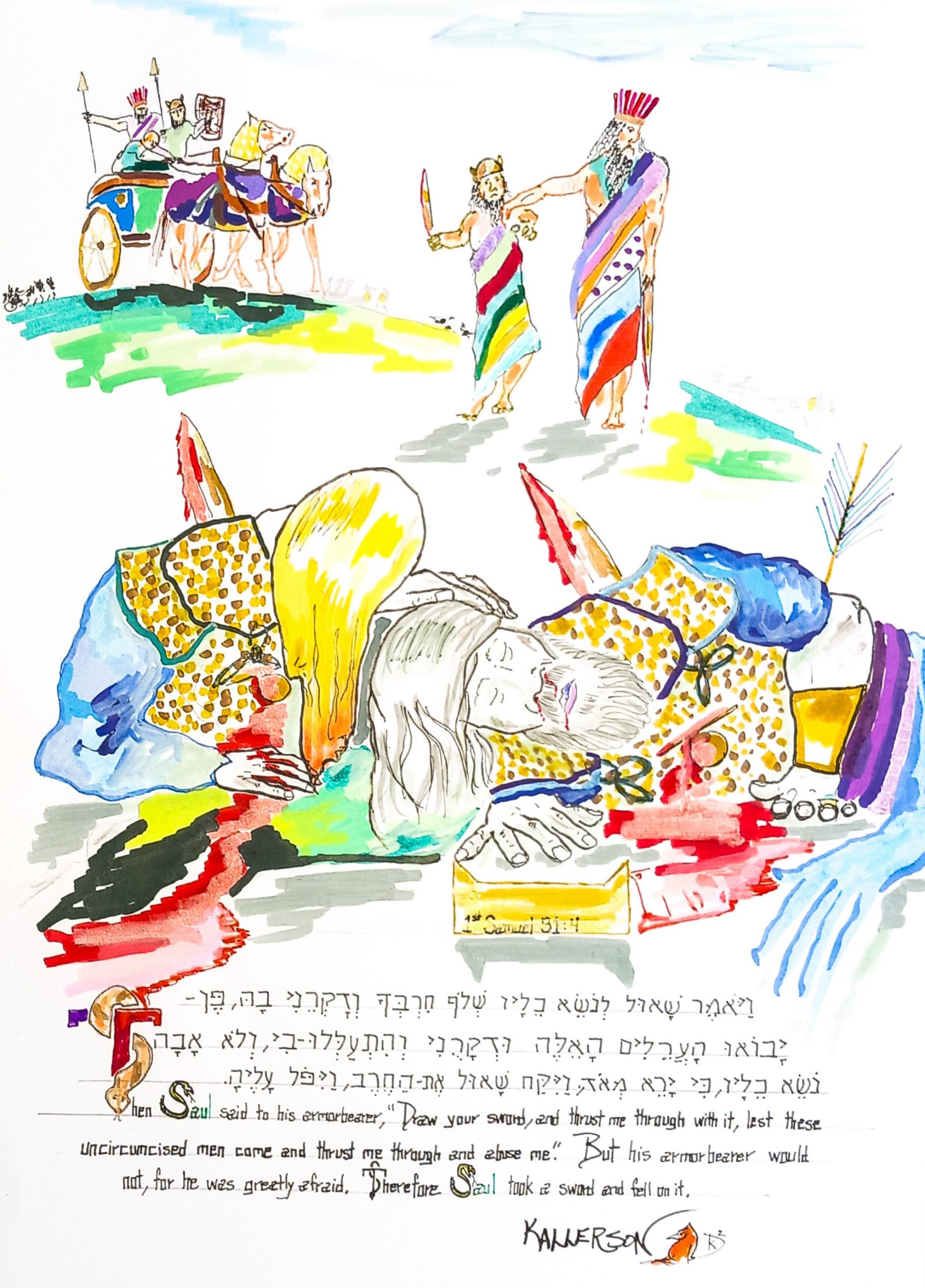
1 Samuel 20:1-16 (The Sone, The Departure, Part I)

Artwork by Douglas Kallerson

1 Samuel 20:1-16
The Stone, the Departure, Part I

(Typed 29 December 2025) One of the curiosities in Scripture, at least to me, is found in these sermon verses. The word khodesh, translated as month, monthly, or new moon, is found two hundred and eighty-three times in the Bible.

The first two times it is used are Genesis 7:11, which refers to “the second month, the seventeenth day of the month.” Numbers 10:10 is the first time the new moon is referred to directly, noting that the trumpet was to be blown over the offerings on various celebratory days, including the new moon.

In Numbers 28:11-15, the new moon offerings are detailed. Later, Numbers 29:1-6 details the offerings mandated for the Feast of Acclamation which, is the first day of the seventh month. Particular offerings were required on that day in addition to the offerings “for the new moon.”

In these 1 Samuel verses, the new moon is mentioned three times as ha’khodesh, the moon, meaning the new moon. The implication from these verses is that it is a set time for feasting. In Amos 8:9, it says –

“When will the New Moon be past,
That we may sell grain?
And the Sabbath,
That we may trade wheat?” Amos 8:9

So, the new moon was a time like the Sabbath when some type of rest was apparently expected. At a minimum, it was a time when selling was not allowed.

The new moon is mentioned by Paul in the New Testament as well. He implies the new moon was some type of day regularly observed like the Sabbath –

Text Verse: “So let no one judge you in food or in drink, or regarding a festival or a new moon or sabbaths, 17 which are a shadow of things to come, but the substance is of Christ.” Colossians 2:16, 17

What I question is where that tradition came from. Other than the mandatory offerings at the temple, which are detailed in Numbers 28, there is nothing in Scripture to define why this day was observed by the general populace, but, if translations are right, it was.

The Topical Lexicon details the new moon history from Scripture. Two of their points say –

“Numbers 28:11-15 prescribes burnt offerings, grain offerings, and a sin offering ‘at the beginning of your months.’ The new moon thus joins Sabbath and festival days as divinely appointed convocations.”

“Saul’s court held a two-day feast at the new moon (1 Samuel 20:5,18,24-27), illustrating the day’s social and royal importance.”

The first point assumes too much for anything beyond the temple offerings. There were other offerings that were made, some every day, that were not observed by the general populace. The second point is correct, but it doesn’t answer anything about why the populace observed them.

Doing something and knowing the reason why it is done are not the same thing. In 2 Kings 4:23, the new moon is mentioned in the same context as the Sabbath, as if it were a particularly designated time, but as noted, there is nothing in the law to prescribe this as there is with the Sabbath.

And so, I find the day curious. Without a basis for why this day was observed by the people, all we are left with is speculation. Having said that, we will explore it in some detail and provide what may be the answer to the matter. One way or another, the new moon (whatever that actually means) was a day for general observance.

A few of the verses have some of the most complicated Hebrew I have encountered. The ungrammatical nature of what is presented is intended to convey a highly troubled state of mind as the words are being spoken.

These and other interesting items are included in this portion of God’s superior word. And so, let us turn to that precious word once again, and… May God speak to us through His word today, and may His glorious name ever be praised.

I. Graciousness in Your Eyes (verses 1-3)

Then David fled from Naioth in Ramah,

vayivrakh David minavoth baramah – “And he bolted, David, from habitations [k.] in the Ramah.” As in Chapter 19, the written and the oral Hebrew are different. The written is debated. It says from habitations, or from Navith, Residence (Strong’s 5121). The same spelling can be considered either way. The oral changes the name to Naioth, which means Habitations.

Thus, the result is the same meaning, but is it a noun or a proper noun? The reason David bolted is that his location has become known. Even though Saul was overwhelmed and lay around prophesying, it is likely he would eventually resume his pursuit of David.

David means Beloved. Navith (or Naioth) means habitations. The Ramah means The Lofty. As for where David bolted to…

1 (con’t) and went and said to Jonathan,

vayavo vayomer liphne yehonathan – “And he came, and he said to ‘faces, Jehonathan’.” Notice that Jonathan’s name goes to the variant spelling, adding in a hey (our h). It is the fifth letter of the aleph-bet and means look, reveal, and breath.

יוֹנָתָ֗ן
יְהוֹנָתָ֜ן

Jonathan will be mentioned twenty-nine times in this chapter. All twenty-nine times, the additional letter will be used. Jehonathan has the same meaning as Jonathan, Yah Has Given.

1 (con’t) “What have I done? What is my iniquity, and what is my sin before your father, that he seeks my life?”

meh asithi meh avoni u-meh khatathi lipne avikha ki mevaqesh eth naphshi – “What I did? What my perversity, and what my sin to ‘faces, your father’ that ‘seeking my soul’?” David proposes his questions to Jonathan, assuming he has heard from Saul the reason for his actions. His threefold set of questions is nothing short of being a threefold denial of any wrongdoing.

In asking the king’s son to identify what he did, meaning any actions against the king, what his perversity is, meaning any attempts of insurrection against Saul or subversion of Saul’s authority, and what his sin is, meaning working against or ignoring the Lord’s anointing of Saul, he is asking Jonathan to confirm or deny such ill intent.

However, no reasonable person would purposefully implicate himself with such questions. Instead, they are an implied confirmation that he had done none of these things. Therefore, the wrongdoing is to be found in Saul, who seeks David’s soul with no valid reason for doing so.

Jonathan, understanding that David’s questions are a declaration of innocence, doesn’t bother responding to them. Instead, he responds to the charge that Saul is seeking to kill David…

So Jonathan said to him, “By no means! You shall not die!

vayomer lo khalilah lo thamuth – “And he said to him, ‘(Surely) Profane! Not you will die.’” By ignoring David’s questions, Jonathan implicitly agrees with the premise that David is innocent. Therefore, there is no reason his father would seek David’s life. He assures him of this. And more…

2 (con’t) Indeed, my father will do nothing either great or small without first telling me.

hineh lo asah avi davar gadol o davar qaton velo yigleh eth azeni – “Behold! To him [k.] he did [k.], my father, word great or word diminutive and not he will denude my ear.” Again, the written and the oral Hebrew don’t agree. The reason is based on a homophone. The word lo means either “to him” or “not” –

לו־ – lo, to him.
לֹֽא־ – lo, not.

With the change, the verb also changes. Therefore, it either says, “To him he did, my father…” or “Not he will do, my father.” All English translations that I know of use the oral, and most scholars agree. However, despite the written being a bit more clunky, the change is unnecessary.

The difference between the two is that Jonathan is saying that Saul will not do anything (past, present, or future) without telling him (the oral). Or he is saying that Saul has not done anything to this point without telling him (the written). As the claim of David’s innocence is based on past actions, there is no need to deviate from the written.

Based on that, Jonathan signifies that David’s deduction about Saul’s intent to kill him cannot be correct. Jonathan assures him he has misread the situation. Therefore…

2 (con’t) And why should my father hide this thing from me? It is not so!

u-madua yastir avi mimeni eth ha’davar ha’zeh ein zoth – “And whatchaknow – he will cause to hide, my father, from me the word, the this?  Naught, this.” This is the first use of madua, whatchaknow, in 1 Samuel. It is a contraction of mah, what, and a shortened form of yada, to know. It is used adverbially to indicate “why,” but whatchaknow gives the same idiomatic sense.

As Saul has not hidden anything from Jonathan in the past, then David’s claim cannot be correct. Despite Jonathan’s assurances, David knows it to be otherwise. Therefore…

Then David took an oath again, and said,

vayishava od David vayomer – “And he was sevened again, David, and he said.” To be sevened means to swear an affirmation, as if seven times. It is the strongest way of confirming a matter. He will also include the name of the Lord in his affirmation.

Saying “again” is a bit perplexing. The word od signifies an iteration. This may be referring to David and Jonathan’s covenant, noted in 1 Samuel 18:3. David is reminding Jonathan of this. As such, his words are covenantally truthful, but he is further swearing to testify to his surety of the matter.

3 (con’t) “Your father certainly knows that I have found favor in your eyes,

yadoa yada avikha ki matsathi khen beenekha – “Knowing, he knew, your father, for I found graciousness in your eyes.” The repetition of the verb is like our saying, “Your father certainly knows that our relationship means he cannot speak any ill about me when you are around.”

In Chapter 18, Jonathan gave David his garments, his sword, his bow, and his belt. Every time David came into Saul’s presence, Saul would be reminded of this bond between David and Jonathan. Therefore…

3 (con’t) and he has said, ‘Do not let Jonathan know this, lest he be grieved.’

vayomer al yeda zoth yehonathan pen yeatsev – “And he said, ‘Not he will know this, Jehonathan, lest he will be carved.’” The word astav means to carve. As such, it conveys the sense of pain, as if one is being cut open. We use the same terminology in English when we say things like, “She carved out my heart when she rejected me.”

Knowing that Jonathan would be pained because of his intent to kill David, Saul kept the matter away from him. That was seen in the exchange between Jonathan and Saul in Chapter 19. Saul could no longer fully confide in Jonathan because of David. David knew this…

3 (con’t) But truly, as the Lord lives and as your soul lives, there is but a step between me and death.”

veulam khai Yehovah vekhe napshekha ki khephesa beni u-ven ha’maveth – “And, however, alive Yehovah, and alive your soul, for ‘according to stride’ between me and between the death.” A unique word is seen here, pesa, a stride, meaning a single step. It is derived from the verb pasa, to stride, which is only found in Isaiah 27:4.

We use the same terminology to this day, saying things like “a step away from calamity,” “a step away from the answer,” etc. It means that the result of an action is imminent, like taking our next step. Also, David personifies death, saying “the death.”

It is as if Mr. Death were following hard after him, just a step away. If David wasn’t attentive, he would be overtaken by him. Finally cluing in to the gravity of David’s words, because of his adjuration, Jonathan concedes…

Into a covenant with the Lord we have been brought
When we called on the name of Jesus
Our souls from the grip of Satan have been bought
See what great things God has done for us

A covenant of the Lord comes with His guarantee
When we unite with Him through faith in Jesus
The sealing of the Spirit reflects this certainty
Oh! What great things He has done for us

Oh God, we thank You for the shed blood
The precious blood of our Lord, Christ Jesus
We are sealed ‘neath the crimson flood
What wonderful things You have done for us

II. Sacrifice the Days (verses 4-9)

So Jonathan said to David, “Whatever you yourself desire, I will do it for you.”

vayomer yehonathan el David mah tomar naphshekha veeeseh lakh – “And he said, Jehonathan, unto David, ‘What it will say, your soul, and let me do to you.’” Jonathan is convinced and offers his total commitment to help in any manner David desires. This is an implied form of personal rebellion against Saul. As for what David desires…

And David said to Jonathan, “Indeed tomorrow is the New Moon, and I should not fail to sit with the king to eat.

vayomer David el yehonathan hineh khodesh makhar veanokhi yashov eshev im ha’melekh leekhol – “And he said, David, unto Jehonathan, ‘Behold! Renewal tomorrow. And I myself, sitting I will sit with the king to eat.” David notes the coming of the Renewal. As noted in the introduction, it is a time set apart in Numbers for sacrifice at the temple.

The translation as New Moon is an explanation of the word khodesh, where the moon is made new. It literally means renewed, coming from khadash, to renew, as in “new again,” not just “restored.” When speaking of the first of the month, it is rightly to be capitalized to offset it. To avoid misunderstanding, using the term Renewal makes the word understandable.

However, without any explanation elsewhere as to why, David understands that he was to be present at a meal with the king at this time. If this refers to the monthly first day of the month, we are not told if this was a nationwide practice or something the king ordered for his people. Regardless, David’s presence was expected…

5 (con’t) But let me go, that I may hide in the field until the third day at evening.

veshilakhtani venistarti vasadeh ad ha’erev hashelishith – “And you sent me, and I was hidden in the field until the evening, the third.” David cannot arbitrarily avoid being at this meal. But in asking Jonathan to send him, it provides him with a legitimate excuse to not be in attendance.

Noting that he would be there until the third day at evening seems to imply a two-day feast was ordained. One day was to usher in the new moon, the second would be to acknowledge it was over.

I suggest that the Renewal here doesn’t mean this feasting occurred every month, but that this is specifically the seventh month. In Leviticus 23, it says –

“Then the Lord spoke to Moses, saying, 24 ‘“Speak to the children of Israel, saying: ‘In the seventh month, on the first day of the month, you shall have a sabbath-rest, a memorial of blowing of trumpets, a holy convocation. 25 You shall do no customary work on it; and you shall offer an offering made by fire to the Lord.’” Leviticus 23:23-25

Thus, “Renewal tomorrow,” could be a reference to this particular day in the year, which happened to be on the day of the Renewal. It is something we do today with New Year’s Day. We might say, “Tomorrow is New Year’s Day,” or “Tomorrow is the first of January.” In the latter, the fact that it is New Year’s Day is implied.

This explanation aligns with what is said next…

If your father misses me at all,

im paqod yiphqedeni avikha – “If visiting, he will visit me, your father.” To visit signifies many things in Scripture. One can visit the troops, meaning muster them. It can also signify counting the number of people, such as mustered troops.

In this case, it means that Saul has his attention on David, as if he counted those at the table, came to David’s empty chair, and considered his absence. Perhaps he asked about where David was. Being the king’s son-in-law, it would be expected of him to be in attendance on a special feast day, such as the Feast of Acclamation. If Saul were to ask…

6 (con’t) then say, ‘David earnestly asked permission of me that he might run over to Bethlehem, his city, for there is a yearly sacrifice there for all the family.’

veamarta nishol nishal mimeni David laruts beith lekhem iro ki zevakh ha’yamin sham lekhal ha’mishpakhah – “and you said, ‘Being asked, he was asked ‘from with me’, David, to run – Bethlehem, his city. For ‘sacrifice, the days’ there to all the family.’” If this is the Feast of Acclamation, it would explain why everyone was resting, sacrificing, and feasting.

It was mandated as a holy convocation in Leviticus 23. This would be a time when families and entire communities gathered, blew trumpets, and rejoiced. In fact, this may explain some of the unusual examples of the use of the term in both testaments.

Rather than it being only a monthly event, the word would, at times, be used synonymously with “New Year,” where the khodesh, Renewal, is referring to the one day appointed in Leviticus 23 that falls on both the day of the new month and the first day of the regal year.

If so, Paul’s use of the word in the singular in Colossians 2:16, 17 would be speaking of one celebration each year, not one each month. These are points of speculation, but they answer all the questions about this otherwise misunderstood day.

We do know that the first of each month was a time for sacrificing at the temple, such as in Ezekiel 45:17. On the other hand, the first of the seventh month was a particular New Moon that was set apart from the others as a special observance by all the people.

Bethlehem is from beith, house, and lekhem, bread. It means House of Bread. It bears a secondary meaning of House of Battle because when soldiers engage in battle (lakham), they consume or are consumed as food.

Whatever is intended here concerning the Renewal, I lean toward this referring to the first day of the seventh month, which is known as the Feast of Acclamation. David’s words to Jonathan continue…

If he says thus: ‘It is well,’ your servant will be safe.

im koh yomar tov shalom leavdekha – “If thus, he will say, ‘Good,’ peace to your servant.” If Saul questioned David’s seat being empty, Jonathan was to give the excuse that David asked him to go to his city for the annual sacrifice. If Saul accepted that, saying, “Good,” then David had misunderstood the events, and he was ok in Saul’s eyes. On the other hand…

7 (con’t) But if he is very angry, be sure that evil is determined by him.

veim kharoh yekhereh lo da ki kalethah ha’raah meimo – “And if burning, it will burn to him, you must know for it finished, the evilness, from with him.” If Saul blew a gasket over David’s absence, he intended to harm to him. Saying, “it finished, the evil,” means that Saul’s intention to harm David was fully fleshed out, and the matter was set in his mind.

Therefore you shall deal kindly with your servant, for you have brought your servant into a covenant of the Lord with you.

veasitha khesed al avdekha ki bivrith Yehovah hevetha eth avdekha imakh – “And you did kindness upon your servant, for in ‘covenant, Yehovah’ you caused to bring your servant with you.” Although 1 Samuel 18:3 doesn’t mention the Lord, it is now implied that the covenant made between the two was either made in the Lord’s name or understood that, as a covenant, the Lord was a Witness to it. Either way, David reminds Jonathan that he initiated the covenant, bringing David into it, uniting the two in faithful allegiance. As such, David makes a solemn request…

8 (con’t) Nevertheless, if there is iniquity in me, kill me yourself,

David’s words are emphatic: veim yesh bi avon hamitheni atah – “And if exists in me perversity, you must cause to kill me, you.” If anything David said in verse 1 was true based on the oath that they had made, David calls on Jonathan to personally kill him. He was not to allow the matter to go beyond himself…

8 (con’t) for why should you bring me to your father?”

vead avikha lamah zeh tevieni – “And unto your father, to why this you must cause to bring me?” The “why this” refers to any matter of perversity found in David. It is an insufficient reason to allow Saul to take vengeance on him. Rather, the matter should be settled by Jonathan. David appeals to the covenant as binding in this matter.

But Jonathan said, “Far be it from you!

The intent is just the opposite: vayomer yehonathan khalilah lakh – “And he said, Jehonathan, ‘(Surely) Profane to you!” It would be like us saying, “No way, Jose,” or maybe, “You’re off your rocker!” Jonathan conveys that by all means, he trusts that David is not an offender. Rather…

9 (con’t) For if I knew certainly that evil was determined by my father to come upon you, then would I not tell you?”

ki im yadoa eda ki kalethah ha’raah meim avi lavo alekha velo othah agid lakh – “For if knowing I will know that it ‘finished, the evilness, from with my father’ to come upon you, and not, it, I will cause to declare to you?’” Jonathan is assured of David’s innocence. What he was unsure of was David’s claim that Saul wanted to kill him.

However, by the end of verse 3, he was convinced that David was probably right. The matter would be determined by Saul’s attitude while at the evening meal. If, in fact, Saul was wholly determined to kill David, despite him being innocent (of which Jonathan was certain), he would definitely let David know, hiding nothing from him. Therefore…

Deal kindly with us forever, O God
And we know that You will, because of Your love for us
In this earthly life as we trod
And throughout eternity – all because of Jesus

We have entered into the covenant of the Lord
We have been saved through the blood of Jesus
Redeemed from the law’s bitter sword
What a glorious thing You have done for us

Thank You, O God, that we are set free
To worship You in spirit and in truth
Endless ages before the glassy sea
Eternally in the day of our youth

Thank You, O God, for Jesus Christ our Lord
Hallelujah to the Lamb, God’s eternal Word

III. Until Vanishment (verses 10-16)

10 Then David said to Jonathan, “Who will tell me, or what if your father answers you roughly?”

If this is one sentence, the words are ungrammatical. If it is two, it is still very complicated. My proposal, which can’t be any worse than the others, is that it is two questions followed by one exclamation: vayomer David el yehonathan mi yagid li o mah yaankha avikha qashah – “And he said, David, unto Jehonathan, ‘Who he will cause to declare to me? Or what he will answer you, your father? Severe!’”

In other words, both questions of David are essentially rhetorical. First, Jonathan can’t send a messenger without risking it getting back to Saul. The old saying that fits is, “If one person knows, it’s a secret. If two know, it’s a risk. And if three know, it’s almost impossible to keep.”

Second, David is worried about Jonathan being involved. Saul tried to pin David to the wall twice. Would Jonathan fare any better if Saul thought he was covering for David? Saul already agreed that Jonathan should die over tasting a bit of honey. How much more would his life be in peril over taking David’s side?

Jonathan understands and develops a plan in his mind…

11 And Jonathan said to David, “Come, let us go out into the field.” So both of them went out into the field.

vayomer yehonathan el David lekhah venetse ha’sadeh vayetseu shenehem ha’sadeh – “And he said, Jehonathan, unto David, ‘You must (surely) walk, and let us go – the field.’ And they went out, they two – the field.” Jonathan wants David to understand the layout of the plan that will avoid any severe consequences in communicating what transpired between him and Saul.

Once in the field, more complicated verses follow…

12 Then Jonathan said to David: “The Lord God of Israel is witness!

vayomer yehonathan el David Yehovah elohe Yisrael – “And he said, Jehonathan, unto David, ‘Yehovah, ‘God, Israel’!” The words are understood by almost all translations to mean something like, “As God is my witness.” His words are similar to where it elsewhere says, “Alive Yehovah!” A solemn adjuration is being made. The next words continue to be mostly understood.

12 (con’t) When I have sounded out my father sometime tomorrow, or the third day,

The NKJV says when and then starts inserting stuff that confuses what is said: ki ekhqor eth avi kaeth makhar ha’shelishith – “For I will penetrate my father according to the time tomorrow, the third.” This issue was already raised in verse 5. David was to be at the king’s table for the meal that accompanied the Renewal. During that time, Saul may question where David is. If so…

12 (con’t) and indeed there is good toward David, and I do not send to you and tell you,

Because of all the insertions, most translations completely divert from the intent. The NASB and a few others are close: vehineh tov el David velo az eshlakh elekha vegalithi eth azenekha – “And behold! Good unto David, and not then I will send unto you, and I denuded your ear?’” It is two clauses, a question, and a statement.

The NASB gives the sense, but incorrectly makes it all one question, saying, “if he has a good feeling toward you, shall I not then send word to you and inform you?”

The verse is actually Jonathan making a vow, agreeing to David’s plans about the feast, followed by his rhetorical question, “And not then will I send unto you?” This means he will do so. And then, he expresses that he will denude David’s ear, meaning that he will explain that all is ok. However…

13 may the Lord do so and much more to Jonathan. But if it pleases my father to do you evil,

Because of all their insertions, the NKJV (et al) takes this as a finishing of the previous thought. That is incorrect. Rather, it begins the next thought: koh yaaseh Yehovah lihonathan vekhoh yosiph ki yetiv el avi eth ha’raah alekha – “Thus He will do, Yehovah, to Jehonathan, and thus He will cause to add, that he will cause to accept unto my father the evilness upon you.”

Jonathan has essentially called a curse down upon himself should he accept it if his father intends evil to come upon David. No matter what happens, he will get word to David of his father’s evil intent. If Saul intends to harm him…

13 (con’t) then I will report it to you and send you away, that you may go in safety.

vegalithi eth azenekha veshilakhtikha vehalakhta leshalom – “And I denuded your ear, and I sent you, and you walked to peace.” Jonathan promises to personally reveal to David exactly what Saul intends. After that, he will send David off, allowing him to go in peace. In his going…

13 (con’t) And the Lord be with you as He has been with my father.

vihi Yehovah imakh kaasher hayah im avi – “And may He be, Yehovah, with you according to He was with my father.” Not only will Jonathan send David off peacefully, but he will send him off with a kingly blessing, as he understands that the kingdom will transfer to David.

14 And you shall not only show me the kindness of the Lord while I still live, that I may not die;

The words are about as complicated as any to be found. Ellicott speaks for most scholars, saying, “The Hebrew of this and the next verse is again very confused, abrupt, and ungrammatical, but this is evidently to be attributed to the violent emotion of the speaker.”

It is evident that Jonathan is in great distress and is blurting out his thoughts abruptly and emotionally. Some find the words entirely impossible to understand. However, if understood as emotionally charged, they do make sense: velo im odeni khai velo taaseh imadi khesed Yehovah velo amuth – “And not, if I yet alive, and not you will do with me ‘kindness, Yehovah’? And not I will die.”

Jonathan has essentially ceded the kingdom to David in his mind. He knows David’s ascendency is inevitable and that he will never be king. But he doesn’t want to be faced with execution by a new king as might be expected, especially because of his love for David and the covenant they made. Therefore, this is the sense of his overwhelmed words:

“As long as I am alive, won’t you bestow the mercy of Yehovah upon me? In doing this, I won’t be executed by you.”

Understanding the threefold “and not” is how to rightly interpret the words –

And not… (sob)
If I am still alive… (gasp)
And not (won’t you be sure to) you will do with me kindness Yehovah? (sob)
And not (be sure to remember this) I will die (by your hand).

Understanding this, he continues…

15 but you shall not cut off your kindness from my house forever,

velo takhrith eth khasdekha meim beithi ad olam – “And not you will cause to cut your kindness from ‘with my house’ until vanishment.” Jehonathan not only asks for mercy upon himself, but for mercy upon his house, which includes his descendants after him, forever. As long as the house of David exists, he asks for mercy upon his own house so that his name will not perish.

15 (con’t) no, not when the Lord has cut off every one of the enemies of David from the face of the earth.”

The words are again very complicated. Despite being a complete paraphrase, the NKJV gives the sense: velo behakhrith Yehovah eth oyeve David ish meal pene ha’adamah – “And not, in cause to cut, Yehovah, ‘hatings, David’ – man from upon ‘faces, the ground’.” The meaning is that as the king, Yehovah will naturally give David’s enemies, his hatings, into his hand, causing them to be cut off.

Even if these enemies include Jonathan’s house, he is asking for mercy to be extended to them. Said plainly, “When all the king’s enemies have been obliterated, please spare my house.” This is his pained request…

16 So Jonathan made a covenant with the house of David,

vayikhroth yehonathan im beith David – “And he cut, Jehonathan, with ‘house, David’.” The meaning is that “he cut a covenant.” This was based on his words petitioning for grace.

Jonathan will fulfill his words to David, ensuring that Saul will not be able to put his hand on him. Likewise, David has covenanted to ensure that the house of Jonathan will continue without being cut off.

*16 (fin) saying, “Let the Lord require it at the hand of David’s enemies.”

u-viqesh Yehovah miyad oyeve David – “(And He sought, Yehovah, from ‘hand, hatings David’.)” This is not something Jonathan said, as the NKJV implies. The words are most likely those of the narrator, confirming that the Lord sought what Jonathan had covenanted with David, requiring it at the hand of David’s enemies.

Despite plenty of complicated ideas and wording, the overall intent of the passage is readily understandable, even from a paraphrase. Translations may lack correctness with the nuances, but that shouldn’t overly concern us unless we are looking for typology.

Then we need to be more precise to understand what is being conveyed. What is certain is that the bond between Jonathan and David is guaranteed to last as long as David’s kingdom lasts. That alone should help us understand what is going on in the passage.

Despite Saul’s attempts at killing David, and any future troubles that may arise in David’s house, the bond between these two houses will last. If we take that understanding, based on a covenant between two men before the Lord as binding, how much more should we consider the covenant between the Lord and His people as binding!

It is true that Israel failed at pretty much every step of their history in complying with the covenant, but the Lord never failed to uphold every single word of wh?t He said he would do for Israel, both positively in blessing and negatively in executing the curses.

And through it all, He has faithfully maintained them, just as He said He would. Now, with the introduction of the New Covenant, we have an even surer hope. This covenant was not enacted with the blood of bulls and goats, but in the precious blood of Jesus Christ.

Therefore, when we enter into the covenant through faith in what Christ has done, the Lord will never fail to uphold what He has promised. The salvation He has given us is as fixed and permanent as Israel as people is before His eyes.

When we mess up, He will be there to carry us through, despite ourselves. When we are faithful and obedient, He will faithfully credit that to our accounts for the day we stand before Him.

Reading about the surety of the faithfulness to the covenant between Jonathan and David is intended to have us consider the greater surety we possess. Hold fast to this thought. Jesus has you! He will never leave you nor forsake you.

It is a great and enduring promise we possess. Thank God for His faithfulness to us! Hooray for Jesus, who has made this possible.

Closing Verse: “If we are faithless,
He remains faithful;
He cannot deny Himself.” 2 Timothy 2:13

Next Week: 1 Samuel 20:17-33 When alone and your hearture really pains you… (The Stone, the Departure, Part II) (44th 1 Samuel sermon)

The Lord has you exactly where He wants you. He has a good plan and purpose for you. He is the One who abases the haughty and exalts the humble. He regards the lowly, and the proud, He knows from afar. So yield yourself to Him, trust Him, and believe His word. In this, He will do great things for you and through you.

1 Samuel 20:1-16 (CG)

20 And he bolted, David, from habitations [k.] in the Ramah. And he came, and he said to faces Jehonathan, “What I did? What my perversity, and what my sin to faces your father that seeking my soul?’”

2And he said to him, “(Surely) Profane! Not you will die. Behold! To him [k.] he did [k.], my father, word great or word diminutive and not he will denude my ear. And why he will cause to hide, my father, from me the word, the this? Naught, this.”

3And he was sevened again, David, and he said, “Knowing, he knew, your father, for I found graciousness in your eyes. And he said, ‘Not he will know this, Jehonathan, lest he will be carved.’ And, however, alive Yehovah, and alive your soul, for according to stride between me and between the death.”

4And he said, Jehonathan unto David, “What it will say, your soul, and let me do to you.”

5And he said, David unto Jehonathan, “Behold! Renewal tomorrow. And I, sitting I will sit with the king to eat. And you sent me, and I was hidden in the field until the evening, the third. 6If visiting, he will visit me, your father, and you said, ‘Being asked, he was asked from among me, David, to run – Bethlehem, his city. For sacrifice the days there to all the family.’ 7If thus, he will say, ‘Good,’ peace to your servant. And if burning it will burn to him, you must know for it finished, the evil, from with him. 8And you did kindness upon your servant, for in covenant Yehovah, you caused to bring your servant with you. And if exists in me perversity, you must cause to kill me, you. And unto your father, to why this you must cause to bring me?”

9And he said, Jehonathan, “(Surely) Profane to you! For if knowing I will know for it finished, the evil, from with my father to come upon you, and not, it, I will cause to declare to you?”

10And he said, David unto Jehonathan, “Who he will cause to declare to me? Or what he will answer you, your father? Severe!”

11And he said, Jehonathan, unto David, “You must (surely) walk, and let us go – the field.” And they went out, they two – the field. 12And he said, Jehonathan, unto David, “Yehovah God Israel! For I will penetrate my father according to the time tomorrow, the third. And behold! Good unto David, and not then I will send unto you, and I denuded your ear?” 13Thus He will do, Yehovah, to Jehonathan, and thus He will cause to add, for he will cause to accept unto my father the evil upon you. And I denuded your ear, and I sent you, and you walked to peace. And may He be, Yehovah, with you according to He was with my father. 14And not, if I yet alive, and not you will do with me kindness Yehovah? And not I will die. 15And not you will cause to cut your kindness from with my house until vanishment. And not, in cause to cut, Yehovah, hatings David – man from upon faces the ground.” 16And he cut, Jehonathan, with house David, (And He sought, Yehovah, from hand hatings David.)


1 Samuel 20:1-16 (NKJV)

Then David fled from Naioth in Ramah, and went and said to Jonathan, “What have I done? What is my iniquity, and what is my sin before your father, that he seeks my life?”

So Jonathan said to him, “By no means! You shall not die! Indeed, my father will do nothing either great or small without first telling me. And why should my father hide this thing from me? It is not so!

Then David took an oath again, and said, “Your father certainly knows that I have found favor in your eyes, and he has said, ‘Do not let Jonathan know this, lest he be grieved.’ But truly, as the Lord lives and as your soul lives, there is but a step between me and death.”

So Jonathan said to David, “Whatever you yourself desire, I will do it for you.”

And David said to Jonathan, “Indeed tomorrow is the New Month, and I should not fail to sit with the king to eat. But let me go, that I may hide in the field until the third day at evening. If your father misses me at all, then say, ‘David earnestly asked permission of me that he might run over to Bethlehem, his city, for there is a yearly sacrifice there for all the family.’ If he says thus: ‘It is well,’ your servant will be safe. But if he is very angry, be sure that evil is determined by him. Therefore you shall deal kindly with your servant, for you have brought your servant into a covenant of the Lord with you. Nevertheless, if there is iniquity in me, kill me yourself, for why should you bring me to your father?”

But Jonathan said, “Far be it from you! For if I knew certainly that evil was determined by my father to come upon you, then would I not tell you?”

10 Then David said to Jonathan, “Who will tell me, or what if your father answers you roughly?”

11 And Jonathan said to David, “Come, let us go out into the field.” So both of them went out into the field. 12 Then Jonathan said to David: “The Lord God of Israel is witness! When I have sounded out my father sometime tomorrow, or the third day, and indeed there is good toward David, and I do not send to you and tell you, 13 may the Lord do so and much more to Jonathan. But if it pleases my father to do you evil, then I will report it to you and send you away, that you may go in safety. And the Lord be with you as He has been with my father. 14 And you shall not only show me the kindness of the Lord while I still live, that I may not die; 15 but you shall not cut off your kindness from my house forever, no, not when the Lord has cut off every one of the enemies of David from the face of the earth.” 16 So Jonathan made a covenant with the house of David, saying, “Let the Lord require it at the hand of David’s enemies.”


1 Samuel 19:15-24 (He Set His Soul in His Palm, Part II)

Artwork by Douglas Kallerson

1 Samuel 19:15-24
He Set His Soul in His Palm, Part II

(Typed 22 December 2025) In 1 Samuel, there have been six times that indicate a “spirit” came upon Saul to replace the Spirit of the Lord that once rested upon him. The word used to describe this spirit is ra’ah, evil.

Most translations go with that and say, “evil spirit.” Attempting to get around the obvious theological difficulty of God sending an evil spirit, some change the wording to “distressing spirit” or something similar.

That conveniently changes the intent, but it doesn’t resolve what the Hebrew says. A couple of times, it specifically says that this was an evil spirit “from God.” In 1 Samuel 19:9, it said –

“Now the distressing spirit from the Lord came upon Saul as he sat in his house with his spear in his hand. And David was playing music with his hand.” (NKJV)

Saying this was an evil (or distressing) spirit from the Lord is such a difficult thing to accept that Charles Ellicott said in his commentary for 1 Samuel 19:9 –

“The LXX. [the Greek translation of the Old Testament] was offended at the statement “evil spirit of (or from) Jehovah,” and cuts the knot by leaving out “Jehovah.” It is, no doubt, a hard saying, and no human expositor has ever yet been able fully to explain it.” Charles Ellicott

I don’t know if anyone else has evaluated this thought as I did, but I can find no translation that uses the word breath rather than spirit. Extensive explanation for this was given in the analysis of 1 Samuel 16, and it fully explains the matter.

Text Verse: “But you must continue in the things which you have learned and been assured of, knowing from whom you have learned them, 15 and that from childhood you have known the Holy Scriptures, which are able to make you wise for salvation through faith which is in Christ Jesus.” 2 Timothy 3:14, 15

There is so much going on in Scripture that none of us will ever be able to fully understand it all. Just when we think we have a passage figured out, someone comes along and adds in some little nugget we never even considered.

However, the more we are in the Bible, reading it, contemplating it, and meditating on it, the more we will be able to grasp the truths contained in it. I would caution you not to get stuck on a single translation.

So far in this chapter, we have already come across numerous errors in the NKJV that follow blunders in the KJV. When comparing the Hebrew with the English, more inconsistencies are seen.

It isn’t that there are just translational errors, but there are missing words necessary to understand typology, faulty structure in the English, which leads to misunderstanding the intent, and other errors to be found in translations.

By reading more than one translation and checking against the original, which is not difficult with modern technology, the word can be more readily evaluated and understood. The more time you put into the word, the greater the reward you will receive from it.

This grand truth is specifically taught in His superior word. And so, let us turn to that precious word once again, and… May God speak to us through His word today, and may His glorious name ever be praised.

I. He Was Eluded (verses 15-18)

15 Then Saul sent the messengers back to see David,

vayishlakh shaul eth ha’malakhim liroth eth David – “And he sent, Saul, the messengers to see David.” There is a literary gap between verses 14 and 15. Saul sent the messengers to take David. Michal said he was sick. Without any explanation of their return and report, Saul again sends them –

14And he sent, Saul, messengers to take David. And she said, “Rubbed he.”
15And he sent, Saul, the messengers to see David…

This abruptness of the narrative suggests that Saul didn’t trust his daughter’s testimony. He senses a conspiracy in relation to everything associated with David, whether it is him personally, Jonathan, his son, or Michal, his daughter. This extends to all who interact with David.

Saul means Asked. David means Beloved.

15 (con’t) saying, “Bring him up to me in the bed,

lemor haalu oto vamitah elay – “to say, ‘You must cause to ascend him in the bed unto me.’” Saul doesn’t care if Michal’s words are true. He intends to have David brought to him, even if he is on his sick bed. Being sick was the least of David’s worries at this point…

15 (con’t) that I may kill him.”

lahamitho – “to cause to kill him.” Saul intended to be rid of David that day. He had become completely possessed by this desire.

16 And when the messengers had come in, there was the image in the bed, with a cover of goats’ hair for his head.

vayavou ha’malakhim vehineh ha’teraphim el ha’mitah u-khevir ha’izim merashotav – “And they went, the messengers. And behold! The teraphim unto the bed, and ‘quilt, the goats’ – his headpieces.” The personal inspection of “David” reveals an embarrassing situation. Michal has been dishonest toward her own father for David’s sake. Her ruse delayed his capture, allowing David a lengthy head start in his escape.

17 Then Saul said to Michal, “Why have you deceived me like this, and sent my enemy away, so that he has escaped?”

vayomer shaul el mikhal lamah kakhah rimithini vateshalekhi eth oyevi vayimalet – “And he said, Saul, unto Michal, ‘To why just so you hurled me, and you sent my hating, and he was eluded?’” We can be sure that Michal had heard of Saul’s determination to kill Jonathan when he thought Jonathan’s tasting of the honey in the forest caused the Lord to turn away from responding to Saul’s petitions (1 Samuel 14:36-45).

If he was willing to allow Jonathan to be executed over such dubious circumstances, Michal would know her life was one misspoken word away from ending.

Genesis 2:24 explains that a man and a woman become one flesh. This is a bond above the allegiances a person has toward his parents, but this would not be acceptable in Saul’s mind.

Michal means Who Is Like God. Her fear was great enough to lie to her own father, therefore…

17 (con’t) And Michal answered Saul, “He said to me, ‘Let me go! Why should I kill you?’”

Her response is emphatic: vatomer mikhal el shaul hu amar elay shalekhini lamah amithekh – “And she said, Michal, unto Saul, ‘He, he said unto me, “You must send me! To why I will cause to kill you?”’” The emphasis, combined with the emphatic verb, “You must send me,” is a plea for leniency. “I know it was wrong, but my life was threatened. It’s all his fault. Daddy, he was going to kill me!”

Despite lying, anything less would have ended badly for her. In the meantime..

18 So David fled and escaped, and went to Samuel at Ramah,

Rather: vedavid barakh vayimalet vayavo el shemuel ha’ramathah – “And David, he bolted, and he was eluded, and he went unto Samuel the Ramah-ward.” Despite being a great warrior, David was probably unsure about what to do. He couldn’t take on the entire Israelite army, and he would never be able to defend himself from the personal attacks of Saul in the eyes of his comrades.

He went to Samuel, who hasn’t been mentioned since David’s anointing in verse 16:13. Samuel anointed David, and would have the word of the Lord available to guide David through the uncertain waters he was facing.

Samuel means Asked from God. Ramah is identical to ramah, height, high place, or exalted. It is from rum, to be high or to exalt. It means The Height, The Lofty, or The Exalted.

18 (con’t) and told him all that Saul had done to him.

vayaged lo eth kal asher asah lo shaul – “And he caused to declare to him all which he did to him, Saul.” David’s explanation would be readily accepted by Samuel, who already knew Saul’s many faults. He also knew that the Lord had chosen David to replace Saul, as well as the exploits of David. Therefore, there would be no reason for Samuel to question the integrity of David or his truthfulness.

As for the location, David went to Samuel “the Ramah-ward,” meaning toward the Ramah. However, the two of them went to a particular spot there…

18 (con’t) And he and Samuel went and stayed in Naioth.

vayelekh hu u-shemuel vayeshevu benoith – “And he walked, he and Samuel. And they sat in habitations [k.].” The written and the oral Hebrew are different. The written is debated. It says nevayoth, habitations, or Navith, Residence (Strong’s 5121). The same spelling can be considered either way. The oral changes the name to Naioth, which means Habitations. That change will occur six times in this chapter.

If it is a plural noun, then “And they sat in habitations” might mean that they dwelt in an area like a communal community, such as where prophets lived together. This seems likely based on what occurs in the coming verses.

Regardless, the roots are all ultimately derived from navah, to rest in the sense of keeping at home or preparing a habitation.

The first use of the word is found in Exodus 15:2, where it says –

“My strength and orchestra – Yah,
And he became to me to salvation,
This – my God, and I will cause to habitate Him [navah],
God, my father, and I will exalt Him.” Exodus 15:2

Whichever is correct, it was a place that others, including Saul, would know of…

When Adam fell, death spread to all men
And so all in Adam die
When our numbered days are finished, it is over… and then
Where do we go? Up to the sky?

We who have trusted in the Lord Jesus Christ
Are set to die unless the rapture happens first
But with His shed blood, our souls were priced
And so, death in us will surely be reversed

God promises that it is so
We have no need to doubt that it is true
Because of Jesus, we can fully know
That to us eternal life God will endue

II. Also, He (verses 19-24)

19 Now it was told Saul, saying, “Take note, David is at Naioth in Ramah!”

vayugad leshaul lemor hineh David benoith baramah – “And it was caused to declare to Saul, to say, ‘Behold! David in habitations [k.] in the Ramah.’” Again, the narrative gets straight to the point, omitting information along the way. There is no note of how Saul knew where David was. Saul proclaims it as a known fact. He takes action to resolve the matter…

20 Then Saul sent messengers to take David.

vayishlakh shaul malakhim laqakhath eth David – “And he sent, Saul, messengers to take David.” With David located, it was Saul’s intent to have him returned for execution. However, his attempts will be frustrated…

20 (con’t) And when they saw the group of prophets prophesying,

Rather: vayar eth lahaqath haneveim nibeim “And he saw ‘gathering, the prophets’ being prophesied.” First, it says, “he saw,” not “they saw.” The Pulpit Commentary says, “…as all the versions have the plural, it is probably a mere mistake.” That makes no sense. A version is rendered out of the Hebrew, not the other way around. Multiple Hebrew manuscripts say “he.”

The meaning is probably that David, the nearest antecedent, is being referred to. He saw what was going on as the messengers came to retrieve him. David had fled to Samuel. The Lord, through what is occurring, is assuring David that things will be ok.

And more, the verb is passive. The prophets were “being prophesied.” A unique word is seen in this clause, lahaqah, a gathering or assembly. It is believed to come from an unused root meaning to gather.

This group was gathered and being prophesied.  This tells David that the Lord is present and actively involved in what is happening. Further…

20 (con’t) and Samuel standing as leader over them,

u-shemuel omed nitsav alehem – “and Samuel standing, being stationed upon them.” In other words, the prophets are ‘being prophesied’ and Samuel is as well. Saying he is “being stationed tells us that these things were happening by the influence of the Lord. This is seen in the next words…

20 (con’t) the Spirit of God came upon the messengers of Saul, and they also prophesied.

vatehi al malakhe shaul ruakh elohim vayithnabeu gam hemah – “And it was, upon the ‘messengers, Saul’, ‘Spirit, God’, and they prophesied themselves, also they.” This confirms that “he saw” in the previous clause was referring to David, not the messengers. Otherwise, there is no need to repeat “the messengers Saul.”

Rather, David is watching all these things going on around him, which includes those sent to retrieve him being overshadowed by God’s Spirit. Although they are not prophets, they too began to “prophesy themselves.”

The reflexive verb solidifies the notion that they were not merely excited and joined in, but this was from God and not themselves.

21 And when Saul was told, he sent other messengers, and they prophesied likewise.

vayagidu leshaul vayishlakh malakhim akherim vayithnabeu gam hemah – “And they caused to declare to Saul, and he sent messengers, others. And they prophesied themselves, also they.” The object of this is to eventually lead Saul to attend to the matter personally.

The first group of messengers was unable to withstand the influence of God upon them. It is likely that they returned and said that there was no way they could withstand the Spirit’s influence and no way they were going to try again.

Therefore, Saul sent others to attend to the matter. However, they were likewise overwhelmed and began to prophesy themselves also. Not cluing into things…

21 (con’t) Then Saul sent messengers again the third time, and they prophesied also.

vayoseph shaul vayishlakh malakhim shelishim vayitnabeu gam hemah – “And he caused to add, Saul, and he sent messengers – third. And they prophesied themselves, also they.” Like the first two attempts, Saul’s hopes of having David returned to him failed.

A similar account of messengers being sent by a king to a prophet is found in 2 Kings 1. Be sure to read that Chapter today to see the similarities and the differences. The repeated inability of Saul’s men to tackle the job finally leads him to take action himself.

This shows the hardness of his heart. Three times, he has failed to secure the capture of David via his messengers. Instead of looking at this as the will of the Lord, which it clearly is because the men came under the power of the Spirit of God, he defiantly proceeds with his murderous intentions…

22 Then he also went to Ramah,

vayelekh gam hu haramathah – “And he walked, also he, the Ramah-ward.” Saul, probably seeing that he has been personally drawn by the Lord to attend to this matter because the others failed, finally relents and heads toward Ramah. On his way, it says…

22 (con’t) and came to the great well that is at Sechu.

vayavo ad bor ha’gadol asher basekhu – “And he came until ‘cistern, the great’, which in the Sechu.” The name Sechu is found only here in Scripture. Its location is unknown. So obscure is the name that the Greek translation changes the wording to say, “and he comes as far as the well of the threshing floor that is in Sephi.”

Changes like this are not uncommon in the Greek text. As for Sechu, Strong’s says it is “From an unused root apparently meaning to surmount.” Therefore, he calls it Observatory. Young’s and Jones’ agree and call it Watch Place.

While at Sechu, it appears Saul forgot where he was heading. He knew where David was, sent three companies of messengers there, but now he has to ask…

22 (con’t) So he asked, and said, “Where are Samuel and David?”
And someone said, “Indeed they are at Naioth in Ramah.”

vayishal vayomer ephoh shemuel vedavid vayomer hineh benoith baramah – “And he asked, and he said, ‘What place Samuel and David?’ And he said, ‘Behold in habitations [k.] in the Ramah.’” Again, information is left out that is often supplied, such as “And he asked a man.”

Therefore, it is unknown who Saul asked. It could have been the Lord in a petition, one of his men, a guy sitting at the well, or a group playing Parcheesi, one of whom responds. The vagueness of the account intentionally leaves us considering the unstated bits and pieces.

Whoever the respondent is, he knew the answer to the question that Saul somehow had forgotten. Although we have no idea who it is, it seems to me that because Saul forgot where he was going, he may have asked the Lord. The reason for that is found in the next verse…

23 So he went there to Naioth in Ramah.

vayelekh sham el noith baramah – “And he walked, there, unto habitations [k.] in the Ramah.” He was reminded of where he was heading, so Saul began this final leg of the trek to his destination. On that trek…

23 (con’t) Then the Spirit of God was upon him also,

The word “then” is a time marker not implied in the Hebrew: vatehi alav gam hu ruakh elohim vayelekh halokh – “And it was upon him, also him, ‘Spirit, God’, and he walked, walking.” These words are an explanation of his trip to the habitations (and), not an explanation of what happened (then) when he got there.

As soon as he learned (well, relearned) where Samuel and David were, the Spirit of God was upon him. This is why, even though the text doesn’t say it, I can’t help but think Saul just said, “Lord, where are Samuel and David?” Unfortunately, it is just speculation. There are no hints to clarify the matter. As for the Spirit of God on him…

23 (con’t) and he went on and prophesied until he came to Naioth in Ramah.

vayithnabe ad bo’o benoith baramah – “And he prophesied himself until he came – habitations [k.] in the Ramah.” From Sechu, wherever that is located, until he got to the habitations where Samuel and David were, he prophesied himself. Once he got there…

24 And he also stripped off his clothes

vayiphshat gam hu begadav – “And he stripped, also he, his garments.” Notice the difference between this account and that of 1 Samuel 10 –

1 Samuel 10
10And they came there, the hill-ward, and behold, company prophets to meet him. And it surged upon him, Spirit God. And he prophesied himself in their midst.

1 Samuel 19
24And he stripped, also he, his garments, and he prophesied himself, also he, to faces Samuel.

It begs the question, “Why did he strip his garments?” The answer is found in what that signifies. A couple of other examples using the same word, pashat, will clarify the matter –

“So it came to pass, when Joseph had come to his brothers, that they stripped [pashat] Joseph of his tunic, the tunic of many colors that was on him.” Genesis 37:23

“Then he [the priest] shall take off [pashat] his garments, put on other garments, and carry the ashes outside the camp to a clean place.” Leviticus 6:11

“So Moses did just as the Lord commanded, and they went up to Mount Hor in the sight of all the congregation. 28 Moses stripped [pashat] Aaron of his garments and put them on Eleazar his son; and Aaron died there on the top of the mountain. Then Moses and Eleazar came down from the mountain.” Numbers 20:27, 28

Saul wore the garments of a king. But under the influence of the Spirit of God, he was reduced to the state of a mere man, like any other…

24 (con’t) and prophesied before Samuel in like manner,

vayithnabe gam hu liphne shemuel – “And he prophesied himself, also he, to faces Samuel.” There in the presence of Samuel, he was overcome by the illapse of the Spirit of God, reduced to an even lesser state than the men he must have thought he was better than in his brash attempt to seize David, despite what the Spirit of God had done to them. And more…

24 (con’t) and lay down naked all that day and all that night.

vayipol arom kal ha’yom ha’hu vekhal ha’layelah – “And he fell naked all the day, the it, and all the night.” Saul is being reminded of the state of man before God, naked and exposed. He had been selected to be king over Israel. This should have reminded him that there was One who did the selection.

And when the selection was made, the signs confirming His selection, including being overcome by the Spirit of God, should have been to Saul a constant reminder of his obligations before Him. He was a man with a short memory and a shorter fuse, the latter seemingly capable of erasing the former with ease.

Despite Saul’s constantly backslidden nature, God was reminding him of Who is in control. Along with that, a previously used saying became fashionable once again…

*24 (fin) Therefore they say, “Is Saul also among the prophets?”

al ken yomeru hagam shaul baneviim – “Upon thus, they will say, ‘Also!? Saul in the prophets?’” In 1 Samuel 10:11, it said, “Upon thus, it became to proverb, ‘Also Saul in the prophets?’”

That saying had probably died away after a while. The king was the king, and people considered him in that light because of it. However, the saying was reenergized into common use because of these events.

The question, however, took on a greater significance. Without it being said, the idea had become, “Is Saul, Israel’s king, also in the prophets?”

With the evaluation of the chapter complete, it is time to consider why this story has been included in the ongoing biblical narrative.

What is the sting of death? Nothing I say!
When one knows the Lord Jesus Christ
It is a temporary parting, until that Day
Because with His shed blood, your soul was priced

The power of Sheol is destroyed
Hades is powerless because of Jesus
Its claim is rendered null and void
See what great thing God has done for us!

Death has lost its hold, and we have been set free
Because of Jesus, we have a new and enduring hope
God has given to us His personal guarantee
It will never fail, no way! I mean it’s a big NOPE!

III. Sheol, the Powerless Pit

The chapter is dealing with two separate thoughts. The first is in verses 1-7. The second is from verse 8 until the end. Despite this, they fit together in the sense that a vow was made by Saul, but was almost immediately voided by his actions.

Saul is emblematic of being destined for the pit. This includes believers and unbelievers. All are going to Sheol/Hades until the rapture. Jonathan, Yah Has Given, is emblematic of those willing to pursue the gifts God has given them. In verse 1, Saul spoke to Jonathan and his servants about wanting to kill David.

David is typical of the state of accepting the doctrines of Christ. Despite Saul’s intentions, it said that Jonathan inclined toward David. Therefore, it said in verse 2 that Jehonathan told David. At that time, the name changed, adding the letter hey (our h).

This represents the mark of grace and the presence of the Spirit. It identifies the saved believer, granted salvation by grace through faith, and sealed with the Spirit. Jonathan is using his gift of faith toward accepting the doctrines of Christ, which Saul wanted killed. One can think of Saul, Sheol, calling out for the souls of men.

With David’s life on the line, Jehonathan instructs him to be on guard in the morning. The morning generally signifies the time when a change takes place. A change in Saul’s relationship with David is expected to occur.

In hopes of avoiding that, Jonathan tells David, the state of accepting the doctrines of grace, to sit in the hideaway. The Hideaway is the Lord. Jonathan then said in verse 3 that he would go out and stand in the field where David was with his father and talk to him about David, promising to tell David what he learns.

The field represents the world. Those who hold to the doctrines of grace are safe in the Lord anywhere in the world. In verse 4, Jonathan spoke well concerning David to Saul. Remember that David and Jonathan covenanted with one another.

There is complete agreement between the saved believer, granted salvation by grace through faith and sealed with the Spirit, and the doctrines of the state of grace. The two are, essentially, inseparable. As such, Jonathan’s appeal for David is an appeal for himself.

It is for this reason that he spoke well of David to Saul. Essentially, he reasons, “He isn’t doing you any harm.” Until the rapture, all people are going to Sheol. Nothing is lost by David living. It would be wrong for Sheol to attempt to usurp God’s plans by coming against the very thing that saves people.

Sheol is a temporary aspect of God’s eternal plan, just as Saul was to be a temporary king until the Messianic line of David assumed the throne. Jonathan even reminds Saul in verse 5 that David, the state of accepting the doctrines of Christ, set his soul in his palm and struck the Philistine. This means he was willing to give himself up entirely for the sake of sound doctrine.

Sheol will get its people either way. What David did was for the sake of God’s plan. All are destined for the pit. That remains unchanged, whatever they believe. However, what David did was on Yehovah’s behalf, who made “salvation whopping to all Israel.”

At that time, Jonathan reminded Saul that he saw and he brightened. What had changed that would cause Saul to sin by killing David for nothing? The answer is obvious. Nothing would be gained by it. Next, in verse 6, Saul heard Jonathan’s word and agreed, sevening himself as an assurance that David would not be killed.

Verse 7 noted that Jonathan called David and explained what occurred, then he took David to be with Saul as before. The state of the doctrines of grace will continue as the means of salvation, even though all, both believers and unbelievers, are destined for Sheol during the dispensation of grace.

Verse 8 brought in the next theme, noting that David struck the Philistines, the Weakeners, meaning those who attempt to weaken the faith of others through law observance. He struck them with a whopping blow, and they fled before him.

Because of this, in verse 9, the evil breath of Yehovah was again upon Saul. Typologically, it is as if there is a constant fear of Sheol that David will prevail so greatly that he will overthrow death itself before the fullness of time passes, something Paul refers to in Romans 11.

David is attempting to restore Saul, symbolized by the thrumming. At the same time, Saul sat with his spear in his hand. In non-pointed Hebrew, the word spear is identical to the feminine form of the word grace.

Verse 10 noted that Saul sought to strike David in the spear and in the wall. It is an attempt to reject the doctrine of grace through faith as a means of salvation. In this act, he has revealed his character, symbolized by the wall.

Despite Saul’s attempt, it said that David cleaved, patar, from Saul’s presence. The use of the word in Scripture signifies the protection of the messianic line, and thus the plan of redemption. Instead of hitting David, the spear went into the wall. Saul’s character is revealed in the act.

Sheol not only wants the souls of men, but he also wants them permanently. Stopping for a moment, we have to look at what is going on.

The Bible is revealing truths about the state of believers. Will they be freed from Sheol, or is there a chance that Sheol will prevail and hold the dead, even the dead in Christ?

This is what is being addressed. With this understanding, in verse 11, Saul sent messengers to David’s house to watch him and have him killed “in the morning,” at the time when a change will take place. Michal, Who Is Like God, signifying true believers in the church, told David that he needed to “elude your soul” that night or he would be killed in the morning.

Therefore, she let him down through the window. The window describes an anticipation of a result. True believers must protect the doctrines of grace at all costs because nothing else can save. Because of her actions, David was saved, eluding Saul’s attempts on his life.

In place of David, in verse 13, Michal set a teraphim in the bed, with a quilt of the goats for the headpieces, and she plumped it up “in the garment.”

The meaning is that she made a knock-off copy of David, including a body shape (teraphim), a quilt of goats for his headpieces (a symbol of authority and signifying atonement), and plumped it as an act of protecting David as he fled.

Although this seems like an outlandish thing, Christians have employed such methods throughout the church age, even since its inception, such as the ICTHYS fish that was used as a means of hiding while protecting their faith.

Michal continued the ruse in verse 14, and in verse 15, Saul sent messengers back to see David, telling the messengers to bring him back, even on his bed, to have him killed. Instead, they found the fake David. In verse 17, Saul questioned Michal about her deception.

Her answer was untrue, just as Rahab’s was hundreds of years earlier. Michal worked under the law of faith, holding to a higher moral standard. As such, neither her lie nor any lie intended to protect the doctrines of grace can be considered sin.

Next, it said David bolted to Samuel, the Ramah-ward. Samuel means Asked from God. He signifies the seed of grace (Christ and those in Him). The Ramah signifies The Lofty, the place where the redeemed will someday arrive.

In that area, it said in verse 18 that David, the state of accepting the doctrines of grace, and Samuel, Christ, and those in Him, stayed in the habitations. Saul has been eluded, and these things are secure. Sheol has no authority over them.

However, what transpires next?  In verse 19, Saul states that David is in “habitations in the Ramah”. It is an acknowledgement that believers are secure through their faith. Despite this, Saul again attempts to undo this.

In verse 20, he sends messengers to take David, but when they see the prophets prophesying, they are overcome by the Spirit of God. This is just what Paul writes about in 1 Corinthians 14 –

“But if all prophesy, and an unbeliever or an uninformed person comes in, he is convinced by all, he is convicted by all. 25 And thus the secrets of his heart are revealed; and so, falling down on his face, he will worship God and report that God is truly among you.” 1 Corinthians 14:24, 25

Saul repeats this process two more times. Finally, he went Ramah-ward in verse 22. At the great cistern at Sechu, Watch Place, he had to ask where Samuel and David were.

The bor, cistern, is a word that is found scattered throughout the Old Testament, bearing various significations. However, it is used synonymously for Sheol several times, such as –

“Yehovah, You caused to ascend from Sheol my soul,
You revived me from descending – Cistern.” Psalm 30:3 (CG)

The meaning is that those destined for Sheol, which is asking even those on their way to the heaven (Lofty) to come, will not thwart the will of God.

Saul forgot where he was going, but he was reminded when he asked about Samuel and David. But when he asked, figuring he had them in his hand as he headed toward habitations, he, too, had the Spirit of God come upon him. Each step of the way (he walked, walking), the Lord was in control of the process.

This state continued until he reached habitations. When he did, it said, “And he stripped, also he, his garments, and he prophesied himself, also he, to faces Samuel. And he fell naked all the day, the it, and all the night.”

Even the king of death, Sheol, who holds the souls of men, lies bare and exposed before God –

“Naked, Sheol, afront Him.
And naught covering to the Abaddon.” Job 26:6 (CG)

Sheol lies naked before the Lord, and Abaddon, the Cistern, has no covering before God. This is true by day and by night. Nothing can thwart the will of God.

The lesson of this chapter is not merely about the immediate effectiveness of the doctrines of grace, meaning salvation by grace through faith and all that it entails for God’s people. It is about the absolute surety of it and is thus inclusive of the often-maligned doctrine of eternal salvation.

God is telling us in this Old Testament story that Sheol has no authority over God’s redeemed. It is a temporary place for all who go the way of Adam. Paul resoundingly proclaims this in 1 Corinthians 15 –

“So when this corruptible has put on incorruption, and this mortal has put on immortality, then shall be brought to pass the saying that is written: “Death is swallowed up in victory.”
55 ‘O Death, where is your sting?
O Hades, where is your victory?’
56 The sting of death is sin, and the strength of sin is the law. 57 But thanks be to God, who gives us the victory through our Lord Jesus Christ.” 1 Corinthians 15:54-57

Hades is the New Testament name of Sheol. We are being instructed on proper doctrine and our hope-filled expectations because of promises from God based on the full, final, finished, and forever work of God in Christ.

Each story is given to instruct us more fully on what God is doing and how it affects us. And Jesus is the key to it all. He did the work, and the doctrines of grace that stem from His labors are what set us on the proper path to glory.A temporary nap in the repository of the dead, Sheol/Hades, has no bearing on our ultimate end. But everything must happen in its proper sequence. These stories are providing important lessons for our understanding of proper doctrine. Thank God for His tender mercies toward us in Christ. Hallelujah and amen.

Closing Verse: “Then Jonah prayed to the Lord his God from the fish’s belly. And he said:
‘I cried out to the Lord because of my affliction,
And He answered me.
“Out of the belly of Sheol I cried,
And You heard my voice.’” Jonah 2:1, 2

Next Week: 1 Samuel 20:1-16 Not finishing the chapter, the outcome will remain unknown, but you will still be smarture, so have fun… (The Stone, the Departure, Part I) (43rd 1 Samuel Sermon)

The Lord has you exactly where He wants you. He has a good plan and purpose for you. He is the One who abases the haughty and exalts the humble. He regards the lowly, and the proud, He knows from afar. So yield yourself to Him, trust Him, and believe His word. In this, He will do great things for you and through you.

1 Samuel 19:15-24 (CG)

15And he sent, Saul, the messengers to see David, to say, “You must cause to ascend him in the bed unto me to ‘cause to kill him’.” 16And they went, the messengers. And behold! The teraphim unto the bed, and ‘quilt, the goats’ – his headpieces. 17And he said, Saul, unto Michal, “To why just so you hurled* me, and you sent my hating, and he was eluded?”

And she said, Michal, unto Saul, “He, he said unto me, ‘You must send me! To why I will cause to kill you?’”

18And David, he bolted, and he was eluded, and he went unto Samuel the Ramah-ward. And he caused to declare to him all which he did to him, Saul. And he walked, he and Samuel. And they sat in habitations [k.]. 19And it caused to declare, to Saul, to say, “Behold! David in habitations [k.] in the Ramah.” 20And he sent, Saul, messengers to take David. And he saw ‘gathering, the prophets’ being prophesied and Samuel standing, being stationed upon them. And it was, upon the ‘messengers, Saul’, ‘Spirit, God’, and they prophesied themselves, also they. 21And they caused to declare to Saul, and he sent messengers, others. And they prophesied themselves, also they. And he caused to add, Saul, and he sent messengers – third. And they prophesied themselves, also they. 22And he walked, also he, the Ramah-ward. And he came until ‘cistern, the great’, which in the Sechu. And he asked, and he said, “What place Samuel and David?”

And he said, “Behold in habitations [k.] in the Ramah.” 23And he walked there, unto habitations [k.] in the Ramah. And it was upon him, also him, ‘Spirit, God’, and he walked, walking. And he prophesied himself until he came – habitations [k.] in the Ramah. 24And he stripped, also he, his garments, and he prophesied himself, also he, to faces Samuel. And he fell naked all the day, the it, and all the night. Upon thus, they will say, “Also!?, Saul in the prophets?”


1 Samuel 19:15-24 (NKJV)

15 Then Saul sent the messengers back to see David, saying, “Bring him up to me in the bed, that I may kill him.” 16 And when the messengers had come in, there was the image in the bed, with a cover of goats’ hair for his head. 17 Then Saul said to Michal, “Why have you deceived me like this, and sent my enemy away, so that he has escaped?”

And Michal answered Saul, “He said to me, ‘Let me go! Why should I kill you?’”

18 So David fled and escaped, and went to Samuel at Ramah, and told him all that Saul had done to him. And he and Samuel went and stayed in Naioth. 19 Now it was told Saul, saying, “Take note, David is at Naioth in Ramah!” 20 Then Saul sent messengers to take David. And when they saw the group of prophets prophesying, and Samuel standing as leader over them, the Spirit of God came upon the messengers of Saul, and they also prophesied. 21 And when Saul was told, he sent other messengers, and they prophesied likewise. Then Saul sent messengers again the third time, and they prophesied also. 22 Then he also went to Ramah, and came to the great well that is at Sechu. So he asked, and said, “Where are Samuel and David?”

And someone said, “Indeed they are at Naioth in Ramah.” 23 So he went there to Naioth in Ramah. Then the Spirit of God was upon him also, and he went on and prophesied until he came to Naioth in Ramah. 24 And he also stripped off his clothes and prophesied before Samuel in like manner, and lay down naked all that day and all that night. Therefore they say, “Is Saul also among the prophets?”

1 Samuel 19:1-14 (He Set His Soul in His Palm, Part I)

1 Samuel 19:1-14
He Set His Soul in His Palm, Part I

(Typed 14 December 2025) It is so easy to fly off the handle, losing control when we get upset. Sleep gets robbed from us, and we lie in bed stewing over whatever thing offended us, real or imagined.

If we encounter the person about our perceived wrong, the matter is likely to end in bad words, even if the person actually did nothing wrong! We make up something in our own minds that has nothing to do with the reality of the situation.

Then, as the long night hours drone on, we fabricate an even greater web of “wrongdoing” and how we are going to deal with it, usually with bad intentions toward the person with whom we are upset.

Saul seemed to do this chronically toward David. It wasn’t David’s fault that the women sang about him slaying myriads in contrast to Saul’s thousand. But Saul let that thought go to his head. That led him to conjuring up all kinds of perverse thoughts about David.

David had no idea that Saul was so miffed at him. He was a loyal subject and a brave warrior for Saul. But Saul couldn’t accept that such a capable person as David didn’t have thoughts of running the kingdom, assuming it at Saul’s expense.

Text Verse: “The God, the ‘giving avengement’ to me,
And he caused to arrange the peoples under me.
48Escaping me from my hatings,
Yea, from ‘arisings me,’ You will raise me,
From man violence, You will cause to deliver me.” Psalm 18:47, 48 (CG)

The opening of Psalm 18 says, “To the Chief Musician. A Psalm of David the servant of the Lord, who spoke to the Lord the words of this song on the day that the Lord delivered him from the hand of all his enemies and from the hand of Saul.”

David eventually understood that whatever he did, Saul would relentlessly pursue him to kill him. At some point in David’s life, that ended, and as he often did, he wrote a psalm about it. It is probable that he never really understood how the animosity from Saul came about.

Throughout his life, David forgave people who intended him harm. At times, he would acknowledge that the one harming him was probably doing it because the Lord instructed him to do so, even if that wasn’t the case.

Because this was his attitude, Saul’s contempt must have been bewildering. But it existed, and he had to deal with it. David never did so in an attack against Saul. In fact, he made every attempt to prove to Saul that he bore him no ill.

It would be good if we, too, have David’s attitude. Instead of stewing over perceived wrongs all night long, we would sleep peacefully. May it be so for each of us. Letting go of offenses is a sound precept found in God’s superior word. And so, let us turn to that precious word once again, and… May God speak to us through His word today, and may His glorious name ever be praised.

I. In the Hideaway (verses 1-8)

The verses that ended Chapter 18 said –

“And he saw, Saul, and he knew for Yehovah with David, and that Michal, ‘daughter, Saul’, she cherished him. 29And he caused to add, Saul, to fear from ‘faces, David’ yet. And he was, Saul, hating David all the days. 30And they went, ‘commanders, Philistines’. And it was, from ‘sufficiency, their going’, he deliberated, David, from all ‘servants, Saul’. And he enweighed his name vehemently.” 1 Samuel 18:28-30 (CG)

Saul sees that David is in his ascendancy in all ways. Thus, his paranoia concerning this increases to a feverish pitch. Therefore…

Now Saul spoke to Jonathan his son and to all his servants, that they should kill David;

Rather: vaydaber shaul el Yonathan beno veel kal avadav lehamith eth David – “And he spoke, Saul, unto Jonathan his son and unto all his servants, to cause to kill David.” The causative verb is applied to Saul, not Jonathan and his servants. In other words, Saul has not given an order to kill David. Rather, he is talking about killing David.

For all we know, he may have said, “David has become a problem, and he needs to be eliminated. I can no longer allow him to undermine my authority.” Something like that is on his mind.

Saul means Asked. But the spelling of his name is identical to Sheol, the pit, meaning the repository for the dead. One can think of the pit calling out for the souls of men.

Jonathan means Yah Has Given.

1 (con’t) but Jonathan, Saul’s son, delighted greatly in David.

vihonathan ben shaul khaphets bedavid meod – “And Jonathan, son Saul, he inclined in David vehemently.” Despite Saul’s murderous intentions, we are reminded of the love Jonathan felt toward David. This sets up the narrative for what follows…

So Jonathan told David,

vayaged yehonathan ledavid – “And he caused to declare, Jehonathan, to David.” The spelling of Jonathan’s name changes here. He will be mentioned eight times in Chapter 19. In verse 1, it was spelled Jonathan. The next seven times it will say Jehonathan, adding in the letter hey (h), the fifth letter of the Hebrew aleph-beth, which means look, reveal, and breath.

יוֹנָתָ֗ן
יְהוֹנָתָ֜ן

Adding the letter hey indicates the presence of the Spirit. The numerical value, five, refers to grace.

2 (con’t) saying, “My father Saul seeks to kill you.

lemor mevaqesh shaul avi lahamithekha – “to say, ‘Seeking, Saul, my father, to cause to kill you.” The NKJV’s rendering of verse 1 was wrong. Saul wasn’t ordering Jonathan and his men to have David killed. Rather, he was speaking of killing David. Even if someone argues he was implying they should do it, no order to do so was given.

Because of Saul’s intentions, as well as his feelings for David, Jonathan goes around Saul to advise David of his peril…

2 (con’t) Therefore please be on your guard until morning,

Again, the NKJV, based on the faulty KJV, gives an incorrect rendering: veatah hishamer na vaboqer – “And now, you must cause to guard, I pray, in the morning.” Jonathan understood that Saul had designs to kill David, but there was no imminent threat (until). Instead, Saul may have gone to bed when Jonathan came to David, telling him to be on guard “in the morning.”

Sticking with a shoddy translation is like reading a paraphrase. You will get the overall sense of what is being said, but without the proper nuances, there is no way to rightly understand what God is conveying as it points to Christ, His work, and how it pertains to His people.

The morning generally signifies the time when a change takes place. It could thus be identified as new beginnings, but that has to be taken in the sense of change in what is, not necessarily something entirely new.

In other words, the day starts at evening. It is the same day in the morning, but the change from dark to light is complete. Jonathan’s words to David continue…

2 (con’t) and stay in a secret place and hide.

veyashavta vasether venakhbetha – “And you sat in the hideaway, and you were secreted.” Jonathan gave advice for David to be on guard in the morning. He doesn’t tell him where to hide, and yet, the next verse indicates that he already knows where David will do so. David will write about his hideaway several times in the psalms, such as –

“You – Hideaway [sether] to me,
From distress You will guard me,
Cheers deliverance – You will surround me! Selah”
Psalm 32:7 (CG)

Wherever David hid, the physical spot was within his greater spiritual Hideaway in whom he trusted with every fiber of his being. As for the place indicated by Jonathan…

And I will go out and stand beside my father in the field where you are, 

Jonathan’s words are emphatic: vaani etse veamadti leyad avi basadeh asher atah sham – “And I, I will go out, and I stood to ‘hand, my father’ in the field where ‘you, there.’” At no time in the preceding chapters has there been any mention of a field or a hideaway for David. And yet, Jonathan speaks as if it were plainly understood by both.

It may be a place Saul frequented, of which both were aware, or it may be that Jonathan conveyed more to David than is recorded, such as, “I will take Dad for a walk to talk to him.” However, that is totally speculative.

In the Bible, the field represents the world. This is understood from Jesus’ words of Matthew 13:38, where He says, “The field is the world.” Of this place, Jonathan says…

3 (con’t) and I will speak with my father about you.

The emphatic nature of his words continues: vaani adaber bekha el avi – “And I, I will speak in you unto my father.” Jonathan intends to convey good words (in you) to Saul, to convince him that his machinations from the previous night were out of line and short-sighted concerning David.

This clause tells us that it wasn’t Jonathan’s intent for Saul to hear their conversation, but to be able to quickly convey the words to David. If David were off in some other location, Jonathan would have to travel there. Thus, it could arouse Saul’s suspicions concerning a scheme existing between him and David.

3 (con’t) Then what I observe, I will tell you.”

veraiti mah vehigadti lakh – “and I saw what, and I caused to declare to you.” Whatever Jonathan gleans from the matter, that is what he will pass on to David. Therefore, in the morning…

Thus Jonathan spoke well of David to Saul his father,

vaydaber yehonathan bedavid tov el shaul aviv – “And he spoke, Jehonathan, in David, good unto Saul his father.” As he promised, Jonathan conveyed good concerning David (in David) to Saul, hoping to elicit a favorable response from him. Specifically…

4 (con’t) and said to him, “Let not the king sin against his servant, against David, because he has not sinned against you,

vayomer elav al yekheta ha’melekh beavdo vedavid ki lo khata lakh – “And he said unto him, ‘Not you will sin, the king, in his servant, in David. For not he sinned to you.” Jonathan understands that the king is sinning through his intent to kill David. As the king, he has the right to judge, sentence, and impose whatever penalty he deems appropriate on his subjects, but his judgments are to be just and based on what is true.

However, Jonathan’s logic is that David has not sinned against Saul. As such, Saul’s actions would, in fact, be sin because they would be unjust. Further…

4 (con’t) and because his works have been very good toward you.

vekhi maasav tov lekha meod – “And for his works – good to you, vehemently.’” The word “toward” signifies motion focused directionally. The NKJV gives an updated amendment to the KJV, which says, “his works have been to theeward very good.” There is no such locative aspect in the Hebrew. Such faulty renderings confuse what is being said.

Jonathan is conveying that David’s deeds have been beneficial to Saul. It is not that they were directed to Saul, but that whatever David did was helpful to Saul, his kingship, and by extension, his kingdom. That is specifically noted next…

For he took his life in his hands and killed the Philistine,

The words are similar to what Jephthah said concerning himself in Judges 12:3: vayasem eth naphsho bekhapo vayakh eth ha’pelishti – “And he put his soul in his palm, and he caused to strike the Philistine.” Not a single translation or scholar properly rendered this clause. A palm, kaph, is not a hand, yad. They have different meanings, both in the text and metaphorically.

The, kaph, palm (and sole) signifies possession and/or the state of something. David took his soul, meaning his being, and set it in his possession. One can think of something precious and brittle being set in the palm. Without care, it could tumble out and crash to the floor, shattering it.

In other words, Goliath’s challenge was accepted by David. The winner of the challenge would possess the very being of the other. If the text said hand, it would signify power and authority. The two thoughts, though similar in intent, have completely different ultimate signification.

Jonathan is reminding Saul of the great thing David did and the outcome of it. At the cost of his very being, he killed Goliath.

Philistine signifies Weakener.

5 (con’t) and the Lord brought about a great deliverance for all Israel.

vayaas Yehovah teshuah gedolah lekhal Yisrael – “And he made, Yehovah, ‘salvation, whopping’ to all Israel.” Jonathan’s words are carefully stated. Despite David placing his soul in his palm, it was the Lord, working through him, who brought salvation to Israel. As this is so, it would be an act tantamount to shunning the Lord to kill David when he had done nothing wrong. Even Saul knew this at one time…

5 (con’t) You saw it and rejoiced.

raitha vatismakh – “You saw, and you brightened.” Saul faced the enemy for forty days. Neither he nor any man of Israel was willing to even try to face the Philistine. And yet, when David appeared to tend to his brothers, he immediately said he would accept the challenge. Saul agreed, David prevailed, and Saul rejoiced in the victory over the Philistines.

Jonathan is reminding his father of what took place, hoping it will convince him that his thoughts are awry concerning David…

5 (con’t) Why then will you sin against innocent blood, to kill David without a cause?”

velamah tekheta bedam naqi lekhamith eth David khinam – “And to why you will sin in ‘blood, innocent’ to cause to kill David gratuitously?” Jonathan restates his earlier thought so that Saul understands the gravity of killing David. It is tantamount to cold-blooded murder of an innocent man. And that, for no reason at all.

So Saul heeded the voice of Jonathan,

vayishma shaul beqol yehonathan – “And he heard, Saul, in ‘voice, Jehonathan’.” To hear signifies more than audible listening. It indicates that he heard Jonathan and then determined not to go forward with his decision. And more…

6 (con’t) and Saul swore, “As the Lord lives, he shall not be killed.”

vayishava shaul khai Yehovah im yumath – “and he was sevened, Saul, ‘Alive, Yehovah, if he will be caused to die.’” Saul sevened himself. It is as if he swore seven times over the matter. That is seen in what he said. He made an adjuration on the name of Yehovah that he would not take the life of David.

There is no reason to assume that Saul was being dishonest. David will again be in the presence of Saul. Only when David increases in his victories will Saul return to his evil intentions…

Then Jonathan called David, and Jonathan told him all these things.

vayiqra yehonathan ledavid vayaged lo yehonathan eth kal ha’devarim ha’eleh – “And he called, Jehonathan, to David. And he caused to declare to him, Jehonathan, all the words, the these.” The narrative leaves a lot unstated, and we have to guess at some of the events. Saul was with Jonathan and then wasn’t.

For whatever reason, Saul departed. After that, Jonathan called out for David, who was also in the field, but hiding somewhere. Once together, Jonathan told David the substance of what was said between him and his father.

7 (con’t) So Jonathan brought David to Saul,

vayave yehonathan eth David el shaul – “And he caused to bring, Jehonathan, David unto Saul.” Jonathan’s care for David continues to be seen. Saul gives assurance that he will not harm David, and so Jonathan personally brings him into Saul’s presence. It would be a reminder of the oath as Jonathan stood there. Therefore…

7 (con’t) and he was in his presence as in times past.

vayhi lephanav keethmol shilshom – “And he was to his faces according to time, trebly.” It is a Hebrew idiom seen elsewhere. It indicates that David was before Saul today and three days past, rightly paraphrased as “in times past.” Everything was back to the way it was. However, things will again go south when Saul’s jealousy of David returns…

And there was war again;

vatoseph ha’milkhamah lihyoth – “And it caused to add, the battle, to be.” The words are given for the purpose of directing the past narrative into the next one. It is, therefore, an anticipatory thought concerning why things will return to the way they were. That continues to develop with the next words…

8 (con’t) and David went out and fought with the Philistines, and struck them with a mighty blow, and they fled from him.

vayetse David vayilakhem bapelishtim vayakh bahem makah gedolah vayanusu mipanav – “And he went out, David, and he was fought in the Philistines. And he caused to strike in them ‘wound, whopping’. And they fled from his faces.” This would have been in a campaign with the thousand men he had charge over, as noted in verse 18:13. There may have been others, but David was charged with this size of force as a part of the greater army.

He is credited with a punishing victory over those he faced. One can see the runners rushing back to Saul about the battle, reporting that David thoroughly stomped on the enemy. However, all of the superlative language heaped upon David’s efforts would have had exactly the opposite effect on Saul…

Alive Yehovah! I will do as I say
I will not do wrong, as I planned to do
For sure, it will be this way
Alive Yehovah! My word is true

And yet, I failed, doing wrong again
Sin just keeps creeping up in me
I am no better than any other men
The law is a burden to carry, so I need to be free
Who will free me from this body of sin and death?
I want to do right, but it keeps escaping me

I have failed from my first breath
O God, send someone to rescue me!

II. And He Bolted (verses 9-14)

Now the distressing spirit from the Lord came upon Saul

There is no definite article: vatehi ruakh Yehovah raah el shaul – “And it was, ‘breath, Yehovah’, evilness unto Saul.” The words are the same as 1 Samuel 16:14. So far, the words have mostly said either “breath, evil” or “breath, God.” Now, however, it returns to being more personal, using the divine name to indicate the source.

To understand why I chose to say “breath” rather than “spirit,” refer to the 1 Samuel 16:14-23 sermon. However, to build upon that and show the same pattern in Genesis, look at the account in Genesis 1 –

“So God created man in His own image; in the image of God He created him; male and female He created them.” Genesis 1:27

“And the Lord [Yehovah] God formed man of the dust of the ground, and breathed into his nostrils the breath of life; and man became a living being.” Genesis 2:7

The narrative begins general and moves to the specific. The same pattern occurs here, but the reason is that Saul made an oath in the name of Yehovah. Therefore, the name of God is also defined as the source of the breath. When this breath comes, Saul is unable to control his inner rage…

9 (con’t) as he sat in his house with his spear in his hand. And David was playing music with his hand.

vehu beveitho yoshev vakhanito beyado vedavid menagen beyad – “And he in his house sitting, and his spear in his hand. And David thrumming in hand.” This is similar to verse 18:10. Saul was having an attack, and David was called to thrum to calm Saul down while Saul sat with his spear in his hand.

Imagine Saul mentally turning over what he had heard about the greatness of David’s victory, mulling and stewing over it. Unable to control himself, the rage welling up in him, it next says…

10 Then Saul sought to pin David to the wall with the spear,

vayvaqesh shaul lehakaoth bakhanit bedavid uvaqir – “And he sought, Saul, to cause to strike in the spear in David, and in the wall.” As noted previously, the khanith, spear, is identical to the feminine form of the word grace. Also, the qir, wall, signifies a revelation of character.

Saul intended to pin David to the wall with his spear. Interesting typology can be derived from what is being conveyed. As in Chapter 18, it says…

10 (con’t) but he slipped away from Saul’s presence;

vayiphtar mipene shaul – “And he cleaved from ‘faces, Saul’.” A new and rare word, patar, to cleave or burst through, is seen. One use is in the proverbs as a general lesson on restraint. But the other three are notably set in the Bible when an important moment in redemptive history takes place or is referred to.

David cleaves from Saul’s presence, sparing the messianic line. Jehoiada did not cleave the divisions of the priests on the Sabbath when the six-year-old Joash was anointed king to regain the throne from Athalia, thus restoring the messianic line. Also, it is seen in the 22nd Psalm, a prophecy concerning Christ’s cross –

“All seeing Me, they will cause to deride,
To Me, they will cause to cleave [patar] in lip,
They will cause to waver head.” Psalm 22:7 (CG)

If nothing else, the word is placed here to indirectly point to the coming of Christ’s ministry.

10 (con’t) and he drove the spear into the wall. So David fled and escaped that night.

vayakh eth ha’khanith baqir vedavid nas vayimalet balaylah hu – “And he caused to strike the spear in the wall. And David, he fled, and he was eluded in the night, it.” Saul missed, but David realized the danger he was in. He was told by Jonathan about when Saul sevened himself, but that moment had passed. Therefore, it was best to get away while he could…

11 Saul also sent messengers to David’s house to watch him and to kill him in the morning

vayishlakh shaul malakhim el beith David leshamero velahamitho baboqer – “And he sent, Saul, messengers unto ‘house, David’ to guard him, and to cause to kill him in the morning.” Psalm 59 was written in response to these events taking place in David’s life. The intro to the psalm says –

“To the Chief Musician. Set to “Do Not Destroy.” A Michtam of David when Saul sent men, and they watched the house in order to kill him.”

This time, Saul has gone beyond personal intent to kill David. Instead, he has sent out a strike force to do so. Not only has he broken his oath with which he sevened himself, but he has the full intention of committing murder through the power of his kingship.

Saul’s rule failed because he failed to honor the Lord, the law under which he existed, and the common morality by which humans are expected to interact with one another.

The reason David was guarded until the morning instead of being killed immediately may be seen in the next words…

11 (con’t) And Michal, David’s wife,

vataged ledavid mikhal ishto – “And she caused to declare to David, Michal his wife.” It could be that Saul didn’t want harm to come to Michal, either physically or mentally. If he sent in the assassins to kill David, she could be harmed in the fray. At the same time, she would know Saul ordered his execution.

However, if David was killed when one or the other was gone, Saul could make an excuse. That possibility seems weak, though. David would have told Michal his side of things. That seems evident from the next clause.

Another possibility is that people in other houses in the area could become aware of the situation and defend David. But that could occur in the day or at night. Therefore, it seems likely that Michal is the main reason for waiting out the night.

Michal means Who Is Like God.

11 (con’t) told him, saying, “If you do not save your life tonight, tomorrow you will be killed.”

lemor im enekha memalet eth naphshekha halaylah makhar atah mumath – “to say, ‘If you not ‘elude your soul’ the night, tomorrow you ‘being caused to die’.’” Michal would not be persuaded by Saul, even if he were trying to hide the situation from her. She already knows the truth of the matter from David, and probably from her own understanding of Saul’s mental condition.

Her words are a sound warning to David based on the circumstances. Therefore, David takes her advice…

12 So Michal let David down through a window.

vatored mikhal eth David bead ha’khalon – “And she caused to descend, Michal, David through the window.” A window in the Bible, based on its various uses, is probably best described as “anticipation of a result.”

In this instance, the account of the spies at Rahab’s house, and Paul’s escape in Damascus, the anticipation of a result is deliverance and salvation.

Michal’s house may have been on a wall of the city. If so, it would make the escape far easier than into a city street. Also, city gates were usually shut at night. This would complicate any later attempt to leave the city.

Simply for the sake of a scenic view, it would make sense that David and the king’s daughter would have a home along the wall. Regardless, the wall was high enough that David needed something tied off to allow him to go down its side. Michal could easily pull that back up and hide the fact that he escaped that way.

12 (con’t) And he went and fled and escaped.

vayelekh vayivrakh vaymimalet – “and he went, and he bolted, and he was eluded.” It is unlikely they would live outside of a city. Their home being on a city wall is the most likely explanation. It would also explain why guards didn’t see him departing the house. Otherwise, one would think they would have guarded all entrances and windows.

No matter what, he was able to get away, eluding Saul and his men in the process.

13 And Michal took an image and laid it in the bed,

vatiqakh mikhal eth ha’teraphim vatasem el hamitah – “And she took, Michal, the teraphim, and she put unto the bed.” Despite the words being clear, it is unknown what teraphim are.

It is a plural word here. In fact, the singular is never used. They were first seen in Genesis 31:19, where Rachel stole her father’s teraphim. In verse 31:30, Laban specifically calls them his gods. In 1 Samuel 15, the word is used in a negative sense –

“So Samuel said:
‘Has the Lord as great delight in burnt offerings and sacrifices,
As in obeying the voice of the Lord?
Behold, to obey is better than sacrifice,
And to heed than the fat of rams.
23 For rebellion is as the sin of witchcraft,
And stubbornness is as iniquity and idolatry [teraphim].
Because you have rejected the word of the Lord,
He also has rejected you from being king.’” 1 Samuel 15:22, 23

There are fifteen uses of teraphim in the Old Testament, but none of them clearly define what they are. Whatever they are, they include something large enough to be used as a decoy for David. In this case, it could be that it is not anything cultic at all, but that it merely is intended to represent a living being. This fact alone may make it a teraphim.

It is ironic, however, that something that has no breath in it is used in the actions of saving David, the Lord’s anointed. Once she had the teraphim in the bed, it says…

13 (con’t) put a cover of goats’ hair for his head, and covered it with clothes.

veeth kevir ha’izim samah meraashothav vatekhas ba’baged – “And ‘quilt, the goats’ she put – his headpieces, and she plumped in the garment.” A new word, kabir, something of intertwined materials, is seen. It is derived from kabar, to plait together.

The word is only seen here and in verse 16. Translations and scholarly opinions vary on what it is. As it is something plaited, my guess of “quilt” is as good as any.

Further, to support this, the word ha’izim, the goats, is used. In other words, goats’ hair was used to fashion the kabir. It is likely that this is a quilt that was plaited from goats’ hair. It was then rolled up into the area where his head would be, like a pillow.

This word, meraashoth, is from rosh, head, first, headship, etc. Strong’s believes the plural signifies it is to be used adverbially. Thus, “headpieces” would mean at his headrest or at his pillow.

As a point of reference, the word, izim, goats, is the term used for the sin offering, including the one mandated on the Day of Atonement in Leviticus 16:5.

With all that in place, the last thing she did was plump it up, meaning to cover it. Michal is dealing covertly against Saul by covering her teraphim and plumping it up to make it look like a body. These items will look like a human in the bed. The covering is what provides the “plumping” over all the convolutions.

*14 So when Saul sent messengers to take David, she said, “He is sick.”

vayishlakh shaul malakhim laqakhath eth David vatomer kholeh hu – “And he sent, Saul, messengers to take David. And she said, ‘Rubbed, he.’” The verses today end on a lying word from Michal. She bought time for David’s escape by saying he was sick. As for the word khalah, rubbed, it is used in various contexts.

It can signify being sick, petitioning someone, being grieved, etc. When something is rubbed, it can show favor, like rubbing someone’s face. It can show sickness, like being worn down in health. It can also apply in a spiritual sense, like being worn down in spirit, grieved, etc.

Michal did what any wife would do if she loved her husband. She cannot be charged with an offense when it is to serve a higher moral intent.

This is a good spot to stop and pick up the narrative next week. We will hopefully be able to determine why God placed this story in the word. There are a ton of details to sort through and more in the final eleven verses.

If nothing else, we will understand various events that allowed the plan of redemption, already prophesied in highly detailed passages, to continue until the coming of Jesus. It is through David, not Saul, that the messianic line is established.

Therefore, knowing these stories and thinking on them allows us to have a greater surety that God is fully in control of conducting the events within time to get the world to the time of the Messiah’s arrival. If that is so, we should not fret that He has a clear plan for those of us who are His now that the Messiah has come.

There should be no fear or dread concerning the events that surround us. David, having gone through this ordeal, didn’t break down and fret his life away. Instead, he wrote a psalm about it. Wouldn’t it be great if we had that same attitude each time we faced great trials?

We can remember his example, and other heroes of faith recorded in the Bible, and we can confidently claim that our lives are on the good and proper path, even when things may seem to be falling apart. That is, if we truly belong to Jesus. To be sure you have that confidence, let me take a minute to explain how you can be sure of the eternal hope found in Him…

Closing Verse: “Deliver me from my enemies, O my God;
Defend me from those who rise up against me.
Deliver me from the workers of iniquity,
And save me from bloodthirsty men.” Psalm 59:1, 2

Next Week: 1 Samuel 19:15-24 Despite the ordeal, he remained calm, it is true… (He Set His Soul in His Palm, Part II) (42nd 1Samuel Sermon)

The Lord has you exactly where He wants you. He has a good plan and purpose for you. He is the One who abases the haughty and exalts the humble. He regards the lowly, and the proud, He knows from afar. So yield yourself to Him, trust Him, and believe His word. In this, He will do great things for you and through you.

1 Samuel 19:1-14 (CG)

1 And he spoke, Saul, unto Jonathan his son and unto all his servants, to cause to kill David. And Jonathan, son Saul, he inclined in David vehemently. 2And he caused to declare, Jehonathan, to David, to say, “Seeking, Saul, my father, to cause to kill you. And now, you must cause to guard, I pray, in the morning. And you sat in the hideaway, and you were secreted. 3And I, I will go out, and I stood to ‘hand, my father’ in the field where ‘you, there’. And I, I will speak in you unto my father, and I saw what, and I caused to declare to you.”

4And he spoke, Jehonathan in David, good unto Saul his father. And he said unto him, “Not you will sin, the king, in his servant, in David. For not he sinned to you. And for his works – good to you, vehemently. 5And he put his soul in his palm, and he caused to strike the Philistine. And he made, Yehovah, ‘salvation, whopping’ to all Israel. You saw, and you brightened. And to why you will sin in ‘blood, innocent’ to cause to kill David gratuitously?”

6And he heard, Saul, in ‘voice, Jehonathan’, and he was sevened, Saul, “Alive, Yehovah, if he will be caused to die.” 7And he called, Jehonathan, to David. And he caused to declare to him, Jehonathan, all the words, the these. And he caused to bring, Jehonathan, David unto Saul. And he was to his faces according to time, trebly.

8And it caused to add, the battle, to be. And he went out, David, and he was fought in the Philistines. And he caused to strike in them, ‘wound, whopping’. And they fled from his faces.

9And it was, ‘breath, Yehovah’, evilness unto Saul. And he in his house sitting, and his spear in his hand. And David thrumming in hand. 10And he sought, Saul, to cause to strike in the spear in David, and in the wall. And he cleaved from ‘faces, Saul’. And he caused to strike the spear in the wall. And David, he fled, and he was eluded in the night, it.

11And he sent, Saul, messengers unto ‘house, David’ to guard him, and to cause to kill him in the morning. And she caused to declare to David, Michal, his wife, to say, “If you not ‘elude your soul’ the night, tomorrow you ‘being caused to die’.” 12And she caused to descend, Michal, David through the window, and he went, and he bolted, and he was eluded. 13And she took, Michal, the teraphim, and she put unto the bed. And ‘quilt, the goats’ she put – his headpieces, and she plumped in the garment. 14And he sent, Saul, messengers to take David. And she said, “Rubbed, he.”


1 Samuel 19:1-14 (NKJV)

Now Saul spoke to Jonathan his son and to all his servants, that they should kill David; but Jonathan, Saul’s son, delighted greatly in David. So Jonathan told David, saying, “My father Saul seeks to kill you. Therefore please be on your guard until morning, and stay in a secret place and hide. And I will go out and stand beside my father in the field where you are, and I will speak with my father about you. Then what I observe, I will tell you.”

Thus Jonathan spoke well of David to Saul his father, and said to him, “Let not the king sin against his servant, against David, because he has not sinned against you, and because his works have been very good toward you. For he took his life in his hands and killed the Philistine, and the Lord brought about a great deliverance for all Israel. You saw it and rejoiced. Why then will you sin against innocent blood, to kill David without a cause?”

So Saul heeded the voice of Jonathan, and Saul swore, “As the Lord lives, he shall not be killed.” Then Jonathan called David, and Jonathan told him all these things. So Jonathan brought David to Saul, and he was in his presence as in times past.

And there was war again; and David went out and fought with the Philistines, and struck them with a mighty blow, and they fled from him.

Now the distressing spirit from the Lord came upon Saul as he sat in his house with his spear in his hand. And David was playing music with his hand. 10 Then Saul sought to pin David to the wall with the spear, but he slipped away from Saul’s presence; and he drove the spear into the wall. So David fled and escaped that night.

11 Saul also sent messengers to David’s house to watch him and to kill him in the morning. And Michal, David’s wife, told him, saying, “If you do not save your life tonight, tomorrow you will be killed.” 12 So Michal let David down through a window. And he went and fled and escaped. 13 And Michal took an image and laid it in the bed, put a cover of goats’ hair for his head, and covered it with clothes. 14 So when Saul sent messengers to take David, she said, “He is sick.”

1 Samuel 18:17-30 (Two Hundred Philistines Foreskins)

Artwork by Douglas Kallerson

1 Samuel 18:17-30
Two Hundred Philistine Foreskins

(Typed 8 December 2025) Although I try to keep current politics out of sermons, in this case, it is hard for me not to see a parallel between Saul’s offer to David and what happened to President Trump during his first term.

Saul tries to set David up so that he will die at the hands of the Philistines. Though unsuccessful, there was the real possibility that David could have perished.

President Trump was successfully navigating his first term as president. The economy was booming, and he had been able to avoid every attempt by the left to remove him from office. Less than a year before the elections, he was told that for the “safety” of the American public, he had to shut down the economy.

It was the greatest hoax ever perpetrated on a sitting president. He was duped into accepting the proposition, and the economy was shut down. For those paying attention, it quickly became obvious that there was more at play than a sudden plague sweeping the world.

The CDC, an organization sold out to the left, whose aisles were filled with weeping people when Trump was first elected, suddenly registered NO flu cases, something impossible by all standards. Instead, COVID swept up all of the statistics.

What was essentially a very bad flu was rebranded as something else. Along with that came an attempt to crush Trump’s reelection, something that ultimately succeeded. This was followed by the government’s persecution of the people of America, unlike anything in our history.

Had it not been for a handful of Republican governors, America would be a very different place today than it is.

Text Verse: “Cast your burden on the Lord,
And He shall sustain you;
He shall never permit the righteous to be moved.
23 But You, O God, shall bring them down to the pit of destruction;
Bloodthirsty and deceitful men shall not live out half their days;
But I will trust in You.” Psalm 55:22, 23

Concerning this passage, David was successful, and Saul’s hoped-for result failed. David was better off for how things turned out. The same is true for our nation. Though Trump was not reelected right away, and despite the left waging every possible attack against him after January 2020, he was ultimately successful in returning to office.

President Trump had a new determination that he never would have had if he had won in 2020. The backlash the left has faced for their cunning machinations has been… well, it has been breathtaking to see. Where it will all end is hard to say, but like David, President Trump was saved to fight for another day.

For any Christian who accepts the Bible as inspired, we must acknowledge that both biden’s election, despite how he won, as well as Trump’s, were ordained by God. It is He who sets up kings and deposes them. David was saved despite Saul’s attempts to kill him. Trump has been saved thus far despite a variety of attempts against him.

We can be confident that whatever happens, it is within the will and acknowledgment of the Lord. Such great truths as this are to be found in His superior word. And so, let us turn to that precious word once again, and… May God speak to us through His word today, and may His glorious name ever be praised.

I. In Second, You Affinitied Yourself (verses 17-24)

17 Then Saul said to David, “Here is my older daughter Merab; I will give her to you as a wife.

The word “then” is a time marker not stated or implied. Also, the Hebrew is more colorful and bears emphasis: vayomer shaul el David hineh viti ha’gedolah merav othah eten lekha leishah – “And he said, Saul, unto David, ‘Behold! My daughter, the whopping, Merab. Her, I will give to you to wife.’” Saul offers his daughter to David as an enticement, but his reason for offering her has a dark purpose.

The enticement is status within the nation. To marry a king’s daughter would bring a person directly into the royal family and give unprecedented access. Calling her “the whopping” means that she is the first, or great, daughter.

Placing the word “her” in the emphatic position is like saying, “This is my crown jewel, but HER I will give to you.” It is a way to lull David into accepting Saul’s offer, as if saying “No” would be to reject his very heart.

Saul means Asked, as in Asked for. David means Beloved. Merab is from ravav, to cast together and, thus, increase. Thus, it means Multiplication or Increase.

17 (con’t) Only be valiant for me, and fight the Lord’s battles.”

akh heyeh li leven khayil vehilakhem milkhamoth Yehovah – “Only, you must be to me to ‘son, valor’, and you must be fought – ‘battles, Yehovah’.” Assuming these verses chronologically follow verses 1-16, this is already what David was tasked to do. Therefore, it may be that Saul is asking for him to be a permanent member of his military, not just a soldier enlisted for a certain amount of time, who is later discharged.

Fighting the Lord’s battles is a way of setting Israel apart from other nations, something David has already done when he said –

“You come unto me in sword and in the spear, and in javelin. And I come unto you in Name – Yehovah Sabaoth – God arrangements Israel whom you exposed.” 1 Samuel 17: 45 (CG)

Israel serves the Lord. Therefore, to fight nations that do not serve the Lord is equated to fighting for the Lord. This is seen in the Book of the Wars of the Lord in Numbers 21:14. The underlying darker purpose for Saul’s words is seen next…

17 (con’t) For Saul thought, “Let my hand not be against him, but let the hand of the Philistines be against him.”

veshaul amar al tehi yadi bo u-thehi vo yad pelishtim – “And Saul, he said, ‘Not may it be, my hand, in him. And may it be in him, ‘hand, Philistines’.’” Saul already tried to pin David to a wall. David, however, avoided this. If this continued, word would get out that Saul’s intentions for David were not just a temporary mental disorder but a purposeful disdain for him.

Therefore, he changes the means of removing his foe. The impetus behind his machinations, meaning his evil heart, remains the same. Saul’s intent is that David, being a man of war, will eventually die in battle. He could ensure that David was put in unfavorable conditions during the battle, something David will do to one of his own men in 2 Samuel 11.

The irony of Saul’s hopes, though many years away, is that he, not David, will be the one to die in battle with the Philistines. David, however, is uninterested in Saul’s proposition to marry Merab, knowing that it was a responsibility that bore a weight he was not prepared to carry…

18 So David said to Saul, “Who am I, and what is my life or my father’s family in Israel, that I should be son-in-law to the king?”

vayomer David el shaul mi anokhi u-mi khayay mishpakhath avi beyisrael ki ehyeh khathan lamelekh – “And he said, David unto Saul, ‘Who, I myself, and who, my livings – ‘family, my father’ in Israel, that I will be affinity to the king?’” Lange says, “David’s artless simplicity and honest humility are here sharply contrasted with Saul’s artfulness and trickiness.”

It is rightly stated. First, David says, “Who, I?” David was ha’qatan, the diminutive, of his father’s house, and he was a mere shepherd. Despite his great deed in slaying the giant, his upbringing was not suited to kingly living. Next, he says, “and who, my livings – ‘family, my father’.”

The words of the NKJV, et al., “and what is my life or…” are incorrect. He has already acknowledged his personal unworthiness. He is acknowledging the unworthy nature of his surroundings, meaning those he interacts with, “my livings.” “Not only am I nothing, but my state within the society, which is reflective of my father’s house, is not of high society. We are just country bumpkins.”

There is nothing concerning himself that would allow him to be acceptable as a relative of the king. As such, the offer remained unaccepted…

19 But it happened at the time when Merab, Saul’s daughter, should have been given to David, that she was given to Adriel the Meholathite as a wife.

Rather: vayhi beeth teth eth merav bath shaul ledavid vehi nitenah leadriel ha’mekholathi leishah – “And it was, in time ‘giving Merab, ‘daughter, Saul’, to David’, and she, she was given to Adriel the Meholathite to wife.” It seems the offer had an expiration date to it. It may be that Saul said something like, “I offer you my daughter, who I have decided should marry by her sixteenth birthday.

Though David didn’t accept Saul’s offer, Merab still needed to be married. Therefore, she was given to another. Most scholars see Saul’s action as a personal attack against David, as if he offered his daughter and then gave her to another to scorn him.

Others see this as an instance of greed where Adriel offered a giant dowry, and Saul took that in favor of the poorer David. These explanations discount two key points. The first is that Saul’s intention was stated, meaning he wanted David to die at the hand of the Philistines.

The second reason is that another daughter will be given to David. If there was another reason, Saul would not have given David another daughter.

The name Adriel is from eder, flock, and el, God. However, the Aramaic adar is equivalent to the Hebrew azar, to help. Thus, his name means Flock of God or possibly My Help Is God. Meholah is from one of three roots: makhalah, disease, makhalath, a sad song, or mekholah, dancing. As such, it means Diseased (One), Sad Singing (One), or Dancing (One).

David’s chance of having Merab ends with her union to Adriel. But if there is a whopping daughter, there is also lessor one…

20 Now Michal, Saul’s daughter, loved David.

vateekhav mikhal bath shaul eth David – “And she cherished, Michal, ‘daughter, Saul’, David.” In 1 Samuel 14:49, the same word used to describe David, qatan, diminutive, was used to describe Michal. They are both the youngest. She has eyes for him. As such, some scholars think that Merab didn’t, so that is why Saul gave her to someone else. That seems like a stretch.

Daughters were given according to their father’s will. Marriages were arranged according to the Hebrew custom. This, however, serves as an opportunity to offer Michal to David. Not only does he have plans for eliminating David, but he has an excuse for David to accept the offer because of Michal’s affections.

Michal is identical to mikal, a rivulet. But it is also a shortened form of Michael, derived from mi (who), k (according to), and el (God), and thus means Who Is Like God.

20 (con’t) And they told Saul, and the thing pleased him.

vayagidu leshaul vayishar ha’davar beenav – “And they caused to declare to Saul. And it straightened, the word, in his eyes.” This forms a great reason to entice David. It might be like saying, “David, I know you don’t feel worthy to hold such a position, but my daughter is crazy about you, and for her sake, I am offering her to you.” Therefore…

21 So Saul said, “I will give her to him, that she may be a snare to him, and that the hand of the Philistines may be against him.”

vayomer shaul etenenah lo u-thehi lo lemoqesh u-thehi vo yad pelishtim – “And he said, Saul, ‘Let me give her to him, and may she be to him to snare, and may it be in him ‘hand, Philistines’.’” Saul still has the same evil intent. He wants David to fall into the hand of the Philistines. The way to do this is to use Michal as a snare to entice David into what he will suggest.

The first time, Saul underestimated David’s humility. He was offered something great at essentially no cost to himself. He was already fighting the Lord’s battles. Therefore, accepting Merab would have been an offer with no discernible cost to him.

It is like the offer of Araunah, who offered David his land and possessions to satisfy the anger of the Lord. David’s response was, “No, but I will surely buy it from you for a price; nor will I offer burnt offerings to the Lord my God with that which costs me nothing” (2 Samuel 24:24).

Saul now understands David better…

21 (con’t) Therefore Saul said to David a second time, “You shall be my son-in-law today.”

vayomer shaul el David bishtayim tithkhaten bi ha’yom – “And he said, Saul, unto David, ‘In second, you affinitied yourself in me the day.” The words, “in second,” seem pretty clear, but there are quite a few ideas about what they mean. So, translations vary greatly. Some options are the second time being offered, one of two ways, in two things, etc.

It seems likely that Saul’s words include the number two/second rather than it being part of the explanation. Young’s says, “By the second – thou dost become my son-in-law to-day.” Though this seems to be the intent, there is no article. Rather, “In second, you affinitied…”

If the text said, “In the second,” it may imply more than two daughters. But Michal is the youngest. Therefore, “In second” is a way of saying, “In my second (and only other) daughter.” It is its own enticement. “This is your big and last chance!”

Two is the number of division or difference. In it, there is both a contrast and a confirmation. For example, Jesus has two distinct natures. He is God, and He is Man. They contrast, spiritual and material, but they confirm the totality of His one Person.

22 And Saul commanded his servants, “Communicate with David secretly,

vayetsav shaul eth avadav daberu el David balat – “And he enjoined, Saul, his servants, ‘You must speak unto David in the secrecy.’” The meaning seems to be that after having offered Michal to David, to impel him towards favorably responding, he sends men from his inner circle to act as if they are going outside of Saul’s knowledge to speak to David.

We do this kind of thing all the time, “When you see Tom, don’t say I said anything, but try to convince him that I really want him to join us this weekend.”

22 (con’t) and say, ‘Look, the king has delight in you, and all his servants love you.

lemor hineh khaphets bekha ha’melekh vekhal avadav ahevukha – “to say, ‘Behold! He inclined in you, the king, and all his servants, they cherished you.’” These are supposedly the words of Saul’s servants. They just really like David and want him to take advantage of the situation. “And why not! We all know Saul, and everyone around him, loves you so much.”

22 (con’t) Now therefore, become the king’s son-in-law.’”

veatah hitkhaten bamelekh – “And now, you must affinitize yourself in the king.” You can almost sense their attitude, “Man, David, we wish we were you! If only this opportunity were given to us, we would jump on it! Do it before she gets away! This is your big chance to be the king’s son-in-law, you lucky duck.”

23 So Saul’s servants spoke those words in the hearing of David.

vaydaberu avde shaul beazene David eth ha’devarim ha’eleh – “And they spoke, ‘servants, Saul’, in ‘ears, David’ the words, the these.” The narrative repeats the notion that these are the words of Saul. It ensures that we understand that the plot is determined by him, and his desire is for this marriage to come to pass.

Not knowing that this is a plot of Saul, David repeats the same general idea of his unworthiness as before…

23 (con’t) And David said, “Does it seem to you a light thing to be a king’s son-in-law,

vayomer David haneqalah veenekhem hithkhaten bamelekh – “And he said, David, ‘Being disesteemed in your eyes ‘affinitize oneself’ in the king?” The NKJV gets the point across. “What, are you kidding? Do you really think it’s so easy to accept and marry a daughter of the king?”

23 (con’t) seeing I am a poor and lightly esteemed man?”

veanokhi ish rash veniqleh – “And I, man being destitute and being lightened.’” A new word, rush, to be destitute, is seen. David understands that he has nothing he can offer the king as a dowry. Saul already concluded that David would not take an offer like this without meeting the accepted demands that traditionally went with it.

Further, David isn’t being noble in his convictions about such a dowry. He feels he is unworthy even if he had the ability to pay it….

24 And the servants of Saul told him, saying, “In this manner David spoke.”

vayagidu avde shaul lo lemor kadevarim ha’eleh diber David – “And they caused to declare, ‘servants, Saul’, to him, to say, ‘According to the words, the these, he spoke, David.’” David’s response to their scheming, as directed by Saul, is exactly what Saul figured he would say.

Saul, having gone down this path already with Merab, has a plan laid out that will address both of David’s hesitations…

There is the church, and then there is the church
Which is which, and how does it show?
Can you tell soft maple from a birch?
Sometimes it’s not easy to know

But in each God does a difference bestow
In the true church, the difference is Christ
In the trees, the wood will show
The difference in each determines how things are priced

There is the church, and then there is the church
Where do you belong? It’s important to know
Don’t be left hanging in the lurch
God can tell, so be sure to let it show

II. And They Filled Them to the King (verses 25-30)

25 Then Saul said, “Thus you shall say to David: ‘The king does not desire any dowry but one hundred foreskins of the Philistines, to take vengeance on the king’s enemies.’”

vayomer shaul koh tomeru ledavid ein khephets lamelekh bemohar ki bemeah areloth pelishtim lehinaqem beoyeve ha’melekh – “And he said, Saul, ‘Thus you will say to David, “Naught pleasure to the king in dowry, for in hundred ‘foreskins, Philistines’ to be avenged in ‘hatings, the king’.””’ The third and last use of the word mohar, dowry, is seen here. The phrasing indicates that Saul doesn’t want a standard dowry, but he still wants a dowry.

He doesn’t expect a payment in money, useable goods, or an expensive trinket. Rather, he requires taking the lives of his enemies, the proof of which is their foreskins. This means that David was to obtain these not by warfare, but by raiding the enemy personally, proving he took their lives through his own bravery.

Thus, this would answer David’s two objections: First, he was capable of paying a dowry, even if it wasn’t a traditional one. Second, he had earned the right to be other than “unweighted” among the people of Israel.

25 (con’t) But Saul thought to make David fall by the hand of the Philistines.

Rather, and more expressively: veshaul khashav lehapil eth David beyad pelishtim – “And Saul, he interpenetrated to cause to fall David in ‘hand, Philistines’.” The word khashav literally means to weave or fabricate. Its intent is to mentally interpenetrate.

Saul has woven a cunning fabric of deceit in his mind, intending for his machinations to be the end of David. What are the chances that David could defeat enough enemies to allow him to take one hundred foreskins?

One hundred is a multiple of ten. Bullinger defines its meaning, saying, “Completeness of order, marking the entire round of anything, is, therefore, the ever-present signification of the number ten. It implies that nothing is wanting; that the number and order are perfect; that the whole cycle is complete.”

26 So when his servants told David these words,

vayagidu avadav ledavid eth ha’devarim ha’eleh – “And they caused to declare, his servants, to David the words, the these.” As instructed, the servants relayed Saul’s words.  Therefore, the narrative of David’s life is set to take a new direction…

26 (con’t) it pleased David well to become the king’s son-in-law.

vayishar ha’davar beene David lehithkhaten bamelekh – “And it straightened, the words, in ‘eyes, David’ to ‘affinitize oneself’ in the king.” Seeing that he could both pay a dowry according to the societal customs while also validating his esteem in the eyes of the king, and thus in the eyes of Israel, he sees that marrying the king’s daughter is an acceptable proposition. As such…

26 (con’t) Now the days had not expired;

velo maleu ha’yamim – “And not they filled, the days.” This tells us that the analysis above about Merab is sound. She was set to be married at a certain point: “And it was in time giving Merab, ‘daughter, Saul’, to David.” David did not accept the offer, allowing the days to expire.

In this case, however, David thought the offer over, planned how to obtain one hundred foreskins, and then went about the business of doing it…

27 therefore David arose and went, he and his men,

vayaqam David vayelekh hu vaanashav – “And he arose, David, and he walked, he and his mortals.” The words “and his men” are taken by some as the thousand he was appointed over in verse 13. But that would hardly be a conquest worthy of earning Saul’s daughter.

The odds at 5 to 1 would make it appalling to bring home anything less than a thousand foreskins. It is possible, but it seems unlikely, that David, in his exploits, would take such an overwhelming force to do something rather underwhelming.

However, if he went with a handful of men, one hundred foreskins would be a real achievement. But he went beyond that…

27 (con’t) and killed two hundred men of the Philistines.

vayakh bapelishtim matayim ish – “And they caused to strike in the Philistines two hundred man.” Saul had set the dowry, even though it wasn’t a customary dowry. To ensure that David would be properly esteemed in this matter, he voluntarily doubled the amount. Nobody could henceforth say that he did not earn the right to the position he was to receive.

The Greek translation of this chapter has omitted verses and has changes in the text, one of which is one hundred here rather than two. That is an unnecessary attempt to align the previous number with this one. David’s character, as well as a simple read through by a Hebrew scribe who would check for any textual errors, tells us that two hundred is the likely reading.

The number two hundred is a multiple of two and tens, both of which have been explained. However, it is also a derivative of twenty and ten, total insufficiency (Bullinger). But it can also be obtained by four, the world number, and fifty, jubilee and deliverance, or five (grace) and forty (probation, trial, and chastisement).

27 (con’t) And David brought their foreskins, and they gave them in full count to the king, that he might become the king’s son-in-law.

vayave David eth arelothehem vaymalum lamelekh lehithkhaten bamelekh – “And he caused to bring, David, their foreskins. And they filled them to the king, to ‘affinitize oneself’ in the king.” The meaning of “filled them to the king” may be that he counted them before the king.

However, it may also (a bit distastefully) be that they didn’t just count them, but counted them into his hands, thus filling them. A pile of two hundred adult foreskins, due to being so thin, would equate is size to “a tennis ball or a small orange” (Google Search).

The reason why this seems right is because of what filling a hand signifies. When a person is consecrated to the Lord, the term used is “fill the hand” –

“…and you anointed them, and you filled their hand [consecrated them], and you sanctified them, and they ministered to Me” Exodus 28:41

Filling them to the king would be like saying, “And they dedicated the dowry to the king.”

27 (con’t) Then Saul gave him Michal his daughter as a wife.

vayiten lo shaul eth mikhal bito leishah – “And he gave to him, Saul, Michal his daughter to wife.” This was probably an unhappy handing over of his little girl. Saul had hoped to be rid of David. Instead, he was now closer to him than ever. And that, coupled with his daughter’s joy over her situation.

28 Thus Saul saw and knew that the Lord was with David,

vayar shaul vayeda ki Yehovah im David – “And he saw, Saul, and he knew for Yehovah with David.” This tends to confirm that David took only a small raiding party with him.

If he took a thousand men with him to take on a garrison or enclave with two hundred men, it would be a victory, but one hardly worth Saul fretting over concerning David’s relationship with the Lord. But it was apparent to Saul that the Lord was with David. And more…

28 (con’t) and that Michal, Saul’s daughter, loved him;

u-mikhal bath shaul ahevathhu – “and that Michal, ‘daughter, Saul’, she cherished him.” The Greek translation again diverts from the Hebrew. Instead of “Michal,” it says, “all Israel.” That was used to confirm the words of verse 16 as a way of explaining Saul’s despondency, but the change is wholly unnecessary.

Saul had hoped to use the offer of Michal as a snare to David. But if that failed, he probably hoped he could rely on their family ties to make David stumble at some point. But seeing that she truly loved David, any hope of that was ended.

29 and Saul was still more afraid of David. So Saul became David’s enemy continually.

vayoseph shaul lero mipene David od vayhi shaul oyev eth David kal ha’yamim – “And he caused to add, Saul, to fear from ‘faces, David’ yet. And he was, Saul, hating David all the days.” Saul’s situation has gone from bad to worse. Instead of relief at David’s death, Saul fears because of his abilities.

David, being married to his daughter, brought him closer to the kingship as well. He was now in the realm of the royal family in the eyes of the people. Therefore, Michal cherishing David is set in complete contrast to Saul’s hatred of him.

With this narrative complete, a note concerning David, which will be set in contrast to Saul’s attitude toward him in the selected stories ahead, is given…

*30 (fin) Then the princes of the Philistines went out to war. And so it was, whenever they went out, that David behaved more wisely than all the servants of Saul, so that his name became highly esteemed.

vayetseu sare phelishtim vayhi mide setham sakhal David mikol avde shaul vayiqar shemo meod – “And they went out, ‘commanders, Philistines’. And it was, from ‘sufficiency their going out’, he deliberated, David, from all ‘servants, Saul’. And he enweighed his name vehemently.” Translations are all over the place, and many of them add in a variety of extra words in an attempt to make sense of it.

The meaning is that the Philistine commanders went out raiding as they frequently did. They would do this anytime they could muster enough people (sufficiency their going). At such a time, David would watch and consider his options and then act in accord with his deliberations. In doing this, he prospered against the Philistines, all the while gaining renown.

There is the commonwealth of Israel
But not all who think they belong to it really do
How can we know who is who? How can we tell?
It’s not a secret! Trust in Jesus, only this will do

There are Jews who aren’t really Jews
And there are Christians only in name
It ain’t automatic, that would be fake news
The Bible tells us all aren’t the same

Many Jews are not of Israel
While many Gentiles are in its commonwealth
Genealogy doesn’t make one spiritually well
Faith in Jesus alone provides the needed bill of health


III. Who Is Who in Redemptive History

In chapter 14, Merab, Increase, and Michal, Who Is Like God, were introduced. They pictured the effects of Christ’s work in the people of the world. They form a body that has multiplied and bears the resemblance of Christ.

In verse 17, Merab is the older and whopping daughter. It never says she cherished David. Rather, she was an offering from Saul, those destined for the pit, to David, the state of accepting the doctrines of Christ. The purpose of giving her is so that he will fight the Lord’s battles and be destroyed in the process.

Merab is the church at large, whether saved or unsaved. One can think of all of those who fall under the umbrella of Christ. There are Roman Catholics, Baptists, Hebrew Roots, Jehovah’s Witnesses, Lutherans, Mormons, Presbyterians, etc.

Some denominations are totally apostate. Some have a few saved believers, and lots who have no heart for the Lord. Some are predominantly saved. Under this umbrella, there is a large increase of the body. But how can you fight the Lord’s battles with a large body of people who may or may not love the Lord?

The Philistines, those who work to weaken and undermine the body, have a field day with such people.

In verse 18, David balks at the offer, noting that he is not acceptable to be the son of the king. In verse 19, she is married off to Adriel the Meholathite, Flock of God of the Sad Singing. I reserve the right to be wrong on the definition of his last name, but it appears to use the appropriate root for it.

This reflects the state of the church at large, a body of people considered the flock of God, but who have a sad song, not having a personal relationship with the Lord.

In verse 20, it states that Saul’s daughter Michal, Who Is Like God, cherished David, the state of accepting the doctrines of Christ, saved by grace through faith. In Chapter 14, she was noted as ha’qethanah, the diminutive. She represents the saved of the church who love being in Christ because of the doctrine of grace. It is a much smaller part of the whole. The news of Michal cherishing David delighted Saul.

In verse 21, Saul said that he would give her to David so that she would be a snare to him. Thus, he would be in the hand of the Philistines. Figuring this would be the case, he said to David, “In second, you affinitied yourself in me the day.”

The use of “second” shows there is a division and difference, and yet a whole is confirmed. It speaks of the totality of the church. There are those who follow the doctrines of Christ, cherishing them, and there are those who do not. And yet, together, they form the whole of the collective body.

Michal is the smaller half who cherishes the doctrines of Christ. Saul’s thought is that she is small and can’t defend against the Weakeners. Admittedly, it is a challenge in the church. The forces of those who push law observance are strong. Saved believers struggle with every possible form of legalism and bondage being thrown at them: tithing, no eating bacon (😋 mmmm… bacon 😋), Sabbath observance, etc., ad nauseum.

Saul figures David, the state of accepting the doctrines of Christ, will be done in. In verse 22, Saul sends his servants to convince David to wed Michal. In verse 23, David hears it and balks, knowing he cannot measure up to such an offer because he is destitute and unweighted.

On hearing this (verse 24), Saul responds (verse 25) that all he wants is one hundred foreskins to merit his daughter. The orlah, foreskin, comes from a word signifying “to expose.” David’s job is to expose one hundred Weakeners for their doctrine. Saul is hoping David will fail and be terminated.

In verse 26, David was told of the dowry offer, and it pleased him to accept the challenge, noting that the days had not expired. As such, in verse 27, David went with his men and killed not one hundred, but two hundred of the Philistines.

Being derived from five and forty, it would signify the period of grace, the church age, which is a time of probation, trial, and chastisement. If from four and fifty, it would signify the scope of the church, the world at large, which ends as a period of jubilee and deliverance. Both derivatives are appropriate in this context.

In verse 28, it said that Saul (those of Israel destined for the pit) knew the Lord was with David and that Michal loved him. Naturally, when considering the doctrines of Christ, those who haven’t accepted them would be concerned, and those who bear Christ’s image, Who Is Like God, would cherish the knowledge they possess, which has brought them restoration with God.

Verse 29 said that Saul was afraid of David and hated him all the days. Saul, indicative of those destined for the pit and without hope, would certainly feel this way. The unregenerate are at enmity with the saved.

Verse 30 referred to the commanders of the Philistines, Weakeners, who went out when they had a sufficiency to do so. However, David, the state of accepting the doctrines of Christ, was careful in deliberation and became esteemed.

The meaning is that until the end of the age, there will continue to be attacks against the proper doctrines of Christ. However, those who hold fast to them, deliberating them and applying them, will be highly esteemed. This is certainly a reference to esteem in God’s eyes.

The first half of Chapter 18 dealt with the totality of those who fall under the umbrella of Israel, regardless of their relationship with Jesus. Jonathan was used as an example of those who are sold out to Him. The passage provides further distinctions.

There is not just the umbrella of Israel (meaning the commonwealth of Israel), but there is the church, which is included in that thought. Under the umbrella of the church, there is a further distinction.

There is a large body of people who claim to be in the church. And then, there is a smaller body that hold to the doctrines of Christ. In Chapter 18, we are being shown the various states in which people who fall under the category of Israel exist.

This chapter does not deal with humanity in general, just those who claim a relationship with the God of Israel. There are subdivisions that have to be identified. Are all of Israel, meaning physical descendants, of the spiritual body of Israel? No.

Are all who claim to be a part of the church, which falls under the commonwealth of Israel, actually of the true spiritual body, the true church? No.

These verses provide an explanation of the state of those who claim the God of the Bible. Are you trusting in Jesus alone? If not, you are pictured by Saul. Are you wholly given over to Him, trusting in Him alone for salvation? If so, you are pictured by Jonathan.

Are you a part of the larger body of the church, regardless of holding to the proper doctrines of Christ? If so, you are pictured by Merab. Are you a part of the smaller body that comprises true believers who hold to the proper doctrines of Christ? If so, then you are pictured by Michal.

These are issues dealt with by Paul in his epistles. But they are first seen in typology. It is a way of ensuring that we rightly understand what is stated in the epistles. Why is this needed? Just look at the almost unlimited number of denominations and doctrines in the world.

God is providing information, tucked away in stories from the Old Testament, to help us determine if we are on the right track or not. Let us hold fast to the core doctrines of Christ. In doing so, we will be wholly sold out to Him.

Let us trust in Him, not in our own efforts, to be pleasing to God. What Jesus has done is fully sufficient to ensure that our restoration with God is complete. From there, we should do our utmost to be pleasing in His eyes by applying the words of the epistles to our lives. May it be so for each of us until His coming! Amen.

Closing Verse: “But as we have been approved by God to be entrusted with the gospel, even so we speak, not as pleasing men, but God who tests our hearts.” 1 Thessalonians 2:4

Next Week: 1 Samuel 19:1-14 Despite the action, he remained calm, just havin’ fun… (He Set His Soul in His Palm, Part I) (41st 1 Samuel Sermon)

The Lord has you exactly where He wants you. He has a good plan and purpose for you. He is the One who abases the haughty and exalts the humble. He regards the lowly, and the proud, He knows from afar. So yield yourself to Him, trust Him, and believe His word. In this, He will do great things for you and through you.

1 Samuel 18:17-30 (CG)

17And he said, Saul unto David, “Behold! My daughter, the whopping, Merab. Her, I will give to you to wife. Only, you must be to me to ‘son, valor’, and you must be fought – ‘battles, Yehovah’.” And Saul, he said, “Not may it be, my hand, in him. And may it be in him, ‘hand, Philistines’.”

18And he said, David unto Saul, “Who, I myself, and who, my livings – ‘family, my father’ in Israel, that I will be affinity to the king?” 19And it was, in ‘time giving Merab, ‘daughter, Saul’, to David’, and she, she was given to Adriel the Meholathite to wife.

20And she cherished, Michal, ‘daughter, Saul’, David. And they caused to declare to Saul. And it straightened, the word, in his eyes. 21And he said, Saul, “Let me give to him, her, and may she be to him to snare, and may it be in him ‘hand, Philistines’.” And he said, Saul, unto David, “In second, you will affinitize yourself in me the day.”

22And he enjoined, Saul, his servants, “You must speak unto David, in the secrecy, to say, ‘Behold! He inclined in you, the king, and all his servants, they cherished you. And now, you must affinitize yourself in the king.’”

23And they spoke, ‘servants, Saul’, in ‘ears, David’ the words, the these. And he said, David, “Being disesteemed in your eyes ‘affinitize oneself in the king’? And I, man being destitute and being lightened.” 24And they caused to declare, ‘servants, Saul’, to him, to say, “According to the words, the these, he spoke, David.”

25And he said, Saul, “Thus you will say to David, ‘Naught pleasure to the king in dowry, for in hundred ‘foreskins, Philistines’ to be avenged in ‘hatings, the king’.’” And Saul, he interpenetrated to cause to fall David in ‘hand, Philistines’. 26And they caused to declare, his servants, to David the words, the these. And it straightened, the words, in ‘eyes, David’ to ‘affinitize oneself’ in the king. And not they filled, the days. 27And he arose, David, and he walked, he and his mortals. And they caused to strike in the Philistines two hundred man. And he caused to bring, David, their foreskins. And they filled them to the king, to ‘affinitize oneself’ in the king. And he gave to him, Saul, Michal his daughter to wife.

28And he saw, Saul, and he knew for Yehovah with David, and that Michal, ‘daughter, Saul’, she cherished him. 29And he caused to add, Saul, to fear from ‘faces, David’ yet. And he was, Saul, hating David all the days. 30And they went out, ‘commanders, Philistines’. And it was, from ‘sufficiency their going out’, he deliberated, David, from all ‘servants, Saul’. And he enweighed his name vehemently.


1 Samuel 18:17-30 (NKJV)

17 Then Saul said to David, “Here is my older daughter Merab; I will give her to you as a wife. Only be valiant for me, and fight the Lord’s battles.” For Saul thought, “Let my hand not be against him, but let the hand of the Philistines be against him.”

18 So David said to Saul, “Who am I, and what is my life or my father’s family in Israel, that I should be son-in-law to the king?” 19 But it happened at the time when Merab, Saul’s daughter, should have been given to David, that she was given to Adriel the Meholathite as a wife.

20 Now Michal, Saul’s daughter, loved David. And they told Saul, and the thing pleased him. 21 So Saul said, “I will give her to him, that she may be a snare to him, and that the hand of the Philistines may be against him.” Therefore Saul said to David a second time, “You shall be my son-in-law today.”

22 And Saul commanded his servants, “Communicate with David secretly, and say, ‘Look, the king has delight in you, and all his servants love you. Now therefore, become the king’s son-in-law.’”

23 So Saul’s servants spoke those words in the hearing of David. And David said, “Does it seem to you a light thing to be a king’s son-in-law, seeing I am a poor and lightly esteemed man?” 24 And the servants of Saul told him, saying, “In this manner David spoke.”

25 Then Saul said, “Thus you shall say to David: ‘The king does not desire any dowry but one hundred foreskins of the Philistines, to take vengeance on the king’s enemies.’” But Saul thought to make David fall by the hand of the Philistines. 26 So when his servants told David these words, it pleased David well to become the king’s son-in-law. Now the days had not expired; 27 therefore David arose and went, he and his men, and killed two hundred men of the Philistines. And David brought their foreskins, and they gave them in full count to the king, that he might become the king’s son-in-law. Then Saul gave him Michal his daughter as a wife.

28 Thus Saul saw and knew that the Lord was with David, and that Michal, Saul’s daughter, loved him; 29 and Saul was still more afraid of David. So Saul became David’s enemy continually. 30 Then the princes of the Philistines went out to war. And so it was, whenever they went out, that David behaved more wisely than all the servants of Saul, so that his name became highly esteemed.


Resurrection Day 2026 – Jonah 1 (The Good News of Jesus Christ)

Artwork by Douglas Kallerson.

Jonah 1
The Good News of Jesus Christ

1 And it was, word Yehovah unto Jonah, son Amitai, to say, 2“You must arise! You must walk unto Nineveh, the city, the whopping, and you must call upon her. For it ascended, their evil, to My faces.” 3And he arose, Jonah, to bolt Tarshish-ward from ‘to faces’ Yehovah. And he descended – Joppa, and he found – ship, going – Tarshish. And he gave her fare. And he descended in her to go with them Tarshish-ward from ‘to faces’ Yehovah.

4And Yehovah, he caused to hurl – wind, whopping, unto the sea. And it was, tempest, great, in the sea. And the ship, it interpenetrated to be broken.

5And they feared, the mariners, and they shrieked – man unto his gods. And they caused to hurl the vessels which in the ship unto the sea to ‘cause to lighten’ from upon them. And Jonah, he descended unto flanks the vessel. And he laid, and he was stupefied.

6And he approached unto him, great, the rope-man, and he said to him, “What to you, being stupefied? You must arise! You must call unto your God. If not, He will shine Himself, the God, to us, and not we will perish.” 7And they said, man unto his associate, “We must walk! And let us cause to fall lots. And let us know in whosoever the evilness, the this, to us.” And they caused to fall lots. And it fell, the lot, upon Jonah. 8And they said unto him, “You must (surely) cause to declare, we pray, to us, in what to whom the evilness, the this, to us? What your deputyship, and from whence you will come? What your land, and where from this people, you?” 9And he said unto them, “Hebrew, I. And Yehovah – God the heavens, I fearful, who, He made, the sea and the dry.”

10And they feared, the mortals, fear whopping. And they said unto him, “What you did?” For they knew, the mortals, for from ‘to faces’ Yehovah he bolting, for he caused to declare to them. 11And they said unto him, “What we will do to you, and it will subside, the sea, from upon us?” For the sea walking and assaulting.

12And he said unto them, “You must lift me, and you must cause to hurl me unto the sea. And it will subside, the sea, from upon you. For knowing, I, for in which to me the tempest, the great, the this, upon you.”

13And they dug*, the mortals, to cause to return unto the dry. And not they could. For the sea walking and assaulting upon them. 14And they called unto Yehovah, and they said, “Ah now, Yehovah, not, we pray, let us perish in soul, the man, the this. And not you will give upon us blood innocent. For You, Yehovah, according to which You inclined, You did.” 15And they lifted, Jonah, and they caused to hurl him unto the sea. And it stood, the sea, from its boil. 16And they feared, the mortals, fear whopping – Yehovah. And they sacrificed sacrifice to Yehovah. And they vowed vows.

17And He allotted, Yehovah, fish, great, to swallow Jonah. And he was, Jonah, in bowels the fish three days and three nights. … (Jonah 2:10) And he said, Yehovah, to the fish, and it caused to vomit Jonah unto the dry.

On Resurrection Day, Christians around the world gather to contemplate the most important moment in all of human history. It isn’t a single moment that came and went in a flash. Rather, it is a series of events: death (including internment), and the culmination of it in a single moment when the bonds of death were destroyed – the resurrection of Jesus Christ.

This series of events is placed by Paul as a single event for theological purposes –

“Now it was not written for his sake alone that it was imputed to him, 24 but also for us. It shall be imputed to us who believe in Him who raised up Jesus our Lord from the dead, 25 who was delivered up because of our offenses, and was raised because of our justification.” Romans 4:23-25

Paul looks at Christ being delivered up for crucifixion and being raised from the dead as a united event. Consider believers’ baptism. During a baptism, a person is submerged and then brought out of the water.

Being submerged symbolizes dying with Christ. The time under water (hopefully not too long!) equates to Christ’s internment. And being raised from the water symbolizes resurrection to newness of life in Christ. Together, they form a single event we speak of afterwards, “Oh, I was baptized in the Jordan River in 2003. Let me show you the photo!”

As for the span of time covering Jesus’ death and resurrection becoming one united act, it is typologically alluded to in Jonah 1:17 –

“Now the Lord had prepared a great fish to swallow Jonah. And Jonah was in the belly of the fish three days and three nights.”

This event in Jonah’s life was used as a metaphor for a similar event that would occur in the life of Jesus –

“For as Jonah was three days and three nights in the belly of the great fish, so will the Son of Man be three days and three nights in the heart of the earth.” Matthew 12:40

A couple of points to understand what Jesus was speaking of should be considered. The first is the time frame. He says, “three days and three nights.” It is a phrase that, unfortunately, leads to all kinds of misinterpretations and misanalyses of what Jesus went through.

The timeline of Jesus’ passion, crucifixion, and resurrection is clear when properly laid out. Jesus was crucified on a Friday, He was in the tomb throughout Saturday, and He arose on Sunday.

A complete analysis of this timeline will be attached to the end of the written sermon online for anyone who needs clarification of everything that occurred in the week of Jesus’ Passion, leading to His cross and resurrection.

In short, however, because Jesus said three days and three nights, some will dogmatically claim that Jesus had to be in the grave a full three days and three nights. Some go so far as to demand exactly seventy-two hours.

Such demands upon the text lead to unscripturally backing up the crucifixion to Thursday or even Wednesday. But this leads to other unjustifiable claims. Despite being unscriptural, they are conjured up to justify the unjustifiable.

The term “three days and three nights” speaks of any part of a day and a night. This is seen, for example, in 1 Samuel 30:12. However, it is explicitly noted with the same terminology in Esther 4:16, where it says, “neither eat nor drink for three days, night and day.”

In Esther 5:1, it reads, “Now it happened on the third day…” Thus, the time frame in Esther, which Jesus uses in Matthew, means three days, up to the third day.

The second point to understand from Jesus’ words is the term “heart of the earth.” Various explanations of this have been suggested, but there is only one proper meaning based on Scripture.

Jesus uses the story of Jonah as His reference. Because this is so, one must go to the Book of Jonah to understand His meaning. When Jonah was cast into the sea, a picture of Christ’s death, he was swallowed by the dag, fish. That corresponds to the kétos, fish in the Greek Septuagint. It says in Jonah 1:17 –

“And He allotted, Yehovah, fish [Hebrew: dag, Greek: kétos], great, to swallow Jonah. And he was, Jonah, in bowels [Hebrew: meeh, Greek: koilia] the fish three days and three nights.” Jonah 1:17

Then in Jonah 2:3, it says –

“From womb Sheol [Greek: Hades], I cried,
You heard my voice,
And you caused to cast me – depth,
In heart [Hebrew: levav, Greek: kardias] seas.” Jonah 2:3 (CG)

In other words, Jesus speaks in parallelism, a literary device found throughout the Bible. He refers to Sheol (Greek: Hades) and equates it directly to the belly of the fish. That is set in parallelism to the heart. Jesus does this while citing the essential contents of Jonah 1:17 and 2:3 –

“For just as Jonah, he was in the lunker’s belly [koilia] three days and three nights, thus He will be, the Son of Man, in the earth’s heart [kardias] three days and three nights.” Matthew 12:40

Jesus takes the story of Jonah, equates the heart of the seas to His own coming death, and replaces “heart of the seas” (something the Jews were perfectly familiar with from the story of Jonah) with His coming descent into Hades as the “heart of the earth.”

The structure of these verses is purposeful. Jesus masterfully explains what would happen and for how long it would be. But these points of doctrine don’t explain to us why Jesus would die and descend.

As He alludes to the story of Jonah, it begs us to return to Jonah to see why he was in the heart of the sea at all. Jonah was a prophet called to cry out against the wickedness of Nineveh, Offspring’s Habitation.

Nineveh represents the world at large, filled with wickedness. Jonah, depending on the surrounding events, takes on different types. At first, he represents Israel, called to be a light to the nations. However, they rebelled against their calling, just as Jonah tried to evade his calling to Nineveh.

Consider it. Israel was redeemed from Egypt, another picture of the world of sin. They were given the law and were expected to live it out in order to possess life, which was explicitly promised to the man who would do the works of the law.

However, as soon as they were called, they violated the law. This pattern never failed throughout their history. There were times when the nation would turn and do what was right, but their disobedient heart was always there, ready to turn to the wrong path.

That attitude was, in a nutshell, represented by Jonah getting into a boat and fleeing from the presence of the Lord. Not only would Israel not fulfill their call to be a light to the nations, but they turned from the Lord in added disobedience.

And so, the entire world churned and whirled in the tempestuous state of sin. This is reflected in the three sons of Noah, all of whom were represented in the first verses of the book of Jonah. Jonah, picturing Israel, was from Shem.

Nineveh, picturing the wicked world whose cry reached as high as heaven, was from the line of Ham. Tarshish, where Jonah was traveling to in order to escape from the Lord, was from the line of Japheth. They were named in the same order as the sons of Noah were listed in Scripture – Shem, Ham, and Japheth.

In one way or another, each group of people was in disobedience and separated from the Lord. This is why Jesus came. The raging sea of turmoil only increased as Israel continued to run from their appointed commission.

There is a moral lesson in this. Jonah was directed to go to Nineveh, a location north and east of Israel. It is where the lands of his past were located, where his forefathers had departed in order to go to Canaan. Rather than go there, he went in the opposite direction, heading north and west of Israel.

With sin and rebellion, there is no middle ground. A person disobedient to the Lord is as far removed from Him as he would have been near Him in obedience. One is either in His favor and near to His throne, or he is out of His favor, nearer to hell.

Like the rich man who went sorrowfully away from the Lord, and like the disciples who turned and no longer walked with Him, Jonah also turned from Him in rebellion.

Israel’s rebellion, like Jonah in the ship on the sea, saw the winds and tempestuous commotion of a world in sin increase. The text said of Jonah’s ship, “And the ship, it interpenetrated to be broken.”

The word khashav was used. It means to plait or interpenetrate, as one would weave together fabric. Anthropomorphism was being used to make the point. It was as if the ship itself thought it would be broken up.

Think of the world in chaos without Christ. Until He came, the world entirely rejected God. Israel was in a state of disobedience, no other group of people had any knowledge of the true God, and sin could not continue this way any longer lest the world break apart as at the time of Noah.

But God promised this would never happen again. To avoid such a calamitous event, the mariners on the ship with Jonah cried out to their gods. They did everything they could to save themselves as well, such as throwing their cargo over the side to lighten the ship.

Think of the sight from heaven’s perspective. The world is roaring and raging in sin. All of the baggage means wars, murder, terror, adultery, hatred, and death.

The world that doesn’t know the true God will call out to whatever spirit or “god” they have in their cultural tradition. They attempt to save themselves by the works of their own hands, looking for any means to rectify their pitiful situation.

At the same time, Israel was doing nothing to help the matter. Jonah was in the recesses of the ship, slumbering. A unique word was used to describe the ship, sephinah. It comes from the word saphan, covered or paneled.

The idea is that Jonah was in the spot where he felt he could be completely hidden from the Lord. Likewise, Israel was smugly sleeping away their responsibilities before the Lord. They were not looking for a cure to sin in their rebellious state.

They felt they were completely hidden from the consequences of their sin because of the law, the same law that they had continuously failed to uphold since their inception as the people of the Lord. Why should they worry about the Gentiles and the world of chaos and sin around them?

They were secure, the Lord “loved” them, and the rest of the world’s population be damned (which, by the way, is the attitude of innumerable Christians today). But something needed to be done lest the world come apart from man’s wickedness.

At this point in Jonah’s story, the great rope-man, the lead pilot of the ship, went down and asked Jonah to get up and call on his God. He said to Jonah, “You must arise! You must call unto your God. If not, He will shine Himself, the God, to us, and not we will perish.”

All people have a fundamental understanding that there is one supreme God. They have called on their lesser “gods,” and there has been no response. Jonah is now being asked to call on his God, in hopes that “the God” will respond to his call.

This is the intent of this great rope-man, as can be discerned from his use of the term ha’elohim, “the God.” Whether or not Jonah’s God was “the God,” maybe “the God” would listen to Him and respond.

Those who read Jonah with the understanding that He is the true God don’t think of things this way. But imagine the state of the world without knowledge of Him. They have no idea who “He” is, so they are trying any way to reach out to Him.

The next thing the great rope-man said begins to make sense. He used the word ashath, a verb which means “to shine.” Some versions say “think.” Other versions, trying to make sense of the word, say “notice us,” “pay attention to us,” “be concerned about us,” “have compassion on us,” etc.

This word ashath comes from a primitive root which means “to be sleek” and thus glossy. Through the idea of polishing, it means to shine. It is used only one other time in the Bible, in Jeremiah 5:28, where it is translated as either sleek or shine.

The captain says, “Perhaps the God will shine on us.” When God shines on someone, it means that He illuminates their thinking, shows them favor, and restores them to a pleasant and propitious place of peace, along with harmony between Himself and that person.

Everything is made manifest by the light. Despite being in a real storm in the sea of chaos, and fear of physical harm, there is a spiritual connotation that is being drawn out for us to consider so that we can see what God is doing in the world.

There was disharmony between the people and God that needed to be rectified. At the same time, the men on the ship decided to cast lots to determine who was responsible for their problem.

With the lot cast, the finger pointed at Jonah. As this is recorded in Scripture, and because of what it says elsewhere, we know that the finger of time and ever-increasing calamity in the world before the coming of Christ was pointing at Israel –

“The lot is cast into the lap,
But its every decision is from the Lord.” Proverbs 16:33

In other words, the Lord is saying that Israel was failing to do the job they were called to do. In what is an ironic twist, Jonah was willing to cut himself off from the Lord in order not to allow someone else to participate in the Lord’s favor.

This is exactly how history repeated itself in the Jews of Jesus’ time. They were so unwilling to accept that Gentiles could share in the Lord’s grace that they willingly cut themselves off from His favor.

That thought must be understood from the fact that the world needed to be redeemed. Once the sailors found out that Jonah was the cause of their calamity, they asked about his identity. His response to them was, “Hebrew, I.”

Jonah identified himself as a Hebrew, one who crossed over. They were the people who crossed over the spiritual void of understanding who God is and what He expects. Jonah also noted that Yehovah is the One true God, the Creator.

This was understood by Israel, even if they didn’t always accept and believe it or honor Him as such. The same remains true to this day. Any competent Jew will acknowledge that the God of Israel is the true God. They may not accept it by personally believing, but they still have the knowledge that this is the claim.

And apart from those who have come to Christ, not one of them honors Him appropriately. It is the same defect that has existed in them since their calling –

“‘Did you offer Me sacrifices and offerings
In the wilderness forty years, O house of Israel?
26 You also carried Sikkuth your king
And Chiun, your idols,
The star of your gods,
Which you made for yourselves.
27 Therefore I will send you into captivity beyond Damascus,’
Says the Lord, whose name is the God of hosts.” Hosea 5:25-27

This was later cited by Stephen in Acts 7 with a few changeup switcheroos to make a new point –

“Did you offer Me slaughtered animals and sacrifices during forty years in the wilderness,
O house of Israel?
43 You also took up the tabernacle of Moloch,
And the star of your god Remphan,
Images which you made to worship;
And I will carry you away beyond Babylon.” Acts 7:42, 43

The forty years of wilderness wandering picture Israel’s time after rejecting Christ until the day they will receive Him as their Messiah. In other words, Israel was in a state of disobedience, they remained in disobedience at Jesus’ time, and that state continues even till today.

In the case of Jonah, he had forsaken the spiritual aspect of the term Hebrew. He was holding onto the physical aspect only. If he thought that he could remain a Hebrew while running from the Lord and passing over a great body of water, he was mistaken.

In the New Testament, Paul said that being a Hebrew was a point on which he could boast if by the standards of the world –

“If anyone else thinks he may have confidence in the flesh, I more so: circumcised the eighth day, of the stock of Israel, of the tribe of Benjamin, a Hebrew of the Hebrews; concerning the law, a Pharisee; concerning zeal, persecuting the church; concerning the righteousness which is in the law, blameless.” Philippians 3:4-6

However, Paul goes on in the same passage to say that in the end, genealogy, clan, position, and obedience to the law fall short of the greatness of Jesus Christ. What matters isn’t culture, race, creed, status, or wealth.

Rather, what matters is knowledge of the Lord and being in a right relationship with Him. Jonah wanted the title, but not the relationship. His next words to the sailors formed an oxymoron. He said, “And Yehovah – God the heavens, I fearful, who, He made, the sea and the dry.”

How can Jonah be fearful of the Creator of all things and yet not honor Him in the manner He directed? The Jamieson-Faucett-Brown Commentary says of Jonah, “His practice belied his profession: his profession aggravated his guilt.”

Again, think of Israel. They claimed their God created the heavens and the earth, and that it was He whom they feared. But the record of their history shows this to be a falsehood.

They isolated themselves from their responsibility, claimed their own personal righteousness, and refused to honor the Lord. One read through their own Scriptures will testify to this.

And an acknowledgment that those writings preanticipated their exile for the past two thousand years will tell anyone that they have not been, and to this day, are not right with Him.

Upon hearing who Jonah (think of Israel) was in relation to the Creator God, it said that the sailors where whoppingly fearful. This was the state of some Gentiles at the time of Jesus as well. The gospels testify to the faith of the centurion, the Canaanite woman of Tyre, and others.

Acts testifies to the faith of Cornelius. Those who heard that Israel’s God was the true God feared the Lord more than those who claimed to fear the God whose name they bore. They wanted the sea of chaos in their lives to be calm, and they asked how it could happen.

This was poignantly highlighted by Jonah 1:11, “For the sea walking and assaulting.” The world was in chaos. It could not bear up under the strain of sin any longer.

The sailors’ fear of the Lord was going in two directions at once. First, it was fear of what He was doing, and second, it was fear of what He may do if what they did was wrong. They needed an answer, and so they awaited the words of the prophet himself.

At this point in the narrative, Jonah goes from representing Israel to representing the true Israel, Jesus. Jonah said to them, “You must lift me, and you must cause to hurl me unto the sea. And it will subside, the sea, from upon you. For knowing, I, for in which to me the tempest, the great, the this, upon you” Jonah 1:12 (CG).

In other words, Israel, through Jesus, finally acknowledges that it was their fault the world was in the catastrophically dangerous place it was in. Nobody had done the things of the law, except Jesus. It is why He came.

Therefore, His death would allay the wrath of the Lord working itself out in the created order. The Lord promised Noah –

“And I caused to rise, My covenant, with you. And not it will be cut, all flesh, again from waters the deluge, and not it will be again, deluge, to ruin the earth.” Genesis 9:11 (CG)

What can be inferred from Genesis and from Jonah is that the flood was a direct result of man’s sin. If man continued down the same path as before, the world would go into upheaval again. To avoid that occurrence, God sent Jesus into the world.

Sin would be dealt with, and the inevitable cataclysm would be averted. God promised a Messiah, and He covenanted to never again destroy the world by flood. Therefore, God gave Israel the law as an instructional tool to lead them to Jesus. Then, as Paul says –

“But when the fullness of the time had come, God sent forth His Son, born of a woman, born under the law, to redeem those who were under the law, that we might receive the adoption as sons.” Romans 4:4, 5

Sin is the problem. Without it being dealt with, the world cannot bear up under the weight of wickedness that results from man’s sin. Jonah acknowledged that the sea would become calm for them in his death.

God was showing in typology that through the death of Christ, this raging, cataclysmic turmoil would cease. After Jonah gave his instructions, the next verse said –

“And they dug, the mortals, to cause to return unto the dry. And not they could. For the sea walking and assaulting upon them.” Jonah 1:13 (CG)

After being told what would save them from the raging tempest, these pagan Gentiles were adamant that they needed to save their passenger, even though they might lose their own lives.

A contrast is set forth between Jonah, who fled from the Lord so he didn’t have to take a saving message to the entire city of Nineveh, and these pagans who risked their own lives for the sake of a single, guilty man. The contrast is stark and striking.

Israel was unwilling to share their heritage with the world to restore it to God, but these men didn’t want a single Hebrew to be lost. Despite their efforts, the sea only grew worse. Therefore, the narrative continued –

“And they called unto Yehovah, and they said, ‘Ah now, Yehovah, not, we pray, let us perish in soul, the man, the this. And not you will give upon us blood innocent. For You, Yehovah, according to which You inclined, You did.’” Jonah 1:14 (CG)

Yehovah sent the storm. As He is the God of heaven who made the sea and the dry land, it was His will. Their understanding means that they no longer cry out, every man to his own god, as in verse 5. Rather, they collectively cry out to the true God.

They acknowledged that the Lord willed for Jonah to perish in the sea as he prophesied. The raging winds and the billowing waves were caused by Him. Therefore, Jonah’s other words must also be true.

For the raging storm to end, he must be cast over the side of the ship. Because the lot decided for them to do this, their prayer was that Yehovah would not impute it to them as taking innocent blood.

The typology has to be remembered. Though Christ Jesus never sinned, it was reckoned to Him as if He did. To these men, they saw Jonah as innocent towards them, even if counted guilty before God.

In imputing our guilt to Christ, and His righteousness being imputed to us, we see how the innocent Christ corresponds directly to the guilty Jonah. This is how the Lord saw it in both instances, and therefore, His will must be yielded to.

The final clause says, ki atah Yehovah kaasher khaphatsta asita – “For You, Yehovah, according to which You inclined, You did.” The words are robust and impressive. They acknowledge that everything to this point has been according to the will of the Lord

The storm arising, the casting of lots, the words of Jonah concerning what had to happen to him, all of it has been directed by the Lord.

The word khaphets, to incline, is the same as that found in Isaiah 53:10 – “It pleased [khaphets] the Lord to bruise Him.” The book of Jonah reveals the work of Christ in type and picture. The sailors, understanding the situation, act according to the Lord’s will –

“And they lifted, Jonah, and they caused to hurl him unto the sea. And it stood, the sea, from its boil.” Jonah 1:15

Interestingly, in verse 12, Jonah specifically told the sailors to lift him up and cast him into the sea. Why didn’t he just say, “Hurl me into the sea”? In verse 5, it didn’t say they lifted up the cargo and hurled it into the sea. It just says they hurled it into the sea.

The reason for the difference is that another picture is made for us. In fulfillment of Jonah 1:12, Jesus said the following in John 12, as translated by the Sar Shalom Hebrew New Testament –

“And I, if I be lifted up [nasah] from the earth, will draw all men unto myself.” John 12:32

Likewise, we read this in Isaiah 52, using the same word, nasah, also found here in Jonah –

“See, my Servant will act wisely; he will be raised and lifted up [nasah] and highly exalted.” Isaiah 52:13

God’s wrath at the sin of man was taken out on Christ Jesus, symbolized by Jonah being hurled into the sea. All the tempestuous turmoil of human wickedness was potentially subsumed by Him in this act.

It was sufficient to allay God’s wrath, withhold destruction on the earth, and allow the dispensation of Grace to come into the ongoing redemptive narrative of mankind’s time walking in the presence of God.

For those who believe, the time of wrath is past. That is seen in the words –

“And they feared, the mortals, fear whopping – Yehovah. And they sacrificed sacrifice to Yehovah. And they vowed vows.” Jonah 1:16 (CG)

This shows the name of the Lord being accepted and honored by the Gentile world. From this point and through to the end of Jonah 2, the story deals in poetic form with the time of Christ’s death, His descent into Sheol, and what occurs on the third day. That is seen at the end of Jonah 2 –

“And he said, Yehovah, to the fish, and it caused to vomit Jonah unto the dry.” Jonah 2:10 (CG)

The book of Jonah is to be taken literally. The Lord gave the command, and the fish followed through with the orders as given. It spewed Jonah out of its belly and onto the dry land.

The symbolism is what is important. First, there was a command from the Lord. This was followed by an action. The fish symbolizes the means of delivery, not the state of death. Jonah died in the waters and was caught up into the belly of the fish, where he prayed.

Christ was cast among the great sea of sinful people, symbolized by the chaos of the ocean. There he died for the sins of the world. However, His delivery was already prepared based on His sinless life, pictured by the fish.

His sinless state is what delivered Him from the ordeal. It is what rescued Him from inevitable corruption. Peter mentioned this in Acts 2 –

“I foresaw the Lord always before my face,
For He is at my right hand, that I may not be shaken.
26 Therefore my heart rejoiced, and my tongue was glad;
Moreover my flesh also will rest in hope.
27 For You will not leave my soul in Hades,
Nor will You allow Your Holy One to see corruption.
28 You have made known to me the ways of life;
You will make me full of joy in Your presence.” Acts 2:25-28

As the fish was the means of Jonah’s delivery, and as Christ is the means of salvation, a picture is formed from the clause “it vomited Jonah on to the dry.” Jesus was vomited out of Sheol (Hades). Sheol simply could not stomach Him.

Sheol devoured that which is unclean from sin. Jonah was spewed out of the fish, but the fish lives in the sea. Therefore, he was spewed out of the sea, which represents the place of sin, chaos, and death. The fish for Jonah, and God in Christ for the sinless Man, Jesus. Both were what provided safety.

The words of Jonah anticipate the symbol of Christianity, ICTHYS, “The Sign of the Fish.” It is an acrostic – ISEOUS CHRISTOS THEO YIOS SOTER – JESUS CHRIST SON OF GOD, SAVIOR. His sinless perfection is what is seen in the fish.

The vomiting of Jonah onto the dry land pictures His triumph over the sea of chaos. Again, it is explained by Peter in Acts 2 –

“…whom God raised up, having loosed the pains of death, because it was not possible that He should be held by it.” Acts 2:24

From the place of chaos and death, Jesus was restored to a place of stability, harmony, and assurance, pictured by the dry land. On the first page of the Bible, a distinction was made between the waters and the dry land. When God made the yabashah, dry land, by separating it from the waters, it was proclaimed good.

In the New Testament, the disciples were told that they would be fishers of men. Christ was the first to be delivered from the chaos of the seas to the dry land, meaning the place of safety. Now, those who follow Him are fished out of the chaotic sea and brought to that same place of safety.

The entire episode was orchestrated by God, based on Jonah’s rebellion, to show us a picture of the world of fallen man being rescued by the perfect Man, Christ Jesus.

The difference between Jonah and Christ is that Jonah died on account of his own sin, something common to all men. He was delivered from that death by the Lord.

On the other hand, Christ died for the sins of His people, which He willingly took upon Himself. But He died as a member of His people, the nation of Israel, and under the law which was given to them.

Jesus died for sin, and He was delivered by God in order to save people from all nations. Jonah, and indeed all of Scripture, is more than a fish tale. It is a grand, epic story about the workings of God in Christ.

Understanding this, think of the men on the boat. Though they didn’t know of the gospel, they knew that there was a need for the gospel. The light of the gospel message is the only way to make things which are indecent appear as they really are.

That is why it said in verse 6, “If not He will shine Himself, the God, to us, and not we will perish.” Once the truth of the gospel shines on the deeds of wickedness, they are exposed and can be compared to what is right, holy, and proper.

That knowledge allows people to do what is needed with that light in order to come to a right relationship with God. Paul says this in the book of Ephesians. It very well could be that he was pondering the book of Jonah at some point and came to this conclusion –

“And have no fellowship with the unfruitful works of darkness, but rather expose them. 12 For it is shameful even to speak of those things which are done by them in secret. 13 But all things that are exposed are made manifest by the light, for whatever makes manifest is light. 14 Therefore He says:
Awake, you who sleep,
Arise from the dead,
And Christ will give you light.” Ephesians 5:11-14

The gospel awakens the internal call of the lost human soul for the knowledge of God and a right relationship with Him. The good news of Jesus Christ is available to all people.

There is a time when the Lord will come for His church. After that, the wickedness of the world will have to be dealt with. Christ’s potential for taking on the sin of the world is unlimited, but it will only be actuated in people who believe the good news.

Once the church is gone, God’s wrath will be poured out on the world. This time, however, the world will not be destroyed by flood, but by fire. If the resurrection of Jesus Christ is true, it proves that the message of the Bible is true.

Today is Resurrection Day. It is hoped that you will hear the message, respond to the call, and be saved by the precious blood of Jesus Christ. His proposition to you is that if you believe what He did as outlined in the gospels, you will be saved. Choose wisely. Choose Jesus.

Closing Verse: Let this mind be in you which was also in Christ Jesus, who, being in the form of God, did not consider it robbery to be equal with God, but made Himself of no reputation, taking the form of a bondservant, and coming in the likeness of men. And being found in appearance as a man, He humbled Himself and became obedient to the point of death, even the death of the cross. Therefore God also has highly exalted Him and given Him the name which is above every name, 10 that at the name of Jesus every knee should bow, of those in heaven, and of those on earth, and of those under the earth, 11 and that every tongue should confess that Jesus Christ is Lord, to the glory of God the Father.” Philippins 2:5-11

Next Week: 1 Samuel 18:17-30 Thinking of it and my head spins… (Two Hundred Philistine Foreskins) (40th 1 Samuel sermon)

The Lord has you exactly where He wants you. He has a good plan and purpose for you. It is He who has defeated the enemy and who now offers His people rest. So, follow Him and trust Him, and He will do marvelous things for you and through you.

A Celebration of the Resurrection of Jesus Christ

This is the gospel which was preached to you
It is also the one you received and on which you stand
It is the gospel of salvation, providing life that’s new
And which will carry you to the promised Holy Land

What is delivered to you is what was before received
That Christ died for our sins according to God’s word
He was buried and He rose, and so we have believed
And many witnesses testify to this message you have heard

Now, if Christ is preached that He is risen from the dead
How can some among you say the resurrection isn’t true?
If there is no resurrection after Christ was crucified and bled
Then our faith as well as yours is certainly askew

And if so, we are found false witnesses of God
Because we have wrongly testified of this mighty deed
And our faith is futile, no heavenly streets we’ll trod
And we are still dead in our sins; fallen Adam’s seed

Even more, those who have fallen asleep in the Lord are gone
And we are the most pitiable creatures the world could ever look upon

But indeed, Christ is risen from the dead
He is the Firstfruits of those who have fallen asleep
And as death came through one man, Adam, our federal head
So Christ will make all alive; our souls He will keep

There is an order to the Resurrection call
Christ was first, the pattern for the rest when He comes
When He does, He will make a shout out to us all
And we will rise as if to the sound of heavenly battle drums

Then comes the time, when He delivers the kingdom to the Father
When all rule, authority, and power have come to an end
The last enemy to be destroyed is death, never more to bother
Then the Son will to the Father eternal rule extend

But you ask, “What will we be like after our time of sleep?
After we have been buried in corruption’s pit so deep?”

Our body is sown in dishonor, but it will be raised in glory
It is sown in weakness, but raised in power – the resurrection story

The first man Adam became a living being, it is true

The last Adam became a life-giving Spirit, life to me and you

And as was the man of dust, created so long ago
So are those likened unto him, also made of dust
And as is the Man, the Lord from heaven, you know
That we shall bear His image for eternity just as we’ve discussed

Flesh and blood cannot inherit the kingdom of God
Nor can corruption inherit that which is incorrupt
Be we shall all be changed, and so, heavenly streets we’ll trod
In the twinkling of an eye, the change will be abrupt

When the last trumpet sounds, we will be taken to glory
We shall all be changed, completion of the gospel story

Where O Death, O where is your sting?
When Christ our Savior, us to Himself does He bring

Where O Hades, O where is your victory?
When Christ translates His children to eternal glory

The sting of death is sin, and the strength of sin the law
But thanks be to God who gives us victory through our Lord
My beloved brethren be steadfast in all you’ve heard and saw
And cling confidently to God’s eternal word

Know for certain that your labor is not in vain
Be of good cheer, Christ is coming again

Hallelujah and Amen…

————————————

TIMELINE OF JESUS’ WEEK OF PASSION


Misconceptions –

1) Sign of Jonah / Three days and three nights. Matthew 12:40 –

a: The sign of Jonah is not the Lord’s time in the belly of the great fish. It is the message He preached and which will be rejected. Jonah cried out, “Yet forty days and Nineveh will be destroyed.” As is consistent in the Bible, it was a warning, a day for a year. Israel would be destroyed in 40 years.

With a cursory look at Jesus’ words in Matthew, the sign seems to be His death and resurrection. But Luke leaves out both the time frame and the entire account of the fish. When he does this, he clears up the context – that the sign of Jonah is his preaching, and what that preaching stated… that destruction was decreed in 40 days. The preaching to the Ninevites was the sign.

When Israel disobeyed in the wilderness, they were given a day for a year punishment for every day that the spies were gone. It was 40 days, and thus 40 years of punishment. In Ezekiel chapter 4, he was told to lie on his right side for 40 days, signifying a day for a year of punishment for Judah. He was told to do the same for his left side, but for 390 days. It was a day for a year for the house of Israel. Together, they form the prophetic basis for the return of Israel in 1948.

Forty years after Jesus’ words, for a day, Israel was destroyed and carried away into exile. The Romans came in and did what Nineveh was spared of. God’s judgment fell heavily upon them for failing to repent, receive their long-awaited Messiah, and conform to the will of God, which is found in the finished work of Jesus Christ.

b: “For as Jonah was three days and three nights in the belly of the great fish, so will the Son of Man be three days and three nights in the heart of the earth.” Matthew 12:40

This is an idiomatic expression. It does not mean literally three days and three nights. This is a misunderstanding of the phrase as it relates to Biblical time. It’s important to note that this verse is from Matthew and is directed to the Jewish people, Jesus as King.

Hebrew idioms would have been understood and not needed any clarification or verbal amending. To the audience, Matthew was writing that any part of a day is considered to be inclusive of the whole day. It’s no different from the terminology we use today. If I arrive in Florida on a plane at 11:30 pm on 11 April, during a later conversation, I would still say I was in Florida on that day.

The biblical pattern of “evening and morning” being a day goes back to the first chapter of the Bible and includes an entire day, regardless of what part of a day one is referring to. If you want to understand the term day and night as an idiomatic expression, simply type “day and night” into your Bible search engine and see how many times, throughout the Bible, the term is used in this way. It goes on and on. Jeremiah does a great job of using it in this way. Study!

The same verse, as recorded in Luke, says, “And while the crowds were thickly gathered together, He began to say,

“This is an evil generation. It seeks a sign, and no sign will be given to it except the sign of Jonah the prophet. 30 For as Jonah became a sign to the Ninevites, so also the Son of Man will be to this generation. 31 The queen of the South will rise up in the judgment with the men of this generation and condemn them, for she came from the ends of the earth to hear the wisdom of Solomon; and indeed a greater than Solomon is here. 32 The men of Nineveh will rise up in the judgment with this generation and condemn it, for they repented at the preaching of Jonah; and indeed a greater than Jonah is here.”  Luke 11:29-32

As you can see, Jesus explicitly states that the sign is the preaching of Jonah. In this instance, Luke was not writing only to Jewish people, but predominantly to non-Jewish people – Jesus as the Son of Man. Therefore, the terminology is amended to avoid confusion. This occurs many times in the gospels, and therefore, the addressees (or the background of the writers themselves) need to be identified to understand proper terminology.

The same phrase is given in Esther 4:16 –

“Go, gather all the Jews who are present in Shushan, and fast for me; neither eat nor drink for three days, night or day. My maids and I will fast likewise. And so I will go to the king, which is against the law; and if I perish, I perish!”

This is then explained in Esther 5:1 –

“Now it happened on the third day (b’yom ha’shelishi) that Esther put on her royal robes and stood in the inner court of the king’s palace, across from the king’s house, while the king sat on his royal throne in the royal house, facing the entrance of the house.”

As you can see, what she said in verse 4:16 is explained as an idiomatic expression in verse 5:1. This same phrase is exactly repeated in the NT 13 times – “On the third day,” not “After the third day.”

2) High Sabbath. John 19:31 –

“Therefore, because it was the Preparation Day, that the bodies should not remain on the cross on the Sabbath (for that Sabbath was a high day), the Jews asked Pilate that their legs might be broken, and that they might be taken away.”

The second issue to be resolved is that some scholars claim that John “appears” to place the crucifixion on a different date than the other writers. Because of this, an attempt was made to insert a second type of Passover meal, or a second Sabbath, into the Bible. This supposedly helps the Bible out of an apparent problem.

However, no such meal, or Sabbath, is identified in the Bible at any time. Nor is it necessary to make something erroneous like this up. The Bible identifies the timing of the entire Passion Week, dispelling the problem. The terminology for “Preparation Day” used in all four gospel accounts absolutely clears this up and will be noted as we go on.

The terminology “high Sabbath” is pointing to the fact that the Sabbath (there is only one Sabbath, Saturday) coincided with the beginning of the Feast of Unleavened Bread, a “holy convocation” according to Exodus 12:16 and Leviticus 23:7. There are only six times in the Bible that something is called a Shabbath Shabaton, or “Sabbath of complete rest.” Four of them speak of the Seventh Day Sabbath, one concerns the Day of Atonement, and the last speaks of the seventh-year Sabbath rest for the land.

Thus, there is no second Sabbath. A holy convocation is not a Sabbath. On a Sabbath, meals could not be prepared. However, Exodus 12:16 says –

“On the first day there shall be a holy convocation, and on the seventh day there shall be a holy convocation for you. No manner of work shall be done on them; but that which everyone must eat—that only may be prepared by you.”

3) Four days. Exodus 12:3 –

“Speak to all the congregation of Israel, saying: ‘On the tenth of this month every man shall take for himself a lamb, according to the house of his father, a lamb for a household.’”

This requirement has nothing to do with the Passover at Jesus’ time. Nothing in Scripture can be used to justify what is commonly taught, saying that the Passover lamb was selected each year to test it for defects. The opposite is true. The lamb was selected because it had no defects. Thus, this has nothing to do with Palm Sunday and the subsequent days leading up to Passover. Rather, this animal was selected early to ensure that every household had a lamb before the plague of darkness that fell on Egypt. It is never mandated again. People bought their lambs in Jerusalem from keepers of the flock who had already inspected them. Further, they did it within a day of the Passover.

There are four things that occurred at the first Passover that are not required in the annual celebration found in Leviticus 23 –

  1. The eating of the lamb in their houses was dispersed through Goshen.
  2. Taking the lamb on the tenth day.
  3. The striking of its blood on the doorposts and lintels of their houses. And,
  4. Eating it in haste.

The four-day requirement never occurred again. There is no biblical support for it. People have picked and chosen selected verses, without following through on the study, to come to an incorrect conclusion on this.

Chronology of the Events –

1) The easiest way to identify the day of Passover from the gospels is by reviewing the term “Preparation Day.” It is in all four gospels, and it exactingly identifies the day of the Passover –

Matthew 27:62 – “The next day, the one after the Preparation Day, the chief priests and the Pharisees went to Pilate.” This was the day after the crucifixion. Matthew says it is the day “after Preparation Day.” After this is recorded the day after the Sabbath (Matt 28:1, the first day of the week).

Mark 15:42 – “It was Preparation Day (that is, the day before the Sabbath). So as evening approached…” This is the day of the crucifixion. Mark says, “It was Preparation Day.” Mark 14 ends on the night of Christ’s time in the Garden of Gethsemane. Mark 15:1 then identifies that it is “immediately, in the morning,” meaning Preparation Day.

Luke 23:54 – “It was Preparation Day, and the Sabbath was about to begin.” This is the day of the crucifixion. Luke says, “It was Preparation Day.” Luke 23:56 then says that they rested on the Sabbath, and then He was raised on the day after the Sabbath, Sunday, the Lord’s Day, the first day of the week (Luke 24:1).

John 19:14 – “Now it was Preparation Day of the Passover.” This is the day of the crucifixion. John says, “It was Preparation Day.”

This definitively, and without any chance of coming to any other conclusion, identifies the day as Friday, followed by the Saturday Sabbath. As sad as it is that this is denied by many, it is what the Bible actually teaches.. The four gospels are harmonious in this, and it is… irrefutable. However, the rest of the Passion week identifies this as well.

And so, let’s break all this down. Here’s what you need to know:

Paul plainly states that the Feast of Firstfruits is a picture of the resurrection:

“But Christ has indeed been raised from the dead, the firstfruits of those who have fallen asleep.”  1 Corinthians 15:20

The feast of Firstfruits was a Sunday according to Leviticus 23:15 – “From the day after the Sabbath, the day you brought the sheaf of the wave offering, count off seven full weeks.” Note: the Sabbath referred to here is a Saturday. We don’t need to go any further there to know this is correct and that Christ rose on a Sunday.

Here is the math from the gospel accounts. It’s all there in black and white and very easy to look up –

**“Six days before the Passover, Jesus arrived at Bethany, where Lazarus lived, whom Jesus had raised from the dead.”  John 12:1 This would have been a Sabbath day (Saturday).

**“The next day, the great crowd that had come for the Feast heard that Jesus was on His way to Jerusalem.”  John 12:12 This would have been 5 days before the Passover, meaning Sunday (Palm Sunday), as the Passover would have started Thursday night at sundown and run until Friday night at sundown (remember biblical days start at sundown).

The account couldn’t be clearer that the next day after the Passover was a Sabbath. This is indicated several times. As I said, some people have attempted to use the terminology in John (it was a “high day” or a “special Sabbath”) to indicate that it could have been a day other than a Saturday. All special Sabbaths are specified in Leviticus and don’t necessarily fall on Saturdays. However, the term “Sabbath” as used in the other gospel accounts indicates a Saturday. There is nothing to support, anywhere in Scripture, that there were two Sabbaths in a row on this particular week. Further, the special Sabbaths in Leviticus do not apply here. As I said, one is the Day of Atonement, which occurs in the seventh month. The other is a Sabbath for the land every seventh year. Neither applies.

In fact, such an analysis does an injustice to the reading of the text. Therefore, the special Sabbath occurred on a regular Sabbath day (Saturday). As I said earlier, it was a great (high) Sabbath because it coincided with the holy convocation, which is the first day of Unleavened Bread.

From this, we can give the entire week’s schedule (refer to the cited verses in your own Bible to familiarize yourself with what’s being said) –

Sabbath 6 before // John 12:1 – …six days before the Passover.  Bethany/Lazarus.
Sunday 5 before // John 12:12 & Mark 11:10 – The next day…  Palm Sunday/Riding the donkey.
Monday 4 before // Mark 11:12 Now on the next day… Jesus cursed the fig tree.
Tuesday 3 before // Mark 11:20 Now in the morning… The withered fig is identified.
Wednesday 2 before // The gospels are silent on what occurred on this day.
Thursday 1 before – Passover starts at Sundown //Mark 14:1 After two days it was the Passover… (this is the first timing mentioned since Mark 11:20, which was Tuesday).

Note:  Pay special attention to the fact that in the following accounts, Mark is using Jewish time (sunset to sunset and John is using Roman time – from midnight) –

Mark 14:12 – “Now on the first day of Unleavened Bread when they killed the Passover Lamb.”  Here, Mark, like Luke, unites the Passover with the Feast of Unleavened Bread.

John 13:1 – “Now before the Feast of the Passover…”

Both Mark and John are speaking of the same day – The meal, washing of feet, Gethsemane, etc.

***Christ was crucified during this same 24-hour period, but it was obviously after the final night at Gethsemane and then the illegal trial.  Mark is speaking of this event from sundown, John is speaking of it in Roman time (this is obvious because they use different terminology for the same meal where Judas left to betray the Lord… can’t miss this point and get it right).

6 days before – Saturday
5 days before – Sunday
4 days before – Monday
3 days before – Tuesday
2 days before – Wednesday
1 day before – Thursday
The Day – Friday

The problem with people believing that John was speaking of a different day (as mentioned above) is that they miss the fact that the terminology for the day is different based on the author. To clear up any misunderstanding here, one needs only to compare the uses of the term “Preparation Day.” Once one does this, there are no discrepancies in the accounts. Go back and review what I said about that earlier. The timeline is set, it is irrefutable, and it is the only biblical option. Anything else inserts unbiblical information into the record.

Based on the biblical evidence,

1) There is no discrepancy between any of the accounts.

2) Jesus was crucified on a Friday.

3) Jesus rose on a Sunday.

Again, the Bible says 13 times that He was raised “on” the third day.  This is mentioned by Jesus Himself as well as the apostles. Therefore, it must have been Friday that Christ was crucified.

——————————————————————–

Finally, please don’t believe (as some have claimed) that Christ rode the donkey into Jerusalem on a Saturday instead of a Sunday. This would have been the Sabbath. If He did, He would have violated the law –

“Observe the Sabbath day, to keep it holy, as the LORD your God commanded you. Six days you shall labor and do all your work, but the seventh day is the Sabbath of the LORD your God. In it you shall do no work: you, nor your son, nor your daughter, nor your male servant, nor your female servant, nor your ox, nor your donkey, nor any of your cattle, nor your stranger who is within your gates, that your male servant and your female servant may rest as well as you.”  Deuteronomy 5:12-14

There is no need to make the assertion that it was a Saturday unless you simply wanted to finagle the dating. There is also no biblical provision for an exemption to the commandment prohibiting working a donkey.