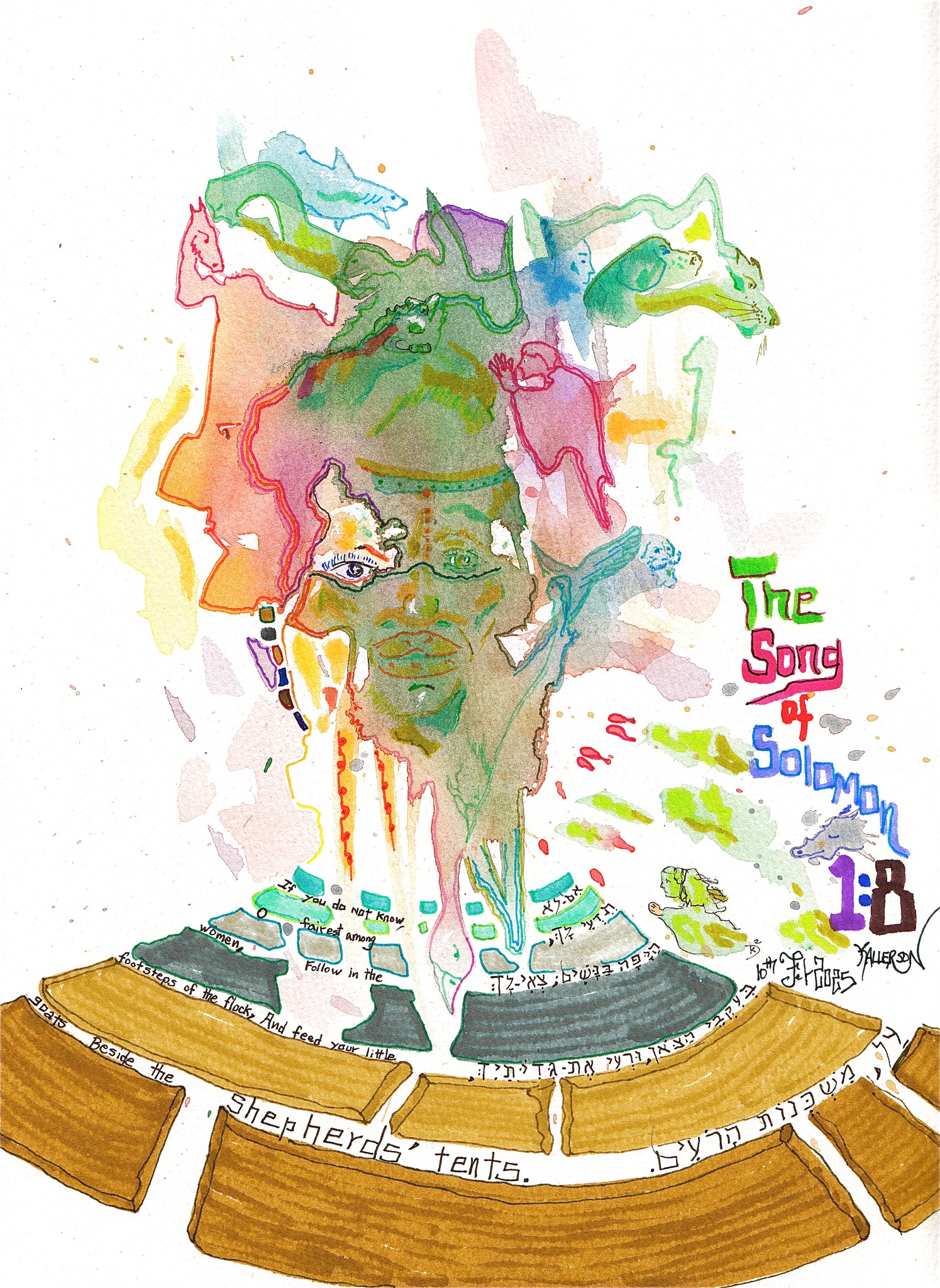
Artwork by Douglass Kallerson
Song of Songs 1:7-11
A Mystery Resolved
(Typed 18 November 2024) For this sermon, I deviated from how I typically use words found within the sermon to give it a title. This title is given because of a resolution to the meaning of complex words found within the verses we will go over.
In fact, some of the words in verse 7 have caused enough speculation concerning their meaning to fill an ocean. I can’t read every commentary on the planet to see if anyone has figured them out, but of those that I read – which cited innumerable other rabbis and scholars – none of them satisfactorily explain the meaning.
In turn, translations follow these scholarly commentaries, repeating what someone guessed was the intent. This is particularly true with one obscure clause that is extremely difficult to explain.
For me, I started sermon typing around 4 am. With only a 20-minute pause to take out the garbage at the mall, I finally finished considering verse 7 at 7:20 am.
After finishing the evaluation, the reason for the endless speculation seems almost impossible to explain. The meaning of the words is as simple to understand as “dinner time.” When you hear that, you rush in and start to eat.
If some other scholar has come to the same conclusion, my hat is off to him. He followed the main rule of biblical interpretation in order to come to his conclusion. The rule is… anyone? Yes! Context. What is the context of what is being said?
Text Verse: “Why do you not understand My speech? Because you are not able to listen to My word.” John 8:43
Jesus was speaking to the people about Himself. He “proceeded forth and came from God” (John 8:42). This is true also of the words of Scripture. They likewise proceeded forth and came from God.
To understand Jesus’ speech, one must listen to His words. And to understand what the Bible is relaying concerning Jesus’ words, you have to spend time in God’s word. In other words, one must consider the context of what is being said.
To rip words out of context will not lead to understanding but confusion. To insert one’s thoughts into Scripture will change the intent of what has come from God, confusing and obscuring the intent.
When there is an enigma in the word, we have to stop and consider the context. We may or may not figure it out, but at least we won’t be shoving our thoughts into the word when we do.
It is better to say, “I don’t know,” or at least, “I could be wrong, but this is what I think,” than to tell someone something that may not be correct.
In the case of verse 7, probably I would have said, “I don’t know,” if I just read the scholar’s comments. They are all over the place and no comment was any better than any other in explaining them. However, I believe my resolution to the mystery of the words is correct.
When I give it, and assuming it is right, you will think, “Well, yeah, that’s obvious. What was so complicated about that?” It probably won’t even seem like a big deal to you, but it is.
It is a part of God’s word. He is giving us information. When we don’t understand His speech, it is because we are not able to listen to His word. This is “Song the songs.” Thus, the Bible tells us that it is the greatest song ever written.
Have you heard a song a million times, but you still don’t know some of its words? When you finally find out what the words say, you think to yourself, “Oh yeah, I’m so glad to know what they were singing.”
If that is how you feel about an old song on the radio from your high school days, how much happier should you be to understand what the “Song the songs” is telling us? Concerning verse 7, I feel that way.
Let’s get into the sermon. It’s dinner time. A feast of beautiful images is to be found in His superior word. And so, let us turn to that precious word once again, and… May God speak to us through His word today, and may His glorious name ever be praised.
I. According to Covering (verses 7 & 8)
7 Tell me, O you whom I love,
As noted, some of the words in verse 7 are extremely complicated, and their actual meaning seems unattainable. Most scholars allegorize them to fit some presupposed notion about one thing or another.
Some take letters and transpose them to form different words that seem to fit their presuppositions. Because of this, such transpositions are then found in various translations. For instance, in his commentary on this verse, Ellicott says –
“The Rabbinical interpretation of this verse is a good instance of the fanciful treatment the book has received: ‘When the time came for Moses to depart, he said to the Lord, “It is revealed to me that this people will sin and go into captivity; show me how they shall be governed and dwell among the nations whose decrees are oppressive as the heat; and wherefore is it they shall wander among the flocks of Esau and Ishmael, who make them idols equal to thee as thy companions?”’”
This utterly inane rabbinical interpretation tells us a couple of things: 1) The rabbis had no idea what the words are telling us, and 2) they also spent their time covering up the sins of their own people.
Idolatry is one of the main reasons why Israel was exiled and dwelt among the nations. The rabbis admit that the people sinned and went into captivity, but then their words completely obscure one of the main sins that caused it.
As for the verse, it begins with: hagidah li sheahava naphshi – “Declare it to me whom loved, my soul.” There is nothing complicated in her words. She is asking her beloved, the one whom her soul loved (the verb is in the perfect aspect), to declare something to her. That something is…
7 (con’t) Where you feed your flock,
eikhah tireh – “Where pasture?” The verb is ra’ah. It signifies tending to a flock. In other words, pasturing. It is quite often translated as the act of shepherding. However, it describes both the act of shepherding by an individual as well as the flock feeding. For example –
“And Shitrai the Sharonite was over the herds that fed [ra’ah] in Sharon, and Shaphat the son of Adlai was over the herds that were in the valleys.” 1 Chronicles 27:29
Therefore, the word pasture is sufficient for both the act of the animal and the conduct of the shepherd.
In this clause, the verb is imperfect. She is asking where he is pasturing his flock. It is out in the land somewhere at the time, and she is curious about where.
The idea of pasturing is frequently turned into metaphor where it describes leaders caring for their people, guiding them, and so forth. For example –
“Then all the tribes of Israel came to David at Hebron and spoke, saying, ‘Indeed we are your bone and your flesh. 2 Also, in time past, when Saul was king over us, you were the one who led Israel out and brought them in; and the Lord said to you, “You shall shepherd [ra’ah] My people Israel, and be ruler over Israel.”’” 2 Samuel 5:1, 2
This state of pasturing is equated to the Lord at times –
“Give ear, O Shepherd [ra’ah – literally “shepherding”] of Israel,
You who lead Joseph like a flock;
You who dwell between the cherubim, shine forth!
2 Before Ephraim, Benjamin, and Manasseh,
Stir up Your strength,
And come and save us!
3 Restore us, O God;
Cause Your face to shine,
And we shall be saved!” Psalm 80:1-3
This pasturing or shepherding doesn’t just describe physically tending to the people but also spiritually. The idea continues in the New Testament, where it is used when referring to leaders in a church, such as in Acts 20 –
“Therefore take heed to yourselves and to all the flock, among which the Holy Spirit has made you overseers, to shepherd the church of God which He purchased with His own blood. 29 For I know this, that after my departure savage wolves will come in among you, not sparing the flock.” Acts 20:28, 29
It is also used when referring to Jesus, such as in 1 Peter 2:25 –
“For you were like sheep going astray, but have now returned to the Shepherd and Overseer of your souls.”
These are just a few of the New Testament examples that convey this thought. As for the words here in “Song the songs,” this woman is asking where her beloved is pasturing…
7 (con’t) Where you make it rest at noon.
eikhah tarbits batsahorayim – “Where crouch in the double-light?” Saying resting or lying down is the result of the crouching. The word is rabats. It signifies crouching, as when an animal folds its four legs under it in a recumbent fashion.
As such, when the word is used of people, the mental idea should extend to that of an animal that is being shepherded –
“The Lord is my shepherd;
I shall not want.
2 He makes me to lie down [rabats] in green pastures;
He leads me beside the still waters.
3 He restores my soul;
He leads me in the paths of righteousness
For His name’s sake.” Psalm 23:1-3
David equates the Lord to a Shepherd of animals and himself to one of His flock. The Lord causes David to fold his legs under him, meaning to rest in the field.
Understanding this, the woman asks where his flocks crouch in the double-light. The word is the plural of tsohar, a window or a light. Thus, it is the double-light, meaning when the sun is at the highest point in the sky. The expanded plural form gives the sense of intense light and, thus, intense heat.
As it is the heat of the day, the heat of the sun is too much for the animals during this time. Thus, one can more fully appreciate David’s words in the 23rd Psalm. He was a shepherd who tended to his father’s flocks –
“And Samuel said to Jesse, ‘Are all the young men here?’ Then he said, ‘There remains yet the youngest, and there he is, keeping the sheep.’
And Samuel said to Jesse, ‘Send and bring him. For we will not sit down till he comes here.’” 1 Samuel 16:11
David understood this type of life and used the concept in metaphor to describe the Lord’s care of him. It is a most tender analogy when understood. He is equating himself to a little lamb being carefully tended to by the Lord.
This woman is asking about her beloved’s flock – where he is pasturing it and where it crouches in the heat of the day. When set side by side, one can see the two lines are not two thoughts but one set in parallel lines –
Where pasture?
Where crouch in the double-light?
With this understood, the words which cause so much anguish to scholars and translators now arrive…
7 (con’t) For why should I be as one who veils herself
The words begin with an abbreviated relative pronoun: shalamah ehyeh k’otyah – “That why become according to covering?” At first, the words seem almost incomprehensible.
The use of this abbreviated relative pronoun in Scripture (she-) is quite rare. It is seen twice in Judges, in the Israelite sections of the books of Kings and also in the Psalms, the Song of Songs, and Ecclesiastes.
The first in the Song of Songs was in verse 1:6 (twice) when the woman described herself – “that I swarthy” and “that tanned me.” Here, she says, “That why become (1st person) according to covering.”
The verb atah comes from a primitive root meaning to wrap. Thus, it signifies to cover. To get the words to make sense, various translations say, “one who is veiled,” “one who veils herself,” “like a veiled woman,” etc.
The veiling is then equated to different things such as mourning, the sign of a prostitute (as in Genesis 38), doing something wrong, etc. The speculations about what is being said go on and on. However, the word is a verbal participle and needs to be translated as such, “covering.”
Others, because of the seemingly impossible nature of what is said, argue that letters have been transposed. That is convenient. When a problem arises, we can just emend (to correct by textual alterations) the text to clear things up! This is a short part of a long and difficult commentary from the scholars at Cambridge –
“The Syriac, the Vulgate, and Symm. apparently read, ‘wanderer,’ transposing the letters and making ‛ôtîyyâh into tô‛ iyyâh, the participle of the verb ‘to wander.’ Archdeacon Aglen’s suggestion in Ellicott’s Commentary for English Readers, that as the word ‛âtâh in Isaiah 22:17 is given the meaning of ‘erring,’ or ‘wandering about,’ by the Rabbinic commentators, probably the idea they had in their mind was that a person with the head wrapped up has difficulty in finding his way, and thus, even without any transposition of the letters, the word might come to be translated ‘wandering,’ is interesting and plausible. He would translate as one blindfold. This seems the best rendering.”
Through one of two ways of manipulating the intent, they arrive at a word that signifies to wander. Flocks wander, so that must be it! Hence, “to wander after the flocks” (Douay-Rheims), “wander like a prostitute” (NLT), “like a sheep which has gone astray” (Lamsa Bible), “as a stray in the flock of your sheep” (Peshitta Bible), etc.
None of these translations, nor any of the comments I read, align with the context. Without that, the words naturally seem unattainable. However, what was she talking about in the previous verses while using this rare relative pronoun? Her darkened state –
“Black, I, and beautiful, daughters Jerusalem –
According to tents Kedar,
According to curtains Solomon.
6 Not seeing me, that I [she-ani] swarthy,
That tanned [she-shezaphathni] me the sun.
Sons my mother burned in me.
Set me keeping the vineyards.
My vineyard, that to me, not kept.”
She is continuing the thought: “That why [sha-lamah] (I) become according to covering?” She is speaking about her state of darkness still. After that, she says…
7 (con’t) By the flocks of your companions?
Every translation I checked, almost forty of them, follows every other, repeating the same thing again and again. Rather: al edre khaverekha – “Upon flocks your associates?” The word al, meaning upon, over, or above, is used. When it is translated as “by” such as in the words of Psalm 137, it still carries the sense of a downward aspect –
“By the rivers of Babylon,
There we sat down, yea, we wept
When we remembered Zion.” Psalm 137:1
When you sit by the waters, you are actually sitting above the waters. Saying “by” is merely implied because you aren’t sitting in the waters. The misguided idea of saying “by,” as in “next to,” makes it impossible to know what thought the woman is conveying.
She is saying that the animals of their flocks are covered (verbal participle – covering) in dark colorings. This is seen, for example, in Genesis 30 –
“Let me pass through all your flock today, removing from there all the speckled and spotted sheep, and all the brown ones among the lambs, and the spotted and speckled among the goats; and these shall be my wages. 33 So my righteousness will answer for me in time to come, when the subject of my wages comes before you: every one that is not speckled and spotted among the goats, and brown among the lambs, will be considered stolen, if it is with me.” Genesis 30:32, 33
This is what has eluded rabbis, Christian scholars, and translators for thousands of years. And yet, when it is seen, it is perfectly obvious. To paraphrase the entire thought –
“I am black and beautiful, O daughters of Jerusalem –
According to the tents Kedar [I am black],
According to curtains of Solomon [I am beautiful].
6 Don’t look at me like that! That I am swarthy,
Just because the sun tanned me.
You see, the sons of my mother made my skin dark.
They set me as the keeper of the vineyards.
And so my vineyard (meaning my appearance) went unkept (I got dark).
Declare it to me, you whom my soul loves,
Where are you pasturing?
Where are you crouching in the heat of the day?
Lest I become according to covering, (If she doesn’t find him, she will only get darker with the blazing heat of the sun on her, a darkness which is) upon the flocks of your associates.”
She is saying that while he is resting during the heat of the day at the time his flocks also rest, she is out searching for him. Hence, he can retain his light skin. She, on the other hand, will continue to darken as she searches for him.
This sufficiently resolves the mystery of these otherwise unattainable words. It maintains the overall context, and it also requires no fudging of the text. The verbal participle is properly used, which is something that none of the other translations do.
When verse 7 is considered in the context of the rest of Scripture, it is hard not to see a parallel to missions, which then become established areas of churches. Where is the Lord pasturing His flock? In other words, where is the flock at this time, ready to feed? The church wants to know and go there.
It has been in the vineyards (verse 6) which represent various cultural expressions tending to them (missions). But there are flocks out there that belong to the Lord. The church wants to know where in order to participate in what the Lord is doing (pasturing).
The book, “Song the songs,” is the expression of God’s love as detailed in various ways throughout the rest of Scripture. A woman is being prepared as a bride to Solomon, and a church is being prepared as a bride to the Lord.
With that hint of scriptural typology explained, the song continues…
8 If you do not know, O fairest among women,
im lo ted’i lakh hayapha banashim – “If not know to you, the beautiful in the women.” It is debated who is speaking here. Some think it is the daughters of Jerusalem. Others maintain that it is her beloved. There are no gender indicators to tell which is the case.
Either way, the words are given in response to her question, “Where pasture?” Whoever the speaker is, the words begin the answer and then provide a high compliment, confirming her beauty despite (or because of) her swarthy complexion.
Saying “the beautiful in the women,” is rightly paraphrased as “fairest among women.” Her darkened skin sets her off as more, not less, beautiful. With that noted, the answer to her question is…
8 (con’t) Follow in the footsteps of the flock,
ts’i lakh b’iqvei ha’tson – “Go out, to you, in heel the flock.” The speaker is telling her to follow in the footsteps of the flock. Wherever they take her, just keep following along, and she will find the one she is looking for. Once she finds the location…
8 (con’t) And feed your little goats
Beside the shepherds’ tents.
ur’i eth g’diyothaikh al mishk’noth ha’roim –
“And pasture your kids,
Upon tabernacles the pasturing.”
The word translated as kids, g’diyah, is found only here in Scripture. It is the feminine form of g’diy, a kid. She is being instructed to take her flock of female kids, follow along in the footprints of the other shepherds, and then pasture her flocks upon the spot where the others are pasturing.
As a point of speculation, the feminine form may point to the New Testament term translated as children. It is a neuter word in Greek, but Hebrew has no neuter. Thus, to offset the young immature believers, the feminine might be used here. The term children is frequently used in this way in the New Testament –
“My little children, for whom I labor in birth again until Christ is formed in you, 20 I would like to be present with you now and to change my tone; for I have doubts about you.” Galatians 4:19, 20
It is speculation, but it does fit the intent.
How fair is My beloved in My eyes!
With all My affection, I will focus my doting love
Of her extravagant beauty, to her, I will apprise
For among all other women, she is heads above
My heart is set on her, and she shall be Mine
With cords of love, I will draw her unto Me
A bride, radiant and divine
Together forever upon the glassy sea
The song of songs we will sing forever
In bonds of love, unending and pure
This bride is composed of any, whosoever
Such as will be Mine, eternally secure
II. My Querida (verses 9-11)
With the previous thought complete, the words begin a new section. The woman has come into the presence of her beloved, and so he now addresses her…
9 I have compared you, my love,
To my filly among Pharaoh’s chariots.
Following the KJV, the NKJV has flipped the clauses and otherwise failed to give a reasonable sense of the words: l’susathi b’rikhvei phar’oh dimithikh rayathi –
“To my mare, in chariots Pharaoh,
Compared you, my querida.”
Solomon uses metaphor to explain how his eyes find her beauty. His mare is his personal horse. This is the only use of the word susah, mare, in Scripture. It is a feminine form of sus, a horse. Therefore, it is a mare. Of the mare, Clarke says –
“Mares, in preference to horses, were used both for riding and for chariots in the East. They are much swifter, endure more hardship. and will go longer without food, than either the stallion or the gelding.” Adam Clarke
Being the king, it would be the finest mare of all, standing out above the rest. Despite this, some are offended at the comparison of a woman to a horse.
It is a ridiculous sentiment. The number of animal comparisons to humans in Scripture is not small. Though they are often somewhat demeaning, such as being compared to a grasshopper or a brute beast, at times, they are high compliments.
As for the horse, the Lord gives it a lofty and honorable description of it in the Book of Job –
“Have you given the horse strength?
Have you clothed his neck with thunder?
20 Can you frighten him like a locust?
His majestic snorting strikes terror.
21 He paws in the valley, and rejoices in his strength;
He gallops into the clash of arms.
22 He mocks at fear, and is not frightened;
Nor does he turn back from the sword.
23 The quiver rattles against him,
The glittering spear and javelin.
24 He devours the distance with fierceness and rage;
Nor does he come to a halt because the trumpet has sounded.
25 At the blast of the trumpet he says, ‘Aha!’
He smells the battle from afar,
The thunder of captains and shouting.” Job 39:19-25
Saying, “in chariots Pharaoh,” reflects what is said in 1 Kings 10 –
“Also Solomon had horses imported from Egypt and Keveh; the king’s merchants bought them in Keveh at the current price. 29 Now a chariot that was imported from Egypt cost six hundred shekels of silver, and a horse one hundred and fifty; and thus, through their agents, they exported them to all the kings of the Hittites and the kings of Syria.” 1 Kings 10:28, 29
Calling them Pharaoh’s chariots (plural) does not mean the mare was used on various chariots. Rather, it is a way of saying the chariots of Israel were of Egyptian origin, bought from Pharaoh’s realm.
Solomon’s chariot, among all the Egyptian-imported chariots, adorned with his personal mare – the finest of the land – is then said by him to be, “Compared you, my querida.”
Here is a word introduced into Scripture, rayah. It will be used nine times, all in “Song the songs.” It is used once in the verbal reading of Judges 11:37, but not in the written reading. It signifies a female associate. Saying, “my love” is a poor paraphrase.
There are many words that could be used, such as darling, dearest, sweetheart, sweetie pie, pet, honey pie, etc., but these can refer to either a man or a woman depending on the speaker.
However, the Spanish word querida is used only when speaking to a female sweetheart. It is a term of endearment for a man’s beloved or lovable person. Thus, it exactly fits the intent.
In the Philippines, the word is transliterated as kerida, which signifies a married man’s mistress, but that is not the intent here. Of his swarthy querida, he says while probably still thinking of his mare…
10 Your cheeks are lovely with ornaments,
The words are striking but also rare: navu l’khayayikh batorim – “Beautified, your cheeks, in the face-chains.” The word naah, comes from a primitive root meaning “to be at home.” Therefore, by implication, it signifies to be pleasant or beautiful.
When a woman goes out, she puts on stuff to make herself attractive. At home, such may not be the case. Therefore, this is speaking of a woman who is naturally beautiful, even at home, without all the extras. The word is used once in relation to the house of the Lord in Psalm 93:5 and once more in Isaiah 52 –
“How beautiful [naah] upon the mountains
Are the feet of him who brings good news,
Who proclaims peace,
Who brings glad tidings of good things,
Who proclaims salvation,
Who says to Zion,
‘Your God reigns!’” Isaiah 52:7
In this case, the word naah is in the perfect aspect. Thus, her cheeks are “beautified.” Solomon next says that they are batorim, in the face-chains. The word tor is seen only four times, twice in Esther and twice here.
It signifies a succession. It is something that occurs in an interval. In Esther, it speaks of Esther’s “turn” to go into the king as a virgin of the harem. There was a succession of virgins, and she was next. A great deal of speculation is given as to what these face chains are, but the context gives the meaning.
These are on her cheeks. That is all we need to know. Though nobody translates it this way, it is the Mideastern and Indian fashion called a face chain. There are innumerable styles of them, but they can go from a single chain crossing the face to an entire facial covering hanging from the forehead down.
Solomon’s horse would have hangings that looked like these dangling on it as well to accentuate its curves and to highlight the king’s prominence among all other horse and chariot riders. Next, he says…
10 (con’t) Your neck with chains of gold.
Rather: tsavarekh bakharuzim – “Your nape in the beads.” The word tsavar is generally associated with the back of the neck, the nape. It is derived from tsur, to bind or besiege. For example, when a yoke is placed on someone, it is on the back of the neck.
The word kharuz is also used, and it is only found here in Scripture. It comes from an unused root, signifying to perforate. As such, it refers to beads of pearls or stones that have been pierced.
Again, it is likely that Solomon’s horse would have such elaborate ornamentation on it. The lines then are set in parallel –
1) “To my mare, in chariots Pharaoh,
Compared you, my querida.”
2) Beautified, your cheeks in the face-chains,
Your nape in the beads.
Next, the words return to the plural…
11 We will make you ornaments of gold
With studs of silver.
torei zahav naaseh lakh im n’qudoth ha’kaseph –
“Face-chains gold make (1st pers. pl.) to you,
With speckles the silver.”
It is the last use of tor, face-chains, in the Bible. The plural is because of the chorus of women as seen in verse 4. The king was captured by the beauty of the woman. That beauty was accentuated by the face-chains. But now, these women call out that they will make her even more alluring to the king by replacing her common face chains with those of gold that are speckled with silver.
As for the speckles, the noun n’quddah, is found only here. It is a feminine word derived from the same source as the adjective naqod, spotted. Thus, it refers to speckles. The face chains of gold with speckles of silver are intended to drive Solomon absolutely bonkers.
If John Gill’s assessment from last week is correct, meaning that the plural and the singular feminine voices are one, as seems possible, then this is speaking of an entity that is singular but composed of many. As he said –
“We; both I thy spouse, and the virgins my companions. And this change of numbers teaches us that the spouse in this book is one great body, consisting of many members, of whom therefore he speaks sometimes in the singular, and sometimes in the plural number.” John Gill
If this is correct, isn’t this final verse what the people in the church should be doing for the church? As the harem of women promises to adorn this woman, so we should be adorning the church with beauty in preparation for joining with the Lord.
Each person should be willing to do his or her utmost for the cause of the whole. Unfortunately, this is not always the situation. Many individual churches place little emphasis on the thought of beautifying the church. Some seem to want to do the opposite.
But that is their choice. As for this church, we can and should be willing to adorn the overall church with right doctrine, sound believers, increasing faith, joy in our salvation, and so forth. The day is coming when the time for our union with the Lord will arrive.
It would be a shame if we are presented without having offered anything of ourselves. The “Song the songs” is the greatest song of all because it provides shadows and details for us concerning the love of God in Christ.
When it is read on Passover by the Jews each year, they still remain blind to the overall redemptive plan God has set forth. But once in Christ, the veil is lifted, and our eyes can see Scripture for what it really is, meaning the most intimate love letter ever penned.
As love sums up the “Song the songs,” it sums up the whole tenor of Scripture. God in Christ! What a marvelous thing He has done to bring us back to Himself. Praise God for His wonderful, loving hand upon us because of Jesus.
Closing Verse: “Let all those who seek You rejoice and be glad in You;
Let such as love Your salvation say continually,
‘The Lord be magnified!’” Psalm 40:16
Next Week: Song of Songs 1:12-17 She deserves a hip-hip-hoorayda… (My Querida) (4th Song of Songs sermon)
The Lord has you exactly where He wants you. He has a good plan and purpose for you. He alone is the perfect example of love – untarnished, unblemished, and completely pure and holy. He offers this love to you. So, follow Him, live for Him, and trust Him, and He will do marvelous things for you and through you.
Song of Songs 1:7-11 (CG)
7 Declare it to me whom loved, my soul –
Where pasture?
Where crouch in the double-light?
That why become according to covering,
Upon flocks your associates?
8 If not know to you, the beautiful in the women,
Go out, to you, in heel the flock,
And pasture your kids,
Upon tabernacles the pasturing.
9 “To my mare, in chariots Pharaoh,
Compared you, my querida.”
10 Beautified, your cheeks in the face-chains,
Your nape in the beads.
11 Face-chains gold make to you,
With speckles the silver.
Song of Songs 1:7-11 (NKJV)
7 Tell me, O you whom I love,
Where you feed your flock,
Where you make it rest at noon.
For why should I be as one who veils herself
By the flocks of your companions?
8 If you do not know, O fairest among women,
Follow in the footsteps of the flock,
And feed your little goats
Beside the shepherds’ tents.
9 I have compared you, my love,
To my filly among Pharaoh’s chariots.
10 Your cheeks are lovely with ornaments,
Your neck with chains of gold.
11 We will make you ornaments of gold
With studs of silver.