Leviticus 1:1-4
The Burnt Offering, Part I
When someone decides to read the Bible, for whatever reason, they will normally start at Genesis and work quickly through that and the first half of Exodus. Then, about chapter 25 of Exodus, the reading slows down. Eventually, it is treated as a chore rather than a pleasure. For many, this is the standard pattern.
By the time they get to Leviticus, the book is closed, placed on a shelf, and never referred to again, except in times of great distress or personal need. In distress, the psalms are referred to. Maybe even the beatitudes are checked out.
For times of personal need, it is common to open the Bible arbitrarily with eyes closed, and then to point to any given portion with the right (yes, it must be the right) index finger. And then,,, in hopes of something miraculous directing their way to riches and glory, or the repair of a failed marriage, or whatever, they open their eyes and feast on that one verse.
If it is a verse or passage which gives them hope, the book is closed with satisfied delight. “Yay! I will have the years that the locust ate away at my possessions restored to me!” If the verse isn’t a satisfying one, the process is repeated until something better is obtained. And then all is right with the world once again. The book is closed and peace is restored. It is certain that nobody wants that one passage to be 2 Chronicles 21:12-15. That’s for sure.
This is the effect that the book of Leviticus has on many people. It is viewed as strange, hard to comprehend, brutal or outdated, and completely irrelevant to the world we live in today. It is, to them, as painful as having their blindly placed finger wind up on those words of 2 Chronicles. Words which, by the way, are our text verse of the day.
Text Verse: “Thus says the Lord God of your father David:
Because you have not walked in the ways of Jehoshaphat your father, or in the ways of Asa king of Judah, 13 but have walked in the way of the kings of Israel, and have made Judah and the inhabitants of Jerusalem to play the harlot like the harlotry of the house of Ahab, and also have killed your brothers, those of your father’s household, who were better than yourself, 14 behold, the Lord will strike your people with a serious affliction—your children, your wives, and all your possessions; 15 and you will become very sick with a disease of your intestines, until your intestines come out by reason of the sickness, day by day.” 2 Chronicles 21:12-15.
Reading the book of Leviticus seems as painful to many as the fate of Jehoram, king of Judah. Be honest, how many of you have ever read the entire book of Leviticus? And of you who have, do you delight in it each time you come to it? Do you say, “Oh boy! This is the cat’s meow and the bees knees?” Or do you read it to get through it and onto the next book?
While in Bible college, there was very little Bible involved. We had a few courses, but most of it was religious stuff, not Bible stuff. But there were a few mandatory Bible courses. One of them was “Old Testament Survey.” It was a survey of the entire Old Testament in a one week module. If one expected great theological discoveries from the Old Testament, this was not going to happen.
However, the professor asked that during the course each student would pick one Old Testament book, and do a full summary on it. We were to outline it, explain its authorship and dating, give its historical context, provide a summary of the book, and include the messianic expectations which could be derived from it. Further, we were to include an application of that particular book to our lives.
As the choice of book was up to each of us, it was obvious that a very large and complicated book, like Ruth or Jonah would be chosen. For the truly daring, the one-chapter book of Obadiah might be the courageous choice. As this is what was normally expected, my professor nearly had a heart attack when I told him I wanted to do Leviticus.
Surely, of all of the books of the Old Testament, this one had the least to offer, especially concerning messianic expectations and contemporary applications! But he was more than excited to approve my choice and await my submission. I chose Leviticus, because it is the heart of the Law of Moses, and one cannot understand the greater work of Christ properly without understanding that work in relation to the law.
Further, messianic expectations in Leviticus literally permeate the book. Like the detailed and marvelously pictorial hints of Christ in the construction of the sanctuary, each portion of Leviticus follows along that path as well. For those of you who survive through this book, you will have a much fuller understanding of the work of Christ, and how Leviticus points to our desperate need for Him.
I will not lie that there are portions which will seem tedious and repetitive to you. However, we will get through them, and you will ultimately say, “I will never look at this marvelous book the same again.” LEVITICUS! It is a marvel and a treasure of God’s wisdom and glory – revealed in Jesus Christ our Lord. Yes, it is a glorious part of His superior word. And so let’s turn to that precious word once again and… May God speak to us through His word today and may His glorious name ever be praised.
I. An Introduction
The book of Leviticus is the third book of the Law of Moses and of the Holy Bible. Its Hebrew name is derived from the first word of the book, va’yikra, which literally means “and called.” In Hebrew, the word consists of the letters vav, yod, qoph, resh, and aleph which numerically equal 317. This is numerically the same as the Hebrew word yabashah, or dry ground. We can think of Leviticus as the dry ground and firm footing of the Law of Moses. It is where the waters of chaos are separated and something substantial is brought out for the people of Israel to conduct their daily lives.
Beginning the book with the word “And” signifies that this is a continuation of what has already been presented. The book of Exodus closed out, but it did not really end. The thought process is simply continued with the opening of the book of Leviticus.
In the Masoretic text of the Hebrew, in the last letter of the word va’yikra, the letter aleph is written smaller than the rest of the letters. This is known as a miniscule, and it is a rare occurrence in the Old Testament. Majuscule and miniscule letters show up in seemingly arbitrary places and without any explanation. For this reason, they can only be guessed at concerning what they mean.
The scholar Rosenmüller notes that ancient variations of the manuscripts leave off the aleph at the end, and so it would say, “And the Lord appeared to Moses” instead of “And the Lord called out to Moses.” The smaller aleph might then be inserted to indicate that it is one or the other, but nobody is sure.
The English name, which is used by almost all modern translations, comes from the Greek translation of the Old Testament known as the Septuagint. They call it Levitikon, which means “relating to the Levites.”
Leviticus is the shortest book in the Pentateuch, being comprised of only 27 chapters, and yet it is certainly the most overlooked of these five masterpieces. A careful study of the book will lead the reader directly to Jesus Christ again and again – and again. As far as the book’s authorship and dating, the author is undoubtedly Moses. Despite modern higher criticism, there is no evidence to support anything other than Mosaic authorship. Internally, the book states, “And the Lord called out to Moses,” “The Lord spoke to Moses,” or “The Lord said to Moses,” etc., many times.
Although this is in the narrative format and therefore such statements could have been made by another author, there is no reason to disbelieve Jewish or Christian tradition which speak of Moses as the author. More to the point though, the New Testament in general, and our Lord Jesus Christ in particular, ascribes Leviticus to Moses as evidenced in passages such as Mark 1 –
“Then Jesus, moved with compassion, stretched out His hand and touched him, and said to him, ‘I am willing; be cleansed.’ 42 As soon as He had spoken, immediately the leprosy left him, and he was cleansed.43 And He strictly warned him and sent him away at once, 44 and said to him, ‘See that you say nothing to anyone; but go your way, show yourself to the priest, and offer for your cleansing those things which Moses commanded, as a testimony to them.’” Mark 1:41-44
In those words, Jesus cites a requirement specifically mentioned in Leviticus 14. Such New Testament references confirm, without any doubt at all, that Moses is the author of the book.
There is dispute as to when this, along with the other 4 books of the law, was written; however, the conservative and traditional dating can be figured based on when Solomon’s Temple was built. By tracing back from that day as stated in 1 Kings 6:1, which indicates 480 years from the Exodus, we can assert with relative confidence that it was penned approximately 1445 BC.
There was a 45-day journey to reach Mount Sinai, where the Israelites worked to construct the Tabernacle. In Exodus 40:2 it stated, “On the first day of the first month you shall set up the tabernacle of the tent of meeting.” This would have been the beginning of the second year and 345 days after the Exodus and 300 days since their arrival at Sinai. It would also make it the year 2515 AM. Later, the Israelites departed Sinai as indicated in Numbers 10:11 –
“Now it came to pass on the twentieth day of the second month, in the second year, that the cloud was taken up from above the tabernacle of the Testimony.”
As Leviticus was certainly recorded by Moses during this 50-day period, we can be confident of this time-frame and dating. Whereas the book of Genesis spanned well over 2000 years of human history, Exodus spanned less than 100, and now Leviticus spans less than two full months. Although mere speculation, it very well may even be that the entire book was compiled during the eight days of the ordination of Aaron and his sons.
The importance of the information then is seen in the condensed time-frame. Special attention was directed to the details of this book, ensuring that the precise instructions at a particular moment in redemptive history were carefully compiled for us.
As far as a historical and redemptive context, the book was given to describe the proper method of approaching God; proper sacrifices when doing so; the priestly requirements which were intricately bound to the religious worship; and other areas of holy living.
These were needed because of 1) The fallen condition of man; 2) The growth of the population of the chosen race to a point where organized worship became essential; and 3) The pagan conditions to which Israel had been exposed during their sojourn in Egypt, thus necessitating a complete break from the incorrect worship conditions which had surely been infused into the Hebrew society.
Further, many of the regulations looked forward to the time when the Israelites would arrive in the Promised Land. As an example, instruction on the handling of mildew in permanent housing was issued. Due to the lack of modern fungicides, which we take for granted, God instructed the people in this area. However, these were issued before such housing was available, while still in the wilderness. Therefore, they anticipated the conquest and settling of Canaan. In a sense then, God was informing them that, “The battle is already won; the land is yours.”
The book deals with a multitude of matters which are all intricately connected to the coming Messiah, Jesus Christ. Although He fulfilled every stated requirement and Christological pre-figuring of Leviticus, thus redeeming us from the curse of the Law (see Galatians 3:10-13), we are reminded that we are to live holy lives before God.
We can look back on the great prophetic fulfillments of Leviticus and have absolute surety that Jesus Christ was and is the Messiah, and therefore is God come in human flesh. Reading and understanding Leviticus also reminds us of the sincerity of God’s promises and curses.
By following them, as laid out in Chapter 26, and then observing the consequences of them as fulfilled in the Jewish people, our faith is actually strengthened that all other promises in Scripture are also accurate and dependable. This book provides us with fundamental proofs of the surety of God’s Old Testament and its fulfillment in Jesus Christ as indicated in the New Testament.
Concerning the sacrifices which are many, and which seem brutal to the world in which we live today, the entire sacrificial system was necessary until the time that the true Lamb of God, Jesus Christ, would come and fulfill each and every one of them. What the world sees as brutal concerning mere animal sacrifices is really a foreshadowing of the most brutal of all sacrifices. One which every person on earth contributed to in their sins of the flesh.
The book itself is categorical rather than chronological. Being compiled in this way, it is a book of spiritual statutes for the people of Israel as the Lord’s congregation. The scholar Keil states that –
“…as the nation of Israel was separated from God, the Holy One, by the sin and unholiness of its nature, the only way in which God could render access to His gracious presence possible, was by institutions and legal regulations, which served on the one hand to sharpen the consciousness of sin in the hearts of the people, and thereby to awaken the desire for mercy and for reconciliation with the holy God, and on the other hand furnished them with the means of expiating their sins and sanctifying their walk before God according to the standard of His holy commandments.”
In accomplishing this, several severe object lessons, involving the death of members of the congregation, will be included for the people to read and remember.
As with many books of the Bible, there are countless sections and patterns which run through Leviticus, but as an overall theme, there are two major sections to the book. The first runs from chapter 1 to chapter 16. These are essentially laws for sacrifice and for purification. These will be highlighted by the laws for the Day of Atonement in Chapter 16. It is a chapter which so precisely pictures the coming Christ, that the only thing more exciting than reaching that chapter would be the rapture itself.
The second major section will go from chapter 17 to chapter 27. These mostly look to the process of sanctification in the lives of the people. These will be highlighted in the instructions for the sabbatical years and the year of jubilee. The two series then remarkably correspond to one another.
The first book of Moses looked to the work of God the Father through Christ in creation, and in directing that creation in the initial process of redemption. The second book of Moses then looked to the work of God the Son in Christ in the actual redemptive process, mirroring His own work countless times. This, the third book of Moses, will highlight then the work of the Holy Spirit applying the purification and sanctification of Christ to the people of God.
In all three books though, it is Christ, the anticipated Son of God who is on prominent display. Nothing is more obvious, and in a thousand different ways it will become evident. When the book of Leviticus is over, the Person and work of Jesus Christ will have been highlighted so many times that you will never look at this book in the same way again.
If we were to sum up the book of Leviticus with one single thought which carries us from Exodus and then into the continued life of Israel, it would be that “The Lord sanctified Israel by His presence, and so the people needed to sanctify themselves in His presence.”
II. The Burnt Offering
Now the Lord called to Moses, and spoke to him from the tabernacle of meeting, saying,
All translations essentially say the same thing here. And the Lord called to Moses… However, it is not how the Hebrew literally reads. Rather, it says, va’yiqra el moshe vaydaber Yehovah elav – “And called unto Moses and spoke Yehovah unto him.” To understand why this change is so important, we have to go back to the end of Exodus. In the last paragraph, it said –
“Then the cloud covered the tabernacle of meeting, and the glory of the Lord filled the tabernacle. 35 And Moses was not able to enter the tabernacle of meeting, because the cloud rested above it, and the glory of the Lord filled the tabernacle.” Exodus 40:34, 35
The beginning of Leviticus is being tied directly to this thought. As I said before, despite this being a new book, it is still only a continuation of the narrative which closed Exodus. Understanding that, we see that there is a time when the glory of the Lord retreated into the Most Holy place, and Moses was then able to enter there in order to speak with the Lord at the ark itself.
This marks one of three most important points in the Lord’s dealings where Moses was specifically called by Him. He was called to his commission in Exodus 3:4 at the burning bush. He was then called twice in Exodus 19 from the top of Sinai prior to the giving of the Ten Commandments. And, he is now called at the beginning of the instructions for the divine worship.
The first looked in anticipation to the coming of Christ. The second looked in anticipation to the work of Christ. And the third looks at the completion of the work of Christ and its application to the lives of His people. In this, the work of the Trinity is implicitly seen. Each member performs His part in the realization of the whole. Finally, as was the case with Exodus, the words should read “tent of meeting,” not “tabernacle of meeting.”
2 “Speak to the children of Israel, and say to them:
The instructions given to Moses here are to be relayed directly to the people of Israel, and not merely to the priests who will receive the offerings which will be laid out next. This then is a corporate instruction intended for all of the covenant people. This is similar to the call to the people to bring offerings for the construction of the sanctuary which was in Exodus 25:2. The call went out to the entire congregation for free-will offerings to be made. Something similar now occurs at the beginning of Leviticus, not for the construction, but for the use of, the sanctuary.
2 (con’t) ‘When any one of you brings an offering to the Lord,
There are many types of offerings which will be allowed – both in type and in purpose, and of which will be precisely named. Nothing else was to be offered except what the Lord specifically authorizes. Each will be detailed in a precise order as the book continues.
The Hebrew reads, “When a man brings an offering.” However, the masculine speaks of both male and female, just as it traditionally has in English. This is confirmed, for example, in the Nazirite vow of Numbers 6 where both men and women could make such a vow. After the fulfillment of it, the offering was then presented by either the man or the woman.
Further, the “when” of this verse implies “if.” Any person in the congregation could bring a voluntary offering. Though they are mandatory in the sense that they had to be brought in order to come near to the Lord, they are voluntary in that they accompanied the desire of the person to, in fact, come near to the Lord.
The word for “offering” here is qorban. It is used for the first two of 82 times in the Old Testament, and almost all of them are in Leviticus and Numbers. It is mentioned one time in Nehemiah and twice in Ezekiel, and that is it. It comes from the verb qarav which means “to come near,” or “approach.”
The idea is that in order to approach near to the Lord, there must be an offering presented at that time. No person could draw near to a king or a royal without presenting an offering. How much more the Lord who was Israel’s true King.
Understanding this, we can already see a picture of the coming Christ. We cannot draw near to God without an offering, and yet, we as believers are told that we can, in fact, draw near to God. This is through the work of Christ, which is our offering. This is spoken of by Jeremiah in the 30th chapter of his book –
“Their nobles shall be from among them,
And their governor shall come from their midst;
Then I will cause him to draw near,
And he shall approach Me;
For who is this who pledged his heart to approach Me?’ says the Lord.
22 ‘You shall be My people,
And I will be your God.’” Jeremiah 30:21, 22
Jeremiah states that One would come who would be allowed to draw near to the Lord God. In the next chapter, it is revealed how this will be accomplished, which is through a New Covenant. When Jesus came, He established that New Covenant in His blood as is recorded in all three synoptic gospels, and which is confirmed by Paul in his writings, such as in 1 Corinthians 11 when speaking of the Lord’s Supper. This is followed up and explained in detail in the book of Hebrews.
The instructions, going directly to the people instead of the priests, shows that the priest had no say in the offering, but rather he was to follow through with his part in the process, inspecting the offering for type, perfection, and conducting the associated work in transmitting the offering to the Lord.
In Christ, we make our offering to God which has been deemed as proper and perfect, and thus He is our qorban. He is our offering by which we draw near to God. This is a voluntary offering in the sense that we must choose to use it, and yet it is mandatory in that if we choose to draw near to God, it must be through Him and Him alone. This is explicitly stated by the author of Hebrews which explains the New Covenant in Christ’s blood –
“For on the one hand there is an annulling of the former commandment because of its weakness and unprofitableness, 19 for the law made nothing perfect; on the other hand, there is the bringing in of a better hope, through which we draw near to God.” Hebrews 7:18, 19
As long as we continue to think about how each detail points to Christ, the book of Leviticus will flow properly, it will be interesting, and it will reaffirm our own Christian walk which is far superior to these rites and rituals which are only foreshadowings of His great work.
2 (con’t) you shall bring your offering of the livestock—of the herd and of the flock.
The first type of acceptable offerings are those of quadrupeds, or behemah. These are set off in contradistinction to the birds which will be mentioned starting in verse 14. The word behemah, or livestock, is then further defined by the terms ha’baqar and ha’tson, or the herd and the flock. The herd speaks of cattle, and the flock speaks of sheep or goats.
The difference is found in the meaning of the words of each. The baqar, or cattle, indicates to seek or inquire. When one plows, they open up the ground, seeking out where to sow. The tson, or flock, comes from an unused root which speaks of migrating, just as flocks are known to do. Of the quadrupeds, only these were considered acceptable as offerings to the Lord.
3 ‘If his offering is a burnt sacrifice of the herd,
The first type of offering is now specified, the olah, or “burnt sacrifice.” The word means “to ascend,” and so the idea of the offering ascending in smoke is what is conveyed. The first time it was mentioned in the Bible was in Genesis 8:20 after the Flood of Noah. There it said –
“Then Noah built an altar to the Lord, and took of every clean animal and of every clean bird, and offered burnt offerings on the altar. 21 And the Lord smelled a soothing aroma. Then the Lord said in His heart, ‘I will never again curse the ground for man’s sake, although the imagination of man’s heart is evil from his youth; nor will I again destroy every living thing as I have done.
22 “While the earth remains,
Seedtime and harvest,
Cold and heat,
Winter and summer,
And day and night
Shall not cease.’” Genesis 8:29-22
The last time this is mentioned in the Bible is actually in the New Testament. There in the Greek it is known as holokautoma. As you can hear, the word finds its origin in the Hebrew olah. However, if you listen carefully, you can also here where our word holocaust comes from. Thus, one can see the where the concept of our modern term is derived.
But its meaning is applied differently based on the user. For those who burnt the Jews, it was as if it was a sacrifice to God which would supposedly please Him because they had done away with His enemies. For the Jews, it was as if a sacrifice to God had been made of their lives in order to please Him. Either way, no such word should rightly be connected to what occurred at the hands of the Nazis – from either viewpoint. There is but one truly acceptable offering which this burnt offering pictures. That is detailed in the final use of the burnt offering in Hebrews 10 –
Therefore, when He came into the world, He said:
“Sacrifice and offering You did not desire,
But a body You have prepared for Me.
6 In burnt offerings and sacrifices for sin
You had no pleasure.
7 Then I said, ‘Behold, I have come—
In the volume of the book it is written of Me—
To do Your will, O God.’”
8 Previously saying, “Sacrifice and offering, burnt offerings, and offerings for sin You did not desire, nor had pleasure in them” (which are offered according to the law), 9 then He said, “Behold, I have come to do Your will, O God.” He takes away the first that He may establish the second. 10 By that will we have been sanctified through the offering of the body of Jesus Christ once for all.” Hebrews 10:5-10
This olah was completely burned on the altar. With the exception of the skin, no part of it was eaten, or kept, by either the offeror or the priest. The skin was given to the priest, and which he could use according to his wishes apparently. This is seen in Leviticus 7 –
“And the priest who offers anyone’s burnt offering, that priest shall have for himself the skin of the burnt offering which he has offered.” Leviticus 7:8
3 (con’t) let him offer a male
Unlike the sin offerings and the peace offerings, the burnt offering was always to be a male. This was specified to more accurately picture Christ in this type of offering.
There is one exceptional deviation from this which is found in 1 Samuel 6. When the Ark of the Covenant which had been captured by the Philistines was returned to the Israelites, those to whom it came took the cows that had pulled the cart on which it was carried and offered them as a burnt offering –
“Now the people of Beth Shemesh were reaping their wheat harvest in the valley; and they lifted their eyes and saw the ark, and rejoiced to see it. 14 Then the cart came into the field of Joshua of Beth Shemesh, and stood there; a large stone was there. So they split the wood of the cart and offered the cows as a burnt offering to the Lord.” 1 Samuel 6:13, 14
This was an exception based on the circumstance, but not an acceptable custom according to the letter of the law.
3 (con’t) without blemish;
The word is tamim. It indicates that which is perfect, without spot or blemish. To make an offering with a blemished animal would be an insult. It would be like drinking half a coke and then when a friend asks for a coke, you give him the half you hadn’t finished and then go an open up of cool, fizzy, fresh one for yourself. This is exactly what the deceivers of Israel were known for doing –
“But cursed be the deceiver
Who has in his flock a male,
And takes a vow,
But sacrifices to the Lord what is blemished—
For I am a great King,”
Says the Lord of hosts,
“And My name is to be feared among the nations.” Malachi 1:14
This burnt offering, which was to draw a person near to God, was typical of Christ in this way as well –
“…knowing that you were not redeemed with corruptible things, like silver or gold, from your aimless conduct received by tradition from your fathers, 19 but with the precious blood of Christ, as of a lamb without blemish and without spot.” 1 Peter 1:18, 19
3 (con’t) he shall offer it of his own free will
The words here are not well translated. It should not say, “of his own free will.” Rather, it should say, “that it may be accepted.” The word is ratson, and it can be translated either way, but many other passages in Exodus and Leviticus explain the meaning which is to be used.
Despite this, and although it is not a sin offering, it certainly implies that there is a fracture between God and man which necessitated coming to the Lord with a gift in order to be accepted. But unlike the sin-offering, it is not intended to specifically take away sins so much as it is to obtain God’s favor. In other words, it looks to the universal sinfulness of man, whereas the sin-offering will look at the specific sins of man. In giving over this offering, it was picturing the surrendering of the life of the offeror wholly and completely to God, body and soul.
3 (con’t) at the door of the tabernacle of meeting before the Lord.
These words needs to be considered properly. First, there was probably somebody outside of the sanctuary itself who inspected all animals, even before they were brought in. However, the offering itself, once accepted, would then be offered, as it says, “at the door of the tent of meeting.
If you were awake during the giving of the details of the sanctuary, and in the details which described its construction, you might remember that I noted that the door and the altar are actually intricately connected. For example, in Exodus 40:6, it said –
“Then you shall set the altar of the burnt offering before the door of the tabernacle of the tent of meeting.”
At that time, I noted that the altar was said to be “before the door of the tent of meeting” despite it having the laver between it and the actual tent. This placement of the altar of burnt offering answered to the placement of the altar of incense and the ark. Just as those were connected, so were the brazen altar and the door.
We then learned that this pictured the work of Christ where He said that He is the good Shepherd. The altar was where the animals were offered, picturing Christ our offering. With that offering, He becomes our Door by which we again have access to the Father. Therefore, presenting the offering at the door of the tent of meeting actually indicates it being offered at the altar which then allows symbolic access through the door. The connection between the two is inseparable.
In this offering, there is nothing secret or hidden. It is done openly and publically. This is how Christ died. It was in a way that all could see and witness. Any and all who passed by would know that an offering had been made as they watched the smoke ascend into heaven. So it was with Christ whose death became known to all. Luke 24:18 shows us that it was fully known throughout Jerusalem. In an ironic twist, the One whose life had been given was questioned if He knew anything about it –
“Then the one whose name was Cleopas answered and said to Him, ‘Are You the only stranger in Jerusalem, and have You not known the things which happened there in these days?’” Luke 24:18
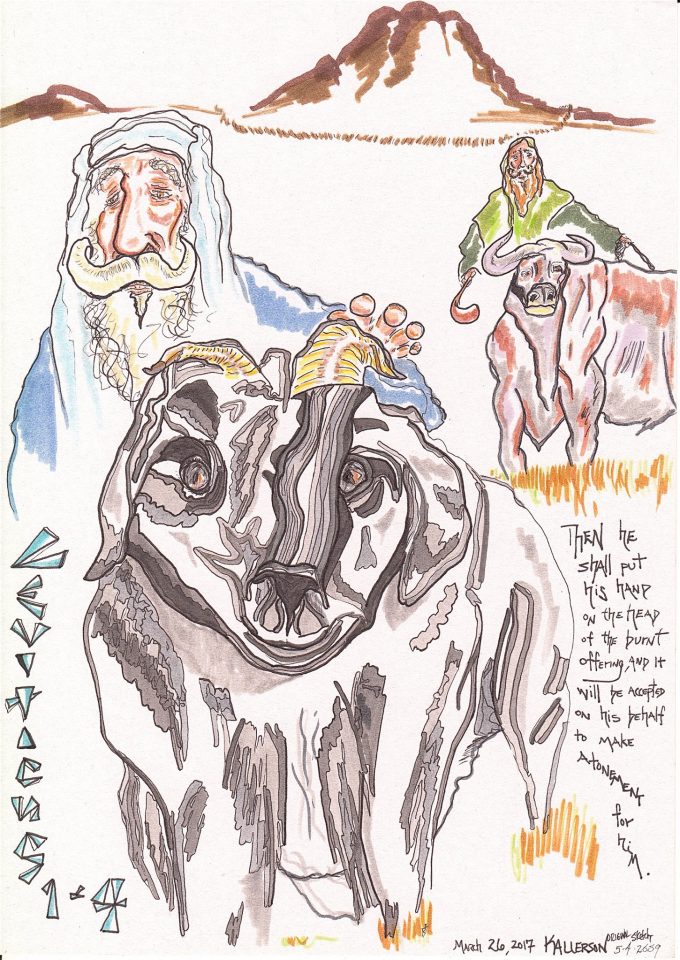
4 Then he shall put his hand on the head of the burnt offering,
The meaning of placing of the hands on the head of the animal is debated hotly, but the next clause explains why it is done. There is no need to go further, except to explain what the words in the clause signify. There is a perfect animal, one without reason – implying innocence, and it has been brought as a whole burnt offering to the Lord.
The people who bring it, do so for a reason. One does not mow a patch of sand, and one does not water plastic plants. The burnt offering is intended to appease the Lord. If the Lord needs to be appeased, it indicates that there is an offender who seeks that appeasement.
The person who places his hands on the animal then is acknowledging that this is HIS sacrifice. He is the offender, and it is his offering. He is asking that the offended will accept it in his place. The implication is that if it were not accepted, then his life is lost already, and would remain lost.
Further, it is implied that this sacrifice would be sufficient to accomplish the mission. However, as these sacrifices were made often, it could only mean that they merely pictured a more perfect offering which lay ahead of them. Thus it was an anticipatory offering until a final, perfect offering could be made.
*4 (fin) and it will be accepted on his behalf to make atonement for him.
The same word, ratsah, is used again here which was incorrectly translated as free-will offering in verse 3. The clause says, v’nirtsah lo l’kapher alav – “…and will be accepted to him to make atonement for him. The act of placing the hands on the head of the animal is what makes the transfer acceptable, and it is what then makes kaphar, or atonement, for the individual.
This word, kaphar, comes from a root which means to cover. When Noah covered the ark with bitumen, the word was used. Thus, it figuratively means to cover over or expiate sin. In providing atonement, the Lord is granting mercy, and thus reconciliation is realized.
Although we are in the middle of a paragraph, this must be where we stop today, and so we will have to continue on with the rest of the chapter next week. The important thing to see so far is that the book of Leviticus begins with the need for an offering to satisfy God, and to restore us to a place of peace with Him.
We have already seen at the end of the book of Exodus that the Lord sanctified Israel by His presence. And yet, even with that understanding, the people of Israel were being told now that their sanctification was positional in His relation to them, but not complete in their relation to Him.
This is all the more evident by the fact that there are priests who were consecrated to minister to the Lord on their behalf. And it was even more evident because the priest had to be consecrated, and they needed to also participate in their own sacrifices before they could sacrifice for the people.
The more one looks into the law, into its requirements, and into what those requirements tell us, the more understanding there is that the law was and is wholly incapable of perfecting anyone. Only a perfect Person under the law could then transfer His perfection to the law-breakers.
And this is what Christ Jesus has done. We could simply cut and paste this thought to the end of every sermon we go through in the book of Leviticus. The law cannot perfect, but Christ can because He was (and is) perfect. It is not that the law is imperfect, but that those who are bound by it, with but one exception, are – in fact – imperfect. And so the law, and the book of Leviticus in particular shows us this.
The book begins with the notion of imperfection in man, and perfection in God. Who will bring the two together, and who will provide the needed imputation of righteousness? Thank God that the answer is found in the Lord Jesus Christ.
This is why the doctrines of men – of Judaizers and of works-based Catholics and of works-based protestants – these doctrines are so poisonous. They rob people of the grace of God which is found in Jesus Christ alone. When someone tells you they don’t eat pork, tell them, “That’s great.” But when someone tells you that you shouldn’t eat pork, “Call him heretic Herman” and have nothing more to do with him.
Jesus Christ embodies every single detail of this law which stands opposed to us. It never made a single person perfect. And so why on earth, God’s beautiful green earth, would you want to voluntarily place yourself back under this system designed specifically for one Man’s success and all others’ failure? Why?
We’re only four verses into Leviticus and already we see what the rabid, wicked, and heretical people of the world refuse to see. We need Jesus. Thank God for Jesus who embodies this law which stood opposed to us. Thank God for Jesus who stands in its place and offers us grace. Thank God for Jesus, for us the shining smile upon God’s face.
Closing Verse: “This only I want to learn from you: Did you receive the Spirit by the works of the law, or by the hearing of faith? 3 Are you so foolish? Having begun in the Spirit, are you now being made perfect by the flesh? 4 Have you suffered so many things in vain—if indeed it was in vain?” Galatians 3:2-4
Next Week: Leviticus 1:5-17 We started the chapter, and to its completion we will follow through… (The Burnt Offering, Part II) (2nd Leviticus Sermon)
The Lord has you exactly where He wants you. He has a good plan and purpose for you. Even if you have a lifetime of sin heaped up behind you, He can wash it away and purify you completely and wholly. So follow Him and trust Him and He will do marvelous things for you and through you.
The Burnt Offering
Now the Lord called to Moses
Yes, He was relaying
And spoke to him
From the tabernacle of meeting, saying
“Speak to the children of Israel
And say to them; let these words ring
‘When any one of you brings an offering to the Lord
You shall your offering bring
Of the livestock—
Of the herd and of the flock
If his offering is a burnt sacrifice of the herd
Let him offer a male without blemish; according to this word
He shall offer it of his own free will
At the door of the tabernacle of meeting before the Lord
Then he shall put his hand on the head
Of the burnt offering, this gesture he shall make
And it will be accepted
On his behalf for him to make atonement, for goodness sake
Lord God, how exciting it is to start Leviticus the book
And to ponder on the treasure hidden there
As we continue, help our eyes to carefully look
For Jesus in each word; surely He is revealed there
And be pleased as we continue to live in accord with Your word
Holding fast to the grace which is found in Christ Jesus
All glory we give to You, through Jesus our Lord
How can we hold back when so much He has done for us!
Hallelujah and Amen…