Leviticus 1:5-17|
The Burnt Offering, Part II
Unlike the books of Genesis and Exodus, the book of Leviticus started out without any story or historical narrative. It simply and immediately begins with the details of the burnt offering. And, the entire first chapter is filled up with the details of it. From this chapter, we will go on to more detailed offerings.
It is therefore, something that is, shall we say, very on the mind of God. We’re being shown, clearly and unambiguously, that the God who resides in the Most Holy Place has specific and absolute requirements for the people to follow.
The details are minute and there is no room for any variation in them. Considering this, one would think that by following them, there would be a sense of completion after going through with them. “Honey, let’s go down to the sanctuary and make our offering. Once we do that, we can go right through the door of the tent, past the Holy Place, and talk to God at the Ark.”
But of course this isn’t the case. Even the High Priest couldn’t go in there except when He was directed to, and when He did, it would be as he followed very specific details. The offerings didn’t really allow the people to draw any nearer to God, except in their hearts. And that itself was only temporary at best…
Text Verse: “For the law, having a shadow of the good things to come, and not the very image of the things, can never with these same sacrifices, which they offer continually year by year, make those who approach perfect.” Hebrews 10:1
The author of Hebrews goes on to explain what he means in this verse, but if someone in Israel simply sat down and thought it through, they would probably be able to figure it out. For us though, we have such a Sacrifice. It is one that can and does perfect us.
And how wonderful that is! We don’t have to keep going back year after year to make the same offering again and again. Instead, it is a one-time-for-all-time offering. And it is an all-encompassing one as well. Every type of sacrifice and offering is fulfilled in it.
Thank God for Jesus who has, in fact, given us both the right and the ability to enter the Most Holy Place. We may not be there now, in reality, but if we have come to God through Him, we are there positionally. As adopted sons of God, we can petition Him as if we are standing right in front of the ark, gazing at the glory which dwells between the cherubim.
Let us remember this as we face life’s difficulties and struggles. In Christ, we have access to the very throne of God. We don’t need to drop off our offering and go back home. Because of Jesus, we are, even now, in the Sanctuary and able to revel in what these things only pictured. This is a truth which is revealed in His superior word. And so let’s turn to that precious word once again and… May God speak to us through His word today and may His glorious name ever be praised.
I. A Sacrifice from the Herd (verses 5-9)
The sacrifice from the herd began in verse 3, but we had to cut that short. And so today we will pick up in the middle of this thought with the words of verse 5…
5 He shall kill the bull
The verse literally says that he shall kill a “son of the oxen.” A male only is to be used for the burnt offering. The word for “kill” here is shakhat. It means specifically “to slaughter.” It was first used when Abraham took the knife in his hand to slay Isaac. It was used in the slaughtering of the goat by the sons of Israel with the intent of dipping Joseph’s coat of many colors in the blood from it. It is also the word used in the slaying of the Passover lamb. It can speak of the slaughtering of one’s enemies, and it is even used figuratively in Jeremiah 9:8 concerning speaking deceit –
“Their tongue is an arrow shot out;
It speaks deceit;
One speaks peaceably to his neighbor with his mouth,
But in his heart he lies in wait.” Jeremiah 9:8
Although it is found in these various ways throughout the Old Testament, it is used mostly in Leviticus concerning sacrifices and offerings, more than thirty-five times.
The slaying process, here and elsewhere, is to cut the throat while another person would hold a bowl under the cut in order to collect the blood of the animal. While we cringe at the thought of this, a few things need to be considered. First, all things are destined to die. No being, person, or animal, is exempt.
For animals in nature, they generally do not die well. For those under the hand of man, it depends on the one controlling the animal as to how its end will come, but the Bible promotes the care of animals, and never their abuse. But, it demands that they are to die at times, and it is for specific purposes according to the will of the One who created them. No wrongdoing can be found here.
These sacrifices were conducted until the time when Christ would come and fulfill what they only pictured. They were a necessary step in understanding what lie ahead.
Secondly, we all eat.
And finally, in the death of the animals here, we are to remember the death of the Lord. What the animal endured was quick, rather painless, and without abuse. What the Lord endured covered an entire day, it was fraught with abuse and pain, and it was done for our salvation.
As we continue through the many offerings, we need to keep these things in mind. Our modern sensibilities are far too geared toward Fifi or Fido to remember that, though we love our pets, there is a whole world of animals that all belong to the Lord. What He directs, or what He determines for each, is according to His will.
5 (con’t) before the Lord;
This male bull was to be slain “before” or in the face of the Lord there at the prescribed place. The place is always the same, but the terminology will continuously change. Sometimes it will say “on the north side of the altar.” Or it may say, “at the door of the tent of meeting,” “before the tent of meeting,” etc. Or it may combine two of the terms from time to time.
Though not recorded in Leviticus, the psalms tell us that the sacrifice was first bound to the altar. Thus it is, in type and picture, the binding of Christ to the true and final Altar – the cross of Calvary –
“God is the Lord,
And He has given us light;
Bind the sacrifice with cords to the horns of the altar.” Psalm 118:27
5 (con’t) and the priests, Aaron’s sons,
The term as is rendered here is faulty. Instead of saying, “the priests, Aaron’s sons,” it should say, “the sons of Aaron, the priests.” It is an exclusive term, limiting the priesthood to the sons of Aaron.” Otherwise, it could be inferred that other priests from other lines existed, but were not selected from Aaron’s sons.
The same term is used seven times, five in Leviticus, once in Numbers, and once in Joshua 21:19. It is always consistent in the Hebrew in order to show that the sons of Aaron alone are designated as priests suitable to perform functions under the Law of Moses and before the Lord.
5 (con’t) shall bring the blood and sprinkle the blood all around on the altar
Again, the translation does not give the correct sense of what is done with the blood. It is not sprinkled, but splashed or scattered. The word is zaraq. The word for “sprinkle” is nazah, and it will not be seen in Leviticus until verse 4:6. I will remind you of this from time to time so that you have the correct sense of what is happening. If your translation says “sprinkle” instead of “splash,” “scatter,” “throw,” “dash,” or the like, make a note of it.
The blood of the animal was taken and literally cast upon the sides of it. One does not sprinkle from a bowl. Instead, they cast it forth. There is specificity here which demands attention. The purpose of this blood being splashed on the altar “expresses one’s complete, voluntary surrender, and readiness to die while yet living” (Lange). The offeror’s blood is what should be poured out; a substitute, however, is taken in his place.
This was, at least in type and picture, the most important part of the rite. Leviticus 17:11 will tell us that the life is in the blood. Therefore, the life is transferred by the hands of the offeror on the
substitute to the hands of the priest as he receives it in the bowl where it is then cast out unto God.
In type, it points to Christ who poured out His blood for us, and yet as High Priest, He then offered it to God. The same word for “offer” in verse 3 is now translated as “bring” here. The offering simply transfers from offeror to priest. This was all accomplished through His work on the cross. He is the ultimate olah, or burnt offering to the Lord, and He is the Priest who brings that offering to God.
As this is what Christ did for us, when we are in Christ, then that same yielding on our part is reckoned as acceptable to God. However, even our very best services and offerings to God, are still not acceptable without the covering of Christ’s blood. Only as seen through what He has done can the things we do be considered in that same acceptable light.
As a note, Alfred Edersheim says that there was, “A red line all round the middle of the altar marked that above it the blood of sacrifices intended to be eaten, below it that of sacrifices wholly consumed, was to be sprinkled” (Pulpit). This is not in the Bible, but Edersheim’s commentary is considered an invaluable tool for understanding what occurred in the tabernacle and temple rites.
5 (con’t) that is by the door of the tabernacle of meeting.
The words “is by” are inserted. It says, “that door tent (of) meeting.” Again, the altar is directly connected to the entrance of the tent of meeting. Despite the laver standing between the two, it is the altar which grants access to move further toward God. It represents the sacrifice of Christ on our behalf, who is the Door as we are told in John 10:9. Each detail points to Christ.
6 And he shall skin the burnt offering
The actions performed on the sacrifice would be accomplished by the priests, not by the offeror. However, the priests could also designate Levites to assist in the work. This is seen, for example, in 2 Chronicles 29:34 –
“But the priests were too few, so that they could not skin all the burnt offerings; therefore their brethren the Levites helped them until the work was ended and until the other priests had sanctified themselves, for the Levites were more diligent in sanctifying themselves than the priests.”
The skinning of the animal was done for a couple reasons. The first was practical, the second was typical. First, the skin had value for clothing and for use in scrolls for writing, among other things. The skins belonged to the priest who officiated at the sacrifice.
However, in type, we see that in slaying the animal, the life departs, but in the skinning, the old appearance of life is removed. This is then typical of the transformation which Christ went through. At the same time, the transfer of the skin to the priest was an act of transferring Christ’s righteousness.
Just as God covered Adam and Eve with skins to cover their nakedness, the transfer of the skin gives the same idea. It is emblematic of the temporary covering which is imparted until we are finally glorified and bear Christ’s true image. At that time we too shall appear as He is. Paul speaks of this transformation in 1 Corinthians 15 –
“The first man was of the earth, made of dust; the second Man is the Lord from heaven. 48 As was the man of dust, so also are those who are made of dust; and as is the heavenly Man, so also are those who are heavenly. 49 And as we have borne the image of the man of dust, we shall also bear the image of the heavenly Man.” 1 Corinthians 15:47-49
6 (con’t) and cut it into its pieces.
After the animal is skinned, it would then be divided according to its parts. The word is nathakh, a rare word which means “to divide by joints.” An animal will not fully burn if it is not divided in this way. But by doing this, it could be piled onto the altar and fully burnt.
The dividing of the animal is, in type, looking to the many aspects and offices of Christ which are recorded in the gospels. After His work was accomplished, and upon His death, all of these together became a whole burnt offering to God. Each was consumed upon the altar as a satisfaction of the law which He had fulfilled.
7 The sons of Aaron the priest shall put fire on the altar, and lay the wood in order on the fire.
The special mentioning of the priests concerning the fire and wood is because no other person could touch the altar as it was considered most holy. If they did, they became devoted to God. That was recorded in Exodus 30:29.
Understanding that, care still needs to be taken here to understand the context, and so we need to go forward to the first lighting of the fire on this altar. It is found in Leviticus 9:23, 24 –
“Then the glory of the Lord appeared to all the people, 24 and fire came out from before the Lord and consumed the burnt offering and the fat on the altar. When all the people saw it, they shouted and fell on their faces.”
That initial fire was never to go out, as is seen in Leviticus 6:13 –
“A fire shall always be burning on the altar; it shall never go out.”
That initial fire was lit by the Lord. From that time on, it was never to go out, even when the altar was transferred from place to place there is no stated provision that it would be extinguished. The fire is the Lord’s doing, and so to “put fire on the altar” signifies feeding the fire with wood. When an offering was made, the wood would then be arranged for such an offering.
This is a picture of the consequences of sin. It is emblematic of the eternal fire of the Lake of Fire where all sin will finally be consumed. Either one’s sin is consumed by Christ and thus forever removed from the offender, or their sin will be consumed when they are cast into that final place of God’s judgment. There are no other options. The pictures are given to show us the consequences of our choices.
8 Then the priests, Aaron’s sons, shall lay the parts, the head, and the fat in order on the wood that is on the fire upon the altar;
Again, only the sons of Aaron, who were the priests of Israel, were allowed to touch or work with the altar. They would take the animal and lay its parts out in a particular order which is believed to have resembled as closely as possible the order in which they were when the animal was alive.
The head and the fat are explicitly named because they, together with the pieces, complete the whole animal with the exception of its blood and hide. Again, it looks to Christ’s death. He died wholly upon the cross rather than some other type of execution, such as being drawn and quartered, beheaded, or the like.
His entire body was an offering to God as a whole burnt offering. The blood and the hide excepted, because the life is in the blood, and because He was so marred that He was otherwise unrecognizable, as is recorded by Isaiah.
The word for fat here is peder. This is the first of only three times it is seen, all are in Leviticus. It comes from a primitive root meaning to be greasy. Thus, it is the suet or fat. This would increase the flame, and thus the picture of judgment we are to see. Even this was offered, wholly and completely to God.
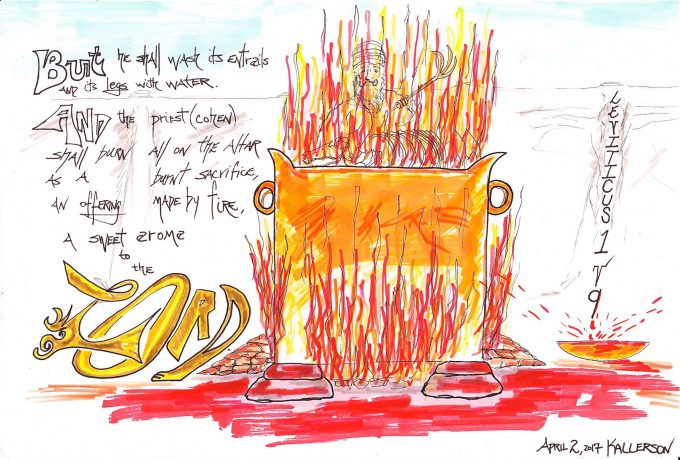
9 but he shall wash its entrails and its legs with water.
These parts are specifically said to be washed for two reasons. The first is because of the word translated as burn in this verse, and the second is because of what that then pictures. The innards of the animal were washed as a picture of the inward purity of Christ. There was no defilement in Him at all.
The kera, or leg, specifically signifies from the knee to the ankle. This is the part of the body which would pick up worldly defilement. This is seen in the washing of the feet throughout the Bible as symbolic of washing away worldly defilement. This is why Jesus said in John 13:10, “He who is bathed needs only to wash his feet.”
Abraham understood this and brought water to wash the Lord’s feet when He arrived at his tent in Genesis 19:2. For this reason, the legs along with the entrails were washed. The animal pictures the purity of Christ, offered up to God as a perfect offering.
9 (con’t) And the priest shall burn all on the altar as a burnt sacrifice, an offering made by fire, a sweet aroma to the Lord.
The word “burn” here is not the regular word which means “to consume.” Instead, it is qatar, or “to make sacrificial smoke.” It is the word used to describe the burning of incense. This offering, picturing Christ in all ways, is an olah isheh reakh nikhoakh l’Yehovah – “a burnt sacrifice by fire, a savor sweet to Yehovah.” Paul explains this for us in Ephesians 5 –
“Therefore be imitators of God as dear children. 2 And walk in love, as Christ also has loved us and given Himself for us, an offering and a sacrifice to God for a sweet-smelling aroma.” Ephesians 5:1, 2
A burnt offering, a bull is presented at the altar
It has value and it could be used for other things
But in presenting this bull, I shall not falter
For in giving it to the Lord, my heart rejoices and sings
For to Him it is a sweet smelling aroma, pleasant and nice
And my heart delights in offering such as this
It is a perfect bull, and thus an acceptable sacrifice
It is as if sending to heaven an aromatic kiss
Bless the Lord who has accepted my offering
Bless the Lord who has received me because of it
He has accepted from my hand this proffering
To Him through the bull my soul I do submit
II. A Sacrifice from the Flock (verses 10-13)
10 ‘If his offering is of the flocks—of the sheep or of the goats—as a burnt sacrifice, he shall bring a male without blemish.
The bull was the more expensive animal, and so it would normally be the richer person who offered one. Now an allowance for the less-wealthy is provided. The offering could be of either the sheep or the goats, but it was still to be a male without blemish. The sheep would have been the preferred animal, but the goat was also considered acceptable. And both, like the bull also, are seen as types of Christ elsewhere in Scripture.
The bull looks to Christ’s strength and enduring labors. The sheep looks to His innocence, harmlessness, and quiet patience. The goat looks to His human nature where he was seen in the likeness of sinful flesh, though He was Himself without sin. However, our sin penalty was imputed to Him.
Because the directions would be the same for these animals as were given for the bull, they are not repeated. Only those requirements which further define the instructions are given, such as in the next verse…
11 He shall kill it on the north side of the altar before the Lord;
The north side is now specified as the place of slaughter. There is a reason for this. In verse 16, the ashes and refuse were to the east of the altar. Also, the laver was to the west, and the ascent to the altar was said by Josephus to be on the south. If Josephus is correct, the north was then the most conducive to be used for this purpose.
The north being set aside in this manner is probably more importantly a picture of where Christ would later die. In Psalm 48, we read this –
“Beautiful in elevation,
The joy of the whole earth,
Is Mount Zion on the sides of the north,” Psalm 48:2
On the “sides of the north,” meaning of Jerusalem the city, is the place where the cross of Christ was. Thus the slaying of the animal on the north side of the altar was an anticipatory look at the crucifixion of Christ, dying on the north sides of Zion.
And further, the word for “north” is tsaphon, which means hidden or dark, and it even gives the sense of gloomy. It comes from tsaphan, which gives the idea of hiding, and even treasure or treasuring up something.
The death of the animal, symbolic of the work of Christ was the dark side of His ministry, and yet, it is in death that He was treasured and protected, having fulfilled the law. Now for those in Christ, we are hidden in Him and likewise treasured until the day of redemption. This is alluded to several times in Scripture, such as in Psalm 27 –
For in the time of trouble
He shall hide me in His pavilion; (tsaphan)
In the secret place of His tabernacle
He shall hide me;
He shall set me high upon a rock. Psalm 27:5
Paul also says in Colossians 3:3 that we have died, and our life is hidden with Christ in God. Every detail points us to Jesus.
11 (con’t) and the priests, Aaron’s sons, shall sprinkle its blood all around on the altar.
As before, the blood was splashed, thrown, dashed, or cast, but it was not sprinkled. Please put a note of correction in your KJV.
12 And he shall cut it into its pieces, with its head and its fat; and the priest shall lay them in order on the wood that is on the fire upon the altar;
In what is known as a zeugma, one verb here is used for the action involving more than one noun. The action of cutting is referring to both the pieces, and to the head and the fat. This is not uncommon in Hebrew, nor is it in English. If I say that John lost his wallet and his temper, I am using a zeugma. This is what is occurring here in verse 12. It is the same action as that of which occurred with the bull in the earlier verse though.
13 but he shall wash the entrails and the legs with water. Then the priest shall bring it all and burn it on the altar; it is a burnt sacrifice, an offering made by fire, a sweet aroma to the Lord.
The same procedures for the sheep or the goat were to be followed as for that of a bull. The requirements do not change based on status or wealth. All must be perfect, all must die in the same manner, all must be purified in the same way, and all were to be considered as a sweet smelling savor to the Lord. Each animal pictures Christ in a different way, but in the end, each pictures the same perfect Christ.
A lamb precious and pure is given
For to my God, I desire to provide my very best
He has brought me to the place of abundant livin’
And to please Him is my heart-filled quest
How good and pleasant it is to offer the lamb
I pray that He is pleased with the condition of my heart
I love my Lord God, the great I AM
And so to Him this precious lamb I do impart
May the Lord accept this offering in my place
And look with favor upon me as I go my way
May the Lord turn to me His glorious shining face
And may He bless my steps each and every day
III. A Sacrifice of Birds (verses 14-17)
14 ‘And if the burnt sacrifice of his offering to the Lord is of birds, then he shall bring his offering of turtledoves or young pigeons.
In contrast to the four-legged animals, an offering of birds could be made. In this, only two were allowed. The first is the tor, or turtledove. The second is the yonah, or dove, also termed a pigeon. And so, in all, five types of animals are allowed.
Five being the number of grace, it is fitting that this many have been allowed. The grace of God in Jesus Christ is realized in the five allowable burnt offerings. And interestingly, they correspond to the five that were requested of Abraham in Genesis 15 –
“So He said to him, Bring Me a three-year-old heifer, a three-year-old female goat, a three-year-old ram, a turtledove, and a young pigeon.’” Genesis 15:9
Allowing these birds is an exceptional act of care for the poor among the people. This provision sets the Law of Moses apart from the others in this regard. The turtledoves are said to appear in large numbers in early April and are easily captured before migrating again. The pigeons, or doves, are common in the land and have several broods each year, making them easy to capture when young and abundant enough to do so. They are also easy to keep and maintain.
As you can see, there is no restriction on age for the turtledoves because they were always in the prime during their short time of migration in the land. However, pigeons were only considered in the prime when young. If a man would reject an older pigeon as a meal, it would be wrong to offer it to the Lord.
These birds picture Christ in their simplicity, purity, and humility. But further, the affection of the dove for their mate makes them a splendid picture of Christ who is so affectionate for His people that He came to dwell among them and give Himself for them.
15 The priest shall bring it to the altar,
There is no laying of the hands on the bird, probably because the bird was transferred by hand to the priest. Thus there is still the symbolic transfer of guilt seen in the act.
15 (con’t) wring off its head,
The word “wring” here is translated from a word, malaq, which is only found here and in Leviticus 5:8. It is not really known what is being said. It could mean either wring its neck, but not take off its head, or it could mean to completely sever the head. Scholars argue; no one is sure. It seems that what is done with it later would necessitate wringing the head completely off, but verse 5:8 complicates that notion. Either way, the bird dies at the altar, just as the other animals do.
15 (con’t) and burn it on the altar;
The order here does follow the Hebrew. It says that it is to be burned after its neck is wrung, but before the blood is said to be drained out. The order then is reversed from what must actually occur. Despite this, the same word is used here as for the four-legged animals. It is an offering of a sweet smell, rather than merely a burning up of the sacrifice. And thus, even the small bird pictures Christ who was offered up to God in this manner.
15 (con’t) its blood shall be drained out at the side of the altar.
The word for “drained” is matzah, which means to suck out. And so by implication it means to drain or even to squeeze out. As there was not enough blood to be gathered in a basin, and due to the small size of the bird, the blood was simply pressed out of it and onto the altar’s side.
Once again, the life is in the blood, and so it forms a picture of Christ whose blood was shed for sinful man, even the poorest of our species. None are exempt from His grace.
16 And he shall remove its crop with its feathers and cast it beside the altar on the east side, into the place for ashes.
A couple new words in the Bible. The first is the crop, or murah. It is only found here, and it signifies the alimentary canal. It comes from ra’ah which means “something conspicuous,” and thus it is the part of the bird which is prominently displayed.
The second is the notsah, or “plumage.” It is seen just four times. Here, in Job, and twice in Ezekiel. Like the animals which were skinned, the birds had their feathers removed, signifying the complete change in appearance. Just as Christ was marred beyond recognition, so were both the animals and the birds.
The third word is deshen, or ashes. However, it comes from the verb dashen, which means “to grow fat,” and thus it is the ashes of fat, and not ashes in general.
In all, the bird had its crop and its feathers removed, and then those were cast to the east side of the altar. This was the place furthest removed from the Holy of Holies, and it thus signifies that the place where uncleanness is, it being the place furthest from where the Lord dwells.
17 Then he shall split it at its wings, but shall not divide it completely;
What this is saying, is that he is to grab the wings of the bird and pull them so that the bird is split, exposing its insides, but the bird is not to be pulled completely apart. This then answers to the placement of the larger animals on the altar in a set manner. The animal would be too big to burn otherwise, but it was to still be in an order which showed that it was one animal.
The bird, being smaller, did not need to be divided up. It remained whole, which again makes the same picture of Christ as the animals did before. Christ’s body remained intact, but the inward parts were exposed, revealing only sincerity and truth. This is what David referred to concerning the condition of one who pleases God when he said, “Behold, You desire truth in the inward parts” (Psalm 51:6).
17 (con’t) and the priest shall burn it on the altar, on the wood that is on the fire.
Once again, we are reminded that this is a sweet smelling burning, not merely something burnt up with the use of the word qatar, or a fragrance like incense. The fire is the Lord’s, the wood is the cross, and the sacrifice is pure, undefiled, and acceptable. And so…
*17 (fin) It is a burnt sacrifice, an offering made by fire, a sweet aroma to the Lord.
The same words are used again as were seem in verses 9 and 13. The repetition indicates that the offering of the poorest person is just as acceptable to the Lord as that of the richest man with the most splendid ox. The sacrifice comes solely down to the heart and intent of the offeror.
This is evident in the rite which is conducted, and in what is considered acceptable concerning the offerings. The one who offers was acknowledging that they were spiritually dying in the offering, but that a substitute was requested to be reckoned in his place. Thus, they were in essence uniting to the Lord through this vicarious act. In turn, they were then expected to conduct their lives in the manner which the offering was accepted.
To not do so would nullify the purpose of the offering. This is seen in the words of Isaiah, words which are repeated numerous times in the Old Testament, and which are then repeated in the New as well –
“‘To what purpose is the multitude of your sacrifices to Me?’
Says the Lord.
‘I have had enough of burnt offerings of rams
And the fat of fed cattle.
I do not delight in the blood of bulls,
Or of lambs or goats.’” Isaiah 1:11
The Lord wearied of their offerings because their offerings were wearisome. There was no heart in them. The people treated their status as one which was deserved. One who deserves favor does not need grace, nor do they need a substitute to make them acceptable before God.
But the very fact that the various offerings were made, was intended to show them that they needed more than what they inherently possessed. We will see more types of offerings as we continue on through the book, but for the burnt offering let us consider it one more time.
The various aspects of the offering are that it was brought volitionally by the offeror. It was offered in a vicarious manner, meaning that the placing of the hands on the animal was intended to relay that the animal was taking the place of the offeror. The animal was slaughtered and its blood, evidence of the ending of its life, was poured out. And then the offering was wholly burnt up on the altar.
From these acts, the people should have grasped that there was a disconnect between them and God. The very fact that an offering is made shows this. If someone was inherently acceptable to Him, then any offering of this type would be pointless.
Further, the fact that such offerings needed to be repeated, as did the other types of offerings we will see, shows us that they could never truly cause to happen what they were intended to cause to happen. If they did, then one such offering would be made, and it would never need to be made again. But such was not the case.
This was therefore true on both an individual level and on a national level. Neither was made perfect by the mandates of the law which showed them that perfection was necessary, and that they were, in fact, imperfect.
Understanding this, there is the truth which could have been deduced by anyone who thought it through to a logical conclusion. If nobody was perfect, as is indicated by the need for sacrifices, and if nobody was made perfect as is indicated by the need for continued sacrifices, then only a perfect Person could fulfill what these sacrifices were intended to mean.
Why a person? Because the animals didn’t work. Why a perfect Person? Because anyone who needed to offer a sacrifice other than himself was obviously imperfect, and all had to offer sacrifices other than themselves. Logically, there had to be an end to these things for perfection to come.
When Jeremiah promised a New Covenant, it meant that the Old Covenant must at some point be fulfilled. And thus, it meant that a perfect Person was anticipated who would fulfill it. This Man then, would be the fulfillment of each and every one of these sacrifices and offerings. If such is not the case, then He didn’t fulfill the law, but fulfill it He did.
This is why we look for Jesus in each precept and on every page. In so doing, we seek and then we find the One who came and did what God promised would occur. Now, the Burnt Offering is behind us. Next will come the Grain Offering, then the Peace, then the Sin, and then the Trespass Offerings. And from there we will go on to more offering details.
If we can just remember to keep looking for Christ, these things will go quickly, they will educate perfectly, and they will satisfy completely. Otherwise, the list of offerings is long, tedious, and seemingly irrelevant to our Christian walk. But understanding them will open up our life in Christ in a much deeper way.
Closing Verse: “I beseech you therefore, brethren, by the mercies of God, that you present your bodies a living sacrifice, holy, acceptable to God, which is your reasonable service. 2 And do not be conformed to this world, but be transformed by the renewing of your mind, that you may prove what is that good and acceptable and perfect will of God.” Romans 12:1, 2
Next Week: Leviticus 2:1-16 Here comes a completely different type of proffering… (The Grain Offering) (3rd Leviticus Sermon)
The Lord has you exactly where He wants you. He has a good plan and purpose for you. Even if you have a lifetime of sin heaped up behind you, He can wash it away and purify you completely and wholly. So follow Him and trust Him and He will do marvelous things for you and through you.
The Burnt Offering
He shall kill the bull before the Lord
And the priests, Aaron’s sons, next to do
Shall bring the blood and sprinkle the blood
All around on the altar, as I am instructing you
That is by the door of the tabernacle of meeting
This task they shall be completing
And he shall skin the burnt offering
And cut it into its pieces
So shall they handle this proffering
The sons of Aaron the priest
Shall put fire on the altar
And lay the wood in order on the fire
In this they shall not falter
Then the priests, Aaron’s sons
Shall lay the parts, the head, and the fat also
In order on the wood
That is on the fire upon the altar; there it shall go
But he shall wash its entrails and its legs with water
And the priest shall burn all on the altar as a burnt sacrifice
An offering made by fire
A sweet aroma to the Lord, pleasing and nice
If his offering is of the flocks—
Of the sheep or of the goats—as a burnt sacrifice
He shall bring a male without blemish
Only this will suffice
He shall kill it on the north side
Of the altar before the Lord
And the priests, Aaron’s sons, shall sprinkle its blood
All around on the altar, according to this word
And he shall cut it into its pieces
With its head and its fat
And the priest shall lay them in order on the wood
That is on the fire upon the altar; where the fire is at
But he shall wash the entrails and the legs with water
Then the priest shall bring it all and burn it on the altar
It is a burnt sacrifice,
An offering made by fire, a sweet aroma to the Lord
An offering both pleasing and nice
And if the burnt sacrifice of his offering
To the Lord is of birds
Then he shall bring his offering of turtledoves or young pigeons
According to these words
The priest shall it to the altar bring
Wring off its head, and burn it on the altar
Its blood shall be drained out at the altar’s side
In these duties he shall not falter
And he shall remove its crop with its feathers
And cast it beside the altar on the east side
Into the place for ashes
To these instructions he shall abide
Then he shall split it at its wings
But shall not divide it completely
And the priest shall burn it on the altar
On the wood that is on the fire it shall burn sweetly
It is a burnt sacrifice, an offering made by fire
A sweet aroma to the Lord, such as I do require
Lord God, in ourselves we are not acceptable to You
But You have made a way for it to come about
Through the offering of Your Son who is faithful and true
We can approach You without fear or doubt
Thank You for this great thing You have done
And we shall thank You even unto eternal days
Marvelous! Wonderful! Stupendous! is Jesus Christ Your Son
And so to You, through Him we shall offer eternal praise
Hallelujah and Amen…