Numbers 21:10-20
Filling Wineskins
I admit that I had no idea what this passage was about until I sat down on 25 March and did the study. Glad I did.
If anybody here is old enough to remember Johnny Horton, or at least his music, he was a singer during the 1950s who did some great tunes, a couple of which were about wars. One of them was The Battle of New Orleans. It was based on a battle between the Americans and the British about 100 years before his birth.
It was such an obscure battle that people in England didn’t even realize that it was real until they researched the contents of the song that they heard on the radio. His words are in a poetic fashion, and the meaning of them is almost obscure to someone who isn’t aware of the lingo he used. For example, in part of it, he says…
We held our fire
‘Till we see’d their faces well
Then we opened up our squirrel guns
And really gave ’em – well we…
Fired our guns and the British kep a-comin’
There wasn’t nigh as many as there was a while ago
We fired once more and they begin to runnin’
On down the Mississippi to the Gulf of Mexico
Unless you were aware of the nuances of the language, the shortness offered at one point for the sensitivity of the people’s ears, and the locations mentioned, it wouldn’t make much sense. He had another great war song called Sink the Bismark. It was a marvelous remembrance of an event that occurred just a few years before, and which he put to music.
In the verses today there is a reference to the Book of the Wars of the Lord. Because of the name of it, and because of the references in it, critical scholars, specifically liberal critical scholars, have argued that this must be a book that had nothing to do with Moses.
Some argue that it was actually written by the Ammonites about the conflicts of Baal in which the feats of their heroes, like Sihon and others, were celebrated in poetry. Others say that it must be a book dating from the time of Jehoshaphat and which contains early history of Israel from the time of the patriarchs to the time of around Joshua.
Others make up other, ridiculous, theories about it, completely disregarding the fact that it is recorded here in the Books of Moses, and that it speaks of things that Israel of the time was intimately familiar with.
There is no reason to assume it was written at some point many centuries later, and it is the height of stupidity to credit the book to the Ammonites when it is specifically said to be sepher mikhamot Yehovah, or the “Book of the Wars of Yehovah.” Liberal scholars are, please forgive the forthrightness, idiots.
Text Verse: Then David lamented with this lamentation over Saul and over Jonathan his son, 18 and he told them to teach the children of Judah the Song of the Bow; indeed it is written in the Book of Jasher:
19 “The beauty of Israel is slain on your high places!
How the mighty have fallen!
20 Tell it not in Gath,
Proclaim it not in the streets of Ashkelon—
Lest the daughters of the Philistines rejoice,
Lest the daughters of the uncircumcised triumph.
21 “O mountains of Gilboa,
Let there be no dew nor rain upon you,
Nor fields of offerings.
For the shield of the mighty is cast away there!
The shield of Saul, not anointed with oil.
22 From the blood of the slain,
From the fat of the mighty,
The bow of Jonathan did not turn back,
And the sword of Saul did not return empty.
23 “Saul and Jonathan were beloved and pleasant in their lives,
And in their death they were not divided;
They were swifter than eagles,
They were stronger than lions.
24 “O daughters of Israel, weep over Saul,
Who clothed you in scarlet, with luxury;
Who put ornaments of gold on your apparel.
25 “How the mighty have fallen in the midst of the battle!
Jonathan was slain in your high places.
26 I am distressed for you, my brother Jonathan;
You have been very pleasant to me;
Your love to me was wonderful,
Surpassing the love of women.
27 “How the mighty have fallen,
And the weapons of war perished!” 2 Samuel 1:17-27
That is certainly the longest text verse I have ever used, and maybe that will stand as a permanent record. Either way, David wrote the Song of the Bow and it is recorded in the Book of Jasher. That was a book known as far back as the time of Joshua, maybe further, as we will see today.
It is only a person with a set and perverse agenda who would willingly deny that the Book of the Wars of the Lord, like the Book of Jasher, wasn’t recorded exactly as the surrounding text states. The burden of the proof of such ludicrous claims rests solely on those making them, and they ain’t got it.
Be careful who you believe. Check all things. Hold fast to what is good. This is a wonderfully precious and sacred word we have been given. It is filled with marvelous wonder and delight. Yes, great things are to be found in His superior word. And so let’s turn to that precious word once again and… May God speak to us through His word today and may His glorious name ever be praised.
I. Arise, O Well! (verses 10-20)
10 Now the children of Israel moved on and camped in Oboth.
The first three verses of the chapter detailed a battle between Israel and the Canaanites under the king of Arad. The Israelites prevailed, and it says that they called the place of the destruction which occurred Hormah. After that were the six verses concerning the bronze serpent. However, no location was named in that account.
The words now say that Israel has “moved on and camped in Oboth.” Because it doesn’t give a starting point, and only the destination is recorded, we can’t tell if the accounts have actually been chronological or not. However, we can tell the record of movement from the detailed list found in Numbers 33 –
“Now the king of Arad, the Canaanite, who dwelt in the South in the land of Canaan, heard of the coming of the children of Israel.
41 So they departed from Mount Hor and camped at Zalmonah. 42 They departed from Zalmonah and camped at Punon. 43 They departed from Punon and camped at Oboth. 44 They departed from Oboth and camped at Ije Abarim, at the border of Moab.” Numbers 33:40-44
As is seen here, this location, Oboth, is the third stop since leaving Mount Hor, where Aaron died and was buried. Nothing has been said of Punon yet, and this is the first time the name Oboth is found in Scripture. This tells us that everything seen in these accounts is recorded in a specific order by the Lord in order to show us hints of redemptive history.
The name Ovoth is simply the plural of ov, which signifies a skin for holding water or wine. Therefore, it means, “Water Skins,” or “Wine Skins.” It could be that the Israelites were able to fill their skins with either water or wine at this location, and thus the name was given because of this. However, ov also signifies a ghost or a necromancer. To understand the connection will take a moment.
Ov comes from the same as av, or father, as in someone prattling a father’s name, like saying dah dah instead of daddy, and so it is then a mumble. A waterskin will resonate from its hollow sound. When one blows into it, out comes the familiar hoooooooo that we get when we blow into a bottle. Hence it leads to the idea of a necromancer or ghost who utters hollow sounds, as a ventriloquist might.
It is this, for example, which is used to speak of the witch of En Dor in 1 Samuel 28, and also of the familiar spirit which Saul asks to be brought forth in that same passage. For such a simple two-letter word, ov, there is much to be considered. Oboth is located in the land of Edom.
11 And they journeyed from Oboth and camped at Ije Abarim,
From Oboth, with all of the highly interesting meaning associated with the name of that place, Israel is said to travel next to Ije Abrarim. The Hebrew actually says, iye ha’avarim, or “Iye of the Abarim.” Iye comes from iy, meaning “a ruin.” Avarim comes from avar, meaning “to pass through.” Thus, iye ha’avarim means something like “Ruins of the Passers,” or “Ruins of the Crossing-over.” This location is said to be…
11 (con’t) in the wilderness which is east of Moab, toward the sunrise.
The location of the wilderness is twice described. The Hebrew does not say “east of Moab.” It says, “against the face of Moab.” This is then further defined as mimizrakh ha’shamesh, or “toward the rising of the sun.” Thus, by default, it is on the east edge of Moab.
The name Moab comes from two words – mi which means “who” and ab which means “dad.” In modern language, we’d call him “Who’s your daddy?” The answer comes from the story of how he was born to the union of Lot and one of his daughters, and so the name has a secondary meaning of “From Father.”
12 From there they moved and camped in the Valley of Zered.
After leaving Ije Abarim, Israel then picked up stakes and camped in nakhal zared, or “The Valley of Zared.” The word nakhal is not a valley as one would think of it today. It signifies a wadi where water would flow through during the seasons of rain. That word comes from nakhal meaning, “to take possession,” or “inherit.”
It is well translated as the “Valley of Zared,” rather than the “Brook of Zared,” because one doesn’t camp in a brook. Rather, they camped in the valley, whether water was running at that time or not. However, it is likely it was as Deuteronomy 2 implies.
Zared comes from an unused root meaning to be exuberant in growth of foliage. According to Deuteronomy 2, this location represents a significant milestone in the travels of Israel, as will be explained in the next verse…
13 From there they moved and camped on the other side of the Arnon,
Israel is said to have left the Valley of Zared and their next travel took them to the side of the Arnon. The translation which says, “the other side of the Arnon” is not correct. The Hebrew says, me’ever. It simply means, “on the side,” and can speak of either side. However, Deuteronomy 2:24 and Judges 11:18 both indicate that they had not crossed over the Arnon into Moab. It should simply say that they camped “on the side of Arnon.”
The name Arnon comes from ranan, a word which has only been seen once, at the dedication of the sanctuary. When the Lord consumed the offering on the brazen altar, the people ranan, or shouted, and fell on their faces. It signifies to give a jubilant, ringing cry, and thus rejoicing. Therefore, this is the Roaring Stream. It is that river…
13 (con’t) which is in the wilderness that extends from the border of the Amorites;
The encampment by the Arnon is next described as being in the wilderness which extends from the border of the Amorites. The name ha’emori, or “the Amorite,” comes from amar, meaning to utter or say. Therefore, the name signifies being spoken of, and thus “Renowned.”
13 (con’t) for the Arnon is the border of Moab, between Moab and the Amorites.
The Arnon is the dividing line between the two territories, one belonging to Moab and the other to the Amorites. The river itself comes out of the mountains of Moab, crosses between these two nations, and finally falls into the Dead Sea.
In crossing this valley where the river is, a milestone which was anticipated for thirty-eight years had been reached. In Deuteronomy 2, it says –
“’Now rise and cross over the Valley of the Zered.’ So we crossed over the Valley of the Zered. 14 And the time we took to come from Kadesh Barnea until we crossed over the Valley of the Zered was thirty-eight years, until all the generation of the men of war was consumed from the midst of the camp, just as the Lord had sworn to them. 15 For indeed the hand of the Lord was against them, to destroy them from the midst of the camp until they were consumed.” Deuteronomy 2:13-15
Upon entering this area, the final trek before leading into Canaan is seen. It will be in a short time that Moses will speak out the words of Deuteronomy, climb to the top of Mount Nebo, see the land of promise, and then die. As Deuteronomy 1:2 says, it is an eleven-day journey from Horeb, meaning Mount Sinai, to Kadesh Barnea.
That is where Israel was told to enter into Canaan and subdue it. But the people rebelled. Because of this failure on their part, they were told to depart that area and wander until all of that wicked generation was dead.
From there, Deuteronomy 2, that I just read, said that they wandered for thirty-eight years, until all of that generation was dead. What is implied is that the last person under sentence is Moses himself. In thirty-eight years, and in just a few recorded stops, hundreds of thousands of people, or more, met their end and were buried in the wilderness.
With the crossing of the Arnon, all but Moses were gone. Only Joshua and Caleb would be left of that generation after that. Instead of eleven days, and then the beginning of a victorious entry into Canaan, there were thirty-eight years of death, defeat, heartache, and woe. That time is now complete, and the new generation is set to begin anew without their faithless fathers. With this crossing, a particular record is made, and which is recorded for Israel…
14 Therefore it is said in the Book of the Wars of the Lord:
There is great speculation as to what the “Book of the Wars of the Lord” is. What seems likely, but without being overly dogmatic – because dogs snarl and fight, but they don’t conduct war – is that this would be a collection of songs or psalms which celebrated the great acts of the powerful deliverances the Lord’s people experienced through His personal action.
It may or may not even be what is later called the Book of Jasher, or the Upright One, which is seen in Joshua 10:13 and again in 2 Samuel 1:18.
From the coming words, it is likely that it is such a book of songs, and it probably even included the Song of Moses from Exodus 15. It is difficult to be adamant, but it seems certain because of the words which begin with…
14 (con’t) “Waheb in Suphah,
va’hev b’suphah. Of the words here, and through verse 15, Adam Clarke says that the words are “impenetrably obscure.” And it is true that there are as many opinions on what is said here as there are people who have sat down to evaluate them. The Hebrew is complicated, but remember Johnny Horton’s song. This is to be expected.
However, the KJV, which basically plagiarized the Geneva Bible, and which itself followed from the Latin Vulgate, gives a general thought in these translations which appears to make the most sense.
And so, the word v’hev would be translated as “And He did.” The next word, b’suphah, would then be “in the Red Sea.” In Hebrew, the Red Sea is called yam suph, or the “Sea of the Ending,” meaning the end of the land in reference to Israel. And so the words here would say, “And He did in the Red Sea.” Next, it says…
14 (con’t) The brooks of the Arnon,
v’eth ha’nekhalim arnon – “And unto the brooks of the Arnon.” In other words, it would then be an all-encompassing thought which goes from the majestic display of power in bringing Israel through the Red Sea, even unto delivering them, finally, at the brooks of the Arnon as they were ready to begin their battles for the conquest of Canaan.
Thus, it would make sense that the Song of Moses, which highlighted the magnificent power of the Lord would be included in this book. One would imagine it would also have included a song concerning the battle against Amalek in Exodus 17, and the battle against the king of Arad in this same chapter, Numbers 21.
The great acts of the Lord would have been put to poetry for future generations to remember what He had done for Israel. It may even be that such a book was started at the time before the exodus, as the plagues came upon Egypt.
Here, it speaks of the “brooks” of the Arnon, poetically using the plural for the singular, and maybe speaking of the many streams which led into the greater river.
15 And the slope of the brooks
v’eshed ha’nekhalim – “And the spring of the brooks.” The word eshed is found only here in Scripture. It indicates “an outpouring.”
15 (con’t) That reaches to the dwelling of Ar,
asher natah l’shevet ar – “Which inclines to the dwelling of Ar.” Ar is a place in Moab, but it simply means “city.” A city is a place of habitation where there is a constant guarded watch over it. Here, the city is poetically personified by saying, “the dwelling of Ar.”
15 (con’t) And lies on the border of Moab.”
v’nishan ligvul moav – “And rests on the border of Moab.” It is this river which is the dividing line mentioned in Deuteronomy 2 and which brings to an end the last of the rebellious generation who perished for their disobedient conduct.
The reason for this poetic inclusion, then, is that it is as a record of all that happened between these two major events – from the crossing of the Red Sea until now. Only this portion is included in Scripture, but it is to show that the Lord was with Israel all the way through their time in the wilderness, and what He did for them is recorded in those songs, even unto the camp at the Arnon.
Despite having been consigned to their fate, which was that the older generation was to die in the wilderness, the Lord had remained with them and had watched over them every step of the way. From this point on, only Joshua, Caleb, and Moses would be left of them, and Moses is also soon to meet his end…
16 From there they went to Beer,
u-misham beerah – “And from there to Beer.” Beer means “Well.” The name of the place is given based on the well which is there. If the well is given a name, then the location may have the name of the well, such a Beersheba. In this case, it is simply, “Well.” But, something important is recorded at Beer…
16 (con’t) which is the well where the Lord said to Moses, “Gather the people together, and I will give them water.”
It is rather unusual because nothing to this point has been said of them thirsting, but He obviously knows that they thirst. There are no complaints as with the older generation. With the disobedient generation all gone, having been counted among the rolls of the dead, the Lord now graciously provides them with water.
In order to do so, He tells Moses, or He who draws out, to “Gather the people together. In their gathering, water will be provided. And in His giving, there is a response from the people…
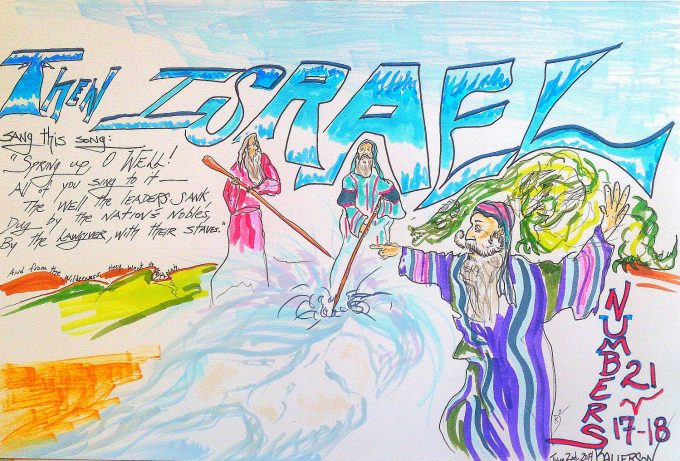
17 Then Israel sang this song:
az yashir yisrael eth ha’shirah ha’zot– “At that time sang Israel the song the this.” The word az is a demonstrative adverb which basically means “at that time.” Next, the verb shir, or to sing, has only been seen so far in Exodus 15 where it was used three times in connection with singing out the Song of Moses when Israel was delivered through the Red Sea. It seems to be a clue that what I said in the previous verses concerning the translation about the Red Sea is correct. There is a singing forth once again as there was then. The Lord’s works are being exalted in a logical, orderly way. Of these words, Adam Clarke says –
“This is one of the most ancient war songs in the world, but is not easily understood, which is commonly the case with all very ancient compositions, especially the poetic.” Adam Clarke
This is certainly true, but despite not being easily understood, it is a part of something the Lord is trying to speak out to us through His recorded word, if we will just pay heed. It must be remembered that typology is often how He does this, and so despite the difficulty, He is giving us advance pictures of things to come which are selected from true accounts of things which actually occurred.
17 (con’t) “Spring up, O well!
ali beer – “Arise, well!”
17 (con’t) All of you sing to it—
enu lah – “all of you respond to it.” The word anah means to answer or to respond. Saying “sing” destroys the intent of the passage because it is a completely different word translated as “sing” in the previous clause. Young’s Literal translation takes these two clauses even further. Instead of, “Arise, well. All of you respond to it,” he says, “Concerning the well – they have answered to it.” Though it is hard to determine how he came up with this, and though it is an odd translation of the word which means “arise,” it is a marvelous translation concerning what is being pictured.
18 The well the leaders sank,
beer khapharuha sarim – “well, sought out, by the rulers.” With the exception of the CEV, in this clause or the next, all translations agree that this is an active digging by the leaders. They say that they “sank,” “dug,” “hollowed out,” etc. The CEV says, “with their royal scepters, our leaders pointed out where to dig the well.”
Though the CEV is right that the leaders certainly weren’t the ones to dig the well, their translation doesn’t reflect the Hebrew. Rather, it is a paraphrase attempting to show intent, probably because it is obvious that the rulers would not be the ones to dig a well.
The word is khaphar. It means “to pry into,” and thus by implication, to delve, explore, pry, paw, search out, seek, or even dig. Because this is dealing with a well, the most obvious thought is, “Oh, they have to dig it.” But that is not the job of a leader, and so that is not what is being relayed. Rather, these rulers sought out what the Lord has provided to them.
18 (con’t) Dug by the nation’s nobles,
karuha nedive ha’am – “opened by the willing of the people.” The word karah means to open. That means by digging, but figuratively it can mean to open one’s ears, and it is translated as pierced in Psalm 22, when referring to the crucifixion.
The next word, nadiv, signifies something voluntary, and thus anyone who is inclined, willing, magnanimous, or someone like a noble. There is a voluntary opening of the well.
18 (con’t) By the lawgiver, with their staves.”
bimkhoqeq b’mishanotam – “by decree, with their staffs.” The word khaqaq comes from a root meaning “to hack.” Thus, it means to engrave and by implication, “to enact.” From there, it can be used to indicate a lawgiver.
The word mish’enah means a staff, as for support. One thing is for certain, nobody would use a staff to dig a well. A shovel yes, their hands maybe, a pack of chihuahuas possibly, but not with a staff. Of the verse, the scholar Keil says –
“…here God gave the people water, not as before by a miraculous supply from a rock, but by commanding wells to be dug. This is evident from the ode with which the congregation commemorated this divine gift of grace.”
Like Keil’s thoughts, translations, for the most part, indicate an active digging of the well, rather than searching it out and opening it without physical effort, but that is hardly a divine gift of grace if someone has to dig for it. The water coming from the rock is certainly divine grace. It is spoken to and the water comes forth. The same is true here. The entire song, as translated by me says –
“Arise, well!”
“All of you respond to it.”
“Well, sought out, by the rulers.”
“Opened by the willing of the people.”
“By decree, with their staffs.”
There is a well which is waiting to come forth for the people. The people are being asked to respond to it. It was a well sought out by the rulers. It was opened by the willing of the people, and it was by decree, while the people did nothing. They simply placed their staffs where the well was, and water came forth.
18 (con’t) And from the wilderness they went to Mattanah,
u-midbar mattanah – “and wilderness to Mattanah.” Mattanah simply means “gift.” It is used, for example, in Psalm 68:18 –
“You have ascended on high,
You have led captivity captive;
You have received gifts among men,
Even from the rebellious,
That the Lord God might dwell there.” Psalm 68:18
19 from Mattanah to Nahaliel,
Nakhaliel means “Valley of God.”
19 (con’t) from Nahaliel to Bamoth,
Bamoth means “High Places,” or “Great High Place.”
20 and from Bamoth, in the valley that is in the country of Moab,
Here Bamoth, or “Great High Place,” is said to be in the guy, or valley, in the country of Moab, or “From Father.” From there, our journey today ends with…
*20 (fin) to the top of Pisgah which looks down on the wasteland.
rosh ha’pisgah, or “the top of the Pisgah.” Pisgah comes from pasag, meaning to pass through, and thus it is a cleft. It is always prefixed by the definite article, and thus it is THE Cleft. Pisgah is said to look down on ha’yeshimon, or the wasteland. Some translations say, Jeshimon, but with the definite article, it simply means, “the wasteland.” That comes from a word meaning “to be desolate.”
It is this place where Israel will wait for word to travel on through the land of the Amorites. Stay tuned for the exciting details in the next sermon.
Arise, O Well! Bring forth the Water of Life
We have long been in a barren and ruined land
But now has ended our time of punishment and strife
Now we know the truth; now we understand
Our fathers didn’t believe, and they were sent away
They were exiled to a barren and ruined land
But here we are, new wineskins – ready to obey
Now we know the truth; now we understand
We have come to trust in You alone, O Lord
No more shall we pass through the barren and ruined land
We know the truth of Messiah, the incarnate Word
Now we know the truth; now we understand
II. Pictures of Christ
The account begins with the children of Israel moving on and coming to Oboth. As we saw, that means skins. In this case, we can be certain it is wineskins. This will become evident, but the picture is seen in Jesus’ words of Luke 5 –
“And no one puts new wine into old wineskins; or else the new wine will burst the wineskins and be spilled, and the wineskins will be ruined. 38 But new wine must be put into new wineskins, and both are preserved. 39 And no one, having drunk old wine, immediately desires new; for he says, ‘The old is better.’” Luke 5:37-39
Jesus was actually speaking of the law and grace. If one tries to put the grace the Lord provides into the law, the skins couldn’t handle it. They were incompatible and both are ruined in the attempt.
That this is the picture is certain because the old generation is now dead. They had rejected the grace of Christ which was pictured in entering the land of promise, and they went into punishment.
Likewise, Israel rejected Christ, crucified Him, and went into punishment. That went until a set point in time, and they are now being brought back to God. They aren’t there yet, but this is what is pictured. The wineskins are being prepared.
From there, they went through Ruins of the Passers, or Ije Abraim. In order to get to glory, one must pass through the ruins of his past life. Nobody starts in glory, and this is what is being seen here. The wineskin of grace means passing through that which is ruined.
This was said to be east of Moab, toward the sunrise. Man in search of God must head west. That is where Moab, or From Father is. And that is the trek we make, pictured by the casting of Adam east of Eden, and the Most Holy Place of the Sanctuary being in the west with the cherubim facing east.
After this, they went to the nakhal zered, or Valley of Zared. Nakhal comes from a word signifying to inherit, or take possession. The valley is named Zared because of abundant foliage, implying well-watered and vibrant.
In this, the significant milestone of all of the disobedient generation being gone, which is recorded in Deuteronomy, was seen. This is the last stop where any but Moses will be. The time of punishment is over which seems to be reflected in the idea of taking possession of the abundant foliage. Abundant life is once again ready to be possessed.
The next stop is on the side of the Arnon. As seen, that comes from ranan, meaning jubilant or rejoicing. It is in the wilderness and lies between Moab, or From Father, and the Amorites, or Renown. The name Renown, gives the sense of foreboding.
In Numbers 13, a fear of these people, along with the others in Canaan, led to their downfall and punishment. But this is a new generation, and such will not be the case. They will live by faith, and will be given life through faith. At this time came the first poetic offset –
“And He did in the Red Sea.”
“And unto the brooks of the Arnon.”
“And the spring of the brooks.”
“Which inclines to the dwelling of Ar.”
“And rests on the border of Moab.”
The Book of the Wars of the Lord is referred to here to tell the people that despite their time of punishment, He had been with them, leading them to this point. They are on the border of Moab, or “From Father,” and no matter what they face, they have been cared for and would be cared for.
The poetic offset looks forward to taking possession of the outpouring which leads to the city and which rests on the border of Moab, or From Father. In other words, it is a picture of receiving the Spirit and entering into the promised heavenly city which is where God interacts with man.
This is then seen with their arrival at Beer, or “Well.” It is here that the Lord promises to give them water. Their time of punishment has ended, and the people will drink water from the well. It is an obvious picture. Israel will someday, not too far off from our present time, receive Christ, and they will receive the Spirit which issues from Christ. The words of the poetic offset said –
“Arise, well!”
“All of you respond to it.”
“Well, sought out, by the rulers.”
“Opened by the willing of the people.”
“By decree, with their staffs.”
In speaking of the well sought out by the rulers, that is referred to by Jesus in Matthew 23:37-39 –
“O Jerusalem, Jerusalem, the one who kills the prophets and stones those who are sent to her! How often I wanted to gather your children together, as a hen gathers her chicks under her wings, but you were not willing! 38 See! Your house is left to you desolate; 39 for I say to you, you shall see Me no more till you say, ‘Blessed is He who comes in the name of the Lord!’”
It is only when Jerusalem, meaning the leadership of Israel, seeks out the Lord, calling on Him, that He will return to them. When they do, He will. Zechariah 12 shows the fulfillment of this picture we are looking at from Numbers 21 –
“And I will pour on the house of David and on the inhabitants of Jerusalem the Spirit of grace and supplication; then they will look on Me whom they pierced. Yes, they will mourn for Him as one mourns for his only son, and grieve for Him as one grieves for a firstborn.” Zechariah 12:10
That is further explained in Zechariah 13:1 –
“In that day a fountain shall be opened for the house of David and for the inhabitants of Jerusalem, for sin and for uncleanness.” Zechariah 13:1
This explains why the translation does not say “dug.” It is the grace of Jesus Christ, poured out on his long disobedient people, but who have ended their time of punishment, which is pictured here.
After this, it says they went to Mattanah, or Gift. What does the giving of the Spirit to a person imply? It implies salvation. From the well, they are given the gift –
“But God, who is rich in mercy, because of His great love with which He loved us, 5 even when we were dead in trespasses, made us alive together with Christ (by grace you have been saved), 6 and raised us up together, and made us sit together in the heavenly places in Christ Jesus, 7 that in the ages to come He might show the exceeding riches of His grace in His kindness toward us in Christ Jesus. 8 For by grace you have been saved through faith, and that not of yourselves; it is the gift of God, 9 not of works, lest anyone should boast.” Ephesians 2:4-9
The people had gone from attempting to enter salvation through their own efforts in Numbers 14, to coming to the Lord through faith here in Numbers 21. The entire time in the wilderness has been one long procession of thought, detailing Israel’s history since the coming of Christ.
From Mattanah, or Gift, they then went to Nakhaliel, or Valley of God. As this is a picture of Israel coming to faith at the end of the tribulation period, after their time of punishment, I would go so far as to say that this is speaking of the valley where Christ will judge the people. In Psalm 110, a messianic psalm, it speaks of exactly this, including the word nakhal, or valley, which is the source of the name Nakhaliel –
“The Lord is at Your right hand;
He shall execute kings in the day of His wrath.
6 He shall judge among the nations,
He shall fill the places with dead bodies,
He shall execute the heads of many countries.
7 He shall drink of the brook by the wayside;
Therefore He shall lift up the head.” Psalm 110:5-7
From Nakhaliel, the people then went to Bamoth, which means High Places or, Great High Place. That would be Jerusalem which Micah 1:5 calls the high places of Judah. It is a picture then of where the Lord will reign during the millennium.
Bamoth is said to have been in the guy, or valley, in Moab. Isaiah 22:1 calls Jerusalem ge khizayon, or the Valley of Vision. Thus, this is a reference to Jerusalem, being this valley which is, as Moab is translated, “From Father.” It is a reference to what will be during the millennium, the great high place in the valley where the Father’s blessings will flow.
That is beautifully seen in the picture of the millennium in Ezekiel 47 where water flows from under the threshold of the temple all the way to where the Dead Sea is now.
Finally, the narrative ends at the top of Pisgah, or “to pass through,” which looks down on the wasteland. This must be a reference to what is stated about the millennium by Isaiah in the very last verse of his book –
“And they shall go forth and look
Upon the corpses of the men
Who have transgressed against Me.
For their worm does not die,
And their fire is not quenched.
They shall be an abhorrence to all flesh.” Isaiah 66:24
The people will have passed through the cleft to life, but they will look back on those corpses of the fallen, pictured by the rebellious generation who died in the wilderness. The entire passage today is simply a foreshadowing of what Israel missed and therefore they suffered exile and death over for the past 2000 years, but which will eventually lead to their salvation and exaltation when Christ returns for and to them.
The pattern has been seen since Numbers 13. Each passage has moved along that same theme, reflecting the state of Israel since their rejection of Christ. And now what will come upon them someday in the future has been methodically detailed in today’s verses.
As this is so, and as it is certain, what that means beyond Israel the people is that the message of Christ is just as true for them in the days ahead as it is for all people at this time. If what God says about the work of Christ and the giving of the Spirit is true for Israel, it is true for the world.
Israel missed the significance of the coming of Messiah, and so He went to the nations during their time of punishment. However, He will be coming back to them and they will receive Him. Before that day, He will call the church home and the time of woe which Israel has faced will extend to a time of woe levied upon the whole world. Only after that final period of purification will Israel call out to God. And until they do the woes will only increase.
To be spared from that, the Lord offers grace. It is grace in the giving of His Son, and it is free. The people in today’s passage did nothing to receive the gift. The Lord led them to the Well, and by decree, the people simply opened it by resting their staffs upon it.
A staff is a symbol of authority of the one who possesses it, and of where one places his trust. In the case of Israel, the picture is that they took their authority, and placed it at the well, trusting in it to provide, and not in their own self. The well is Christ, the water is the Spirit. They trusted Christ, and the Spirit came forth.
This is what God asks of us. He asks us to come, in faith, putting aside trust in self, and in deeds of merit. Are you ready to come to Christ and submit yourself to His capable hands. The Lord is calling. I pray you will make the right choice.
Closing Verse: People shall mourn upon their breasts
For the pleasant fields, for the fruitful vine.
13 On the land of my people will come up thorns and briers,
Yes, on all the happy homes in the joyous city;
14 Because the palaces will be forsaken,
The bustling city will be deserted.
The forts and towers will become lairs forever,
A joy of wild donkeys, a pasture of flocks—
15 Until the Spirit is poured upon us from on high,
And the wilderness becomes a fruitful field,
And the fruitful field is counted as a forest.” Isaiah 32:12-15
Next Week: Numbers 21:21-35 When they are gone, God’s people will be overjoyed (Two Foes to Be Destroyed) (42nd Numbers Sermon)
The Lord has you exactly where He wants you. He has a good plan and purpose for you. It may seem at times as if you are lost in a desert, wandering aimlessly. But the Lord is there, carefully leading you to the Land of Promise. So follow Him and trust Him and He will do marvelous things for you and through you.
Filling Wineskins
Now the children of Israel moved on and camped in Oboth
And they journeyed from Oboth and camped at Ije Abarim
In the wilderness which is east of Moab
Toward the sunrise, from where the sun first does beam
From there they moved and camped in the Valley of Zered
|From there they moved and camped on the Arnon’s other side
Which is in the wilderness that extends
———-from the border of the Amorites
For the Arnon is the border of Moab
———-between Moab and the Amorites; so it does divide
Therefore it is said in the Book of the Wars of the Lord:
So is recorded this poetic word
“Waheb in Suphah,
The brooks of the Arnon,
And the slope of the brooks
That reaches to the dwelling of Ar,
And lies on the border of Moab.”
From there they went to Beer
Which is the well where the Lord said to Moses, about the throng
“Gather the people together, and I will give them water
Then Israel sang this song:
“Spring up, O well!
All of you sing to it—
The well the leaders sank,
Dug by the nation’s nobles,
By the lawgiver, with their staves.”
And from the wilderness they went to Mattanah
From Mattanah to Nahaliel, from Nahaliel to Bamoth
———-so we understand
And from Bamoth, in the valley that is in the country of Moab
To the top of Pisgah which looks down on the wasteland
Lord God, we are even now in a wilderness
And we are wanting to be led by You
Without You to direct, our lives would be a mess
And so be our guide, O God; You who are faithful and true
We long for the water in this barren land
May it flow forth from the Rock, our souls to satisfy
Give us this refreshing, spiritual hand
And may we take it, and to our lives daily it apply
And we shall be content and satisfied in You alone
We will follow You as we sing our songs of praise
Hallelujah to You; to us Your path You have shown
Hallelujah we shall sing to you for all of our days
Hallelujah and Amen…