Numbers 21:21-35
Two Foes to Be Destroyed
On the day I typed this sermon, I got to verse 27 and needed an analogy concerning the type of literature that is being presented. The Marine Corps hymn came to mind, and so I did a search to pull it up. Ironically, an article concerning the hymn was published that same morning.
The commandant of the Marines directed that instead of coming to attention and remaining silent when the hymn is played, all Marines are to now sing it out loud. Due to the irony of these two things coming about on the same day, I decided that we should hear the hymn read so that we can, like Israel did, remember the history of our Marine warriors.
From the Halls of Montezuma
To the shores of Tripoli
We fight our country’s battles
On the lands, and on the sea
First to fight for right and freedom
And to keep our honor clean
We are proud to claim the title
Of United States Marine
Our flag’s unfurled to every breeze
From dawn to setting sun
We have fought in every clime and place
Where we could take a gun
In the snow of far-off northern lands
And in sunny tropic scenes
You will find us always on the job
The United States Marines
Here’s health to you and to our Corps
Which we are proud to serve
In many a strife we’ve fought for life
And never lost our nerve
If the Army and the Navy
Ever look on Heaven’s scenes,
They will find the streets are guarded
By United States Marines
From the Halls of Montezuma
To the shores of Tripoli
We fight our country’s battles
On the lands, and on the sea
First to fight for right and freedom
And to keep our honor clean
We are proud to claim the title
Of United States Marine
Text Verse: “Then I looked, and I heard the voice of many angels around the throne, the living creatures, and the elders; and the number of them was ten thousand times ten thousand, and thousands of thousands, 12 saying with a loud voice:
“Worthy is the Lamb who was slain
To receive power and riches and wisdom,
And strength and honor and glory and blessing!” Revelation 5:11, 12
Whether singing a song about the deeds of the heroes of a nation, or of the greatness of God, we remember these things because they stir our souls and remind us of past deeds which carry future significance.
Someday, the redeemed of the Lord will shout out together the words of Revelation 5:12 – all hailing the great deed which was done and which will have not just future, but eternal significance.
But there is nothing wrong with calling out those words today. The words of our text verse were put to music by George Frideric Handel in his most esteemed work, Messiah. In fact, it is the 53rd and last portion of the work. It encompasses Scene 4 and is entitled “Worthy is the Lamb.”
So, in preparation for the marvelous day when the saints of God together sing out to the Lamb, maybe you will, from time to time, take advantage of listening to the words of Handel’s Messiah. And certainly, because I know you read your Bible daily, you will come to Revelation 5 at least a couple times each year.
When you get there, you can ponder on the great things that Christ has done for His people. Someday, Israel will be on that same page with us. That was seen last week, but it continues to be seen this week. It’s all to be found in His superior word. And so let’s turn to that precious word once again and… May God speak to us through His word today and may His glorious name ever be praised.
I. Sihon King of the Amorites (verses 21-28)
21 Then Israel sent messengers
va’yishlakh yisrael malakim – “and sent Israel messengers.” The word “messengers” is malak, a word often translated as “angel.” In the Hebrew, as in the Greek, the idea of an angel is a divine messenger. The word itself is simply one that signifies being dispatched as a messenger.
21 (con’t) to Sihon king of the Amorites, saying,
Sihon, or Sikhon, is introduced here. The name will be referred to many times in the Old Testament, even as late as the time of Jeremiah. His name will be directly associated with the land he rules. The name comes from a root which signifies “to sweep away,” or “to strike down.” Thus his name may signify anything from “Tempestuous” to “Warrior.”
He is defined further as melekh ha’emori, or “king of the Amorite.” We saw in last week’s verses that Amorite comes from amar, meaning to utter or say. Therefore, the name signifies being spoken of, and thus “Renowned.” Israel is sending messengers to this king with a petition which is not at all unreasonable.
During an acrostics search of Chapter 21, our friend Sergio found that in the words, “Then Israel sent messengers to king Sihon,” there is a forward running acrostic which says ve-yemasam which means — “and rejected them.” This is the forward acrostic. The same words also form a backward running acrostic which says khen la’melekh, or “Favor to the King.”
Together, they show what happens in the passage. Israel extends favor to the king and the king rejects their request. It is rather astonishing. This is especially so because the length of the first acrostic is rather long which is quite unusual.
22 “Let me pass through your land.
This first sentence is one of appeal. There is no presumption in it, and there is no hint of threat. It is simply a request. But more…
22 (con’t) We will not turn aside into fields or vineyards; we will not drink water from wells.
There is the promise of respect for the property of the Amorites, signifying that they have the right to the land, and that right will not be violated in any way. Instead…
22 (con’t) We will go by the King’s Highway until we have passed through your territory.”
derek ha’melekh, or “Way of the King,” signifies a public road paid for at the cost of the king’s treasury. It would be kept in proper order at all times for the king and his army to set out on in times of either offensive or defensive battles. It would pass through the heart of the land, meaning that Israel would be completely under the eye of the Amorites, and at their mercy. They would, in essence, be leaving themselves open to the forces of Sihon.
The entire appeal is similar to that found in Numbers 20 when speaking to the king of Edom –
“Please let us pass through your country. We will not pass through fields or vineyards, nor will we drink water from wells; we will go along the King’s Highway; we will not turn aside to the right hand or to the left until we have passed through your territory.” Numbers 20:17
23 But Sihon would not allow Israel to pass through his territory.
It is the same reaction as that of the king of Edom. There, it said, “You shall not pass through my land, lest I come out against you with the sword” (Numbers 20:18). After a second appeal, it then said that Edom came out against them. Here, no second appeal is recorded. Rather, it simply says…
23 (con’t) So Sihon gathered all his people together and went out against Israel in the wilderness,
What is unrecorded in this account of Numbers, but what is stated in Deuteronomy 2, is that the Lord already knew what the outcome of sending these messengers would be. There we read –
“Rise, take your journey, and cross over the River Arnon. Look, I have given into your hand Sihon the Amorite, king of Heshbon, and his land. Begin to possess it, and engage him in battle. 25 This day I will begin to put the dread and fear of you upon the nations under the whole heaven, who shall hear the report of you, and shall tremble and be in anguish because of you.’” Deuteronomy 2:24, 25
It is only after stating this that Moses then sent the messengers. The reason for telling him that they would be given to Israel in battle is twofold. First, the Amorites were set for destruction by the Lord because they were ripe for judgment. That is seen in Genesis 15 –
“But in the fourth generation they shall return here, for the iniquity of the Amorites is not yet complete.” Genesis 15:16
Abraham was told that the reason for his not receiving the land during his years was because the Amorites had not yet reached the full measure of their iniquity. That time has now come. Secondly, the verse in Deuteronomy explains that the nations would hear of what occurred and fear. Thus, this would give them the psychological advantage in future battles.
However, despite being told, in advance, that they would engage in battle, Moses followed the proper protocols in order to demonstrate that Sihon was the aggressor, and that when the land was won in battle, it rightly became the possession of Israel. If Israel had attacked without this diplomatic offer, then the validity of the land acquisition would be in question.
Further, it says that Sihon “went out against Israel in the wilderness.” Thus, Israel had not even entered into Sihon’s land. This was a war initiated by Sihon, and it was an attack outside of his jurisdiction. Therefore, Israel was wholly within their rights to assume the land as theirs. In Deuteronomy 2, it says this –
“But Sihon king of Heshbon would not let us pass through, for the Lord your God hardened his spirit and made his heart obstinate, that He might deliver him into your hand, as it is this day.” Deuteronomy 2:30
It says here that the Lord hardened Sihon’s heart. The question is, was this an active, or passive hardening. The answer is that it was passive. The fact that Israel had retreated from Edom led Sihon to a false conclusion that they were weak, but the Lord would not allow them to war against their own brother.
The same is true with Moab, as is recorded in Deuteronomy 2. But Sihon didn’t realize that the Lord had forbidden Israel to battle them either, having given the land to the descendants of Lot. Therefore, Sihon’s heart was passively hardened, making him think that Israel was a cowardly nation that could be easily plundered…
23 (con’t) and he came to Jahaz and fought against Israel.
The name yahatz, or, Jahaz, comes from a root meaning “to stamp.” Thus, it signifies, “Trodden Down.” It appears that the name of the place is derived from what occurred during the battle. At this location, the Amorites were trodden down, and thus Israel gave the location its name as a memorial of the battle…
24 Then Israel defeated him with the edge of the sword,
The Hebrew is more descriptive, saying, le-pi kharev, or “with the mouth of the sword.” The sword consumes the souls of men, devouring their existence. This sets up the next words…
24 (con’t) and took possession of his land
The word translated as “took possession” speaks of inheritance. Through death, Sihon disinherited, and thus Israel is now the inheritor or possessor of the land that goes…
24 (con’t) from the Arnon to the Jabbok, as far as the people of Ammon;
As seen last week, Arnon comes from ranan, which signifies to give a jubilant, ringing cry, and thus rejoicing. Therefore, it is the Roaring Stream. The yaboq, or Jabbok, has only been seen in Genesis 32:22 where Jacob wrestled with the Man in the night.
At that time, it was noted that Jabbok means, “Pouring out.” Like the name Israel, it carries a double entendre. There is a pouring out of God’s favor – love, grace, mercy and the like – even the Holy Spirit. But, there is also a pouring out of God’s wrath.
24 (con’t) for the border of the people of Ammon was fortified.
These words explain why the land acquisition ended at the Jabbok, not the reason why Israel didn’t attack them. Because of the strong fortification of their border, Sihon’s territory only extended that far. However, Israel was given the reason for not conquering them. That is stated in Deuteronomy 2 –
“And when you come near the people of Ammon, do not harass them or meddle with them, for I will not give you any of the land of the people of Ammon as a possession, because I have given it to the descendants of Lot as a possession.” Deuteronomy 2:19
Ammon comes from the word am, or “people.” In this, the sense is that they are the people called “A People,” and thus inbred, having their source in the union of Lot and his younger daughter.
Like Moab, his brother Ammon, was not to be harassed. They were both sons of Lot through his two daughters. Both nations have individuals who entered into the line of the Messiah. The Lord’s plans in such things always have the purpose and intent of leading to, or revealing, the coming Lord Jesus. For Sihon, however, such was not to be the case…
25 So Israel took all these cities, and Israel dwelt in all the cities of the Amorites, in Heshbon and in all its villages.
Israel took possession, and it is seen that certain tribes took favorably to the land and decided they wanted to stay there and make this their possession. That will be recorded later in Numbers. But for now, the account states this as a fact of the victory in battle. kheshvon, or “Heshbon” comes from khashav. It is a word which signifies to consider, calculate, or devise. Therefore, it signifies an explanation of things, or “Intelligence.”
This mentions both Heshbon and “all its villages.” The Hebrew reads, “all its daughters,” and so it means Heshbon is a mother city with small villages dependent upon the greater city. It would be comparable to the cities of Venice, Osprey, Nokomis, and so on found in the greater Sarasota area.
26 For Heshbon was the city of Sihon king of the Amorites, who had fought against the former king of Moab, and had taken all his land from his hand as far as the Arnon.
This verse explains that the city of Heshbon once belonged to Moab, and that it was acquired during a battle with Moab, including all of the land up to the Arnon itself. Thus, it was not improper for Israel to take possession of the land.
The rule of war is that land lost in a battle which one has initiated is no longer theirs. Instead, it transferred to Sihon, and from Sihon it transferred to Israel. Moab requires no explanation or payment for this transfer. This land will become a point of contention at the time of the Judges, and Jephthah will recount what occurred here to defend Israel’s rights to it.
Ia: Poem Part I – The Words of the Amorites
27 Therefore those who speak in proverbs say:
The word, “Therefore,” is given to explain the previous verse. A proverbial saying had come about to reflect the Lord’s victory and how it stood in relation to what had happened in the past. In this is a new verb, mashal. It signifies “to represent,” or “to be like.”
Thus, it is speaking in proverbs and making a comparison of one thing to another. It is the basis for the noun, mashal, meaning “a proverb.” The reason for this being spoken as a proverb instead of a song is because the destruction of Heshbon by Sihon is now likened to the destruction of Sihon by Israel. The words forthcoming were commonly spoken or sung, just as we might, even today, sing the Marine Corps hymn.
27 (con’t) “Come to Heshbon, let it be built;
bou kheshvon tibaneh – “Come to Heshbon; it shall be built.” The idea here is that Heshbon was destroyed during the battle by Sihon and must be rebuilt. The words here are a taunt to Moab concerning their defeat and Sihon’s great victory. In the rebuilding of Heshbon, it will be given a new title…
27 (con’t) Let the city of Sihon be repaired.
v’tikonen ir sikhon – “and let be prepared the city of Sihon.” The city of Hesbon would henceforward also be known as the “city of Sihon.” This is similar to Jerusalem being called, the “City of David.” The conqueror receives the honor. In fact, this was so common that we read this in 2 Samuel 12:26-29 –
“Now Joab fought against Rabbah of the people of Ammon, and took the royal city. 27 And Joab sent messengers to David, and said, ‘I have fought against Rabbah, and I have taken the city’s water supply. 28 Now therefore, gather the rest of the people together and encamp against the city and take it, lest I take the city and it be called after my name.’ 29 So David gathered all the people together and went to Rabbah, fought against it, and took it.”
28 “For fire went out from Heshbon,
ki esh yaseah me-kheshvon – “For fire went out from Hesbon.” This is speaking of the fire of war which proceeded from Heshbon after Sihon had made it his own new capital city. From that staging point, war – symbolized by fire – went out further…
28 (con’t) A flame from the city of Sihon;
lehavah miqirat sikhon – “A flame from the city of Sihon.” Another new word is seen here, qiryah, or “city.” That comes from a word signifying “to happen,” or “come to pass.” Thus, it is a place where events occur. From the city of Sihon, a flame went forth. It is a parallel statement to the previous clause.
A flame is shaped like a blade, or the head of a spear, and so it poetically is speaking of the blade of war going forth to consume, just as fire consumes. In this case…
28 (con’t) It consumed Ar of Moab,
akelah ar moav – “It devoured Ar of Moab.” Deuteronomy 2:29 shows that the city of Ar was inhabited by Moab. Therefore, it could be that the words are comparable to saying, “We stomped on them all the way to Tokyo.” The city itself wasn’t taken, but the land right up to it was, and the people were crushed along the way.
28 (con’t) The lords of the heights of the Arnon.
baale bamoth arnon – “The lords of the high places of Arnon.” This is parallel to the preceding clause. The “lords of the heights of the Arnon” is probably referring to the priests and people who worshiped their god in the high places. In verses 19 and 20, the location Bamoth was mentioned. It is the people of this area that were consumed by the war fire of Sihon.
Ib: Poem Part II – The Words of Israel
29 Woe to you, Moab!
oy lekha moav – “Woe to you Moab!” Here, the familiar word oy is introduced. It signifies “woe.” Today, we hear Jews proclaim, Oy veh! This is something like, “Woe is me!” In this case, it is “Woe to you, Moab!” This is because…
29 (con’t) You have perished, O people of Chemosh!
abadta am kemosh – “You are annihilated, people of Chemosh.” The people of Sihon are taunting the Moabites by taunting their god, Chemosh. The meaning of Chemosh can’t be definitively defined, but it seems to come from an unused root meaning “to subdue,” and thus it means something like “Vanquisher.”
The taunt then is all the more striking when it says, that the people of their god “Powerful” are powerless to ward off annihilation. And more taunts towards Chemosh are forthcoming…
29 (con’t) He has given his sons as fugitives,
natan banav peletim – “Given sons as fugitives.” Those sons of Moab who trusted the failing god Chemosh that weren’t destroyed were taken from their people and given as fugitives to Sihon…
29 (con’t) And his daughters into captivity,
u-benotav bashevit – “And daughters into exile.” The daughters of Chemosh have been separated from their people. Because of his inability to protect them, they were given away…
29 (con’t) To Sihon king of the Amorites.
l’melekh emori sikhon – “to king of the Amorites, Sihon.” Sihon and his people had defeated Moab, the people of Chemosh. They were victorious in battle, and what belonged to Moab became the property of Sihon. However, something new has been added to the song of war, making it a proverbial song…
1c: Poem Part III – The Victory of Israel
30 “But we have shot at them;
va-niram – “And we have shot at them.” In contrast to the great power of Sihon over Moab, the greater power of Israel over Sihon is seen. Thus, because the god of Moab gave up to the power of the Amorites, so the god of the Amorites could not withstand the power of the Lord.
30 (con’t) Heshbon has perished as far as Dibon.
abad kheshvon ad divon – “Has perished Heshbon as far as Dibon.” Just as Hesbon had been taken from Moab, now those who took it have been destroyed, even as far as a place called Dibon. The name probably comes from duv, meaning “to pine away.” And thus Dibon would be “Pining.”
30 (con’t) Then we laid waste as far as Nophah,
va-nashim ad nophakh – “And made desolate to Nophah.” Again, another taunt is raised concerning the greatness of the victory. The name Nophah comes from a word meaning “to breathe,” or “to blow.” It is what the Lord did to Adam on the day He created him. He “breathed into his nostrils the breath of life.” It is also what Ezekiel says will again happen to Israel in the Valley of Dry Bones when the breath is breathed again into the slain.
Therefore, the name probably means, “Windy Place.” An entire section of the land was destroyed from Heshbon to Nophah by the onslaught of Israel. And, it is Nophah…
30 (con’t) Which reaches to Medeba.”
asher ad medeva – “Which extends to Medeba.” This would be the reading according to the text itself, but there is a special mark above the last letter of the word translated as “which.” If that letter does not belong, as the mark calls it into question, then the text would match what it says in the Greek translation of the passage, and so it would say, “With fire unto Medeba.”
That would then form a proper parallel to the previous clause – “We laid waste as far as Nophah, with fire unto Medeba.” It would also, then, correspond to the flame and the fire mentioned in verse 28. This is probably the correct reading. Either way, Medeba means something like, “Waters of Rest.”
In all, the poem calls out the superiority of Israel over the Amorites, and thus the greatness of Yehovah over the gods of both the Amorites and the Moabites. Because of this…
31 Thus Israel dwelt in the land of the Amorites.
This is stated, like was said earlier, to show Israel’s right to dwell in this area. Any future claim on the land by the children of Lot would be invalid because Israel had defeated those who had defeated Moab. It was, at the time of Israel’s battle, “the land of the Amorites.”
32 Then Moses sent to spy out Jazer; and they took its villages and drove out the Amorites who were there.
The next area of conquest is a place called yatser, or Jazer. This means something like, “Helpful” or “He Shall Help.” It was an area of the Amorites which was subsequently defeated and driven out. Jazer was a main mother city which had its own daughter villages.
This verse includes a new word in the Bible, lakad. It signifies to capture or seize. It will become a common word from this point on, both for and against Israel. After this, it says…
33 And they turned and went up by the way to Bashan.
From Jazer, a turn is made and Israel ascended on the way to “the Bashan.” There is an article in front of Bashan. The name signifies something like “Place of fertile soil.” Another foe is now seen…
33 (con’t) So Og king of Bashan went out against them, he and all his people, to battle at Edrei.
Og is said to be king of the Bashan. His name comes from uggah, which is a round baked cake. That comes from ug, to bake. Here, it says that he led his entire force out to meet Israel at Edrei. Edrei means something like “Mighty.” Despite the name, implying the great force which has arisen against them, the Lord is more powerful, and has good news for His people…
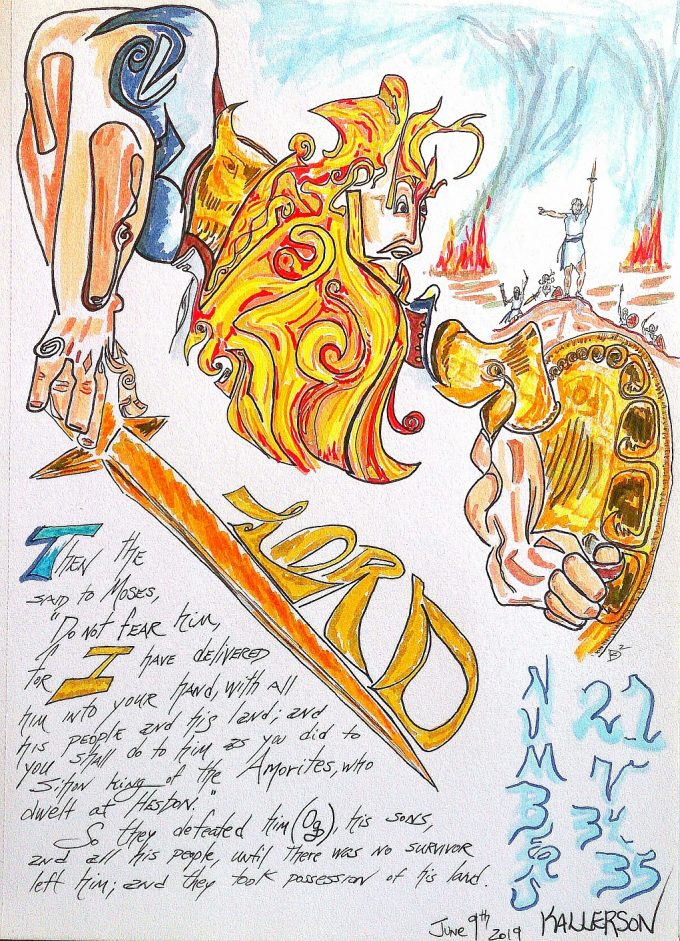
34 Then the Lord said to Moses, “Do not fear him, for I have delivered him into your hand, with all his people and his land; and you shall do to him as you did to Sihon king of the Amorites, who dwelt at Heshbon.”
We will find out later that Og was one of the giants, a man of great stature, like Goliath. That, along with the large accompanying army, would have made them appear as a formidable foe, but as Hezekiah noted many years later against his own great foe, with Og was an arm of flesh; but with Israel is the Lord their God, to help them and to fight their battles. There was no need to fear such an impotent foe…
35 So they defeated him, his sons, and all his people, until there was no survivor left him;
This requires an explanation found in Deuteronomy. In both the battle against Sihon and that of Og, every person was kharam, or devoted to destruction. As it says in Deuteronomy 2 & 3 –
“We took all his cities at that time, and we utterly destroyed the men, women, and little ones of every city; we left none remaining. 35 We took only the livestock as plunder for ourselves, with the spoil of the cities which we took.” Deuteronomy 2:34
&
“And we utterly destroyed them, as we did to Sihon king of Heshbon, utterly destroying the men, women, and children of every city.” Deuteronomy 3:6
What may seem overly brutal to our sensibilities today is irrelevant to what the Lord determines. He creates, and He can dispense with His creation in whatever way He finds appropriate.
*35 (fin) and they took possession of his land.
Again, this is a final statement which reveals Israel’s right to the land they have acquired. Both Sihon and Og came out against Israel, they were defeated by Israel, and Israel has the right to the land because of their victory. It is the standard procedure revealed throughout history concerning victory in such a battle.
Worthy is the Lamb who was slain
To receive power and riches and wisdom
Worthy is Lamb, so we say again
Glorious is the Lamb and we are His kingdom
Worthy is the Lamb who was slain
To receive strength and honor and glory and blessing
Worthy is the Lamb, so we say again
Let the song of the Lamb clothe you like dressing
Worthy is the Lamb who was slain
All honor is to be given to Him now and for always
Worthy is the Lamb, and so we say again
We shall sing of the glory of the Lamb for eternal days
II. A Look Ahead in Redemptive History
This is the last recorded event of the wilderness wanderings, just after all of the disobedient generation are dead, and just before the narrative dramatically changes, leading into an entirely different theme. Here, despite Israel as having been seen to receive the Spirit in the last sermon, there are two foes which must be defeated.
In the end times, there are two foes which need to be defeated, the Antichrist and the false prophet. How do you take an account of the future, where two foes are destroyed at the same time, and give details of them so that it is understood that each foe is who is being pictured? You give two separate stories in the same narrative.
Here we see Israel first tries to appease Sihon, asking to simply pass through his territory. Sihon means “Warrior,” He anticipates the Antichrist. He comes out to Jahaz to war against Israel. That means “Trodden Down.” It is what happens to Jerusalem in the end times where it says in Revelation 16:2, “And they will tread the holy city underfoot for forty-two months.”
Israel defeated Sihon and, as it says, took possession of the land. The word used speaks of inheritance. What belonged to the Antichrist and his master, the devil, is regained for Israel. At that time, it says that they have inherited the land from the Arnon to the Jabbok.
Arnon comes from ranan, which signifies to give a jubilant, ringing cry, and thus rejoicing. The yaboq, or Jabbok, means, “Pouring out.” There was a pouring out of God’s favor – love, grace, mercy and the like – even the Holy Spirit – on Israel. But there is also a pouring out of God’s wrath on the Antichrist.
In this, kheshvon, or “Heshbon” is highlighted. It comes from khashav. It is a word which signifies to consider, calculate, or devise. Therefore, it signifies an explanation of things, or “Intelligence.” It is in the acquisition of Heshbon that the poetic offset was introduced.
Sihon had taken it from the former king of Moab, but Israel took it from Sihon. The poem looks to the state of the world that will continue until Christ’s final rule. Paul speaks of it in 1 Corinthians 1:19 –
“I will destroy the wisdom of the wise;
the intelligence of the intelligent I will frustrate.” (NIV)
The wisdom and intelligence of God, meaning the gospel, represented by Heshbon, was unavailable to Israel. The spirit of Antichrist is that which denies the Son (1 John 4:3). Sihon’s defeat of Heshbon looked to Antichrist’s defeat by Israel. The sons were fugitives, and the daughters were captives to Sihon.
But, in Israel’s calling out to Christ came the return of Christ and the destruction of Antichrist. The supposed wisdom of the wise was destroyed. That is why the land is said to be laid waste “as far as Dibon … as far as Nophah, which reaches to Medeba.” Dibon means “Pining.” Nophah signifies “Windy Place.” Medeba, means “Waters of Rest.”
The intelligence of this world is gone, and with it everything that stands against the knowledge of the breath of life which reaches to the waters of rest. This will be fully realized when the Antichrist is defeated. After this, Moses sent to spy out Jazer. It signifies, “He Shall Help.” It looks to the Lord as their Helper, as Israel no longer trusts in self.
The second foe to be defeated is the false prophet, represented by Og. The account says they went by the way of ha’bashan, or “the Bashan,” a place of fertile soil.
Og is said to be king of the Bashan. His name comes from uggah, which is a round baked cake. That comes from ug, to bake. The picture we see is one set in opposition to Israel and who is to be destroyed. The uggah, or baked cake, is seen seven times in the Bible. It is that which nourishes and sustains life.
Thus Og, who is king over the fertile place of soil, pictures the False Prophet who denies the people of God the truth and nourishment of the word. The battle of Israel against him was at Edrei which signifies “Mighty.” Despite the mighty place chosen for this final battle, it is the Lord, through Israel, who defeats Og.
As the passage finishes, it says that they were defeated until there were no survivors left. Both Sihon and Og were devoted to destruction, along with all of their people. That is well represented by the destruction of the armies gathered together against the Lord who has come back to defend Israel in Revelation 19 –
“Then the beast was captured, and with him the false prophet who worked signs in his presence, by which he deceived those who received the mark of the beast and those who worshiped his image. These two were cast alive into the lake of fire burning with brimstone. 21 And the rest were killed with the sword which proceeded from the mouth of Him who sat on the horse. And all the birds were filled with their flesh.” Revelation 19:20, 21
The history of Israel, from their exile due to rejecting Christ, all the way through until the time just prior to the millennial kingdom, found in Revelation 20, has been beautifully represented in type and picture since Numbers 14. The symbolism is perfectly clear.
As asked earlier, how does one present an account of history, before it happens, so that the things will be understood when they come about, but without simply giving all of the details in clear text? It is done through typology. The Lord uses real events of history, recording those which will match later events, so that the overall picture becomes evident. The majority of the typology has already been seen in the coming of Christ, and in the completion of the writing of the New Testament, but some of the things revealed in the New are yet to come about – things like the rapture, Israel’s coming to Christ, the second coming of Christ, and the millennium.
By knowing what the Bible clearly reveals about the future, we can then look for and identify the typology that was given to foreshadow it. This gives us a double-assurance that what is prophesied to yet come about is all the more certain.
If only Israel could look at the past, compare it with themselves, their current state, and what lies ahead, they would avoid many troubles in the days to come. We should pray for them, and hope that they will open their eyes and see what the Lord is shouting out to them from His word.
And the same is true with us. The things we are looking at aren’t novel stories, but real examples of God’s care over redemptive history. In the word of God, we have a sure word. And that word, above all, tells us of Jesus. It reveals His love for this world, and His love for Israel, despite their current rejection of Him. He who is ever-faithful will never forget His promises.
Let us trust in this, and let us be confident of it as we continue our walk down life’s path. Let us be grounded in Christ, and in this, we will never be led astray from His goodness.
Closing Verse: “That which has been is what will be,
That which is done is what will be done,
And there is nothing new under the sun.” Ecclesiastes 1:9
Next Week: Numbers 22:1-21 What is the story of Balaam about? Stay tuned and we shall see… (Curse This People for Me) (43rd Numbers Sermon)
The Lord has you exactly where He wants you. He has a good plan and purpose for you. It may seem at times as if you are lost in a desert, wandering aimlessly. But the Lord is there, carefully leading you to the Land of Promise. So follow Him and trust Him and He will do marvelous things for you and through you.
Two Foes to Be Destroyed
Then Israel sent messengers to Sihon king of the Amorites, saying
“Let me pass through your land
We will not turn aside into fields or vineyards
We will not drink water from wells, please understand
We will go by the King’s Highway until we…
Have passed through your territory
But Sihon would not allow Israel to pass through his territory
So Sihon gathered all his people together and went
———-as the record does tell
Out against Israel in the wilderness
And he came to Jahaz and fought against Israel
Then Israel defeated him with the edge of the sword
And took possession of his land from the Arnon to the Jabbok
———-yes on that side
As far as the people of Ammon
For the border of the people of Ammon was fortified
So Israel took all these cities
And Israel dwelt in all the cities of the Amorites
In Heshbon and in all its villages
Having sunny days and sleepy nights
For Heshbon was the city of Sihon king of the Amorites
Who had fought against the former king of Moab
———-so it was this way
And had taken all his land from his hand as far as the Arnon
Therefore those who speak in proverbs say:
“Come to Heshbon, let it be built;
Let the city of Sihon be repaired.
“For fire went out from Heshbon,
A flame from the city of Sihon;
It consumed Ar of Moab,
The lords of the heights of the Arnon.
Woe to you, Moab!
You have perished, O people of Chemosh!
He has given his sons as fugitives,
And his daughters into captivity,
To Sihon king of the Amorites.
“But we have shot at them;
Heshbon has perished as far as Dibon.
Then we laid waste as far as Nophah,
Which reaches to Medeba.”
Thus Israel dwelt in the land of the Amorites
Then Moses sent to spy out Jazer; probably at early dawn
And they took its villages and drove out
———-the Amorites who were there
And they turned and went up by the way to Bashan
So Og king of Bashan went out against them, so we see
He and all his people, to battle at Edrei
Then the Lord said to Moses —-
“Do not fear him, for I have delivered him into your hand
With all his people and his land
And you shall do to him as you did to Sihon king of the Amorites
Who dwelt at Heshbon, so we understand
So they defeated him, his sons, and all his people
———-until there was no survivor left him
And they took possession of his land
Lord God, we are even now in a wilderness
And we are wanting to be led by You
Without You to direct, our lives would be a mess
And so be our guide, O God; You who are faithful and true
We long for the water in this barren land
May it flow forth from the Rock, our souls to satisfy
Give us this refreshing, spiritual hand
And may we take it, and to our lives daily it apply
And we shall be content and satisfied in You alone
We will follow You as we sing our songs of praise
Hallelujah to You; to us Your path You have shown
Hallelujah we shall sing to you for all of our days
Hallelujah and Amen…