Numbers 23:1-12
Balaam’s First Oracle
In early 2017, a gathering of self-proclaimed witches around the US came together and performed a mass spell intended to stop President Trump from continuing with his agenda, which they found an unhappy one for their lifestyle choices.
As has been seen in the two years since then, their poofy arts, magic incantations, and summoning of the dark spirits proved to be a flop. He is still in office, his agenda is continuing on unabated, and if anything, those forces aligned against him have only lost their voice and their power.
This isn’t an indication, nor is it a claim, that President Trump is a sound Christian. He may be; he may not be. Those who are closest to him, and who are of the faith, believe he is. But either way, those who attempted to stop his agenda were ineffective against him because his position – and his filling that position – is established by God, as the Bible proclaims concerning all those in positions of authority.
Because of this, it is childish at best, and certainly foolhardy, to suppose that their purported powers of darkness have any true ability to accomplish what they set out to bring about. However, it served several purposes.
First, it showed the folly of their attempts, demonstrating their actual impotency. Secondly, it got Christians who believe this kind of stuff in a high tizzy until it was proven to be lacking power. Hopefully they learned, but Christian skulls can be rather thick.
And thirdly, it gave me material for an introduction to today’s sermon, something for which I am always grateful because the introductions often are hard to think up.
Text Verse: “Let every soul be subject to the governing authorities. For there is no authority except from God, and the authorities that exist are appointed by God. 2 Therefore whoever resists the authority resists the ordinance of God, and those who resist will bring judgment on themselves.” Romans 13:1, 2
Throughout the Bible, the sovereignty of God is seen. From the first page where it is said that God created the heavens and the earth – meaning that He is both their Creator, and the One who then has control over them – to the times where the Bible reveals that the universe is still, even now, being held together by God in Christ, and even to the seemingly out of control things which happen, but which we find out are in complete control, we see that God is sovereign.
This has been seen, and it will continue to be seen, in the story of Balaam and of Israel – and in numerous ways. One person wants Israel cursed, God overrides that. The curse is intended to bring harm, and instead a word is given to bring blessing.
And even when a curse is pronounced upon God’s people, we find the truth that it cannot override the blessing. President Trump was blessed with the authority of his position. His leadership was ordained by God, and his leadership will continue until the time when God chooses it to end, and in whatever way He determines.
He may die of a Big Mac overdoes on Air Force One, he may be taken out by the deep state, or he may serve out his term and a second term and then go on for whatever time the Lord ordains. Or, he may be taken out at the rapture of the righteous should that day come during his tenure.
We don’t have to worry about these things, and we don’t have to worry about the curses of our enemies falling upon us. They are powerless. Don’t get sidetracked into strange doctrines concerning such things. Keep yourself on an even keel in your walk with the Lord, and know that – because of Christ Jesus – harm cannot come upon you except as has been ordained by Him. As this is so, don’t fret when it comes, but look to it as a part of His unfolding plan for you. Whatever happens, happens within the framework of the love of the Father for you.
Be confident of this, knowing that these truths are to be found in His superior word. And so let’s turn to that precious word once again and… May God speak to us through His word today and may His glorious name ever be praised.
I. A Word in Balaam’s Mouth (verses 1-8)
Then Balaam said to Balak, “Build seven altars for me here, and prepare for me here seven bulls and seven rams.”
The chapter now begins right where the previous chapter left off. There, the last words said, “So it was, the next day, that Balak took Balaam and brought him up to the high places of Baal, that from there he might observe the extent of the people.”
There, in the high places of Baal, Balaam gives his instructions which include seven altars for sacrifice, and fourteen animals which include seven bulls and seven rams.
The Hebrew word for “bull” is par, it is an animal which denotes wild strength, coming from the word parar which gives the sense of breaking, casting off, or annulling. This would be as a petition for the Lord to break off his covenant with Israel, and to instead be favorable to the petitions of Balaam on behalf of Balak.
The ayil, or ram, comes from the word ul. This signifies something fixed and firm, and denotes strength – like a firm pillar or a tree. Thus, this would be a petition to form a strong bond based on the request of Balak. One scholar sees the seven altars as a form of idolatrous worship. In the sanctuary, and at other times in earlier history, there is only one altar. This appears to be correct. Further, the location being the high places of Baal indicates idolatrous worship as well. Man does not ascend to God in order to sacrifice. Rather, God came down to men in Christ, and His sacrifice alone rises to God.
Another commentary says, “The number seven was especially connected with the revelation of the tree God, the Creator of the world, and was probably observed here for this reason” (Pulpit).
This is not necessarily so. It dismisses what is seen later in the book of Job, a book which chronologically precedes the time of Balaam, and which occurs outside of the covenant people, Israel. In Job 42:8, and at the word of the Lord, it says –
“Now therefore, take for yourselves seven bulls and seven rams, go to My servant Job, and offer up for yourselves a burnt offering; and My servant Job shall pray for you. For I will accept him, lest I deal with you according to your folly; because you have not spoken of Me what is right, as My servant Job has.” Job 42:8
The exact same sacrifices were requested by the Lord, seven bulls and seven rams, that are offered by Balaam here. Only the number of altars is left unstated in Job. The number seven, whether in Israel, Persia, Greece, Rome, or other nations, has always had a special significance in connection to the perfection of God. And so what we have here is a typical example of mingling original truth with man’s additions to what God had first ordained.
As was noted in the last verse of the previous chapter, it is likely that Balaam has a view of the camp, looking from one end of it to the other as it is stretched out away from him. It is from this vantage point that he makes his request for the altars and sacrifices.
2 And Balak did just as Balaam had spoken,
When Israel sacrificed a bull or a ram, it was according to the specifications of the law, and in anticipation of Christ to come. Everything about their sacrifices looked to the blessing found in the coming Messiah. Here, the bull and the ram are in opposition to that. Instead of blessing in anticipation of Christ, it is petitioning a curse on Christ.
How do we know this? It is because Christ is to come through Israel, the covenant people. For the Lord’s curse to take effect, it would signify annulling His covenant with Israel, and a strengthening of a covenant with Balak and Balaam. To curse Israel would then be a curse upon Messiah who comes through Israel.
Despite being on the high places of Baal, Balaam is offering to Israel’s God. It would be pointless to petition any other god when it is the Lord who has already said in the previous chapter that the people of Israel are blessed. It is his offering here which is in hopes of annulling that blessing in order to allow the curse.
2 (con’t) and Balak and Balaam offered a bull and a ram on each altar.
Here it says that both men offered a bull and a ram. This is unlike Israel where only priests were to offer sacrifices in this manner. By this time, the law was written, and so the only priests were those of the line of Aaron. No other person, including a king, was to make the sacrifice, although the king or anyone else could make the offerings which were in accord with the law.
Here, there is the typical mingling of that which is correct and that which is false. Only through Israel in accord with the Old Covenant, and only in Christ who is the fulfillment of that Covenant, are the sacrifices to God properly conducted and pleasing to Him.
3 Then Balaam said to Balak, “Stand by your burnt offering, and I will go; perhaps the Lord will come to meet me, and whatever He shows me I will tell you.”
With the sacrifice made, Balaam assumes that the Lord, meaning Yehovah – Israel’s God – is appeased and will offer him a vision or an oracle. In this, he is seeking the Lord through divination. This is stated explicitly about what he is now doing in Numbers 24:1 –
“Now when Balaam saw that it pleased the Lord to bless Israel, he did not go as at other times, to seek to use sorcery, but he set his face toward the wilderness.” Numbers 24:1
The word “sorcery” is nakhash. It signifies practicing divination or seeking an omen, and the verb form of the word was strictly forbidden to Israel in Leviticus 19:26. Balaam, being unaware of this, resorts to this form of sorcery. He will proclaim, however, in verse 23 of this chapter, that such things are not done in Israel. Where divination is sought it can be thwarted, but what Israel receives is God’s direct revelation and cannot be.
3 (con’t) So he went to a desolate height.
Here is a new word, shephi. It signifies a smooth or bare height or plain. It comes from shaphah, a verb meaning to sweep bare. Balaam’s intent is to go to where there is nothing but him and open sky around him. Any omen, then, would be obvious and not likely to be misconstrued. Balaam looked at the Lord as one of many gods, and as such, the scholar Hartung says –
“As the gods did not live outside the world, or separated from it, but the things of time and space were filled with their essence, it followed, as a matter of course, that the signs of their presence were sought and seen in all the visible and audible occurrences of nature, whether animate or inanimate. Hence all the phenomena which affected the senses, either in the elements or in the various creatures, whether sounds or movements, natural productions or events, of a mechanical or physical, or voluntary or involuntary kind, might serve as the media of revelation.” Hartung
In this shephi, or bare spot, one could think of the meaning of the word Golgotha, or Calvary, it is the place of the skull. It is a bare place where the Lord’s sign would be obvious and could not be misconstrued. Such an open place would be considered ideal for Balaam to seek his oracle.
4 And God met Balaam, and he said to Him,
There is no article before “God.” But it is not necessary, because the next verse will define the elohim, or God, that he met as the Lord Yehovah. How God met with him remains unstated, but it is certain that he did. In this, Balaam speaks his words to the God…
4 (con’t) “I have prepared the seven altars, and I have offered on each altar a bull and a ram.”
It is a note of achievement expecting a reward. “I have done this for You. It is the full amount of sacrifices You could expect. And, all are offered at once on seven altars.” First, the implication is that they were, in fact, offered to Yehovah and not to Baal. Otherwise, he would be a fool to make a request of the Lord. Secondly, the statement to the Lord implies, “Now, you probably have something for me in return.”
The intent is to secure a curse upon Israel, speak the curse, and be paid for his time, but he also knows that whatever he is told to say, he must say – curse or otherwise. The Lord will take the evil intent of Balak, and the follow-through of that evil intent by Balaam, and turn it around. This follows logically with the Proverb –
“The sacrifice of the wicked is an abomination;
How much more when he brings it with wicked intent!” Proverbs 21:27
Though the offering was made to the Lord, it was one anticipating evil, and thus it is a sacrifice of the wicked with wicked intent. To overrule this, it next says…
5 Then the Lord put a word in Balaam’s mouth, and said, “Return to Balak, and thus you shall speak.”
If Balaam was hoping for a change in the Lord based on his offerings, he was to be disappointed. Rather, he is given a set, specific, and unalterable word to speak to Balak. Of this verse, Bishop Wordsworth says, “God, who had opened the mouth of the ass in a manner contrary to her nature, now opens Balaam’s mouth in a manner contrary to his own will.”
6 So he returned to him, and there he was, standing by his burnt offering, he and all the princes of Moab.
Balaam, as instructed, returned to Balak and there it says, v’hinneh nitsav al olato hu – “and behold, he was standing by his burnt offering.” It is as if the scene is a bit of a surprise, because it then says, v’kal sare moav – “and all the princes of Moab.”
The seeming surprise is probably, first, because he is still by the burnt offering, as if he is truly expecting that it will be effective in changing the Lord’s mind. And, secondly, because all the leaders of Moab are there, it means that there will be a loss of face for Balak in front of them, and possibly danger to Balaam because of them.
Balaam is now stuck between two options, curse Israel and face the wrath of the Lord whom he had petitioned, or speak the words of the Lord and possibly face the wrath of the king and his princes. Balaam wisely chooses the former and complies with the Lord’s words to him…
7 And he took up his oracle and said:
Here the word mashalo is introduced. It is a proverb or a parable. It comes from mashal which was introduced in Numbers 21:27. That signifies “to be like,” as in using figurative language. Therefore, the words that are to be spoken are an allegory or a representation of the intent of the Lord as spoken through Balaam.
In other words, it is the word of the Lord in intent, but it is spoken from Balaam’s perspective. In such a proverb, there is a progression of speech from that which is individual and concrete to that which is more universal and general. This will be seen time and again.
Adam Clarke notes that, “All these oracular speeches of Balaam are in hemistich metre in the original. They are highly dignified, and may be considered as immediate poetic productions of the Spirit of God.”
It is to be noted that Balaam is not so much speaking to Balak or anyone else as he is just speaking forth words which go forth for any to receive. In this, they are as valid to the reader today as they were when spoken in front of Balak. And they carry the same weight today as they did then.
And more, the utterances are not like those of the true prophets of the Lord. They are more like songs or simile-type utterances that may have been inserted among their prophecies. These cannot be considered, then, as direct prophecies of the Lord, even if they contain full prophetic truth. Those utterances now begin with…
7 (con’t) “Balak the king of Moab has brought me from Aram,
min aram yankheni balak melek moav – “from Aram has led me Balak king of Moab.” Aram is fully named in Deuteronomy 23:4 as Aram Naharaim, or “Aram of the two rivers,” meaning the Euphrates and the Tigris. In Greek, it is known as Mesopotamia. The word Aram signifies a highland.
He places the reason for his having come on the leading of the king of Moab. Thus, it is considered that he was brought forth in kingly honor to perform a task. What is understood is that without having been led, he would not be there now. The call had been made, and he had followed based on that call. This is the specific part of the words. He then gives the general part by saying…
7 (con’t) From the mountains of the east.
mehare qedem – “From the mountains of the east.” He had spoke of the specific place from which he had been led, now he describes where they are. The mountains of his dwelling sit eastward in relation to Moab.
As the words here are allegory, it should be remembered that mountains in the Bible will, at times, represent kingdoms, authority, or rule. The east is aforetime, meaning “the past.” He came from the area where Abraham and his family had been called out from in the past.
Israel is now ready to enter into the land promised to them, first to Abraham, and then to Isaac and Jacob after him. It is as if the kingdoms of the past have been sought to come forward and stop the plan of the future. To do this, he has been called to…
7 (con’t) ‘Come, curse Jacob for me,
lekhah arah li yaaqov – “Come, curse for me Jacob.” Despite the son of promise, Jacob is a natural man who is a son of Isaac. Balaam has been called to curse this son of promise. Here, the common word for curse, arar, is used. It simply means “to execrate.” In the Old Testament, it is seen sixty-three times from Genesis 3 to Malachi 3.
This is the specific act which is called for, a curse upon Jacob. Next comes the general act towards him…
7 (con’t) And come, denounce Israel!’
u-lekhah zoamah yisrael – “And come rage against Israel.” Israel is the spiritual man, named as such when he was blessed by God after he wrestled with the Man at night by the Jabbok River, as was seen in Genesis 32. Here, Balaam is said to have been called to zaam, or denounce Israel.
It is a new and much rarer word. It comes from a root signifying “to foam at the mouth.” It is to be enraged at, or indignant. The call for a curse was a specific action. This is a call for a general outpouring against Israel. However, the Lord has already blessed Israel, and so it would be futile to act in either way…
8 “How shall I curse whom God has not cursed?
mah eqov lo qaboh el – “How to defame not has maligned God?” Here two words are used. One is naqav. It signifies to pierce, blaspheme, or even appoint by name. The other is the one used by Balak in the previous chapter, qavav. It signifies to malign with words. The meaning of what he says, as instructed by the Lord, is that he cannot logically defame one that God has not maligned.
He could, in fact, do so, but it would be pointless, and it would be self-destructive as well. Jacob was blessed by his father, the possessor of the divine blessing. Israel was blessed by God, who is the Source of all divine blessing. To bring a word against this people would be futile.
In this clause, he uses the simple term, el, or God. It signifies a mighty one. It is a shortened form of ayil, or ram, which had been offered. And, that explains and confirms what has already been said about the ram offering which came along with the bull offering. He had hoped to first annul the covenant between the Lord and Israel, and then firm up his own between their God and himself.
Like all such diviners, he thought that he could arbitrarily hand out blessings and curses at his own whim, or that he had the power to influence the gods through his divination so that they would agree to his doing such. But he is indicating through his words that such is not the case with Yehovah. He is God, and Balaam cannot impugn what God has not impugned.
8 (con’)And how shall I denounce whom the Lord has not denounced?
u-mah ezom lo zaam Yehovah – “And how to be enraged at has not been enraged at the Lord?” Like the previous question, this question is rhetorical. The Lord has not had indignation towards Israel, and so how could Balaam be indignant with them. It would be counterproductive to work against the will of the Lord.
Such a pronouncement would go unratified by the One he sought the favor of. The favor was not granted, and so any such further action would be pointless. The only assured outcome is that the Lord would then be enraged against him.
Who can curse whom God has not cursed
And who can speak against the people of God
If he has blessed them, that cannot be reversed
To think otherwise… such thinking is flawed
And who has been blessed, but the people of God
Those who share in the commonwealth of Israel
He has scattered His favor near and abroad
Saving His people from the clutches of hell
Upon those who are His, no curse can alight
They are secure in Him, His upright ones
He watches over them both in day and in night
And His favors extends to all of His sons
II. The People of the Messiah (verses 9-12)
9 For from the top of the rocks I see him,
ki merosh tsurim erenu – “For from top rocks I see him.” As in the previous lines, it is specific in the first clause. Balaam says that he sees the one he is looking at from a specific location, which is the top of the rocks.
What Balaam is relaying here is literally true. He stood and looked upon Israel. But his mind sees him from the top of the rocks as well. In the Bible, the tsur or “rock,” speaks figuratively of a mighty one, and at times of God as the Rock.
In a figurative sense, then, Balaam is seeing the vision as he was told to speak it. From the top of the mighty ones, meaning “From the vantage point of God, I see him.” It is a way of saying, “I see this people dwelling safely under the Almighty.” From there, he restates it in a more general term…
9 (con’t) And from the hills I behold him;
u-migevaoth ashurenu – “And from hills I observe him.” He was standing atop the rocks visually looking down upon Israel. Now he says that from the hills he is looking them over, as if in observation. Like the mountains, the hills are representative of a seat of power, such as in Isaiah 10:32 where Zion is called “the hill of Jerusalem.”
It is therefore a way of saying that among all the seats of power, Israel is to be observed. It is a truth which has never ceased to be realized, even in their dispersion, much less in their time of being in the land of their possession. Wherever Israel is, they are observed among the seats of power.
For Balaam, it is from such a lofty position, with such a unique vantage of them that he then speaks of their unique nature…
9 (con’t) There! A people dwelling alone,
hen am l’badad yishkon – “Behold! People to isolation dwelling.” The words were literally true for the moment. Israel dwelt apart from the surrounding nations, but this is not only what is being referred to. Moab dwelt in their land. China dwells in their land. Mongolians live in their land, but they are not alone and separate in the way that Israel is indicated to be here.
The very fact that Balaam says they dwell alone signifies more than just a physical location. Though the physical location defines the specific nature of their dwelling. From there, he goes to the more general nature of the thought…
9 (con’t) Not reckoning itself among the nations.
u-bagoyim lo yitkhashav – “And among the nations not are woven.” They are like a thread left out of the whole fabric, and like a number not counted among other numbers when added together. This was true with Israel in their land. They were a distinct people from all the others. It was, and is, true while Israel is among the nations as well.
For 3500 years, they have remained distinctly separate from the other nations. Thus, it is not so much the physical separation that Balaam is perceiving, but the moral and national character of them as God’s possession and covenant people. Of this verse, the scholar Hengstenberg (1802-1869) amazingly said, at a time when it was still not to be imagined –
“How truly Balaam said that Israel ‘did not reckon itself with the heathen’ appears from the fact that while all the powerful empires of the ancient world—the Egyptian, Assyrian, Babylonian, and others—have utterly perished, Israel (which even under the Old Covenant was rescued from so many dangers that threatened its entire destruction, particularly in being brought back from exile) flourishes anew in the Church of the New Covenant, and continues also to exist in that part of it which, though at present rejected, is destined to restoration at a future period.” Hengstenberg
10 “Who can count the dust of Jacob,
mi manah aphar yaaqov – “Who has counted the dust of Jacob?” It is a metaphor which speaks of the number of people who comprise Jacob. The word aphar, or dust, is in the singular construct. It comprises the whole.
In Genesis 2:7, it says that man was taken from the aphar, or dust, of the ground. He is comprised of a mass of dust which is considered one mass. When he sinned, the Lord said that he was dust and would return to the dust.
In Genesis 13, Abraham was told that his descendants would be as the dust of the earth. That is now what is spoken of here. The dust of Jacob is the literal descendants of Jacob. It is one people. That is the specific. Balaam next goes to the general…
10 (con’t) Or number one-fourth of Israel?
U-mispar eth rova yisrael – “And number fourth-part of Israel.” What Balaam literally saw was the sanctuary surrounded by four separate encampments, as laid out by the Lord – to the east, south, west, and north. But what the Lord is referring to through Balaam is the innumerable size of Israel which includes those Gentiles who are brought into Israel’s commonwealth through the work of Christ.
The dust of Jacob spoke of the specific, literal descendants of Jacob. Israel, in this case, is a general description of all those in Messiah. The number four in Scripture denotes creation. To attempt to count one-fourth of believers in creation would be pointless. As there is no literal east or west, one would count in one direction, and never cease to count. That is the idea which is referred to here.
10 (con’t) Let me die the death of the righteous,
tamot naphshi mowt yesharim – “Let die my soul death the righteous ones.” The word “righteous” is plural. It is speaking of those who are reckoned as righteous before God. Israel here is reckoned as the righteous ones because of their calling.
But not all of Israel was, or is, righteous. For example, Korah could not be counted as such. Therefore it is those of Israel who are deemed righteous because of imputation by their God who are being referred to. David spoke explicitly of the non-imputation of sin in the Old Testament, and Paul cites David’s words in the New. To not have sin imputed implies that righteousness has, instead, been imputed.
In other words, this is a general statement concerning Israel. In Deuteronomy, Israel will be called Jeshurun, or “Upright One,” three times. Isaiah will use the term once as well. It is speaking of the collective whole regardless of the individual.
And Israel’s imputation of righteousness was no different than ours. It was, and it is, by faith in Messiah alone. Israel the people looked forward to Him until His coming, the Commonwealth of Israel looks back on His coming since then. For those in Messiah, there is an understood very good end…
10 (con’t) And let my end be like his!”
u-tehi akhariti kamohu – “and let be my end according to his.” The previous clause spoke of the specific, “let me die.” This clause speaks of the general, “my end.” The word is akhar, and it signifies, “the latter (or after) part.”
The death of the righteous signifies one who lived righteously. The end of the righteous signifies the life lived by the righteous. The life of the righteous is one which is lived in Messiah, not apart from Messiah. One can only die in Messiah if they lived in Messiah. The words of the Lord given to Balaam to speak are those of anticipation of Messiah, and the people of Messiah.
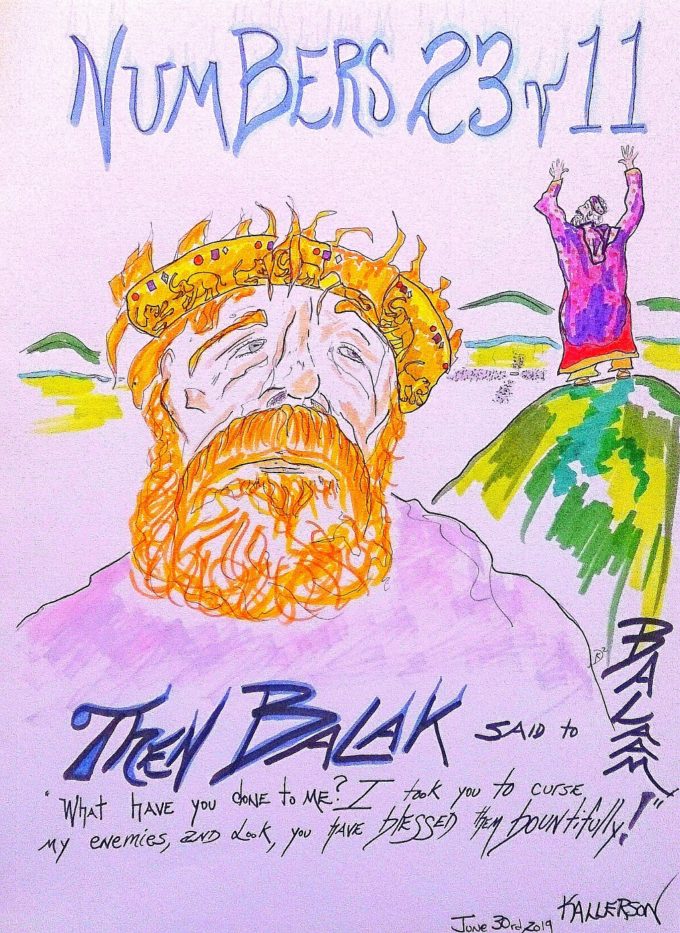
11 Then Balak said to Balaam, “What have you done to me?
Balak takes the oracle of Balaam as a personal attack against him. By not cursing Israel, a negative has now fallen upon him.
11 (con’t) I took you to curse my enemies, and look, you have blessed them bountifully!”
Balak uses the same word he used twice in the previous chapter and which Balaam used in verse 8 here, qavav. He had asked for Balaam to malign Israel, and instead, as he says, v’hinneh berakhta barekh, “And behold, you have in blessing blessed.” In response, Balaam answers…
*12 (fin) So he answered and said, “Must I not take heed to speak what the Lord has put in my mouth?”
Balaam finishes this first round of offerings with words reflecting the state of the matter. He had hoped to come and change the course of events through the offerings, but they had no effect upon the Lord. He was forced to speak out what the Lord instructed him to speak. As it says, “what the Lord has put in my mouth.”
The words of the passage today show that God is in complete control of things going on around us. It further shows that God has a plan, that plan is set and it cannot be thwarted, and that the focal point of the plan is the Messiah.
Without doubt, the words of the Bible reveal that Jesus is that Messiah. Understanding this, the upright ones who are spoken of in this passage today cannot be speaking of Israel of the flesh. They were twice exiled, and they are still not right with Christ Jesus.
And yet, the utterances of God given to Balaam speak of Israel as a people, not just at that time, but at any given time. Therefore, it must now speak of those of Israel who are in Christ and of those Gentiles who are brought into the commonwealth of Israel with them. Not that the Gentiles are Israel, but that they share in the blessings of Israel.
Together, one whole is formed for the time in which we live. At some point, the people of Israel, those still apart from Him, will come to see the state of their existence, and, as Paul says, “all Israel will be saved.” That is future to us now, but until then, God has them safely cared for.
The ordeals they will face, and the trials they will suffer through, will be allowed in order to refine them, but no curse against them will stand, except the curse of their own self-inflicted wounds.
Such is true with those who are in Christ as well. The curses of the enemies of God’s people are ineffective. We are not to be concerned that there is a power which can overcome us. Instead, because of Christ, we are the blessed of the Lord, and because of that, no curse can stand. Be comforted in this, and be thankful to God for your position in Him because of what He did for you in Christ.
Closing Verse: “Like a flitting sparrow, like a flying swallow,
So a curse without cause shall not alight.” Proverbs 26:2
Next Week: Numbers 23:13-30 In the list it is number 2, categorical (Balaam’s Second Oracle) (46th Numbers Sermon)
The Lord has you exactly where He wants you. He has a good plan and purpose for you. It may seem at times as if you are lost in a desert, wandering aimlessly. But the Lord is there, carefully leading you to the Land of Promise. So follow Him and trust Him and He will do marvelous things for you and through you.
Balaam’s First Oracle
Then Balaam said to Balak
“Build seven altars for me here
And prepare for me here seven bulls and seven rams
Are my instructions clear?
And Balak did just as Balaam had spoken, in this he did not falter
And Balak and Balaam offered a bull and a ram on each altar
Then Balaam said to Balak, “Stand by your burnt offering
And I will go; perhaps the Lord will come to meet me
———-to set my words aright
And whatever He shows me I will tell you
So he went to a desolate height
And God met Balaam, and he said to Him
“I have prepared the seven altars, as I knew to do
And I have offered on each altar a bull and a ram
To now receive a word from You
Then the Lord put a word in Balaam’s mouth, and said
“Return to Balak, and thus you shall speak; so you shall do
So he returned to him, and there he was
Standing by his burnt offering, he and all the princes of Moab too
And he took up his oracle and said:
The words he spoke as he was led
“Balak the king of Moab has brought me from Aram,
From the mountains of the east.
‘Come, curse Jacob for me,
And come, denounce Israel!’
“How shall I curse whom God has not cursed?
And how shall I denounce whom the Lord has not denounced?
For from the top of the rocks I see him,
And from the hills I behold him;
There! A people dwelling alone,
Not reckoning itself among the nations.
“Who can count the dust of Jacob,
Or number one-fourth of Israel?
Let me die the death of the righteous,
And let my end be like his!”
Then Balak said to Balaam
“What have you done to me?
I took you to curse my enemies, and look
You have blessed them bountifully!”
So he answered and said
“Must I not take heed to speak
What the Lord has put in my mouth?”
His words I cannot change; not even a little tweak
Lord God, we are even now in a wilderness
And we are wanting to be led by You
Without You to direct, our lives would be a mess
And so be our guide, O God; You who are faithful and true
We long for the water in this barren land
May it flow forth from the Rock, our souls to satisfy
Give us this refreshing, spiritual hand
And may we take it, and to our lives daily it apply
And we shall be content and satisfied in You alone
We will follow You as we sing our songs of praise
Hallelujah to You; to us Your path You have shown
Hallelujah we shall sing to you for all of our days
Hallelujah and Amen…