The Word of God
The Basis of our Faith
The voice said, “Cry out!”
And he said, “What shall I cry?”
“All flesh is grass,
And all its loveliness is like the flower of the field.
7 The grass withers, the flower fades,
Because the breath of the Lord blows upon it;
Surely the people are grass.
8 The grass withers, the flower fades,
But the word of our God stands forever.” Isaiah 40:6-8
It is certainly argued which point, or aspect, of religion and faith is to be held as preeminent. This is especially true because there are innumerable religions, and there are countless texts out there which claim religious authority.
And within adherence to those various religions, whether defined by a tradition, a text, or simply an adherent who claims divine inspiration to speak on behalf of God, there are still innumerable interpretations of how to correctly pursue what is presented within a particular religion.
Does anyone here think that all Buddhists are united in how they interpret the teachings of Buddha? Obviously not. There are as many subdivisions within Buddhism as there are kernels of corn in Iowa at harvest time.
Did everyone in Jamestown accept the words of Jim Jones equally? Again, obviously not. Some gladly drank the grape juice while others were forced to do so. Are Muslims united in their theology? If they are, they wouldn’t be blowing one another up as much as they do, and there wouldn’t be Shiites, Sunnis, and Wahhabis – along with countless other divisions among them.
Each different religion, and each difference within a religion, must come from somewhere – even if it is simply from the mind of a lunatic – L. Ron Hubbard anyone?
What is it that is preeminent in religion that would define one particular religion as right and proper, and how can it be known that adherence to that one right religion is doctrinally correct?
In a random list of possibilities, not intended to place any above another so as to incorrectly settle the matter in your mind now, we could consider various points and try to establish which is the most noble, which is the most important, and which is to be preeminently considered before the others. Here are some options –
The nature of grace. The Trinity. The nature and/or attributes of God. The Deity of Christ. The Humanity of Christ. The need for Christ. The nature of Sacred Doctrine. The sovereignty of God. The all-sufficient atonement of Christ. The salvation of man. Eternal security in salvation. How man is saved. The covenants of God. The dispensations of time. Israel. The existence of God. The nature of man. Creation. The nature of Creation. The glory of God. Heaven and hell.
Which of these, or is it some other not mentioned, is most necessary for us – as human beings – to know what is right and proper to place first in our search for the truth of God and the disposition of man within the stream of time?
Text Verse: “If a man of wind were to come and say falsely, ‘I will preach to you of wine and strong drink,’ he would be just the preacher for this people!” Micah 2:11 (BSB)
Adding to our list, how about the nature of good and evil? Wouldn’t that be an appropriate starting point in our quest for the truth? If there is good, there must be a source of goodness. If there is evil, there must be a reason for it to exist and a source from where it is derived. Right?
No, rather all such things, even the nature of God, must be pursued, logically, from a source which reveals those things to us. I could have just said, “the nature of God Himself,” but that would be presupposing that God has revealed Himself in the masculine.
Maybe God is female, as some claim. My use of the masculine would be a point of contention with Him… I mean Her, if so. How can we determine what is correct in all things theology? Or, can we even do so?
The answer is, “Yes.” However, the answer will actually take some thought to get us to that point. Yes, you are going to have to use your brains today, and you are going to have to think about things logically and rationally.
That is absolutely necessary to know if the word of God is, in fact, the word of God. “‘Come now, and let us reason together,’ Says the Lord.” The Lord wants you to think your faith through, and He wants you to be well prepared to then explain it to others.
Such truths, believe it or not, are to be found in His Superior Word, and so, let’s both turn to and contemplate that precious word once again, and may God speak to us through His word today. And may His glorious name ever be praised.
I. A Reasoned Defense
Of the great works of Christian philosophy, somewhere right at the very top of the list, is what is known as the Summa Theologica. It is the massive and detailed work of Thomas Aquinas, written from 1265-1274. It is considered one of the most influential works of western literature. In it, Aquinas evaluates a vast array of subjects, many of which we just considered a moment ago.
He discusses the nature of God and the Godhead. He discusses the problem of evil. He evaluates what the natures of man and angels are like. He looks into the law and also into grace. There is hardly a subject that one could think of in relation to religion that Aquinas didn’t evaluate. And he did it in an order that allows a person to think logically from one premise to the next.
With this in mind, what discipline did he place first? What was the one thing that set the parameters for all of the other things he would discuss, including the very nature of God? The answer is “Sacred Doctrine,” meaning Scripture. His first subject, or as he puts it, his first Question is –
“Question 1. The nature and extent of sacred doctrine.” From there, he asks, discusses, and answers the following ten questions: Is it necessary? Is it a science? Is it one or many? Is it speculative or practical? How it is compared with other sciences? Is it the same as wisdom? Is God its subject-matter? Is it a matter of argument? Does it rightly employ metaphors and similes? May the Sacred Scripture of this doctrine be expounded in different senses?”
The logic of placing the nature and extent of Sacred Doctrine first is impeccable. Without a surety of knowing what Sacred Doctrine is, nothing else in religion matters. Everything, including the nature of God and all that proceeds from Him, is subject to error.
We can deduce things about God without a source of writing which tells us of Him. In fact, we can be positive about a host of things about Him without ever first being told those things.
We can also do this concerning creation, about who we are as a species, and so on. Man has done this since the beginning, and he continues to do it today. We can logically work out things that must be because of things that are. However, there are also deficiencies and defects in man which can cause us to make limited or incorrect conclusions about such things as well. Despite having knowledge, we don’t have all knowledge.
But, with knowledge we can often – if we are willing to – prove things false much more readily than we can prove things to be true. If we look at religious beliefs, for example, we can see a common thread among many of them. There is the proclamation that there is a “God,” or there are “gods,” and that we are accountable to Him or them.
However, by simply thinking the matter through logically, man can actually know – with all certainty – that there is only one “God,” meaning the Source of all things. We can, in fact, know this.
Therefore, we can be sure that any religion which proclaims more than one God cannot be true. If you can’t see how this is possible, go back and watch our Genesis 1:1 sermon. There we discuss the First Principles. First Principles are statements of logic which are undeniable, or which can be reduced to the undeniable. We will even talk about some of them later here and in upcoming sermons.
From there, and understanding that there is a God, just One, we can also further determine what this God must be like. Aristotle was able to do this. He deduced that there is a God, and then he deduced many things about Him that Christians today take as axioms concerning Him.
For example, there can be no change in God. Aristotle explains why this must be so. Aquinas builds upon that and further defines it. Did Aristotle have the Bible to tell him this? No! He simply thought the matter through logically. And you can too.
As God does not change, that will then further refine our pursuit of “which” God, if any, is the true God as claimed by His adherents.
Taking the god of Islam, for example, we can read the text which describes “Allah” the god of Islam, and we can know if what it says about God is correct or not. The Koran says that there is “one God.” Well, that matches what we can know is certain. Is that the end of the test? Do we now bow down and say, “O great Allah, you are “god” and there is none other!”?
No, more is needed. God doesn’t change. Does Allah, the god of Islam, change? Yes. He is vindictive. He also proclaims one thing and then another, but not in a logical way. Rather the supposed god of Islam changes in his very nature by the proclamations he makes. We can toss out Islam, and we can toss out Allah.
See, this isn’t that difficult. Man has been given a brain to use, if he will but use it. God did this so that man will seek Him and reach out for Him. He is actually not far from us. Man has, however, invented many gods, but because there is one God, man can – and very well should – be able to say, “This is a lie. This is not ‘God.’”
So, we know there is one God, and we can know things about this God. This then allows us to search out the supposed revelations of God, like the Koran, and say, “No, this ain’t God.” Eventually, through this process – and if it exists – we come to what is truly “Sacred Doctrine.”
We are presented with a copy of the Bible. This word of God says there is one God. That passes the test. The word then says, “For I am the Lord, I do not change” (Malachi 3:6). So far so good. But what about the verses which seem to show that He does change?
Do those actually reveal this, or are those supposed changes in Him merely logical and orderly revelations of Himself for our benefit and understanding, but not actually changes in His being? Through careful study, we find out that this is the case. God hasn’t changed. Rather, we have changed in relation to Him, and the result is obvious and expected based on His unchanging nature.
And so, after reading what is truly Sacred Doctrine, meaning the proclaimed Word of God, or what we would call the “Holy Bible,” we are convinced that this is how God has revealed Himself to us, including in the masculine – something we were trying to avoid as a presupposition a few minutes ago. He has done this, and so we follow suit – He, Him, Father, etc.
And so now, with this carefully and precisely laid out word, this text of Sacred Doctrine that finds its source in God, we continue to expose faulty conclusions concerning Him. As we have already seen, there are countless denominations and cults all claiming this word as their source and authority for right doctrine. How can that be, and this still be the Word of God?
The answer is not that there is a problem with either God or His word. The answer is found in us and in our translations and interpretations of this precious gift of life and restoration. We act no differently about our own text than Muslims do about theirs. They don’t engage their brains, and we don’t engage our brains.
The Jews stop with one testament and one over-arching covenant. Some supposed Christians do this as well by falling back on the Old when the New has set it aside. But right there in the Old is the promise of a New. The same God who does not change is not changing still. He is slowly and progressively revealing Himself.
And so, knowing this, we can toss out Judaism – in all its forms – as being a proper evaluation of Sacred Doctrine – it is not. The Old Testament is proper revelation, but it is incomplete. And in tossing out this theology, we can then toss out the theology of some Christians, such as Dual-Covenant theologians like John Hagee. Such heretics teach that Christians are saved through the New Covenant, and Jews are saved through adherence to the Old. This is even taught by the Roman Catholic Church – the church of Thomas Aquinas.
And yet, there is more to consider. The New Testament, which details the New Covenant, also details some very precise revelations of God, of who He is, and of what He has done. For example – and of which will be explained in greater detail in another sermon – the Bible clearly shows that though God is One, there are different persons within the Godhead.
And more, there are not two or five or twenty or a hundred. The revelation of Sacred Doctrine, which is the only source for knowing this aspect of God, shows us that there are three individual Persons within the Godhead – not more, not less.
There is a Person we call the Father. There is a Person we call the Son. And, there is a Person we call the Holy Spirit. Each is clearly revealed to be God based on the nature of who God is.
However, there are some denominations and cults which deny this. There are others who affirm it but then violate laws concerning the nature of God that we don’t even need Scripture for in order to know they are wrong.
For example, the Jehovah’s Witnesses state that Jesus is a created being – denying His deity – and yet they say that Jesus is the Creator of all things other than Himself. We don’t need the Bible to know this is incorrect. All we need to do is think it through logically.
For Jesus to be a created being, and yet to create all other things beside Himself, would violate the Principle of Contingency, the Positive Principle of Modality, and the Principle of Existential Causality. To understand this, go back and watch the Genesis 1:1 sermon. And so, we can toss out their teaching.
Likewise, Mormonism also teaches that Jesus was a created being. He was a man who became God. The same principles apply as those we just saw. But Mormonism also adds another Testament to Sacred Doctrine. Without going into all the details and faults of this supposed text – of which there are many – it violates what is explicitly stated in the New Testament writings, and it is false. Mormonism can be tossed out.
As you can see, the brilliance of Aquinas’ logic of placing the nature and extent of Sacred Doctrine first is evident. One must be able to determine if there is such a text. That is possible without even having such a text.
In other words, there may not be a true text of sacred doctrine. God may have just not revealed Himself in this way. But that doesn’t mean we can’t know if all of the false texts which claim to be sacred doctrine are false. We can. If they don’t match what we can know by simply using our brains through logic, then they are false.
From there, and if such a text actually does exist, one must be able to determine if how the text is presented is acceptable or not. This can be determined from within the text itself, such as through revealing a misunderstanding of what Paul says in relation to something that Jesus says.
It can, at times, also be determined from outside of the text – by simply using logic, such as the necessity for Jesus to be God if He is the Creator of anything.
If He created anything at all, even one coffee bean, then He must have created all things – and no thing which is created came into existence apart from Him. The Bible may tell us this – and it does, in Colossians 1 – but we don’t need the Bible to do so for us to know it is true, as we have already learned.
Logic necessarily precedes God’s revelation of Himself in order for us to know if this (or that) is God’s revelation. If it (meaning logic) does not come first, then we cannot truly know if it is God’s revelation.
This is exactly why there are so many religious texts, and this is why there are so many religions. And this is why the immensely intelligent Albert Einstein, a Benedict Spinoza pantheist, spent the rest of his life – after discovering the Theory of Relativity – working on the theory of everything. Yes, his worldview said that all is God (Pantheism), meaning the universe is the manifestation of God.
He did not want to accept that his logic, which is revealed in Relativity, confirmed the very source of his Judaism, meaning Sacred Doctrine – “In the beginning God created the heavens and the earth.” Through Relativity, Einstein proved there was a beginning. If there was a beginning, there must be a Beginner.
The Bible says that God precedes His creation. He is not a part of it. That didn’t fit with Einstein’s presuppositions about the universe and about the god he believed in. Hence, his continued work on the theory of everything. However, if we now know that God has revealed Himself in this manner, meaning through Sacred Doctrine – of which we are convinced He has – then we must still use logic to know if our understanding of what He has revealed is correct.
This is exactly why there are so many denominations within Christianity, and so many – countless variations in fact – disparate doctrines which come to completely opposite conclusions concerning Christian theology.
Again, logic must precede God’s revelation of Himself in order for this to not occur. If it does not, then any and all of those religions, denominations, and even cults, are on an equal standing before your eyes. You actually have no basis for saying one is more or less valid than another.
Some of you are now sitting here and saying, “But the Bible proclaims faith, not logic. We are to ‘live by faith and not by sight.’” Yes, I know that verse. It is 2 Corinthians 5:7, I’ve written a commentary on it, and that is not what Paul is speaking about. He is speaking about our existence in Christ, after having made a decision for Christ.
And biblical faith is not, as the vast majority of people seem to believe, blindly stepping into acceptance of the Bible. It is exactly the opposite. It is stepping into the revealed light of God, which is the Bible. Nobody comes to a saving faith in Jesus unless he has heard about Jesus. And the knowledge of Jesus is recorded where? Yes, in the pages of Sacred Doctrine – the Holy Bible.
Again, there has to be a basis for your faith, or your faith has no basis. This does not mean that God does not accept you because of your faith. Rather, God accepts you based on your faith which was based on His word which He has revealed. It is light, you heard it, and you accepted it. But you had to logically put those things together in your head when you heard the word.
As Paul says in Romans 10:17, “So then faith comes by hearing, and hearing by the word of God.” God did the revealing, you did the analysis, you found it reasonable, and you then – only after logically thinking it through – demonstrated faith in what the Bible revealed to you.
This is why God made the gospel so simple, and the means of obtaining it so simple. It is because too much needed logic, and most people would never get saved. The gospel’s simplicity is its own mark of the infinite grace of God.
As we have seen though, there are those who say Jesus is not God, and yet, they proclaim exactly the same verses concerning salvation as those who say Jesus is God. Therefore, again, logic must precede the faith, and that logic precedes the revelation of God in His word. It doesn’t mean it is more important, but it is a necessary part of the process in order to come to accept whether the message is true or not.
The title of this sermon is “The Word of God – The Basis of our Faith,” and that is true. The salvation of God which is found in Jesus Christ our Lord is only found for us in the word of God – whether transmitted orally, in writing, in a play on a stage, on a computer, or some other way. We are not getting saved without faith, and we cannot have faith without the word.
God is pleased with our faith in Christ when we hear this word and accept it as such. But there is a world full of people that do not. They have already either rejected the truth, and/or they have accepted something other than the truth. Or, they may have simply never heard the gospel.
How will they be saved unless you are willing to show them that what they have in their hands is false, and that what you have in your hands is true? If you care about their state at all, then you have an obligation to, as Peter says, “…always be ready to give a defense to everyone who asks you a reason for the hope that is in you” 1 Peter 3:15.
The word Peter uses there, which is translated as “defense,” is apologia. It signifies not a dubious doctrine based on blind faith, but a well-reasoned reply for an issue which is raised. In ancient courts, it signified a legal defense and a reasoned argument.
The word of God, holy and pure
Is given to us from His wise and loving hand
Through this word, our faith is strong and sure
Because of our God, through it we can Him understand
We can know what is right for salvation unto life
And we can know when to reject that which is wrong
Through sound doctrine, we can weed out theological strife
And have doctrine which is sure, sound, and strong
Praise be to God who has given us this precious word
Praise be to God who has shown us what is true and right
The pages of the Bible are a precious cutting sword
Weeding out all that is false and revealing God’s glorious light
II. The Problem of Evil, the State of Man, Israel, the Nature of Creation, the Prophetic Word, etc.
The word of God has been given by God. The Bible makes this claim. It is up to man to either prove it false, or to accept it as true. By simply thinking the matter through – in a very limited way – we have seen how man has determined logically that there is one God. From there, we have seen what this one God must be like.
We have reduced the religious expressions of the world, through simple logic, to one possible expression which reveals God as He is – biblical Christianity. We could include biblical Judaism, but that is simply an incomplete revelation of Himself to the world.
The coming of Christ, and the introduction of the New Covenant, supplants the expression of God as limited to the Old Testament. But it is certain that the Bible is a big book, we are not going to prove or disprove every aspect of it here in the next few minutes.
Nor are we going to defend or prove false every point of doctrine to be found in the Church of Christ, the Episcopal Church, Methodism, fundamental Baptists, and so on. Those things will take a lifetime of study and contemplation. And it shouldn’t be necessary to rush away from a church simply because of a few minor doctrinal points of disagreement.
But what we can do is contemplate some of the aspects of what the Bible presents, and then decide if what it says aligns with how things are. In other words, why would someone read the Bible and put their hopes in a word which mischaracterized the state of man?
Likewise, why would someone look to the Bible for the plan of salvation if it got the problem of evil wrong? In fact, when there is an error in something, the thing is defective. If something is defective, then why would anyone go to it to correct their own defects?
And yet, people have gone to, and they continue to go to, the Bible for the correction of their defects. Drunks become productive citizens, harlots become faithful wives, the miserable are made joy-filled. There is a power in the word which transforms lives.
And as desperately as its enemies have attempted to challenge the Bible, there has been no successful challenge to it since it was first given to man through the hands of Moses 3500 years ago. Since then, it has been added to by God through men of God right up until John received the book of Revelation and then finished it with the word “Amen” in Revelation 22:21.
It accurately details the problem of good and evil – how it came about, what He would do to correct it, and why it continues to this day. Yes, the Bible explains how evil is cured, and when evil will be eradicated forever. In this, there is nothing left unattended to. What was lost in Eden will be restored in God’s coming Paradise.
How often it is said, “If God was truly God, He would eliminate all the evil in the world.” But that is a shallow and naive way of looking at how things work. It assumes that evil is out of the control of God’s sovereignty, but the Bible very clearly shows that it is not.
In fact, time and again what we consider to be true evil is used by God for good purposes and for His glory. Adam fell, Cain killed Abel, and from Joseph’s troubles in Egypt to man’s trouble with sin being laid upon Christ, God uses evil to bring about good.
We look at the cross as the highest expression of love, grace, and mercy, and it is so. And yet, you can be guaranteed that Jesus’ mother, Peter and the other apostles, and indeed many who saw Christ being crucified would have said, “This is evil. So why has God allowed it?”
Do you see the fallacy and naivete of those who question God’s competence because of their own supposed standards of what is good and what is evil and what God is doing about those things?
What is appropriate is to say that God has allowed evil into the world for His purposes, those things bring Him glory, and the evil will come to an end in His timing. If someone desires to use the problem of evil as a point of discrediting the God revealed in Scripture, they will find no satisfaction in their attempt.
The problem of evil is accurately explained in Scripture, it is properly death with by God in Scripture, and its end is assured in Scripture. That which was good at the beginning will be good again at the consummation of all things.
*The state of man – from how he got here, to what his purpose is – is exactingly expressed in Scripture. The desperately evil human heart is spoken of there. Go check Jeremiah 17:9. The chains which bind man are described there.
The freedom which man seeks is revealed there. The relationship between man and his Creator is defined there. If someone is looking to prove the Bible wrong, the state of man will not satisfy his goal.
*Some people look at Israel and deny Scripture because of them. That may be the most perverse ideology of all. In fact, exactly the opposite is true. Israel’s rejection of God does not in any way call into question the reliability of Scripture.
Rather, the words of the Lord, through the writings of Moses, foretold what has subsequently been revealed. Israel’s rejection of the Lord, the Lord’s continued faithfulness to Israel, and the prophetic timeline of such events – all recorded in His word – confirm time and again the reliability of what God has spoken.
If someone is in hopes of calling the word of God false because of either what it says about Israel, or what Israel says about the Lord, they have simply rejected what is clearly printed about both in it. And in fact, the attempts to destroy Israel are merely attempts to find some fatal flaw in God’s word which has not yet been found.
If only Israel can be destroyed, the word will be proven false and man will no longer have the convicting power of it hanging over their heads. Such is the dream, and such is the hope for a world which hates God, rejects His word, and finds the message of the gospel of Jesus Christ deplorable. But the Lord has spoken –
“‘I will bring back the captives of My people Israel;
They shall build the waste cities and inhabit them;
They shall plant vineyards and drink wine from them;
They shall also make gardens and eat fruit from them.
15 I will plant them in their land,
And no longer shall they be pulled up
From the land I have given them,’
Says the Lord your God.” Amos 8:14, 15
Israel stands, and Israel will stand. They have been planted again in their land, and they shall remain rooted there forever. The Lord God has spoken, and it shall be. If someone is looking to find fault in the Bible, the nation of Israel is a poor and perfectly pitiful place to attempt to do so.
*But what about something larger than Israel? What about the nature of creation itself? The Bible doesn’t attempt to argue that there is a God – a Creator. Instead, the Bible proclaims His existence and then it explains how He created. Further, it does so in a logical, orderly, fashion. God speaks, information is transmitted, and creation stands firm.
Rather than a universe which created itself, a logical impossibility by the way, the Bible reveals exactly what logic demands. There is existence, the existence is not necessary and yet it exists, and therefore there must be a necessary Being that exists in order for all other things – which are not necessary – to exist.
And not only that, but there can be only one necessary Being. That is God, and the Bible proclaims Him as such –
“For thus says the Lord,
Who created the heavens,
Who is God,
Who formed the earth and made it,
Who has established it,
Who did not create it in vain,
Who formed it to be inhabited:
I am the Lord, and there is no other.” Isaiah 45:18
And within the realm of creation, the Bible explains that things don’t always work as they were originally intended to, why that is so, and how it will be corrected. The Bible also explains aspects of creation, stating them as axioms, that were not understood until modern times.
For those who desperately desire to break off the chains of God by disproving the Bible’s claims concerning the Creator and His creation, their efforts only end in embarrassing futility. The word of God stands because it is, in fact, the word of God.
*And there is another aspect of the word which not only confirms that God is, but that God knows. He didn’t just create and let things go however they may come about. Rather, He reveals – in His word – things that will come to pass before they occur. He does this so that when they come about, man can say, “My trust in God is not in vain.” He even explains this to us so that we are all the more assured of what lies ahead –
“Behold, the former things have come to pass,
And new things I declare;
Before they spring forth I tell you of them.” Isaiah 42:9
The things He has spoken have come about, and the new things He reveals are assured to happen as well. Not a word of the word shall ever fail, because it is the word of God who cannot fail.
The prophecies of God, both those that are expressly spoken, and those that are typologically prophetic, and which have already been fulfilled, are so numerous and so specific that there is literally no excuse for those who see them and deny what they reveal.
The prophetic word, for those who have heard it, seen it fulfilled, and who yet reject it will stand as an eternal witness against them. God has spoken, His word has come to pass, and man will stand before God and receive his just due for how he has responded to that same prophetic word.
I am the One who created all things
And by Me all things are held together
My works are that of which the angel sings
Stretching out the heavens, they go on forever
I am the Lord who called Abraham so long ago
I am the One who renamed Jacob Israel
I spoke from the burning bush to Moses, so you know
And of Me, David in the psalms does tell
I am the Word of God, who was and is and is to come
And I offer the water of life; be pleased to partake of some
III. Common Sense Concerning the Word
One obvious question about the word of God, and one which is probably most often levied against it, is that of source texts. “Why are there variations in texts?” “How can we be sure that it is one rather than another?” And, “Don’t these variety of texts disprove the very premise that the Bible is the word of God?”
The answer to each is, “No,” but it is also not a study that can be completed in a few short minutes. Entire books have been devoted to the matter. Scholars dedicate their entire lives to this field. But, in short, the very fact that there are numerous source texts – even if they vary in content – will validate the reliability of the word.
If there are 10 source texts, and one of them says ABC in Isaiah 53, and the other 9 say XYZ in the same place, then it is rather certain that XYZ is the correct reading. This is especially so when these source texts come from different locations, different languages, different points in time, etc.
This could not be the case if there was only one source text. Nobody would know if the source was accurate or not. And there are other logical reasons why God would not want one single text to be the only source of His word. There is great wisdom in God’s word not being kept in any single man’s possession.
And so, for five groups to have five texts, each with some type of minor error in one place or another, but four of the texts having no error in the same place as any other text, it actually benefits the scholar. There is not just a reasonable certainty of the text, but a convincing certainty of it.
What we possess in our hands may have variations based on source texts which people can quibble over, but the substance of the words is as reliable as the over-arching message of the whole.
No major point of doctrine in Scripture is in question, and the absolute reliability of the word of God is evidenced through the amazing care God has taken to preserve His word in various ways, places, and languages throughout history.
If this is a point where you would question your faith, then spend the time needed to study this discipline. Give up 10 or 20 hours of TV a week that you watch, and instead, go learn just how reliable this word is.
When reading your Bible, forget the commentaries that may be provided with the text. Instead, read the footnotes which are also provided. They are where the mechanics of the accuracy of the word of God can be found.
For example, what you might read is something that at first causes you to question the Bible’s reliability. You read the footnote and find a difference between some texts, of which they cite the Greek, Hebrew, Samaritan, Masoretic, Vulgate, and Dead Sea Scrolls.
And yet, when you see that only the Masoretic Text and a few lesser Hebrew manuscripts say DEF, but all the others say GHI, you will realize that a corruption occurred, possibly on purpose, to hide Jesus, such as occurs in the Masoretic Text of Psalm 22 and of Isaiah 53.
But when you learn that the Greek and the Latin were both translated out of the Hebrew, long before the time of the Masoretic Text, and that the Hebrew Dead Sea Scrolls and the Greek both predate the coming of Christ, then you can say, “Aha! I understand!”
Your faith in the word will not be diminished. Rather, your faith in man will rightly be reduced, and your glory to God will be magnified when you realize that He has actually protected His word, even from the manipulations by His own chosen people who rejected Him when they rejected Christ.
Have confidence in God, be sure of His word, and trust that what He has proclaimed concerning His Son, His redemption, and His future promises to you are surer than the ground under your feet. Use your brain when you are presented with a doctrine you may have been unaware of before.
There is that which is of God and is reasonable, and there is that which comes from man and is simply wrong. Unless you are willing to study in order to show yourself approved, you will most likely not be approved. Proper theology is hard work, but the rewards for pursing it are heavenly.
As a good summary of this marvelous treasure, this gift and blessing from God, an unknown person penned the following words which are often printed in the Gideon’s Bible. Think on what you hear as I read to you what it says –
The Bible contains the mind of God, the state of man, the way of salvation, the doom of sinners, and the happiness of believers. Its doctrines are holy, its precepts are binding, its histories are true, and its decisions are immutable. Read it to be wise, believe it to be safe, and practice it to be holy. It contains light to direct you, food to support you, and comfort to cheer you.
It is the traveler’s map, the pilgrim’s staff, the pilot’s compass, the soldier’s sword, and the Christian’s charter. Here Paradise is restored, Heaven opened, and the gates of hell disclosed.
Christ is its grand subject, our good the design, and the glory of God its end.
It should fill the memory, rule the heart, and guide the feet. Read it slowly, frequently, and prayerfully. It is a mine of wealth, a paradise of glory, and a river of pleasure. It is given you in life, will be opened at the judgment, and be remembered forever. It involves the highest responsibility, will reward the greatest labor, and will condemn all who trifle with its sacred contents.
I implore you now, to always consider the word of God. Handle it carefully, treat it as the most precious jewel you possess, and love it as God in Christ loves you. It is the rhema, the written word of God, that speaks of the logos – meaning the Word, Christ Jesus –the expression of God in Whom He reveals Himself.
Cherish the one and you will cherish the other.
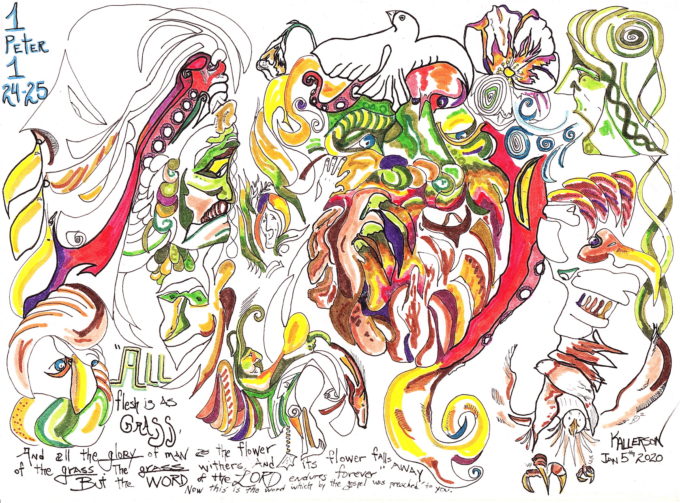
Closing Verse: “’All flesh is as grass,
And all the glory of man as the flower of the grass.
The grass withers,
And its flower falls away,
25 But the word of the Lord endures forever.’
Now this is the word which by the gospel was preached to you.” 1 Peter 1:24, 25
For we walk by faith, not by sight. 2 Corinthians 5:7
The word “for” builds upon what was just said – “So we are always confident, knowing that while we are at home in the body we are absent from the Lord.” As we are “absent from the Lord” our walk is different than it would be if we were in His presence. The word “walk” denotes our conduct in this life. It is a metaphor used to indicate the things we do and how we do them.
This “walk” for the Christians is a walk of “faith.” We have been saved by Christ and therefore, the conduct of our lives is to be for Him, emulating Him, telling others about Him, anticipating our being gathered to Him, etc. But as he said in the previous verse, at this time we are “absent from the Lord.” Because of this, our walk is entirely one of faith, “not by sight.”
The word “sight” doesn’t mean the active sense of vision. Rather, it means “appearance.” The word faith then is being contrasted with the time when we actually behold Jesus and our new heavenly home. We have never seen Him and we have never experienced heaven, and so our walk in this life is only in anticipation of those things. It is entirely a walk of faith. As the author of Hebrews says –
“Now faith is the substance of things hoped for, the evidence of things not seen.” Hebrews 11:1
But in this walk of faith is a blessing in and of itself. In fact, the next verse in Hebrews says, ”For by it the elders obtained a good testimony” (Hebrews 11:2). We obtain a “good testimony” through walking in faith. Jesus confirmed this to the disciples when addressing Thomas after the resurrection –
“Thomas, because you have seen Me, you have believed. Blessed are those who have not seen and yet have believed.” John 20:29
Life application: Lots of people have claimed to have seen Jesus, and lots of people have claimed to have gone to heaven. This is contrary to what the Bible teaches. If someone has experienced one of these things, then their walk is no longer of faith. And so, we must decide to either believe the Bible or believe them. Though many have seemed convincing about having experienced these things, it is better we reject their stories and accept that we do, in fact, live by faith and not by sight.
Lord God, we don’t need to read the stories people have written about going to heaven or having talked to Jesus. The Bible says that we are to live by faith and not by sight. That is good enough for us. We have researched Your word and we have the surest hope of all that what You have told us is sufficient for our faith and practice. The change in us testifies to this. We will stick to Your word and not fancy stories which do nothing to enhance our walk with You! Amen.