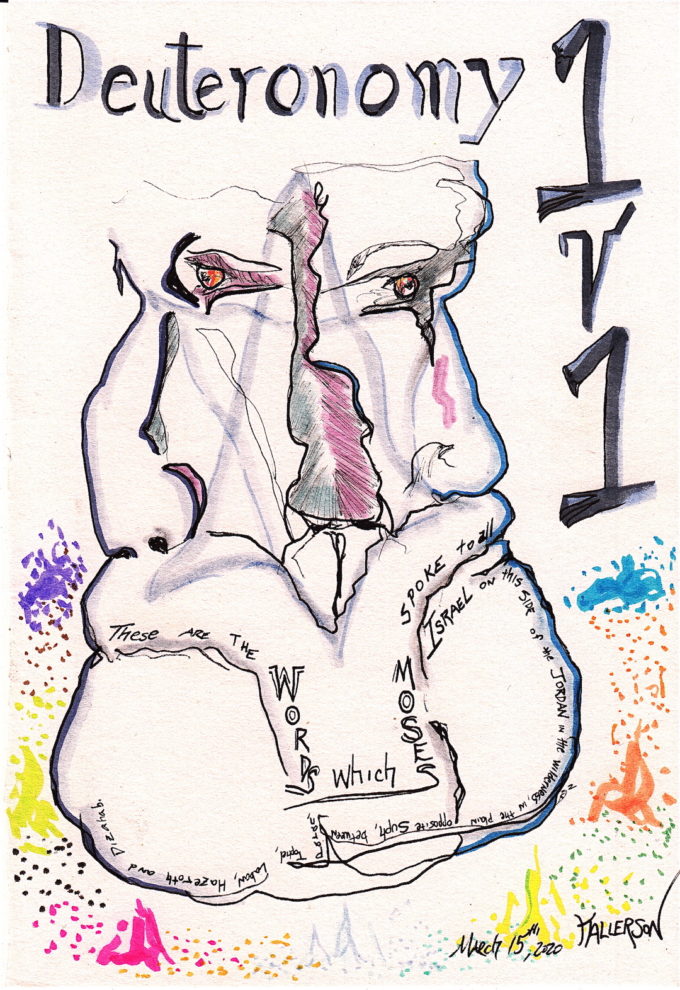
Deuteronomy 1:1-4
An Eleven Days’ Journey
Today, we enter into our first sermon from the last book of Moses. Before we go even one more thought, it must be stated that the Law of Moses is not an end in and of itself. It is a part of God’s unfolding revelation, which – by itself – is incomplete.
Unfortunately, the Jews as a collective whole, still reject some or all of the further revelation of what He has presented to the world. But equally unfortunately, so have many supposed Christians, who bear that title in name only.
The New Testament clearly reveals that the New Covenant has superseded the Old. It is done, it is obsolete, it is set aside, it is annulled, and it is nailed to the cross. Christ fulfilled it, He called out “It is finished,” and He died, thus releasing us from the bondage of the law.
However, this does not mean that the law serves no purpose. In fact, without the law, we wouldn’t understand our need for grace. A thousand times a thousand points of theology find their basis in the law as well. And, of the Law of Moses, Deuteronomy holds a very special place. Adam Clarke realized this and penned these words to consider –
“The Book of Deuteronomy and the Epistle to the Hebrews contain the best comment on the nature, design, and use of the law; the former may be considered as an evangelical commentary on the four preceding books, in which the spiritual reference and signification of the different parts of the law are given, and given in such a manner as none could give who had not a clear discovery of the glory which was to be revealed. It may be safely asserted that very few parts of the Old Testament Scriptures can be read with greater profit by the genuine Christian than the Book of Deuteronomy.”
Clarke spoke of “the glory which was to be revealed.” He certainly is referring to Christ Jesus who not only came under this law, but who also gave forth this law, taught this same law to the people of Israel, and who then died in fulfillment of it.
Without knowing Deuteronomy, we cannot appreciate the life of Jesus Christ, nor can we appreciate the things He said and taught to the people He dwelt amongst. And so, as is right and fitting, we begin our trek today through this marvelous piece of literature known as Deuteronomy.
Text Verse: “The words of the wise are like goads, and the words of scholars are like well-driven nails, given by one Shepherd. 12 And further, my son, be admonished by these. Of making many books there is no end, and much study is wearisome to the flesh.
13 Let us hear the conclusion of the whole matter:
Fear God and keep His commandments,
For this is man’s all.
14 For God will bring every work into judgment,
Including every secret thing,
Whether good or evil.” Ecclesiastes 12:11-14
I chose these words for our text verse because they speak of goads, used to prod us along into an understanding of what God intends for us. In a few minutes, you will hear about a nice pattern which includes the thought of goads in it. The two fit together so well that it seemed natural to cite Solomon here.
He says that we are to “Fear God and keep His commandments.” Unfortunately, people take verses like that, and others from the New Testament, and they misapply them to the Christian. Such is an error in theology – a serious and eternity-changing error.
We are to understand all things revealed in the Bible in their intended context. In properly understanding God’s dispensations, and in applying verses in the context of those dispensations, we won’t be led down the wrong path concerning what commandments we are to be obedient to, and what it means for us when we fail to do so.
Let us be sure to take the book of Deuteronomy in its intended context. It is a part of the tutoring mankind needs in order to be brought to that marvelous Gift of grace which is found in Jesus Christ our Lord. And believe it or not, that is even revealed in the book of Deuteronomy itself.
The very book which proclaims the laws for Israel, also gives us hints and pictures of its own fulfillment and ending. Marvelous, isn’t it! It’s all to be found in His superior word. And so, let’s turn to that precious word once again and… May God speak to us through His word today and may His glorious name ever be praised.
I. An Introduction
The book of Deuteronomy is the fifth book of the Law of Moses and of the Holy Bible. Its Hebrew name is derived from the first words of the book, elleh ha’devarim, which literally means “These are the words.” However, it is generally simply called Devarim, or “Words.”
In Hebrew, the word consists of the letters dalet, beit, resh, yod, and mem which numerically equal 256. This is numerically the same as the Hebrew word, dorbon, or goad, that is a word used by Solomon as he closes out the book of Ecclesiastes, as we saw in our text verse today –
“The words of the wise are like goads, and the words of scholars are like well-driven nails, given by one Shepherd.” Ecclesiastes 12:11
Therefore, we would be wise to use the book of Deuteronomy to goad us into a better understanding of God’s wonderful story of redemption as it points to the Person and work of Christ.
It is also the same numerical value as the name Amariah, or “Yah Said.” As this book is a recounting of the words of the Lord, that is a most apt description of the book’s contents. It is also the numerical value of the phrases l’olam v’ed, or “forever and ever” which is commonly found in Scripture; and hittiv mealelim, or “to make one’s actions good.”
Both of these in Hebrew have a numerical value of 256. The law stands forever and ever as a witness against man, but one’s actions can be made good through the fulfillment of this law by Another, if that imputation is accepted. Christ fulfilled it, and we can be granted His righteousness through an act of faith.
As far as the dating of Deuteronomy, there is dispute as to when this, along with the other 4 books of Moses, was written. However, the conservative and traditional dating can be figured based on when Solomon’s Temple was built. By tracing back from that day as stated in 1 Kings 6:1, which indicates 480 years from the Exodus, we can assert with relative confidence that it was penned in the year 1405 BC.
The Exodus occurred in the year 2514 Anno Mundi. This is now the ending of the fortieth year since the Exodus, as is noted in Deuteronomy 1:3. Therefore, it is recorded in the 11th month of the year 2554 Anno Mundi.
The timeframe for the writing of the book goes from the 1st day of the 11th month of the 40th year (Deuteronomy 1:3) until maybe as late as sometime in the twelfth month. This is certain because at the death of Moses, it says that Israel mourned for him for thirty days (Deuteronomy 34:8). After that, the first recorded date in the book of Joshua is the 10th day of the 1st month of the 41st year.
A period of at least three (or more) days preceded that, as is recorded in Joshua 1 & 2. Therefore, Moses died no later than the 7th day of the 12th month of the 40th year, possibly earlier. As his death is recorded in Deuteronomy, the book took five weeks, or less, to be spoken out and recorded. However, the final note that the people mourned for Moses for thirty days must be added to that to complete the narrative.
The English name for the book is derived from the Greek name given to it from the words deuteros and nomos, or literally, “second law.” This Greek title surely means “a copy” or “a repetition,” rather than the actual etymological sense of “a second law,” meaning something different. The English name then comes from the Latin Vulgate translation out of the Greek which says Deuteronomium.
However, both of these ideas spring from Deuteronomy 17:18. In that verse, the king of Israel is commanded to write down his own copy of this law. There, the Hebrew reads, mishneh ha’torah, meaning a copy or double of the law. The Greek translation of that then says to deuteronomion, meaning “this second law,” and thus, “a copy of this law.”
As far as a historical context, the book is given as a reiteration and expansion on the words given by the Lord at Sinai. There are recountings of the events which occurred in the wilderness, and which led the people to their time of punishment for having rejected the Lord. There is also the speaking forth of the commandments of the Lord to the people, imploring them to stand fast on the law and to not deviate from it.
The final four chapters of Deuteronomy include the passing of Moses’ authority from him to Joshua, the next leader of the people of Israel. This is followed by the second Song of Moses, the first having come after the crossing of the Red Sea. And, also found there is the blessing of Moses upon the tribes of Israel. And finally, there is the record of the death of Israel’s great lawgiver upon Mount Nebo, outside of the Land of Promise.
There are, obviously, challenges to the authorship of the book. However, the book ascribes the words to Moses in its first verse. Numerous Old Testament passages ascribe the writings of the books of Moses to Moses, and – more importantly – Jesus cites the words of Deuteronomy and attributes them to Moses. For example, Jesus cites Deuteronomy 24 in this manner –
They said to Him, “Why then did Moses command to give a certificate of divorce, and to put her away?”
8 He said to them, “Moses, because of the hardness of your hearts, permitted you to divorce your wives, but from the beginning it was not so. 9 And I say to you, whoever divorces his wife, except for sexual immorality, and marries another, commits adultery; and whoever marries her who is divorced commits adultery.” Matthew 19:7-9
One must dismiss the words of the Lord Jesus in order to state that Moses was not the author. In doing so, then, all of His words become suspect. The same is true with Paul, who attributes Deuteronomy to Moses in Romans 10:19, and in 1 Corinthians 9:9. Rather, Moses is unquestionably the author of all five books attributed to him.
The location of the writing of the book is outside of the Land of Promise, in the plains of Moab, just across from Jericho – right where the book of Numbers left off. Here, in that location, Moses makes his heartfelt appeal to the people concerning the law he had received and passed on to them.
Rather than statements of law coming directly from the Lord, the words here are generally commandments and admonitions from Moses concerning that same law. For example, in Leviticus 26, a passage which details the blessings and curses which Israel could expect for adherence to the law, the words are in the first person, from the Lord Himself, “I will.”
However, in the parallel passage found in Deuteronomy 28, they are spoken by Moses in the third person, “The Lord will.” Moses is confirming that what the Lord said will, in fact, come to pass. All of the blessings and joy, and all of the curses and horror, that were spoken out to their fathers still apply, even after they had all perished.
Concerning a redemptive context, Deuteronomy is a part of the Law of Moses. It is a law which has, thus far, been filled with pictures of Christ, including His cross. Malachi 4 will state –
“Remember the Law of Moses, My servant,
Which I commanded him in Horeb for all Israel,
With the statutes and judgments.
5 Behold, I will send you Elijah the prophet
Before the coming of the great and dreadful day of the Lord.
6 And he will turn
The hearts of the fathers to the children,
And the hearts of the children to their fathers,
Lest I come and strike the earth with a curse.” Malachi 4:4-6
The important thing to remember is that the law of Moses anticipated the coming of Messiah. The prophets continued to call out this fact, and through Jeremiah came the promise of a New Covenant. In the call of Malachi to “Remember the Law of Moses,” it was a call to remember what Moses himself anticipated – Messiah. Deuteronomy is no different.
In Deuteronomy 18, Moses anticipated Another who would come in a manner similar to himself, meaning a Prophet who would also be the instrument through which a covenant would be enacted –
“I will raise up for them a Prophet like you from among their brethren, and will put My words in His mouth, and He shall speak to them all that I command Him. 19 And it shall be that whoever will not hear My words, which He speaks in My name, I will require it of him.” Deuteronomy 18:18, 19
This is not an unreasonable analysis. Rather, it is exactly what the people of Israel anticipated as they cited the substance of these words when questioning John the Baptist, “Are you the Prophet?” (John 1:21). In other words, Deuteronomy, and the laws contained in it, were anticipatory of Christ.
Paul explains this in Galatians where he notes that the law was a tutor to lead the people of Israel to Christ, the embodiment and fulfillment of this law. The impossibility of the people of Israel to live by the words of Moses is highlighted time and again in Scripture. They – based on the words of Moses – became an object lesson to the people of the world of our desperate need for the righteousness of Christ.
But the Law of Moses itself, and indeed that which is highlighted in Deuteronomy, includes the doctrine of eternal salvation. Corporate Israel, being used as a template for individuals in Christ, is promised to endure despite their infractions of the law. The punishments and curses are inevitable, but the promise of faithfully being kept as a people is highlighted. God will never forsake those whom He has covenanted with.
Although there are several key thoughts and verses in the book, probably the main thought upon which all others hinge is found in Chapter 30 where it says –
“I call heaven and earth as witnesses today against you, that I have set before you life and death, blessing and cursing; therefore choose life, that both you and your descendants may live; 20 that you may love the Lord your God, that you may obey His voice, and that you may cling to Him, for He is your life and the length of your days; and that you may dwell in the land which the Lord swore to your fathers, to Abraham, Isaac, and Jacob, to give them.” Deuteronomy 30:19, 20
The failure of the people to do what is said there set the tone for all of Israel’s history, and it defines the mercy of the Lord in both preserving Israel, and in sending the Messiah to accomplish that which they could not do.
The first book of Moses, Genesis, looked to the work of God the Father through Christ in creation – directing that creation in the initial process of redemption.
The second book of Moses, Exodus, then looked to the work of God the Son in Christ in the actual redemptive process, mirroring His own work countless times.
The third book of Moses, Leviticus, highlighted the work of the Holy Spirit applying the purification and sanctification of Christ to the people of God.
The fourth book of Moses, Numbers, highlighted the crucified Savior who rose to lead His people in the wilderness of their lives, ever faithful to bring them along the path of life, difficult as it may be, and despite their faithlessness along the way.
This fifth and final book of Moses, will highlight the deeds of the Savior who fulfilled the laws which the people will be unable to meet. The infection is too deep, the sin is too prevalent in them, and without Messiah, there is simply no hope. But five is the number of grace.
Deuteronomy, though being a book of law, something which excludes grace – if taken in the context of Christ Jesus – is a book which literally exudes it. The grace of God is found in the thought that, “I have revealed to you My standard. Your history will bear out the fact that you cannot meet it. And so, I will meet it for you. I offer you the grace of the fulfillment of it in My Son.”
In all five books of Moses, it is Christ, the anticipated Son of God, who is on prominent display. Nothing is more obvious, and in a thousand different ways this should be evident. When the book of Deuteronomy is complete, the Person and work of Jesus Christ will stand as a testimony to God’s healing of His people through this law. Not in their accomplishment of it, but in His.
If we were to sum up the book of Deuteronomy with a single thought which carries us from Numbers and then into the continued life of Israel, it would be that “The Lord has given His standard to His people, and despite our failure to meet that standard, the grace of God found in Jesus Christ meets it for us.”
And that thought brings us to our final words of this introduction. Though a Prophet was promised by God and anticipated by the people, this is not the highest Christological anticipation and expression to be found in Deuteronomy. Rather, that is found in these words –
“If a man has committed a sin deserving of death, and he is put to death, and you hang him on a tree, 23 his body shall not remain overnight on the tree, but you shall surely bury him that day, so that you do not defile the land which the Lord your God is giving you as an inheritance; for he who is hanged is accursed of God.” Deuteronomy 21:22, 23
Paul cites those words in Galatians and ascribes them to Jesus –
“Christ has redeemed us from the curse of the law, having become a curse for us (for it is written, ‘Cursed is everyone who hangs on a tree’), 14 that the blessing of Abraham might come upon the Gentiles in Christ Jesus, that we might receive the promise of the Spirit through faith.” Galatians 3:13, 14
The law brings a curse, and Christ fulfilled that law, even becoming a curse for His people. The grace of God is the performance of this law by His only begotten Son, that whoever believes in Him shall not perish, but have everlasting life.
A new book to study, seeking out its veins of gold
A new adventure as we seek the Lord’s face
Thirty-four chapters set before us, ready to unfold
Lessons for all people, in every generation and every place
What is in store for us as we begin our trek?
Deuteronomy seems so vast and complicated at this time
Will we have a headache even down to our neck?
Or will the book come to seem glorious and sublime?
Open our eyes, O Lord, to what lies ahead
Direct the understanding of our eyes and our heart
This is what we petition; looking to be fed
This is what we ask for, today as we start
Show us the riches of Christ in this new book
Be with us as we open it, and for its treasures we look
II. And Moses Spoke (verses 1-4)
The first four verses of Deuteronomy are a form of introduction, giving information concerning the author, the intended recipient, the location, a detailed record of how they came to be here, a note concerning the state of the recipient – meaning an indictment upon Israel – the dating, and the events which immediately preceded the now-to-be introduced account.
These are the words which Moses spoke
elleh ha’devarim asher dibber Moshe – “These the words which spoke Moses.” As we saw in the introduction, the second word, devarim, or “words,” is the Hebrew name of the book of Deuteronomy.
What is explicit is that the book claims to contain the very words of Moses, not something penned hundreds of years, or even a millennium later – as is claimed by revisionist “scholars.” Moses spoke out these words, and they were recorded at the time he spoke them out.
Also, the statement, “These are the words,” are used to make an attachment of this book to the previous books. It is a continuation of the narrative which began in Genesis and now moves forward in time.
Moses, or “He who draws out,” pictures Christ who draws out the words of the Father, as He said in John 14:24, “He who does not love Me does not keep My words; and the word which you hear is not Mine but the Father’s who sent Me.”
1 (con’t) to all Israel
el kal Yisrael – “to all Israel.” The recipient is Israel collectively. Though they may have only been spoken to a scribe who penned them, or to a group of leaders who sat as he spoke, the intent is that they are meant for the ears, understanding, and action of the collective whole.
The importance of this is that despite the punishment of the fathers, all who died in the wilderness with the exception of Joshua and Caleb, the collective whole remained as one and was gathered together before their lawgiver.
As the wilderness wanderings clearly reflected the years of punishment and exile that Israel faced after the coming of Messiah, this is a note of the faithfulness of the Lord to keep Israel collectively united as a people, and to bring them to the point where they will, in fact, collectively enter into God’s promised rest.
1 (con’t) on this side of the Jordan
b’ever ha’yarden– “in side the Jordan.” The reference, as always, is from Canaan. Therefore, it should read, “on the other side of the Jordan,” or at best “on the side of the Jordan.”
ha’yarden, or “the Descender,” is a picture of Christ who descended from heaven to the lowest parts of the earth – just as the Jordan descends from the snowy heights of Hermon to the salted water of the Dead Sea. In the first verse of the book, there are already anticipatory pictures of Christ for us to taste and appreciate.
1 (con’t) in the wilderness,
bamidbar – in the wilderness. Here begins a parenthetical thought. This is not speaking of the area where Moses and Israel now are. Rather, it is speaking of where they have been before getting here. In the Bible, the wilderness signifies an uncultivated area, not specifically a barren desert. It is a place of God’s grace and of closeness to God, but it is also a place of testing.
For some, such as Israel, the testing resulted in disobedience. For others, such as when Christ was tested, it is a place of fellowship through obedience. The wilderness and the law are closely connected because it is by law that testing is accomplished.
1 (con’t) in the plain opposite Suph,
ba’aravah mol suph – in plain opposite Suph. The names which are now mentioned are indeed perplexing. Israel is in the same location where Numbers ended, and yet the description is entirely different. Further, Deuteronomy 4 provides a completely different description of this same spot, saying –
“Now this is the law which Moses set before the children of Israel. 45 These are the testimonies, the statutes, and the judgments which Moses spoke to the children of Israel after they came out of Egypt, 46 on this side of the Jordan, in the valley opposite Beth Peor, in the land of Sihon king of the Amorites, who dwelt at Heshbon, whom Moses and the children of Israel defeated after they came out of Egypt.” Deuteronomy 4:44-46
Therefore, the names which are given have two possibilities. The first is that they are unknown locations in the area Israel is now at. Or, they are a summary of what has occurred over the past 38 years.
The latter is certainly correct. As with the term “in the wilderness,” everything here mentioned does not tie in with the location where Moses and Israel are now. Rather, it ties in with where they have been. Thus, it forms a map which is then explained in verse 3.
This may be confusing, but it is showing the results of Israel’s rejection of Christ. The names ask for us to consider them. The word “plain” is aravah, coming from arav, to darken. It is identical with arav, meaning a pledge or surety. The name Suph means, “reed.” However, it comes from the verb suph, signifying to come to an end, or cease. This an abbreviated form which is referring to yam suph, or the Red Sea.
1 (con’t) between Paran, Tophel, Laban, Hazeroth, and Dizahab.
ben paran u-ben tophel, v’lavan, v’khatseroth, v’di zahav – There are two things being said, not one. It reads, “1) between Paran, and 2) between Tophel, and Laban, and Hazeroth, and Di-Zahav.”
Paran was the first main stop after leaving Sinai, as was recorded in Numbers 10:12. Paran comes from the same root as porah, meaning a branch. But the idea from which it comes is that of ornamentation. That is found in the root of both words, paar, signifying to beautify or glorify. Thus, it means “Glorious.”
It was there, back in that area, that the Lord had deposited His covenant law, a law which Paul calls “glorious” in 2 Corinthians 3. Paran was named in anticipation of Messiah where the Lord would once again deposit a New Covenant in human form in the Person of Jesus Christ.
Tophel is found only here in Scripture. It comes from taphel, meaning whitewash, and thus it conveys the sense of being foolish. In Matthew, Jesus equated the scribes and Pharisees as whitewashed tombs, and in Acts, Paul called the high priest a whitewashed wall. Both give the sense of the law being used as a pretense.
Laban comes from lavan, meaning white, but that comes from a word which signifies a brick, because bricks whiten as they are fired. The word has consistently pictured works.
Hazeroth means villages, and it implies a place of many people. It was seen in Numbers 11:35. And finally, Di-Zahab is actually two words which signify “Abounding in Gold.” It is only seen this one time in the Bible. Gold usually gives the imagery of the divine, of the eternal nature of things, and holiness. However, here it carries another signification.
And so, we have six named places which are given to draw a map of the plain which Israel trekked on their way to Canaan, but which is recorded in reverse. Paran, or Glorious, is on one side to their right, and the other locations are on the other side, to their left. All of this is said to be opposite Suph, meaning opposite the Red Sea.
The Red Sea of this verse, and Mount Seir of the next verse, are both stated together in verse 2:1. Therefore, there must be a picture being given.
Before Israel enters the recounting of the law, a recounting of what occurred before they arrived at their current location will take place. “In the wilderness” is speaking of their time after leaving Sinai. The wilderness signifies a place of God’s grace and yet of testing. It is in the plain, a place of pledge or surety. They will reach their goal, even if there is an extended delay before it comes.
It is opposite Suph, the place of ceasing, or the end, which speaks of the end of their bondage in Egypt. Mentioning this was to call to mind recollections of the bondage from which they had been redeemed. And, it is between Paran, or “glorious,” and between “whitewash,” “works,” “villages,” and “abounding in gold.”
Everything looks to the nature of the law and how it is contrasted. On one side is the glory of Christ, who fulfilled the law – signified by entrance into Canaan, and on the other side is the futility of returning to the law instead of towards Christ.
Either one can use the law in a negative way, or in a positive way. If one uses the law as a personal means to an end, as Israel did, then there is only futility. But if one uses the law as a means of learning and having it lead to Christ – who embodies the law – then there will be reward. The law doesn’t change either way, but the destiny of the person does, based on how he uses it.
In other words, what the specificity of all of the locations and geographical descriptions is pointing to is the need for Christ, the only One who was able to do the works of the law. It is trust in Him and His works – and only that – which can satisfy.
The final place mentioned, Di-Zahab, or “Abounding in Gold,” is actually the starting point. The locations to the left of Israel work backward in direction, as if Israel is turning from the Lord and back to the law. It takes the reader back to Sinai where the people worshipped the golden calf.
At that time, Moses took the calf, crushed it to powder and threw it into the brook that came down from the mountain. There he made the people drink of the water which bore the sin of their idolatry. Hence, the place was “abounding in gold,” as the name implies.
As one can see, Paran to the right looks to the promise of Christ. While Tophel, Laban, Hazeroth, and Dizahab to the left look to life under the law and apart from Christ. The indictment for rejecting Christ is next seen…
2 It is eleven days’ journey from Horeb by way of Mount Seir to Kadesh Barnea.
Distances are computed based on how long they take to travel. Here, following the path – which was just described by Moses – under normal conditions, Moses shows that it would take eleven days to go from Horeb, meaning Mt. Sinai, to Kadesh Barnea.
Horeb means “Arid” or “Desert” which, interestingly, is similar to Zion, the mountain of God, which in one sense means “Dry Place.” It is the main name that will be used throughout the book of Deuteronomy. Horeb will be used 9 times, while “Mount Sinai” will be used only once.
The words of this verse may indeed mean that Israel actually only traveled for eleven days in the stops that are recorded in the Numbers account. Kadesh Barnea is the last stop before entering into the Land of Promise on that route.
It is the very stop where the spies returned and gave a bad report, and it is the place where Israel rejected the Lord and they were sentenced to wander until all that generation was dead.
A journey which would normally take eleven days, after which one would step into the Land of Promise, thus, turned into thirty-eight years. The words are recorded by Moses as a caustic indictment upon Israel for their faithlessness in rejecting the Lord. As for the number 11, Bullinger defines it saying –
“If ten is the number which marks the perfection of Divine order, then eleven is an addition to it, subversive of and undoing that order. If twelve is the number which marks the perfection of Divine government, then eleven falls short of it. So that whether we regard it as being 10 + 1, or 12 – 1, it is the number which marks, disorder, disorganization, imperfection, and disintegration.” EW Bullinger
If Israel had simply believed the Lord and trusted His word, on the twelfth day, they would have walked into the land and begun to subdue it. And such is true with Israel when they rejected Christ. If they had simply believed the word and received their Savior, they would have entered the promise. Instead, they found 2000 years of disorder, disorganization, imperfection, and disintegration.
As far as the term, derek har Seir, or “way of Mount Seir,” that doesn’t mean they traveled via “Mount Seir,” but rather, “which leads to Mount Seir.” I note that to avoid any confusion because, otherwise, the map of travels would make no sense.
Seir comes from sear, or hair. Hair represents awareness. Man is a cognitive being and Israel should have been aware of both the presence and the power of the Lord, but they rejected both and suffered because of it.
Here, the name Sinai is changed to Horeb, or Khorev. It means “Arid” or “Desert.” Kadesh Barnea is given its full name here. It means “Holy purifying wanderings.”
The people could have been purified and ready for entrance into Canaan, but in their rejection of the Lord, they entered into thirty-eight years of holy purifying wanderings. And all of that time, they were within only a few miles of the inheritance.
One can see that despite the past two thousand years of Israel’s rejection of Christ, they have been, literally, within a step of Him. All that any Jew needed to do was turn and call out and He would have heard.
For Israel by the Jordan, now that those years of wandering were ended, they were to be schooled, once again, in the law which was to be their guide in Canaan.
3 Now it came to pass in the fortieth year,
These words go back to before the parenthetical thought which began in verse 1. Moses is said to have spoken to Israel on the side of the Jordan. After that, came that parenthesis, and now the narrative resumes.
This is an especially notable year for the people, because it was explained to them in advance how long they would be under punishment. That was recorded in Numbers 14:34, 35 –
“According to the number of the days in which you spied out the land, forty days, for each day you shall bear your guilt one year, namely forty years, and you shall know My rejection. 35 I the Lord have spoken this. I will surely do so to all this evil congregation who are gathered together against Me. In this wilderness they shall be consumed, and there they shall die.”
The Lord graciously counted the first year and two months – from the Exodus and the time at Sinai – into the total. This is also the year that Aaron died, on the 1st day of the 5th month. And, it will be the year of Moses’ death.
3 (con’t) in the eleventh month, on the first day of the month,
This is the Hebrew month Shevet which is in the January/February timeframe. As Israel left Egypt on the 15th day of the first month, the expectation, if Israel is to take the Lord literally – as they should – is that they should pass into Canaan, the Land of Promise, in just about two months from this date. For now, it is said…
3 (con’t) that Moses spoke to the children of Israel according to all that the Lord had given him as commandments to them,
This then begins the formal words which explain the purpose of Deuteronomy, even if those words have not yet begun. Moses will restate and expand upon what was previously instructed.
The words, though from Moses, are divinely inspired, and they both complement what has been received, and they bear the full weight and authority of what was directly spoken by the Lord. Jesus, Paul, and the author of Hebrews all show that the Law of Moses is a unified whole and is to be taken as such. Before entering into that discourse, however, one more point of detail is given. It is that…
4 after he had killed Sihon king of the Amorites, who dwelt in Heshbon,
The “he” here is debated as to whether it is speaking of Moses or the Lord. Either way, the Lord led Moses, Moses led Israel, and Israel was the Lord’s instrument of battle. Therefore, ultimately, it is the Lord who accomplished the feat. This is noted elsewhere as such in Deuteronomy.
It is also repeated by the Gibeonites in Joshua 11, by Nehemiah in Nehemiah 9, and it is stated by the psalmist in Psalm 135 and again in Psalm 136. It is the Lord who provides the victory.
The battle against Sihon is recorded in Numbers 21:21-31. Here, like Numbers 21, it explicitly says that Sihon dwelt in Heshbon. This is important to note because of what it also says there –
“For Heshbon was the city of Sihon king of the Amorites, who had fought against the former king of Moab, and had taken all his land from his hand as far as the Arnon.” Numbers 21:26
As noted, when we were in that chapter, Heshbon once belonged to Moab, but it was acquired by Sihon during a battle with them. This included all of the land up to the Arnon itself. Thus, it was not improper for Israel to take possession of that land.
The rule of war is that land lost in a battle which one has initiated is no longer theirs. Instead, it transferred to Sihon, and from Sihon it transferred to Israel. Neither Moab nor Ammon require explanation or payment for this transfer. But this land will become a point of contention at the time of the Judges, and Jephthah will recount what occurred here to defend Israel’s rights to it.
*4 (fin) and Og king of Bashan, who dwelt at Ashtaroth in Edrei.
The battle against Og is recorded in Numbers 21 as well. The name Edrei refers to the place where Og was slain, not where he lived. That is recorded in Numbers 21 –
“And they turned and went up by the way to Bashan. So Og king of Bashan went out against them, he and all his people, to battle at Edrei. 34 Then the Lord said to Moses, “Do not fear him, for I have delivered him into your hand, with all his people and his land; and you shall do to him as you did to Sihon king of the Amorites, who dwelt at Heshbon.” 35 So they defeated him, his sons, and all his people, until there was no survivor left him; and they took possession of his land.” Numbers 21:33-35
The reason for including these two battles is to show that the Lord, not Moses, is the true leader of Israel. Though Moses will soon be dead, the instructions he is now to give are from the Lord, and the battles which brought them safely to this place were also won by the Lord. These battles will be recounted in the first two chapters.
The Lord led Israel all the way through their time of punishment, preserving them despite their rejection of Him. He then defeated any enemies that could have potentially stopped them from entry into the promise.
No obstacles at all remained, and all they have to do is to listen to the words of the Lord, accept them in light of Christ’s fulfillment of them, and then put the law behind them, signified by the coming death of Moses. From there, they will be prepared to advance through the Descender, meaning Christ, and receive their inheritance.
Though these things are yet future for Israel, they are sure to come about. The book is written, and it shall come to pass. Until then, God has been working out salvation on an individual basis for both Jew and Gentile.
It is offered through what these many types and pictures look forward to – Jesus Christ. It is He who can bring the weary soul to its place of rest, and it is offered through a simple act of faith. In faith we receive His accomplished work, and in faith we will be carried through to our meeting with Him some wonderful day.
As this is so, have faith. Call on Christ and be reconciled to God through Him.
Closing Verse: “For as many as are of the works of the law are under the curse; for it is written, ‘Cursed is everyone who does not continue in all things which are written in the book of the law, to do them.’ 11 But that no one is justified by the law in the sight of God is evident, for ‘the just shall live by faith.’ 12 Yet the law is not of faith, but ‘the man who does them shall live by them.” Galatians 3:10-12
Next Week: Deuteronomy 1:5-8 Something they were to do, but which they rejected out of hand… (Go in and Possess the Land) (2nd Deuteronomy sermon)
The Lord has you exactly where He wants you. He has a good plan and purpose for you. But He also has expectations of you as He prepares you for entrance into His Land of Promise. So, follow Him and trust Him and He will do marvelous things for you and through you.
An Eleven Days’ Journey
These are the words which Moses spoke to all Israel
On this side of the Jordan (in the wilderness
In the plain opposite Suph
Between Paran, Tophel, Laban, Hazeroth, and Dizahab)
———-is where he made his address
It is eleven days journey from Horeb, as we now know
By way of Mount Seir to Kadesh Barnea, is how to go
Now it came to pass in the fortieth year
In the eleventh month, on the month’s first day
That Moses spoke to the children of Israel
According to all that the LORD had given him
———-as commandments to them, as to them He did say
After he had killed Sihon king of the Amorites
Who dwelt in Heshbon, and Og king of Bashan, as well
Who dwelt at Ashtaroth in Edrei
On this side of the Jordan in the land of Moab, east of Israel
Lord God, turn our hearts to be obedient to Your word
Give us wisdom to be ever faithful to You
May we carefully heed each thing we have heard
Yes, Lord God may our hearts be faithful and true
And we shall be content and satisfied in You alone
We will follow You as we sing our songs of praise
Hallelujah to You; to us Your path You have shown
Hallelujah we shall sing to You for all of our days
Hallelujah and Amen…