Deuteronomy 1:5-8
Go in and Possess the Land
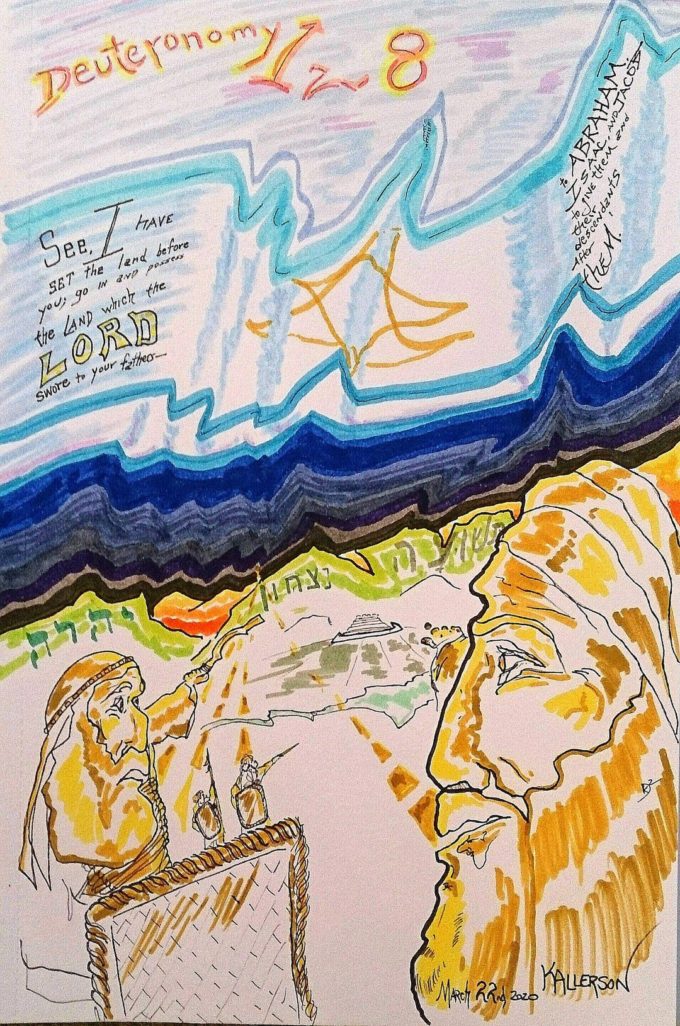
Today, Moses will begin his words to Israel concerning what lies ahead. He will repeat the words of the Lord saying, “See, I have set the land before you; go in and possess the land which the Lord swore to your fathers—to Abraham, Isaac, and Jacob—to give to them and their descendants after them.”
The promise lies ahead, but what exactly is the promise? Is it the land of Canaan? Surely, the Lord promised the land, and He swore to them on oath that they would receive it. However, is that the sum of the promise? Or is there more? The land of Canaan is a small piece of land in the middle of a big world filled with land and people. If that was all there was to the promise, it would be a bit lacking.
Rather, other things are promised in Scripture which extend beyond the borders of Canaan. The New Jerusalem, for example, is rather large. My friend Kathleen emailed me a joke concerning it some time ago –
“A man who lives in the New Jerusalem comes home from work and says to his wife, “I had to go to a meeting across town today. Boy am I beat!”
Overlooking any theological errors in that, it still gets the point across. Canaan is about the size of a very small postage stamp on a very large box in comparison to New Jerusalem.
Text Verse: “Remember the Law of Moses, My servant,
Which I commanded him in Horeb for all Israel,
With the statutes and judgments.” Malachi 4:4
Moses is sitting on one side of the Jordan, and he is compiling words which are to become a part of the Law of Moses. But they are only a part of that law. Malachi speaks of Horeb. That is not where Moses is now. Thus, the words here are an extension of that law, but not the whole law.
Israel was admonished to “Remember the Law of Moses.” What does that mean? Were they expected to exactingly follow every precept without fail? Well, yes. But there is more to the Law of Moses than rote observance of the laws, statutes, and judgments contained within it.
We will see this, and we will continue to see this, as we progress through this marvelous book of Law and of Anticipation. Great things are to be found in His superior word. And so, let’s turn to that precious word once again and… May God speak to us through His word today and may His glorious name ever be praised.
I. Turn and Take Your Journey (verses 5-7)
5 On this side of the Jordan in the land of Moab,
Beginning our verses, the immediate thought is given to specify where the narrative is taking place. It is in the same place where the book of Numbers ended, b’ever ha’yarden b’eretz moav – “in side the Jordan in land Moab.”
The Christological picture must be presented. Moses is the lawgiver, the land of promise anticipates the place of God’s rest – meaning a restored paradise, or – as we say – heaven. The Jordan, or the Descender, pictures Christ who descended from heaven to earth. Moab means “From Father.”
As the lawgiver, representing the law, is outside of the Land of Promise, and as he will remain there, it signifies that the law can only bring one to the Lord Jesus, but one must go through the Lord, who is From Father – meaning He is the Son of God – in order to enter into God’s promised rest.
The law, as Paul says in Galatians, is a tool which is given to lead man to Christ –
“Is the law then against the promises of God? Certainly not! For if there had been a law given which could have given life, truly righteousness would have been by the law. 22 But the Scripture has confined all under sin, that the promise by faith in Jesus Christ might be given to those who believe. 23 But before faith came, we were kept under guard by the law, kept for the faith which would afterward be revealed. 24 Therefore the law was our tutor to bring us to Christ, that we might be justified by faith. 25 But after faith has come, we are no longer under a tutor.” Galatians 3:21-25
With this understanding…
5 (con’t) Moses began
hoil moshe – “ventured Moses.” It is a rather rare word, yaal, having been used only three times so far. When Abraham was speaking to the Lord concerning the destruction of Sodom, knowing that Lot was there and desiring to save his life, he used this word twice. For example, in Genesis 18:27, it said –
“Then Abraham answered and said, ‘Indeed now, I who am but dust and ashes have taken it upon myself to speak to the Lord:’” Genesis 18:27
This word, yaal, comes from a primitive root and gives the sense of undertaking something as an act of volition. Moses has voluntarily begun to speak out his words to the people of Israel. In this, it is specifically…
5 (con’t) to explain this law, saying,
beer eth ha’torah ha’zot lemor – “Making distinct the law, the this, saying…” The words are very specific and direct, beginning with a new and rare word, baar. It is a verb meaning to make distinct or plain. It also comes from a primitive root which signifies to dig, and so by analogy it means to engrave.
Figuratively then, it may mean to explain distinctly. However, it is only used two other times, in Deuteronomy 27:8, and in Habakkuk 2:2. Citing those two times will reveal the intent of the word –
“And you shall write very plainly on the stones all the words of this law.” Deuteronomy 27:8
&
“Then the Lord answered me and said:
‘Write the vision
And make it plain on tablets,
That he may run who reads it.’” Habakkuk 2:2
Though it may be that this is simply referring to audible words, distinctly spoken, it is more probable that whether speaking or not, he is very specifically annotating the words of the law. This is what Luke said he was doing in Luke 1:1-4, and it is what Peter said he was doing in 2 Peter 1:15 while writing out his second epistle.
The fact that Moses is making the words distinct indicates that the words already exist. When one inscribes a tablet with words, it is because the words are there already and are simply being transcribed from either another document or from the mind, or so on. The common scholarly sentiment that is drawn from Moses’ words are similar to that of the Pulpit Commentary –
“This exposition of the Law was designed specially for the sake of those who, at the time the Law was first promulgated, either were not born or were incapable of understanding it (Grotius). The expression used by Moses plainly indicates that this book was not intended to furnish a second code of laws different from the former, but simply to explain and enforce what had before been enjoined.” Pulpit Commentary
Though this may be correct to some extent, the fact is that there are many things in Deuteronomy which are not found in the first four books of Moses. Though this may not be a second law, it goes beyond the substance of what has thus far been given.
And further, it is apparent that the first books of Moses were recorded. There are several times where it explicitly says Moses wrote down certain things. Further, the fact that we have the first four books of Moses, and which Jesus and the apostles state are divinely inspired words, it is clear that what is presented in Deuteronomy is more than just an explanation and enforcement of that which had already been given.
Rather, it is both a reiteration and a continuation of the books of Moses. As noted with the use of the word baar, the words already existed, but this does not necessarily mean that they are a repetition of words that are already recorded. Nor can it mean that, merely because of the additions and variations of what will be presented.
Rather, there is an imposition of the will of the Lord upon Moses to write out the words of this book. Moses felt that will, and he ventured to write it out. In other words, this book is given as a true prophetic utterance by the Lord through Moses.
Unlike the countless other times where it says, “And the Lord spoke to Moses saying,” this is a word given not “to” Moses, but “through” Moses. It then may be similar to Genesis, which is clearly ascribed to Moses, but which does not contain the words, “And the Lord spoke to Moses saying.”
What will be presented is in the first person, and yet it is the word of the Lord. Therefore, it is a book of prophecy in its most profound sense as it continues the presentation of the mind of the Lord which began with the words, “In the beginning God created the heavens and the earth.” This continuation now says…
6 “The Lord our God
Yehovah elohenu – “Yehovah our God.” The term speaks of the covenant which united Israel with Yehovah. Though they had been under covenant curses for the past many years for disobeying the Lord, they were still the Lord’s people.
The picture of those years, that of Israel’s second exile and the 2000 years of living under the covenant curses, is exactly the same. The Lord never rejected them, as replacement theologians arrogantly state.
Rather, they were, and they are, in union with Yehovah because of the unbreakable covenant promises He made to them. Their violation of the covenant in no way negates His faithfulness to it.
6 (con’t) spoke to us in Horeb, saying:
As noted last week, Horeb means “Arid” or “Desert.” The importance of this change of the name from Mt. Sinai to Horeb takes us all the way back to a commentary from Exodus 3. In Deuteronomy 1:1, it mentioned the midbar, or wilderness. Here in this verse it mentions that God dabar, or spoke, to Israel in Horeb.
The word midbar, or desert, is related to the word dabar, or spoke. The term “Mt. Sinai” consistently spoke in picture of the cross of Christ. Israel had rejected Christ’s work and was driven into the midbar, or wilderness. Now, Moses relays what the Lord spoke, or dabar, to Israel all the way back at Horeb, or “Arid.”
With this understanding, we can return to the comments made in Exodus 3. There we noted that Abarim states the following concerning these words –
“These two root-verbs are really quite adjacent in Hebrew thought. Note that the word מדבר (midbar) means wilderness (or desert), and the related verb דבר (dabar) means to speak. When Paul augments Isaiah’s spiritual armor, he adds the sword of the Spirit, which is the Word of God … Words commonly protrude from one’s mouth, and the mouth is typically a wet place, not a dry place. But it should be noted that the Meribah incident occurred at Horeb (Exodus 17:6), “Behold, I will stand before you there on the rock at Horeb, and you shall strike the rock, and water will come out of it, that the people may drink.” Abarim
As can be seen, Moses used the name Horeb, or “Arid,” in Exodus 17. It may seem curious that the place where God is would be defined this way, but what is it that gives life? Water.
The Word of God proceeds from the wet place, the mouth, and the Word of God is where the water of life issues from. Horeb, the Arid place, is where the water came from the rock. Paul in the New Testament says this about that account –
“…all ate the same spiritual food, 4 and all drank the same spiritual drink. For they drank of that spiritual Rock that followed them, and that Rock was Christ.” 1 Corinthians 10:3, 4
The word points to Christ. Israel arrived at Sinai and they rejected Christ. They then went into the midbar, or wilderness, to wander until they would again come to the word. Moses is now relaying the word of the Lord, that very word which speaks of Christ. The instruction is given to lead them to Christ.
As noted by Paul, the law is only a tutor to lead the people to Christ. In finding Christ, they will pass over Jordan and into the inheritance, while Moses, representative of the law, will remain outside of the promise.
After all of this, in short, we can say that Deuteronomy is given to lead the people to what they had missed. The intent of the law is to reveal Jesus. It is not an end in and of itself, but a path to find Christ. Jesus said as much –
“You search the Scriptures, for in them you think you have eternal life; and these are they which testify of Me. 40 But you are not willing to come to Me that you may have life.” John 5:39, 40
But Jesus was even more direct in His words a moment later. He makes it absolutely clear that not only the Scriptures in general, but Moses in particular, spoke of Him –
“Do not think that I shall accuse you to the Father; there is one who accuses you—Moses, in whom you trust. 46 For if you believed Moses, you would believe Me; for he wrote about Me. 47 But if you do not believe his writings, how will you believe My words?” John 5:44-47
This is exactly why Malachi 4:4, our text verse today, said that the people were to remember the law of Moses. They were to consider it, find Christ, and come to Christ. It is also why Malachi said “Horeb” instead of “Mt. Sinai.” They had rejected the cross, they needed to go back to the word which issues from the wet place, while in the dry place, and pay heed to the word which issues forth life.
Understanding this, the book of Deuteronomy is a book which is to be searched out with Christ in mind. If it is, then it will make all the sense in the world. For those who cling to the law as a means to an end, they provide their own path to condemnation. For those who pursue it in light of Christ, they will find salvation.
The words which the Lord told them at Horeb, meaning Mount Sinai were…
6 (con’t) ‘You have dwelt long enough at this mountain.
rav lakem shevet ba’har ha’zeh – “Long enough you have dwelt at the mountain the this.” The words have not been previously seen in Scripture. The Lord said them, but until now, they have not been recorded. Israel arrived in the Wilderness of Sinai at the beginning of the third month of the first year after leaving Egypt. They departed on the 20th day of the 2nd month of the second year. Thus, they were at Sinai a period of 350 days.
Christ had been presented to them in a thousand different ways – in the tabernacle, the sacrificial system, the Feasts of the Lord, and in so many other types and shadows. They had been numbered, ordered, and arranged – prepared as a people for the Lord’s purposes. They had been provided with everything necessary which was needed for the fulfillment of the covenant and it was now time to go forward and enter the Land of Promise.
Israel could have left Horeb and entered Canaan, thus entering their rest. And 1500 years later, Israel could have accepted Christ and entered His rest. They were to depart from there and head toward Mount Zion, leaving the law and finding Christ.
This is what the author of Hebrews says. In Hebrews 12, he tells them that believers have not come “to the mountain that may be touched and that burned with fire, and to blackness and darkness and tempest, 19 and the sound of a trumpet and the voice of words, so that those who heard it begged that the word should not be spoken to them anymore” (vss. 18, 19)
Rather, they had come to Mount Zion. This is what Israel was told to do. It was time to leave the cross and enter the glory…
7 Turn and take your journey, and go to the mountains of the Amorites, to all the neighboring places in the plain, in the mountains and in the lowland, in the South and on the seacoast, to the land of the Canaanites and to Lebanon, as far as the great river, the River Euphrates.
Most translations do not adequately translate this verse. It says, “Turn you, and take your journey, and go you mount (it is singular) the Amorite (it is singular), and to all the neighboring (meaning either places or peoples, probably peoples) in the plain, in the mount (it is singular), and in the lowland, and in the South, and on coast the sea, land the Canaanite (it is singular.)”
This is all one thought, explaining the land of Canaan. From there, it then continues with “And the ‘Lebanon,’ as far as the river, the great, the River Euphrates.” In other words, it is the land of Canaan, plus what is beyond it.
The specificity explains the land. The Amorite is used as a catchall name for all of the inhabitants of Canaan. Amorite comes from amar, meaning to utter or say. Therefore, the name signifies being spoken of, and thus “Renowned.”
The various areas include the Aravah, or the plain, the mount signifies the mountainous area, there is the Shephelah or lowland (a place and a word which is new to Scripture), the Negev, or southern area, and the seacoast. It is an overall description of the layout of the land with its varied types of geography.
The additional words which include Lebanon and the Euphrates are given to confirm the promise first made to Abraham in Genesis 15:18 and which was repeated in Exodus 23:31. This is the first use of the name Lebanon in the Bible.
The land of Canaan was meticulously described in Numbers 34, and it did not include this additional designation, nor that of the Euphrates. However, these areas that extend beyond the land itself have been promised and Moses now reconfirms that to the people.
Lebanon means, “Place of Whiteness,” or “White One,” signifying its perpetual snow. It comes from lavan, meaning “white” but which itself comes from levenah, or brick, because bricks turn white when fired. That concept has consistently been used as a picture of works, because bricks are manmade, unlike stones.
Perath, or the Euphrates, means “Fruitfulness,” or “That which makes Fruitful.” Both of these are extensions to what one should expect after coming to Christ. The Land of Promise, Canaan, is obtained by coming to God through Christ.
One is expected to work after coming to Christ, not before. The works are to be an extension of what is received. That is seen, for example, in Colossians 1 –
“For this reason we also, since the day we heard it, do not cease to pray for you, and to ask that you may be filled with the knowledge of His will in all wisdom and spiritual understanding; 10 that you may walk worthy of the Lord, fully pleasing Him, being fruitful in every good work and increasing in the knowledge of God.” Colossians 1:9, 10
One can see that Moses is anticipating Christ, and then that which stems from life in Christ. Again, the law is not an end in and of itself. This is why these descriptions, along with these additional locations, are now named.
By faith you will receive the Promise and by faith you will stand
It is by grace through faith that this comes about
In this, you will enter the heavenly promised land
And without it, you will forever be kept out
The Lord is pleased with your faith, small as a mustard seed
Yes, He lets us know that a little bit will do
That simple act is a powerful, mighty creed
With a little bit of faith, God will then see you through
Have faith and believe the message you have heard
Believe what God has said and He will accept you
And then cling fastly to His wonderful, precious word
Have faith in God, rest in Him, for He is ever faithful and true
II. A Heavenly Inheritance (verse 8)
8 See, I have set the land before you;
This is immediately speaking of the land of Canaan. The promise was made, and it was for a tract of physical land. However, the promise actually anticipates the true land, meaning the heavenly promise. This will be explained in a minute.
8 (con’t) go in and possess the land which the Lord swore to your fathers—
Israel is a people under the Lord, or in a covenant relationship with the Lord, with Moses as their head. They are instructed to go in and possess the land Yehovah swore to their fathers. This means Canaan.
However, it more assuredly speaks of the heavenly inheritance where the Lord will give rest and dwell with His people. This is the purpose of all that has been seen since Genesis 3 when Adam fell, but restoration was promised.
This promise began to take on specificity with Israel’s fathers, meaning the following men…
8 (con’t) to Abraham,
l’avraham – “to Abraham.” This was first promised to Abraham in Genesis 12:7, and it was repeated to him several times after that –
“Then the Lord appeared to Abram and said, “To your descendants I will give this land.” And there he built an altar to the Lord, who had appeared to him.” Genesis 12:7
8 (con’t) Isaac,
l’yitskhaq – “to Isaac.” This was explicitly stated to Isaac in Genesis 26 –
“Then the Lord appeared to him and said: ‘Do not go down to Egypt; live in the land of which I shall tell you. 3 Dwell in this land, and I will be with you and bless you; for to you and your descendants I give all these lands, and I will perform the oath which I swore to Abraham your father. 4 And I will make your descendants multiply as the stars of heaven; I will give to your descendants all these lands; and in your seed all the nations of the earth shall be blessed; 5 because Abraham obeyed My voice and kept My charge, My commandments, My statutes, and My laws.’” Genesis 26:1-5
8 (con’t) and Jacob—
u-l’yaakov – “and to Jacob.” This was first explicitly said to Jacob in Genesis 28 –
“Then he dreamed, and behold, a ladder was set up on the earth, and its top reached to heaven; and there the angels of God were ascending and descending on it.
13 And behold, the Lord stood above it and said: ‘I am the Lord God of Abraham your father and the God of Isaac; the land on which you lie I will give to you and your descendants. 14 Also your descendants shall be as the dust of the earth; you shall spread abroad to the west and the east, to the north and the south; and in you and in your seed all the families of the earth shall be blessed. 15 Behold, I am with you and will keep you wherever you go, and will bring you back to this land; for I will not leave you until I have done what I have spoken to you.’” Genesis 28:12-15
Each of these three fathers of the people of Israel was given this promise. It then extended to all the sons of Jacob, as Moses next explains…
8 (con’t) to give to them and their descendants after them.’
The promise was made, and because it is the word of the Lord, it must come to pass. And so, despite departing the land of Canaan and spending the next 215 years in the land of Egypt, the promise remained. The time finally came when it was to be fulfilled, and the words were spoken out to a man named Moses.
On the sacred mountain, Moses beheld a burning bush, and a voice called forth to Him. When he responded, “Here I am,” the voice then spoke forth what is now being repeated by Moses –
“Then He said, ‘Do not draw near this place. Take your sandals off your feet, for the place where you stand is holy ground.’ 6 Moreover He said, ‘I am the God of your father—the God of Abraham, the God of Isaac, and the God of Jacob.’ And Moses hid his face, for he was afraid to look upon God.
7 And the Lord said: ‘I have surely seen the oppression of My people who are in Egypt, and have heard their cry because of their taskmasters, for I know their sorrows. 8 So I have come down to deliver them out of the hand of the Egyptians, and to bring them up from that land to a good and large land, to a land flowing with milk and honey, to the place of the Canaanites and the Hittites and the Amorites and the Perizzites and the Hivites and the Jebusites.’” Exodus 3:5-8
The promise was then renewed to Moses in Exodus 6 –
“And God spoke to Moses and said to him: ‘I am the Lord. 3 I appeared to Abraham, to Isaac, and to Jacob, as God Almighty, but by My name Lord I was not known to them. 4 I have also established My covenant with them, to give them the land of Canaan, the land of their pilgrimage, in which they were strangers.’” Exodus 6:2-4
From there, the Lord continued to promise this, time and again, in Exodus and Leviticus. In Numbers, the people were prepared for entrance based on those repeated promises, but in Numbers 14, the first note of the giving of the land to Israel isn’t by the Lord. Rather it is by Joshua and Caleb, pleading with the people to not accept the bad report which they had heard from the other ten spies.
The people did reject the promise though, and the Lord thus rejected them. In their rejection, they were punished. These things will be seen and reviewed in the verses ahead in Deuteronomy. However, before we get to them, it must be understood that though this is immediately and literally speaking of Canaan the land, there is more to it than that.
The promise extends beyond the physical and into the spiritual. The land of Canaan was, and it is, only a steppingstone on the way to true glory.
We know this because of what is said first of Abraham in Hebrews 11. There the author explains that the physical land in which Abraham dwelt, and which was promised to him and his seed, was only a picture of something better; something permanent –
“By faith Abraham obeyed when he was called to go out to the place which he would receive as an inheritance. And he went out, not knowing where he was going. 9 By faith he dwelt in the land of promise as in a foreign country, dwelling in tents with Isaac and Jacob, the heirs with him of the same promise; 10 for he waited for the city which has foundations, whose builder and maker is God.” Hebrews 11:8-10
This, however, could be taken as a form of hyperbole, speaking of the promise of the actual land of Canaan in a superlative way. After all, the land was promised to be given actually to his descendants after him, but not to him personally.
However, this would an incorrect assumption. After those words, it continues to speak of Sarah for two verses, relaying that she who was barren had finally bore a child through an act of faith. From there, Hebrews then says –
“These all died in faith, not having received the promises, but having seen them afar off were assured of them, embraced them and confessed that they were strangers and pilgrims on the earth. 14 For those who say such things declare plainly that they seek a homeland. 15 And truly if they had called to mind that country from which they had come out, they would have had opportunity to return. 16 But now they desire a better, that is, a heavenly country. Therefore God is not ashamed to be called their God, for He has prepared a city for them.” Hebrews 11:13-16
The author of Hebrews, while speaking of Abraham and Sarah, then backs up to those mentioned before them in his letter – to Abel, Enoch, and Noah – including them in this as well. But to them, nothing was said of the land of Canaan.
There was only the remembrance of Eden, the hope of the promise after the fall, and the anticipation of restoration and rest, of which Canaan was to be a type. These people could not have been seeking Canaan as a homeland because Canaan, as a land, did not even yet exist.
Abel and Enoch were before the Flood of Noah, but more importantly, Canaan is the grandson of Noah. The land which bears his name only bore his name sometime after he was born and after he settled it. Therefore, the promise of Canaan is more than just the promise of a piece of land.
To further explain this, the author of Hebrews then returns to Abraham and speaks of his offering up Isaac, the very son through whom the promise was to continue. But in his words, the author then explains the importance of this –
“By faith Abraham, when he was tested, offered up Isaac, and he who had received the promises offered up his only begotten son, 18 of whom it was said, “In Isaac your seed shall be called,” 19 concluding that God was able to raise him up, even from the dead, from which he also received him in a figurative sense.” Hebrews 11:17-19
From there, the author continues with the stream of human existence, specially marked out by the Lord, as people of faith who believed the promises of the Lord.
He speaks of Isaac, Jacob, and Joseph. Concerning Joseph, it is in regard to his bones – having faith that God would give the land to Israel, and so he – knowing this would be true – gave instructions concerning his bones. They were to be taken back to the land when the promise was realized.
However, it was an act of faith which anticipated more than just the act of carrying his bones back. Faith in the word of the Lord means faith in all of the word of the Lord. Joseph’s faith in the promise for Israel is inclusive of the promise of Messiah.
The Lord spoke of Messiah long before He spoke of the land of Canaan. It was, then, to be understood that the promise of Canaan was to be a promise of Messiah to come. The land, as well as the line, are intricately united in the thought put forth in Scripture in relation to Messiah.
The promise of Messiah is made. The line of Messiah is named and refined throughout the generations. The land is then promised to the line from which Messiah would come. Therefore, obtaining the land by this people of Messiah is as weighty as is the naming and continuance of the line from which Messiah would come.
However, because of these things, and as deflating it may be for Israel the people, who are now back in the land of Israel, neither they, nor the land is the center of attention. Abraham is said to have looked forward to the promise of a city in a heavenly country. That is not the land of Canaan, and it is not obtainable apart from the coming of Messiah.
The same is true with the others mentioned – Isaac, Jacob, and Joseph, and even of Moses who is next named and discussed in detail. And who is then further mentioned collectively with all of Israel when it says, “By faith they passed through the Red Sea as by dry land, whereas the Egyptians, attempting to do so, were drowned” (Hebrews 11:29).
The whole congregation demonstrated faith, and by faith they were collectively saved. From there, and as we will see in the coming verses of Deuteronomy, they will collectively lack faith, and they will collectively be punished.
However, individually two had faith and they were kept through that time of punishment – Joshua and Caleb. They will enter the land of Messiah along with the collective people of Messiah.
But even then, there is a lack for Israel. The author goes on to speak of the walls of Jericho collapsing, the faith of a Gentile harlot named Rahab, and then of Gideon, Barak, Samson, Jephthah, and of David and Samuel and the prophets.
Indeed, he goes on to speak in generalities because the list was getting too long. As he says, “time would fail me to tell.” Of all of these people, he notes that even though they had entered Canaan and been people of faith while in Canaan, Canaan was not the end of the story, nor were they the end of the story.
Instead, he speaks of them – all of these multitudes who had lived in Canaan and who had lived lives of faith in Canaan – as understanding that the land was not the goal, nor was it the true promise. In his final words of this magnificent passage of Scripture, he sums up his thoughts by saying –
“And all these, having obtained a good testimony through faith, did not receive the promise, 40 God having provided something better for us, that they should not be made perfect apart from us.” Hebrews 11:39, 40
Canaan cannot be the promise, because they neither entered their rest – as he noted in earlier chapters of Hebrews – nor did they receive the promise, despite having lived in the land which has been, and continues to be, promised in the ongoing narrative.
If they lived in Canaan, the land promised to them, and yet they did not receive the promise, then the promise is not Canaan. As this is so, then Canaan is simply a promised step towards the promise. And therefore, the promise is restoration of that which was lost, and that promise is found in the One who can restore man to that promise.
The Garden of Eden was a place. Likewise, heaven is a place. A place, however, is defined by what is in that place. In both, Eden and Heaven, the place is defined by the presence of the Lord. That is the promise, and the promise is only realized by coming to God through Christ.
He is the Hope of what is ahead, He is the Way upon which one travels to arrive at that Hope. He is the Door through which one obtains access to that place. And He is the Presence which fills that long-anticipated place.
In understanding this, we will be able to understand the book of Deuteronomy. It is a book filled with laws, commandments, statutes, and judgments. It is a book filled with blessings and curses. But it is a book which is not an end in and of itself, nor is the law of Moses a book of restoration, except in its fulfillment as found in Christ.
Where will you hang your hat as we continue through this book? Will it be on observance of the laws, or will it be by resting in Christ? Moses will not enter the promise because the law must die outside of the promise.
Only through the death of Christ will we die to the law. And that will only happen if we are in Christ who fulfilled, and then died under, that law. He died for us outside of the Promise so that He can then bring us into that same Promise when He brings us back to Himself.
Closing Verse: “For what the law could not do in that it was weak through the flesh, God did by sending His own Son in the likeness of sinful flesh, on account of sin: He condemned sin in the flesh, 4 that the righteous requirement of the law might be fulfilled in us who do not walk according to the flesh but according to the Spirit.” Romans 4:3, 4
Next Week: Deuteronomy 1:9-25 Will they go through, or will Israel be the great dissenter?… (At the Door, Ready to Enter) (3rd Deuteronomy Sermon)
The Lord has you exactly where He wants you. He has a good plan and purpose for you. But He also has expectations of you as He prepares you for entrance into His Land of Promise. So, follow Him and trust Him and He will do marvelous things for you and through you.
Go in and Possess the Land
Moses began to explain this law, saying
The LORD our God spoke to us in Horeb, saying:
‘You have dwelt long enough at this mountain
To them He was so relaying
Turn and take your journey
And go to the mountains of the Amorites, so do understand
To all the neighboring places in the plain
In the mountains and in the lowland
In the South and on the seacoast
To the land of the Canaanites and to Lebanon, so shall it be
As far as the great river, the River Euphrates
Pay heed now to these words from Me
See, I have set the land before you
Go in and possess the land which swore to your fathers the LORD
To Abraham, Isaac, and Jacob
To give to them and their descendants after them
———- according to His word
Lord God, turn our hearts to be obedient to Your word
Give us wisdom to be ever faithful to You
May we carefully heed each thing we have heard
Yes, Lord God may our hearts be faithful and true
And we shall be content and satisfied in You alone
We will follow You as we sing our songs of praise
Hallelujah to You; to us Your path You have shown
Hallelujah we shall sing to You for all of our days
Hallelujah and Amen…
5 On this side of the Jordan in the land of Moab, Moses began to explain this law, saying, 6 “The Lord our God spoke to us in Horeb, saying: ‘You have dwelt long enough at this mountain. 7 Turn and take your journey, and go to the mountains of the Amorites, to all the neighboring places in the plain, in the mountains and in the lowland, in the South and on the seacoast, to the land of the Canaanites and to Lebanon, as far as the great river, the River Euphrates. 8 See, I have set the land before you; go in and possess the land which the Lord swore to your fathers—to Abraham, Isaac, and Jacob—to give to them and their descendants after them.’