Deuteronomy 4:15-24
The Form of the Lord
The day I typed this sermon is the day that Florida was removed from lockdown status. Remember that? It seems like eons ago, doesn’t it? In the morning, I posted my usual sunrise photo (a really beautiful sky), and I made a comment on it saying –
“Florida is off lockdown. If you’re still stuck at home – be adventurous. Get in your car and c’mon down. The weather is here. We wish you were beautiful. Join us at the beach.”
I was thoroughly amazed at the number of negative comments that came in. People horrified that we were freed from the bondage we had been in, and what an unwise decision it was to do this. Others cautiously said, “Be safe, Charlie,” as if I was now going to change my daily routine from what it had been.
But the fact is, I never changed it – even a bit – from before the lockdown, and so there was nothing to change back to. There are all types of bondage in the world. There is forced bondage, there is incarceration, there is self-imposed bondage, and so on. And, within these, there are countless subdivisions.
But the word “bondage” always signifies “not free.” Why anyone would want to continue in the bondage of fear – of a virus which proved as undeadly as a mild flu, or bondage to a government that salivated at the chance of taking away the freedoms of its people? It is hard to figure. But this is what was evident on the morning of 4 May 2020.
Text Verse: “For you did not receive the spirit of bondage again to fear, but you received the Spirit of adoption by whom we cry out, ‘Abba, Father.’ 16 The Spirit Himself bears witness with our spirit that we are children of God, 17 and if children, then heirs—heirs of God and joint heirs with Christ, if indeed we suffer with Him, that we may also be glorified together.” Romans 8:15-17
Paul very well may have been thinking of this passage from Deuteronomy when he wrote these words to those at Rome. He speaks of bondage, adoption, and an inheritance. These things are found in today’s passage as well, and it is certain that they did not come through the Law of Moses.
This is seen, again, in today’s verses as well. Moses repeats that he will not cross over Jordan and into the inheritance. As Paul shows in Romans 8, the law has no part in the inheritance. Only in coming to Christ is that made possible.
These verses today will also close out our chiasm which began in verse 3:25. That truth is seen laid out quite clearly in it…
Deuteronomy 3:25-4:22 – Call upon Him.
Israel’s Instruction (11/07)
a 3:25 Moses wants to cross Jordan
b 3:26 Lord angry with Moses
c 3:27 “Lift your eyes toward the west, the north, the south, and the east.”
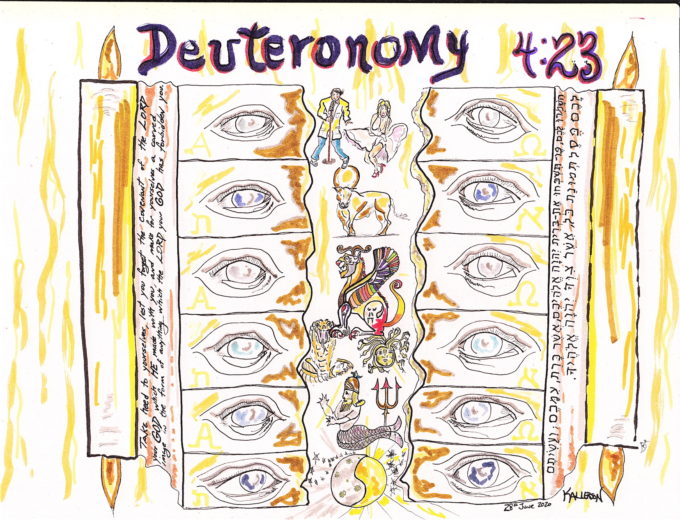
d 4:3, 4 Example of apostasy (idolatry)
e 4:5 Taught statutes and judgments
f 4:6 Be careful to observe them (judgments)
g 4:7 Great nation
x 4:7 Call upon Him
g 4:8 Great nation
f 4:9 Diligently keep yourself (judgments)
e 4:10-14 Taught statutes and judgments.
d 4:15-18 Warning of apostasy (idolatry)
c 4:19 “Lift your eyes to heaven.”
b 4:21 Lord angry with Moses
a 4:22 Moses must not cross over the Jordan
Where are you placing your trust? In self-imposed bondage? In a government which can’t balance its own budget? In a bottle of Clorox and a face mask? What is it that will make you safe and keep you that way? The answer is Jesus Christ. The law was given to lead us to Him. Therefore, use the law wisely – not as bondage leading to death, but as a tutor to lead you to Christ.
This is an invaluable lesson which is found in His superior word. And so, let us turn to that precious word once again and… May God speak to us through His word today and may His glorious name ever be praised.
I. Out of the Iron Furnace (verses 15-19)
15 “Take careful heed to yourselves,
This is a new section of Deuteronomy 4 which builds upon what Moses has already expressed. First, in verse 4:9, he said to the people raq hishamer lekha u-shemor naphshekha meod – “only take heed to yourself and keep yourself exceedingly.”
When he said that, it was in the second person singular. Moses was speaking to each individual which made up the collective whole. Thus, he was speaking to Israel collectively. Now he says, v’nishmartem meod l’naphshotekhem – “and take heed exceedingly to yourselves.”
The words are in the second person plural. He is speaking to all the people collectively. The first stressed personal responsibility leading to national acceptability. The second stresses national responsibility which is derived from the obedience of all people.
Moses is ensuring that the nation understands that it cannot blame the individuals for failing, and he is ensuring that the individuals cannot blame a national failure for their own failings.
To get this, imagine a family where the father is arrested. They are in a culture that looks to family responsibility in a collective manner. He cannot say, “My family is out of control, and so it is their fault.” And if the whole family is arrested, they cannot say, “It is dad’s fault because he is out of control.”
Moses tells all of Israel that they are to take heed, individually and as a nation. If this is not the case, breakdown in society is inevitable. This is the very reason for these words coming in Deuteronomy 17:1-5 –
“If there is found among you, within any of your gates which the Lord your God gives you, a man or a woman who has been wicked in the sight of the Lord your God, in transgressing His covenant, 3 who has gone and served other gods and worshiped them, either the sun or moon or any of the host of heaven, which I have not commanded, 4 and it is told you, and you hear of it, then you shall inquire diligently. And if it is indeed true and certain that such an abomination has been committed in Israel, 5 then you shall bring out to your gates that man or woman who has committed that wicked thing, and shall stone to death that man or woman with stones.”
That subject matter from Chapter 17 is exactly what Moses has spoken about and what he will again speak about now. The contents of what he says ahead are new even if parts of it are substantially a repeat of what he just said in verse 12 –
“And the Lord spoke to you out of the midst of the fire. You heard the sound of the words, but saw no form; you only heard a voice.”
Some of that repetition begins with the next words…
15 (con’t) for you saw no form
lo reitem kal temunah – “no saw you any likeness.” Of these words, Adam Clarke incorrectly states –
“Howsoever God chose to appear or manifest himself, he took care never to assume any describable form. He would have no image worship, because he is a Spirit, and they who worship him must worship him in Spirit and in truth. These outward things tend to draw the mind out of itself, and diffuse it on sensible, if not sensual, objects; and thus spiritual worship is prevented, and the Holy Ghost grieved. Persons acting in this way can never know much of the religion of the heart.” Adam Clarke
Christians worship Jesus Christ because Jesus Christ is God. Not only this, but God is pleased when we worship Him. Jesus says this explicitly in John 5:23 and John 12:26. Paul confirms it, saying –
“Therefore God also has highly exalted Him and given Him the name which is above every name, 10 that at the name of Jesus every knee should bow, of those in heaven, and of those on earth, and of those under the earth, 11 and that every tongue should confess that Jesus Christ is Lord, to the glory of God the Father.” Philippians 2:9-11
Further, Moses has already recorded that the Lord did appear in a form – in the likeness of a man. That is actually first recorded in Genesis 3, where it says that Adam and Eve “heard the sound of the Lord God walking in the garden.” If the Lord God walked, he had feet. The implication is that there was a form. This is seen again in Genesis 18 –
“Then the Lord appeared to him by the terebinth trees of Mamre, as he was sitting in the tent door in the heat of the day. 2 So he lifted his eyes and looked, and behold, three men were standing by him; and when he saw them, he ran from the tent door to meet them, and bowed himself to the ground, 3 and said, ‘My Lord, if I have now found favor in Your sight, do not pass on by Your servant.’” Genesis 18:1-3
These, and other, manifestations of the Lord – the eternal Christ – had already been revealed to the people through Moses’ words, but when the law was given at Sinai, the Lord set about to impress upon the people’s minds that the Lord extends beyond mere human form, and indeed beyond any form.
Because this is so, no image can fully represent Him. This is why Isaiah wrote these words to the same people who were so prone to going astray in their hearts –
“The craftsman stretches out his rule,
He marks one out with chalk;
He fashions it with a plane,
He marks it out with the compass,
And makes it like the figure of a man,
According to the beauty of a man, that it may remain in the house.
14 He cuts down cedars for himself,
And takes the cypress and the oak;
He secures it for himself among the trees of the forest.
He plants a pine, and the rain nourishes it.
15 Then it shall be for a man to burn,
For he will take some of it and warm himself;
Yes, he kindles it and bakes bread;
Indeed he makes a god and worships it;
He makes it a carved image, and falls down to it.
16 He burns half of it in the fire;
With this half he eats meat;
He roasts a roast, and is satisfied.
He even warms himself and says,
“Ah! I am warm,
I have seen the fire.”
17 And the rest of it he makes into a god,
His carved image.
He falls down before it and worships it,
Prays to it and says,
‘Deliver me, for you are my god!’” Isaiah 44:13-17
People who say that worshipping the Lord Jesus is idolatry make the fundamental mistake that the Jews made and then have passed on for two thousand years. God had already revealed Himself in human form, since the very beginning of man’s time on earth, and throughout the times of the Old Testament.
Not only is that clear, but the worship of Him in this form already has precedent. Abraham clearly called the Lord as such, saying Adonai, or my Lord (meaning Yehovah), and he bowed himself to the ground before Him. Joshua will, in the very near future, worship this same Person –
And it came to pass, when Joshua was by Jericho, that he lifted his eyes and looked, and behold, a Man stood opposite him with His sword drawn in His hand. And Joshua went to Him and said to Him, “Are You for us or for our adversaries?”
14 So He said, “No, but as Commander of the army of the Lord I have now come.”
And Joshua fell on his face to the earth and worshiped, and said to Him, “What does my Lord say to His servant?”
15 Then the Commander of the Lord’s army said to Joshua, “Take your sandal off your foot, for the place where you stand is holy.” And Joshua did so. Joshua 5:13-15
A similar incident will occur in Judges 6 with Gideon and the Lord, and again in Judges 13 with the parents of Samson. Some of the prophets will have visual manifestations of the Lord appear to them as well. Thus, the unseen God has clearly chosen to reveal Himself in a Person, even before the coming of Jesus – and yet it was Christ the Lord who came to them.
What is being revealed to Israel now is a lesson concerning idolatry, but it is not to be – nor can it be – considered as idolatry to worship the Man who is the Lord. “No form, then, signifies no thing which man can create or devise which could failingly resemble the Lord God.
An image of a man cannot reveal anything beyond itself, whereas Jesus can. It is He who reveals the unseen God to us. Israel needed tutoring before that could happen, and so God gave no form or likeness when He spoke out the law. Moses repeats that now for Israel’s instruction. That instruction came…
15 (con’t) when the Lord spoke to you at Horeb
Rather than “when,” the Hebrew says, b’yom – “in the day.” In other words, it was one day, and one day only, that the Lord so spoke to Israel. After that, Moses stood between them, receiving the Lord’s word and passing it on to the people.
15 (con’t) out of the midst of the fire,
Again, this was seen in verse 12. The Lord was demonstrating His holy nature, and that He alone was to be served and worshipped. Thus, speaking out of the fire was a deliberate note to Israel that His word is one of judgment. For a violation of it, the expectation was to be that of punishment.
The lesson of the voice is that of worship – properly directed worship. There is nothing that man can imagine or produce that is, or ever could be, a substitute for God. If this is so, then making something – be it a household idol, or an artificial intelligence computer, or any other thing in creation – it cannot suffice to represent God.
Therefore, no such thing was to be made and then bowed down to. To do so is to pervert the lesson of the voice, it is to diminish the glory of God, and it is to diminish the value of the person who so commits such a crime. That is revealed in Moses’ next words…
16 lest you act corruptly
The Lord is holy, and He demands holiness in His people. To act corruptly is to act in an unholy manner. This was unbefitting of a person who had been redeemed by the Lord, and who was considered one of the people of the Lord.
But further, this corruption extends in another way. To make an image of God is to make it out of something which is corruptible. But God is incorruptible. Therefore, there is an infinite disparity between the two. It equates something worthless with that which cannot be valued.
Moses next defines how this could come about, beginning with…
16 (con’t) and make for yourselves a carved image
A portion of the chiasm which has spanned the verses of our last few sermons begins to be defined here.
d 4:3, 4 Example of apostasy (idolatry)
d 4:15-18 Warning of apostasy (idolatry)
In verses 4:3, 4, Moses referred to the idolatry of the people. It was an example of apostasy for the people to remember.
The incident concerning Peor is found in Numbers 25. The men of Israel were enticed by the women of Moab, they fell into harlotry with them, and they then fell into idol worship with their gods. Moses reminded them of this in order to warn them of it now.
One cannot call on the Lord, the central thought of the chiasm, if his mind, heart, or eyes are focused on a god which is no god at all. No form was seen at Horeb, and therefore, no pesel, or carved image, of any form was to be made.
But, again, because we are slow to learn, we can – and indeed we should – consider the Lord Jesus in our every prayer. To do so is not idolatry. He is the incarnate Word of God. He is our Mediator between this physical world of people and the unseen God.
Because God has revealed Himself to us in this way, it would not only be inappropriate to worship God apart from Jesus, it would be an affront to Him. As Jesus said, “all should honor the Son just as they honor the Father. He who does not honor the Son does not honor the Father who sent Him” (John 5:26).
The difference between that which man has made, and the body which God prepared for Christ, is infinite in scope. Until Israel learns this, they must remain under this law which forbids any image to be made or worshipped. Moses further defines this as…
16 (con’t) in the form of any figure:
temunath kal samel – “form of any figure.” Moses introduces a new word here, semel. It signifies “to resemble,” and thus it is a figure or image. It is a word which will only be seen again in 2 Chronicles 33 (twice) and Ezekiel 8 (twice). The powerful significance of this word will be seen before we end today. For now, Moses speaks on…
16 (con’t) the likeness of male or female,
tavnith zakar o neqevah – “pattern after male or female.” This explains what was just said – “the form of any figure.” The word tavnith, or “pattern,” comes from the word banah, “to build.” Nothing was to be constructed into such a form.
The Hebrew words signify the form of the sexes. Thus, it includes the male or female form. Though not stated, this clause certainly speaks of a human man or woman.
The Lord has already, in the books of Moses, revealed Himself in such a way, and so the Lord is making a complete distinction between what He has done and what man can do. The unseen voice reveals no form for Israel to emulate.
Logically, this cannot mean that Israel could not worship the Man, who is the Lord. This is evident because Joshua will do so within about one month’s time from the words Moses now speaks. The words hinge on the thought that one is God’s revelation of Himself while the other is man’s attempts at creating a god in his own image and calling it the Lord. Next, Moses continues…
17 the likeness of any animal that is on the earth
tavnith kal behemah asher ba’aretz – “pattern after any beast which is on the earth.” The words of this clause, and the next, take us back to Genesis 1:1. It is God who created those things, and thus they are not gods.
Further, they are things God had purposed for the benefit of man. For man to worship and serve them is not only to deny the Creator, but it is to turn upside down the order of His creation by exalting over man that which was for man’s enjoyment and benefit.
This is what the Egyptians had done. But the Lord had brought judgment on those, and all the other, false gods of Egypt.
17 (con’t) or the likeness of any winged bird that flies in the air,
This again returns us to Genesis 1. In fact, the word uph, or “flies,” hasn’t been seen since then. It also takes the reader back to Israel’s time in Egypt where birds, such as the ibis and the falcon were worshipped. These or any bird of wing were not to be patterned into an idol. And Moses continues…
18 the likeness of anything that creeps on the ground or the likeness of any fish that is in the water beneath the earth.
Moses rounds out the list from Genesis 1 of created species, but which had become objects of worship throughout Egypt. They worshipped both creeping animals like the scarab beetle, and the fish-goddess Hatmehyt, along with many other such creatures.
In the Genesis account, the creation of the living beings is in a different order. There, the creatures are noted in order of creation – fish, bird, beast, creepy, man. Here, it appears Moses is ordering them in likeliness to be worshipped – Man, beast, bird, creepy, fish.
But it is noted that all categories were worshipped in Egypt – from Pharaoh the man, all the way down to the crocodile, and everything in between. Israel is strictly forbidden from fashioning any such image in order to set it up and worship it.
However, there is more that was worshipped in Egypt, and that is also worshipped in the land of Canaan where Israel was heading. And so, Moses begins a new category of such things…
19 And take heed, lest you lift your eyes to heaven,
u-pen tisa eneka ha’shamaymah – “And lest you lift your eyes to the heaven.” Heaven is singular. It is where God is seen to dwell, such as in Genesis 28:12, where Jacob saw a ladder set up on the earth and which reached to heaven. The Lord stood above the top of the ladder.
They are words of caution. This is something that everyone does. We all look to the sky, both in day and in night, but Moses warns that trouble could be lurking in our minds when doing so.In other words, what he will warn about does not indicate anything wrong with what is up there, but how we treat what is up there…
19 (con’t) and when you see the sun, the moon, and the stars,
This is something that most people do every time that they are out. They look up and check things out – the sun and how its light dances around, the moon and how it bathes the night in a soft glow, and the stars which capture our imagination for a multitude of reasons. Indeed, they are each a part of…
19 (con’t) all the host of heaven,
kol tseva ha’shamayim – “all the host of the heavens.” Here, the singular “heaven” of the previous clause is now rendered in the plural. The Lord is in heaven, but these things are the host of the heavens.
They are created things, as are the heavens, just as was explicitly stated in Genesis 1. As they are created, they are not gods, but are rather things which exist and are sustained by His direction and power. But man has devised many schemes in his imaginings…
19 (con’t) you feel driven to worship them and serve them,
Here is a new word to Scripture, nadakh – to impel, compel, be led, driven away, etc. There is a force which moves something, and that force here is to impel a person to do what is against the proper order expected by God.
Here the verb is reflexive, meaning “you allow yourself to be drawn away.” Man’s own mind moves him from the proper worship of the Creator to the improper worship of the creation.
19 (con’t) which the Lord your God has given to all the peoples under the whole heaven as a heritage.
asher khalaq Yehovah elohekha otam l’kol ha’ammim takhat kal ha’shamayim – “which divided Yehovah your God to all the peoples under all the heavens.” It is a fascinating and, at first, perplexing statement.
Scholars argue over what is meant, some saying that God has divided the other nations, allowing them to worship these bodies, but Israel was to worship only the Lord. That is a rather perverse way of looking at it.
Cambridge lessens the force of that and says it is “An interesting attempt by the writer to reconcile his great truth that Jehovah is God alone with the fact that the other nations worship other gods.” As justification for that, they cite Deuteronomy 29:26 which speaks of Israel doing exactly this –
“…for they went and served other gods and worshiped them, gods that they did not know and that He had not given to them.” Deuteronomy 29:26
But this is an error in thinking. The Lord did not give these things to Israel, or anyone else, as gods. The verse says that the Lord has divided these heavenly bodies “to all the peoples under the whole heavens.” It is inclusive of Israel.
What Moses is saying is that no nation can claim any or all of these heavenly bodies as its own. The same sun that shines on Shiloh, Israel also shines on Wang Chung, China. Egypt claimed the sun god Ra as their own. But it is not a god. It is the sun, and the Lord has divided it among all the peoples of the earth.
These things were never intended to be objects of worship. This is evident because the sun is found over Japan at one time, but over England at another. The same is true with the moon and the stars. The heavens, being plural, means any and every view of the sky by man at any point in time.
At one time, a part of the people enjoys one aspect of them, at another, others do. If these were gods, they would always be present. Thus, the Lord has divided them among the peoples because He is the Creator of them, and the One who appoints their seasons.
Therefore, the evident truth is that the Lord God gave these, as is recorded in Genesis 1 to serve man, not that they should be served by men. Man was the anticipated guest. All of these things – the animals, birds, creeping things, fish, and the host of the heavens were all created before man was. And man was created to worship and serve the Lord God.
Do not worship anything, but Me alone, says your God
In doing this, you will do well
I will keep you safe on this earthly path you trod
And will open to you heaven, instead of opening hell
I am the Lord your God, so you are to worship only Me
And I will lead you in paths of righteousness for My name’s sake
I will guide you each step, watching over you tenderly
If you will follow Me – may this be the path you take
Forget the idols of the nations, which are only vanity
Don’t bow to the heavenly host, and you will do well
Don’t allow yourself to be pulled into idolatrous insanity
And I will open to you heaven, instead of opening hell
II. A Jealous God (verses 20-24)
20 But the Lord has taken you
v’etkhem laqakh Yehovah. It is emphatic, “And you, has taken Yehovah.” Egypt pictures bondage to sin. They were caught up in worshipping and serving everything Moses just mentioned – all of it. But the Lord brought them out of that…
20 (con’t) and brought you out of the iron furnace,
These words are unfortunately taken completely out of their intended context by many. This is not saying Israel was forced to work in iron furnaces. It is also not speaking of any other forced labor that Israel suffered under.
It is certainly true those things literally happened, but the context is that of idolatry. Moses said that the Lord spoke to the people at Horeb from the fire. Iron represents strength, be it in binding together, in government, in hard service, in bondage, etc.
But iron can go into a furnace, which is now a new word in the Bible, kur. It signifies a pot or furnace – something dug out in order to form a place for smelting. It is kin to the word kir, found only in Leviticus 11:35. It is a place of divine testing and purification.
In an iron furnace, the strength of iron is removed and cohesion is lost through the heat of the fire. In idolatry, there is no cohesion and strength of worship toward God. Rather, there is a purposeless state of futility. This iron furnace is next described as…
20 (con’t) out of Egypt,
Egypt, or double distress, is the iron furnace. Being brought out of that implies that the iron can be shaped and strengthened by the Lord for His purposes. This is exactingly seen in Isaiah 48:10 where the kur, or furnace, is noted –
“Behold, I have refined you, but not as silver;
I have tested you in the furnace of affliction.
11 For My own sake, for My own sake, I will do it;
For how should My name be profaned?
And I will not give My glory to another.” Isaiah 48:10
The Lord sent Israel to Egypt to be tested and refined. The purpose of this was because Israel was…
20 (con’t) to be His people, an inheritance, as you are this day.
Israel was morally prepared in Egypt to be a people who were to know the difference between idolatry and true worship. This selection was typologically given to prefigure the church – the people of God in Christ – be they Jew or Gentile. Paul states this in Ephesians 1 –
“…that the God of our Lord Jesus Christ, the Father of glory, may give to you the spirit of wisdom and revelation in the knowledge of Him, 18 the eyes of your understanding being enlightened; that you may know what is the hope of His calling, what are the riches of the glory of His inheritance in the saints.” Ephesians 1:17, 18
21 Furthermore the Lord was angry with me for your sakes,
v’Yehovah hitaneph bi al divrekhem – “And Yehovah was angry with me for your words.” This is the third time that Moses has substantially repeated this. However, each time Moses has changed the wording concerning why. The first time, in Deuteronomy 1:37, he used the word galal, or roll. The Lord was angry with Moses because the words of the people rolled back upon him.
The second time, in Deuteronomy 3:26, the word maan, meaning intent or purpose, was used. It was the Lord’s purpose that Moses (picturing the law) would not cross the Jordan. Now, for the third time, he says it is because of the people’s words that he cannot enter. It again looks to Christ.
How does one enter into the promise? Is it by faith – displayed in words – or is it by deeds of the law? The words of the people kept them out of the inheritance. They didn’t believe and their words reflected that. Now, the people’s words will be words not of law, but of faith. The law cannot bring the people into the inheritance. Only the word of faith can do so –
“But what does it say? “The word is near you, in your mouth and in your heart” (that is, the word of faith which we preach): 9 that if you confess with your mouth the Lord Jesus and believe in your heart that God has raised Him from the dead, you will be saved. 10 For with the heart one believes unto righteousness, and with the mouth confession is made unto salvation.” Romans 10:8-10
21 (con’t) and swore that I would not cross over the Jordan, and that I would not enter the good land which the Lord your God is giving you as an inheritance.
This is not recorded anywhere else. But it is a statement of fact, relayed by Moses, and which points directly to the consequences of being led by the law and not by following Christ through faith.
Moses led the people, the people failed to believe – thus indicting Moses for failure to lead the people – and so the Lord swore that he would not enter. There is nothing unfair about this. If a president fails to lead his people properly – think of Jimmy Carter and his famous malaise speech accompanied by a malaise administration – there are consequences for that failure.
It may have been, and it certainly was, an indictment upon the people by the Lord, but it was also a failure of Moses to inspire them to words of faith, because the law is not of faith, but of deeds. This is the truth which Moses presents to the people and the consequences of that are once again stated by him…
22 But I must die in this land,
ki anokhi met ba’arets ha’zot – “For I die in the land the this.” Translations using the word “but” reduce the impact of the clause. It is a statement of fact, an affirmation, that Moses is to die outside of the promise.
The symbolism is absolutely clear. The Lord swore that Moses would not enter for he is to die in the land outside of the inheritance. The law died when Christ died. Those under law will die with the law. Those who died to the law, with Christ, will live with Christ. They will cross over. As for Moses, meaning the law…
22 (con’t) I must not cross over the Jordan;
One is either under law and outside the promise, or one dies to the law and crosses over the Jordan (the Descender), meaning Christ. This same thought has been stated at least seven jillion times, or close to that. The emphasis on this cannot be overstated. The law can bring no one into the inheritance. However…
22 (con’t) but you shall cross over and possess that good land.
v’atem oberim vi’rishtem – “And you shall cross over and inherit.” With the law dead, the people can enter. One plus one will always equal two in proper theology. As long as one is under law, there is no inheritance. When the law dies, the inheritance is possible. The law died in Christ, and therefore only in Christ can one cross over to possess the good land the Lord has in store for His people.
23 Take heed to yourselves, lest you forget the covenant of the Lord your God which He made with you,
The words are words of law, but of what timeframe is Moses speaking of? Obviously, he is speaking of the time after having crossed the Jordan. It is speaking of the nation of Israel, under the law, not of a typological picture of Christ.
The covenant was cut, and the people were to pay heed to it. Despite the typology Moses is fulfilling in his death east of Canaan, there is the continued existence of Israel under the law which must be lived out in order to give the world an understanding of its need for grace.
That covenant, and its many laws and prohibitions, says further…
23 (con’t) and make for yourselves a carved image in the form of anything which the Lord your God has forbidden you.
Here, the Hebrew actually says, “which the Lord your God has commanded you.” That is referring to the negative command of Exodus 20:4, 5 –
“You shall not make for yourself a carved image—any likeness of anything that is in heaven above, or that is in the earth beneath, or that is in the water under the earth; 5 you shall not bow down to them nor serve them.”
Those words of Exodus 20 are then immediately followed by exactly the same thought. Moses begins that now…
24 For the Lord your God is a consuming fire,
ki Yehovah elohekha esh okelah, “For Yehovah your God fire consuming.” The symbolism of this was seen by the people in Exodus 24 –
“The sight of the glory of the Lord was like a consuming fire on the top of the mountain in the eyes of the children of Israel.” Exodus 24:17
The appearance of the Lord’s glory was a representation of the Lord’s character and being. It was to impress upon the people that what they saw was reflective of who the Lord is. And more than just this outward display reflecting his nature also comes the final, terrifying, words of today’s passage…
*24 (fin) a jealous God.
hu el qanna – “He God Jealous.” It is an emphatic statement which describes His very character. After giving the commandments concerning idolatry, the Lord said this in Exodus 20 –
“For I, the Lord your God, am a jealous God, visiting the iniquity of the fathers upon the children to the third and fourth generations of those who hate Me, 6 but showing mercy to thousands, to those who love Me and keep My commandments.” Exodus 20:5, 6
God is Jealous. The word is qanna. This doesn’t indicate jealously of success in another. Rather, it speaks of a defense of His honor and glory. When one bows to another god, the Lord isn’t jealous of that false god receiving worship. His jealousy is directed to the violation of depriving Him what He is justly due. As He says in Isaiah –
“I am the Lord, that is My name;
And My glory I will not give to another,
Nor My praise to carved images.” Isaiah 42:8
This is the fourth use of this adjective, qanna. It will be used only two more times, both in Deuteronomy, and it is always used in relation to the Lord. As I said in verse 16, however, the word introduced at that time, semel, is one used only four more times.
It is seen in 2 Chronicles 33, where Manasseh, king of Israel, set up such an image in the house of the Lord. Because of that, and the other things Manasseh did, the Lord said he would no longer forgive Israel. Thus, He thrust them from His presence. But the word is also used in Ezekiel 8. There, it says this –
He stretched out the form of a hand, and took me by a lock of my hair; and the Spirit lifted me up between earth and heaven, and brought me in visions of God to Jerusalem, to the door of the north gate of the inner court, where the seat of the image of jealousy was, which provokes to jealousy. 4 And behold, the glory of the God of Israel was there, like the vision that I saw in the plain.
5 Then He said to me, “Son of man, lift your eyes now toward the north.” So I lifted my eyes toward the north, and there, north of the altar gate was this image of jealousy in the entrance. Ezekiel 8:3-5
The image erected at the temple is called “the image of jealousy.” The Lord was deprived His rightful worship because of this image, and the consequences of this, and the other violations of the law which are outlined there, resulted in death for those who followed those practices.
Though we are under grace, it is of note that John closes out his first epistle with these words, “Little children, keep yourselves from idols. Amen” (1 John 5:21).
Idolatry is no less serious under the New Covenant, even if its consequences in this life are not as terrifying. But the same Lord, whose name is Jealous, rules over us today. His hand of grace upon our lives does not negate His jealous nature when we worship other gods.
One thing we must do, then, is to ensure that our hearts are always directed to Him, and that we are not swayed away from a close walk with Him because of those things which are temporary, corruptible, and which have no value in the life we have been called to live.
Let us carefully evaluate our lives, from day to day, and let us endeavor to always put the Lord Jesus first. With this, the Lord our God will be pleased. And, as the trial of the Coronavirus lockdown is behind us, let us remember to not walk in this life with a spirit of fear.
The Lord has ordained our days, He had them set before the moment we were conceived, and our worries and anxieties will not change that one iota.
Israel saw no form of the Lord, because they were to focus on the Lord – and nothing else. We have something far better. What is the form of the Lord? It is the form of a Man – our Savior, Jesus. Paul says as much in 2 Corinthians –
“For it is the God who commanded light to shine out of darkness, who has shone in our hearts to give the light of the knowledge of the glory of God in the face of Jesus Christ.” 2 Corinthians 4:6
Jesus – He is the Lord, the eternal God. Let us entrust our souls to Him, be confident and encouraged in Him, and be a light to others – both in how to conduct our lives properly, and in how to bear up in a positive way during those times which bring fear to the hearts of men. May they see our lives and say, “I want what they have. I want Jesus.” To the glory of God the Father.
Closing Verse: “Therefore, since we are receiving a kingdom which cannot be shaken, let us have grace, by which we may serve God acceptably with reverence and godly fear. 29 For our God is a consuming fire.” Hebrews 12:28, 29
Next Week: Deuteronomy 4:25-31 Something to do always as on this earth you trod… (Seek the Lord Your God) (16th Deuteronomy Sermon)
The Lord has you exactly where He wants you. He has a good plan and purpose for you. But He also has expectations of you as He prepares you for entrance into His Land of Promise. So, follow Him and trust Him and He will do marvelous things for you and through you.
The Form of the Lord
Take careful heed to yourselves
For you saw no form; nothing visible to admire
When the LORD spoke to you
At Horeb out of the midst of the fire
Lest you act corruptly
And make for yourselves a carved image – yes even of a whale
In the form of any figure
The likeness of male or female
The likeness of any animal that is on the earth
Or the likeness of any winged bird that flies in the air
The likeness of anything that creeps on the ground
Or the likeness of any fish that is in the water beneath the earth
———-No! Don’t you dare
And take heed, lest you lift your eyes to heaven
And when you see the sun, the moon, and the stars
All the host of heaven
You feel driven to worship them and serve them
———-even the planet Mars
Which has given the LORD your God
To all the peoples as a heritage under the whole heaven
———-wherever man does trod
But the LORD has taken you
And brought you out of the iron furnace; a place not bright and gay
Out of Egypt, to be His people
An inheritance, as you are this day
Furthermore the LORD was angry with me for your sakes
And swore that I would not cross over the Jordan
———-for me there is no such chance
And that I would not enter the good land
Which the LORD your God is giving you as an inheritance
But I must die in this land
I must not cross over the Jordan, thus I was made to understand
But you shall cross over
And possess that good land
Take heed to yourselves, lest you forget the covenant
Of the LORD your God which He made with you
And make for yourselves a carved image in the form of anything
Which the LORD your God has forbidden you to do
For the LORD your God – please give me an understanding nod
Is a consuming fire; a jealous God
Lord God, turn our hearts to be obedient to Your word
Give us wisdom to be ever faithful to You
May we carefully heed each thing we have heard
Yes, Lord God may our hearts be faithful and true
And we shall be content and satisfied in You alone
We will follow You as we sing our songs of praise
Hallelujah to You; to us Your path You have shown
Hallelujah we shall sing to You for all of our days
Hallelujah and Amen…
15 “Take careful heed to yourselves, for you saw no form when the Lord spoke to you at Horeb out of the midst of the fire, 16 lest you act corruptly and make for yourselves a carved image in the form of any figure: the likeness of male or female, 17 the likeness of any animal that is on the earth or the likeness of any winged bird that flies in the air, 18 the likeness of anything that creeps on the ground or the likeness of any fish that is in the water beneath the earth. 19 And take heed, lest you lift your eyes to heaven, and when you see the sun, the moon, and the stars, all the host of heaven, you feel driven to worship them and serve them, which the Lord your God has given to all the peoples under the whole heaven as a heritage. 20 But the Lord has taken you and brought you out of the iron furnace, out of Egypt, to be His people, an inheritance, as you are this day. 21 Furthermore the Lord was angry with me for your sakes, and swore that I would not cross over the Jordan, and that I would not enter the good land which the Lord your God is giving you as an inheritance. 22 But I must die in this land, I must not cross over the Jordan; but you shall cross over and possess that good land. 23 Take heed to yourselves, lest you forget the covenant of the Lord your God which He made with you, and make for yourselves a carved image in the form of anything which the Lord your God has forbidden you. 24 For the Lord your God is a consuming fire, a jealous God.