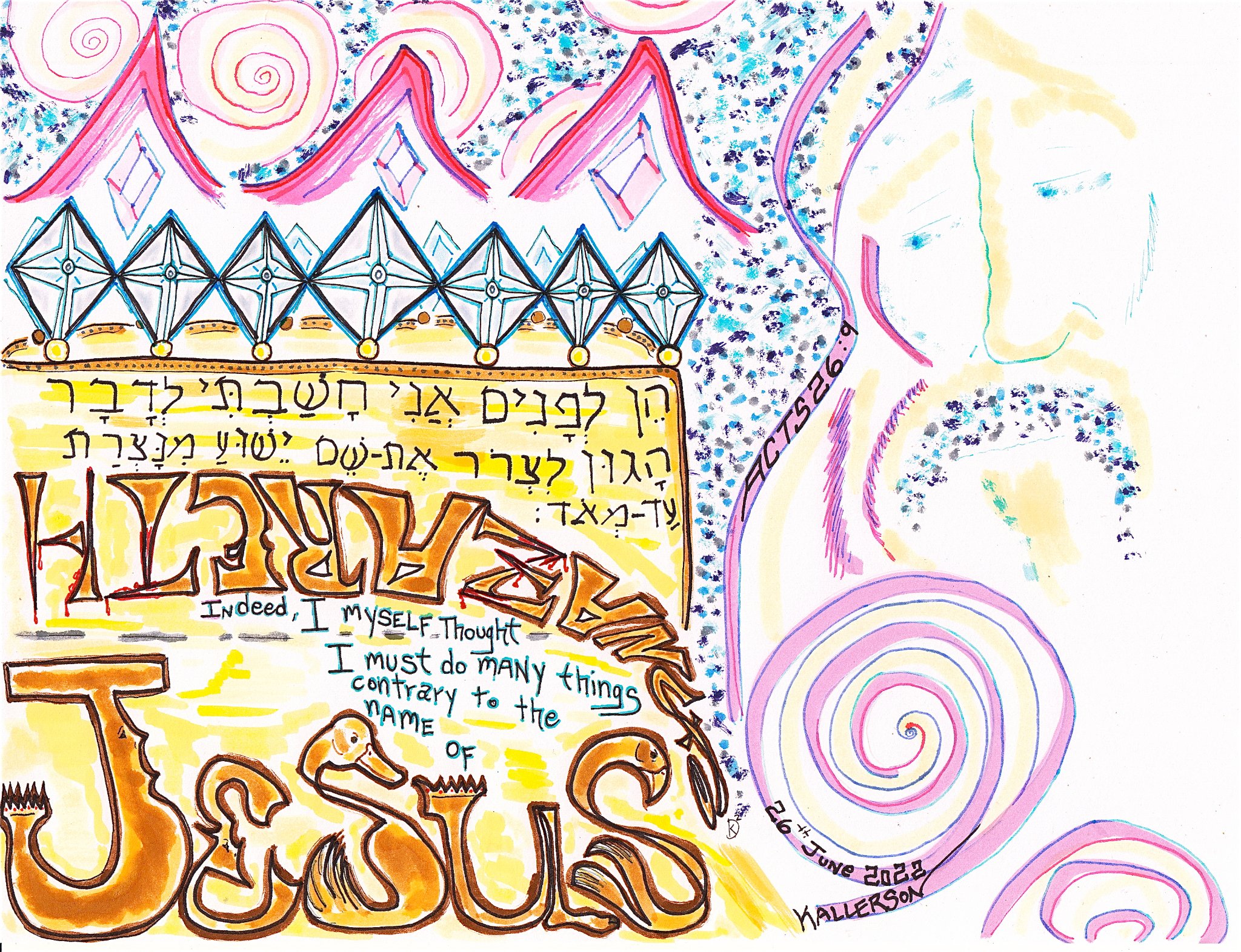
Artwork by Doug Kallerson
Acts 26:9
This Jesus of Nazareth
A question to start us out today: “Where was Jesus born?”
Most of us would say, “Bethlehem.” But for the enlightened “scholars” of the Jesus Seminar, you would be wrong. Though they are pretty much a has-been group at this point, they were very effective in destroying the faith of countless people through their rather unscholarly analyses of Scripture.
On their website, they used to have a “Bible Literacy Test.” It was a multiple-choice quiz that asked questions any two-year-old could answer, and then they would show you how stupid you were by giving you a completely different answer than anyone but a Klingon might give. For example, if you answered “Bethlehem” to the question, “Where what Jesus born?”, you would be apprised of your stupidity by being informed that He was born in Nazareth.
The biblical account recorded in Matthew and Luke is wrong according to them! But that is not surprising. The Jesus Seminar claimed that eighty percent of what is recorded in Scripture is wrong. They, the supposed final arbiters of God’s word, decided what verses – and even individual words – were later insertions and which were original.
They did this through the concept of dissimilarity. In other words, a saying was only considered to be authentic if it did NOT match either the beliefs of Judaism or those that were held by the early Christian church.
Considering that Jesus was a Jew and that the early church was under the guidance of the apostles who were designated as such by Jesus, their approach makes as much sense as starting a Heavenly Ham franchise in Mecca.
Text Verse: “All flesh is grass,
And all its loveliness is like the flower of the field.
7 The grass withers, the flower fades,
Because the breath of the Lord blows upon it;
Surely the people are grass.
8 The grass withers, the flower fades,
But the word of our God stands forever.” Isaiah 40:6-8
This will be our final sermon on this short series from Acts 26. Paul is making his case for why Jesus is the Christ. King Agrippa has been paying rapt attention. Hopefully, he will see the light and make the good choice. Paul has used logic, personal experience, Scripture, developed theology, and more to convince the king about his faith in Christ.
With these various approaches, he has carefully explained the simple gospel as well. All of the head knowledge in the world concerning Jesus is pointless without an acceptance of the simple gospel.
Tragically flawed thinking concerning the work of God in Christ, such as that put forth by the Jesus Seminar, permeates the world. Such flawed thinking includes the simple gospel. Imagine it! If we can’t get that most basic premise of Scripture right, how can we then be expected to understand the weightier matters of theology?
The Jesus Seminar was founded in 1985 by Robert Funk. It pretty much ended at the time of his death in 2005 (I sure wouldn’t want to be him at this point). During its time, it got lots of sensational headlines, and scholars who were a part of it were highlighted on well-known TV shows. They had their ten minutes of fame, and now they will stand before God and be judged for their treatment of His sacred word.
Imagine it! Approximately fifty critical scholars and about one hundred laymen working together to diminish the most important document ever held in human hands. Their work will collectively be relegated to the trash heap of human history and the word of God will be vindicated.
Where was Jesus born? We know that it was in Bethlehem, but he was called a Nazarene. A beautiful story is laid out for us in God’s superior word. And so, let us turn to that precious word once again and… May God speak to us through His word today and may His glorious name ever be praised.
I. If We Walk in the Light
—————
Paul, the afternoon is quickly passing by. I have heard your words and am astonished at your insights concerning your understanding of Scripture, of the things of God, and especially of the workings of Jesus.
Earlier in the day, when you first stood before me and gave your initial defense, you said that you “must do many things contrary to the name of Jesus of Nazareth.” Almost every time that I have heard Jesus mentioned in various conversations, this is normally how He is referred to.
But tell me, Paul, you know the Scriptures. It has been known for hundreds of years that the Messiah would be born in Bethlehem. How is it then that He is called a Nazarene?
—————
King Agrippa, though you were born into a royal household, were you always known as King Agrippa, or is that a title conferred on you at some later point in your life?
—————
You know the answer to that Paul. I assumed the title upon the death of my father.
—————
And so it is with Jesus, O King. He was born in Bethlehem as is chronicled in the records maintained at the temple. However, due to difficult circumstances that arose under the rule of your own great grandfather, his parents took him to Egypt for a short time, and then they eventually moved to Nazareth where he was raised.
This has all been carefully documented by my fellow apostle, Matthew (Matthew 2). In his writings, of which I have a copy in my coat’s side pocket, O King, he says of the move to Nazareth by Jesus’ parents, “And he came and dwelt in a city called Nazareth, that it might be fulfilled which was spoken by the prophets, ‘He shall be called a Nazarene’” (Matthew 2:23).
It is from Jesus’ upbringing in Nazareth that He came to be known as a Nazarene.
—————
Yes, that makes complete sense Paul. But what I don’t understand now is the reference to the prophets. Where does it say, “He shall be called a Nazarene?” I have never heard or read that before.
—————
That, O King, takes us back to the words of Isaiah, of which I know you are aware –
“Nevertheless the gloom will not be upon her who is distressed,
As when at first He lightly esteemed
The land of Zebulun and the land of Naphtali,
And afterward more heavily oppressed her,
By the way of the sea, beyond the Jordan,
In Galilee of the Gentiles.
2 The people who walked in darkness
Have seen a great light;
Those who dwelt in the land of the shadow of death,
Upon them a light has shined.” Isaiah 14:1, 2
You see, King Agrippa, Matthew wasn’t quoting Scripture. He was explaining it. As you know, Nazareth is located within Naphtali. Matthew was making a point about Jesus and His ministry by saying that He is the Light referred to by Isaiah. By being called a Nazarene, it is a fulfillment of this prophecy.
Like you being called “king” only when you ascended to the throne of your kingdom, Jesus was called a Nazarene because he was raised in Nazareth. His birth in Bethlehem fulfilled one portion of Scripture and His growing up in Nazareth fulfills another. The great Light referred to by Isaiah is Jesus, the Nazarene.
—————
Paul, explain to me what it means by “great Light.”
—————
King Agrippa, that speaks of His nature. My friend and fellow apostle, John, has spoken of this. I do hope he will take the time to write down what he has said. One time, while talking with him, he brought several natures of Jesus into one thought. He said words that are incredible to consider, and yet they accurately explain so much –
“In the beginning was the Word, and the Word was with God, and the Word was God. 2 He was in the beginning with God. 3 All things were made through Him, and without Him nothing was made that was made. 4 In Him was life, and the life was the light of men. 5 And the light shines in the darkness, and the darkness did not comprehend it” (John 1:1-4).
Jesus is the Word. He is the Life. He is the Light. These are all abstract terms used to describe who Jesus is. He is called the Light because He expresses the very nature of who God is. John has also said that “God is light and in Him is no darkness at all” (1 John 1:5). That is our way of speaking of His nature.
King Agrippa, light is a real thing. It is something that comes from somewhere and transmits out from that source. However, in the case of God, the two are united as one. Unlike an oil lamp (which merely sends forth light), and unlike the sun (which only sends forth light), John says, “God is light.” It is His absolute nature.
But there is more to the thought than just that of our perception of light being conveyed. In the early Genesis account (Genesis 1:4), light is associated with goodness. Therefore, this is telling us that God is perfectly good in His being. In Him, there is no evil at all – no malice, no wickedness, and so on. He is perfectly, wholly, and absolutely defined by light. That is fully substantiated by the other words of John when he said, “and in Him is no darkness at all.”
The psalmist declared this under inspiration of the Holy Spirit –
“Bless the Lord, O my soul!
O Lord my God, You are very great:
You are clothed with honor and majesty,
2 Who cover Yourself with light as with a garment,
Who stretch out the heavens like a curtain.” (Psalm 104:1, 2)
This notion of the dazzling brightness of God, O King, is found elsewhere in Scripture as well. The absolute moral purity of God is spoken of in such words. King Agrippa, unlike the deities of other nations and peoples who are angry, vindictive, dark, or unholy, the Lord God is Light. He is morally perfect.
Along with such things come the ideas of intellectual perfection, absolute truth, and more. Everything that is good in the absolute sense is found in God. This is what my friend John proclaims, and it is that which is then a source of fellowship for those who come to Christ. In that fellowship is found joy in its fullness.
King Agrippa, the light is proclaimed about the nature of the Person of Jesus Christ. He Himself declared this when He was among His apostles. He explicitly stated it to the leaders of Israel, saying, “I am the light of the world” (John 8:12).
He also said to His apostles, as John himself has relayed to me, “I have come as a light into the world, that whoever believes in Me should not abide in darkness” (John 12:46).
King Agrippa, Jesus said this on the night before He was crucified. And what He said to them, I will also convey to you, imploring you to believe. He told them –
“A little while longer the light is with you. Walk while you have the light, lest darkness overtake you; he who walks in darkness does not know where he is going. 36 While you have the light, believe in the light, that you may become sons of light” (John 12:35, 36).
This is the message, O King, and this is the declaration. Only in Christ can fellowship with the Father be obtained, because only in Him is the perfect moral purity to allow such fellowship to take place. I tell you, King Agrippa, that in coming to Christ, His moral purity is imputed to the believer.
This doesn’t mean that we are now without sin, but that God has covered those who come to Him through Jesus. Our moral purity is not of ourselves, but of Christ. With the imputation of that moral purity comes full, final, and forever fellowship with God.
O King, all of this is tied up in the thought of Jesus the Nazarene. Isaiah saw Christ’s glory and spoke of Him (John 12:41). The Scriptures are written, they are the word of God, and they spoke of and are confirmed in Him.
—————
Paul, you truly believe every word of Scripture, don’t you? And more, you surely believe that it all is pointing to Jesus. But what about those people, even those of Israel, who say that they are fellowshipping with God even though they don’t believe in Jesus. What about them, Paul?
—————
O King, I can only proclaim what I know to be the truth. John’s words concerning Jesus (Oh! How he needs to write them down!) also say, “If we say that we have fellowship with Him, and walk in darkness, we lie and do not practice the truth” (1 John 1:6).
King Agrippa, when John says, “If we say,” it is his way of introducing a thought concerning any person or group of people. The thought would even include himself if the statement he is about to make was true concerning himself. It is universal in its scope.
—————
Paul, I noticed that you cited John’s words in the subjunctive mood. Why did he say it this way?
—————
King Agrippa, your grasping the nuances of the Greek language is most impressive! John is saying that this is a supposed thing, not something that actually is the case. “If this is so, then this is the result.” Therefore, he is speaking of anyone who claims to have fellowship with God.
But John and I assert, as you already have seen from our words, that Jesus is God. The Father is God, and the Son is God. Fellowship with the Father means fellowship with the Son. Without the fellowship of the Son, there can be no fellowship with the Father. As this is so, when John speaks of a person walking in the darkness as a habitual aspect of his life, it means that he is walking without Jesus in his life.
This hypothetical person says that there is fellowship between himself and God, but his walk is actually a walk in darkness. O King, I already told you the words of John when he said, “that God is light, and in Him is no darkness at all.”
But Jesus is the Light referred to in Scripture. As He Himself said this, there is now an obvious disconnect between that statement and the claim which is made by the person who has not come to God through Jesus.
How can light and darkness be in fellowship? The two are in complete opposition to one another. He claims fellowship with God, who is light, and yet he walks in darkness because he is without Christ, who is the Light. Such cannot be the case. Of any such person in this state, John says that “we lie and do not practice the truth.”
I have already told you, King Agrippa, that “God is light.” It is a statement of fact. But I have also told you that this signifies moral purity, truth, righteousness, and so on. The light is anything that reflects the absolutely holy nature of God.
The “darkness” is that which is impure, unholy, defiled, etc. It is a corrupt moral state. The two are in opposition. Therefore, a person who claims fellowship with God, but who rejects Jesus lies and he does not practice the truth.
But, O King, this does not, and it cannot, mean that a person who does something wrong or who sins is specifically referred to here. Everyone has sinned, O King. But those who have come to Christ have been forgiven of their sin, and because they have been redeemed from the law, they are also no longer imputed sin (2 Corinthians 5:19). This is the marvel of what Jesus has done. He has freed us from sin, and there is, therefore, now no condemnation to those who are in Christ Jesus (Romans 8:1).
Before I tell you more of what John said about Jesus, light, and darkness, I would beg a moment to divert and give a lesson about what I just discussed.
King Agrippa, the first time that darkness is mentioned in our Scriptures is right at the beginning. In the book of Genesis, it noted that darkness was over the face of the deep (Genesis 1:2).
At that point, there was only formless void and chaos. But God brought order out of it and established His creation – including the creation of man. But, as we talked about this morning, man rebelled against God and died spiritually at that moment. Since then, man has been born physically alive but also spiritually dead. We pursue the things of the world, but not the things of God.
Our great need is to be born again, this time from above. Light and darkness are what the Apostle Matthew wrote about when citing the words of Jesus –
“The lamp of the body is the eye. If therefore your eye is good, your whole body will be full of light. 23 But if your eye is bad, your whole body will be full of darkness. If therefore the light that is in you is darkness, how great is that darkness!” (Matthew 6:22, 23).
In Matthew’s writing, just prior to Jesus saying this, and then just afterward, He spoke of worldly treasure and money. These and other things keep our eyes fixed on the things of the world and its system instead of on the things of God. Man is spiritually dead and at enmity with God. It is only the things of the world that direct him, even if he claims a religious piety of some sort.
I dare say, O King, that this is the case with many who profess faith in Christ as well, but John noted that if we walk in darkness we are lying, regardless of whether we say we have the light or not. All people need to evaluate their conduct and determine if they are truly in Christ or if they are only paying lip service to Him in hopes of worldly gain.
It is for this reason, O King, that I have said in my own letter to the church at Corinth for people to examine themselves as to whether they are in the faith. They must test themselves as to whether Christ is in them, or they are indeed disqualified (1 Corinthians 13:5).
King Agrippa, John spoke of walking in darkness, even when we might claim to have fellowship with God. In such a state, we are lying and not practicing the truth.
But, O King, John imparted more words. They are marvelous words that I really hope he will write down someday! He said, “But if we walk in the light as He is in the light, we have fellowship with one another, and the blood of Jesus Christ His Son cleanses us from all sin” (1 John 1:7).
—————
Paul, I am seeing so many things in Scripture, and so many things that are spoken of by you and the other apostles, that are interconnected. And they all keep pointing to Jesus. Tell me more.
—————
King Agrippa, John – as with all of the Apostles – declares the message of Christ. It is through accepting this message that fellowship with God is obtained. John said that “in Him there is no darkness at all.”
O King, in God, the light is pure and completely undefiled because He is pure and undefiled. This light is being equated to absolute moral purity by John. And so, when we consider what John has said we can see that for each person, the absolute moral perfection of God is the standard we must meet.
That is what John is saying in the words, “But if we walk in the light as He is in the light.” And yet, because we are stained with sin, we are incapable of personally attaining such a state. Reason alone, O King, tells us that in and of ourselves fellowship with God is impossible.
But John says we can have fellowship with Him. What is it that makes walking in the light of God possible? The prophet Amos asked a similar question centuries ago –
“Can two walk together, unless they are agreed?” (Amos 3:3).
King Agrippa, the question from Amos demands a negative reply, “No, they cannot.” There must be an agreement for such a walk. Without such an agreement, there is only walking in darkness. Solomon spoke of this as well –
“But the path of the just is like the shining sun,
That shines ever brighter unto the perfect day.
19 The way of the wicked is like darkness;
They do not know what makes them stumble” (Proverbs 4:17, 18).
Solomon speaks of the one who is just and the one who is wicked, but all have sinned just as King Solomon said at the dedication of the temple (1 Kings 8:46). How can we be just if we have sinned? How can we walk in the light, even as He is in the light?
Do you see the dilemma we face, O King? That dilemma is reconciled through coming to Christ Jesus. The great light that Isaiah spoke of is this Jesus of Nazareth whom I fought against. I was in darkness, O King, and yet I claimed I was in fellowship with God.
But when I realized that the very light of God is found in Jesus, I realized the terrible state of darkness in which I walked and in which I fellowshipped. Now, O King, I am in the fellowship of the believers that John speaks of. We walk together with all others who are on this same walk.
There is no exclusion in the body based upon some human trait, institution, culture, or class. There is, instead, a uniting with God, and with one another, in a harmonious walk because of Jesus.
The question is, “If man is imperfect and God is perfect, then how can such a walk of agreement come about?” The answer, King Agrippa, is found in what John said, “and the blood of Jesus Christ His Son cleanses us from all sin.”
Sin! Sin is the problem, King Agrippa. The shed blood of Jesus is what deals with that sin. This takes us back to our own rituals at the temple. The Day of Atonement was given to provide a covering for our sin so that God could dwell among us.
But that was only in anticipation of the coming of Christ. The sacrifices were made year after tiring year. It told us that the consciousness of sin remained (Hebrews 10:2). If those sacrifices could truly remove the sin, they would have been conducted once and then ended. But they come around each year, don’t they!
However, there is better news in Christ. From a letter to the Hebrew people that I have in my back pocket, I’d like to read you what it says –
“For if the blood of bulls and goats and the ashes of a heifer, sprinkling the unclean, sanctifies for the purifying of the flesh, 14 how much more shall the blood of Christ, who through the eternal Spirit offered Himself without spot to God, cleanse your conscience from dead works to serve the living God?” Hebrews 9:13, 14
King Agrippa, it is through Christ that such a walk is made possible. His sacrificial death continually cleanses the one who has put faith in Him. Christ makes this possible, He has cleansed us, and He continues to do so.
Again, O King, and as I have partially explained already, there is a difference between being forgiven (something I am yet to convey to you from the words of John) and being cleansed.
In forgiving there is a judicial act of forgiveness. It is that which brings us to union with God in Christ. In cleansing, there is an ongoing process of having our sins purged as we continue in Christ. This is what I said to you already. A person in Christ is no longer imputed sin. The sin is cleansed, and the guilt of the act is taken away.
When John refers to “the blood,” he speaks of everything associated with the Person and work of Christ. Jesus came in a human body, and thus it speaks of his humanity. In his humanity, He suffered. Thus, “the blood” speaks of that. And Christ was crucified and died. Thus, “the blood” speaks of that.
The death of Christ is what is transferred to the believer who then dies to the law, by which is the knowledge of sin (Romans 3:20). The person moves to Christ, and he is now “in Christ.” In this state, he can – and forever after does – walk with God, in His light.
The great light of Isaiah is Jesus the Nazarene. Our Scriptures testify to this, King Agrippa. And I, as His apostle, along with the words of the other apostles, testify to it as well.
—————
I see time and again, Paul, how you bring in the very rites and rituals of the Law of Moses and ascribe them as types that merely point to Jesus. It is more than fascinating.
—————
King Agrippa, I tell you that everything in the law points us to Jesus. God has given us a written body of literature that speaks out what He would do in the giving of His Son. As you listen to the words of Scripture read out in the future, I pray you will take this to heart and consider what you are hearing!
It may be, O King, that you are struggling with the thought of Jesus being God, but I tell you that those who reject Jesus’ deity cannot be walking in the light of God.
If we acknowledge Jesus as Lord, and if we walk in His light, then we also have fellowship with those who are like-minded in accepting His incarnation. How important it is to understand who Jesus is! But when we call on Jesus as Lord, understanding what God is doing in and through Him, we are saved forever!
Jesus saves us and continues to save us – despite ourselves. He is a mighty Savior and fully able to keep us from even our own weaknesses and failings.
A cross is there on the hill of Calvary
It is a sign of God’s love to the people of the world
On that cross, Jesus died for you and for me
The greatest display of love ever, was on that day unfurled
Oh! That Christ would die for sinners like us!
How deep is the love of God for this to have come about?
Wondrous is the giving of His own Son, Jesus
So, take hold of the promise, stand fast, and do not doubt
Christ died and into the grave He went – had death won?
A lifeless body, seemingly the end of the story
But no! Death could not hold the sinless Son
He burst forth from the grave in radiant glory!
II. He is Faithful and Just to Forgive
King Agrippa, I am almost finished. But I would like to share a few more words of John before I am through. I have just told you about the purification from sin that comes through Christ. It is a purification that our own Scriptures anticipated in the Law of Moses.
But John said more to consider. He said that “If we say that we have no sin, we deceive ourselves, and the truth is not in us” (1 John 1:8). As John said, the blood of Jesus Christ cleanses us from all sin. But I told you, O King, that there is a difference between being forgiven and being cleansed.
Through belief in Christ, man is forgiven of his sin. And more, the person forgiven by Christ, and who is now “in Christ,” is no longer imputed sin. But, King Agrippa, there is still the fact that we have committed sin, and we continue to commit sin.
John’s words deal with both issues. First, he says, “If we say that we have no sin.” A person may claim he is without sin, and he, therefore, does not need a Savior. Such a person denies that he has offended God through his actions. And more, he demonstrates that he believes he is morally pure enough to stand before God and be accepted for the life he has lived. John is speaking of such a person.
But his words go further saying words that are inclusive of himself because he says, “we have.” It is true of all people. And more, his word is in the present tense. He refers to those who are engaged in their walk at the present time. What John says needs to be taken as an all-inclusive statement. We have sinned and we continue to sin. If we say that this is not true it is because, as he says, “we deceive ourselves.”
This means we lead ourselves astray. Whether ignorantly, or willfully, a person who says, “I do not have sin” is deluded. He has gone astray, walking onto the wrong path of self-deception. And more, the way John spoke he put the word “ourselves” in the emphatic position.
It shows that people like this are not innocent victims. They have taken a lead role in deceiving themselves. Such a person, O King, calls into question the truth of God. King Solomon, as I have already told you, acknowledged that all have sinned. It is recorded in the word of God, and thus it is so.
But, King Agrippa, just as there is a mediator from the line of Aaron for the covenant of Moses, Christ is the Mediator of the New Covenant (Hebrews 12:24). A person who has attained sinlessness, no longer needs a mediator. But we do sin, and we do need a Mediator. This is what John is saying.
For someone who says otherwise, John says that “the truth is not in us.” I have told you, O King, that in Christ, God is no longer imputing sins to us. The meaning is that we have sin, but God has been gracious to no longer count those sins against us.
To deny that we have sin, is to deny the goodness of God toward us in not imputing to us our sins. Such a claim would diminish the work of Christ and the grace of God in Christ.
King Agrippa, this would bring the issue of sin in man to possibly meaning that he only needs atonement for inherited sin, but not committed sin. But inherited sin leads naturally and surely to committed sin.
Any person who is old enough and competent enough to say, “I have no sin,” is also old enough and competent enough to know that this is not true. God is due the glory that He demonstrates towards us in His grace and mercy. To deny our sin is to deny God this rightful due.
John’s words concerning Jesus show us, without any doubt, that the attainment of a sinless state in this life is not possible. But it also then magnifies the glory of God in Christ, doesn’t it! Jesus saves His people and then He just keeps right on saving His people.
With this in mind, I would like to give you a hypothetical situation, O King, that could arise. Should you call on Jesus and be saved, you should be on the alert for those who claim they have attained sinless perfection in this life through their own efforts, apart from Christ’s continued grace.
The problem would then go in two directions. The first is that the person would no longer need Jesus as his Mediator. But if Christ is no longer his Mediator, then should he sin (and indeed he will), his sin would be imputed to him. This would mean that he would no longer be saved.
But grace cannot be earned. There is no such thing as earning grace! And that is the second problem with someone thinking this. If we need grace to be saved, and if a person can lose his salvation in Christ, then he was never saved by grace. He had to earn it and continue earning it. Therefore, it would mean that what God in Christ has done was insufficient.
No, O King! I tell you clearly on this point, as do the words of John, we cannot attain a sinless state in this life, nor can a saved believer in Christ lose his salvation. Should you, King Agrippa, put your faith in Christ Jesus, hold fast to the grace imparted to you.
—————
But Paul, what does all this point to? What is it that your hope is anticipating?
—————
I tell you, O King, that the restoration of all things is coming. For those who are in Christ, there will be a complete renewal. This is our hope.
Someday, those in Christ will be free from their bodies of sin because of Christ. But for now, we are already free from the debt of our sin. We now, right at this moment, have the hope of eternal life because of Christ Jesus. This is because of the next thing John said when we spoke, and to which I affirm, “If we confess our sins, He is faithful and just to forgive us our sins and to cleanse us from all unrighteousness” (1 John 1:9).
You just heard the words of John that said, “If we say that we have no sin, we deceive ourselves.” There the word sin was in the singular. It is speaking of the state of man in a general sense. In the words I just conveyed to you John says, “If we confess our sins.”
His words are strategically placed between two antithetical proclamations. I will quote you everything he said to me and then continue to give you the explanation of his words –
“If we say that we have no sin, we deceive ourselves, and the truth is not in us. 9 If we confess our sins, He is faithful and just to forgive us our sins and to cleanse us from all unrighteousness. 10 If we say that we have not sinned, we make Him a liar, and His word is not in us” (1 John 1:8-10).
O King, when a person comes to Christ, he is acknowledging he is a sinner. This is exactly why we call on Christ. Therefore, a person who does so is admitting he has sin. It is a part of the simple gospel that I wrote out to the church in Corinth, “Christ died for our sins according to the Scriptures” (1 Corinthians 15:3).
In believing the gospel, a person is confessing his sins. In doing so, as John says, “He is faithful and just to forgive us our sins.”
The state of man is that of being born in original sin. As soon as he is old enough to think, he begins to sin in his mind (lust, coveting, etc.) and then in his actions (lying, stealing, etc.). This state of sin, this human condition, could metaphorically be said to form a wall of separation between us and God.
But in believing the gospel, meaning that Christ died for our sins, we are acknowledging this state and believing that God sent the remedy for it. In our belief and acceptance of this message, God faithfully and righteously grants us forgiveness of our sins – all of them.
From there, John says that He not only does this, but He also cleanses “us from all unrighteousness.” This is the state, O King, into which the believer is brought. God judicially declares man to be free of the guilt of sin, but he also cleanses us from the stain of that sin. And this continues forever due to the non-imputation of further sin that I have already told you about.
In Christ, the believer is forgiven and cleansed. And yet, we still err while in these bodies. As such we need ongoing cleansing from our sin for right fellowship with God. We have sinned, we continue to sin, but Christ has forgiven us, and Christ continues to cleanse us. This is the marvel of what God has done for us in Jesus Christ.
What John says cannot be construed to mean that a saved believer will remain unforgiven if he doesn’t acknowledge a sin after coming to Christ. That is not at all what he is saying. With that understood, King Agrippa, I would like to restate just a few more words that John spoke to me. He said, “If we say that we have not sinned, we make Him a liar, and His word is not in us” (1 John 1:10).
Notice what John has done, King Agrippa. Let me write it on a piece of papyrus so that you can see it. Notice, O, King, the contrasting middle thought to the first and third thought. The three together read –
- If we say that we have no sin, we deceive ourselves, and the truth is not in us. (1:8)
- If we confess our sins, He is faithful and just to forgive us our sins and to cleanse us from all unrighteousness. (1:9)
- If we say that we have not sinned, we make Him a liar, and His word is not in us. (1:10)
Now, I will take out the middle thought and put the first and third side by side. In this, the two can be more fully understood –
- If we say that we have no sin, we deceive ourselves, and the truth is not in us. (1:8)
- If we say that we have not sinned, we make Him a liar, and His word is not in us. (1:10)
The words, “we have no sin,” speak of the state of the individual. It is a denial of original sin, and it also denies committed sin. The words, “we have not sinned,” deny any wrong moral actions of the individual.
The words, “we deceive ourselves,” speak of the supposed morally exalted state of the individual (reaching upward). The words, “we make Him a liar,” speak of diminishing the truth of God (pulling downward).
The words, “the truth is not in us,” connect to the self-deception and speak of our own moral failing. The words, “His word is not in us,” are connected to the utterance of God which we have called into question and show that there is no connection in such a person to God. This is because His word is truth.
This, King Agrippa, ties into the purpose of Christ’s coming, which is to free man from the bonds of sin which hold him. That is why John strategically placed the middle thought between the other two. The problem rests in us while the cure rests with God.
O King, Scripture presents it as fact that we have sin, that we have sinned, and that when we deny this – or unless we confess our sinful state to correct it – we both deceive ourselves and we also call God a liar. All of this is seen in the sacrificial system set forth by Moses which anticipates the coming of Christ.
In such a state, we continue in our moral failings of denial, we reject the only path to restoration with God, which is revealed in His word. John has spoken of darkness and of light. He is basing his words on Jesus’ claim that He is the light of the world. And that light is what Isaiah spoke of when he saw the One we call Jesus of Nazareth.
Again, to understand John’s words, one must understand the gospel as Christ’s apostles, including myself, have proclaimed. Here, in my inner coat pocket, I have a copy of what I wrote to the church at Corinth. Let me read it to you –
“For I delivered to you first of all that which I also received: that Christ died for our sins according to the Scriptures, 4 and that He was buried, and that He rose again the third day according to the Scriptures” (1 Corinthians 15:3, 4).
O King, “Christ died for our sins.” If we say we have no sin, and that we have not sinned, then we both deceive ourselves and we call God a liar. But God cannot lie. Therefore, the truth is not in us, and His word is not in us – because God’s word, which comes from God who cannot lie – says that we have sinned. This is why Christ died. It was for our sins.
King Agrippa, the gospel cannot be realized in a person who has not confessed his sin. But by saying, “I believe Christ died for my sin,” it acknowledges that the person does have sin and that he has sinned.
King Agrippa, when John spoke to me his words (O! How I hope he writes them down) he was not just rambling and making arbitrary statements that have no logical cohesion. Rather, he was methodically making statements that must be taken in the full context of what he was expressing.
In understanding John’s words, there is the inescapable truth that we either will come to Jesus to be saved, or we will continue to deceive ourselves, continue to call into question God’s word, and remain in a state of condemnation. The choice is left up to us, but the remedy has already been provided by God.
King Agrippa, I see that your royal escort has arrived to take you to your evening of feasting and enjoying the many blessings that God has bestowed upon you. I shall not take up any more of your time. But I say again as I said to you when you first arrived and questioned me. To this day I stand, witnessing both to small and great, saying no other things than those which the prophets and Moses said would come—that the Christ would suffer, that He would be the first to rise from the dead, and would proclaim light to the Jewish people and to the Gentiles.
I would to God, King Agrippa, that not only you, but also all who hear me today, might become both almost and altogether such as I am, except for these chains. I petition you, O King, to be like those whom I met at Berea some years ago.
I had left Thessalonica and come to Berea with my traveling partner Silas. When we arrived, we went into the synagogue of the Jews. There we proclaimed the message of Christ. When we had done so, we noticed a difference between them and those at Thessalonica.
The Bereans were more noble than those at Thessalonica. They received the word with all readiness, O King, and then they searched the Scriptures daily to find out whether the things we said were so.
King Agrippa, I have appealed to Caesar to have chains of iron removed from my body. Today I pray you will appeal to Christ Jesus in order to have removed the chains that rest upon your soul.
When the fullness of time had come, God sent forth His Son, born of a woman, born under the law to redeem those who were under the law, that we might receive the adoption as sons (Galatians 4:4, 5). Call on Jesus of Nazareth, O King. He is the great light that has shone not only upon Galilee of the Gentiles, but upon the whole world.
—————
Paul, you have made your case well. I shall consider it and contemplate it. I would like to impose upon you with one request. You have spoken of your letters to the churches you ministered to. You have even pulled many portions of them out of your various pockets (boy do you have a lot of pockets!). My request is that you provide me a copy of your letters, if you have such, so that I may study your words further.
—————
King Agrippa, nothing would please me more than to know that you will study what I have put forth in writing concerning the majestic Christ whom I serve. And, O King, I just happen to have a full set of what I have thus far written right here in the cargo pocket on my right thigh.
Search the Scriptures, O King! Seek out Christ in them. Finally, O King, I would like you to consider the words I wrote in my second letter to those at Corinth. You said that you will consider my words and contemplate what I have said. King Agrippa, don’t delay –
“For He says:
‘In an acceptable time I have heard you,
And in the day of salvation I have helped you.
Behold, now is the accepted time; behold, now is the day of salvation” (2 Corinthians 6:2).
———————————
There is no historical record of King Agrippa having come to Christ for salvation. All we have is the record of Paul’s words to him as are found in Acts 26. It would be nice if such a conversation, as we have pretended to have for the past four weeks, took place. But this has simply been an exercise for our own edification in the word and in points of theology that can be obtained from it.
You, unlike King Agrippa, are still alive and breathing. For you, now is the acceptable time. I do pray you will not delay in seeking out God in Christ. Call on Jesus, be forgiven of your sins, and be reconciled to your heavenly Father today.
Closing Verse: “But even if our gospel is veiled, it is veiled to those who are perishing, 4 whose minds the god of this age has blinded, who do not believe, lest the light of the gospel of the glory of Christ, who is the image of God, should shine on them. 5 For we do not preach ourselves, but Christ Jesus the Lord, and ourselves your bondservants for Jesus’ sake. 6 For it is the God who commanded light to shine out of darkness, who has shone in our hearts to give the light of the knowledge of the glory of God in the face of Jesus Christ.” 2 Corinthians 4:3-6
Next Week: Joshua 1:1-9 A great word to Joshua to start him out and carry him through… (The Lord Your God Is with You) (1st Joshua Sermon)
The Lord has you exactly where He wants you. He has a good plan and purpose for you. But you must first believe by faith in what He has done. Once you do, then that plan can come about in you as it will in all of His redeemed. So, follow Him and trust Him and He will do marvelous things for you and through you.
What am I
that I can talk to the God
face to face?
What am I
but the dust of His
holy hands.
What am I
but the fruit of His grace,
when I didn’t deserve
He took my place.
And He died for me
that I would know
what Love really is
undeserved and whole.
When there was no way
He became the way for me,
He did everything there is
to save me from Hell’s pit.
So what Am I
that the Lord
would care for me,
that from the mere dust
I became a child of the King.
Izabela Bednara
Izabela sent this poem to me within minutes of finishing this sermon. I figure it was right to include it for you to hear.