Joshua 1:1-9
The Lord Your God Is with You
I cut my left ring finger with a chainsaw pretty badly a couple days before typing this sermon. On Sunday, I got through church but had no energy left to even complete the day’s tasks. I got done what was necessary, but nothing more. I then plopped into bed about 6pm.
If I had not set the clock, I wouldn’t have gotten up when I always do, at around 3:30. But the clock went off and up I got, thinking, “How can I ever type a sermon today?”
My finger was swollen, the antibiotics had me woozy, the tiredness of the weekend was not removed, and a new book was about to be opened. I talked to the Lord before and during the typing, and the sermon did get done. The constant repetition of the words of this passage were certainly an encouragement to help me through it.
“I will be with you,” “I will not leave you nor forsake you,” “be strong and of good courage,” “do not be afraid or dismayed,” “the Lord your God is with you.” They are words of comfort and strengthening. I sure am glad they were there to help me through.
Text Verse: “The Lord is my strength and song,
And He has become my salvation.” Psalm 118:14
For the people of the Lord, the Bible is one continuous stream of good and uplifting news, comfort, hope, and anticipation. For those not in the Lord, well, not so much. There are promises for them too, but they are not the kind of promises any sane person would want to receive.
Better to trust in the Lord, put your hope in Him, and await the good and sure blessings that lie ahead. His word will not fail, and it will come to pass, just as He says. As I noted, in today’s passage, Joshua is given instruction and encouragement. It was something he could remember and rely upon.
But we will see that pretty much everything said there anticipates a greater fulfillment in Christ Jesus. As this is so, and as He is the One who has accomplished everything necessary to deliver us from this present evil age and into an eternal inheritance, let us not despair.
We have entered the promise through faith. As this is so, then we will enter the promise – meaning the realization of it – without any chance of it not coming to pass. We are on the road to glory, so trust in what Jesus has done, trust in what God has said concerning it because of your faith in that, and don’t be afraid or discouraged.
Great, great things lie ahead for the redeemed of the Lord. Hold fast to this. For now, here we go – heading into Joshua. It is a marvelous part of God’s superior word. And so, let us turn to that precious word once again and… May God speak to us through His word today and may His glorious name ever be praised.
I. The Book of Joshua; an Introduction
The book of Joshua is the sixth book of the Holy Bible, and it is the first book of the section sometimes called The Writings. It is also referred to as a portion of the Historical Books, also known as the Former Prophets. Jesus uses this last division in Luke 24 –
“These are the words which I spoke to you while I was still with you, that all things must be fulfilled which were written in the Law of Moses and the Prophets and the Psalms concerning Me.” 45 And He opened their understanding, that they might comprehend the Scriptures.” Luke 24:44, 45
Joshua follows immediately after the section known as the Law, the Pentateuch, or the Torah. Its Hebrew name is Sefer Yehoshua, literally, “Book of Joshua.” It is named after the key figure in the book, Joshua the son of Nun who assumed leadership of Israel after the death of Moses.
As far as the dating of Joshua, there is dispute as to when it was written. However, the conservative and traditional dating can be figured based on when Solomon’s Temple was built. By tracing back from that day as stated in 1 Kings 6:1, which indicates 480 years from the Exodus, we can assert with relative confidence that the narrative begins in the year 1404 BC.
The Exodus occurred in the year 2514 Anno Mundi. It is now the beginning of the forty-first year since the Exodus, as can be deduced in several ways. One is based on the presence of the manna in relation to the crossing of the Jordan –
“And the children of Israel ate manna forty years, until they came to an inhabited land; they ate manna until they came to the border of the land of Canaan.” Exodus 16:35
Next, entrance into the land as indicated in Joshua 4:19 –
“Now the people came up from the Jordan on the tenth day of the first month, and they camped in Gilgal on the east border of Jericho.”
And finally, the ending of the manna –
“Now the children of Israel camped in Gilgal, and kept the Passover on the fourteenth day of the month at twilight on the plains of Jericho. 11 And they ate of the produce of the land on the day after the Passover, unleavened bread and parched grain, on the very same day. 12 Then the manna ceased on the day after they had eaten the produce of the land; and the children of Israel no longer had manna, but they ate the food of the land of Canaan that year.” Joshua 5:10-12
The timing of Joshua begins several days earlier than the crossing of the Jordan as is seen in Joshua 1:10-11 –
“Then Joshua commanded the officers of the people, saying, 11 ‘Pass through the camp and command the people, saying, “Prepare provisions for yourselves, for within three days you will cross over this Jordan, to go in to possess the land which the Lord your God is giving you to possess.”’”
A note of another three-day period is seen in Joshua 2:22 which will be analyzed when we get to that verse. Taking the dating from Joshua 1, the events of the book would begin right around (depending on when the Sabbath would have been observed) the first few days of the first month in the year 2555 Anno Mundi.
Obviously, critical scholars question the dating of the book, some claiming it was written even many hundreds of years later at the end of the period of the kings. However, Jewish tradition places the writing as coming from Joshua, with the exception of the final portion which details his funeral.
Though no author is given within the book, in the text itself Joshua personally commands things to be written down (18:8), or he is said to have written them down (24:26). Also, some manuscripts of Joshua 5:1 say “we.” If original, this would probably indicate personal authorship.
Other indications of an early compilation come through the author’s use of certain terms, such as “the Jebusite city” for Jerusalem. These and other early designations, and inclusions and exclusions of various names and titles, lend credence to an earlier dating.
On the other hand, references to the Book of Jasher in verse 10:13, as well as the frequently used term “until this day,” give the sense that the book may have been compiled at some point after Joshua’s death, maybe by Samuel or some other early chronicler.
As far as a historical context, the book is given to reveal the entry of Israel into the land promised to Abraham, Isaac, and Jacob. After that, the conquest of the land is recorded, the land is divided according to tribal inheritance, assignment of cities of refuge, and so on. The book ends with a note concerning the unity of the tribes, a final exhortation by Joshua to the people, a renewal of the covenant, and the death and burial of Joshua.
Concerning a redemptive context, Joshua demonstrates the faithfulness of the Lord in meeting His promises to His people. A key thought in that is found in these words –
“So the Lord gave to Israel all the land of which He had sworn to give to their fathers, and they took possession of it and dwelt in it. 44 The Lord gave them rest all around, according to all that He had sworn to their fathers. And not a man of all their enemies stood against them; the Lord delivered all their enemies into their hand. 45 Not a word failed of any good thing which the Lord had spoken to the house of Israel. All came to pass.” Joshua 21:43-45
Those things that did not go well for the people were due to their own failings, not those of the Lord. The Lord had warned them as such –
“But if you do not drive out the inhabitants of the land from before you, then it shall be that those whom you let remain shall be irritants in your eyes and thorns in your sides, and they shall harass you in the land where you dwell. 56 Moreover it shall be that I will do to you as I thought to do to them.” Numbers 33:55, 56
This sentiment is restated by Joshua –
“Therefore take careful heed to yourselves, that you love the Lord your God. 12 Or else, if indeed you do go back, and cling to the remnant of these nations—these that remain among you—and make marriages with them, and go in to them and they to you, 13 know for certain that the Lord your God will no longer drive out these nations from before you. But they shall be snares and traps to you, and scourges on your sides and thorns in your eyes, until you perish from this good land which the Lord your God has given you.” Joshua 23:11-13
The thought then is that the Lord is faithful. He will always uphold His word and follow through on the promises He has made. It is through our disobedience alone that we fail in obtaining that which God freely offers to His people.’’
Being the sixth book of the Bible, it is of value to consider the number as it is revealed in Scripture. Six is the number of man, especially fallen man. It is the final day of creation, after which man was to enter into His rest.
However, despite entering into the land of promise, and despite having been given rest “from all their enemies round about” (23:1), the author of Hebrews clearly indicates that Israel did not enter into its rest at this time –
“For if Joshua had given them rest, then He would not afterward have spoken of another day. 9 There remains therefore a rest for the people of God. 10 For he who has entered His rest has himself also ceased from his works as God did from His.” Hebrews 4:8-10
As such, Joshua is only typical of Christ, and the book is only a typological representation of entering into that which only comes through faith in Jesus Christ. Fallen man, apart from Christ, can never obtain the true rest that God offers.
There is much more that could be said about the book, and commentaries abound for you to consider. As for us, it is time to enter into this treasure of God’s word and begin our time of seeking out its secrets. May the Lord bless our time in the book of Joshua, and may you be blessed as we travel through it.
Be strong and of good courage, I am with you
Fear not and be not dismayed
Others may depart, but I am faithful and true
It is I who have all your debts paid
I will bring you into the inheritance
And there I will place you forever
Of Me failing, there is not even a chance
Nothing can the bond between us sever
Be strong and of good courage, trust in Me
Fear not and be not dismayed, I am with you
The word I have spoken, so shall it be
I am the Lord your God, faithful and true
II. Be Strong and of Good Courage (verses 1-9)
After the death of Moses the servant of the Lord, it came to pass
The book actually begins as several of the books of the Old Testament begin, with a conjunction connected to a verb: v’hi akhare moth Mosheh eved Yehovah – “And, it came to pass, after death Moses, servant Yehovah.”
In beginning with the word “and,” it signifies that what is presented is merely a continuation of the same story we have been reading. God is revealing to us wonders, unfolding them in a logical sequence which – at times – may or may not be chronological, but they fit in a fashion as orderly as if they were chronological.
In this case, it is a chronological event, following directly after the record of the death and burial of Moses as Deuteronomy ended. This same “and” begins the books of Exodus, Leviticus, Numbers, Judges, Ruth, 1 and 2 Samuel, 1 and 2 Kings, 2 Chronicles, Ezra, Esther, Ezekiel, and Jonah.
Beginning this way is certainly intended to show us the unraveling of a thought process that already began elsewhere. The note of Moses’ death was found towards the close of Deuteronomy –
“So Moses the servant of the Lord died there in the land of Moab, according to the word of the Lord. 6 And He buried him in a valley in the land of Moab, opposite Beth Peor; but no one knows his grave to this day. 7 Moses was one hundred and twenty years old when he died. His eyes were not dim nor his natural vigor diminished. 8 And the children of Israel wept for Moses in the plains of Moab thirty days. So the days of weeping and mourning for Moses ended.” Deuteronomy 34:5-8
Immediately after that, it then said –
“Now Joshua the son of Nun was full of the spirit of wisdom, for Moses had laid his hands on him; so the children of Israel heeded him, and did as the Lord had commanded Moses.” Deuteronomy 34:9
Following that was a note of commendation concerning Moses and then the book closed out. It is with this remembered, that the words, “And it came to pass,” find their meaning. It is now Joshua who assumes the main role in this ongoing narrative, and so it is…
1 (con’t) that the Lord spoke to Joshua the son of Nun,
Rather than “spoke,” it says, “said.” Though close in meaning, the idea here is that the Lord is conveying words to Joshua as if in a conversation: va’yomer Yehovah el Yehoshua bin nun – “And said Yehovah unto Joshua son of Nun.”
In the ongoing narrative, Joshua pictures Christ. In fact, in the Greek, the names of Joshua and Jesus are the same. In the Hebrew, his name means “The Lord is Salvation.” Jesus is the Lord, and He is salvation.
The name of Joshua’s father anticipates Christ also. Nun is from the verb nun, to propagate, or increase. This is what Christ would do, increasing the family of God through His completed work. The Lord says to Joshua…
1 (con’t) Moses’ assistant, saying:
Though nobody translates it as such, it is a verb: mesharet Moseh lemor – “Ministerer of Moses, saying.” Rather than a servant, he was a personal attendant for Moses. It is what Samuel is said to have done when he ministered before the Lord.
Moses means, “He who draws out.” He represents the law as he has drawn out the will of the Lord through the law. A picture is developed here as Joshua is this one ministering to the law and completing and fulfilling the will of the Lord.
That is pictured in the death of Moses and also in the continuance of Joshua. Though the law dies, the One who ministered to it continues while also increasing the family of God through His efforts. With this typology hinted at, it next says…
2 “Moses My servant is dead.
The Lord acknowledges that Moses was His servant. This same title, avdi, “My servant,” is used of the coming Messiah in Isaiah 52:13. Joshua will also be called the Lord’s servant in Joshua 24:29. The idea of being the Lord’s servant is the highest title by which a person can be referred to. With Moses dead, the Lord now instructs Joshua…
2 (con’t) Now therefore, arise, go over this Jordan,
v’attah qum avor eth ha’yarden ha’zeh – “And you, arise, cross over the Jordan, the this.” The word Jordan is prefixed by an article. It is ha’yarden, or “the Jordan,” meaning, “the Descender.” It is never known as “the river,” river“the brook,” or any other connecting word. Rather, it is simply “the Descender.”
Its waters originate in the area of Mount Hermon and flow south through the Sea of Galilee. It then continues south to the Salt Sea, meaning the Dead Sea. That is a distance of about sixty miles, but because of how it flows, zigzagging back and forth, its actual path is said to be about two hundred miles. It is this river that is to be crossed…
2 (con’t) you and all this people, to the land which I am giving to them—the children of Israel.
It is of note that the text itself mentioned Moses’ death, and then the Lord specifically mentions it again. The law dies before entrance by either Joshua or the people. But with Moses dead, Joshua and all the people may enter. It is the land of promise, and it is incorrect to say that it is not typical of heaven, at least indirectly.
The reason for this is that those who enter have done so by crossing through what the Descender typifies, meaning Christ. The Jordan began in the area of Hermon (meaning Sacred). That is typical of heaven where Jesus came from.
He is the Descender who came down from heaven, lived out His life, and died, just as the Jordan came down from Hermon and ended at the Salt Sea, the Dead Sea.
The flow of the Jordan through Israel actually pictures His life. The Jordan travels through the Sea of Galilee, picturing the many years of His life and ministry being focused in that area.
The long zigzagging pattern of the river is emblematic of His time zigzagging throughout the entire length and breadth of the land. The entrance into the Salt Sea – the Dead Sea – pictures His death without corruption and then His ascending, just at the Dead Sea ascends in evaporation, not in continuing to the sea.
In passing through Him, one enters life. It is a spiritual state that Canaan anticipates, but heaven – meaning restored paradise – is a result of that state.
The two are often disconnected, which is too bad. Though believers in Christ are not yet in heaven, the guarantee that they will be is already obtained. The result, meaning glorification and eternal life in the heavenly inheritance, is already assured.
The Lord is giving the land to Israel. Israel is merely typical of what the Lord gives us when we, by faith, pass through Christ’s death, burial and resurrection. There is a literal story, and there are typological anticipations given in that story. As for Joshua, now, the narrative continues…
3 Every place that the sole of your foot will tread upon I have given you,
It is the fulfilling of the promise made just a short time before in Deuteronomy 11:24, which says, “Every place on which the sole of your foot treads shall be yours.” The word “foot” is in the singular construct, but the words “your” and “you” are plural.
Israel is a single entity, even if made up of many people. One cannot help but see hints of what Jesus said in John 14 –
“In My Father’s house are many mansions; if it were not so, I would have told you. I go to prepare a place for you. 3 And if I go and prepare a place for you, I will come again and receive you to Myself; that where I am, there you may be also.” John 14:2, 3
There is one place (singular) made up of many mansions (plural) that is being prepared for “you” (plural). There is one body (Jew/Gentile Church) that is made up of many parts. The Lord is giving the land (singular) to Israel as a type of His giving the inheritance (singular) to those who are in Christ.
3 (con’t) as I said to Moses.
The Lord says, “as I said to Moses.” And yet, that is not recorded anywhere except Deuteronomy 11 where Moses spoke in the first person, or he referred to the Lord in the third person. As such, one can clearly see the doctrine of divine inspiration where the Lord is seen to have spoken through Moses as he spoke out the word of the Lord. As for Canaan, the Lord next says…
4 From the wilderness
This refers to the wilderness on the southern border of Canaan as recorded in Numbers 34:3 –
“Your southern border shall be from the Wilderness of Zin along the border of Edom; then your southern border shall extend eastward to the end of the Salt Sea;”
4 (con’t) and this Lebanon
The words are emphasized: v’ha’levanon ha’zeh – “and the Lebanon, the this.” It explains the northern border. It speaks of the Lebanon range that could actually be discerned from where Joshua was, even though it was a long way off.
4 (con’t) as far as the great river, the River Euphrates,
v’ad ha’nakhar ha’gadol nehar perat – “and unto the river, the great, River Euphrates.” This was to eventually be the eastern border of the land. This extended border was originally promised to Abraham in Genesis 15:18.
4 (con’t) all the land of the Hittites,
The name is first mentioned in Genesis 15. It means Terror. It isn’t sure why this group of the various nations living in Canaan is singled out here. Thus, there must be typology being conveyed.
It may be because they not only filled the land in general, but they extended to the east in the direction of the Euphrates. As such, it would signify that they represented the entire span of the land.
4 (con’t) and to the Great Sea toward the going down of the sun, shall be your territory.
The Great Sea, where the sun goes down, is the Mediterranean. This would be the western border. The word translated as “toward the going down” is mabo. It signifies an entrance, and it has only been seen in Deuteronomy 11:30. One can think of the sun entering into its daily obscurity.
It is the final note of the general borders of the land. The words “your territory” are given in the plural “the territory for all of you.” The words expand upon what is said in Deuteronomy 11:24 –
“from the wilderness and Lebanon, from the river, the River Euphrates, even to the Western Sea, shall be your territory.”
At this time, I will bring you into the land of speculation, and try to interpret what has been said as it anticipates Christ. The southern border is the wilderness. It is a place of testing and of closeness with God.
The northern border is “this Lebanon.” Lebanon comes from a word signifying to be white. That comes from a word signifying a brick because bricks whiten as they are fired. As such, it is a picture of works – the making of bricks in the Tower of Babel, for example.
The eastern border is the River Euphrates, meaning Fruitfulness, or That Which Makes Fruitful. The land is the land of the Hittites, or Terror. The western border is the Great Sea where the sun goes down. Understanding these things, we can look for typology.
The first thing noted after the death of Moses is that they are to cross over the Jordan. As such, the thing to remember is the symbolism of the Jordan. In fulfillment of the typology, Jesus Himself expressly tells us that He is what the Jordan pictures –
“For I have come down from heaven, not to do My own will, but the will of Him who sent Me.” John 6:38
Though modern New Testament Hebrew is different than biblical Hebrew, there are overlapping words. In the Sar Shalom Hebrew translation of Jesus’ words, the word v’yaradti, “and I have come down,” is used. The name Jordan is from the same word, yarad. Jesus is the Descender.
The land is emblematic of where He will accomplish His work. The southern border is emblematic of His time on earth, it was a time of testing and closeness with God while under the law – both reflected in the gospels.
The northern border with the emphatic “this Lebanon” is emblematic of His work in fulfillment of the law – this and none other. The eastern border is emblematic of the state of His work under the law, fulfilling it. It is “That Which Makes Fruitful.” The Hittites, Terror, are reflective of the state of those who dwelt in the land –
“Inasmuch then as the children have partaken of flesh and blood, He Himself likewise shared in the same, that through death He might destroy him who had the power of death, that is, the devil, 15 and release those who through fear of death were all their lifetime subject to bondage.” Hebrews 2:14, 15
There is the fear of death for all because of the law which is eliminated because of the work of Christ. The western border is reflective of the scope of Christ’s work under the law. The last use of mabo, or entrance of the sun, is seen in Malachi 1:11 –
“For from the rising of the sun, even to its going down,
My name shall be great among the Gentiles;
In every place incense shall be offered to My name,
And a pure offering;
For My name shall be great among the nations,”
Says the Lord of hosts.” Malachi 1:11
Hence, this may be figuratively showing that the law is merely a transitional part of the redemptive plan. The sun rises in the east, and it sets in the west with the greatness of the name of the Lord being proclaimed by the Gentiles throughout the entire extent of that happening.
This appears to be so based on the last use of shemesh, or “sun,” in the Old Testament, which is referring metaphorically to Christ the Lord –
“But to you who fear My name
The Sun of Righteousness shall arise.” Malachi 4:2
As the sun actually never sets, but simply disappears from view, the borders of Canaan, as being described to Joshua, appear to allude to the fact that Christ is the One to work out, fulfill, and embody the law, and that its scope is without ending or limit.
With that seeming reasonable explanation now understood, the citing of Deuteronomy 11 continues with the next words as well…
5 No man shall be able to stand before you all the days of your life;
lo yityasev ish l’phanekha kol yeme khayekha – “No shall stand man to your face all days your life.” Despite being similar to Deuteronomy 11, there are differences. There it says –
“No man shall be able to stand against you.” Deuteronomy 11:25
In Deuteronomy it says lo yityatsev ish biphnekhem – “no shall stand man in your face” (meaning, “in your presence”). Here in Joshua, it says, “to your face,” instead of “in your face.” In Deuteronomy, the words are to all the people in the plural. But here in Joshua, the Lord is speaking only to Joshua.
One can see that Joshua, as the leader of the people, is representative of all the people. The communication to Joshua alone continues in the next words…
5 (con’t) as I was with Moses, so I will be with you. I will not leave you nor forsake you.
The words were said by Moses to all of Israel collectively (singular), and then they were repeated by Moses to Joshua –
“‘Be strong and of good courage, do not fear nor be afraid of them; for the Lord your God, He is the One who goes with you. He will not leave you nor forsake you.’
7 Then Moses called Joshua and said to him in the sight of all Israel, ‘Be strong and of good courage, for you must go with this people to the land which the Lord has sworn to their fathers to give them, and you shall cause them to inherit it. 8 And the Lord, He is the One who goes before you. He will be with you, He will not leave you nor forsake you; do not fear nor be dismayed.’” Deuteronomy 31:6-8
Here, the words are spoken to Joshua alone. As the leader, he represents all who are with him. It is reflective of Jesus who was not forsaken by the Lord, even in His suffering and death, and who now represents His people in the same manner –
“Let your conduct be without covetousness; be content with such things as you have. For He Himself has said, ‘I will never leave you nor forsake you.’ 6 So we may boldly say:
‘The Lord is my helper;
I will not fear.
What can man do to me?’” Hebrews 13:5, 6
And, again, more words from the same passage in Deuteronomy 31 that were spoken by Moses to the people, and then to Joshua, are repeated by the Lord to Joshua…
6 Be strong and of good courage,
It is the same words spoken to both Israel in Deuteronomy 31:6 and to Joshua in 31:8 and 31:23 –
“Be strong and of good courage, do not fear nor be afraid of them; for the Lord your God, He is the One who goes with you.”
“Be strong and of good courage, for you must go with this people to the land which the Lord has sworn to their fathers to give them, and you shall cause them to inherit it.”
“Be strong and of good courage; for you shall bring the children of Israel into the land of which I swore to them, and I will be with you.”
When we were in that chapter, it was noted how this pointed to the work of Christ – the Lord, the Man, and the relationship between them. The wording of these verses made that evident. Now, it is the Lord speaking to Joshua, typical of the Lord God directing Jesus the Man…
6 (con’t) for to this people you shall divide as an inheritance the land which I swore to their fathers to give them.
The words here form a large section of the book of Joshua where he leads the division of the land among the tribes. That is subsequently divided among the people (as can be seen, for example, in Joshua 17:3).
But what happens here is only typical of the greater work of the Lord. It is a certain reference to the work of Jesus as is outlined in Colossians 3 –
“And whatever you do, do it heartily, as to the Lord and not to men, 24 knowing that from the Lord you will receive the reward of the inheritance; for you serve the Lord Christ.” Colossians 3:23, 24
Joshua is to “divide as an inheritance the land” to the people. Jesus divides to the people (the “you” is plural) the inheritance. As for Joshua, as the leader of the people, he must “do” just as it was Jesus who “did.” That is seen in the next words…
7 Only be strong and very courageous,
The words are repeated with a note of encouragement and a superlative: raq khazaq v’emats meod – “Only! Be strong and be strengthened very.”
In thinking of Jesus, we can see Him needing this encouragement as He faced down one enemy after another, and then coming to the final enemy that He knew was just ahead as He prayed, even to the sweating of blood, in the Garden of Gethsemane.
7 (con’t) that you may observe to do according to all the law which Moses My servant commanded you;
lishmor la’asoth – “to observe to do.” Joshua was given a charge to obediently observe the law in order to do the law which Moses commanded him. Jesus came to do likewise in order to fulfill this law. Not a word of the law was to be allowed to fail…
7 (con’t) do not turn from it to the right hand or to the left, that you may prosper wherever you go.
al tasur mimenu yamin u-semol l’maan taskil b’kol asher telek – “not do turn from right and left to end purpose you may prosper in all which you walk.” It is a note that in obedience (to observe to do), and without any deviation from the law set forth for him, he would prosper.
It is an exacting description of Jesus. Isaiah uses the same word, sakal, or prosper, to describe His work, culminating in the cross –
“See, my servant shall prosper, he shall be raised high and greatly exalted.” Isaiah 52:13 (NAB)
And, again, the same thought is presented to Joshua…
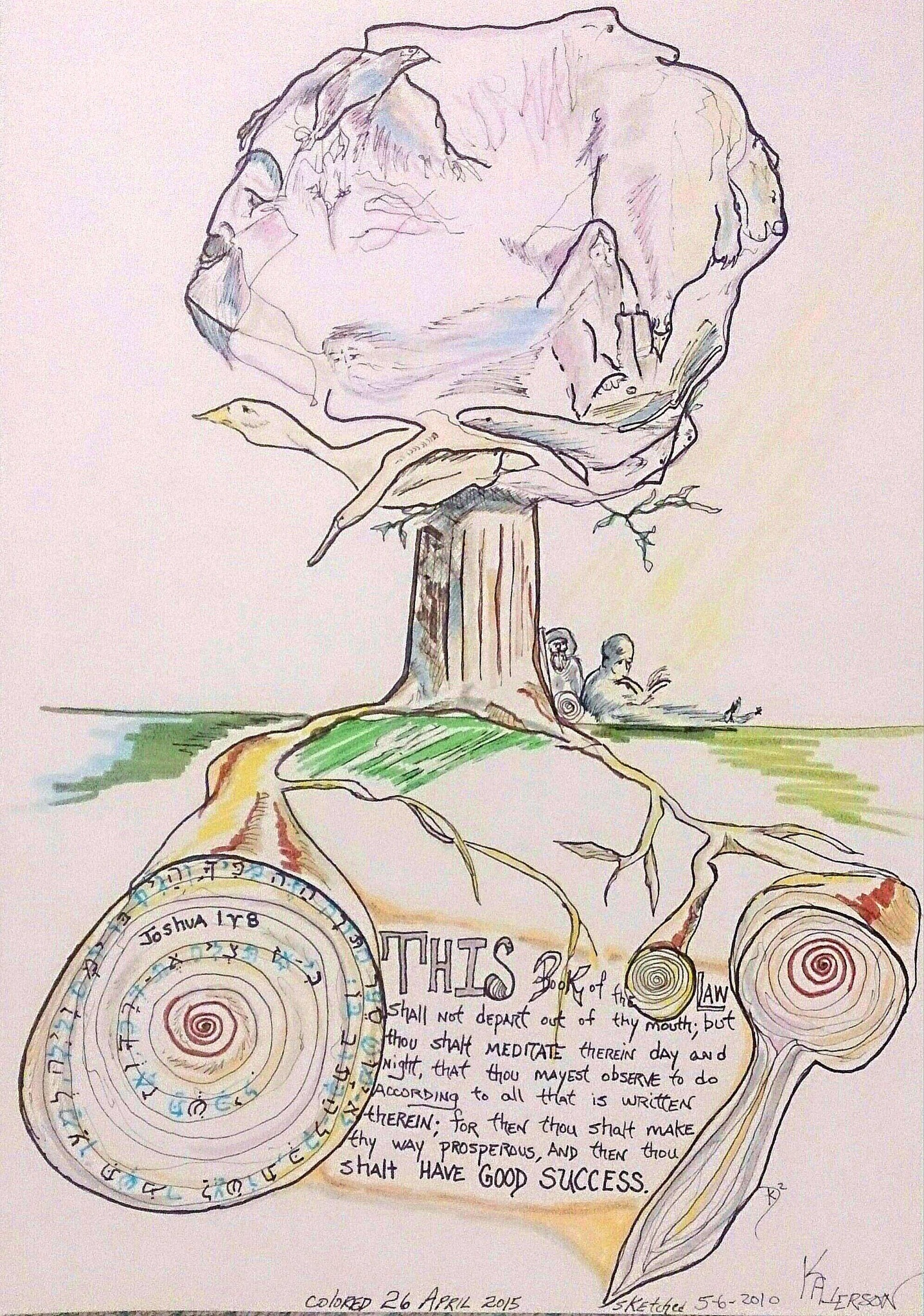
8 This Book of the Law shall not depart from your mouth, but you shall meditate in it day and night,
Here is the first new biblical word found in Joshua, hagah. It is translated as “meditate.” It means to murmur. By implication it means to ponder, imagine, meditate, speak, study, and so on. When one meditates, he often murmurs to himself. A more literal translation would be, “Not shall depart Book the Law, this, from your mouth, and you shall murmur in it, daily and night.”
This is speaking of the book that was mentioned several times in Deuteronomy. For example –
“So it was, when Moses had completed writing the words of this law in a book, when they were finished, 25 that Moses commanded the Levites, who bore the ark of the covenant of the Lord, saying: 26 ‘Take this Book of the Law, and put it beside the ark of the covenant of the Lord your God, that it may be there as a witness against you; 27 for I know your rebellion and your stiff neck. If today, while I am yet alive with you, you have been rebellious against the Lord, then how much more after my death?’” Deuteronomy 31:24-27
For all intents and purposes, the Book of the Law reflects the will of the Lord. It is Jesus who came to fulfill the will of the Lord. Joshua is being used as a type to point us to the Antitype –
“Therefore, when He came into the world, He said:
“Sacrifice and offering You did not desire,
But a body You have prepared for Me.
6 In burnt offerings and sacrifices for sin
You had no pleasure.
7 Then I said, ‘Behold, I have come—
In the volume of the book it is written of Me—
To do Your will, O God.’” Hebrews 10:5-7
The knowing of, and meditating on, the law allows for the will of the Lord to be done. That continues to be seen in the next words…
8 (con’t) that you may observe to do according to all that is written in it.
l’maan tishmor la’asoth – “to end purpose you shall observe to do.” It is in knowing and meditating on the word that the end purpose of observing and doing what is written in it is accomplished. Only Christ, the embodiment of the law, was able to fully meet this expectation. As such…
8 (con’t) For then you will make your way prosperous, and then you will have good success.
The words “good success” are translated from the same word just used in the previous verse – sakal, or prosper. And the word “prosperous,” is from the word tsalakh. It comes from a root signifying “to push forward.” Hence, it also carries the sense of prospering. And it too is used when referring to the work of Christ, in Isaiah 53 –
“Yet it pleased the Lord to bruise Him;
He has put Him to grief.
When You make His soul an offering for sin,
He shall see His seed, He shall prolong His days,
And the pleasure of the Lord shall prosper in His hand.” Isaiah 53:10
One cannot help but see the constant anticipations of Christ. Yes, the Lord is speaking to Joshua about his commitments, but it is Christ who more perfectly fulfills the types and pictures that are given
9 Have I not commanded you? Be strong and of good courage;
Notice the repetition –
My servant commanded you (7)
Have I not commanded you (9)
Be strong and of good courage (6)
Only be strong and very courageous (7)
Be strong and of good courage (9)
These repetitions form their own stress. And that leads to the final words of the day…
9 *(fin) do not be afraid, nor be dismayed, for the Lord your God is with you wherever you go.”
Joshua was to face challenges; the Lord Jesus was to face challenges. Each was given His charge, and each was to carry it out according to the will of God. But each is given a promise that the Lord is also there in the process.
For Jesus, it was the presence of the Spirit that was with Him wherever He went until the mission set before Him was complete –
“Behold! My Servant whom I have chosen,
My Beloved in whom My soul is well pleased!
I will put My Spirit upon Him,
And He will declare justice to the Gentiles.
He will not quarrel nor cry out,
Nor will anyone hear His voice in the streets.
20 A bruised reed He will not break,
And smoking flax He will not quench,
Till He sends forth justice to victory;
21 And in His name Gentiles will trust.” Matthew 12:18-21
Joshua was given his charge to subdue the land and prepare the inheritance. Jesus was given a similar charge. He was to defeat the enemy and provide the inheritance. The Lord was with Joshua as he carried out his work faithfully, completing his part of the task. Jesus did likewise as the Spirit of the Lord rested upon Him.
The failure of anyone not obtaining the inheritance is not because of Joshua (for Israel) or Jesus (for us), but of our failure to follow them. It is we who have to choose to follow the leader set before us. In our case, Jesus has done all that is necessary to accomplish this.
All we need to do is to simply believe that He has done it. The inheritance has been secured for us. Let us be wise and accept what Christ has done for us. Then, we too can be strong and of good courage. We too can be without fear or trepidation. In Christ, the Lord is with us wherever we go.
This is the hope set before us, and great hints of it are to be found in this marvelous book called Joshua. It will be interesting to see how it unfolds before us as the weeks progress. I do hope you will stick it out as the chapters pass by. Joshua! The marvelous “next book” in the unfolding story of redemption. Stay tuned for more!
Closing Verse: “And for this reason He is the Mediator of the new covenant, by means of death, for the redemption of the transgressions under the first covenant, that those who are called may receive the promise of the eternal inheritance.” Hebrews 9:15
Next Week: Joshua 1:10-18 We will carry it out, our word is true… (All That You Command Us We Will Do) (2nd Joshua Sermon)
The Lord has you exactly where He wants you. He has a good plan and purpose for you. It is He who has defeated the enemy and who now offers His people rest. So, follow Him and trust Him and He will do marvelous things for you and through you.
The Lord Your God Is with You
After the death of Moses the servant of the Lord
It came to pass that the Lord spoke, words He was relaying
To Joshua the son of Nun
Moses’ assistant, saying:
“Moses My servant is dead
Now therefore, arise, go over this Jordan, so to you I tell
You and all this people, to the land
Which I am giving to them —the children of Israel
Every place that upon the sole of your foot will tread
I have given you, as to Moses I said
From the wilderness and this Lebanon
As far as the great river, the River Euphrates, so shall it be
All the land of the Hittites, and to the Great Sea
Toward the going down of the sun, shall be your territory
No man shall be able to stand before you
All the days of your life; as I was with Moses, My word is true
So I will be with you
I will not leave you nor forsake you
Be strong and of good courage
For to this people, you shall divide
As an inheritance the land which I swore to their fathers
To give them on Jordan’s other side
Only be strong and very courageous, that you may observe to do
According to all the law which Moses My servant commanded you
Do not turn from it to the right hand or to the left
That you may prosper wherever you go, and in all you do
This Book of the Law shall not depart from your mouth
But you shall meditate in it day and night
That you may observe to do
According to all that is written in it here in My sight
For then you will make your way prosperous, so I address
And then you will have good success
Have I not commanded you?
Be strong and of good courage, it shall be so
Do not be afraid, nor be dismayed
For the Lord your God is with you wherever you go
Lord God, turn our hearts to be obedient to Your word
Give us wisdom to be ever faithful to You
May we carefully heed each thing we have heard
Yes, Lord God may our hearts be faithful and true
And we shall be content and satisfied in You alone
We will follow You as we sing our songs of praise
Hallelujah to You; to us Your path You have shown
Hallelujah we shall sing to You for all of our days
Hallelujah and Amen…
After the death of Moses the servant of the Lord, it came to pass that the Lord spoke to Joshua the son of Nun, Moses’ assistant, saying: 2 “Moses My servant is dead. Now therefore, arise, go over this Jordan, you and all this people, to the land which I am giving to them—the children of Israel. 3 Every place that the sole of your foot will tread upon I have given you, as I said to Moses. 4 From the wilderness and this Lebanon as far as the great river, the River Euphrates, all the land of the Hittites, and to the Great Sea toward the going down of the sun, shall be your territory. 5 No man shall be able to stand before you all the days of your life; as I was with Moses, so I will be with you. I will not leave you nor forsake you. 6 Be strong and of good courage, for to this people you shall divide as an inheritance the land which I swore to their fathers to give them. 7 Only be strong and very courageous, that you may observe to do according to all the law which Moses My servant commanded you; do not turn from it to the right hand or to the left, that you may prosper wherever you go. 8 This Book of the Law shall not depart from your mouth, but you shall meditate in it day and night, that you may observe to do according to all that is written in it. For then you will make your way prosperous, and then you will have good success. 9 Have I not commanded you? Be strong and of good courage; do not be afraid, nor be dismayed, for the Lord your God is with you wherever you go.”