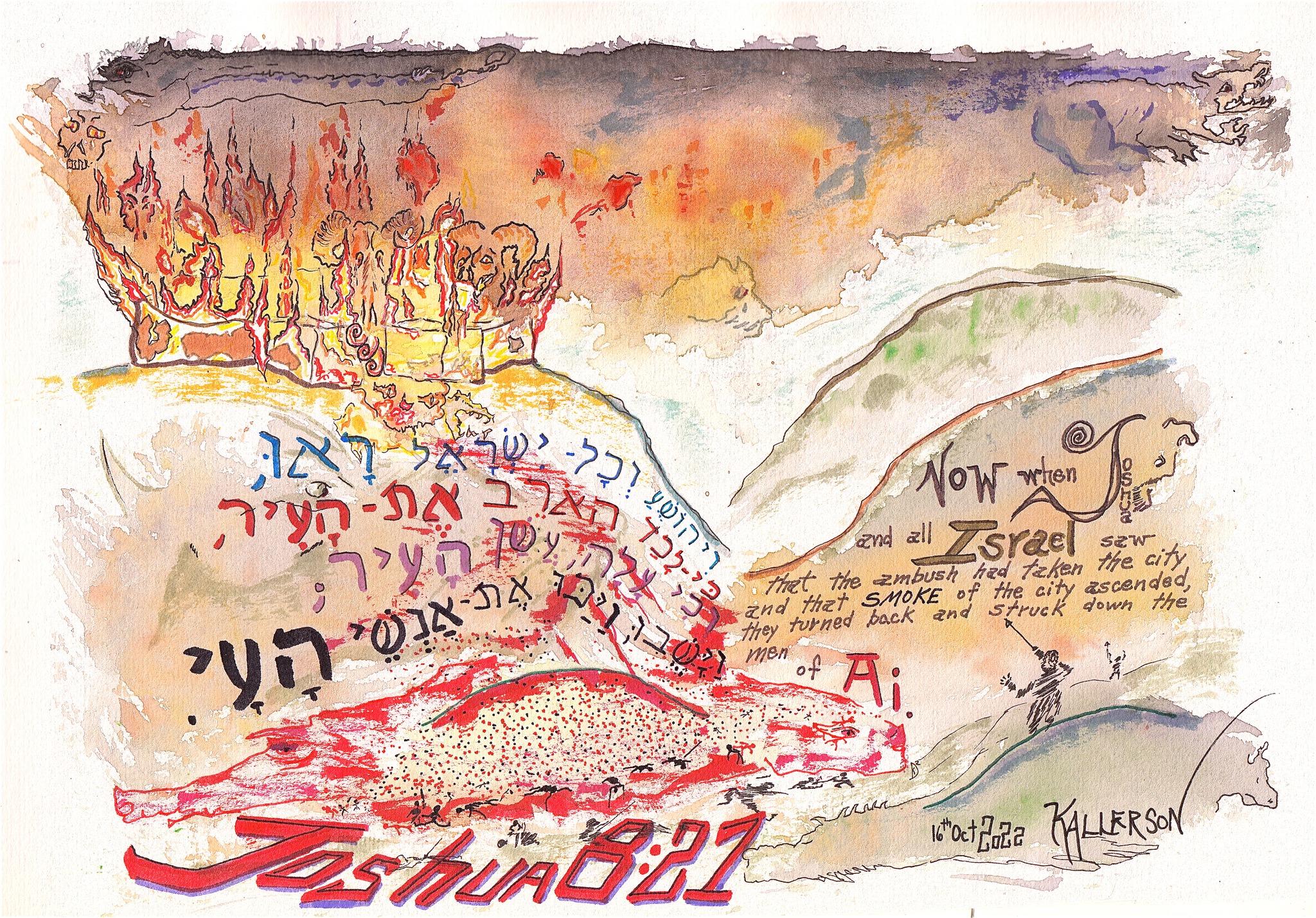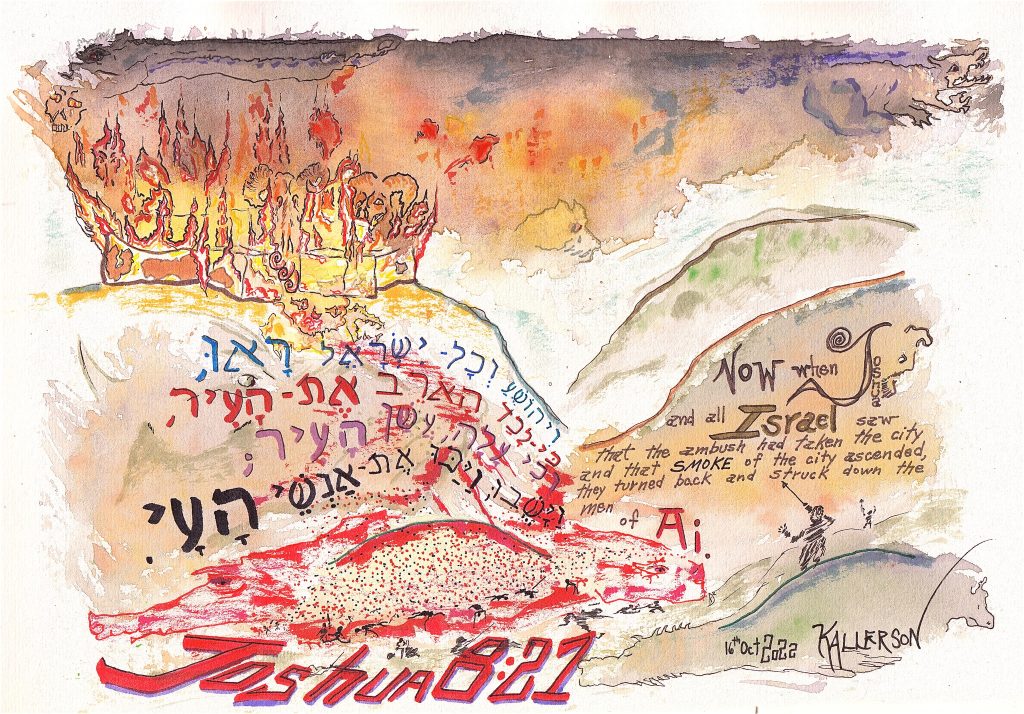
Artwork by Doug Kallerson
Joshua 8:21-29
The Fall of Ai, Part II
Israel faced a foe and was beaten back by it. That was because of a transgression of the law by one person. This was at a time when nothing was said of Joshua going out with the troops.
And so what is it that is the great foe of Israel? What is it that will bring them victory or defeat? This is what Chapter 7 and Chapter 8 of Joshua are revealing to us. I will be honest that in these first eight chapters of the book, there are probably a lot of pictures and types that I have gotten wrong.
None of this would have been intentional, but there has been – as you have seen – a lot going on. For sure, the overall message is correct, and the overall typology is as well. We can be certain of that. When I first read this sermon, some weeks after I typed it, I was actually amazed at what is presented. As stupid as that may sound, I type these things and am so tired when I finish that I often cannot even remember what passage I typed, much less the detail in it. I was overjoyed at how things came out when I first came back to it.
What I will present today follows in the same vein. I honestly believe the picture is accurate, and by the time we’re done today, I think you will agree with that. If I am wrong in any of the smaller details, I apologize. I hope that is not the case at all though.
Text Verse: “Now all things are of God, who has reconciled us to Himself through Jesus Christ, and has given us the ministry of reconciliation, 19 that is, that God was in Christ reconciling the world to Himself, not imputing their trespasses to them, and has committed to us the word of reconciliation.” 2 Corinthians 5:18, 19
Apart from the devil, who is obviously our adversary, there is an enemy that has been working against man all along. It is the law. And it isn’t that the law is bad. Rather, it is good (Romans 7:12), but when the first law was introduced, man didn’t have the knowledge to understand that (Genesis 3:5).
Since then, it is man who has been corrupted. And so, despite the law being good, it is we who are bad. Thus, the law stands against us. It is contrary to us (Colossians 2:14). But the law has been given, and so something has to happen in order for us to be freed from its yoke.
Enter Jesus. He is the One who can, and who does, make things right once again. This is the story that we are repeatedly seeing. God has presented it to us in so many ways over the past ten years of sermons that it is incredible to imagine.
And yet, much of the world that sees this precious book remains in bondage to the very law Christ came to remove from us. Let us be wise and discerning and understand that when we work out the law in an attempt to be pleasing to God, we are actually doing exactly the opposite.
Let us rest in Christ’s accomplishment of all things. That is what God finds pleasing. It is a central message to be found in His superior word. And so, let us turn to that precious word once again and… May God speak to us through His word today, and may His glorious name ever be praised.
I. A Heap Forever (verses 21-29)
21 Now when Joshua and all Israel saw that the ambush had taken the city
vihoshua v’kal Yis’rael rau ki lakhad ha’orev eth ha’ir – “And Joshua and all Israel see according to had taken the liers in wait the city.” The words here follow after what was last said in the previous sermon –
“Then the Lord said to Joshua, ‘Stretch out the spear that is in your hand toward Ai, for I will give it into your hand.” And Joshua stretched out the spear that was in his hand toward the city. 19 So those in ambush arose quickly out of their place; they ran as soon as he had stretched out his hand, and they entered the city and took it, and hurried to set the city on fire. 20 And when the men of Ai looked behind them, they saw, and behold, the smoke of the city ascended to heaven. So they had no power to flee this way or that way, and the people who had fled to the wilderness turned back on the pursuers.” Joshua 8:18-20
The fighting men of the cities of Bethel and Ai came out after Joshua. The Lord then directed Joshua to stretch out the spear in his hand. With that signal, the liers in wait captured Ai and set it on fire. Once that happened, the fighting men of Ai realized the trap that had been set and lost their will to continue or to even flee.
With that complete, Joshua and the army of Israel saw it had been taken at the same time as those from Ai, because…
21 (con’t) and that the smoke of the city ascended,
v’ki alah ashan ha’ir – “and according to ascended smoke the city.” This was per the instructions of Joshua earlier –
“Then you shall rise from the ambush and seize the city, for the Lord your God will deliver it into your hand. 8 And it will be, when you have taken the city, that you shall set the city on fire. According to the commandment of the Lord you shall do. See, I have commanded you.” Joshua 8:7, 8
This is the purpose of the liers in wait. They had been prepared and waited for the opportune moment to strike. At Joshua’s command, they readied themselves, and at Joshua’s signal, they acted. With the armies of Ai and Bethel brought out, and with the army of Israel seeing that they are hedged in, it next says…
21 (con’t) they turned back and struck down the men of Ai.
va’yashuvu va’yaku eth anshe ha’ay – “And turned back and struck men the Ai.” This is speaking of those who purposefully fled from the battle to draw the men of Ai out –
“And Joshua and all Israel made as if they were beaten before them, and fled by the way of the wilderness. 16 So all the people who were in Ai were called together to pursue them. And they pursued Joshua and were drawn away from the city.” Joshua 8:15, 16
It is these five thousand that were used to draw the men of Ai out that have turned and have begun to strike the enemy. At the same time…
22 Then the others came out of the city against them;
The words of this verse come in a rapid sequence expecting the hearer to pay attention as the various events are taking place. They show the precision of Israel’s movements even in the chaos of battle. That begins with: v’eleh yaseu min ha’ir liqratam – “And these went out from the city to against them.”
The description is short and brief. Instead of taking time to say, “And the men who attacked the city came out to join the attack,” it simply calls them “these.” The hearer would have to mentally say, “Ok, this is speaking of Israel.” Next, the subject changes…
22 (con’t) so they were caught in the midst of Israel,
va’yihyu l’Yis’rael batavek– “And were to Israel in the midst.” It is speaking of the men of Ai. Those of Israel who were fleeing had turned back. Those of Israel in the city had come out, and Ai was caught smack dab in the middle. With that, the subject returns again to Israel…
22 (con’t) some on this side and some on that side.
eleh mizeh v’eleh mizeh – “these from this and these from this.” It is speaking of Israel hemming in the men of Ai. There was nowhere for them to go because of the rushing onslaught of Israel.
22 (con’t) And they struck them down, so that they let none of them remain or escape.
It is incorrect. The words now speak of Israel and the enemy in the singular – va’yaku otam ad bilti hish’ir lo sarid u-paliyt – “And struck them until none he left to him survivor and escapee.”
There is the enemy, and there is Israel. Each is an entity, and he [Israel] left to him [Ai] no survivor and escapee. The victory over the people of Ai is total.
Here is a new word, paliyt. It signifies a fugitive, refugee, or escapee. It comes from palat, to escape. In this case, there are none who did. The entire army of fighting men was destroyed…
23 But the king of Ai they took alive, and brought him to Joshua.
A more precise translation would be, “And king the Ai they captured alive, and brought near him unto Joshua.” This would then explain the singular of the previous verse, “none he left to him.” The sides faced off under Joshua and the king of Ai, and Joshua has prevailed.
With that, the king of Ai is the only one of his people left alive at this point and he is then brought before his vanquisher.
24 And it came to pass when Israel had made an end of slaying all the inhabitants of Ai in the field,
Unlike the brevity and action of verse 22, the words of verse 24 are meticulously detailed, beginning with, “And it came to pass according to finishing Israel to slay all inhabitants the Ai in the field.” It tells us that the battle occurred in an open place where Ai was hemmed in from escaping. That is then further explained as…
24 (con’t) in the wilderness where they pursued them,
ba’midbar asher r’daphum bo – “in the wilderness which pursued them in him.” The “him” is referring to the wilderness. It seems the purpose of adding this is to indicate that they had been drawn quite a distance from Ai.
They would have been tired from the running, caught in the open and far enough from Ai that they could not have easily made it back there to rescue anyone. Instead, they were all destroyed. As it next says…
24 (con’t) and when they all had fallen by the edge of the sword until they were consumed,
va’yip’lu kulam l’pi kherev ad tumam – “And fallen all them to mouth sword until finished.” It is a further explanation of the state of the warriors of Ai. They were, to the last one, finished off.
It should be noted that the kherev, or sword comes from kharav meaning to be dry or dried up. It is identical to the name of the mountain, Horeb (Sinai), where the Law of Moses was received, and which comes from the same root word, kharav.
24 (con’t) that all the Israelites returned to Ai and struck it with the edge of the sword.
va’yashuvu kal Yis’rael ha’ay va’yaku otah l’pi kharev – “and returned all Israel the Ai and struck her to mouth sword.” The warriors of Israel, fighting on behalf of their tribes, are said to all have returned from the battle to Ai. With that, the city is completely emptied of life as the sword consumed all…
25 So it was that all who fell that day, both men and women, were twelve thousand
v’hi kal ha’noph’lim ba’yom ha’hu me’ish v’ad ishah sh’nem asar aleph – “And it was all the fallers in the day the it from men and even to women two ten thousand.” This is the entire number of all in the city. The number, as it is recorded, asks us to consider its meaning.
Twelve thousand would be a multiple of 120 (3×40) and 100 (10×10). Bullinger provides the meaning of 120 saying it “is made up of three forties (3×40=120). Applied to time therefore it signifies a divinely appointed period of probation.” Of the number 10, he says –
“…ten is one of the perfect numbers, and signifies the perfection of Divine order, commencing, as it does, an altogether new series of numbers… Completeness of order, marking the entire round of anything, is, therefore, the ever-present signification of the number ten. It implies that nothing is wanting; that the number and order are perfect; that the whole cycle is complete.”
A time of a divinely appointed period of probation, a part of a cycle that is now complete, is what we can derive from the number provided in regard to the fall of Ai. It is inclusive of…
25 (con’t) —all the people of Ai.
kol anshe ha’ay – “all men the Ai.” The masculine reveals that as the men died, so their families – male and female – are reckoned under them. As it next says…
26 For Joshua did not draw back his hand, with which he stretched out the spear, until he had utterly destroyed all the inhabitants of Ai.
The action of each verb is singular, he – “And Joshua no did draw back his hand which he stretched in the javelin until which he had anathematized all inhabitants the Ai.”
The entire battle is ultimately credited to Joshua. In typology then, Israel in the battle is being used as a type of Jesus in accomplishing the deeds which are being credited to Jesus. In other words, everything is picturing Him and what He has done.
27 Only the livestock and the spoil of that city Israel took as booty for themselves,
This is what was allowed concerning the cities of Canaan unless there was a specific command or reason for not doing so. Every human was to be destroyed, but the spoil could be taken. Jericho was an exception as everything from it was to be wholly devoted to the Lord. The Lord determined the extent of the destruction and Israel was to comply.
For example, an exception concerning Amalek is found in 1 Samuel –
“Samuel also said to Saul, ‘The Lord sent me to anoint you king over His people, over Israel. Now therefore, heed the voice of the words of the Lord. 2 Thus says the Lord of hosts: “I will punish Amalek for what he did to Israel, how he ambushed him on the way when he came up from Egypt. 3 Now go and attack Amalek, and utterly destroy all that they have, and do not spare them. But kill both man and woman, infant and nursing child, ox and sheep, camel and donkey.”’” 1 Samuel 15:1-3
For Ai, the spoil could be taken…
27 (con’t) according to the word of the Lord which He had commanded Joshua.
This word was specifically given at the beginning of the chapter –
“Now the Lord said to Joshua: ‘Do not be afraid, nor be dismayed; take all the people of war with you, and arise, go up to Ai. See, I have given into your hand the king of Ai, his people, his city, and his land. 2 And you shall do to Ai and its king as you did to Jericho and its king. Only its spoil and its cattle you shall take as booty for yourselves. Lay an ambush for the city behind it.’” Joshua 8:1, 2
The Lord allowed Joshua to keep and divide the spoil among the warriors of the battle, and this now confirms that took place. Once the spoil was taken, it next says…
28 So Joshua burned Ai and made it a heap forever, a desolation to this day.
The name Ai is certainly derived from the battle and destruction, maybe even from this verse: v’yish’roph Yehoshua eth ha’ay vay’simeha tel olam sh’mamah ad ha’yom ha’zeh – “And burned Joshua the Ai and set her heap forever; desolation to the day the this.” Britannica says of the location –
“Biblical references agree in locating Ai (Hebrew: ha-ʿAy, “The Ruin”) just east of Bethel (modern Baytīn in the West Bank). This would make it identical with the large early Bronze Age site now called At-Tall.”
It is ha’ay, the Ruins, and it is simply a ruins: “the Tel.” There are many tells in Israel, some of them have other names assigned to them, such as Tel Aviv. However, as Canon Williams wrote, “the site of Ai has no other name ‘unto this day.’ It is simply et-Tel = the Heap, ‘par excellence.’”
It is further defined as “a desolation to this day.” The idea is that this city, whatever it was actually named, was given its name because of its state after the battle and it remained in a state of desolation from that time on.
In Nehemiah, a city called Ayyah is noted, and some believe it to be this same location. However, no article precedes it and the spelling, though having the same meaning, is different. With that noted, it next says…
29 And the king of Ai he hanged on a tree until evening.
The words are specific: v’eth melekh ha’ay talah al ha’ets ad eth ha’arev – “And king the Ai hanged upon the tree until the evening.” It doesn’t say “a tree,” but “the tree.” Also, it does not say how he died. It could have been from hanging, it could have been from the sword and then being hanged, and so on. The point of the words is to highlight his hanging on a specific tree…
29 (con’t) And as soon as the sun was down, Joshua commanded that they should take his corpse down from the tree,
It reads, “And according to going the sun commanded Joshua and they take down his corpse from the tree.” This is specifically required according to the law –
“If a man has committed a sin deserving of death, and he is put to death, and you hang him on a tree, 23 his body shall not remain overnight on the tree, but you shall surely bury him that day, so that you do not defile the land which the Lord your God is giving you as an inheritance; for he who is hanged is accursed of God.” Deuteronomy 21:22, 23
When that was evaluated, the explanation was that the person died in sin, a moral issue. It isn’t the physical body that is being referred to, even though defilement does come to one who touches a dead body. And it is not a ceremonial defilement that is being referred to. It is a moral issue being addressed.
And more, this does not mean that the person who is hanged is accursed in the sense of not being saved. That would mean that any saved person who was hanged on a tree could not be saved. That is not the issue. What this means is that the person becomes a curse when hanged on a tree. Why?
Because sin is in all people. Anyone who is publicly displayed on a tree is dead. Death is the final penalty for sin. It is not the physical body, but the sin that is being focused on. Sin hangs on the tree and that sin is accursed of God.
Therefore, the hanging is a sign of being accursed. In leaving the body up overnight, the corpse would defile the land. Hence, Joshua complied with the precept of the law and…
29 (con’t) cast it at the entrance of the gate of the city,
va’yashliku otah el petakh shaar ha’ir – “And cast it to door gate the city.” The spot where the gate of the city opened was to be blocked by the corpse of the king. The gate is the place of judgment. Access is denied or granted at that point. Placing the body there means the way is blocked.
29 (con’t) and raise over it a great heap of stones that remains to this day.
It is masculine: va’yaqimu alav gal abanim gadol ad ha’yam ha’zeh – “And raised over him heap stones great until the day, the this.” Also, the word translated as “corpse” is feminine. Hence, it is speaking of the person and not the corpse.
Also, the word translated as “heap” is a different one than used earlier. That was tel, a heap of ruin. This is gal, something rolled. Hence it is stones they cast on top of him forming a round mound over him.
Who can defeat us with Christ as our Head?
We have nothing to fear as we continue on
Our sins are forgiven, placed on Him instead
He who knew no sin has taken them; they are long gone
Because of this, we have a new hope in us
The enemy cannot stand against us any longer
We have won the victory because of Jesus
Against Him, no foe can stand; He is stronger
Thank God for His wonderful workings for us
Praises to Him for all that He has done
He has restored us to Himself through Jesus
His only begotten Son
II. Pictures of Christ
The same concept is seen again in this chapter as has been seen throughout Joshua so far. It is all pointing to what God in Christ has done. It is the same process for Jews and for Gentiles, but the Joshua sermons have shown that these things will finally be realized in Israel the nation someday as well.
As for this section of the typology, it is the final account recorded before the building of the altar and writing the law upon it on Mount Gerizim, and then reading it to the people. The law is clearly the focus of what is being dealt with in this passage about Ai before that happens.
In other words, to understand what is going on in these Joshua sermons we have been seeing the process of salvation in individual passages, but they all happen at once. *Moses, the law dies. Israel accepts Christ’s fulfillment of the law. *Israel enters the Jordan (Christ); Israel is baptized into Christ’s death (Chapter 3). *Israel, signified by the stones carried to Gilgal and which are then rested there, enters its rest (Chapter 4). *Two sets of stones are set up, signifying the heavenly government of Jews and Gentiles (Chapter 4). *Israel is circumcised; Israel has put off the body of sins of the flesh / The reproach of the past is taken away when believers are circumcised by the Lord (Chapter 5). *Believers partake of Christ as their Passover (Chapter 5). *The Lord is the Leader of the people, and they are brought into “holy ground.” (Chapter 5). *Access to that holy ground is brought about by acceptance of Christ’s work (Chapter 6). *Coming out of the state of anathema (kherem) is realized through the love of Jesus (1 Corinthians 16:22) and pursuing the true gospel of Jesus Christ (Galatians 1:8, 9) (Chapter 7). And now, *Christ’s prevailing over the law is highlighted in this passage (Chapter 8). In Chapter 1, Joshua was given the charge –
“Only be strong and very courageous, that you (sg) may observe to do according to all the law which Moses My servant commanded you (sg).” Joshua 1:7
It is Joshua who is encouraged in verse 1 of this chapter with the words, “Do not be afraid, nor be dismayed.” He, typical of Jesus, is given the charge. In this case, it is to take, ha’ay, “the Ruins.” The Lord promises Joshua that it shall be given into his hand.
The name of the city is certainly given based on what took place in the account. Whatever its name was, it is now “the Ruins.” Like Ai, the Law of Moses is the obstacle barring entry into a restored relationship with God.
As Ai is said to be east of Bethel (House of God), and east is the place of exile, it is a picture of being exiled from the House of God, meaning from His presence. In verse 2, it is noted that the city is a single entity, and it is also a feminine word in Hebrew. Hence it noted “to Ai and her king” and “to Jericho and her king.” The symbolism will be explained in a bit.
The city was to be ambushed or have a “lying in wait” behind it. This consisted of a force of thirty thousand. As noted, the number thirty thousand is a multiple of thirty.
Thirty in the Bible “denotes in a higher degree the perfection of Divine order, as marking the right moment” (Bullinger). There is a divinely appointed right moment when the city, the Ruins, will be overrun. This comes from God and is well explained by Paul in Galatians 4 –
“But when the fullness of the time had come, God sent forth His Son, born of a woman, born under the law, 5 to redeem those who were under the law, that we might receive the adoption as sons.” Galatians 4:4, 5
On the other side would be another force that would seemingly flee from the city during the attack. In this, they would “tear away,” nathaq, the warriors, leaving the city defenseless. It is at that time that the right moment comes.
As for verse 9, if you remember, it is a hard verse to pin down. Either this force of thirty thousand was said to be between Bethel and Ai (the House of God and the Ruins), or it is Joshua who spent the night in that location. I would go with the latter. Either way, as Ai is east of Bethel, being between the two means east of Bethel and west of Ai.
In verse 11, the main army of Israel camped on the north side of Ai with a valley between them. The north, tsaphon, is the dark side, coming from a word signifying hidden. In the northern hemisphere, the north receives the light later and less than the south. The word used to describe the valley, gai, comes from gevah, signifying pride or exaltation.
This group is not noted as being a part of the battle. Rather, Joshua and his two forces, all picturing Jesus, engage the battle. Israel is as a spectator who will be exalted if Joshua (Jesus) prevails.
In verse 12, Joshua went with the group of five thousand and set them between Bethel and Ai, west of Ai. Five thousand is a multiple of fifty, and thus it signifies jubilee or deliverance. It … “points to deliverance and rest following on as the result of the perfect consummation of time” (Bullinger).
The battle is one that will occur according to the Divine order of the right moment (thirty thousand) and it will be one that brings about deliverance for the people (five thousand). The law is the obstacle, meaning that in Christ’s fulfillment of the law, the people will receive their deliverance.
From there, it curiously mentioned that Joshua spent the night in the midst of the valley, using a different word, emeq, or depth. That comes from amoq, it is a word that gives the sense of great depth and also to seek deeply. The BDB Lexicon includes the note to “implore (earnestly; ‘from bottom of one’s soul’).” I would suggest that this anticipates Christ’s final night before the cross where it says –
“And He was withdrawn from them about a stone’s throw, and He knelt down and prayed, 42 saying, ‘Father, if it is Your will, take this cup away from Me; nevertheless not My will, but Yours, be done.’ 43 Then an angel appeared to Him from heaven, strengthening Him. 44 And being in agony, He prayed more earnestly. Then His sweat became like great drops of blood falling down to the ground.” Luke 22:41-44
In verse 14, it noted the king of Ai coming out against Israel to an appointed place liphne ha’aravah, or “before the plain.” The word aravah is from verb arav which means to grow dark or become evening.
It is identical with the verb arav signifying to give in pledge. Therefore, typologically, this would read “at an appointed place before the pledge.” In type, the battle must be engaged at a particular time and place in order for the pledge of the Spirit to be given (Ephesians 1:13, 14).
It was at that time that Joshua and all Israel made as if they were beaten, fleeing by way of the wilderness with the army of Ai pursuing Joshua. The focus of the narrative was on him. They were just as planned, torn away from the city, leaving it totally exposed.
Jesus appeared defeated even as He was going to His cross. But the apparent defeat became the greatest of victories. It was then that the Lord told Joshua to stretch out the kidon, the javelin in his hand.
That comes from a word signifying destruction or calamity. Joshua did, and he remained with outstretched arm until the battle was complete. With the javelin stretched out, the liers in wait, the thirty thousand, entered the city and took it. The divinely perfect “right moment” had come.
The city was set on fire, the soldiers of Ai saw what had taken place, and they lost all power to continue. The strength of the law had been taken away. Paul speaks of this in 1 Corinthians 15 –
“The sting of death is sin, and the strength of sin is the law. 57 But thanks be to God, who gives us the victory through our Lord Jesus Christ.” 1 Corinthians 15:56, 57
It is at this time that the five thousand turned. The time of jubilee and deliverance had come. With that, last week’s sermon ended and today’s began.
With the city burning and the smoke rising, the five thousand met up with the thirty thousand catching the men of Ai in the middle. At that time, the words went to the singular, “And struck them until none he left to him survivor and escapee.”
There was the enemy, and there was Israel under Joshua. Each is an entity, and he [Israel] left to him [Ai] no survivor and escapee. The victory over the people of Ai was total.
Despite this, the king of Ai was taken alive and brought to Joshua. Apart from him, it noted that every single one of the enemy fell by the mouth of the kherev, or sword. Ai has been a picture of the enemy, the one that stands against Israel, meaning the law.
It is the law that stands against grace. One cannot enter heaven by works of the law and the entire law must be fulfilled. As Jesus said to Israel –
“For assuredly, I say to you, till heaven and earth pass away, one jot or one tittle will by no means pass from the law till all is fulfilled.” Matthew 5:19
As long as heaven and earth stand, the law stands. Every single precept of the law is as an enemy that must be battled against. And man will always fail in the challenge. But Christ Jesus, who is God, could fulfill it and He did. Only through His fulfillment of the law can man then receive His grace.
Jesus was able to overcome the law given at Horeb (חרב), pictured by eliminating every foe with the sword, kherev (חרב). The law is dry and harsh, but grace is a water of life. In overcoming the law (that which is dried up), the grace can be offered.
Once the soldiers were eliminated, the city itself was destroyed to the last person, totaling twelve thousand. As noted, the number is derived from 120 and 100, “a divinely appointed period of probation,” and “that nothing is wanting; that the number and order are perfect; that the whole cycle is complete.”
The time of the law is a period of probation. In its fulfillment nothing is wanting and the whole cycle is complete. That it is completed was seen in verse 26 where the entire campaign against Ai is credited to Joshua – “And Joshua no did draw back his hand which he stretched in the javelin until which he had anathematized all inhabitants the Ai.”
Think of Jesus in that and remember the meaning of the word translated as “javelin.” It comes from a root signifying destruction: “And Jesus no did draw back His hand which He stretched in the destruction until which He anathematized all of the law!”
The entire law was devoted to God through the work of Christ. As for the city itself, it was seen that it is noted as a female entity “her.” The city of Ai is being equated to the law. Paul explains the symbolism in Galatians –
“Tell me, you who desire to be under the law, do you not hear the law? 22 For it is written that Abraham had two sons: the one by a bondwoman, the other by a freewoman. 23 But he who was of the bondwoman was born according to the flesh, and he of the freewoman through promise, 24 which things are symbolic. For these are the two covenants: the one from Mount Sinai which gives birth to bondage, which is Hagar— 25 for this Hagar is Mount Sinai in Arabia, and corresponds to Jerusalem which now is, and is in bondage with her children— 26 but the Jerusalem above is free, which is the mother of us all.” Galatians 4:21-26
In the taking and destruction of Ai, that which destroyed Israel in Chapter 7 (when Joshua was not present with the army), is taken and destroyed. In Christ’s work, the law is ended. With that understood, it then said, “Only the livestock and the spoil [shalal] of that city Israel took as booty for themselves.”
Christ did the work, but His people share in the spoils. That is precisely reflected in Isaiah 53 where the same word is used –
Therefore I will divide Him a portion with the great,
And He shall divide the spoil with the strong, [shalal]
Because He poured out His soul unto death,
And He was numbered with the transgressors,
And He bore the sin of many,
And made intercession for the transgressors. Isaiah 53:12
With that understood, it next said that Joshua burned Ai and set her as a heap forever, a desolation to this day. Again, the credit is given to Joshua as a type of Christ. The law is so set according to Hebrews. It is annulled (Hebrews 7:18), obsolete (Hebrews 8:13), and set aside (Hebrews 10:9).
In Christ, and because of Him, the law is a desolation to this day. With that noted, it then went to the hanging of the king of Ai. Like Joshua, who is a type of Christ, and like the armies under him, also typical of Christ, so this king becomes a type of Christ. Christ is the King of the law. He and no other. And He was talah, hung on a tree, becoming a curse for us. Paul explains that in Galatians as well –
“Christ has redeemed us from the curse of the law, having become a curse for us (for it is written, ‘Cursed is everyone who hangs on a tree’).” Galatians 3:13
The law, Horeb/Ai, is defeated but the curse of the law stands without this part of Christ’s work. The King of Ai, picturing the work of Christ, became a curse.
Sin is a moral, not a physical or ceremonial, issue. Sin infects all people. Christ became a curse under the law. He paid the final penalty for sin. Our sin, in His fulfillment and ending of the law, hung on the tree, becoming that curse of the law.
In His death, He was taken down from there and interred. The corpse of the king of Ai was taken down and it was “cast to door gate the city.” Christ is the Door. Those under law must come through him. Christ is the Judge, signified by the gate, the place of judgment.
Those under law cannot pass through. Those freed from the law can no longer be judged by the law. That was seen in our text verse today where 2 Corinthians 5:19 says that in Christ God is not imputing our sins to us. The law is how sin is reckoned. When one is in Christ, sin is no longer imputed.
The death (the dead body) of Jesus goes in two directions. It keeps those under law from entering through the Door. It keeps those no longer under law from being returned to the law. This is seen in Colossians 2:13-15 –
“And you, being dead in your trespasses and the uncircumcision of your flesh, He has made alive together with Him, having forgiven you all trespasses, 14 having wiped out the handwriting of requirements that was against us, which was contrary to us. And He has taken it out of the way, having nailed it to the cross. 15 Having disarmed principalities and powers, He made a public spectacle of them, triumphing over them in it.”
The heaping up of stones over the corpse at the door of the gate of Ai pictures this. The corpse (noun fem.) of the dead king pictures the law (noun fem.) One must come through the risen Christ, Jesus, in order to find salvation. It does no good to call on a dead person. Without the resurrection, there is no hope. Paul says –
“For He made Him who knew no sin to be sin for us, that we might become the righteousness of God in Him.” 2 Corinthians 5:21
That is the first half of the equation. Christ died in fulfillment of the law, and He died bearing our sin. But He came out of that grave as well. If nothing else shows us the concept of potential atonement and actual atonement, this picture of the king of Ai buried at the door of the gate certainly does.
Christ died for all potentially, but He only died for some actually. The sin of all men was placed upon Jesus, but there is no passing His dead body and coming to the Father if He stayed in the grave. Rather, it is faith in the death, the burial, and the resurrection that brings believers all the way through.
Finally, this all occurred in Ai, east of Bethel. Access to the House of God is from the east. The meaning is obvious. Access to the House of God is only possible through the law, but that can only be accomplished through its fulfillment. As only Christ can fulfill the law, no man can enter the House of God apart from Jesus Christ.
This is the final part of the pictures from Joshua that began in Chapter 1. Each chapter has been a part of the series that is intended to reveal to us what God did for the people of the world, including the nation of Israel as a whole.
The final verses of this chapter, which we will look at next week, confirm that this is the end of this series of pictures. For now, think on everything that has been given since Chapter 1. It has been an amazing journey of typology and wonder – all pointing to the marvelous work of God in Christ.
The point of it all is that God has brought glory to Himself through the coming of Christ. He has revealed His love for the people of the world, He has demonstrated His faithfulness to His covenants, and we are shown that His word is both trustworthy and it is demanding.
When I say demanding, I mean He expects us to respond to it. The choice is ours, we can ignore it, we can misuse it, or we can rightly apply it. But there is no getting around what it says.
Let us learn the lesson of the law and place our trust and our hope in Christ’s fulfillment of it. Anything else will lead to an unhappy end. Let us trust in Christ, rest in Christ, and be confident in what God has done in and through Jesus Christ our Lord.
Closing Verse: “And you, being dead in your trespasses and the uncircumcision of your flesh, He has made alive together with Him, having forgiven you all trespasses, 14 having wiped out the handwriting of requirements that was against us, which was contrary to us. And He has taken it out of the way, having nailed it to the cross. 15 Having disarmed principalities and powers, He made a public spectacle of them, triumphing over them in it.” Colossians 2:13-15
Next Week: Joshua 8:30-35 It is what God had from the law demanded… (All that Moses Had Commanded) (17th Joshua Sermon)
The Lord has you exactly where He wants you. He has a good plan and purpose for you. It is He who has defeated the enemy and who now offers His people rest. So, follow Him and trust Him and He will do marvelous things for you and through you.
The Fall of Ai, Part II
Now when Joshua and all Israel saw
That the ambush had taken the city, when that caught their eye
And that the smoke of the city ascended
They turned back and struck down the men of Ai
Then the others came out of the city against them
So they were caught in the midst of Israel, some on this side
———-and some on that side
And they struck them down without haw or hem
So Israel let none of them remain or escape; all of Ai died
But the king of Ai they took alive – ooh yah!
And brought him to Joshua
And it came to pass when Israel had made an end
Of slaying all the inhabitants of Ai in the field
———-where death had bloomed
In the wilderness where they pursued them
And the people of Ai fell by the edge of the sword
———-until they were consumed
That all the Israelites returned to Ai
And struck it with the edge of the sword, every last girl and guy
So it was that all who fell that day, both men and women
———-(girl and guy)
Were twelve thousand—all the people of Ai
For Joshua did not draw back his hand
With which the spear he stretched out
Until he had utterly destroyed
All the inhabitants of Ai; it was a total rout
Only the livestock and the spoil of that city
Israel took as booty for themselves – hoorah!
According to the word of the LORD
Which He had commanded Joshua
So Joshua burned Ai and made it a heap forever – it is that way
A desolation to this day
And the king of Ai he hanged on a tree until evening
And as soon as the sun was down, Joshua commanded
———–so he did say
That they should take his corpse down from the tree, cast it
———-at the entrance of the gate of the city
And raise over it a great heap of stones that remains to this day.
Lord God, turn our hearts to be obedient to Your word
Give us wisdom to be ever faithful to You
May we carefully heed each thing we have heard
Yes, Lord God may our hearts be faithful and true
And we shall be content and satisfied in You alone
We will follow You as we sing our songs of praise
Hallelujah to You; to us Your path You have shown
Hallelujah we shall sing to You for all of our days
Hallelujah and Amen…
21 Now when Joshua and all Israel saw that the ambush had taken the city and that the smoke of the city ascended, they turned back and struck down the men of Ai. 22 Then the others came out of the city against them; so they were caught in the midst of Israel, some on this side and some on that side. And they struck them down, so that they let none of them remain or escape. 23 But the king of Ai they took alive, and brought him to Joshua.
24 And it came to pass when Israel had made an end of slaying all the inhabitants of Ai in the field, in the wilderness where they pursued them, and when they all had fallen by the edge of the sword until they were consumed, that all the Israelites returned to Ai and struck it with the edge of the sword. 25 So it was that all who fell that day, both men and women, were twelve thousand—all the people of Ai. 26 For Joshua did not draw back his hand, with which he stretched out the spear, until he had utterly destroyed all the inhabitants of Ai. 27 Only the livestock and the spoil of that city Israel took as booty for themselves, according to the word of the Lord which He had commanded Joshua. 28 So Joshua burned Ai and made it a heap forever, a desolation to this day. 29 And the king of Ai he hanged on a tree until evening. And as soon as the sun was down, Joshua commanded that they should take his corpse down from the tree, cast it at the entrance of the gate of the city, and raise over it a great heap of stones that remains to this day.