Acts 7:35

Austin Capitol, being tidied up in 2010.

Wednesday, 11 May 2022

“This Moses whom they rejected, saying, ‘Who made you a ruler and a judge?’ is the one God sent to be a ruler and a deliverer by the hand of the Angel who appeared to him in the bush. Acts 7:35

Note: You can listen to today’s commentary courtesy of our friends at “Bible in Ten” podcast. (Click Here to listen).

You can also read this commentary, with music, courtesy of our friends at “Discern the Bible” on YouTube. (Click Here to listen), or at Rumble (Click Here to listen).

The previous verse referred to the Lord’s words at the bush noting the oppression of His people and His coming down to deliver them. He completed the thought to Moses with, “And now come, I will send you to Egypt.” Stephen continues now, saying, “This Moses whom they rejected.”

What had happened forty years earlier is being reminded to the council again. Moses had appeared to his brother Israelites, coming to them as one of them, and yet they rejected him, “saying, ‘Who made you a ruler and a judge?’”

It is the words of verse 7:27 being called to mind. Moses had attempted to intercede by bringing harmony between the two who were fighting, but his attempts met with being pushed away and stinging words of rejection. Despite this, Stephen continues with his words about Moses, saying that this same Moses “is the one God sent.”

This refers to the words, “And now come, I will send you to Egypt,” of the previous verse. Despite having been rejected by his own people, it is he who was commissioned to be sent “to be a ruler and a deliverer.”

The word translated as “ruler” signifies one commanding with authority. It can be a governor, a leading man, a member of the elders, and so on. It is a general word that would rightly describe Moses over the people. The next word, translated as “deliverer,” is found only here in the Bible, lutrótés. It comes from the verb, lutroó, to release by paying a ransom, or to redeem. As such, it is more appropriately translated as “redeemer.”

In the choice of this word, Stephen is clearly tying the leadership of Moses in with the work of Christ. Moses worked on behalf of the Lord who redeemed Egypt –

“Therefore say to the children of Israel: ‘I am the Lord; I will bring you out from under the burdens of the Egyptians, I will rescue you from their bondage, and I will redeem you with an outstretched arm and with great judgments.’” Exodus 6:6

“’And it came to pass, when Pharaoh was stubborn about letting us go, that the Lord killed all the firstborn in the land of Egypt, both the firstborn of man and the firstborn of beast. Therefore I sacrifice to the Lord all males that open the womb, but all the firstborn of my sons I redeem.’ 16 It shall be as a sign on your hand and as frontlets between your eyes, for by strength of hand the Lord brought us out of Egypt.” Exodus 13:15, 16

The verb from which this noun comes is applied to Jesus three times in the New Testament: Luke 24:21, Titus 2:14, and 1 Peter 1:18. It says in 1 Peter –

“knowing that you were not redeemed with corruptible things, like silver or gold, from your aimless conduct received by tradition from your fathers, 19 but with the precious blood of Christ, as of a lamb without blemish and without spot.” 1 Peter 1:18, 19

Stephen is showing that Moses, through the blood of the Passover, was a type and picture of the coming Christ. This is exactingly stated by Paul in Ephesians 1:7 where he notes that it is “In Him we have redemption through His blood.” It is Jesus who would be rejected by those he came to, and yet, he was appointed by God to be their Ruler and Redeemer. As for Moses, he was sent in this capacity “by the hand of the Angel who appeared to him in the bush.”

The Greek preposition, en, or “in,” is used – “in the hand.” The hand is a symbol of power and strength. Thus, it is a way of saying, “in the strength of the Angel.” Thus, it is the power of the Lord who led him and by which he performed the miracles, signs, and wonders before Pharaoh and the people of Egypt. The connection to Jesus, the Ruler of Israel and who performs in the strength of the Lord, is being called forth once again –

“‘But you, Bethlehem Ephrathah,
Though you are little among the thousands of Judah,
Yet out of you shall come forth to Me
The One to be Ruler in Israel,
Whose goings forth are from of old,
From everlasting.’
Therefore He shall give them up,
Until the time that she who is in labor has given birth;
Then the remnant of His brethren
Shall return to the children of Israel.
And He shall stand and feed His flock
In the strength of the Lord,
In the majesty of the name of the Lord His God;
And they shall abide,
For now He shall be great
To the ends of the earth;
And this One shall be peace.” Micah 5:2-5

Stephen is clearly and precisely showing the council that everything about the coming Messiah was clearly prophesied in advance and that the typology of their historical figures – along with the prophecies – is exactingly fulfilled in Jesus.

Life application: Studying what Jesus has done, as it was anticipated in Old Testament types and pictures, clearly reveals His deity. If you are struggling with this concept, or if you have someone telling you that it is not a proper doctrine, all you need to do is pick up your Bible and read it – cover to cover and again and again. The more familiar you are with it, the more obvious what is being said becomes.

Jesus Christ is clearly a Man, born of a woman. Jesus Christ is clearly God, born of the Holy Spirit. The pattern for all things reproducing after their own kind is found on the first page of the Bible. It is explicitly stated there for a reason. Be confident in your faith concerning Jesus Christ, the God/Man.

Glorious God Almighty, what You have done is incredible! We may struggle with the core doctrines concerning You and what You have done, but they are so clearly presented in Scripture that we would be foolish to deny them. And so, Lord, help us to have faith when our knowledge may be lacking. But also, Lord, lead us to those who can also firm up our knowledge. Thank You, O God. Amen.


Genesis 10,21-32 (Die Völkertafel Teil 3 – die Söhne von Sem)

Genesis 10,21-32 (Die Völkertafel Teil 3 – die Söhne von Sem)

In einer der ersten Predigten, die ich je gehalten habe, habe ich das Vorwort der „Gideon’s New Testament Bible“ zitiert. Es ist gut, von Zeit zu Zeit daran erinnert zu werden, und deshalb möchte ich es heute noch einmal zitieren. Achte darauf, wie der anonyme Autor die Bibel und ihre Bedeutung für uns so feinfühlig und doch treffend beschreibt –

„Die Bibel enthält die Gedanken Gottes, den Zustand des Menschen, den Weg des Heils, das Verhängnis der Sünder und das Glück der Gläubigen. Ihre Lehren sind heilig, ihre Gebote sind verbindlich, ihre Geschichten sind wahr und ihre Entscheidungen sind unumstößlich. Lies sie, um weise zu sein, glaube sie, um sicher zu sein, und praktiziere sie, um heilig zu sein. Sie enthält Licht, um dich zu leiten, Nahrung, um dich zu unterstützen, und Trost, um dich aufzumuntern. Es ist die Karte des Reisenden, der Stab des Pilgers, der Kompass des Piloten, das Schwert des Soldaten und die Charta des Christen. Hier wird das Paradies wiederhergestellt, der Himmel geöffnet und die Pforten der Hölle aufgedeckt. Christus ist das große Thema, unser Wohl ist das Ziel und die Herrlichkeit Gottes ist der Zweck. Sie sollte das Gedächtnis füllen, das Herz beherrschen und die Füße leiten. Lies sie langsam, häufig und unter Gebet. Es ist eine Fundgrube des Reichtums, ein Paradies der Herrlichkeit und ein Fluss der Freude. Ihr Inhalt wird dir im Leben gegeben, wird beim Gericht geöffnet und bleibt für immer in Erinnerung. Dieses Buch bringt die höchste Verantwortung mit sich, wird die größte Mühe belohnen und wird alle verurteilen, die sich an seinem heiligen Inhalt vergreifen.“

Wunderschöne Worte, die von einer kontemplativen Seele stammen. Einer, die die Größe des Wortes Gottes und die Tiefe, in die es eindringt, klar erkannt hat… den wahren Geist Gottes und das wahre Herz Christi.

Einleitung:

Ich habe mich entschlossen, dies heute zu zitieren, weil die Bibel verschiedene Dinge offenbart, die uns zu verschiedenen Zeiten unseres Lebens auf unserem Weg beeinflussen können. Sie ist mit vielen wichtigen Themenbereichen gefüllt, und einer davon ist einer, an dem alle Christen festhalten sollten. Und das ist natürlich das große Thema, Jesus Christus.

Von den ersten Worten der Bibel bis hin zum letzten Satz steht Jesus Christus im Mittelpunkt. Er ist das Zentrum und der Mittelpunkt unseres Glaubens und Er ist derjenige, der uns den unsichtbaren Schöpfer offenbart.

Wenn wir die Geschichten der Bibel durchgehen, gibt es bestimmte Arten, wie Gott sich offenbart. Wenn wir während unseres Studiums nach diesen verschiedenen Schlüsseln Ausschau halten, können wir sehen, wie er jeden neuen Abschnitt, der uns begegnet, öffnet.

Ich nenne das “progressive Offenbarung”. Mit anderen Worten: Gott offenbart sich schrittweise und prägnant auf eine Weise, die selbst komplexe Sachverhalte verständlich macht.

Schritt für Schritt begeben wir uns auf eine Reise, wenn wir die Bibel lesen, und so wie wir eine Tür nach der anderen öffnen, um der mittleren Kammer eines Gebäudes immer näher zu kommen, so öffnen wir beim Lesen der Bibel eine Tür nach der anderen, bis wir das Herz Gottes und die innersten Vorgänge in Seinem Geist erreichen.

In dieser fortschreitenden Offenbarung gibt es eine besondere Art und Weise, wie Gott Sein Tun konkretisiert und uns zu Jesus Christus führt. Ich bin einige Predigtnotizen eines Mannes namens Ray Stedman durchgegangen, und er hat einen Begriff verwendet, der einen bestimmten Weg der Offenbarung sehr schön zusammenfasst, und deshalb übernehme ich ihn gerne in meine eigene Ausdrucksweise.

Er nennt es “Gottes Trichter”. Wie du sicher weißt, wird ein Trichter verwendet, um den Weg einer Flüssigkeit, eines Pulvers, von Kieselsteinen oder Sand oder was auch immer zu verengen. Mit einem Trichter lenkt man etwas, das breit und unhandlich ist, in eine bestimmte und sichere Bahn.

Gott benutzt in weiten Teilen des Alten Testaments ein trichterförmiges Muster, um unsere Aufmerksamkeit auf ein bestimmtes Ereignis und eine bestimmte Person in der menschlichen Geschichte zu lenken.

Auf dem Weg dorthin zweigt er immer wieder von der Hauptgeschichte ab, wie zum Beispiel in Genesis 4, als Kain und sein Geschlecht erwähnt werden. Aber nach den Abzweigungen kehrt die Geschichte zum Hauptstrang zurück und geht weiter… den Trichter hinunter.

Mit der Sintflut ließen wir die alte Welt hinter uns und begannen das neue Abenteuer mit Noah und seinen drei Söhnen – Sem, Ham und Japheth. Dann ging die Geschichte in einen Zweig über das, was Ham seinem Vater angetan hat, und dann zu Noah, der einen Fluch und Segen aussprach.

Danach kamen wir hier zu Kapitel 10 und haben über zwei Zweige gelesen, Japheth und dann Ham. Jetzt kehrt Gott mit Noahs zweitem Sohn, Sem, zum Trichter zurück.

Erinnere dich an diese Art von Muster, wenn du die Bibel liest, und du wirst sehen, wie Zweige erwähnt werden, wenn sie sich irgendwie auf den Trichter auswirken, und dann wird zum Trichter zurückgekehrt. Schließlich wird der Trichter zu König David und Gottes Verheißung an ihn über ein ewiges Königtum durch einen seiner Nachkommen führen, eine Verheißung, die unseren heutigen Textvers bildet.

Textvers:

„Wenn deine Zeit abgelaufen ist und du gestorben bist, werde ich dir einen deiner eigenen Nachkommen auf dem Thron folgen lassen und seine Herrschaft festigen. Der wird dann ein Haus für meinen Namen bauen. Und seinem Königtum werde ich ewigen Bestand geben. Ich werde sein Vater sein, und er soll mir Sohn sein. Wenn er Unrecht begeht, werde ich ihn mit menschlicher Rute und auf menschliche Weise züchtigen. Aber meine Gnade entziehe ich ihm nicht, wie ich sie Saul entzog, den ich vor dir beseitigt habe. Dein Königshaus und deine Königsherrschaft sollen für immer vor mir Bestand haben. Dein Thron steht fest auf ewig.“
Samuel 7,12-16

Möge Gott heute durch Sein Wort zu uns sprechen, und möge Sein glorreicher Name immer gepriesen werden.

I. Gepriesen sei der HERR

Der Trichter, der zu Jesus führt, begann bei Adam, ging dann über seinen Sohn Seth, und wir sind ihm bis zu Noah gefolgt, und jetzt wird er sich wieder zu Sem verengen. Als Noah seinen Fluch und seinen Segen aussprach, war es Sem, der den geistlichen Segen und den Vorrang vor dem Rest von Noahs Nachkommenschaft erhielt.

„Verflucht sei Kanaan! Ein Knecht der Knechte sei er seinen Brüdern!“ Und weiter sprach er: „Gepriesen sei der Herr, der Gott Sems, und Kanaan sei sein Knecht! Gott breite Japhet aus und lasse ihn wohnen in den Zelten Sems, und Kanaan sei sein Knecht!“
Genesis 9,26-27

In einer früheren Predigt haben wir gesehen, wie Noahs Worte hier in jedem Fall wahr geworden sind. Und es ist die Linie von Sem, die zu Abraham, Isaak, Jakob, Juda und dann zu David führt. Der Trichter verengt sich, und bei jedem Schritt kommen Zweige hinzu und verschwinden wieder, aber die Hauptlinie bleibt immer erhalten.

Warum sind diese Informationen so wichtig und wie nehmen wir sie auf? Was ist der Sinn dieser Vorgehensweise? Ich denke, die Frage, die wir uns stellen könnten, lautet: “Wählt Gott willkürlich Menschen aus und lehnt andere ab … zeigt er Bevorzugung, wenn Er Seinen Trichter verengt?

Die Antwort ist nicht so einfach wie ein Ja oder ein Nein. Gott hat einen Plan, die Welt mit sich selbst zu versöhnen, und Er tut es durch echte Menschen, die wirklich gelebt haben. Aber auf dem Weg dorthin gibt Er uns Einblicke in den menschlichen Zustand und in das, was Ihm gefällt und was Ihm nicht gefällt.

Wenn wir zum Buch Rut kommen, werden wir eine Geschichte über eine echte menschliche Familie sehen, die echte Tragödien und echte Freuden erlebt. Eine der Hauptfiguren des Buches, Rut, steht außerhalb des Stammbaums Israels, und doch wird sie in diesen hineingebracht und wird schließlich eine Vorfahrin von Jesus.

Gab es in ihrem Fall also eine Bevorzugung? Nein. Es gab eine Antwort auf den Glauben, genauso wie es eine Antwort auf Abels Glauben gab und eine Ablehnung von Kain, der keinen Glauben hatte. Gleichzeitig gibt es auch in der Bibel eine Art von Bevorzugung von Menschen.

Sobald Gott seinen Bund mit einer Gruppe von Menschen, wie den Söhnen Israels, geschlossen hat, haben sie Anteil an den Segnungen dieses Bundes, unabhängig davon, ob sie individuell gläubig sind oder nicht. Der Regen fiel auf die ungehorsamen Söhne Israels und bewässerte ihre Ernten genauso wie auf die gehorsamen Söhne. Ebenso würden die Ungehorsamen oft denselben Schutz erhalten wie die Gehorsamen.

Heute gibt es in Israel Menschen, die sich auf Jesus berufen haben, und solche, die es nicht getan haben. Einige von ihnen werden es tun, andere werden es nicht tun. Aber Gott hat sie alle in ihr Land zurückgebracht und sie alle profitieren von Seiner Gnade. Im physischen Sinne scheint Gott also eine Bevorzugung zu zeigen, aber im geistlichen Sinne muss jeder einzeln zu Ihm kommen, durch den Glauben.

Aber stell dir vor, es ist für alle Menschen auf der Erde dasselbe. Keiner von uns verdient es, überhaupt geboren zu werden. Manche von uns werden in netten Familien geboren und manche in schlechten. Einige von uns werden an einem schönen Ort wie Siesta Key geboren und andere an Orten wie Nowheres’ville, USA. Die Welt mag willkürlich und ungerecht erscheinen, aber der Prediger sagt: –

„Wieder sah ich, wie es unter der Sonne zugeht. Nicht die Schnellen gewinnen den Lauf und nicht die Helden den Kampf, auch nicht die Weisen das Brot, die Klugen den Reichtum und die Einsichtigen Gunst. Denn Zeit und Zufall trifft sie alle. Außerdem kennt der Mensch nicht seine Zeit. Wie die Fische ins tückische Netz geraten, die Vögel in der Falle gefangen werden, so verstricken sich die Menschen zur Zeit des Unglücks, wenn es plötzlich über sie kommt.“
Prediger 9,11+12

Zeit und Zufall… das ist es, wo wir stehen, auch wenn diese Zeit und dieser Zufall von Gott gelenkt wird. Mit anderen Worten: Die auserwählte Linie, der Trichter Gottes, der nach Israel führt, ist ein Mikrokosmos der Welt im Allgemeinen.

Ob Jude oder Nichtjude, wenn wir uns Gott nicht durch den Glauben nähern, haben wir letztlich keinen wirklichen Anteil oder kein Erbe in Ihm, sondern nur die vorübergehenden irdischen Segnungen, die mit dem Tod vergehen. Paulus erklärt dies im Galaterbrief und benutzt Abraham, den Mann des Glaubens, als ein Beispiel für diesen Glauben, der zu Gunst führt.

„Denn durch den Glauben an Jesus Christus seid ihr mündige Kinder Gottes geworden. Denn ihr alle, soweit ihr in Christus hineingetaucht worden seid, seid ja mit Christus bekleidet. Da gibt es keine Juden oder Nichtjuden mehr, Sklaven oder Freie, Männer oder Frauen, denn durch eure Verbindung mit Jesus Christus seid ihr alle zu Einem geworden. Wenn ihr aber Christus gehört, seid ihr Abrahams Nachkommen und habt Anspruch auf das zugesagte Erbe.“
Galater 3,26-29

II. Von Sem bis Eber

In Kapitel 9 haben wir uns diesen Vers angesehen –

Die Söhne Noahs, die aus der Arche gingen, waren Sem, Ham und Japheth. Und Ham war der Vater von Kanaan. Diese drei waren die Söhne Noahs, und von ihnen wurde die ganze Erde bevölkert.
Genesis 9,18-19

Als wir dort waren, bat ich dich, den Teil zu beachten, in dem es heißt: “Ham war der Vater von Kanaan”. Bis zu diesem Zeitpunkt war niemand mit dem Namen Kanaan erwähnt worden, und so bekamen wir einen Hinweis darauf, dass er später in der Bibel ein zentraler Punkt werden würde.

Wir werden das Gleiche noch einmal erleben –

21 Auch Sem wurden Kinder geboren, ihm, dem Vater aller Söhne Ebers, dem älteren Bruder Japhets.

In der Völkertafel wurde die Linie von Japheth und Ham behandelt. Nun wendet sie sich Sem zu, dem Sohn mit dem geistlichen Segen, der von Noah kam, und der Linie, die Teil von Gottes Trichter ist. Und das erste, was wir in dieser von Gott erwählten Linie von Sem sehen, ist die Erwähnung von Eber – der bis zu diesem Punkt überhaupt nicht erwähnt wurde.

So ungewöhnlich es auch erscheinen mag, Eber ist eigentlich der Ururenkel Sems. Und trotzdem wird er zur gleichen Zeit wie die Söhne Sems erwähnt – einer von 70 Namen, die in der Völkertafel stehen.

Diesem Schlüssel folgend können wir feststellen, dass Eber wieder erwähnt wird und dass er in der Geschichte eine Bedeutung haben wird, da Gottes Trichter auf Christus gerichtet ist. Eber bedeutet “jenseits” oder als Verb: „passieren“ oder „überqueren“. Dieser Name wird später in der Bibel wichtig werden.

In dem Vers, den wir gerade lesen, heißt es auch, dass Sem “der Bruder von Jafet, dem Älteren” ist. Eine Sache, die ich bei Bibelstudien empfehle, ist, die Leute verschiedene Übersetzungen mitbringen zu lassen, und wenn sie einen Unterschied zu dem, was vorgelesen wird, bemerken, sollten sie ihn benennen.

In diesem Vers heißt es in der NASB: “Auch Sem, dem Vater aller Kinder Ebers und dem älteren Bruder Japheths, wurden Kinder geboren.” Das ist eine falsche Übersetzung, denn Sem ist jünger, nicht älter als Japheth. Achte auf die Details…

In Genesis 11 heißt es, dass Sem nach der Flut 102 Jahre alt war. Noah hatte seinen ersten Sohn mit 500 Jahren und die Flut dauerte nur ein Jahr. Das bedeutet, dass der Erstgeborene Japheth war. Kleinigkeiten wie diese mögen unwichtig erscheinen, aber das sind sie nicht, wenn wir uns ansehen, wie und warum die Dinge in der Bibel geschehen.

Der Unterschied, ob Sem der Erstgeborene ist oder nicht, ist wichtig, weil er unter die Lehre der göttlichen Erwählung fällt. Gott hat den Erstgeborenen übergangen, um Seinen Trichter durch Seine auserwählte Linie fortzusetzen, unabhängig von der Reihenfolge der Geburt.

22 Die Söhne Sems waren Elam, Assur, Arpachschad, Lud und Aram.

Sem bedeutet “Name” oder “Ruhm”. Er ist der Vater aller semitischen Völker der Welt. Dazu gehören heute Juden, Araber und andere. Wenn wir den Begriff Antisemitismus hören, wird er in der Regel auf jüdische Menschen angewendet, aber er ist viel umfassender als das.

Nach Sem werden in der Bibel seine fünf Söhne erwähnt. Der erste von ihnen ist Elam, was “Ewigkeit” bedeutet. Seine Linie hat zu den Elamiten und Persern der heutigen Welt geführt.

Asshur wird als nächstes erwähnt. Sein Name bedeutet “ein Schritt” oder “stark” und er hat zu den Assyrern und Nordirakern des Nahen Ostens geführt.

Der nächste Sohn ist Arpachschad, was so viel bedeutet wie “Ich werde versagen wie die Brust”. Seine Nachkommen wurden zu den im Alten Testament erwähnten Chaldäern, den Südirakern, den Hebräern, Moabitern, Jordaniern und anderen Bevölkerungsgruppen in diesem Gebiet.

Der vierte erwähnte Sohn ist Lud, was “Streit” bedeutet. Sie sind einige der Gruppen in Kleinasien und Nordafrika geworden.

Und der letzte Sohn, der hier erwähnt wird, ist Aram, was “erhaben” bedeutet. Sie sind das Volk um Syrien, den Libanon und einige andere Orte im Nahen Osten, Afrika usw.

Alle diese Menschen stammen von Sem ab und sind auch heute noch auf der Weltbühne sehr aktiv. Von Sem stammen die drei großen monotheistischen Religionen der Welt ab – das Christentum, das Judentum und der Islam.

23 Arams Söhne hießen Uz, Hul, Geter und Masch.

In 1. Chronik 1,17 werden diese vier Söhne von Aram als Söhne von Sem aufgeführt. Einer der Söhne, Uz, ist sicherlich ein Vorfahre von Hiob aus dem Buch Hiob, denn in Hiob 1,1 lesen wir dies –

„Es war ein Mann im Land Uz, der hieß Hiob; der war ein untadeliger und rechtschaffener Mann, der Gott fürchtete und das Böse mied.“
Hiob 1,1

Es ist nicht mit Sicherheit bekannt, wer das Buch Hiob geschrieben hat, aber wenn es von ihm oder jemandem aus seinem Stamm geschrieben wurde, dann ist es ein seltenes Werk in der Bibel, denn dieses Buch und nur ein paar andere wurden von Nicht-Juden geschrieben.

Wir wissen, dass Lukas kein Jude war, und doch hat er sowohl das Lukasevangelium als auch die Apostelgeschichte geschrieben. Diese beiden Bücher machen fast ein Drittel des Neuen Testaments aus, was seine Schriften außergewöhnlich macht.

Damit du weißt, woran du erkennen kannst, dass Lukas kein Jude war, gibt Paulus in Kapitel 4 des Kolosserbriefs eine Liste von Personen an und sagt dann Folgendes –

„…und Jesus, der Justus genannt wird, die aus der Beschneidung sind. Diese allein sind meine Mitarbeiter für das Reich Gottes, die mir zum Trost geworden sind.“
Kolosser 4,11

Erst nachdem er dies gesagt hat, erwähnt er Lukas und andere, was bedeutet, dass Lukas nicht zur Beschneidung gehörte, also kein Jude war.

III. Die Völker Sems

24 Arpachschad war der Vater von Schelach und Schelach der Vater von Eber.

Hier werden wir nun sehen, wo Gottes Trichter von Sem zu seinem Sohn Arphaxad und dann die Linie hinunter führt. Zuerst wurden die Söhne Sems erwähnt und danach kam der Nebenzweig, nämlich die Söhne von Sems Sohn Aram. Sie wurden ausdrücklich erwähnt, weil die Söhne Arams auf den späteren Seiten der Bibel eine große Rolle spielen, da sie mit der auserwählten Linie Israels interagieren.

25 Eber wurden zwei Söhne geboren. Der eine hieß Peleg, Teilung, weil zu seiner Zeit die Erde geteilt wurde, und der andere Joktan.

Wir halten bei diesem Vers an, um einen der Söhne Ebers zu erwähnen, nämlich Peleg. Im Gegensatz zu den anderen Namen in diesem Bericht wird Peleg mit einer spezifischen Information erwähnt – “denn in seinen Tagen wurde die Erde geteilt.” Das muss einen Grund haben, und der Grund kann nur eines bedeuten. Schauen wir uns ein paar Möglichkeiten an und sehen wir, welche richtig ist.

Die erste ist, dass die Erde geteilt wurde, d.h. die physische Erde und die Kontinente. Dies ist eine sehr populäre Ansicht über Peleg. Du hast sicher schon von der Kontinentalverschiebung gehört. Diese Ansicht wird von vielen Menschen vertreten, die sagen, dass es das ist, was hier gemeint ist. Die Landmassen teilten sich und die Menschen wurden entsprechend getrennt.

Für diese Ansicht spricht, dass Peleg im Hebräischen “Teilung” bedeutet, im Griechischen aber “Meer”. Daraus leitet sich das Wort Archipel ab. Die Griechen nannten das Ägäische Meer “Archipel” oder das erste Meer und leiteten den Namen von diesem Mann, Peleg, ab.

Die zweite Möglichkeit ist, dass die Erde nach Menschengruppen und nicht nach geografischen Gesichtspunkten aufgeteilt wurde. Was ist richtig und können wir das wirklich sagen? Peleg ist der Ur-Ur-Ur-Enkel Sems und wurde 100 Jahre nach der Sintflut geboren, also im Jahr 1758 Anno Mundi.

Wir wissen dies aus dem Bericht in Genesis Kapitel 11, in dem die Generationen von Sem aufgezeichnet werden. Zwischen Kapitel 10 und dem Stammbaum Sems liegt jedoch der Turmbau zu Babel, den wir nächste Woche betrachten werden. Dieser Bericht ist speziell dort platziert, um uns die Aufteilung der Menschen nach Sprachen zu zeigen.

Mit anderen Worten, die Teilung der Erde, als Peleg erwähnt wird, spricht von der Aufteilung in einzelne Sprachen, und das ist der Grund, warum die Berichte in der Reihenfolge stehen, in der sie stehen. Auch hier offenbart uns Gott nach und nach, was geschieht und warum.

Der Turmbau zu Babel fand zu Pelegs Lebzeiten statt, und die Völker der Erde wurden damals entsprechend geteilt. Peleg bedeutet “Teilung” und der Name seines Bruders Joktan bedeutet “klein”.

26 Und Joktan zeugte Almodad, Scheleph, Hazarmawet und Jerach,
27 Hadoram, Usal und Dikla,
28 Obal, Abimael und Scheba,
29 Ophir, Hawila und Jobab; alle diese sind Söhne Joktans.
30 Und ihre Wohnsitze erstreckten sich von Mescha an, bis man nach Sephar kommt, zum östlichen Gebirge. 

Diese Menschen sind östlich des Landes Israel zu finden. Sie siedelten in Arabien, im Jemen und sogar entlang des Indischen Ozeans bis nach Indien. Letzte Woche haben wir von Scheba und Dedan, den Söhnen Hams, gehört. In diesem Vers heute hören wir von einer anderen Scheba.

Es ist nicht hundertprozentig sicher, wer der Vorfahre der berühmten Königin von Scheba ist, die Salomo besuchte. Es könnte sein, dass der Name aufgrund der Vermischung zwischen den Linien von Sem und Ham hier als Nachfahre der anderen Scheba wiederverwendet wird.

31 Das sind die Söhne Sems nach ihren Sippen und Sprachen, in ihren Ländern und Völkerschaften.

Vorhin habe ich gesagt, dass die Linie Sems in Kapitel 11 wieder auftauchen wird. Damit soll der Trichter Gottes gezeigt werden, der von Sem hinunter zu Abraham, dem Mann des Glaubens, führt. Er wird das Beispiel für die Rechtfertigung durch den Glauben nach den Schriften des Paulus sein.

Gott hat durch die Zeit und die Geschichte gewirkt und langsam Seinen wunderbaren Plan entfaltet, und wir überspringen oder übergehen schnell jeden Schritt zu unserem eigenen großen Verlust. Selbst mit den vielen Details, die wir uns angesehen haben, haben wir die riesige Menge an Informationen über diese vielen Menschen in Genesis Kapitel 10 nur gestreift.

Trotzdem sind wir jetzt beim letzten Vers des Kapitels und beim letzten Vers für den heutigen Tag –

32 Das sind die Sippen der Söhne Noahs nach ihrer Abstammung in ihren Völkern; und von ihnen haben sich nach der Sintflut die Völker auf der Erde verteilt.

Noah taucht in Genesis 5,29 auf, und hier ist nun das letzte Mal, dass wir von ihm hören, bis er viel später in der Bibel in kurzen Berichten erwähnt wird. Er hat seine Zeit abgesessen und verschwindet nun still und leise von der Bildfläche in einem Vers, der eher von seinen Söhnen als von ihm selbst handelt.

Er wird im Buch der 1. Chronik, bei Jesaja und Hesekiel und dann bei Jesus, dann dem Autor des Hebräerbriefs und bei Petrus erwähnt. Noah war ein Mann des Glaubens und ein treuer Mann, und er wird von Gott in Seinem Wort als solcher gewürdigt.

Letztendlich ist die Lektion von Noah eine, die wir uns alle zu Herzen nehmen sollten. Gott liebt die Menschen auf der Welt und Er wird sich sorgfältig und zärtlich um sie kümmern, wenn sie Ihn treu anrufen und Ihm für ihre Sicherheit und Rettung vertrauen.

Von Noah bis zur Erwähnung seiner Söhne sehen wir einen Übergang und in diesem Übergang liegt eine Teilung der Welt. Alle Menschen stammen von Noah ab, und von ihm nehmen wir einen von drei Wegen – durch Sem, den geistlichen Sohn, durch Ham, den Sohn der physischen Leistung, oder durch Japheth, den intellektuellen Sohn.

Nun möchte ich mich den Schriften von Ray Stedman zuwenden und seine Überlegungen zu diesen drei Themen zitieren und darlegen, wie sie sich auf uns als Einzelpersonen und Mitglieder der menschlichen Rasse beziehen. Eine Rasse von Menschen, die nach Gottes Bild und zu Seiner Ehre geschaffen wurde –

“Es gibt drei Bereiche der Menschheit, so wie es drei Bereiche im Menschen, in euch, gibt. Jede dieser Abteilungen ist dafür verantwortlich, eines der Grundbedürfnisse des Menschen zu befriedigen – geistlich, körperlich und intellektuell. In jedem von uns finden sich diese drei Bereiche wieder. Jeder von uns hat die Fähigkeit zu beten, jeder von uns hat die Fähigkeit zu denken und jeder von uns hat die Fähigkeit zu schaffen. Dies sind die Dinge, die uns von den Tieren unterscheiden. Dies ist das Bild Gottes im Menschen.

Jedes von ihnen muss in perfektem Gleichgewicht gehalten werden. Die Welt befindet sich in einem Zustand der Verwirrung, Unsicherheit und Verzweiflung, weil das von Gott gewollte Gleichgewicht unerfüllt geblieben ist. So befindest du dich in deinem individuellen Leben in einem Zustand der Verwirrung, Verzweiflung, Frustration, Schwäche oder was auch immer es sein mag, weil du es versäumt hast, die dreifachen Fähigkeiten deiner eigenen Natur zu erfüllen. Das kannst du nur tun, wenn du sie in vollkommener Harmonie miteinander hältst.

Es ist falsch, den Menschen als grundlegend geistlich zu betrachten. Er ist auch intellektuell und körperlich. Es ist falsch, ihn als im Wesentlichen körperlich zu betrachten und die sportlichen Fähigkeiten unter Vernachlässigung der anderen zu entwickeln; er ist auch geistlich und intellektuell. Interessant ist, dass in der Bibel das Intellektuelle an letzter Stelle steht. Wenn die Reihenfolge der Schrift sowohl für den Einzelnen als auch für die Rasse gilt, dann ist auch die Reihenfolge in uns Sem, Ham und Japheth. Erst das Geistliche, dann das Körperliche, dann das Intellektuelle.

In dieser Ordnung findet die Menschheit ihre vollständige Erfüllung. Wenn wir uns selbst verstehen, werden wir auch die Welt um uns herum verstehen. Die Herrlichkeit des Evangeliums besteht darin, dass es sich genau unter diesen Bedingungen an die Menschheit wendet. Wir finden uns selbst in der Erfüllung, in der Begeisterung, in einem dramatischen Gefühl, das zu sein, wozu wir bestimmt sind, wenn wir unser Leben Gott durch Jesus Christus öffnen und dies zu unserer ersten Priorität machen; dann entwickeln wir das physische Leben, kümmern uns um physische Bedürfnisse, physische Anforderungen; und indem diese beiden zusammenarbeiten, entwickeln wir den Intellekt zu einem Verständnis unserer selbst…”

Vielen Dank, Ray Stedman.

Nun, da wir am Ende des Berichts über Noah und die Tafel der Völker angelangt sind, möchte ich dir noch einmal einen Gesamtüberblick über den Fluch und den Segen Noahs geben. Das wurde mir klar, als ich eine frühere Predigt vorbereitete. Dadurch wird deutlich, wie sich diese Dinge buchstäblich auf den Seiten und im Layout der Bibel erfüllt haben.

Im Wesentlichen handelt es sich im Alten Testament um Informationen, die Gott dem jüdischen Volk gegeben hat. Obwohl die Genesis vor der Berufung Israels steht, ist sie Teil der Tora oder der fünf Bücher Mose, die am Berg Sinai empfangen wurden. Das ganze Alte Testament hindurch steht Israel im Mittelpunkt der Geschichte, die zu Jesus führt.

Und dann sehen wir in den ersten drei Evangelien, wie Jesus das Alte Testament stellvertretend für uns erfüllt. Mit anderen Worten: Was dort gesagt wird, ist unter dem Alten Testament geschrieben und richtet sich an das jüdische Volk, nicht an die Gemeinde. Erst in der Nacht der Kreuzigung hat Jesus den Neuen Bund in Seinem Blut begründet.

Im Neuen Testament bezeichnet Paulus die Gemeinde und unser Leben in Christus als “ein Geheimnis”, das zuvor nicht offenbart worden war. Das Johannesevangelium, obwohl es größtenteils unter den Begriffen des Alten Bundes geschrieben wurde, enthält eine Mischung aus Altem und Neuem Testament und bildet somit einen Übergang zum Verständnis von Christus und der Gemeinde.

Nach Johannes folgt die Apostelgeschichte, die diesen Übergang vervollständigt. Wo beginnt die Apostelgeschichte? In Jerusalem. Und wo endet sie? In Rom. Die ersten 12 Kapitel der Apostelgeschichte können mit dem Untertitel „Petrusgeschichte“ (Die Taten des Petrus) versehen werden, die Kapitel 13 bis 28 mit dem Untertitel „Paulusgeschichte“ (Die Taten des Paulus).

Ich werde dir einige Parallelen dazu aus der Apostelgeschichte zeigen. Gott hat diese Parallelen gesetzt, um uns den Übergang von Petrus, dem Judenapostel, zu Paulus, dem Heidenapostel, zu zeigen.

  1. Petrus’ Wirken begann durch den Heiligen Geist (2)
  2. Paulus’ Wirken begann durch den Heiligen Geist (13)


  1. Petrus wurde für betrunken gehalten und erklärt sich dann (2)
  2. Paulus wurde für verrückt gehalten und erklärt sich dann (26)


  1. Mit Petrus’ erster Predigt beginnt ein neuer Abschnitt des Buches (2)
  2. Mit Paulus’ erster Predigt beginnt ein neuer Abschnitt des Buches (13)


  1. Petrus hat eine Zeit der Arbeit, des Predigens und dann der Verfolgung (2-11)
  2. Paulus hat eine Zeit der Arbeit, des Predigens und dann der Verfolgung (13-19)


  1. Petrus hat Schwierigkeiten, nachdem er einen von Geburt an lahmen Mann geheilt hat (3)
  2. Paulus hat Schwierigkeiten, nachdem er einen von Geburt an lahmen Mann geheilt hat (14)


  1. Petrus sagt: “Silber und Gold habe ich nicht” (3)
  2. Paulus sagt: “Ich habe niemandes Silber oder Gold begehrt” (20)


  1. Der Schatten des Petrus heilt (5)
  2. Das Taschentuch des Paulus heilt (19)


  1. Petrus wird im Tempel verhaftet und zum Sanhedrin gebracht (4, 5)
  2. Paulus wird im Tempel verhaftet und vor den Sanhedrin gebracht (21-23)


  1. Petrus konfrontiert Simon, den Zauberer (8)
  2. Paulus konfrontiert Elymas, den Zauberer (13)


  1. Petrus treibt Dämonen aus (5)
  2. Paulus treibt Dämonen aus (16)


  1. Petrus weckt Tabitha von den Toten auf (9)
  2. Paulus weckt Eutychus von den Toten auf (20)


  1. Petrus legt die Hände auf, um den Geist zu empfangen (8)
  2. Paulus legt die Hände auf, um den Geist zu empfangen (19)


  1. Petrus betete an (10)
  2. Paulus betete an (14)


  1. Petrus wird inhaftiert und entkommt auf wundersame Weise (12)
  2. Paulus wird inhaftiert und entkommt auf wundersame Weise (16)


  1. Ein Engel stand Petrus zur Seite (12)
  2. Ein Engel stand Paulus zur Seite (27)


  1. Petrus wird durch eine Vision berufen, in Cäsarea zu predigen (10)
  2. Paulus wird durch eine Vision berufen, in Mazedonien zu predigen (16)


  1. Petrus’ Erfolg ruft jüdische Eifersucht hervor (5)
  2. Paulus’ Erfolg ruft jüdische Eifersucht hervor (13)


  1. Petrus heilt den bettlägerigen Aeneas (9)
  2. Paulus heilt den bettlägerigen Vater des Publius (28)


  1. Petrus ordiniert Diakone (6)
  2. Paulus ordiniert Älteste (14)


  1. Petrus ist ” erfüllt mit dem Geist ” (4)
  2. Paulus ist “erfüllt mit dem Geist” (13)


Neben diesen vielen Parallelen sagt Paulus in seinen Schriften viermal, dass er der Apostel für die Heiden ist, und zweimal, dass Petrus der Apostel für die Juden ist.

Gleich nach der Apostelgeschichte ist der erste Brief der Römerbrief. Der Staffelstab wird von Sem an Japheth weitergegeben, der ihn 2000 Jahre lang tragen wird, während Israel für die Ablehnung seines Messias bestraft wird. Der letzte von Paulus unterzeichnete Brief ist Philemon, auf den wiederum… der Hebräerbrief folgt.

Der Brief ist an das hebräische Volk gerichtet. Danach folgt Jakobus, der an die 12 verstreuten Stämme – das jüdische Volk – geschrieben ist. Unmittelbar nach Jakobus folgen die beiden Briefe des Petrus, der an “die Pilger in der Zerstreuung” schreibt. Er schreibt sogar von Rom aus, wo die Apostelgeschichte aufhört.

Nach diesen Briefen werden die drei Briefe des Johannes vorgestellt, die dem gleichen Muster folgen wie sein Evangelium – eine Mischung aus alttestamentlichen und neutestamentlichen Konzepten, die einen Übergang zum Verständnis von Christus und der Gemeinde bilden.

Danach folgt der Judasbrief, der fast eine Zusammenfassung des 2. Petrusbriefes ist und der über die gleichen Themen spricht. Schließlich das Buch der Offenbarung, das in den ersten drei Kapiteln an die Gemeinde und in den Kapiteln 4-19 an Israel gerichtet ist.

Ab dem Zeitpunkt der Wiederkunft Jesu in Kapitel 19 sehen wir die Verschmelzung der beiden Teile zu einem einzigen während der tausendjährigen Herrschaft von Jerusalem aus und dann im ewigen Zustand.

Mit anderen Worten: Wenn man sich das Gesamtbild der Bibel vor Augen hält und dann Noahs Segen für seine Söhne betrachtet, ist es Japheth, der in den Zelten Sems wohnt. Das bedeutet, dass Japheth das gleiche geistliche Erbe wie Sem haben würde. Und das hat er – seit 2000 Jahren. Aber in den Zelten von jemandem zu wohnen bedeutet, dass man von ihm umschlossen ist.

Sem ist der Bannerträger des geistlichen Erbes von der Genesis bis zur ersten Hälfte der Apostelgeschichte. Von der Apostelgeschichte, Kapitel 13, bis Philemon trägt Jafet das geistliche Erbe. Doch ab dem Hebräerbrief wird das geistliche Banner wieder an Sem zurückgegeben.

Und dies wird sich bei der Entrückung der Gemeinde buchstäblich erfüllen, wenn Israel, das von Sem abstammt, wieder der geistige Mittelpunkt der Welt sein wird. Wir sehen bereits, wie sich die Welt darauf einstellt.

All dies geht auf den Segen zurück, den ein Mann seinen drei Söhnen im grundlegenden Buch der Bibel erteilt hat. Es ist eine erstaunliche und schöne Geschichte in der sich entfaltenden Offenbarung von Gottes ewigem Wort.

Die Linie Sems

Auch Sem wurden Kinder geboren
Der der Vater aller Kinder Ebers ist geworden

Von ihm würde Jesus schließlich abstammen
Dem älteren Bruder Sems gab man Japhet als Vornamen

Die Söhne Sems waren Elam, Assur, Arphaxad, Lud und Aram.
Und die Söhne von Aram waren Uz, Hul, Gether und Mash
Die Araber stammen von diesen Jungen ab, einige haben ihren eigenen Harem
Und andere geben heute Schekel aus, das ist die Form des israelischen Geldes in Cash

Arphaxad zeugte Salah, und Salah zeugte Eber
Und Eber wurden auch Peleg und Joktan geboren
Peleg ist ein Name, der hoffentlich in unseren Köpfen verweilt,
Denn zu Pelegs Zeiten wurde die Erde aufgeteilt.

Joktan zeugte 13 Söhne, eine ganze Reihe, wohlan!
Almodad, Sheleph, Hazarmaveth, Jerah, und auch Hadoram
Auch Uzal, Diklah, Obal und Abimael waren von seinem Samen
Und Scheba, Ophir, Havila und Jobab vervollständigen die ganze Schar mit ihren Namen.

Diese 13 waren die Söhne Joktans, die ihn sicher einiges kosten
Und sie wohnten von Mescha bis Sephar, den Bergen im Osten.
Von diesen Söhnen Sems sind noch einige Linien erhalten
nach ihren Völkern, die vom größten bis zum kleinsten sich entfalten

Und so beenden wir die Aufzählung des Stammbaums von Noahs Blut
Alle sorgfältig aufgezählt nach ihren Geschlechtern unter einem Hut
Von ihnen wurden die Menschen nach der Sintflut geteilt, das stimmt
Alle von diesen Söhnen, die zu den Völkern der Welt geworden sind

Was für ein Vergnügen zu wissen, was Gott getan
Sorgfältig führt Er uns durch viele Generationen dann
Und Er führt Seinen Trichter hin zu Seinem Sohn ohne Hürde
Der der Retter der Nationen werden würde

Oh Großer und mächtiger Gott, überwältigend ist dein Handeln
Hilf uns, in deinem Licht zu wandeln
Auf dem Pfad der Herrlichkeit mögest du uns leiten
Und lass unsere Lippen die Geschichte des Evangeliums verbreiten

Wir wollen dir unser höchstes Lob singen
Denn du hast uns zu deinem Lob und zu deiner Herrlichkeit gemacht
Und so soll auf Erden jedes Lebewesen bringen
die Kunde des Sieges von Jesus, dem König in Seiner Pracht

Halleluja und Amen!

Nächste Woche – 1. Mose 11,1-9, Der Turmbau zu Babel


Acts 7:34

Statue of man with firefighter-looking hat and boy in left arm. Lamp in right hand. hmmm

Tuesday, 10 May 2022

“I have surely seen the oppression of My people who are in Egypt; I have heard their groaning and have come down to deliver them. And now come, I will send you to Egypt.” Acts 7:34

Note: You can listen to today’s commentary courtesy of our friends at “Bible in Ten” podcast. (Click Here to listen).

You can also read this commentary, with music, courtesy of our friends at “Discern the Bible” on YouTube. (Click Here to listen), or at Rumble (Click Here to listen).

In the previous verse, the Lord instructed Moses to take his sandals off because the place where he stood was holy ground. Stephen now continues with the words of the Lord, saying, “I have surely seen the oppression of My people who are in Egypt.”

Stephen follows the wording and structure of the Hebrew. In Exodus 3:7, it reads, “seeing, I have seen, the oppression.” The Greek now reads, “having seen, I saw.” The structure is a Hebraism that displays emphasis. Thus, the Lord is emphatically stating that He is fully aware of the treatment being received by Israel from the Egyptians. Stephen continues with his words, paraphrasing what is said in Exodus, “I have heard their groaning.”

The groaning (or outcry) is specifically stated to be because of their taskmasters. Their lives were in bondage, and they suffered oppression in that state. As such, Stephen continues with, “and have come down to deliver them.”

The words “have come down” are an anthropomorphic way of saying that the Lord is attentive to their cries and intends to now deliver the people. It is as if a ruler has stepped down from His throne in order to assist those under Him, or as a person being called to help another in a time of crisis. In this, one cannot help but see the parallel to Jesus –

“For I have come down from heaven, not to do My own will, but the will of Him who sent Me.” John 6:38

The Exodus account is being equated directly to the state of the world under law. It is a state of bondage because by the law is the knowledge of sin, and the wages of sin is death. The call of Moses to lead the people out of the bondage of Egypt is only a typological anticipation of Jesus’ coming down to free the world from the bondage of sin. This is what Stephen is focusing on. With that, he next skips over several verses from Exodus and finishes the words of this verse with, “And now come, I will send you to Egypt.”

Moses is being called to go from a place outside of Egypt to the land of Egypt itself. It is he who is to be the Lord’s instrument to bring the Israelites out to freedom from their oppression. Likewise, Jesus is the Lord’s instrument to bring humanity out to freedom from their bondage. As Jesus said –

“Then Jesus said to those Jews who believed Him, ‘If you abide in My word, you are My disciples indeed. 32 And you shall know the truth, and the truth shall make you free.’” John 8:31, 32

In response to this, it next says –

“They answered Him, ‘We are Abraham’s descendants, and have never been in bondage to anyone. How can You say, “You will be made free”?’” John 8:33

And then, in His reply to them, we read –

“Most assuredly, I say to you, whoever commits sin is a slave of sin. 35 And a slave does not abide in the house forever, but a son abides forever. 36 Therefore if the Son makes you free, you shall be free indeed.” John 8:34-36

Stephen is taking the council back to school, tutoring them on what they had failed to see when Jesus came. What man needs is freedom from sin. Being free in a nation or in a society gives people a false sense of security. Only when the true oppressor is identified and removed can a human truly be considered free.

Notice how Stephen focuses on the negative aspect of bondage and skips over the benefit of having that removed when his words are placed side by side with the corresponding Exodus narrative –

I have surely seen the oppression of My people who are in Egypt; I have heard their groaning and have come down to deliver them. And now come, I will send you to Egypt.”

“And the Lord said: ‘I have surely seen the oppression of My people who are in Egypt, and have heard their cry because of their taskmasters, for I know their sorrows. So I have come down to deliver them out of the hand of the Egyptians, and to bring them up from that land to a good and large land, to a land flowing with milk and honey, to the place of the Canaanites and the Hittites and the Amorites and the Perizzites and the Hivites and the Jebusites. Now therefore, behold, the cry of the children of Israel has come to Me, and I have also seen the oppression with which the Egyptians oppress them. 10 Come now, therefore, and I will send you to Pharaoh that you may bring My people, the children of Israel, out of Egypt.’” Exodus 3:7-10

Stephen left out the words concerning bringing the nation into the land of promise for a reason. The council sat there in that land. As such, they thought that they were in a right standing and favor with the Lord. But Stephen’s words are intended to make them think. Canaan was only a typological representation of something far greater – freedom in Christ from the bondage of the human soul to sin. Heaven, a return to paradise, it is the benefit of that state.

Life application: The Bible is written for man’s benefit. When we read about God in words like, “He came down,” “His right hand,” “His arm is not shortened,” and so on, we are reading anthropomorphisms that help us to see what the Lord is doing or what He is like in a way that we can understand. God doesn’t have a right hand, nor does He sit on a throne. God is Spirit.

When the Bible says that the sun also rises, that is for man’s benefit. The sun does not rise. The earth rotates. As it does, from man’s perspective, the sun appears to come up and go down. The Bible refers to the four corners of the earth (Isaiah 11:12). The earth is a sphere. It doesn’t have corners. However, the words are given for man’s benefit as he stands on the ground.

This is actually very important to remember because there are people who claim the earth is flat. To justify this, they misuse Scripture – twisting it – in order to confuse people. Why would they do this? It isn’t because they are religious at all. It is because by getting people to believe that they have been lied to, those who “understand the truth” can now wield authority over their newly made disciples. It is a return to bondage.

In the end, all such control tears people away from focusing on Christ Jesus. Be wise and be aware of what the Bible is saying and why. How easy it is for people to get pulled away from the truth, simply because they have failed to read, know, and understand the word.

Heavenly Father, thank You for the wisdom You have displayed in the creation. We live on a beautiful ball, suspended upon nothing, as it moves through space. We have the warmth of the sun and the soft light of the moon. The stars twinkle and shine to delight our eyes. Thank You for Your care of us through such wonderful detail. Amen.


Acts 7:33

Some guy. Looks like Jefferson Davis. Austin Capitol.

Monday, 9 May 2022

‘Then the Lord said to him, “Take your sandals off your feet, for the place where you stand is holy ground.  Acts 7:33

Note: You can listen to today’s commentary courtesy of our friends at “Bible in Ten” podcast. (Click Here to listen).

You can also read this commentary, with music, courtesy of our friends at “Discern the Bible” on YouTube. (Click Here to listen), or at Rumble (Click Here to listen).

The previous verse is where the Lord revealed Himself to Moses as the God of Abraham, Isaac, and Jacob. Stephen next says, “Then the Lord said to him.” Moses was terrified and would not look at the sight. Despite this, the Lord continues to speak to him. His words demand a state of humility in His presence, saying, “Take your sandals off your feet.”

There is much to be learned about shoes, their use, and their removal in the Bible. And this is true even though they are only mentioned about 35 times.

In this command, and it is a command, God is instructing Moses from One who is greater to one who is lesser. In essence, “Resign yourself to me.” He is the possessor of, and in authority over, the land. Moses’ shoes, whether made by him or by someone else, were the work of man’s hands. The footprints of Moses were created by God, implying God’s mastery over him.

There is then a uniting of the created foot with the dust from which it was created. Nothing of human origin would be considered acceptable in the presence of such a place of holiness. This is also seen later in Exodus 20, where it says –

“And if you make Me an altar of stone, you shall not build it of hewn stone; for if you use your tool on it, you have profaned it.” Exodus 20:25

God made the stones, not man. If man’s efforts are placed along with God’s holiness, only defilement can take place. God calls, God sanctifies, and God glorifies. The process of holiness is of and by God and God alone.

Only twice in the Bible is someone told to take off their shoes because the ground is holy. Here, and in Joshua. To understand this better, that account needs to also be given –

“And it came to pass, when Joshua was by Jericho, that he lifted his eyes and looked, and behold, a Man stood opposite him with His sword drawn in His hand. And Joshua went to Him and said to Him, ‘Are You for us or for our adversaries?’
14 So He said, ‘No, but as Commander of the army of the Lord I have now come.’
And Joshua fell on his face to the earth and worshiped, and said to Him, ‘What does my Lord say to His servant?’
15 Then the Commander of the Lord’s army said to Joshua, ‘Take your sandal off your foot, for the place where you stand is holy.’ And Joshua did so.”  Joshua 5:13-15

When two things, or two similar occurrences, are noted in the Bible, there is a reason for it. There will be a contrast between the two and yet they will confirm something. In the case of these two accounts, one is before Israel is delivered from bondage; one is after they have been safely led into the land of promise. He is the covenant-keeping Lord.

One is outside of Canaan; one is in Canaan. The Lord is God over the whole earth, over both Jew and Gentile. In one there is the Lord unseen and the voice of God from “over there.” In the other, there is the Lord visible, tangible, and in human form. The Lord is the incarnate Word of God; He is Jesus.

In one, He is the Lord who will give the Law – the Angel or Messenger of it; in the other, He is the Lord who defends the Law which is given – the Commander of the Lord’s army. He is the Lord of the Law, its herald and upholder. For these, and certainly other reasons, we are given these two accounts to compare and ponder. Stephen finishes the verse, saying, “for the place where you stand is holy ground.”

In the Old Testament, the word for “holy” is qodesh. This was the first time it was used in the Bible. Over 2500 years of human history had been recorded, and yet it was the first mention of anything connected to God’s holiness since the creation.

A parallel word to qodesh is qadash which means to sanctify. That was used just once in the Bible to this point, in the creation account in Genesis 2:3 where it said, “God blessed the seventh day and sanctified it.” From this point in Exodus, the two terms will cumulatively be used about six hundred and forty times in the Old Testament.

The holiness of God was being introduced at the burning bush because Moses will become the human giver of God’s law for His chosen people. Moses was being taught a lesson, right from the start, of God’s holiness. It is a lesson he would carry with him all the days of his life.

He would even see on many occasions what it means to step over the bounds of propriety concerning that state of holiness in his Creator and Lord. This will be seen in others, both within the covenant community and without, and it will be seen in himself as well when he failed to take it to heart during a brief moment of anger.

For now, Moses stands on ground that has been rendered holy by the presence of God. As a final note, Stephen has cited the words of this verse and the previous one in opposite order –

“Then He said, ‘Do not draw near this place. Take your sandals off your feet, for the place where you stand is holy ground.’ Moreover He said, ‘I am the God of your father—the God of Abraham, the God of Isaac, and the God of Jacob.’ And Moses hid his face, for he was afraid to look upon God.” Exodus 3:5, 6

This lends credence to the notion that it is truly the way Stephen presented it. Anyone simply copying the Exodus narrative would have done so in the order it was given there.

Life application: As noted above, Moses died outside of the Promised Land. The reason for this punishment is found in Numbers 20 –

“And Moses and Aaron gathered the assembly together before the rock; and he said to them, ‘Hear now, you rebels! Must we bring water for you out of this rock?’ 11 Then Moses lifted his hand and struck the rock twice with his rod; and water came out abundantly, and the congregation and their animals drank.
12 Then the Lord spoke to Moses and Aaron, ‘Because you did not believe Me, to hallow Me in the eyes of the children of Israel, therefore you shall not bring this assembly into the land which I have given them.’
13 This was the water of Meribah, because the children of Israel contended with the Lord, and He was hallowed among them.” Numbers 20:10-13

Moses was to speak to the rock, not strike it. This was to reveal the pattern of justification before God based on faith. Moses did not provide the word of faith, and he ruined the typology of Christ. But this was used by the Lord to show us another truth. The law cannot bring anyone into a right standing before God.

One must come to Him in faith, and by faith alone. Works of the law are excluded. If one attempts to merit God’s favor by works, he is excluded. The credit for entry into the promise is solely through the merits of Christ. Be careful to remember this lesson. Stay away from those who would tell you that you must do something to be pleasing to God. Have faith in Jesus and in Him alone in order to be reconciled to Him!

Glorious God, thank You that You have done all that is necessary to reconcile us to Yourself. Thank You for the giving of Jesus our Lord and for all that means to us. We are reunited to You through a simple act of faith in what He has done. Help us to never diminish the glory of His work through our selfish attempts to “do better” through our own works. To Your glory alone! Amen.


Deuteronomy 33:12-17 (Moses Blesses Israel, Part II)

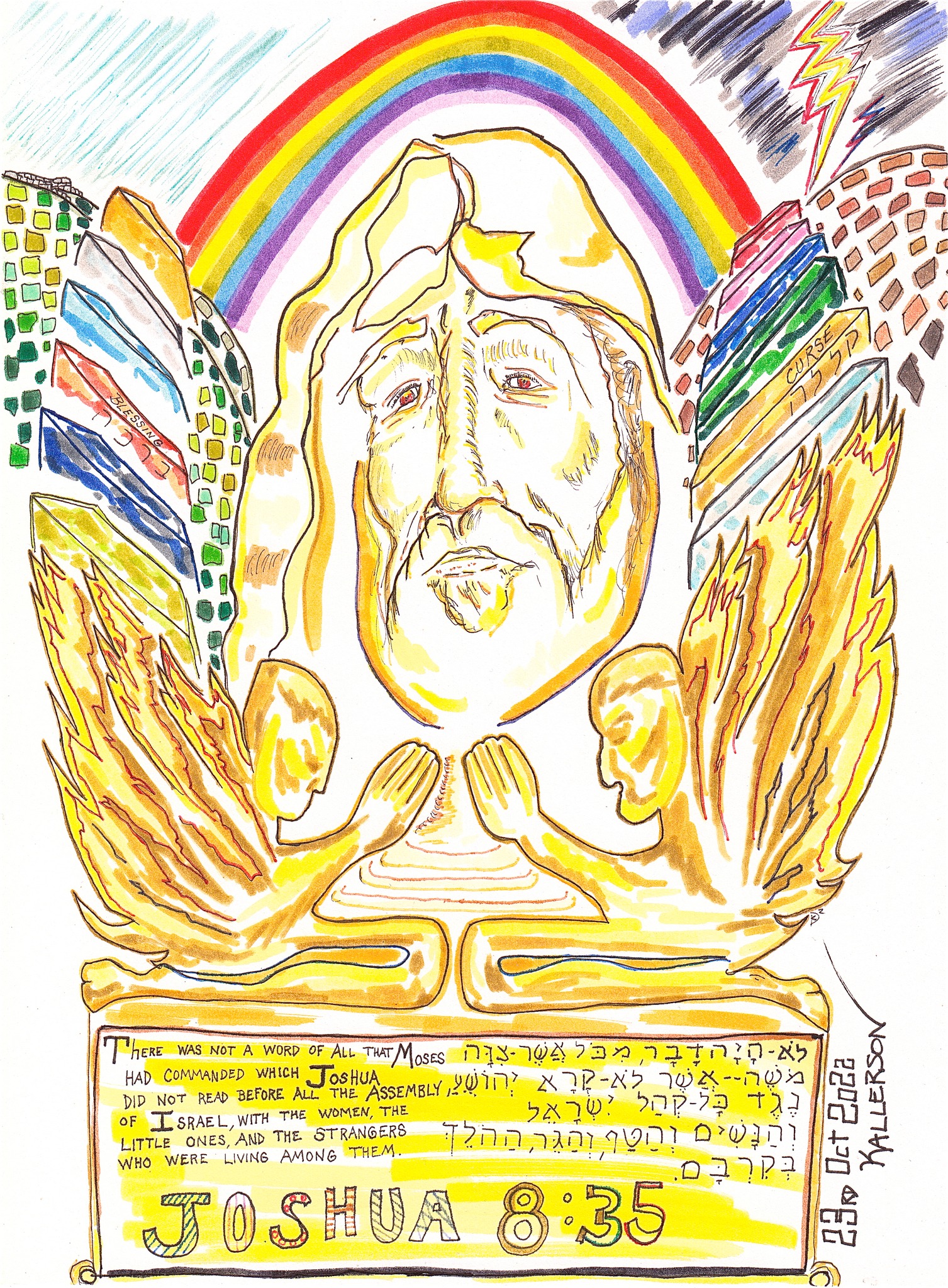
Artwork by Doug Kallerson

Deuteronomy 33:12-17
Moses Blesses Israel, Part II

This may seem like a curiosity to you but right now there is an American oil company in Israel, that is drilling for oil in the area referred to in Moses’ words today, and the owner is basing his reasoning on verses from Genesis 49 and Deuteronomy 33, both from the blessings spoken over Joseph –

“By the God of your father who will help you,
And by the Almighty who will bless you
With blessings of heaven above,
Blessings of the deep that lies beneath,
Blessings of the breasts and of the womb.
26 The blessings of your father
Have excelled the blessings of my ancestors,
Up to the utmost bound of the everlasting hills.
They shall be on the head of Joseph,
And on the crown of the head of him who was separate from his brothers.” Genesis 49:25, 26

&

“And of Joseph he said:
“Blessed of the Lord is his land,
With the precious things of heaven, with the dew,
And the deep lying beneath,
14 With the precious fruits of the sun,
With the precious produce of the months,
15 With the best things of the ancient mountains,
With the precious things of the everlasting hills,
16 With the precious things of the earth and its fullness,
And the favor of Him who dwelt in the bush.
Let the blessing come ‘on the head of Joseph,” Deuteronomy 33:13-16

Whether you agree with his reasoning or not, the land spoken of by both Jacob and Moses is still there, it is identifiable through historical records, and the company – Zion Oil and Gas – is there drilling wells.

Text Verse: “I am your fellow servant, and of your brethren who have the testimony of Jesus. Worship God! For the testimony of Jesus is the spirit of prophecy.” Revelation 19:10

Whether you agree with his insights into the prophecies of Jacob and Moses, one thing is for sure: their words, and all the other prophetic oracles of God that are found in the Bible are true and they ultimately lead us to Jesus or at least an understanding of what He has done, is doing, or will do.

We will see more of that in our verses today. As far as Zion Oil and Gas, they put out occasional updates on the status of things. At the time I typed this sermon, their most recent update was as of February 16 –

Dear Zion Supporters and Shareholders,
2022 has kicked off to a fast and exciting start for Zion and its operations team as we prepare to continue developing and testing the MJ-02 well.
We are pleased to announce that all necessary services for completing the well, along with enhancement and reservoir testing, have been secured.
Zion has partnered with some of the leading Petro physicists and stimulation experts in the United States to plan the next phase of the operation.
As Zion continues to navigate manufacturing and logistical delays, the plan is to resume operations in quarter one.
These operations will start with necessary re-certifications and inspection of the rig while also upgrading critical systems that will benefit this operation and allow for enhanced drilling operations in the future.
Upon completing the inspections, upgrades, and rigging up, the crew will complete the final casing and tubular run before moving on to the enhancement and reservoir testing phase.
We continually give thanks to God and our loyal shareholders and supporters who make all this possible.
We will continue to provide material updates when we have relevant information to share with the public.

Sincerely,

Rob Dunn
CEO

The company is registered with the SEC, it has stocks for purchase, and who knows if they will ever hit the big time. If they do, the stock will probably be worth a lot, but it may not last long. If large amounts of oil show up in Israel, the nations will suddenly find a reason to go in and take things over.

That is always a possibility based on other very clear passages of Scripture. Amazing things such as this possible prophecy of oil in the land of Joseph are based on verses found in God’s superior word. And so, let us turn to that precious word once again and… May God speak to us through His word today and may His glorious name ever be praised.

I. The Blessing to Benjamin (verse 12)

In the previous sermon, Judah – the fourth son of Jacob and Leah – was blessed before Levi, the third son. Simeon was left out of a blessing, probably because he was eventually dispersed in, and assimilated into, Judah.

Now, the two sons of Jacob and his beloved Rachel will be blessed, and they are again out of birth order. Moses first blesses Benjamin and only then will he bless Joseph.

Because Benjamin is blessed before Joseph, critical scholars try to say that this order, and thus the blessing, actually dates to the time of the kings where Benjamin was the tribe of the first king of Israel, Saul. But there is no reason to assume this at all. Judah was already blessed before Levi, and Simeon has been left out of a blessing.

There is more reason to believe that God’s foreknowledge of future events superintends over the blessings given by Moses than that the blessings are some sort of later fabrication.

As for an immediate reason why the blessings are noted as Judah / Levi / Benjamin, it cannot go without notice that the future temple of the Lord will be in Jerusalem.

This then forms a sort of geographical prophecy where Judah is to the south, the temple is in Jerusalem that is on Judah’s northern border, and then Benjamin is on the north of that.

As the temple is identified with those who ministered in it, meaning the priests and the Levites, we can see the pattern found in Moses’ order of blessing from south to north – Judah / Levi / Benjamin.

Later, Judges 1:8 says, “Now the children of Judah fought against Jerusalem and took it; they struck it with the edge of the sword and set the city on fire.” And yet, in the same chapter, it says, “But the children of Benjamin did not drive out the Jebusites who inhabited Jerusalem; so the Jebusites dwell with the children of Benjamin in Jerusalem to this day” (Judges 1:21).

Throughout the time of the kings, Jerusalem is said to be in Judah, and yet, again and again, people both from Judah and Benjamin are noted as being in Jerusalem. Further, the geographical overlapping of the two is also noted, even after the exile, such as in Ezra 1 –

“Then the heads of the fathers’ houses of Judah and Benjamin, and the priests and the Levites, with all whose spirits God had moved, arose to go up and build the house of the Lord which is in Jerusalem.” Ezra 1:5

But more, I would argue that the entire set of blessings upon the tribes – from Reuben to Asher – form an interesting pattern, a sort of circle around the temple in Jerusalem, in the order in which they are pronounced.

So far, Reuben is east of Jerusalem and outside of Canaan proper. Then it went south to Judah, which is inclusive of Simeon. This would explain why Simeon had no blessing. If the blessings are based upon situation in relation to the temple, and because Simeon is within the boundaries of Judah, then there was no need to give a separate blessing to them.

After Judah, it then went to Levi, emblematic of the temple, then it will next go to Benjamin, the land bordering the north of where the temple is. As such, the next blessing, the blessing of Benjamin, begins with…

12 Of Benjamin he said:

l’binyamin amar – “To Benjamin he said.” Benjamin is the younger of the two sons of Rachel and the twelfth son born to Jacob. Upon him, Moses pronounces that he is…

12  (con’t) “The beloved of the Lord shall dwell in safety by Him,

yedid Yehovah yishkon lavetakh alav – “Beloved Yehovah shall dwell to security upon Him.” The blessing of Benjamin speaks of his geographical situation. The words are difficult and highly debated, but it appears that this is, in fact, referring to Benjamin’s future placement in relation to the House of God. He thus dwells “upon” the Lord.

Lange says it cannot be speaking of this because the words Moses pronounces speak of the state (how) he lives rather than the location (where) he lives. But both can be true at the same time. The where, meaning in relation to the temple, leads to the how, meaning its safety and continuance.

The layout of the tribes provided a sort of buffer around where the temple is located, both in physical geography and in spiritual affiliation.

In his words now, Moses introduces the word yadid. It is an adjective that will be seen nine times, always in poetry. It is from the same root as dod, the noun meaning “beloved.” Benjamin is the beloved of Yehovah.

Benjamin means, “Son of the Right Hand.” As such, there is a definite hint of Jesus who is the Son at the right hand of the Father and who is the Beloved of the Lord. It is He who rests securely upon Him. Next, Moses says of him…

12  (con’t) Who shelters him all the day long;

khopheph alav kal ha’yom – “Covering him all the day.” This is a most rare word, found only here, khaphaph. It is related to yakheph, or barefoot. The foot is uncovered. Here, however, the word is speaking of being covered.

The word itself is closely connected to the word khuppah, which is a canopy for protection and a bridal chamber. Benjamin would be covered at all times in his dwelling. The sentiment of these words appears to be reflected extending into the future of Jerusalem where the word khuppah, or covering is explicitly used when referring to it –

“In that day the Branch of the Lord shall be beautiful and glorious;
And the fruit of the earth shall be excellent and appealing
For those of Israel who have escaped.
And it shall come to pass that he who is left in Zion and remains in Jerusalem will be called holy—everyone who is recorded among the living in Jerusalem. When the Lord has washed away the filth of the daughters of Zion, and purged the blood of Jerusalem from her midst, by the spirit of judgment and by the spirit of burning, then the Lord will create above every dwelling place of Mount Zion, and above her assemblies, a cloud and smoke by day and the shining of a flaming fire by night. For over all the glory there will be a covering [khuppah]. And there will be a tabernacle for shade in the daytime from the heat, for a place of refuge, and for a shelter from storm and rain.” Isaiah 4:2-6

With this understood, Moses speaks on…

12  (con’t) And he shall dwell between His shoulders.”

u-ben kethepha shaken – “And between His shoulders dwells.” Between the shoulders would signify to ride upon the back, and thus to be carried along. Metaphorically, the shoulders are referring to mountain slopes.

As this is speaking of Benjamin, this is taken by many scholars to refer to the two mountain peaks, Zion belonging to Judah, and Moriah in the land of Benjamin. However, that seems to be coopting that which is intended for Judah.

As such, I would think it just as likely, or more so, to be referring to Mount Moriah on the south and Bethel on the north. Mount Moriah is where the temple, the house of God, was erected –

“Now Solomon began to build the house of the Lord at Jerusalem on Mount Moriah, where the Lord had appeared to his father David, at the place that David had prepared on the threshing floor of Ornan the Jebusite. And he began to build on the second day of the second month in the fourth year of his reign.” 2 Chronicles 3:1, 2

Bethel, on the north, means “House of God.” Thus, the “shoulders” of Benjamin would then be referring to these two locations which include, or which are called, the “House of God.” When looked at on a map, the two locations literally look like the two shoulders of the land. Thus, the blessing is that of a realtor’s dream: location, location, location –

To Benjamin he said.
Beloved Yehovah shall dwell to security upon Him.
Covering him all the day.
And between His shoulder dwells.

The entire prophecy of Benjamin looks to the future concerning Jesus, the Son at God’s right hand, the beloved of the Lord who rests safely upon the Lord, covered by Him, and dwelling in the House of God. Next, Moses turns to Benjamin’s older brother…

I will bless you with a blessing
And you shall be blessed as My words convey
There will be no doubt; there will be no guessing
Things will come to pass just as I say

The future is known because I am already there
If you could understand this, things would go well
I tell in advance because I care
If My words you dismiss, you will pave a path to hell

But if you listen to My words, including this blessing
You will find the way to heaven is opened to you
There will be no doubt and there will be no guessing
Listen to My words which are faithful and true

II. The Blessing to Joseph (verses 13-17)

If you set the blessing of Jacob upon Joseph side by side with the one now from Moses, you will see how closely they parallel one another. I won’t highlight that for you, but if you have the time and motivation, it would be a short and fun project for you to do. With that, we now turn to Moses’ words to this son of Israel…

13 And of Joseph he said:

u-l’yoseph amar – “And to Joseph he said.” Joseph is the older of the two sons of Rachel and the eleventh son born to Jacob. Joseph is actually divided into the tribes of his sons Ephraim and Manasseh.

Ephraim is next north of Benjamin, and Manasseh is both north and then northeast of Ephraim, being divided into two sections that rest on both sides of the Jordan. Thus, the pattern of the order of the tribes surrounding Jerusalem in a somewhat discernible fashion continues with this tribe divided into two tribes. For now, upon Joseph, Moses pronounces that…

13 (con’t) “Blessed of the Lord is his land,

meboreket Yehovah artso – “Blessed Yehovah his land.” The blessing of Joseph pertains predominantly to the land. It is a land that would abound in productivity, and this has been noted as true concerning the areas where Ephraim and Manasseh, the two sons of Joseph who were adopted by Jacob, settled. The land is promised to be blessed…

13 (con’t) With the precious things of heaven, with the dew,

mi’meged shemayim mital – “From preciousness heavens, from dew.” Another new word, meged, is used. It is a noun that will be seen five times in the blessing upon Joseph, and then only three more times, all in the Song of Solomon.

The meaning of it is obscure, but James Strong places it as coming from a root probably meaning “eminent.” As such it is a distinguished thing or something valuable. That which is precious from heaven would be the rains, favorable climate, and so on.

The next word, mital, means “from dew.” However, some manuscripts have one letter changed, making it to say meal, or “from above.” Thus, some translations say this instead.

Either way, the thought is similar, but I would go with “from the dew.” As such, it would then be a separate category. One can see this when is the two are placed side by side –

Blessed Yehovah his land.
From preciousness heavens, from dew. (separate category)
Blessed Yehovah his land.
From preciousness heavens, from above. (second explains first)

Dew comes less from heaven than from the interaction between the immediate ground and the surrounding air as moisture condenses. When taken with the next clause, it being a separate category would then follow through more logically…

13 (con’t) And the deep lying beneath,

u’mi’tehom rovetseth takhath – “And from deep crouching underneath.” The tehom is a void or an abyss. As such, it is where water flows up from underground. Here Moses poetically portrays it as a recumbent animal that crouches below. Combining this with the previous clauses, one can see why I feel “from dew” is the correct meaning –

Blessed Yehovah his land.
From preciousness heavens (water from above), from dew (water from ground level).
And from deep crouching underneath (water from below).

Without water, life dries up and dies. But with water, everything is fruitful and abundant. That is what Moses will confirm concerning the land of Joseph in the next beautifully painted words…

14 With the precious fruits of the sun,

u-mi’meged tevuoth shamesh – “And from preciousness increases sun.” The sun is that which rises from day to day. Throughout the Bible, it is reflective of that state. Thus, it speaks of life being lived one day at a time as each day is “the day.” There is tomorrow, but when it comes, it becomes “the day.”

Each day, the sun will bless Joseph where he will receive abundance in the increases (produce, fruits, crops, etc.) of the day. The words speak of abundance arising from the events of the day…

14 (con’t) With the precious produce of the months,

u-mi’meged geresh yerakhim – “And from preciousness [the] casting moons.” Here is a word found only once in Scripture, geresh. It is a noun coming from the common verb garash which refers to casting out or driving out (such as an enemy), divorcing, and so on. Hence, one can think of expatriating.

The moon here speaks of the months. Each moon is one month, and thus, it speaks of the cycle of the year as it passes. As the various crops produce their fruit, they are said to cast them off. The contrasting parallelism between the clauses is evident –

And from preciousness increases sun. (daily cycle)
And from preciousness [the] casting moons. (monthly cycle)

One can see the workings of the Lord in this where Jesus speaks of each day being sufficient for its own trouble, meaning relying on the produce of the day as each day produces. And yet, He also speaks of the fields being white for harvest, which is a cyclical thing that comes as the months pass.

And more, Jesus is the fulfillment of both the daily sacrifices at the temple as well as each sacrifice that occurs during the months of the year. Now, with the marvelous words of this verse complete, Moses speaks on…

15 With the best things of the ancient mountains,

u-me’rosh harerei qedem – “And from excellency mountains ancient.” Translations will vary widely on this because the words can have several meanings. The word rosh means “head.” As such, it can signify the first, the top, the best, and so on.

The word “ancient” is qedem, which literally means “east,” but east in Scripture also signifies that which is before. The sun rises there. And because it comes from seemingly nowhere, it then speaks of the unknown past – that which is in antiquity, is ancient, is eternal.

I translate it as “excellency” because it is a singular noun, but the word “mountains” is plural. Also, I say “ancient” rather than “east,” otherwise, one might say “top of the mountains of the east,” signifying the mountains of Gilead and Bashan where some of Joseph settled. But more, using excellency will also maintain parallelism with the next clause.

The words now speak of what is derived from these higher areas, be it grasslands for flocks and herds, trees, vines, olives, minerals, and so on. Whatever these elevations uniquely provide, that is the excellency derived from them. Also…

15 (con’t) With the precious things of the everlasting hills,

u-mi’meged givoth olam – “And from preciousness hills antiquity.” It is the same word used three times already in the past two verses, meged, or preciousness. The word givah is a hill, and here it is plural, givoth. And the word olam signifies “to the vanishing point.” Thus, it is an indeterminate amount of time.

In other words, the clause is perfectly parallel to the previous clause –

And from excellency mountains ancient.
And from preciousness hills antiquity.

As for typology, I would say these words look beyond the hills and mountains, here termed Ancient and Antiquity. Though they are old, they didn’t create themselves. Rather, they came from the wisdom of God in creation. If there is an ancient hill, there is One more ancient that created it, meaning He was there before the hill.

As such, it is reflective of the words of James concerning God –

“Do not be deceived, my beloved brethren. 17 Every good gift and every perfect gift is from above, and comes down from the Father of lights, with whom there is no variation or shadow of turning.” James 1:16, 17

It is Christ who came from God and who is described with both the word qedem and olam in Micah –

“But you, Bethlehem Ephrathah,
Though you are little among the thousands of Judah,
Yet out of you shall come forth to Me
The One to be Ruler in Israel,
Whose goings forth are from of old,
From everlasting.” Micah 5:2

As for Joseph, the high places – the mountains and hills that were founded in the primeval past – will yield that which is excellent and precious for Joseph. And more…

16 With the precious things of the earth and its fullness,

u-mi’meged erets u-meloah – “And from preciousness land and its fullness.” This speaks of the overall favor of the land, whether on mountain, hill, valley, or plain. Where Joseph would settle, in its fullness, there would be abundance. But more…

16 (con’t) And the favor of Him who dwelt in the bush.

u-retson shokeni seneh – “And favor Him dwells bush.” Moses returns to his time of calling on Mount Sinai where he met the Lord God who called to him from the bush. It was there that Moses was told that the promise to the fathers – Abraham, Isaac, and Jacob – would be realized from Him through Moses.

Just as Israel had received His favor, and just as Moses has been bestowed the good pleasure of the Lord, so this same Source of blessing is now pronounced to come upon Joseph. The clauses are parallel –

And from preciousness land and its fullness.
And favor Him dwells bush.

The earth is the Lord’s, and all its fullness, and the Lord dwells in the bush that is on the earth. Moses pronounces that the blessing would come up from the land possessed by the Lord, and out from the Lord of the bush…

16 (con’t) Let the blessing come ‘on the head of Joseph,

tabothah l’rosh Yoseph – “Let come to head Joseph.” The verb is cohortative. Thus, it is like saying, “Let everything come upon the head of Joseph that has just been pronounced.” To have it come upon the head is its own blessing. An example of this is found in the 133rd Psalm –

“Behold, how good and how pleasant it is
For brethren to dwell together in unity!
It is like the precious oil upon the head,
Running down on the beard,
The beard of Aaron,
Running down on the edge of his garments.
It is like the dew of Hermon,
Descending upon the mountains of Zion;
For there the Lord commanded the blessing—
Life forevermore.” Psalm 133

A blessing upon the head is one that will then continue down the whole body and even to the feet. The clause is then set parallel to the next one…

16 (con’t) And on the crown of the head of him who was separate from his brothers.’

u-l’qadeqod nezir ekhav – “And to crown of head Nazirite his brothers.” The nazir signifies someone consecrated, devoted, and so on.

What this seems to be saying is that his brothers devoted him or consecrated him to taking on the bonds of a slave. As such, he was set apart to that. Despite this state, however, Moses asks for all of the blessings pronounced to come upon the very crown of his head.

The clauses form somewhat of a pun and a contrasting parallel. Joseph, or Yoseph, means “He shall add.” And yet, the brothers separated him from themselves –

Let come to head Joseph.
And to crown head Nazirite his brothers.

The four clauses anticipate Christ who is the One to receive the ultimate blessing of the inheritance of the earth from the Lord who dwells in the bush. Further, Joseph anticipates Christ in the meaning of his name.

Yoseph, or “He shall Add” speaks of the One who adds (yasaph) to the people of God through His ministry. But the name is also based on the word asaph, to take away. He is the One who takes away the reproach of His people.

At the same time, He was separated from His brothers being set apart to the bondage of the law in order to free His brothers from it. The totality of Moses’ words speaks of Joseph, but they anticipate Christ. Moses next says…

17 His glory is like a firstborn bull,

bekor shoro hadar lo – “Firstborn his bull magnificence to him.” The object of the words is his (Joseph’s) seed, not Joseph. Some say that this is referring to Ephraim as his firstborn bull.

This is because though not the firstborn, Jacob blessed Ephraim as such, placing him above his brother, Manasseh. When Joseph told Jacob he was blessing the wrong son, Jacob corrected him –

“I know, my son, I know. He also shall become a people, and he also shall be great; but truly his younger brother shall be greater than he, and his descendants shall become a multitude of nations.” Genesis 49:19

Ephraim was the one who grew into the most powerful of the sons and who was called melo ha’goyim, or “fullness the nations,” by Jacob. However, I would argue that this bull is referring to both sons – Manasseh, the firstborn, and Ephraim, the second, the one placed as firstborn.

I think this will be evident as we go on. It is the collective, Ephraim and Manasseh, that Moses is saying would be magnificence to Joseph. He next says…

17 (con’t) And his horns like the horns of the wild ox;

v’qarne ra’em qarna – “And horns [wild] ox His horns.” The horn is a symbol of power. It is saying that this bull’s power would be like the horns of the reem, or wild ox. The symbolism is both majestic and terrible.

As a side note for all KJV-only readers, the words here show a mistranslation and a contradiction in that translation. They say, “and his horns are like the horns of unicorns.”

The word “unicorns” is decidedly incorrect. First, there are no such things. But even if the old English word speaks of a rhino or something else with one horn, the Hebrew word is singular – “unicorn.”

And so, no matter what, the translation is wrong because a unicorn has only one horn. Therefore, this is another of the innumerable errors found in that translation. It is just a ridiculously funny one.

As for the words, the two clauses are parallel –

Firstborn his bull magnificence to him.
And horns [wild] ox His horns.

The bull is magnificent, and the horns stand out prominently, further revealing his magnificence. But a bull with two horns is a two-horned bull. The horns then represent the tribes of the two sons…

17 (con’t) Together with the

bahem – “In them.” Despite the division by the NKJV, this word should be a part of the next words. As such…

17 (con’t) He shall push the peoples

bahem amim yenagakh – “In them peoples he butts.” It is referring to the horns of the wild ox. In these two horns, Joseph’s seed would butt the peoples. It is a butting bull, pushing and goring as he goes, constantly moving the peoples back as he progresses, even…

17 (con’t) To the ends of the earth;

yakhdav aphse arets – “Together ends land.” The word “together” is referring to both horns working as one, pushing and thrusting the people to the ends of the land of Canaan. Again, the clauses are parallel –

In them peoples he butts.
Together ends land.

The horn pushes the people, and the horns work together to do so. The bull is the seed of Jacob, the horns represent the divisions, Ephraim and Manasseh working as one to clear the land. From there, the blessing now speaks of the two horns, naming them individually…

17 (con’t) They are the ten thousands of Ephraim,

v’hem rivoth Ephraim – “And they myriads Ephraim.” It refers to the immense size of the tribe. He has grown into a family of giant proportions, filling the land. Next, the second horn is named…

17 (con’t) And they are the thousands of Manasseh.”

v’hem alphe menasheh – “And they thousands Manasseh.” Though smaller by a factor of maybe ten or more, the tribe will be large and strong. Together, the two tribes form from one bull which is the magnificence to Joseph.

Ephraim means, “twice fruitful,” but it also means “ashes.” He pictures Jesus. He is twice fruitful in the land of His affliction, prevailing over the law and thus becoming the Savior of Jew and Gentile, but his work also meant that sin was judged in Him; thus the ashes, a sign of judgment.

Both names have a dual meaning, just as for Joseph. Manasseh means “to forget” but it also means “from a debt.” He pictures Christ who replaces Adam the man who owes a debt but whose debt is forgotten in Christ.

The two together then anticipate the explosive growth of the gospel as it pushes out further and further, even to the ends of the earth. There is both a literal and a symbolic meaning to the blessings of Moses. Each can be seen to anticipate what Christ would do –

Firstborn his bull magnificence to him.
And horns [wild] ox His horns.
In them peoples he butts.
Together ends land.
And they myriads Ephraim.
And they thousands Manasseh.
And to Joseph he said.
Blessed Yehovah his land.
From preciousness heavens, from dew.
And from deep crouching underneath.
And from preciousness increases sun.
And from preciousness casting moons.
And from excellency mountains ancient.
And from preciousness hills antiquity.
And from preciousness land and its fullness.”
And favor Him dwells bush.
Let come to head Joseph.
And to crown of head Nazirite his brothers.
Firstborn his bull magnificence to him.
And horns [wild] ox His horns.
In them peoples he butts.
Together ends land.
And they myriads Ephraim.
And they thousands Manasseh.

Typology is the kind of thing that one must be careful with, and it can be stretched too far if we aren’t careful. In the evaluation of these blessings, I have tried to be conservative in what is presented in this regard.

The literal is obvious. Moses is blessing these tribes in prophetic utterances that will literally take place. He is also doing it in a manner that makes a rather interesting pattern of the tribes around where the temple in Jerusalem is.

But more, the words are certainly anticipating the coming of Christ. Some of the typology is rather obvious. Some of it is a bit more difficult. But in the end, Moses is setting the tribes in their locations and in their circumstances which will continue on for well over a thousand years before Christ comes.

The land will continue to be occupied by Israel until He comes, even if it is ruled by outsiders. And when He came, it was to these twelve tribes. Paul makes this obvious when he spoke to King Agrippa in Acts –

“To this promise our twelve tribes, earnestly serving God night and day, hope to attain. For this hope’s sake, King Agrippa, I am accused by the Jews. Why should it be thought incredible by you that God raises the dead?” Acts 26:7, 8

His words are in the present tense. Twelve tribes were serving God in hopes of attaining the promise. Though they had been jumbled around, dispersed among the nations, and bullied by those around them, the tribes remained, and the hope remained as well.

Christ, the fulfillment of that hope, came, and yet they missed Him. But the promise remains for them, and it will come to its fulfillment when they call out to Him. Until that day, the message – this wonderful message of hope – continues on in the world.

Let us be wise and check out whether it is true. I honestly believe that if you are willing to put in the effort and check, you will come to the conclusion that countless souls around the world have also come to. The hope of Israel, and the blessings they are promised, are realized in Christ.

And for any who will come to Him, he too will share in the commonwealth of Israel. Come to Christ and share in this wonderful state of blessing that the Lord has pronounced in His precious and sacred word.

Closing Verse: “Give ear, O Shepherd of Israel,
You who lead Joseph like a flock;
You who dwell between the cherubim, shine forth!
Before Ephraim, Benjamin, and Manasseh,
Stir up Your strength,
And come and save us!” Psalm 80:1, 2

Next Week: Deuteronomy 33:18-22 Moses continues to bless, as you will see... (Moses Blesses Israel, Part III) (102nd Deuteronomy Sermon)

The Lord has you exactly where He wants you. He has a good plan and purpose for you. But He also has expectations of you as He prepares you for entrance into His Land of Promise. So, follow Him and trust Him and He will do marvelous things for you and through you.

Moses Blesses Israel, Part II

Of Benjamin he said:
The beloved of the LORD
Shall dwell in safety by Him as well
Who shelters him all the day long
And he shall between His shoulders dwell

And of Joseph he said:
“Blessed of the LORD is his land
With the precious things of heaven, with the dew
And the deep lying beneath too

With the precious fruits of the sun
With the precious produce of the months, as the Lord wills
With the best things of the ancient mountains
With the precious things of the everlasting hills

With the precious things of the earth and its fullness
And the favor of Him who dwelt in the bush
———-according to His druthers
Let the blessing come on the head of Joseph
And on the crown of the head of him who was
———-separate from his brothers

His glory is like a firstborn bull
And his horns like the horns of the wild ox, such their worth
Together with them
He shall push the peoples
To the ends of the earth

They are the ten thousands of Ephraim
And they are the thousands of Manasseh, what a team!

Lord God, turn our hearts to be obedient to Your word
Give us wisdom to be ever faithful to You
May we carefully heed each thing we have heard
Yes, Lord God may our hearts be faithful and true

And we shall be content and satisfied in You alone
We will follow You as we sing our songs of praise
Hallelujah to You; to us Your path You have shown
Hallelujah we shall sing to You for all of our days

Hallelujah and Amen…


12 Of Benjamin he said:

“The beloved of the Lord shall dwell in safety by Him,
Who shelters him all the day long;
And he shall dwell between His shoulders.”

13 And of Joseph he said:

“Blessed of the Lord is his land,
With the precious things of heaven, with the dew,
And the deep lying beneath,
14 With the precious fruits of the sun,
With the precious produce of the months,
15 With the best things of the ancient mountains,
With the precious things of the everlasting hills,
16 With the precious things of the earth and its fullness,
And the favor of Him who dwelt in the bush.
Let the blessing come ‘on the head of Joseph,
And on the crown of the head of him who was separate from his brothers.’
17 His glory is like a firstborn bull,
And his horns like the horns of the wild ox;
Together with them
He shall push the peoples
To the ends of the earth;
They are the ten thousands of Ephraim,
And they are the thousands of Manasseh.”