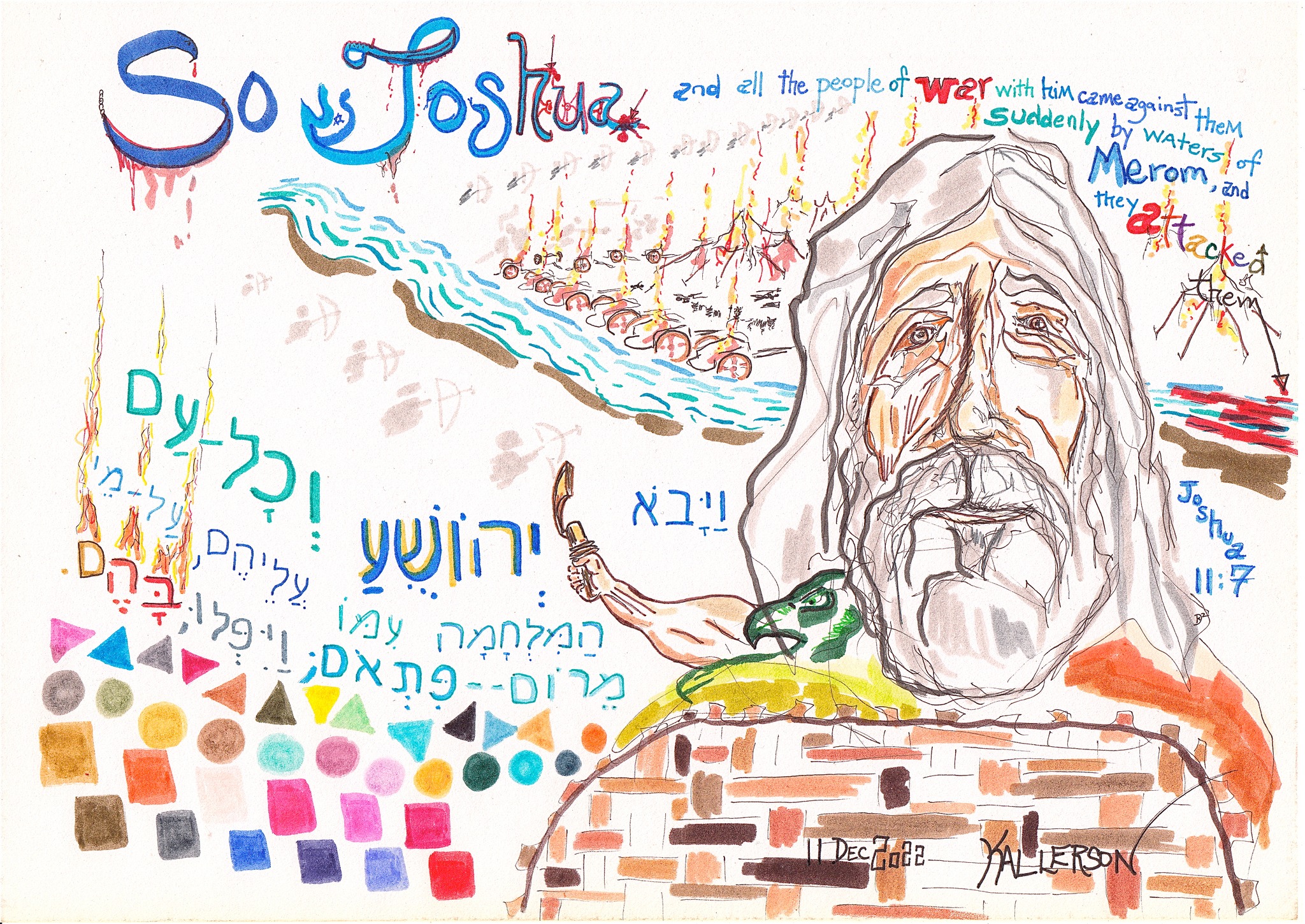
Artwork by Douglas Kallerson.
Joshua 11:1-15
The Waters of Merom
The passage today continues the same pattern that has been presented in Joshua. One step logically follows after another as each story about the life of Joshua and Israel unfolds in typology pointing to the Person and work of Christ and the lives of His people in Him.
There is a battle to be waged in our verses. It anticipates a battle that we face today. The victory is already found in Christ, but we still have to live out our lives in Christ and we constantly face enemies that come against us.
Paul speaks of this in Ephesians 6. He writes of spiritual warfare and of an unseen enemy. The fact is that the unseen enemy is working out his devices in real people and real teachings in the world. That is perfectly evident from Paul’s words when they are rightly considered. He spells out his thoughts on this spiritual warfare beginning in Ephesians 6:10, which is today’s text verse…
Text Verse: “Finally, my brethren, be strong in the Lord and in the power of His might. 11 Put on the whole armor of God, that you may be able to stand against the wiles of the devil. 12 For we do not wrestle against flesh and blood, but against principalities, against powers, against the rulers of the darkness of this age, against spiritual hosts of wickedness in the heavenly places. 13 Therefore take up the whole armor of God, that you may be able to withstand in the evil day, and having done all, to stand.” Ephesians 6:10-13
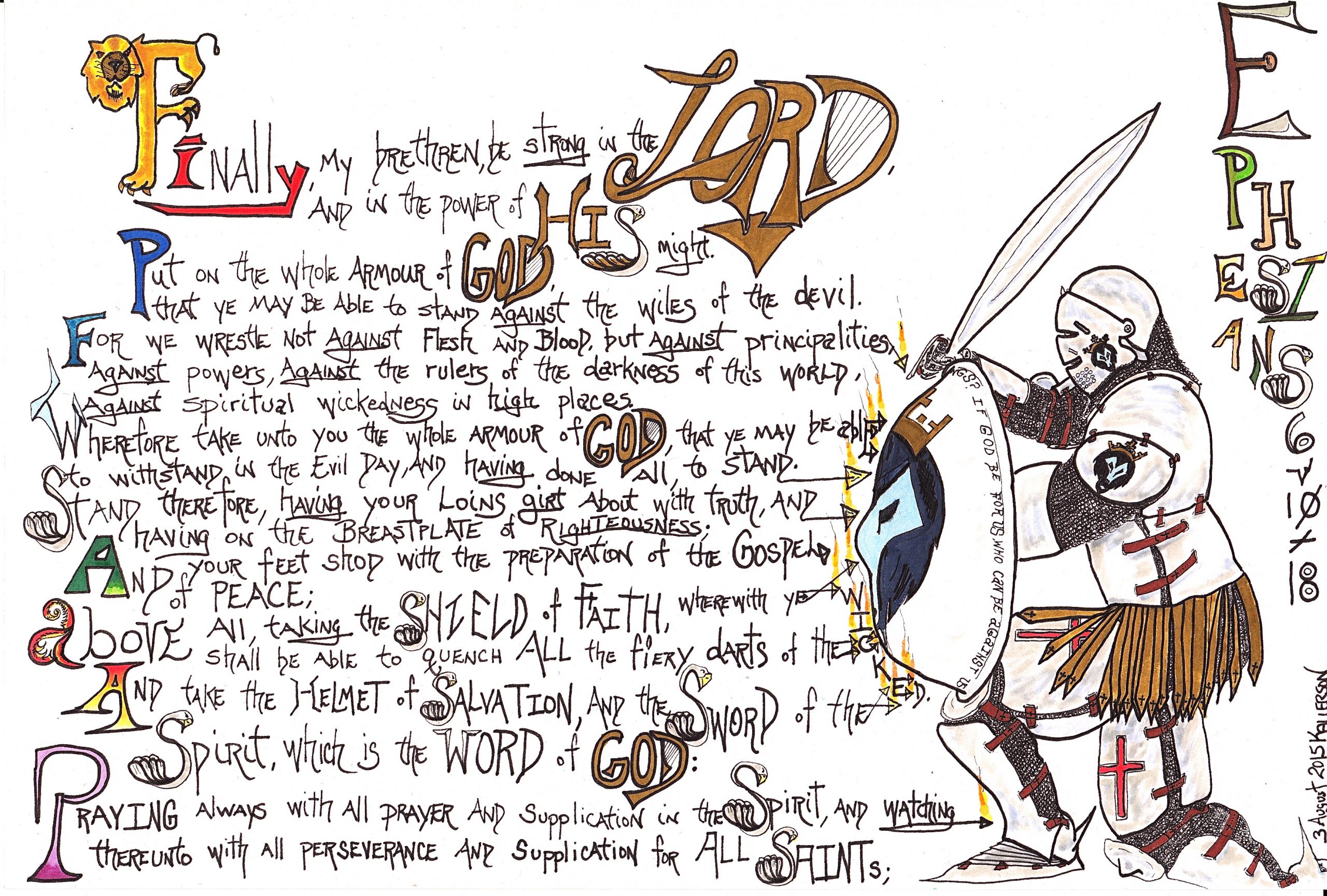
The words here seem more spiritual and less tangible as if there is this unseen battle that we somehow have to guard against. But his continued thoughts show us that the spiritual side only points to realities that we must face in our Christian lives.
There is the gospel of peace. It is a spiritual thing, but it is realized in real people. There are fiery darts of the wicked one. That isn’t the devil just shooting unseen arrows at you. It includes false teachers and preachers who are pointing their heresies at you, trying to destroy your faith. And so on.
The spiritual things Paul speaks of are realities we face. If people would understand this, there would be less hype and sensation about Ephesians 6, and there would be a lot more proper doctrine and getting the truth about Jesus out to those who need to hear it.
These things are typologically anticipated in today’s passage. Such great things as this are to be found in His superior word. And so, let us turn to that precious word once again, and… May God speak to us through His word today, and may His glorious name ever be praised.
I. So They Went Out (verses 1-5)
And it came to pass, when Jabin king of Hazor heard these things,
The words are based upon what was recorded in chapter 10 where the Gibeonites called Joshua to rescue them when attacked by the five kings. From there, Joshua defeated the five kings and went on to subdue the area of the southland. With that coming to the ears of Jabin, the account now begins.
The name Jabin, or yavin, has to do with discernment, coming from the word bin, meaning “to discern.” The name means He perceives, He discerns, He understands, The Wise, The Intelligent. This name may be a hereditary title of the ruler of Hazor because it is the same name used at a much later date as found in Judges 4.
The name Hazor, or khatsor, actually has various meanings based on its root which signifies “to begin to cluster or gather.” It may mean Village, Trumpet, Leek, Enclosure, and so on. The city will eventually fall within the borders of Naphtali (Joshua 19:36).
1 (con’t) that he sent to Jobab king of Madon, to the king of Shimron, to the king of Achshaph,
Jabin is the primary subject, but he needs an alliance in order to deal with the pressing issue: the Israelites flooding over the land, and destroying city after city. Hence, he calls out to other kings in order to form such an alliance.
The name Jobab, or yovav, comes from yavav, meaning to cry in a shrill voice. As such, it means To Call Shrilly, Crying Out, or To Lament. His city is Madon, coming from din, to judge. Thus, it probably means Contention or Strife.
Shimron comes from shamar, to watch or guard. Hence, it is Watching or Vigilant Guardian. Strong’s defines it as Guardianship. Shimron will eventually be located within the borders of Zebulun (Joshua 19:15).
Achshaph is possibly from kashaph, meaning to practice sorcery. Hence, it signifies Fascination or Bewitched. The city will eventually be located within the borders of Asher (Joshua 19:25). Along with the call out to these kings, the petition next reaches much further…
2 and to the kings who were from the north, in the mountains,
The word mountain is singular: v’el ham’lakhim asher mits’phon be’har – “And to the kings who from north in the mountain.” This probably refers to the hill-country as a single mountain. And so, it may refer to the mountainous area of Naphtali noted in Joshua 20:7.
2 (con’t) in the plain south of Chinneroth,
u-ba’aravah negev kinaroth – “and in the Arabah south Chinneroth.” The meaning is the plain that extends south from the Lake of Galilee to the Dead Sea as noted in Deuteronomy 1 –
These are the words Moses spoke to all Israel across the Jordan in the wilderness, in the Arabah opposite Suph, between Paran and Tophel, Laban, Hazeroth, and Di-zahab.” Deuteronomy 1:1 (Holman)
As a reminder, the word comes from arav, to grow dark. That is identical to arav – to take or give in pledge. Chinneroth comes from kinor, a harp. That comes from a root meaning to twang.
2 (con’t) in the lowland, and in the heights of Dor on the west,
u-bash’phelah u-b’naphot dor miyam – “And in the lowland, and in heights Dor from west.” The Shephelah is the lowland noted in Joshua 9:1. It is a broad flat plain extending south from Mt. Carmel.
The “heights of Dor” is literally, “the sieves of Dor.” The meaning is that as a sieve is raised, it pours out. Hence it can signify heights or borders of an area. Dor means To Dwell, but it is identical to the word translated as generation, as in the time period of one’s dwelling. Next…
3 to the Canaanites in the east and in the west, the Amorite, the Hittite, the Perizzite, the Jebusite in the mountains, and the Hivite below Hermon in the land of Mizpah.
More correctly, the words read: “the Cannanite from east and from west, and the Amorite, and the Hittite, and the Perizzite, and the Jebusite in the mountain [meaning hill country], and the Hivite under Hermon in land the Mizpah.”
The list is similar to that noted in Joshua 9:1. The meaning of the names are: Canaanite – Humiliated, Humbled, or even Subdued; Amorite – Talkers (active) or Renown (passive); Hittite – Terror, Terrible, Fearsome; Perizzite – Villager or Dweller in an Open Country; Jebusite – Treading Down (active) or Trodden Underfoot (passive); Hivite – Villagers, or maybe more specifically Tent Villagers; Hermon means Sacred; And finally, ha’mitspah or “The Mizpah” means The Watchtower.
This great alliance has been called together to come against Israel in battle, hoping to destroy them in one fell swoop…
4 So they went out, they and all their armies with them,
va’yetsu hem v’kal makhanehem imam – “And they went out, they and all their camps with them.” There is an obvious excitement in the words as it refers to the kings and then adding in the vast array of camps that accompanied them. A great and epic battle lay ahead that was comprised of…
4 (con’t) as many people as the sand that is on the seashore in multitude,
am rav ka’khol asher al sephath ha’yam la’rov – “People many according to the sand upon lip the sea to the multitude.” The thought is expressed in the superlative, comparable to “the stars in the heavens.” Just as they could not be counted, so it seemed that the multitudes in this battle could not be counted either. Also…
4 (con’t) with very many horses and chariots.
Again, it is stated in the superlative: v’sus va’rekhev rav meod – “And horse and chariot many very.” Noting the horses and chariots is intended to show the vast advantage held by this army. Israel had neither. If these were equipped with iron hooks or scythes, as would be expected, they could cut through the infantry with ease, mutilating any who were caught in their path.
5 And when all these kings had met together,
va’yivadu kol ham’lakhim ha’eleh – “And made an appointment all the kings, the these.” The idea is that of agreeing to meet at a set place and time in order to join forces. As such…
5 (con’t) they came and camped together at the waters of Merom to fight against Israel.
The words are close enough to get the meaning. The kings, along with their armies have come to the appointed place and they have camped together towards the waters of Merom.
The name Merom is found only here and in verse 7. It is formed similarly to the word marom, or height. As such, it is the highest or upper waters of the three lakes in the Jordan Valley, now known as the Hula Valley. Of this area, Albert Barnes notes –
“This lake occupies the southern half of the Ard el Huleh, a depressed basin some 15 miles long and 3 or 4 miles wide lying between the hills of Galilee on the west and the lower spurs of Hermon on the east. The size of the lake varies with the season, and the northern side of it ends in a large swamp. The shape of the lake is triangular, the point being at the south, where the Jordan, which enters it on the north, again quits it. There is a considerable space of tableland along the southwestern shore, and here probably the troops of Jabin and his confederates were encamped, preparing to move southward when Joshua and his army fell suddenly upon them.” Albert Barnes
The location was highlighted in a video on YouTube by an adventuresome couple known as Sergio and Rhoda in Israel entitled 500 Million Birds in Hula Valley. Unbelievable! As for this large and impressive army, they will next be described…
A battle is set, and the foes are gathered together
They want to destroy Israel from the face of the earth
They will come and attack in whatever weather
And if they gain the victory, they will dance with mirth
But we have the Lord on our side
And we have our exalted Leader in the battle
There is no way the enemy can abide
When we engage the fight and the swords start to rattle
The victory is assured when the Lord is our Head
We shall prevail! The Lord is with us!
Yes, the enemy will all be found dead
When we follow our Savior – the Lord Jesus
II. And They Attacked Them (verses 6-15)
6 But the Lord said to Joshua, “Do not be afraid because of them,
va’yomer Yehovah el Yehoshua al tira mipenehem – “And said Yehovah unto Joshua no do fear (sg.) from their faces.” It is the often-repeated phrase that the Lord has everything set, Joshua has no need to fret over the enormity of those arrayed against him…
6 (con’t) for tomorrow about this time I will deliver all of them slain before Israel.
Rather than “about,” the wording is exacting: ki makhar ka’eth ha’zot anokhi noten eth kulam khalalim lipne Yisrael – “For tomorrow according to the time, the this, I give all them pierced before Israel.” By the time that the hour they are speaking of comes, every soldier of the army will be pierced through.
The idea being conveyed here is that Israel has already gone up to meet the enemy and either a scout has reported the location of their encampment or Israel is close enough to see them. The distance to where Israel currently is located is too far from Gilgal to have marched in one day. Regardless of their current location, they will attack, and they will prevail.
6 (con’t) You shall hamstring their horses and burn their chariots with fire.”
The words are to Joshua in the singular: susehem t’aqer v’eth mark’votehem tisroph ba’esh – “their horses hamstring (sg.) and their chariots burn (sg.) in the fire.” The words carry several thoughts. The first is that of contempt. The horses and chariots would be dedicated to whatever god the people worshipped. This is seen, for example, in 2 Kings 23 –
“Then he removed the horses that the kings of Judah had dedicated to the sun, at the entrance to the house of the Lord, by the chamber of Nathan-Melech, the officer who was in the court; and he burned the chariots of the sun with fire.” 2 Kings 23:11
Even if not so dedicated, the horse and chariot would be a source of pride and confidence. To destroy them would be as if Israel had destroyed even that which the enemy trusted in –
“Some trust in chariots, and some in horses;
But we will remember the name of the Lord our God.” Psalm 20:7
This sentiment is found numerous times in the Old Testament where the horse is an implied source of trust and of victory in battle. Along with this, destroying the horses and the chariots was to teach Israel a future lesson as well.
Not only had they prevailed over such a foe, but they were to continue to trust in the Lord and not in their own armaments and abilities. This is seen explicitly in the law when referring to the multiplication of horses, not only for the king of Israel, but for the people as well –
“But he shall not multiply horses for himself, nor cause the people to return to Egypt to multiply horses, for the Lord has said to you, ‘You shall not return that way again.’” Deuteronomy 17:16
7 So Joshua and all the people of war with him came against them
va’yavo Yehoshua v’kal am ha’milkhamah immo alehem – “And came Joshua and all people the war with him upon them.” They are the ones to initiate the events in an offensive battle. This would leave the enemy completely surprised and unable to properly align themselves. This is because Israel came upon them…
7 (con’t) suddenly by the waters of Merom, and they attacked them.
al me Merom pithom va’yipelu bahem – “upon waters Merom suddenly and fell in them.” The obvious strategy was to meet in this area, prepare the army for battle, and then take the battle to Joshua. However, instead of that, Joshua caught them before they were set in any type of battle array, they were given no time to muster the army when they were attacked, and Israel simply fell upon them in a manner that was entirely indefensible. Thus…
8 And the Lord delivered them into the hand of Israel,
va’yitnem Yehovah b’yad Yisrael – “And gave them, Yehovah, in hand Israel.” The Lord is the Subject and the Giver of the enemy. Israel is the recipient. From there, it changes to the plural for the next verbs…
8 (con’t) who defeated them and chased them to Greater Sidon,
va’yakum va’yirdphun ad Tsidon Rabah – “And struck (pl.) them, and chased (pl.) them to Sidon Greater.” Sidon comes from tsud – to hunt. Thus, it is Hunting Place. As it is on the coast, it means to hunt fish and thus, Fishery. Combined with the word rabah, it would mean Great Hunting Place or Great Fishery.
8 (con’t) to the Brook Misrephoth, and to the Valley of Mizpah eastward;
v’ad misr’photh mayim v’ad biqat mitspeh mizrakhah – “and to Burning of Water, and to Valley Watchtower eastward.” Misrephoth comes from saraph, to burn. Combined with mayim, or water, it thus means Burning of Water(s).
It is debated what Burning of Waters means. Some think it is glass manufacture. Others think hot springs. But the only hot springs in Israel are a bit south and east of the Sea of Galilee. Some think it is smelting pits by water, or something else. Regardless, with the flight of the enemy noted, the verse ends with…
8 (con’t) they attacked them until they left none of them remaining.
The translation is wrong. The second verb is singular and so it is speaking of either the Lord or Israel. Israel is the nearest antecedent, and so it is the most likely subject: va’yakum ad bilti hishir lahem sarid – “and they strike them until none he left (sg.) to them survivor.” The entire verse thus reads:
“And He gives them, Yehovah, in hand Israel. And they strike them, and they chase them to Great Fishery and to Burning of Water and to Valley of Watchtower eastward, and they strike them until none he [Israel] left to them survivor.”
Those who fled from the battle went northwest to Sidon, southwest to Misrephoth Mayim, and eastward to the Valley of Mizpah. They ran all over, but Israel pursued them and utterly destroyed them.
9 So Joshua did to them as the Lord had told him:
The words now are given to confirm the words of verse 6. The word of Yehovah was given, and Joshua is shown to have fulfilled it exactingly…
9 (con’t) he hamstrung their horses and burned their chariots with fire.
Exactly as was spoken by the Lord to Joshua, so it is done:
Their horses you shall hamstring and their chariots you shall burn in the fire.
Their horses he hamstrung and their chariots he burned in the fire.
With that noted, the words continue to refer to Joshua…
10 Joshua turned back at that time and took Hazor, and struck its king with the sword;
It appears that with the sudden attack upon the armies, and with a sure defeat at hand, the king of Hazor fled back to his city. As he was the chief instigator of the planned attack, this is Joshua’s first order of business after eliminating all the other fleeing enemy. As such, he took the city and then struck her king, as the Hebrew says, “in the sword.” The reason for this is next explicitly stated…
10 (con’t) for Hazor was formerly the head of all those kingdoms.
Earlier, it was said that the name Hazor is derived from a root that signifies “to begin to cluster or gather.” This is almost a typological pun then. Hazor was the head of this gathering of kingdoms as if it was the trumpet that was blown to gather them together.
Because of their position as the head, it was to receive a special mark of punishment that would go beyond what other such cities would face. It would be the first and the most utterly destroyed…
11 And they struck all the people who were in it with the edge of the sword, utterly destroying them.
va’yaku eth kal ha’nephesh asher bah l’pi kherev hakherem – “And struck every soul who in her to mouth sword anathematizing.” Exactly as was ordered according to the law, so Joshua unfailingly accomplishes. Every soul is devoted to the Lord. This is then further explained…
11 (con’t) There was none left breathing.
lo nothar kal n’shamah – “No remaining every breath.” Complete extermination is the command. Nothing is to be left alive, and so in exacting compliance with the law, so it was done. And as a final indignation for initiating the alliance…
11 (con’t) Then he burned Hazor with fire.
v’eth khatsor saraph ba’esh – “And Hazor he burned in the fire.” This was to keep it from being reoccupied. However, in Judges 4:2, it is seen that it was rebuilt, despite being within the land grant of Naphtali. At that time it was ruled by another king also known as Jabin. For the present time, however, the city would remain unoccupied.
12 So all the cities of those kings, and all their kings, Joshua took and struck with the edge of the sword.
This is referring to the list of the kings that had joined together in verses 1 & 2. It would be the ideal time to do this because their fighting men had been wiped out. As such, their resistance would be greatly diminished. And fighting men left behind would eventually be worn out. The cities would be quickly overthrown and destroyed.
The words “and all their kings,” could mean either that they died in battle, and they are included in the narrative now, or they could have fled to their cities and were wiped out then, or new kings were appointed to replace those lost in battle. Once the city was destroyed, the new kings would be executed as well.
12 (con’t) He utterly destroyed them, as Moses the servant of the Lord had commanded.
The singular, identifying Joshua as the subject, continues here. He anathematized them exactly in accord with the Law of Moses. Nothing was left undone that was to be accomplished according to the precepts handed down to him –
“But of the cities of these peoples which the Lord your God gives you as an inheritance, you shall let nothing that breathes remain alive, 17 but you shall utterly destroy them: the Hittite and the Amorite and the Canaanite and the Perizzite and the Hivite and the Jebusite, just as the Lord your God has commanded you, 18 lest they teach you to do according to all their abominations which they have done for their gods, and you sin against the Lord your God.” Deuteronomy 20:16-18
13 But as for the cities that stood on their mounds, Israel burned none of them,
raq kal he’arim ha’om’doth al tilam lo s’rapham Israel – “Only, all the cities the standers upon their mound, no burned them Israel.” The meaning is that these cities were anathematized, meaning all life in them, but the structures were not destroyed. They could be inhabited and would be easy to defend. Thus, there was no need to utterly destroy them. The cities were spared…
13 (con’t) except Hazor only, which Joshua burned.
The exemptions of the previous clause are credited to Israel while the destruction in this one is credited to Joshua: zulati eth khatsor l’badah saraph Yehoshua – “Besides Hazor to alone burned Joshua.” The leading city of the conflict and the beginning of the gathering was purposefully destroyed as an example, a lesson, and a warning.
14 And all the spoil of these cities and the livestock, the children of Israel took as booty for themselves;
The law of kherem, or anathema, is decided by the Lord. If He allows the spoil to be taken by Israel, then they may take it. In this case, it was granted to them. By the time Israel apportions the land and begins to settle, they would have all they would need to immediately settle down and begin a productive life. For the people in the cities, not so much…
14 (con’t) but they struck every man with the edge of the sword until they had destroyed them, and they left none breathing.
raq eth kal ha’adam hiku l’pi kherev ad hishmidam otam lo hishiru kal n’shamah – “only, every the man struck to mouth sword until they destroyed them; no left any breath.” The words “the man” do not exclude women. Rather, in this case, it speaks of humanity. All humans were slain by the sword until there was no breath left…
*15 (fin) As the Lord had commanded Moses His servant, so Moses commanded Joshua, and so Joshua did. He left nothing undone of all that the Lord had commanded Moses.
Every verb in the Hebrew is in the perfect aspect. Thus, it is a mark of total completion of everything conveyed. The sequence of what is said is not to be missed. The Lord commanded Moses and he completed as commanded. Moses then commanded Joshua who also completed everything. It is then restated that nothing was left undone. All that the Lord had commanded Moses was completed.
The Word of God – holy, pure, and perfect too
Is given to satisfy man’s weary soul
In this life, let us take an eternal view
And allow the word to convert us to God’s heavenly roll
There, in the Book of Life our names will be
Because we pursued His word and found Jesus
Innumerable redeemed, there beside the glassy sea
Such a marvelous thing God has done for us
If we will just open the Bible, our own Book of Life
And accept what it says as holy and true
Then between us and God will end the strife
In believing the gospel, life begins anew
Thank You, O God, for this marvelous word
In accepting its truths our place in heaven is forever assured
III. Pictures of Christ
In the first portion of Chapter 10, we had a pretty clear picture of the Judaizers or Hebrew Roots movement people coming in and attacking the people of God. What was required was to destroy the five kings once and for all. It was a total ending of the Law of Moses, meaning the Torah, the Pentateuch, or the five books of Moses as a means of obtaining God’s favor.
The second portion of Chapter 10 continued to anticipate false teachers and false doctrines, such as work-based salvation. Instead, all such avenues are negated by the work of Jesus.
This passage continues on with those that come against the completed work of Christ, just as these foes are set to come against and destroy Israel. This is first seen in the leader of the gathering, Jabin, king of Hazor. Jabin is He understands, or more directly The Wise (Intelligent).
What we see is a picture of those who would come against sound doctrine by the intellectual elite that would stand against the wisdom of God –
“For the message of the cross is foolishness to those who are perishing, but to us who are being saved it is the power of God. 19 For it is written:
‘I will destroy the wisdom of the wise,
And bring to nothing the understanding of the prudent.’
20 Where is the wise? Where is the scribe? Where is the disputer of this age? Has not God made foolish the wisdom of this world? 21 For since, in the wisdom of God, the world through wisdom did not know God, it pleased God through the foolishness of the message preached to save those who believe. 22 For Jews request a sign, and Greeks seek after wisdom; 23 but we preach Christ crucified, to the Jews a stumbling block and to the Greeks foolishness, 24 but to those who are called, both Jews and Greeks, Christ the power of God and the wisdom of God. 25 Because the foolishness of God is wiser than men, and the weakness of God is stronger than men.” 1 Corinthians 1:18-25
As noted, Hazor has various meanings, but the root word is what is instructing us. It comes from a word signifying “to begin to cluster or gather.” This is exactly what Paul writes of as expressed to Timothy –
“For the time will come when people will not put up with sound doctrine. Instead, to suit their own desires, they will gather around them a great number of teachers to say what their itching ears want to hear.” 2 Timothy 4:3 (NIV)
Such people are what the epistles focus on. They are the Gnostics with their secret wisdom. They are the intelligentsia who are too smart for the gospel. They are those who want to divide and destroy for their own gain.
The only other king mentioned by name is Jobab. That signifies Crying Out. His city, Madon, signifies Contention or Strife. He is the type spoken of by Paul in the pastoral epistles. They cry out and lament over the simplicity of the gospel and strive contentiously to destroy it –
“But avoid foolish and ignorant disputes, knowing that they generate strife.” 2 Timothy 2:23
&
“But avoid foolish disputes, genealogies, contentions, and strivings about the law; for they are unprofitable and useless. 10 Reject a divisive man after the first and second admonition, 11 knowing that such a person is warped and sinning, being self-condemned.” Titus 3:9-11
The other two kings were unnamed, but their cities’ names meant Guardianship and Fascination or Bewitched. Paul equates the law to a guardianship in Galatians 4:2. I would suggest that these are two more types of foes to the gospel. Those who still want to cling to the law and those who are sensationalists, focusing on anything but the purity of the gospel.
Without going into every name of every location or people group that is then identified, we can assume that they are all allied with those already mentioned who come against the gospel. They are foes of it, and they are aligned against the people of God, ready to destroy them.
Together, they meet towards the waters of Merom. The word means Height. Its root is used when speaking of the proud –
Who is it you have mocked and blasphemed? Who have you raised your voice against and lifted your eyes in pride [lit: on high]? Against the Holy One of Israel!” Isaiah 37:23 (BSB)
This is exactly what those who come against the gospel do. They come against the Holy One of Israel in pride. They say His cross is insufficient, or that it is out of reach except to the enlightened, or any of ten thousand other permutations of twisting the truth.
And yet, despite the innumerable false doctrines and their false teachers, the gospel of Christ remains the only force suitable for salvation. Joshua’s battle is promised to be won and that it would be on the following day. As long as Jesus is the Leader of our faith, we too shall prevail.
With that, in verse 6, the Lord told Joshua, “You shall hamstring their horses and burn their chariots with fire.” The lesson is anything that will bring about pride in one’s abilities or that will distract us from a total reliance on the Lord must be completely removed. Pride leads to idolatry of self. But salvation is a work of the Lord alone.
In verse 7, we saw the attack of Joshua and the people of war “upon waters of Merom.” For those who are with Christ Jesus, the attack is against the flowing pride of the false teachers. In verse 8, the words went from the singular (the Lord) to the plural, and then back to the singular. The battle is won.
I can only speculate what the three places where the enemy fled to and were later destroyed signify, but I would say that the Great Fishery is the victory of the gospel for those who are fishers of men.
The Burning of Water would be zeal for the word of those who hold to it for sound instruction, prevailing over the enemy with it. And the Valley of the Watchtower would be the place where those who carefully watch over the truth of the gospel prevail. I have to admit this is total speculation, but it does fit the typology of waging a war for the purity of the gospel.
Verse 9 gave the credit for the actions solely to Joshua. And this is how it should be for any who are in the Lord. He is to receive the credit for destroying the pride of the enemy. Verse 10 then went on to describe Joshua’s taking of Hazor and the killing of the king with his sword.
The destruction of the entity that rose up as the head of all of those false doctrines is ultimately accomplished by the Lord. The killing of the king with the sword is a picture of Christ destroying them with the Law (remembering from many other sermons that the words sword and Horeb, where the law was given, are spelled the same).
He is the embodiment of the law. The gospel is that Christ fulfilled the law, that He died in fulfillment of it, and that He prevailed over it through His resurrection. Our faith in that as outlined in 1 Corinthians 15:3, 4 is what wins the battle and destroys the enemy.
With that, verse 11 said that all in the city were anathematized. This is what those who teach false gospels are, anathema, as Paul says in Galatians 1 –
“I marvel that you are turning away so soon from Him who called you in the grace of Christ, to a different gospel, 7 which is not another; but there are some who trouble you and want to pervert the gospel of Christ. 8 But even if we, or an angel from heaven, preach any other gospel to you than what we have preached to you, let him be accursed [anathema]. 9 As we have said before, so now I say again, if anyone preaches any other gospel to you than what you have received, let him be accursed.” Galatians 1:6-9
All false gospels will be utterly destroyed. Only what Christ has done will remain. This is the battle that we are in, and it is just what this passage is conveying to us.
Verse 12 detailed Joshua’s taking all of the other kings and their cities and destroying them with the sword as well. In other words, all who come against the gospel will fail to overcome. God’s people will prevail because Jesus has prevailed.
Verse 13 curiously mentions the cities of the kings were not destroyed even though all the inhabitants were. As a note of speculation, I would say this pictures those teachings that begin on the foundation of Christ but which divert from the truth. The city, the teaching founded on Christ, will remain, but those who pervert it – along with their teachings – will be destroyed.
Verse 14 said that the children of Israel took the spoil of the cities for themselves. Everything that is good and acceptable is to be saved. Only that which perverts and is wicked will be destroyed. Likewise, there will be rewards and losses for those who belong to Christ according to the lives they lead while in Christ.
With that, the verses today end with words of absolute completion of everything directed by the Lord. The Lord had commanded Moses – the Law. Moses commanded Joshua – the law was set forth before Jesus. Joshua followed the instructions completely – Jesus did all the law until it was complete.
The text then restated that nothing was left undone. All was finished according to the Lord’s commands to Moses. Jesus wholly and entirely fulfilled what He was sent forth to do. The gospel is given based on this and nothing else. Only Christ accomplished the work. Only Christ’s work can bring Israel (God’s people – the commonwealth of Israel) to victory.
Anything that comes against the gospel is already defeated for all intents and purposes, but it also continues to be defeated in this dispensation of grace. This is the lesson of the passage today. It follows marvelously after the lessons of chapter 10.
Each step of Joshua is showing us the victory of the Lord in all ways and at all times. He has done it; now we just need to follow Him in the battle and be obedient to what He has set forth. This is the commission that we saw in our text verse today.
The overall lesson, once again, is that the Lord is in control, He has a plan, and that plan will come to pass. In the meantime, there are those who will come against God’s people, be it the Judaizers, those who claim a wisdom that only they can convey, those who hold to immorality and licentiousness as an acceptable thing, or an innumerable host of other falsities.
We need to be on guard against such things, and we do that by staying in God’s word – reading it, learning it, meditating on it, and applying it to our lives. Jesus has already gained the victory. That is seen and understood already, but we still have a part to play in this ongoing and unfolding narrative called “redemptive history.”
And so let us trust in the Lord, be obedient to His word, and accept the victory that He has already won. Let us not lose out by getting involved with falsity, error, manipulation of the word, and so on. We eat three meals a day. By the next meal we have, we may not remember what it was we ate in the last meal, but it still did us good.
How can we expect to be filled with good if we neglect reading the word, attending Bible studies, and coming to church? That’s not how God has designed us, and we will suffer from it. This is an appeal to do those things because this is what we need to follow for holy living.
Spend more time in the word, spend more time thinking about the word, and spend more time talking to the Lord about His word. Let us fix our eyes on Jesus and let us read our Bibles. To the glory of God who sent Jesus and to the glory of God who gave us the word.
Closing Verse: “Stand therefore, having girded your waist with truth, having put on the breastplate of righteousness, 15 and having shod your feet with the preparation of the gospel of peace; 16 above all, taking the shield of faith with which you will be able to quench all the fiery darts of the wicked one. 17 And take the helmet of salvation, and the sword of the Spirit, which is the word of God; 18 praying always with all prayer and supplication in the Spirit, being watchful to this end with all perseverance and supplication for all the saints…” Ephesians 6:14-18
Next Week: Joshua 11:16-23 His victory is complete, and it is grand… (And Joshua Took All the Land) (24th Joshua Sermon)
The Lord has you exactly where He wants you. He has a good plan and purpose for you. It is He who has defeated the enemy and who now offers His people rest. So, follow Him and trust Him and He will do marvelous things for you and through you.
The Waters of Merom
And it came to pass
When Jabin king of Hazor heard these things
That he sent to Jobab king of Madon
To the king of Shimron, to the king of Achshaph, and to the kings…
Who were from the north
In the mountains where skiing is the best
In the plain south of Chinneroth
In the lowland, and in the heights of Dor on the west
To the Canaanites in the east and in the west
The Amorite, the Hittite, the Perizzite – hoorah!
The Jebusite in the mountains
And the Hivite below Hermon in the land of Mizpah
So they went out, they and all their armies with them
As many people as the sand
That is on the seashore in multitude
With very many horses and chariots, an army quite grand
And when all these kings had met together
So the account does tell
They came and camped together at the waters of Merom
To fight against Israel
But the LORD said to Joshua
“Do not be afraid because of them, so to you I tell
For tomorrow about this time I will deliver all of them
Slain before Israel
“You shall their horses hamstring
And burn their chariots with fire, yes you shall do this thing”
So Joshua and all the people of war with him
Came against them suddenly (surely, they will get whacked!)
By the waters of Merom
Israel fell upon them and attacked
And the LORD delivered them into the hand of Israel
Who defeated them and chased them to Greater Sidon
To the Brook Misrephoth, and to the Valley of Mizpah eastward
They attacked them until they left of them remaining none
So Joshua did to them as the LORD had told him
Yes, so he had learned
He hamstrung their horses
And their chariots with fire he burned
Joshua turned back at that time and took Hazor
And struck its king with the sword
For Hazor was formerly the head of all those kingdoms
But it was a goner before the Lord
And they struck all the people
Who were in it with the edge of the sword, as the battle churned
Utterly destroying them. There was none left breathing
Then he Hazor with fire burned
So all the cities of those kings, and all their kings
Joshua took and struck with the edge of the sword
———-as the situation demanded
He utterly destroyed them
As Moses the servant of the LORD had commanded
But as for the cities that stood on their mounds
Israel burned none of them, burning them was spurned
Except Hazor only
Which Joshua burned
And all the spoil of these cities and the livestock
The children of Israel took as booty for themselves – ooh what fun
But they struck every man with the edge of the sword
Until they had destroyed them, and they left breathing no one
As the LORD had commanded Moses His servant
So Moses commanded Joshua, and so Joshua did also
He left nothing undone
Of all that the LORD had commanded Moses, yes it was so
Lord God, turn our hearts to be obedient to Your word
Give us wisdom to be ever faithful to You
May we carefully heed each thing we have heard
Yes, Lord God may our hearts be faithful and true
And we shall be content and satisfied in You alone
We will follow You as we sing our songs of praise
Hallelujah to You; to us Your path You have shown
Hallelujah we shall sing to You for all of our days
Hallelujah and Amen…
And it came to pass, when Jabin king of Hazor heard these things, that he sent to Jobab king of Madon, to the king of Shimron, to the king of Achshaph, 2 and to the kings who were from the north, in the mountains, in the plain south of Chinneroth, in the lowland, and in the heights of Dor on the west, 3 to the Canaanites in the east and in the west, the Amorite, the Hittite, the Perizzite, the Jebusite in the mountains, and the Hivite below Hermon in the land of Mizpah. 4 So they went out, they and all their armies with them, as many people as the sand that is on the seashore in multitude, with very many horses and chariots. 5 And when all these kings had met together, they came and camped together at the waters of Merom to fight against Israel.
6 But the Lord said to Joshua, “Do not be afraid because of them, for tomorrow about this time I will deliver all of them slain before Israel. You shall hamstring their horses and burn their chariots with fire.” 7 So Joshua and all the people of war with him came against them suddenly by the waters of Merom, and they attacked them. 8 And the Lord delivered them into the hand of Israel, who defeated them and chased them to Greater Sidon, to the Brook Misrephoth, and to the Valley of Mizpah eastward; they attacked them until they left none of them remaining. 9 So Joshua did to them as the Lord had told him: he hamstrung their horses and burned their chariots with fire.
10 Joshua turned back at that time and took Hazor, and struck its king with the sword; for Hazor was formerly the head of all those kingdoms. 11 And they struck all the people who were in it with the edge of the sword, utterly destroying them. There was none left breathing. Then he burned Hazor with fire.
12 So all the cities of those kings, and all their kings, Joshua took and struck with the edge of the sword. He utterly destroyed them, as Moses the servant of the Lord had commanded. 13 But as for the cities that stood on their mounds, Israel burned none of them, except Hazor only, which Joshua burned. 14 And all the spoil of these cities and the livestock, the children of Israel took as booty for themselves; but they struck every man with the edge of the sword until they had destroyed them, and they left none breathing. 15 As the Lord had commanded Moses His servant, so Moses commanded Joshua, and so Joshua did. He left nothing undone of all that the Lord had commanded Moses.