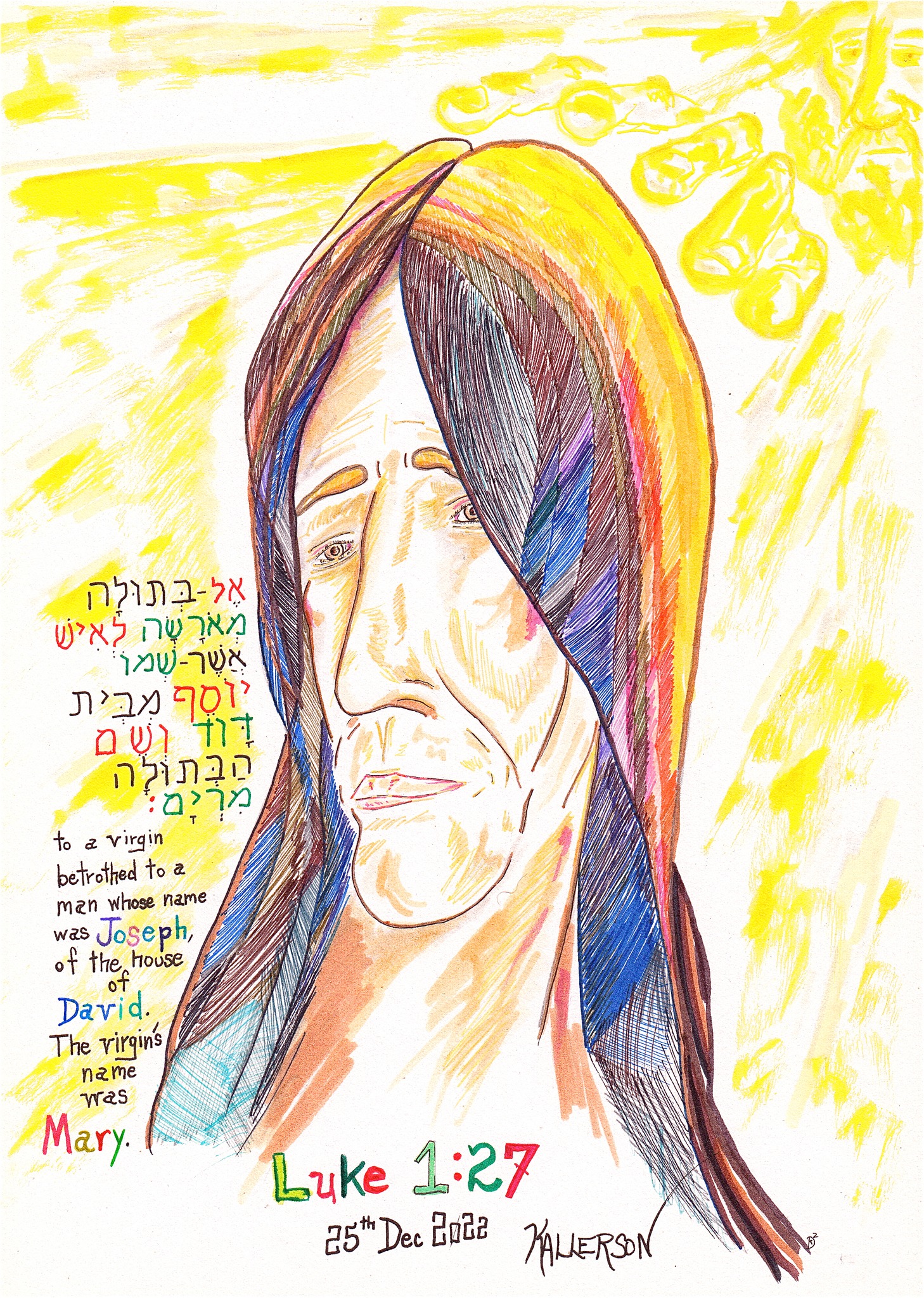
Artwork by Douglas Kallerson.
Luke 1:27
The Virgin’s Name Was Mary
(Read: Luke 1:26-38) One aspect of churches that hold to a literal interpretation of Scripture is, obviously, their focus on Jesus. He is the Grand Subject of everything going on in the Bible. Therefore, Bible-believing men and women will naturally direct their attention and adoration toward Him and what He has done.
Take Paul, the tireless apostle of Jesus Christ, who stated his thoughts on the matter clearly and precisely in several ways. Concerning the Person of Jesus, he said –
“But what things were gain to me, these I have counted loss for Christ. 8 Yet indeed I also count all things loss for the excellence of the knowledge of Christ Jesus my Lord, for whom I have suffered the loss of all things, and count them as rubbish, that I may gain Christ 9 and be found in Him, not having my own righteousness, which is from the law, but that which is through faith in Christ, the righteousness which is from God by faith; 10 that I may know Him and the power of His resurrection, and the fellowship of His sufferings, being conformed to His death, 11 if, by any means, I may attain to the resurrection from the dead.” Philippians 3:7-11
Concerning the sacrifice of Christ Jesus, he says –
“But God forbid that I should boast except in the cross of our Lord Jesus Christ, by whom the world has been crucified to me, and I to the world.” Galatians 6:14
And this is not unique to Paul. Everything about the gospels, the book of Acts, and the other epistles finds its greatest focus on the Lord Jesus and what He has done. All other aspects of Scripture point to Him in one way or another, calling out for us to direct our eyes, our hearts, and our attention to Him.
The unnamed author of Hebrews states the matter so exactingly and concisely, that it is hard to imagine how people miss it –
“Let us fix our eyes on Jesus, the author and perfecter of our faith, who for the joy set before Him endured the cross, scorning its shame, and sat down at the right hand of the throne of God.” Hebrews 12:2 (BSB)
Let’s consider these words. Elsewhere, Paul says, “All Scripture is given by inspiration of God” (2 Timothy 3:16). Peter then explains that, specifically saying it is the third member of the Godhead, the Holy Spirit, by whom the men of God spoke (2 Peter 1:21).
As for Hebrews 12:2, we were instructed to fix our eyes on Jesus and that it is He who sat down at the right hand of the throne of God. It is Jesus, the God/Man, who is to be our focus even though Jesus is sitting at the throne of God.
And this is testified to by the Holy Spirit. In other words, the Holy Spirit inspired what is written, and Hebrews 12:2 says that we are to fix our eyes on Jesus, it means that the Holy Spirit is instructing us to do this. But more, even the Father has explicitly instructed us concerning the Son –
“While he was saying this, a cloud came and overshadowed them; and they were fearful as they entered the cloud. 35 And a voice came out of the cloud, saying, ‘This is My beloved Son. Hear Him!’” Luke 9:34, 35
Nothing could be clearer. Jesus! It is all about Jesus! We are to hear Him. We are to fix our eyes on Him. We are to boast in His cross. We are to consider Christ as our Source of gain. We are to know Him and the power of His resurrection, and even to fellowship in His sufferings. This is what Scripture tells us.
Text Verse: “In the beginning was the Word, and the Word was with God, and the Word was God. 2 He was in the beginning with God. 3 All things were made through Him, and without Him nothing was made that was made. 4 In Him was life, and the life was the light of men. 5 And the light shines in the darkness, and the darkness did not comprehend it.” John 1:1-5
John begins his gospel narrative with a note concerning Jesus, the Word of God, tying Him directly to the Creator God, Elohim, of Genesis 1:1. Notice the unmistakable connection –
“In the beginning God created the heavens and the earth.”
“In the beginning was the Word, and the Word was with God, and the Word was God. … All things were made through Him, and without Him nothing was made that was made.”
John’s introduction of the Word, Jesus, and his note of the creation wrought by Him is to tell us plainly and unambiguously that Jesus is the Lord God of the Old Testament, having come in the flesh. No wonder the other writers of the New Testament admonish us as they do concerning where our attention is to be directed.
And yet, being misdirected away from this fundamental truth is the main goal of the devil to this day. It may be a direct attack, such as that of the Jehovah’s Witnesses denying the deity of Christ. It may be a diversionary attack, such as that found in the Mormons where Jesus was a man who became a god and that we too can be a god someday, ruling our own little universe.
It may be a subtle dismissal of the authority of Christ as is occurring in almost every mainstream denomination of the church today. Idols of perverted sex or the diminishing the God-ordained church hierarchy have become a substitute for allegiance to Jesus, the Lord God.
Instead, He is relegated to a sappy figure who will tolerate whatever evil inclination of the heart arises to permeate the congregation and, indeed, the entire denomination.
Sadly, another approach is to exalt others to positions of spiritual recognition that belong to Christ Jesus alone. This is a principal tenant of the Roman Catholic Church where the Pope assumes a primary role in mediatorial aspects of the faith, something that directly contradicts Scripture.
This is followed by lesser mediatorial roles assigned to saints and priests as well. But of all of their violations of Scripture, the most damaging is that of the worship and adoration of Mary. It is, literally speaking, a fatal flaw of their faith.
The amount of attention focused on her is so genuinely demeaning of the Lord that it is hard to imagine how those who are caught up in this overt cult will escape their just condemnation. She has supplanted Jesus in innumerable ways through their rites, rituals, and doctrines.
Sadly, this will bring condemnation on many who have never come to a saving knowledge of the only One who can bear their sin debt and who will then mediate for them before the Father. It is truly heartbreaking how misdirected people have become. And the prophetic word exactingly showed us in advance the state of the church as the end times approaches.
Let us hold fast to the faith we profess, meaning the eye-directed, ear-hearing attention that comes through embracing Jesus Christ as the Object of our hope and the Subject of our faith. This is the doctrine that is to be found in God’s superior word. And so, let us turn to that precious word once again, and… May God speak to us through His word today, and may His glorious name ever be praised.
I. What About Mary?
For simplicity’s sake, I went online and typed the words, “All References to Mary in Scripture.” The obvious meaning is “Mary the mother of Jesus.” Google, being rather slow at 5am, took 4.77 seconds to come up with “about 7,050,000 results.”
The first site that came up was maryimmaculate.tripod.com and the following was pulled from there. If it is incorrect in one place or another, please blame them. I like to be precise in everything I do, especially in regard to Scripture, but for the sake of the sermon today it isn’t of critical importance if they missed a reference or two.
My guess is that they did not. If they are trying to exalt Mary, they will do their best to ensure they have every possible detail available for that purpose. They appeal to the Old and New Testaments in order to exalt her to a point of adoration and worship. For example, they say that she is noted in Genesis 3:15 –
“And I will put enmity
Between you and the woman,
And between your seed and her Seed;
He shall bruise your head,
And you shall bruise His heel.” Genesis 3:15
Unfortunately for their argument, this is not speaking of Mary, except in an incidental manner. Mary is a woman and she would bear the Messiah, but the focus is actually on the Seed of the woman as opposed to the seed of man.
In other words, this is speaking less of a particular woman than it is speaking of One born of a woman but not of a man, meaning not having a human father. Therefore, woman is not the relevant point of the verse at all. It is the process involved and the theology behind the coming of the Seed of the woman that is being highlighted.
This is not discernable at this early point in the redemptive narrative, but in understanding the overall context of Scripture, this is what is being conveyed. No matter what, however, the focus is on the Seed, not the woman. This then follows along with the prophecy of Isaiah –
“Therefore the Lord Himself will give you a sign: Behold, the virgin shall conceive and bear a Son, and shall call His name Immanuel.” Isaiah 7:14
Again, the focus is on the Son. The sign is a virgin who conceives. A sign stands for something else; it is not the thing itself. In other words, her virginity is highlighted, not who she is. And even her virginity is only given to highlight and direct attention to a theological point being made. To understand the limiting nature of Genesis 3 and Isaiah 7, we can cite the words of Jacob from Genesis 49 –
“The scepter shall not depart from Judah,
Nor a lawgiver from between his feet,
Until Shiloh comes;
And to Him shall be the obedience of the people.” Genesis 49:10
The prophecy of Genesis 3:15 excludes the seed of man. Hence, no person born of a union between a man and a woman will be the Messiah. Thus, all such unions are excluded. As noted, this will later be confirmed by Isaiah 7:14 where it explicitly states that a virgin will conceive. No non-virgin will bear the Messiah.
As every female ever born was born as a virgin, it could ostensibly be any woman up until the point that she was no longer a virgin who could bear the Messiah. However, we know from Scripture that a descendant of Abraham would bear the Messiah. Thus, no virgin outside of the line of Abraham could be the Messiah.
From there, that was further refined when Isaac was chosen as the son of promise. One must descend from Isaac to be considered as the Messiah. Again, that was later refined to mean one born of Jacob, who is Israel. Only someone born from the line of Israel could be the Messiah. Any virgin of Israel could potentially be the bearer of the Messiah at this point in the narrative.
With that clearly presented in Scripture, Jacob’s prophecy narrowed this down to the tribe of Judah. Therefore, any virgin of Judah, who is descended from Jacob, Isaac, and Abraham could potentially be the bearer of the Messiah. But this is then further refined in 2 Samuel 7 where the promised seed was to come through the house of David –
“When your days are fulfilled and you rest with your fathers, I will set up your seed after you, who will come from your body, and I will establish his kingdom. 13 He shall build a house for My name, and I will establish the throne of his kingdom forever. 14 I will be his Father, and he shall be My son. If he commits iniquity, I will chasten him with the rod of men and with the blows of the sons of men. 15 But My mercy shall not depart from him, as I took it from Saul, whom I removed from before you. 16 And your house and your kingdom shall be established forever before you. Your throne shall be established forever.” 2 Samuel 7:12-16
This is why, just before uttering his prophecy concerning the coming Son who would be born of a virgin, Isaiah said, “Hear now, O house of David! Is it a small thing for you to weary men, but will you weary my God also?” (Isaiah 7:13).
Isaiah specifically addresses the house of David because it was clearly understood from the words of 2 Samuel 7 that the Messiah would come through David’s house. Thus, any virgin of the house of David, which was of the tribe of Judah, and who came from Jacob, Isaac, and Abraham could potentially be the bearer of the Messiah.
Other prophecies within Scripture further refine the timing of the coming of the Messiah, the place where He would be born, and so on. But the focus is always on the coming Messiah.
Identifying Mary as a person to be worshiped based on these and other Old Testament references would be no different than identifying Bethlehem as a place to be worshiped. The attention is on neither. They are simply incidental necessities to identify the Messiah based on the prophetic utterances.
For example, in their quest to exalt Mary as worthy of worship, maryimmaculate.tripod.com cites Micah 5. Think on who is being highlighted and why the other references are given, such as Bethlehem –
“But you, Bethlehem Ephrathah,
Though you are little among the thousands of Judah,
Yet out of you shall come forth to Me
The One to be Ruler in Israel,
Whose goings forth are from of old,
From everlasting.”
3 Therefore He shall give them up,
Until the time that she who is in labor has given birth;
Then the remnant of His brethren
Shall return to the children of Israel.
4 And He shall stand and feed His flock
In the strength of the Lord,
In the majesty of the name of the Lord His God;
And they shall abide,
For now He shall be great
To the ends of the earth;
5 And this One shall be peace.” Micah 5:2-5
The claim by the website is that “she who is in labor” is referring to Mary. Even if this were true, the mentioning is incidental to the One who is being highlighted, just as Bethlehem is. But this incidental entity is not Mary at all. It is a reference that builds upon what was said in the previous chapter –
“And you, O tower of the flock,
The stronghold of the daughter of Zion,
To you shall it come,
Even the former dominion shall come,
The kingdom of the daughter of Jerusalem.
Now why do you cry aloud?
Is there no king in your midst?
Has your counselor perished?
For pangs have seized you like a woman in labor.
10 Be in pain, and labor to bring forth,
O daughter of Zion,
Like a woman in birth pangs.
For now you shall go forth from the city,
You shall dwell in the field,
And to Babylon you shall go.
There you shall be delivered;
There the Lord will redeem you
From the hand of your enemies.” Micah 4:8-10
It is probable that, like Isaiah 7, the prophecy has a dual meaning. Hence, it could be speaking of the virgin birth. But in this case, Mary as an individual is not even a consideration at this point.
The website pulls out six references that they claim highlight Mary in Scripture. Actually, they only incidentally mention her but the main subject of each verse is the coming Messiah. Mary is never directly a consideration in any of them. After this, the website states –
“I have only included prophetic statements here, not the Old Testament types of Mary such as the Ark of the Covenant and the Daughter of Zion. I omitted the latter from this list because they are only implicit foreshadows – not explicit prophecies – of the Mother of the Messiah in Scripture. However, they are still part of what God’s holy Word has to tell us about the Mother of Jesus, so the complete Old Testament revelation of Mary is by no means limited to the above six verses!”
This is a person that understands nothing of Old Testament typology. Referencing the Ark of the Covenant as being a type of Mary is as far from reality as would be saying that the Table of Showbread was a type of John the Baptist. The only thing these things foreshadow is Christ, His work, and His church in relation to His work.
The approach of the website’s author is what we might term “pick and choose theology” mixed together with “The Bible says what I want it to say.” In the site’s concluding statements, it claims –
The Old Testament prophesies of Mary in six verses. [Not correct]
The New Testament stories of Mary comprise about 129 verses in all, scattered over seven books. [Incorrect – Mary is incidental in most of them and the references in Revelation are not speaking of Mary.]
Mary’s own words are recorded in a total of fifteen verses. [Mostly magnifying the Lord.]
She is explicitly given seventeen names and titles. [Incorrect – the list repeats some and many are just descriptions.]
So she clearly appears in Scripture a lot more than just “three or four times”! [True, but when she is, it is never to exalt her personally. For example, when she says, “all generations will call me blessed,” it is because she was the bearer of the Messiah. Her favor is a result of her relationship to Him.].
Such evaluations of Mary are forced, they ignore the context of what is being presented, and they violate Scripture by redirecting the focus and attention which should be directed to the Lord and placing it on her instead.
Mary, like Abraham or David, was a person who was used by God to lead to Jesus, nothing more. The adoration and exaltation of Mary is no different than if someone were to adore and exalt one of these men. Let us consider this and never fail to offer our prayers, our praises, and our glory in spiritual matters to God alone, through our Lord and Savior Jesus Christ.
I shall put enmity between you and the woman
An on-going battle through lengths of ages
Your seed, the unregenerate human
Who against me reviles and rages
But there shall come One, a Promised Seed
Who will crush your head for what you have done
Your days are numbered so take heed
In my mind the battle is already won
Jesus is coming to make all things new
This word is faithful, and it is true
In the cross, a victory you will assume
A victory – yes – but not for you
After His cross and His tomb
He will arise and make all things new
Man’s redemption will have been wrought
By the Seed of the woman, My own Son
With His blood He will have bought
The right to man’s soul, the victory won
II. Mary’s Virginity. Why It Matters.
Some years ago, I was working at the wastewater plant on Siesta Key. At the time, we were very short-staffed, and I was working double shifts, sixteen hours a day, seven days a week. This lasted for about three months. In the evenings while working in the laboratory, I would have Christian radio on one of the shows that came on each day, Renewing Your Mind with RC Sproul.
Because of his clear thinking and depth of biblical knowledge, the areas of doctrine that he failed in were really maddening to me. I would often ask myself, “How can he not get this right?” But that goes back to his training in theology.
Unless you are grounded in your understanding of the word you will usually follow the ones who teach you. He did this to a T. Jim once went to a conference where R.C. was speaking and I said to him, “If you see R.C. Sproul while you’re there, please give him a big hug from me and then sock him in the jaw.”
One of the things he talked about one night while I was working in the lab was the virginity of Mary. He used several verses from 1 Corinthians 15 to make his point. There, Paul speaks of the resurrection of Christ and the importance of that to our lives as Christians. Those verses say –
“Now if Christ is preached that He has been raised from the dead, how do some among you say that there is no resurrection of the dead? 13 But if there is no resurrection of the dead, then Christ is not risen. 14 And if Christ is not risen, then our preaching is empty and your faith is also empty. 15 Yes, and we are found false witnesses of God, because we have testified of God that He raised up Christ, whom He did not raise up—if in fact the dead do not rise. 16 For if the dead do not rise, then Christ is not risen. 17 And if Christ is not risen, your faith is futile; you are still in your sins! 18 Then also those who have fallen asleep in Christ have perished. 19 If in this life only we have hope in Christ, we are of all men the most pitiable.” 1 Corinthians 15:12-19
R.C. then essentially said, “If you consider the virginity of Mary using this same logic, you understand how important this issue is.” Without attempting to change Scripture, but to make a theological point, he then substituted the resurrection with the virginity of Mary. His thoughts went something like this –
“Now if Christ is preached that He has been raised from the dead, how do some among you say that there is no resurrection of the dead? But if Mary was not a virgin, then Christ is not risen. And if Christ is not risen, then our preaching is empty and your faith is also empty. Yes, and we are found false witnesses of God, because we have testified of God that He raised up Christ, whom He did not raise up—if in fact Mary was not a virgin. For if Mary was not a virgin, then Christ is not risen. And if Christ is not risen, your faith is futile; you are still in your sins! Then also those who have fallen asleep in Christ have perished. If in this life only we have hope in Christ, we are of all men the most pitiable.”
Again, this was not an attempt to change Scripture, but to make a point about Mary’s role in the process of man’s redemption. The virgin birth is actually that important. The main reason for this is that of the doctrine of Original Sin. Essentially, this doctrine teaches that our first father, Adam, fell. And in his falling, we fell with him. This is confirmed by David in the Psalms –
“Behold, I was brought forth in iniquity,
And in sin my mother conceived me.” Psalm 51:5
As the psalms are a different type of literature, one might be able to say that David was speaking in a poetic manner about the level of corruption he felt in his soul over the offense he had committed. This would be incorrect, but it could be argued if there were no other clear indications of this doctrine in Scripture.
The story of Cain and Abel is strategically placed and carefully worded to reveal the doctrine to us. Immediately after the record of the fall and then man’s expulsion from the Garden of Eden, the first account we read is that of the births of Cain and Abel –
“Now Adam knew Eve his wife, and she conceived and bore Cain, and said, “I have acquired a man from the Lord.” 2 Then she bore again, this time his brother Abel. Now Abel was a keeper of sheep, but Cain was a tiller of the ground. 3 And in the process of time it came to pass that Cain brought an offering of the fruit of the ground to the Lord. 4 Abel also brought of the firstborn of his flock and of their fat. And the Lord respected Abel and his offering, 5 but He did not respect Cain and his offering. And Cain was very angry, and his countenance fell.” Genesis 4:1-5
Without any record of sinning on the part of either son, the narrative immediately notes that the sons brought an offering to the Lord, implying that appeasement between God and them was required. This becomes more evident when it notes that one offering was accepted and the other was not.
Unless there was a purpose and an intent that extended beyond the offerings themselves, there would be no need for the statement. As this is readily discernible, and because the record indicates no sin committed by either of the sons, the implication is that they were fallen, just as their parents were.
But these things are only implied in the passage, and it could be argued that we just don’t have the details right in our minds, or we missed some other point that shows this wasn’t the intention of Scripture at all. That would be incorrect, but it is not definitive enough to clearly express the doctrine of Original Sin.
However, we are not left without a clear treatise on the subject. That is found in Paul’s letter to the Romans. There are several key verses, but they are interspersed in an overall context that should be considered –
“Therefore, just as through one man sin entered the world, and death through sin, and thus death spread to all men, because all sinned— 13 (For until the law sin was in the world, but sin is not imputed when there is no law. 14 Nevertheless death reigned from Adam to Moses, even over those who had not sinned according to the likeness of the transgression of Adam, who is a type of Him who was to come. 15 But the free gift is not like the offense. For if by the one man’s offense many died, much more the grace of God and the gift by the grace of the one Man, Jesus Christ, abounded to many. 16 And the gift is not like that which came through the one who sinned. For the judgment which came from one offense resulted in condemnation, but the free gift which came from many offenses resulted in justification. 17 For if by the one man’s offense death reigned through the one, much more those who receive abundance of grace and of the gift of righteousness will reign in life through the One, Jesus Christ.)
18 Therefore, as through one man’s offense judgment came to all men, resulting in condemnation, even so through one Man’s righteous act the free gift came to all men, resulting in justification of life. 19 For as by one man’s disobedience many were made sinners, so also by one Man’s obedience many will be made righteous.
20 Moreover the law entered that the offense might abound. But where sin abounded, grace abounded much more, 21 so that as sin reigned in death, even so grace might reign through righteousness to eternal life through Jesus Christ our Lord.” Romans 5:12-21
The point of Paul’s words is clear and explicit and it tells us that because Adam sinned, all in Adam have sinned. Because all have sinned, all stand condemned. Adam’s one act of disobedience has spread both sin (the doctrine of Original Sin) and condemnation (signifying the universal need for a Savior) to all human beings. Paul’s words are built upon the theology that is clearly presented in Scripture, and which is explicitly stated by Jesus –
“For God so loved the world that He gave His only begotten Son, that whoever believes in Him should not perish but have everlasting life. 17 For God did not send His Son into the world to condemn the world, but that the world through Him might be saved.18 He who believes in Him is not condemned; but he who does not believe is condemned already, because he has not believed in the name of the only begotten Son of God.” John 3:16-18
Jesus did not simply pull this out of the wind. He derived it from what is clearly taught from the very first pages of Scripture. With the introduction of the law, this state of sin and condemnation is only highlighted. That is why Paul said in Romans 4, “Moreover the law entered that the offense might abound” (5:20).
Original sin is implied in the requirements of the Levitical sacrifices in numerous ways, chiefly in the Day of Atonement observance, and it is hinted at in other ways as well. It is also seen and highlighted in the rite of circumcision as detailed in Scripture. The reason I say, “as detailed in Scripture,” is because other cultures circumcise, but not at the set time found in Scripture nor for the reason given in Scripture. The rite of circumcision was given as a sign –
“And God said to Abraham: ‘As for you, you shall keep My covenant, you and your descendants after you throughout their generations. 10 This is My covenant which you shall keep, between Me and you and your descendants after you: Every male child among you shall be circumcised; 11 and you shall be circumcised in the flesh of your foreskins, and it shall be a sign of the covenant between Me and you. 12 He who is eight days old among you shall be circumcised, every male child in your generations, he who is born in your house or bought with money from any foreigner who is not your descendant.’” Genesis 17:9-12
As stated earlier, a sign is not a thing in and of itself. Despite this, it is how the Jews treat circumcision. In essence, they say, “I am circumcised, and thus I am right before God.” In this, they use the physical cutting of the flesh and equate it directly to their right standing.
This is neither the purpose nor the meaning of circumcision. Rather, circumcision is given as a sign anticipating the coming of Christ, and it is why the virgin birth is absolutely essential to what God has done in Him.
Paul has shown that Adam sinned, that death is the result of sin, and that all die because all have sinned. Thus, all stand condemned. This is a simple one plus one type of equation. Adam sinned. Adam knew his wife and they had children. Adam’s sin spread to his children. His children died and their default position is condemnation.
Adam’s sin has continued to spread to each child that has been born since. Each child is born in sin and each child’s default position is condemnation. This is what Jesus explicitly stated in John 3:18 and it is what Paul lays out in detail in Romans 5.
But Jesus is a Man. If Mary was not a virgin, the sin of Adam would have transferred to her child. Her being a virgin is where the sign of circumcision finds its fulfillment. The account in Luke clearly details this –
“Now in the sixth month the angel Gabriel was sent by God to a city of Galilee named Nazareth, 27 to a virgin betrothed to a man whose name was Joseph, of the house of David. The virgin’s name was Mary. 28 And having come in, the angel said to her, ‘Rejoice, highly favored one, the Lord is with you; blessed are you among women!’
29 But when she saw him, she was troubled at his saying, and considered what manner of greeting this was. 30 Then the angel said to her, ‘Do not be afraid, Mary, for you have found favor with God. 31 And behold, you will conceive in your womb and bring forth a Son, and shall call His name Jesus. 32 He will be great, and will be called the Son of the Highest; and the Lord God will give Him the throne of His father David. 33 And He will reign over the house of Jacob forever, and of His kingdom there will be no end.’
34 Then Mary said to the angel, ‘How can this be, since I do not know a man?’
35 And the angel answered and said to her, ‘The Holy Spirit will come upon you, and the power of the Highest will overshadow you; therefore, also, that Holy One who is to be born will be called the Son of God.’” Luke 1:26-35
The record of her virginity stands as a witness that the Child born from her did not have a human father. It is also a witness that, like Bethlehem being the geographical point of Scripture’s fulfillment, she is the human focal point of the prophecies fulfilled in Scripture. And more, because the Holy Spirit, who is God, overshadowed her, the Child born to her is the sinless Son of God.
No sin transferred to the child because the sin comes from the union of a man and a woman. Hence, the sign of circumcision. As I said, a sign points to something else. The cutting of the male, in the spot where sin transfers during a union between a man and a woman, is a sign that points to the cutting of that line of sin in the coming of Christ.
Hence, you can see where R.C. Sproul’s logical statement applies. If Jesus Christ had sin, He would not have risen. But sin is not merely something that is committed. It is also something that is received. Hence, the doctrine of Original Sin is what is evident in Scripture, and it is what evidently needs to be corrected.
Jesus Christ was born without original sin, and Jesus Christ – as testified to in the gospel narratives – lived without sinning. As such, death could not hold Him. The first part of the equation is what is dealt with in the virginity of Mary. As stated before, without attempting to change Scripture, but to simply make a theological point about the virgin birth –
“Now if Christ is preached that He has been raised from the dead, how do some among you say that there is no resurrection of the dead? But if Mary was not a virgin, then Christ is not risen. And if Christ is not risen, then our preaching is empty and your faith is also empty. Yes, and we are found false witnesses of God, because we have testified of God that He raised up Christ, whom He did not raise up—if in fact Mary was not a virgin. For if Mary was not a virgin, then Christ is not risen. And if Christ is not risen, your faith is futile; you are still in your sins! Then also those who have fallen asleep in Christ have perished. If in this life only we have hope in Christ, we are of all men the most pitiable.”
Without the first half of the sin equation (original sin being imputed), there would be no need for even considering the second half, meaning that of committed sin. But with the first half out of the way, the Child of Christmas was conceived in the womb of Mary, at this exact time of year.
Nine months later, He was born in Bethlehem in the land of Judah. The sinless Son of God was born of a woman under the law to redeem those who were under the law. With that, God’s Christ continued to live without sinning, perfectly fulfilling the law that God had given to Israel.
And in His fulfillment of the law, He gave up His life in exchange for our sins. Thus, He alone fulfills the typology of the Ark of the Covenant. He is the embodiment of the law contained within. He is the incorruptible Man pictured by the acacia wood.
He is the divine God, pictured by the gold covering. He is the place of propitiation, pictured by the golden mercy seat. He is the One revealed in the two testaments of Scripture, pictured by the poles by which the ark is carried. And so on. To ascribe these things to Mary is the epitome of blasphemy because it deprives Jesus of the glory He alone is due.
We can remember Mary and consider the honor she had as the mother of the Son of God, but we can also remember Bethlehem and consider it in light of its honor as the birthplace of the Son of God. Where is our attention rightly focused? It is not to be on such things that are mentioned only in relation to Christ Jesus. Rather, it is to be on Christ Jesus alone. Indeed, let us fix our eyes on Him.
The story of Christmas is twisted, maligned, and misunderstood by so many. The story of Christmas is the moment when the sinless life of Jesus Christ was conceived in the womb of a virgin. He was the hope of Adam, the anticipation of Eve, the point of the rejoicing of Abraham, Isaac, and Jacob.
Jesus was the One David eagerly expected and He was the Glory heralded by all of the true prophets of God since the world began. He is the point upon which all of time and creation pivots. Without Him, nothing matters. But with Him, everything finds its purpose and value. He is our hope, our joy, our point of rejoicing in all things. He is the Child of Christmas. He is JESUS.
Closing Verse: “So he came by the Spirit into the temple. And when the parents brought in the Child Jesus, to do for Him according to the custom of the law, 28 he took Him up in his arms and blessed God and said:
29’Lord, now You are letting Your servant depart in peace,
According to Your word;
30 For my eyes have seen Your salvation
31 Which You have prepared before the face of all peoples,
32 A light to bring revelation to the Gentiles,
And the glory of Your people Israel.’” Luke 2:27-32
Next week: Joshua 12:1-6 It’s a place where there’s lots of fun… (An Inheritance Toward the Rising of the Sun) (25th Joshua Sermon)
The Lord has you exactly where He wants you. He has a good plan and purpose for you. He sent His own Son into the world to reconcile you to Himself. Remember the enormity of what that means each day of your life. And then, follow Him and trust Him as He continues to do marvelous things for you and through you.
The Zeal of the Lord of Hosts
Unto us a Child is born
A time to rejoice and not to mourn
Unto us a Son is given
The One to lead us from death to a’livin’
And the government will be upon His shoulder
Every eye will see Him; every soul will be His beholder
Upon the throne of David and over His kingdom’s realm
To order it and establish it with judgment and justice
From that time forward, even forever – He at the helm
The zeal of the Lord of hosts will perform this
And His name will be called Wonderful
The Counselor and Mighty God is He
Everlasting Father, Prince of Peace, pure and white as wool
Of the increase of His government and peace, no end shall we see
Do not be afraid, for behold
I bring you good tidings of great joy
Which will be to all people, forever told
The wondrous story, the birth of a Boy
For there is born to you this day
In the city of David, a Savior, it is He
Christ the Lord whom heaven’s hosts obey
The Messiah has come; and now you may go and see
And this will be the sign to you:
You will find a Babe wrapped in swaddling clothes
Lying in a manger, a glorious view
The Christmas Child whom our Heavenly Father bestows
A Child like no other has come to dwell among us
He shall lead us in paths of righteousness for His name’s sake
And His name is called out, His name is JESUS
Come, and of the Heavenly Child partake
He is God’s gift and heaven’s treasure
He is Immanuel – God with us
And He bestows upon us grace without measure
The Christmas Child, our glorious Lord – JESUS!
Hallelujah and Amen…