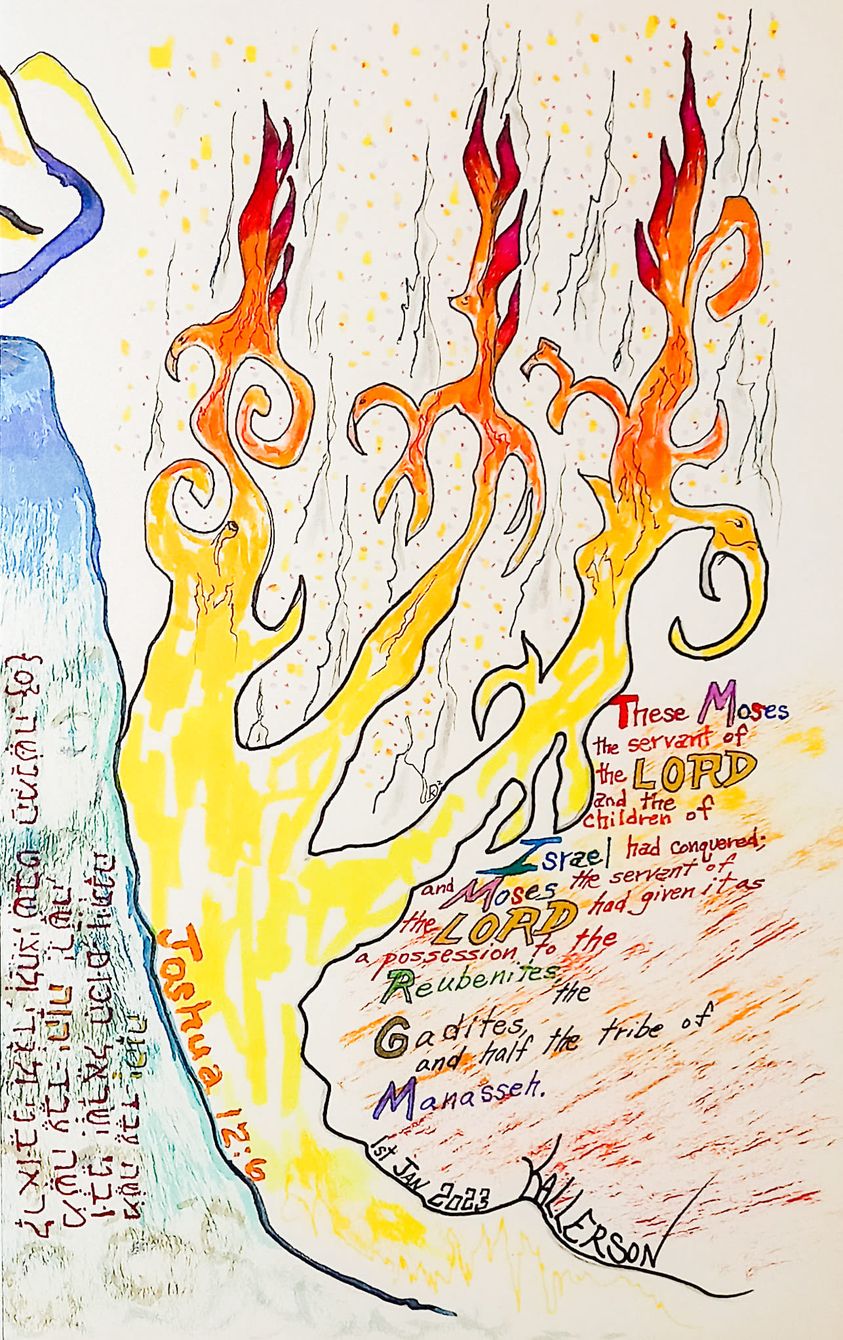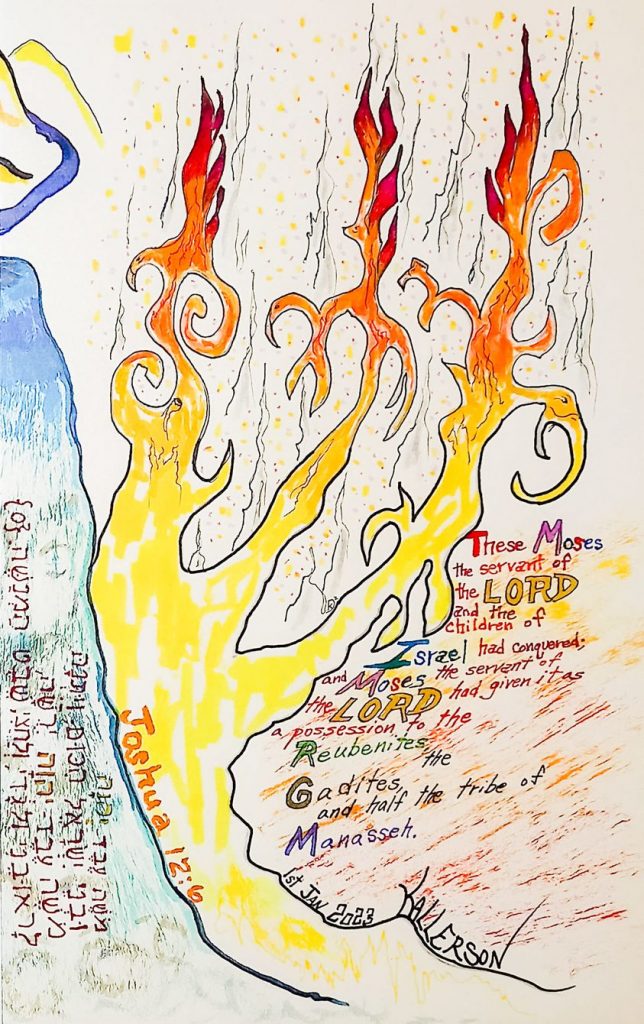
Artwork by Doug Kallerson
Joshua 12:1-6
An Inheritance Toward the Rising of the Sun
The thing about going through the Bible verse by verse as we have been doing is that you learn as you go. In Numbers 32, I assumed that the tribes mentioned in our verses today pictured unsaved people because their inheritance was outside of Canaan.
After going through all of the verses in Numbers 32 through Joshua 11, I cannot agree with that conclusion now. Even then, I was unsure and mentioned my uncertainty in the introduction to the second Numbers 32 sermon. I just couldn’t put my finger on what was being presented.
Now, it is more apparent that there was a logical order of events in Numbers 21 that more accurately describes what the people of these tribes typologically anticipate. As a result, the typology concerning the meaning of these tribes when elsewhere mentioned would not have been correct as well.
These people have an inheritance. Just because it is not in Canaan does not mean that they have not been saved. The crossing of the Jordan in Joshua 3 and 4 clearly pointed to Israel’s national salvation. But there are those of Israel who are already saved. They have already received the inheritance offered by God in Christ.
As I say, we learn as we go, and we will not stop learning until we get to the end.
Text Verse: “And He Himself gave some to be apostles, some prophets, some evangelists, and some pastors and teachers, 12 for the equipping of the saints for the work of ministry, for the edifying of the body of Christ, 13 till we all come to the unity of the faith and of the knowledge of the Son of God, to a perfect man, to the measure of the stature of the fullness of Christ.” Ephesians 4:11-13
I would rather be wrong and correct the errors as I go than to never figure out the typology of what is being said. This is often a very difficult trek. But God communicates with purpose and intent in His word.
As such, we need to contemplate His meaning and figure out what He is saying. God is working through history, typology, prophecy, and moral lessons in order to get us to understand what He is doing in the world through Christ.
If we keep that in mind, as we continue through the word, we will be able to self-correct our previously incorrect thoughts. It bothers me that I may have drawn some incorrect conclusions in that Numbers sermon, but if the thoughts are corrected now, then we are on the right path. In the end, the Lord knows. We just need to keep on thinking and praying for discernment to determine what He is telling us.
For now, we have six verses to look over. An inheritance is noted east of the Jordan. What is this telling us? We will endeavor to sort out the many names of people and locations as we go. Great things are to be found in His superior word. And so, let us turn to that precious word once again, and… May God speak to us through His word today, and may His glorious name ever be praised.
I. Sihon King of the Amorites (verses 1-3)
Joshua 12 contains two main sections that comprise the sum total of the victories in the wars for the land possessed by Israel: verses 1-6 detail the victories east of the Jordan; verses 7-24 detail the victories west of the Jordan.
These are notably divided further. The first set of conquests says, “whom the children of Israel defeated” for those victories east of the Jordan (verse 1). This is further explained as “These Moses the servant of the Lord and the children of Israel had conquered” in verse 6. The second set of conquests says, “which Joshua and the children of Israel conquered” (verse 7).
Recording these, at this point in the narrative serves at least two main purposes. The first provides a conclusion of the wars waged. The second provides a basis for the next main section of the book, where the land is divided among the tribes. That will commence in Joshua 13:8. With that noted, the verses begin with…
These are the kings of the land whom the children of Israel defeated,
The words begin with a conjunction to connect it directly to the preceding section – “And these, kings the land who struck sons Israel.” As such, we can more naturally see the flow between the ending of chapter 11 and the words here –
So Joshua took the whole land, according to all that the Lord had said to Moses; and Joshua gave it as an inheritance to Israel according to their divisions by their tribes. Then the land rested from war. … “And these, kings the land who struck sons Israel…”
Seeing this, the narrative continues with…
1 (con’t) and whose land they possessed on the other side of the Jordan toward the rising of the sun,
More literally, it reads, “and possessed (pl.) their land in side the Jordan rising (eastward) the sun.” It is detailing the land won in battle prior to entry into Canaan. The battles are more fully detailed in Numbers 21. They are then recounted by Moses in Deuteronomy 2 & 3.
Also, the division of those lands is carefully detailed in Numbers 32, and it is recounted in Deuteronomy 3. As the Jordan is a picture of Christ, the Descender, the designation “in side the Jordan” is telling us that this land pictures events prior to Israel’s national salvation that were detailed earlier in Joshua. This is based on it being “toward the rising of the sun,” as will be explained later. This land is…
1 (con’t) from the River Arnon to Mount Hermon,
mi’nakhal arnon ad har khermon – “from Wadi Arnon to Mount Hermon.” The nakhal is a torrent or wadi. It is derived from the verb nakhal signifying “to take possession.” The name Arnon comes from ranan, signifying to give a jubilant, ringing cry, and thus rejoicing. Therefore, this is the Roaring Stream. Also…
1 (con’t) and all the eastern Jordan plain:
v’kal ha’aravah mizrakhah – “and all the Aravah, eastward.” The word translated as “eastward” is the same word just translated as rising in an earlier clause. It comes from zarakh, signifying to rise or come forth as in the dawning of the day. As such, it is eastward.
The Aravah is the plain that extends about one hundred miles, south from the Dead Sea to the Gulf of Aqaba, forming a border between Israel and Jordan. The word comes from arav, to grow dark or become evening. This is because of the darkness of the terrain. However, that is identical to arav, meaning to take or given in pledge. This is the land east of the Jordan…
2 One king was Sihon king of the Amorites,
The Hebrew reads more simply, and it is singular: sikhon melekh ha’emori – “Sihon king the Amorite.” The name Sihon comes from a root that signifies “to sweep away,” or “to strike down.” Thus, his name may signify anything from “Tempestuous” to “Warrior.”
He is defined further as melekh ha’emori, or “king the Amorite.” Amorite comes from amar, meaning to utter or say. Therefore, the name signifies being spoken of, and thus “Renowned.” It is he…
2 (con’t) who dwelt in Heshbon and ruled half of Gilead, from Aroer, which is on the bank of the River Arnon, from the middle of that river, even as far as the River Jabbok, which is the border of the Ammonites,
From here, the clauses in the translation are laid out much differently from the Hebrew. The rest of the verse reads, “the dweller in Heshbon, ruling from Aroer which upon lip Wadi Arnon and midst the wadi, and half the Gilead, and to Jabbok – the wadi – border sons Ammon.”
It is defining the extent of his rule. First, it notes that he is the dweller in Heshbon. Heshbon comes from khashav. It signifies to consider, calculate, or devise. Therefore, it signifies an explanation of things, or “Intelligence.”
Aroer means “Stripped,” “Bare,” or “Naked.” It is on the “lip” or edge of the Wadi Arnon and its border extended to the middle of the wadi as is normally the case where a river is divided between two kingdoms. But more specifically, the city itself extended into the wadi. This is seen in Joshua 13:9 –
“from Aroer which is on the bank of the River Arnon, and the town that is in the midst of the ravine, and all the plain of Medeba as far as Dibon.”
This city is also called Ar of Moab, such as in Numbers 21:28. It belonged to Moab, but Sihon’s rule extended as far as that location. The careful designation of this city is given because there are two other locations known as Aroer. One is found in Joshua 13:25 and the other is found in 1 Samuel 30:28. Along with this city, the rule of Sihon included half of the Gilead.
Gilead means Perpetual Fountain. When Gilead is referred to, it is more of a great area that extends to both the north and south of the Jabbok River. Here it is identified with the area south of the Jabbok and extending to Wadi Aroer. Jabbok, or yaboq, means, “Pouring out.”
That is on the border of the sons of Ammon. Ammon comes from the word am, or “people.” The sense is that they are the people called “A People,” and thus inbred, having their source in the union of Lot and his younger daughter. The area Sihon possessed continues to be described next, saying…
3 and the eastern Jordan plain from the Sea of Chinneroth as far as the Sea of the Arabah (the Salt Sea),
The clauses are a bit jumbled. It reads, “and the Aravah to Sea Kinereth eastward and to Sea the Aravah (Sea of Salt) eastward.” It is describing the western border of the land. It is the plain known as the Aravah that extends along the Jordan River on its east bank, and which goes from the Sea of Galilee all the way south to the Dead Sea.
The name Kinereth comes from kinor, meaning a type of harp. The reason for the name is the shape of the sea, which looks like a harp when viewed from above. The harp is an instrument used for praising, prophesying, and making a joyful noise.
As for the explanatory words “Sea of Salt,” salt is a sign of incorruptibility. In the case of a covenant, it is a sign of the incorruptible nature of a covenant. This western border that goes to the south continues to…
3 (con’t) the road to Beth Jeshimoth, and southward below the slopes of Pisgah.
derek beith hay’shimoth u-mi’teman takhat ashdoth ha’pisgah – “way House the Yeshimoth and from south under slopes the Pisgah.” The word beith means “house,” ha is the definite article and yeshimoth means, “Desolations.” Thus, it is “House of the Desolations.”
Pisgah, or ha’pisgah, meaning “the Pisgah,” signifies a cleft. It is a high area where there is a cleft in the mountain. As such, it reads “Slopes of the Cleft.”
The land is before us, but it is possessed by a foe
He must be removed before we can enter in
How will it be done? How can we make it so?
It is a great battle we face. How will we win?
The foe stands against us
We cannot defeat him on our own
What we need is the strength of the Lord Jesus
This is what the word has shown
Through His deeds we can this foe defeat
And through what He has done, the battle we can win
Through Jesus this great foe we can unseat
And in this, we can then enter in
II. Og King of Bashan (verses 4-6)
4 The other king was Og king of Bashan and his territory,
u-gebul og melekh ha’bashan – “And territory Og, king the Bashan.” As noted, the battle against Og is also recorded in Numbers 21. His name comes from uggah, which is a round baked cake. That comes from ug, to bake.
The location, Bashan, is prefixed by an article. It signifies something like “The place of fertile soil.” He is next described…
4 (con’t) who was of the remnant of the giants,
The word “giants” is an explanation of their size, not a meaning of their name: mi’yeter ha’rephaim – “from remnant the Rephaim.” The name Rephaim is a hard one to pin down. It comes from a word meaning to sink down or relax. This is similar to the Nephilim. That comes from naphal, meaning to fall.
However, Rephaim could also come from a word meaning “to heal.” If so, then it indicates that their size came from being invigorated in some way, probably through special inbreeding.
The root, rapha, also means ghosts or departed spirits, but that isn’t the intent here. They are a group of exceptionally large people who lived in the area at the time. It is he…
4 (con’t) who dwelt at Ashtaroth and at Edrei,
ha’yoshev b’ashtaroth u’b’edrei – “the dweller in Ashtaroth and in Edrei.” The name Ashtaroth, was seen in Deuteronomy 1 and again in Joshua 9. It is believed to signify Union of Instructions, and thus One Law. Edrei means something like “Mighty.” The meaning is that he dwelt in and ruled from both cities, probably having a palace in each of them. The narrative continues by next noting…
5 and reigned over Mount Hermon,
The Hebrew says, “in Mount Hermon.” However, the meaning is “over,” not that he reigned from there. Hermon means Sacred.
5 (con’t) over Salcah,
Again, it says, “and in Salcah.” Salcah means Walking.
5 (con’t) over all Bashan,
And again, it reads, “and in all the Bashan.” That is then next further explained…
5 (con’t) as far as the border of the Geshurites and the Maachathites,
The names are singular: “to border the Geshurite and the Maachathite.” The name Geshur comes from an unused root meaning to join. Thus, it may mean “Bridge.” They may have been located at a spot that forded, or bridged, the Jordan. Maakah comes from a verb that means to press or squeeze. Thus the name signifies “Oppression.”
Geshur was a small area in the northeast corner of Bashan. It was adjoined to the area of Argob (Deuteronomy 3:14), and to the kingdom of Aram (Syria) as is seen in 2 Samuel 15:8. It is where Absalom fled after murdering his brother Amnon (2 Samuel 13:37).
The Maachthite dwelt on the southwest area of Mount Hermon where the Jordan finds its source. This can be inferred from Deuteronomy 3:14. Next, his kingdom continues with…
5 (con’t) and over half of Gilead to the border of Sihon king of Heshbon.
This would be the northern half of the Gilead with his southern border being the northern border of Sihon. The two kingdoms together form a large swath of land that comprises parts of Jordan and Syria today. It extends from the area of the Dead Sea all the way up to the area of Mount Hermon.
With that noted, the first major section of Chapter 12 ends with the words of verse 6, saying…
6 These Moses the servant of the Lord and the children of Israel had conquered;
More literally, it reads: “Moses, servant Yehovah, and sons Israel struck them.” The battles are carefully recorded in Numbers 21. There, it notes that these kings were the aggressors. They came out against Israel for battle even though Israel had only asked permission to go through Sihon’s land.
After Sihon was defeated, Og then came out against them. His land, therefore, became a possession of Israel. Once it was subdued, certain tribes wanted it because it is a fertile land, well suited to pasturing flocks. As such…
*6 (fin) and Moses the servant of the Lord had given it as a possession to the Reubenites, the Gadites, and half the tribe of Manasseh.
More literally: “and gave it, Moses, servant Yehovah, inheritance to the Reubenite and to the Gadite, and to the half-tribe the Manasseh.” This is the land east of the Jordan that is allotted as an inheritance to these tribes. Reuben means See a Son. Gad means Fortune. Manasseh has a dual meaning of to Forget and From a debt. It is the kings of these areas that have been disinherited so that those of Israel can receive their inheritance.
Another foe stands against us
Together they are united as one
But they cannot prevail against the Lord Jesus
Through Him, this battle is already won
There is an inheritance waiting for us
And it is for sure that we will possess it
Because we have on our side the Lord Jesus
Never to the enemy shall we submit
Great is the Lord and greatly to be praised
Because through faith in His work, the battle is won
Our hearts are filled with joy and our voices raised
We are victors in Christ because of what He has done
III. Pictures of Christ
There are many names in this short passage, both of locations and of people. It is to be remembered that these things occurred before the death of Moses. Hence, despite picturing the Lord, it is still at a time when Israel has not yet collectively come to Jesus.
Despite this, salvation for individuals is available as is clearly revealed in the verses that immediately preceded the accounts in Numbers 21 which began with a few verses concerning trusting in the Lord rather than self for the victory (Numbers 21:1-3).
It then detailed the account of Israel complaining against the Lord and speaking against God and against Moses. Because of that, the Lord sent fiery serpents among the people, and many died. However, when they acknowledged their sin, the Lord told Moses to fashion a fiery serpent and set it on a pole. Anyone bitten could look at the bronze serpent and live.
It is a clear picture of those of Israel being saved by looking to the cross of Christ (verses 4-9). The chapter then contained poetic lines indicating how the Spirit is received (verses 10-20). Finally, we saw the battle where the two foes were defeated, Sihon and Og (verses 21-35).
After their defeat, chapter 34 gave the details of how this land was granted to the Reubenite, the Gadite, and the half-tribe of Manasseh.
It is necessary to detail their inheritance again in Joshua to fully settle the matter of why they received the inheritance and also exactly what land each tribe will receive.
Because this happened while Moses was the leader of Israel, I couldn’t see what these people were picturing while still in Numbers. I gave an opinion and am now sure it was incorrect.
These Israelites describe either those saved in Israel prior to Israel’s national salvation or those saved prior to the coming of Christ by faith in the Messiah.
An argument can be made for both options, but it is certainly the first. This is referring to those who have received an inheritance in Israel. This will be seen more clearly in Joshua 13.
These two- and one-half tribes received their possession first, and it is on the side of the Jordan (the Descender – Jesus) eastward. East in the Bible signifies before; west is after. Although the word qedem, or east, is not used, it is implied with the word mizrakh, or eastward.
The root of that word, zarakh, to arise, is used in Malachi 4 to describe those who look to the rising of Christ and His effect on them –
“’For behold, the day is coming,
Burning like an oven,
And all the proud, yes, all who do wickedly will be stubble.
And the day which is coming shall burn them up,’
Says the Lord of hosts,
‘That will leave them neither root nor branch.
2 But to you who fear My name
The Sun of Righteousness shall arise [zarakh]
With healing in His wings;
And you shall go out
And grow fat like stall-fed calves.
3 You shall trample the wicked,
For they shall be ashes under the soles of your feet
On the day that I do this,’
Says the Lord of hosts.” Malachi 4:1-3
With this understood, I should note that many of these locations are in a variety of passages from Numbers, Deuteronomy, and even Joshua. In order to be consistent, I went back to the sermons where the names were mentioned to obtain the same meaning for the typology as was used before.
By doing this, we have a consistent analysis of the words that are all lumped together into one short passage. Their land is first described as “from Wadi Arnon to Mount Hermon.” Using the root meaning of the words, this can be paraphrased as “from the inheritance of rejoicing to the Sacred Mountain.” It is surely a picture of salvation and inheritance of the heavenly promise –
“Blessed be the God and Father of our Lord Jesus Christ, who has blessed us with every spiritual blessing in the heavenly places in Christ, … In Him also we have obtained an inheritance, being predestined according to the purpose of Him who works all things according to the counsel of His will, 12 that we who first trusted in Christ should be to the praise of His glory.” Ephesians 1:3 & 11, 12
In Ephesians, Paul is writing to Gentiles, but his words include any who are saved in this dispensation, Jews or Gentiles. Hence, it is before the salvation of national Israel, even if it includes some from Israel.
Next, it says, “and all the Aravah, eastward.” This is paraphrased as “and all the pledge, eastward.” Hence, it is speaking of the pledge of the Spirit (Ephesians 1:14) prior to national Israel’s salvation.
After that, it named the first foe, “Sihon king the Amorite.” In type, this would read “Warrior king of the Renowned.” In Numbers 21, I suggested that he anticipates the Antichrist.” There is no reason to amend that, and yet, it is true that there are already antichrists in the world –
“Little children, it is the last hour; and as you have heard that the Antichrist is coming, even now many antichrists have come, by which we know that it is the last hour.” 1 John 2:18
Those who come to Christ prevail over this spirit of antichrist that exists in the world. He was next described as “the dweller in Heshbon, ruling from Aroer which upon lip Wadi Arnon and midst the wadi, and half the Gilead, and to Jabbok – the wadi – border sons Ammon.”
Taking the meaning of the words, it says, “the dweller in Intelligence, ruling from Stripped upon the edge of inheritance Rejoicing and midst inheritance, and half the Perpetual Fountain, and to Pouring Out – the inheritance – border sons A People.”
When one inherits the kingdom, he inherits the whole kingdom. In this case, this is one of two foes to be defeated and thus it speaks of the first half of the battle. Hence, half of the Perpetual Fountain. The words, though confusing, speak of the various aspects of what Christ offers. For example, Paul says of intelligence in 1 Corinthians 1 –
“For the message of the cross is foolishness to those who are perishing, but to us who are being saved it is the power of God. 19 For it is written:
“I will destroy the wisdom of the wise;
the intelligence of the intelligent I will frustrate.” 1 Corinthians 1:18, 19 (NIV)
Of being stripped, Paul says this in 1 Corinthians 14, using the term “laid bare” –
“But if an unbeliever or an inquirer comes in while everyone is prophesying, they are convicted of sin and are brought under judgment by all, 25 as the secrets of their hearts are laid bare. So they will fall down and worship God, exclaiming, ‘God is really among you!’” 1 Corinthians 14:24, 25 (NIV)
The point is that this foe, described by these terms, will be defeated in order to provide the inheritance of the pledge of the Spirit, the reception of the Spirit, the pouring out of the Spirit, and so on. That description continues with, “and the Aravah to Sea Kinereth eastward and to Sea the Aravah (Sea of Salt) eastward.”
Once again, translating the words reads: “and the pledge to Sea of the Harp eastward and to Sea the Pledge (Sea of Covenant) eastward.” Again, it points to the work of Jesus. The pledge is the Spirit. The harp anticipates Him as the source of prophecy. Harps, at times, accompany prophesying. And the salt anticipates His incorruptible nature (Acts 2:27) and thus the incorruptible nature of His covenant.
The direction eastward indicates that this is east of the Jordan, the Descender, and thus it is an inheritance granted before the nation itself receives its inheritance.
The final clause of the verses concerning Sihon say, “way House the Yeshimoth and from south under slopes the Pisgah.” Translated, it would say “way House the Desolations and from south under the slopes of the Cleft.”
As it is on the way to the House of Desolations (another word for death), it means that the house is outside of the inheritance. Under the Cleft anticipates passing through Christ into the inheritance. With that, the verses turn to the land of Og.
In the Numbers 21 sermon, I noted him as a type of the False Prophet of Revelation. Having said that, and just like the antichrist, John says –
“Beloved, do not believe every spirit, but test the spirits, whether they are of God; because many false prophets have gone out into the world.” 1 John 4:1
Therefore, even if there is one final False Prophet, there is the spirit of the false prophet that has existed all along. Those who come to Christ overcome this.
Like in Numbers 21, Og is said to be king of the Bashan, or Place of fertile soil. His name comes from uggah, which is a round baked cake. That comes from ug, to bake. The picture we see is one set in opposition to Israel. The uggah, or baked cake, is seen seven times in the Bible. It is that which nourishes and sustains life.
Thus Og, who is king over the fertile place of soil, anticipates this spirit of false prophecy that denies the people of God the truth and nourishment of the word. He is noted here as “from the remnant of the Rephaim.” Rephaim signifies to sink down or relax.
Charlie’s best guess as to why he is called Rephaim here is that he anticipates those who find the ease of lies of the false prophets appealing. Peter alludes to this type of simple appeal –
“But there were also false prophets among the people, just as there will be false teachers among you. They will secretly introduce destructive heresies, even denying the sovereign Lord who bought them—bringing swift destruction on themselves. 2 Many will follow their depraved conduct and will bring the way of truth into disrepute.” 2 Peter 2:1, 2
Here he is called “the dweller in Ashtaroth and in Edrei,” or Unity of Instructions and Mighty. The unity of instruction is against the gospel, and it is a powerful foe. His reign, until it is taken from him is said to be “in Mount Hermon and in Salcah and in all the Bashan.” Translated, it would say “In Sacred Mount, and in Walking, and in all the Place of fertile soil.”
Until he is eliminated, access to the Lord is restricted, one’s walk is opposed to the Lord, and the truth and nourishment of the word is unavailable. In his defeat through coming to Jesus, the inheritance is granted to everyone who believes.
It then notes that Og’s domain went “to border the Geshurite and the Maachathite.” The names mean To Join (as in a bridge) and Oppression. As they are outside of the inheritance, I would assume it signifies those who are not joined to the inheritance and who are under the oppression of the law.
Next, Og’s rule was “half the Gilead border Sihon king Heshbon,” or half the Perpetual Fountain border Intelligence. As this is the other half of the Perpetual Fountain, and as he was defeated, the inheritance encompasses the entire Perpetual Fountain – the giving of the Spirit through Christ.
The final verse referred to Moses the servant of the Lord and it noted the land the children of Israel conquered. However, the typology of Moses is clear. The typological meaning refers to Jesus’ fulfillment of the law (Moses) and those of Israel who accept His work.
With that, the final words of the section say that Moses gave it as a possession to the Reubenites, the Gadites, and the half-tribe of Manasseh. Their possession, though not in Canaan, is clearly a picture of a possession in Christ.
It’s not that these people are types of those who aren’t saved, as I once thought, but rather, it is that they picture those who are saved prior to the national salvation of Israel. The second set of twelve stones set up in Joshua 4 are a clear representation of those who form the church, both Jew and Gentile.
In the end, the point of it all is Christ Jesus. His work extends out to all, both Jew and Gentile, and to both Israel and the church. It is the same saving message to both. God has done it all through Him. All we need to do as individuals is to accept this, and all Israel needs to do as a nation is to accept it as well.
Time is marching on, and we have choices to make. I hope and pray that each person who hears this word will consider that and make the right choice, by faith, in calling out to God through Jesus. He is the only hope in this fallen and quickly failing world. Receive God’s goodness as it is offered through Him and be sure to do so today.
Closing Verse: “In Him also we have obtained an inheritance, being predestined according to the purpose of Him who works all things according to the counsel of His will, 12 that we who first trusted in Christ should be to the praise of His glory.” Ephesians 1:11, 12
Next Week: Joshua 12:7-24 This is the nation’s legacy and its reward… (An Inheritance Seaward) (26th Joshua Sermon)
The Lord has you exactly where He wants you. He has a good plan and purpose for you. It is He who has defeated the enemy and who now offers His people rest. So, follow Him and trust Him and He will do marvelous things for you and through you.
An Inheritance Toward the Rising of the Sun
These are the kings of the land
Whom the children of Israel defeated; over whom they won
And whose land they possessed on the other side of the Jordan
Toward the rising of the sun
From the River Arnon to Mount Hermon
And all the eastern Jordan plain as it is known:
One king was Sihon king of the Amorites
Who dwelt in Heshbon and ruled half of Gilead
From Aroer, which is on the bank of the River Arnon
From the middle of that river, not north or south even a tad
Even as far as the River Jabbok
Which is the border of the Ammonites, so they agree
And the eastern Jordan plain from the Sea of Chinneroth
As far as the Sea of the Arabah (the Salt Sea)
The road to Beth Jeshimoth as the map denotes
And southward below the Pisgah slopes
The other king was Og king of Bashan and his territory
Who was of the remnant of the giants, yes it’s true
Who dwelt at Ashtaroth and at Edrei
And reigned over Mount Hermon, over Salcah, over all Bashan too
As far as the border of the Geshurites and the Maachathites
———-so it is known
And over half of Gilead to the border of Sihon king of Heshbon.
These Moses the servant of the LORD
And the children of Israel had conquered on that day
And Moses the servant of the LORD had given it as a possession
To the Reubenites, the Gadites, and half the tribe of Manasseh
Lord God, turn our hearts to be obedient to Your word
Give us wisdom to be ever faithful to You
May we carefully heed each thing we have heard
Yes, Lord God may our hearts be faithful and true
And we shall be content and satisfied in You alone
We will follow You as we sing our songs of praise
Hallelujah to You; to us Your path You have shown
Hallelujah we shall sing to You for all of our days
Hallelujah and Amen…
These are the kings of the land whom the children of Israel defeated, and whose land they possessed on the other side of the Jordan toward the rising of the sun, from the River Arnon to Mount Hermon, and all the eastern Jordan plain: 2 One king was Sihon king of the Amorites, who dwelt in Heshbon and ruled half of Gilead, from Aroer, which is on the bank of the River Arnon, from the middle of that river, even as far as the River Jabbok, which is the border of the Ammonites, 3 and the eastern Jordan plain from the Sea of Chinneroth as far as the Sea of the Arabah (the Salt Sea), the road to Beth Jeshimoth, and southward below the slopes of Pisgah. 4 The other king was Og king of Bashan and his territory, who was of the remnant of the giants, who dwelt at Ashtaroth and at Edrei, 5 and reigned over Mount Hermon, over Salcah, over all Bashan, as far as the border of the Geshurites and the Maachathites, and over half of Gilead to the border of Sihon king of Heshbon.
6 These Moses the servant of the Lord and the children of Israel had conquered; and Moses the servant of the Lord had given it as a possession to the Reubenites, the Gadites, and half the tribe of Manasseh.