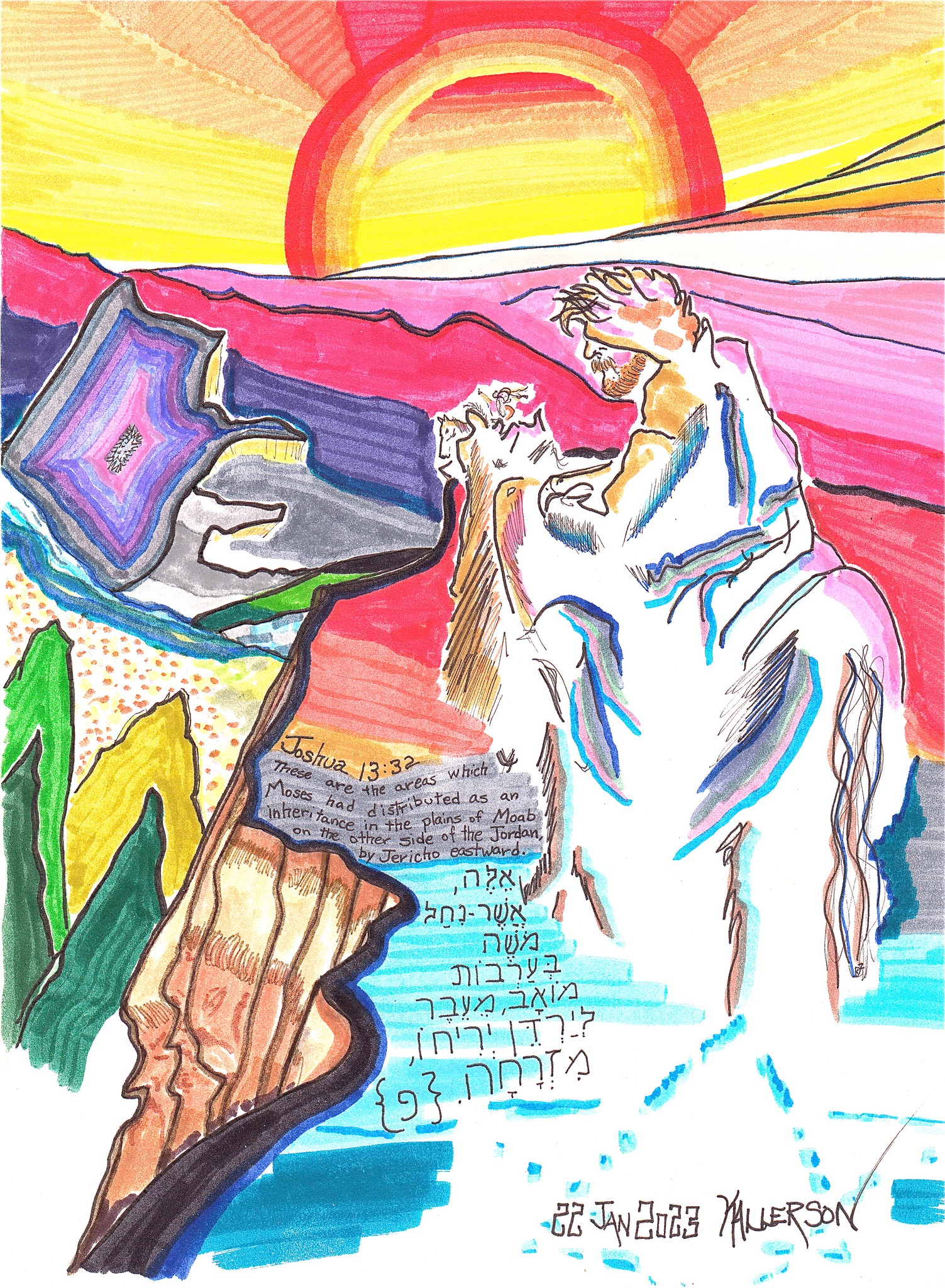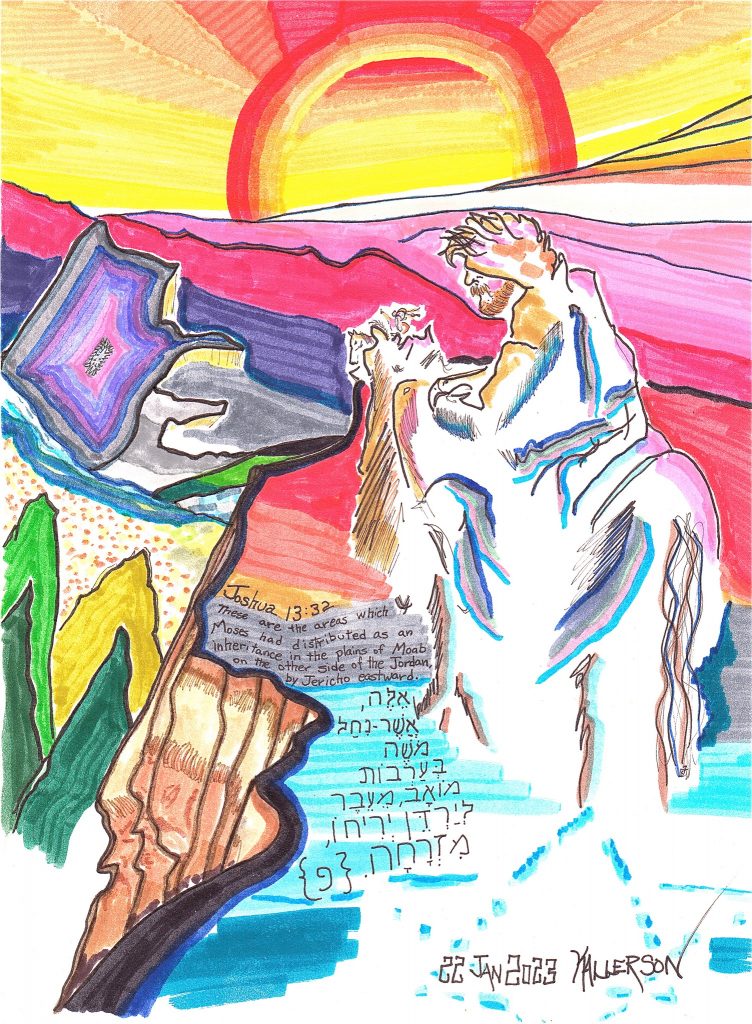
Artwork by Doug Kallerson.
Joshua 13:15-33
An Inheritance by Jericho, Eastward
In Chapters 1-12, Israel’s entrance into Canaan and subduing of the land were detailed. Within those chapters, there were several logical divisions of what was taking place. As a whole, those chapters should be taken as the first major division of the historical aspect of the book.
The next major division began at verses 13:1-14. That defined the scope of the land to be inherited and the people groups who possessed the land prior to Israel on both sides of the Jordan.
This major section is to go from Chapter 13 through chapter 22. It is long, and the structure is often difficult. If we can just remember that this lengthy division of the land is all picturing the Lord’s distribution of His inheritance to His people, it will take away much of the tedium that we may otherwise feel.
Think of our position in Christ. We have received Christ’s completed work. We have been given the pledge of the Spirit, the guarantee of our salvation, and yet, we have actually not fully received the inheritance that has been granted.
Think of it as a will that cannot be revoked. A son is given his land inheritance. It has been guaranteed by the legal document, but he has to live out his life while waiting for the actual bestowal of it.
There is also a condition in the will that things will be added to the inheritance (rewards) or taken away from it (losses) based on how he lives his life while waiting for the inheritance.
Text Verse: “For no other foundation can anyone lay than that which is laid, which is Jesus Christ. 12 Now if anyone builds on this foundation with gold, silver, precious stones, wood, hay, straw, 13 each one’s work will become clear; for the Day will declare it, because it will be revealed by fire; and the fire will test each one’s work, of what sort it is. 14 If anyone’s work which he has built on it endures, he will receive a reward. 15 If anyone’s work is burned, he will suffer loss; but he himself will be saved, yet so as through fire.” 1 Corinthians 3:11-15
Our inheritance is absolutely guaranteed, and it cannot be revoked. However, the quality of the inheritance is up to the one who is receiving it to act in accordance with whatever instructions are given.
Israel has attained the promise, but how it handles the conditional portion is up to them. Look to how God has dealt with national Israel and you will more fully understand how God will deal with you as an individual. Keep thinking on these lines as we go through these pages.
The meticulous nature of defining each inheritance assures us that God is being equally meticulous in His dealings with us. The excitement of the first conquests of Joshua remains true for what we are now going through if we can just remember this.
The passage today may seem overloaded with names and information. There is certainly a ton of typology in what is presented, and delving into speculation on the minutiae would lead us away from the main theme. God is revealing His plan to us in a manner that reveals Christ. Keep that in mind.
This great truth continues to be found in His superior word. And so, let us turn to that precious word once again, and… May God speak to us through His word today, and may His glorious name ever be praised.
I. The Land of Reuben (verses 15-23)
In Joshua 13:8-14 that were looked at last week, an overall description of the land east of the Jordan was detailed. With that complete, the parceling out of that land to the two-and-one-half tribes will now take place.
Each step is methodically detailed to ensure that an accurate accounting of each inheritance is recorded. The land has already been briefly described in Number 32 –
“So Moses gave to the children of Gad, to the children of Reuben, and to half the tribe of Manasseh the son of Joseph, the kingdom of Sihon king of the Amorites and the kingdom of Og king of Bashan, the land with its cities within the borders, the cities of the surrounding country. 34 And the children of Gad built Dibon and Ataroth and Aroer, 35 Atroth and Shophan and Jazer and Jogbehah, 36 Beth Nimrah and Beth Haran, fortified cities, and folds for sheep. 37 And the children of Reuben built Heshbon and Elealeh and Kirjathaim, 38 Nebo and Baal Meon (their names being changed) and Shibmah; and they gave other names to the cities which they built.
39 And the children of Machir the son of Manasseh went to Gilead and took it, and dispossessed the Amorites who were in it. 40 So Moses gave Gilead to Machir the son of Manasseh, and he dwelt in it. 41 Also Jair the son of Manasseh went and took its small towns, and called them Havoth Jair. 42 Then Nobah went and took Kenath and its villages, and he called it Nobah, after his own name.” Numbers 32:33-42
As for the divisions being documented in Joshua, the tribes would be able to refer back to these writings if there was ever a dispute concerning the land. This parceling out of the land begins with…
15 And Moses had given to the tribe of the children of Reuben an inheritance according to their families.
Reuben is the firstborn son of Israel, and his inheritance is detailed first. His name means See a Son. The words, “according to their families” mean that the overall parcel is given based on their tribal inheritance and from there it will be more precisely divided by those within Reuben in a fair and equitable manner.
It is Moses who granted this land with the stipulation that they would go with Israel into battle in order to subdue the land of Canaan. Once that was accomplished, the grant would be considered permanent. As for the overall area of Reuben…
16 Their territory was from Aroer, which is on the bank of the River Arnon, and the city that is in the midst of the ravine, and all the plain by Medeba;
The Hebrew reads “border” instead of “territory.” The land is being defined by the southern border and moving north according to their cities. Further, the land is the southernmost portion of all the land east of the Jordan. It borders the land of Moab. This border was almost identically described in verse 13:9. The cities of this land include…
17 Heshbon and all its cities that are in the plain: Dibon, Bamoth Baal, Beth Baal Meon,
Just for reference, the names of these locations mean: Hesbon – Intelligence; Dibon – Pining; Bamoth Baal – High Places of Baal or Great High Place of Baal; Beth Baal Meon – House of the Master of the Hideout. As an interesting point of history, the famous Mesha Stele, or Moabite Stone, was found in Dibon.
18 Jahaza, Kedemoth, Mephaath,
In sloppy fashion, the translation here and in the coming verses leaves out the conjunctions: v’yahtsah, u-qedemoth, u-mephaath – “And Jahaza, and Kedemoth, and Mephaath.” Jahaza is a variant spelling of Jahaz. It is where the battle between Israel and Sihon took place as is recorded in Numbers 21:23. It means Trodden Down.
Kedemoth means Ancient Times, Antiquity, or Beginnings. Mephaath is first seen here. It means something like Place of Radiance. Joshua 21 shows that all three of these will become Levitical cities.
19 Kirjathaim, Sibmah, Zereth Shahar on the mountain of the valley,
Again, each location is preceded by a conjunction which is left off by the translators. Kirjathaim means Twin Cities or Double Cities. Sibmah may mean Spice. The third city is tsereth ha’shakhar b’har ha’emeq, or “Zereth the Shahar in mountain the valley.” It is found only here in the Bible.
The meaning is hard to pin down. It may mean Splendor of the Dawn, but the word specialists at Abarim seem to stretch the meaning, saying it might point to an eclipse. They call it Distress at a Solar Eclipse or Darkness at Midday. They then say that “These events are obviously mimicked in the Biblical accounts of the crucifixion and resurrection.”
That would be incorrect. There was no eclipse at the time of Jesus’ crucifixion. The moon is full at the Passover, so it is seen at night and is hidden during the day. Therefore, the moon cannot eclipse the sun at that time of month.
The most probable meaning is Splendor of the Dawn. As Zereth Shahar is believed by some to border the Dead Sea, the beautiful coloring of the landscape would be resplendent, and especially so at the dawn.
20 Beth Peor, the slopes of Pisgah, and Beth Jeshimoth—
Again, and to be precise, each location is preceded by the word “and.” Beth Peor means “House of Peor.” Peor comes from the verb paar, meaning “to open.” Thus, it is the House of the Opening. The next location is ashdoth ha’pisgah, or Ashdoth of the Pisgah, meaning Slopes of the Cleft. Beth Jeshimoth means House of the Desolations.
21 all the cities of the plain and all the kingdom of Sihon king of the Amorites, who reigned in Heshbon,
This means all of the other cities that were in the realm of Sihon and which extended out over the open and flat plain, the mishor, that was mentioned in Joshua 13:9. This land is very suitable for grazing. All of this was the land of Sihon…
21 (con’t) whom Moses had struck
The battle was detailed in Numbers 21, and it has been referred to numerous times since. It next says…
21 (con’t) with the princes of Midian: Evi, Rekem, Zur, Hur, and Reba,
oto v’eth n’siye midyan eth evi, v’eth reqem, v’eth tsur, v’eth khur, v’eth reva – “with and with princes Midian, with Evi, and with Rekem, and with Zur, and with Hur, and with Reba.” This does not mean that they were killed in the same battle with Sihon, but in the same manner.
Rather, they had conspired against Israel by seducing them and so the Lord instructed Moses to take vengeance on them as is seen in Numbers 31. Here, they are called nasiy’ or “princes.” Literally, “exalted ones.” The word comes from nasa, to lift up. Hence, they were raised up to serve under Sihon.
Their names as best as can be determined mean – Evi – Desirous; Reqem – Many Colored; Tsur – Rock; Khur – White; Reva – Fourth. Of them, it next says…
21 (con’t) who were princes of Sihon dwelling in the country
n’siyke sikhon yosheve ha’arets – “consecrated Sihon dwellers the land.” Sihon had taken the land he possessed from Moab. Because they were dwelling in the Moabites territory when it was taken over, Midianite men were appointed as vassals under him over a portion of the territory.
Here, instead of prince, the word n’siyke is used. This speaks of a libation that is poured out or a molten image. Hence, it signifies something like pouring out authority or consecrating to serve in a particular position. Along with killing these vassals, it says…
22 The children of Israel also killed with the sword Balaam the son of Beor,
The slaying of Balaam and the five men just mentioned is recorded in Numbers 31:8. So infamous is Balaam, that he will be named two more times in Joshua and also in Nehemiah and Micah. In the New Testament Peter, Jude, and Revelation also discuss his deeds. He was…
22 (con’t) the soothsayer, among those who were killed by them.
The word used to describe Balaam is the verb qasam. It signifies to practice divination or act as a soothsayer. It is also used of the witch of En Dor where she acts as a conjuror.
The biblical narrative does not tell how he ended up among these vassals. At the end of the account in Numbers 24:25, it said that he “departed and returned to his place.” The meaning could be that he “turned to his place,” but never got there, instead stopping at the dwelling of these Midianites and dying there.
Or he could have returned to his home after giving advice to Midian about how to handle Israel. When they took his advice, he may have returned there to receive his wages and been killed. No matter what, he was found among these men and was slain by the sword.
23 And the border of the children of Reuben was the bank of the Jordan.
The Hebrew is difficult, but it reads similarly to Numbers 34:6 and Joshua 15:12: vay’hi gebul bene Reuven ha’yarden u-gebul – “And was border sons Reuben the Jordan and his border.” The most likely meaning is that Reuben’s border is formed by the natural border of the Jordan.
The bank of the Jordan, or the Descender, is said to be the western border of the land given to Reuben. But this is only in the very northern extremity. Almost all of their western border lay on the eastern edge of the Dead Sea. Because of this, it can be seen that the Dead Sea is actually thought of as a final portion of the Jordan River.
23 (con’t) This was the inheritance of the children of Reuben according to their families, the cities and their villages.
Reuben desired this land outside of Canaan and it was granted to him. Rather than agriculture, the land is mostly suitable for pasturing flocks. Of their history in the Bible, Cambridge notes, “In the chief struggle of the nation Reuben never took part. No judge, no prophet, no hero of the tribe is handed down to us.” Thus, the history of their tribe is almost one of obscurity.
There is an inheritance that is coming to us
And it has already been granted, the deal is done
We have received the promise because of Jesus
It is based on His work alone; that of God’s own Son
There is no need to worry if we will enter glory
It is guaranteed because we believed what was told to us
We heard the word of faith, the gospel story
And we believed on the glorious name of Jesus
The inheritance is given to all who are sanctified
It has been granted because of what God has done
It has come through the blood of Jesus, He who died
And who rose again! In Him the victory is won
II. The Land of Gad (verses 24-28)
24 Moses also had given an inheritance to the tribe of Gad, to the children of Gad according to their families.
Gad is the seventh son of Israel, and his inheritance is the second to be detailed. His name means Fortune. Like Reuben, his parcel of land came from the direction of Moses. As for the overall area of Gad…
25 Their territory was Jazer, and all the cities of Gilead,
Jazer, or yatser, means Helpful or He Shall Help. The words “all the cities of Gilead” do not mean that they possessed all of that land. Rather, half of the Gilead is given to Manasseh as will be indicated in verse 13:31. And yet, no cities are mentioned in that half. Hence, “all the cities of Gilead” means that there were no inhabitable cities in the other half of the Gilead that went to Manasseh. Along with that…
25 (con’t) and half the land of the Ammonites as far as Aroer, which is before Rabbah,
The Hebrew reads “and half land sons Ammon.” What this means is that it was originally Ammonite land that was taken by Sihon. When Israel defeated Sihon, it then became the property of Israel. The importance of this is that Israel was told by the Lord –
“And when you come near the people of Ammon, do not harass them or meddle with them, for I will not give you any of the land of the people of Ammon as a possession, because I have given it to the descendants of Lot as a possession.” Deuteronomy 2:19
This land will later be contested by Ammon in Judges 11. However, Israel’s right to it was firm because Ammon lost possession of it to Sihon and Sihon lost possession of it to Israel. The name Rabbah means Great or Populus. The description continues with…
26 and from Heshbon to Ramath Mizpah and Betonim, and from Mahanaim to the border of Debir,
Heshbon signifies an explanation of things or Intelligence. ramath ha’mitspeh or Ramath the Mizpah means something like Height of the Watchtower. This is the area where Jacob and Laban set up their heap of stones as a witness between them as was seen in Genesis 31.
Betonim is found only here in the Bible and it probably means Pistachios. Although it could come from beten, a womb, and thus mean Hollows. This would still fit with Pistachios which form two hollows when split open and the nut is removed. Mahanaim means Two Camps.
As for the last name, the Hebrew reads Lidbir. Most translations equate it to Debir which means Place of the Word. However, it may be the same as Lo Debar which is first seen in 2 Samuel 9:4. If this is so, then it literally means “No Word.” As such, the intended meaning could go from No Pasture to Nothing. It is used in a pun in Amos 6:13 –
“You who rejoice over Lo Debar,
Who say, ‘Have we not taken Karnaim for ourselves
By our own strength?’” Amos 6:13
In this, it means “You who rejoice over nothing.” The idea then is that of stupidity. Next…
27 and in the valley Beth Haram, Beth Nimrah, Succoth, and Zaphon, the rest of the kingdom of Sihon king of Heshbon,
Beth Haram is found only here in Scripture, but it is certainly the same place known as Beth Haran found in Numbers 32:36. It means Mountain House or House of the Lofty. Beth Nimrah means House of the Leopard or House of Clean Water.
Succoth means Tabernacles. The location received its name in Genesis 33:17 when Jacob built himself a house and made tabernacles for his livestock. Hence, it was thereafter called Succoth.
Zaphon means North, but also Concealed because the north is the hidden direction in the northern hemisphere.
27 (con’t) with the Jordan as its border, as far as the edge of the Sea of Chinnereth, on the other side of the Jordan eastward.
ha’yarden u-gebul ad qetseh yam kinereth ever ha’yarden mizrakhah: “the Jordan and border to extremity sea Chinnereth, side the Jordan eastward.” This defines the westernmost area of the land grant which is the eastern side of the Jordan River and reaching to the very southern tip of the Sea of Galilee.
28 This is the inheritance of the children of Gad according to their families, the cities and their villages.
Gad desired to join with Reuben in the land outside of Canaan and it was granted to them. Taken together, the land of Reuben and Gad cover all of the kingdom that belonged to Sihon.
The Spirit is the guarantee of the inheritance
Given by God because of faith in His Son
Will He take it back? Of this, there is no chance
We have gone from death to life – the victory is won
And so, let us live out our lives as we should
Anticipating the inheritance given to us
Living in holiness is right, that is understood
Living according to the glory of our Lord Jesus
Thank You, O God, for the promise that lies ahead
Help us to live in faith, and faithfully too
May we conform to all that Your word has said
And may our lives and our hearts be loyal, pure, and true
III. The Land of the Half Tribe of Manasseh (verses 29-32)
29 Moses also had given an inheritance to half the tribe of Manasseh; it was for half the tribe of the children of Manasseh according to their families:
The wording is precise in this verse, but it is something that cannot be discerned from the English translation. The first occurrence of the word “tribe” is the word shevet. The second is the word mateh.
Both words are commonly translated as “tribes,” and they both signify a type of staff or rod. Further, both come from roots signifying to branch off.
Though very similar in intent, shevet looks to a political stem and branch, whereas mateh looks more to a genealogical one. For example, the first word, shevet, was seen eighteen times in Deuteronomy while mateh never was.
Likewise, shevet is used 33 times in Joshua while mateh is used 17 times, but only from Joshua 13-22.
So to understand what is being said, we can translate this verse as: “And gave Moses to half polity, Manasseh. And it was to half descended sons Manasseh according to their families.”
Manasseh is an adopted son of Israel, being the firstborn son of Joseph. Both sons of Joseph were to be given an inheritance along with the other sons of Israel. The land now to be detailed is the final parcel of land to be portioned out east of the Jordan.
The name Manasseh has a dual meaning of He Shall Forget and From a Debt. Like Reuben and Gad, this parcel of land came from the direction of Moses seen in Numbers 32 –
“And the children of Machir the son of Manasseh went to Gilead and took it, and dispossessed the Amorites who were in it. 40 So Moses gave Gilead to Machir the son of Manasseh, and he dwelt in it. 41 Also Jair the son of Manasseh went and took its small towns, and called them Havoth Jair. 42 Then Nobah went and took Kenath and its villages, and he called it Nobah, after his own name.” Numbers 32:39-42
As for the overall area of this half of Manasseh…
30 Their territory was from Mahanaim, all Bashan, all the kingdom of Og king of Bashan, and all the towns of Jair which are in Bashan, sixty cities;
Because Machir dispossessed the Amorites in this area, Moses bestowed this land to half the tribe as an inheritance. This parcel nicely lines up with the parcel belonging to the other half of Manasseh west of the Jordan so that the two comprise one enormous swath of land that covers both sides.
When looking at them on a map, it almost looks like two arms stretching out, one to the east and one to the west. The territory of this half tribe goes from Mahanaim on its south, which is on Gad’s northern border, and it covers all of the area of the Bashan as well as all the towns of Jair, or khavoth yair, meaning Villages of the Enlightener.
As a side note, Jair will be listed in the genealogy of the tribe of Judah in 1 Chronicles –
“Now afterward Hezron went in to the daughter of Machir the father of Gilead, whom he married when he was sixty years old; and she bore him Segub. 22 Segub begot Jair, who had twenty-three cities in the land of Gilead.” 1 Chronicles 2:21-22
Despite this, he is reckoned as being a son of Manasseh in Numbers 32:41 and again in the next verse. In 1 Chronicles 2:21, 22 it said that he is a descendant of Manasseh through Machir’s daughter, her son Segub, and then through Jair. Thus, Manasseh is reckoned as his great, great-grandfather.
The surprising part of his genealogy is his being reckoned as a son of Manasseh, rather than a son of Judah, and this despite Machir’s daughter having married Hezron, a grandson of Judah. This is because the reckoning of a person in Scripture is through the father.
However, this could be because Hezron was old when he married her and already had other children. He may not have wanted this son to interfere with the inheritance rights of his other children, so their son was reckoned through Manasseh.
As far as the number of villages making up Jair, it changes from time to time in Scripture. Depending on the account, it may be twenty-three villages, thirty, or even sixty. The reason for the difference is based upon the context of what is being said.
For example, Moses spoke of the sixty towns of Jair in Deuteronomy 3. When he did, it was referring to everything in a wider sense that was taken by both Jair and a man named Nobah. That included its daughter villages. In Numbers, it was referred to in its stricter sense, meaning only the cities captured by Jair.
An example for understanding would be to say that Charlie Brown owns 15 McDonald’s franchises in Sarasota. Those are Charlie’s McDonald’s. However, there are 25 total McDonald’s in Sarasota. One might say, I’m going to Charlie’s for lunch, while actually going to one that isn’t Charlie’s. The term is simply used for the whole. Later in Judges 10, it will say –
“After him arose Jair, a Gileadite; and he judged Israel twenty-two years. 4 Now he had thirty sons who rode on thirty donkeys; they also had thirty towns, which are called “Havoth Jair” to this day, which are in the land of Gilead. 5 And Jair died and was buried in Camon.” Judges 10:3-5
There is no contradiction. The sons of Jair were given thirty of the sixty towns in this area to rule, and they were called by the name of their father within the wider sense of the term mentioned above. Though a bit confusing, with a bit of research, it all makes complete sense.
As far as this land, it was the first recorded granting of land to any people of Israel, as noted in Numbers 32:42. That is rather interesting, especially when considering that it is also the first land the inhabitants were to be permanently dispossessed from. In 1 Chronicles 5, this is recorded –
“So the children of the half-tribe of Manasseh dwelt in the land. Their numbers increased from Bashan to Baal Hermon, that is, to Senir, or Mount Hermon. 24 These were the heads of their fathers’ houses: Epher, Ishi, Eliel, Azriel, Jeremiah, Hodaviah, and Jahdiel. They were mighty men of valor, famous men, and heads of their fathers’ houses.
25 And they were unfaithful to the God of their fathers, and played the harlot after the gods of the peoples of the land, whom God had destroyed before them. 26 So the God of Israel stirred up the spirit of Pul king of Assyria, that is, Tiglath-Pileser king of Assyria. He carried the Reubenites, the Gadites, and the half-tribe of Manasseh into captivity. He took them to Halah, Habor, Hara, and the river of Gozan to this day.” 1 Chronicles 5:23-26
The first of these tribes who are granted land were also the first to be dispossessed from it later in Israel’s history. The majority of the people of these tribes disappeared into obscurity. As far as their cities…
31 half of Gilead,
This is the half of the Gilead to the north of what Gad received. No cities are listed in this area…
31 (con’t) and Ashtaroth and Edrei, cities of the kingdom of Og in Bashan,
Ashtaroth is believed to signify Union of Instructions, and thus One Law. Edrei means something like Mighty. These…
31 (con’t) were for the children of Machir the son of Manasseh, for half of the children of Machir according to their families.
This means that those who descend from Machir received land on both sides of the Jordan. As this is so, it is speculated that Machir was the only son of Manasseh. Machir means, Salesman. 1 Chronicles 7:14 says that Manasseh bore him by a concubine from Aram. The same place from which Machir’s son was named – because of the union between his father and mother, Manasseh and Manasseh’s Aramitiss concubine – became their possession. This may explain why he then named his own son Gilead.
Gilead means, Perpetual Fountain, or Heap of Booty. It is the border area between Syria and Canaan, and Machir may have called him Gilead to honor the union between the two people groups he came from. This also explains why it said in Numbers 32 that he went to Gilead and took it and dwelt there.
32 These are the areas which Moses had distributed as an inheritance
Rather than which, it is probably better translated as whom. In other words, rather than referring to the land, it is referring to the people: elleh asher nikhal mosheh – “These whom caused to inherit, Moses.” This then would correspond to the verses which opened each section of the passage –
And gave Moses to tribe (mateh) sons Reuben (13:15).
And gave Moses to tribe (mateh) Gad (13:24).
And gave Moses to half tribe (shevet) Manasseh, and it was to half tribe (mateh) sons Manasseh (13:29).
These whom caused to inherit, Moses (13:32).
This inheritance was granted by Moses…
32 (con’t) in the plains of Moab on the other side of the Jordan, by Jericho eastward.
b’arvoth moav me’ever l’yarden y’rikho mizrakhah – “in plains Moab from side to Jordan, Jericho, eastward.” These words refer to that action of Moses which explains the location of the inheritance as stated in Numbers 34. Putting the two side by side will show this –
The location of the inheritance:
“For the tribe of the children of Reuben according to the house of their fathers, and the tribe of the children of Gad according to the house of their fathers, have received their inheritance; and the half-tribe of Manasseh has received its inheritance. 15 The two tribes and the half-tribe have received their inheritance on this side of the Jordan, across from Jericho eastward, toward the sunrise.” Numbers 34:14, 15
The action of Moses:
“These whom caused to inherit, Moses, in plains Moab from side to Jordan, Jericho, eastward.”
The action was accomplished in the same place where the grant was made. Using the words of this verse and translating them in typology, it would say, “These whom caused to inherit, He Who Draws Out, in pledge From Father from side to Descender, Place of Fragrance, eastward.”
This would signify that in Christ’s fulfillment of the law, the pledge from the Father is given in Christ’s first Advent and in anticipation of the heavenly promise. Next…
33 But to the tribe of Levi Moses had given no inheritance;
Here it turns to the political entity: u’l’shevet ha’levi lo nathan mosheh nakhalah – “And to tribe [polity] the Levite, no gave inheritance.” The Levites, meaning the polity of Levites, were set apart for the service of the Lord. Hence, no inheritance is given to them out of the land grants. But this does not mean they did not possess an inheritance. Rather…
33 (con’t) the Lord God of Israel was their inheritance, as He had said to them.
Yehovah elohe Yisrael hu nakhalatam ka’asher dibber lahem – “Yehovah, God Israel, HE, their inheritance according to which spoke to them.” The Levites, who include the priestly class, received from the land of the people the Lord’s portion, the tithe. Hence, He is their inheritance.
As we have previously seen, they picture Christ in the service of the law, administering it, mediating it, fulfilling it and finally bringing it to its end.
This finishes the land grant including the cities given to Reuben, Gad, and the half-tribe of Manasseh, all of which is east of the Jordan. The book is being very precise in what it is presenting. And think of it! This is only for an earthly inheritance of land that will be filled with a group of people that may or may not care at all about the Lord.
But He promised that they would receive it and so the account is meticulously detailing every bit of what is being given. If God is going into such detail over something like this and for a group of people that He has already labeled as stiff-necked, imagine how carefully he is recording the details of our inheritance.
Are we stiff-necked? He is recording that. Are we expending ourselves in His service? That is being recorded. Above all, are we living as people of faith in His presence? This is the key to everything else we do, and it is the main point upon which every reward or loss will be based.
It is faith that brought us to Jesus. It is faith that secured our salvation. And it is faith by which our deeds will be reckoned. So, in all you do, have faith. Be thankful. That is demonstrating faith. Pray and ask God for His guidance. That is demonstrating faith. Spend your time talking to the Lord. That too is demonstration of faith.
The closer you align your thoughts to the thought that God is always with you, the greater your faith will be. The inheritance awaits. Let us live in faith until the day we are brought into it and receive it in all its fulness. And may that day be soon.
Closing Verse: “Therefore we make it our aim, whether present or absent, to be well pleasing to Him. 10 For we must all appear before the judgment seat of Christ, that each one may receive the things done in the body, according to what he has done, whether good or bad.” 2 Corinthians 5:9, 10
Next Week: Joshua 14:1-5 To a different inheritance, they have the rights… (No Part to the Levites) (29th Joshua sermon)
The Lord has you exactly where He wants you. He has a good plan and purpose for you. It is He who has defeated the enemy and who now offers His people rest. So, follow Him and trust Him and He will do marvelous things for you and through you.
An Inheritance by Jericho, Eastward
And Moses had given to the tribe of the children of Reuben
An inheritance according to their families as we have seen
Their territory was from Aroer, which is on the bank of
———-the River Arnon
And the city that is in the midst of the ravine
And all the plain by Medeba
Heshbon and all its cities that are in the plain as well:
Dibon, Bamoth Baal, Beth Baal Meon
Jahaza, Kedemoth, Mephaath – as the record does tell
Kirjathaim, Sibmah, Zereth Shahar
On the mountain of the valley
Beth Peor, the slopes of Pisgah, and Beth Jeshimoth
And that’s not the final tally
All the cities of the plain and all the kingdom of Sihon
———-king of the Amorites
Who reigned in Heshbon, whom Moses had struck in one spree
With the princes of Midian: Evi, Rekem, Zur, Hur, and Reba
Who were princes of Sihon dwelling in the country
The children of Israel
Also killed with the sword, without haw or hem
Balaam the son of Beor the soothsayer
Among those who were killed by them
And the border of the children of Reuben
Was the bank of the Jordan, yes it’s true
This was the inheritance of the children of Reuben
According to their families, the cities and their villages too
Moses also had given an inheritance to the tribe of Gad
To the children of Gad according to their families was the score
Their territory was Jazer, and all the cities of Gilead
And half the land of the Ammonites as far as Aroer
Which is before Rabbah
And from Heshbon to Ramath Mizpah and Betonim
And from Mahanaim to the border of Debir
And in the valley Beth Haram, Beth Nimrah, Succoth, and Zaphon
———-a lot of land it would seem
The rest of the kingdom of Sihon king of Heshbon
With the Jordan as its border
As far as the edge of the Sea of Chinnereth
On the other side of the Jordan eastward, so was the order
This is the inheritance of the children of Gad, so the record
———-does tell
According to their families, the cities and their villages as well
Moses also had given an inheritance to half the tribe of Manasseh
It was for half the tribe of the children of Manasseh
———-according to their families, it is so
Their territory was from Mahanaim
All Bashan, all the kingdom of Og king of Bashan, so the record
———-does show
And all the towns of Jair which are in Bashan, sixty cities
Half of Gilead, Ashtaroth and Edrei, cities of the kingdom
———–of Og in Bashan, as we know
Were for the children of Machir the son of Manasseh
For half of the children of Machir according to
———-their families, it is so
These are the areas which Moses
Had distributed as an inheritance on that day
In the plains of Moab on the other side of the Jordan
By Jericho eastward, so the records say
But to the tribe of Levi
Moses had given no inheritance, it was so
The LORD God of Israel was their inheritance
As He had said to them, and as they came to know
Lord God, turn our hearts to be obedient to Your word
Give us wisdom to be ever faithful to You
May we carefully heed each thing we have heard
Yes, Lord God may our hearts be faithful and true
And we shall be content and satisfied in You alone
We will follow You as we sing our songs of praise
Hallelujah to You; to us Your path You have shown
Hallelujah we shall sing to You for all of our days
Hallelujah and Amen…
15 And Moses had given to the tribe of the children of Reuben an inheritance according to their families. 16 Their territory was from Aroer, which is on the bank of the River Arnon, and the city that is in the midst of the ravine, and all the plain by Medeba; 17 Heshbon and all its cities that are in the plain: Dibon, Bamoth Baal, Beth Baal Meon, 18 Jahaza, Kedemoth, Mephaath, 19 Kirjathaim, Sibmah, Zereth Shahar on the mountain of the valley, 20 Beth Peor, the slopes of Pisgah, and Beth Jeshimoth— 21 all the cities of the plain and all the kingdom of Sihon king of the Amorites, who reigned in Heshbon, whom Moses had struck with the princes of Midian: Evi, Rekem, Zur, Hur, and Reba, who were princes of Sihon dwelling in the country. 22 The children of Israel also killed with the sword Balaam the son of Beor, the soothsayer, among those who were killed by them. 23 And the border of the children of Reuben was the bank of the Jordan. This was the inheritance of the children of Reuben according to their families, the cities and their villages.
24 Moses also had given an inheritance to the tribe of Gad, to the children of Gad according to their families. 25 Their territory was Jazer, and all the cities of Gilead, and half the land of the Ammonites as far as Aroer, which is before Rabbah, 26 and from Heshbon to Ramath Mizpah and Betonim, and from Mahanaim to the border of Debir, 27 and in the valley Beth Haram, Beth Nimrah, Succoth, and Zaphon, the rest of the kingdom of Sihon king of Heshbon, with the Jordan as its border, as far as the edge of the Sea of Chinnereth, on the other side of the Jordan eastward. 28 This is the inheritance of the children of Gad according to their families, the cities and their villages.
29 Moses also had given an inheritance to half the tribe of Manasseh; it was for half the tribe of the children of Manasseh according to their families: 30 Their territory was from Mahanaim, all Bashan, all the kingdom of Og king of Bashan, and all the towns of Jair which are in Bashan, sixty cities; 31 half of Gilead, and Ashtaroth and Edrei, cities of the kingdom of Og in Bashan, were for the children of Machir the son of Manasseh, for half of the children of Machir according to their families.
32 These are the areas which Moses had distributed as an inheritance in the plains of Moab on the other side of the Jordan, by Jericho eastward. 33 But to the tribe of Levi Moses had given no inheritance; the Lord God of Israel was their inheritance, as He had said to them.