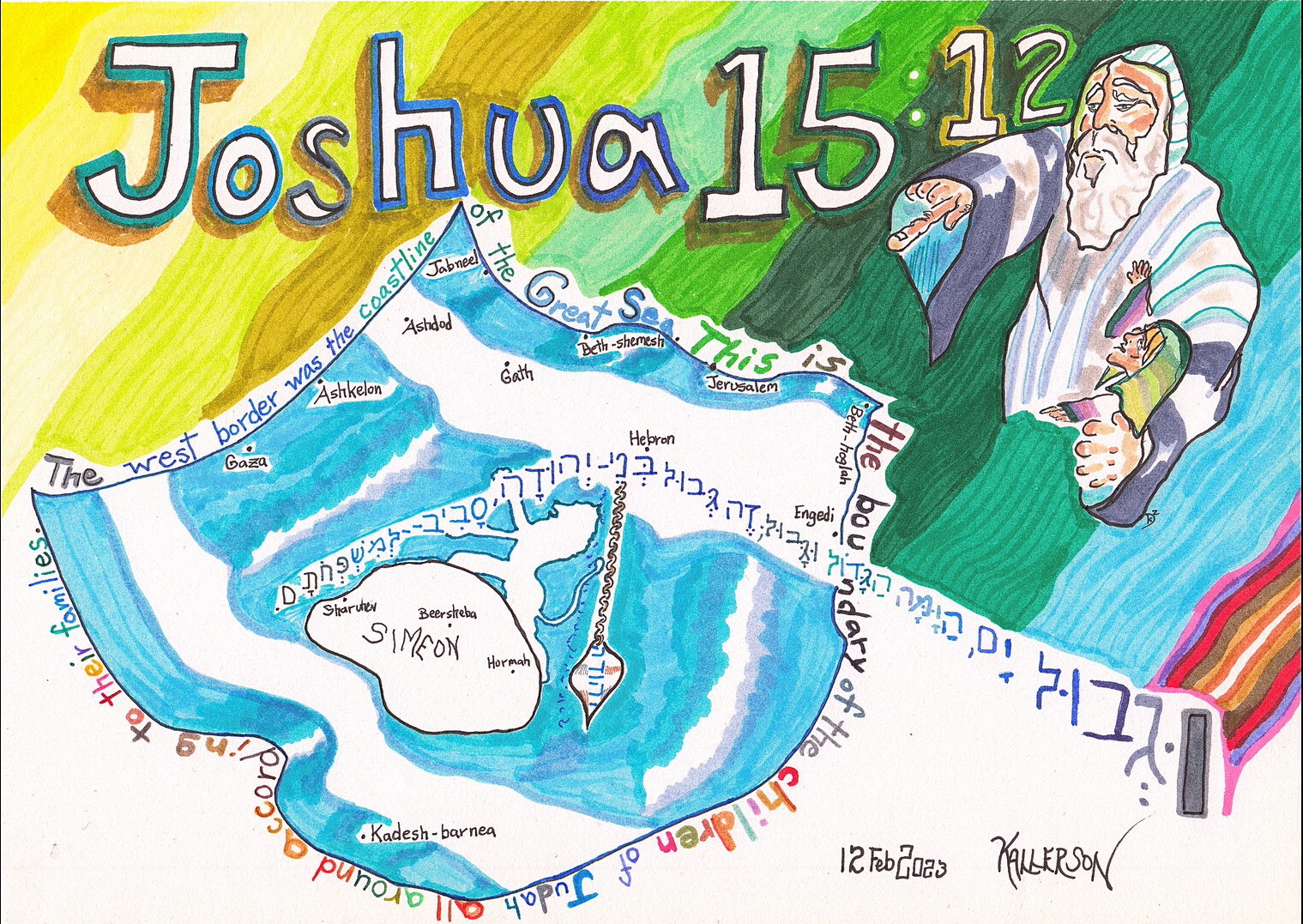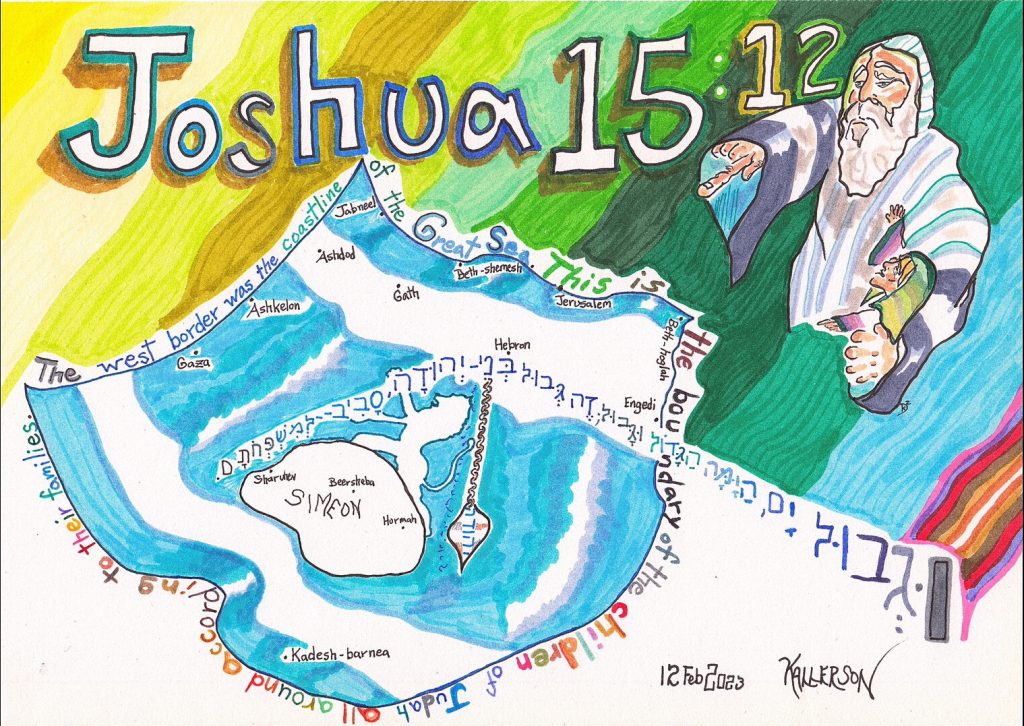
Artwork by Douglas Kallerson.
Joshua 15:1-12
The Borders of the Land of Judah
I went out to Boulder, Colorado, in September of 2021 to be with a friend as he buried his wife who was also my friend. I was only there a couple days and didn’t see much, but one thing that I remember clearly was a rocky outcropping on the top of a mountain called Devil’s Thumb.
I was told it was there but couldn’t really see it until we got to the right angle, and then it became pretty obvious. It stuck right out just like a big fat thumb. There will be a similar thumb in today’s passage.
You’ve heard the sermon passage mentioning the Stone of Bohan. We could just say, “Well, yeah, it’s there to mark out the border and nothing more.” And that could be true. But when the things referred to in these borders keep matching things found elsewhere in the Bible, it becomes harder and harder to simply dismiss them as coincidences.
I will admit to a bit of speculation for a couple of the names in this passage, but that is more likely my inability to properly analyze what is being presented than any lack in the biblical text.
The thing is, like all other typology, it has to match the other instances where the same things are mentioned, or we’re just making things up as we go. That’s not a good way to handle an evaluation of Scripture. But when it does match up, that makes it pretty certain that we are being shown more than just literal history, but typology as well.
Text Verse: “Every word of God is pure;
He is a shield to those who put their trust in Him.” Proverbs 30:5
If every word of God is pure, then it logically follows that every word of God also has purpose. In stating that something in the word is pure, and the Bible says a lot of things, then we can be confident that God has carefully placed each word in Scripture for a reason, or several reasons.
Solomon then goes on to say that God is a shield to those who put their trust in Him. Well, how does that come about? Someone could say some other supposed holy book was the word of God. So, do we just say, “Ok, then I will put my trust in the god seen in that book because someone said it?” That would be foolish.
So how do we determine if the word we have is really the word of God? By reading it, studying it, and then accepting or rejecting the premise stated in it. Paul says that faith comes by hearing and hearing by the word of God (Romans 10:17).
You can’t reasonably say, “This is the word of God” without actually checking it out. But once you checked it out, faith came. The word was heard, and only then was there the necessary response. To get this, think of someone printing off a stack of books with the words “The Holy Bible” on the outside but just blank pages on the inside.
See, it doesn’t work. This wonderful book that we go through each week is filled with evidence that it is what it claims to be. In today’s sermon, I am going on faith that the borders of Judah are telling us a story. Why? Because I have done the study. If you stick around, you’ll hear this presented. Then you can decide if it fits with what you know.
Great things truly are to be found in His superior word. And so, let us turn to that precious word once again, and… May God speak to us through His word today, and may His glorious name ever be praised.
I. This Is the Boundary (verses 1-12)
The methodical presentation of how the land is divided continues in Chapter 15. The narrative went from what was conquered under Joshua to what remained to be conquered (13:1-7). It next detailed the land inheritance of those east of the Jordan (13:8-14).
That was then further defined by detailing the land of each of the tribes east of the Jordan: Reuben, Gad, and the half-tribe of Manasseh (13:15-33). In Chapter 13, it twice noted that Levi had no inheritance, meaning land inheritance.
Chapter 14 first noted how the land west of the Jordan would be divided to the nine and one-half tribes, again noting that Levi received no land inheritance (14:1-5). Immediately after that, it detailed the inheritance to be given to Caleb (14:6-15).
With that logically presented and detailed, the division of the land to individual tribes west of the Jordan takes place. There is careful order in how each step is laid out. The first tribe’s land grant is here detailed, that of Judah…
So this was the lot of the tribe of the children of Judah according to their families:
v’hi ha’goral l’mateh bene Yehudah l’mishp’hotam – “And came the lot to tribe sons Judah to their families.” Of this initial division, Charles Ellicott provides a logical reason for Judah’s placement, which is otherwise unstated in the narrative –
“The question arises at this point how the position of the tribes of Judah, Ephraim, and Manasseh was determined. As to the remaining seven, see Note on Joshua 18:5-10. It is noticeable that Hebron appears to have been promised to Caleb (Joshua 14:12), and Shechem assigned to Joseph by Jacob (Genesis 48:21-22; Joshua 24:32). Did not this necessarily bring the tribe of Judah into the south, the neighbourhood of Hebron, and Ephraim (with his brother Manasseh) into the centre of the country?” Ellicott
His thoughts make sense. The lot is directed by the Lord. In order to keep the tribes together in a logical fashion, He determined each placement in accord with these earlier promises and also in accord with prophecies previously uttered.
In other words, and for example, Jacob prophesied that Simeon and Levi would be divided in Jacob and scattered in Israel (Genesis 49:7). The scattering of Levi has come about through their selection as ministers to the people and because they have no tribal land grant. Simeon’s scattering will come about when their land grant is placed within the borders of the already selected land grant of Judah.
Another example would be when Jacob prophesied that the Messiah would come from Judah (Genesis 49:10). To ensure this, Judah’s land grant will be in the protected southern area of the land.
While the northern tribes are exiled, Judah would remain a bastion of safety for those from any tribe who moved into that inheritance, thus preserving all tribes and allowing the Messiah to come forth as prophesied.
From this, it can be seen that everything in the Old Testament, and even into the New Testament gospels and Acts, finds its place based upon the land grants being made as determined by the Lord. As the proverb says –
“The lot is cast into the lap,
But its every decision is from the Lord.” Proverbs 16:33
As for the listing of Judah first, nothing is said regarding the order of the lots cast. It is the results of the cast lots that is the focus. The land division for these first three tribes is stated according to the positioning of the tribes, generally going from south to north. As for Judah’s land…
1 (con’t) The border of Edom at the Wilderness of Zin southward was the extreme southern boundary.
el gevul edom midbar tsin negbah miqtseh teman – “unto border Edom, Wilderness Tsin, southward extremity south.” This is the southern border of the land of Canaan as defined in Numbers 34. Hence, this means that Judah is the southernmost tribe. Edom means Red. Tsin means Thorn or Barb.
2 And their southern border began at the shore of the Salt Sea,
Not only is the land described from south to north, but it is described from east to west. These words read: v’hi lahem gevul negev miqtseh yam ha’melakh – “And came to them border south extremity Sea, the Salt.” This is the southeasternmost point of the land now granted to Judah. Hence, the eastern border lies along the Dead Sea, which is further described as…
2 (con’t) from the bay that faces southward.
min ha’lashon ha’poneh negbah – “from the tongue, the facer southward.” It is debated what this tongue is, be it a rock promontory, a salt marsh, or simply the southern end of the Dead Sea. Looking at maps of the land gives varied possibilities. As the same term is used again in verse 5 and referring to the north end of the sea, I deduce it is speaking of the southern end of the sea here.
3 Then it went out to the southern side of the Ascent of Akrabbim, passed along to Zin, ascended on the south side of Kadesh Barnea, passed along to Hezron, went up to Adar, and went around to Karkaa.
The names are: Maaleh Aqrabim or Ascent of Scorpions. There are scorpions in this barren area, but in Scripture, the scorpion is also used figuratively for a scourge. Tsin means Thorn. Qadesh Barnea means Holy Purifying Wanderings. Khetsron means Enclosure or Surrounded by a Wall. Adar means Wide Open Place, Honorable, or Majestic. Karkaa means Floor, Ground, or Pavement.
Kadesh Barnea is the area furthest south. It was first noted in Genesis 14 as En Mishpat. It is the area where Miriam died and where Moses and Aaron rebelled against the word of the Lord. At that time, it was called Meribah Kadesh.
4 From there it passed toward Azmon and went out to the Brook of Egypt; and the border ended at the sea.
Atsmon comes from atsom meaning mighty. That comes from etsem meaning a bone. The idea is that the skeletal structure is what provides strength. Thus, the place is called Mighty or Mighty One. The Brook of Egypt is Nakhal Mitsraim.
The noun nakhal comes from the verb nakhal meaning to take or get as a possession. Mitsraim, though debated, may mean Double Trouble.
4 (con’t) This shall be your southern border.
The words of this single clause go from the third-person past tense to the second-person future tense, following the same style as Moses in Numbers 34. The reason for this isn’t certain, but it is probably because this is not only the southern border of Judah’s inheritance, but it is also the southern border of Israel’s inheritance.
5 The east border was the Salt Sea as far as the mouth of the Jordan.
u’gevul qedemah yam ha’melakh ad qetseh ha’yarden – “And border eastward, Sea the Salt, unto extremity the Jordan.” The meaning is that the western shore of the Dead Sea would be Judah’s eastern border all the way to where the Jordan enters into the sea. At that point…
5 (con’t) And the border on the northern quarter began at the bay of the sea at the mouth of the Jordan.
u-gevul liphat tsaphonah mil’shon ha’yam miqtseh ha’yarden – “And border side northward from tongue the sea extremity the Jordan.” The meaning is that this northern border goes to the spot where the Jordan River flows into the Dead Sea. From there…
6 The border went up to Beth Hoglah and passed north of Beth Arabah;
v’alah ha’gevul beith haglah va’avar mitsphon l’beith ha’aravah – “And went up the border, Beth Hoglah, and passed over north to Beth Arabah.” Beith Khoglah means House of the Partridge, but it also means House of Turning in Joy. The word comes from khagal, to wobble or hop. It is the same name as one of the daughters of Zelophehad.
This is a point between the tribes of Judah and Benjamin but belonging to Benjamin. It is between Jericho and the Dead Sea.
Beith ha’Aravah means House of the Plain, but it is derived from arav, to give in pledge. Hence, it can also mean House of the Pledge. It is ascribed to Judah in Joshua 15:61 and then to Benjamin in Joshua 18:22. Hence, it was a joint border city. Next…
6 (con’t) and the border went up to the stone of Bohan the son of Reuben.
v’alah ha’gevul even bohan ben reuben – “and went up the border, Stone Bohan, son Reuben.” Bohan is identical to bohen, the thumb or big toe. It was probably a thick, prominent stone that was used as a landmark and named after a son of Reuben. Maybe he was buried there or did some heroic thing there. Strong’s defines the meaning as Closing, but I have no idea why.
7 Then the border went up toward Debir from the Valley of Achor, and it turned northward toward Gilgal, which is before the Ascent of Adummim, which is on the south side of the valley.
Debir means Place of the Word. This is not the same Debir as seen in Joshua 10 or the other Debir in Joshua 13. It is a third location with this name situated not too far from Jericho.
Achor means Trouble. This is most likely where Wadi Qelt is today. It received its name from the events recorded in Joshua 7 when Achan was taken out and then stoned and burned.
Gilgal (ha’Gilgal) means The Rolling Away, signifying the Liberty. Adummim is a plural word coming from adom, red, and adam, Adam or man. Thus, it is the Ascent of the Red Ones or Ascent of the Adams (men). That is said to be mi’negev la’nakhal, or from south to the wadi. The noun nakhal coming from the verb nakhal means to inherit.
7 (con’t) The border continued toward the waters of En Shemesh and ended at En Rogel.
En Shemesh means Fountain (Eye) of the Sun. It is identified today as the Apostle’s Spring which is about a mile below Bethany; it is the only spring on the road to Jericho
En Rogel could have a couple meanings. Rogel comes from regel meaning foot or ragal, to go about on foot. As such, it could mean Fountain (Eye) of the Fuller, because the foot is used for washing garments, or Fountain of the Traveler.
8 And the border went up by the Valley of the Son of Hinnom to the southern slope of the Jebusite city (which is Jerusalem).
v’alah ha’gevul ge ben hinom el ketheph haybusi mi’negev hi yerushalim – “And ascended the border valley Son Hinnom unto shoulder the Jebusite – it Jerusalem.” The word translated as valley is different than the previous verses. It is ge, coming from gavah, pride or confidence. That comes from gaah, to rise up, increase, etc.
The original meaning of Hinnom is pretty much lost. The few who attempt to translate it associate it with wailing. Hence, this could be paraphrased as “the exaltation of the Son of Groaning.” In the New Testament this, becomes the well-known Gehenna. It is a valley that runs along the border of Jerusalem.
Jebusite means Treading Down or Trodden Underfoot. Jerusalem can have various meanings, but Foundation of Peace is sufficient.
8 (con’t) The border went up to the top of the mountain that lies before the Valley of Hinnom westward, which is at the end of the Valley of Rephaim northward.
It is supposed by some that this is referring to Mt. Moriah seen in Genesis 22:2 and 2 Chronicles 3:1, the spot where Isaac was offered up and later where the temple was built. This is said to be at the end of emeq rephaim tsaphonah – “depth Rephaim, northward.” The emeq is a deep broad valley.
Rephaim comes from either raphah, to sink or relax, or from rapha, to heal. Strong’s goes with the latter. Thus, it would be the Depth of Healed Ones.
9 Then the border went around from the top of the hill to the fountain of the water of Nephtoah,
v’ta’ar ha’gevul me’rosh ha’har el mayan me nephtoakh – “And marked out the border from top the mountain unto fountain waters Nephtoah.” There is a new word here, ta’ar. It comes from a primitive root meaning to delineate. Hence, it means to extend, be drawn, or mark out.
There is a marking out of the area from the top of the mountain that extends to the fountain of these waters, identified as Ain Lifta which is northwest of Jerusalem. Nephtoakh means Opening.
9 (con’t) and extended to the cities of Mount Ephron.
The name Ephron comes from either opher, a deer, or aphar, dust. The same name was seen in Genesis 23 and signifies Of the Dust.
9 (con’t) And the border went around to Baalah (which is Kirjath Jearim).
v’ta’ar ha’gevul baalah hi qiryat yearim – “And marked out the border Baalah, it Kirjath Jearim.” Baalah means Lady or Mistress. Kirjath Jearim means City of Forests or City of Honeycombs. This city is noted in Scripture as the residence for the Ark of the Covenant for twenty years after it was sent back to Israel by the Philistines.
10 Then the border turned westward from Baalah to Mount Seir,
v’nasav ha’gevul mi’baalah yammah el har seir – “And went around, the border, from Baalah westward unto Mount Seir.” This is obviously not the same Mount Seir in Edom. But the name is the same, Mount Hairy, probably given because of its hairy appearance, being covered in low brush or bushes. From there…
10 (con’t) passed along to the side of Mount Jearim on the north (which is Chesalon), went down to Beth Shemesh, and passed on to Timnah.
Mount Jearim has the same meaning as Kirjath Jearim – Mount of Honeycombs or Mount of Trees. The name Chesalon comes from kasal, used only in Jeremiah 10:8 –
“Inasmuch as there is none like You, O Lord
(You are great, and Your name is great in might),
7 Who would not fear You, O King of the nations?
For this is Your rightful due.
For among all the wise men of the nations,
And in all their kingdoms,
There is none like You.
8 But they are altogether dull-hearted and foolish;
A wooden idol is a worthless doctrine.” Jeremiah 10:6-8
Some use the word in a manner that attempts to turn it into a good concept and thus translate Chesalon as Trust or Firm Confidence, but it appears to simply mean Mount Stupidity. Beth Shemesh means House of the Sun. Timnah means Allotted Portion. Timnah is said to be in Judah in verse 15:57, but it is said to be in Dan in verse 19:43. Hence, it too was a joint border city.
11 And the border went out to the side of Ekron northward.
As seen in Chapter 13, Ekron comes from aqar, to pluck up or uproot. But that is from the same as eqer, an offshoot or descendant. Hence, the name could mean either Offshoot or Uprooted. Zephaniah will make a play on the name later in Scripture, saying, “Ekron shall be Uprooted.”
In Joshua 10:43, Ekron is said to be in the original land grant of Dan. It is a city that remained pretty much under the control of the Philistines. Wikipedia notes –
“Since the discovery in 1996 of the Ekron inscription, Ekron has been positively identified with the mound of Tel Miqne (Hebrew) or Khirbet el-Muqanna (Arabic). The tell lies 35 kilometres (22 mi) west of Jerusalem, and 18 kilometres (11 mi) north of Tell es-Safi, the almost certain site of the Philistine city of Gath, on the grounds of Kibbutz Revadim on the eastern edge of the Israeli coastal plain.”
11 (con’t) Then the border went around to Shicron, passed along to Mount Baalah, and extended to Jabneel;
Shicron supposedly comes from shakar, to become drunk. However, the root skr can mean either shakar or sakir, hired, sakar, to hire, wage, and so on. As such, it does not have to indicate being drunk, but wages. Jabneel comes from banah, to build, and el, God. Hence it is something like Built of God.
11 (con’t) and the border ended at the sea.
v’hayu tots’oth ha’gevul yamah – “and have been outgoings the border westward.” The meaning is seaward and thus the Mediterranean Sea. The entire northern border is thus complete. From there, the final border is described…
12 The west border was the coastline of the Great Sea.
u-gevul yam ha’yamah ha’gadol – “And border west the Sea the Great.” The same word, yam, means both sea and west. This is because directions are often defined by the layout of the land as one is standing in Canaan looking east. With that, the verses today finish with…
*12 (fin) This is the boundary of the children of Judah all around according to their families.
zeh gevul bene Yehuda saviv l’misp’hotam – “This boundary sons Judah around to their families.” One can see how this clause of verse 12 complements the opening verse of the chapter. They are like bookends to the section which has been presented –
v.1 – And came the lot to tribe sons Judah to their families.
v.12 – This boundary sons Judah around to their families.
The tribe of Judah, from which will descend the Messiah Himself, is thus described according to all of the names presented. However, it is certain is that this is more than just a list of marking points to define the land where Judah will dwell.
That will be seen as we continue. God is telling us a story about the coming Messiah, if we will just pay heed…
These are the borders of My land known as Praise
And together they have a story to tell us
It is a story that will continue on for eternal days
It is the story of our Lord, Jesus
Every detail gives us hints of what He has done
Or of how it is realized in each of us
The marvelous details concerning God’s own Son
Glorious pictures of our Lord, Jesus
God has set forth these things, allowing us to see
The beautiful things that Christ has done for us
The truths are found in the gospel that He offers for free
It is the precious gift of God, the gospel of our Lord, Jesus
II. Pictures of Christ
The borders of Judah were marked out, but Scripture doesn’t say how this came about. Whether it is the same process that is detailed for the northern tribes in Joshua 18 or not, we can’t know. All we are told in verse 1 is that this lot came out for Judah.
As the lot is directed by the Lord, that is sufficient for deciding the rest of the land divisions. Whether marked out by man and then decided by lot for the tribe, or whether the Lord decided the borders and then the tribe, or the tribe and then the borders, it doesn’t matter. There are borders, and they form a land grant. That grant is now given to Judah.
I will give the details of each place mentioned, but I don’t want to make stuff up. When my comments are speculative, I will let you know. As for these borders of Judah, or Praise, I suggest they are given as a snapshot of the work of Christ and how it applies to His people, including the state of His people.
The southern border, the right-hand border as Canaan is laid out, gives numerous references to Christ and His work. Edom’s border is the first thing mentioned and it defines Judah’s southern border. Edom means Red, but its letters are identical to adam, Adam/man. The picture of Adam and Edom in Genesis 25 was very clear, as other pictures have been since.
Christ is noted as the second Man and the last Adam, in 1 Corinthians 15 –
“And so it is written, ‘The first man Adam became a living being.’ The last Adam became a life-giving spirit.” 1 Corinthians 15:45
“The first man was of the earth, made of dust; the second Man is the Lord from heaven.” 1 Corinthians 15:47
This border was also said to be at the Wilderness of Zin or Thorn. In the Bible, the wilderness signifies an uncultivated area, not necessarily a barren desert. It is a place of God’s grace and of closeness to God, but it is also a place of testing.
For some, such as Israel, the testing resulted in disobedience. For others, such as when Christ was tested, it is a place of fellowship through obedience. The wilderness and the law are closely connected because it is by law that testing is accomplished.
As for the Wilderness of Zin, that was seen several times as typical of Christ’s cross. This is the extreme right or southern border.” The implication is that because the right is the position of power, the cross is the ultimate expression of the power of God in Christ –
“For the message of the cross is foolishness to those who are perishing, but to us who are being saved it is the power of God.” 1 Corinthians 1:18
If the message of the cross is the power of God, then it is the cross itself that demonstrates that power. The southern border was next said to begin at the southern border of the Salt Sea. Salt is a sign of the covenant, and it also signifies incorruptibility, an obvious picture of Christ’s incorruptibility, proven through His death and resurrection (Acts 2:31).
Akrabbim, or Scorpions, anticipates Christ’s scourging. The word scorpion is used elsewhere metaphorically in this manner. Kadesh Barnea, Holy Purifying Wanderings, is the extreme southern part of the wilderness of Zin. It anticipates the perfect work of Christ. Hezron, or Enclosure, anticipates His tomb.
Adar would signify the majestic nature of the Lord’s work (Luke 9:43, 2 Peter 1:16, etc.). Karkaa (Pavement) would anticipate the Pavement (Gabbatha) where Christ was judged in John 19:13. Atsom, Mighty, speaks of the mighty nature of Christ’s work.
These are not in order in the narrative, but! that only makes sense because they are north of Kadesh Barnea in the Wilderness of Zin which anticipates His cross. Hence they are anticipating the cross as the south is approached. The brook of Egypt, nakhal mitsraim, is the anticipation of the inheritance of those who were in Double Trouble – fallen and without God in the world.
This is the southern border. It anticipates Christ’s work, the power of God unto salvation brought about through His life, fulfilling of the law, death in fulfillment of the law, and the application of those things to the people of the world.
The statement which was in a different tense than the others, “This shall be your southern border,” anticipates that the typology extends beyond Judah to all of Israel. This would then be inclusive of Gentiles who are brought into the commonwealth of Israel (Ephesians 2:12). As such, it is an all-inclusive statement concerning the scope of the completed work of Christ.
With that, the eastern border was defined in verse 5 as the western border of the Salt Sea. The word qedemah, or eastward, was used. Qedem signifies east, but it also signifies before, earlier, and even everlasting in the Bible.
Again, it speaks of the nature of the covenant, which would be the New Covenant because the Jordan (the Descender, Christ Jesus) falls into the Salt Sea. His perfect work anticipates His incorruptible nature, the perfection of the New Covenant, and the eternal nature of that covenant.
The northern border has a lot of names in it. North is the dark or hidden direction in Scripture. We can think of it anticipating those who are hidden in Christ. In other words, the effects of the work of Christ as they apply to His people.
As just relayed, that begins at the Jordan as it falls into the Salt Sea. One must come through the Jordan (through Christ) to enter the inheritance. That is through His death, burial, and resurrection – typified by the Jordan at the mouth of the Salt (Dead) Sea.
Beth Hoglah, the House of Turning in Joy, anticipates the state of believers in their salvation. Beth Aravah, House of the Pledge, signifies the state of being sealed with the Spirit –
“Now He who establishes us with you in Christ and has anointed us is God, 22 who also has sealed us and given us the Spirit in our hearts as a guarantee [Greek: arrabón/pledge].” 2 Corinthians 1:21, 22 (see also 2 Corinthians 5:5 and Ephesians 1:13, 14)
The stone of Bohan, or Thumb, is next. Stone signifies establishment, as in setting up a pillar. It signifies permanence; that which is established is set to stand firm. It signifies resiliency and strength, as in that which is fixed and unyielding.
The thumb represents the hand and thus action. It is that which has the ability to grasp firmly. It anticipates the eternal security of the believer, something that follows naturally after the pledge of the Spirit. Adding in the name Reuben, meaning, See a Son, would anticipate the sonship of those who are in Christ. As Paul says, “For you are all sons of God through faith in Christ Jesus” (Galatians 3:26).
Verse 7 anticipates the trek believers take in Christ. It says the border went to Debir, Place of the Word, from the Valley (Depth) of Trouble. Man in Christ was in the depth of trouble. He hears the word and believes. From there, it goes to ha’Gilgal, the Liberty, just as man enters into the Liberty found in Christ. The reproach is rolled away.
That is said to be before the Ascent of Adummim, or Ascent of the Red Ones (men). It is the heavenly promise noted many times in Scripture, such as Ephesians 2:6 where believers are said to be raised up and seated in the heavenly places in Christ Jesus.
This location was on the south side of the valley. The word negev, or parched, is used. The valley is nakhal, an inheritance. The meaning seems obvious. Even though we have the heavenly inheritance in Christ, until things are finished, we are still on the dry side of glory, awaiting the life that is truly life where the waters of life flow copiously and constantly.
The border then continues to En Shemesh, Fountain of the Sun, and ends at En Rogel, Fountain of the Fuller. It speaks of the eternal light of Christ (Malachi 4:2) and thus the eternal flowing of light where there will be no night (Revelation 22:5), and of the eternally purified garments such as those mentioned in Revelation 3:5.
Verse 8 continues with the effects of the work of Christ on His people. It mentions the Valley of the Son of Hinnom – the exaltation of the Son of Groaning. Christ went through His passion and because of it, He now brings each of us out of our own state of groaning –
“For we know that the whole creation groans and labors with birth pangs together until now. 23 Not only that, but we also who have the firstfruits of the Spirit, even we ourselves groan within ourselves, eagerly waiting for the adoption, the redemption of our body.” Romans 8:22, 23
It then mentioned the Jebusite, the Treading Down. The word is derived from bus, to tread down or trample. The thought is expressed in Psalm 60 –
“Give us help from trouble,
For the help of man is useless.
12 Through God we will do valiantly,
For it is He who shall tread down [bus] our enemies.” Psalm 60:11, 12
Immediately after that, it said, “It Jerusalem.” The Foundation of Peace is realized because of our position in Christ.
Next, it said, “The border went up to the top of the mountain before the Valley [ge] of Hinnom westward, which is at the end of the Valley [emeq] of Rephaim northward.” A paraphrase of the two would be “the exaltation of groaning and the depth of the healed ones.” Each again anticipates the state of believers.
The fountain of Nephtoah anticipates eternal access into glory, symbolized by the gates that are never shut in the New Jerusalem (Revelation 21:25). Mount Ephron is given to anticipate the gathering of those “Of the Dust,” meaning the redeemed of humanity.
As for the next two names, I mentioned I don’t want to be dogmatic. I can only speculate and tell you what I think. Baalah is a feminine word. The word baal means “Master.”
Hence, Baalah, means Lady, but not as we think of as a general female. Rather, we can think of Lords and Ladies. My supposition would be it refers to the church as whole, a feminine noun. This was also called Kirjath Jearim. The standard meaning is City of Honeycombs or City of Forests. However, Abarim says –
“The verb יער (ya’ar) isn’t used in the Bible and it’s a complete mystery what it might have meant. Noun יער (ya’ar) is the common word for forest or thicket, and the identical noun יער (ya’ar) means honeycomb. It is, of course, perfectly possibly that these two nouns are not two but one, describing something general like a thing that consists of many elements, which contain energetic nutrients (either fruits or honey)…” Abarim
Therefore, this could be an explanation of the church, a group derived from many people, each filled with individual fruit of the Spirit. That’s the best I can do on this location. But it is actually supportable by the comparison of Israel to a forest in Malachi 7:14 –
“Tend Thy people with Thy staff, the flock of Thy heritage, That dwell solitarily, as a forest in the midst of the fruitful field; Let them feed in Bashan and Gilead, as in the days of old” (JPS Tanakh)
From there, it again mentions Baalah turning to Mt. Seir, meaning Hairy. Hair in the Bible signifies awareness, especially the awareness of sin. This would fit perfectly with those in the church who are both aware of sin and have handed that sin over to Christ.
As this seems likely, the next words would then follow logically. Mount Jearim would represent the gathering of the church that is restated as “it Chesalon.” Chesalon is the Mount of the Foolish, and it is well reflected by Paul’s words of 1 Corinthians 1:27 (and elsewhere) where he says that God has chosen the foolish things of the world to put to shame the wise.
The idea of being foolish is used in an ironic way when referring to believers, but it fits the typology here. The next two references are the House of the Sun, an obvious picture of the eternal nature of the light in the New Jerusalem.
In Revelation, it does say that there will be no sun. However, seeing as how Jesus is the Sun of Righteousness and He will be there, and because He is the lamp of the light of God, the typology fits. Timnah, Allotted Portion, is exactly what believers anticipate, meaning their allotted portion in glory.
Naming Ekron, or Offshoot, again speaks of the state of believers in Christ. Shicron or Wages, seems out of place as wages are usually negatively associated with earning one’s way. But when the wages are applied to Christ, such as in Zechariah 11:12, and then placed alongside the last two named places, Mount Baalah and Jabneel, the meaning seems clear.
The wages (Shicron) paid by Christ form the gathering of the church (Mount Baalah) which is Built of God (Jabneel). With that, the northern border is ended. All that is left is the west which is the Great Sea. That anticipates the state of eternally seeking after God.
Revelation 4:6 says there is a sea like glass before the throne of God. It later says there is no sea in the New Jerusalem because the sea in Scripture pictures the chaos/churning of the nations. The sea before the throne is placid like glass. There is harmony and tranquility before God. The west is the direction of the Holy of Holies and is emblematic of the throne of God. Hence, the Great Sea anticipates that.
With that, our passage for today is complete. As I mentioned, there are a few points that I feel confident enough to speculate on, but not confident enough to say with certainty.
Remember that when you listen to preachers evaluate the word. And the only way you can truly do that is to read and know the word as well. Take time to do that each day; at least two or ten times each day. And maybe get an audio Bible for your time in the car.
The more you take in the word, the better prepared you will be to walk away from people that misuse it. Above all, be sound in your doctrine about Jesus. If nothing else, be sure about that. If you get Him wrong, the rest of the Bible will be totally out of whack. Jesus! Jesus! Jesus! He is the key to salvation. Without Him, there can be no salvation.
Hold fast to Jesus, the One who all of this precious word anticipates, reveals, and explains. Yes, hold fast to Jesus.
Closing Verse: “For this reason we also thank God without ceasing, because when you received the word of God which you heard from us, you welcomed it not as the word of men, but as it is in truth, the word of God, which also effectively works in you who believe.” 1 Thessalonians 2:13
Next Week: Joshua 15:13-63 More precious than the biggest heists of lootah!… (A Share Among the Children of Judah)
The Lord has you exactly where He wants you. He has a good plan and purpose for you. It is He who has defeated the enemy and who now offers His people rest. So, follow Him and trust Him and He will do marvelous things for you and through you.
The Borders of the Land of Judah
So this was the lot of the tribe
Of the children of Judah according to each family:
The border of Edom at the Wilderness of Zin
Southward was the extreme southern boundary
And their southern border began at the shore of the Salt Sea
From the bay that faces southward
Then it went out to the southern side of the Ascent of Akrabbim
Passed along to Zin, yes Zin-ward
Ascended on the south side of Kadesh Barnea
Passed along to Hezron, how about that, ha?
Went up to Adar
And then around to Karkaa
From there it passed toward Azmon
And went out to the Brook of Egypt
And the border ended at the sea
This shall be your southern border, so don’t feel jipped
The east border was the Salt Sea
As far as the mouth of the Jordan (which rhymes with Gordon)
And the border on the northern quarter
Began at the bay of the sea at the mouth of the Jordan
The border went up to Beth Hoglah
And passed north of Beth Arabah, there and then
And the border went up to the stone
Of Bohan the son of Reuben
Then the border went up toward Debir from the Valley of Achor
And it turned northward toward Gilgal, where the troops rally
Which is before the Ascent of Adummim
On the south side of the valley
The border continued toward the waters of En Shemesh
And ended at En Rogel (let’s not hear any haw or hem)
And the border went up by the Valley of the Son of Hinnom
To the southern slope of the Jebusite city (which is Jerusalem)
The border went up to the top of the mountain
That lies westward before the Valley of Hinnom
Which is at the end of the Valley
Of Rephaim northward, where Rephaim roam
Then the border went around from the top
Of the hill to Nephtoah’s fountain of water (flowing to the brim)
And extended to the cities of Mount Ephron
And the border went around to Baalah (which is Kirjath Jearim)
Then the border turned westward from Baalah to Mount Seir
Passed along to the side of Mount Jearim – oohrah!
On the north (which is Chesalon)
Went down to Beth Shemesh, and passed on to Timnah
And the border went out to the side of Ekron northward
Then the border went around to Shicron, as you can see
Passed along to Mount Baalah, and extended to Jabneel
And the border ended at the sea
The west border was the coastline of the Great Sea
This is the children of Judah’s boundary
According to their families all around
This was Judah’s piece of ground
Lord God, turn our hearts to be obedient to Your word
Give us wisdom to be ever faithful to You
May we carefully heed each thing we have heard
Yes, Lord God may our hearts be faithful and true
And we shall be content and satisfied in You alone
We will follow You as we sing our songs of praise
Hallelujah to You; to us Your path You have shown
Hallelujah we shall sing to You for all of our days
Hallelujah and Amen…
So this was the lot of the tribe of the children of Judah according to their families:
The border of Edom at the Wilderness of Zin southward was the extreme southern boundary. 2 And their southern border began at the shore of the Salt Sea, from the bay that faces southward. 3 Then it went out to the southern side of the Ascent of Akrabbim, passed along to Zin, ascended on the south side of Kadesh Barnea, passed along to Hezron, went up to Adar, and went around to Karkaa. 4 From there it passed toward Azmon and went out to the Brook of Egypt; and the border ended at the sea. This shall be your southern border.
5 The east border was the Salt Sea as far as the mouth of the Jordan.
And the border on the northern quarter began at the bay of the sea at the mouth of the Jordan. 6 The border went up to Beth Hoglah and passed north of Beth Arabah; and the border went up to the stone of Bohan the son of Reuben. 7 Then the border went up toward Debir from the Valley of Achor, and it turned northward toward Gilgal, which is before the Ascent of Adummim, which is on the south side of the valley. The border continued toward the waters of En Shemesh and ended at En Rogel. 8 And the border went up by the Valley of the Son of Hinnom to the southern slope of the Jebusite city (which is Jerusalem). The border went up to the top of the mountain that lies before the Valley of Hinnom westward, which is at the end of the Valley of Rephaim northward. 9 Then the border went around from the top of the hill to the fountain of the water of Nephtoah, and extended to the cities of Mount Ephron. And the border went around to Baalah (which is Kirjath Jearim). 10 Then the border turned westward from Baalah to Mount Seir, passed along to the side of Mount Jearim on the north (which is Chesalon), went down to Beth Shemesh, and passed on to Timnah. 11 And the border went out to the side of Ekron northward. Then the border went around to Shicron, passed along to Mount Baalah, and extended to Jabneel; and the border ended at the sea.
12 The west border was the coastline of the Great Sea. This is the boundary of the children of Judah all around according to their families.