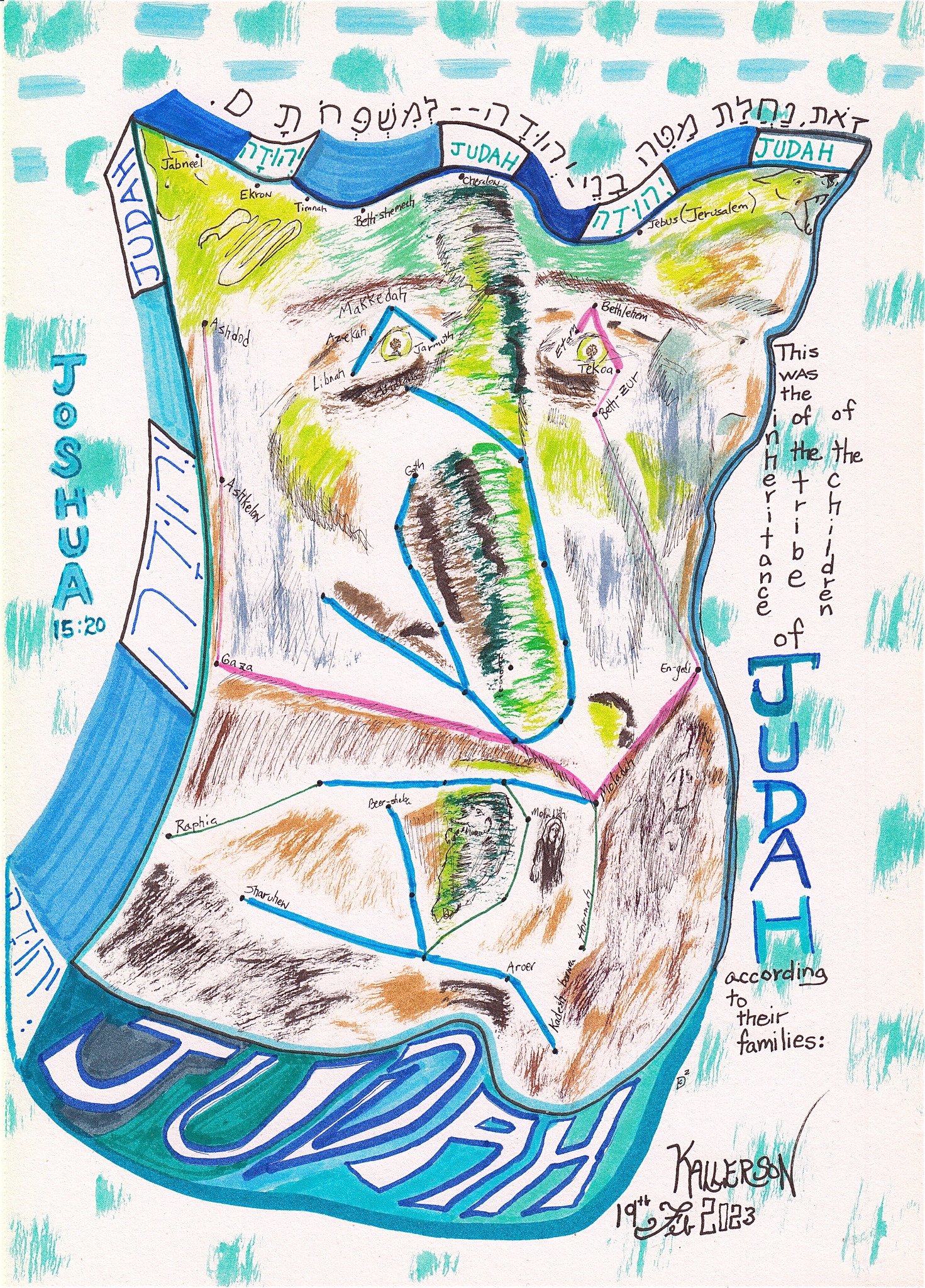
Artwork by Douglas Kallerson
Joshua 15:13-63
A Share Among the Children of Judah
The account today has verses that will be very closely repeated in Judges 1. When this happens in the Bible, it is telling us that really important information is being conveyed. This doesn’t negate the other information in the Bible but highlights the material worthy of repetition.
There are some differences between the accounts here and in Judges 1, and there is lengthy debate concerning which account is the original, or which is in the right chronological location, and so on. It is the kind of thing you might read, and just continue on saying, “I wonder why it mentions this twice?” But you never dig any further.
I admit that has been me for the past many years. I never took my own advice and paid extra heed to what is being presented. Notice what Charles Ellicott remarks –
“Which is its original place? In Judges it is connected with the continuation of the conquest of Canaan by the tribe of Judah after Joshua’s death, and there we read they slew (literally, smote) Sheshai, and Ahiman, and Talmai. If this is the death, and not merely the defeat of the Anakim (the Hebrew word is not absolutely decisive), we have two stages in the conquest of Hebron described … It would seem, then, that the entire conquest of the Anakim was not effected at once, but begun by Caleb and Joshua in Joshua’s lifetime, and completed by the tribe of Judah, under the leadership of Caleb, after Joshua’s death.” Charles Ellicott
He tries to reconcile the two as both being different accounts. However, he later appears to give up on that notion and says –
“Upon the whole, it seems most reasonable to conclude that the proceedings by which Caleb secured his inheritance, and fulfilled the promise of Joshua 14:12, have been recorded here for the sake of completeness, though not necessarily belonging to this time.” Ellicott
Text Verse: “May God enlarge Japheth,
And may he dwell in the tents of Shem;
And may Canaan be his servant.” Genesis 9:27
What Ellicott appears to be saying is that though he isn’t sure about the two accounts being separate, he tends towards the notion that they are one account and the insertion of them here is not that it is separate but “for the sake of completeness.”
Looking at the surrounding text here in Joshua, that seems evident, and it will be explained as we go. Context matters, and the context of this passage is that of inheritance. If we think on that, then what is said about Caleb is obviously also dealing with an inheritance.
It has something to do with Noah’s blessing upon Japheth and Shem. I will not give a detailed explanation of that when we get there in the passage today, so you’ll have to go back and watch the early Genesis sermons or the recorded Bible studies to get an answer to that, but the two are connected.
Everything is interconnected in this word. We just need to figure out how. And in all honesty, we can read and study for the rest of our lives and still not see it all. We have fifty-one verses to go through today, and you will see that I do not even attempt to explain all but a few of them. We may never leave Joshua if I did.
Instead, I am giving you what is most relevant to understanding the overall picture of what is going on. Other details will be drawn out as we continue through the word and refer back to make a necessary connection someday.
For now, let us turn to that precious word once again, and… May God speak to us through His word today, and may His glorious name ever be praised.
I. A Blessing for Achsah (verses 13-19)
13 Now to Caleb the son of Jephunneh he gave a share among the children of Judah,
As a reminder, Caleb means Dog, Yephunneh means He will be Beheld, and Judah means Praise.
Because the division of the land is what is being described, it naturally follows that this section would be recorded here in Joshua, regardless of when the events actually took place. In Joshua 13:1 it said that Joshua is old. His time is drawing near.
The land which remained to be conquered is detailed (13:1-7). Then the division of the land east of Jordan is repeated, indicating the matter is accomplished (13:8-14). That included the subdivisions of land by tribe (13:15-33).
Next, the division of the land west of the Jordan is introduced (14:1-4), but before it actually occurs, the inheritance of Caleb is settled (14:6-15). With that carved out, the borders of Judah are given (15:1-12). Then comes the naming of the cities within those borders (15:20-63).
But Caleb will, at some point in the future, carve out a particular division of this inheritance as indicated in these intervening verses. Though this is future, the details are logically placed here, before the naming of the cities of Judah, to ensure that the matter is settled and recorded.
One might ask, “Why would this account be placed here now if the actual events occur when it is recorded in Judges?” Rather, the exact opposite question would arise if it wasn’t: “Why wasn’t this record placed in the land division of Judah to clarify the exception?”
This is because it is the land division that is being dealt with. If we have an amendment to a land grant today, it would naturally be affixed to the original land grant documents regardless as to when it occurred. As such, these words now are that affixed amendment. Caleb was given his inheritance –
“Now therefore, give me this mountain of which the Lord spoke in that day; for you heard in that day how the Anakim were there, and that the cities were great and fortified. It may be that the Lord will be with me, and I shall be able to drive them out as the Lord said.” Joshua 14:12
Those anticipated events occur later in Judges 1, but they are logically placed in Joshua 15. As such, the words here in Joshua 15:13 are further detailing Caleb’s inheritance as spoken forth in Joshua 14.
To show that Caleb’s land grant, including this division, is included in Judah’s inheritance and not cut out of it as a separate and independent parcel, we read –
“And Joshua blessed him, and gave Hebron to Caleb the son of Jephunneh as an inheritance. 14 Hebron therefore became the inheritance of Caleb the son of Jephunneh the Kenizzite to this day, because he wholly followed the Lord God of Israel. 15 And the name of Hebron formerly was Kirjath Arba (Arba was the greatest man among the Anakim).” Joshua 14:13-15
Only after that were the borders of Judah described (15:1-12). Within those borders, a further division of Caleb’s inheritance is stated, demonstrating that it is a part of Judah, not a piece of land cut out of Judah. Joshua gave Caleb the son of Jephunneh a share among the children of Judah…
13 (con’t) according to the commandment of the Lord to Joshua,
This is in accord with Joshua 14:6, “You know the word which the Lord said to Moses the man of God concerning you and me in Kadesh Barnea.” His request, based on that, was to be granted…
13 (con’t) namely, Kirjath Arba, which is Hebron (Arba was the father of Anak).
As a reminder, Kirjath Arba means City of Four and Hebron means Alliance. We are reminded now that Arba, or Four, is the father of the Anaq. Rather than referring to a single person, Anak, it speaks of the clan: eth qiryath arba avi ha’anaq hi khevron – “Kirjath Arba, father the Anaq, it Hebron.”
As for the grant itself, this is in accord with Joshua 14:12 where Caleb said, “Now therefore, give me this mountain of which the Lord spoke in that day.” From there, the words of Joshua 14:13-15 (cited above) confirmed the grant. At the time of that request, Caleb said –
“…for you heard in that day how the Anakim were there, and that the cities were great and fortified. It may be that the Lord will be with me, and I shall be able to drive them out as the Lord said.” Joshua 14:12
That hopeful anticipation is now detailed, even though the events occur in Judges 1. The record states…
14 Caleb drove out the three sons of Anak from there: Sheshai, Ahiman, and Talmai, the children of Anak.
Rather than “drove out,” it reads: v’yoresh mi’sham Kalev eth sh’lovoshah bene ha’Anaq – “And disinherited from there Caleb three sons the Anaq.” The meaning is that he killed them (disinherited), and he assumed their land (inherited).
Sheshai means Whitish. Akhiman means My Brother is a Gift. Talmai means Plowman. Anak means Long Neck or Necklace. As they are called “the Anak,” they are a clan of people known for their unusually long or thick necks, or the adornments worn on their necks.
These three were already named in Numbers 13, many years before. Hence, the Pulpit Commentary may be correct when they say, “This also must not be pressed literally. Possibly these men were three chiefs of the Anakim.”
In other words, saying “the three sons of the Anaq” could be a way of speaking of those who descended from them, each being a clan. Or they may be sons bearing the same names as their fathers. As the order of the names is different now, it may explain that.
15 Then he went up from there to the inhabitants of Debir (formerly the name of Debir was Kirjath Sepher).
After dispossessing the Anakim, Caleb turned his sites on Debir, or Place of the Word, a place noted as having been called Kirjath Sepher. The word sepher is singular and means book. However, to get the right idea, you would call it “Book City,” and thus “City of Books,” a name obviously connected to Place of the Word. It was the place where the scrolls of writings were maintained, like a library today.
It was evidently important because of this, and Caleb defers to the former name when planning its attack. This is total supposition, but perhaps they wanted to capture the scrolls in order to get a better understanding of the layout of the land, the structure of cities, etc., by obtaining any such documents maintained there. So important was this mission that a great honor is offered…
16 And Caleb said, “He who attacks Kirjath Sepher and takes it, to him I will give Achsah my daughter as wife.”
va’yomer kalev asher yakeh eth qiryath sepher ul’khadah v’natati lo eth akhsah biti l’ishah – “And said Caleb, ‘Who strikes Book City and takes her – and I will give to him Achsah my daughter to wife.” Achsah comes from ekes, meaning a fetter (Proverbs 7:22) or an anklet (Isaiah 3:18). That comes from akas, to shake bangles as seen in Isaiah 3 –
“Moreover the Lord says:
‘Because the daughters of Zion are haughty,
And walk with outstretched necks
And wanton eyes,
Walking and mincing as they go,
Making a jingling with their feet,
17 Therefore the Lord will strike with a scab
The crown of the head of the daughters of Zion,
And the Lord will uncover their secret parts.’” Isaiah 3:16, 17
The offering of a daughter in this manner is not unusual. Throughout Kings and Chronicles, intermarriages are noted where one king gives a daughter to another, such as in 1 Kings 3:1. It is also something Saul promised to the victor over Goliath –
“So the men of Israel said, ‘Have you seen this man who has come up? Surely he has come up to defy Israel; and it shall be that the man who kills him the king will enrich with great riches, will give him his daughter, and give his father’s house exemption from taxes in Israel.’” 1 Samuel 17:25
As for the prize named Achsah, she goes to…
17 So Othniel the son of Kenaz, the brother of Caleb, took it; and he gave him Achsah his daughter as wife.
The wording here seems to place Caleb’s father as Kenaz and not Jephunneh. This is not right. The Hebrew could mean either Othniel or Kenaz is Caleb’s brother. Othniel is Caleb’s brother, both are sons of Jephunneh. The words ben qenaz, or “son of Kenaz,” mean “descendant of Kenaz,” and thus, he is – like Caleb – a Kenizzite as noted in Numbers 32:12.
His name means either Force of God or Lion of God. The NAS uses a different root which would signify Burning of God. Because he is the one to prevail over the city, Achsah goes to him, her uncle, as wife.
The meaning behind Kenaz, or Hunter, was explained in Chapter 14. It signifies a person who seeks after wisdom.
The purpose of the words is to show that both Caleb and Othniel are reckoned as descendants of this Gentile, Kenaz, and Achsah is thus accounted under both in this regard and yet she is being given a set inheritance within Judah as will be described.
18 Now it was so, when she came to him, that she persuaded him to ask her father for a field.
v’hi b’boah va’tsithehu lishol me’eth abiha sadeh – “And it was in her coming and she poked him to ask from her father field.” The word suth comes from shayith, a thorn. Hence, it figuratively signifies to poke or entice.
The meaning is that in her coming to Othniel as wife, she used that as opportunity to get him to either ask Caleb directly or to have him allow her to ask personally for a field. In Judges 1, the term ha’sadeh, or the field, is used. Thus, it is a particular field she has in mind. With that…
18 (con’t) So she dismounted from her donkey, and Caleb said to her, “What do you wish?”
va’titsnakh me’al ha’khamor va’yomer lah kalev mah lakh – “And jumped down from upon the donkey, and said to her, Caleb, ‘What to you?’” The difficulty here has ended in a wide variety of translations. The word tsanakh is found in only two accounts, this one and that of Jael in Judges 4 –
“Then Jael, Heber’s wife, took a tent peg and took a hammer in her hand, and went softly to him and drove the peg into his temple, and it went down into the ground; for he was fast asleep and weary. So he died.” Judges 4:21
What seems the best explanation of this comes from Adam Clarke, where he says “she hastily, suddenly alighted, as if she had forgotten something, or was about to return to her father’s house.”
One can imagine the scene. She is being conducted to the house of her new husband. She leans over and says, “We really need that field with the water. Let me ask him for it.” With that, she jumps down as if she refuses to go further unless she gets what she wants. Caleb is caught completely off guard and asks, “What’s the matter with you?” And then…
19 She answered, “Give me a blessing;
va’tomer t’nah li berakhah – “And answered, ‘Give to me blessing.’” The words mean, “Give to me a gift.” She wants something tangible from him. With that, she explains what…
19 (con’t) since you have given me land in the South, give me also springs of water.”
ki erets ha’negev n’thatani v’nathatah li guloth mayim – “For land the south given me, and give to me springs water.” The word negev means south, but it comes from a word meaning parched. Therefore, the land is almost pointless to possess unless water is available.
The word translated as springs, gullah, is new. It comes from galal meaning to roll. Thus, the water comes up as round and bubbling. Stanley described it in the 1860s, saying –
“Underneath the hill on which Debir stood is a deep valley, rich with verdure from a copious rivulet, which, rising at the crest of the glen, falls, with a continuity unusual in the Judæan hills, down to its lowest depth. On the possession of these upper and lower ‘bubblings,’ so contiguous to her lover’s prize, Achsah had set her heart.” Stanley’s Lectures, i. 264.
19 (con’t) So he gave her the upper springs and the lower springs.
va’yiten lah eth guloth iliyoth v’eth guloth takhtiyoth – “And gave to her springs upper and springs lower.” The word translated as upper, ili, is only found in this account. It comes from alah, to ascend. Thus, they are upper springs. The word signifying lower, takhti, comes from takhat, under. Thus it is the lower or lowest springs.
The account of Caleb, Othniel, and Achsah with the lands they possess is specifically stated here, just before the naming of the cities of Judah, to show what was rightfully theirs is to be reckoned within the overall inheritance of Judah.
Rolling waters, bubbling forth to us
Providing life in a parched land
They tell us of the glories of Jesus
Who alone sits at God’s right hand
The water of the word is what washes us
With it, we are cleansed and sanctified
It is these waters that tell us of Jesus
Of His perfect life, and that for us He died
We possess it because it was granted to us
And so, we carry to others this precious word
These rolling, bubbling waters reveal Jesus
It is through them that the salvation message is heard
II. Cities Within Judah’s Land Grant (verses 20-63)
20 This was the inheritance of the tribe of the children of Judah according to their families:
zot nakhalath mateh bene yehudah l’mishp’hotam – “This inheritance tribe sons Judah to their families.” Some translations make this a closing summary of verses 1-19 based on the borders provided minus the land given to Caleb. That then flows into the naming of the cities. As such, verses 13-19 are essentially a parenthetical insert for clarity.
Others take it as an opening statement concerning the cities that belong to Judah. As Hebron and Debir are listed as cities within Judah in the coming verses without any noted exceptions for Caleb, it seems likely that the first option is correct. As for the land, Cambridge notes –
“The territory of Judah, in average length about 45 miles and in average breadth about 50, was from a very early period divided into four main regions—(i) the South; (ii) the Lowland; (iii) the Mountain; (iv) the Wilderness.” Cambridge
From here through verse 63, these four main areas will be noted with some descriptions of their terminating lines. There will be 112 cities in the counting, plus Ekron, Ashdod, Gaza, and Jerusalem, thus totaling 116 cities. However, the naming of the cities will not match the numbers given. Of these lists, I will provide only a few comments along the way.
There may be a million typological patterns or hidden meanings, but those, if they exist, will be left for someone else to figure out. The main point of listing the cities is to specifically define what belongs to Judah. It is a necessary historical record. Therefore, we will review the verses without giving the meaning of the names.
21 The cities at the limits of the tribe of the children of Judah, toward the border of Edom in the South, were
More literally, it reads, “And were the cities extremity to tribe sons Judah until border Edom in the southward.” The meaning is that this list includes everything to the border of Edom and that is in the southern area of the inheritance.
Cambridge notes, “The South was the undulating pasture country which intervened between the hills, the proper possession of the tribe, and the desert country which marks the lower part of Palestine.” Their cities are –
21 (con’t) Kabzeel, Eder, Jagur, 22 Kinah, Dimonah, Adadah, 23 Kedesh, Hazor, Ithnan, 24 Ziph, Telem, Bealoth, 25 Hazor, Hadattah, Kerioth, Hezron (which is Hazor), 26 Amam, Shema, Moladah, 27 Hazar Gaddah, Heshmon, Beth Pelet, 28 Hazar Shual, Beersheba, Bizjothjah, 29 Baalah, Ijim, Ezem, 30 Eltolad, Chesil, Hormah, 31 Ziklag, Madmannah, Sansannah, 32 Lebaoth, Shilhim, Ain, and Rimmon: all the cities are twenty-nine, with their villages.
A few things of note: One is that Simeon will receive its inheritance within the borders of Judah. This will fulfill prophecy, but it also explains why some of the cities will be listed here and again in Simeon’s grant later.
Also, one city, Ziklag, is listed for both, but it was never subdued by Israel. It belonged to the Philistines. However, it was granted to David as a gift by Achish, king of Gath, in 1 Samuel 27:6.
Also, though it says 29 cities, depending on how they are listed, (such as “Hazor, Hadattah” or “Hazor-Hadattah,”) there are always more than 29. Various reasons have been suggested, such as 1) clerical error; 2) cities that were given but which were not possessed at that time; 3) joint cities that belonged to Judah and to Simeon; 4) some cities were known by more than one name; 5) some named locations were smaller hamlets or villages; or 6) other cities were later added while the original figure was maintained.
Some of the reasons given are ridiculous. Others may sufficiently explain the disparity.
33 In the lowland:
Of this, Cambridge says –
“The Lowland, or, to give it its proper name, the Shephelah, was a broad strip of land lying between the central mountains and the Mediterranean Sea. From the edge of the sandy tract which fringes the immediate shore it stretched up to the bases of the hills of Judah—the garden and granary of the tribe—and formed the lower part of the maritime plain which extended along the whole seaboard of Palestine from ‘the river of Egypt’ to Sidon.”
The cities of this area are…
33 (con’t) Eshtaol, Zorah, Ashnah, 34 Zanoah, En Gannim, Tappuah, Enam, 35 Jarmuth, Adullam, Socoh, Azekah, 36 Sharaim, Adithaim, Gederah, and Gederothaim: fourteen cities with their villages;
There are fifteen names even though the list says fourteen. However, in this listing, there is an article before Enam, v’ha’enam, or “and the Enam.” Enam means “Two Springs.” As such, Tappuah and Enam may be describing the same location – “Tappuah and the Two Springs.” If so, then the number fourteen is solved. If not, there is some other logical reason as stated before.
37 Zenan, Hadashah, Migdal Gad, 38 Dilean, Mizpah, Joktheel, 39 Lachish, Bozkath, Eglon, 40 Cabbon, Lahmas, Kithlish, 41 Gederoth, Beth Dagon, Naamah, and Makkedah: sixteen cities with their villages;
In verse 40, the name is either Lahmas or Lahmam. The letters for s and m are very similar in Hebrew and some manuscripts have one or another. Either way, the original exists and so there is no error in Scripture based on this.
Also, one of our dogs, a white chihuahua with ruby eyes is named Naamah (Pleasant). She is, mostly. But at times…
42 Libnah, Ether, Ashan, 43 Jiphtah, Ashnah, Nezib, 44 Keilah, Achzib, and Mareshah: nine cities with their villages;
The cities are named and their number matches. Let’s go on…
45 Ekron, with its towns and villages; 46 from Ekron to the sea, all that lay near Ashdod, with their villages; 47 Ashdod with its towns and villages, Gaza with its towns and villages—as far as the Brook of Egypt and the Great Sea with its coastline.
The word translated as towns is bath, daughter. Hence, it is a daughter to the main city. Also, the cities being mentioned are in the feminine and it is more consistent to do as King Jimmy did, saying something like, “and her daughters and her villages.” In doing this, other passages in Scripture are more fully appreciated when they are given a feminine aspect.
48 And in the mountain country:
u-ba’har – “And in the mountain.” Cambridge says –
“The Mountain, or ‘the Hill Country,’ though not the richest, was at once the largest and the most important of the four. ‘Beginning a few miles below Hebron, where it attains its highest level, it stretches eastward to the Dead Sea and westward to the Shephelah, and forms an elevated district or plateau, which, though thrown into considerable undulations, yet preserves a general level in both directions.’”
48 (con’t) Shamir, Jattir, Sochoh, 49 Dannah, Kirjath Sannah (which is Debir), 50 Anab, Eshtemoh, Anim, 51 Goshen, Holon, and Giloh: eleven cities with their villages;
The cities are named and their number matches…
52 Arab, Dumah, Eshean, 53 Janum, Beth Tappuah, Aphekah, 54 Humtah, Kirjath Arba (which is Hebron), and Zior: nine cities with their villages;
The Masoretic Text has an R instead of a D here, saying Rumah instead of Dumah. The letters are very similar in Hebrew. Other than that, the cities are named and the number matches…
55 Maon, Carmel, Ziph, Juttah, 56 Jezreel, Jokdeam, Zanoah, 57 Kain, Gibeah, and Timnah: ten cities with their villages;
Again, the numbers match what is named…
58 Halhul, Beth Zur, Gedor, 59 Maarath, Beth Anoth, and Eltekon: six cities with their villages;
The cities are named and numbered without controversy…
60 Kirjath Baal (which is Kirjath Jearim) and Rabbah: two cities with their villages.
Again, all is good with the description…
61 In the wilderness:
ba’midbar – “in the wilderness.” Cambridge says, “…which here, and here only, is synonymous with Arâbah, represents the sunken district adjoining the Dead Sea.”
61 (con’t) Beth Arabah, Middin, Secacah, 62 Nibshan, the City of Salt, and En Gedi: six cities with their villages.
Six cities numbered accordingly. And finally…
*63 (fin) As for the Jebusites, the inhabitants of Jerusalem, the children of Judah could not drive them out; but the Jebusites dwell with the children of Judah at Jerusalem to this day.
It is singular – “As for the Jebusite.” It is referring to the people group as a whole. A similar statement is made in Judges 1 –
“But the children of Benjamin did not drive out the Jebusites who inhabited Jerusalem; so the Jebusites dwell with the children of Benjamin in Jerusalem to this day.” Judges 1:21
Jerusalem was a border city, partly belonging to both Judah and Benjamin. It is, however, an interesting foreshadowing of the importance of the city to be so markedly noted at the end of these verses. It is also a sure note that this was not a later addition after the time of the kings when this could not have been a true statement. It was accomplished at the time of David.
Also, Bethlehem is noticeably missing from these, but eventually, it will become a city of the greatest importance.
The inheritance is within part of the commonwealth
And so, any can receive what it contains
But you cannot obtain it by trickery or stealth
Rather, those can never remove your chains
To have the freedom found in the waters that bubble
You must pay heed to that word
It is the remover of every care and trouble
When you accept the message you have heard
And it is not one spring, or seven, or three
No, the streams are numbered at only two
It is in them together that you can be free
Just these two springs will work; nothing else will do
III. Explaining the Achsah Typology
Translating the names of verse 13 sets the tone – Now to Dog the son of He Will Be Beheld he gave a share among the sons of Praise. We have seen that Caleb anticipates Gentiles. The words signify that believing Gentiles who come to Jesus are given an inheritance among the commonwealth of Israel (sons of Praise).
This is “according to the commandment of the Lord to Joshua [Jesus].” Verse 13 continued with the naming of the city. That inheritance was already explained in Chapter 14 and the meaning of the typology can be reviewed there. However, verse 14 adds in the note, “Caleb drove out the three sons of Anak from there: Sheshai, Ahiman, and Talmai, the children of Anak.”
Those names are given to explain the position of those who are a part of this joining together (Hebron/Alliance). Sheshai, or Whitish, looks to the purification of the believer because of Christ. Ahiman, “My Brother is a Gift,” is the relationship of the believer to Christ. Christ is the Gift. Talmai, or Plowman, looks to the one who puts his hand to the plow and doesn’t look back. In other words, a believer in Christ.
Verse 15 then noted going up to Debir (formerly Kirjath Sepher). Jesus is the Oracle, the Place of the Word. But He is to be found in the scrolls (as seen in the City of the Books) that speak of Him. Caleb is going there to dispossess the inhabitants and gain possession of it.
Verse 16 notes that whoever attacks the City of the Books and takes it will get Achsah, Caleb’s daughter, as wife. Her name means Anklet, an adornment of the foot. The foot signifies possession. She is the reward for the one who obtains the City of the Books. And the victor in verse 17 is Othniel, the son of Kenaz, brother of Caleb.
Othniel, or Force of God, is also the son of Kenaz, or Hunter. That was explained in Chapter 14 by Abarim as a name based on a profession, similar to many of our own names. Hence it is someone who seeks a form of wisdom like any such profession would.
In his case, it would be as a hunter of men in the sense that he is seeking the wisdom not only for himself, but for others as well. Thus, Othniel is typifying those who expend themselves in the pursuit of the knowledge of God and in conveying that to others.
It is to him that Achsah (Anklet) is given. As an adornment of the foot, she would indicate open and showy possession. But in receiving her after his victory over the City of the Books, he also inherits more. At her prodding, not only will there be a possession of parched land, but there is also request for, and granting of, bubbling waters.
The whole picture can be seen: Caleb signifying the Gentiles being brought into the commonwealth of Israel (Joshua 9), is also guaranteed the inheritance (Joshua 14). But there is more. Caleb possesses the inheritance. The City of Books is subdued.
It is the Bible that tells of Jesus that eventually comes under the responsibility and care of the Gentiles. This is something anticipated back in Genesis 9. Achsah is the prize, the “showy possession,” for the victory. But it is not just a lifeless inheritance that is obtained.
Rather, the waters given to Achsah (and thus to Othniel) are reflective of the living oracles of God, the two testaments, signified by the upper and lower springs – the New and Old Testaments. It is these that bubble up and provide life in the otherwise parched land of existence. They become the possession of the Gentiles.
And yet, that is still within the commonwealth, the borders of Judah. And so, it cannot be said that these are denied to the Jews. The commonwealth of Israel has never ceased to exist. It is the Gentiles who have been grafted into it.
The word has never been unavailable to the Jews, but these oracles have become the passion and possession of the Gentiles. The mantle of the spiritual blessing has gone to them while Israel as a nation has fallen away. Again, this is prefigured in the blessing upon Japheth by Noah in Genesis chapter 9.
This is what is being conveyed. Gentiles are not in any way subservient within Israel, and in many ways, they have taken the lead role for an extended amount of time.
While the Jews have frittered away the last 2000 years, the Gentiles have been hunting for souls and bringing them to Christ, teaching the word, searching out the riches of the word, and – above all – glorying in the Lord Jesus who is revealed in the word.
The account of Caleb, Othniel, and Achsah, with the lands they possess, was specifically placed just before the naming of the cities of Judah to show what was rightfully theirs is to be reckoned within the overall inheritance of the sons of Praise, the commonwealth of Israel.
God is telling a story to us through this word, and He is providing insights into the future, revealing the ongoing narrative in typology, and allowing us to see and understand these things, confirming that we are on the right path as we continue.
For example, Achsah was not given three springs. But Mormonism would necessitate that with “The Book of Mormon – Another Testament of Jesus Christ.” I’m sorry for them, but God has already shown, in advance, that this is not what is going on in the redemptive narrative.
He has methodically been covering every base for us to see what is and what is not acceptable. Nothing is left out, nothing is overlooked, and everything finds its place later that is hinted at in advance.
Do we have a sure word? We sure do.
Closing Verse: “Therefore let it be known to you that the salvation of God has been sent to the Gentiles, and they will hear it!” Acts 28:28
Next Week: Joshua 16:1-10 One lot wasn’t enough, so it would seem… (The Inheritance of Joseph – Ephraim) (33rd Joshua Sermon)
The Lord has you exactly where He wants you. He has a good plan and purpose for you. It is He who has defeated the enemy and who now offers His people rest. So, follow Him and trust Him and He will do marvelous things for you and through you.
A Share Among the Children of Judah
Now to Caleb the son of Jephunneh
He gave a share among the children of Judah
———-(but this was no setback)
According to the commandment of the LORD to Joshua
Namely, Kirjath Arba, which is Hebron
———- (Arba was the father of Anak)
Caleb drove out the three sons of Anak from there
Sheshai, Ahiman, and Talmai, the children of Anak
———-them he didn’t spare
Then he went up from there to the inhabitants of Debir
(formerly the name of Debir was Kirjath Sepher)
And Caleb said, “He who attacks Kirjath Sepher and takes it
———-thus risking his life
To him I will give Achsah my daughter as wife
So Othniel the son of Kenaz, the brother of Caleb, took it
———-while keeping his life
And he gave him Achsah his daughter as wife
Now it was so, when she came to him
That she persuaded him to ask her father for a field
———-who could resist that cute little dish?
So she dismounted from her donkey
And Caleb said to her, “What do you wish?”
She answered, “Give me a blessing
Since you have given me land in the South
———-(a land fit for kings)
Give me also springs of water”
So he gave her the upper springs and the lower springs
This was the inheritance of the tribe
Of the children of Judah according to their families as we know:
The cities at the limits of the tribe of the children of Judah
Toward the border of Edom in the South, toward the south
———-it does go
Were Kabzeel, Eder, Jagur, Kinah, Dimonah, Adadah
Kedesh, Hazor, Ithnan, Ziph, Telem, Bealoth (we’re not done yet)
Hazor, Hadattah, Kerioth, Hezron (which is Hazor)
Amam, Shema, Moladah, Hazar Gaddah, Heshmon, Beth Pelet
Hazar Shual, Beersheba, Bizjothjah, Baalah, Ijim, Ezem
Eltolad, Chesil, Hormah, Ziklag, Madmannah, Sansannah
———-(we’ll be done in a bit)
Lebaoth, Shilhim, Ain, and Rimmon
All the cities are twenty-nine, with their villages – that’s all of it
In the lowland: Eshtaol, Zorah, Ashnah, Zanoah, En Gannim
Tappuah, Enam, Jarmuth, Adullam, Socoh, Azekah, Sharaim
Adithaim, Gederah, and Gederothaim
Fourteen cities with their villages – a lot it would seem
Zenan, Hadashah, Migdal Gad, Dilean, Mizpah, Joktheel
Lachish, Bozkath, Eglon, Cabbon, Lahmas, Kithlish
Gederoth, Beth Dagon, Naamah, and Makkedah
Sixteen cities with their villages – more than one could wish
Libnah, Ether, Ashan, Jiphtah, Ashnah, Nezib
Keilah, Achzib, and Mareshah – a lot of reading to do
Nine cities with their villages
Ekron, with its towns and villages too
From Ekron to the sea, all that lay near Ashdod, with their villages
Ashdod with its towns and villages – where the swimming is fine
Gaza with its towns and villages—
As far as the Brook of Egypt and the Great Sea with its coastline
And in the mountain country: Shamir, Jattir, Sochoh
Dannah, Kirjath Sannah (which is Debir)
Anab, Eshtemoh, Anim, Goshen, Holon, and Giloh
Eleven cities with their villages – hold on! The list’s end is near
Arab, Dumah, Eshean, Janum, Beth Tappuah, Aphekah
Humtah, Kirjath Arba (which is Hebron), and Zior
Nine cities with their villages
Hold on… just a bit more
Maon, Carmel, Ziph, Juttah, Jezreel, Jokdeam, Zanoah
Kain, Gibeah, and Timnah too
Ten cities with their villages
Don’t you fret! We’re almost through
Halhul, Beth Zur, Gedor, Maarath, Beth Anoth, and Eltekon:
Six cities with their villages also
Kirjath Baal (which is Kirjath Jearim) and Rabbah:
Two cities with their villages, though you may not believe me
———-there’s just a bit more to go
In the wilderness: Beth Arabah, Middin, Secacah
Nibshan, the City of Salt, and En Gedi – the last to be named
Six cities with their villages
If your head is swimming, I’m not to be blamed
As for the Jebusites, the inhabitants of Jerusalem
The children of Judah could not drive them out, sad to say
But the Jebusites dwell with the children of Judah
At Jerusalem to this day
Lord God, turn our hearts to be obedient to Your word
Give us wisdom to be ever faithful to You
May we carefully heed each thing we have heard
Yes, Lord God may our hearts be faithful and true
And we shall be content and satisfied in You alone
We will follow You as we sing our songs of praise
Hallelujah to You; to us Your path You have shown
Hallelujah we shall sing to You for all of our days
Hallelujah and Amen…
13 Now to Caleb the son of Jephunneh he gave a share among the children of Judah, according to the commandment of the Lord to Joshua, namely, Kirjath Arba, which is Hebron (Arba was the father of Anak). 14 Caleb drove out the three sons of Anak from there: Sheshai, Ahiman, and Talmai, the children of Anak. 15 Then he went up from there to the inhabitants of Debir (formerly the name of Debir was Kirjath Sepher).
16 And Caleb said, “He who attacks Kirjath Sepher and takes it, to him I will give Achsah my daughter as wife.” 17 So Othniel the son of Kenaz, the brother of Caleb, took it; and he gave him Achsah his daughter as wife. 18 Now it was so, when she came to him, that she persuaded him to ask her father for a field. So she dismounted from her donkey, and Caleb said to her, “What do you wish?” 19 She answered, “Give me a blessing; since you have given me land in the South, give me also springs of water.” So he gave her the upper springs and the lower springs.
20 This was the inheritance of the tribe of the children of Judah according to their families:
21 The cities at the limits of the tribe of the children of Judah, toward the border of Edom in the South, were Kabzeel, Eder, Jagur, 22 Kinah, Dimonah, Adadah, 23 Kedesh, Hazor, Ithnan, 24 Ziph, Telem, Bealoth, 25 Hazor, Hadattah, Kerioth, Hezron (which is Hazor), 26 Amam, Shema, Moladah, 27 Hazar Gaddah, Heshmon, Beth Pelet, 28 Hazar Shual, Beersheba, Bizjothjah, 29 Baalah, Ijim, Ezem, 30 Eltolad, Chesil, Hormah, 31 Ziklag, Madmannah, Sansannah, 32 Lebaoth, Shilhim, Ain, and Rimmon: all the cities are twenty-nine, with their villages.
33 In the lowland: Eshtaol, Zorah, Ashnah, 34 Zanoah, En Gannim, Tappuah, Enam, 35 Jarmuth, Adullam, Socoh, Azekah, 36 Sharaim, Adithaim, Gederah, and Gederothaim: fourteen cities with their villages; 37 Zenan, Hadashah, Migdal Gad, 38 Dilean, Mizpah, Joktheel, 39 Lachish, Bozkath, Eglon, 40 Cabbon, Lahmas, Kithlish, 41 Gederoth, Beth Dagon, Naamah, and Makkedah: sixteen cities with their villages; 42 Libnah, Ether, Ashan, 43 Jiphtah, Ashnah, Nezib, 44 Keilah, Achzib, and Mareshah: nine cities with their villages; 45 Ekron, with its towns and villages; 46 from Ekron to the sea, all that lay near Ashdod, with their villages; 47 Ashdod with its towns and villages, Gaza with its towns and villages—as far as the Brook of Egypt and the Great Sea with its coastline.
48 And in the mountain country: Shamir, Jattir, Sochoh, 49 Dannah, Kirjath Sannah (which is Debir), 50 Anab, Eshtemoh, Anim, 51 Goshen, Holon, and Giloh: eleven cities with their villages; 52 Arab, Dumah, Eshean, 53 Janum, Beth Tappuah, Aphekah, 54 Humtah, Kirjath Arba (which is Hebron), and Zior: nine cities with their villages; 55 Maon, Carmel, Ziph, Juttah, 56 Jezreel, Jokdeam, Zanoah, 57 Kain, Gibeah, and Timnah: ten cities with their villages; 58 Halhul, Beth Zur, Gedor, 59 Maarath, Beth Anoth, and Eltekon: six cities with their villages; 60 Kirjath Baal (which is Kirjath Jearim) and Rabbah: two cities with their villages.
61 In the wilderness: Beth Arabah, Middin, Secacah, 62 Nibshan, the City of Salt, and En Gedi: six cities with their villages.
63 As for the Jebusites, the inhabitants of Jerusalem, the children of Judah could not drive them out; but the Jebusites dwell with the children of Judah at Jerusalem to this day.