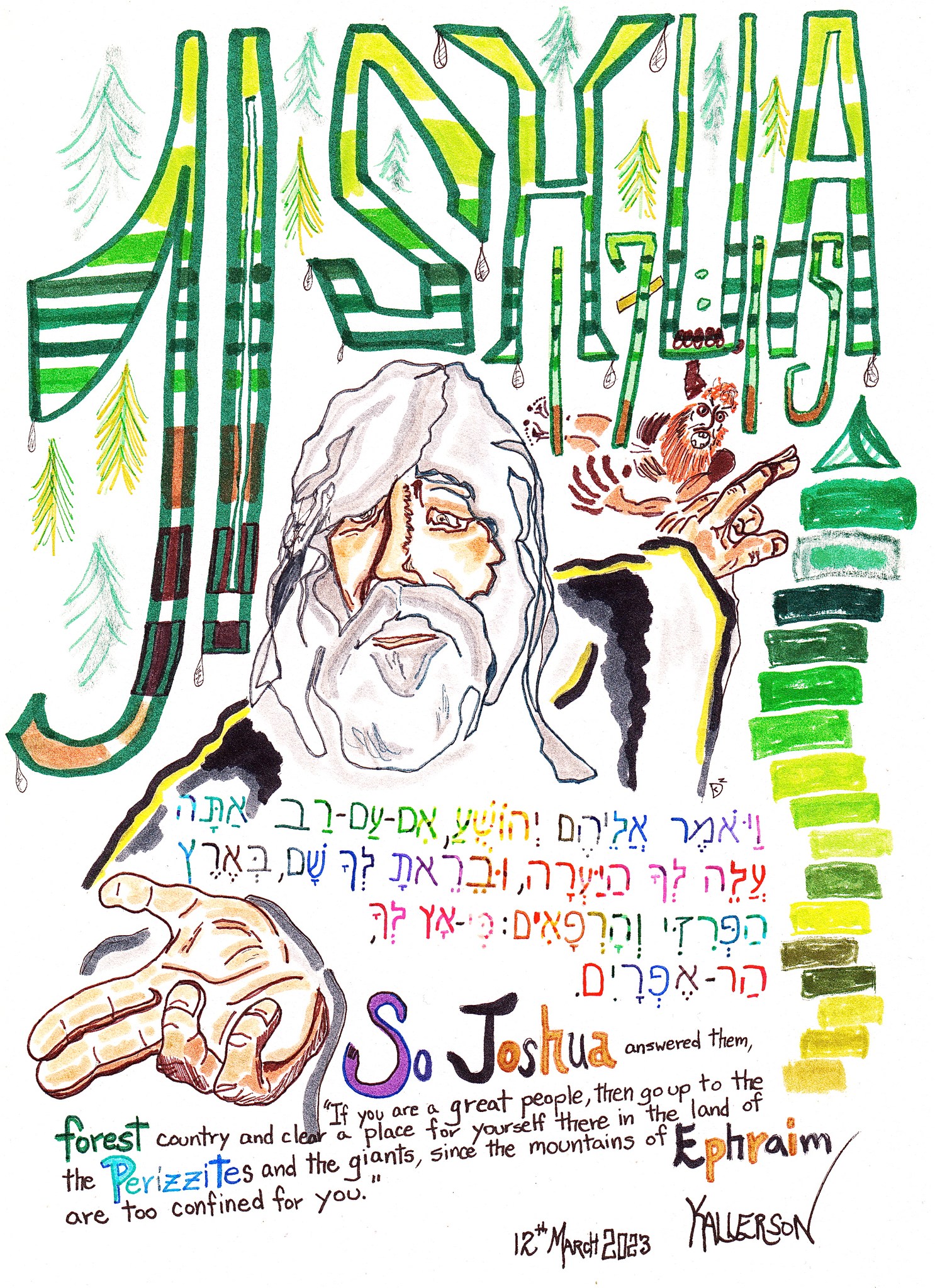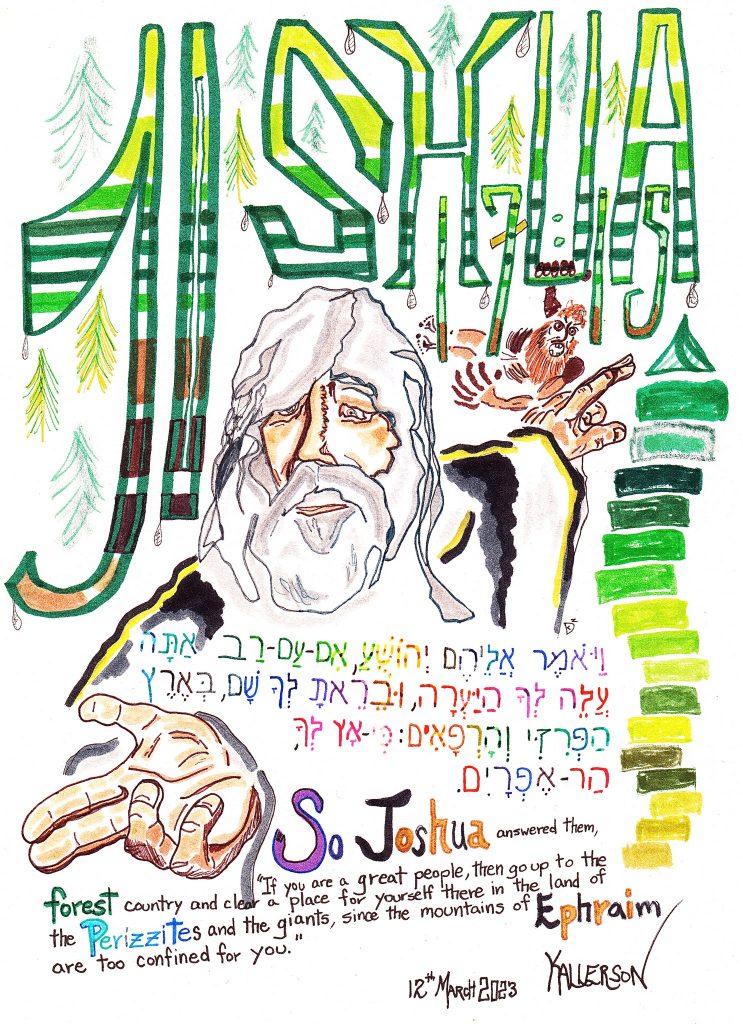
Artwork by Doug Kallerson.
Joshua 17:14-18
You Shall Create
On sermon typing day, my friend Sergio will often send me twenty messages in a row, just to be as annoying as possible. But that’s ok, I do the same to him while he is trying to do his video work. Other than him, I have contact with absolutely no one from the time I start till the time I finish. This has been true for years. An exception to this is truly an exception.
While studying the text for this sermon, there were some rather amazing inaccuracies in the translation of the verses. I noted to Sergio how fascinating the passage was and a few minutes later he came back with some comments on the first verse.
I responded with some analysis from verses 15 and 16. He came back with a dubious, “Yes that sounds right.” But after going through it a bit more, he said, “Yes. Wow. Incredible.” To make sure he wasn’t funning me, I asked if he really agreed with my conclusion and his response was, “Can’t believe you paid attention.”
In other words, while translators are spending their time trying to make a translation sound good and understandable, they will often miss the actual meaning of the words. Feeling good about this, I told Sergio that I actually just ran my thoughts through AI and that is what popped out. After that, I spent the morning playing solitaire.
Ok, that didn’t happen, but for fun, Sergio asked his AI resource for a sermon on our verses today. About one minute later, he sent me this –
“In Joshua 17:14-18, we see the story of the tribe of Joseph, specifically the half-tribe of Manasseh, who were given a large portion of land on the west side of the Jordan River. However, instead of being satisfied with the land they had been given, they complained and asked for more. This passage reminds us that it is easy to become discontent and never feel satisfied with what we have been given. It is important to remember to be grateful for the blessings that we have received, rather than constantly striving for more. Let us strive to cultivate an attitude of gratitude and trust in God’s provision for our lives.”
Being a little weak, he strengthened the parameters, asking it to “write a short sermon paragraph in an expository style about Joshua 17:14-18. Focus on the meaning of the Hebrew words and how this passage points to Jesus.”
Thirty seconds later, I got this –
“In Joshua 17:14-18, we see the tribe of Joseph, specifically the half-tribe of Manasseh, requesting more land from Joshua. The Hebrew word used for “more” in this passage is ‘od,’ which can also be translated as ‘still’ or ‘yet.’ This implies that the half-tribe of Manasseh already had a significant amount of land, but they were not satisfied and wanted more. This passage serves as a reminder of our own tendency to always want more, even when we have already been blessed with so much. However, this passage also points us to Jesus, who came to fulfill the desires of our hearts. In Philippians 4:19, Paul writes, ‘And my God will supply every need of yours according to his riches in glory in Christ Jesus.’ Just as God provided for the Israelites, He also provides for us, and we can trust that He will give us what we truly need. Let us seek to find contentment in Jesus and trust in His provision for our lives.”—AI
Well, so much for letting AI do the work. Hopefully what is presented today will be a bit better than that.
Text Verse: “And so all Israel will be saved, as it is written:
‘The Deliverer will come out of Zion,
And He will turn away ungodliness from Jacob;
27 For this is My covenant with them,
When I take away their sins.’” Romans 11:26, 27
It’s hard to understand how anyone can read the words of Paul and come to any other conclusion than that they are referring to national Israel of the future. But that is exactly what many think. It is stupefying to even imagine.
Our passage today will deal with this issue in detail. But having heard the verses from the NKJV, or almost any other version, you probably would never guess it. But look at some of the variations in translation you will see today –
*then go up to the forest country and clear a place for yourself there in the land of the Perizzites and the giants. NKJV
*Go up, to you the forest and create to you, there in land the Perizzite and the Rephaim. CG
*since the mountains of Ephraim are too confined for you. NKJV
*for hastened to you Mount Ephraim. CG
*The mountain country is not enough for us. NKJV
*Not found (meaning able to attain) to us the mount. CG
Reading the differences in these two translations is almost like reading an entirely different account. One thing is for sure, either one is right, and one is wrong, or they are both wrong, but both cannot be right.
What is the Lord telling us, and why is what is being said so hard to understand? The reason is what we are looking for. Translators will tend to reject things that don’t seem to make sense, even if that is the obvious translation of what is presented.
But in following this strategy for translation, a lot of meaning will be missed. I think you’ll agree by the time we finish. If not, and if you prefer something a little easier to listen to, let me know and I will have the AI put out 25- page sermon for you next week. That will take about 10 minutes and I’ll have the rest of the day to play solitaire.
Be sure to let me know what you decide. 10 minutes or 10 hours, I leave it up to you J. I hope you will go with the 10 hours. Such great treasure is to be found in His superior word. And so, let us turn to that precious word once again, and… May God speak to us through His word today, and may His glorious name ever be praised.
I. For Hastened to You Mount Ephraim (verses 14-18)
14 Then the children of Joseph spoke to Joshua, saying,
Here is a united voice of those of Ephraim and Manasseh. Together they form the voice of their father Joseph. The right of the firstborn was granted to him by Jacob, meaning a double portion. As such, this is making a play on the name Joseph.
Joseph or Yoseph, comes from the verb yasaph, to add. Thus, his name means He Shall Add. However, there is another meaning to his name based on his mother’s declaration at his birth –
“Then God remembered Rachel, and God listened to her and opened her womb. 23 And she conceived and bore a son, and said, ‘God has taken away [asaph] my reproach.’ 24 So she called his name Joseph, and said, ‘The Lord shall add [yasaph] to me another son.’” Genesis 30:22-24
She not only used the word yasaph, to add, but also the word asaph, to gather or remove. As such, his name means He Shall Take Away as much as it means He Shall Add. This duality of name meanings extends to both of Joseph’s sons as well. Ephraim and Manasseh each have dual meanings.
As for the double portion of the firstborn having been granted to him, that goes back to Jacob’s blessing upon his sons in Genesis –
“And now your two sons, Ephraim and Manasseh, who were born to you in the land of Egypt before I came to you in Egypt, are mine; as Reuben and Simeon, they shall be mine.” Genesis 48:5
During this blessing, Jacob placed the younger, Ephraim, above the older, Manasseh –
“So he blessed them that day, saying, ‘By you Israel will bless, saying, “May God make you as Ephraim and as Manasseh!”’ And thus he set Ephraim before Manasseh.” Genesis 48:20
Immediately after that, he then spoke of the surety of the double blessing to Joseph –
“Then Israel said to Joseph, ‘Behold, I am dying, but God will be with you and bring you back to the land of your fathers. 22 Moreover I have given to you one portion above your brothers, which I took from the hand of the Amorite with my sword and my bow.’” Genesis 48:21, 22
Because of this, the events of these verses in Joshua 17 take place. One can see the hidden pun of this opening clause by translating the names in it – vaydaberu bene Yoseph eth Yehoshua – “And spoke sons He Shall Add to the Lord is Salvation.”
The sons of He Shall Add are coming to get a little more added…
14 (con’t) “Why have you given us only one lot and one share to inherit,
Rather, the preposition is singular: madua nathatah li nakhalah goral ekhad v’khevel ekhad – “Why given to me inheritance – lot one and portion one?” The goral, or lot, is the casting of the grant itself. The khevel, or cord, is the measurement of that lot into a granted portion of land.
The two tribes of Joseph speak with one united voice. Because of their words, one might wonder if they had been out drinking all night or something.
A little background will help explain. First, the numbers of the tribes at the first census were 40,500 for Ephraim and 32,200 for Manasseh (Numbers 1:32-25). It is true that together they outnumbered every tribe except Judah, but individually, they were not exceptionally large in number.
At the second census, the numbers of Manasseh were more than Ephraim. Ephraim was 32,500 and Manasseh was 52,700. Together, they could be considered a large tribe, being 8700 larger than the largest tribe of Judah.
However, one-half of Manasseh wanted land east of the Jordan. This was granted. Taking them out of the total, the number left to occupy the grant west of the Jordan would be comparable to one of the middle or even smaller sized tribes.
And more, it may be that the land grant of Judah was significantly larger than that of Joseph’s land west of the Jordan, but Simeon will be incorporated within Judah’s land grant. And even more to the point, Judah’s land contains vast areas that are barren wilderness.
On the other hand, the land given to the sons of Joseph is rather large in proportion to their numbers and it contains some of the most fertile and productive land to be found within the borders of Canaan. Add in the giant swath of land east of the Jordan that was immensely good land for pasturing flocks, and they had more than any other tribe, by far.
What would cause them to claim they had insufficient land, or only one inheritance is hard to guess. Maybe they had been drinking too much the night before. Or it could be, based on what they will say in the coming verses, that they are claiming the only inheritance they have is what has been given to the half-tribe east of the Jordan. Whatever it is, a review of their recorded inheritance is needed.
The lot for both was introduced in Joshua 16:1-4. From there, the land of Ephraim was detailed in verses 16:5-10. After that, verses 17:1-13 detailed that of Manasseh. The land for both was decided and then it was divided between the two.
It is possible that they felt jipped by getting one lot which was then divided, or only Manasseh is speaking out the complaint because it had grown so much during the wilderness wanderings while Ephraim had diminished. As such, they felt they were due more land. But neither of these will seem to fit with the protestations they lay before Joshua.
The entire discourse is unreasonable based on what was just reviewed. And yet, they are presenting it as if there is an obvious deficiency in their allotment. It could be that because Joshua is of the tribe of Ephraim, they thought he would bear with their complaint and give them a note of favoritism. He will, however, remain steadfast in showing impartiality. Their complaint is…
14 (con’t) since we are a great people, inasmuch as the Lord has blessed us until now?”
Again, it is singular: va’ani am rav ad asher ad koh ber’khani Yehovah – “And I, people great until which, until now, has blessed me, Yehovah.” This is the only time that Yehovah is mentioned in this passage, and it appears that they are claiming that what they have been apportioned is not a blessing from Him at all.
They have been blessed up until now, but that doesn’t seem to include what they have been handed at this time. Their words are laughable in comparison to their numbers and in relation to what they have been allotted.
What they claim is obviously not correct, but something has motivated them to speak as they have, and Joshua immediately perceives what it is. He addresses it directly and he does it by using their own words…
15 So Joshua answered them, “If you are a great people
There is a strong emphasis as he repeats their claim right back to their ears: va’yomer alehem Yehoshua, im am rav attah – “And said to them, Joshua, ‘If people great, you…’”
They made the claim. If it is so, and if the land they have is supposedly insufficient for them, then there must be a problem within the land that they are unwilling to address. Instead, they want more (or other) land so that they can avoid that issue altogether. Joshua knows this and subtly uses their boasting to highlight their cowardice…
15 (con’t) then go up to the forest country and clear a place for yourself there in the land of the Perizzites and the giants,
aleh lekha ha’yarah u-beretha lekha sham ba’erets ha’perizi v’ha’rephaim – “Go up, to you the forest and create to you, there in land the Perizzite and the Rephaim.”
The problem isn’t the amount of land at all. The problem is the inhabitants in the land. The tribes have boasted of their size, supposedly necessitating more land and so Joshua hurls their words back at them – “If you are so great, you don’t need more land, you need a backbone.”
In his statement, he uses the word bara’, or create. It is the first use of this word in Scripture not connected to God and it appears intentional. There is another word he could have used, khatav, meaning to cut wood. But he goes beyond that and says, “Go create something out of the forest. Make it usable you great people. God, through the lot, created a portion for you. Now go create something out of it.”
The need for a backbone is twofold. First, they need to get to work with their creating. And second, Joshua seems to poke at them that they need to do it “there, in the land of those settled-in people, including the dreaded giants.”
There is an obvious failure of these people to rely on the Lord. He had promised to go before them, and He had done so, never failing them in the process. With the land allotted by Him, all they needed to do was trust and act.
As for the people groups,
Perizzite comes from perazi, a hamlet dweller. Thus, it means something like Villager or Dweller in an Open Country. Rephaim comes from a word meaning to sink down or relax or from a word meaning to heal. If the latter, then it indicates that their size came from being invigorated in some way, probably through special inbreeding.
Joshua has identified their failing and he has told them what to do about it. Their complaint about land really comes down to accessibility…
15 (con’t) since the mountains of Ephraim are too confined for you.”
Rather than “too confined,” as if that is all that is being referred to, it is Joshua speaking about the speed in which they will be able to subdue the mountainous area: ki ats lekha har ephrayim – “for hastened to you Mount Ephraim.” Mount Ephraim is being used as a synecdoche referring to all of the mountainous area apportioned to them.
In this, Joshua uses the word uts, to hasten to labor. It appears to be another poke at them. “Look at how easy Mount Ephraim is. You will have it all cleared out in no time. You just need to get to work and put a little effort into your inheritance.” With that, the moaning of Joseph continues…
16 But the children of Joseph said, “The mountain country is not enough for us;
Not living up to their name, He Shall Add, Joseph moans against Joshua’s words. Further, their answer is not that the mountain country isn’t enough. Rather, they are refuting Joshua’s claim that they can attain it speedily: lo yimatse la’nu ha’har – “Not found to us the mount.”
The meaning is not that the mountainous area is not enough for them, as if they needed more. Rather, the word is matsa, to find or attain. They are saying that they cannot overtake it. The people living there are too strong, they have settled into the area and are fortified, and there will be no way to drive them out.
Joshua said that the sons of Joseph will hasten to attain it and they claim that it is unattainable. They are wallowing in their own incompetence and ineptitude while failing to trust in the unseen hand of the Lord. With that, the moaning goes further…
16 (con’t) and all the Canaanites who dwell in the land of the valley have chariots of iron,
It is all singular: v’rekhev barzel b’kal ha’k’naani ha’yoshev b’erts ha’emeq – “and chariot iron in each the Canaanite, the dweller in land the valley.” It is a total exaggeration. Though they possessed chariots, these men claim that each and every Canaanite in the area had one, making it sound like they were as common as front doors on houses.
As such, they grumble that not only can they not attain the mountainous country, they also could never defeat those in the valley. The Canaanite was too strong, and they could never drive him out. Unlike the mountainous area where the people were dug in and fortified, these people were in the open areas.
This is where chariots are suitable and effective. Any obstruction at all would render them useless, but in open areas they are quite lethal. However, despite being a fearful weapon of war, it is not something beyond their ability to defeat.
In the battle of Joshua 11 by the waters of Merom, Joshua handily defeated the vast army and burned their chariots with fire. They knew this and yet they peevishly whine about the sizeable and beautiful grant of land they had been provided.
The entire passage demonstrates a complete lack of faith in the Lord and the promises He has made. Of the armies with chariots, they continue their grousing with the words…
16 (con’t) both those who are of Beth Shean and its towns and those who are of the Valley of Jezreel.”
la’asher b’beith sh’an u-b’noteha v’la’asher b’emeq yiz’r’el – “to who in Beth Shean and her daughters and to who in Valley Jezreel.” The term “daughters” means towns. Thus, it speaks of the smaller towns that fall under the protection of the mother city.
The entire clause speaks of utter defeat. Not only are they afraid of the main city, but they are irritable about even attacking the little towns around it. And those in the valley, open and exposed in the wide expansive area, are thought to be too tough for them to handle because of their chariots.
As for the names, Beth Shean means House of Ease or House of Security. Jezreel means God Sows. Being prefixed with emeq, or valley, it would be the Depth of God Sows, the emeq being a deep, broad valley.
Despite their whimpering, Joshua remains unaffected…
17 And Joshua spoke to the house of Joseph—to Ephraim and Manasseh—saying,
Rather than “spoke,” it uses the word “said.” Further, the chronicler says his words are directed “to the house of Joseph.” They have come to him with a complaint about their inheritance and so he addresses them as one.
His words confirm what I said earlier. Their initial complaint, which continues here, is that their only inheritance is that already given to the half-tribe east of the Jordan. What they have been granted west of the Jordan is unattainable and so they are left with that single land grant – whiners…
But, remaining undeterred, Joshua pokes them with great and emphatic words, even greater than they claimed themselves…
17 (con’t) “You are a great people and have great power;
am rav atah v’koakh gadol – “People great, you! And power whopping!” They came to Joshua with a claim that they were a great people, meaning numerous. Joshua has used the same word, rav, in the sense of powerful.
They obviously didn’t get it the first time, and so he adds in superlatives to almost mock them at their wincing attitude. The thing is, they cannot refute him. He has never failed in a battle, is of their same stock (meaning of the house of Joseph), and has had the Lord with him.
They are the entire house of Joseph, they are numerous, and they have accompanied Joshua into battle, having learned the skills he possesses. And more, it would be blasphemous for them to claim the Lord is not with them as well. They know this, and they know Joshua knows they know it. Hence…
17 (con’t) you shall not have only one lot,
lo yihyeh l’kha goral ekhad – “No shall be to you lot one.” Their griping has left Joshua entirely unaffected. What is east of Jordan is for the half-tribe of Manasseh. What is west is for Ephraim and half of Manasseh. And that land west of the Jordan is sufficient for both of them.
The matter is decided, the challenge is set before them, and it is their task to secure what has been decided by the lot. The land has been marked out, and now it is time for them to act. And so, Joshua continues…
18 but the mountain country shall be yours.
ki har yihyeh lakh – “For mountain shall be to you.” As in verse 15, the word har, or “mountain,” is referring to the entire mountainous area of the land grant. It is given to the house of Jacob. And it is attainable…
18 (con’t) Although it is wooded, you shall cut it down, and its farthest extent shall be yours;
ki yaar hu u-bereto v’hayah lekha tots’otav – “For forest it, and you shall create, and shall become to you its outgoings.” Joshua implies that the forest will sufficiently provide for them. With the wood, they can fashion weapons, they can build houses, and so on.
In other words, it should not be considered an obstacle, but a benefit. In cutting down the forest, they will also have the benefit of workable fields. The land is good, it is available, and they will be able to subdue it.
There is a formative process that must take place, but when it is accomplished, their goal of possessing a second lot will have been obtained. Joshua’s words are direct, but they are also encouraging. All of this would belong to them.
Many scholars say the “outgoings” refer to fields and plains that border the wooded area, but what seems more likely is that it is referring to the sea which borders the inheritance on the west. The Canaanites dwelt throughout the land, even to the seacoast. That will belong to them as well because, as he says…
18 (con’t) for you shall drive out the Canaanites,
It is again singular: ki torish eth ha’k’naani – “For shall disinherit the Canaanite.” They have been granted their inheritance from the Lord by lot. They are to disinherit those in the land in order to receive it. Joshua has remained fixed and resolute in his words. They are capable despite the force they will face…
18 (con’t) though they have iron chariots
Rather than “though,” Joshua makes a statement of fact: ki rekev barzel lo – “For chariot iron to him.” It seems almost like he is trying to intimidate them, and without his previous words, one would wonder what he was talking about. But Joshua has already told them that they are able, that they will prevail even against iron chariots, and even more…
*18 (fin) and are strong.”
The passage ends with Joshua making a strong and emphatic statement that seems contradictory to the intent of the matter: ki khazaq hu – “For strong, he.” Not only does the Canaanite possess chariots, but he is a strong foe. Despite this, the house of Joseph will prevail.
The final verse of the passage contains five statements, each beginning with ki, or for –
*For mountain shall be to you.
*For forest it, and you shall create, and shall become to you its outgoings.
*For shall disinherit the Canaanite.
*For chariot iron to him.
*For strong, he.
Each is based on what was previously stated. This because of this:
“No shall be to you lot one. Because mountain shall be to you. Because forest it, and you shall create, and shall become to you its outgoings. Because shall disinherit the Canaanite. Because chariot iron to him. Because strong, he.”
Behold, I create something new
Something glorious lies ahead that you will see
Believe that what I say, I will do
You can put your full confidence in Me
I shall create it and it shall be done
There will be a new order of things on that day
As sure as is the rising of the sun
So there is surety in what I now say
What you cannot imagine is what I will do
Though you disbelieve now, it shall come about
My word is faithful, and it is true
Be confident in this and have no doubt
II. Pictures of Christ
The inheritance of the half-tribe of Manasseh is east of the Jordan. In Joshua 12:1-6 it was noted that this was an inheritance obtained prior to national Israel’s salvation. In this case, a review of the events leading to the inheritance after Israel’s salvation is being detailed.
The passage deals with the house of Joseph, or He Shall Add, with a secondary meaning of Take Away. Joseph was to receive a double inheritance. If the land for the half-tribe of Manasseh is one inheritance, then there needs to be another.
The thing about this section is that it does not have to be chronological to what has already been said. Beginning it with “Then” as some translations do gives a time order sense, but it actually begins with “And.”
Because of this, the lot for their land could have been thrown at the time of their coming forward. The inheritances noted in Chapter 16 and the first half of this chapter could simply be categorical, just as has repeatedly occurred in Joshua. The inheritances are defined, and then background information is filled in.
That seems likely, but it is speculation. The reason it seems likely is that their claim to only one inheritance having been given them seems to presuppose it. Regardless of that, the matter is now addressed.
Joshua anticipates Christ, the Lord is Salvation. But each named tribe does too. The inheritance east of the Jordan is prior to Israel’s national salvation. Whether it pictures the church or just individual Jews within the church isn’t the issue because the Jews are a part of the church. It (with them) is an inheritance.
Putting aside the whining of the house of Joseph, which is certainly historical and accurate, the point of the words is that there is a second inheritance for Joseph due to the birthright. Likewise, there is a second inheritance for Christ due to His right to Israel, something testified to thoroughly in the books of Moses, the prophets, and so on.
The negative attitude of those who come to Joshua implies the difficulty of the task. Despite Jesus not being negative about the events, the difficult nature of providing an inheritance to national Israel is being seen.
In fact, to much of the church, it appears to be an impossibility. So the tenor of the words explains the reality of Israel’s current situation. It seems impossible that it could ever be the case.
In verse 15, the naming of the Perizzites and the Rephaim highlights this. Rephaim, as seen in Joshua 12, anticipated those who follow false prophets. That is about as accurate a description of Israel today as anyone could imagine – any word from the Lord is ok as long as it isn’t from Jesus.
Joseph, He Shall Add (and Take Away), picturing Jesus, is to add national Israel to His promised inheritance. He is to “create” land (fertile soil which is useable) out of these people groups. A seemingly impossible task.
Joshua (Jesus) lets it be known that the job is a snap – it is hastened labor to obtain “Mount Ephraim.” As has been seen in previous sermons, a mountain (har) is a lot of something gathered. It is synonymous with a large but centralized group of people.
The meaning is that Ephraim (Twice Fruitful) representing this second inheritance will hasten to come about.
Verse 16 noted that the sons of Joseph said they could not attain to this. That is the historical record. It may be doubted that the Lord Jesus will bring about the restoration of national Israel, but it will come about. Despite the staggering amount of apostasy and false prophets, through Christ, it will happen.
From there, another obstacle, the Canaanites, are mentioned along with their iron chariots. Canaanite signifies Humbled, Humiliated, or even Subdued. Iron represents strength, be it in binding together, in government, in hard service, in bondage, etc.
Chariots, like horses, are a source of pride –
“Some trust in chariots, and some in horses;
But we will remember the name of the Lord our God.
8 They have bowed down and fallen;
But we have risen and stand upright.” Psalm 20:7, 8
Israel is a land of humiliated people, trusting in self and in doctrines which are strongly bound together, such as in the culture and religious aspects of life. Saying these are in the emeq, or deep broad valley, signifies that they are deeply engrained and completely pervasive in them.
The two locations, Beth Shean and the Valley of Jezreel, signify Israel’s confidence and state of ease in their false ways and God sowing into their lives the just due they deserve –
“It shall come to pass in that day
That I will break the bow of Israel in the Valley of Jezreel.” Hosea 1:5
Like most prophecies, Hosea’s has an immediate fulfillment and a future one. Also, the writings of Hosea prophesy both the casting off of Israel, “You are not my people,” (Hosea 1:8) and the calling again of Israel, “You are my people,” (Hosea 2:23).
Verse 17 mentioned Joseph, Ephraim, and Manasseh all as one. It is the three two-fold workings of Christ seen previously in Joshua. Joseph anticipates Christ Who takes away man’s reproach and Who then adds him to God’s people. Manasseh pictures Christ who came to pay Adam’s debt and who, in the process, allows that debt to be forgotten before God.
Ephraim looks to Jesus. He is twice fruitful in the land of His affliction, prevailing over the law and thus becoming the Savior of Jew and Gentile as well as the church and national Israel. But His work also meant that sin was judged in Him, thus the ashes, signifying His afflictions.
To them Joshua acknowledges that they are great and whoppingly powerful. Of course, Christ can prevail over the failings of Israel. Therefore, “you shall not only have one lot.” The double inheritance belongs to the Lord.
With that, the fivefold repetition of “For” was proclaimed.
For mountain shall be to you. The centralized people group of Israel shall be His.
“Again the word of the Lord came to me, saying, 16 “As for you, son of man, take a stick for yourself and write on it: ‘For Judah and for the children of Israel, his companions.’ Then take another stick and write on it, ‘For Joseph, the stick of Ephraim, and for all the house of Israel, his companions.’ 17 Then join them one to another for yourself into one stick, and they will become one in your hand.” Ezekiel 37:15-17
For forest it. It is a forest, a cluttered and unusable land that needs to be created –
“For behold, I create [bara] new heavens and a new earth;
And the former shall not be remembered or come to mind.
18 But be glad and rejoice forever in what I create;
For behold, I create [bara] Jerusalem as a rejoicing,
And her people a joy.
19 I will rejoice in Jerusalem,
And joy in My people;
The voice of weeping shall no longer be heard in her,
Nor the voice of crying.” Isaiah 65:17-19
In creating this, it “shall become to you its outgoings.” In other words, the entire extent of Israel, to the very last person, will be holy.
For shall disinherit the Canaanite.
“In that day ‘HOLINESS TO THE LORD’ shall be engraved on the bells of the horses. The pots in the Lord’s house shall be like the bowls before the altar. 21 Yes, every pot in Jerusalem and Judah shall be holiness to the Lord of hosts. Everyone who sacrifices shall come and take them and cook in them. In that day there shall no longer be a Canaanite in the house of the Lord of hosts.” Zechariah 14:20, 21
The reason for disinheriting those who oppose Him is For chariot iron to him. Those who trust in self and in their firm unyielding false doctrines will either have those doctrines removed from them, or they, meaning those who trust in self, will be removed. Either way, nothing that is false will ever afflict Israel. This must be removed, For strong, he.
The meaning is obvious. Falsities are strong, dangerous, invasive, and pernicious. Those who teach them will be removed. Those who hold to them will be corrected or destroyed. This is what the double inheritance of the house of Joseph anticipates.
The inheritance is not merely the church that is saved during the church age. National Israel is the inheritance of Jesus as well. He was promised this, and it is His by inheritance.
The verses today are an explanatory statement of this fact. The thing about the passage that most strikes me is that without a correct translation of the Hebrew words, a completely different meaning is derived, which has nothing to do with what is actually being conveyed.
Hence, to really understand what is being said, one needs to go beyond reading several versions of the word (which is a good start), and go line by line through the text contemplating each word. It is a long, laborious, and tedious task, but what treasure is to be found in the word!
In such a study, we can be assured and reassured of the integrity of Scripture, the soundness of doctrines and the unsound nature of others, and so on. There are innumerable teachers and denominations that reject any future plan for, or significance of, national Israel. But they will be corrected in their thinking someday.
They have failed to understand what God is doing and why, but through a close evaluation of names, places, and obscure words, it all comes more clearly into focus. Above all, let us hold fast to the most fundamental truth of any. All of Scripture is about Jesus.
Without Him nothing in life makes sense and nothing in His word or this world has clarity. But with Him, our lives have purpose and meaning. And the word, it comes alive when we look for Him in its pages. Thank God for this tender and precious word and thank God for Jesus Christ our Lord. Amen and amen.
Closing Verse: “But you are a chosen generation, a royal priesthood, a holy nation, His own special people, that you may proclaim the praises of Him who called you out of darkness into His marvelous light; 10 who once were not a people but are now the people of God, who had not obtained mercy but now have obtained mercy.” 1 Peter 2:9, 10
Next Week: Joshua 18:1-10 It was a whopping gathering. You can bet it was so… (Israel Assembled Together at Shiloh) (36th Joshua Sermon)
The Lord has you exactly where He wants you. He has a good plan and purpose for you. It is He who has defeated the enemy and who now offers His people rest. So, follow Him and trust Him and He will do marvelous things for you and through you.
You Shall Create
Then the children of Joseph spoke to Joshua, saying
“Why have you given us only one lot and one share to inherit
Since we are a great people
Inasmuch as the LORD has blessed us until now?
———- surely more land we merit
So Joshua answered them, “If you are a great people
Then go up to the forest country and clear a place for yourself
———-this you shall do
There in the land of the Perizzites and the giants
Since the mountains of Ephraim are too confined for you”
But the children of Joseph said, “The mountain country
———-is not enough for us
And all the Canaanites who dwell in the land of the valley
———-have chariots of iron, as you know well
Both those who are of Beth Shean and its towns
And those who are of the Valley of Jezreel”
And Joshua spoke to the house of Joseph
To Ephraim and Manasseh, saying
“You are a great people and have great power
You shall not have only one lot. Hear what I am conveying
But the mountain country shall be yours
Although it is wooded, you shall cut it down, it’s where you belong
And its farthest extent shall be yours
For you shall drive out the Canaanites, though they have
———-iron chariots and are strong”
Lord God, turn our hearts to be obedient to Your word
Give us wisdom to be ever faithful to You
May we carefully heed each thing we have heard
Yes, Lord God may our hearts be faithful and true
And we shall be content and satisfied in You alone
We will follow You as we sing our songs of praise
Hallelujah to You; to us Your path You have shown
Hallelujah we shall sing to You for all of our days
Hallelujah and Amen…
14 Then the children of Joseph spoke to Joshua, saying, “Why have you given us only one lot and one share to inherit, since we are a great people, inasmuch as the Lord has blessed us until now?”
15 So Joshua answered them, “If you are a great people, then go up to the forest country and clear a place for yourself there in the land of the Perizzites and the giants, since the mountains of Ephraim are too confined for you.”
16 But the children of Joseph said, “The mountain country is not enough for us; and all the Canaanites who dwell in the land of the valley have chariots of iron, both those who are of Beth Shean and its towns and those who are of the Valley of Jezreel.”
17 And Joshua spoke to the house of Joseph—to Ephraim and Manasseh—saying, “You are a great people and have great power; you shall not have only one lot, 18 but the mountain country shall be yours. Although it is wooded, you shall cut it down, and its farthest extent shall be yours; for you shall drive out the Canaanites, though they have iron chariots and are strong.”