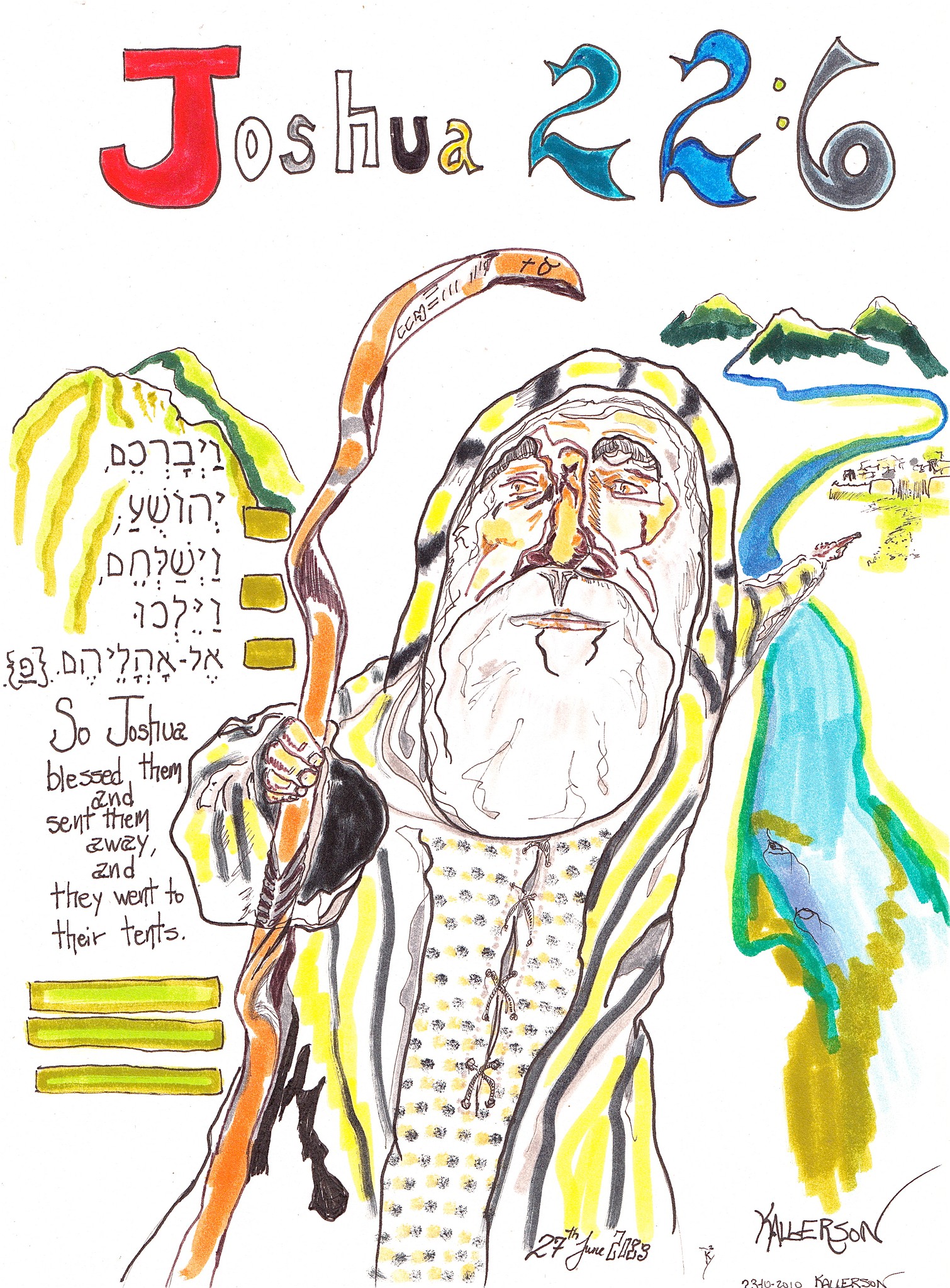
Artwork by Douglas Kallerson.
Joshua 22:1-9
So Joshua Blessed Them
One of the questions I have never been dogmatic about in my response is whether those of Israel saved before the coming of Christ would be raised at the rapture or not. The verses in Scripture are not definitive enough to tell us one way or the other.
However, the passage today appears to typologically provide an answer to that question. By the end of the sermon, you will know the answer as the typology instructs us.
As with several passages we have seen in Joshua, such as the battles of Gibeon and Ai as well as the inheritance of Caleb, there are little issues that need to be uncovered for us to understand exactly what God is doing.
One might say, “Well, this is what the Bible says about that issue.” But then someone might come along and say, “Yes, but then what about this issue?” There are seemingly unimportant issues that suddenly need to be addressed. And God covers each of them so carefully in typology.
Text Verse: “All Scripture is given by inspiration of God, and is profitable for doctrine, for reproof, for correction, for instruction in righteousness, 17 that the man of God may be complete, thoroughly equipped for every good work.” 2 Timothy 3:16, 17
This is a good text verse to use in today’s sermon because Paul was referring to the Old Testament when he wrote it to Timothy. There are words about being obedient to Moses and the law there, but how do they apply to a believer in Jesus, someone not under the law?
How can it be that a story seemingly about troops returning home from war with all kinds of riches instructs us in doctrine? If you stay awake or don’t leave before we’re done unpacking the typology today, you will see. The word is the gift that just keeps on giving. It is an endless source of amazing detail for us to consider.
Wonderful things, such as the explanation revealed in today’s passage, can be accomplished by a careful study of God’s superior word. And so, let us turn to that precious word once again, and… May God speak to us through His word today, and may His glorious name ever be praised.
I. Return With Much Riches (verses 1-9)
Then Joshua called the Reubenites, the Gadites, and half the tribe of Manasseh,
The names are in the singular, speaking to the people as clans descending from an individual: az yiqra Yehoshua la’reubeni v’la’gadi v’la’khatsi mateh m’nasheh – “At that time called Joshua to the Reubenite and to the Gadite, and to the half-tribe of Manasseh.”
This is important to understand because many commentaries assume that those being discharged here had not been home for seven or more years. For example –
“And the time during which these soldiers must in this case have remained separated from their wives and families was a very long one.” Pulpit Commentary
This is incorrect. As was seen early in Joshua, only a portion of the men went to battle while most stayed in their land of inheritance, building, tending to flocks, providing protection, etc.
Without the text saying it, the meaning is that the men rotated into and out of service. While some served, others remained in their land. At set intervals, they would then enter service while the others returned home. Thus, referring to the tribe in the singular means that this arrangement, involving these two-and-a-half tribes will now end. There will no longer be a need for their presence in Canaan.
The land has been subdued sufficiently for all of the tribes to receive their inheritances. The lots have been cast, the borders have been set, the cities have been named, the Levites have received their cities, and now dwelling in the inheritances that have been granted will take place.
As for the opening word, az, it signifies “at that time.” Exactly what that means is debated. The last specific detailing of a major new event was recorded at the opening of Chapter 18 –
“Now the whole congregation of the children of Israel assembled together at Shiloh, and set up the tabernacle of meeting there. And the land was subdued before them. 2 But there remained among the children of Israel seven tribes which had not yet received their inheritance.” Joshua 18:1, 2
After that, the land was surveyed and apportioned out to the remaining seven tribes, Joshua received his inheritance, the cities of refuge were designated, and then the Levitical cities, including the priestly cities, were detailed. That detail then ended with –
“So the Lord gave to Israel all the land of which He had sworn to give to their fathers, and they took possession of it and dwelt in it. 44 The Lord gave them rest all around, according to all that He had sworn to their fathers. And not a man of all their enemies stood against them; the Lord delivered all their enemies into their hand. 45 Not a word failed of any good thing which the Lord had spoken to the house of Israel. All came to pass.” Joshua 21:43-45
Therefore, it might be assumed that what is being detailed came at this point in the chronology of events, following in time directly after the closing words of Joshua 21. However, the events could actually be connected with the statement that closed out the main subduing of the land at the end of Chapter 11 –
“So Joshua took the whole land, according to all that the Lord had said to Moses; and Joshua gave it as an inheritance to Israel according to their divisions by their tribes. Then the land rested from war.” Joshua 11:23
If this is the case, then all of the detail concerning the division of the land from Chapters 12-21 would be a long insert into the narrative without regard to chronology. Either way, what is stated in these verses is necessary to show that the words of Moses were fully followed.
As for the names, Joshua means The Lord is Salvation. Reuben means See a Son. Gad means Fortune. Manasseh has a dual meaning of To Forget and From a Debt.
2 and said to them: “You have kept all that Moses the servant of the Lord commanded you,
The words are in the plural, you all. He called the tribe as a whole and speaks to all of the men of the tribe. His words refer to the order given by Moses in Numbers 32.
The men of these tribes came before Moses and asked that their inheritance be granted east of the Jordan, something that got Moses highly miffed at them, thinking they would discourage Israel from entering their inheritance.
After agreeing to the expectation that they would accompany Israel into battle to subdue the land, Moses accepted their request –
“So Moses gave command concerning them to Eleazar the priest, to Joshua the son of Nun, and to the chief fathers of the tribes of the children of Israel. 29 And Moses said to them: ‘If the children of Gad and the children of Reuben cross over the Jordan with you, every man armed for battle before the Lord, and the land is subdued before you, then you shall give them the land of Gilead as a possession. 30 But if they do not cross over armed with you, they shall have possessions among you in the land of Canaan.’” Numbers 32:28-30
These tribes faithfully fulfilled their obligation to the words of Moses. Moses means He Who Draws Out.
2 (con’t) and have obeyed my voice in all that I commanded you.
va’tishmeu b’qoli l’kol asher tsiviti etkhem – “and have hearkened in my voice to all which I commanded you.” This refers to what Joshua said to these men in Chapter 1 –
“And to the Reubenites, the Gadites, and half the tribe of Manasseh Joshua spoke, saying, 13 ‘Remember the word which Moses the servant of the Lord commanded you, saying, ‘The Lord your God is giving you rest and is giving you this land.’ 14 Your wives, your little ones, and your livestock shall remain in the land which Moses gave you on this side of the Jordan. But you shall pass before your brethren armed, all your mighty men of valor, and help them, 15 until the Lord has given your brethren rest, as He gave you, and they also have taken possession of the land which the Lord your God is giving them. Then you shall return to the land of your possession and enjoy it, which Moses the Lord’s servant gave you on this side of the Jordan toward the sunrise.’” Joshua 1:12-15
Joshua proclaims that these men have fully complied with the commands set before them.
3 You have not left your brethren these many days, up to this day,
The words “many days” sum up the entire war campaign, at least six or seven years. However, if the narrative follows after the division of the land, it could be somewhat longer. Joshua’s point is that they have been faithful as long as they were needed…
3 (con’t) but have kept the charge of the commandment of the Lord your God.
ush’martem eth mishmereth mitsvath Yehovah elohekhem – “and have hearkened charge – command of Yehovah you God.” Without the Lord directly speaking about this matter in Numbers 32, the men who came before Moses responded to his words, saying –
“As the Lord has said to your servants, so we will do. 32 We will cross over armed before the Lord into the land of Canaan, but the possession of our inheritance shall remain with us on this side of the Jordan.” Numbers 32:31, 32
Whether Moses went before the Lord with the matter, or simply set the conditions, he was the representative of the Lord. Either way, their response acknowledges that the conditions were as the Lord had said.
The same is true for the leadership of Joshua as well. Thus, what was spoken by the Lord directly, or through His representatives was heeded as the word of the Lord. Because of their faithful obedience, Joshua continues with…
4 And now the Lord your God has given rest to your brethren, as He promised them;
Rather than “as He promised them,” it says, “as He spoke to them.” The verb translated as “rest” is nuakh, to settle down or cease. The Greek translation uses the word katapauó, the same word used in Hebrews 4 when making a point about the promised rest of God. The noun form, katapausis, the state of repose or a place of rest, is also used in that passage.
There, the author of the epistle makes a point about the greater work of Christ that the events in Joshua only anticipated. For now, the men of Israel have been given rest according to the word of the Lord…
4 (con’t) now therefore, return and go to your tents and to the land of your possession,
Rather than “return,” it more precisely, it says v’atah penu ulku lakhem l’aholekhem el erets akhuzathem – “and now turn to you to your tents unto land your possession.” Only now is this truly their possession. Until this point, it has been conditional. With their obligations fulfilled, they can now turn to their possession.
The words “to your tents” are not referring to their military tents which will be packed up and carried home. Rather, this is a poetic way of saying “your homes.” Cities and houses had been built, but the nostalgic use of tents was a reminder of their years living in tents while wandering in the wilderness. Now, the wandering is over and they will turn to the land of their possession…
4 (con’t) which Moses the servant of the Lord gave you on the other side of the Jordan.
asher nathan lakhem Mosheh eved Yehovah b’ever ha’yarden – “which gave to you Moses, servant Yehovah, in side the Jordan.” It speaks of the promised inheritance that came before crossing the Jordan. With the inheritance of Israel granted, they too receive what was promised to them at that time.
The Jordan means The Descender. With the grant complete, Joshua next admonishes them concerning their obligations…
5 But take careful heed to do the commandment
The verb is imperative: raq shimru meod laasoth eth ha’mitsvah – “Only! Watching very to do the commandment.” The tsivah is a positive precept, coming from tsavah, to command, charge, etc. It is something one is ordered to do as in an obligation. Here, the entire body of commandments cumulatively comprises one commandment. That is then supplemented with…
5 (con’t) and the law
v’eth ha’torah – “and the law.” The word torah, or law, is derived from yarah, to throw or shoot. One can think of someone aiming to hit a mark. Thus, it speaks of a precept or a statute that one is to aim for. The entire body of the Pentateuch is called The Torah.
This, like the previous word tsivah, speaks of the entire body of law. Each law or precept cumulatively comprises one law. Joshua speaks of these as one whole…
5 (con’t) which Moses the servant of the Lord commanded you,
Hence, this body of law is called The Law of Moses. Using the word tsivah again, Joshua charges them to remember Moses and be obedient to what he has spoken on behalf of the Lord. As such, the commandment and the law are considered two sides of the same coin. With that, Joshua continues by explaining exactly what that means…
5 (con’t) to love the Lord your God,
Of this, John Gill says, “…of which keeping the commands of God is an evidence.” Although it is true that keeping the commands is an evidence of loving Yehovah, that is not what is being said.
These words do not form an evidence. Rather, they are a command. “You are to love Yehovah your God.” Obeying the commands is the evidence of obeying these words which are a condensed form of Deuteronomy 6:5 – “You shall love the Lord your God with all your heart, with all your soul, and with all your strength.”
What does it mean to love Yehovah? In the context of what is being conveyed, which is doing His commandments, it means to obey His commandments.
One cannot say, “I love Yehovah,” and yet not obey His commandments. Because He is God, His words reflect who He is. Unlike humans who lie for any reason, thus demonstrating a disconnect between their words and who they are, there is no disconnect between the Lord and His words.
Along with loving Yehovah, they are next reminded…
5 (con’t) to walk in all His ways,
The NKJV leaves off the conjunction, making it seem as if this is explaining the last clause. It isn’t. Rather, it is a further command: v’la’leketh b’kal d’rakav – “and to walk in all His ways.” Because His words reflect who He is, His ways are revealed in His words. Thus, to walk in all His ways is commanded so that His people will be like Him. And more, they are admonished…
5 (con’t) to keep His commandments,
Again, the conjunction is missing: v’lishmor mitsvotav – “and to keep His commandments.” A part of the way you keep the commandment and the law is to keep the individual commandments. Understanding this, the words of James are more fully understood –
“For whoever shall keep the whole law, and yet stumble in one point, he is guilty of all.” James 2:10
One cannot say, “Well, I didn’t commit adultery and so I have kept the commandment” if he has just killed his neighbor. It is a single body comprised of many individual parts. One must do them all…
5 (con’t) to hold fast to Him,
The necessary conjunction is again missing, and the words are stronger and more personal: u-l’dav’qah bo – “and to hold fast in Him.” The Pulpit Commentary remarks, “…as though regarding not so much isolated actions as principles of life.”
To cling in Him is to reside in Him and refuse to let go of that state. This command is unlike the state of believers in Christ. The term “in Christ” signifies the position of the believer, but it is a position that is securely maintained not by the believer but by God in Christ. As for Joshua’s words, they continue with…
5 (con’t) and to serve Him
This must go beyond the written law itself, although the written law may define what this means in broad terms. In other words, if a king is chosen by the Lord, serving the Lord would include serving the king. When a prophet of the Lord spoke, serving the Lord would include heeding the word of the Lord from that prophet.
Both the offices, king and prophet, are defined in the law of Moses. Thus, serving the Lord includes the people’s actions in relation to those who fill these offices. With that, Joshua says…
5 (con’t) with all your heart and with all your soul.”
Though speaking to all the people (you all), the words heart and soul are singular: b’kal l’vavkhem u-b’kal naphsh’khem – “in all to your heart and in all your soul.” As for these words, they surely do not qualify only the last clause, “to serve Him.” Rather, they are given to qualify each clause. Setting the thought off will give the true sense of what is said –
“Only! Watching very to do the commandment and the law which commanded you Moses, servant Yehovah – to love Yehovah your God, and to walk in all His ways, and to keep His commandments, and to hold fast in Him, and to serve Him – with all your heart and with all your soul.”
The heart refers to the understanding and mental assent of the person. The soul speaks of that which animates and impels a person. To understand the meaning, it could be paraphrased, “in all your attitude and in all your actions.” Everything that comprises the person is to be dedicated to this type of faithful obedience to the Lord. Understanding that, it next says…
6 So Joshua blessed them and sent them away, and they went to their tents.
As Joshua blessed Caleb upon the designation of his inheritance in Chapter 14, so he blesses all of the men who have officially received their inheritances east of the Jordan, sending them away after his words of admonishment and encouragement.
Next, as a note to ensure clarity for exactly who is being referred to, Manasseh is clearly specified. What is said here should be taken as a parenthetical insert. Thus, it should read –
So Joshua blessed them and sent them away, and they went to their tents.
(7 Now to half the tribe of Manasseh Moses had given a possession in Bashan, but to the other half of it Joshua gave a possession among their brethren on this side of the Jordan, westward.)
And indeed, when Joshua sent them away to their tents, he blessed them, 8 and spoke to them, saying, “Return with much riches to your tents, with very much livestock, with silver, with gold, with bronze, with iron, and with very much clothing. Divide the spoil of your enemies with your brethren.”
With that understood, the parenthesis begins…
7 Now to half the tribe of Manasseh Moses had given a possession in Bashan,
The verb has no object. Thus, the words “a possession” should be italicized: v’lakhatsi shevet ham’nasheh natan Mosheh ba’bashan – “And to the half tribe the Manasseh gave Moses in the Bashan.” Because Manasseh’s inheritance was divided, falling on both sides of the Jordan, these words are given. Of note is that in verses 1 and 14, the word for tribe is mateh, the genealogical aspect of the tribe. However, the word shevet, meaning the political aspect of the tribe, is mentioned seven times in the chapter, including this verse.
All of the uses of shevet pertain to this half-tribe of Manasseh. One use of mateh (verse 1) refers to this half-tribe of Manasseh and the other (verse 14) pertains to ten tribes west of the Jordan. This is certainly being structured this way to reveal the political nature of what will transpire starting in verse 10.
Verse 1 was given to denote the genealogical heritage (mateh) of this half-tribe. From this verse on, it denotes the political (shevet) aspect. As for the Bashan, it means The Place of Fertile Soil.
7 (con’t) but to the other half of it Joshua gave a possession among their brethren on this side of the Jordan, westward.
The words are being very precise: u-l’kheshyo natan Yehoshua im akhekhem m’ever ha’yarden yamah – “and to his half gave Joshua with their brothers from side the Jordan, westward.” Moses gave the land east of the Jordan; Joshua gave the land west of the Jordan. This now ends the parenthesis and the narrative continues with…
7 (con’t) And indeed, when Joshua sent them away to their tents, he blessed them,
v’gam ki shil’khem Yehoshua el aholekhem v’barakhem – “And also, for sending them, Joshua, unto their tents, and he blessed them.” Because of the way the narrative reads, Ellicott said, “It is noteworthy that of all the tribes of Israel who followed Joshua, and remained with him, this half tribe alone is mentioned as receiving a special blessing.”
One can see from the way I have parenthetically divided it that this is incorrect. The parenthesis is simply to provide clarity of what is occurring concerning the two half-tribes of Manasseh. As such, these words refer to the same blessing as verse 6. Removing the parenthesis shows this –
So Joshua blessed them and sent them away, and they went to their tents. … And indeed, when Joshua sent them away to their tents, he blessed them, 8 and spoke to them, saying…
With that understood…
8 and spoke to them, saying,
Rather, it says, “and said to them, saying.” Using “said” indicates participation by the one being addressed. That participation is…
8 (con’t) “Return with much riches to your tents, with very much livestock, with silver, with gold, with bronze, with iron, and with very much clothing.
More precisely, it reads, “In riches great, return unto your tents, and in livestock much very, in silver, and in gold, and in bronze, and in iron, and in garments much very.” Using the word “in” gives the sense of them almost swimming in these things. They were adorned with them and they were carrying them.
As for the word translated as riches, it is a new word, nekes, coming from an unused root meaning to accumulate. Thus, it signifies treasure, riches, or wealth. Of all of this booty, Joshua says…
8 (con’t) Divide the spoil of your enemies with your brethren.”
Most commentators say that this means those who stayed behind and didn’t go to battle. As I have said on several occasions, the troops rotated in and out of the battles, going home on leave, replacing wounded or killed soldiers, etc.
Thus, this is a general statement that whoever is on the other side awaiting the final release of the warriors is to be included in sharing the spoils. This had occurred regularly over the past seven years. Joshua is simply making a general blessing and statement that their time of commitment is over, so they should go back and fraternally unite with those who await them…
9 So the children of Reuben, the children of Gad, and half the tribe of Manasseh returned, and departed
The actions of the warriors are stated first: “And returned, and went, sons Reuben and sons Gad, and half-tribe the Manasseh.” They had been granted their leave and so they immediately took it…
9 (con’t) from the children of Israel at Shiloh, which is in the land of Canaan
It more closely reads, “from the sons of Israel, from Shiloh.” Israel means He Strives with God. Shiloh means Tranquility. Canaan means Humbled, Humiliated, or Subdued. The warriors turn from this area…
9 (con’t) to go to the country of Gilead, to the land of their possession,
The Gilead means The Perpetual Fountain. This land has now been designated as their permanent possession…
*9 (fin) which they had obtained according to the word of the Lord by the hand of Moses.
asher nokhazu bah al pi Yehovah b’yad Mosheh – “which had obtained they upon mouth Yehovah in hand Moses.” Until studying this passage, I wasn’t settled as to whether these tribal inheritances pictured those of Israel saved prior to Christ’s coming or any of Israel who were saved prior to national Israel.
The wording of this passage pretty much clears it up. This pictures those saved apart from the church age. It is not referring to Jews saved during the church age. After study, it seems obvious, but it is never good to be dogmatic without a set reason for it. In this case, the text has cleared it up, especially verses 7 and 9.
These people have obtained their inheritance as granted by Moses and according to the word of the Lord in the hand of Moses. In other words, they anticipated the coming Messiah in faith through their time under the law, thus receiving their inheritance.
With this thought, the verses are ended. The precision of the wording in the passage today has been remarkable, clearly defining what has transpired and will transpire in the future as redemptive history continues to unfold.
Don’t lay up for yourselves treasure on the earth
Where moth and rust destroy
Rather, save up for what is of heavenly worth
And which leads to eternal joy
Treasures in heaven! That’s where it’s at
Not stuff that thieves can break in and steal
Eternal rewards – try shooting for that
Heavenly things! That’s the real deal
For where your treasure is
That is where your heart will be also
Give up on the earthly stuff, gee whizz
The things of this life have gotta go
Go for the eternal, that’s where it’s at
Yes, heavenly rewards – try shooting for that
II. Pictures of Christ
The passage we have looked at is an explanatory note confirming the salvation of those who anticipated the coming of Messiah while living under the law of Moses, prior to the incarnation of Jesus Christ. This will be seen as we continue.
Verse 1 opened with Joshua calling those of the eastern tribes. Joshua, the Lord is Salvation, anticipates Jesus. The three tribes look to the state of those saved by the work of Christ: the Reubenite, See a Son; the Gadite, Fortune; and half the tribe of Manasseh, He Shall Forget/From a Debt. The names explain their state as has been seen numerous times.
Verse 2 was Joshua’s words to them noting that the people had kept all the words of Moses, He Who Draws Out, along with all that Joshua had commanded them. They were faithful to the writings of Moses and to the word of the Lord through the mouths of the prophets who came after Moses.
This doesn’t mean that they were sinless under the law, nor should this be assumed. Rather, they anticipated Messiah and observed Moses. Jesus, during His ministry, noted that Moses wrote of Him (John 5:39 & 46). Thus, to heed Moses is to believe the word and anticipate the Messiah.
Those who believed received the promise of their inheritance prior to Israel’s acceptance of the finished work of Christ. One could argue, “That’s illogical, Charlie. Israel’s national acceptance of Christ was detailed in Joshua 3 & 4. We’re in Joshua 22 now.”
Such a thought would be a misunderstanding of the structure of Joshua. Joshua has been a continuous stream of pictures concerning the work of Christ, the ending of the law, the church age, the rapture of the church, and so much more. That has all been detailed throughout Joshua.
Joshua has been carefully detailing redemptive history in categorical segments, not in chronological order. But it has not yet detailed the salvation of those of Israel who have lived under the law. There is an inheritance that awaits those of Israel who were saved by faith in the Messiah outside of the church age. Those saved during the church age, both Jew and Gentile, receive their inheritance at the rapture.
Verse 4 noted that “Lord your God has given rest to your brethren.” This demands an understanding of the purpose of and who the addressees are in the book of Hebrews.
Paul’s letters define what is going on during the church age. Whether Hebrews is written by Paul or not (I believe it is) doesn’t bear on what the intent of Hebrews is conveying. It is written to Hebrew believers.
Its placement in Scripture after Paul’s signed epistles indicates that it is an epistle pertaining to those Hebrews who are coming to faith after the church age. In other words, it is addressed to Israel, under the law, as defined in the 70 7’s of Daniel 9.
Of those 490 years, 483 years have occurred. Seven more years are promised to Israel to bring them out of the law and into the New Covenant. This is explicit. Hebrews explains things to these people that they need to know and hold fast to.
Having said that, this does not mean that information in Hebrews does not pertain to those in the church. Christ is our High Priest, atoning Sacrifice, and so forth. But the subject matter is addressed to the Hebrew people coming out of the law. That is clearly and precisely seen throughout the epistle.
Two key thoughts will substantiate this. The first is what it says of the Old Testament saints and those who are being addressed in Hebrews –
“And all these [Old Testament saints], having obtained a good testimony through faith, did not receive the promise, 40 God having provided something better for us, that they should not be made perfect apart from us [those coming out of the law].” Hebrews 11:39, 40
Again, and to make sure you get this, it is the placement of the epistle, after the church-age epistles, that reveals who is being addressed. Even if Paul wrote the epistle, he is a member of the church and will be taken at the rapture. But his words are addressed to those Jews of the end times.
The second key thought is –
“In that He says, ‘A new covenant,’ He has made the first obsolete. Now what is becoming obsolete and growing old is ready to vanish away.” Hebrews 8:13
The law is still in effect for Israel, although it is obsolete and no longer useful as a means of obtaining a propitious relationship with God. Now that Messiah has come, it can no longer serve the purpose for which it was given, meaning to anticipate the Messiah.
The words “ready to vanish away” show us this. Israel, after the coming of Messiah, cannot be saved by faith in the coming Messiah because He has already come. This is the point of the words.
With that understood, there has to be a provision for those who were saved under the time of the law who believed in the coming Messiah (before His incarnation) or the Messiah that has come (after the rapture). The latter is what those final seven years of law are for, until national Israel believes and is saved.
With national Israel saved and having received their inheritance and rest, it still needs to be revealed what will happen to those who were of faith under the law before Christ’s coming. That is explained here. Joshua releases them to the land of their possession “which Moses the servant of the LORD gave you on the other side of the Jordan,” meaning before national Israel’s salvation.
With that, verse 5 reminded them to observe Moses by keeping the commands of the Lord, loving Him, etc. This seems like a note of reinserting the law, but that is to misunderstand both the words of Jesus and the purpose of Hebrews as well.
Moses only anticipated Jesus. To properly observe Moses is to come to Christ and be obedient to Him. That was clearly and unambiguously seen in the sermon where Moses said this –
“And the Lord said to me: ‘What they have spoken is good. 18 I will raise up for them a Prophet like you from among their brethren, and will put My words in His mouth, and He shall speak to them all that I command Him. 19 And it shall be that whoever will not hear My words, which He speaks in My name, I will require it of him.’” Deuteronomy 18:17-19
To be obedient to Moses, a person under the law must be obedient to Christ Jesus who replaces Moses. This is what I referred to a moment ago without citing the verse –
“For if you believed Moses, you would believe Me; for he wrote about Me. 47 But if you do not believe his writings, how will you believe My words?” John 5:46, 47
With that understood, verse 6 said that Joshua (anticipating Jesus) sent them away to their tents. In other words, he is sending them to their inheritance. However, it was at this time that the parenthetical thought carefully defined Manasseh as being two half-tribes.
The half-tribe east of the Jordan is being referred to. They were given by Moses (He Who Draws Out) a possession in the Bashan, the Place of Fertile Soil. This is a reference to those saved prior to the return of Christ at Israel’s national salvation. While still under the law (Moses) they believed the word of Messiah (in The Place of Fertile Soil) and were saved.
As elsewhere, including quite a few times in Joshua, Manasseh is singled out as a tribe, using that name to explain that God in Christ is the one who forgets man’s sin because Jesus paid their debt (To Forget/From a Debt).
The use of both mateh (22:1) and shevet (22:7) shows us that this pertains to both the genealogical (individual) and political (national) nature of those of Israel who are saved. This was clearly seen in the two statements made by Joshua –
“And to the half tribe the Manasseh gave Moses in the Bashan…”
“…and to his half gave Joshua with their brothers from side the Jordan, westward.”
As I said, Moses gave the land east of the Jordan; Joshua gave the land west of the Jordan. This does not mean they were saved by adherence to Moses, but that they received their inheritance while under Moses. It is Joshua (anticipating Jesus) who actually bestows the inheritance upon both as recorded in the book of Joshua.
With that thought, the parenthesis ended. It was a necessary insert to clarify what was going on. If translations had recorded this parenthesis earlier, the typology would have been much more evident.
Verse 8 then expanded on the blessing that began in verse 6 noting all the riches the men had obtained. As was seen, the word nekes comes from an unused root meaning to accumulate. Thus, it signifies treasure, riches, or wealth. What they accumulated is only a foreshadowing of the true, heavenly riches that are coming for those in Christ. Jesus, speaking to Israel under the law said to the people –
“Do not lay up for yourselves treasures on earth, where moth and rust destroy and where thieves break in and steal; 20 but lay up for yourselves treasures in heaven, where neither moth nor rust destroys and where thieves do not break in and steal. 21 For where your treasure is, there your heart will be also.” Matthew 16:19-21
This is what is foreshadowed in the great treasure laid up by the half-tribe of Manasseh here in Joshua.
Verse 9 noted that the three eastern tribes departed. They have the sonship, they have the fortune, and their sins are forgotten because of Christ having paid their debt. Their departure was said to be from Shiloh, Tranquility.
They had received their rest in the land of Canaan, Humbled, and were going to the Gilead, the Perpetual Fountain, eternity in Christ, in the land of their possession.
The key idea of this passage is found in verse 4. “And now, the Lord your God has given rest to your brethren.” It cannot be that this passage in Joshua stands as the promised rest of God. That is clearly seen in the words of Hebrews 4 which builds upon the words of Psalm 95.
To understand that rest, you may need to go back and watch the Joshua 1:10-18 passage where that is fully explained in the second section of the sermon. In short, remember that in verse 4, I noted that the Greek translation uses the word katapauó, the same word used in Hebrews 4 about the promised rest of God. The noun form, katapausis, the state of repose or a place of rest, is also used in that passage. Here is what a part of that passage says –
“For if Joshua had given them rest [katapauó], then He would not afterward have spoken of another day. 9 There remains therefore a rest [sabbatismos] for the people of God. 10 For he who has entered His rest [katapausis] has himself also ceased [katapauó] from his works as God did from His.
11 Let us therefore be diligent to enter that rest [katapausis], lest anyone fall according to the same example of disobedience.” Hebrews 4:8-11
Joshua’s statement to these tribes only anticipates what Jesus actually provides to His people. David understood this and spoke of another day, knowing that Joshua did not provide the promised rest of God. However, Christ Jesus did.
But the Jews under the law who were saved through faith in Messiah must wait for their inheritance which will be given only when national Israel receives their grant. That is made clear in today’s passage.
The church, both Jew and Gentile, will receive the fulfillment of their inheritance at the rapture. All others will receive theirs after the tribulation when the nation comes to Jesus. That will be evident when we read our closing verse today.
As for the question concerning whether Old Testament saints would also be raptured, my answer in the future will be, “The typology of Joshua points to “No.”
The rapture is reserved for those of the church since the coming of Christ. Nothing is lost if this is incorrect, but the typology surely leans in that direction. Other verses in the Old Testament seem to point to that as well, but it is the typology here that pretty much sets it for me.
As for you, if you want to be a part of what the Lord is doing during the church age, including the rapture of the church, you need to be saved by the Lord first. It’s such a simple thing, but it is the necessary requirement God has set forth for you. Let me tell you how you can appropriate what He offers through Jesus…
Closing Verse: “And at that time your people shall be delivered,
Every one who is found written in the book.
2 And many of those who sleep in the dust of the earth shall awake,
Some to everlasting life,
Some to shame and everlasting contempt.
3 Those who are wise shall shine
Like the brightness of the firmament,
And those who turn many to righteousness
Like the stars forever and ever.”
…
“But you, go your way till the end; for you shall rest, and will arise to your inheritance at the end of the days.” Daniel 12:1-3 & 13
Next Week: Joshua 22:10-20 All will be ok despite the odds, yes, when the story is done… (The Lord God of Gods, Part I) (51st Joshua Sermon)
The Lord has you exactly where He wants you. He has a good plan and purpose for you. It is He who has defeated the enemy and who now offers His people rest. So, follow Him and trust Him and He will do marvelous things for you and through you.
So Joshua Blessed Them
Then Joshua called the Reubenites, the Gadites, and half the
———-tribe of Manasseh
And said to them what they could now do
“You have kept all that Moses the servant of the LORD
———-commanded
And have obeyed my voice in all that I commanded you
You have not left your brethren these many days
Up to this day and so to you I applaud
But have kept the charge
Of the commandment of the LORD your God
And now the LORD your God has given
Rest to your brethren, as He promised them
Now therefore, return and go to your tents
And to the land of your possession, that precious gem
Which Moses the servant of the LORD
Gave you on the other side of the Jordan, according to his word
But take careful heed to do the commandment and the law
Which Moses the servant of the LORD commanded you
To love the LORD your God, to walk in all His ways, to keep
———-His commandments
To hold fast to Him, and to serve Him with all your heart and
———-with all your soul, being faithful and true
So Joshua blessed them and sent them away
And they went to their tents on that very day
Now to half the tribe of Manasseh
Moses had given a possession in Bashan as you may have heard
But to the other half of it Joshua gave a possession
Among their brethren on this side of the Jordan, westward
And indeed, when Joshua sent them away to their tents
He blessed them, and spoke to them, saying
“Return with much riches to your tents
With very much livestock, so he was conveying
“With silver, with gold
With bronze, with iron too
And with very much clothing
Divide the spoil of your enemies with your brethren
———-so you shall do”
So the children of Reuben, the children of Gad, and half the tribe
———-of Manasseh returned
And departed from the children of Israel at Shiloh
Which is in the land of Canaan, to go to the country of Gilead
To the land of their possession they did go
Which they had obtained according to the word
Of the LORD by the hand of Moses just as they heard
Lord God, turn our hearts to be obedient to Your word
Give us wisdom to be ever faithful to You
May we carefully heed each thing we have heard
Yes, Lord God may our hearts be faithful and true
And we shall be content and satisfied in You alone
We will follow You as we sing our songs of praise
Hallelujah to You; to us Your path You have shown
Hallelujah we shall sing to You for all of our days
Hallelujah and Amen…
Then Joshua called the Reubenites, the Gadites, and half the tribe of Manasseh, 2 and said to them: “You have kept all that Moses the servant of the Lord commanded you, and have obeyed my voice in all that I commanded you. 3 You have not left your brethren these many days, up to this day, but have kept the charge of the commandment of the Lord your God. 4 And now the Lord your God has given rest to your brethren, as He promised them; now therefore, return and go to your tents and to the land of your possession, which Moses the servant of the Lord gave you on the other side of the Jordan. 5 But take careful heed to do the commandment and the law which Moses the servant of the Lord commanded you, to love the Lord your God, to walk in all His ways, to keep His commandments, to hold fast to Him, and to serve Him with all your heart and with all your soul.” 6 So Joshua blessed them and sent them away, and they went to their tents.
7 Now to half the tribe of Manasseh Moses had given a possession in Bashan, but to the other half of it Joshua gave a possession among their brethren on this side of the Jordan, westward. And indeed, when Joshua sent them away to their tents, he blessed them, 8 and spoke to them, saying, “Return with much riches to your tents, with very much livestock, with silver, with gold, with bronze, with iron, and with very much clothing. Divide the spoil of your enemies with your brethren.”
9 So the children of Reuben, the children of Gad, and half the tribe of Manasseh returned, and departed from the children of Israel at Shiloh, which is in the land of Canaan, to go to the country of Gilead, to the land of their possession, which they had obtained according to the word of the Lord by the hand of Moses.