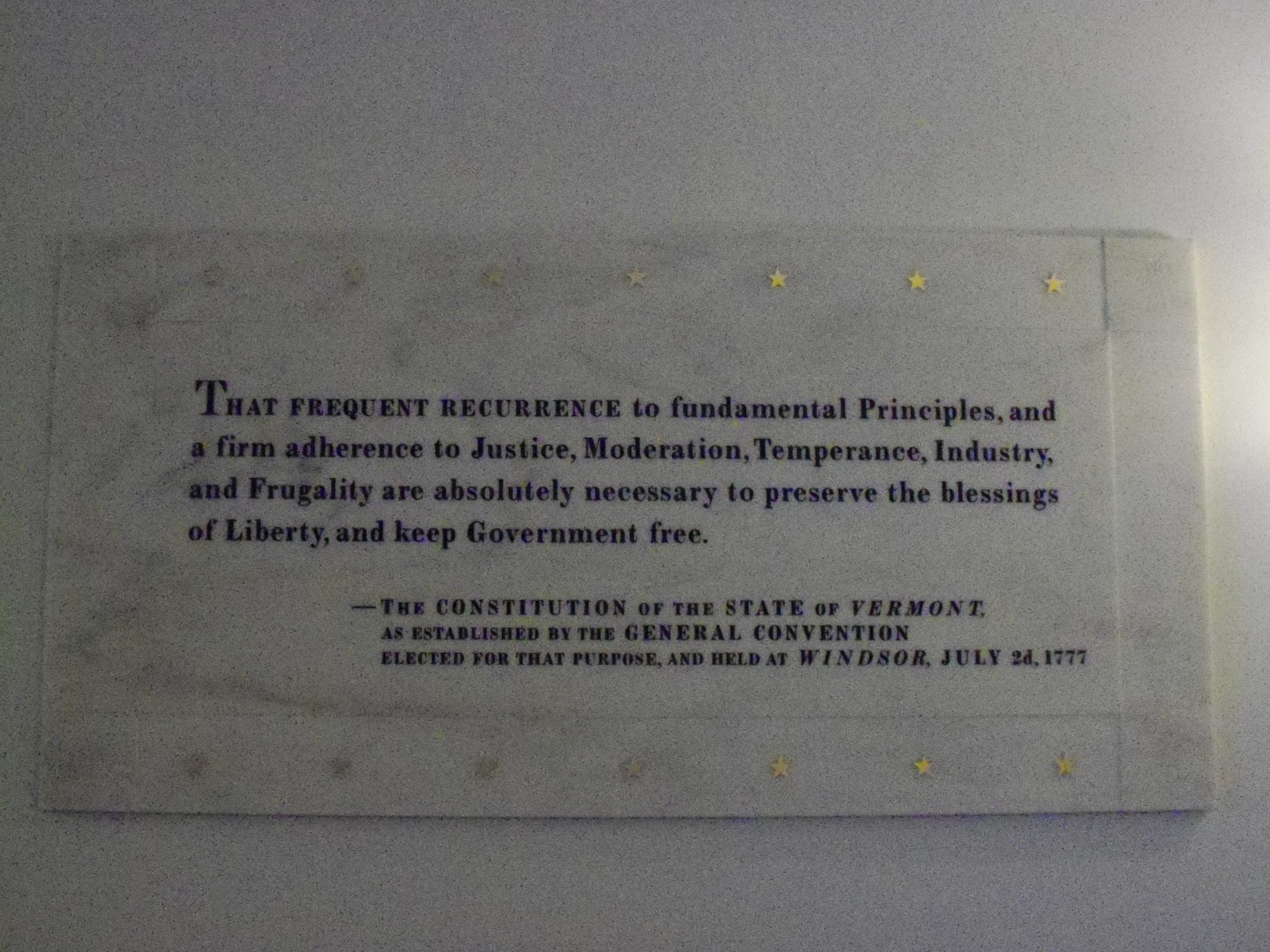
Acts 13:26

Excerpt from Vermont Constitution.

Friday, 6 January 2023

“Men and brethren, sons of the family of Abraham, and those among you who fear God, to you the word of this salvation has been sent. Acts 13:26

Note: You can listen to today’s commentary courtesy of our friends at “Bible in Ten” podcast. (Click Here to listen).

You can also read this commentary, with music, courtesy of our friends at “Discern the Bible” on YouTube. (Click Here to listen), or at Rumble (Click Here to listen).

Paul had just spoken of John the Baptist’s denial of being the Messiah, instead pointing the people of Israel to the One who was coming after him. Paul now proclaims that this One has come. His words begin with, “Men and brethren, sons of the family of Abraham,”

The words are surprisingly widely translated, dividing the three designations into two or three categories. Literally, the words read, “Men, brothers, sons of the stock of Abraham.” This is probably how Paul intended. He is speaking to the men of the synagogue. He refers to them next as brothers. And then, he notes their lineage being traced back to Abraham as a particular point of note because of what he will say in verse 13:32 concerning the promise made to the fathers, a promise that first came to Abraham.

He is carefully defining them so that they pay heed to the details of what he will say. The importance of heeding or not heeding will make all the difference in their eternal future. Therefore, he speaks precisely so that they will be without excuse in their decision concerning the matter presented. Next, he adds another category, saying, “and those among you who fear God.”

An important question arises here: Is this another descriptor of those he just addressed or is it a separate category altogether? In other words, is this a way of saying, “You sons of Abraham who fear God,” or is it “and anyone who is not a son of Abraham but who fears God” as in verse 13:16? Notice the difference between the two verses:

13:16 – and those fearing God
13:26 – and those among you fearing God

The reason this is important is that these are words of warning to his people as much as they are words heralding the good news concerning Jesus. The two are actually inseparable. To reject the good news will lead to being handed the results of that rejection.

The confusion continues with the next words to some degree. They say, “to you the word of this salvation has been sent.” In this, the words are directed to whoever is hearing, be it Jew or Gentile. However, some manuscripts say, “to us.”

In this, it may or may not change the meaning. It still could mean that God’s salvation has been sent to both Jew and Gentile, but it also may be that he is saying that God’s salvation was sent to the literal descendants of Abraham who fear God as opposed to Abraham’s literal descendants and those Gentiles who fear God as well.

In Acts 10:2, the same term is used when referring to Cornelius. He was a man “that feared God.” Because of this, it is hard to be dogmatic, but even if it extends to proselytes of the gate who are in attendance, the result will ultimately remain unchanged. If those proselytes were to reject the message of Paul and continue with observance of Moses, they would – henceforth – be separated from what God is doing in Christ.

This is to be seen quite clearly in verses 13:38 & 39 –

“Therefore let it be known to you, brethren, that through this Man is preached to you the forgiveness of sins; 39 and by Him everyone who believes is justified from all things from which you could not be justified by the law of Moses.”

Whether Paul’s words include the proselytes of the gate, or whether they are solely directed to the Jews at this point, an absolute distinction is made between “everyone who believes” and “the law of Moses.” To follow the law will mean that you are not included in everyone who believes. That then means no justification and thus eternal separation from God. This is because, as Paul says in Galatians –

“…knowing that a man is not justified by the works of the law but by faith in Jesus Christ, even we have believed in Christ Jesus, that we might be justified by faith in Christ and not by the works of the law; for by the works of the law no flesh shall be justified.” Galatians 2:16

&

“For as many as are of the works of the law are under the curse; for it is written, ‘Cursed is everyone who does not continue in all things which are written in the book of the law, to do them.’ 11 But that no one is justified by the law in the sight of God is evident, for ‘the just shall live by faith.’ 12 Yet the law is not of faith, but ‘the man who does them shall live by them.’” Galatians 3:10-12

Life application: Faith in Jesus Christ saves. Nothing else will do.

Heavenly Father, help us to be people of faith, trusting in the merits of Jesus Christ alone for our salvation. And then, Lord, help us to be faithful people, working out our salvation in righteousness and holiness all our days. May our walk be in accord with the honor bestowed upon us when we first believed. To Your glory, we pray. Amen.




Acts 13:25

Toes on grating.

Thursday, 5 January 2023

“And as John was finishing his course, he said, ‘Who do you think I am? I am not He. But behold, there comes One after me, the sandals of whose feet I am not worthy to loose.’ Acts 13:25

Note: You can listen to today’s commentary courtesy of our friends at “Bible in Ten” podcast. (Click Here to listen).

You can also read this commentary, with music, courtesy of our friends at “Discern the Bible” on YouTube. (Click Here to listen), or at Rumble (Click Here to listen).

The previous verse referred to John’s preaching a baptism of repentance to all the people of Israel. Paul continues now with, “And as John was finishing his course.”

Paul uses the term dromos or “course” for the first time in Scripture. It signifies a racetrack where runners on foot competed in the Greek games of old. It will only be seen again in Acts 20:24 and 2 Timothy 4:7, both of which give us the same sense as he now uses –

“But none of these things move me; nor do I count my life dear to myself, so that I may finish my race with joy, and the ministry which I received from the Lord Jesus, to testify to the gospel of the grace of God.” Acts 20:24

“For I am already being poured out as a drink offering, and the time of my departure is at hand. I have fought the good fight, I have finished the race, I have kept the faith.” 2 Timothy 4:6, 7

Paul equated the ministry of John the Baptist to such a course and noted that as he was coming to the end of it, “he said, ‘Who do you think I am? I am not He.’”

Paul again uses a new word, huponoeó. Literally, it signifies “to think under” and thus privately. As such, it means to suppose or conjecture. The people were thinking privately about who John might be. He was aware of it and asked them to consider what he would reveal. As for what Paul has said, his words of the previous verse and this one now follow the narrative of Luke 3 closely. In the previous verse, it mentioned the preaching of repentance to Israel. That was seen in Luke 3:3. It continued with instruction after that. Then, it next says –

“Now as the people were in expectation, and all reasoned in their hearts about John, whether he was the Christ or not.” Luke 3:15

The question was proffered. From there, John’s denial of being the Messiah is not explicitly spoken in the same manner that Paul speaks to those in the synagogue. Rather it is implied in John’s response to the people’s question which Paul states as, “But behold, there comes One after me, the sandals of whose feet I am not worthy to loose.”

Rather, the word is “sandal” in the singular. John is saying that he was unworthy to undo even a single sandal on the feet of the Messiah, much less both of them. This follows Luke’s narrative –

“Now as the people were in expectation, and all reasoned in their hearts about John, whether he was the Christ or not, 16 John answered, saying to all, ‘I indeed baptize you with water; but One mightier than I is coming, whose sandal strap I am not worthy to loose. He will baptize you with the Holy Spirit and fire. 17 His winnowing fan is in His hand, and He will thoroughly clean out His threshing floor, and gather the wheat into His barn; but the chaff He will burn with unquenchable fire.’” Luke 3:15-17

Untying the feet of one’s master would have been the most menial of all tasks. As today, it would be considered degrading to be told to remove the shoes of someone as he sat and relaxed. John, however, knew that even such a lowly assignment was above his right to perform. It is a surprising statement when considering Jesus’ words to the people –

“But what did you go out to see? A prophet? Yes, I say to you, and more than a prophet. 27 This is he of whom it is written:
‘Behold, I send My messenger before Your face,
Who will prepare Your way before You.’
28 For I say to you, among those born of women there is not a greater prophet than John the Baptist; but he who is least in the kingdom of God is greater than he.” Luke 7:26-28

John was highlighted by Jesus in this manner and yet he knew his unworthy state before the Lord. It makes the rest of the narrative of Israel’s interactions with Jesus all the more relevant and striking. Their rejection of John was like their rejection of all the prophets who came before him. Their rejection of Jesus, of whom all those prophets spoke, was intolerable and inexcusable.

Life application: In considering our position in relation to Jesus, there is a dichotomy that needs to be considered. He has given His life for us and there is a bond of closeness that arises from that where we can speak to Him now in the most intimate way. He is nearer to us than any blood relative and He should be dearer to us than our own spouse or children.

And yet, we must also consider the absolute magnificence, splendor, and holiness of the Lord as well. We stand before the perfection of God when we stand before the Lord Jesus. He is our Creator, Sustainer, and continued life. Our conduct before Him should be that of reverential fear and always conducting our lives in a circumspect manner.

Even if those who are “least in the kingdom of God” are greater than John the Baptist, we are no more worthy than he was to untie the strap of one of His sandals. Let us remember this and share our lives and intimate thoughts with Him as our nearest and truest love, and yet let us honor Him with the due respect that is owed to our God. All glory to Jesus, our All in all.

Glorious Lord Jesus, we stand in awe of You. We were created by You, we exist because You allow it to be so, and yet You came to die for us so that we could be reconciled to God through You. How great You are. How magnificent, splendid, and beautiful! Glory to You in the highest, Lord Jesus. Amen.


Acts 13:24

Hallway in Vermont State Capitol building.

Wednesday, 4 January 2023

“after John had first preached, before His coming, the baptism of repentance to all the people of Israel. Acts 13:24

Note: You can listen to today’s commentary courtesy of our friends at “Bible in Ten” podcast. (Click Here to listen).

You can also read this commentary, with music, courtesy of our friends at “Discern the Bible” on YouTube. (Click Here to listen), or at Rumble (Click Here to listen).

Paul is in the synagogue in Antioch of Pisidia. He has been addressing those gathered on the Sabbath, telling them about God’s plan of salvation. In the previous verse, he specifically introduced Jesus as the Savior. He now notes that Jesus’ ministry began “after John had first preached.”

This is referring to John’s preaching which immediately preceded the ministry of Jesus. It was not that John preached before the coming of Jesus at His birth, but before the designated time for His ministry to begin.

The significance of this was that John didn’t preach like the other prophets, as if the Messiah was coming at some unstated point in the future. Rather, his words indicated that the Messiah was right at hand and ready to appear. This was, as Paul continues to note, “before His coming.” The Greek literally reads “before the face of His entrance.”

It is a Hebrew expression indicating an appearance, the face representing the person’s presence. In this, a new word is used, eisodos. It is essentially the opposite of exodus. It indicates an entrance and extends to a means or place of entrance. Because Paul is connecting John’s ministry to that of the coming of the Messiah, he is indicating that the two events are inextricably linked. The herald had come and then the One he proclaimed had immediately followed. As for John, his proclamation was “the baptism of repentance.”

The meaning is that John called the people to repent. In his calling, those who agreed with his proposition were then baptized to outwardly acknowledge the inner change that had taken place. It was a symbolic act of repentance. The word “repent” must be defined to understand what is being said –

“A word compounded of the preposition μετά, after, with; and the verb νοέω, to perceive, and to think, as the result of perceiving or observing. In this compound the preposition combines the two meanings of time and change, which may be denoted by after and different; so that the whole compound means to think differently after. Μετάνοια (repentance) is therefore, primarily, an after-thought, different from the former thought; then, a change of mind which issues in regret and in change of conduct. These latter ideas, however, have been imported into the word by scriptural usage, and do not lie in it etymologically nor by primary usage. Repentance, then, has been rightly defined as ‘Such a virtuous alteration of the mind and purpose as begets a like virtuous change in the life and practice.’ Sorrow is not, as is popularly conceived, the primary nor the prominent notion of the word. Paul distinguishes between sorrow (λύπη) and repentance (μετάνοια), and puts the one as the outcome of the other. ‘Godly sorrow worketh repentance’ (2 Corinthians 7:10).” Vincent’s Word Studies

It was this changing of the mind that John was called to proclaim. The Messiah was soon to appear and there was to be a national preparing for His arrival –

“In those days John the Baptist came preaching in the wilderness of Judea, and saying, ‘Repent, for the kingdom of heaven is at hand!’ For this is he who was spoken of by the prophet Isaiah, saying:
‘The voice of one crying in the wilderness:
“Prepare the way of the Lord;
Make His paths straight.”’” Matthew 3:1-3

This call for the people to change their minds was “to all the people of Israel.” Jesus came to the people of Israel. His ministry was to the nation of Israel. No Gentiles were a part of the nation. He had come to fulfill the law and then initiate a New Covenant. This covenant was to be “with the House of Israel and with the house of Judah” as stated in Jeremiah 31:31.

As such, what Paul is conveying to those at the synagogue is a restating of the process of preparation for Israel to enter into this New Covenant based on their lives under the Law of Moses. As the Gentiles were never under the law of Moses, what Paul says here does not apply to them. It is simply a restating of the facts as they occurred just as the Messiah was ready to come forth. That was prophesied by the prophet Malachi –

“Remember the Law of Moses, My servant,
Which I commanded him in Horeb for all Israel,
With the statutes and judgments.
Behold, I will send you Elijah the prophet
Before the coming of the great and dreadful day of the Lord.
And he will turn
The hearts of the fathers to the children,
And the hearts of the children to their fathers,
Lest I come and strike the earth with a curse.” Malachi 4:4-6

Commentaries quite often shove Paul’s words here in Acts 13 into their “Gentile” theology concerning entry into the New Covenant, meaning “how to be saved.” But this is entirely inappropriate. Christ has come. And more, the Law of Moses was never in effect for any Gentile at any time or place in human history. The entrance of Gentiles into the New Covenant was anticipated by Isaiah, and it is something that was only available after the work of Christ was accomplished –

“And now the Lord says,
Who formed Me from the womb to be His Servant,
To bring Jacob back to Him,
So that Israel is gathered to Him
(For I shall be glorious in the eyes of the Lord,
And My God shall be My strength),
Indeed He says,
‘It is too small a thing that You should be My Servant
To raise up the tribes of Jacob,
And to restore the preserved ones of Israel;
I will also give You as a light to the Gentiles,
That You should be My salvation to the ends of the earth.’” Isaiah 49:5, 6

Israel had to repent because they were under the law. To be brought out of that state, they needed to be in the right condition for that to occur. Now, with Christ’s work complete, salvation is solely by faith in what He has accomplished.

Life application: Remember the basics of the gospel –

“For I delivered to you first of all that which I also received: that Christ died for our sins according to the Scriptures, and that He was buried, and that He rose again the third day according to the Scriptures.” 1 Corinthians 15:3:4

By faith in this message, one is saved. At that time, the Holy Spirit is given as a seal, a guarantee, of that salvation –

“In Him you also trusted, after you heard the word of truth, the gospel of your salvation; in whom also, having believed, you were sealed with the Holy Spirit of promise, 14 who is the guarantee of our inheritance until the redemption of the purchased possession, to the praise of His glory.” Ephesians 1:13, 14

The process is of God. The work is accomplished by Jesus. Belief in this results in eternal salvation. Nothing can be added to this message without causing damage to its purity.

Glorious God, we stand in awe of what You have done. You have brought us from darkness into the wonderful light of Christ. Thank You for restoring us to Yourself. And thank You for Your word that reveals these things to us. We can have confidence in our walk and hope concerning our future because of what You have provided for us. Hallelujah! Amen.


Acts 13:23

State houses of the state of Vermont, past to present.

Tuesday, 3 January 2023

“From this man’s seed, according to the promise, God raised up for Israel a Savior—Jesus— Acts 13:23

Note: You can listen to today’s commentary courtesy of our friends at “Bible in Ten” podcast. (Click Here to listen).

You can also read this commentary, with music, courtesy of our friends at “Discern the Bible” on YouTube. (Click Here to listen), or at Rumble (Click Here to listen).

Paul has been speaking about the history of Israel. In the previous verse, he noted the raising up of David because of having removed Saul as king. In his words, he said that God had found David a man after His own heart and a man who would do His will. With that, Paul now continues with, “From this man’s seed.”

The meaning is that a direct descendant of David is who is being referred to. The word “seed” as understood from Scripture indicates a direct connection between one entity and another, just as when a stalk of wheat bears seed. That seed bears the characteristics of the stalk from which it came. It will be none other than a seed of wheat. And more, if it is a particular class of wheat, it will remain in that same class.

Because this Seed is from David, it remains a fixed part of the line of David in nature and in attributes. The Seed being referred to is next said to be “according to the promise.” The inserted word “the” does not belong there. Nor is the word “his” found in many translations. The words should be rendered just as the Greek, “according to promise.” It is not a specific promise, but a succession of promises all related to the same unchanging nature of God.

This Seed was promised in Genesis 3 as the “Seed of the woman.” He was promised to Abraham, Isaac, Jacob, Judah, and David. He was promised through the words of the prophets in a multitude of ways, all of which were in accord with one another. It is this one overall promise that Paul refers to now. With that understood, Paul then explains the fulfillment of this promise. It is that “God raised up for Israel.”

The promise that began in Genesis, and which was the hope of all people who anticipated a return to paradise as indicated there, eventually became the hope of Israel. This was not only as a hope of the people in general, but the hope of its specific fulfillment through them as a people.

Eventually, it became the hope of the house of David, being promised to him personally in 2 Samuel 7:12-16. This promise is also recorded later in the psalms and in the prophets. Paul, speaking to those in the synagogue now, confirms that the promised seed has come, noting that to them God has raised up “a Savior—Jesus.”

His words, however, would cause an immediate conflict in the thinking of these Jews. How could Jesus be the Savior of Israel if Israel isn’t saved? Their minds were attuned to the idea that Jesus would deliver Israel from her enemies, gather them back to the land of Israel, and lead them as the head of the nations. And yet, they were sitting in a synagogue in Antioch of Pisidia some years after Jesus had come.

It won’t be until verse 13:38 that he will exactingly explain what Jesus came to save them from. And then in verse 13:39 he will continue that thought with words that would trouble any Jew unless he understood what their history under the law was intended to reveal. Until he gets there, Paul will continue to explain the proofs that verify Jesus truly is the promised Seed of David.

Life application: Heresies are points of doctrine that destroy the message of salvation by changing the fundamental tenets of what God has revealed in Christ. For example, God has revealed that in the Godhead there are individual “persons” in one essence. Scripture reveals that the Father is God. It reveals that the Son is God. It also reveals that the Holy Spirit is God. And yet, they are not the same “person.” We may not understand the concept, but to deny it as a fundamental tenet of the faith is heresy.

Despite teaching that Jesus (the Son) is God, the Bible also teaches that Jesus is a Man. To deny this would then be heresy. But going further, Jesus is not just a Man who was created by God, directly and immediately in Mary’s womb. Rather, He is a man who descended from Adam. From there He descends from a long genealogy recorded in Luke 3. He also descends from others as is recorded in Scripture. He is the Seed of these people. Lot, for example, is not in the direct genealogy of Jesus as recorded in Luke 3, but he is still an ancestor of Jesus as the pages of Genesis reveal.

Jesus is also said to be the “Seed of David” here in Acts and elsewhere, such as in Romans 1:3 and 2 Timothy 2:8. Because this is so, to deny His humanity is derived from these people is to teach heresy. A person does not need to know these things to be saved. Salvation comes through belief in the gospel. However, if a person is told, in advance, that these things are not true when the “gospel” is proclaimed, he will not be saved. He has believed in a false Jesus.

It is important to be exact when speaking of the nature of Christ. God has carefully and meticulously revealed Him in Scripture. And so, let us carefully and soberly consider what is recorded there.

O God, we stand in awe of what You have done for us. You set forth a plan and You have meticulously brought it about in human history, finally revealing the purpose of that plan when You sent Jesus. We are the recipients of the glory and splendor of what You have done for us. Thank You, O God. You have done it all, and now You ask us to just believe that it is so. And we do! Thank You for the coming of Jesus Christ our Lord. Amen.


Acts 13:22

Dewey at Manila, Vermont Capitol.

Monday, 2 January 2023

“And when He had removed him, He raised up for them David as king, to whom also He gave testimony and said, ‘I have found David the son of Jesse, a man after My own heart, who will do all My will.’ Acts 13:22

Note: You can listen to today’s commentary courtesy of our friends at “Bible in Ten” podcast. (Click Here to listen)

You can also read this commentary, with music, courtesy of our friends at “Discern the Bible” on YouTube. (Click Here to listen), or at Rumble (Click Here to listen).

The previous verse referred to the reign of Saul. With that remembered, it now says, “And when He had removed him.” It refers to Saul who had disobeyed the Lord in two critical matters. The final one cost him the kingship. The account is found in 1 Samuel 15, and it is summed up with these words –

“And as Samuel turned around to go away, Saul seized the edge of his robe, and it tore. 28 So Samuel said to him, ‘The Lord has torn the kingdom of Israel from you today, and has given it to a neighbor of yours, who is better than you. 29 And also the Strength of Israel will not lie nor relent. For He is not a man, that He should relent.’” 1 Samuel 15:27-29

From there, Paul continues with, “He raised up for them David as king.” Israel had asked for a king, rejecting the Lord as king over them. Therefore, He gave them what they asked for. In Saul’s disobedience, but still in agreement with the will of the people, the Lord continued a kingship over Israel. But this time, it would be in accord with the prophecy of Jacob that the scepter (the rule of a king) would not depart from Judah until Shiloh came.

Shiloh is an anticipatory appellation for the coming Messiah. In raising up David, this prophecy would come about. The name David means Beloved. Of David, Paul next says, “to whom also He gave testimony,”

The meaning is “about David also the Lord gave testimony.” In other words, the Lord spoke words concerning David that defined his character and the Lord’s attitude toward it. The Lord spoke, “and said, ‘I have found David the son of Jesse.’”

The words mean that the Lord searched out David, knowing all that his life was and would be. The sum of what could be found in David is what the Lord “found” concerning him. He was the proper choice by which to continue the redemptive narrative. Despite David’s many faults, he was a man of great character in his dealings with the Lord and with those around him.

The name Jesse means My Husband. But it also means Yehovah Exists. As such the name Jesse contains the weighty notion that human marriage reflects divine revelation. In considering these names in the surrounding Old Testament accounts, great hints of God’s workings in relation to the coming Messiah become evident. As for David, the Lord says he is “a man after My own heart.”

Paul takes two Old Testament verses and combines them to give a full description of the character of David. The first concerns what God was looking for in a king when addressing Saul –

“But now your kingdom shall not continue. The Lord has sought for Himself a man after His own heart, and the Lord has commanded him to be commander over His people, because you have not kept what the Lord commanded you.” 1 Samuel 13:14

The second is a reference to David from the psalms –

I have found My servant David;
With My holy oil I have anointed him.” Psalm 89:20

Taken together, the two thoughts show that David is what the Lord searched for after first giving what Israel asked for. Because of whom David was, and because that included being a man after the Lord’s own heart, the Lord knew that he was one, as it next says, “who will do all My will.” The sentiment is found in the continued words of Psalm 89. In verse 21, it says, “With whom My hand shall be established.”

In other words, the Lord’s will, His hand, would be realized in the person of David, who would establish that will in all his doings. Unlike Saul who rejected the word of the Lord, when the Lord spoke, David complied. In the times he did not, such as in his adultery with Bathsheba, his heart was convicted, and he returned fully to the Lord. Thus, the will of the Lord was wholly established through David.

Life application: The Lord “found” David in a certain condition, a certain state, before Him. As noted, this means that the Lord looked upon David, from beginning to end, and knew that he was a man whose very character defined what was good and right in his overall attitude and conduct.

The Lord has also “found” you out. He already knows everything about who you are, from beginning to end. However, you do not. This sentiment is expressed by David –

“O Lord, You have searched me and known me.
You know my sitting down and my rising up;
You understand my thought afar off.
You comprehend my path and my lying down,
And are acquainted with all my ways.
For there is not a word on my tongue,
But behold, O Lord, You know it altogether.
You have hedged me behind and before,
And laid Your hand upon me.
Such knowledge is too wonderful for me;
It is high, I cannot attain it.” Psalm 139:1-6

David understood that the Lord knew everything about him from beginning to end. As he knew this, he directed his life toward the Lord’s ways. Now that you know this is true about you, you can also demonstrate the wisdom of David and direct your ways to the ways of the Lord. What God has “found” in you does not have to simply be who you have been in the past, but who you can be in the future.

In turning to the Lord and living for Him now, what the Lord has “found” already about you is that you are a person who is willing to turn wholly to Him and follow in His ways. If you don’t do this, then that is what the Lord has “found” about you. Contemplate this and understand that you can be “found” by the Lord in a manner that pleases Him from this point on. He already knows what you will do. Do what is right, and in your doing, you will be found a person after His own heart.

Lord God, You already know everything about us. We can only direct the future by our conduct as we express it from moment to moment. May what You know about us be something that shows we are people who live after Your heart from this moment forward and for all our lives. To Your glory, we pray. Amen.