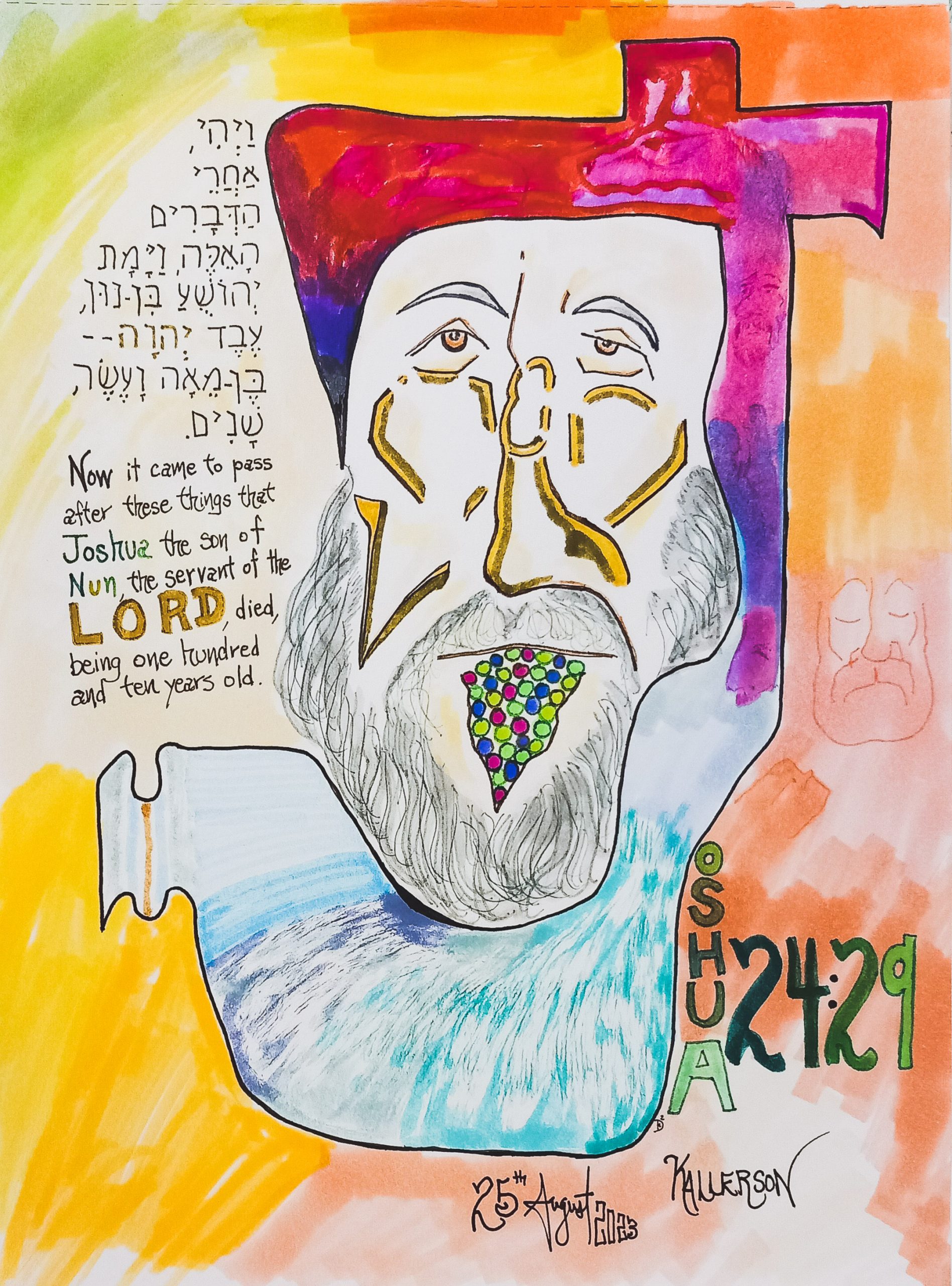
Joshua 24:29-33
Joshua the Son of Nun
Apart from the clear connection to Jesus that runs throughout the book of Joshua, there is one major theme that has been repeatedly seen in the typology of this book.
There have been innumerable things pictured in Joshua, from national Israel’s future salvation to the rapture of the church to salvation by grace through faith, how inheritances are secured, the introduction of the New Covenant, and so forth.
But all of these things are dependent upon one major aspect of what Christ has done. We have seen the death of Christ, His resurrection and exaltation to God’s right hand, and more. But what is THE one thing that all of these things are ultimately focused on?
More than that, what will be the result of it coming about? If you are not sure, consider Paul’s writings. What does Paul focus on above all other points of doctrine? Hint: Nearly the entire book of Galatians and a majority of the book of Romans focus on it. Only a few of his books don’t explicitly refer to it. What is it? He speaks of it in our text verse…
Text Verse: “Where is boasting then? It is excluded. By what law? Of works? No, but by the law of faith. 28 Therefore we conclude that a man is justified by faith apart from the deeds of the law.” Romans 3:27, 28
It is such an important point that the very first words ever spoken to man (as recorded in the Bible) to the very last words of Scripture are focused on this issue –
“Of every tree of the garden you may freely eat; 17 but of the tree of the knowledge of good and evil you shall not eat, for in the day that you eat of it you shall surely die.” Genesis 2:16
“The grace of our Lord Jesus Christ be with you all. Amen.” Revelation 22:21
One can choose law or grace. This is what Joshua has most heavily focused on. And there is a reason for this. The glory of God is not displayed in man’s observance of the law. It is seen in those who trust Him apart from their own merit.
God gave mankind law, man failed, and death was the result. Without the coming of Jesus to fulfill the law, nothing else in human history would have any eternal value. This is the lesson of Joshua and of the Bible. The law or grace.
We can choose one or the other, but we cannot have both and be pleasing to God except as the law is fulfilled in Jesus Christ. Joshua has shown us this. Today, a brief summary of it will be seen once again as the book closes out.
Jesus! His coming and His perfection, this is what the Bible is about. It is His work that is highlighted. God came to dwell among us and to remove the burden of law from us. The devil wants nothing more than for you to stay under the law and try to work your way to heaven.
Don’t let him trick you. Christ has gone before us. Let us trust wholly and completely in what He has done. This wonderful truth is seen in Joshua and indeed is be found throughout God’s superior word. And so, let us turn to that precious word once again, and… May God speak to us through His word today, and may His glorious name ever be praised.
I. One Hundred and Ten Years Old (verses 29-33)
29 Now it came to pass after these things that Joshua the son of Nun, the servant of the Lord, died,
v’hi akhare ha’devarim ha’eleh vayamath Yehoshua bin nun eved Yehovah – “And it was after the words, the these, and died Joshua son of Nun, servant Yehovah.” Joshua means The Lord is Salvation. Nun means Increase. This is the tenth and final time in the book of Joshua that this full name, Joshua the son of Nun, is used.
Bullinger says “that ten is one of the perfect numbers, and signifies the perfection of Divine order, commencing, as it does, an altogether new series of numbers. The first decade is the representative of the whole numeral system, and originates the system of calculation called ‘decimals,’ because the whole system of numeration consists of so many tens, of which the first is a type of the whole.”
He then says of it, “Completeness of order, marking the entire round of anything, is, therefore, the ever-present signification of the number ten. It implies that nothing is wanting; that the number and order are perfect; that the whole cycle is complete.”
Scripture does not give a date concerning when Joshua called the tribes together at Shechem, nor are we now told how long after that occurred that Joshua died, whether it was a week or a year later.
What is noted is that this gathering was the last great recorded moment of Joshua’s life. At Shechem, the Lord, through him, had faithfully reminded the people of their original calling through their father, Abraham, demonstrating that it was an act of grace. He noted the promise made to Abraham, Isaac, and Jacob – a granting that came without merit on their part.
He reminded them of their sojourn in Egypt and of the Lord’s deeds on their behalf. He had defeated Pharoah and his army, the Amorites on both sides of the Jordan, and He had given them a land for which they did not labor and cities which they did not build. The land was filled with vineyards and olive groves upon their arrival.
Everything came apart from Israel’s merit. Instead, it was all grace bestowed upon them. After the Lord reminded them of these things, Joshua asked the people to choose whom they would serve, noting that he and his house would serve the Lord.
The people likewise agreed to serve the Lord, noting that it was He who had done all of the great things for them, restating some of those deeds and repeatedly stating that He was the One whom they would serve. He had proven Himself faithful, and so they vowed to faithfully serve Him. After that, it said –
“But Joshua said to the people, ‘You cannot serve the Lord, for He is a holy God. He is a jealous God; He will not forgive your transgressions nor your sins. 20 If you forsake the Lord and serve foreign gods, then He will turn and do you harm and consume you, after He has done you good.’” Joshua 24:19, 20
The words of Joshua were unlike the closing words of Moses. Moses blessed the individual tribes, and then it said –
“So Moses came with Joshua the son of Nun and spoke all the words of this song in the hearing of the people. 45 Moses finished speaking all these words to all Israel, 46 and he said to them: ‘Set your hearts on all the words which I testify among you today, which you shall command your children to be careful to observe—all the words of this law. 47 For it is not a futile thing for you, because it is your life, and by this word you shall prolong your days in the land which you cross over the Jordan to possess.’” Deuteronomy 32:44-47
Where Moses proclaimed the law was their life, Joshua never directly mentioned the law. Rather, he focused his words on forsaking the Lord through the service of other gods. Sin would result in turning from the Lord.
You can see the difference. If a person remains faithful to the Lord, there is forgiveness, even for committed sin. David had Uriah killed and took his wife. And yet the Lord forgave him because his heart was set on the Lord.
However, in forsaking the Lord and turning to other gods, there is no forgiveness of transgressions and sins. Such a person cuts himself off from the only Source of life. As for Joshua, he has been used as a type of Christ Jesus, the One who fulfills the will of the Lord. That was seen back in Joshua 11 –
“As the Lord had commanded Moses His servant, so Moses commanded Joshua, and so Joshua did. He left nothing undone of all that the Lord had commanded Moses.” Joshua 11:15
After Joshua completed these things, the land was divided according to inheritance. Likewise, Jesus fulfilled the will of the Lord. Through Him, the inheritance is received. This included those who received their inheritance by Moses.
Despite the eastern tribes being granted their inheritance conditionally, it still was not realized until after Joshua had completed the campaign for Canaan. The same is true with Jesus. The Old Testament saints do not receive any actual inheritance until after Jesus returns. That was seen in Joshua 22.
Everything in Joshua has played out according to a greater plan of redemption in Christ Jesus. Joshua has anticipated Jesus as the leader who goes before his people, clearing the way for them to receive their inheritance. With his typological role in this unfolding drama complete, it notes that he has died…
29 (con’t) being one hundred and ten years old.
ben meah va’esher shanim – “son hundred and ten years.” This is ten years less than Moses (Deuteronomy 34:7) and the same age as Joseph (Genesis 50:26) from whom he descended. One hundred and ten is the product of 10 x 11. The meaning of ten was previously given. Of eleven, Bullinger says –
“If ten is the number which marks the perfection of Divine order, then eleven is an addition to it, subversive of and undoing that order. If twelve is the number which marks the perfection of Divine government, then eleven falls short of it. So that whether we regard it as being 10 + 1, or 12 – 1, it is the number which marks disorder, disorganization, imperfection, and disintegration.”
Like Joseph who died at this age, there is in these men a perfection of divine order marked with a state of imperfection. The two men were types of Christ in their lives, meaning they anticipate His coming. And yet, they were only types of Christ. God used these fallen men to typologically look ahead to the perfection seen in Jesus. As for the death of Joshua, it next says…
30 And they buried him within the border of his inheritance at Timnath Serah,
vayiqberu oto bigvul nakhalatho b’timnath serakh – “And they buried him in border his inheritance in Timnath Serah.” The meaning is that he was buried in his own land, given to him according to Joshua 19 –
“When they had made an end of dividing the land as an inheritance according to their borders, the children of Israel gave an inheritance among them to Joshua the son of Nun. 50 According to the word of the Lord they gave him the city which he asked for, Timnath Serah in the mountains of Ephraim; and he built the city and dwelt in it.” Joshua 19:49, 50
Timnath Serah means Extra Portion. It next says…
30 (con’t) which is in the mountains of Ephraim,
asher b’har ephrayim – “which in Mount Ephraim.” As seen previously, a mountain (har) is a lot of something gathered. It is synonymous with a large but centralized group of people. Ephraim means Twice Fruitful with a secondary meaning of Ashes. This is said to be…
30 (con’t) on the north side of Mount Gaash.
Mits’phon l’har gaash – “from north to Mount Gaash.” The word tsaphon, north, signifies that which is hidden or treasured away because the north receives less light in the northern hemisphere.
Strong’s notes the name Gaash comes from the verb gaash, to shake or quake. Thus it means something like A Shaking or A Quaking.
It cannot go unnoted that the Greek and Arabic translations of this verse include the following: “there they put with him into the tomb in which they buried him, the knives of stone with which he circumcised the children of Israel in Galgala, when he brought them out of Egypt, as the Lord appointed them; and there they are to this day.”
Either the words are original, and the Hebrew intentionally dropped them, or they are not original, and for some reason the translators of the Septuagint decided it was necessary to include them. If original, it could be that the Hebrew dropped them out because of the words “when he brought them out of Egypt.”
That would appear to be contradictory to what it says elsewhere about Moses being the one to bring them out of Egypt. But that is no excuse for removing the words. There would be nothing contradictory about it.
The reason is because of how the Hebrew is worded elsewhere. In Joshua 5:5, for example, it said, “For circumcised were all the people, the comers out. And all the people, the born (pl.) in the wilderness – in the way, in their coming out from Egypt – no circumcised.”
It isn’t that they came out of Egypt and were no longer coming out of Egypt. The entire process, from Exodus until they arrived safely in Canaan, is considered as part of coming out of Egypt. Until they entered Canaan, they were on their way out of Egypt. Thus, there is no contradiction in saying Moses brought them out, Joshua brought them out, and also that the Lord brought them out.
Also, Judges 2:6-9 closely matches the words recorded here in Joshua, but they do not include the extra words. It could be that the scribes of the Hebrew text, along with thinking there was a contradiction, also thought that because Judges 2 was of sufficient detail, the words were also unnecessary here.
If the words are not original, it is hard to imagine why the Septuagint, as well as the Arabic writers, would include them. They are otherwise so arbitrary that it seems impossible someone would make them up and insert them into their translation.
31 Israel served the Lord all the days of Joshua,
vayaavod Yisrael eth Yehovah kol yeme Yehoshua – “And served Israel Yehovah all days Joshua.” It is a note of faithfulness to the Lord because of the leader. Throughout the times of the judges and kings, it will be seen that the people remain faithful when the leader is faithful to the Lord. Likewise, the people will fall away from the Lord when the king is unfaithful. Also…
31 (con’t) and all the days of the elders who outlived Joshua,
v’kol yeme ha’zeqenim asher heeriku yamim akhare Yehoshua – “And all days the elders who prolonged days after Joshua.” Of these words, Ellicott mistakenly says that the prolonging of the days of the elders, “seems to suggest that Joshua’s death was comparatively an early death. Had he thought and laboured more for himself and less for Israel, he also might have prolonged his days.”
It needs to be remembered that Joshua came out of Egypt as an adult. Other than he and Caleb, every other person who entered Canaan was under twenty at the exodus from Egypt. Thus, they all were younger than Joshua.
Also, their lives didn’t go much beyond Joshua’s. The people had already begun to apostatize by Judges 2. They made covenants with the inhabitants of the land, and by Judges 2:11, they were worshipping the Baals and other gods. But even if that is considered a general summary, seJudges 3 specifically notes this –
“So the children of Israel did evil in the sight of the Lord. They forgot the Lord their God, and served the Baals and Asherahs. 8 Therefore the anger of the Lord was hot against Israel, and He sold them into the hand of Cushan-Rishathaim king of Mesopotamia; and the children of Israel served Cushan-Rishathaim eight years. 9 When the children of Israel cried out to the Lord, the Lord raised up a deliverer for the children of Israel, who delivered them: Othniel the son of Kenaz, Caleb’s younger brother.” Judges 3:7-9
Othniel, Caleb’s younger brother, was the first judge of Israel. And yet, by the time he became judge, the people had departed from the Lord. Thus, it was a very short time after Joshua’s death that these things began to take place. However, for a short time, the people served the Lord under the elders…
31 (con’t) who had known all the works of the Lord which He had done for Israel.
It is singular: v’asher yadeu eth kal maaseh Yehovah asher asah l’Yisrael – “and who knew all work Yehovah which had done to Israel.” Everything the Lord had accomplished is summed up as one great act on behalf of the nation.
The Israelites, though under twenty at the exodus, had seen everything that the Lord had done and were fully aware of the consequences for rejecting such knowledge, having personally seen every person older than them perish at the word of the Lord through the years of wilderness wanderings.
With that, the next words are given as a confirmation that the promise of the children of Israel to Joseph was fulfilled in its due time…
32 The bones of Joseph, which the children of Israel had brought up out of Egypt, they buried at Shechem,
v’eth atsmoth Yoseph asher heelu bene Yisrael mi’mitsrayim qaberu bishkhem – “And bones Joseph which had ascended sons Israel from Egypt buried in Shechem.”
Nothing is said as to when Joseph’s burial took place. It could have been as soon as the land was conquered, at some point afterwards, or even at the calling of the people to Shechem at the beginning of Chapter 24.
The stating of it here is a note of closure showing the fulfillment of an oath, regardless of when it actually took place. This oath is recorded in Genesis 50, about 200 years earlier –
“And Joseph said to his brethren, ‘I am dying; but God will surely visit you, and bring you out of this land to the land of which He swore to Abraham, to Isaac, and to Jacob.” 25 Then Joseph took an oath from the children of Israel, saying, “God will surely visit you, and you shall carry up my bones from here.’ 26 So Joseph died, being one hundred and ten years old; and they embalmed him, and he was put in a coffin in Egypt.” Genesis 50:24-26
In Acts 7, Stephen notes that not only were the bones of Joseph brought up, but so were the bones of the other fathers as well. However, the text here is only concerned with the fulfillment of the oath made by the sons of Israel. The actual removal of Joseph’s bones is recorded in Exodus 13:19 –
“And Moses took the bones of Joseph with him, for he had placed the children of Israel under solemn oath, saying, ‘God will surely visit you, and you shall carry up my bones from here with you.’”
Joseph means both He Shall Add and Take Away.
Egypt means Double Trouble.
Shechem is identical to shekem, shoulder. Thus, it literally means Shoulder. However, that comes from shakam signifying to incline, as in inclining the shoulder to a burden. Hence, it is normally translated as to rise or start early. Abarim defines Shechem as “[Having a Sense of] Responsibility.”
Joseph was buried in Shechem…
32 (con’t) in the plot of ground which Jacob had bought from the sons of Hamor the father of Shechem
b’khelqath ha’sadeh asher qanah Yaaqov meeth bene khamor avi shekhem – “in parcel the field which acquired Jacob from sons Hamor, father Shechem.” Jacob has several meanings that all point to his birth when he grabbed Esau’s heel. It literally means Heel Catcher, but that also has several independent meanings such as Supplanter, One Who Trips Up, One Closely Following, etc. Each is tied to the thought of grabbing the heel of another.
Hamor means Donkey, but that comes from the verb khamar, to be red, so it also means Red One. The land was bought…
32 (con’t) for one hundred pieces of silver,
b’meah q’sitah – “in hundred q’sitah.” The q’sitah comes from an unused root probably meaning to weigh out. Hence, it is a specific weight, probably like an ingot or a particular sized coin. The transaction is recorded in Genesis 33:18-20 –
“Then Jacob came safely to the city of Shechem, which is in the land of Canaan, when he came from Padan Aram; and he pitched his tent before the city. 19 And he bought the parcel of land, where he had pitched his tent, from the children of Hamor, Shechem’s father, for one hundred pieces of money. 20 Then he erected an altar there and called it El Elohe Israel.”
In weighing out the money, the transfer was made…
32 (con’t) and which had become an inheritance of the children of Joseph.
v’yihyu livne Yoseph l’nakhalah – “And became to sons Joseph to inheritance.” The granting of the land to Joseph is recorded in Genesis 48 –
“Then Israel said to Joseph, ‘Behold, I am dying, but God will be with you and bring you back to the land of your fathers. 22 Moreover I have given to you one portion above your brothers, which I took from the hand of the Amorite with my sword and my bow.’” Genesis 48:21, 22
With that, we come to the final verse of the book of Joshua…
33 And Eleazar the son of Aaron died.
Eleazar, Whom God Helps, was the second high priest of Israel –
“Moses stripped Aaron of his garments and put them on Eleazar his son; and Aaron died there on the top of the mountain. Then Moses and Eleazar came down from the mountain. 29 Now when all the congregation saw that Aaron was dead, all the house of Israel mourned for Aaron thirty days.” Numbers 20:28, 29
33 (con’t) They buried him in a hill belonging to Phinehas his son,
The Hebrew is more precise: v’yiqberu oto b’givath pin’khas beno – “And buried him in Hill Phinehas, his son.” The JPS Tanakh translates it as “the Hill of Phinehas.” The SLT gives the same idea while leaving the Hebrew untranslated – “in Gibeah of Phinehas.”
Due to the shortness of the Hebrew, it seems correct to say Givath Pin’khas, or Phinehas Hill. As has been seen several times in Joshua, the word translated as hill comes from a root that is etymologically connected to Gabbatha in the New Testament. Regardless of the translation, this is the connection that we are being asked to make.
The name pin’khas, or Phinehas, means Mouth of Brass, and thus, Mouth of Judgment, because brass signifies judgment. With this noted, the verse, the chapter, and the book of Joshua finish with…
*33 (fin) which was given to him in the mountains of Ephraim.
asher nitan lo b’har ephrayim – “which was given to him in Mount Ephraim.” Eleazar is buried in the same tribal land grant as that of Joshua. Of this, Ellicott rightly says –
“The inheritance of Phinehas as a priest would lie within the tribe of Judah (Joshua 21:13, &c.) or Benjamin. This gift to Phinehas in Mount Ephraim, near the seat of government, seems to have been a special grant to him over and above his inheritance. But inasmuch as the tabernacle itself was at Shiloh, in Mount Ephraim, it was altogether suitable and natural that some place of abode should be assigned to the priests in that neighbourhood, where they were compelled to reside.”
The Greek translation adds several sentences more at the end of Joshua that seem unlikely to be original, even if they may be historically accurate to some measure. With that noted, the book of Joshua has come to its end.
Be strong and of good courage; I am with you
Fear not and be not dismayed
Others may depart, but I am faithful and true
It is I who have all your debts paid
I will bring you into the inheritance
And there I will place you forever
Of Me failing, there is not a chance
Nothing can the bond between us sever
Be strong and of good courage; trust in Me
Fear not and be not dismayed, I am with you
The word I have spoken, so shall it be
I am the Lord your God, faithful and true
II. Pictures of Christ
To close out the book of Joshua, these final five verses have been affixed to the lengthy discourse that preceded them. The first thing noted in verse 29 was the death of Joshua, the son of Nun. As noted, this was the tenth and final time that his full name was given.
The ten instances are given to show the perfection of divine order concerning the types of Christ. Nothing is wanting. The number and order are perfect. The whole cycle is complete. Everything that needs to be seen in the typology of Joshua the man concerning Jesus is sufficiently revealed.
Joshua (The Lord is Salvation), the son of Nun (Increase), died. He is here called eved Yehovah, servant of Yehovah, the same as Moses was called at his death. That is given as a type of Christ –
“Behold, My Servant [avdi] shall deal prudently;
He shall be exalted and extolled and be very high.” Isaiah 52:13
“The God of Abraham, Isaac, and Jacob, the God of our fathers, glorified His Servant Jesus, whom you delivered up and denied in the presence of Pilate, when he was determined to let Him go.” Acts 3:13
Including the father’s name, Nun, is – as before – given to reveal that Jesus is the One who increases the family of God by including both Jews and Gentiles. That is seen in Isaiah 49 –
“Indeed He says,
‘It is too small a thing that You should be My Servant [eved]
To raise up the tribes of Jacob,
And to restore the preserved ones of Israel;
I will also give You as a light to the Gentiles,
That You should be My salvation to the ends of the earth.’” Isaiah 49:6
The next words of note were the age of Joshua at his death, one hundred and ten years. Being only a type of Christ, there is a note of imperfection to be found. This is the product of 10×11. It reveals that the whole cycle is complete, but the imperfection of him as a son of Adam who bore his own original sin is included.
Verse 30 noted the burial of Joshua in Timnath Serah, Extra Portion. It speaks of the full scope of Christ’s work as was noted in Isaiah 49:6. His work includes not only Israel but the Gentiles as well, making the effect of it the Extra Portion.
After that, the text continued, saying, “which is in Mount Ephraim.” Saying this was in the mount (har), points to the effect of His work, the mountain being synonymous with a large but centralized group of people. It refers to the uniting of all believers, Jews and Gentiles, as one in Christ.
Noting Ephraim points to the same truth again. Ephraim means Twice Fruitful. It signifies that Christ’s work has produced fruit in the conversion of both Jews and Gentiles. The secondary meaning of Ashes speaks of the price He paid to make this possible which was the afflictions He endured.
Still in verse 30, it noted that the location was “from north to Mount Gaash.” In Scripture, tsaphon, north, signifies that which is hidden or treasured away because the north receives less light in the northern hemisphere. It thus speaks of those who are “hidden with Christ in God” (Colossians 3:3).
If Timnah Serah signifies those redeemed by Christ and the north signifies that they are hidden in Christ, then Mount Gaash, Mount Shaking, would signify what is not hidden in Christ and what has been separated from Him. This is seen in Hebrews 12 –
“See that you do not refuse Him who speaks. For if they did not escape who refused Him who spoke on earth, much more shall we not escape if we turn away from Him who speaks from heaven, 26 whose voice then shook the earth; but now He has promised, saying, ‘Yet once more I shake not only the earth, but also heaven.’ 27 Now this, ‘Yet once more,’ indicates the removal of those things that are being shaken, as of things that are made, that the things which cannot be shaken may remain.
28 Therefore, since we are receiving a kingdom which cannot be shaken, let us have grace, by which we may serve God acceptably with reverence and godly fear. 29 For our God is a consuming fire.” Hebrews 12:25-29
As noted, the Greek and Arabic translations of verse 30 include the words concerning the stone knives used to circumcise the people in Gilgal being buried in the tomb with Joshua.
If original, it would signify that it is only through the death of Christ that the nation of Israel will be truly circumcised. To understand that, you can revisit the sermons from Joshua 5.
Verse 32 mentioned Joseph. Placing this at the end of Joshua is given for typology as well. Joseph, He Shall Add/Take Away, is given to reveal the work of Christ again. He is the One to add people to God’s flock, having taken away their reproach.
Naming Egypt, Double Trouble, indicates those brought out from the predicament they were in, meaning fallen and without God.
Noting Shechem, [Having a Sense of] Responsibility, looks to the believer who understands his violation of the law and has accepted Christ’s fulfillment of it.
This is then reconfirmed in the words that Joseph was buried “in the field which acquired Jacob from the sons of Hamor, the father of Shechem.” Jacob pictures Christ, the one who follows after or supplants Adam.
The field represents the world (Matthew 13:38). It is an open place of productivity. Hamor, Red One, pictures Adam, the man made from the red soil of the earth which the name Adam implies. Adam (ruddy) comes from adom, to be red.
Jacob (Christ the second Man/the last Adam, as noted in 1 Corinthians 15), purchased the field (the world) from the sons of Hamor (the Red One – Adam) for those who accept his work (Shechem).
This was for one hundred (10×10) q’sitah. In the amount Bullinger notes that “nothing is wanting; that the number and order are perfect; that the whole cycle is complete.” The perfection of divine order is realized in the work of Christ.
It was then said that this field had become the inheritance of the children of Joseph. It speaks of the secured and eternal inheritance for those in Christ.
Verse 32, the last verse of the book, then mentioned the death of Eleazer, Whom God Helps, the son of Very High, who was buried in Givath Pin’khas, which is in Mount Ephraim. It again anticipates the work of Christ. He is the One Whom God Helps –
“But I am poor and needy;
Make haste to me, O God!
You are my help [ezri] and my deliverer;
O Lord, do not delay.” Psalm 70:5
Jesus is the Son of the Most High (Luke 8:28). He received the Mouth of Judgment at Gabbatha which is in Mount Ephraim. That gives the same symbolism just explained when it noted Joshua’s burial.
Every name and location in these final five verses of Joshua points to various manifestations of Christ, His work, or its effects in relation to His people.
Therefore, the point is to once again highlight the scope of the work of Christ and also to reiterate to Israel their future national salvation based on the work of Christ. But they must hold fast to Him in that capacity as a nation as well. The work of Christ was effective for the salvation of individual Jews and Gentiles, but it is also effective for the collective nation of Israel as well.
And yet, in their national salvation, they must remember that each individual is responsible to the Lord personally. It is not unlike the church. Christ is the Savior of the church, but each person has an individual choice to make to become a member of it.
As for the law versus grace, Christ is the embodiment and fulfillment of the law. The only way to enter God’s presence is by receiving the grace of God in Christ who died in fulfillment of that law.
No other point has been so significantly highlighted in this book. One account after another has shown this. The death of Moses outside of the promise, the faith of Rahab, the crossing through the Jordan (the death of Christ) with the Ark (Christ the embodiment of the law) in view of the people, the raising of the stone monuments, the circumcision of the people after crossing through the Descender (Christ), the ending of the manna at that time, the destruction of Jericho, the sin of Achan, the defeat of Ai and the hanging of its king (the law), the building of the altar at Mount Ebal, the treaty of the Gibeonites, the defeat of the five kings and their hanging (the five books of Moses), to name a few.
That is only a snapshot of the first ten chapters of Joshua. And it continued on with this same theme again and again. Each story has revealed Jesus Christ, the world’s need for Him, the typological warnings that one cannot be saved by law but by grace, and so on.
From the very first moments of man on earth, it is law that has brought calamity upon man. What we need is Jesus who frees us from the bondage of the law, be it the law of Adam or the more burdensome law of Moses.
This has been the main theme of Joshua: God in Christ has accomplished everything necessary to secure our salvation and free us from the burden of law. In a right relationship with God, works are excluded except the works of God in Christ.
When we return to Joshua in our reading of the Bible, let us remember this. He is the One to lead us into our inheritance. He is the One who has defeated the enemy. He is the One who will return to raise His people and bring them to Himself. Jesus! The book of Joshua has been given to reveal Jesus. Thank God for Jesus Christ, who has made our restoration with Him possible. Yes. Thank God for Jesus Christ our Lord. Amen.
Oh what an army, Lord,
You’ll have at your side!
The weak, not the strong,
will stand at your side.
The rejected, the lost,
the poor, and the weak.
Those called by the world
unsuccessful and meek.
The needy, the sick,
the guilty, the shamed,
stained with imperfections,
with sins in their veins.
Those who, on their knees,
were searching for the Truth.
Those, will one day,
stand with You.
Not many rich
will be drawn to your side.
Not many mighty
in You will abide.
Not many with knowledge
and filled with success,
will look for You,
to be truly blessed.
Oh what an army, Lord,
You’ll have at your side!
Those who brought You the cross will stand at your side.
Those hated by the world,
yet loved by You.
The strongest army ever!
Because their King
is the Truth.
Izabela Bednara – 20 May 2023
Closing Verse: “Or is He the God of the Jews only? Is He not also the God of the Gentiles? Yes, of the Gentiles also, 30 since there is one God who will justify the circumcised by faith and the uncircumcised through faith.” Romans 3:29, 30
Next Week: Judges 1:1-8 The people want to know wazzup… (Judah Shall Go Up) (1st Judges Sermon)
The Lord has you exactly where He wants you. He has a good plan and purpose for you. It is He who has defeated the enemy and who now offers His people rest. So, follow Him and trust Him and He will do marvelous things for you and through you.
Joshua the Son of Nun
Now it came to pass after these things
That Joshua the son of Nun as we are told
He, the servant of the LORD, died
Being one hundred and ten years old
And they buried him within the border
Of his inheritance at Timnath Serah where he did reside
Which is in the mountains of Ephraim
On Mount Gaash’s north side
Israel served the LORD all the days of Joshua
And all the days of the elders who outlived Joshua as well
Who had known all the works of the LORD
Which He had done for Israel
The bones of Joseph, which the children of Israel had brought up
———-out of Egypt
They buried at Shechem, in the plot of ground which Jacob
———-had bought
From the sons of Hamor the father of Shechem for one hundred
———-pieces of silver
And which had become an inheritance of the children of Joseph
———-as we have been taught
And Eleazar the son of Aaron died
They buried him in a hill (a fitting place it would seem)
Belonging to Phinehas his son
Which was given to him in the mountains of Ephraim
Lord God, turn our hearts to be obedient to Your word
Give us wisdom to be ever faithful to You
May we carefully heed each thing we have heard
Yes, Lord God may our hearts be faithful and true
And Lord God, thank you for this wonderful book
Joshua! What a marvel to have studied it
Into every detail possible we took a look
And to You our thanks and praise we now submit!
Hallelujah to Christ our Lord!
Hallelujah for Joshua, a marvelous part of Your superior word!
Hallelujah and Amen!
Indeed, Hallelujah and Amen…
29 Now it came to pass after these things that Joshua the son of Nun, the servant of the Lord, died, being one hundred and ten years old. 30 And they buried him within the border of his inheritance at Timnath Serah, which is in the mountains of Ephraim, on the north side of Mount Gaash.
31 Israel served the Lord all the days of Joshua, and all the days of the elders who outlived Joshua, who had known all the works of the Lord which He had done for Israel.
32 The bones of Joseph, which the children of Israel had brought up out of Egypt, they buried at Shechem, in the plot of ground which Jacob had bought from the sons of Hamor the father of Shechem for one hundred pieces of silver, and which had become an inheritance of the children of Joseph.
33 And Eleazar the son of Aaron died. They buried him in a hill belonging to Phinehas his son, which was given to him in the mountains of Ephraim.