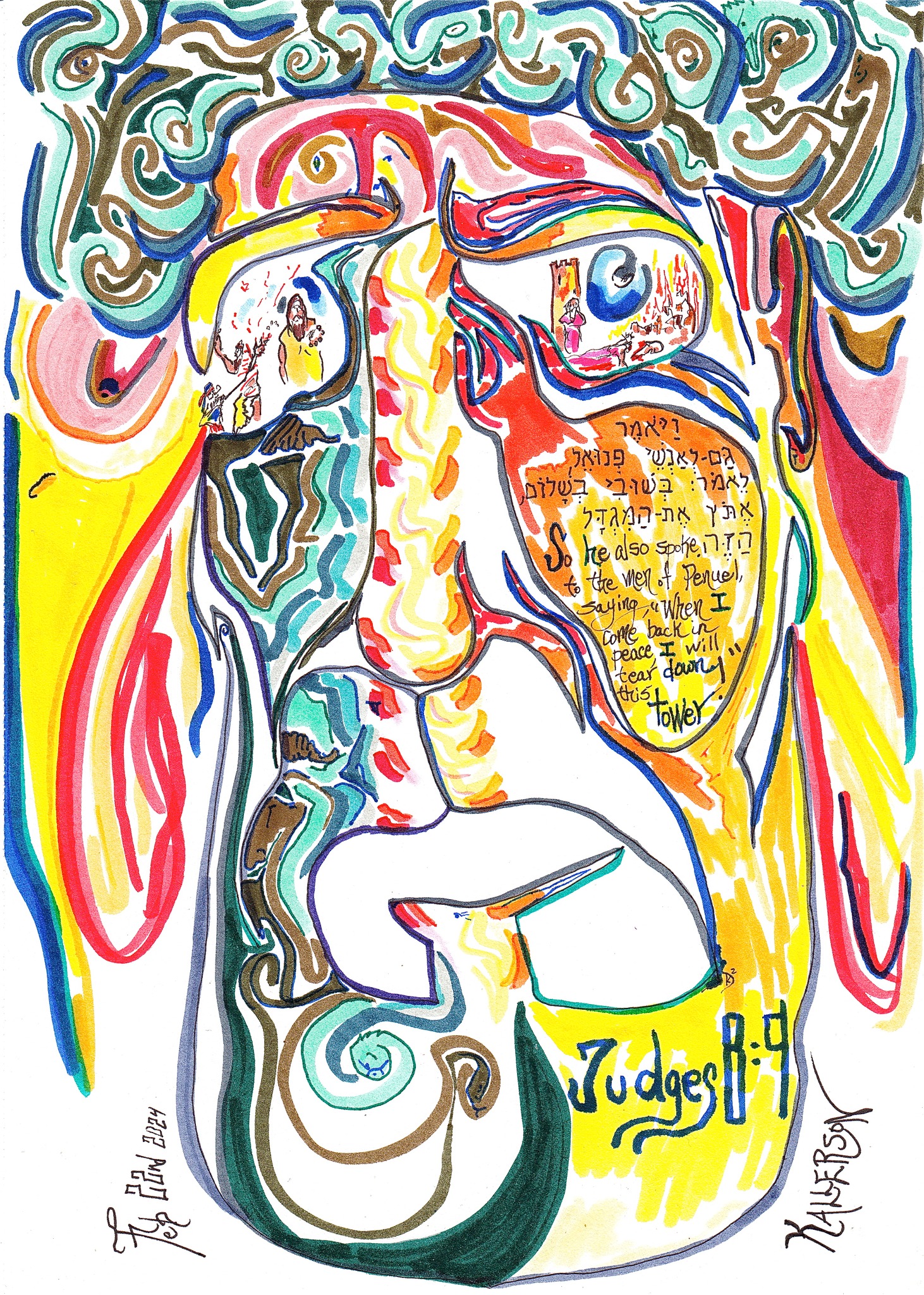
Artwork by Douglas Kallerson
Judges 8:1-12
Gideon, Judge of Israel, Part VIII
(Typed 18 December 2023) The reason for the battle that took place in Judges 6 was to take the burden off Israel after their time of oppression under Midian. Leading up to the battle, the children of Israel had done evil in the eyes of Yehovah. Therefore, the Lord delivered them into the hand of Midian for seven years (Judges 6:1).
The people of Israel were, therefore, hidden in caves and strongholds (Judges 6:2) because Midian would come against Israel and plunder them, leaving nothing in their wake (Judges 6:3-5).
The reason for all of their affliction was the evil they were doing in the eyes of the Lord. As was seen, this is a prophetic type of what is to come upon Israel during the tribulation period. It was only when their power was totally shattered that they finally cried out to the Lord (Judges 6:6).
The Lord sent a messenger to rebuke and remind them of their past, which they had completely forgotten. Instead, they ignored the voice of the Lord (Judges 6:7-10). Finally, Gideon was selected as the judge, and the process of delivering Israel began.
Text Verse: “For yet a very little while and the indignation will cease, as will My anger in their destruction.” 26 And the Lord of hosts will stir up a scourge for him like the slaughter of Midian at the rock of Oreb; as His rod was on the sea, so will He lift it up in the manner of Egypt.” Isaiah 10:25, 26
As today’s verses indicate, the arrogance of Ephraim is seen. The point of the Lord choosing Gideon was because it was the Lord who was to obtain the glory for the victory in battle, not Israel. That was explicitly stated by the Lord in Judges 7:2.
To select Ephraim to gain the victory over the foes, the greater of the two tribes would stand as the head of the battle. Even if it was only three hundred men led by someone from Ephraim, it would have been more notable for them than three hundred from Manasseh, much less the weakest clan of Manasseh (Judges 6:15).
Therefore, the Lord gaining the glory would be, at least in part, diminished. When we read the Bible, we must look at everything that is going on and continually ask ourselves, “Why have things been orchestrated as they are? What is the Lord doing, and why is He doing it in a particular way?”
In contemplating such things, we can more clearly understand how jealously He protects His glory. The Lord, having done what He did through Jesus, only makes sense if Jesus is Yehovah incarnate. The Lord Himself, through the work of Jesus Christ, is what is being highlighted in Scripture.
Our participation, whether as part of Israel or part of the church, is for us to see the work of the Lord, to rejoice in it, and to glorify Him for it. Let the glory of the Lord always be considered as you walk before Him in this life you have been given.
This marvelous truth is to be considered as we read His superior word. And so, let us turn to that precious word once again, and… May God speak to us through His word today, and may His glorious name ever be praised.
I. The Vintage of Abiezer (verses 1-3)
The words of Chapter 7 ended with –
“Then Gideon sent messengers throughout all the mountains of Ephraim, saying, “Come down against the Midianites, and seize from them the watering places as far as Beth Barah and the Jordan.” Then all the men of Ephraim gathered together and seized the watering places as far as Beth Barah and the Jordan. 25 And they captured two princes of the Midianites, Oreb and Zeeb. They killed Oreb at the rock of Oreb, and Zeeb they killed at the winepress of Zeeb. They pursued Midian and brought the heads of Oreb and Zeeb to Gideon on the other side of the Jordan.” Judges 7:24, 25
Remembering that, Chapter 8 begins with seemingly contradictory words…
Now the men of Ephraim said to him, “Why have you done this to us
vayomeru elav ish ephrayim mah ha’davar ha’zeh asitha lanu – “And said unto him man Ephraim, ‘What the word, the this, done to us?’” From the outset there is an obvious sense of anger in the words. Ephraim is bent out of shape at their treatment at the hand of Gideon. The specific reason is next stated by them…
1 (con’t) by not calling us when you went to fight with the Midianites?”
l’bilti q’roth lanu ki halakhta l’hilakhem b’midyan – “To except calling to us when went to fight in Midian.” It said at the end of Chapter 7 that Gideon sent messengers throughout Mount Ephraim to engage in the battle against Midian. However, this isn’t what they are arguing about.
Rather, they got the leftovers of the battle, as Midian was already fleeing away. They were called to be a mop-up crew to ensure total defeat of those in retreat. They weren’t called to participate in the larger battle where the glory of victory was gained. Therefore…
1 (con’t) And they reprimanded him sharply.
The words are highly emphatic: v’rivun ito b’khazeqah – “And quarreled (surely) with him in vehemence.” The attitude of Ephraim has its roots in the past. A good summary of where their arrogance is derived from is given by the Pulpit Commentary –
“It is possible that the transfer of the birthright from Manasseh to Ephraim (Genesis 48:13-19) may have produced some estrangement between the tribes. It is also possible that Ephraim, in view of their great tribal power, and the distinction conferred upon them by the judgeship of Joshua the son of Nun (Numbers 13:8), and the possession of his grave (Joshua 24:30), may have grown haughty and domineering, and perhaps more disposed to rest upon their former glories than to embark in fresh undertakings. Anyhow Gideon did not consult them, nor ask their aid, in the first instance. Now that the war had been so successful, the men of Ephraim were much displeased at not having been consulted.”
Remember that Gideon is from Manasseh. Therefore, the tribe with the greater blessing, Ephraim, is upbraiding the leader who has come from the less-favored tribe, Manasseh.
Ephraim’s position among the tribes, their size, their history of being preeminent in blessing and battle, etc., all came together, resulting in a haughty feeling that they deserved more share in the glory of the battle than they had received.
As for the names, Ephraim means Twice Fruitful and Ashes. Midian means Place of Judgment.
Concerning Ephraim’s chiding of Gideon, this same hauteur will cost them greatly in Chapter 12. For now, instead of fighting over the matter, Gideon yields to their protestations by acknowledging Ephraim’s greatness…
2 So he said to them, “What have I done now in comparison with you?
vayomer alehem meh asithi atah kakhem – “And said, ‘What done now like you?” In order to mollify the fit of pique that had welled up in Ephraim, Gideon subordinates himself, and thus his tribe, to his younger brother by asking a question in a comparative manner. The actual comparison comes in the next words…
2 (con’t) Is not the gleaning of the grapes of Ephraim better than the vintage of Abiezer?
halo tov ol’loth ephrayim mibsir aviezer – “Not grape-gleanings Ephraim from vintage Abiezer?” Here is a new word, oleloth. It is insufficiently translated by many as gleaning or gleanings. Rather, it is a particular type of gleaning, that of grapes. Being a noun in the plural construct, it should be rendered grape-gleanings. To get the sense of the word, Isaiah 17 provides clarity –
“Yet gleaning grapes [oleloth] will be left in it,
Like the shaking of an olive tree,
Two or three olives at the top of the uppermost bough,
Four or five in its most fruitful branches,”
Says the Lord God of Israel.” Isaiah 17:6
The word is derived from alal, to effect thoroughly. As such, it can indicate maltreatment of another, mocking, etc. In the case of such gleaning, a person goes through the grapes at harvest time. In order to get the most out of his harvest, he will cut all that he can as he goes over the grapes. The reason for this is stated in the law –
“When you gather the grapes of your vineyard, you shall not glean [alal] it afterward; it shall be for the stranger, the fatherless, and the widow. 22 And you shall remember that you were a slave in the land of Egypt; therefore I command you to do this thing.” Deuteronomy 24:21, 22
By law, there was not to be a second passing through (a gleaning) of the grapes. To do so would deprive those who were in need and who relied on these gleanings to merely survive.
Gideon is saying that the gleaning of Ephraim, this second passing through the meager remaining grapes, is greater than the vintage, or first cutting of the grapes, of Manasseh.
This may be a general statement of Gideon, like “You are so much greater than us that what we harvest each year is a pittance compared to what the poorest in your clan are left to eat.” If this is his intent, he will explain how in his coming words.
However, this is more likely a comparison to the battle itself, as in, “We may have initiated the battle, but what we did was incomparable to what you accomplished in the battle.”
The name Abiezer means Father of Help. As for what Gideon is conveying, his next words speak of the battle and the great achievement wrought by Ephraim…
3 God has delivered into your hands the princes of Midian, Oreb and Zeeb.
b’yedkhem nathan elohim eth sare midyan eth orev v’zaev – “In your hand gave God princes Midian, Oreb and Zeeb.” This explains the great accomplishment that outshone the deeds of Gideon, who cannot take credit for having dispersed the Midianite camp.
Rather, he simply did as instructed and the Lord brought about the victory. Gideon is humbly placing the deeds of Ephraim ahead of his effort, subordinating his clan below Ephraim who received the greater blessing from Jacob.
Oreb means Raven. Zeeb means Wolf. Continuing, he says…
3 (con’t) And what was I able to do in comparison with you?”
u-mah yakhol’ti asoth kakhem – “And what was I able to do like you?” In essence, his words say – “Gideon led the original charge of the battle against Midian (the first passing through of the vineyard), but you (YOU!) captured and beheaded the two princes of Midian, Oreb and Zeeb (the gleaning of the grapes). You then pursued the battle even as far as Midian itself. What did I do in comparison to you?” With that, the hoped-for response is realized…
3 (con’t) Then their anger toward him subsided when he said that.
Rather: az raphtah rukham mealav b’dabero ha’davar ha’zeh – “Then relaxed their spirit from upon him in his speaking the word, the this.” The word ruakh means wind, spirit, and breath. They all are united in thought.
There is the spirit which expresses the state of the emotion. There is the breath which is the spirit animated into substance. And there is the wind which is the motion of the breath as it passes through the nostrils of the men. One can think of someone fuming and the heavy breathing that results.
Any of the three words would suffice in the translation, but the spirit is the basis of the other two. Gideon, through his statement, was able to soothe the indignation of Ephraim. The substance of these first three verses is well reflected in the words of Proverbs 15:1 –
“A soft answer turns away wrath,
But a harsh word stirs up anger.
2 The tongue of the wise uses knowledge rightly,
But the mouth of fools pours forth foolishness.”
The whole thought is summed up well by John Lange –
“The vain tribe, which only smarted at the thought that an insignificant member of Manasseh should reap greater glory than Ephraim, is quieted when this person himself disclaims the glory. Vanity that prides itself on seeming merits, is always contracted. The Ephraimites do not understand the modesty of Gideon, which, in denying, as it were, his own real merits, necessarily pours the contempt of irony on their pretended deserts. But Gideon’s object is gained. They allow themselves to be pacified, and go home to bask themselves in the sunshine of their achievements. Gideon, for his part, teaches that victory alone does not suffice to save a people; but that he is the real hero who is truly humble, and for the sake of peace overcomes himself. To conquer, he must know how to bend.”
Who is fearful and unwilling to help?
When the Lord has already provided the victory
They will cry in anguish, from yelp to yelp
When Gideon punishes those who are contradictory
Pain and shame lie ahead for those of Succoth
When Gideon teaches them with thorns and flails
No more will they boastfully gloat
Instead, they will be remembered for their epic fails
And for the men of Penuel
For them, bad times lie ahead
A tough lesson is coming, and things won’t be swell
When the men wind up nothing but dead
II. Seeking Succor from Succoth (verses 4-9)
4 When Gideon came to the Jordan,
The whole verse is one of motion: vayavo gidon ha’yardenah – “And came, Gideon, the Jordan-ward.” The Jordan means The Descender. Gideon means Cutter. Gideon is coming toward and arriving at the Descender…
4 (con’t) he and the three hundred men who were with him crossed over, exhausted but still in pursuit.
The action and intensity continue: over hu u-shlosh meoth ha’ish asher ito ayephim v’rodphim – “crossing over, he and three hundred the man who with him, wearied and pursuing.” The Latin Vulgate completely botches the thought –
“he crossed him with the three hundred men who were with him, and who fled because of weariness and could not pursue him.”
It doesn’t at all say they couldn’t pursue. Rather, they were completely exhausted, and yet they continued the pursuit. They began their pursuit in the dead of night and just kept going.
The word used to describe them, ayeph, signifies languid. It thus is to be wearied or faint. It is the same word used to describe Esau when he sold his birthright –
“Now Jacob cooked a stew; and Esau came in from the field, and he was weary [ayeph]. 30 And Esau said to Jacob, “Please feed me with that same red stew, for I am weary [ayeph].” Therefore his name was called Edom.” Genesis 25:29, 30
It is because of their wearied state that the next words are detailed…
5 Then he said to the men of Succoth, “Please give loaves of bread to the people who follow me,
The translation is correct, but the Hebrew is more expressive: vayomer l’anshe sukoth tenu na kik’roth lekhem la’am asher b’raglay – Literally: “And said to men Succoth, ‘Give, pray, circles bread to the people who in my feet.’” Gideon is looking to revitalize his men with bread. This is all he has asked for, and it would be a common courtesy to oblige, especially for fellow Israelites in their state.
Succoth means Tabernacles. Gideon next explains his request…
5 (con’t) for they are exhausted, and I am pursuing Zebah and Zalmunna, kings of Midian.”
He emphatically states what is going on: ki ayephim hem v’anokhi rodeph akhare zevakh v’tsalmuna malkhe midyan – “For wearied, they, and I, I pursuing after Zebah and Zalmunna, kings Midian.” Gideon doesn’t go beyond the request for bread, such as enlisting fighting men, asking for intel on troop size or direction, or any other such thing. He simply notes the men are wearied as they pursue the enemies of Israel.
Zebah is the same as zebakh, a sacrifice. It means Sacrifice. The NAS Concordance says Zalmunna comes from the same as tselem, an image. The na at the end would then refer to nuah, to move, waver, tremble, quiver, etc. It gives the sense of motion.
Others say it is derived from tsel and mana – shade and to withhold. Therefore, the name may mean Moving Image or something like Denied Shade, Deprived of Shade, or Shade Has Been Denied. Without explanation, Ellicott says Shadow of an Exile.
As for the word tselem, image, it is the word used in Genesis 1 when God created man –
“Then God said, ‘Let Us make man in Our image [b’tselmenu], according to Our likeness; let them have dominion over the fish of the sea, over the birds of the air, and over the cattle, over all the earth and over every creeping thing that creeps on the earth.” 27 So God created man in His own image [b’tsalmo]; in the image [b’tselem] of God He created him; male and female He created them.’” Genesis 1:26, 27
This word is also used as a prophetic type of Christ when Bezalel was selected to build the tabernacle in Exodus –
“Then the Lord spoke to Moses, saying: 2 ‘See, I have called by name Bezalel [b’tselel] the son of Uri, the son of Hur, of the tribe of Judah. 3 And I have filled him with the Spirit of God, in wisdom, in understanding, in knowledge, and in all manner of workmanship, 4 to design artistic works, to work in gold, in silver, in bronze, 5 in cutting jewels for setting, in carving wood, and to work in all manner of workmanship.’” Exodus 31:1-5
Bezalel was selected by the Lord to oversee the construction of the tabernacle that anticipated, in every detail, the “last Adam,” the very “image [tselem] of the invisible God” [Colossians 1:15 – as seen in the Modern Hebrew New Testament].
As for Gideon, with his simple request stated, a surprising response is provided…
6 And the leaders of Succoth said, “Are the hands of Zebah and Zalmunna now in your hand,
Rather: vayomer sare sukoth ha’kaph zebakh v’tsalmuna atah b’yadekha – “And said princes Succoth, ‘The palm Zebah and Zalmunna now in your hand?’” First, the verb “said” is singular. Therefore, either one person speaks for them or, more likely, they speak with a united voice.
Next, of the forty-plus translations I referred to, the only two that accurately translated the word as palm were a couple of Catholic Bibles. Though similar in meaning, the hand signifies power and/or authority. The palm (and sole) signifies possession and/or the state of something.
The men of Succoth are saying that the state of these two kings, because of the authority they possess, is not in Gideon’s hand (under his authority). As such, they question why it is…
6 (con’t) that we should give bread to your army?”
There may be a dual meaning here that forms a pun: ki niten litsvaakha lakhem – “for giving to your army bread.” Without the vowel points, the word lakhem, or bread, is identical in spelling to lakhem, war.
Therefore, they could be making a play on the thought. “Why should we give your army bread so that you can wage war.” If Gideon’s army is defeated, there will be retribution upon those who aided the warriors.
It is, however, an inexcusable excuse, peevish and cowardly. First, how on earth would a retreating army even know that their pursuers stopped and received bread? And more, these are fellow Israelites. If Gideon doesn’t succeed, Succoth will continue to be oppressed by Midian anyway.
It is Israel who cried out to the Lord for relief. He has provided the chance of obtaining it through Gideon, and yet they are unwilling to assist. Therefore…
7 So Gideon said, “For this cause, when the Lord has delivered Zebah and Zalmunna into my hand,
vayomer gidon lakhen b’theth Yehovah eth zebakh v’eth tsalmuna b’yadi – “And said, Gideon, ‘Therefore, in giving, Yehovah, Zebah and Zalmunna in my hand…” Gideon asserts, with all assurance, that the battle is won. Rather than wasting his time and energy with what he intends to do to these princes, he defers their punishment. But it is coming…
7 (con’t) then I will tear your flesh with the thorns of the wilderness and with briers!”
Though nobody translates it this way, this is the most probable meaning: v’dashti eth b’sarkhem eth qotse ha’midbar v’eth ha’barqanim – “And thresh your flesh with thorns the wilderness and with the flails.” Here is a word found only in this passage, now and in verse 16, barqanim.
It is so obscure that the Greek translation punts and simply says, “I tear your flesh with the thorns of the wilderness, and the Barkenim.”
The word comes from the noun baraq, lightning. That then comes from the verb baraq to flash, but in the sense of casting forth. It isn’t the light that is the flash, but the action. Most translations say briars. To justify this, Strong’s says, “perhaps as burning brightly.” In other words, when lit, thorns burn brightly.
That makes no sense. The only other suggestion is threshing sledges. To justify that, BDB says, “furnished with sharp (glittering) stones.” Neither of these satisfies.
However, the CG translation (fortunately for your understanding) does what the others fail to do. Rather than what is intended, the other options focus on the idea of the light aspect of lightning, not the action.
However, the CG translation insightfully uses the casting forth aspect of a flail. It is a rod connected to another rod by loops so that when the rod is cast forward by the arm, the smaller rod, the flail, picks up immense speed and thwacks down on the grain, threshing it. To confirm this most astute translation, we turn to Isaiah –
“For the black cummin is not threshed with a threshing sledge,
Nor is a cartwheel rolled over the cummin;
But the black cummin is beaten out with a stick,
And the cummin with a rod.” Isaiah 28:27
The rod, in this case, would include a flail. In using this implement, the person will increase his productivity without wearing himself out in the process. For best happy, and for more shrewd commentaries on obscure or mistranslated words, be sure to continue attending the Superior Word.
As for the promised pending punishment, it is delayed until the enemy is eliminated. It will make what comes upon these princes all the more poignantly painful. The narrative continues…
8 Then he went up from there to Penuel and spoke to them in the same way.
vayaal misham penuel vaydaber alehem kazoth – “And ascended from there, Penuel, and spoke unto them according to this.” Penuel is translated as Face of God, but this must be more exactingly explained. The word comes from panah (to turn) and el (God). The word paneh (or pl: panim) comes from this and signifies face(s).
The idea of Penuel is of action – He Turns to God, or emphatically, Turn to God! It speaks in the sense of a relationship.
8 (con’t) And the men of Penuel answered him as the men of Succoth had answered.
vayaanu oto anshe penuel kaasher anu anshe sukoth – “And answered him, men Penuel, according to which answered men Succoth.” In other words, they completely rejected his appeal for bread, ignoring any sense of familial relationship with him and opting to stay in the good graces of Midian. Therefore…
9 So he also spoke to the men of Penuel, saying, “When I come back in peace, I will tear down this tower!”
vayomer gam l’anshe penuel l’mor b’shuvi b’shalom etots eth ha’migdal hazeh – “And said, also to men Penuel, saying, ‘In returning in peace, breaking down the tower, the this.’” It may be that these men were in the tower when Gideon arrived, securing themselves there from the fleeing Midianites.
When Gideon arrived, he called out to them for bread, but they refused, thinking that they were secure in their tower and didn’t need Gideon’s assistance. Therefore, Gideon promised to return and destroy the object of their confidence. With that, the narrative turns to the objects of Gideon’s attention…
Another surprise awaits Midian
Another defeat awaits her kings
This is the Lord’s power working through Gideon
And for it, Israel’s heart sings
Who can doubt that the Lord led the battle
Victory despite such overwhelming odds
The shout of war and swords as they rattle
So much for Midian’s false trust in their gods
Through the Lord is victory and life
He is the One who guided every step of Gideon
Until was ended the time of strife
Until was defeated the vast army of Midian
III. He Took the Two Kings of Midian (verses 10-12)
10 Now Zebah and Zalmunna were at Karkor, and their armies with them, about fifteen thousand,
Rather: v’zebakh v’tsalmuna ba’qarqor u’makhanehem imam ka’khamesheth asar eleph – “And Zebah and Zalmunna in the Karkor, and their camps with them according to five ten thousand.” The name Karkor is variously defined as Foundation, Pounded Down, Even Ground, etc.
The word is identical in spelling to qarqar which is found in Numbers 24:17 where it signifies to shatter. As such, some define it as Destruction instead of Pounded Down.
There is another interpretation, though. As Karkor is not mentioned elsewhere, some suggest that it signifies rest. Not a place, but as what happens in the location. This is based on what it says in the next verse.
As for the number, it is a multiple of fifteen and ten (multiplied). Of fifteen, Bullinger says –
“…being a multiple of five, partakes of the significance of that number, also of the number three with which it is combined, 3 x 5. Five is, as we have seen, the number of grace, and three is the number of divine perfection. Fifteen, therefore, specially refers to acts wrought by the energy of Divine grace. Deity is seen in it, for the two Hebrew letters which express it are y, Yod (10), and h, Hey (5). These spell the ineffable Name of hy, Jah, who is the fountain of all grace. The number fifteen is thus made up, by addition, 10 + 5; but as the Jews would not, by the constant use of these two letters, profane the sacred name, two other letters were arbitrarily used for this number, and a different and artificial combination was thus formed—+ (Teth) = 9, and w (Vau) = 6. The number 9 + 6 would thus represent the number fifteen, but without any significance. Fifteen being 8 + 7 as well as 3 x 5, it may also include a reference to resurrection, as being a special mark of the energy of Divine grace issuing in glory.”
Ten: “Completeness of order, marking the entire round of anything, is, therefore, the ever-present signification of the number ten. It implies that nothing is wanting; that the number and order are perfect; that the whole cycle is complete.”
There, in this location, their camps totaled fifteen thousand. They were…
10 (con’t) all who were left of all the army of the people of the East;
kol ha’notarim mikol makhaneh b’ne qedem – “All the remainings from all camp sons East.” As seen several times, the b’ne qedem or “sons East” are the various people groups gathered together as one camp.
It seems like a sizable army, but when it says “the remainings,” it brings the matter to its true light…
10 (con’t) for one hundred and twenty thousand men who drew the sword had fallen.
v’ha’nophlim meah v’esrim eleph ish sholeph kharev – “And the fallers hundred and twenty thousand man drawing sword.” The meaning is that only one-ninth of the army had survived to this point.
As for the number, it is derived from one hundred and twenty multiplied by tens. Bullinger says one hundred and twenty –
“…is made up of three forties (3×40=120). Applied to time therefore it signifies a divinely appointed period of probation.”
The odds are still heavily against Gideon, but he has the initiative. Therefore, he continues onward against the oppressors of Israel…
11 Then Gideon went up by the road of those who dwell in tents on the east of Nobah and Jogbehah;
vayaal gidon derek ha’sh’khune ba’ohalim miqedem l’novakh v’yagbehah – “And ascended Gideon way the dwellers in tents from east to Nobah and Jogbehah.” The point is that they circled around to the east of these cities in an area where tent dwellers lived.
As such, it would be totally unexpected that war would come from a place where people were peacefully tending flocks. It was also the direction in which Midian was fleeing.
Nobah, or Novakh, is seen for the third and last time in Scripture. It means To Bark or Barking. It was located in the territory of Manasseh. Jogbehah is seen for the second and last time. It means Lofty or Exalted. It was in the territory of Gad.
Because of the surprising direction of Gideon’s attack, the camp of Midian was completely unprepared…
11 (cont) and he attacked the army while the camp felt secure.
vayak eth ha’makhaneh v’ha’makhaneh haya betakh – “And struck the camp, and the camp was confidence.” The word betakh is a noun signifying security or confidence. The men were confident, assuming that they had escaped far enough from near the Hill of Moreh, the original place of attack. Thus, they stopped and rested to lick their wounds.
They could rest and ponder how things could have gone so poorly, and yet, they would be comfortable enough to set their swords down and prepare for their return home. It is at such a time that Gideon and his men struck the camp.
12 When Zebah and Zalmunna fled, he pursued them;
vayanusu zebakh v’tsalmuna vayirdoph akharehem – “And fled Zebah and Zalmuna. And pursued after them.” Because of another engagement with the enemy in such an unexpected manner and place, the kings of Midian simply got up and fled. However…
*12 (fin) and he took the two kings of Midian, Zebah and Zalmunna, and routed the whole army.
It doesn’t say that they killed all of the camp. They may have been routed, but that isn’t what is conveyed: vayilkod eth shene malkhe midyan eth zebakh va’eth tsalmuna v’khal ha’makhaneh hekherid – “And seized two kings Midian, Zebah and Zalmunna, and all the camp terrified.”
What it seems to mean is that Gideon struck the camp, and the kings fled, so Gideon and his men simply left the battle to seize them. The rest of the Midianites were so terrified that they didn’t even bother to come after Gideon and his army, despite the huge numerical superiority.
They had been defeated, their leaders were goners, and they refrained from everything but shaking in their sandals and cowering in their tents.
With that, the verses for today are ended. Despite the odds, Gideon knew that with any number, when the Lord is involved, victory is guaranteed. And more, even without proper provision to sustain him and his men, he was willing to expend himself in pursuit of the enemy.
However, the Lord provided for them. They were able to continue and even prevail. This will be true for us if the Lord is behind what we are engaged in. This doesn’t mean that we should run off willy-nilly, assuming that what we intend to do will be a success.
Gideon had the word of the Lord to assure him of what he was to do. We have the word of the Lord as well. We don’t want to ever go beyond what is written, but we can have confidence in what we are doing if it is in accord with His word.
Let us trust in this and not falter in our determination to do what is right and what is expected of us. In the end, through life or death, we will be carried through to the promised end set before us in the word. So why worry in the meantime?
Until your time arrives, take heed to yourselves and to the doctrine you possess. Continue in them, and you will do well. Have the confidence of Gideon that you will prevail. The Lord is with you, so you will.
Closing Verse: “For You have broken the yoke of his burden
And the staff of his shoulder,
The rod of his oppressor,
As in the day of Midian.” Isaiah 9:4
Next Week: Judges 8:13-21 You wanna have fun, just listen for a spell, so get in line… (Gideon, Judge of Israel, Part IX) (26th Judges sermon)
The Lord has you exactly where He wants you. He has a good plan and purpose for you. It is He who judges His people according to their deeds. So, follow Him, live for Him, and trust Him, and He will do marvelous things for you and through you.
Gideon, Judge of Israel, Part VIII
Now the men of Ephraim said to him
Why have you done this to us by not calling us
When you went to fight with the Midianites?
And they reprimanded him sharply, putting up a fuss
So he said to them, “What have I done now
In comparison with you?
Is not the gleaning of the grapes of Ephraim
Better than the vintage of Abiezer? Isn’t it true?
God has delivered into your hands
The princes of Midian, Oreb and Zeeb, how about that?
And what was I able to do in comparison with you?
Then their anger toward him subsided when he said that
When Gideon came to the Jordan, he and the three hundred men
Who were with him crossed over, exhausted but still in pursuit
Then he said to the men of Succoth
“Please give loaves of bread to the people who follow me
———-our hunger is acute
For they are exhausted, and I am pursuing
Zebah and Zalmunna, kings of Midian, this is what I am doing
And the leaders of Succoth said
Speaking a bit too smarmy
“Are the hands of Zebah and Zalmunna now in your hand
That we should give bread to your army?
So Gideon said, “For this cause
When the LORD has delivered Zebah and Zalmunna into my hand
Then I will tear your flesh
With the thorns of the wilderness and with briers
———–so I have planned!
Then he went up from there to Penuel
And spoke to them in the same way
And the men of Penuel answered him
As the men of Succoth had answered that day
So he also spoke to the men of Penuel, saying
“When I come back in peace, I will tear down this tower!
———-So to you I am relaying
Now Zebah and Zalmunna were at Karkor
And their armies with them, about fifteen thousand men
All who were left of all the army of the people of the East
For one hundred and twenty thousand men who drew the sword
———-had fallen
Then Gideon went up by the road
Not taking a sightseeing tour
Of those who dwell in tents on the east of Nobah and Jogbehah
And he attacked the army while the camp felt secure
When Zebah and Zalmunna fled
He pursued them, intending them harmy
And he took the two kings of Midian, Zebah and Zalmunna
And routed the whole army
Lord God, turn our hearts to be obedient to Your word
Give us wisdom to be ever faithful to You
May we carefully heed each thing we have heard
Yes, Lord God may our hearts be faithful and true
And we shall be content and satisfied in You alone
We will follow You as we sing our songs of praise
Hallelujah to You; to us Your path You have shown
Hallelujah we shall sing to You for all of our days
Hallelujah and Amen…
Now the men of Ephraim said to him, “Why have you done this to us by not calling us when you went to fight with the Midianites?” And they reprimanded him sharply.
2 So he said to them, “What have I done now in comparison with you? Is not the gleaning of the grapes of Ephraim better than the vintage of Abiezer? 3 God has delivered into your hands the princes of Midian, Oreb and Zeeb. And what was I able to do in comparison with you?” Then their anger toward him subsided when he said that.
4 When Gideon came to the Jordan, he and the three hundred men who were with him crossed over, exhausted but still in pursuit. 5 Then he said to the men of Succoth, “Please give loaves of bread to the people who follow me, for they are exhausted, and I am pursuing Zebah and Zalmunna, kings of Midian.”
6 And the leaders of Succoth said, “Are the hands of Zebah and Zalmunna now in your hand, that we should give bread to your army?”
7 So Gideon said, “For this cause, when the Lord has delivered Zebah and Zalmunna into my hand, then I will tear your flesh with the thorns of the wilderness and with briers!” 8 Then he went up from there to Penuel and spoke to them in the same way. And the men of Penuel answered him as the men of Succoth had answered. 9 So he also spoke to the men of Penuel, saying, “When I come back in peace, I will tear down this tower!”
10 Now Zebah and Zalmunna were at Karkor, and their armies with them, about fifteen thousand, all who were left of all the army of the people of the East; for one hundred and twenty thousand men who drew the sword had fallen. 11 Then Gideon went up by the road of those who dwell in tents on the east of Nobah and Jogbehah; and he attacked the army while the camp felt secure. 12 When Zebah and Zalmunna fled, he pursued them; and he took the two kings of Midian, Zebah and Zalmunna, and routed the whole army.