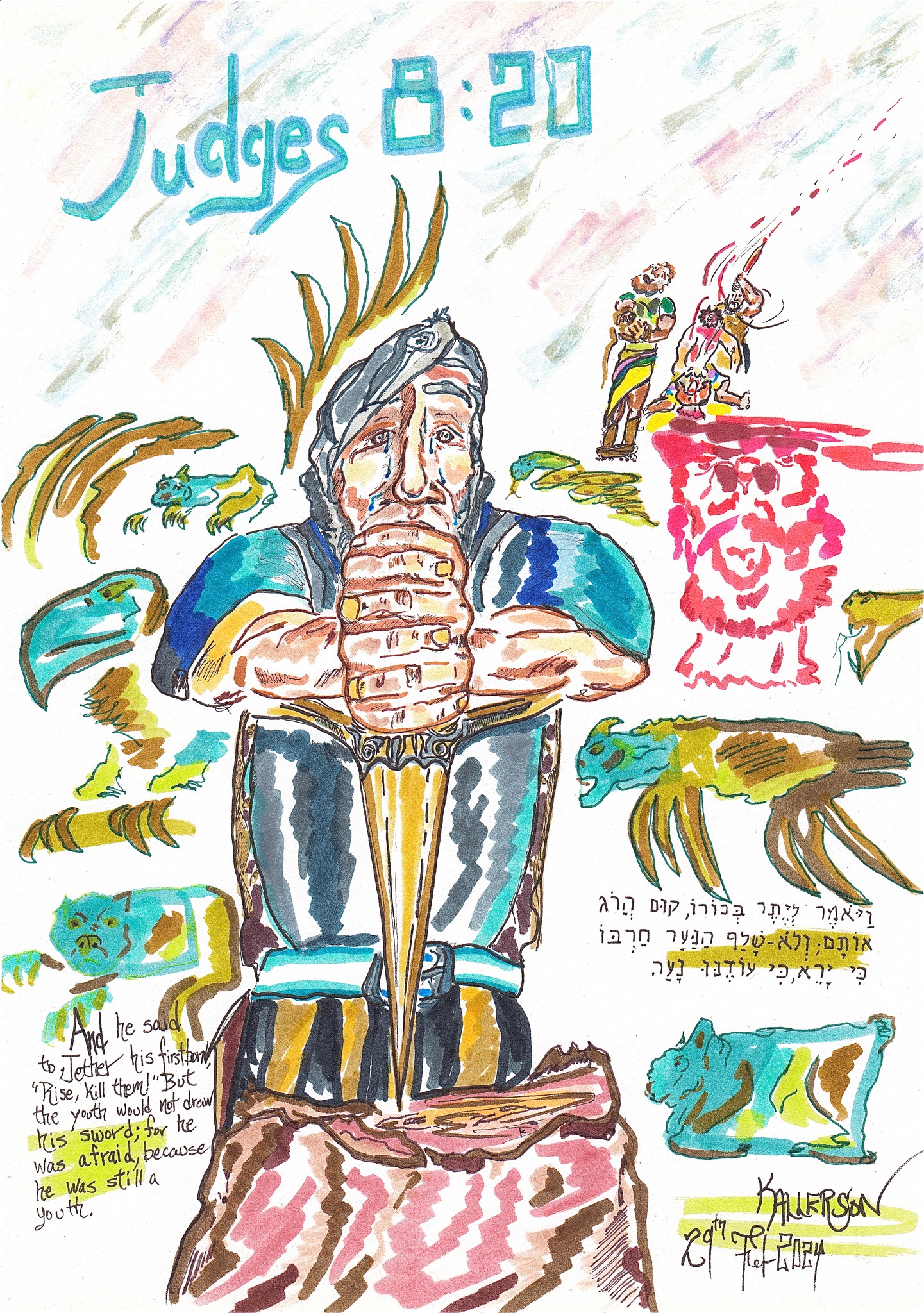
Artwork by Douglas Kallerson.
Judges 8:13-21
Gideon, Judge of Israel, Part IX
(Typed 25 December 2023) It has been pointed out in previous sermons that what will happen during the tribulation period in a literal sense, meaning the destruction and carnage on the planet, is only part of the story. At the same time, there is a spiritual battle that will be waged.
The timeline set by Paul in his epistles reveals the sequence of events that will take place. The rapture will occur, the antichrist will be revealed, and after that, a peace deal will be signed that will initiate the seven years of tribulation.
The timeline is clearly and unambiguously set in 2 Thessalonians 2. It was alluded to in Judges 6:1-10 in the opening narrative leading to Gideon as the judge of Israel. But the contents of Judges aren’t focused on the literal carnage of the world to come. Rather, they are focused on the spiritual battle that Israel will face.
Why would that be the case? The reason is that the church age is complete. The promises in the Old Testament concerning the millennium may include Gentiles who come to faith during the tribulation period, but it is Israel to whom the promises belong.
Everything else that occurs during the tribulation period is to bring Israel to this understanding. That will lead to their acceptance of the gospel and national salvation.
Text Verse: “I will plant them in their land,
And no longer shall they be pulled up
From the land I have given them,”
Says the Lord your God.” Amos 9:15
Israel is already back in the land. They have been planted, and they shall never again be pulled up. But their nation today is one of wickedness and unfaithfulness to the Lord. That, like the wickedness throughout the earth, must be dealt with before the time of harmony promised in the prophets comes.
What occurs outside of Israel, especially in what happens in the world in relation to Israel, is what is needed to bring them to the point of their anticipated conversion. Once that momentous event occurs, the Lord can personally intervene and bring about the end of the tribulation.
This is seen in Revelation 19, but it is also hinted at in Matthew 24. There, Jesus notes that there will be such great tribulation on the earth that if the days were not cut short, “no flesh would be saved.” However, He then says, “but for the elect’s sake, those days will be shortened.”
The spiritual battle that occurs during this time of tribulation is what Judges continues to deal with. It’s all to be found in His superior word. And so, let us turn to that precious word once again, and… May God speak to us through His word today, and may His glorious name ever be praised.
I. My Brothers, the Sons of My Mother (verses 13-21)
13 Then Gideon the son of Joash returned from battle, from the Ascent of Heres.
To start the verses today we come to a very complicated set of words that are widely rendered: vayashav gidon ben yoash min ha’milkhamah milmaaleh hekhreres – “And returned Gideon, son Joash, from the battle, from to ascent the sun (or, Ascent the Sun).”
Some translations say: before the sun was up; at the going up of the sun; from the cliff of the sun; by way of Heres pass; down from the battle of Ares; etc. This is referring to what was presented in the previous sermon from last week –
“Now Zebah and Zalmunna were at Karkor, and their armies with them, about fifteen thousand, all who were left of all the army of the people of the East; for one hundred and twenty thousand men who drew the sword had fallen. 11 Then Gideon went up by the road of those who dwell in tents on the east of Nobah and Jogbehah; and he attacked the army while the camp felt secure. 12 When Zebah and Zalmunna fled, he pursued them; and he took the two kings of Midian, Zebah and Zalmunna, and routed the whole army.”
Gideon went around the army and came at the camp in an unexpected manner. During the battle, the two kings fled. The natural way for them to flee would be east, the direction they had originally come from. Gideon pursued them and took them. Now, after capturing the kings, it says, “from to ascent the sun.” The meaning is that he turned back (from) the point (to) which he had been in pursuit of them.
He was heading in the direction of the sun’s ascent (east). Eventually, he captured the kings. Now, to return to his land, he turned back from this direction. This appears to be a purposeful way of saying “east” without using that descriptor.
It is also notable that the full name, Gideon son of Joash, is used. The last time it was seen was in Judges 7:14 at the time of the dream –
“Then his companion answered and said, ‘This is nothing else but the sword of Gideon the son of Joash, a man of Israel! Into his hand God has delivered Midian and the whole camp.’”
Since then, the name Gideon has been stated nine times. Now, his full name is again stated as a confirmation that the task of defeating the enemy has been completed. Joash means Yehovah Has Bestowed.
14 And he caught a young man of the men of Succoth and interrogated him;
vayilkad naar meanshe sukkoth vayishalehu – “And took youth from men Sukkoth and asked him.” The words seem unnecessarily detailed, but they are needed to set the framework for the next clause. That this is a naar, or youth, may seem surprising based on the next words…
14 (con’t) and he wrote down for him the leaders of Succoth and its elders, seventy-seven men.
vayiktov elav eth sare sukoth v’et zeqeneha shivim v’shivah ish – “and wrote unto him princes Sukkoth and her elders, seventy and seven man.” It is unknown if this youth being able to write was some unusual exception, or if it was a common trait. Either way, he was able to write, and he was intelligent enough to know the names of the princes of the city as well as its elders.
This was a means of ensuring that none of the leadership would escape justice for refusing to assist Gideon’s men with the simple provision of bread. Because of their pusillanimous refusal to help…
15 Then he came to the men of Succoth and said, “Here are Zebah and Zalmunna, about whom you ridiculed me,
va’yavo el anshe sukoth vayomer hineh zevakh v’tsalmuna asher kheraptem oti – “And came unto men Sukkoth, and said, ‘Behold! Zebah and Zalmunna, whom you reproached me.’” Presenting the kings would have been a rather shocking display. Gideon could have simply killed the two kings and left them to rot.
He could have taken their heads off and brought them back. But that would leave the question open as to how they died. However, with the two kings standing right there, this was an absolute confirmation that there was total victory over Midian. The kings had been spared for this very purpose. And more, he turns these leaders’ words back on their own heads…
15 (con’t) saying, ‘Are the hands of Zebah and Zalmunna now in your hand,
lemor ha’kaph zevakh v’tsalmuna atah b’yadkha – “to say, ‘The palm Zebah and Zalmunna now in your hand.’” In verse 6, using a singular verb indicating unanimity of speech, the leaders of Sukkoth said, “The palm Zebah and Zalmunna now in your hand?” Gideon reminds them of their words, repeating them back to the men. It is a letter for letter response. And he continues…
15 (con’t) that we should give bread to your weary men?’”
ki niten laanashekha hay’ephim lahem – “for giving to your men, the wearied, bread.” Gideon does a masterful changeup to their words –
“for giving to your army bread.”
“for giving to your men, the wearied, bread.”
Gideon had first said to them, “For wearied, they, and I, I pursuing after Zebah and Zalmunna, kings Midian.” The leaders had responded, essentially saying, “Why would we give your puny army bread when you are pursuing a massive force of Midianites?”
Here, he uses the same word for wearied, noting that they were, in fact, wearied. And yet, they prevailed over the massive force of Midian and the palm (the authority they possessed) of Zebah and Zalmunna was now in his hand (under his authority). As this was so, it is certain that a little city couldn’t stand against him…
16 And he took the elders of the city, and thorns of the wilderness and briers, and with them he taught the men of Succoth.
vayiqakh eth ziqne ha’ir v’eth qotse ha’midbar v’eth ha’barqanim vayoda bahem eth anshe sukoth – “And took elders the city, and thorns the wilderness and the flails. And knowing in them men Sukkoth.” This is just what he promised to do to them – “And thresh your flesh with thorns the wilderness and with the flails.”
The meaning is that using briars and flails, he threshed the flesh of the elders. By this, the men of Sukkoth as a whole were instructed in what the punishment for cowardice was. In this verse is the second and last use of barqanim, flails, in Scripture.
What this seems to mean is that they completely covered the elders with thorns of the wilderness and then repeatedly hit them with the flails, thus threshing their flesh in the process. It would have been an exceedingly painful lesson – stingy hot and ouchy.
As a side note, some commentators think there is an error in the text. Instead of the word yada, to know, they think it should read threshed. The two are very close in spelling if structured in a particular way –
וידע – and knowing
וידש – and threshed
Some manuscripts agree with this, but the change is unnecessary. The elders were punished and the rest of the men of the city learned the penalty for being cowards. Gideon next moves on to another spineless group…
17 Then he tore down the tower of Penuel and killed the men of the city.
v’eth Migdal penuel natats vayaharog eth anshe ha’ir – “And tower Penuel tore down. And killed men the city.” In verse 9, Gideon promised to come back and tear down the tower of Penuel. Nothing was said of killing the men of the city. And so it may have been that in tearing down the tower, the men were killed. They fled there for refuge and in its collapse, those inside were crushed with it.
The location of the city was strategically important enough that later, in the time of King Jeroboam, it was built again (1 Kings 12:25). Next, with his promise to the lily-livered inhabitants fulfilled, Gideon will turn his hand of justice upon those who had so severely afflicted Israel…
18 And he said to Zebah and Zalmunna, “What kind of men were they whom you killed at Tabor?”
The words are curious: vayomer el zevakh v’el tsalmuna ephoh ha’anashim asher haragtem b’thavor – “And said unto Zebah and unto Zalmunna, “Where-here the men whom you killed in Tabor?’” First, there is no antecedent to what is said. Neither Tabor nor the killing of these men has been mentioned during the account of Gideon. The last time Tabor was noted was in the battle of Judges 4 where it was called Mount Tabor.
Second, Gideon uses a rare word, ephoh. It comes from ay, where, and poh, here. Thus, it literally means where-here. It is always translated elsewhere as “where.” However, he may be using it as a general interrogative concerning a particular aspect of the men. If so, a similar combination in English might be “whaddabout.”
If it means only “where,” then it may be a taunt to the kings. “Where the men you killed in Tabor?” Something similar would then be the taunting of the Rabshakeh who stood at the walls of Jerusalem –
“Beware lest Hezekiah persuade you, saying, ‘The Lord will deliver us.’ Has any one of the gods of the nations delivered its land from the hand of the king of Assyria? 19 Where are the gods of Hamath and Arpad? Where are the gods of Sepharvaim? Indeed, have they delivered Samaria from my hand? 20 Who among all the gods of these lands have delivered their countries from my hand, that the Lord should deliver Jerusalem from my hand?” Isaiah 36:18-20
Tabor comes from barar, to purify. It means Purity or Purified.
18 (con’t) So they answered, “As you are, so were they; each one resembled the son of a king.”
vayomru kamokha kh’mohem ekhad k’toar b’ne ha’melekh – “And said according to you, according to them: one according to form, sons the king.” Without hearing their intonation, it’s hard to be dogmatic concerning their intent.
If Gideon was taunting them in the previous clause, which seems likely, then they are either trying to pacify him through flattery, acknowledging his princely state, or they are returning a taunt as in, “They were all like the king’s sons, but now they’re all dead.”
Either way, it is of note that they use the term “the king” when there was no king in Israel. One would think they would say “a king.” Next, Gideon’s response seals their fate…
19 Then he said, “They were my brothers, the sons of my mother. As the Lord lives, if you had let them live, I would not kill you.”
The words are filled with life and force: vayomar akhai b’ne imi hem khai Yehovah lu hakhayitem otham lo haragti etkhem – “And said, ‘My brothers, sons my mother, them! Life Yehovah! Would you lived them, not I killed you.”
Not only were they sons of his father, but they were sons of the same mother. Thus, they had the closest bond of all between them. As Gideon is the nearest blood relative, from a legal sense it was his duty to execute these kings. However, he defers to his son to accomplish the deed. Thus, it would be a demeaning act added to their demise…
20 And he said to Jether his firstborn, “Rise, kill them!”
Gideon speaks with imperatives: vayomer l’yether b’koro qum harog otham – “And said to Jether, his firstborn, ‘Arise! Kill them!’” Deferring to his young son to accomplish the task would be considered a disgraceful death for these kings almost comparable to having a woman kill them.
It would also be instructional for the son as well as a mark of prestige that he could carry with him later in life, being the one who finished off these great kings.
As for the name Jether, it comes from yathar, to remain, make plenteous, preserve, etc. It can mean Preeminence, Excellence, Abundance, Remnant, Preserved, etc.
20 (con’t) But the youth would not draw his sword; for he was afraid, because he was still a youth.
v’lo shalaph ha’naar kharbo ki yare ki odenu naar – “And no drew the youth his sword. For afraid. For he still youth.” Despite being granted the honor of the kill, he was still young and fearful about such an act. Thus, he would have to learn through sight rather than action.
21 So Zebah and Zalmunna said, “Rise yourself, and kill us; for as a man is, so is his strength.”
The word “said” is singular and the kings use their own imperatives: vayomer zevakh v’tsalmuna qum atah uphga banu ki kaish g’vurato – “And said Zebah and Zalmunna, ‘Arise, you, and impinge in us. For according to the man, his strength.’”
These two know they are goners. If Gideon pressed the boy, insisting that he kill them, it wouldn’t simply be a disgrace. It is painfully evident that Jether had never done such a thing. Therefore, it would also be evidently painful for them that he had learned to kill through them. Therefore, they taunt Gideon into dispatching them to the pit. Therefore…
21 (con’t) So Gideon arose and killed Zebah and Zalmunna,
Hooray! vayaqum gidon vayaharog eth zevakh v’eth tsalmuna – “And rises, Gideon, and kills Zebah and Zalmunna.” With a little taunting to spur him on, Gideon determines not to press the child but to give the men what they asked for. Once the job was finished, it says…
*21 (fin) and took the crescent ornaments that were on their camels’ necks.
vayiqakh eth ha’saharonim b’tsaverei g’malehem – “And takes the round-ornaments which in necks their camels.” Here is a new and rare word, saharon. It is a round ornament, coming from the noun sahar, roundness. The word crescent has to be inferred, something that may or may not be the case.
Some tie it to the Arabic moon-god Sahar, but that still would signify roundness. Because many translations say crescent, and because it can be tied to the moon, an attempt to align this with the Islamic crescent is made. The decorations on camels’ necks both go all the way around the neck and, at times, hang like crescents.
The reason for taking the ornaments is to be found in verse 26 where it is noted that these are gold, ornaments fitting for the donkeys of kings.
Let us rejoice in God, we are no longer defiled
We have come to the One who purifies us
We were objects of His wrath, but upon us, He has now smiled
He is our Lord, He is our God, He is Jesus!
We missed Him on the first time around
Since then, we have remained defiled
Upon us, His wrath grew hot; it did abound
But finally, upon us, He has smiled
Our circumcision is not just in the flesh, but in the heart
We have accepted the gospel, entering new life
Today, we have made a glorious new start
We have reconciliation after many years of strife
II. Pictures of Christ
Judges 8 began with Ephraim angrily arguing with Gideon for not having been consulted concerning the battle against Midian. Ephraim (Twice Fruitful/Ashes), as has been seen, refers to the effect of the work of Christ among both Jews and Gentiles.
However, Gideon (the Gospel) had not called them for the initial battle against Midian (Place of Judgment, signifying the tribulation). This was upsetting to them.
To appease them (verse 2), he reminded them that their gleaning of grapes (the harvest of judgment) was better than the vintage of Abiezer (Father of Help). In validation of this, he referred to the fact that God gave into their hand Oreb and Zeeb (verse 3).
Remember in Chapter 7 there was a reference to those who tried to obtain the pledge of the Spirit without Christ and those who devour the flock. These were able to overcome through their faith in Christ, just as Revelation says will happen.
Gideon essentially said to them, “I, the Gospel, led the original charge of the battle against Midian (the first passing through of the vineyard), but you (YOU!) captured and beheaded the two princes of Midian, Oreb and Zeeb (the gleaning of the grapes). You then pursued the battle even as far as Midian itself. What did I do in comparison to you?”
It is a way of saying that just because the gospel goes forth, it doesn’t necessarily save everyone who hears it. Rather, only those who appropriate it by faith are saved.
The Father of Help, the giving of the Spirit accompanied by the gospel, is only effective for people when it is combined with their faith. It is a confirmation of the doctrine known as synergism. God does His part, but He does not force salvation on man. Rather, man must do his part by accepting Jesus and His work by faith.
With that, Ephraim was content and “relaxed their spirit.” This introductory account was given to clear up several points of theology that people still do not properly grasp.
Verse 4 noted that Gideon and the three hundred with him came to the Jordan, the Descender. As was seen, three hundred is a multiple of 3 and 10. Three signifies Divine Perfection. Ten signifies that nothing is wanting and the whole cycle is complete. But more, as noted, Bullinger says of 3 –
“The number three, therefore, must be taken as the number of Divine fulness. It signifies and represents the Holy Spirit as taking of the things of Christ and making them real and solid in our experience. It is only by the Spirit that we realise spiritual things. Without Him and His gracious operation, all is surface work: all is what a plane figure is to a solid.”
The numbers perfectly fit with what one would expect in the final spiritual battle being played out during the tribulation period. Further, as has been seen, the Greek letter Tau, a cross, represents the number 300. It is a clear note that Christ’s cross, which is the basis of the gospel, is what is being pictured here.
From it comes salvation and prevailing over the Place of Judgment. The gospel (Gideon) and the three hundred (the cross/Christ’s work) cross the Descender (Christ) and arrive at Succoth, Tabernacles. This would reflect the state of Israel (on the other side of the Jordan) not yet converted as a nation.
Succoth reflects their state as individuals. The tent refers to the human in his physical body. That is explicitly stated by both Paul and Peter. Peter says –
“For this reason I will not be negligent to remind you always of these things, though you know and are established in the present truth. 13 Yes, I think it is right, as long as I am in this tent, to stir you up by reminding you, 14 knowing that shortly I must put off my tent, just as our Lord Jesus Christ showed me. 15 Moreover I will be careful to ensure that you always have a reminder of these things after my decease.” 2 Peter 1:12-15
At Succoth (verse 5), Gideon asks for circles of bread. The elders and leaders deny his request. They are not willing to accept the gospel’s power to deliver them from Midian, the tribulation, by assisting in its propagation. This, in spite of Gideon’s claim that he is pursuing Zebah and Zalmunna – Sacrifice and Moving Image.
The names are referring to the law. Sacrifice is the Levitical sacrificial system set up for atonement. Moving Image is an exact description of the rites of the tabernacle/temple under the law. The Modern Hebrew New Testament confirms the use of the words below –
“For the law, having a shadow [tsel] of the good things to come, and not the very image [tselem] of the things, can never with these same sacrifices, which they offer continually year by year, make those who approach perfect.” Hebrews 10:1
“And every priest stands ministering daily and offering repeatedly the same sacrifices, which can never take away sins. 12 But this Man, after He had offered one sacrifice for sins forever, sat down at the right hand of God, 13 from that time waiting till His enemies are made His footstool.” Hebrews 10:11-13
These two, Zebah and Zalmunna are called “kings of Midian.” That is exactly what they will be in Israel. The reestablished law will be ruled during the tribulation by the sacrificial and temple system.
Remember that the word image, tselem, means that the tabernacle and temple were only shadows of the coming Christ, who is the very “image [tselem] of the invisible God” (Colossians 1:15 – confirmed by the Modern Hebrew New Testament). Israel rejected His coming, they removed themselves from fellowship with the Lord, were exiled, and will suffer through the tribulation.
The leaders of Succoth, picturing the leaders of those in Israel dwelling in their human tents, turn Gideon (the gospel) down – “The palm (possession of) Zebah and Zalmunna now in your hand (under your authority)?” They refused the message of Christ and failed to assist in the presentation of the gospel.
Because of their refusal, Gideon says (verse 7) that they will be punished, carefully describing what the punishment would be. He then (verse 8) ascended to Penuel (Turn to God!) and they answer similarly. There is a refusal to turn to God through the gospel, even while Midian (the tribulation) continues to exist.
With that (verse 9), Gideon promises that when he comes back in peace, he will tear down their tower. The tower, Migdal, comes from gadal, a verb that gives the sense of advancing, growing, boasting, magnifying, etc.
Israel will continue boasting in their state under the law, stubbornly refusing to acknowledge the gospel as long as their tower, the temple and its rites, are there for them to revel in.
Verse 10 noted that Zebah and Zalmunna were at Karkor, Destruction, with their army of fifteen thousand of the b’ne qedem, or sons East. They anticipate those who continue to cling to the law, annulled in the past through Christ’s work, simply because they cannot let go of it. A full description of such is carefully detailed in Hebrews.
The name Karkor (qarqor), where Midian is encamped, gives an ominous foreboding of their demise. The name is identical to the word used in Numbers 24:17 –
“I see Him, but not now;
I behold Him, but not near;
A Star shall come out of Jacob;
A Scepter shall rise out of Israel,
And batter the brow of Moab,
And destroy [qarqar] all the sons of tumult.”
The number of Midianites, fifteen thousand, is a multiple of fifteen and ten. Fifteen was explained by Bullinger as “acts wrought by the energy of Divine grace.”
Ten signifies, “Completeness of order, marking the entire round of anything … [it] implies that nothing is wanting; that the number and order are perfect; that the whole cycle is complete.” It would be hard to find a better description of Israel’s future meeting with God in Christ when the gospel finally prevails.
Still in verse 10, it noted that these fifteen thousand were all that was left out of the original one hundred and twenty thousand men who drew the sword. This is a multiple of one hundred and twenty and tens. Bullinger says one hundred and twenty –
“…is made up of three forties (3×40=120). Applied to time therefore it signifies a divinely appointed period of probation.”
In Daniel 9, Israel was given a divinely appointed period of probation under the law. The final seven years of that appointed time encompasses the tribulation period. When that entire round is complete, the time will be ended.
It is at this time that Gideon (the gospel) “went up by the road of those who dwell in tents on the east of Nobah and Jogbehah.” The east speaks of aforetime, the past. Nobah (barking) and Jogbehah (Lofty), speak of the state of the people.
Dogs bark. It is equating Israel to Gentiles. Those under law exalt themselves. Israel is being shown its true state before the Lord while under the law. However, the gospel will prevail in the battle. As it said of Gideon, “And struck the camp, and the camp was confidence.”
There is Israel, sitting in confidence smug and barking as they enter the tribulation, represented by these Midianites (Place of Judgment). But Jesus and Paul both show that the Antichrist is coming and the temple will be defiled by his presence. Israel’s confidence will be shattered and they will almost be brought to an end.
Verse 12 says at that time Zebah and Zalmunna fled. It is exactly described by Daniel –
“Then he shall confirm a covenant with many for one week;
But in the middle of the week
He shall bring an end to sacrifice [Zebah] and offering.
And on the wing [Zalmunna] of abominations shall be one who makes desolate,
Even until the consummation, which is determined,
Is poured out on the desolate.” Daniel 9:27
Jesus explains the “wing” metaphor –
“Therefore when you see the ‘abomination of desolation,’ spoken of by Daniel the prophet, standing in the holy place” (whoever reads, let him understand), 16 “then let those who are in Judea flee to the mountains.” Matthew 24:15, 16
The gospel will not prevail until Israel realizes they have put their eggs in the wrong basket. That won’t happen until after the Antichrist has done his evil work. Sacrifice and temple worship will flee (be brought to an end) and be captured.
With that understood, verse 13 says that Gideon (Cutter, the gospel) the son of Joash (Yehovah has Bestowed) returned from battle from ascent to the sun. As noted, the wording appears to be a purposeful way of avoiding saying the words “from the east.”
In other words, that would have marred the typology. Therefore, a different way of describing the same thing was employed. The gospel is from earlier times in Israel’s history, but it will only be understood by Israel in the future.
Using the full name, Gideon son of Joash, at this time signifies the victory of the gospel that was introduced at the beginning of the narrative. The wording, when considered, is rather incredible.
Verse 14 told of taking the young man of Succoth and inquiring of him. In turn, he wrote down the names of the seventy-seven leaders and elders of Succoth. Seventy-seven is a multiple of eleven (disorder, disorganization, imperfection, and disintegration) and seven (spiritual perfection).
They represent the chaotic state of Israel before coming to Christ mixed with the spiritually perfect completion of their state. In other words, it marks the spiritual fullness of Israel’s rebellion against the gospel. The time has come for the rule of the law to end. As seen earlier, being in Succoth, Tabernacles, signifies their state in humanity.
Gideon presented the ending of Sacrifice and Temple worship to them. They wouldn’t give the gospel a moment of consideration through all the times of wearied toil under the law. Therefore, he inflicts upon them their promised punishment, threshing them with thorns and flails.
It is not unlike what happened to Jesus. In Matthew 27:29, a crown of thorns was placed on his head. Only after that, in Matthew 27:30 did they strike him on the head with a reed. Thus, his flesh was threshed in a similar way, meaning with thorns and rods.
It next says (verse 17) that he tore down the tower of Penuel and killed the men of the city. The place of confident boasting, representing the law, is to be torn down and those who adamantly adhere to it will be killed. Jesus alludes to this in Luke –
“But his citizens hated him, and sent a delegation after him, saying, ‘We will not have this man to reign over us.’” … “But bring here those enemies of mine, who did not want me to reign over them, and slay them before me.” Luke 19:14 & 27
After this (verse 18), Gideon mockingly addresses Zebah and Zalmunna about the men who they killed at Tabor (Purified – from barar, to purify). It speaks of those who came to God through Christ during the tribulation period. Daniel 12, referring to this time, says –
“Many shall be purified [barar], made white, and refined, but the wicked shall do wickedly; and none of the wicked shall understand, but the wise shall understand.” Daniel 12:10
Their mocking, but surprising, response to him was, “one according to form, sons the king.” As there was no king in Israel at the time, the words are certainly given prophetically concerning those who will accept the gospel in the future. They are all likened to sons of the King. It refers to the sonship of those in Christ.
To confirm this, Gideon’s (the gospel’s) response was, “My brothers, sons my mother, them!” Each person saved by the gospel is a brother within the framework of the gospel. Their one mother is defined in Galatians 4:26, “but the Jerusalem above is free, which is the mother of us all.”
Those under law are in bondage and at enmity with God; those in Christ are free and sons of the King and brothers within the gospel. Because the law caused the death of these brothers, the law must be ended.
The introduction of Jether (verse 21) is brilliant. The firstborn of the gospel refers to the Jews who accepted the gospel first. The name has various meanings, such as Preeminence, Excellence, Abundance, Remnant, Preserved, etc. Each is a reflection of their state.
What does it say about the firstborn? He did not draw his sword, for he was afraid. It is the godly fear of one who possesses the grace of God mixed with a refusal to rely on the law (the kherev, sword), to slay the enemy. That task is left to Gideon, the gospel, to accomplish. Israel will learn that for each Jew who is saved, it is Christ’s work alone, reflected in the gospel, that prevails over the law.
Therefore, Gideon dispatched the law, the sacrifice and temple worship pictured by Zebah (Sacrifice) and Zalmunna (Moving Image). Finally, the passage ended with Gideon removing the round-ornaments off of their camel’s necks.
As seen in Chapter 7, camel comes from the verb gamal, to deal fully or adequately with. Thus, it can mean to wean, repay, require, reward, ripen, and so forth. The time of the law, clearly outlined in Daniel 9, is fully ripened and its end has come. It has been fully cameled.
Therefore, its ornamentation is stripped from its neck (tsavar), a word that comes from tsur, to confine, bind, besiege, etc. The binding of the law for Israel will be ended with the acceptance of the gospel.
Thus, with Israel’s acceptance, the battle is complete. The law is ended and its burden is removed. Remember, Gideon anticipates the gospel message –
“I declare to you the gospel which I preached to you … that Christ died for our sins according to the Scriptures, 4 and that He was buried, and that He rose again the third day according to the Scriptures.” From 1 Corinthians 15:1, 3, and 4
He, meaning His work which defines Him as the Messiah, is the gospel. The story of Gideon’s battle in Judges 8 is a marvelous tapestry detailing how it will, someday, change the status of Israel from being an enemy of the Lord to again being His people in the fullest sense of the word.
As noted at the beginning of the sermon, what is going to be played out in the world in literal events as described in Revelation are all a part of the underlying spiritual message of Israel’s reconciliation with God through Jesus.
The message is inclusive of Gentiles who will be saved, but the overarching goal of the tribulation is to bring about the promises of wholeness and fellowship with God that the Old Testament promises to Israel as a nation during the millennium.
It is an incredible witness to the faithfulness of God to uphold His word, even beyond any measure that we can hope to understand. It is so hard to grasp, that a large portion of those in the church simply reject the notion of God having any future purpose for Israel at all.
Likewise, a large portion of the church continues to believe that even if Jesus saved them, they still must perform works in order to keep their salvation. Most simply do not understand what the word grace means, and they cannot trust that God is eternally faithful to the commitments He makes.
Don’t be like these faithless souls. Your rewards are wholly tied up in one word – faith. Whatever you do in faith will be rewarded. Anything you do apart from faith is sin, and it will be a loss of rewards to you. The word is written. Have faith that everything it proclaims will come to pass, just as it is written.
Closing Verse: “Make their nobles like Oreb and like Zeeb,
Yes, all their princes like Zebah and Zalmunna,
12 Who said, ‘’Let us take for ourselves
The pastures of God for a possession.” Psalm 83:11, 12
Next Week: Judges 8:22-35 It’s great and so fun, what a story to tell, better than a royal bloodline… (Gideon, Judge of Israel, Part X) (27th Judges sermon)
The Lord has you exactly where He wants you. He has a good plan and purpose for you. It is He who judges His people according to their deeds. So, follow Him, live for Him, and trust Him, and He will do marvelous things for you and through you.
Gideon, Judge of Israel, Part IX
Then Gideon the son of Joash returned from battle
From the Ascent of Heres where the swords did rattle
And he caught a young man of the men of Succoth
And interrogated him right there and then
And he wrote down for him the leaders of Succoth and its elders
Seventy-seven men
Then he came to the men of Succoth and said
“Here are Zebah and Zalmunna, about whom you ridiculed me
———-back then
Saying, ‘Are the hands of Zebah and Zalmunna now in your hand
That we should give bread to your weary men?
And he took the elders of the city
And thorns of the wilderness and briers (this wasn’t
———-going to be pretty)
And with them he taught the men of Succoth
Then he tore down the tower of Penuel and killed
———-the men of the city
And he said to Zebah and Zalmunna
“What kind of men were they whom you killed at Tabor?
So they answered, “As you are, so were they
Each one resembled the son of a king, good for tales of lore
Then he said, “They were my brothers
The sons of my mother. Yes, it’s true
As the LORD lives, if you had let them live
I would not kill you
And he said to Jether his firstborn
“Rise, kill them! The order was not uncouth
But the youth would not draw his sword
For he was afraid, because he was still a youth
So Zebah and Zalmunna said, “Rise yourself, and kill us
For as a man is, so is his strength, got it, Tex?
So Gideon arose and killed Zebah and Zalmunna
And took the crescent ornaments that were on their camels’ necks
Lord God, turn our hearts to be obedient to Your word
Give us wisdom to be ever faithful to You
May we carefully heed each thing we have heard
Yes, Lord God may our hearts be faithful and true
And we shall be content and satisfied in You alone
We will follow You as we sing our songs of praise
Hallelujah to You; to us Your path You have shown
Hallelujah we shall sing to You for all of our days
Hallelujah and Amen…
13 Then Gideon the son of Joash returned from battle, from the Ascent of Heres. 14 And he caught a young man of the men of Succoth and interrogated him; and he wrote down for him the leaders of Succoth and its elders, seventy-seven men. 15 Then he came to the men of Succoth and said, “Here are Zebah and Zalmunna, about whom you ridiculed me, saying, ‘Are the hands of Zebah and Zalmunna now in your hand, that we should give bread to your weary men?’ ” 16 And he took the elders of the city, and thorns of the wilderness and briers, and with them he taught the men of Succoth. 17 Then he tore down the tower of Penuel and killed the men of the city.
18 And he said to Zebah and Zalmunna, “What kind of men were they whom you killed at Tabor?”
So they answered, “As you are, so were they; each one resembled the son of a king.”
19 Then he said, “They were my brothers, the sons of my mother. As the Lord lives, if you had let them live, I would not kill you.” 20 And he said to Jether his firstborn, “Rise, kill them!” But the youth would not draw his sword; for he was afraid, because he was still a youth.
21 So Zebah and Zalmunna said, “Rise yourself, and kill us; for as a man is, so is his strength.” So Gideon arose and killed Zebah and Zalmunna, and took the crescent ornaments that were on their camels’ necks.